
A few winters ago I kept driving past a house on my street that had done almost nothing: one line of light along the eaves, a single bare-branch tree lit from below in a concrete planter, and a dark, quiet lawn. Every other house on the block had inflatables and a tangle of net lights, and that one restrained facade was the only one I actually remembered the next morning. That is the entire argument for minimalist outdoor Christmas decor on a modern home, and the ideas below are how you get there: fewer pieces, one palette, and real attention paid to the parts most people leave to chance.
Minimal does not mean bare, and it is not the cheap option by default (good single pieces cost more than a bin of dollar-store garland). It means editing. Most of what follows is about subtraction and precision, where the light lands, what finish the planter has, whether the cord crossing your matte stone steps is white or orange.

Light the house, not the lawn, and choose a single white
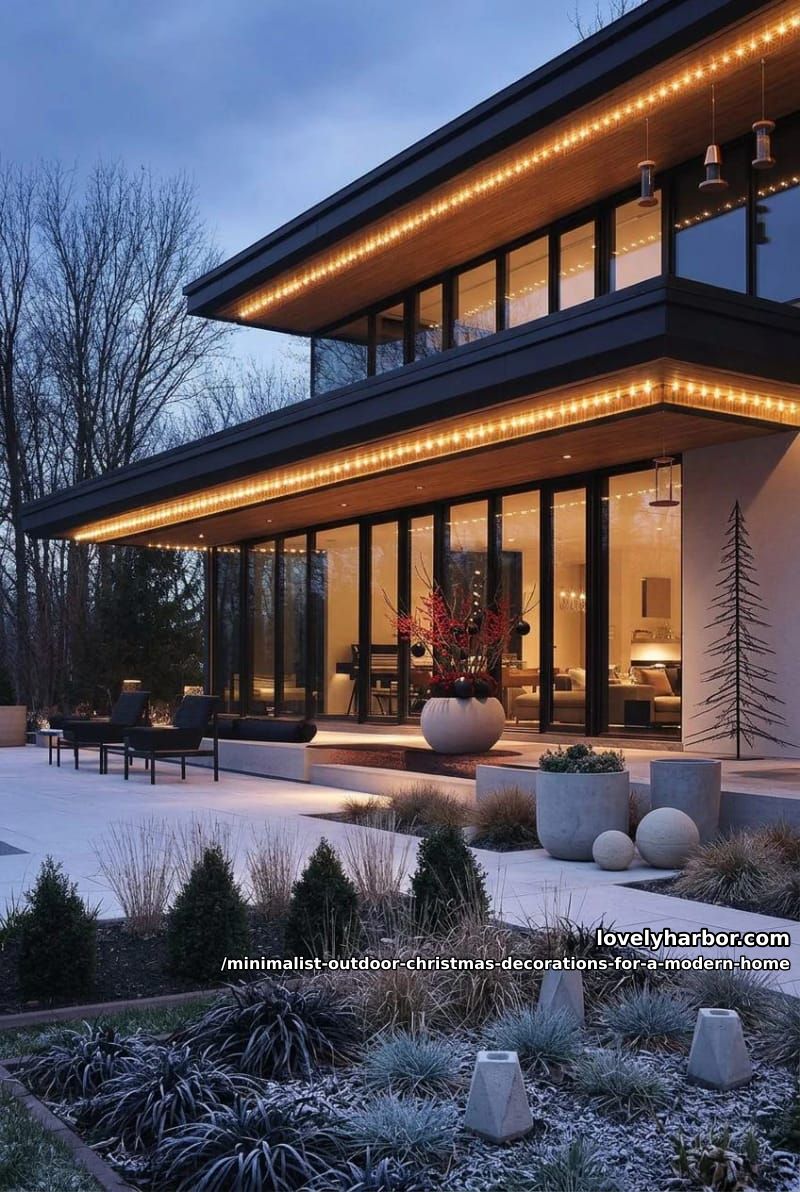
The houses that read as deliberate at night are the ones lighting the building and leaving the grass dark. A flat-roofed house with a clean parapet does not need its shrubs wrapped; it needs one continuous line tracing an edge the architecture already has.
Granted, this only works if you commit to a single white and run it consistently. The fastest way to make a restrained facade look cheap is to hang two strands that do not match, one creamy and one icy, because they came from different boxes two years apart.
Choose one white and do not mix it
Color temperature is measured in Kelvin, and the three families do genuinely different jobs. Warm white sits around 2700 to 3000K and reads golden and traditional, close to old incandescent minis. Pure or neutral white lands roughly 3500 to 4600K and looks clean without going blue. Cool white runs 5000 to 6500K and reads icy and bright from the street.
Here is the call I will defend: on a flat, hard-edged house, neutral white near 4000 to 4600K looks the most architectural, warm white reads cozy rather than contemporary, and cool white belongs on a storefront. I ran cool white for two seasons because I assumed bluer meant more modern. From the sidewalk my house looked like a closed office. Switching to a neutral white around 4600K was the single change that made it look lived in again.
Trace an edge the house already has
Run the light along one line and stop. The front roofline is the obvious one, but a single large window outlined cleanly, or the vertical of one column, can carry a whole facade on its own.
Use all-in-one shingle and gutter clips rather than staples. Staples pierce the wire jacket, and that is how a strand quietly dies in February. On brick or stucco, adhesive clips will not hold either; you want the kind that hook a shingle edge or the gutter lip.
Drop the wreath, or shrink it to a single line
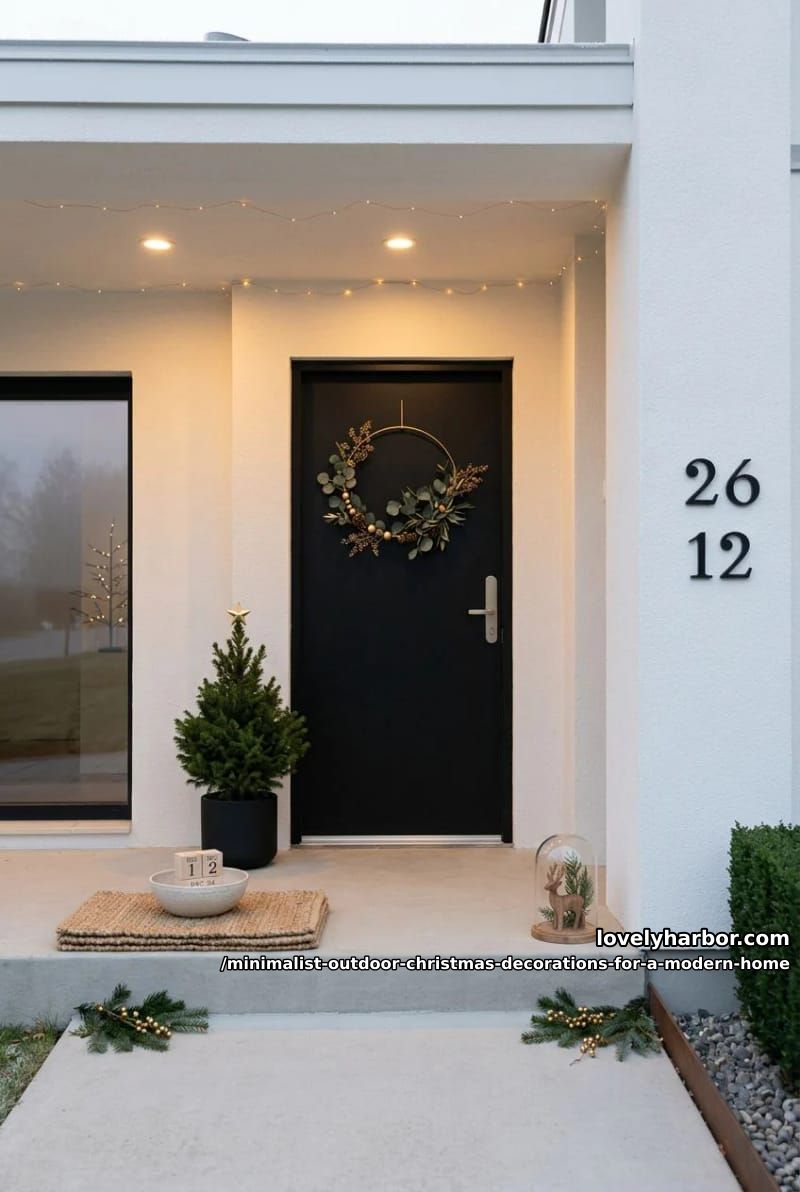
The most modern thing you can do to a front door in December is hang nothing on it, and the second most modern is to hang one spare gesture instead of a wreath. A dense fluffy ring with berries and a plaid bow fights a matte black door rather than finishing it.
Admittedly this is a matter of taste, and plenty of people will read a bare door as unfinished. The middle path is a single line: one thin brass hoop, or a loose bundle of olive or eucalyptus stems tied at one point and left to hang, more sculpture than wreath.
What one gesture looks like
A few that hold up:
- A plain brass or matte black metal ring, sixty centimeters or so, greenery tied to one arc and the rest left bare.
- A single lit birch or willow branch leaning in the corner of the porch, threaded with a few warm white micro lights.
- Eucalyptus and olive instead of pine. The grey-green is quieter against a dark door, and it dries without shedding everywhere.
- Or genuinely nothing, and let the potted tree below do the work.
Skip anything described as "flocked." Fake snow on a clean porch reads like a craft-store afterthought (your neighbors will not be fooled).
Let one potted evergreen carry the entry
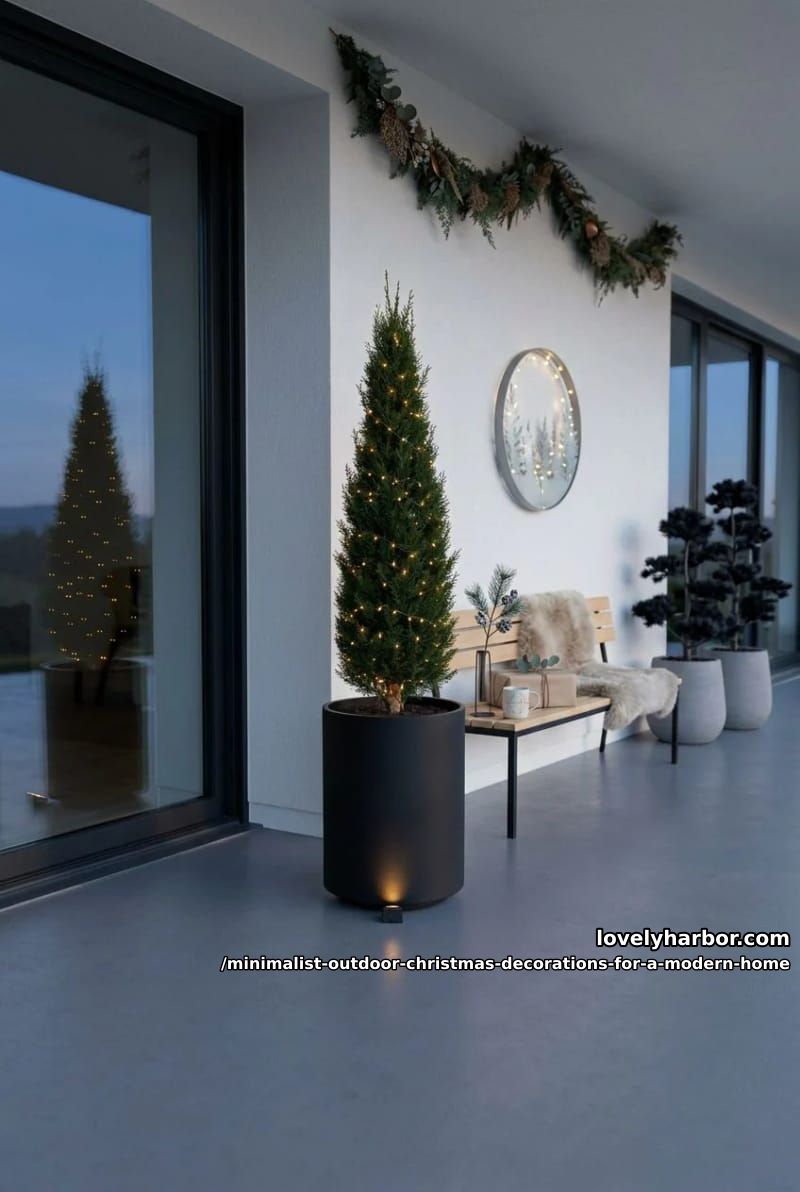
One good potted evergreen at the door does more than a porch full of decor, and it is the single piece most worth spending on. A slim conical spruce or a tight boxwood in a heavy planter gives you structure, green, and a place to put a little light, all in one object.
The planter is the actual decoration
Spend on the container, not the contents. A matte black powder-coated steel cylinder, raw concrete with its faint speckled grain, or a fiberstone pot in charcoal will outclass a plastic pot every winter and most of the rest of the year. Glossy ceramic is the one finish to skip; it catches light wrong and reads cheaper than it cost.
If you light it, light it from the base with one small warm or neutral uplight aimed up the trunk, or thread a single strand through the branches. Not both. A potted spruce wearing a full string-and-ornament treatment is just a small version of the maximalist tree you were trying to get away from.
Group a few lit orbs instead of dotting the yard with figures
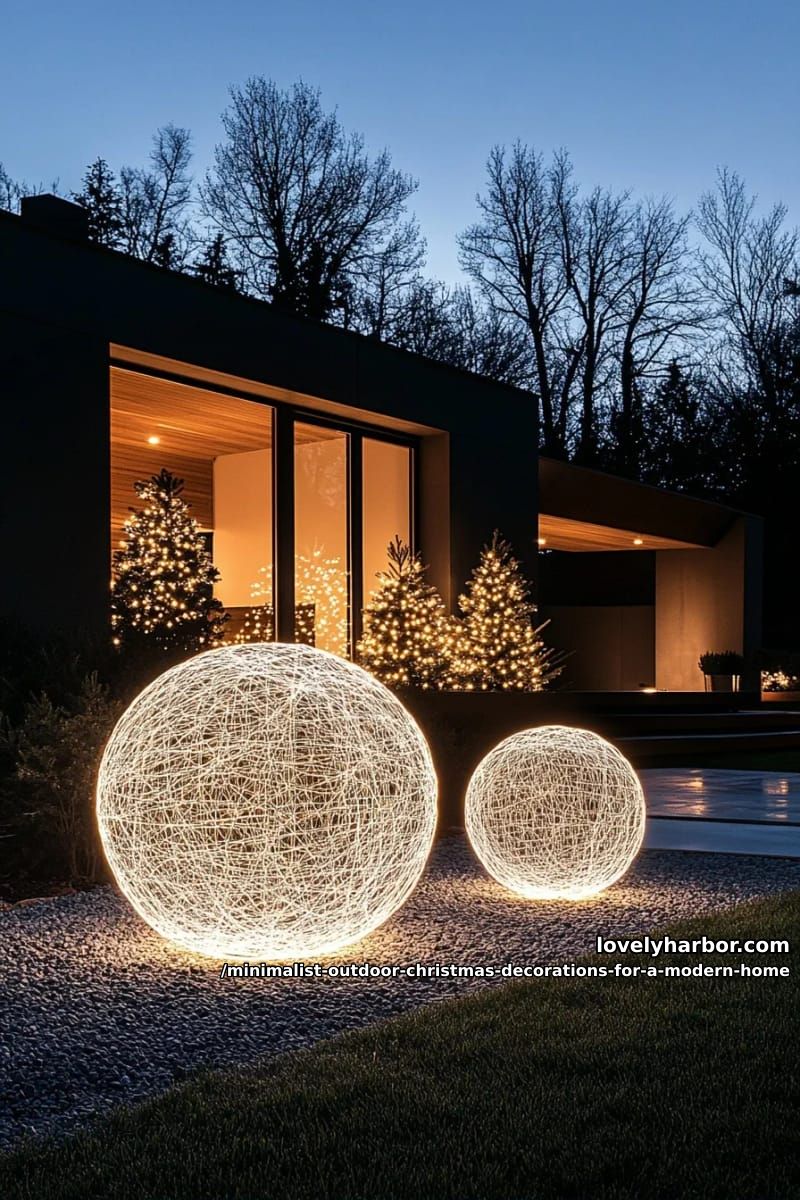
If you want something on the lawn, use three lit spheres clustered in one spot rather than objects scattered across the whole yard. Woven-wire LED orbs in warm white, in two or three diameters set close together, read as one sculptural moment instead of clutter.
Odd numbers and uneven heights do the work; line them up evenly and they look like merchandise on a shelf. Keep them in a single corner near the house so the rest of the lawn stays dark, which is what makes the cluster register at all.
Run the path lights on one straight rhythm
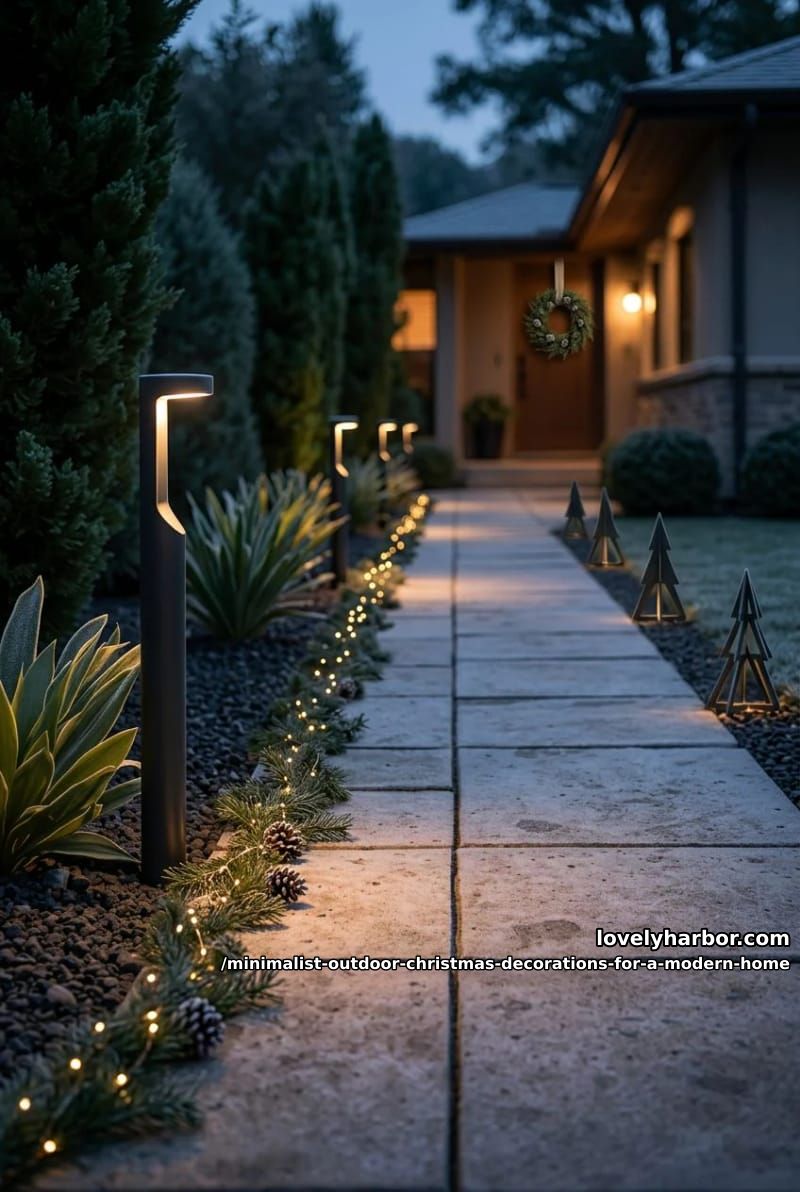
Path lighting works when every fixture is identical and evenly spaced, and falls apart the second you mix types. Pick one low bollard or one stake lantern in matte black and repeat it down a single side of the walk.
Even spacing matters more than the fixtures themselves. Roughly a metre to a metre and a half apart, all the same height, on one side, is enough; alternating sides or crowding them turns a clean path into a runway. Solar versions are fine if your walk gets real sun, but in December most do not, so a low-voltage wired set on the same timer as everything else is the safer bet.
Scale the whole thing down for a balcony or a rented porch
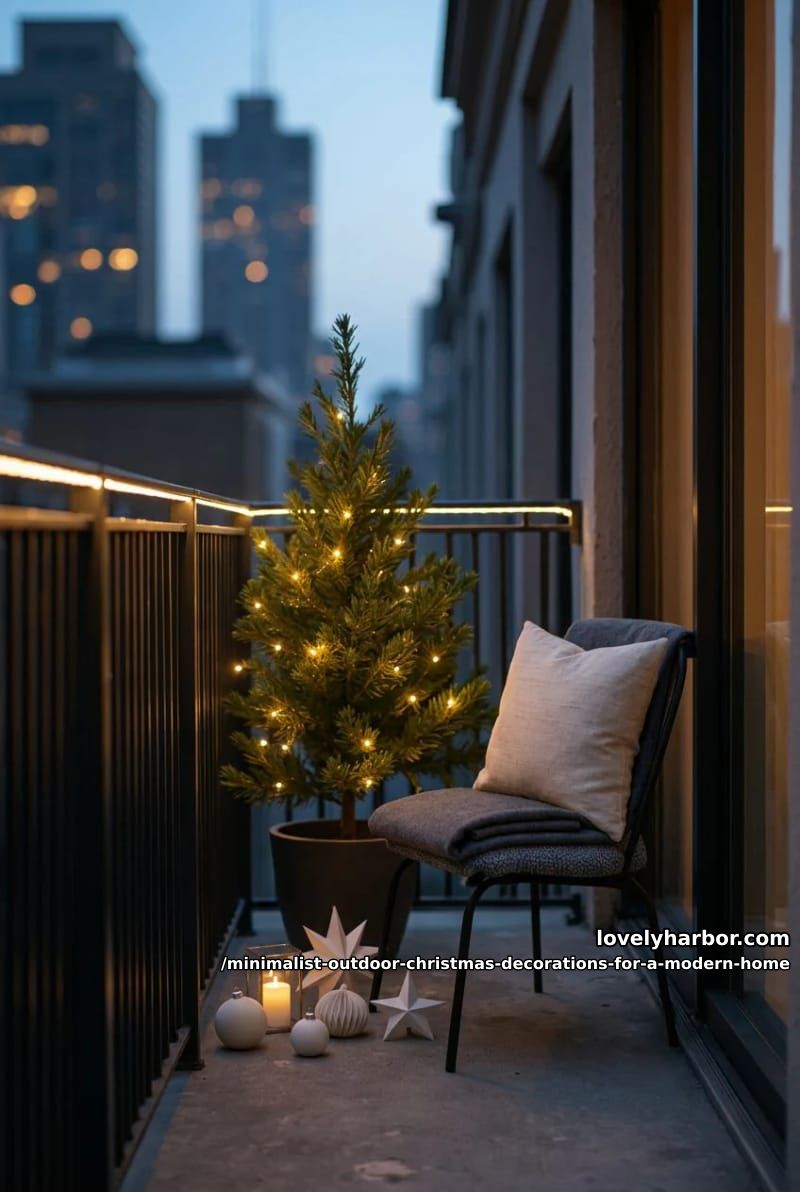
On a balcony or a rental, the minimalist approach is not a compromise, it is the only thing that fits, and it keeps you from losing your deposit. The same rules just shrink: one potted tree, one line of light, one palette, no drilling.
Hardware that does not leave marks
Clear adhesive outdoor light clips are the renter's friend. The Command outdoor version runs about ten dollars a pack, holds well below freezing, and peels off clean in January. Two things to know before you stick them: they bond to smooth surfaces like vinyl siding, finished wood, and glass, and they will not hold on brick, stucco, or rough concrete. Plan one clip roughly every two feet, and run the strand along the top rail only rather than wrapping every baluster.
One small tree, battery or solar
A tabletop potted evergreen around a metre tall, wrapped in battery warm white micro lights on a six-hour timer, covers most balconies on its own. No outlet, nothing screwed in. If you have one exterior outlet, a single low-wattage strand along the railing edge plus the tree is the whole display, and it looks intentional rather than apologetic.
Treat the cords and the timer as part of the design
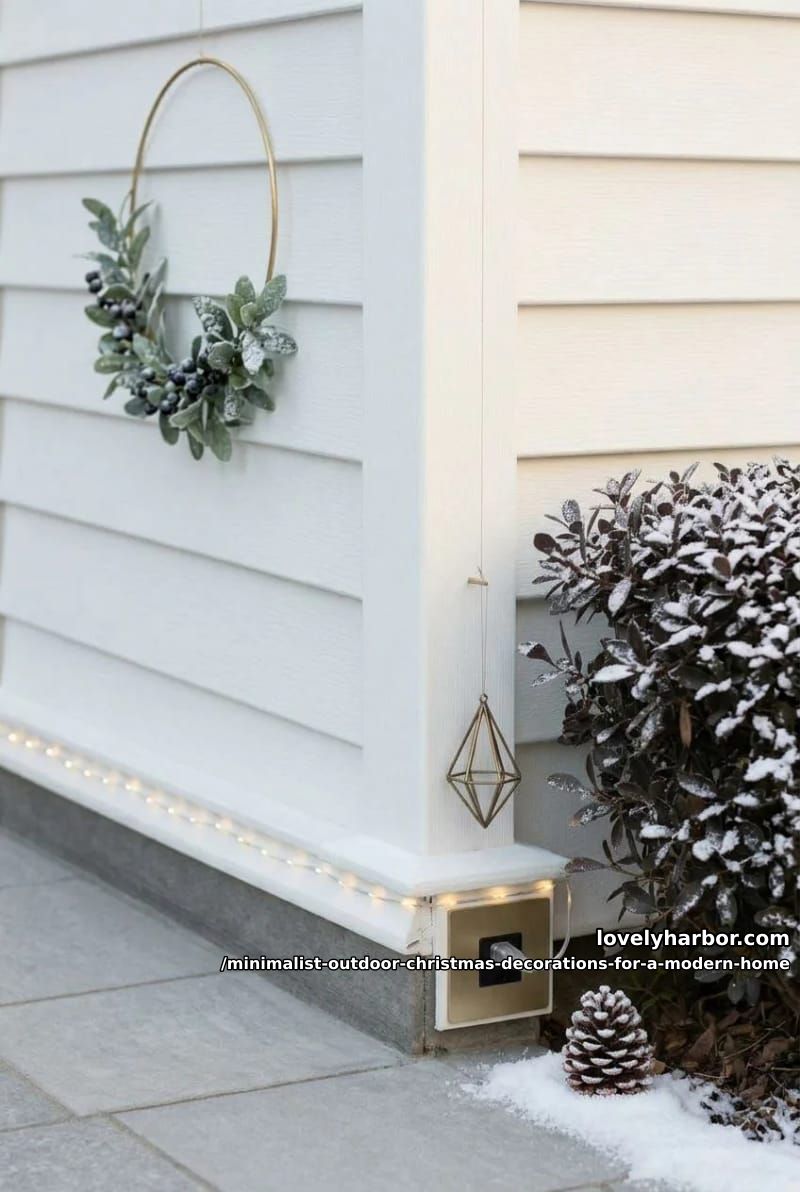
The thing that separates a minimalist display from a messy one is almost never the decorations; it is whether you can see the cords. An orange extension cable looping across grey stone steps undoes every careful choice above it.
Granted, nobody photographs their extension cords, which is exactly why most people ignore them. But on a restrained facade the wiring is visible precisely because there is so little else competing for the eye.
Match the cord to what it crosses
Buy cord in the color of the surface it runs along, not whatever was on the shelf:
- White flat cord along white trim, where it nearly vanishes.
- Green through a hedge or a planting bed.
- Black or brown across stone, soil, or dark cladding.
Clip it down every couple of feet so no slack pools on the ground, and route it along a line that already exists, a trim edge or a railing, rather than the shortest diagonal across an open surface.
One outdoor smart plug, set to dusk
Put everything on a single weatherproof timer and then leave it alone. An outdoor smart plug like the Kasa EP40, rated IP64 and built for the cold, costs around twenty dollars, carries two outlets, and switches on at sunset and off at a set hour using your phone's local sunrise and sunset times. Set it for dusk to about eleven and the display runs itself. Lights blazing at three in the morning is the other quiet tell of a display nobody is actually tending.
Conclusion
If you are building this from nothing, sequence it. Get the single white right first, because the temperature decision in the opening section changes how everything else reads, then add the one potted tree at the door, then sort the cords before you so much as look at the lawn. The orbs and the path lights are the last ten percent, and plenty of houses look finished without ever getting to them.
And resist the "just one more thing" that shows up around week three, which is how a minimalist plan quietly turns into an ordinary cluttered one by Christmas Eve. The second wreath, the lawn figures, the impulse strand from the hardware-store endcap: each seems harmless on its own. If you already added them last year, take the cool-white strand down first.