
Drive any decent street the week before Christmas and you can tell exactly which house the kids in the back seat turn their heads for, and it is never the one with the most lights. It is the one where something moves: a snowman rotating on his base, a Grinch lowering a candy-cane helicopter onto the grass, a roofline of pixels chasing a beat. Static displays are wallpaper; motion is what taps the brakes of a passing car. What follows are seven ways to put real animation in an outdoor display, from the inflatable half the block already owns to a projection rig that turns a whole garage into a screen, plus the electrical math that decides whether any of it survives past 9 p.m.

1. Animated inflatables earn their spot, but only the ones that move
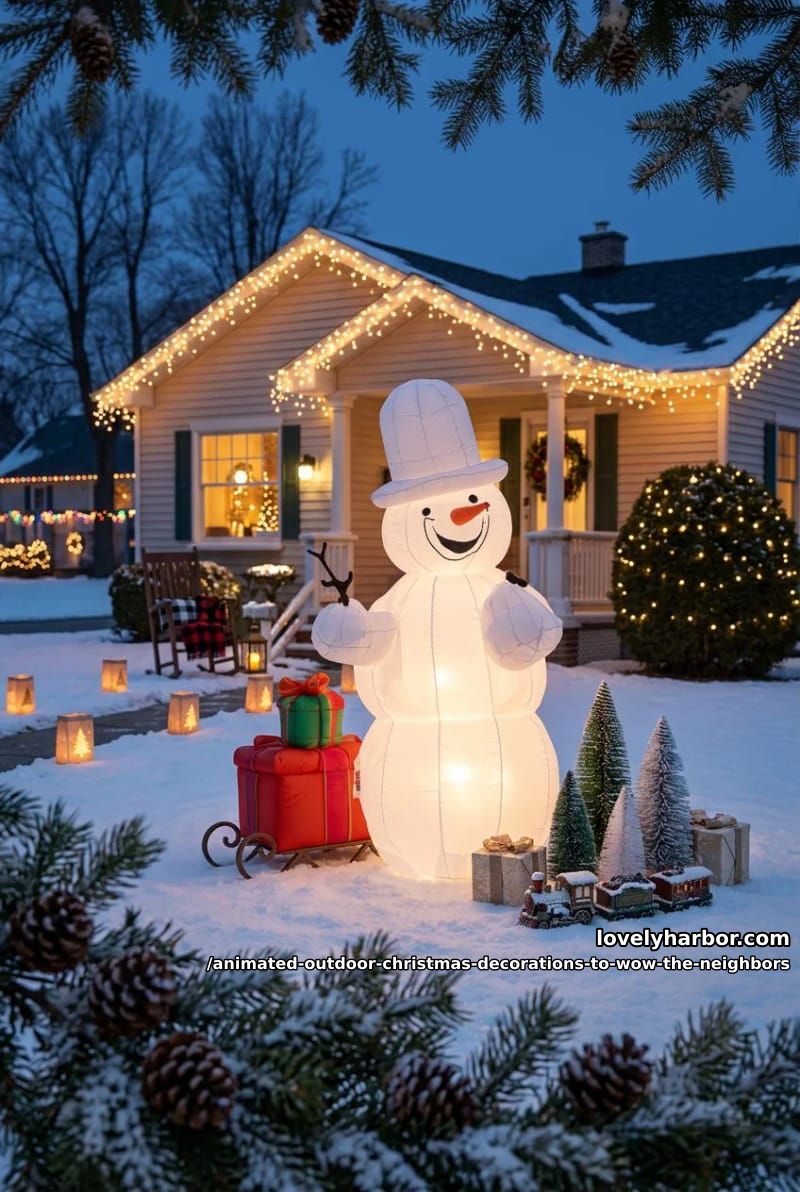
Buy for motion, not height. A static twelve-foot Santa is a billboard; an eight-foot snowman that pivots left and right, or a Grinch whose helicopter blade actually spins, is the one people point at. The animated tier costs a little more and the moving parts are the first thing to fail, so this is the rare case where the brand-name Gemmy-style units are worth it over the no-name import that seizes up after a week of cold.
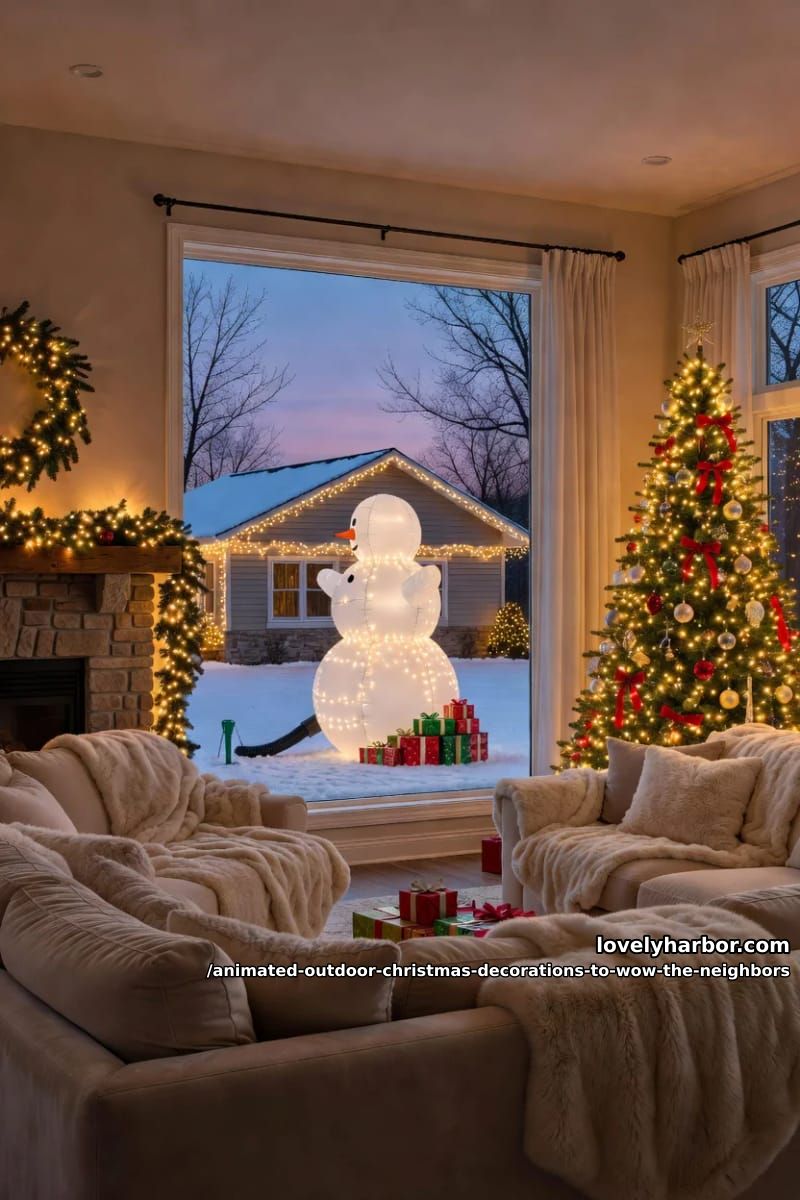
Stake it like you expect weather, because you will get weather
The classic failure is the deflated nylon heap on the lawn at 7 a.m. Inflatables ship with flimsy plastic stakes and a couple of guy lines; throw those in a drawer and anchor with steel stakes plus the included water-bag weights, and add your own tie-downs at the base. The blower runs continuously and pulls roughly 300 watts on its own, which matters later when you do the wattage tally.
2. Motion projectors do the work of a thousand bulbs
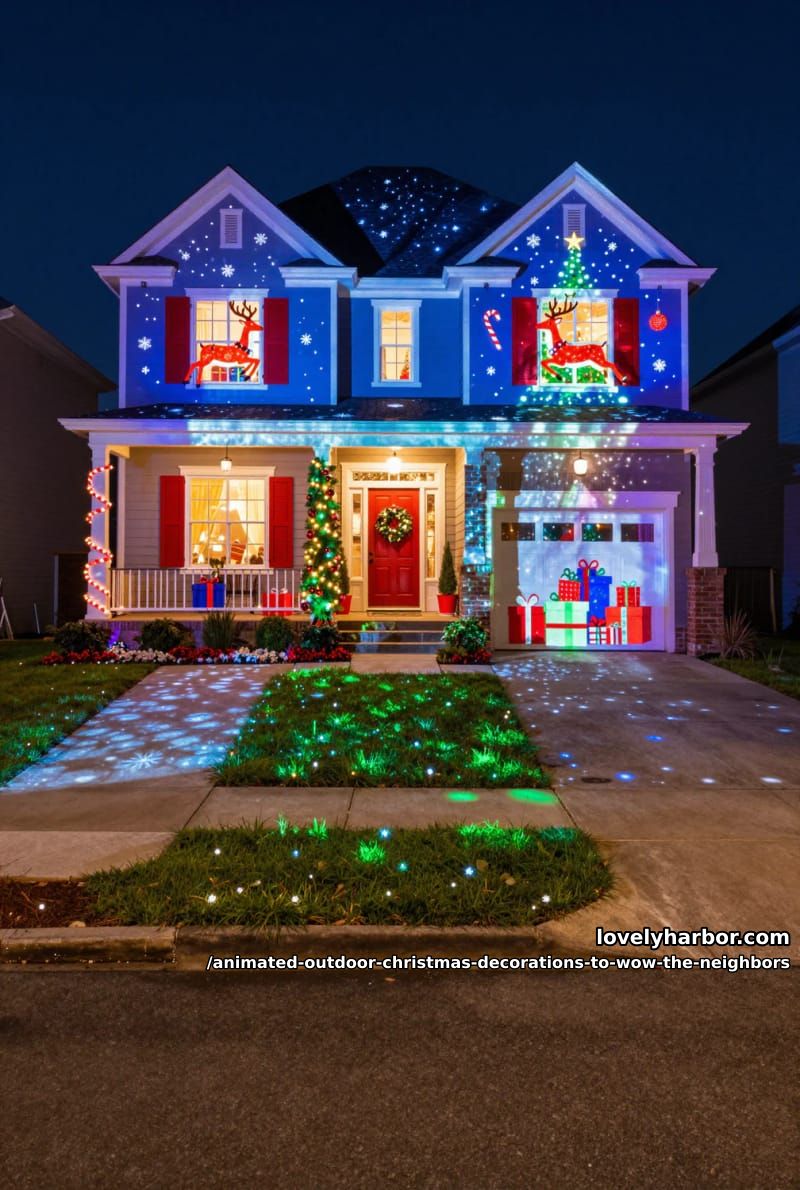
For coverage per dollar, nothing beats a projector. One unit staked in the flower bed throws drifting snowflakes or dancing dots across an entire two-story facade, draws under a quarter a month in electricity, and goes up in the time it takes to push a stake into soft ground. This is the move for anyone who hates ladders.
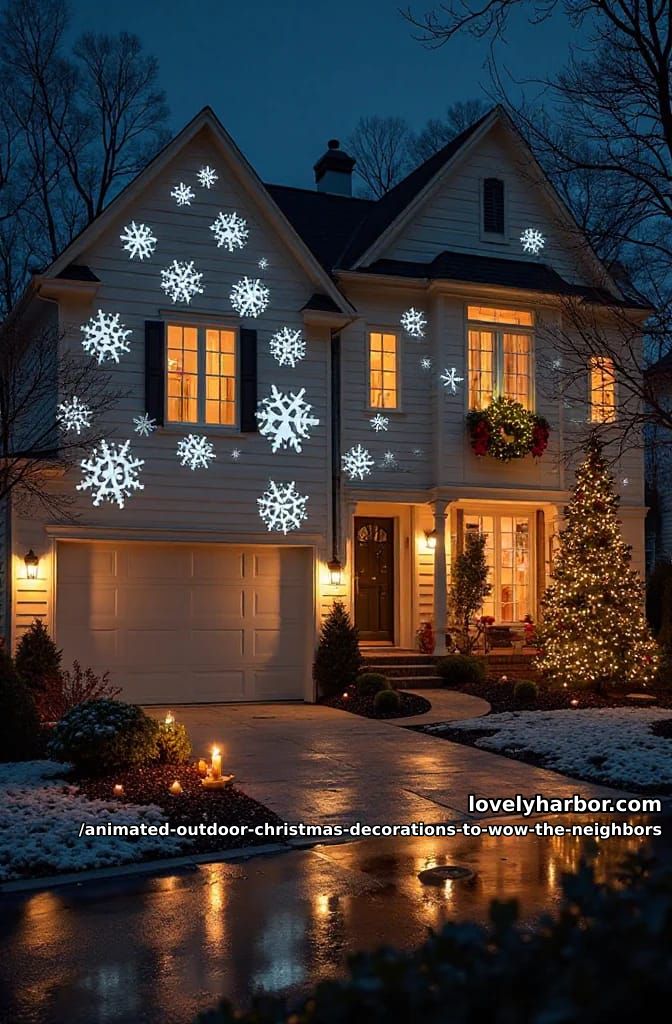
Laser and LED do different jobs: laser throws thousands of sharp pinpoints that read crisply on siding and foliage and cuts through ambient light, while an LED gobo projector casts broader, softer color and detailed shapes like a "Merry Christmas" in script. Plenty of people run one of each. Two rules keep it neighborly and legal: aim the beam below the windows and away from the road so you are not flashing drivers, and stake the unit on a short steel cable if your block has a resident Grinch, because ground-level projectors walk off.
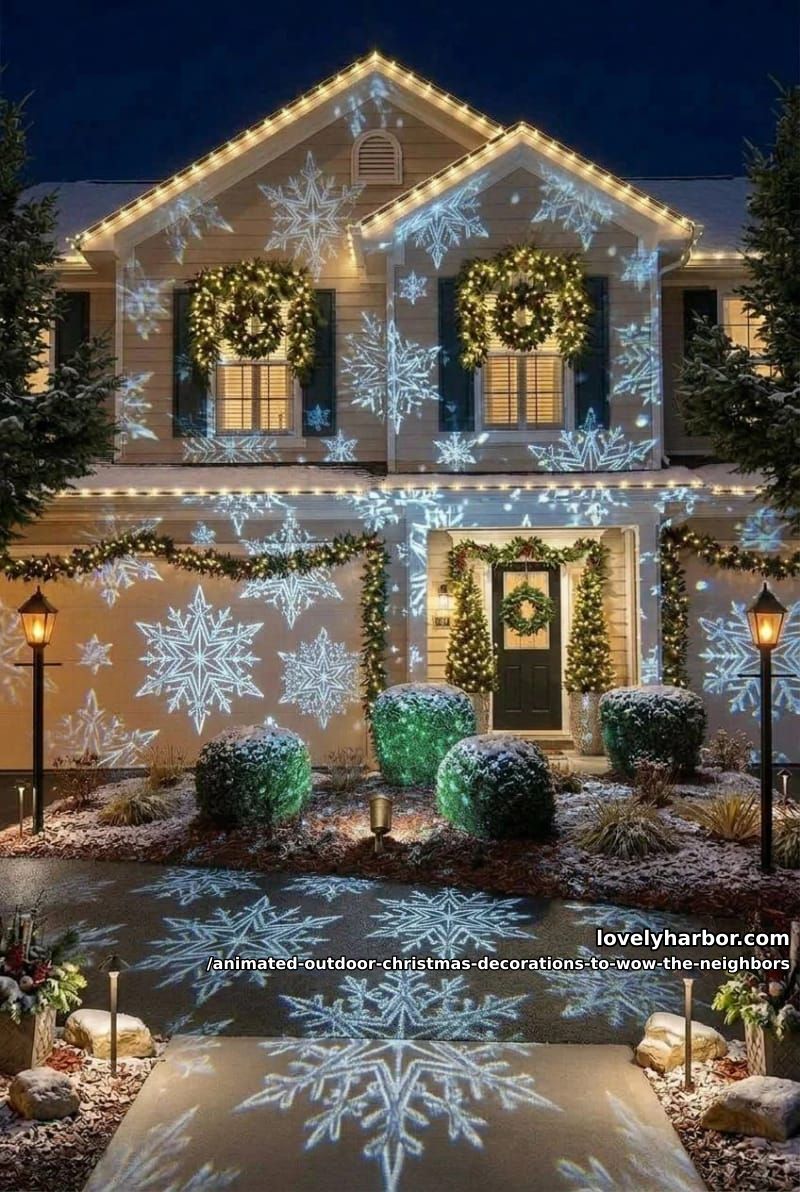
3. Music-synced pixel displays are the arms race the block didn't ask for
This is the ceiling of the hobby, the house that ends up on the local news. Individually addressable RGB pixels outline the roof, windows, and yard props, and a controller fires each node to a choreographed sequence timed to a song; done well, the whole facade looks like it is breathing in time with the music. It is also a genuine commitment, so go in with eyes open.
The software is free; your weekends are the real cost
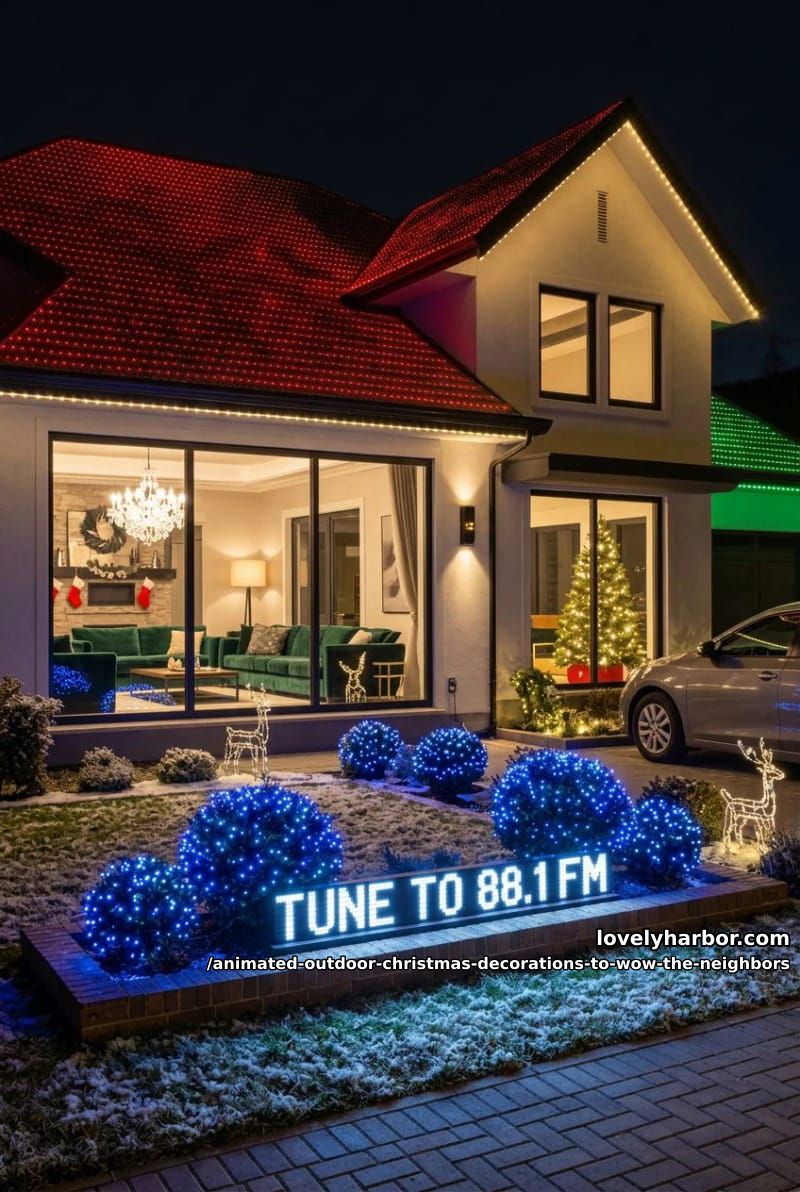
xLights is the free, open-source program most people use; it grew out of Light-O-Rama’s old sequence editor, runs on Windows, Mac, and Linux, and drives cheap ESP32-based controllers over standard protocols. The catch is labor. Experienced builders spend something like three to five hours of sequencing per minute of music, so a single ninety-second song is a few weekends before you have hung a single pixel. Most people buy a couple of pre-made sequences for their first year and learn the editor on the side.
Hand the sound to car radios, not a speaker
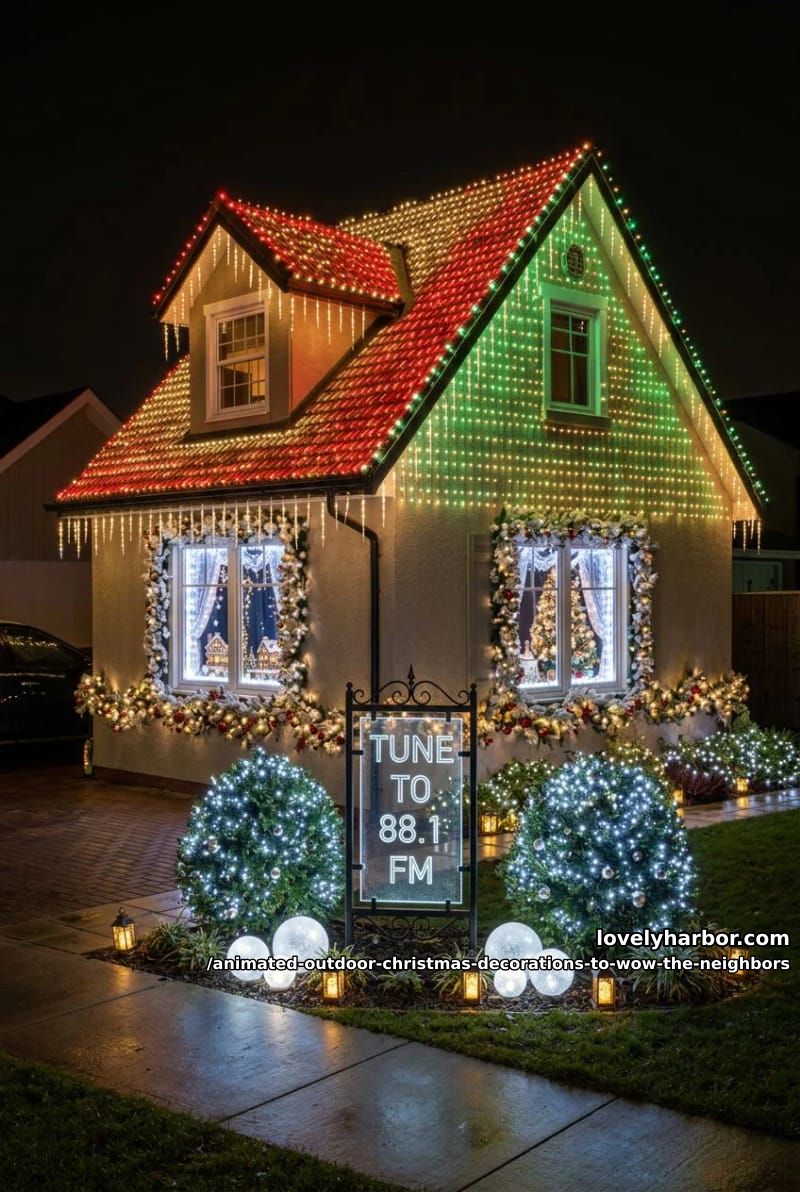
Outdoor speakers blasting “Carol of the Bells” on a loop are how a beloved display becomes a noise complaint. The fix is a low-power FM transmitter and a “tune your radio to ___” sign at the curb, so people hear the show from inside their own cars. The Whole House FM Transmitter 3.0 is the common pick, FCC-approved with a listed ID and roughly 100 feet of range, which covers most front yards out to the street. Stay with a Part 15 compliant unit; the overpowered “long range” boxes float around online, and running an unlicensed station can draw FCC fines that start in the five figures.
4. Sequenced LED motifs make reindeer leap across the lawn
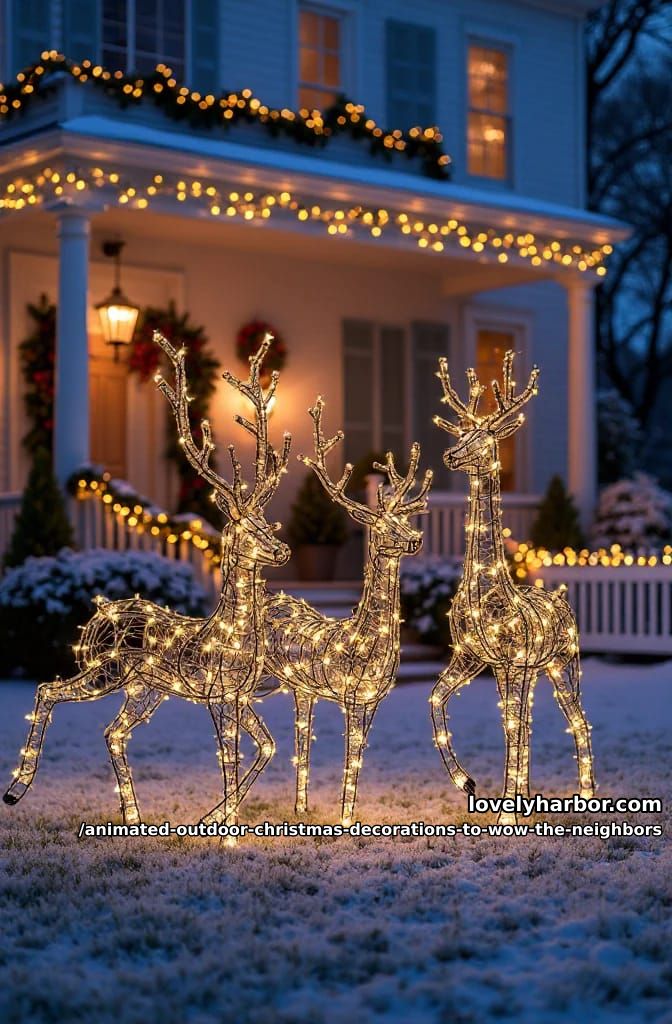
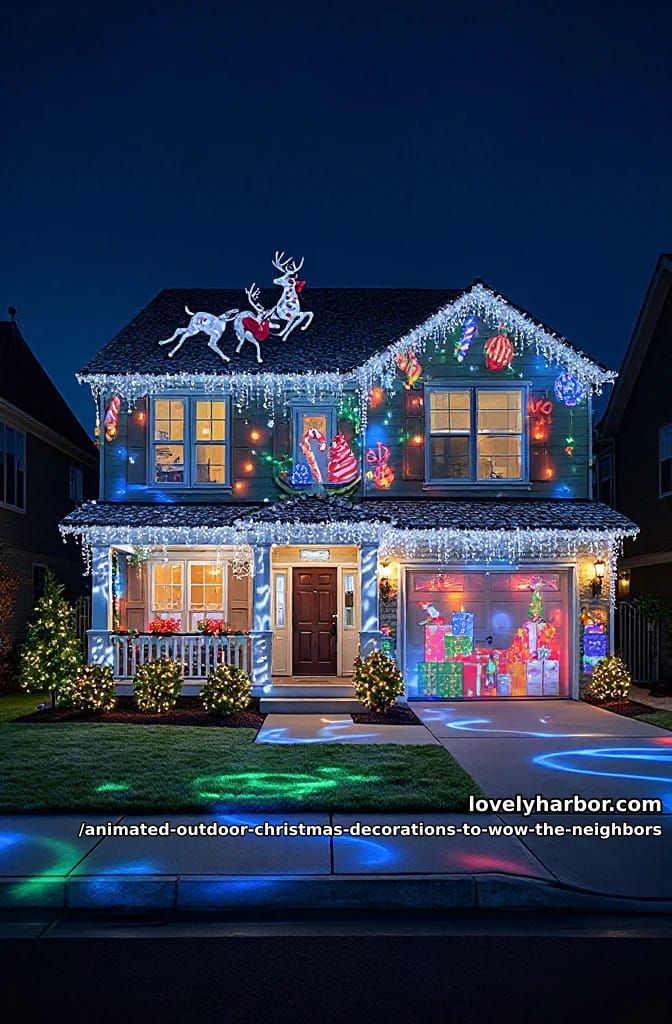
Wireframe motifs fake motion without any moving parts. A set of three or four steel-frame deer wired so they light in sequence reads, from the street, as one animal bounding across the yard; the trick is staggered timing, not mechanics. Skip the floppy plastic versions and buy welded steel tube frames rated IP44, which hold their shape under snow load and survive being stepped on during teardown. Warm white reads classic and a little frosted against snow; cool white and color shift the whole thing toward carnival, which may be the point.
5. Animatronic figures that sing, wave, and unsettle the mail carrier

Animatronics bring the motion-plus-sound combo that nothing else on this list quite matches: a sensor-tripped Santa that turns his head and sings two carols, a drumming bear, a waddling licensed character. They are also, almost universally, indoor-rated. The polyresin and exposed motors hate freeze-thaw and UV, so the porch under a roof is where they belong, not out on open grass. I used to wave people off these as gimmicks; then I watched a four-foot singing figure stop every stroller on a block, and revised my snobbery.
Animated decor stacks loads fast: an inflatable blower near 300 watts, a laser projector around 200, a motor figure, and then the lights. A standard 15-amp outdoor circuit tops out at 1,800 watts and you should stay under 1,440 (the 80 percent rule), so two big pieces and a few light strings can put you over before you notice. Tally every device, split the display across separate GFCI circuits, and use only WR or SJTW outdoor cords in 14- or 12-gauge for longer runs. Outdoor receptacles must stay GFCI-protected per code; if yours trips nightly, that is the protection working, not a reason to bypass it.
6. One moving hero beats a yard full of twitching everything
Restraint is the single biggest difference between a display people photograph and one they squint at. A yard with six animated props all going at once does not read as abundance; it reads as a clearance sale, because the eye has nowhere to land. Pick one moving focal point, the inflatable or the leaping motif or the projected scene, and let everything else hold perfectly still around it. The motion only registers as special when most of the frame is calm.
Compose for the windshield, not the doormat
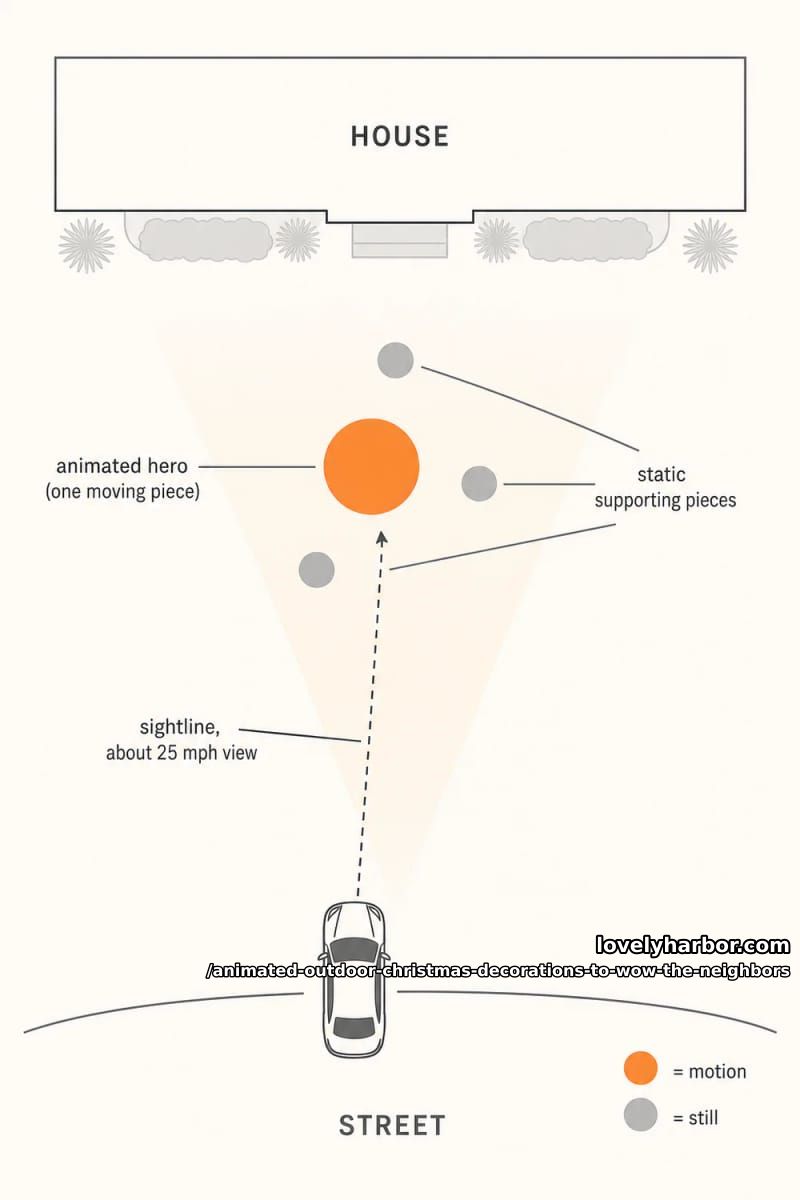
Most people will see your yard for about four seconds, from an angle, at twenty-five miles an hour. So place the animation where the street actually looks, not tucked by the front door where only someone climbing the porch catches it move. Knock the static pieces down a notch in brightness so the moving thing wins the contrast; a hero that is also the brightest object is doing two jobs at once. And put the whole display on a timer, because nothing says "forgot about it" like a snowman pirouetting alone at 2 a.m.
Do this
- Choose one animated hero and build the static pieces around it.
- Aim the motion at the street sightline, where cars slow.
- Dim the supporting decor so the moving piece reads as the star.
Avoid
- Six animated props competing in the same yard.
- Burying the animatronic where only the porch sees it.
- Matching every brightness, so nothing stands out.
7. Projection-mapped scenes turn the whole facade into the show
This is the newest swing, and the one that genuinely surprises people, because it is animation without a single physical prop on the lawn. A projector plays a looping video of moving characters or falling snow onto a window or the garage door, and from the street the house itself appears alive.
Start in a window before you map the whole house
The easy entry is a “living window”: a translucent rear-projection screen taped behind the glass, a projector six to eight feet back inside the room, and a video file of holiday characters moving through the scene. AtmosFX Christmas decorations are the standard library for this, and they sell the bundled kits if you do not want to source a projector separately.
Full-facade mapping needs real brightness
Throwing video across the entire front of the house is the bigger project, and here is where most attempts disappoint: the $30 mini LED projector is far too dim, washing out the second your own string lights come on, with an obvious screen-door grid once the image fills a wall. You want a short-throw 1080p unit, and you want the surrounding area dark so the projection has contrast to fight for. AtmosFX rates its kit projector at 300 LED lumens, which sounds low next to the inflated numbers on cheap boxes but holds an image far better, a reminder that the lumen spec on a $40 projector is mostly fiction.
A first animated yard, roughly $150 to $250
One hero, one wash of coverage, and the parts that keep it lit.
You do not need the pixel rig to get the reaction. A single animated inflatable as the hero, a motion projector to cover the facade, and the unglamorous power pieces will read from the street as a deliberate display, not a starter kit.
Shopping list
| Qty | Item | Spec | Price |
|---|---|---|---|
| 1 | Animated inflatable | 8 ft, rotating or moving element, internal LEDs | $70 to $120 |
| 1 | Motion projector | IP65 laser or LED gobo, remote and timer | $30 to $70 |
| 1 | Outdoor extension cord | WR-rated, 14 AWG, ~25 ft | $20 to $35 |
| 1 | Outdoor timer | Weatherproof, mechanical or Wi-Fi | $10 to $20 |
| Total | $130 to $245 | ||
Prices are approximate ranges as of mid-2026; verify before purchase.
| Approach | Setup effort | Power draw | Weather resilience | Street impact |
|---|---|---|---|---|
| Animated inflatable | Low | High (blower ~300W) | Good if anchored | High |
| Motion projector | Very low | Low to medium | Good (IP65) | Medium to high |
| Pixel show | Very high | Medium | Good | Highest |
| Sequenced LED motif | Low | Low | Good (steel frame) | Medium |
| Animatronic figure | Low | Low to medium | Poor outdoors; keep covered | Medium |
| Projection mapping | Medium to high | Low | Projector must stay dry | High in the dark |
Conclusion
If you are starting from a dark lawn, sequence it like this: one animated hero first, then the honest wattage tally, then a projector for cheap facade coverage, and only after all that the pixel arms race in whatever year you have the weekends to give it. The hero plus correct circuits is most of the reaction for a fraction of the effort, and skipping the wattage step is how the whole thing goes dark on the first cold, damp night.
One last thing that has nothing to do with lights: the fastest way to turn a display people love into the block's grievance is sound. Keep the singing animatronic on a timer, send your music to car radios through a low-power transmitter instead of a speaker, and the neighbors filming your yard stay the ones who aren't leaving notes. Even then, somebody on your street will quietly prefer the house with three strands of warm white and nothing that moves, which is its own kind of correct.