
Most Christmas porch advice is written for a four-foot stoop, which is why it falls apart the moment you have real square footage to fill: a single wreath and a doormat that looked complete on a small entry just read as bare across thirty feet of railing and a deep covered porch. The actual problems with a large porch are scale (small pieces vanish), span (the far ends sag while everyone crowds the door), and cost (you need more of everything, and it adds up fast). The eleven ideas below are organized around those three, with the garland math, the corner-anchoring call most people get wrong, and the one zone almost nobody uses.

1. Flank the door with oversized planters, not a lonely wreath
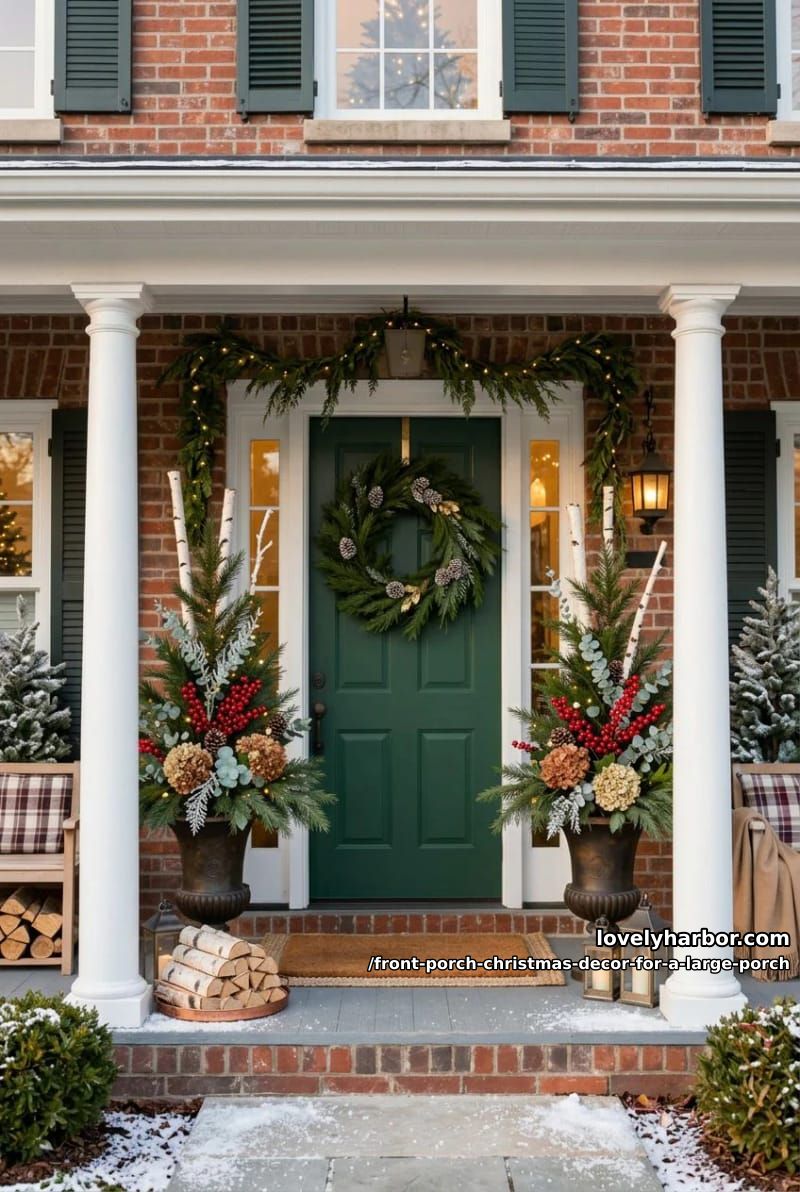
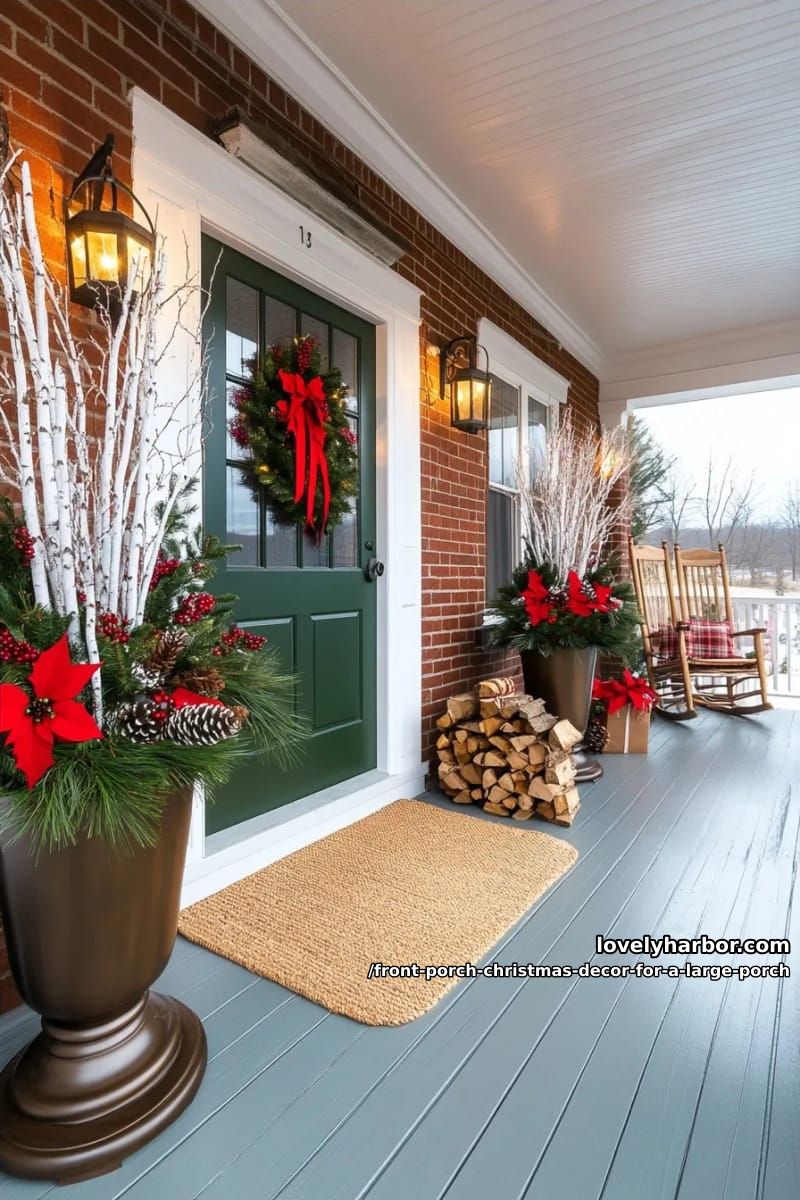
Start with a matched pair of oversized planters, one on each side of the door, built taller and fuller than feels reasonable indoors. On a large porch the planter itself has to register from the street, so a 24-inch urn that looks generous in the store reads small once it is sitting under an eight-foot ceiling beside a wide door. Go to 28 or 30 inches at the base and let the greenery rise five to six feet, mixing birch poles for height with cedar, fir, eucalyptus, and a little magnolia for texture instead of one flat material.
The version I used to recommend, a tidy foam cone wrapped in faux garland, looks like a hotel lobby and I stopped suggesting it years ago. Real or faux both work outdoors if you commit to fullness; what kills the look is a thin, sparse arrangement trying to cover too much vertical space.
2. Run continuous garland and do the math before you buy
Measure the full run of your railing, then multiply by 1.5 for a relaxed swag or by 2 for deep, dramatic loops, because a large porch swallows garland faster than almost anyone budgets for. A straight, taut drape that just spans the railing always looks flat and stingy; the slack is what makes it read full. For the door header, decorators typically use around 24 feet cut into two pieces tied at the center so each side cascades down toward the floor, separate from whatever the railing needs.
Cost is the real constraint here. A 9-foot faux pre-lit garland runs roughly $25 to $45, so a 40-foot railing done with swags is four to seven strands, easily $150 to $300 before you touch the columns. Fresh cedar or fir garland smells like the actual holiday and costs less per foot, but it sheds and browns within two to three weeks outdoors, so I only buy fresh if the party is early and I plan to swap it.
| Railing run | Relaxed swag (×1.5) | Deep swag (×2) | Approx. 9-ft strands |
|---|---|---|---|
| 12 ft | ~18 ft | ~24 ft | 2 to 3 |
| 20 ft | ~30 ft | ~40 ft | 4 to 5 |
| 30 ft | ~45 ft | ~60 ft | 5 to 7 |
| 40 ft | ~60 ft | ~80 ft | 7 to 9 |
3. Hang oversized ornaments from the ceiling at staggered heights
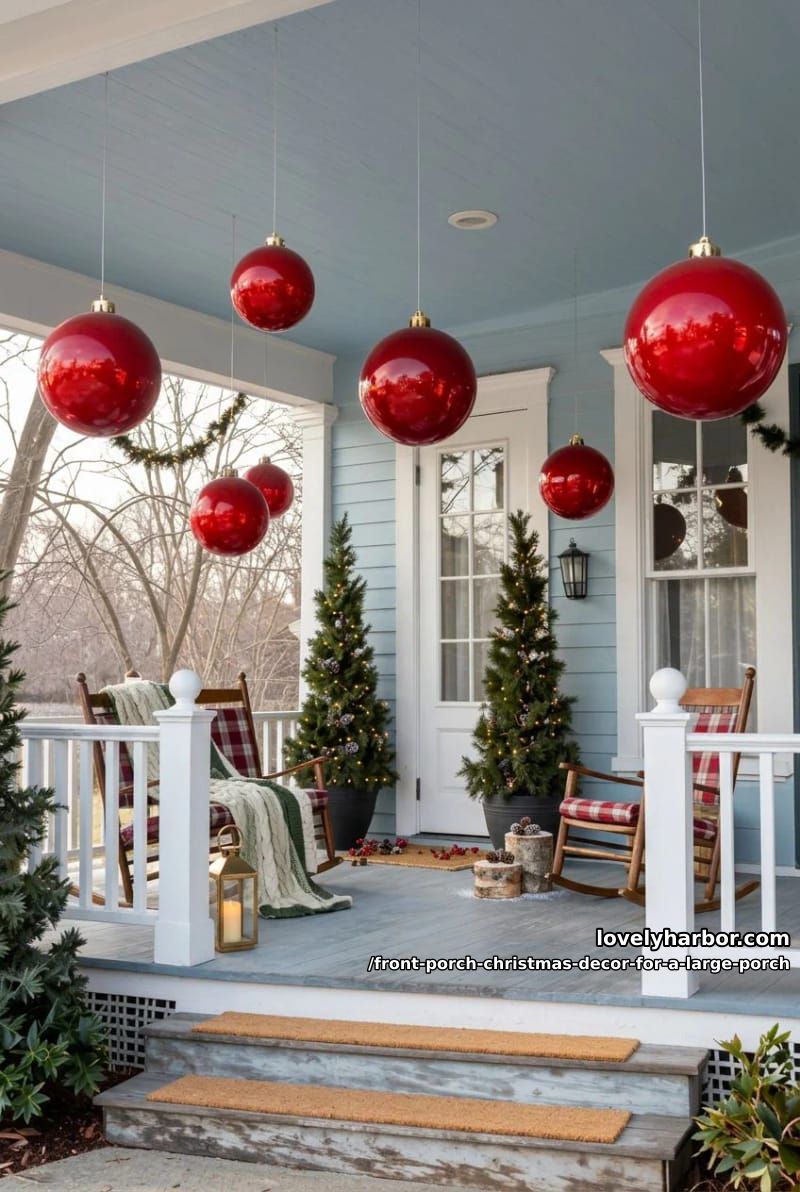
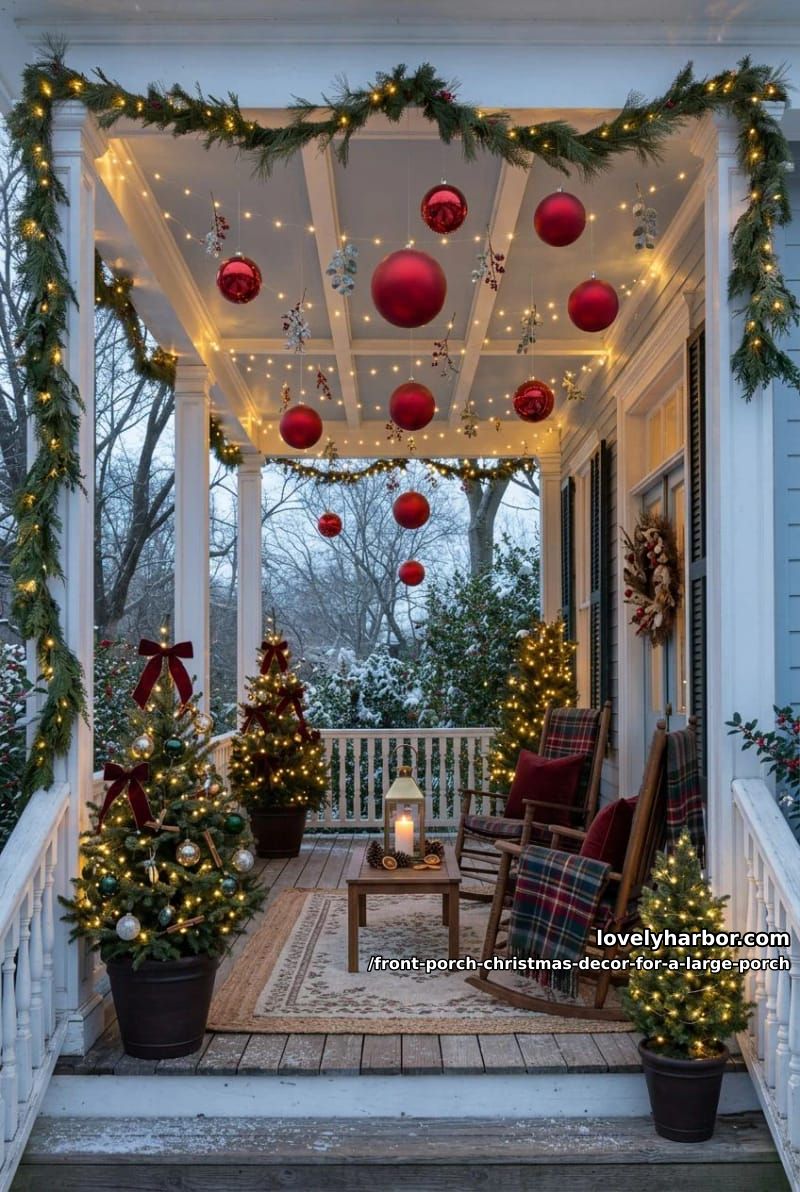
Use the ceiling, which is the one surface a large covered porch has in abundance and a small one does not. Suspend shatterproof balls in the 6 to 12 inch range from the beams or ceiling on clear fishing line at staggered heights, so they read as a floating cluster rather than a flat row. A standard 3-inch tree ornament is invisible out here; the whole point is going big enough that the scale matches the space.
One color in mixed finishes (matte, glossy, glitter) looks deliberate; a rainbow assortment looks like the clearance bin. Cluster odd numbers, vary the drop length by at least a foot between balls, and tie off to cup hooks you can leave in year-round.
Shatterproof and UV-treated so they survive wind and a season of sun without fading or cracking, in 6 and 8 inch sizes that actually register on a big porch.

4. Carve out a real seating zone with the porch's depth
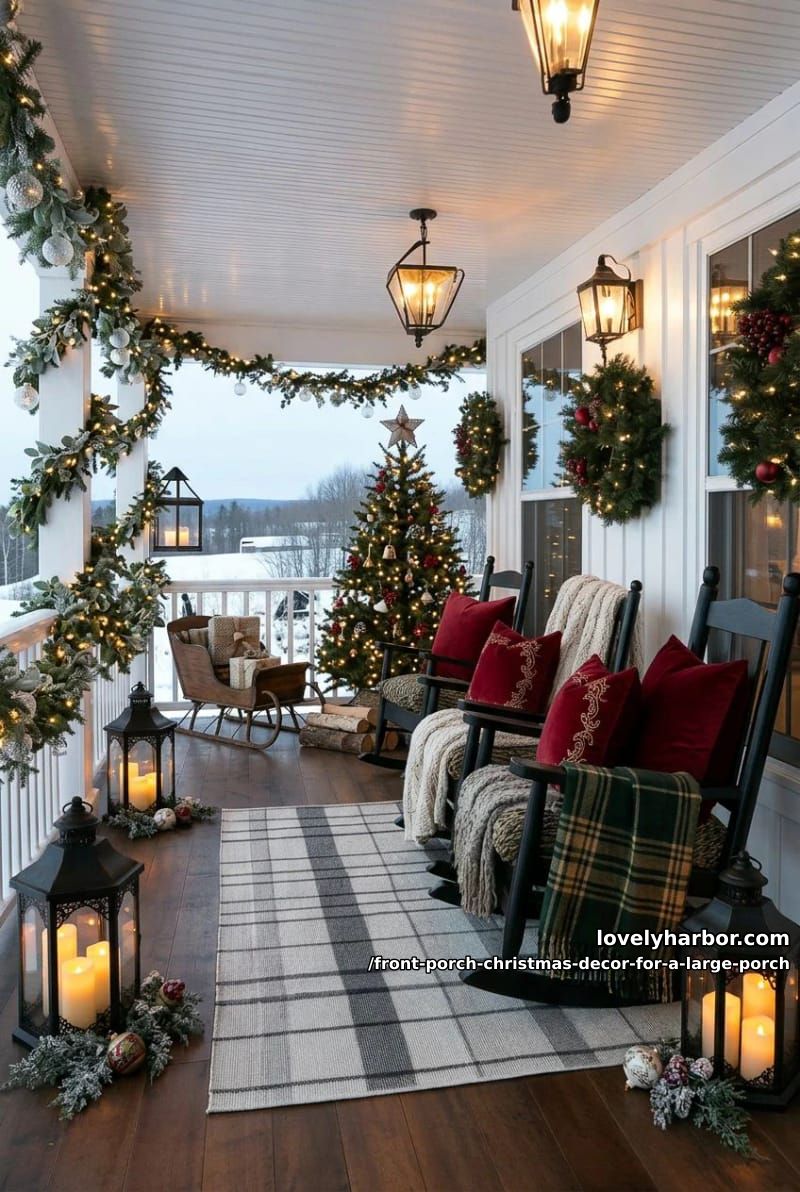
The thing a large porch can do that a stoop physically cannot is hold an entire furniture grouping, and most people leave that space empty while piling everything at the door. Define a seating zone with an outdoor rug (a 5×8 or 6×9 in weatherproof polypropylene draws the boundary), add two chairs or a bench, fold a couple of wool-blend throws over the arms, and set a small lit tree and a lantern or two in the corner. The rug is what makes it look intentional instead of like patio furniture that nobody moved.
People email me asking why their porch still looks sparse when they bought "so much stuff." Almost every time, the stuff is jammed into the six feet around the door and the other two hundred square feet are bare. A seating vignette is the fix that also gives you somewhere to drink your coffee in December.
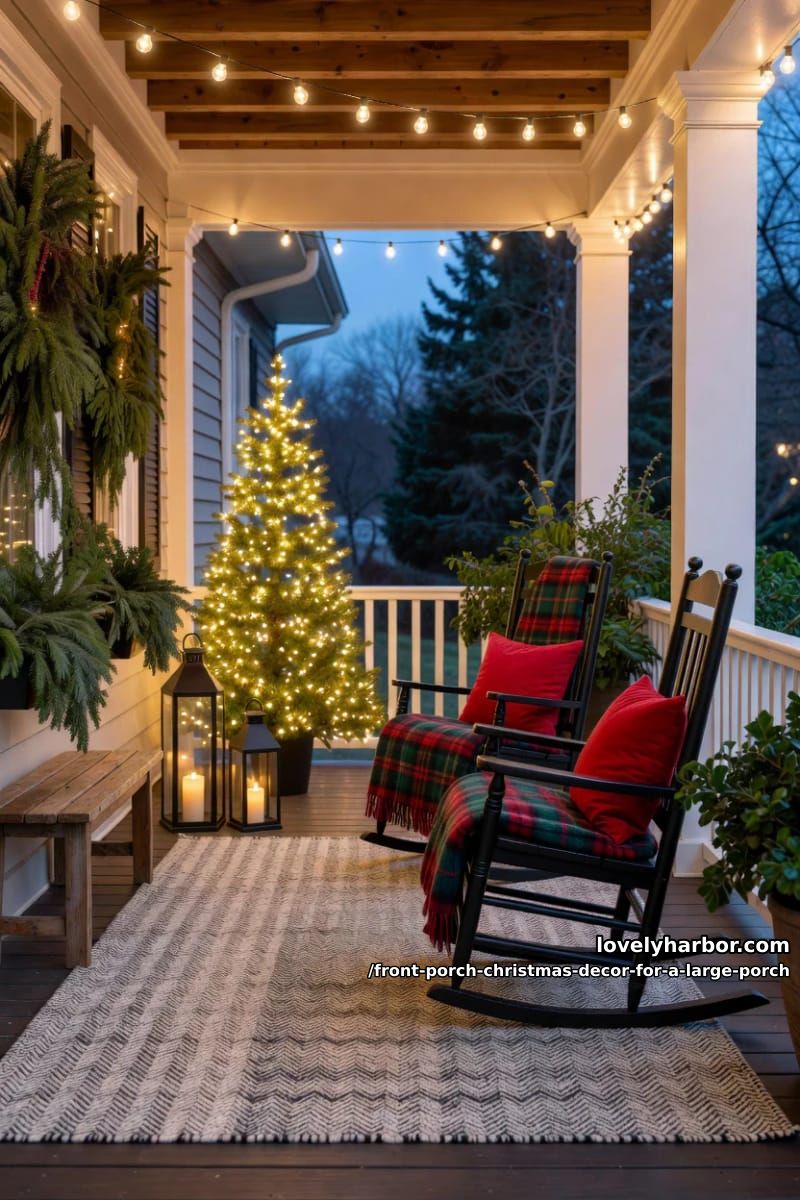
5. Anchor the far corners, not just the door
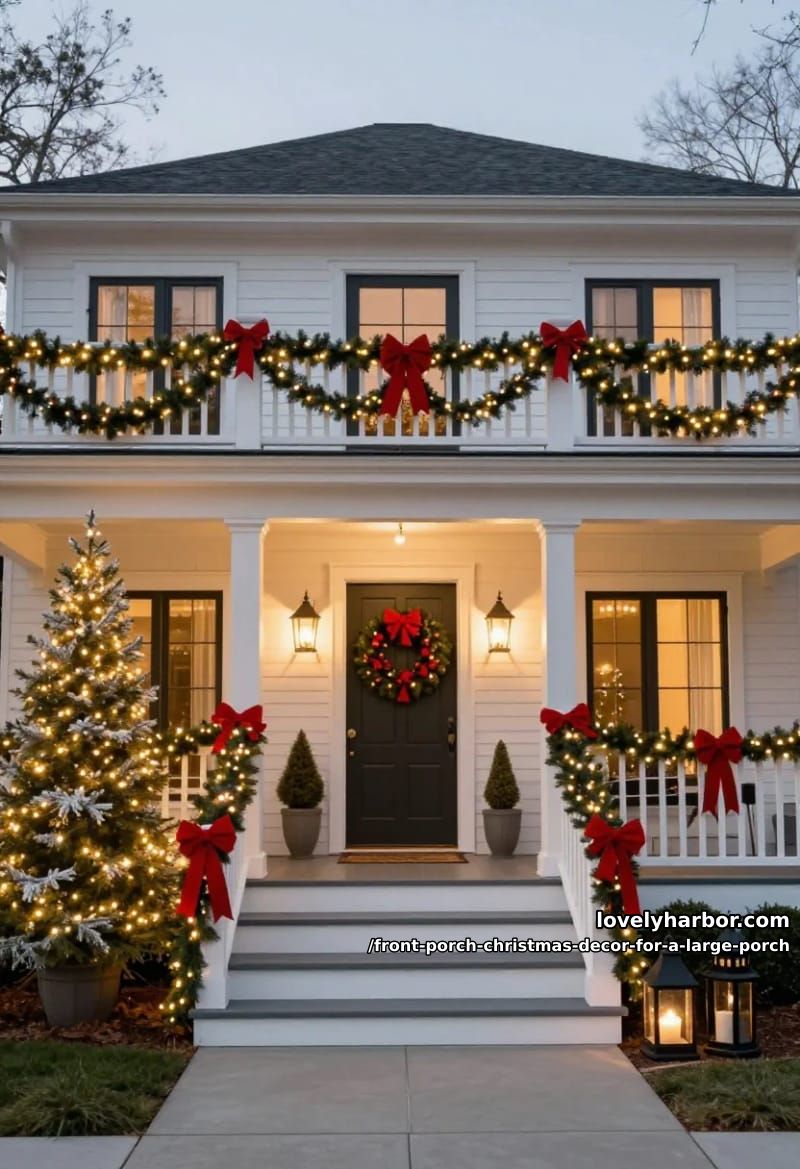
On a wide porch, weight the two far corners with something tall and lit before you touch the center, then let the door arrangement be the quietest part. A display built outward from the door alone leaves the ends looking unfinished from the street, where most people actually see your porch.
Put a lit tree, a stacked column of lanterns, or a tall potted topiary at each outer corner so the eye registers the full width as decorated. This is the single correction that turns "a wreath on a big porch" into "a decorated big porch," and it costs nothing extra if you simply move pieces you already bought out to the edges.
6. Lock a two-color palette and refuse the third
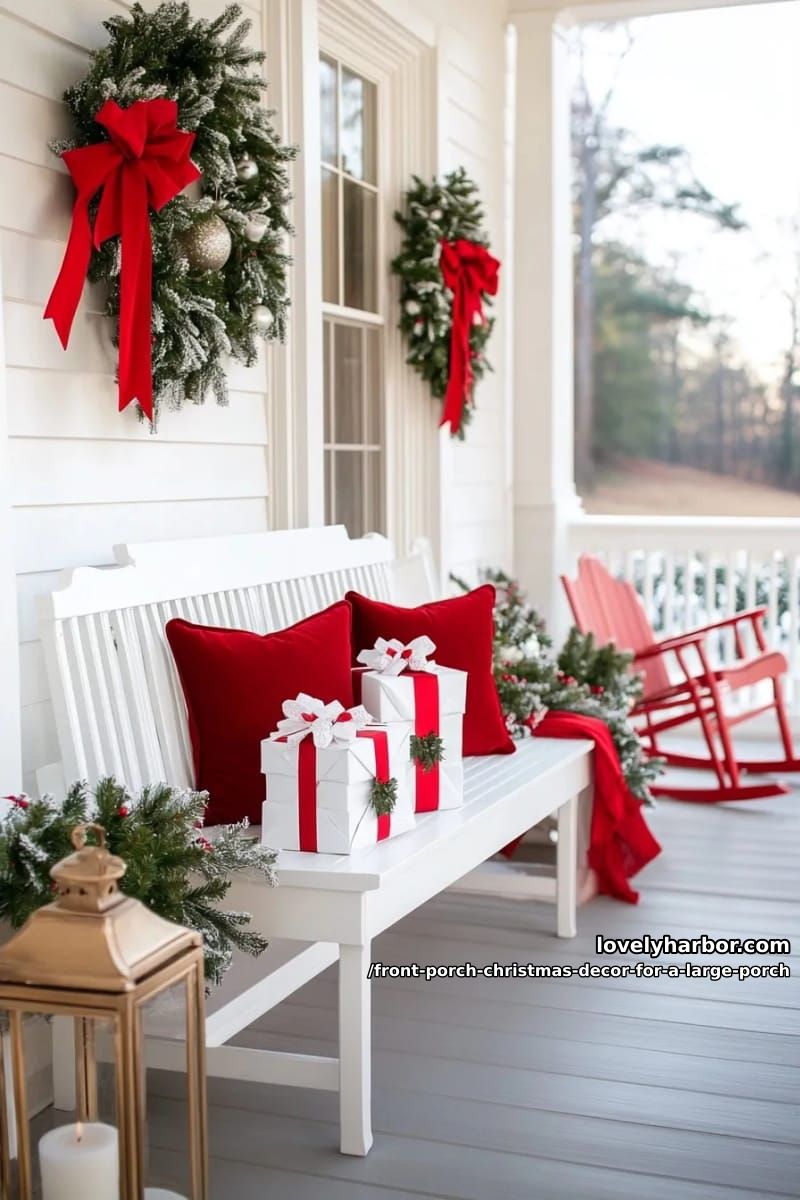
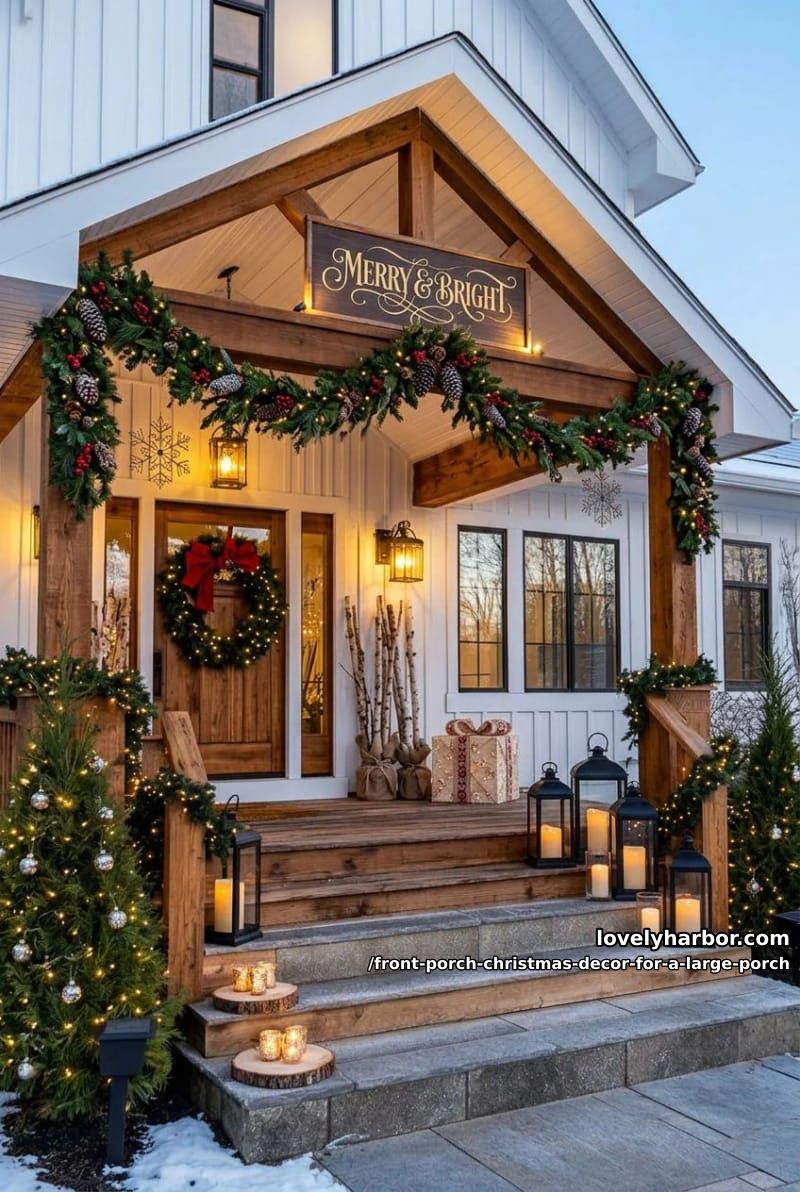
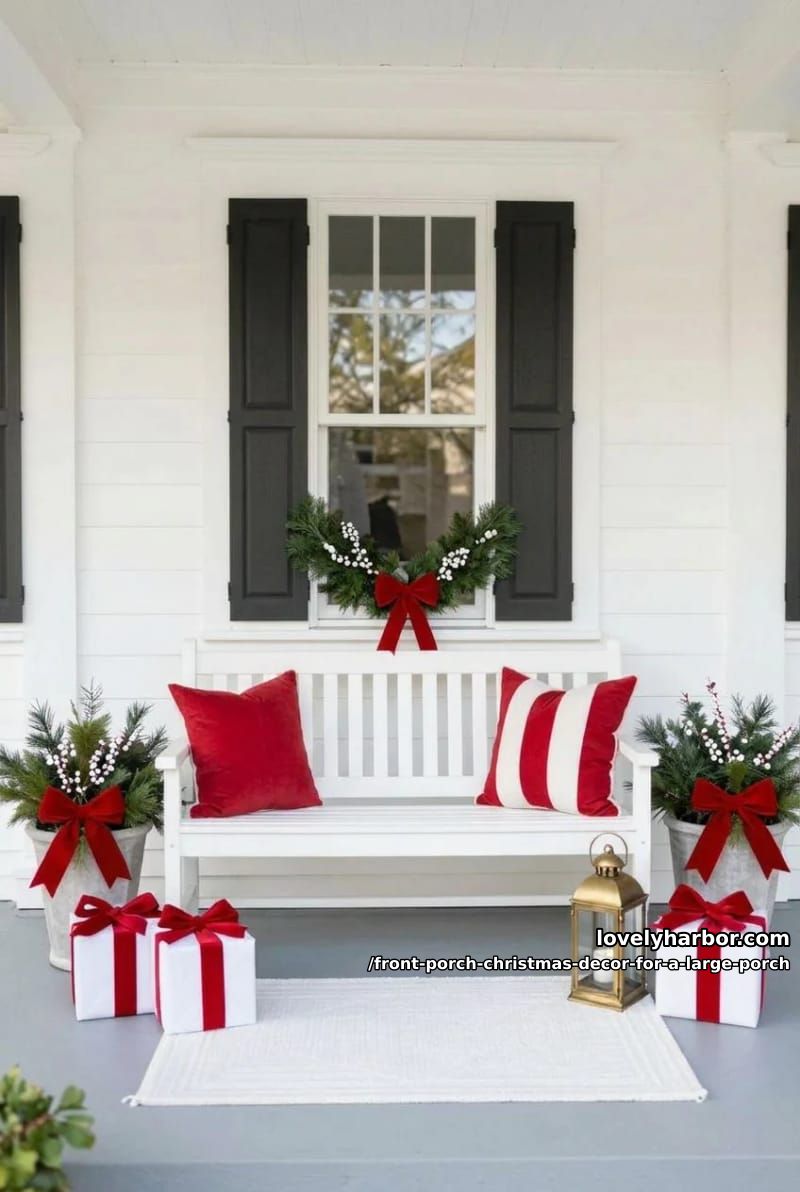
Pick two colors plus greenery and one metal, then turn everything else away, because a large porch multiplies clutter the way a small one hides it. Across a wide span, four or five competing colors stop reading as festive and start reading as chaos from any distance. Red and brass leans traditional; green and white reads quieter and more current; black and white with greenery photographs sharp on a modern facade.
Do this
- Commit to two hues, then repeat them at every zone so the whole porch coheres.
- Let natural greenery be the third “color,” and pick one metal (brass or matte black) for lanterns and accents.
Avoid
- One of everything: a red bow here, a blue ornament there, gold and silver both.
- Mixing warm-white and multicolor light strings on the same porch.
7. Cluster lanterns in graduated heights at the steps and corners
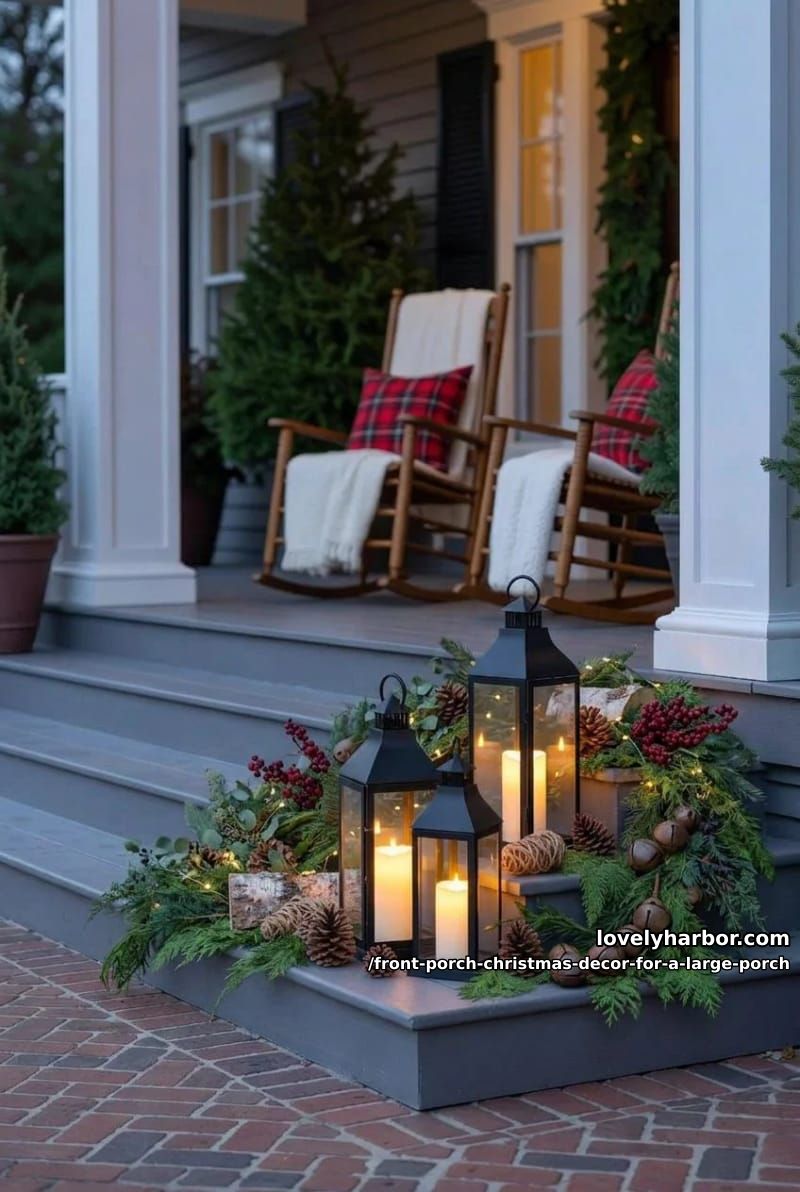
Group lanterns in odd numbers at graduated heights, then repeat the cluster at a corner or the far end of the steps so the lighting reads as a system, not a one-off. A single lantern by the door disappears; three of staggered height holding warm-white LED pillars on a dusk-to-dawn timer give you glow at the level where people actually walk. Vary the heights by at least four to six inches between pieces or the grouping looks like a mistake.
A 23-inch and 17-inch pair gives you instant height variation; add a third from the same line for a proper cluster.

8. Drape an overhead light canopy across the covered ceiling
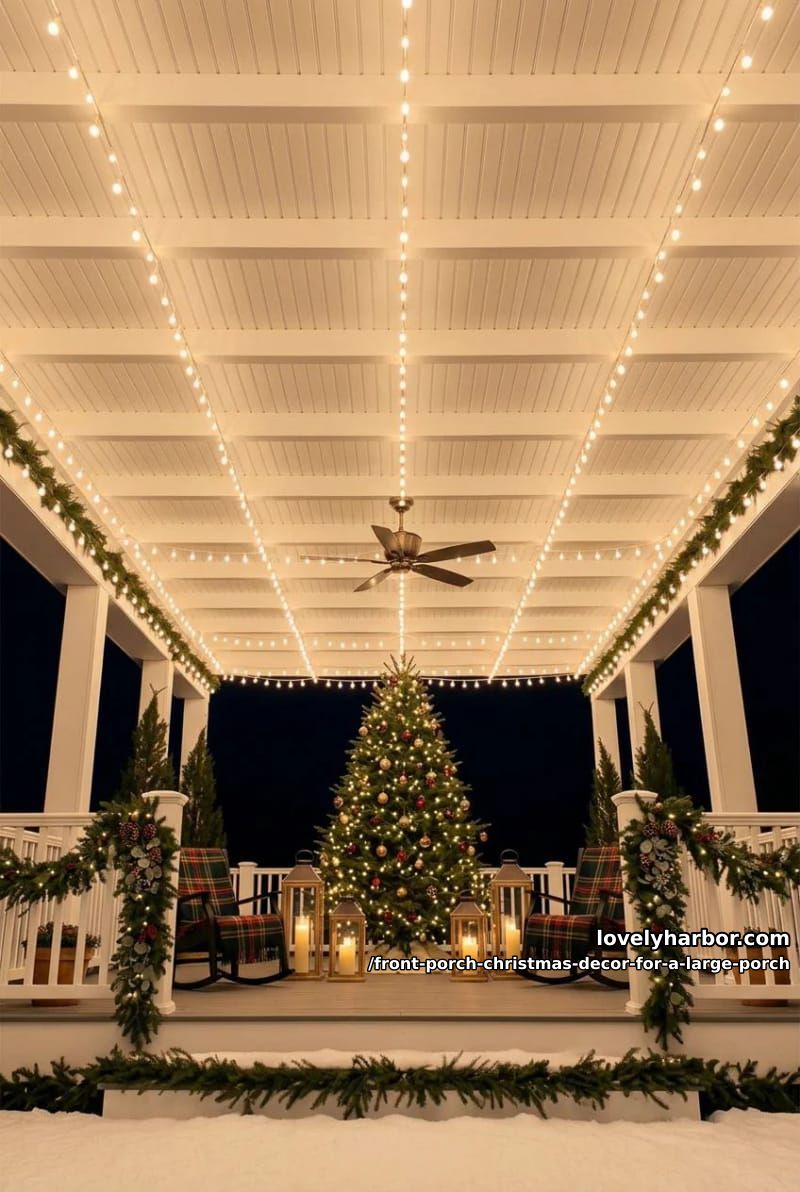
String warm-white bulbs across the ceiling in parallel runs or a loose zigzag, because the ceiling is the largest unused surface on a covered porch and lighting it makes the whole space feel finished after dark. Cafe-style bulb strings read better overhead than thin fairy lights, which get lost against a big ceiling. Run them to a single power source and put the display on a timer.
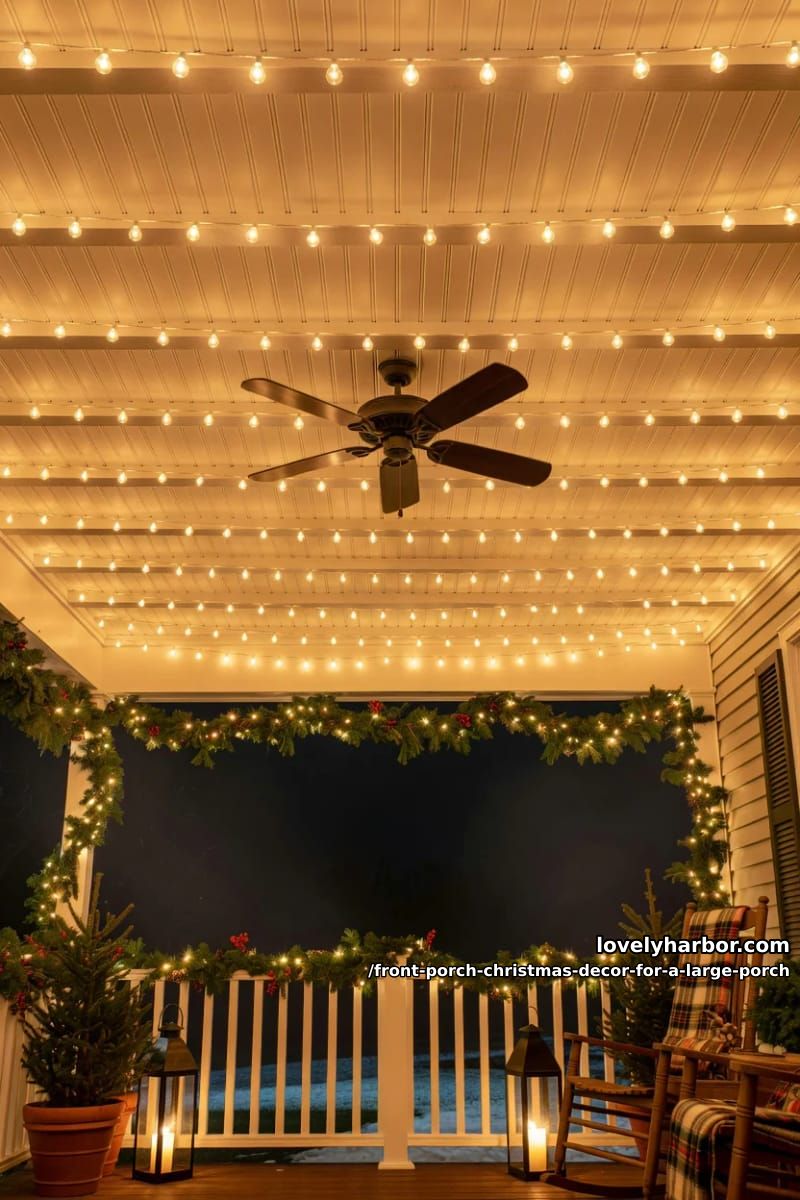
Use only outdoor-rated cords into a GFCI outlet, and leave a drip loop so water runs off rather than into the connection. Don’t daisy-chain extension cords together, and don’t exceed your light strings’ end-to-end limit (it is printed on the tag; LED sets allow far more runs than incandescent, which typically caps around three). A standard 15-amp circuit handles 1,800 watts, but stay under about 1,440 to leave margin for a long season.
9. Repeat one matching wreath across every window and column
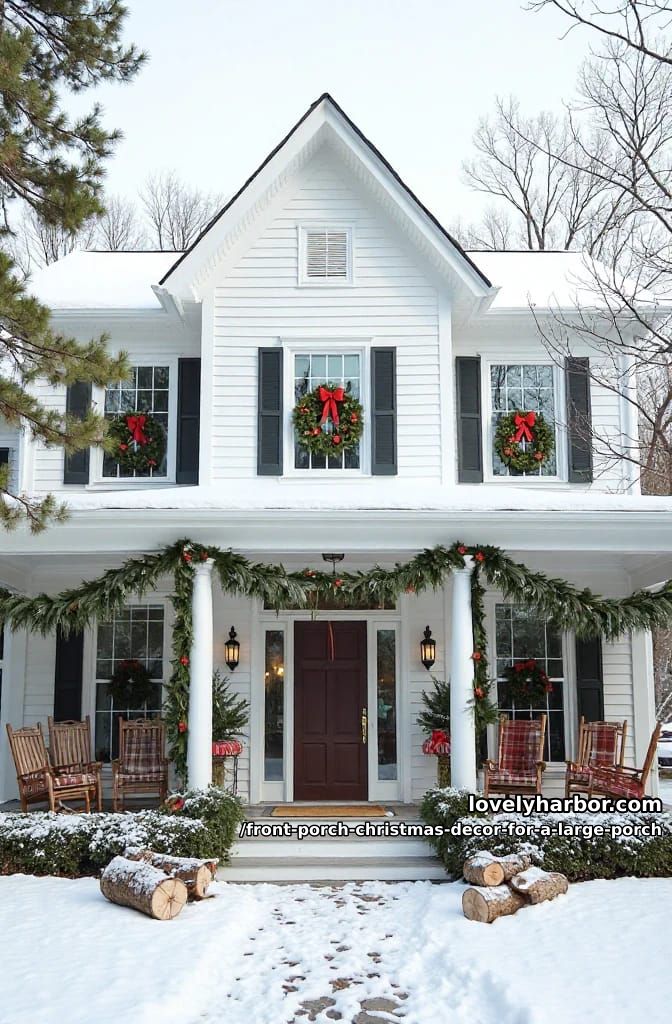
Hang the same wreath on every window and a matching wreath or swag on each column, because repetition is what reads as intentional across a big facade where a single front-door wreath looks marooned. Match the diameter to the opening: a 24-inch wreath suits a 36-inch door, while windows usually want something in the 18 to 20 inch range so they don't look crowded. Buying identical pieces in bulk is cheaper per unit and guarantees they actually match.
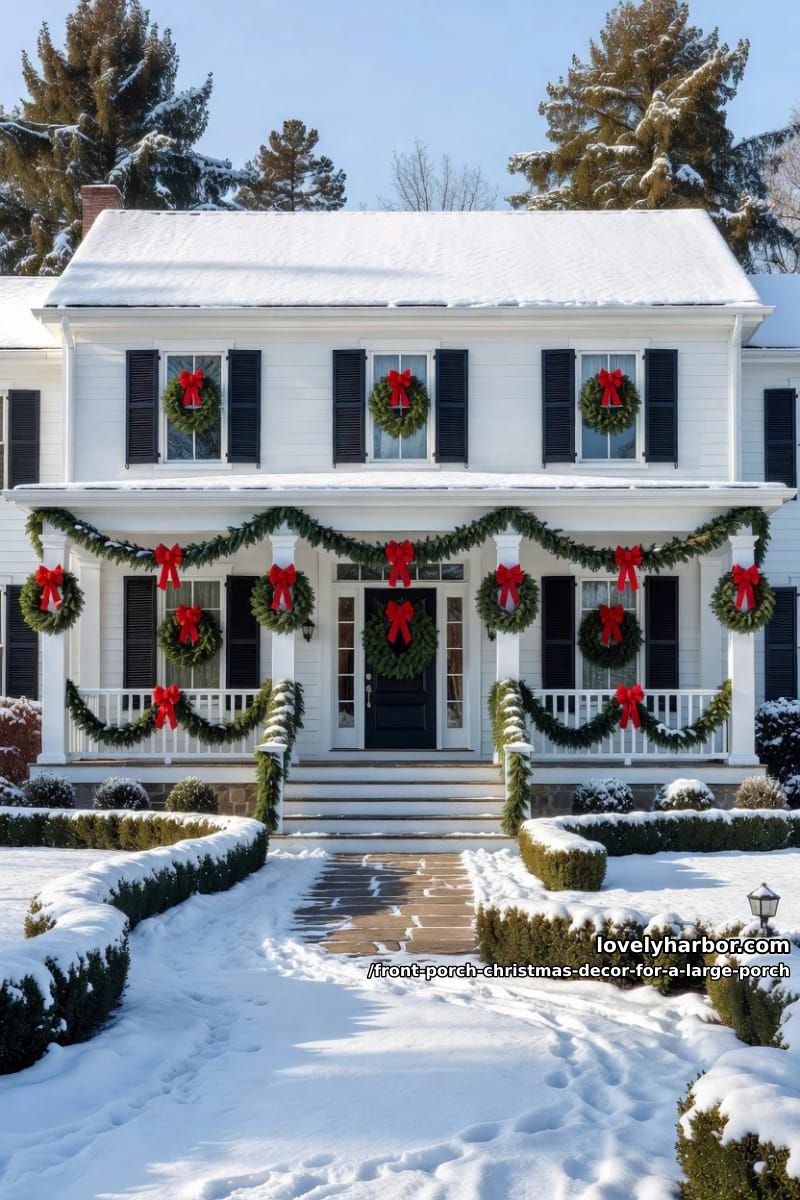
A coordinated set (two entrance trees, garland, and a wreath, all pre-lit and rated for covered outdoor use) is a low-effort way to start the repetition without hunting for matches.

10. Add one tall standalone focal piece
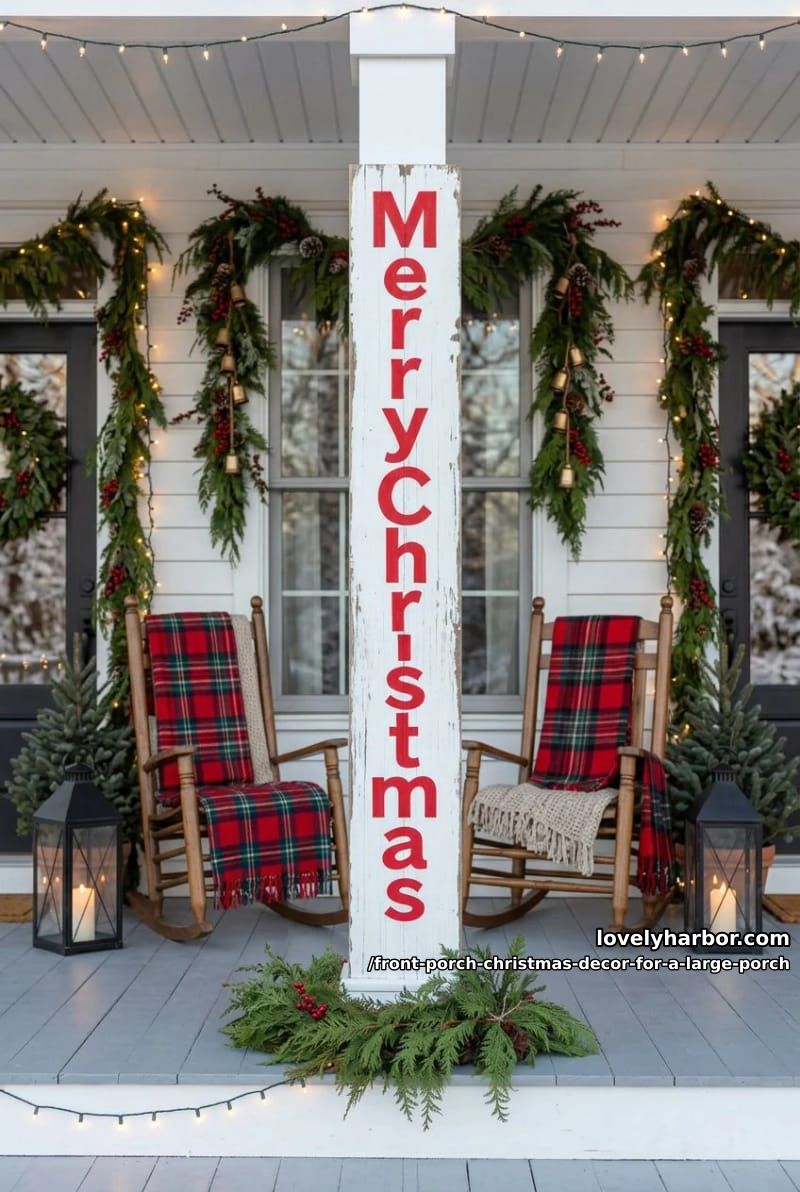
Give the eye one large object to land on: a four to five foot vertical "Merry Christmas" sign, a pair of three to four foot nutcrackers, or a wooden sleigh loaded with greenery. Scale it to at least chair height or it gets lost out here. One strong focal piece does more than a dozen scattered small ones.
I'll take the controversial position and say it plainly: a giant inflatable snow globe undoes a large porch you otherwise styled with restraint. If the rest of the porch is greenery and warm light, keep the focal piece in the same register.
11. Layer the floor so the wide entry doesn't read empty
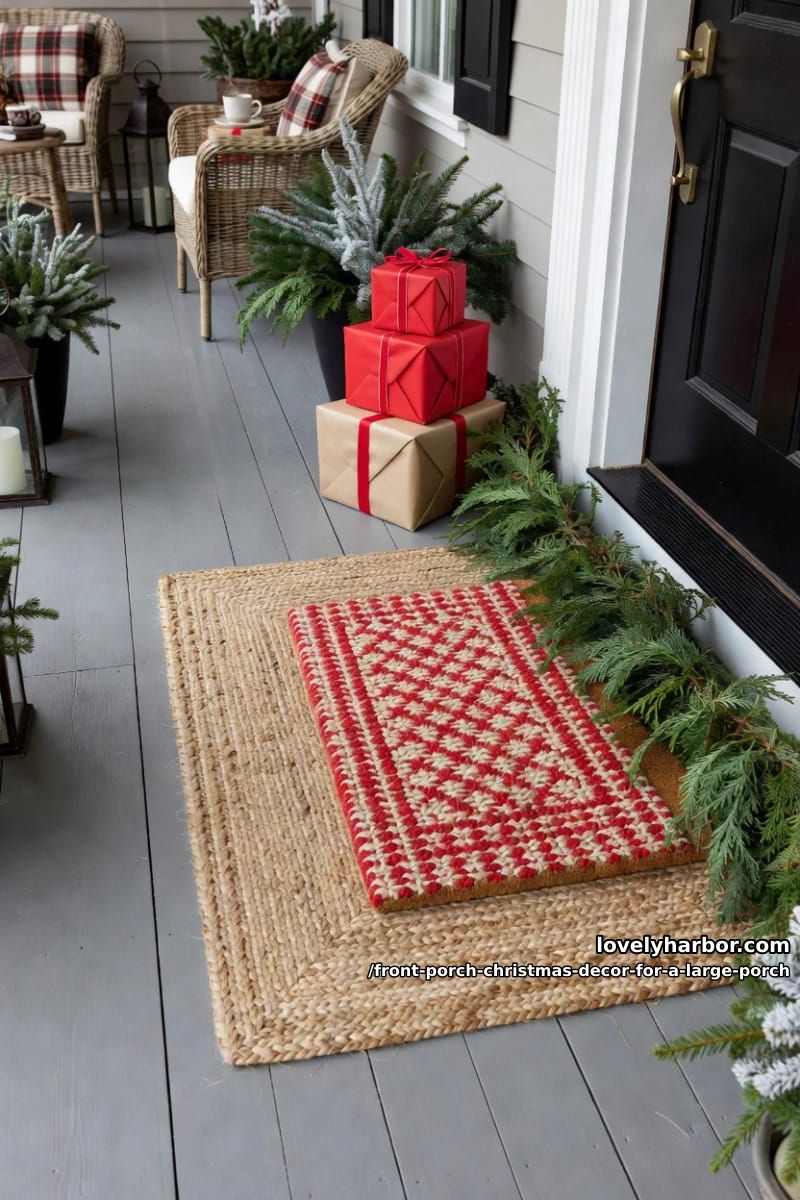
Ground the wide threshold with layered mats and a few floor-level pieces, because bare floorboards are what make a large entry look unfinished even when the railing and door are done. A standard 24×36 doormat looks like a postage stamp here; layer a 30×48 jute base under a smaller patterned mat, or run a length of garland along the wall base. A graduated stack of faux gift boxes wrapped in weatherproof vinyl or treated paper holds up to rain and fills floor space the eye otherwise reads as empty.
Conclusion
If you do nothing else, get the sequence right: set the two corner anchors and the door planters first (idea 5 is the one most people skip and the one that fixes a sparse-looking span), run the railing garland using the multiply-by-1.5 math so you don't come up three strands short on a cold afternoon, then add lighting, then fill the floor and ceiling. A large porch rewards restraint more than a small one does, because every mistake is bigger out here too. Last practical thing: put the lanterns and string lights on the same timer, and do a full light test before anything goes up high, since nobody wants to restring a dead run off a ladder in December.