
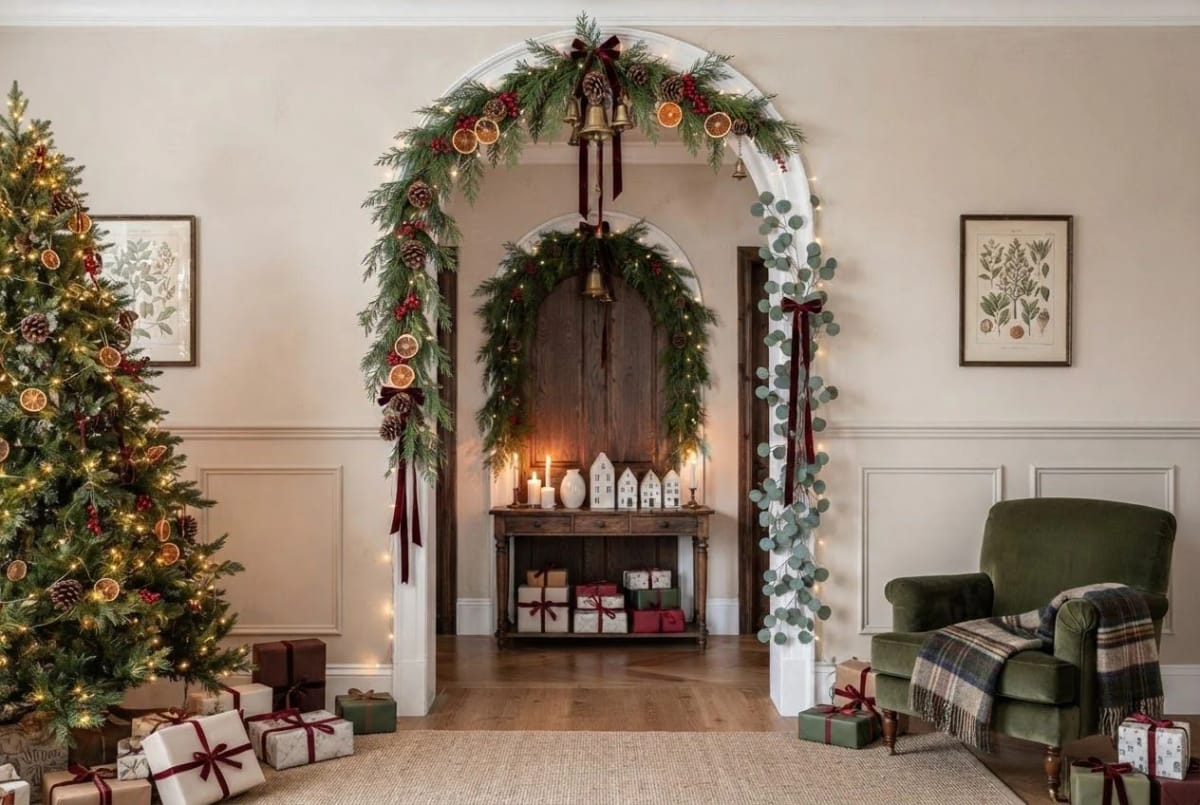
A standard American interior door is 80 inches tall and 30 to 36 inches wide, which means the three sides you would wrap add up to roughly 196 inches. A single 9-foot garland is 108 inches. It covers a little over half the frame, and that gap between what people buy and what the opening actually needs is the reason most interior doorway garlands read as a thin green rope taped to the trim.
Doorways, cased openings, and true curved archways are three different problems, too. A cased opening between a kitchen and a dining room has no door to swing, so it can carry weight a working doorway cannot. A plaster arch has no flat casing to staple into at all.
What follows sorts the ideas by which opening you actually have, with the hanging hardware and the clearance numbers included, because a garland that brushes your forehead every time you carry a casserole through is a garland you will take down on December 14th.
Two garlands beat one on a standard doorway
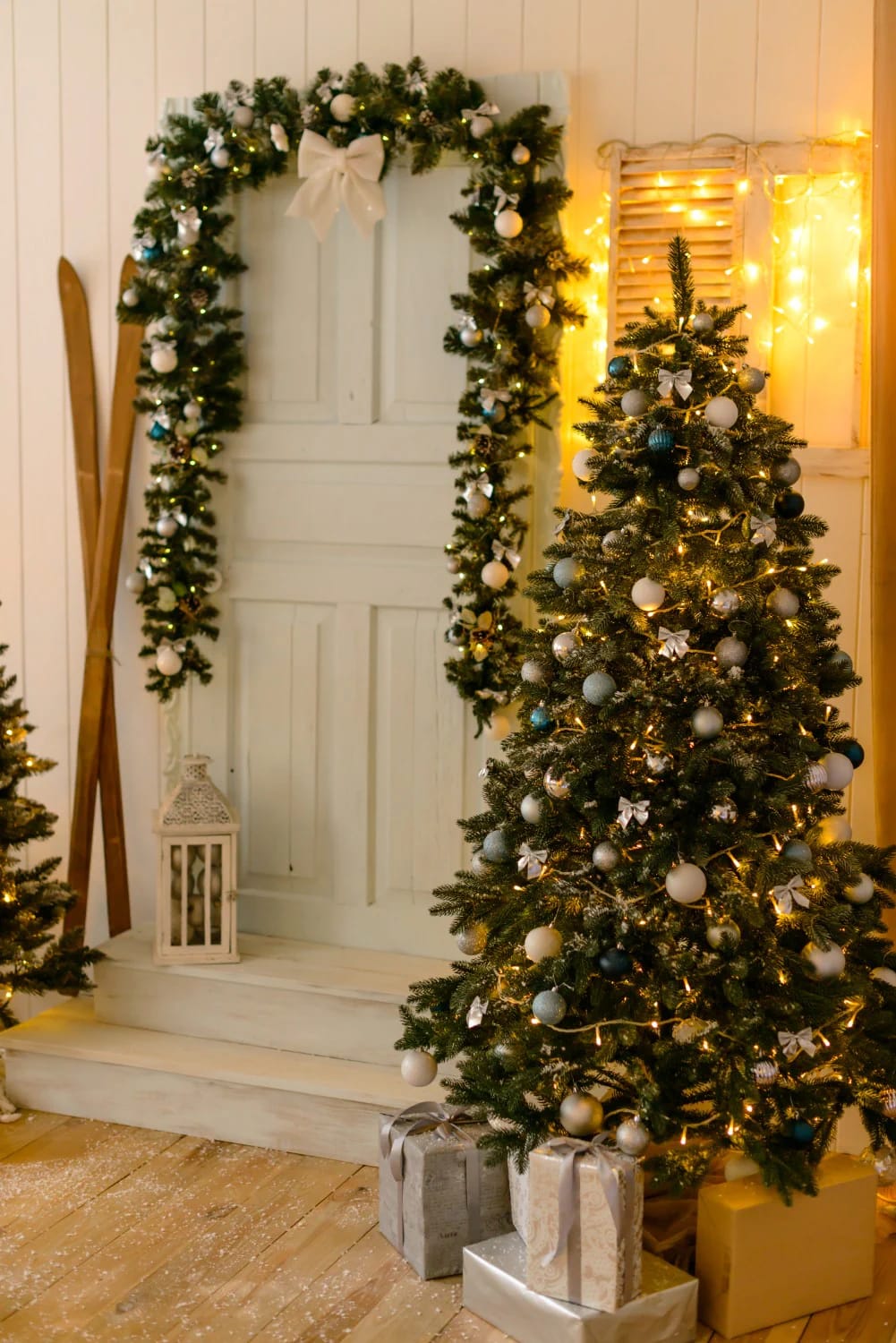
Buy twice the garland you think you need and twist the two lengths together before you hang anything. Two 9-foot strands wound around each other read as one dense 9-foot garland with real depth, and the doubled wire spine holds a shaped curve instead of relaxing into a smile shape by the second week. It is the same failure that ruins a stair rail, and the fix is identical to the one in our guide to garland that stops sagging on a staircase or banister.
Granted, this doubles the cost. A pair of unlit 9-foot faux garlands usually runs $30 to $60 total, which is still less than one pre-lit “premium” strand that will look thin anyway. Go unlit and mixed-needle so the texture is not one flat, uniform green: Vickerman 9 ft unlit Mixed Country Pine garland is the plain workhorse version of this, and two of them twisted together is the whole trick.
Hang the doorway garland asymmetrically, not as a symmetrical swag
Run the greenery heavy down one side and stop the other side about a third of the way down. Symmetry is what makes a doorway garland look like store display fixturing, and the asymmetric version reads as something a person arranged rather than something that came in a box.
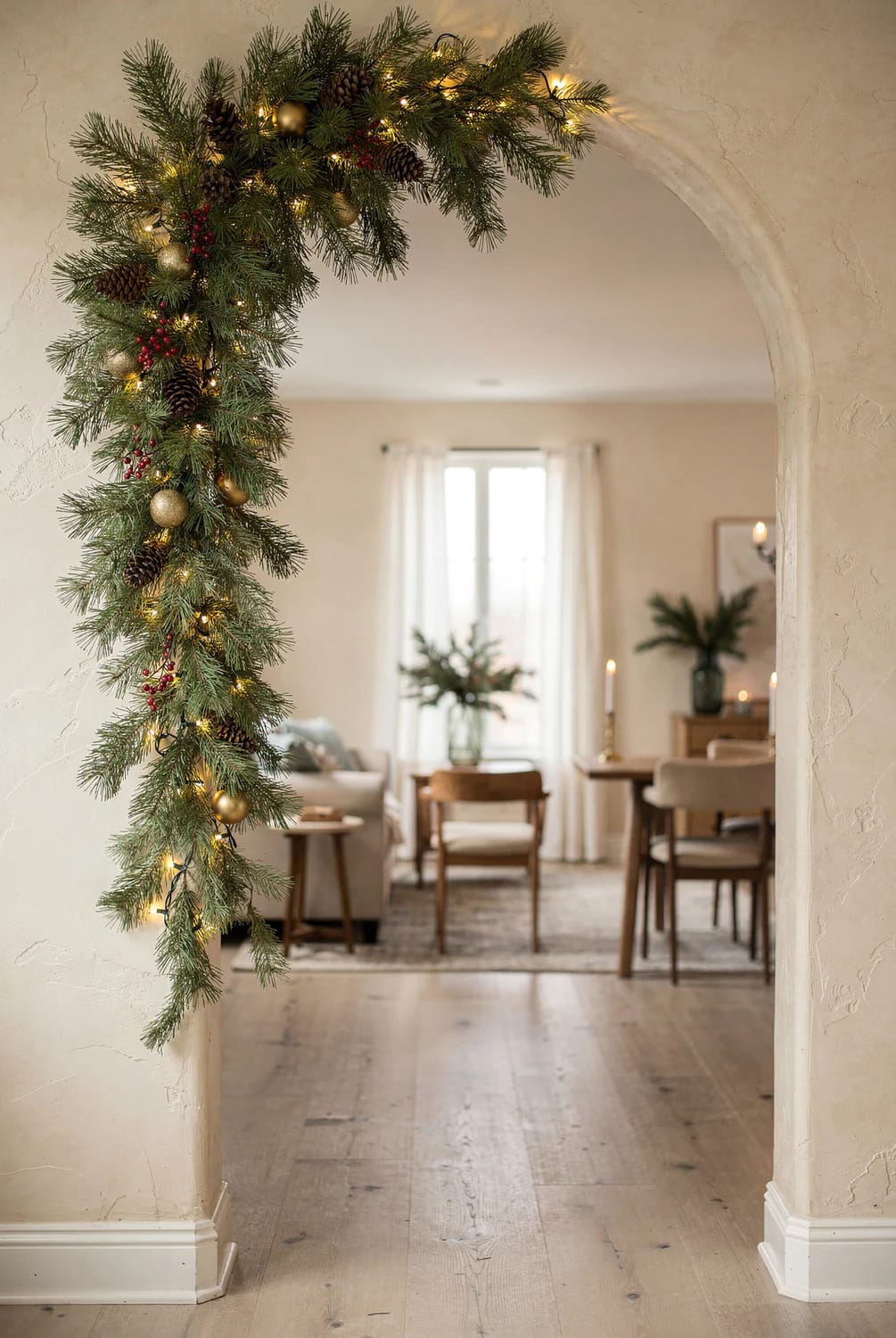
The practical version: mark the center of the top casing, then place the bulk of the greenery about 8 inches off-center toward your heavy side. Weight follows gravity anyway, so the drape settles into the asymmetry rather than fighting it.
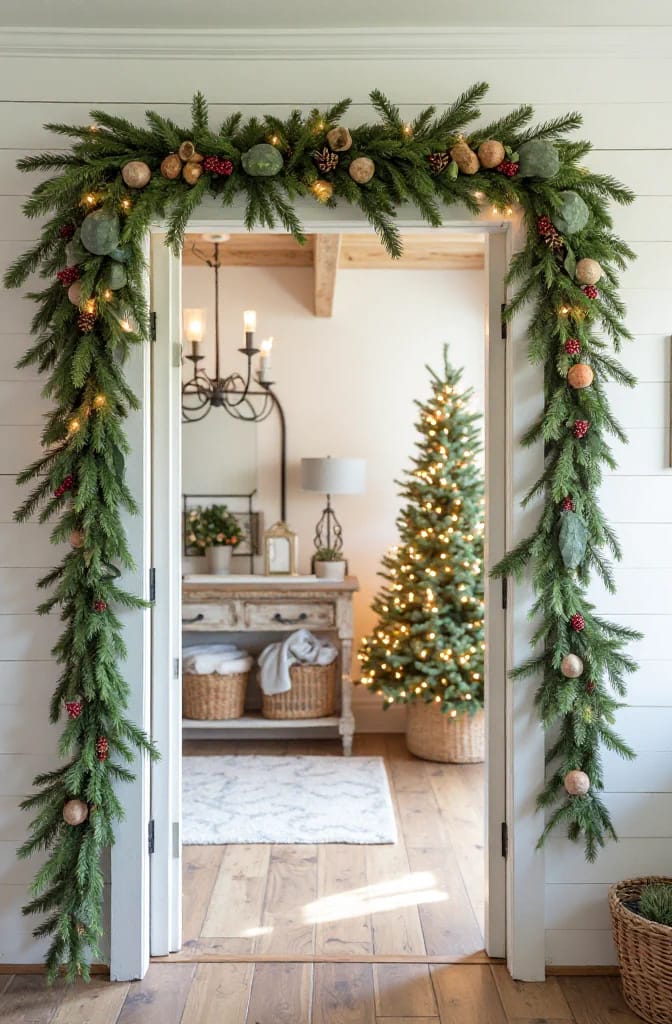
Buy the garland unlit and add your own warm-white micro-lights
Pre-lit interior garland is the one purchase I would talk almost anyone out of. The bulbs are spaced for a mantel, the wire is stiff enough to fight the curve of a door casing, and when one section dies in year three the whole garland is landfill.
Thread your own instead. Copper-wire micro-lights at 2700K or lower disappear into the needles during the day and glow amber at night, and a battery pack with a built-in timer means no cord running down the casing to a baseboard outlet, which is the detail that ruins most interior doorway lighting. One 33-foot strand covers a doubled 9-foot garland with room to spare: koopower 33 ft warm white copper-wire fairy lights with remote and timer. Keeping every light in the house on a single color temperature is the same discipline behind outdoor displays that read expensive without a single inflatable, and it matters more indoors, where a cool-white strand next to a warm lamp looks broken.
A true archway wants a flexible garland pinned to the curve, not draped across it
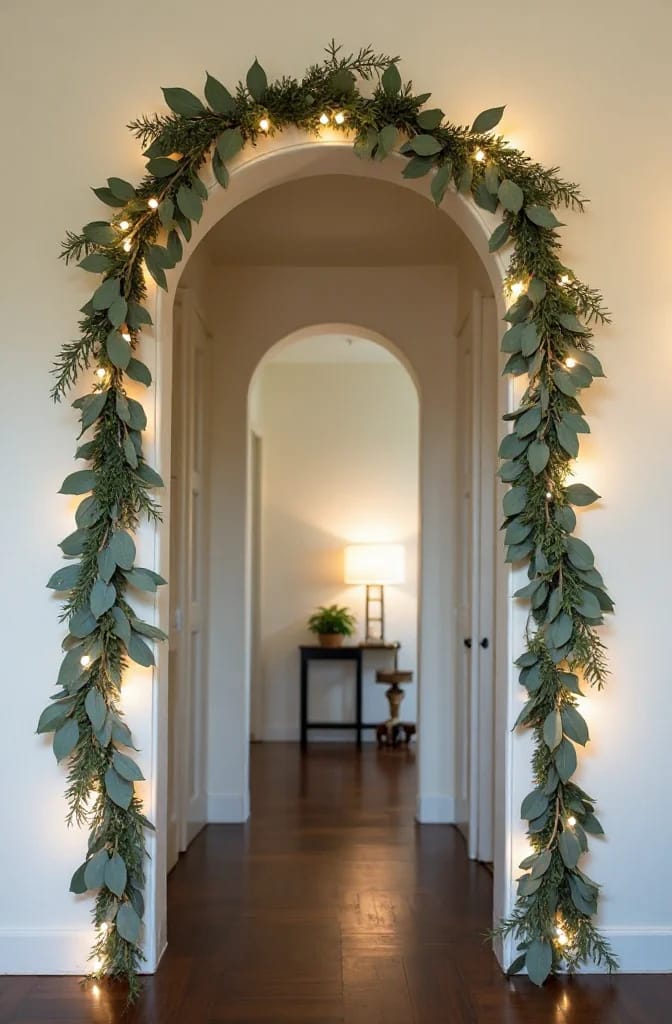
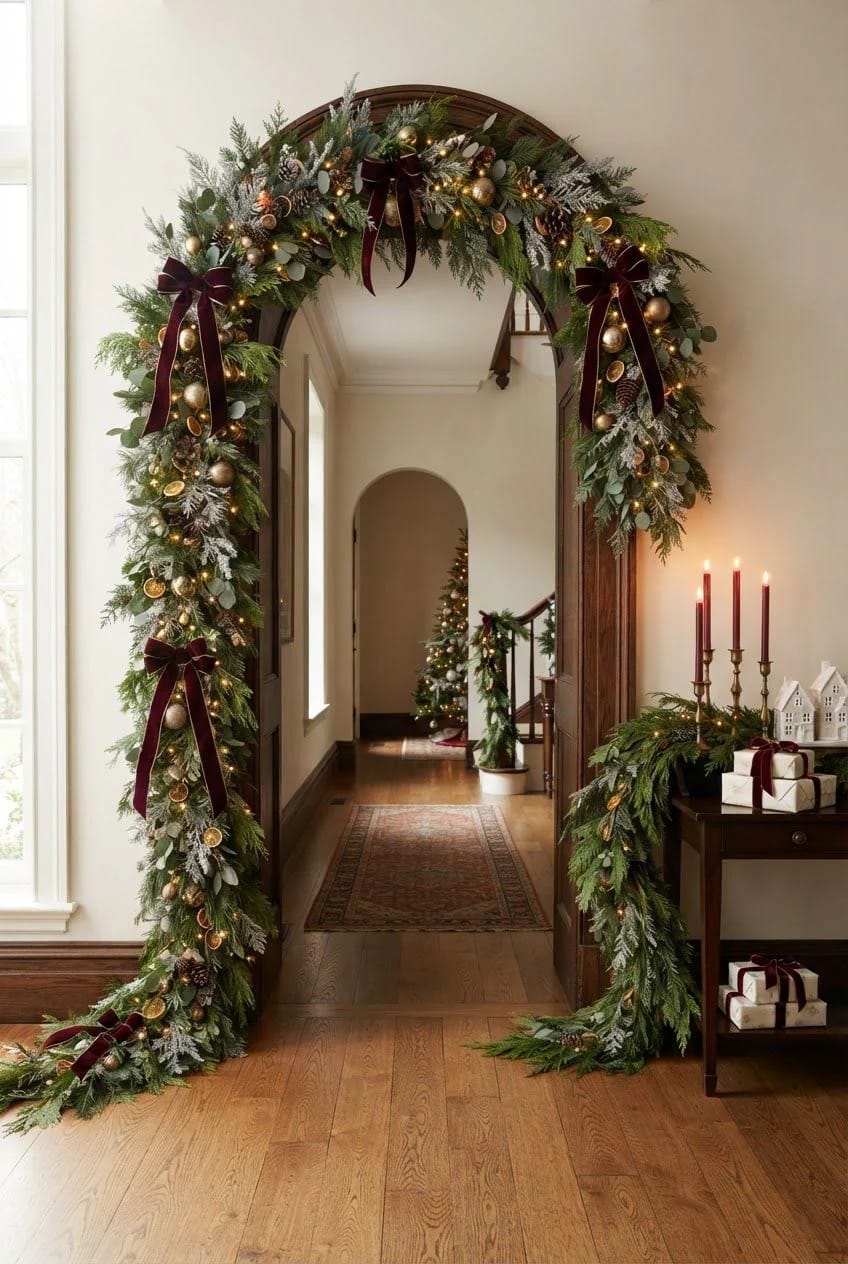
Bulky faux pine will not take a radius. It bridges the curve in straight chords and you end up with a hexagon, which looks worse than doing nothing. What works on a plaster or drywall arch is a slim, bendy garland with a thin spine, eucalyptus and cypress being the two easiest to find, pinned every 10 to 12 inches so the greenery is held against the curve rather than hanging from two anchor points.
Use small adhesive-backed hooks or clear upholstery pins spaced tightly. The tighter the spacing, the truer the curve.
Renter-friendly doorway garland: adhesive hooks, and the weight number that matters
Weigh the finished garland before you decide the hardware. A doubled faux 9-foot garland with lights and ribbon lands somewhere around 3 to 5 pounds, which is right at the edge of what a single large adhesive hook holds.
Three hooks across the top casing, not two, is the answer, so no single point carries the whole load. Command’s large utility hooks are rated to 5 pounds each and come off painted trim without lifting the finish if you pull the tab straight down: Command large utility hooks rated to 5 lb, 7 hooks and 12 strips. Press them onto the casing, not the wall, and give the adhesive the full hour before you hang anything. The rest of the no-nail toolkit is covered in our renter-friendly Christmas decor ideas for small apartments, including what to do about the tub of decor in January.
Carry the garland along the hall ceiling above the opening
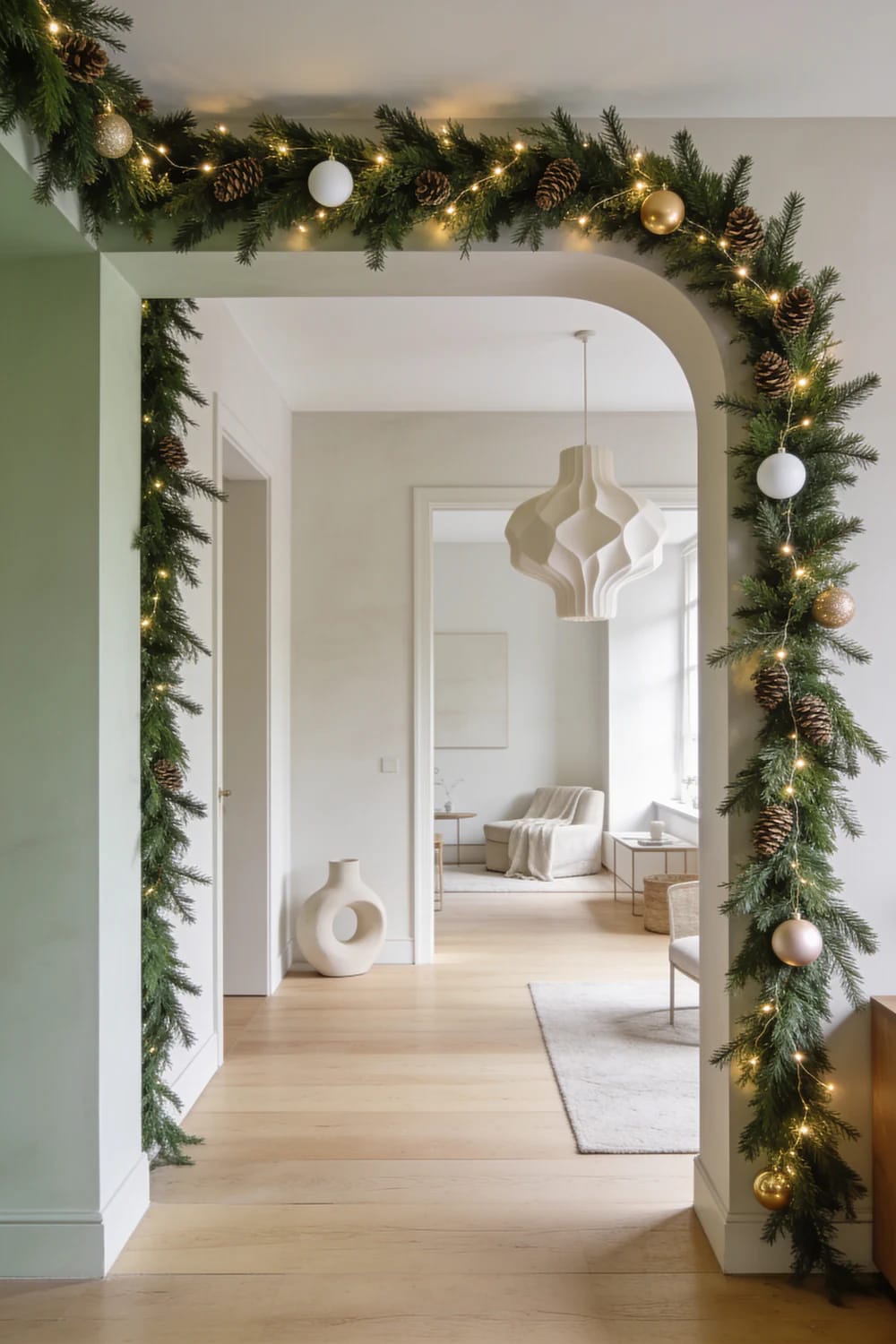
A hall with a cased opening at the end gains more from a garland running along the ceiling than from one framing the opening. Ceilings in a corridor sit close enough overhead to read as a surface, so a lit strand up there turns the entire passage into something, where a garland on the opening alone is a single decorated rectangle at the far end of a dim tunnel.
Run it along the wall-to-ceiling seam rather than down the middle. The seam gives you a line to follow and a shadow to hide the hooks in, and the light bounces off both planes.
Two cautions. Ceiling paint is usually flat and chalky, and adhesive hooks bond poorly to it, so plan on hooks pressed onto the wall an inch below the seam instead. And keep it slim: a full-bodied garland overhead in a 36-inch hallway makes the hall feel like a crawl space.
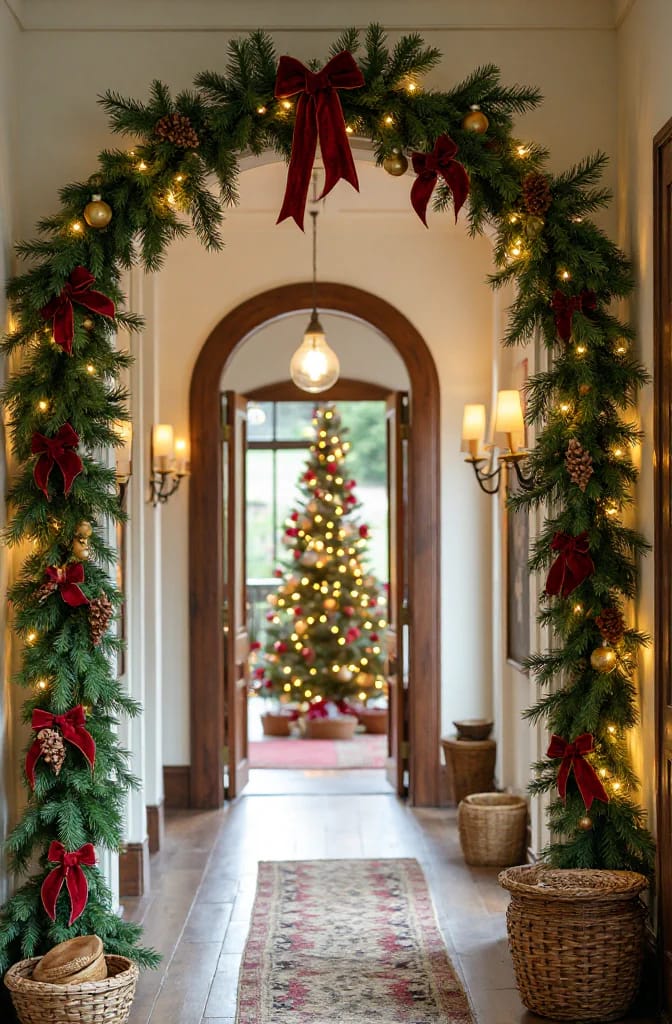
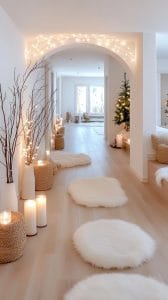 20 Unique Christmas Hallway Decoration Ideas What to put on the walls and floor once the ceiling line is handled.
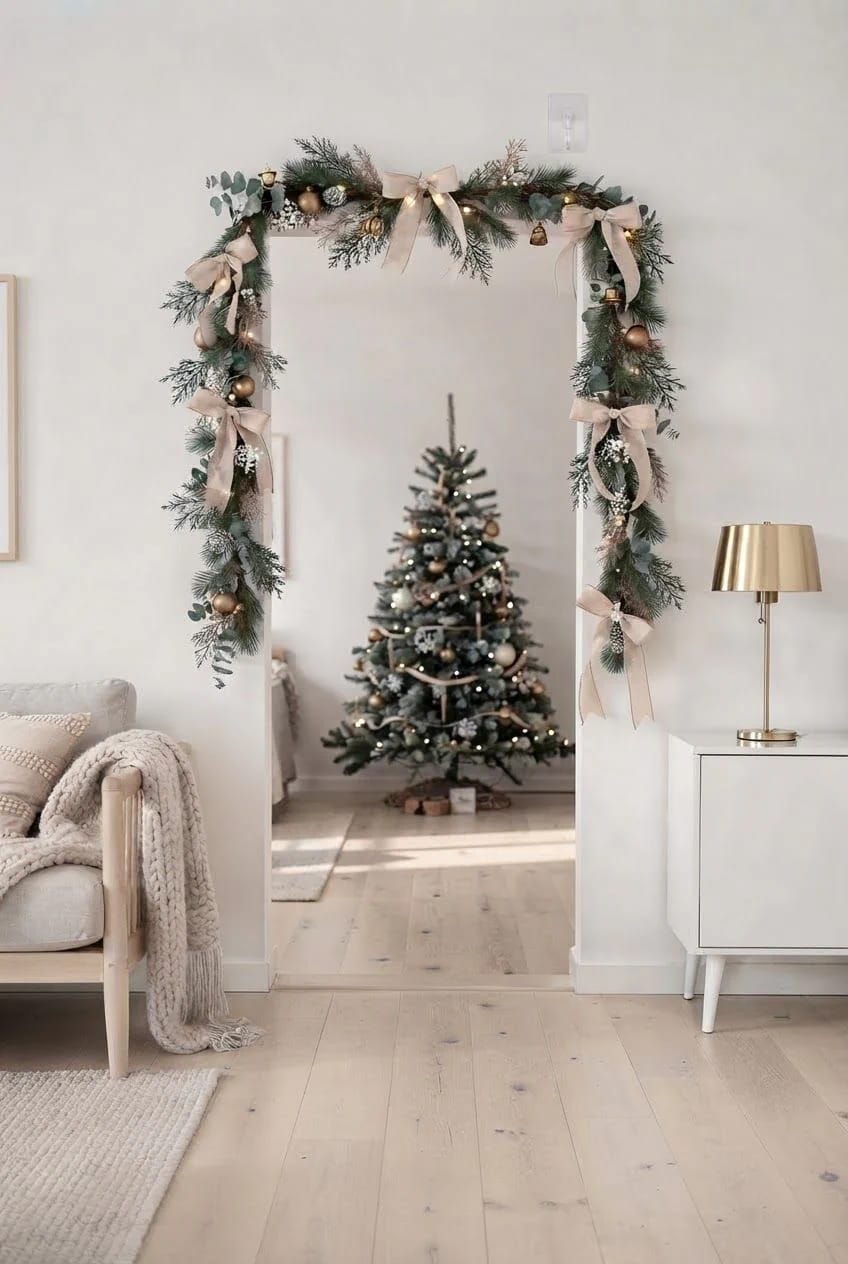
A cased opening between two rooms takes a flat top run, not a swag
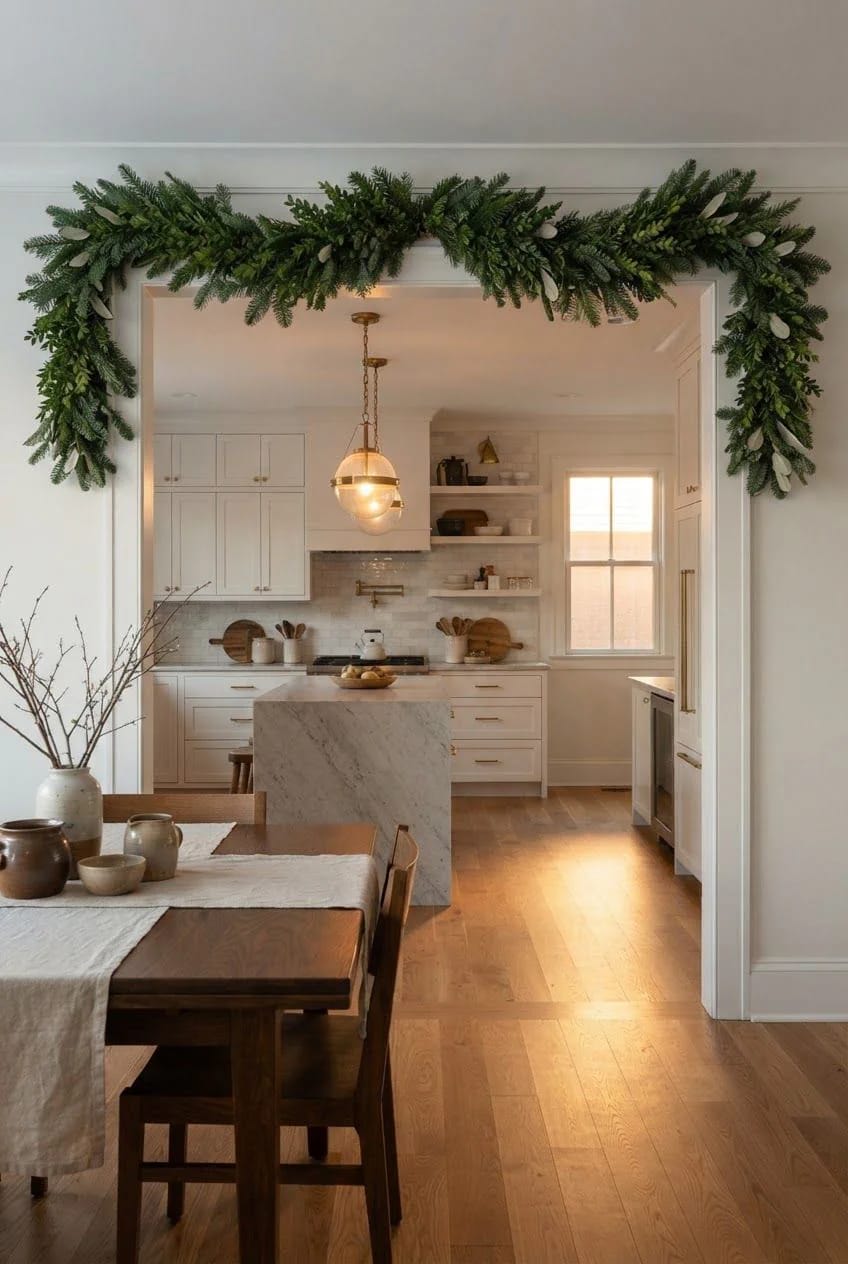
Skip the drape entirely on a wide cased opening and run the garland flat along the top casing only, tight to the trim, with no tails down the sides. Wide openings are usually 5 to 8 feet across, and a swag hung in the middle of that span drops into the sightline between two rooms you actually look through.
Pin it in three places and let it sit like a shelf of greenery on top of the casing. It reads architectural instead of festive, which is the point when the opening is a permanent feature of the house rather than a door.
One wide velvet ribbon at three points, not a bow on top
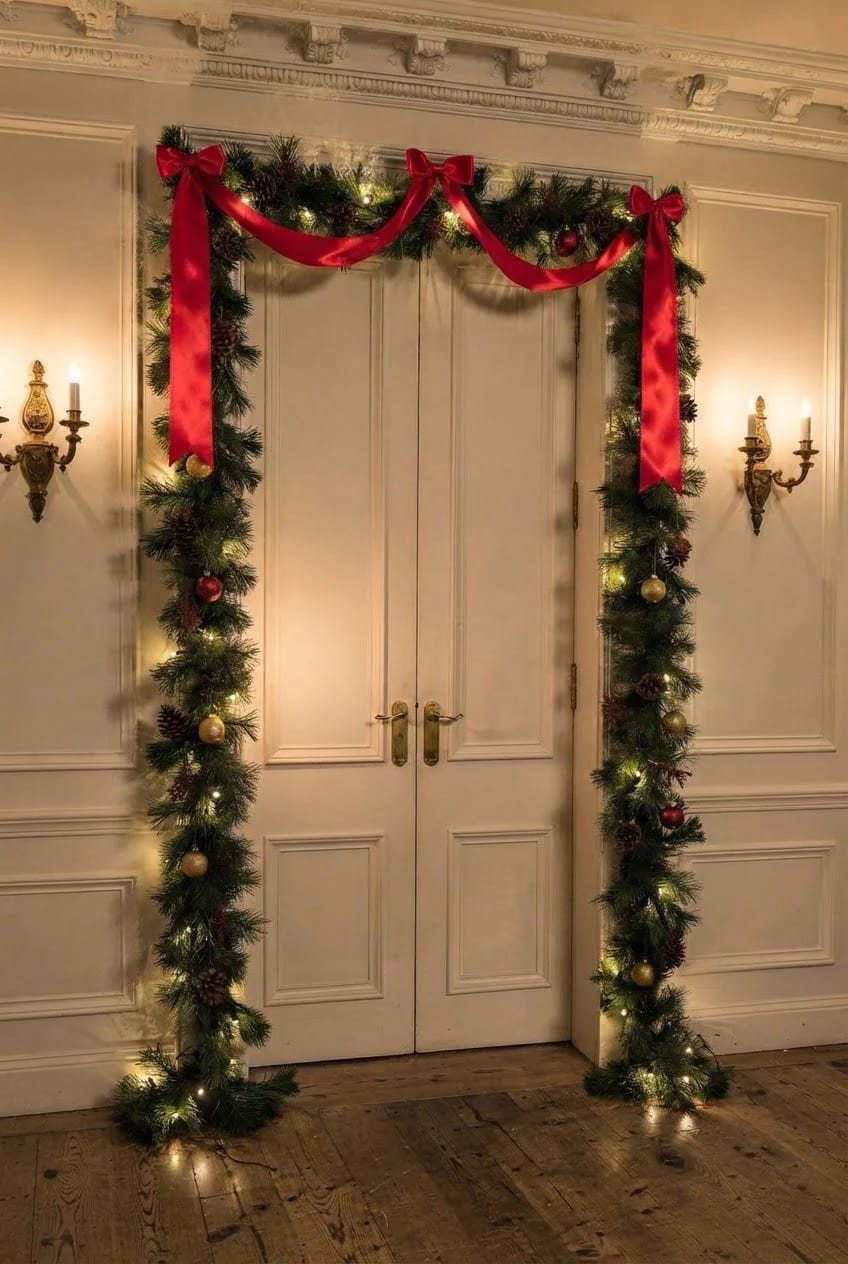
Wired velvet ribbon at 2.5 inches wide, cut into three lengths and tied as plain knots along the garland, does more than a single large bow at the top. The bow is the most predictable move in holiday decorating and it puts all the color in one spot; three knots distribute the red down the frame and give the eye somewhere to travel.
Cut the tails on a steep diagonal and let them differ in length, one long, one short. Ribbli 2.5 in red crinkled velvet wired ribbon, 10 continuous yards is enough for a doorway with plenty left for the tree, and the wired edge means the knots hold their shape instead of going limp by the second week.
The no-red archway: dried citrus, brass bells, bleached cones
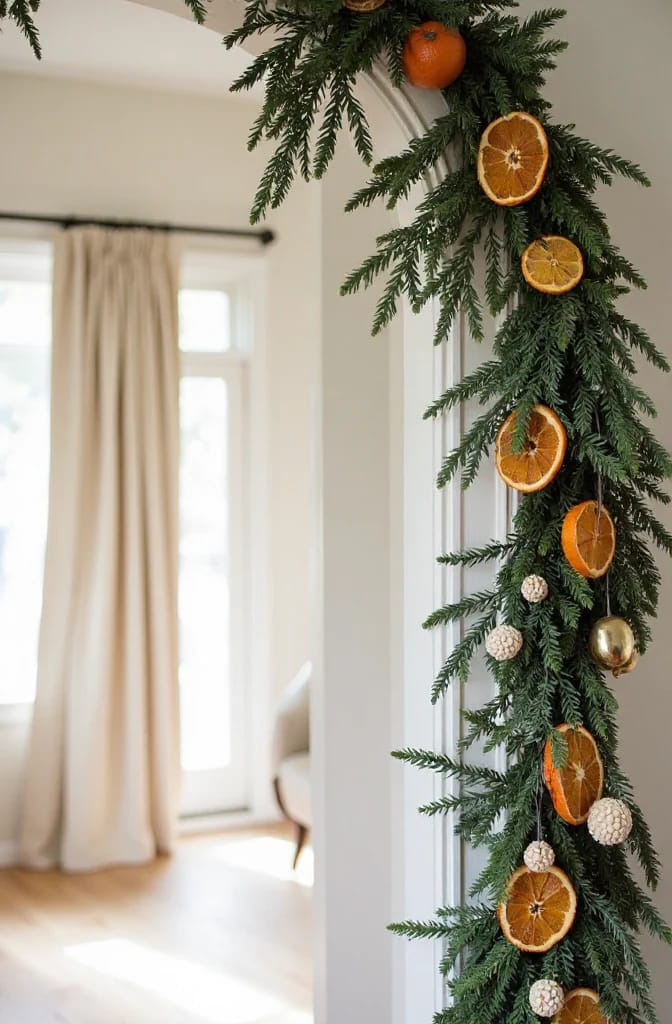
Strip the red out and the greenery has to carry more, so change the greenery. Dark fir against cream plaster with no color to distract is flat; grey-green eucalyptus and juniper have enough tonal variation to hold an arch on their own, and dried orange slices supply warmth without introducing a second color scheme.
Dry the citrus yourself at 200°F for about three hours per side, turning once. Store-bought dried slices run $10 to $18 a bag and are usually thicker and cloudier than what you get from a 3mm cut at home.
Unlacquered brass bells over silver or nickel, always. Brass ages toward a warm brown patina that suits dried material; nickel goes cold against it. If you want the fresh version of this palette, the same logic drives our fresh greenery door ideas that look intentional and last the season, and the browning timeline there applies indoors too, only faster with the heat on.
Hang vertical strands to turn the doorway into a curtain
Suspend eight to twelve vertical strands from the top casing so they hang inside the opening at staggered lengths. Eucalyptus stems, beaded garland, or fishing line strung with ornaments all work, and the result is a doorway you walk through rather than one you look at.
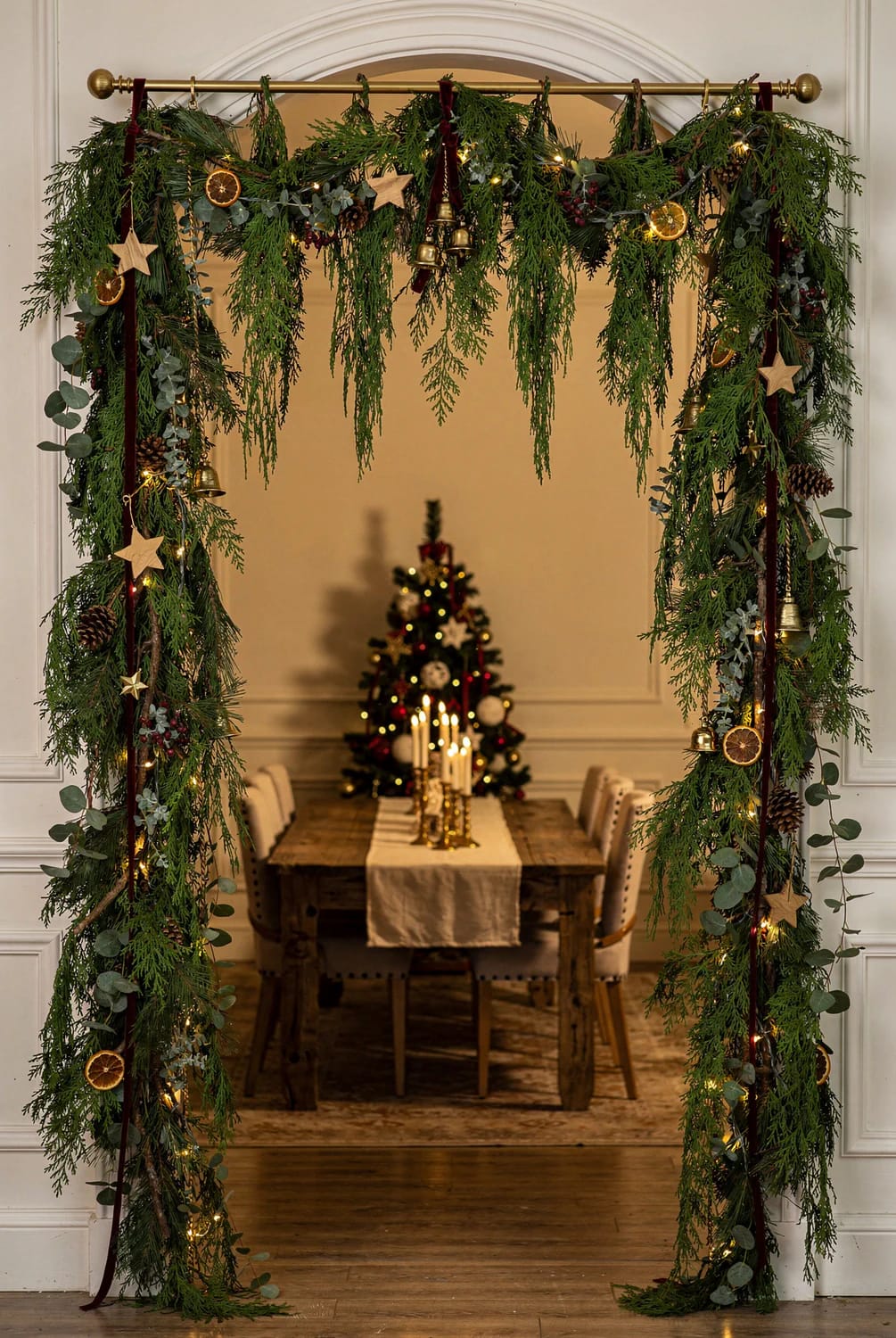
Keep the shortest strand above 68 inches from the floor if it is a doorway anyone uses, and be honest about whether that is true. This works best on a doorway to a room you are not walking in and out of every ten minutes, which usually means a dining room, a guest room, or the opening to a stair landing. Plenty more indoor Christmas decor ideas follow the same rule about traffic patterns.
Run the garland to the floor and let the tails pool
Extend both sides past the bottom of the casing and let 12 to 18 inches of greenery gather on the floor. It is the move that separates a hotel lobby installation from a decorated doorway: pooling reads deliberate and expensive in the way a curtain that breaks on the floor does, where a garland stopping neatly at the baseboard reads measured-to-fit.
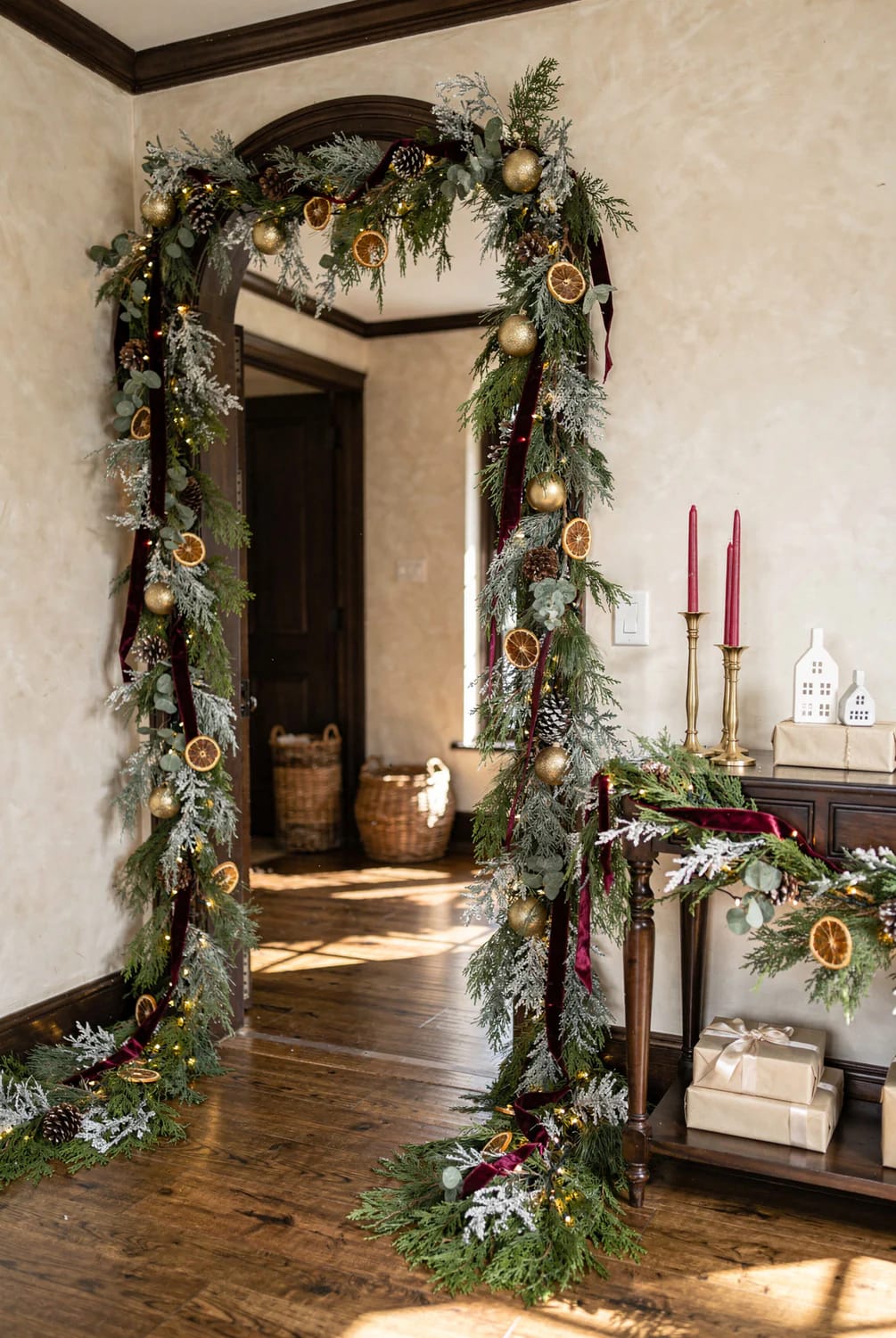
This does mean vacuuming around it, and it means no pets who chew. Assuming neither applies, it is the single highest-impact change on this list, and it costs nothing beyond the extra length you were already going to need. The same restraint that makes it work is what we argue for in our mantel garland ideas that look designer rather than draped-on.
Peppermint and gingerbread on the kitchen doorway
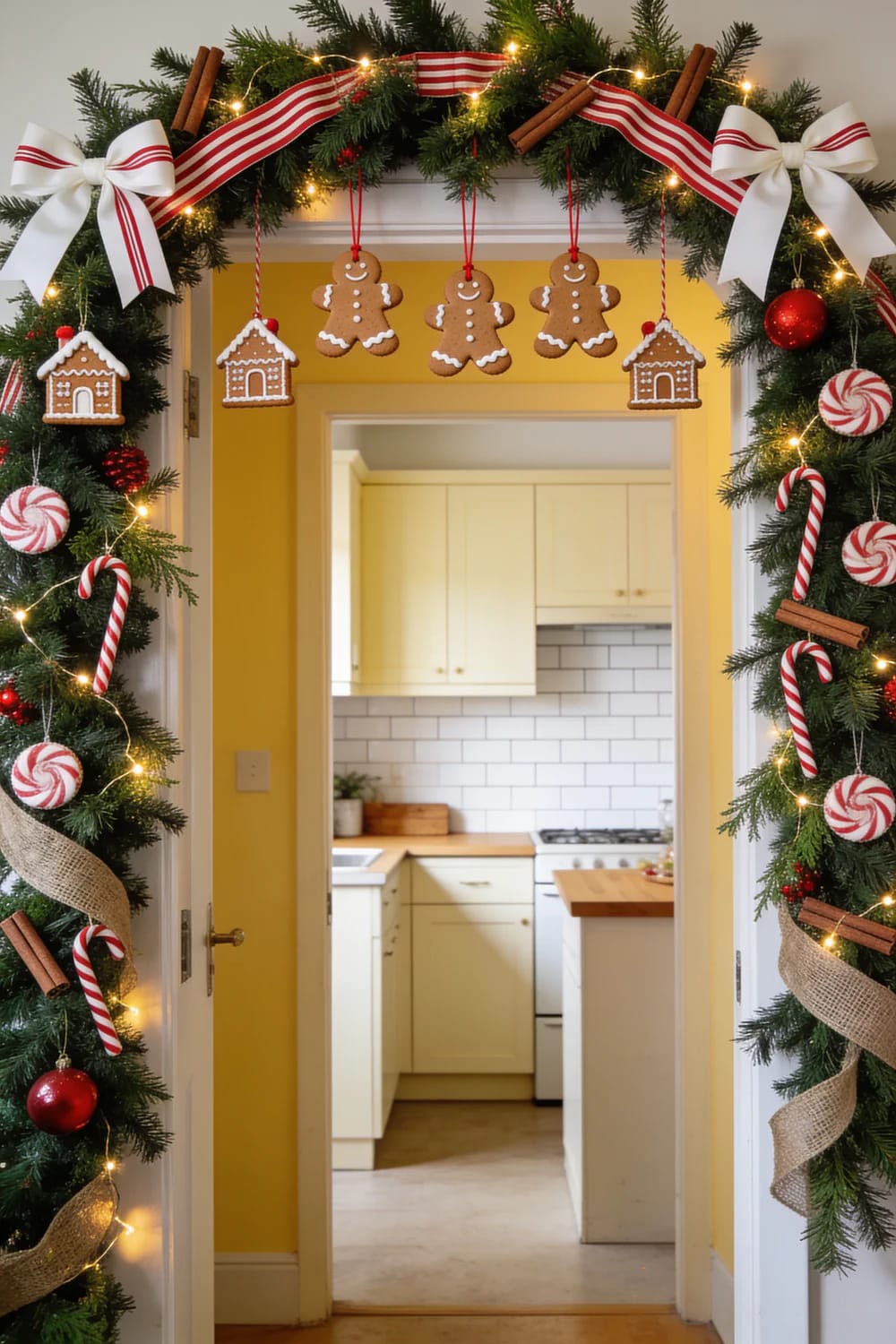
Give the kitchen or playroom doorway the candy version and keep it out of the rest of the house. A peppermint-and-gingerbread doorway is the highest-scoring idea in this whole category on Pinterest, and it works precisely because it is contained to one opening rather than spread across the living room.
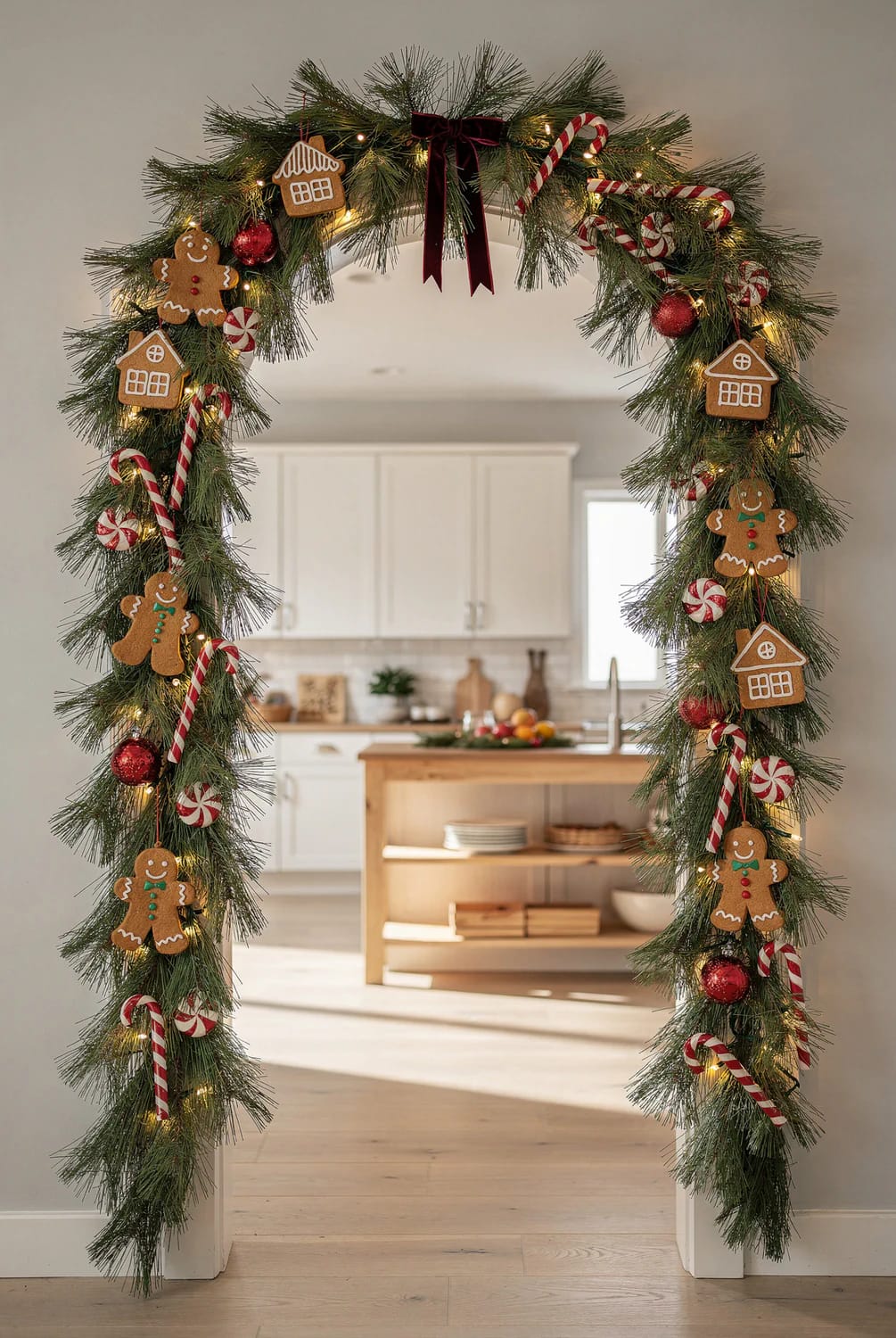
Real candy canes fade in direct light and the wrappers yellow after a few weeks, so buy a box and plan to swap them once mid-season. Wire them in pairs, crook facing outward, rather than hooking them over the greenery where they slip and end up on the floor.
 12 DIY Front Door Christmas Swags and Garland Ideas Worth Making Yourself The wiring technique behind a teardrop swag, which is the same skill a doorway garland needs.
Mix one bundle of real cedar into the faux garland
Wire a single bundle of fresh cedar or balsam into the faux garland at the top of the doorway and the whole opening smells like the season for about two weeks. Faux greenery has solved the shape problem and lost the scent one, and this is the cheap fix: a bundle of cut cedar from a florist or a Christmas tree lot runs $5 to $15, and lots frequently hand over trimmings for nothing if you ask.
Put it at head height where you pass through, not at the top of the frame where nobody breathes. A real-touch cedar-and-pine faux base blends best with the fresh material because the needle shape roughly matches: 9 ft mixed Norfolk pine and cedar real-touch garland. Expect the fresh cedar to go brittle and drop after two to three weeks indoors with the heating running, which is fine if you plan for one swap in mid-December rather than discovering it on the twenty-third.
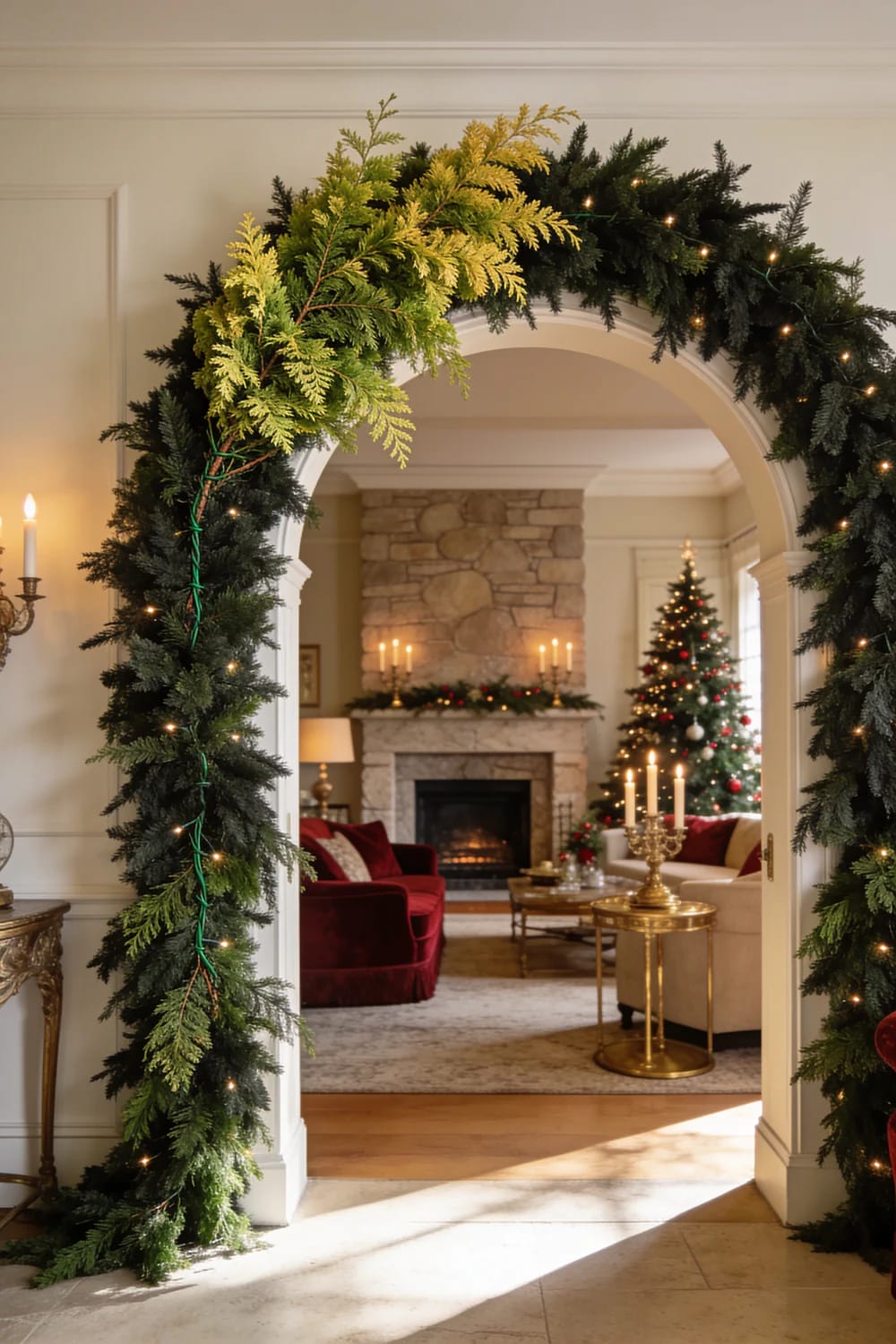
One last thing worth doing before you commit to any of these: stand in the doorway and hold your arm up. If the greenery would sit lower than 76 inches on a working door, either move it to the casing face instead of the underside of the header, or pick the flat top run from earlier. Every year somebody hangs a beautiful doubled garland with pooling tails on the doorway between the kitchen and the dining room and takes it down before the first party, because a swag hanging into a 32-inch opening turns into an obstacle course the moment two people are carrying plates.
And if you only do one thing from this list, double the greenery. The asymmetric drape, the velvet knots, the pooling tails, the brass bells, all of it depends on having enough material to shape in the first place, and no amount of ribbon rescues a single thin strand.
Related Posts
- Front Door Christmas Decorations With Fresh Greenery: 11 Ideas That Look Intentional and Last the Season
- 15 Best Front Porch Christmas Garland Ideas For Instant Holiday Charm
- 29 Festive Christmas Door Decor Ideas for a Magical Entry
- 12 Christmas Garland Ideas for Staircases and Banisters That Don’t Just Look Draped-On
- 27 Gorgeous Indoor Christmas Decor Ideas You’ll Love For 2025
- 20 Unique Christmas Hallway Decoration Ideas