
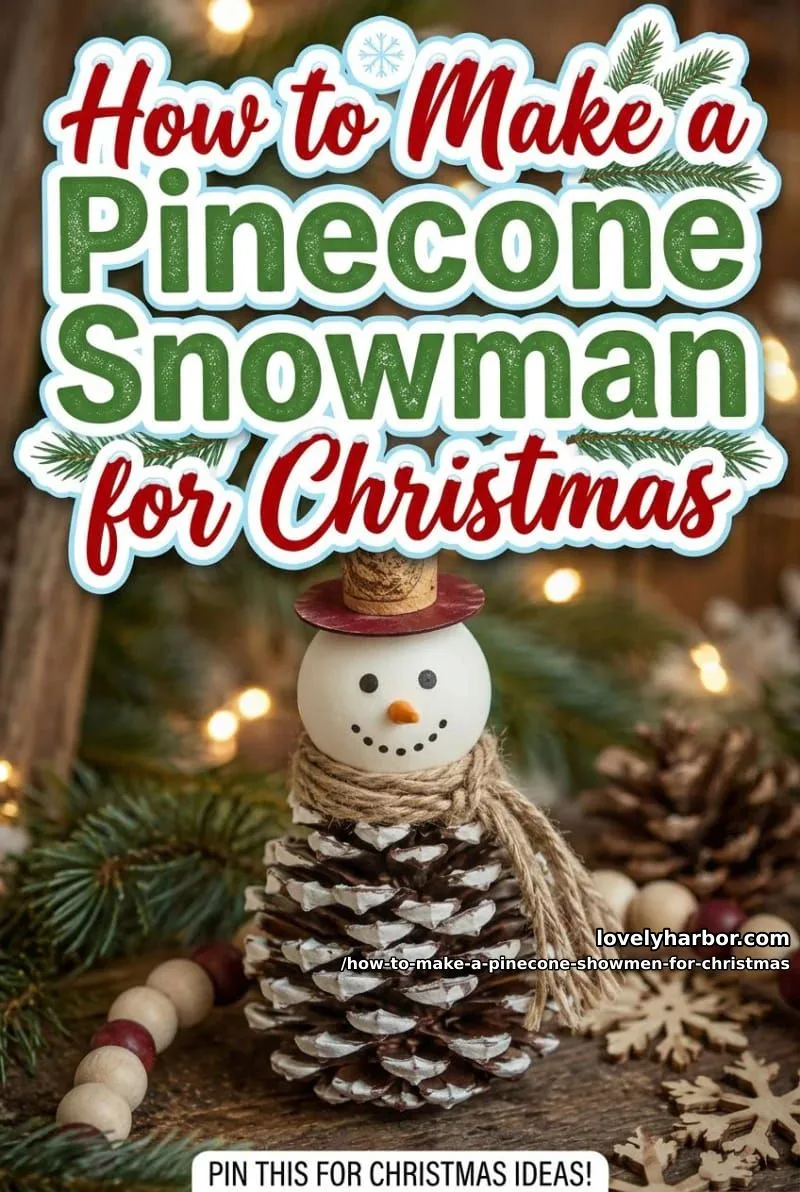
This is the little upcycled cardboard and wine cork hat version of the pinecone snowmen. A pinecone body with snow-dabbed tips, a ping pong ball for the head, a hat built from a cardboard disc and a wine cork, and a length of jute knotted at the neck for a scarf. It sits on a shelf rather than hanging on a tree, and that one fact changes everything: standing at eye level, the proportions and the face have nowhere to hide.
Keep the face restrained and it reads like something off a table at a Scandinavian Christmas market. Overdo it and you've got the lopsided craft-fair version instead. What follows is the build that stays on the right side of that line, including the one gluing step that quietly wrecks more of these than anything else.
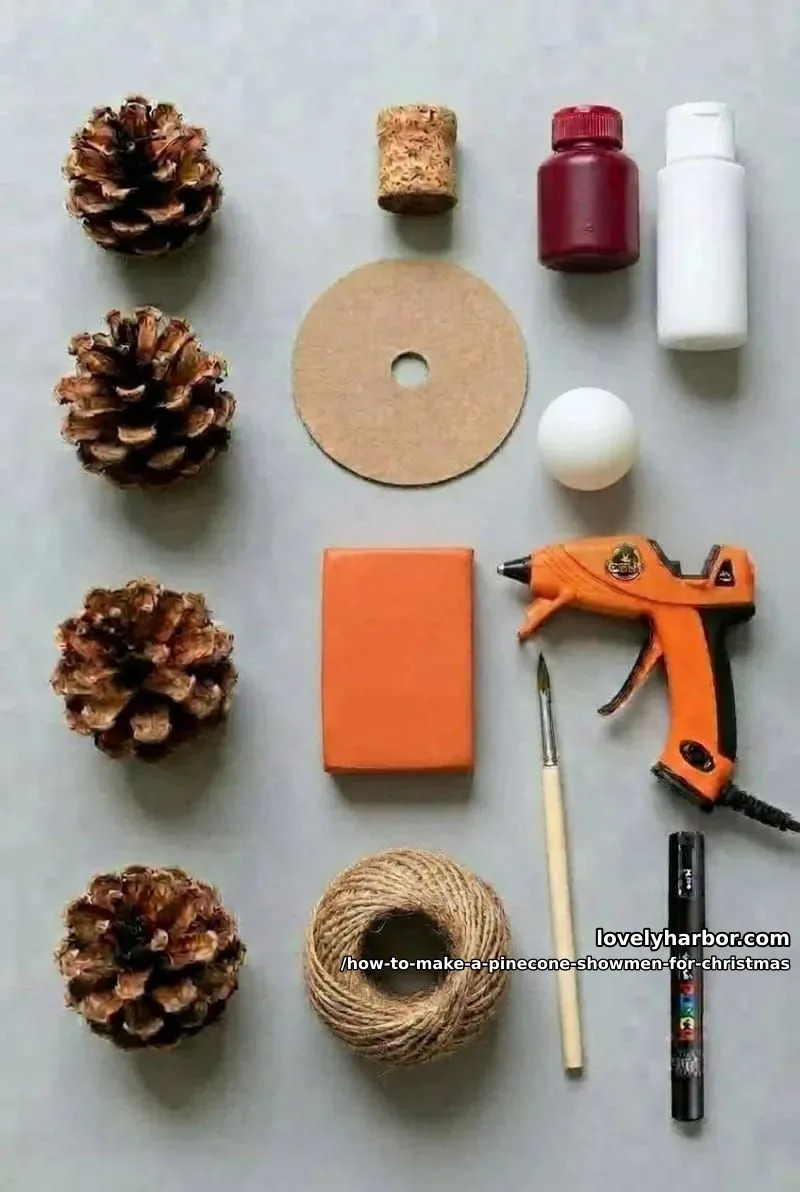
Materials and tools
Nearly everything here comes in a multipack, so the per-snowman cost lands at a few dollars even though the from-scratch total looks steep. One bag of pinecones and one tube of ping pong balls will see you through a whole windowsill of snowmen. The only things you actually use up each time are a thumbnail of clay, a little paint, and a bit of twine.
Materials (per snowman)
| Qty | Item | Spec | Price |
|---|---|---|---|
| 1 | large Ponderosa pinecone, 3 to 5 in | open, woody cone for the body; sold in packs of 12. Free if you forage one | $13 to $20 |
| 1 | white ping pong ball, 38mm | the head; PMLAND 144-pack matte white plays nicer with paint than glossy game balls | $13 to $18 |
| 1 | used wine cork | the hat crown; cut a ~1 in chunk and leave it raw. Upcycled from the recycling | Free |
| 1 | shoebox cardboard scrap | the hat brim; cut 2 to 3 discs (2 to 2.4 in) and glue into a stack. Upcycled | Free |
| 1 | natural jute twine, 3mm | the scarf; one thick ball does dozens | $7 to $11 |
| 1 | orange polymer clay, 2 oz | the carrot nose; Sculpey III “Just Orange,” oven-bake | $2 to $4 |
| 1 | white acrylic craft paint, 8 oz | snow on the scale tips; Apple Barrel matte | $5 to $9 |
| 1 | matte craft acrylic, berry red or forest green | the festive brim color; one small bottle, the same Apple Barrel matte line works | $0.6 to $6 |
| 1 | black extra-fine paint marker | eyes and mouth; Posca PC-1M, 0.7mm bullet tip | $5 to $9 |
| 1 | white faux fur trim, 2 in wide | optional hat band; 36 ft roll, cut a thin strip | $8 to $13 |
| Materials subtotal | $40 to $70 | ||
Tools (you keep these)
| Qty | Item | Spec | Price |
|---|---|---|---|
| 1 | mini hot glue gun with sticks | Gorilla dual-temp kit, includes 30 mini sticks | $13 to $20 |
| 1 | scissors | for cutting the fur and twine; probably in a drawer | $0 to $12 |
| 1 | stiff flat craft brush | an old, slightly worn brush dry-brushes snow better than a new one | $0 to $8 |
| Tools subtotal | $13 to $40 | ||
| Combined total (buying everything from scratch) | $53 to $110 | ||
Prices are approximate ranges as of May 2026; verify before purchase. Most items are multipacks, so the real cost per snowman after the first one is closer to $3 to $5.
Step 1: Pick and prep the body
The pinecone does most of the visual work, so be picky about it. You want one that's open and fat and woody, with a flattish bottom that already wants to stand on its own. Ponderosa cones earn their place here because the scales are broad and curved, a big surface for the white paint to catch. A skinny, tightly closed cone just photographs like a little fir tree, and no amount of paint fixes that.
Do this
- A fully open cone, 3 to 5 inches, with broad rounded scales.
- Look for a naturally flat base, or one you can trim flat, so it stands without help
- Foraged cones go in a 200°F oven for 30 minutes, which kills any bugs and locks the scales open
Avoid
- Long, narrow, closed cones. They read as a tree, not a body.
- Anything with a heavy curved stem end; it tips over and won’t sit flat
- Damp forest cones you haven’t baked , they slowly close back up, and they sometimes arrive with mites
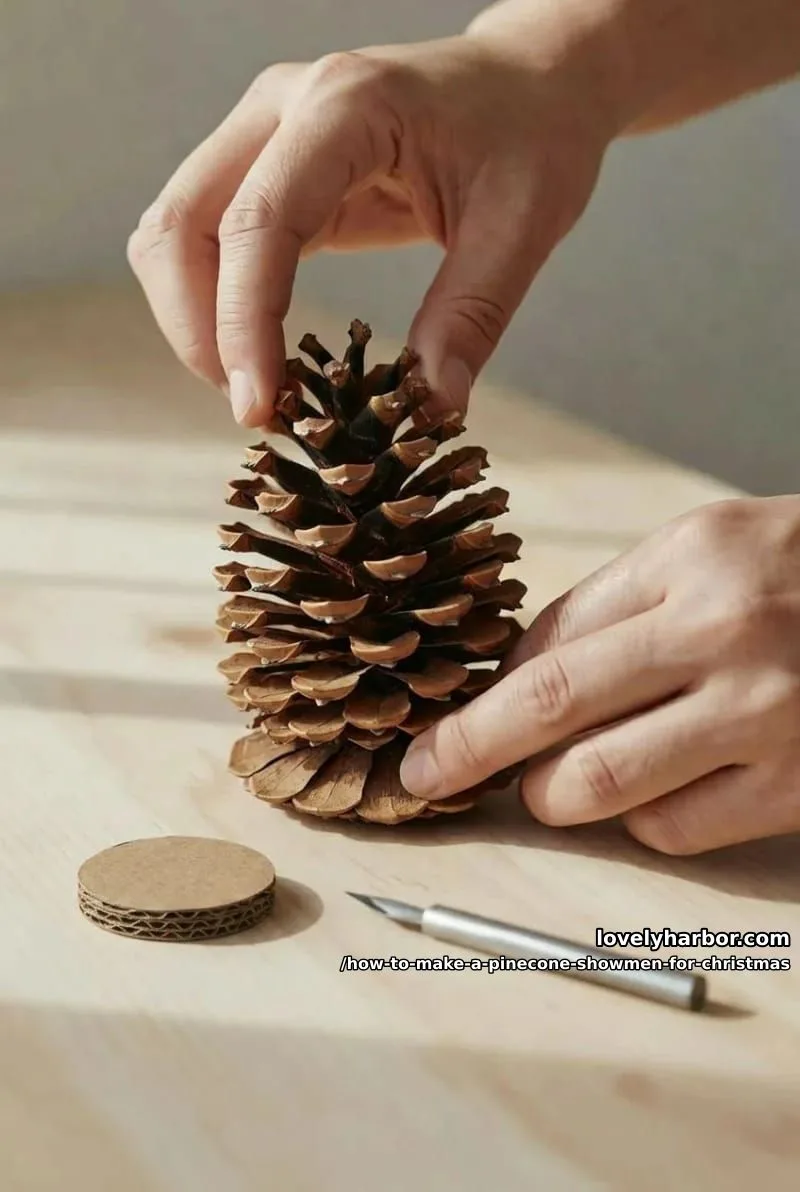
Set the cone on the table base-down and let go. Wobbles or leans? Snip a few bottom scales flat with the craft knife, or hot glue the pinecone to a circular cardboard or wooden base if you don't want to break the bottom part of the pinecone. Wide cone, smaller ball on top; narrow cone, smaller ball still. The head should always read as clearly smaller than the body.
| Pinecone height | Ball size for the head | Why |
|---|---|---|
| 3 in | 33mm (mini ball) | Keeps the head from swallowing a short body |
| 4 in | 38mm (standard ping pong) | The balanced default shown here |
| 5 in or taller | 40mm (oversize) or a 1.5 in wood ball | A tall body can carry a slightly bigger head |
Step 2: Dab on the snow
The snow is nothing but white acrylic on the raised edges of the scales, and the whole thing lives or dies on a single decision: tips only. Load a stiff, dryish brush, wipe most of the paint back off onto a scrap of cardboard, then drag the side of the bristles across the outer rim of each scale. The paint catches the high points and skips the recesses, which stay brown. That contrast is the entire trick. It's the difference between frost that settled on the cone and paint that someone clearly spilled on it.
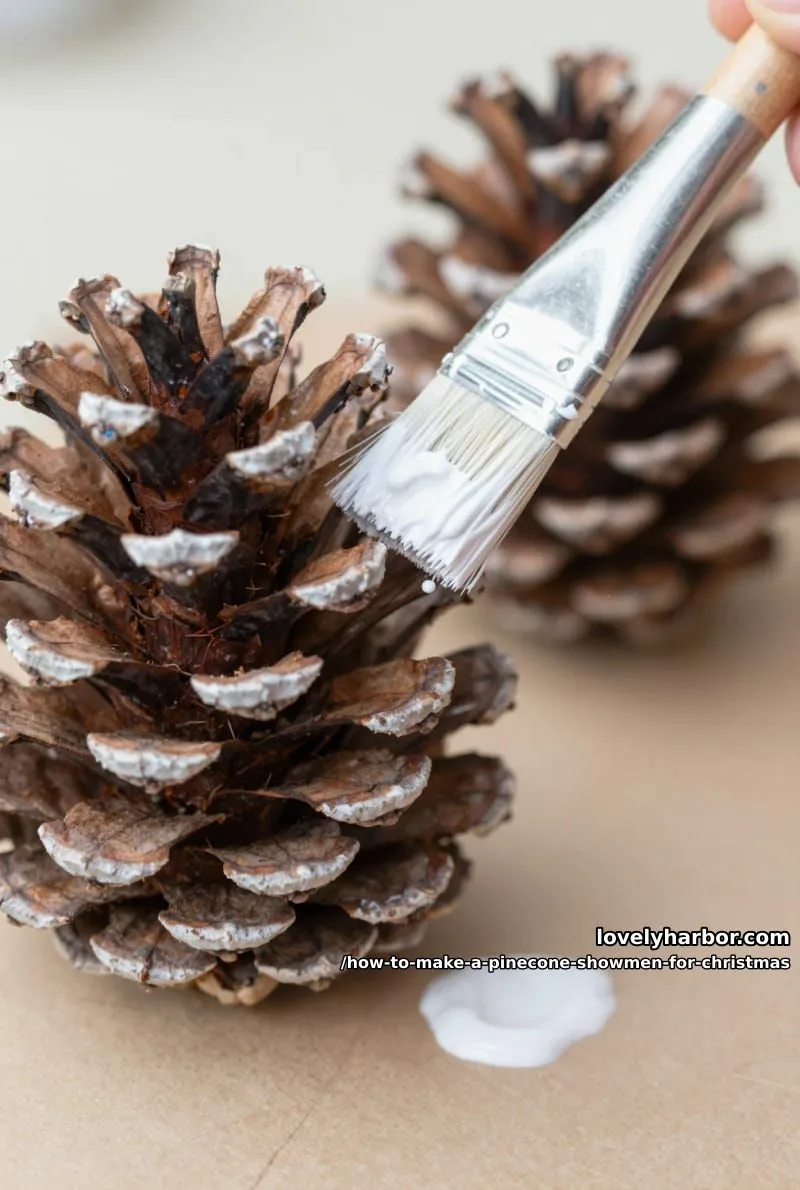
Work around the cone in passes and give it 20 minutes or so to dry; acrylic that looks streaky and patchy while wet pulls together as it sets. You can buy textured snow paste for a heavier, crustier look, but honestly plain Apple Barrel white, dry-brushed in two light passes, gives you more control and dries faster.
Step 3: Make the head and the face
I've made a dozen of these, and the ones that pass for store-bought all share a single trait: a tiny, restrained face packed into the lower third of the ball. My first one had a big confident grin drawn across the middle in Sharpie, and it came out looking faintly deranged. Small, low, close together. That's the whole secret.
Eyes: two dots set low, only about a nose-width apart, sitting just above the midline.
Nose: a short orange clay carrot, glued right at the midline, between and a touch below the eyes.
Mouth: five to seven small dots in a shallow upward arc , dots, not a continuous line. They read as stitched and friendly, and they forgive a shaky hand.
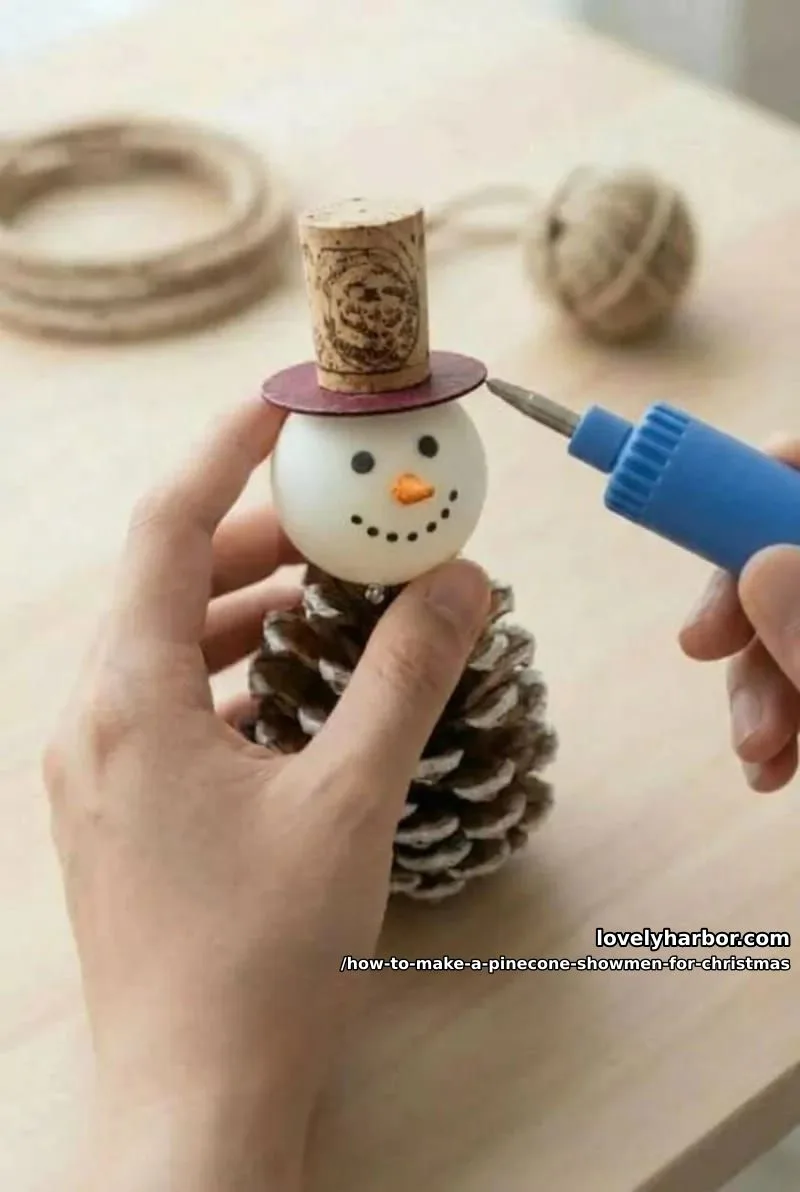
Do it in this order so nothing smears. Step 3.1, kill the shine: a glossy ball repels acrylic, so scuff it with fine sandpaper and brush on one thin coat of white , or skip the step entirely if you bought matte balls. Step 3.2, draw the features: with the black extra-fine marker, lay down the two eye dots, then the mouth. Let each dot set for a few seconds before the next so you don’t drag wet ink across the plastic. Step 3.3, make the carrot: roll a pea of orange clay into a short cone, bake it per the package (Sculpey III wants 275°F for about 15 minutes), and hot glue it on once it’s cool. No oven? A small orange wooden bead works, and so does a snipped, rolled point of orange cardstock.
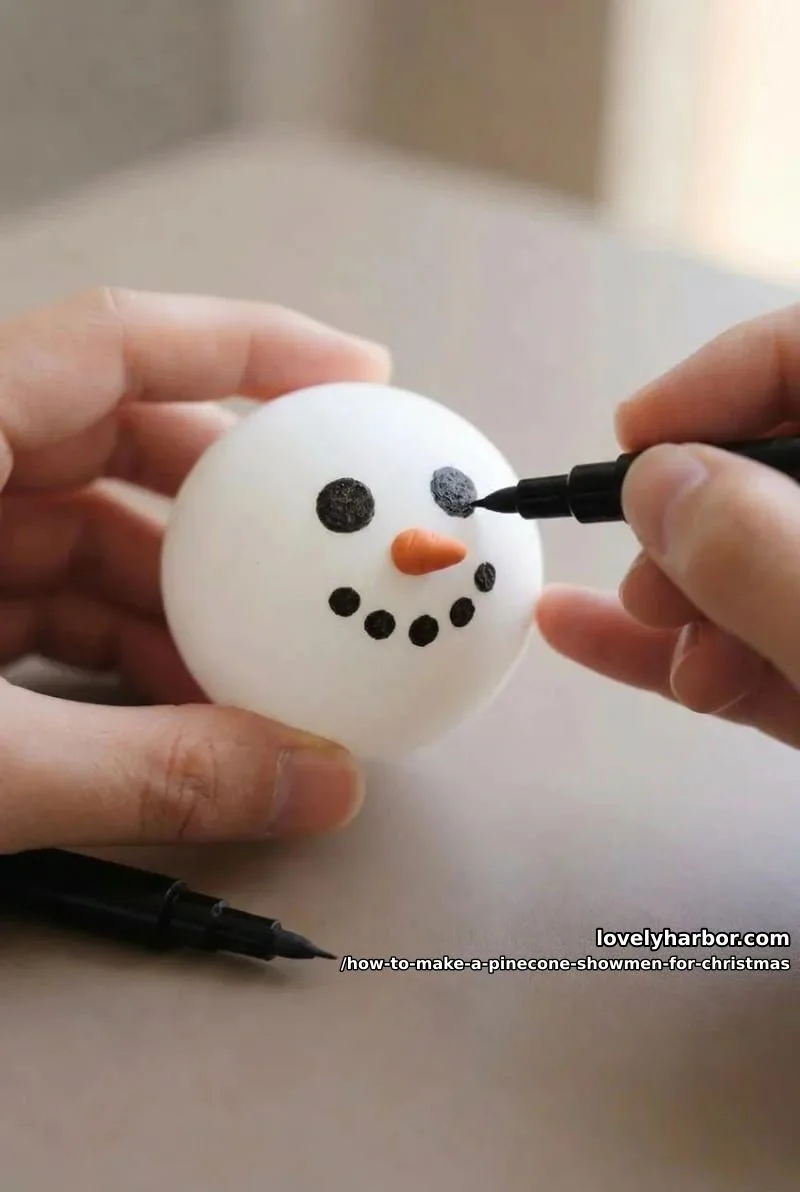
The face is the whole personality, and a bleedy marker ruins it. This one puts down a crisp opaque dot on slick plastic, exactly where a Sharpie goes gray and feathers.

Step 4: Build the cork-and-cardboard hat
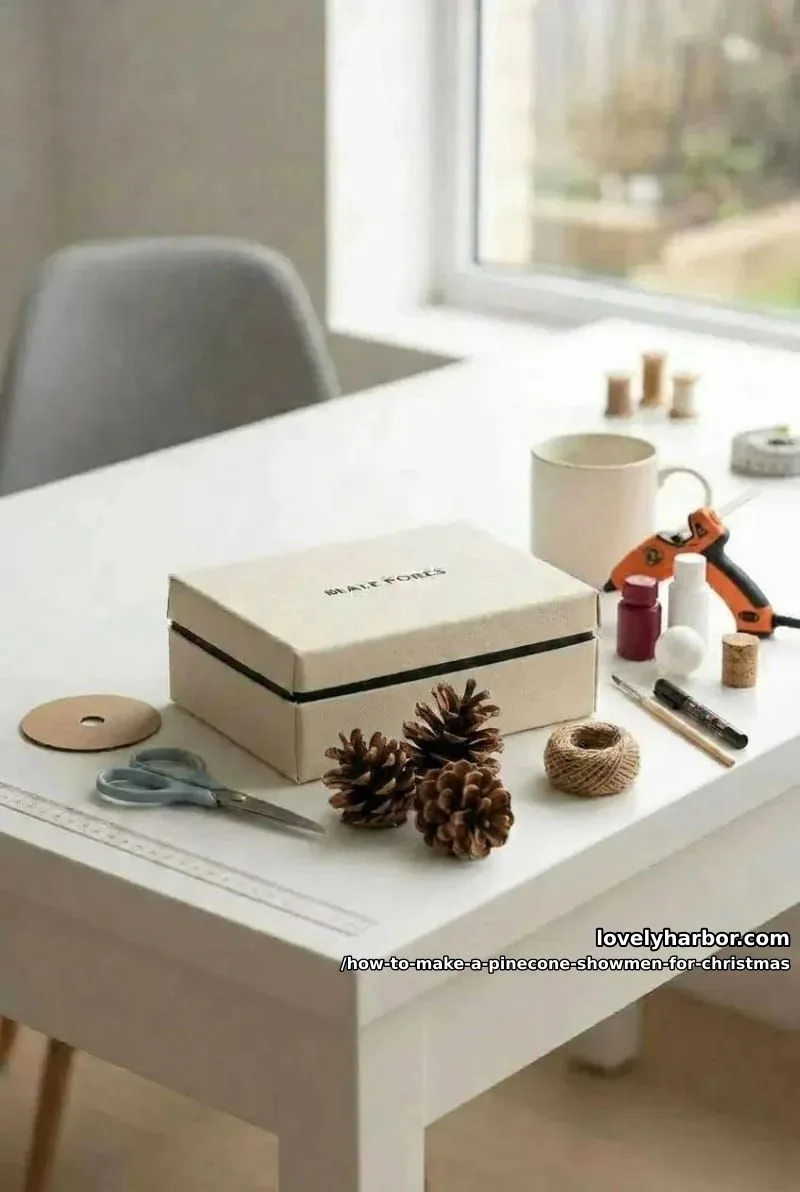
Same trick as the original, different junk drawer. The hat is still two parts pretending to be one: a flat brim and a stubby crown. Here the brim is a disc cut from a shoebox, and the crown is a chunk of wine cork. The ping pong head is light and perfectly round, so the hat earns its keep twice, it has to look like a hat and quietly lock itself onto the ball so the head stops wanting to roll.
Start with the brim. Trace a circle about 1.75–2 in (4.5–5 cm) across onto the shoebox card and cut it out. A single layer of shoebox card is too thin and floppy to read as a brim, so cut two or three identical discs and glue them into a stack. If the card is corrugated, lay each layer with the ridges crossing the one below, it stiffens the same way plywood does and stops the brim from curling.
Let the head sit into the brim
A flat disc glued onto a smooth sphere has almost nothing to grab — one bump and it slides off-center. Fix it by cutting a small round hole through the center of the stacked brim, a bit narrower than the ball, start around 1 in (2.5 cm). Now when you set the brim down, the curved top of the ping pong ball noses up into the hole instead of balancing on a flat surface, so the brim wedges onto the curve and centers itself.
It only needs to catch a few millimeters to stop the head moving. Cut the hole undersize and test-fit, widening it in small bites until the brim sits level and snug, just don’t open it up as wide as the ball, or the head pushes straight through. Easiest to cut or punch the hole in each disc before you stack them, lining the holes up as you glue.
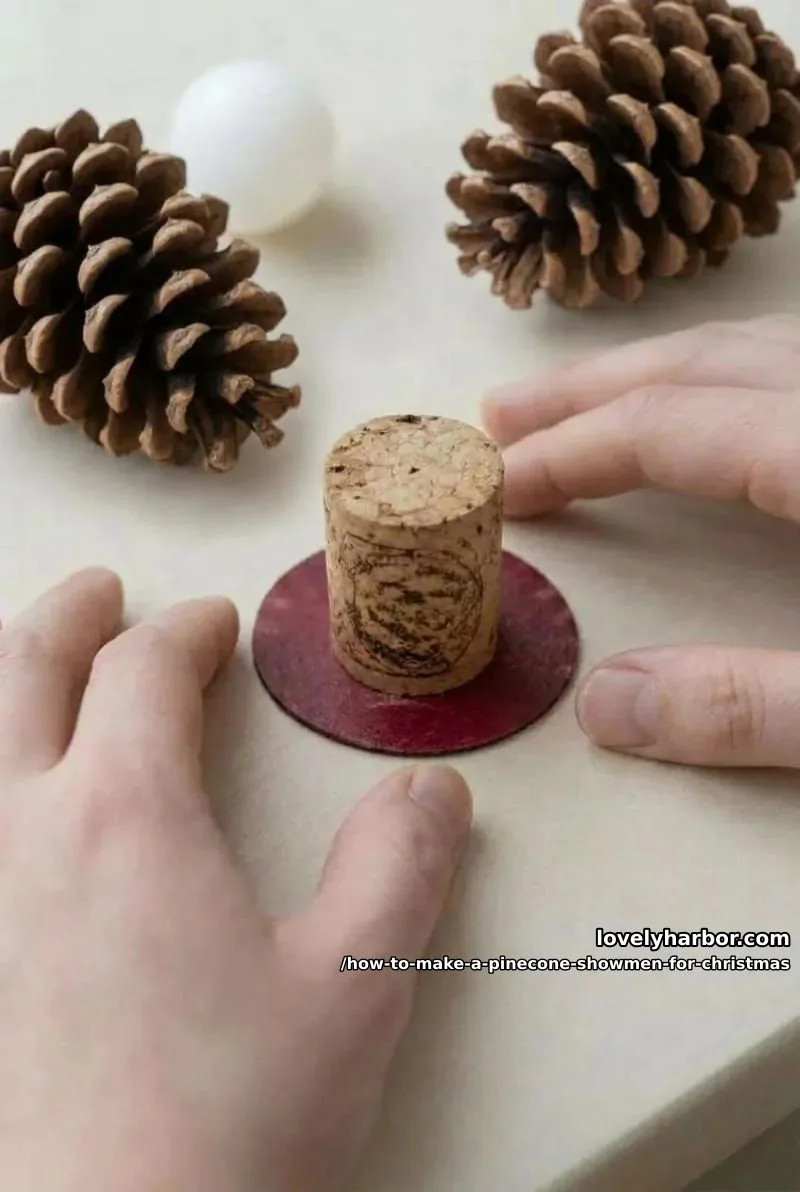
Bare cut cardboard looks like bare cut cardboard, fuzzy edges, visible corrugations, so it needs finishing either way. Skip white, though: a white brim caught between a white head and a tan cork crown just disappears. You want three readable bands, white head, colored brim, raw cork, so let the brim carry a festive color and do the separating. A deep matte berry red is the easy winner: it pops against the white head, sits warmly next to the cork and the jute scarf, and reads Christmas without shouting. A muted forest or sage green is the quieter alternative if you'd rather nod to the pine in the scene. Either way keep it matte and a touch dusty rather than a glossy primary, so it stays in the rustic family.
To apply it, brush a thin coat of watered-down PVA or Mod Podge over both faces and the edge first to seal the fuzz, let it dry, then lay down two thin coats of acrylic in your color. Keep the coats thin and dry the disc flat under a book, cardboard plus anything wet equals a warped brim if you rush it. If you'd rather skip paint entirely, a strip of red or green felt wrapped around the edge does the same job with zero warping risk. Leave the cork raw, that natural top against a colored brim and a white head is the move that keeps the whole thing from sliding into kitsch.
For the crown, cut a chunk of wine cork about 1–1.25 in (2.5–3 cm) tall, roughly as tall as it is wide for that stubby top-hat look. Stand it dead center on the brim, right over the hole, and hot glue it down; the cork caps the hole and hides the sliver of ball poking through from below. With the crown attached, run a bead of glue around the underside of the hole and press the whole hat onto the head so the ball seats into its socket. If you kept any fur trim from the scarf step, a quarter-inch band glued where the cork meets the brim is a nice echo, optional now, not load-bearing.
Do this
- Brim wider than the cork crown, always — otherwise it’s a barrel, not a hat
- Stack two or three card layers so the brim is stiff and reads as solid
- Cut the center hole undersize and widen it by test-fitting the ball
- Seal the cardboard before painting, and dry it flat under a weight
Avoid
- A brim the same width as the cork — now it’s just a cork on a cork
- A tall, narrow cork crown; the proportions tip toward wizard
- Thick wet coats on a single thin layer — the brim will curl
- A hole as wide as the ball; the head drops through instead of seating
Step 5: Assemble and tie the scarf
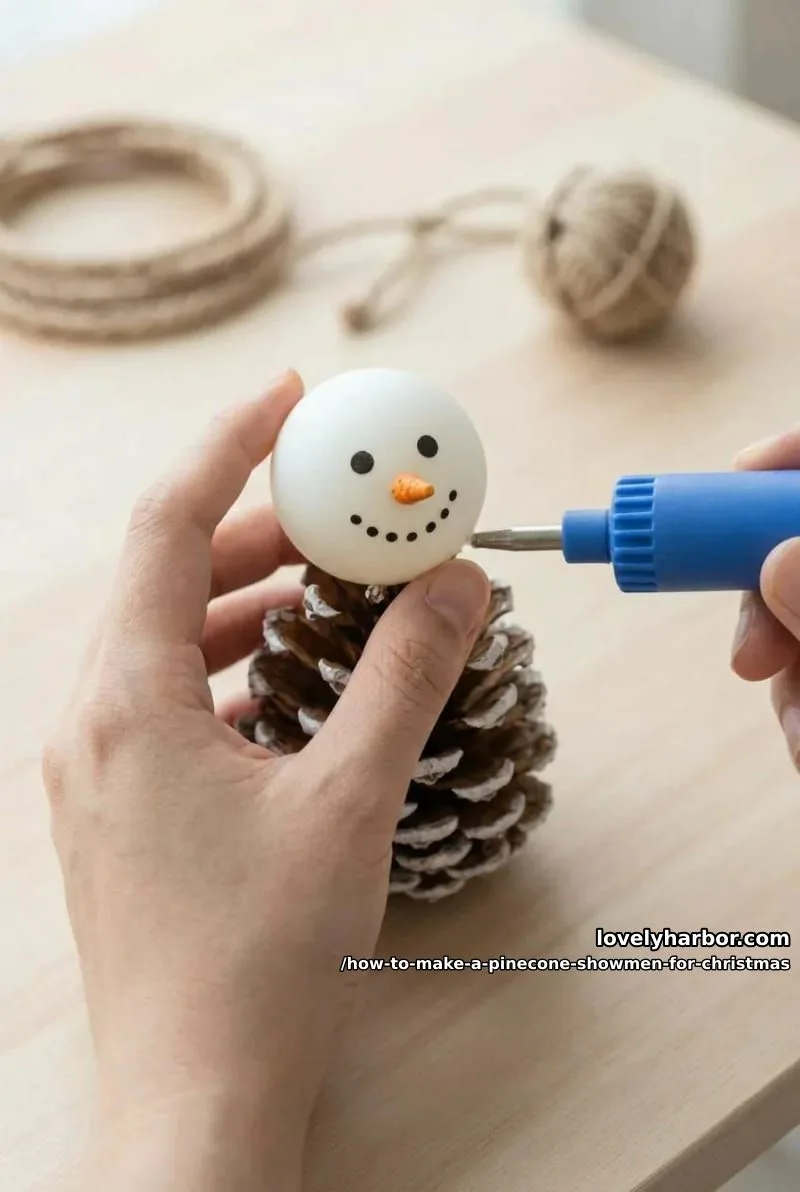
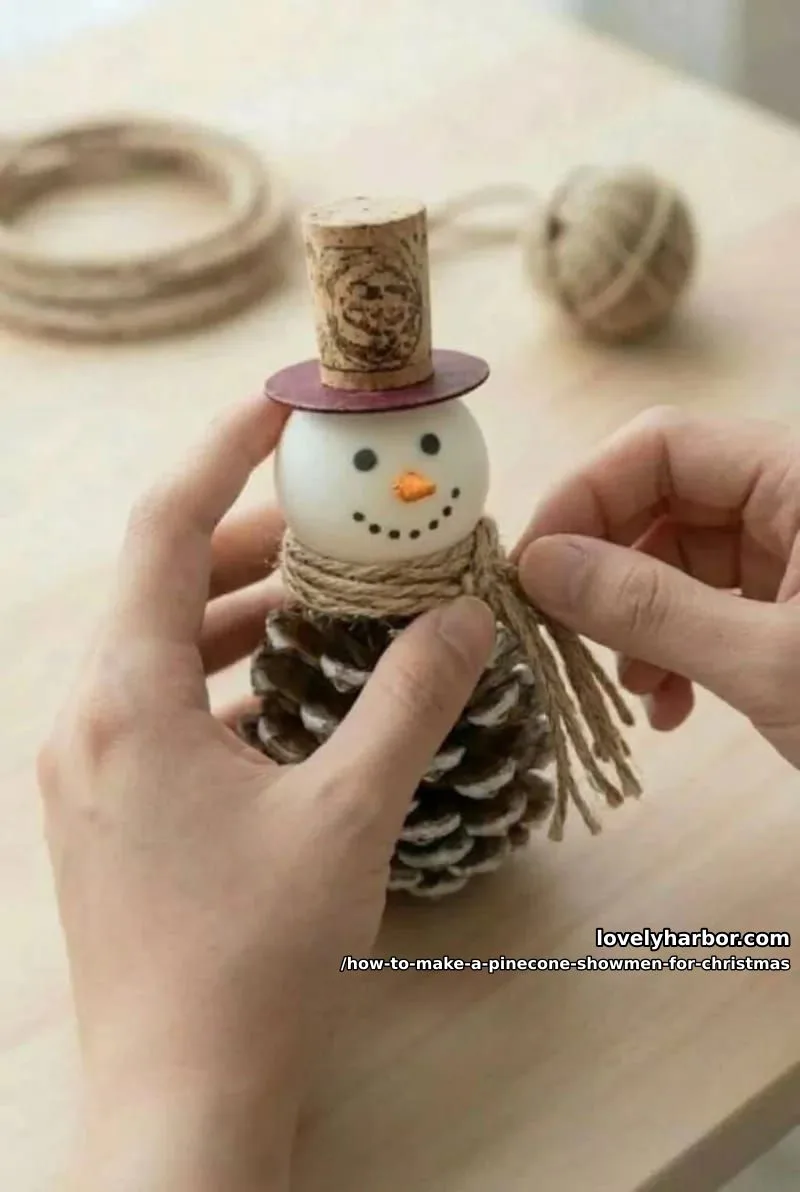
Order matters now. Head to the body first, hat to the head next, scarf last so it covers the neck seam. Run a generous bead of hot glue into the little dish at the top of the pinecone, set the ball down into it, and hold for a full 30 seconds. Then glue the hat on at a slight tilt, which looks more alive than dead level.
Mistakes that ruin a pinecone snowman
- The face is too big. Oversized or spread-out features are the fastest way to look amateur. Small dots, low and tight.
- The snow is a solid coat. White whole scales instead of just the tips and the grain disappears , the cone flattens into a blob.
- The head outsizes the body. A 40mm ball on a 3-inch cone is a lollipop. Match the head down to the body, never up.
- The hat sits dead flat. Level reads rigid; a few degrees of tilt reads as character.
- The scarf is too thin. One strand of fine twine is just string. Use 3mm jute and wrap it several times so it has some bulk.
- You skipped the bug bake. Bring an unbaked forest cone indoors and its tenants come too. 200°F, 30 minutes, problem settled.
The build sequence, start to finish
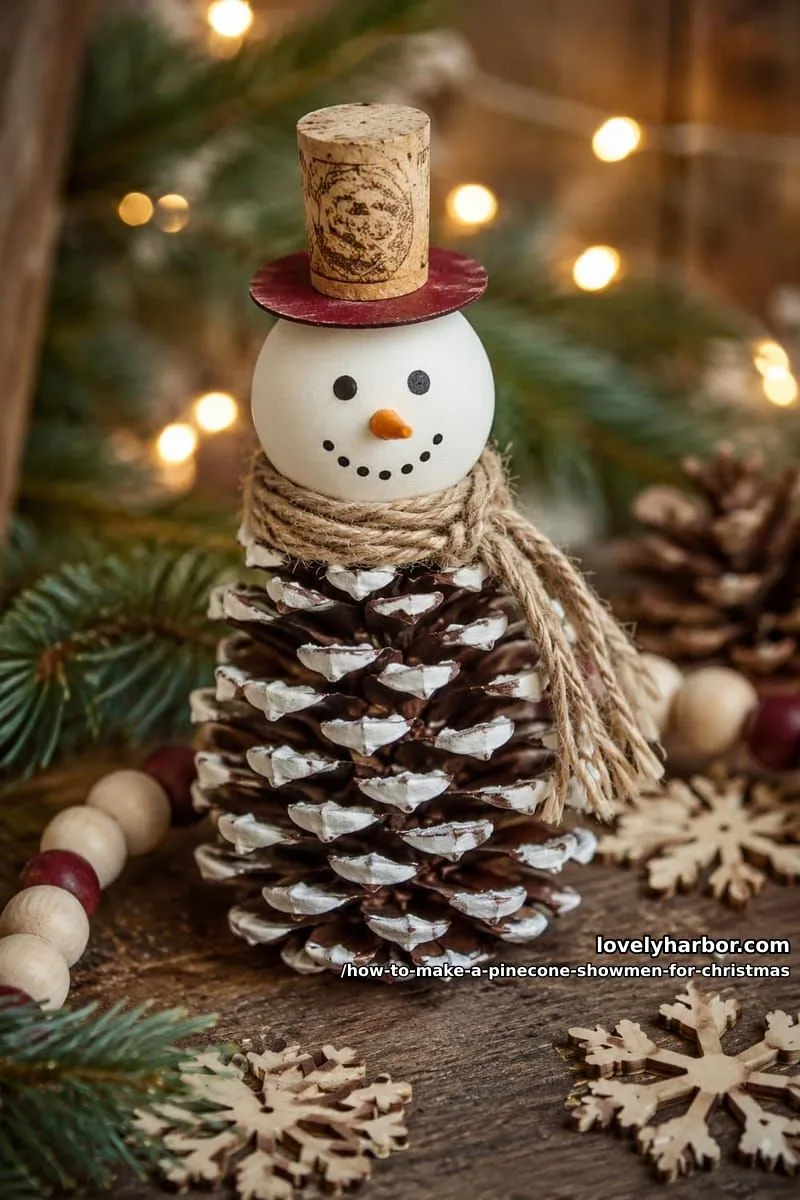
None of this is hard, but two stages need drying or curing time, so it pays to plan the order instead of racing the glue.
- First, the slow parts: dry-brush the snow onto the cone and roll the clay carrot, then bake the carrot at 275°F for about 15 minutes.
- While the carrot bakes and cools: prep and paint the ball, draw the face, and let the marker dry a few minutes.
- Around the 20-minute mark: the snow on the cone is dry to the touch, so build the hat , disc, spool, fur band.
- Final 10 minutes: glue on the carrot, the head, and the hat, then wrap and fray the scarf.
- If you used E6000 on the head instead of hot glue: leave it clamped or propped overnight before handling.
Ways to change it up
Build one and you'll see the parts are really a kit. The pinecone, the ball, the hat , change the scale or the accessories and you've got a different piece for a different corner of the house.
Tree ornament
A 2-inch cone and a 25mm ball, no standing base. Hot glue a loop of the jute to the back of the hat and it hangs.
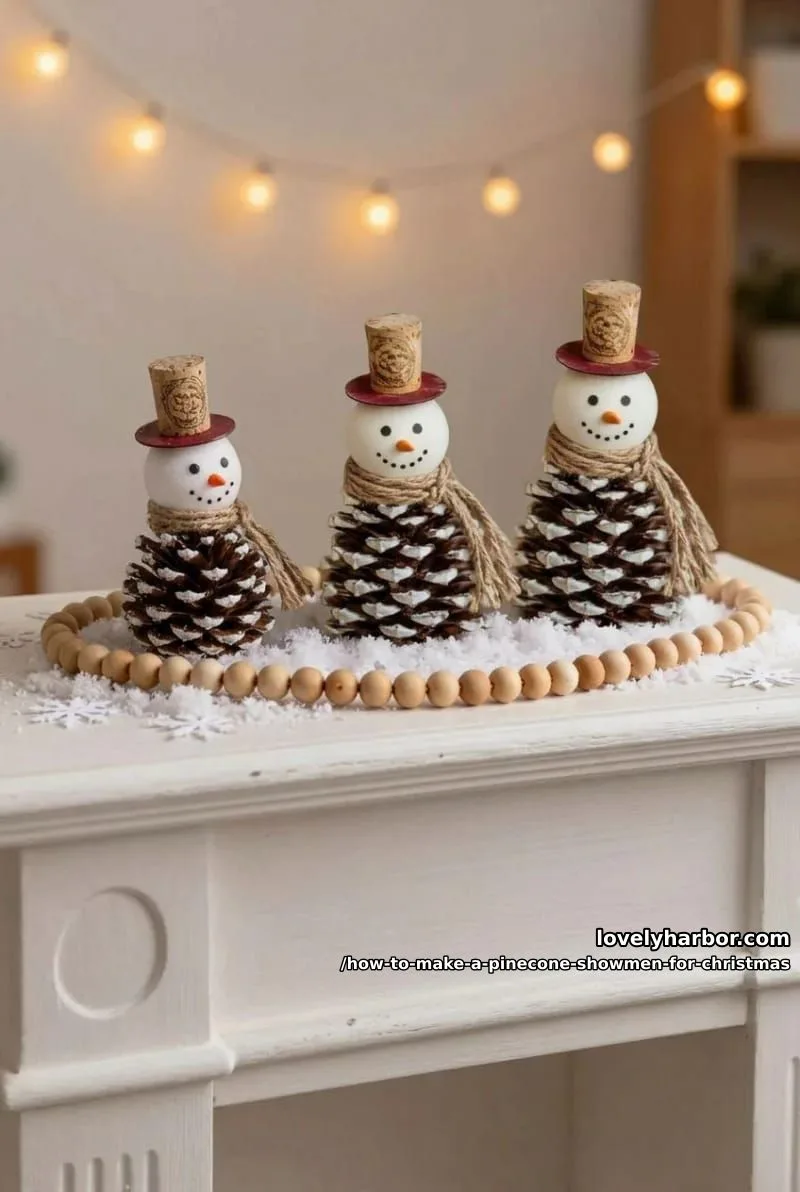
Mantel trio
Make three at 3, 4, and 5 inches and group them. Odd numbers and stepped heights look composed instead of random on a shelf.
Place-card holder
Skip the hat. Glue a small slit cork or a mini clothespin to the back, then tuck a name card in for the holiday table.
Conclusion
If you fuss over one thing, fuss over the face , and do it in the morning, not late at night when your dots start drifting large. Build a test one first and let it sit on the counter for a day. You'll catch the head that's a hair too big, or the scarf that's a touch thin, and the next one comes out right. One thing nobody tells you: save the cones with the most open, sculptural scales for the snowmen you plan to give away, and let the lopsided forest finds stay home with you.