
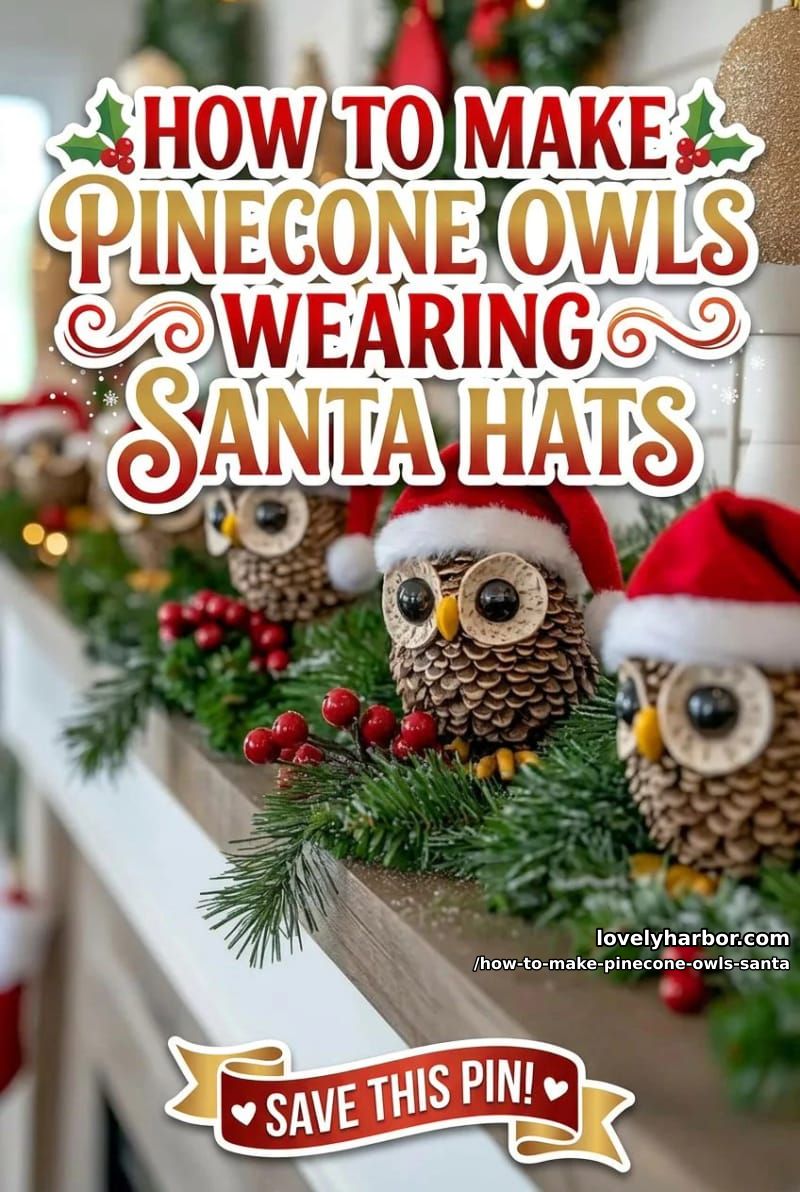
The pinecone owls you’ve saved on Pinterest are not the same craft as the pinecone owls most tutorials walk you through. The good ones have tight, feather-like scales, big concave handmade eye discs with glossy black centers, and plush velvet Santa hats almost as tall as the body.
The mediocre ones have chunky pinecones, googly eyes glued straight to the brown, and tiny stiff felt hats. This walks through the version in the photo: warm, traditional, unapologetically cute, with the specific materials and the egg-carton-pulp eye technique that get you there.
What’s in this guide
- The pinecone (round and egg-shaped, not long and skinny)
- Materials and a real shopping list
- Make the paper-pulp eye cups
- Paint the eyes and add the black centers
- Add the small pinched-felt beak
- The Santa hat (or, save yourself an hour)
- How to display them so they read as a flock
- Five mistakes that ruin pinecone owls
- Variations once you have the basic owl down
1. The pinecone (round and egg-shaped, not long and skinny)
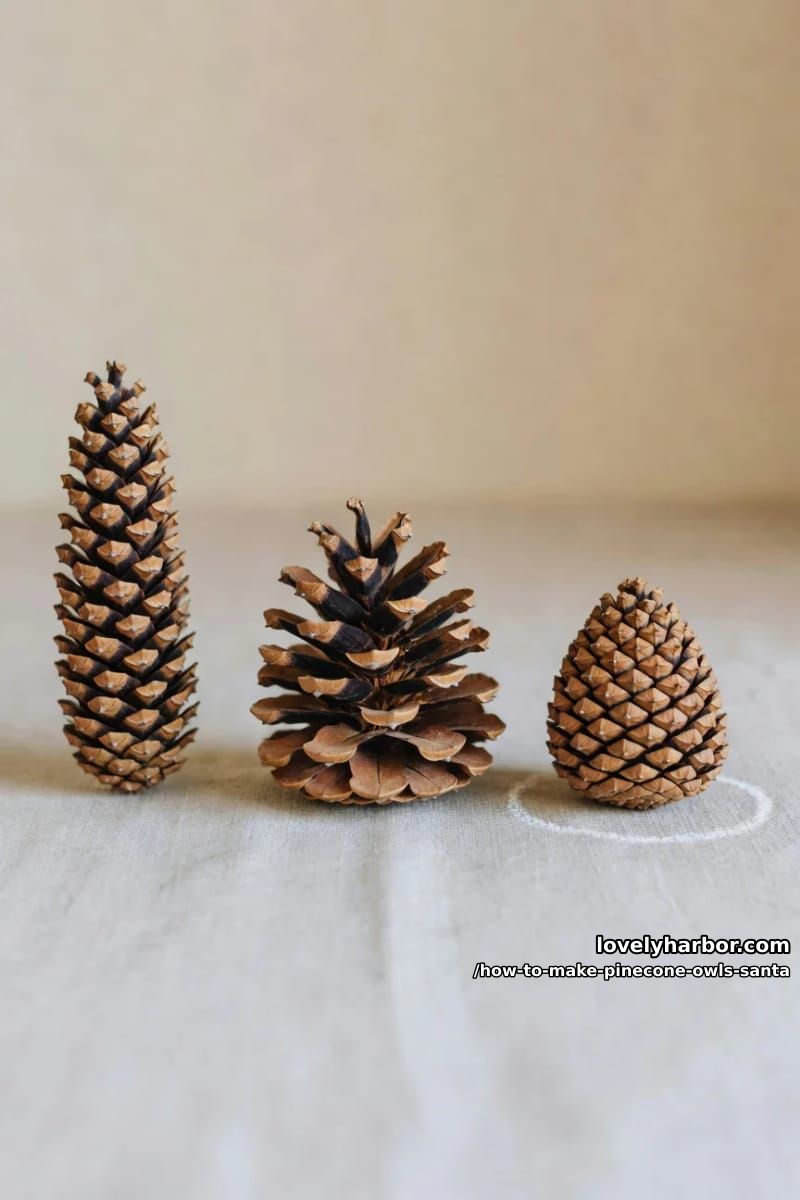
Most “pinecone owl” tutorials send you looking for tall thin cones or fat chunky cones with wide-open scales. For this owl, both are wrong. The scale pattern is doing all the feathering work, which is why no felt wings are needed and why most attempts that add them look fussy.
What to look for
- Shape: short, round, egg-shaped , almost as wide as it is tall
- Height: 3 to 4 inches
- Scales: tight, uniformly overlapping, reading like fish scales or feathers
- Surface test: at arm’s length and squinted, it should read as smooth, knit, almost like a textured sweater. If you can see daylight between the scales from across the room, keep looking.
Species that work (and don’t)
Right shape
- Shortleaf pine
- Loblolly pine
- Other round-bodied pine species
Wrong shape
- Eastern white pine (too long and thin , makes armored anteaters)
- Ponderosa (too big and gappy , makes hedgehogs in hats)
- Sugar pine (way too long)
Orient the cone the “wrong” way
Set the cone with the wide base down and the narrow tapered tip up. This is upside-down from how the cone grew on the tree, but it’s the right way for the owl:
- Wide base down → stable, owl-bodied sit
- Narrow tip up → the Santa hat sleeves cleanly over the taper
Set it stem-down (the way it grew) and you’ll get a pointy-bottomed owl that won’t stand and a flat-topped hat platform that won’t hold the hat.
Prep before you build
- Source the cones: forage in late fall from short-bodied pine species, or buy a bag of decorative round pine cones.
- Bake to clean: 200°F for 45 minutes on a foil-lined sheet.
- Why bake: dries out remaining sap and kills any hitchhiking insects.
2. Materials and a real shopping list
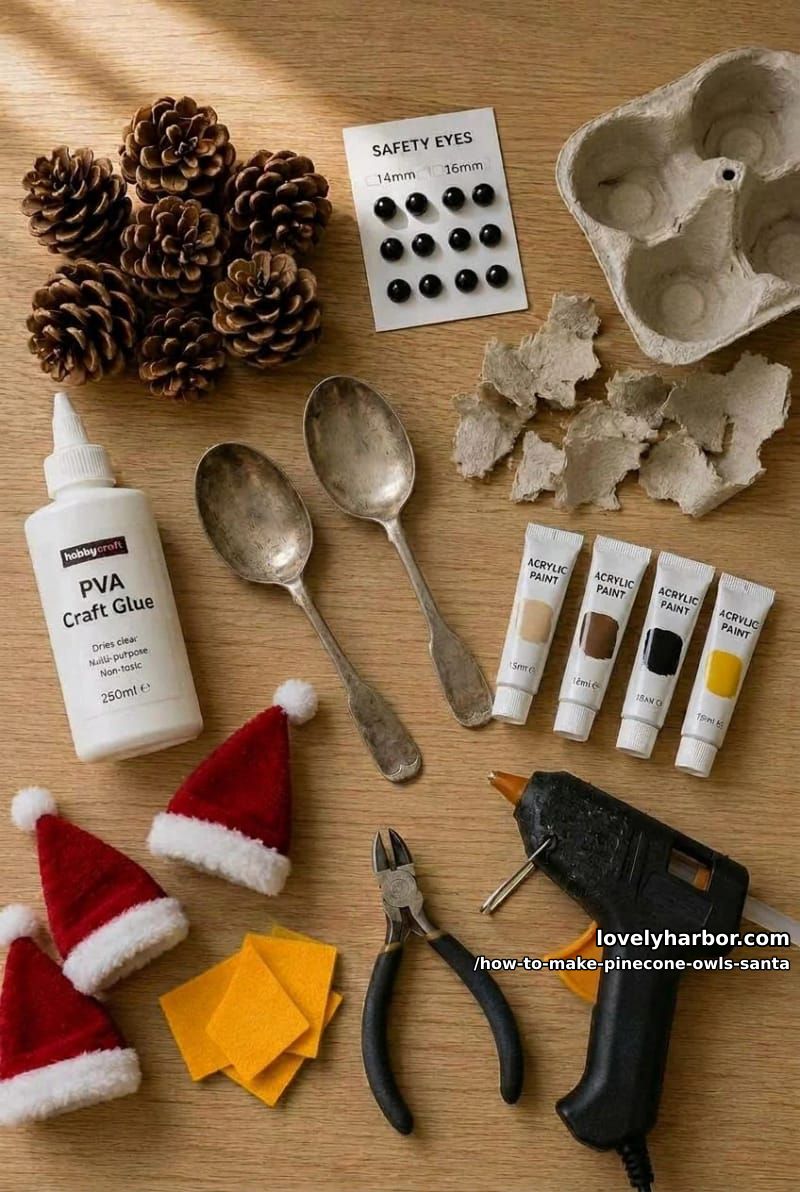
The shopping list looks long but most of it is craft-drawer staples plus one specialty item (the safety eyes). The eye discs themselves you’ll make from torn egg cartons and white glue, which means the most distinctive part of this owl costs almost nothing once you’ve finished breakfast. The list below is split into materials (what you’ll use up making the owls) and tools (one-time purchases you’ll keep for future crafts), so you can see at a glance what this actually costs if you already own a hot glue gun and a pair of wire cutters.
Supplies for a flock of six owls
Enough materials to make six owls, with leftover paint, glue, eyes, and felt for a second batch.
Materials (consumables)
| Qty | Item | Spec | Price |
|---|---|---|---|
| 6 | Round, egg-shaped pine cones | 3 to 4 in tall, chubby silhouette, tight scales | Free to $20 |
| 12 | Black cabochon safety eyes | 14mm to 16mm, glossy domed | $8 to $14 (assorted pack) |
| 2-3 | Cardboard egg cartons | paper-pulp type, not foam; saved from your kitchen | Free |
| 1 | White PVA glue (Elmer’s Glue-All) | 8 oz bottle, for binding the paper pulp | $4 to $6 |
| 1 | Acrylic craft paint set | must include titanium white, burnt sienna or umber, lamp black, yellow ochre | $12 to $18 |
| 1 | Yellow felt sheet | mustard or golden yellow, 9 x 12 in | $1 to $3 |
| 6 | Mini plush Santa hats | 5 to 3.5 in tall, flannelette or fleece, with faux-fur trim | $10 to $16 |
| Materials subtotal | $35 to $77 | ||
Tools (one-time, reusable)
| Qty | Item | Spec | Price |
|---|---|---|---|
| 1 | Mini hot glue gun + sticks | low-temp, 10W to 20W | $10 to $20 |
| 1 | Small wire cutters or flush cutters | for trimming safety-eye stems | $6 to $12 |
| Tools subtotal | $16 to $32 | ||
| Combined total(if you need to buy everything from scratch) | $51 to $109 | ||
Prices are approximate ranges as of early 2026; verify before purchase.
You’ll also need a few things from the kitchen and craft drawer that aren’t worth listing: two matching deep spoons or small ladles as molds, plastic wrap or a little cooking oil to release the pulp, scissors or a craft knife, and an old toothbrush for paint speckling.
3. Make the paper-pulp eye cups
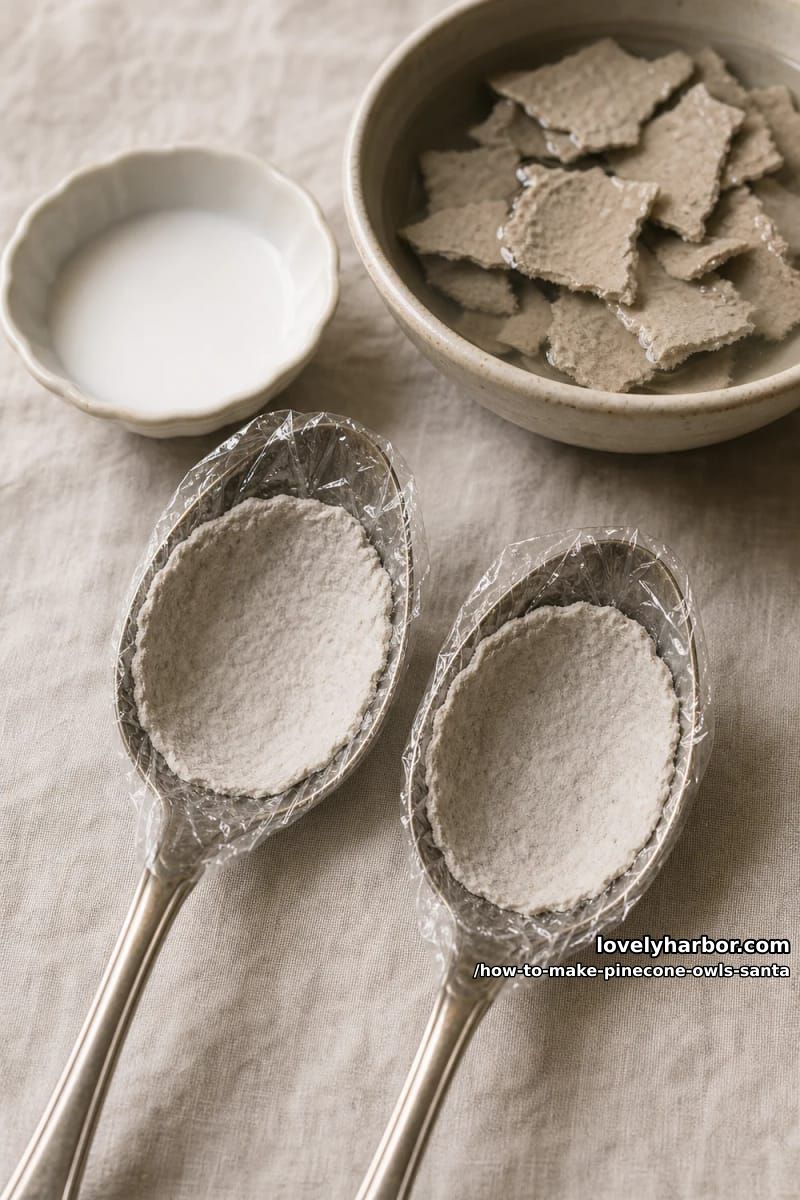
This is the single most important step in the whole craft. The big concave eye discs in the reference photo are not wood slices, cork rounds, or white felt. They’re homemade paper pulp, molded over the back of a deep spoon, dried hard, and painted. The handmade speckled texture is what gives the face its rustic-but-not-childish quality, and you cannot reproduce it with store-bought materials. Plan on starting these on day one, since the discs need 24 to 48 hours to fully dry before you can paint and assemble.
Step 3.1 — Make the paper pulp
- Tear 2 to 3 cardboard egg cartons into small pieces, roughly 1 inch across. Use the paper-pulp kind only; styrofoam cartons will not work.
- Soak in a bowl of warm water for several hours, or overnight if it’s easier.
- Mash by hand until uniform, or pulse briefly in a blender (a few seconds , you want fiber, not slurry).
- Squeeze out the excess water with your hands until you have a damp, clay-like wad.
- Mix in white PVA glue a tablespoon or two at a time, kneading between additions, until the pulp holds its shape like soft modeling clay.
Too wet: drips off your fingers, won’t hold an edge, sags out of the spoon. → Squeeze out more water and add another small spoonful of glue.
Too dry: crumbles instead of compressing, leaves visible chunks. → Sprinkle in a teaspoon of warm water and re-mash.
Just right: behaves like damp clay; you can shape it, press it thin, and it holds the spoon’s curve without sagging. A small ball pressed between two fingers should flatten and hold the shape.
Step 3.2 — Mold the eye cups
- Line two matching deep spoons(or small ladles) with plastic wrap, or grease them lightly with cooking oil or Vaseline so the pulp will release later.
- Press a thin layer of pulp into each spoon, about 5 to 8 mm thick, covering an area roughly 1 to 1.25 inches across.
- Smooth the surface with damp fingers.
The shape you’re after is a shallow, slightly concave disc that mirrors the curve of the spoon: cupped enough to cradle the safety eye, not so deep that it looks like a satellite dish. Use the same spoon for both discs of a given owl; matched curvature is what makes the face read as a face.
Step 3.3 — Dry the discs
- Let the discs dry partially in the spoons for 6 to 12 hours.
- Turn them out carefully once they hold their shape.
- Trim the edges into clean circles with scissors or a craft knife while the pulp is still slightly pliable.
- Leave them to fully dry for another 24 to 48 hours in a spot with good airflow, until they’re hard, lightweight, and slightly off-white.
Step 3.4 — Optional adjustments
- For stronger discs: mix in a pinch of tissue paper fibers or a teaspoon of flour-and-water paste with the pulp for added structural strength.
- For a smoother finish: stir a small spoonful of joint compound or fine flour into the pulp. Skip this if you want the rustic, slightly bumpy look in the reference photo (recommended).
- To speed up drying: place the discs on a wire rack near a fan or in a warm dry room. Don’t use an oven; the glue can scorch.
4. Paint the eyes and add the black centers
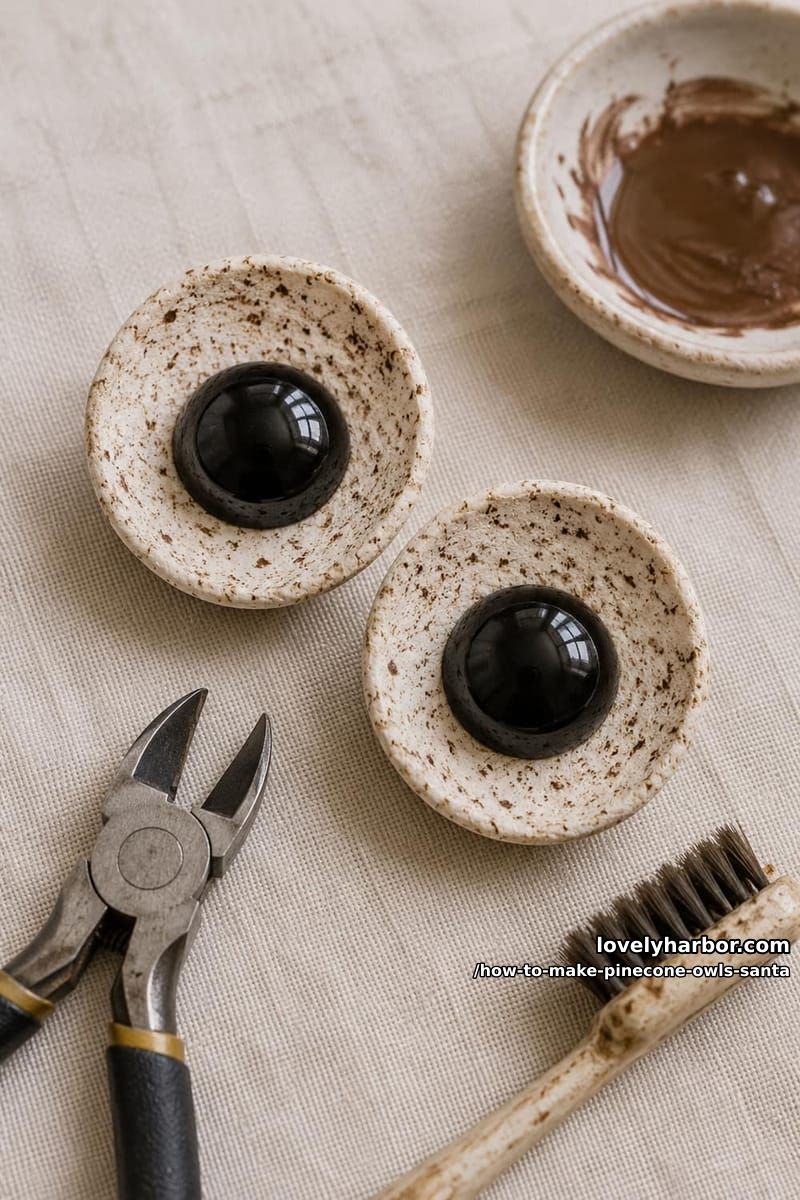
Step 4.1 — Base coat the discs
- Paint two thin coats of off-white, cream, or light beige acrylic over each dry disc.
- Let each coat dry fully before adding the next. Thin coats beat one thick coat every time.
Step 4.2 — Add the speckles
Speckles are what turn a plain disc into something that looks handmade. Skip them and the discs read as cheap craft foam. Pick one of these methods:
- Toothbrush flick (preferred): dip an old toothbrush in slightly thinned burnt sienna or burnt umber, then flick the bristles toward the disc with your thumb. Aim for a fine spray, not blobs.
- Dry brush: wipe most of the paint off a brush, then drag it lightly over the disc’s high points so only the texture catches color.
Step 4.3 — Trim and glue the cabochon centers
- Trim the post off each safety eye withwire cutters or flush cutters, leaving just the domed black cabochon.
- Glue the cabochon into the concave center of each painted disc with a dot of hot glue. The dome should sit proud of the disc, not flush.
The posts are hard plastic. Scissors slip on the rounded shaft and either bend the blades or send a small black projectile across the room. Wire cutters give a clean snip in about a second.
Substitutes for the cabochon if you don’t want to buy safety eyes: large glossy black beads, black shank buttons with the shanks snipped off, or small marbles. The requirement is glossy and solid, not flat or speckled.
Step 4.4 — Attach the eye assemblies to the pinecone
- Position both eye assemblies on the upper third of the cone, almost touching at the inner edges (a 2 to 3mm gap is plenty).
- Keep the discs flat and parallel, not angled inward. The “looking at you” effect comes from proximity and forward placement, not from tilting the discs.
- Trim any rogue scale tips that prevent the disc from sitting flat against the cone.
- Press firmly with hot glue underneath, both discs at the same height and the same forward-facing angle.
This is the one place symmetry actually matters , uneven eye height is the difference between “wise owl” and “drunk owl.”
Googly eyes have a clear plastic shell with a loose black disc that rattles inside. They look fine on a snowman. On a pinecone owl, they read as a different craft entirely (closer to Sesame Street than the photo you saved). The cabochon eye is a solid glossy half-sphere; light catches it as a single bright highlight, the way a real eye does. Skipping the paper-pulp discs and gluing googly eyes straight to the pinecone is the single most common reason home-made pinecone owls look childish.
5. Add the small pinched-felt beak
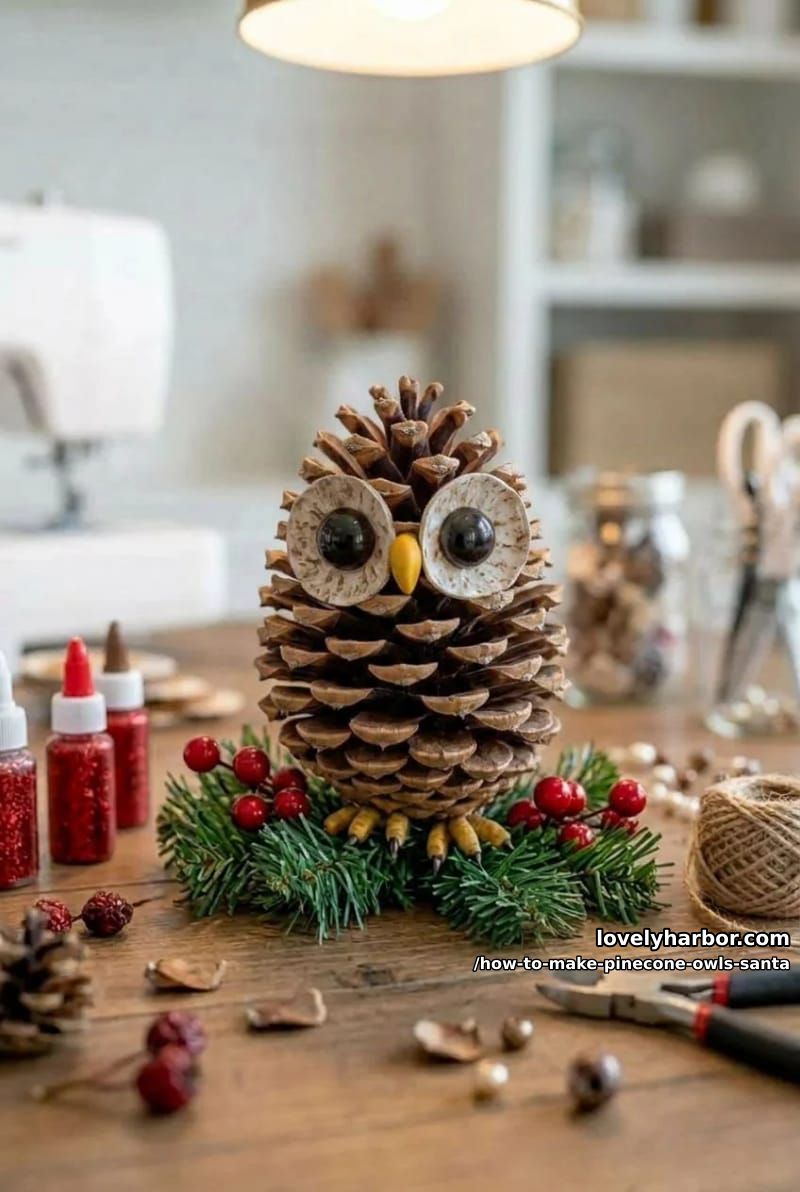
The beak is small, fast, and the only piece of felt in the entire owl.
- Cut a tiny triangle of mustard yellow felt, wider than it is tall: about 1/2 inch across the top edge and 3/8 inch from top to point.
- Pinch it gently along the vertical center so the two sides angle forward, giving it a folded-tab dimension instead of a flat sticker look.
- Tuck it pointing downward into the gap between the inner edges of the two paper-pulp discs, nestled right where they almost meet.
- Glue with one dot of hot glue on the back center.
The beak should poke out below and slightly between the eyes , not above them, not off to one side. It’s a small piece doing a lot of work, so place it deliberately.
Felt-free alternative: shape a tiny teardrop or curved cone from leftover paper pulp (or air-dry clay), let it dry, paint it yellow or ochre, and glue it in the same spot.
6. The Santa hat (or, save yourself an hour)
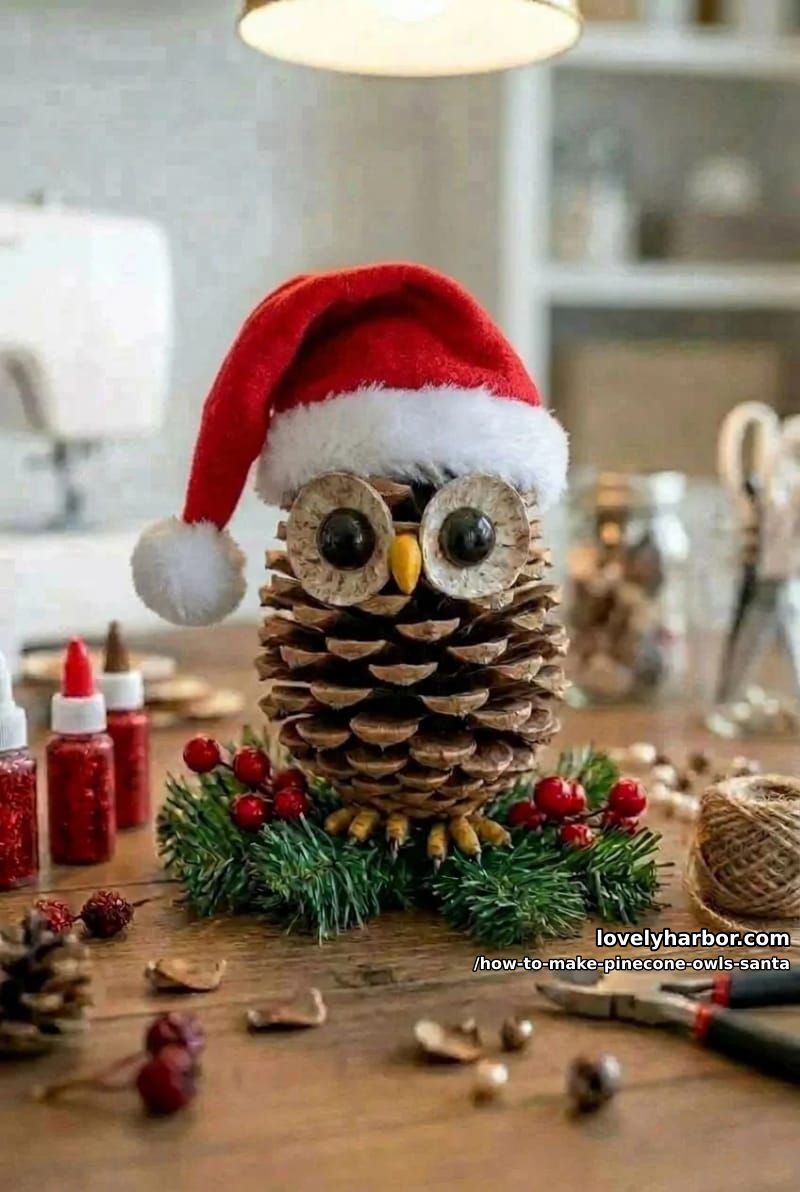
This is where I’m going to give you permission to skip the DIY. The Santa hat in the reference photo is not a hand-rolled felt cone , it’s plush velveteen or flannelette with a fluffy faux-fur trim and a soft pom-pom that flops to one side. Pre-made mini Santa hats sold for wine bottles and dolls match the look exactly, cost about $1.50 each in a bulk pack, and free up an evening.
Buy them (recommended)
- Search “mini Santa hats” or “wine bottle Santa hats”
- Pick the 2.5 to 3.5 inch size
- Material should be flannelette, fleece, or velveteen , not stiff felt
- About $1.50 each in a bulk pack
Make them (only if you must)
- Sewing or careful hot-glue work required
- Plush fabrics are tricky to roll into a clean cone
- Faux-fur trim sheds while you cut it
- Takes 20–30 minutes per hat versus 0 minutes for store-bought
Hat height: 80 to 90% of pinecone height. On a 3.5-inch cone, that’s a 2.75 to 3.25-inch hat. Substantial.
Fabric: bright warm red (not orangey, not dark crimson) in velveteen, fleece, or flannelette. The nap is visible at conversational distance, which is the point.
Trim: 1/4 to 1/3 of hat height, in fluffy faux fur or marabou. Wraps the full base.
Pom-pom: 20 to 25mm (~1 inch), faux fur or fluffy, not a tight yarn ball.
Set: upright and centered, with a soft forward slump near the top. Slight forward tilt over the eyes, not aggressively off-axis.
Attach the hat
- Apply a bead of hot glue around the inside base of the hat.
- Sleeve the hat over the narrow top of the pinecone.
- Position the white trim on the “forehead,” almost touching the top edges of the paper-pulp discs.
- Press and hold for 10 seconds while the glue sets.
The hat does most of its own holding because it sleeves over the tapered cone , the glue is insurance, not structure.
7. How to display them so they read as a flock
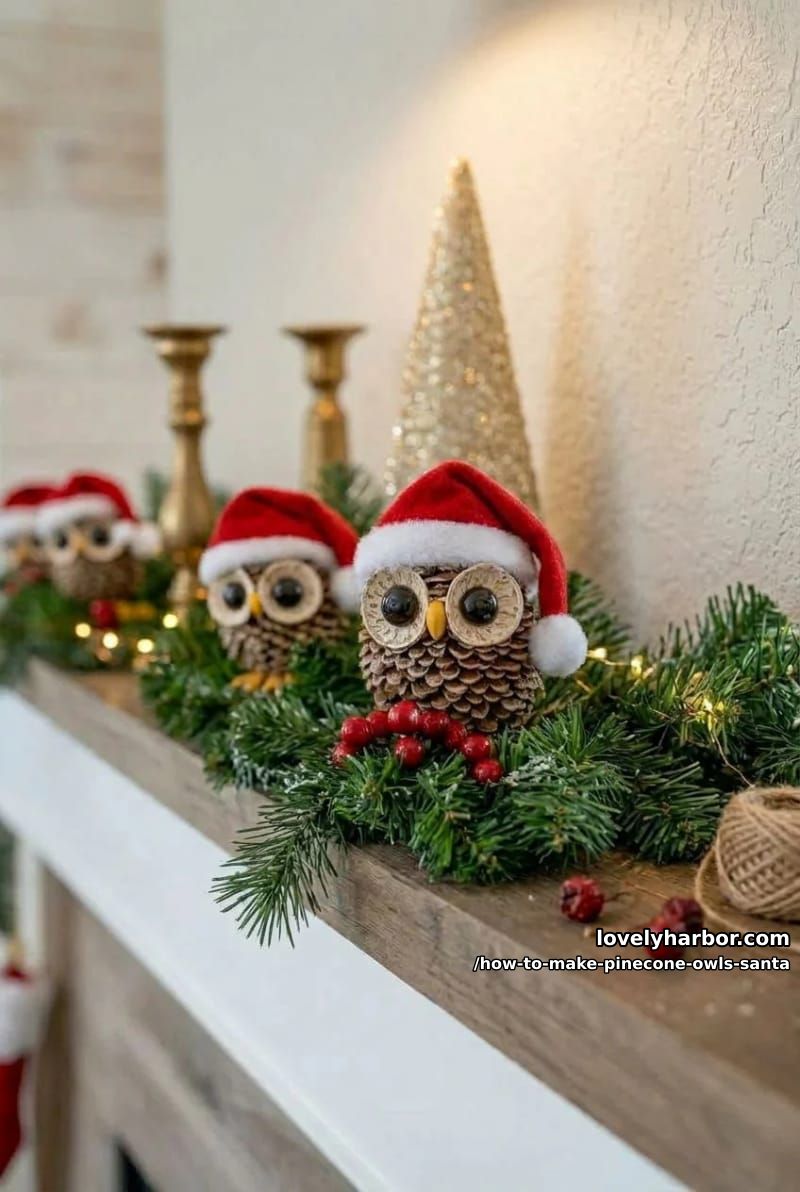
How many owls = a flock
- 1 owl: looks like someone forgot to finish decorating
- 2 owls: a couple
- 3 to 5 owls: a proper flock , the sweet spot for most mantels
- 6 or more: starts to look like a Christmas-market kiosk
Cluster them close enough to almost touch, with fresh greenery weaving between them and a few small red berries tucked in. Make at least three.
Do this
- Cluster in odd numbers among fresh fir, cedar, or pine garland
- Tuck small clusters of red holly-style berries near the base of each owl
- Place them at the front edge of the mantel where the eyes catch lamplight
- Vary the height slightly by setting some on small wood slices or stacked books as risers
Avoid
- Lining them up in a row, evenly spaced, facing forward like a class photo
- Setting them against a dark background with no warm light; the cabochon eyes need a highlight to read
- Fake snow batting underneath, which dates the scene by about three decades
- Mixing with cartoonish plastic Santas; the scale difference makes the owls look stranded
8. Five mistakes that ruin pinecone owls
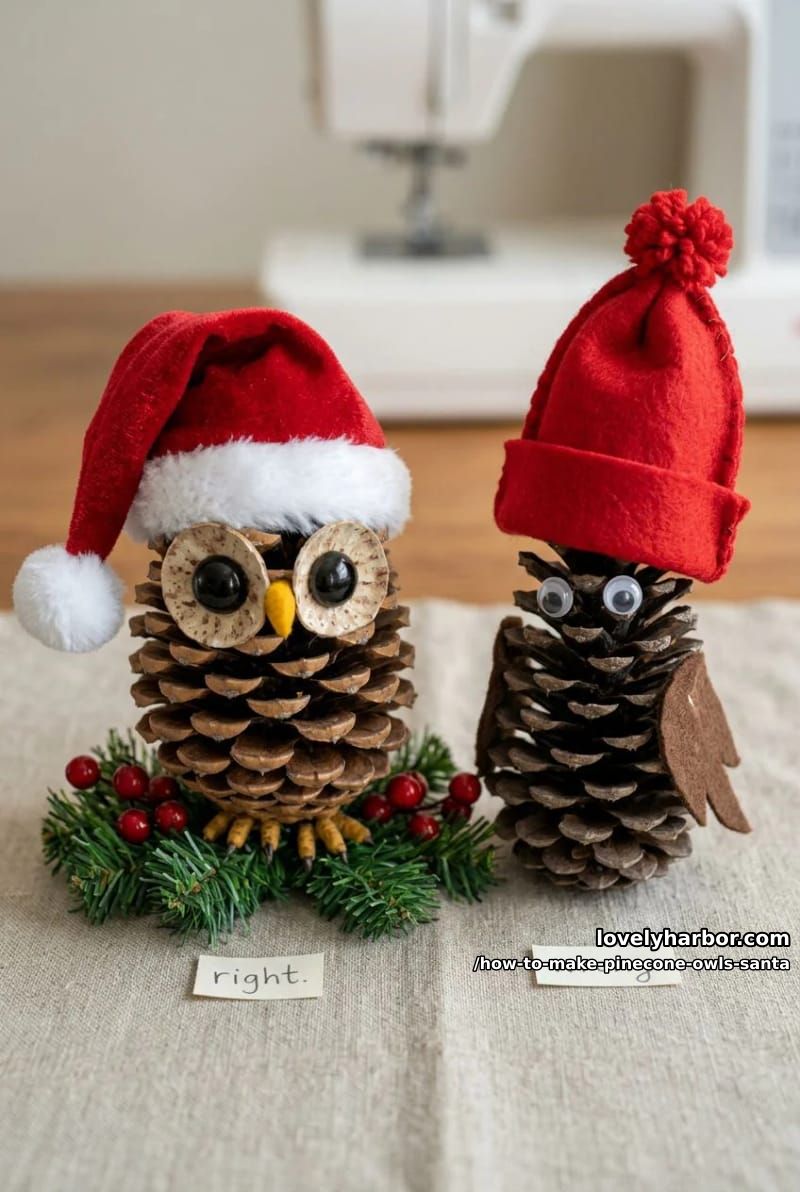
I made every one of these the first time around. The first batch I tried looked like a row of grumpy little hedgehogs. The second batch had eyes the size of seed beads. The third batch I substituted white felt for paper-pulp discs because I didn’t want to mess with the pulp; it took five minutes to see that the felt was wrong. None of those owls made it to a second Christmas.
- Wrong pinecone shape. Long thin cones make armadillos. Big chunky open cones make hedgehogs. You want short, round, and tight-scaled , almost as wide as it is tall.
- Googly eyes instead of cabochons. Switch the eye type and the entire mood of the craft shifts. The glossy solid dome is what gives the eye a single bright highlight; googly eyes scatter light through the plastic shell and look hollow.
- Flat felt circles instead of cupped paper-pulp discs. The concave shape and speckled handmade texture of the pulp discs are doing 80 percent of the visual work. Flat white felt circles, no matter how big, look like school-craft eyes.
- Hat too small. A modest 1-inch felt cone looks adequate on the workbench and stingy on the mantel. The hat should be nearly as tall as the body and visibly plush.
- Adding felt wings. The scales already feather the body. Felt wings on top are the move that ages the craft into Sunday-school territory. Skip them.
9. Variations once you have the basic owl down
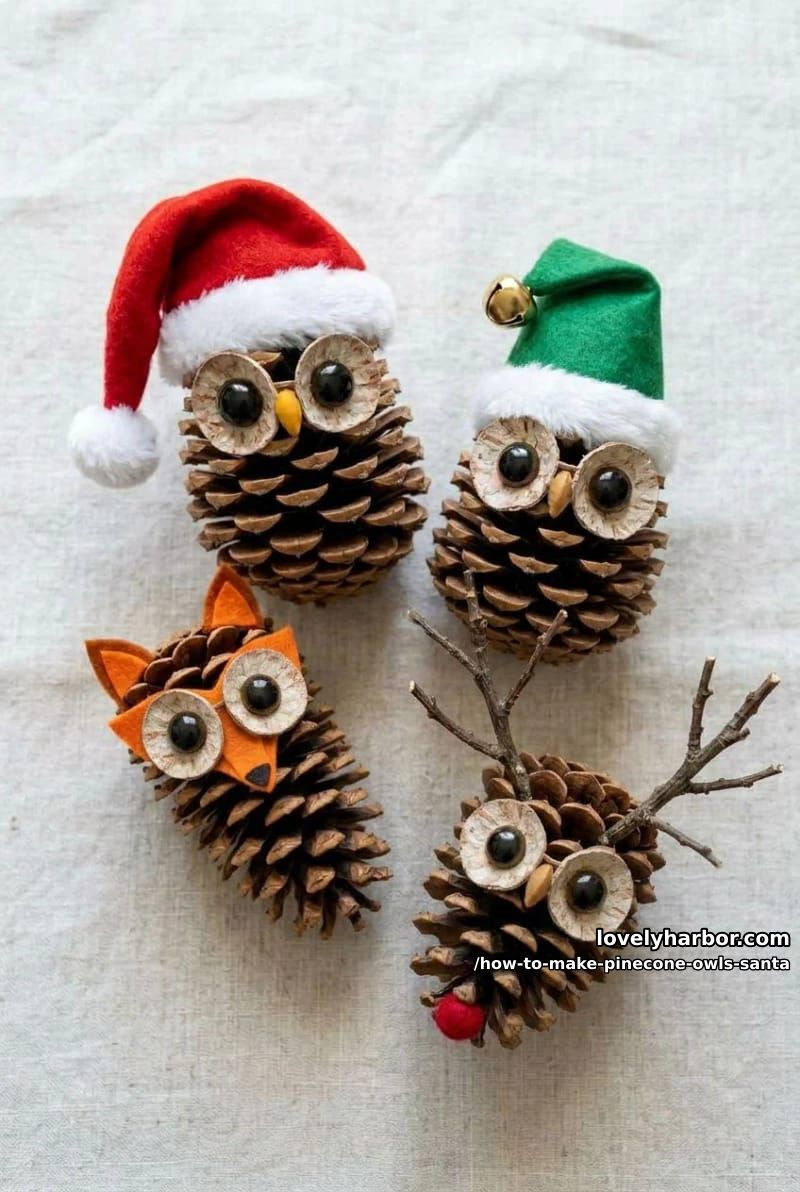
Once the basic owl is muscle memory, the substitutions get easy. Three directions worth trying:
Variation 1 — The elf owl
- Swap the red Santa hat for a small green felt elf hat
- Replace the white pom-pom with a small brass jingle bell at the tip
- A slightly less obvious holiday version that doesn’t scream “Christmas”
Variation 2 — The barn owl
- Mold a single heart-shaped paper-pulp face plate instead of two round discs
- Paint the same cream-with-brown-speckles
- Set two smaller 10mm cabochon eyes low in the heart’s lobes
- This is one of the reasons the paper-pulp method is worth learning , you can mold it into whatever shape the owl needs
Variation 3 — The year-round owl
- Skip the Santa hat entirely on one or two of your flock
- A bare pinecone owl with painted-pulp eye discs is a year-round mantel piece
- Add the hat for Christmas, remove it in mid-January, leave the owl out for the rest of winter
- Most holiday crafts can’t pull this off
Optional: seal the discs for long-term durability
Brush the finished paper-pulp discs with a thin coat of matte Mod Podge or diluted white glue. This protects the paint and toughens the surface. Useful if you plan to store the flock and bring them out year after year , unsealed paper pulp can chip if knocked against something hard.
Conclusion
If you only change one thing from a typical pinecone-owl tutorial, change the eyes. Big concave paper-pulp discs, painted cream with brown speckles and centered with a glossy black cabochon, are doing eighty percent of the work that makes this owl look like the one in the saved pin and not the one your kid brought home from third grade. After that, the right round pinecone and a plush ready-made Santa hat take care of the rest.
Build-day sequence
- Day 1, morning: tear and soak egg cartons, mix the pulp, mold the eye discs in spoons.
- Day 1, evening: turn discs out, trim edges.
- Day 2 or 3 (after full dry): base-coat paint, then speckle.
- Same day: trim cabochon posts, glue cabochons into discs, glue discs to pinecone.
- Then: add the beak.
- Last: attach the Santa hat. Hot glue near a finished hat is how pom-poms get scorched.