
Most pipe cleaner tree tutorials teach the wrong method. They have you wind a green stem around a dowel until it builds into a fuzzy green blob. There’s a better way: a cardstock cone covered in short folded loops. That’s the trick that makes these little trees read as fir instead of as a bottle brush.
The work itself is slow and close to mindless, the kind of thing you do with a show on in the background, and a single $7 bag of pipe cleaners gets you a whole forest. What follows is the full build , the interactive sizing tool, the trunk debate I have strong feelings about, and the six mistakes that flatten the shape.

Materials and tools
Almost all of this comes from the craft aisle or a dollar store, and most of it sells in bulk packs that outlast several trees. The table below splits what you burn through from what stays in your drawer afterward. From scratch you’re looking at roughly $60 to $95 , but that’s enough green chenille, wood slices and pom poms for a dozen-plus trees, which drops the marginal cost to somewhere around $2 to $4 each.

Materials (you use these up)
| Qty | Item | Spec | Price |
|---|---|---|---|
| 20+ | Caydo dark green chenille stems (200 pc) | 12 in × 6 mm; the darker green reads more like fir than bright kelly green | $6 to $9 |
| 1 pack | Incraftables 20-color pipe cleaner set | Pull brown for the trunk, red + white for candy canes | $7 to $11 |
| 1 sheet | Clear Path Paper green cardstock | 65 lb, letter size, stiff enough to hold the cone under glue | $9 to $14 |
| 1 | Wooden dowel rods (1/4 in × 12 in) | Cut one to about 1.5 in for the trunk; the pack lasts for dozens | $6 to $9 |
| 1 | Wood slices | 3.5 to 4 in, bark edge | $14 to $19 |
| pinch | Mini pom poms (2,000 pc) | 6 mm assorted, ornaments | $6 to $9 |
| 1 | Gold metallic pipe cleaner | Twist your own star topper (from the color pack above, or any metallic stem) | $0 |
| 1 | Clear tape | For the cone seam (most people own this) | $0 to $4 |
| Materials subtotal | $48 to $75 | ||
Tools (one-time, reusable)
| Qty | Item | Spec | Price |
|---|---|---|---|
| 1 | Low temp hot glue gun | To put together your tree without burning your fingertips. | $5 to $9 |
| 1 | Wire cutters or craft snips | Keeps the wire core away from your good scissors | $7 to $11 |
| 1 | Scissors | For cutting the cardstock (most people own this) | $0 |
| Tools subtotal | $12 to $20 | ||
| Combined total (everything from scratch) | $60 to $95 | ||
Prices are rough ranges as of early 2026, so check before you buy. Because most of it sells in bulk, the per-tree cost drops fast once you own the tools.
Pick the right stems and trunk
Two choices decide whether this works, and both are easy to flub at the store. The body wants plain fuzzy chenille, not the sparkly tinsel stems. The trunk wants something genuinely stiff. It’s important to use a strong enoug dowel, avoid thin skewers or the finished tree would lean like it’s bracing into a headwind. A bamboo straw or a 1/8 to 1/4 inch dowel holds vertically much better.
Do this
- 6 mm fuzzy green chenille for the body. It packs into dense rows that hide the cone.
- For the trunk, a 1/8 to 1/4 in dowel keeps the tree standing straight
- Cardstock should be 65 lb or heavier so it holds the cone shape under hot glue
- Set a few brown stems aside to wrap the trunk in matching fuzz
Avoid
- Tinsel stems on the body , the wire shows through and the rows look thin
- A single bamboo skewer for the trunk. Too flimsy; it tilts.
- Printer paper for the cone, which buckles and softens the moment hot glue touches it
- High-temp guns run hot enough that thin cardstock passes it straight to your fingertips.
The one tool that changes the experience: a low-temp gun lets you press stems against thin paper without scorching a fingertip on the row you just glued.

How many pipe cleaners you need
Stem count scales with cone height. You can use the handly tool below to calculate everything you need to make the pipe cleaners Christmas tree with the shape you prefer. As a general rule, buy in whole packs, a 200-piece bag of green chenille covers several small trees with room to spare.
Make it your size
Pipe Cleaner Tree Planner
Shape the tree the way you want it, then get the exact cone to cut, how to chop your pipe cleaners, and roughly how many you’ll burn through. No template, no guessing.
buy ~25 to leave a buffer
Your cone
4.5" tall · 2.75" base
Cut this wedge from cardstock and roll it: a circle slice with radius 4.7″ and an opening of 105°. Tip to base, roll, tape the seam.
Cone sizes are exact geometry. Counts are estimates from a model calibrated by us based on real data, so round up and keep a buffer.
Our interactive tool gives you all the things you need for this project, including how to cut the base cone, how to cut the pipe cleaners, and how many of them do you need.
Step 1: Cut and fold the branches

Every branch is one short folded loop, and you need a small mountain of them before you go near the cone. Batch this part and don’t stop until you’ve got a real pile. Here’s the detail that saves you grief later: stack all your folds facing the same way. Once they’re in a heap you can’t tell the rounded fold from the snipped ends, and the fold is the part you want facing out on the tree.
- Cut according to the directions of our interactive tool above. Fold a 12 inch green pipe cleaner in half and snip it, then fold and snip each half again if needed.
- Fold each piece. Bend every piece in half into a narrow U with a rounded bend at one end.
- Repeat in bulk. Run through at least 25 pipe cleaners for a small tree, keeping the folds stacked the same way.
Step 2: Roll the cardstock cone
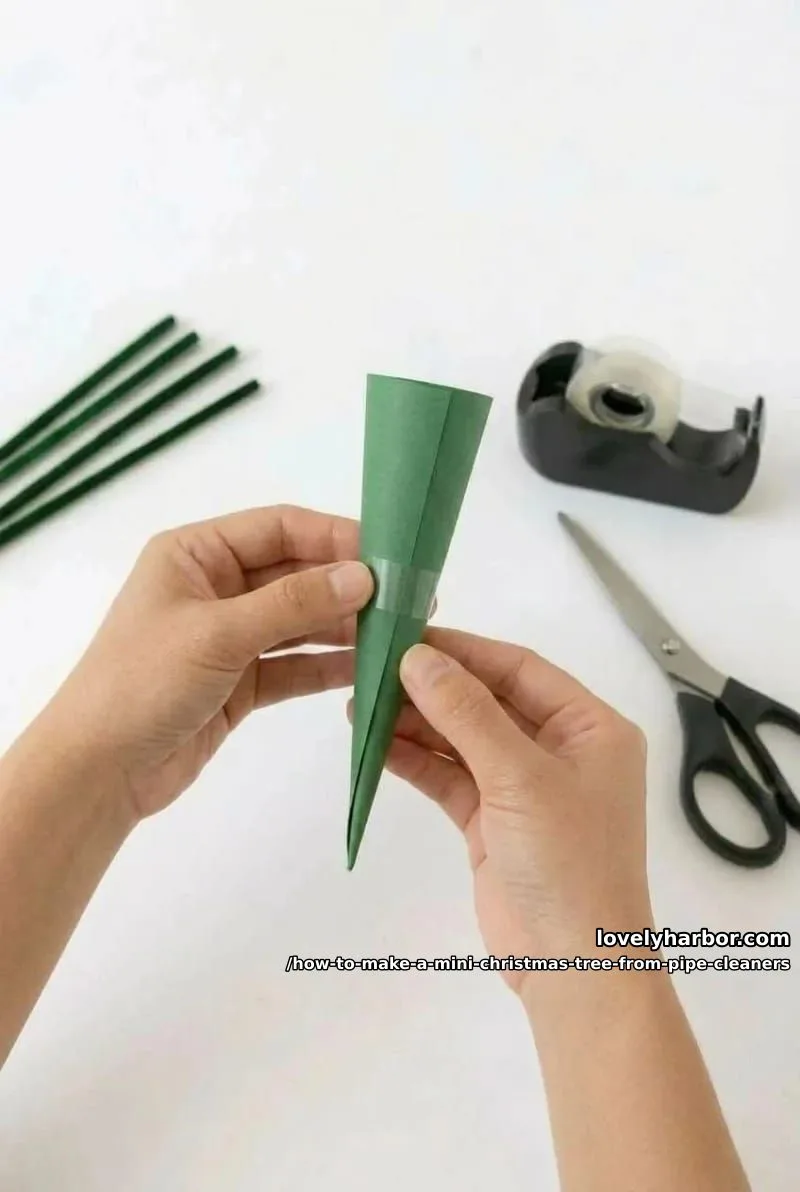
The cone is just the hidden skeleton, nobody sees it once the branches go on, so it only has to be the right height and hold its shape. Simply use our interactive tool to get the right cone shape for the exact tree you want to create.
- Cut your size. Cut the cone shape with the measures given by our tool.
- Transfer to cardstock. Trace and cut from green cardstock.
- Roll and tape. Roll it into a cone with a sharp tip and an open base, hold the seam, and secure it with two pieces of clear tape.
Step 3: Glue the branches on, bottom to top

This is the long, meditative stretch, and it’s where the fir shape is won or lost. Work in short arcs. Lay down glue for only two or three loops at a time so it doesn’t skin over before the chenille lands in it. Every new row sits directly on top of the last and laps it by half, the way real fir foliage shingles down over itself.
The loop: a piece folded down gives you a rounded tip that catches light along a curve instead of a flat cut end.
The overlap: when each row covers half the one below, no green cardstock peeks through, so the surface reads as dense foliage rather than a decorated cone.
The downward angle: bending every loop down 30 to 45 degrees later (Step 5) is what makes it droop like fir. Skip it and you’ve built a pom-pom on a stick.
- Start at the base. Run a bead of glue along a small section of the bottom edge and press in folded loops, rounded fold pointing down, poking past the edge by about half.
- Ring the bottom. Work all the way around the base, loops packed snug side by side.
- Stack the rows. Glue the next row just above, lapping the one below by half, and keep climbing until you’re 1/4 to 1/2 inch from the tip.
- Cap the point. Twist the two ends of a folded piece together into a spike. Glue four or five of these at the very top, lined up to form a clean point.
Step 4: Wrap the trunk and set the base
A bare dowel looks like a straw, so you sheath it in brown chenille to pass for bark. Wrap bottom to top in tight spirals, gluing both ends so it can’t unwind, and grab a second brown stem if the first runs short. Then plant the trunk on the wood slice before the tree ever goes on, which lets you hold it dead straight while the glue grabs.
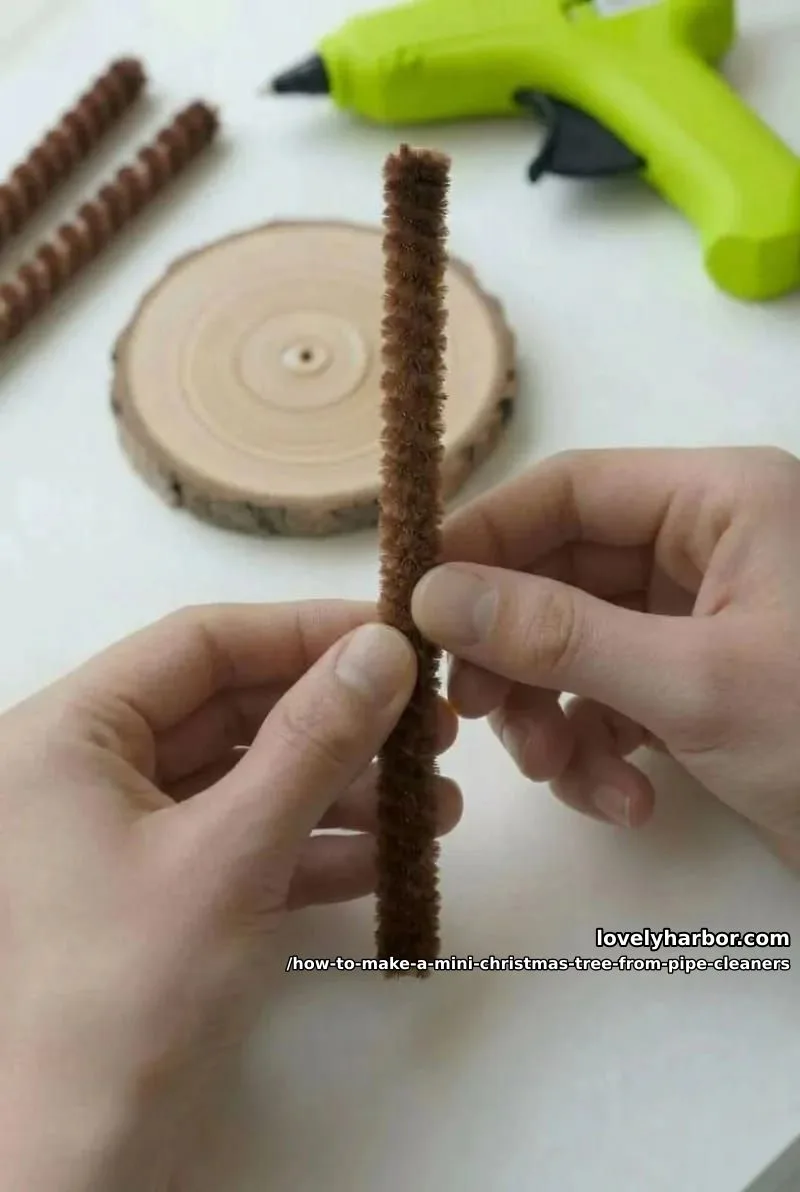
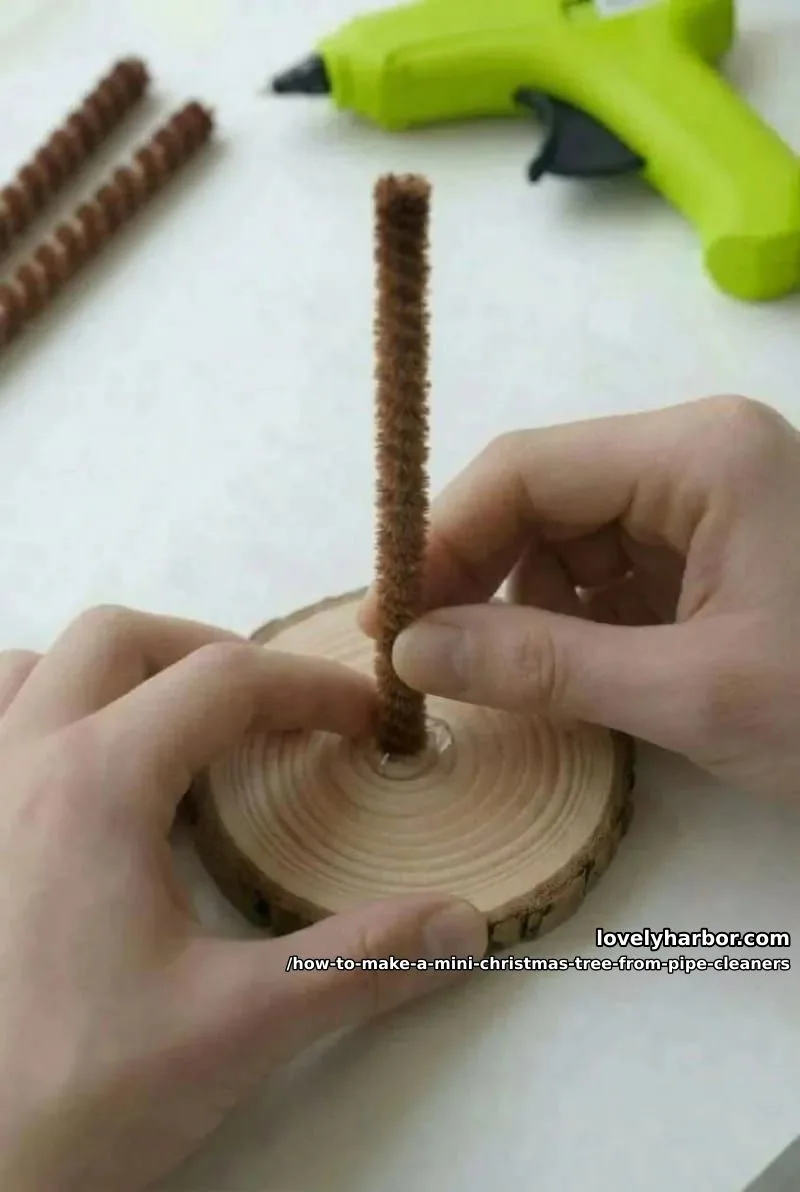
Tip: If you can, mount through the slice, not on it. Push the trunk through a pre-drilled hole (if you can make it at the center of the wooden slice) and glue it from underneath. A glue-only joint on a flat surface shears off the first time the tree gets knocked; a through-mount doesn’t.
Step 5: Attach the cone and fluff
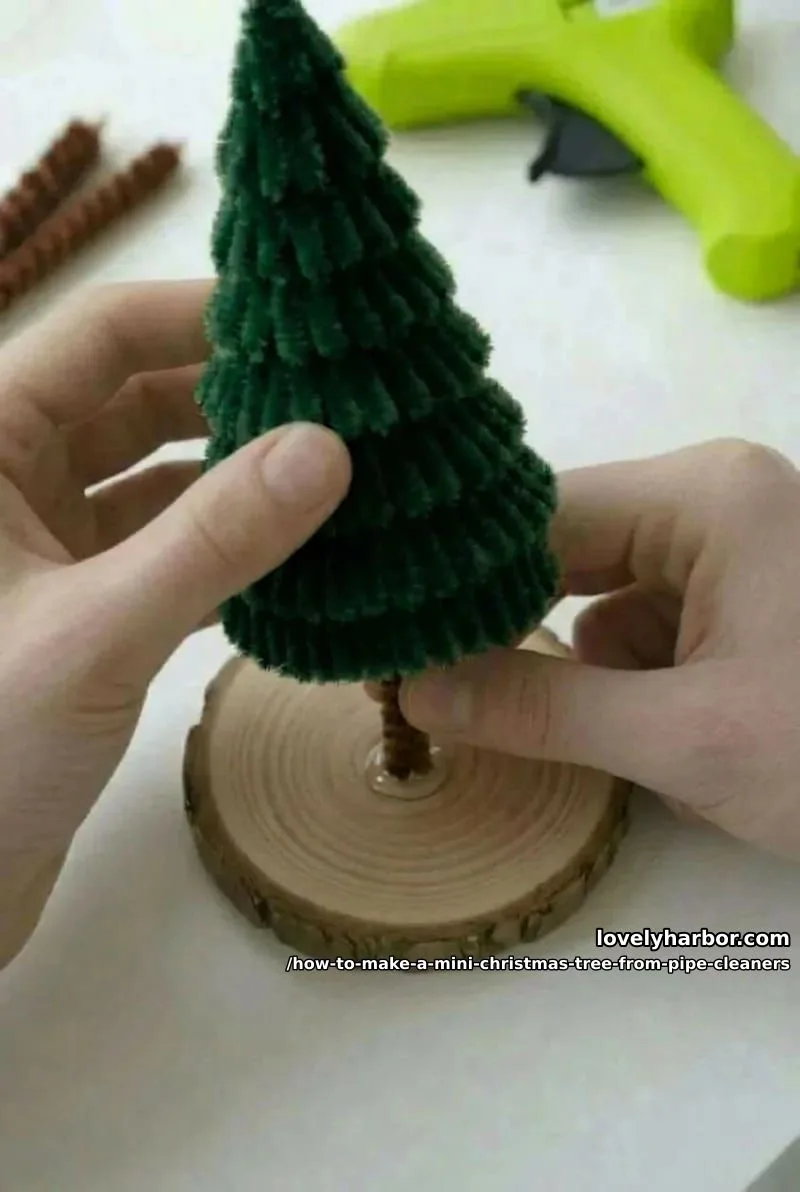
Skip the fluffing and you’ve made a green ice cream cone. This is the step that turns flat-glued rows into tiered branches, and it takes longer than anyone expects, because you’re bending every single loop by hand. Go one ring at a time, from the bottom up, pulling each loop out and tipping it slightly down , the way a real branch sags under snow.
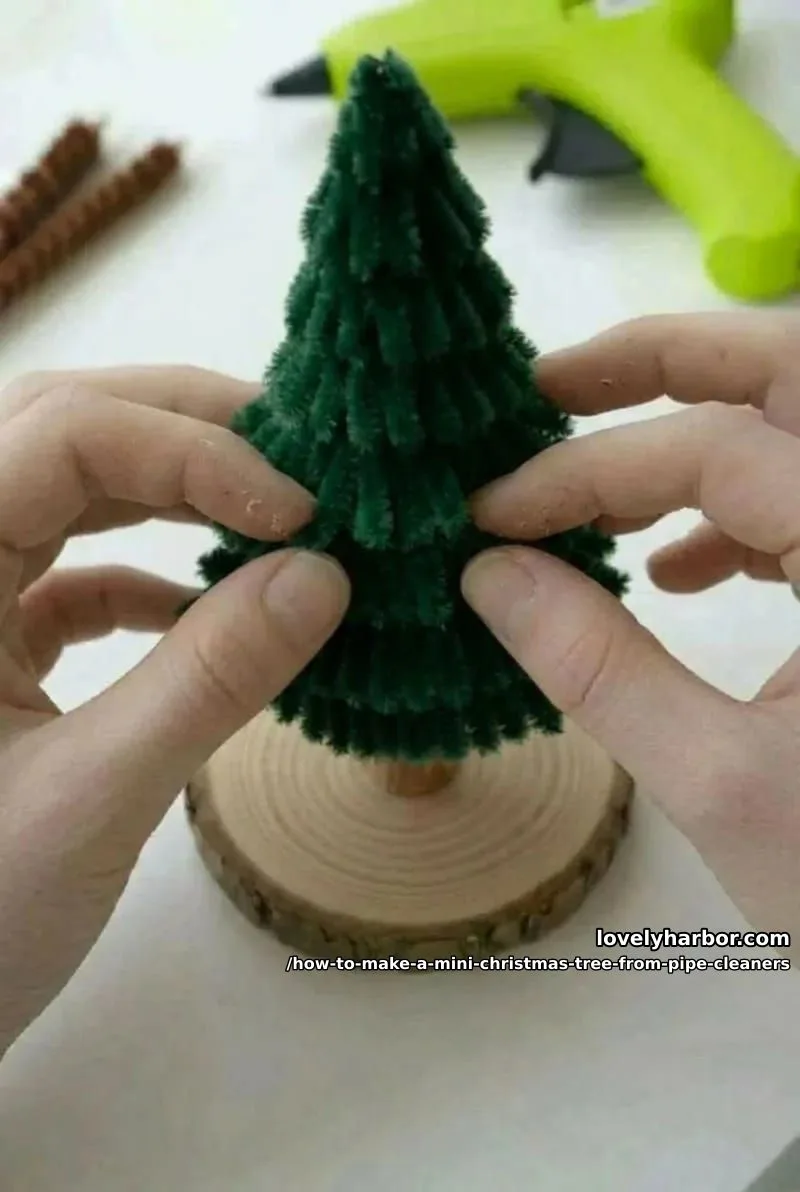
Step 6: Decorate (optional)
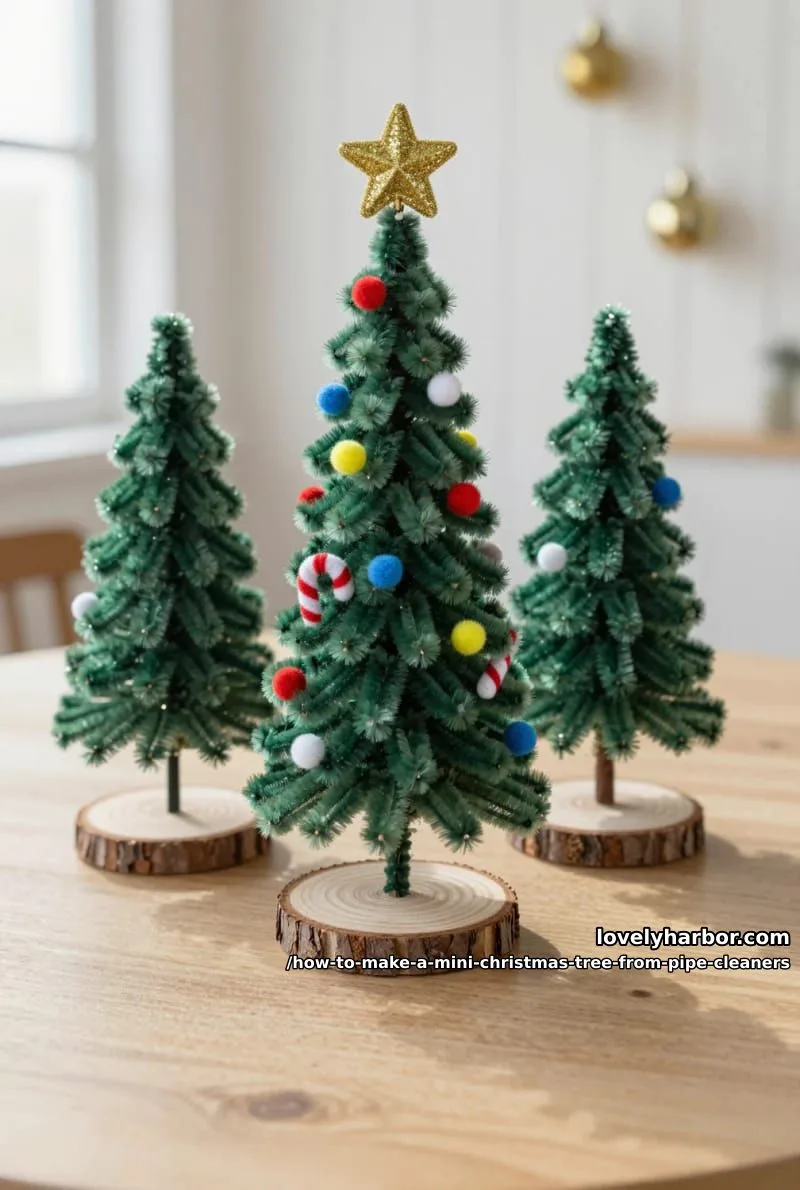
Unpopular opinion: the plain green trees photograph better than the decorated one, and a 4.5 inch tree needs maybe three pom poms, not thirty. At that scale, more ornaments just turn the silhouette to noise. If you do decorate, spend the extra five minutes on the twisted candy canes, since they sell the whole scene, and rhinestone gem stickers make instant ornaments if you’d rather skip the glue.
- Make candy canes. Twist a red and a white pipe cleaner together, cut into three equal lengths, and bend a hook into one end of each.
- Add ornaments. Glue 5 mm pom poms between the branches, scattered rather than lined up. Hook the candy canes over the branch loops.
- Top it. Press a glitter foam star onto the tip, or twist a small star from a metallic stem.
A 2,000-piece bag of 5 mm pom poms in mixed colors is enough ornaments for an entire mantel of trees and still leaves plenty for the kids to lose in the carpet.

Mistakes that flatten the tree
I’ve made most of these at least once. None of them wreck the project past saving, but catching one mid-build is a lot easier than fixing it after the glue cures.
- Folds facing every direction. Glue a few cut-ends-down by accident and stray wires start poking out of the foliage. This is why you stacked them the same way back in Step 1.
- Over-decorating the small ones. Crowding kills the fir shape you just spent an hour building.
- Rows spaced too far apart. Green cardstock peeks through between the branches. Pack the loops; overlap each row by half.
- A skewer for a trunk. It’ll lean within a day. Bamboo straw or a real dowel.
- Skipping the fluff. The branches stay pinned flat and the thing reads as a cone, not a tree. Bend every loop down in Step 5.
- Hot glue through printer paper. The cone softens and caves in. Use 65 lb cardstock.
Plan a whole forest in one sitting
These look better in odd-numbered groups of varied height than they ever do alone, so most people end up making three or five at once. Batch the work by stage instead of finishing one tree start to end, and a trio of 4.5 inch trees comes together in an evening.
A trio of trees in one evening
About 65 green pipe cleaners, 3 cones, 3 wood slices
- First 30 minutes: cut and fold every branch loop for all the trees at once , around 250 pieces.
- Next 10 minutes: roll and tape all three cones.
- The long stretch, 20 to 30 min per tree: glue the rows. This is your TV-watching block.
- Then 10 minutes: wrap three trunks and glue each to its wood slice, letting them set a minute or two each.
- Next: attach each cone to its trunk, let the glue cool, then fluff every branch.
- Last: decorate, if at all, only once all three are fluffed, so you can balance ornaments across the group.

Conclusion
Vary the heights if you change nothing else. A 6 inch tree flanked by two 4 inch ones reads as a stand of evergreens; three identical trees read as a product display. Leave at least one undecorated, set them on mismatched wood slices, and tuck a short strand of warm-white fairy lights between the trunks. And if you want a tiny tabletop village instead of mantel pieces, just shrink the size in our interactive tool.
One last warning: at around 2.5 inches the fluffing gets fiddly, and you may wish you’d made fewer of them.