
Four 4-ounce jelly jars, a scrap of pine or reclaimed wood plank, and one fiddly evening with stencils. That's the build. You get a shelf piece for $82 to $119 in materials, and visitors will reliably ask about it. What makes it look intentional rather than craft-fair sits in two places nobody photographs: the proportions of the wood base relative to the jars, and how loose the twine bow sits at the neck. Both below.
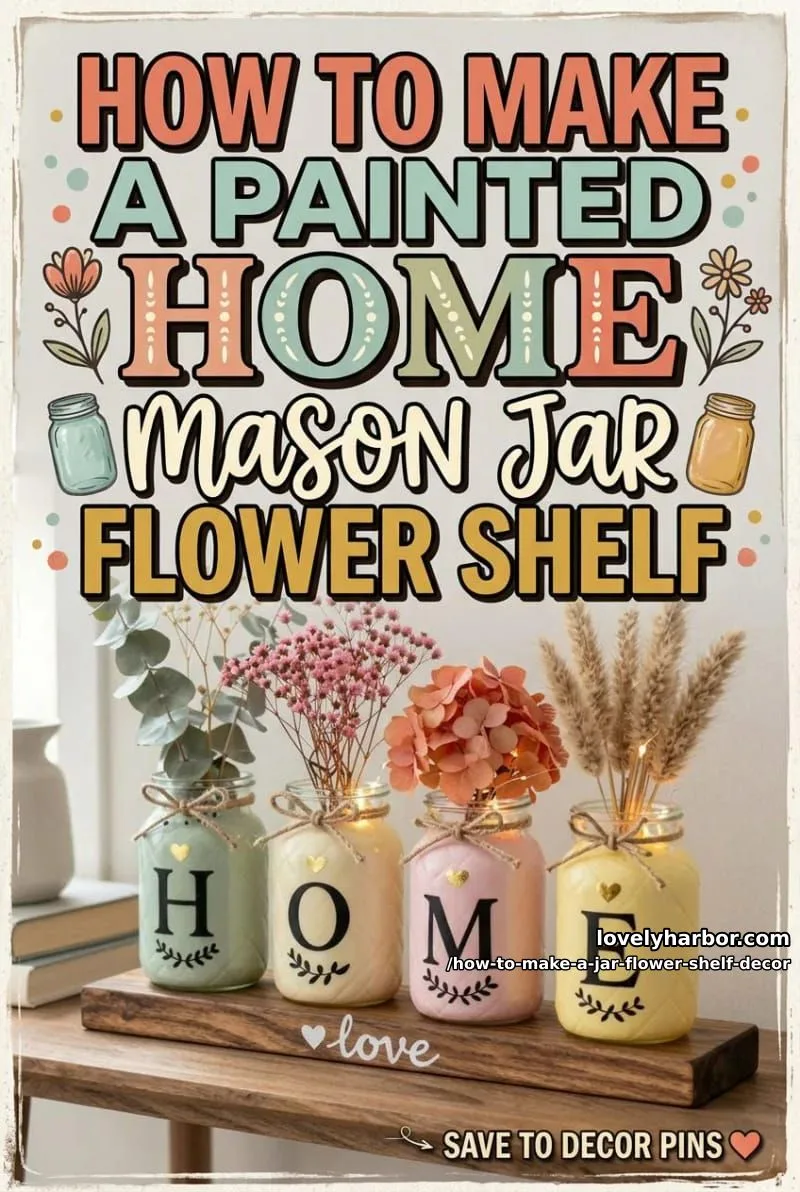
Why this build works (and where it usually fails)
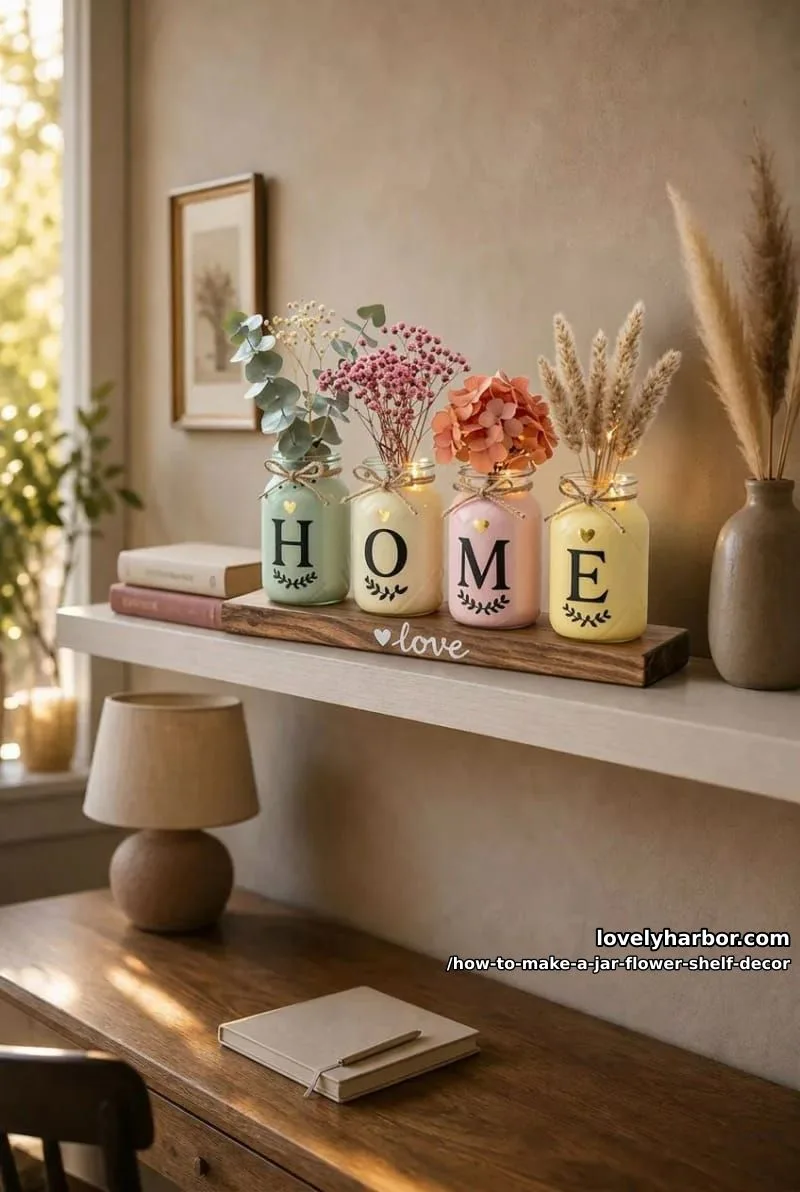
The reference piece commits to one thing , a tight color story across four jars with every other element pulled from the same restrained palette. Sage, cream, blush, butter yellow. Black hand-drawn letters. Natural jute. Dark stained wood. Eight ingredients total. Most homemade versions of this idea pile on glitter, gemstones, or a fifth jar in a clashing color, and the result reads like a Pinterest screenshot from 2014.
Sizing is the other tripwire. Build it on a 16-inch plank and the jars float. Squeeze it onto an 8-inch plank and the jars touch, with the bows fighting each other for space. The numbers you want are 0.5 inch of gap between jars and 0.75 inch of plank visible at each end. For 4-ounce jars (2.36 inches wide each), the math puts the plank around 12 to 13 inches long by 3.5 to 4 inches deep.
Plank length equals (jar diameter × 4) + (3 small gaps × 0.5 in) + (2 end margins × 0.75 in). For standard 4-ounce jelly jars, that’s 14.6 inches. Round down to 13 or up to a stock 12-inch craft plank and adjust gaps.
What you'll need
The shopping list splits into materials (consumables) and tools (one-time, reusable). Already own paint brushes, scissors, and a hot glue gun? The project itself runs $82 to $119. Starting from zero, it climbs to roughly $115 to $173 , but every tool here earns its keep on a hundred future projects.
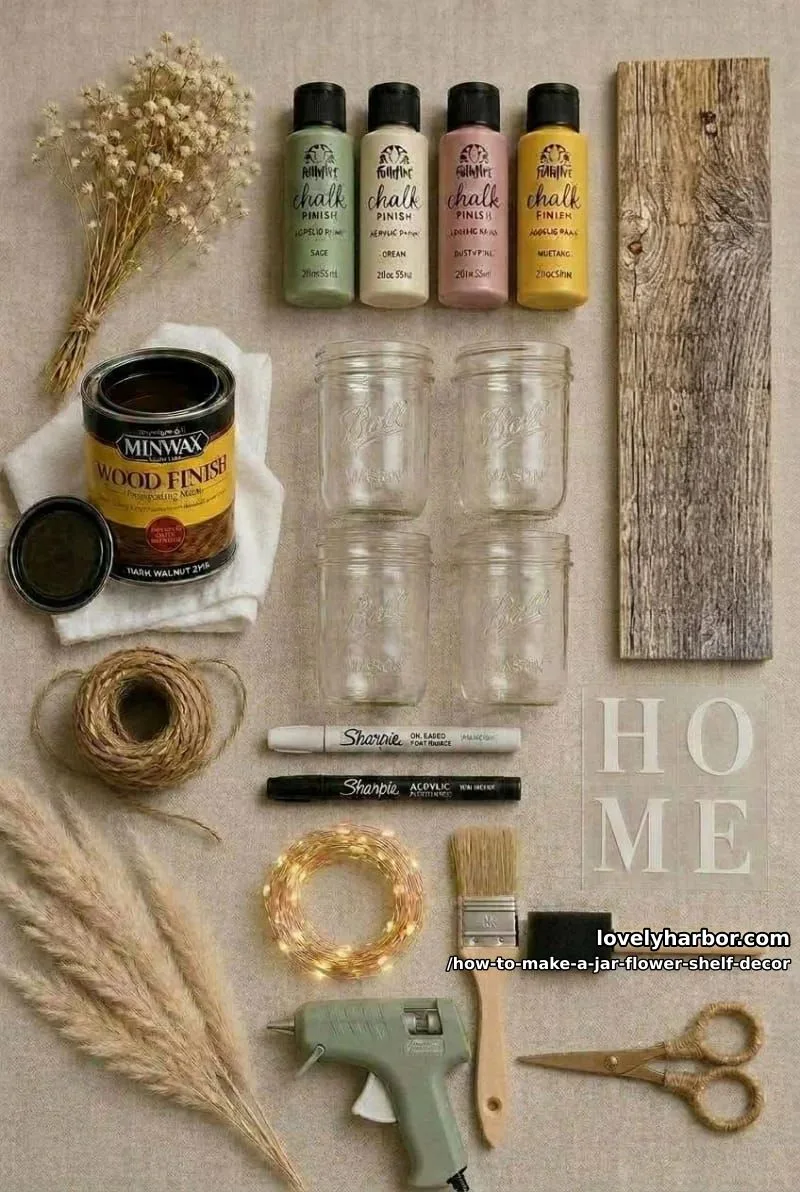
Materials and tools for one 12-inch HOME jar shelf
Finished dimensions: roughly 12 × 4 × 4.5 inches including jars
Materials (consumables)
| Qty | Item | Spec | Price |
|---|---|---|---|
| 4 | 4 oz Jars | 4 oz, regular mouth, 12-pack (uses 4) | $15 to $20 |
| 1 | FolkArt Home Decor Chalk Finish Paint Set | 9 × 2 oz bottles, matte chalk finish | $22 to $30 |
| 1 | Rockin’ Wood Rustic Weathered Reclaimed Wood Planks, 12 × 3.5 in | Reclaimed wood, 1 plank from 12-pack | $2 to $4 each |
| 1 | Minwax Dark Walnut wood stain, 8 oz | Oil-based interior stain, half-pint | $7 to $10 |
| 1 | Vivifying natural jute twine, 656 ft × 2mm | 3-ply brown, uses about 6 ft total | $6 to $9 |
| 1 | Ariceleo battery-operated copper wire fairy lights | 5m / 16 ft warm white, 1 string cut to 4 lengths | $8 to $12 |
| 1 | Dried baby’s breath bouquet, ivory | 17-inch stems, ~2500 mini florets | $8 to $13 |
| 1 | CITYES pink pampas grass and dried flower bouquet | 17 in, includes pampas, bunny tails, mini daisies | $10 to $15 |
| 1 | Sharpie oil-based paint marker, white, extra fine | For “love” script and hearts on plank | $4 to $6 |
| Materials subtotal | $82 to $119 | ||
Tools (one-time, reusable)
| Qty | Item | Spec | Price |
|---|---|---|---|
| 1 | I Like That Lamp 2-inch alphabet letter stencils | Reusable mylar, upper and lower case | $10 to $14 |
| 1 | Foam paint brushes, 1-inch, set of 4 | For chalk paint and stain | $4 to $7 |
| 1 | Stencil brush, round, 1/2 inch | Stiff bristles for crisp letter edges | $5 to $8 |
| 1 | Mini hot glue gun + 10 glue sticks | Low-temp, for mounting jars to plank | $8 to $14 |
| 1 | Fine-tip black acrylic paint pen | For the leaf laurel detail under each letter | $4 to $7 |
| 1 | Sandpaper, 220 grit, half-sheet | To knock the edges off the plank | $2 to $4 |
| Tools subtotal | $33 to $54 | ||
| Combined total (if buying everything from scratch) | $115 to $173 | ||
Prices are approximate ranges as of late 2025; verify on Amazon before purchase.
About the chalk paint set: the 9-bottle FolkArt sampler is the cheap way in , it covers all four colors you need (Spanish Moss and Oatmeal are in this set; Maui Sand, Salmon Coral, and Yellow Crochet are not included and must be purchased as separate bottles) with five extras for future projects. If you’d rather buy single 2 oz bottles, plan on $3 to $4 each at Michaels.
Step 1: Prep and base-coat the jars
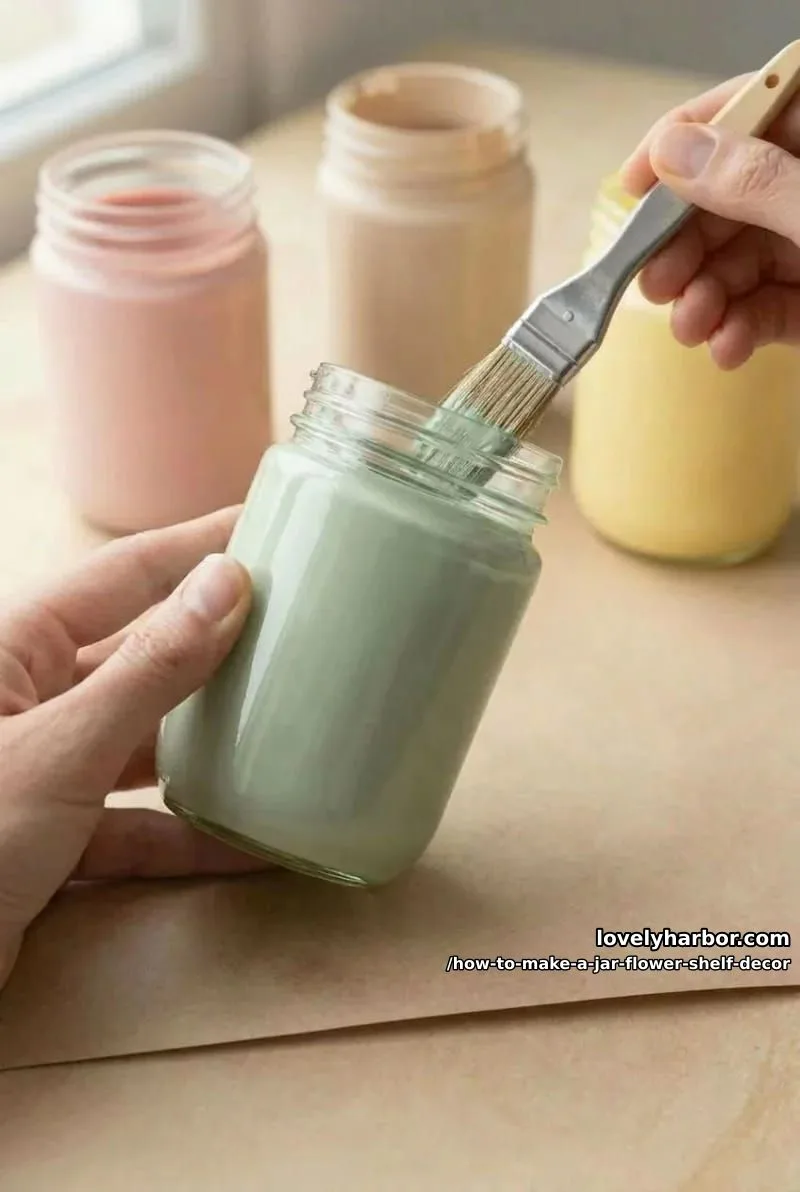
Chalk paint sticks to glass without primer, which is the whole reason this look became viable at home. You still have to wash the jars first , oils from the factory and from your fingers will repel paint and leave fish-eye spots that show up after the second coat dries. Hot soapy water, rinse, towel-dry, set on a sheet of brown craft paper.
- Wash and dry the jars. Hot water, dish soap, thorough rinse. Don’t skip the inside , you’ll handle the rim later and any residue migrates. Air-dry 10 minutes after the towel.
- Decide your color order before painting. The reference goes sage / cream / pink / yellow, alternating cool-warm-warm-warm, which reads balanced. Swap to all-warm or all-cool and the whole piece tips visually.
- Paint coat 1, thin. Foam brush, vertical strokes bottom to rim, stopping about 1/8 inch below the rim threads so the jute wrap covers any edge mess. Streaks and visible glass underneath are fine.
- Wait 30 minutes, then coat 2. Same direction, slightly heavier brush load. This is the coverage coat.
- Wait another 30 minutes and decide on coat 3. Yellow and pink almost always need it. Sage and cream sometimes don’t. Hold the jar up to a window; if the diamond quilted pattern still shows through as visible shadow, add a third coat.
- Cure overnight. Chalk paint feels dry in 30 minutes but a fingernail will scratch it for at least 4 hours. Stencil work waits for the next day.
Step 2: Cut and stain and letter the wood base
Cut the plank to your preferred size if necessary, using a hand saw or miter saw. Measure and mark the cut line first, then cut carefully along the mark for a clean, straight edge.
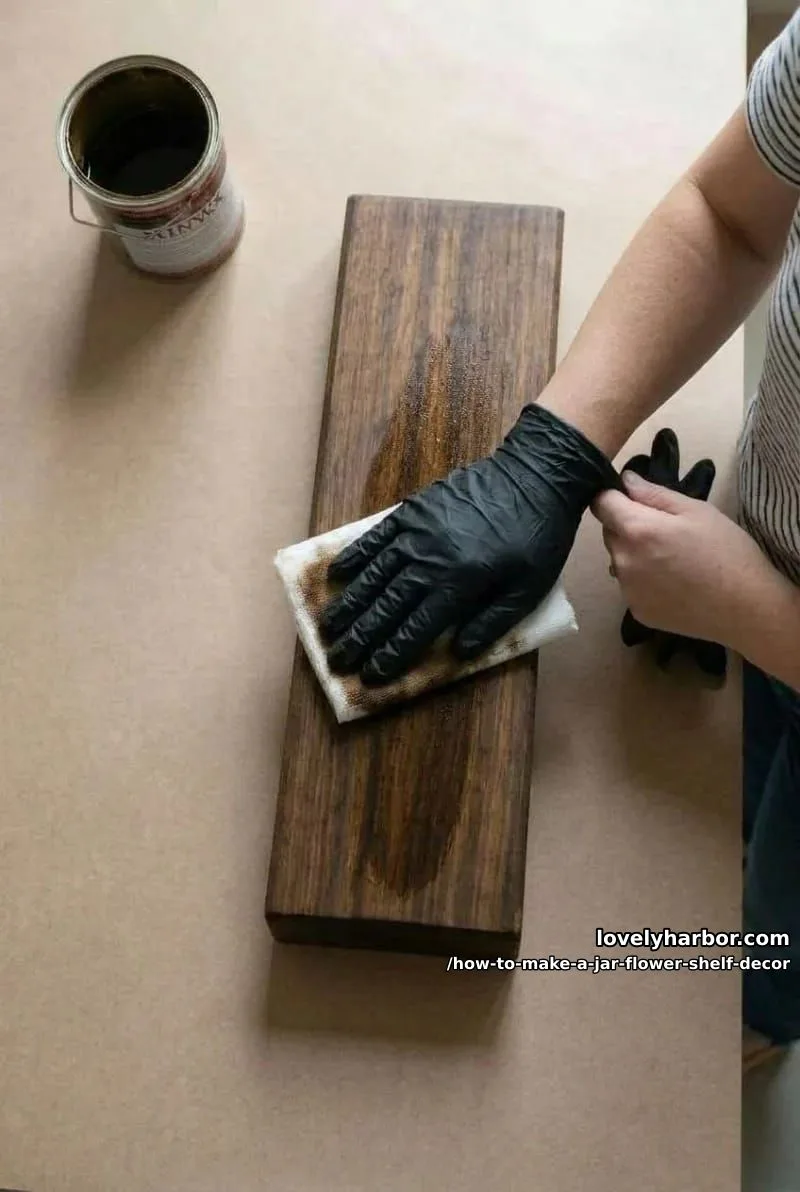
Stain the plank before you letter it. The white paint marker reads cleaner over fully cured stain than the other way around. Dark walnut is the right call: dark enough to make the white "love" script pop, warm enough that it doesn't fight the chalk-paint pastels.
Step 2.1: Stain the plank
- Sand the plank lightly. 220-grit, with the grain, 30 seconds per face. Knock down the sharp edges. Wipe with a slightly damp cloth and let dry 10 minutes.
- Apply stain with a cotton rag. Pour about a tablespoon onto the rag and drag it down the board in long strokes with the grain. Cover top, sides, ends. Skip the bottom , nobody sees it.
- Wait 5 to 15 minutes, then wipe. Longer dwell, darker color. For the reference look, 10 minutes is the window. Wipe excess with a clean part of the rag.
- Dry for at least 8 hours before lettering. Oil-based stain feels dry in 2 hours but the paint marker will smear if the wood is still gassing off solvents.
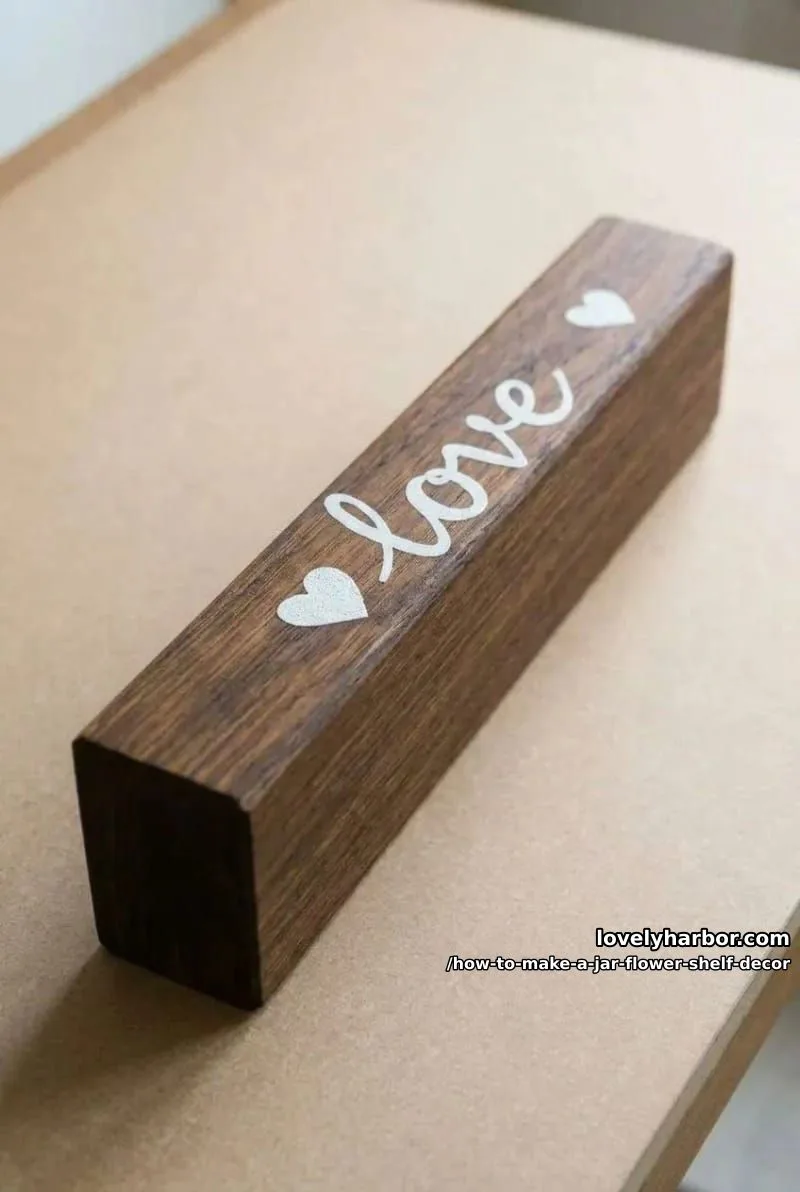
Step 2.2: Add the "love" script and hearts
Freehand the script if you write loose cursive comfortably, or pencil it in first. The word "love" centers between two small filled hearts. Do not stencil cursive. Stenciled cursive looks like stenciled cursive, which is exactly the wrong impression.
- Pencil the layout. Mark the center of the plank, sketch “love” in cursive about 1.25 inches tall, place hearts 1.5 inches to each side, each roughly 0.4 inches wide.
- Shake the Sharpie oil-based paint marker hard for 30 seconds , the bead inside is doing real work. Press the tip on scrap cardboard to start the flow.
- Trace the pencil lines. Go slow on the curves; the marker pools paint on slow movement, which actually makes the script look more painted than printed.
- Fill the hearts solid, two passes. Let dry 2 hours before handling.
Step 3: Stencil the letters and freehand the laurels
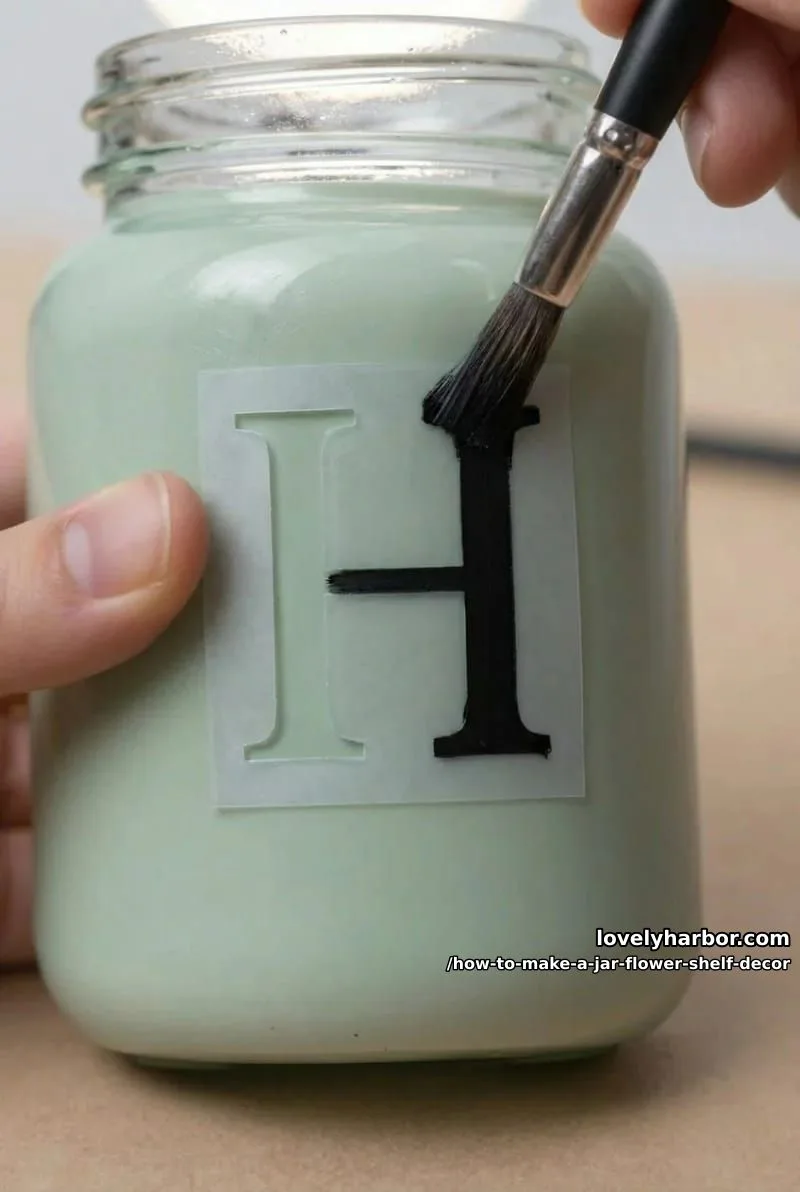
This is the step where the project tips toward hand-made-cute or hand-made-bad, and the difference comes down to brush technique. The mistake almost everyone makes is dragging the stencil brush sideways under the mylar edge. Dragging pulls paint under the stencil and ruins the line every single time. You pounce. Straight down. Like dabbing the brush on a tabletop. Get this one thing and the rest of the step falls into place.
Step 3.1: Position and stencil the letters
- Mark center on each jar. A small piece of painter’s tape on the rim gives you a top-center reference. The letter sits in roughly the middle vertical third of the jar.
- Tape the stencil flat. Mylar curves around the jar surprisingly well, but the corners still want to lift. Two strips of low-tack painter’s tape, top and bottom, keep it pressed.
- Load the brush lightly. Dab paint, then offload most of it on a paper towel. “Lightly loaded” means you can barely see paint on the bristles. Counterintuitive, but it’s the only way to get a clean edge.
- Pounce, don’t sweep. Tap straight down inside the stencil opening, working outside-to-inside on each letter shape. Repeat until coverage looks solid.
- Lift the stencil straight up. Not sideways.
- Touch up with the fine-tip black paint pen if any edge crumbled. Better to touch up than to re-register the stencil at a slightly wrong position.
Step 3.2: Freehand the laurel sprigs and gold hearts
Under each letter, a small curving laurel branch with 5 to 7 leaves per side fans outward and slightly downward. Above each letter, a small filled gold heart. Both freehand. They look better imperfect.
Do this
- Draw the central curved stem first as one smooth arc, then add leaves outward from it
- Make leaves teardrop-shaped , pointed at the stem end, rounded at the tip
- Vary leaf sizes slightly. The eye reads uniform leaves as printed, not painted.
- A gold paint pen works, or a dab of metallic gold acrylic on a Q-tip for the hearts
Avoid
- Symmetrical mirror leaves on both sides of the stem , reads stenciled
- Outlined ovals instead of filled teardrops
- Yellow paint for the hearts in place of true gold. It goes muddy against the chalk pastels.
- Dots, stars, or sparkles around the heart. Instant cheap-craft signal.
Step 4: Wrap twine and tie the bows
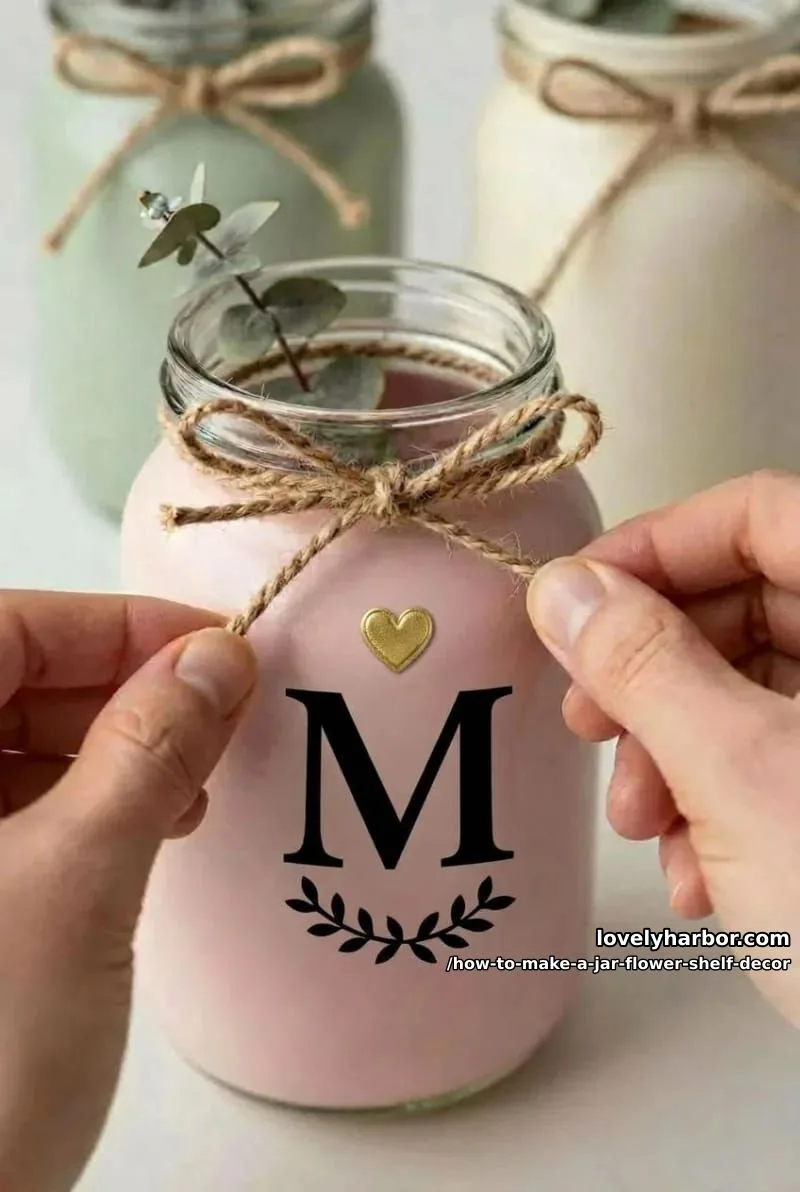
The twine wrap is where most copies of this project quietly fall apart. Some people use ribbon, which is the wrong material. Some cinch the twine into a perfect tight bow, which is the wrong proportion. Some double-wrap a thick jute rope on a small jar, which is the wrong scale. The answer is 2mm twine, four wraps, a small loose bow tied a touch off-center toward the front. The bow should look like it's about to slip but won't. I've ended up undoing and re-tying more of these than I want to admit, and I still think it's the most satisfying part of the build.
- Cut a 14-inch length of 2mm jute per jar. Slightly long is forgivable; you’ll trim later.
- Wrap four times around the neck just below the rim threads, holding the wraps in place with a thumb on the back of the jar.
- Tie a simple knot at the front-center, then a single bow on top. Loops about 3/4 inch wide each. Don’t pull the knot tight , the bow should sit slightly loose, almost flopped.
- Trim the tails to about 1 inch each with sharp scissors. A clean diagonal cut reads more intentional than a flat one.
- Adjust the wraps so they sit flush in parallel, not crossing.
Step 5: Mount jars, drop in the lights, arrange the dried flowers
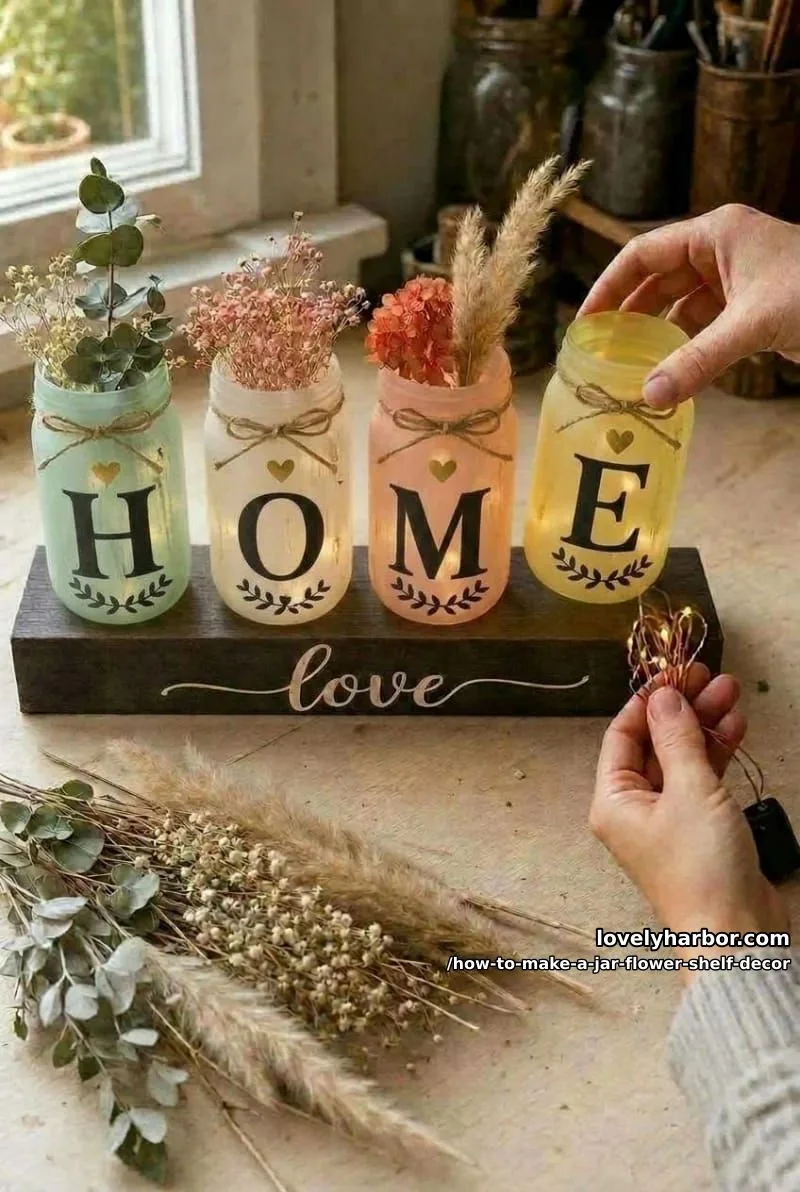
Mount before you fill. Empty jars are forgiving to glue. Full jars are not.
Step 5.1: Glue the jars to the plank
- Dry-fit first. Place the four jars on the plank in HOME order, adjust spacing to about 0.5 inch between jars and 0.75 inch at each end. Mark the bottom center of each jar with a pencil.
- Hot glue the bases. A thick ring of glue around the bottom edge, one jar at a time. Press onto the pencil mark and hold 20 seconds. Work fast , hot glue grabs glass in about 30 seconds.
- Cure 15 minutes before adding contents.
If you want the jars removable for cleaning, use four small adhesive gel dots ($3 at Michaels) instead of hot glue. The hold is strong enough that the jars don't slide and the dots peel off cleanly.
Step 5.2: Drop in the fairy lights
One 5m / 16ft string of copper-wire fairy lights has enough length for four jars and the cut. Cut isn't an exaggeration: snip between two LED beads (count 5 to 8 LEDs per jar), tape the cut end so it doesn't short. Each segment then needs its own battery pack, which is why 16-foot strings are wrong for this project unless you're willing to either coil the whole length inside one jar (option A) or do the cutting (option B).
One light string, coiled
Use a single 16ft warm-white string. Coil most of it inside the back two jars and snake the rest through the front two. Battery pack hides behind the plank.
Four mini strings, one per jar
A 4-pack of 3.3ft mini strings runs about $10. One per jar. Battery packs all sit behind the plank. More finished, more cost.
Step 5.3: Arrange the dried flowers
Here's where the project either looks like the reference or like a craft fair. The rule for dried floral at this scale is simple but easy to violate: one dominant element per jar, one filler, one small accent. Three things per jar, hard cap. The reference reads beautifully because each jar makes a distinct color statement that doesn't repeat another. I find this the hardest part of the build to stop tinkering with. Every additional sprig you push in convinces you it's better, and it almost never is.
| Jar | Dominant | Filler | Accent |
|---|---|---|---|
| H (sage) | Silver-green eucalyptus | Ivory baby’s breath | One small dried wheat stalk |
| O (cream) | Pink dried gypsophila | Ivory baby’s breath | One dried lavender sprig |
| M (pink) | Coral preserved hydrangea bloom | Pale pink bunny tail | One small ivory baby’s breath sprig |
| E (yellow) | Beige pampas plume | Dried mustard yarrow | One ivory baby’s breath sprig |
Cut stems short. Each one should sit no more than 4 to 5 inches above the jar rim. Anything taller and the proportions go off , the piece starts reading as a small flower vase rather than a styled shelf object. Floral shears or sharp scissors only; tearing pampas stems leaves a fuzzy split end that won't sit straight in the jar.
If you only buy one floral bundle, get the CITYES mixed boho assortment. The pink bunny tails, white pampas, mini daisies, and pink baby’s breath are exactly the shapes you need, and at $12 it covers three of the four jars without forcing a second bundle.

Mistakes that ruin this project
Six failures show up over and over in the homemade version. Spotting them early saves the build.
- Painting the rim threads. Chips on the first handle, looks bad forever. Stop 1/8 inch below the rim.
- One-coat chalk paint. The diamond quilted glass shows through as shadow lines and the piece looks unfinished. Two coats minimum, three for yellow and pink.
- Letters too big. Anything over 1.5 inches tall on a 4 oz jar reads like a Halloween costume label. Stay between 1.25 and 1.5 inches.
- Glossy varnish topcoat. Adds shine you don’t want and turns the matte chalk paint plastic. Skip it. Chalk paint is plenty durable on a shelf piece nobody handles.
- Mismatched white and gold. Bright white “love” script with yellow-gold hearts above the letters , the whites fight each other. Either warm white for both, or true gold plus cool white. Don’t mix.
- Too many flowers per jar. Three stems is the cap. The reference looks airy because there’s negative space between the dried elements.
The build sequence across two days
This is a weekend project, not an evening project. Paint and stain drying times set the pace.
- Day 1, morning (45 minutes active): Wash and dry jars. Sand and stain the plank. First coat of chalk paint on all four jars.
- Day 1, midday (15 minutes active): Second chalk paint coat.
- Day 1, afternoon (15 minutes active): Third coat where needed.
- Day 1, evening: Jars cure overnight. Plank cures overnight before lettering.
- Day 2, morning (30 minutes): Letter the plank with the white paint marker. Stencil the letters on the jars. Freehand the laurels and gold hearts.
- Day 2, afternoon (45 minutes): Wrap and tie the twine. Glue the jars to the plank. Drop in the lights. Arrange the dried flowers.
Conclusion
The yellow jar will need a third coat. Plan on it. That, and the looseness of the twine bow, are the only two things on this build genuinely worth fussing over. The rest forgives a little wobble. Best viewed on a shelf at eye level with the lights on at dusk , which is also when you'll notice the gypsophila in the O jar starting to shed onto the plank. Doesn't bother me. If it bothers you, a small dab of clear-drying craft glue at the base of each stem before insertion handles it.