
These oversized peppermint candles are nothing more than painted 6×6 posts with a battery candle parked on top. That’s why they photograph like a department-store display and cost a fraction of one. The part that trips everyone up is the light.
How do you seat a flameless candle so it doesn’t blow off the first windy night, or funnel rainwater straight down into the wood? Three ways to handle that, coming up , plus the caulk trick that makes the dripping wax read as melted wax instead of a kindergarten craft.

Materials and tools
One eight-foot 6×6 cuts into three candles, which is the grouping in the reference photo. Want a fuller cluster of five? Buy a second post. The tables below split what you use up from what stays in your drawer afterward , because if you already own a saw and a drill, your real cost lands closer to the materials column than the all-in total.
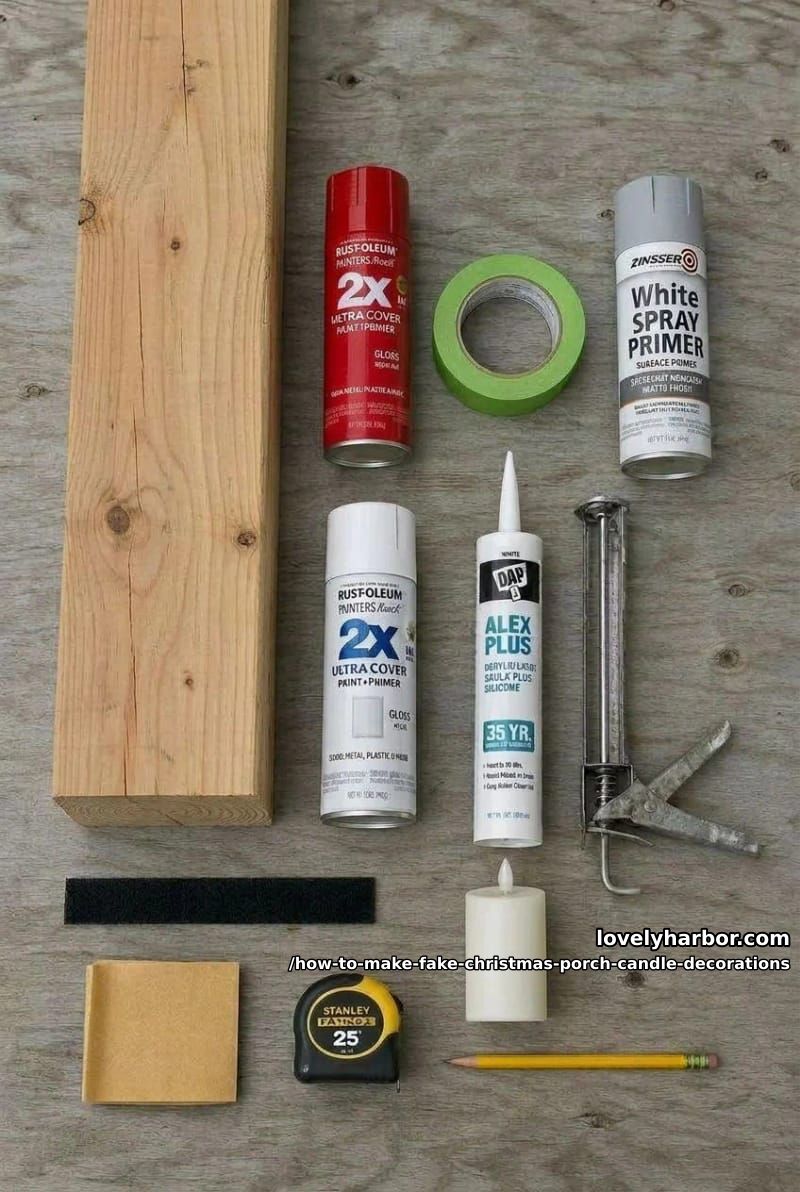
Materials (consumables)
| Qty | Item | Spec | Price |
|---|---|---|---|
| 1 | 6×6 lumber, 8 ft (kiln-dried pine or fir) | Cuts into 3 posts; buy at Home Depot or Lowe’s, not Amazon | $10 to $16 |
| 1 | Zinsser Cover-Stain white primer spray, 13 oz | Oil-based, seals bare wood and blocks tannin bleed | $8 to $12 |
| 2 | Rust-Oleum Painter’s Touch 2X, Gloss Apple Red, 12 oz | Interior/exterior durable; two cans cover three posts | $10 to $16 |
| 1 | Rust-Oleum Painter’s Touch 2X, Gloss White, 12 oz | Base coat under the stripes and the white crown | $5 to $8 |
| 1 | FrogTape Multi-Surface painter’s tape, 1.41 in | Sharp stripe lines; UV-stable for several days outdoors | $7 to $10 |
| 1 | DAP Alex Flex sealant, white, 10.1 oz | Paintable, interior/exterior; this becomes the wax drips | $5 to $8 |
| 1 | VELCRO Brand Extreme Outdoor fasteners, 4 in x 1 in strips | UV/weather rated, holds 15 lb; lets you pull the candle for batteries | $8 to $12 |
| 1 | Artmarry outdoor flameless LED candles, 3 in dia, set of 3 | Weatherproof plastic with a raised 3D flickering flame; remote and 10-key timer. One candle per post | $25 to $40 |
| 1 | National Tree 9 ft pine garland with pinecones and red berries | For the swag banked around each base | $30 to $50 |
| 1 | Larksilk faux holly berry stems, pack of 12 | Variegated holly and red berries tucked into the garland | $10 to $15 |
| Materials subtotal | $118 to $187 | ||
Tools (one-time, reusable)
| Qty | Item | Spec | Price |
|---|---|---|---|
| 1 | Miter saw or handsaw | To cut the post; or have the lumberyard cut it free | $0 to $40 |
| 1 | Cordless drill | Only if you use the recessed-seat mount in Step 4 | $0 (owned) |
| 1 | Yonico 16-piece Forstner bit set (includes 2 in and 2-1/8 in) | Flat-bottom recess sized to the candle; optional | $35 to $55 |
| 1 | Newborn 930-GTD drip-free caulk gun | Drives the sealant cartridge for the drips | $8 to $20 |
| 1 | Sandpaper, 120 grit | Ease the end grain and knock down sheen between coats | $5 to $10 |
| 1 | Tape measure, pencil, speed square | Layout and square cut lines | $0 (owned) |
| Tools subtotal (skip the Forstner set with the no-drill mount) | $15 to $125 | ||
Prices are approximate ranges as of 2026; verify before purchase.
Picking the right wood
This is the one decision that quietly sinks the whole project, so let me be blunt about it. The 6×6 posts stacked by the door at most home centers are wet pressure-treated lumber. Paint won’t stick to them until they dry out, and that can take weeks. People grab them anyway , the label says “outdoor,” so why not , then watch the red flake off by New Year’s. For a seasonal piece that lives on a porch, plain kiln-dried pine or fir takes paint the same afternoon and weighs a lot less in your arms.
Do this
- Kiln-dried pine or fir 6×6. A true 6×6 actually measures 3.5 in square, which throws people off.
- Sight down the post before you buy and pick the straightest one in the bin.
- Seal the cut bottom end grain so it can’t wick water.
- A paver or a few rubber feet under each post keeps it out of the slush.
Avoid
- Wet pressure-treated 6×6 , paint peels until it fully dries.
- Posts with deep checks or a corkscrew twist. Your stripes will run crooked.
- Landscape timbers with rounded edges; you want crisp 90-degree corners.
- Raw end grain sitting flat on the ground.
Step 1: Cut the posts to graduated heights
- Pick the post: use a 6×6 (5.5 in actual), not a 4×4. You need enough width to bore a pocket that seats the 3 in LED candle with a solid wall left around it.
- Cut three equal posts: all the same height, about 20 in each (anywhere from 18 to 24 looks right). The candles in the photo only look staggered because they sit on different steps; on level ground they read as a matched set. Square each cut with a speed square so the candle sits level.
- Bore the candle pocket: centered in the top of each post, bore a flat-bottomed pocket about 3-1/4 in across and 1.5 in deep (a large Forstner bit, or a router on a circle jig). The LED candle drops in and lifts back out for battery swaps.
- Ease the top edges: one quick pass of 120-grit along the four top corners keeps the paint from chipping there.
- Seal the bottoms: brush a little primer onto the bottom end grain and let it dry before anything touches the ground.
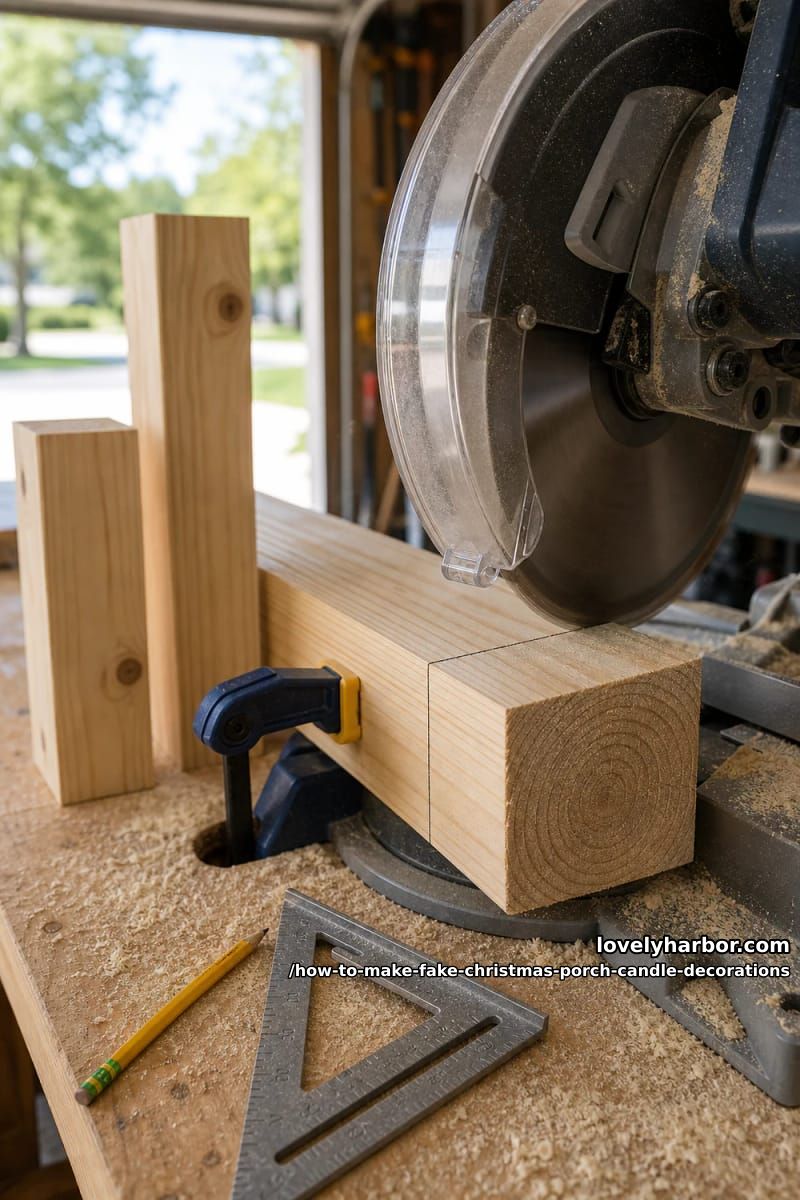
Varied heights are what sell the grouping. You can cut them all the same. One eight-foot post gives you a clean set of three with almost nothing wasted.
Step 2: Prime and lay down the white base
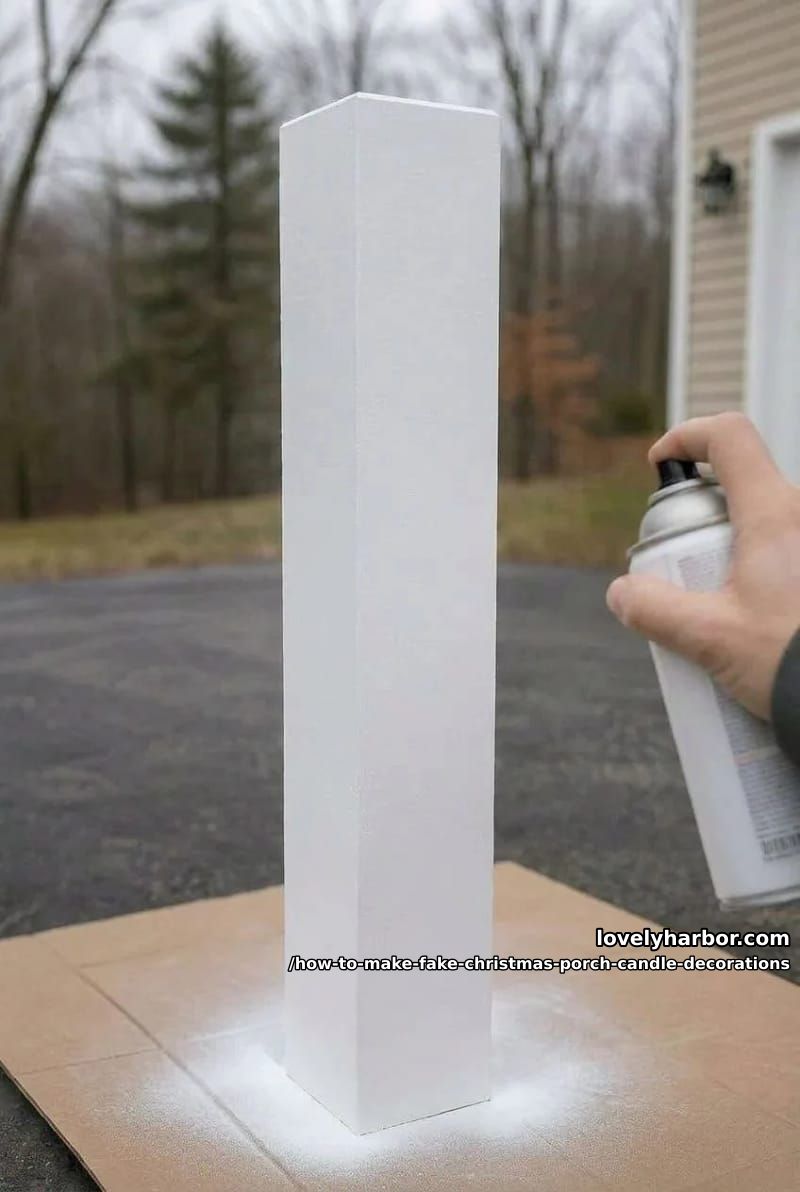
Here’s the order that saves you grief. White goes down first, over the entire post. Try to paint white stripes over red later and you’re looking at three coats and ragged edges. Instead you tape off the white you want to keep, then shoot red over everything.
- Prime: one even coat of Zinsser Cover-Stain. This is what keeps the pine knots from bleeding yellow through your white. Dry one to two hours.
- Base white: two light coats of gloss white, about 30 minutes apart, rotating the post so you hit all four faces. Hold the can roughly ten inches off the surface or you’ll get runs.
- Cure before taping: give the white a few hours. Tape pressed onto soft paint drags it right back off when you pull it.
Step 3: Tape and paint the candy-cane stripes
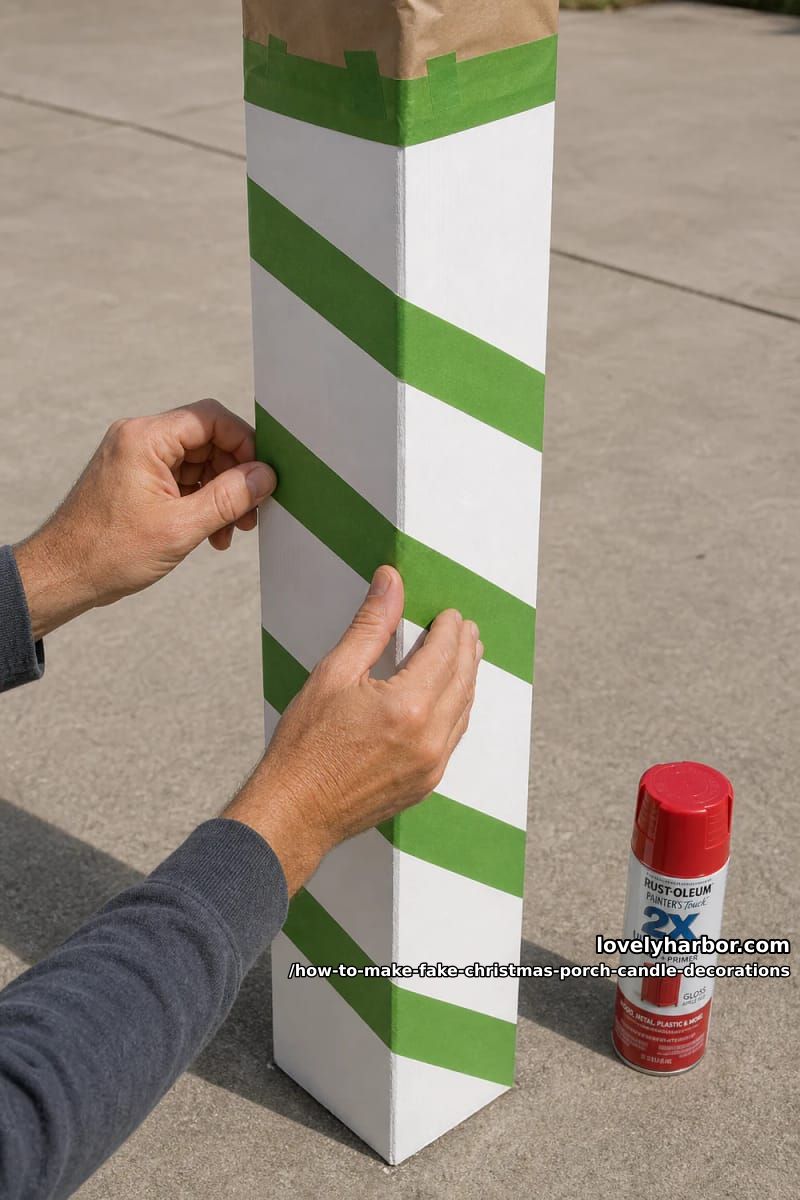
The candy-cane angle is consistent, not random , that’s the whole trick. Wrap the tape at the same diagonal on every face so the stripes look continuous as the post turns. Let the tape decide your stripe width: the 1.41-inch FrogTape lands you a classic peppermint band.
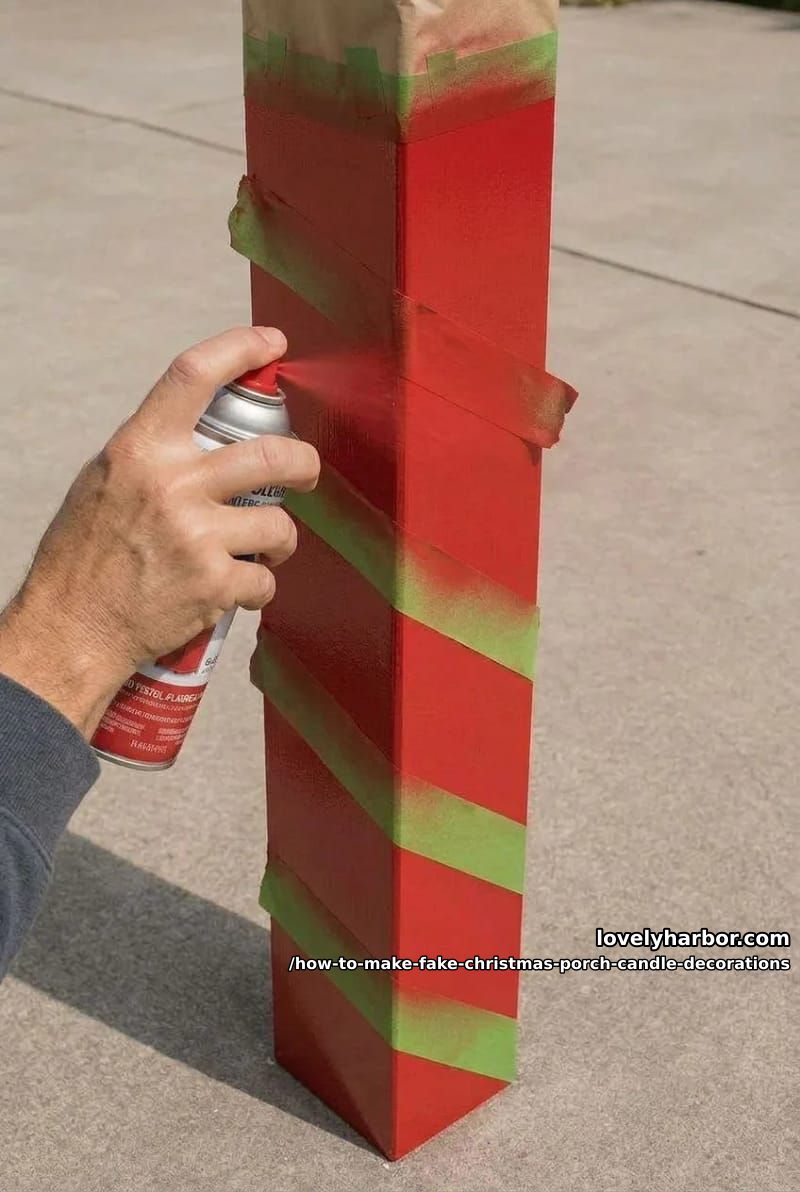
- Mask the crown: wrap tape around the post about four inches down from the top, then cover everything above it. That white top becomes your melted-wax pool in Step 5.
- Wrap the stripes: run diagonal tape bands down the post at even spacing, burnishing every edge hard with a fingernail so red can’t creep under.
- Shoot red: two light coats of Apple Red over the whole striped section, crown still masked.
- Pull tape while it’s tacky: peel each strip back on itself before the last coat fully hardens. That’s the line between a knife-sharp edge and a torn one.
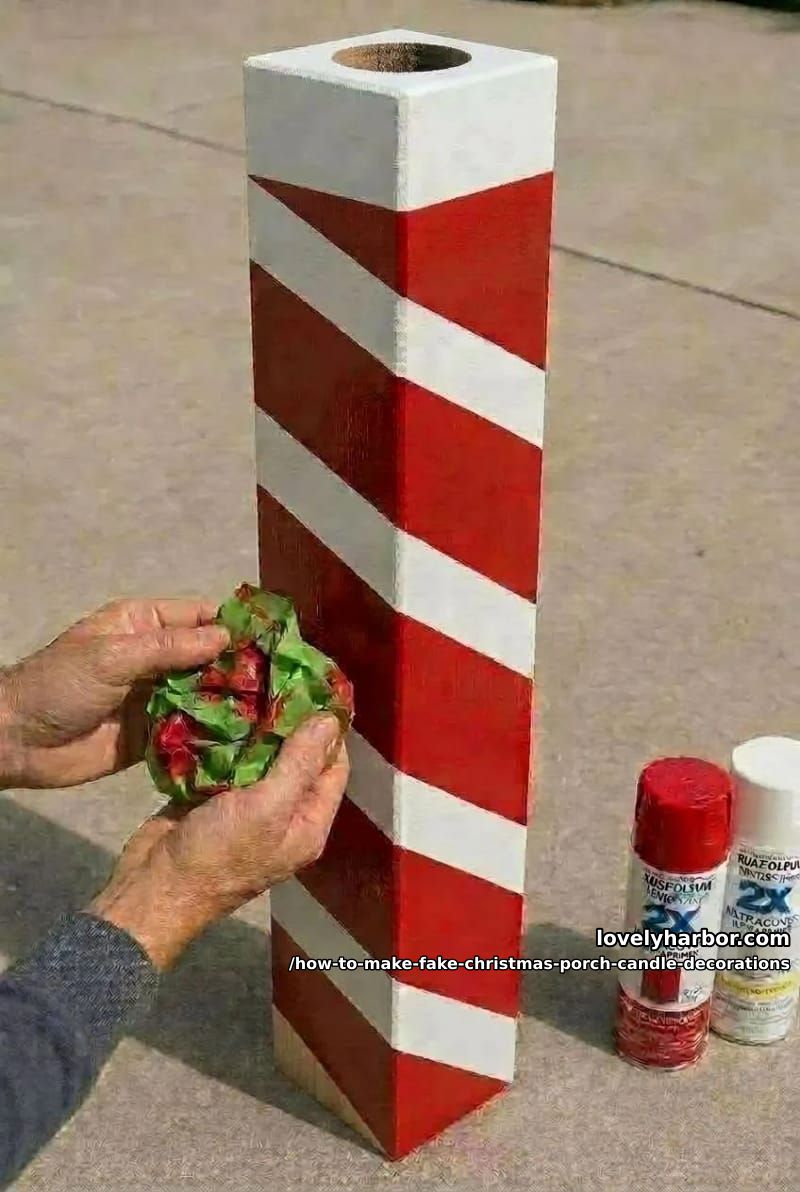
Once spray paint cures hard around a tape edge, peeling it lifts flakes of red along with the tape and leaves a jagged border. Pull each strip within 15 to 20 minutes of the final pass, while the surface is still a little soft.
Step 4: Mount the flameless candle
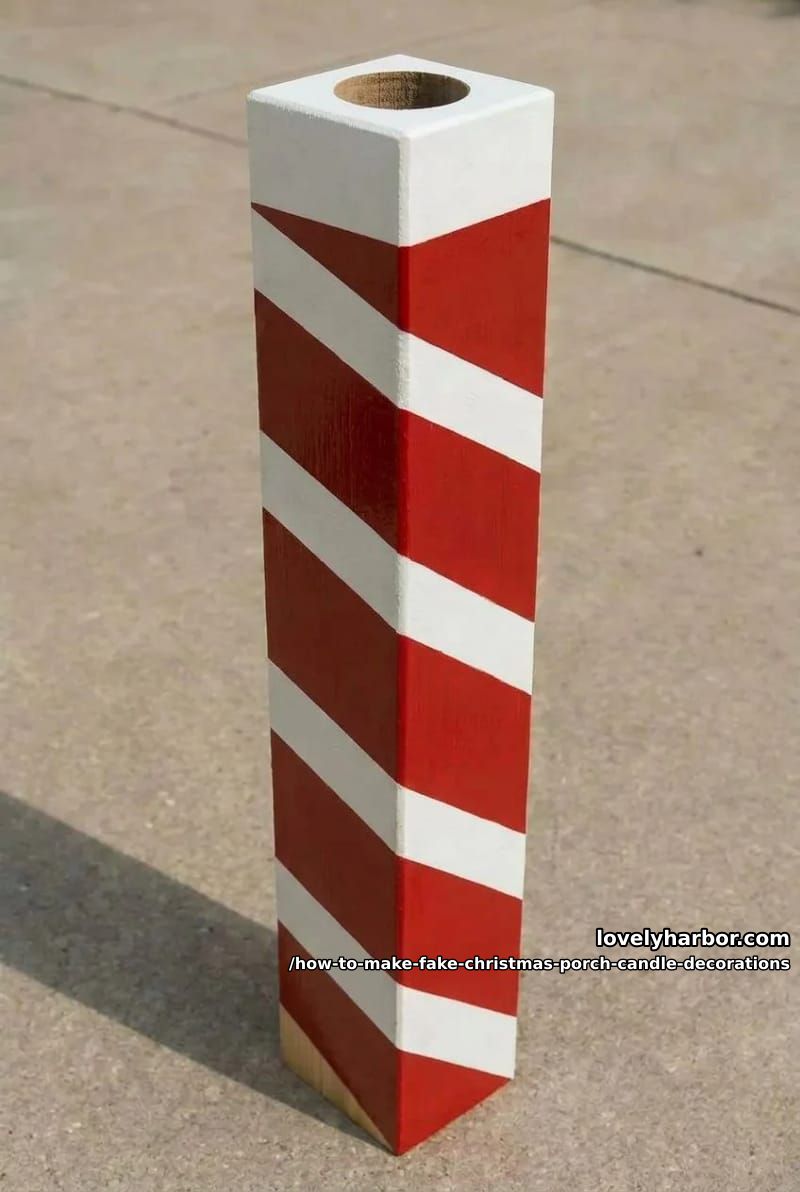
This is the question that brought you here. There are three good answers, and which one’s right depends on how wide your candle is and whether you mind drilling a hole. One thing ties all three together: the candle has to come back off. It runs on AA or AAA batteries, and you’ll be swapping those every season.
| Method | How it holds | Candle size it suits | Comes off for batteries? |
|---|---|---|---|
| Hook-and-loop (no drilling) | Outdoor fastener squares between the flat post top and the candle base | 3 in pillar, sitting nearly the full width of the post | Yes, peel it off |
| Recessed seat | Candle nests into a shallow flat-bottom hole; gravity holds it | 2 to 2.25 in slim pillar | Yes, lift it out |
| Glued collar | A short ring glued to the top; the candle drops inside it | 3 in pillar | Yes, lift it out |
For the chunky 3-inch candle in the photo, I’d skip drilling altogether. Stick two squares of outdoor hook-and-loop to the sanded post top and the candle base, press them together, done. The Extreme Outdoor fastener is rated to 15 pounds and shrugs off wind and cold. The caulk drips you add in the next step hide the seam, so the candle reads as one piece with the post.
Want the candle to sit down into the wood instead? Reach for a Forstner bit, not a hole saw. The Forstner cuts a flat-bottomed blind recess; a hole saw simply can’t. There’s a catch worth knowing before you commit, though. A 4×4 is only 3.5 inches across, so any recess wider than about 2.5 inches leaves the walls thin enough to split. The seated look wants a slim 2-inch candle, in other words. Drill the recess about a quarter inch wider than the candle and roughly half an inch deep, dead center.
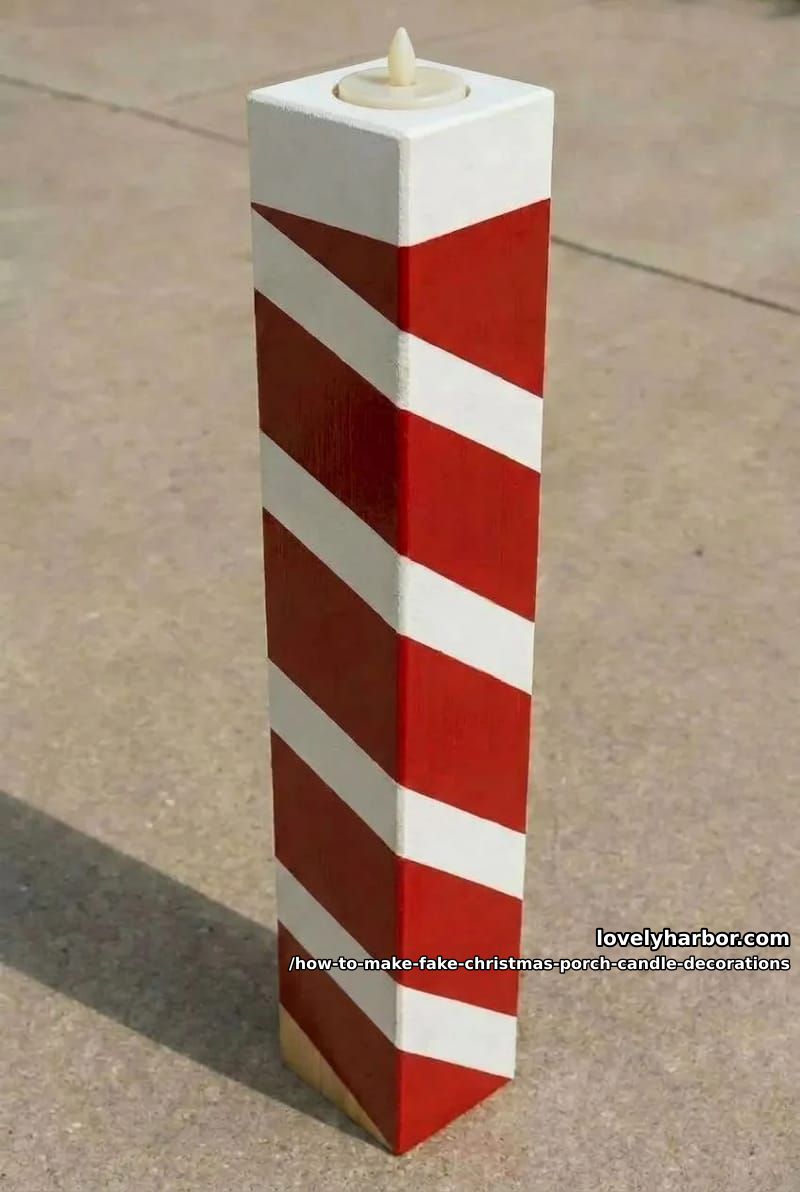
Don’t want to fake the melted top with caulk at all? These have the dripped wax edge molded right in, and a flame that actually sways.

A bead of construction adhesive, or a deep press-fit, feels secure right up until the batteries die in January and you’re out there prying a candle off a frozen post. Keep every mount removable. Store the candles indoors between seasons too, so the electronics last more than one winter.
Step 5: Build the dripping wax
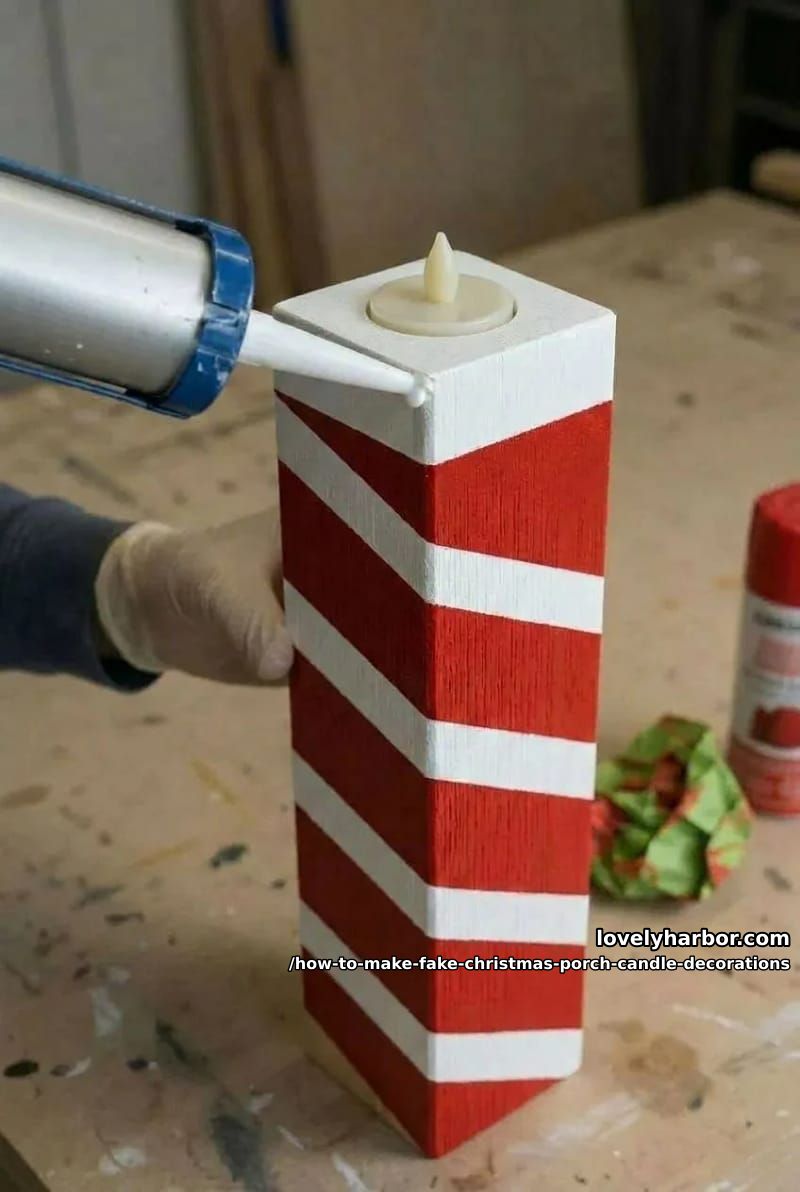
This is my favorite part, and the one that does the most work for the least money. White paintable caulk is what makes the wax look like wax. It dries to a soft, rounded surface that catches light exactly the way a pool of melted wax does, and because it stays a little flexible, it rides out the freeze-thaw that would crack anything rigid. Run the bead from the white crown so the drips spill down over the red.
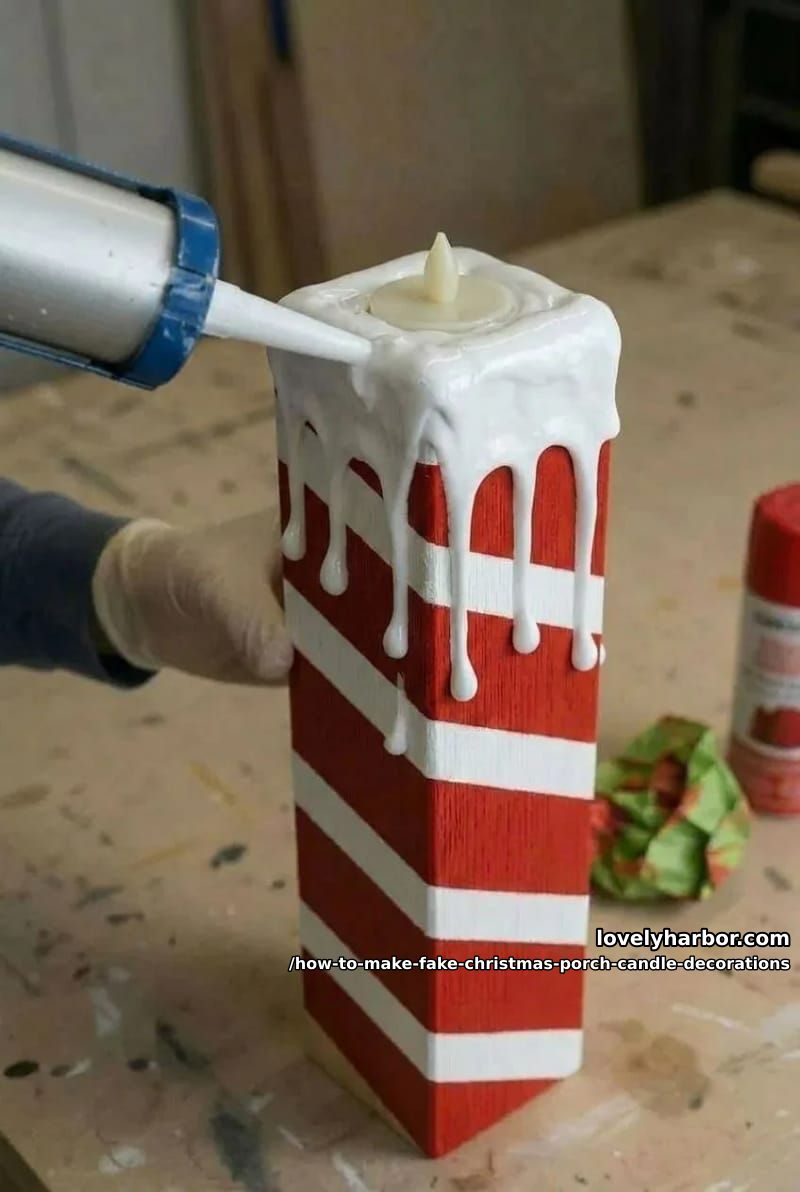
- Pipe the crown: lay a heavy bead of DAP Alex Flex around the top edge of the post, right where the white meets the candle.
- Pull the drips: let gravity start a sag, then drag a few longer drips down over the stripes with the nozzle tip. Vary the lengths , uniform drips look fake.
- Skin, then cure: the surface firms up in about 30 minutes, but give it a full 24 hours before the candles go outside.
- Touch up white: if any caulk looks glossy or off-white against the paint, a light pass of the gloss white spray blends it in.
Hot glue is the go-to for faux drips on indoor crafts, and it falls apart outside. UV turns it yellow, and below freezing it goes brittle and pops off the post in sheets. Save it for a mantel candle. On anything that sees weather, use exterior caulk.
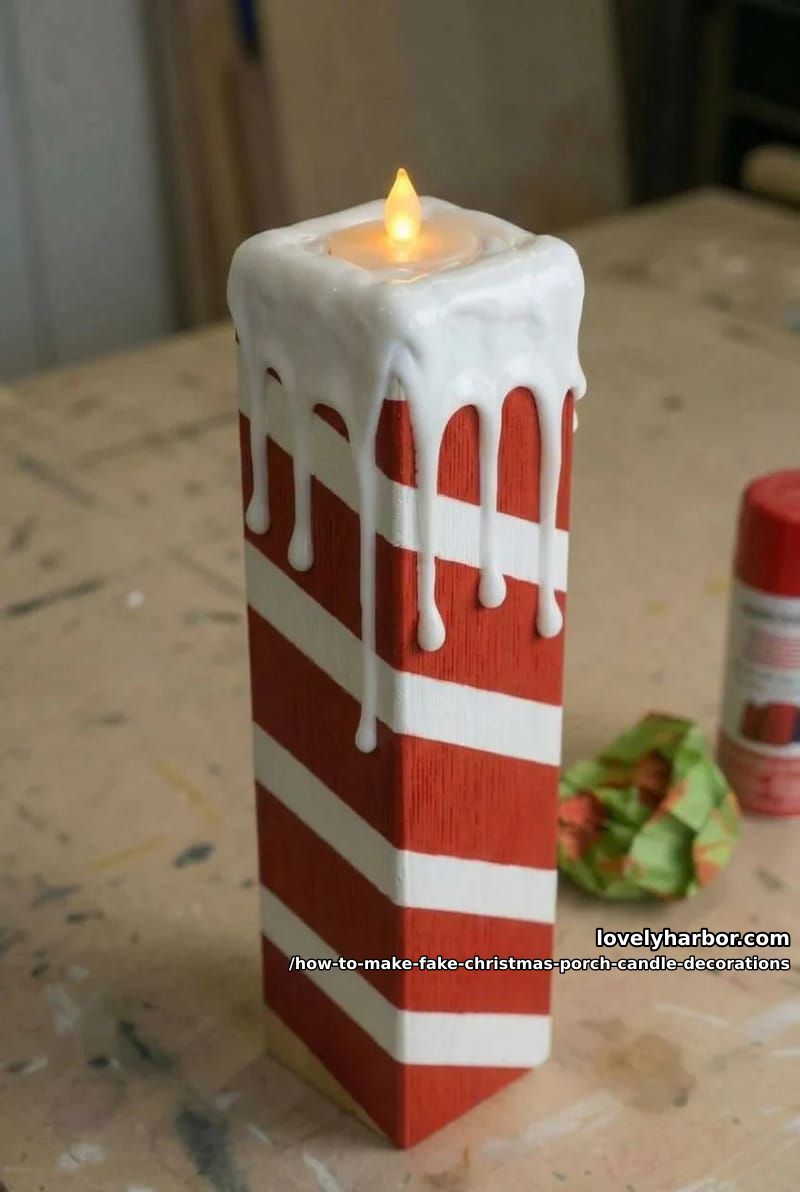
Step 6: Stage on the porch
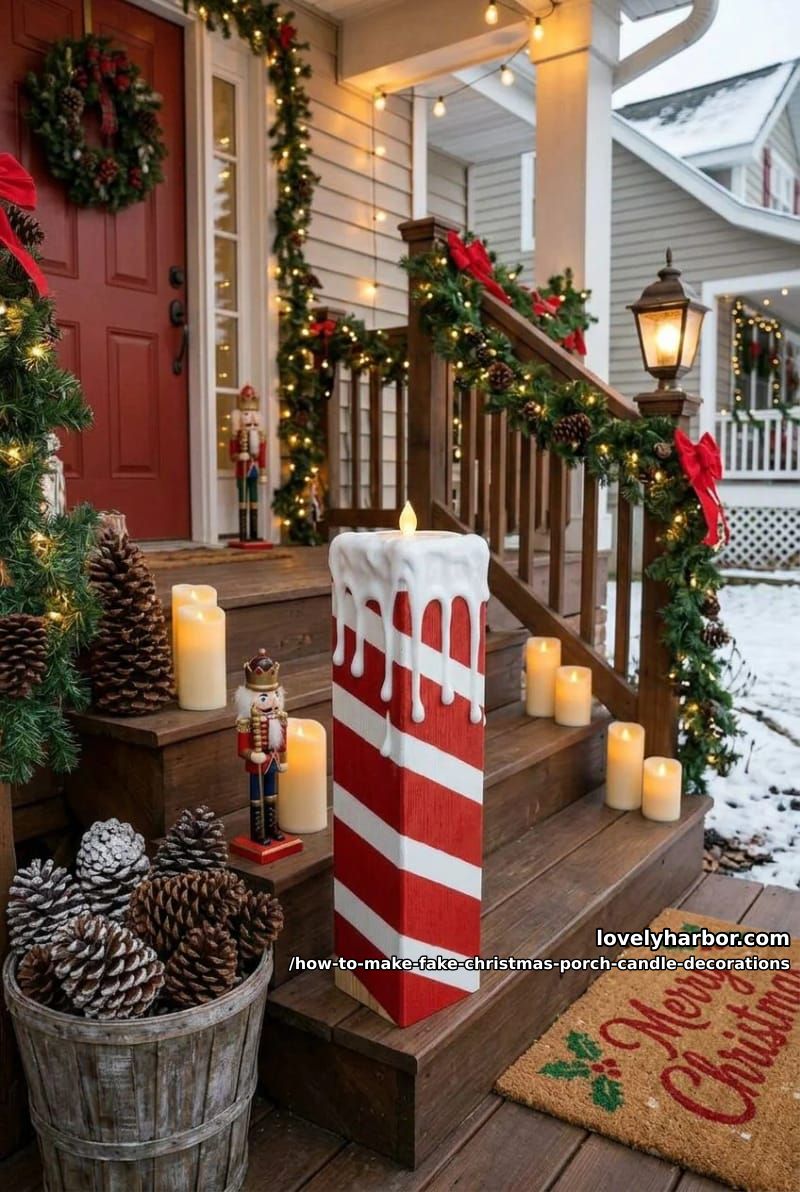
The greenery earns its keep two ways. It hides the bottom of each post and the paver underneath, and it pulls three separate objects into a single display. Bank the pine garland in a loose ring around each base, then tuck holly stems and berry clusters into the gaps so the red echoes the red of the stripes. Set the candle timers once and they cycle on at dusk on their own.
Cluster odd numbers and stagger the heights , tallest at the back of a step, shortest spilling toward the edge. If a post feels tippy on stone, a dab of museum putty under the paver settles it without committing to anything permanent.

Mistakes that ruin the build
- Painting wet pressure-treated lumber. The most common failure, and it isn’t close. The paint beads up, never bonds, and peels within weeks. Kiln-dried wood, or let treated wood dry for weeks first.
- Leaving the tape on too long. Cured paint tears at the tape edge, so pull it while the last red coat is still slightly soft.
- Hot glue for the drips. It yellows in the sun and shatters in the cold. Exterior caulk, full stop.
- Sealing the candle in with no way to open it. You will need to reach the battery compartment eventually. Every mount in Step 4 stays removable for that exact reason.
- Standing raw wood in snow. The end grain wicks water, the post swells, and the paint fails from the bottom up. Seal the bottom and set it on a paver.
- Drilling the recess too wide. On a 3.5-inch post, anything past 2.5 inches leaves walls that split. Match a slim candle to the recess, not the recess to the candle.
Build-day timeline
Spread across a weekend with drying time built in, it’s a relaxed two-and-a-half-day project. Most of that clock is paint and caulk curing, not actual work.
- Day 1, morning: cut the three posts, sand the corners, seal the bottoms, and prime. Let the primer dry one to two hours.
- Day 1, afternoon: two coats of white, 30 minutes apart, then let it cure into the evening.
- Day 2, morning: mask the crown, tape the diagonal stripes, shoot two red coats, and pull the tape while the paint is still tacky.
- Day 2, afternoon: mount the candles, then pipe and pull the caulk drips. Leave them to cure overnight.
- Day 3: set the candle timers, carry the posts out, and bank the greenery and holly around each base.
Conclusion
Dry pine. That’s the whole game , the wet treated post is what peels by New Year’s, and the kiln-dried one is what’s still red next December. Everything after that is forgiving, the mounting most of all, which stops being hard the second you quit trying to drill a 3-inch candle into a 3.5-inch post and just stick it down. One thing I’ll be honest about: the battery candles are the weak link, and even the IP-rated ones don’t love a hard freeze, so bring them in when the season’s over. Start with three, see how they read from the street after dark, and add a couple more next year.