
The island is the surface you actually use, for prep, homework, and the inevitable pile of mail, so it earns more design attention than any other part of a farmhouse kitchen. The twenty below are sorted less by how they photograph and more by the decisions sitting behind them: which countertop survives daily cooking, how high to hang the pendants, whether that distressed paint finish will still look intentional in five years, and how much clearance you need before stools turn into a tripping hazard.

1. Cozy farmhouse kitchen with cream cabinets, marble counters, and rustic beams.
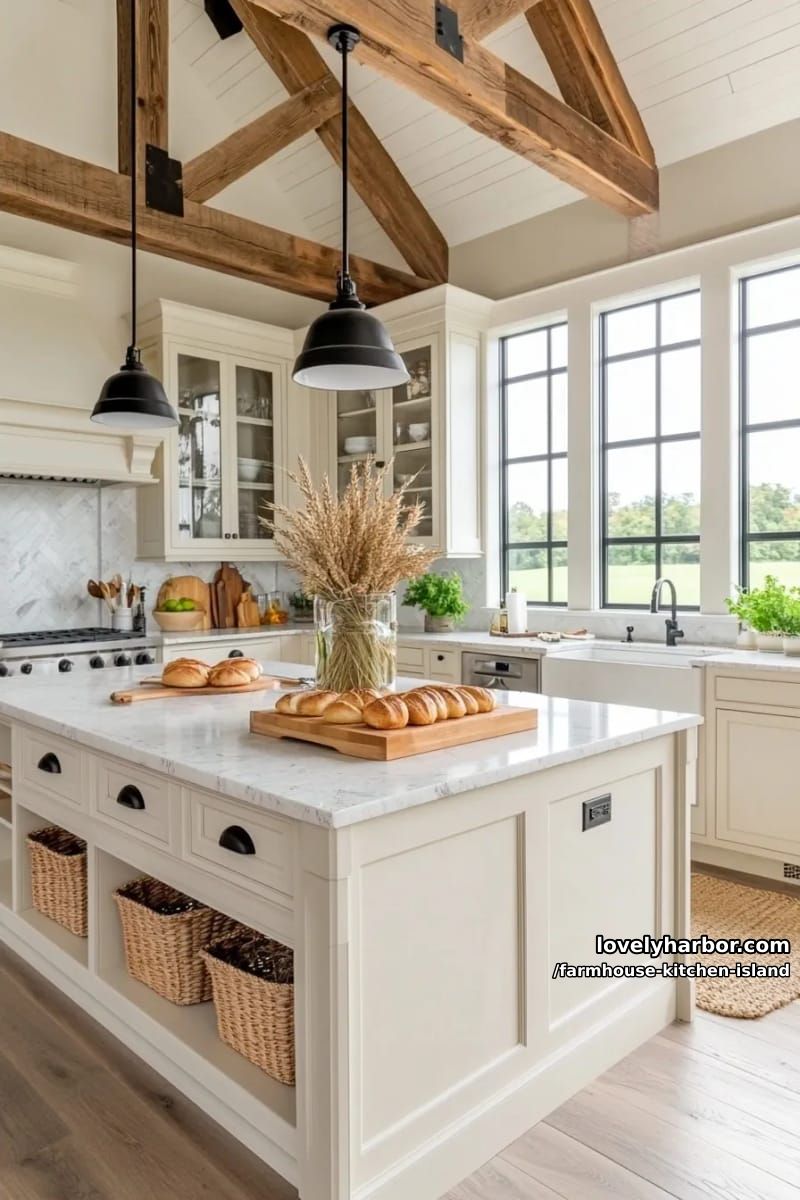
Polished Carrara on an island you actually cook at is a decision you will regret by month three. Marble etches the moment it meets anything acidic (lemon, wine, a tomato left to sit), and an etch is not a stain you can scrub out, it is a dull spot where the acid ate the polish. Order it honed instead of polished and the etching mostly disappears into the matte finish.
The cream cabinets are the smarter half of this pairing. A warm off-white in satin or semigloss wipes clean where a flat finish would hold grease, and it hides the smudges a true white shows off. The Pottery Barn version of this look, all bright-white-everything, photographs well and reads like a hotel breakfast bar in person.
Reclaimed beams overhead carry most of the room's age, even when they are hollow boxes screwed to the ceiling, which most of them are. Run a duster along the top edge once a month, or the next bout of low evening light will find the gray fuzz for you.
2. Rustic wooden island, butcher block countertop, open shelves, and shiplap walls.

Butcher block is the right call here, with one caveat I learned the slow way. I spent a couple of years telling everyone to top their island in it, then refinished my own for the third time and started qualifying the advice. End-grain block (the checkerboard pattern) is gentler on knife edges and hides cut marks; edge-grain (long parallel strips) costs less and shows every slice. For an island you prep on daily, pay up for end-grain.
The open shelves under the island look generous in photos and become a crumb-and-dust ledge in practice, so reserve them for the colander and the mixing bowls you grab every day, not for display. Shiplap on the walls I would skip entirely at this point. It reads as a specific 2016-to-2021 renovation more than a country tradition, and the grooves hold grease three feet from a stove.
A dry top is a cracked top. Oil bare wood with food-grade mineral oil weekly for the first month, then monthly after that, and never let standing water pool near the sink seam. Skip a season and you get black mildew lines down in the grain that sanding only partly lifts.
3. Farmhouse kitchen with green island, brick backsplash, and industrial pendant lights.
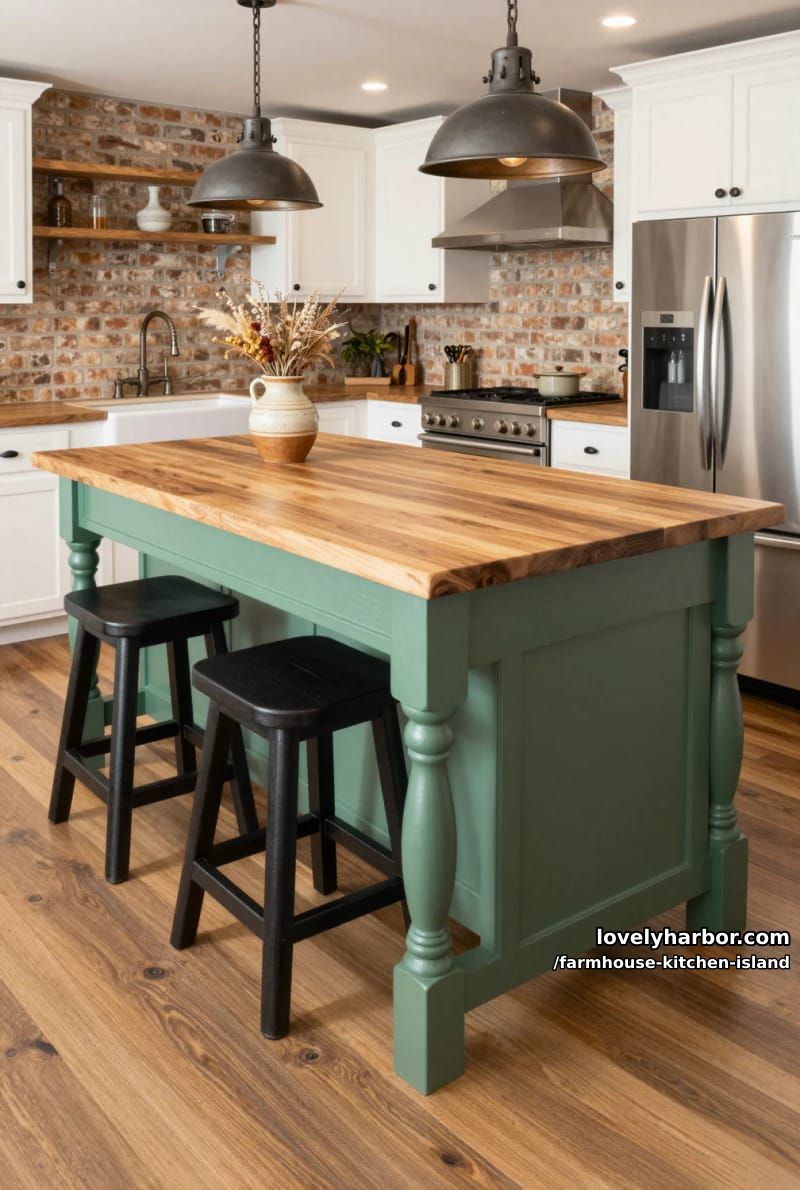
Hang the industrial pendants 30 to 36 inches above the counter and no lower, or tall guests end up eating around them. Space the run so it covers roughly half to two-thirds of the island's length, and use an odd number; two pendants over a long island always look like a third one fell off.
A muted, grayed green on the island base is the safest saturated color you can put in a farmhouse kitchen, because it behaves like a neutral next to wood and brick. The bright kelly and emerald greens are a different story, and you will be repainting in three years.
Real brick or brick veneer behind a cooktop wants a matte masonry sealer. Left raw, the porous face grabs grease you cannot get out of the mortar joints without a wire brush and some bad language.
4. Spacious kitchen with wooden island, white cabinetry, and subway tile backsplash.
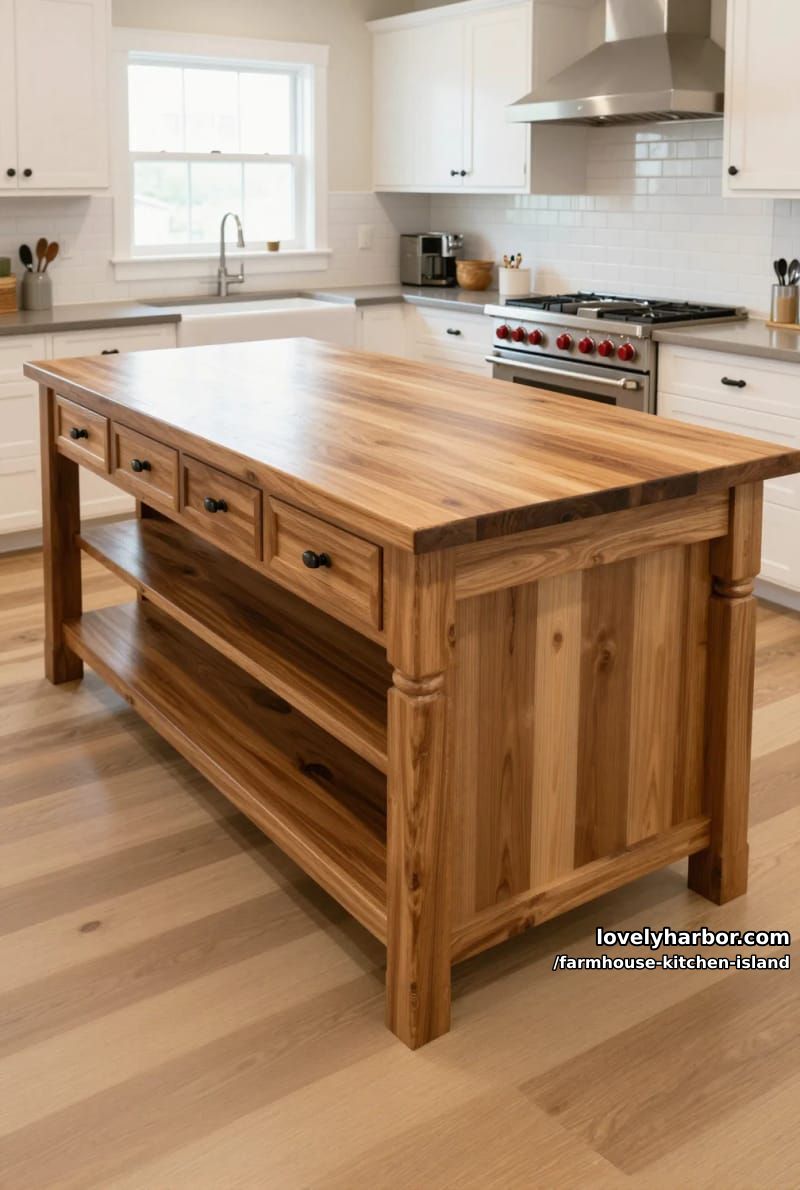
The grout color decides what this kitchen looks like, more than the tile does. White subway tile with bright white grout reads clean and slightly clinical; the same tile with a warm gray or greige grout reads softer and older, which is the whole point of farmhouse. Pick the grout before you fall for the tile.
A wood-topped island will scratch, no exceptions, so either choose a hard close-grained species like hard maple and make peace with a few marks, or keep an end-grain cutting board parked on it and cut nowhere else.
5. Compact wooden island, marble countertop, white cabinets, and brass hardware.

A compact island only works if you keep the walkways around it at 36 to 42 inches. Squeeze that to 30 and two people cannot pass while the dishwasher hangs open. Below about 40 by 24 inches of usable top, an island stops justifying the floor space it eats, and a rolling cart would serve you better.
Unlacquered brass hardware is the finish I keep coming back to, even though it darkens and goes blotchy, because that living patina is the entire reason to choose brass over brushed nickel. If you hate the idea of it aging, buy lacquered and accept that the coating will eventually chip and look worse than honest tarnish. The shiny gold builder-grade knobs from the big-box aisle are neither.
On a 36-inch-wide island, a single marble remnant slab is often enough to top it, which is the one situation where marble gets cheap.
6. Distressed turquoise island, open shelves, glass pendant lights, and pink wildflowers.
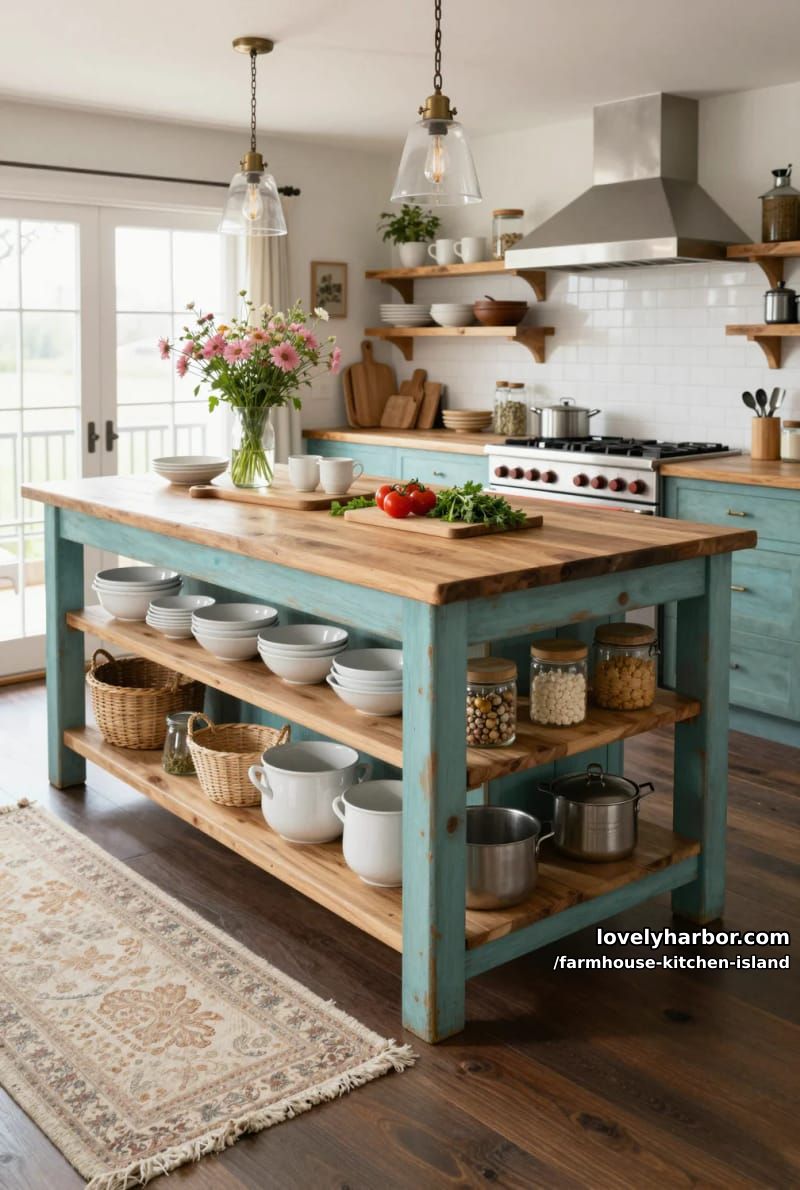
Distressed turquoise reads coastal cottage more than farmhouse, which is fine if that is what you are after, but be honest with yourself before you commit a whole island to a saturated blue-green. The distressing is a technique, not an accident: chalk or milk paint, then sand back only the edges, corners, and the foot rail where real wear would land, not randomly across the face.
Clear glass pendants let the eye pass through, so they crowd a small room less than opaque metal shades, but they also show every dead bug and dust film; count on wiping the insides of the globes a few times a year. As for the pink wildflowers in the photo, that is styling. Nobody keeps fresh stems on an island they actually cook on.
7. Reclaimed wood island, industrial pendant lights, white cabinets, and farmhouse sink.
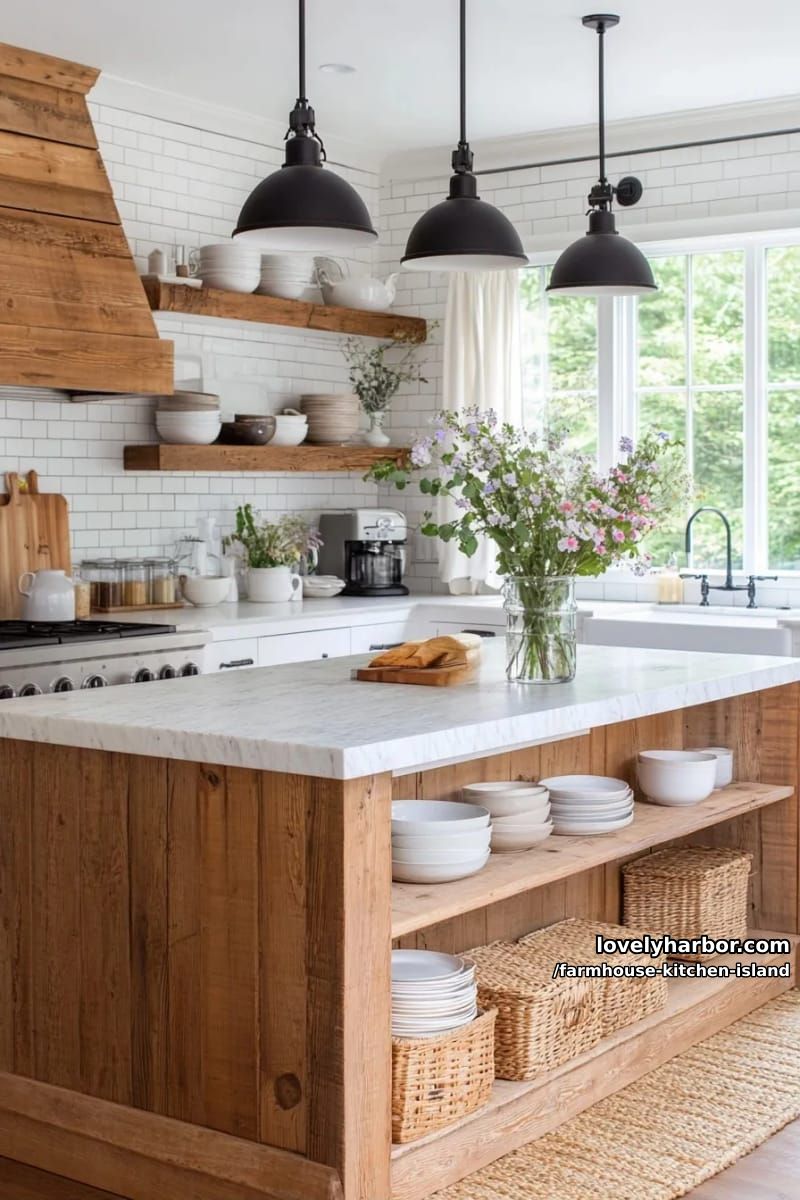
Reclaimed wood is wonderful and occasionally a problem you carry into the house, so vet the source. Barn and factory salvage can come with lead paint, old insecticide residue, powderpost beetle holes, or moisture that warps a board once it acclimates to a heated room. Buy from a dealer who kiln-dries and remediates, or have a local mill plane and inspect every piece.
The farmhouse sink is the part people underestimate. A fireclay or cast-iron apron sink can weigh 80 to 150 pounds once it is full, so the cabinet beneath needs a reinforced base and a modified front. You cannot drop one into a standard sink cabinet and hope. Budget for the cabinet work, not just the sink.
8. Weathered white cabinetry, shiplap island, vintage stools, and wooden hanging shelf.
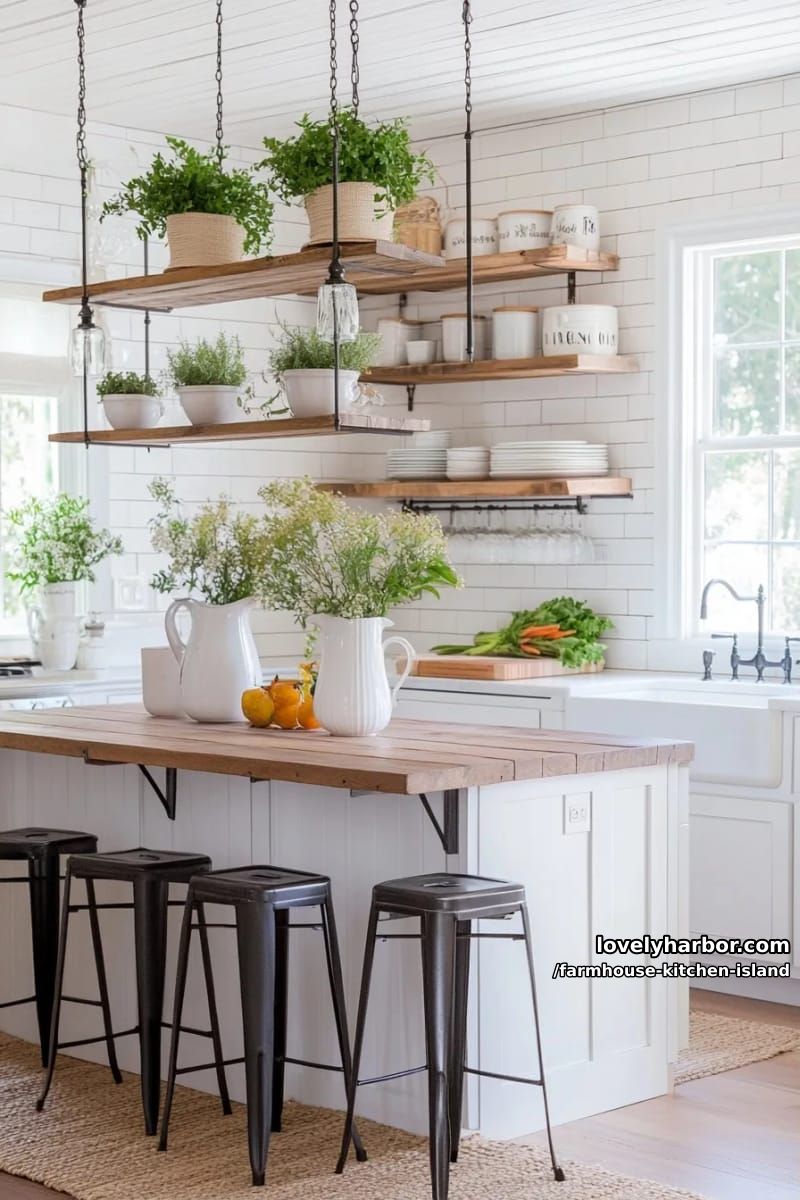
Get the stool height right or the vintage stools become decoration nobody sits on. A standard 36-inch counter takes a 24-to-26-inch seat with about 12 inches of overhang for knees; a 42-inch bar top takes a 30-inch stool. Measure the actual island first, then buy.
Mismatched flea-market stools beat the matched set from the Pottery Barn catalog, because uneven height and honest wear are what make a kitchen look accumulated instead of ordered. Just keep the seats within an inch of each other in height, or the whole row looks drunk.
A hanging shelf over the island has to clear head height for anyone standing under it, 30-plus inches above the surface, and even then it picks up a greasy film if it floats over the cooking zone rather than the seating end.
9. Distressed wooden island, shiplap walls, industrial pendant lights, and dark cabinetry.
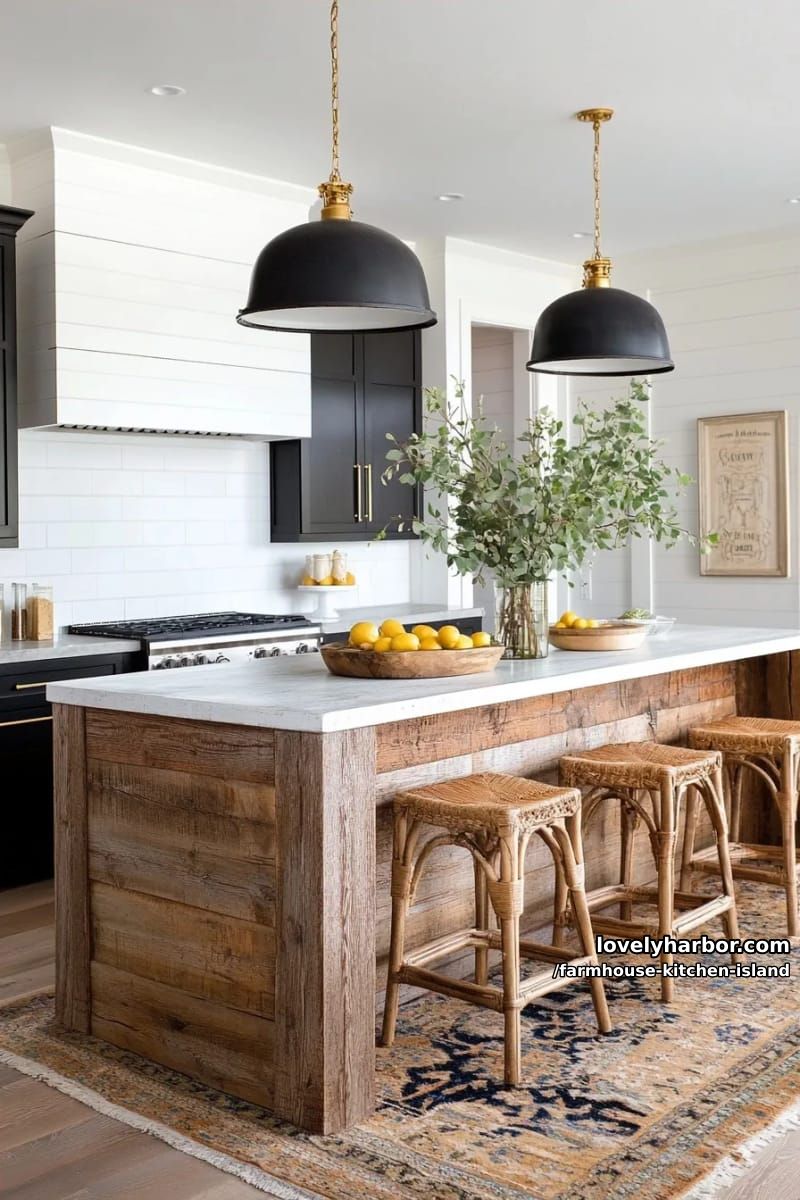
Dark lower cabinets ground a kitchen that has a lot of pale wood and shiplap going on, and the colors that hold up over years are the near-blacks and deep greens, not true black, which can look flat and cheap in a matte finish. Tricorn Black and Hale Navy are the dependable picks.
Granted, dark cabinets show grime differently than white: less obvious in daylight, much more obvious as a haze under raking light, so a satin sheen beats matte if you have kids or a hardworking cooktop. Anyone who tells you dark cabinets hide everything has not lived with them under a south-facing window.
10. Weathered wood island, leather barstools, hanging plant fixture, and stone walls.
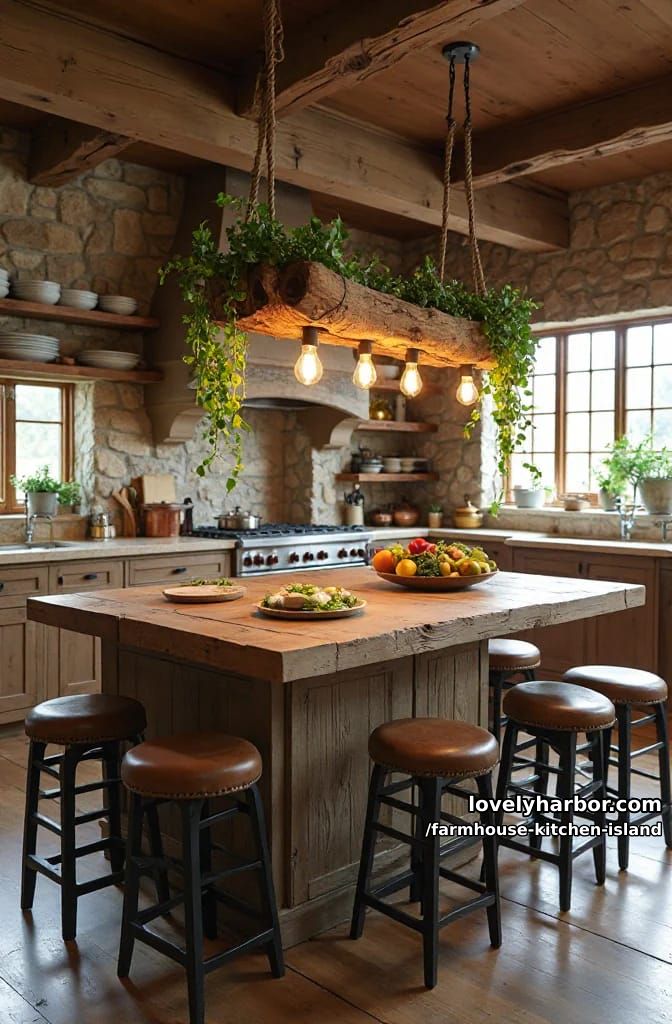
Real leather barstools work only if you accept that they will spot and darken where hands and jeans land, which most people end up liking. The faux-leather versions crack along the seat fold within a couple of years and there is no repairing that. If the kitchen sees greasy fingers, pick an oiled or pull-up leather that absorbs marks rather than a smooth aniline that shows them.
A hanging plant over the island needs something that shrugs off low, indirect light and a missed watering or two: pothos or a heartleaf philodendron, not the fiddle-leaf fig that will sulk and drop leaves into your dinner. Stone walls look solid and run cold and echoey, so a single trailing plant and a softer pendant warm the room far more than another basket of throw pillows.
11. Sage green island, butcher block top, rattan barstools, and rustic ceiling beams.
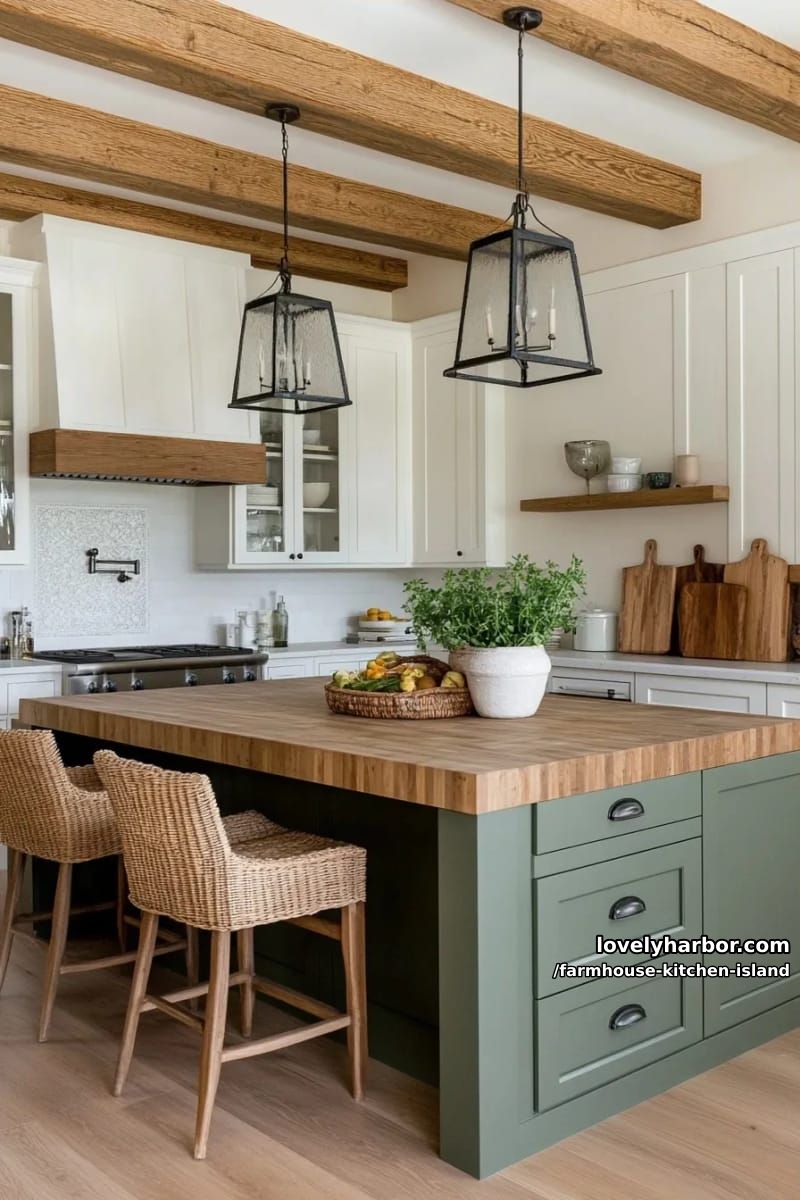
Sage is the green that behaves itself, and the shades that read farmhouse rather than dated are the grayed, dusty sages like Benjamin Moore October Mist or Saybrook Sage, not the yellow-leaning avocados. On the island base, sage sits quietly beside a butcher block top and warm beams without picking a fight with either.
Rattan barstools add texture, and the styling photos never mention this: woven seats near a stove trap grease and crumbs in every gap, and you cannot wipe them, you brush them out over the sink. Lovely in a breakfast nook, a maintenance trap pulled up to a working island.
Do this
- Choose grayed, dusty sages (October Mist, Saybrook Sage) that act like a neutral.
- Lean olive or deep green if you want the island to read darker and more grounded.
- Test a large painted sample in both daylight and your evening bulbs before committing.
Avoid
- Bright kelly or emerald, which date fast and fight the wood.
- Yellow-green avocado, which drags the room straight back to the 1970s.
- Picking off a paint chip; green shifts more under different light than any other color.
12. Modern farmhouse kitchen, white island, woven stools, stone backsplash, and large windows.

Big windows are the selling point and the trap. Pair them with a high-gloss quartz or polished stone island top facing the glass and you fight glare every sunny afternoon; a honed or matte top kills the reflection. Orientation matters too, a north window gives even light, a west window gives you sunset glare right at dinner prep.
Woven or rope stools soften an all-hard-surface modern kitchen, with the same grease caveat that applies to rattan near a stove. A stone backsplash, real slab or thin veneer, needs an impregnating sealer if it is anything porous like limestone, travertine, or some marbles. Skip the sealer and oil splatter darkens the stone for good.
13. Rustic wooden table, ornate turned legs, and visible wood grain.
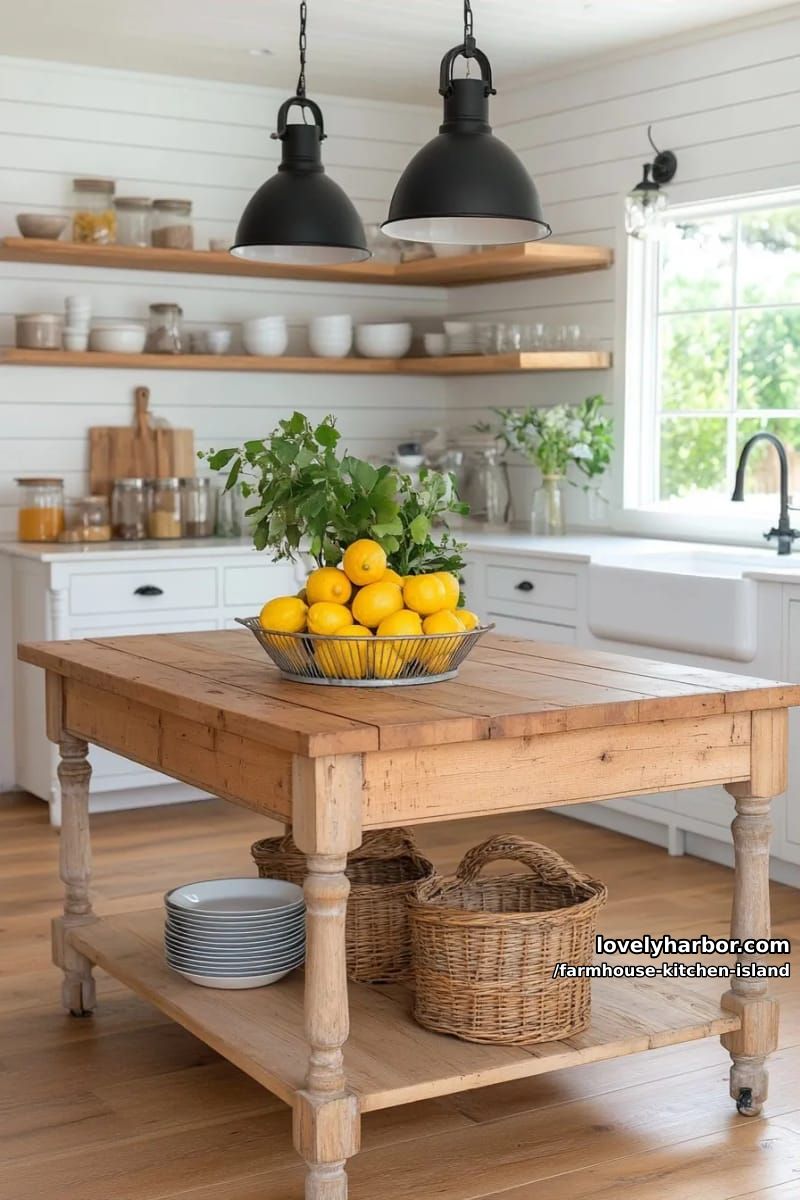
Using an antique table as an island is a clever trick with one catch most people discover only after they buy the table: dining tables are 29 to 30 inches tall and kitchen counters are 36, so a table-as-island sits six inches low for standing prep. It works as a baking station (low is actually easier for kneading), or you raise it on bun feet or casters to claw back the height.
Ornate turned legs are charming and they eat your seating; the legs sit at the corners exactly where knees want to go, so a four-seat table often seats two once you pull up stools. The grain and old finish are the entire appeal, so do not strip a genuinely old top to bare wood. You would be sanding off the patina you paid for.
14. Rustic island, butcher block top, dark cabinets, and floating wooden shelves.
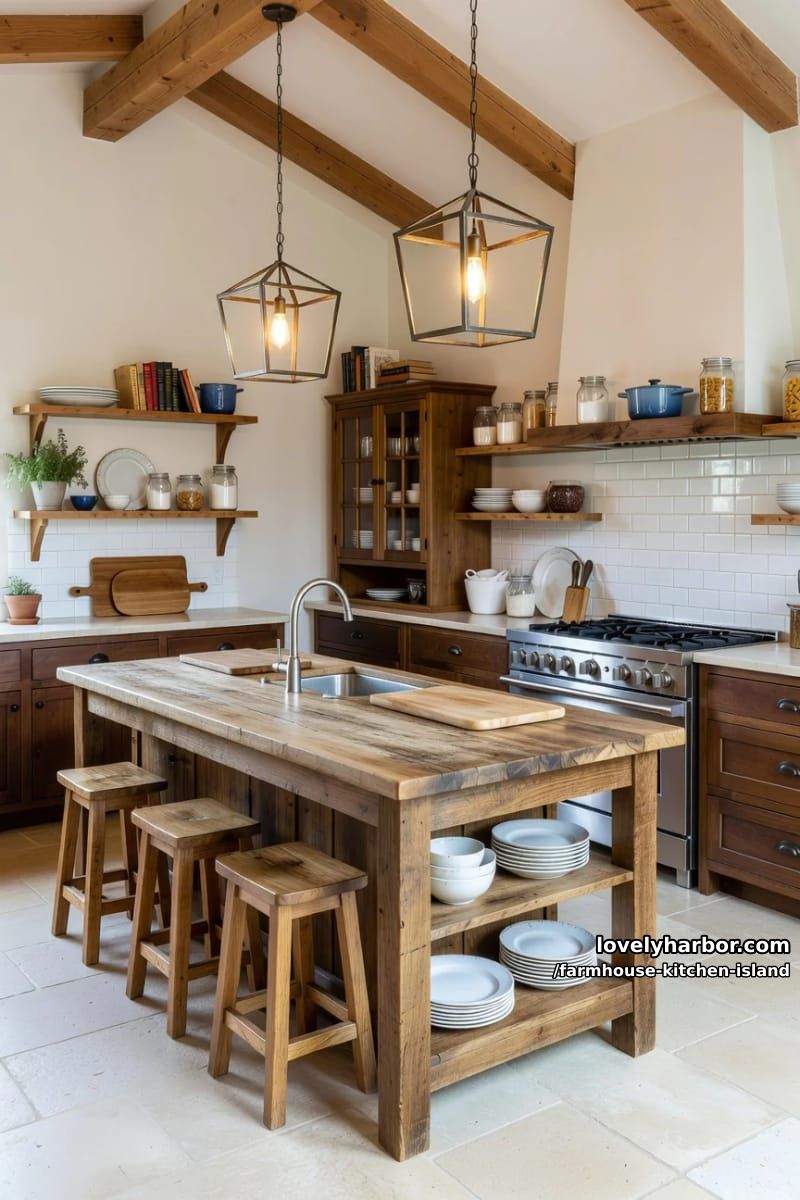
Floating shelves are only as strong as what they are screwed into, and a shelf stacked with stoneware needs to hit studs or solid blocking, not the drywall anchors that sag and eventually let go. For a heavy display, use a concealed steel-rod bracket rated for the load, not the decorative L-brackets from the hardware aisle.
The honest fix for the dust-and-tidying problem of open shelves is to mix them with closed cabinets: open shelves for the everyday plates and mugs you cycle through fast enough that dust never settles, closed doors for everything else. People who put their whole dish collection on open display repaint that wall behind the shelves more often than they planned to.
15. Modern farmhouse kitchen, wooden island, glass pendant lights, and wood beams.

Most ceiling beams in new farmhouse kitchens are faux: three-sided boxes of stained pine, sometimes polyurethane, and that is fine, since a structural beam in a single-story addition would be pointless overkill. What gives away a bad faux beam is uniform color and crisp factory corners, so hunt for ones with variation and softened edges if you want them to pass as salvage.
For glass pendants over the island, the spacing math is simple enough to do on paper. Center the run on the island, leave equal gaps at the ends, and keep fixtures roughly 24 to 30 inches apart center to center. Two pendants over a six-foot island look sparse; three is usually the number.
16. Modern kitchen, white marble island, oak base, and industrial black pendant lights.
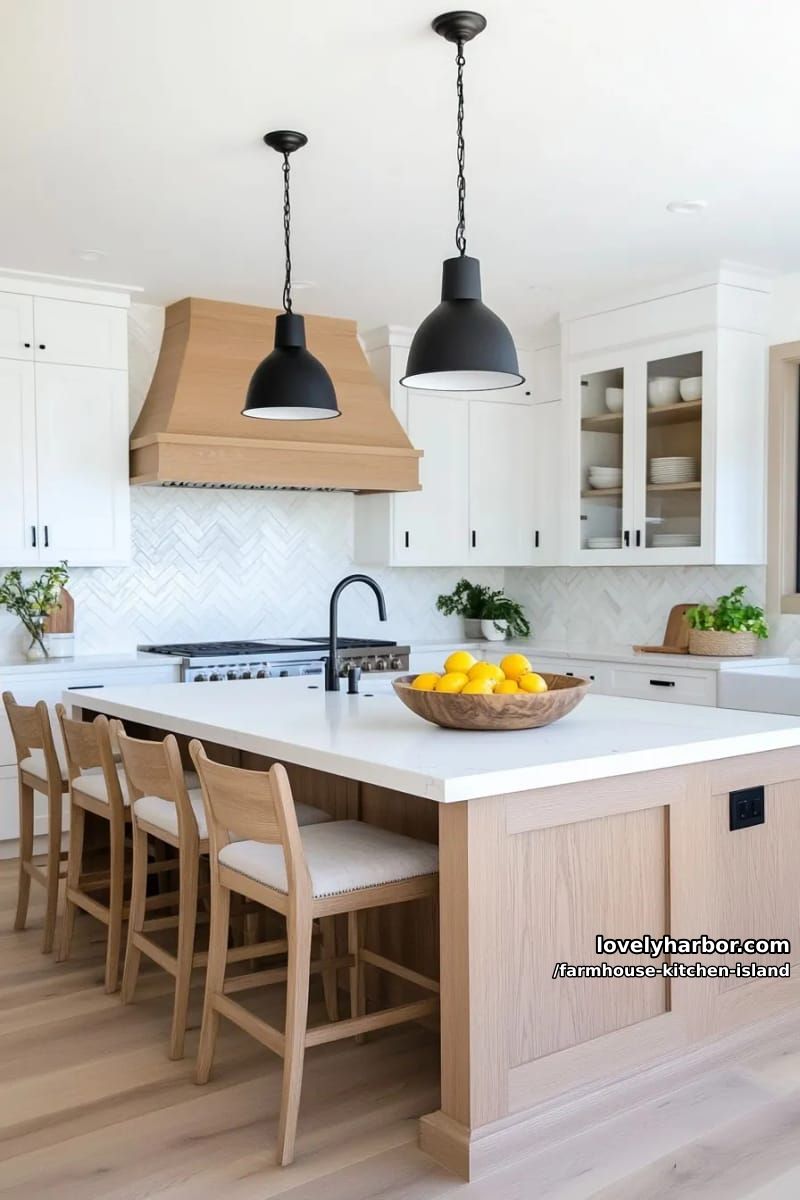
A white marble top on an oak base is the pairing showing up in every modern farmhouse kitchen right now, and the detail that pushes it contemporary is the edge: a waterfall edge (the stone running down the sides to the floor) reads modern, a thick mitered apron reads more traditional. Matte black pendants are the practical pick because the finish hides the fingerprints polished chrome would broadcast across the room.
Before you commit to marble, weigh it honestly against the two materials it competes with on an island, because the right answer depends on how you cook, not on how it photographs.
| Top material | Upkeep | Stands up to | Watch out for |
|---|---|---|---|
| Butcher block | Oil monthly, sand to renew | Knives, warmth, daily abuse | Standing water at the sink, hot pans, mildew if neglected |
| Honed marble | Seal periodically, blot acids fast | Heat, rolling cool dough | Etching from citrus and wine, a soft surface that scratches |
| Quartz | Wipe with soap, no sealing | Stains, daily wear, no maintenance | Direct hot pans can scorch it, seams show on long islands |
17. Rectangular wood island, brass knobs, slatted shelves, and carved legs.
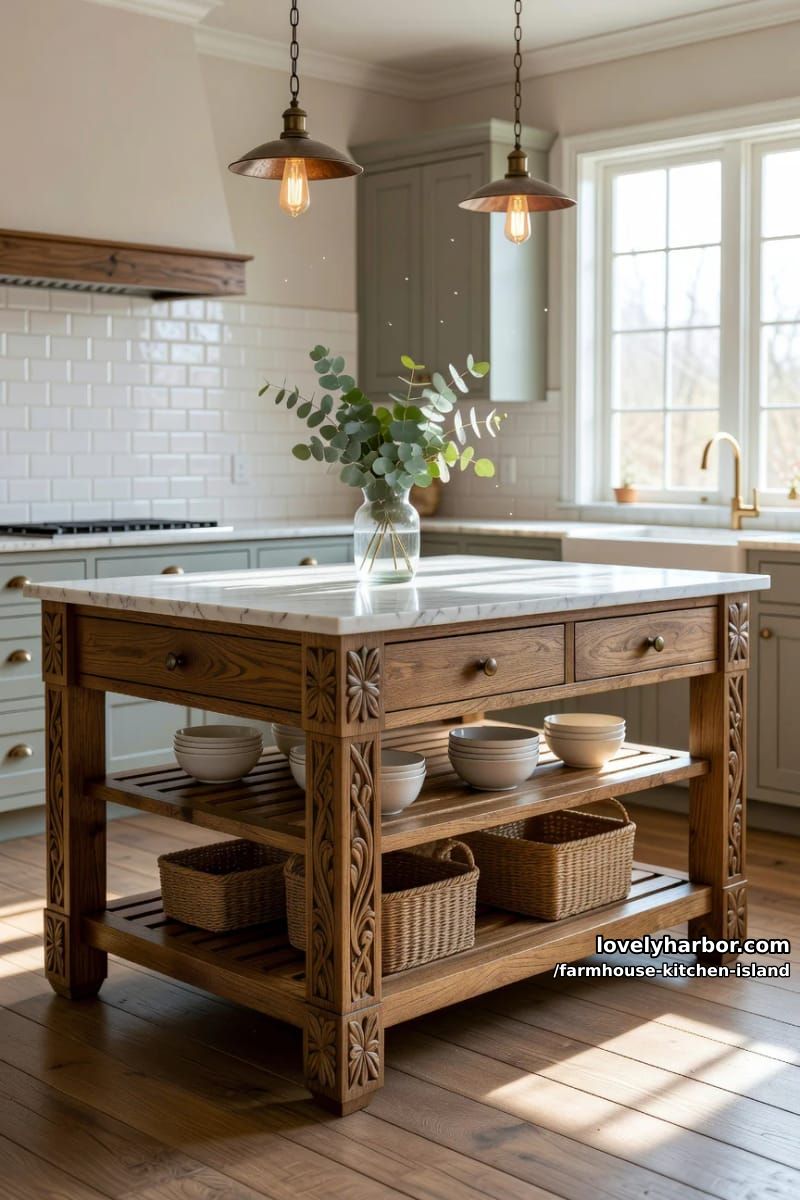
Slatted shelves breathe, which is genuinely useful for storing produce or linens, and they also drop crumbs through the gaps onto whatever sits below, so park a tray or a basket on the lower slats if you keep anything loose down there. The carved legs are the same bargain as the turned-leg table: charm up top, dust caught in every groove, a quick pass with a dry brush every week or two.
Match the knob finish to the faucet and the lighting, not to nothing in particular. Unlacquered brass knobs next to a chrome faucet looks like an unfinished thought.
18. Forest green island, butcher block top, wicker pendant lights, and stone accent wall.
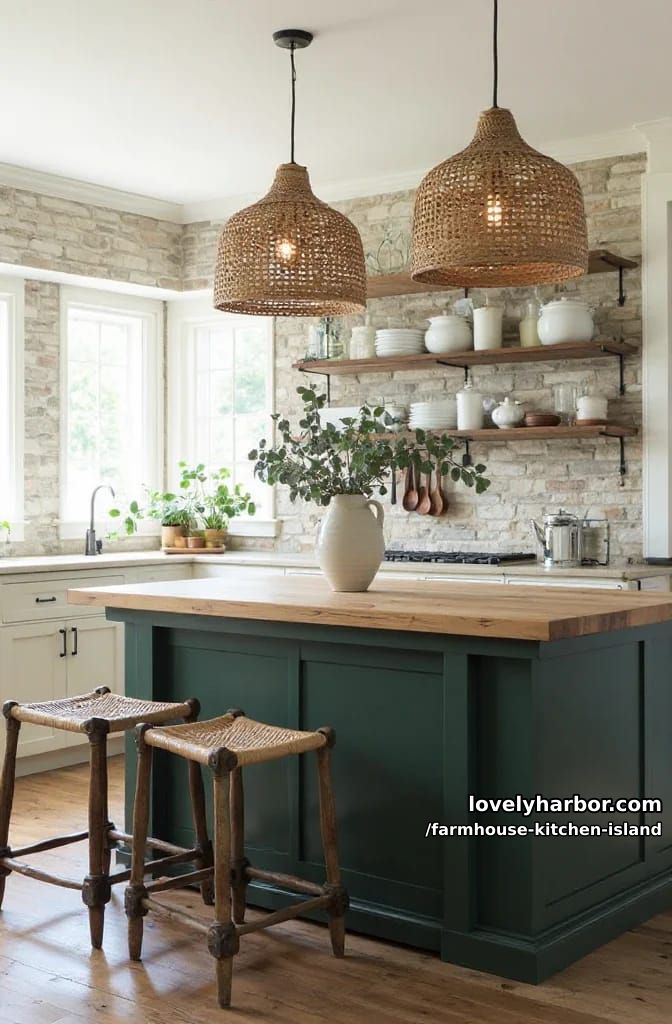
Forest green is the deep end of the green pool, and it works on an island precisely because it is dark enough to behave like a neutral. Something like Farrow & Ball Studio Green reads almost charcoal in low light and full green in sun, which anchors a stone accent wall better than any mid-tone green could.
Wicker and woven pendant shades cast a warm dappled light and almost no usable task light, so they belong over the seating end of the island, never over the prep zone where you are holding a knife in the gloom. Put recessed cans or a dedicated fixture over the work surface, and let the wicker be atmosphere.
19. Blue-based island, spindle chairs, exposed bulb chandelier, and shiplap walls.
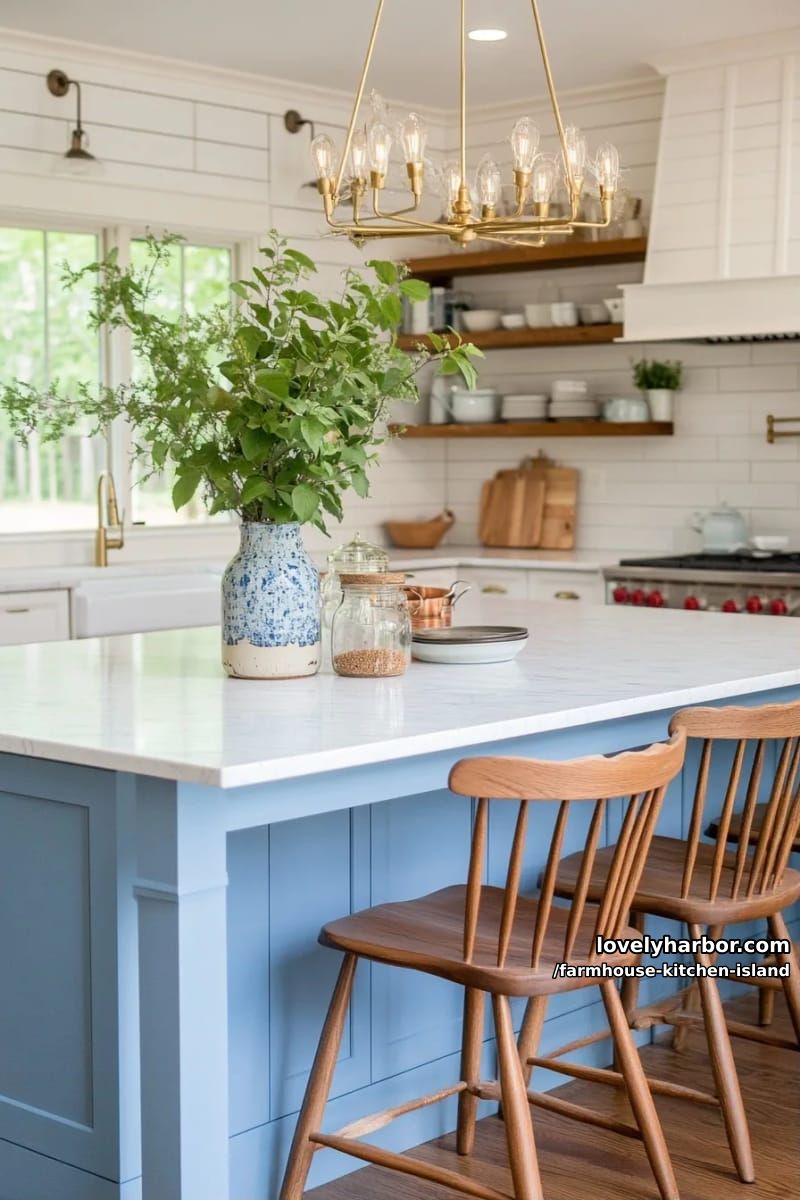
The risk with a blue island is that it tips nautical, so choose a blue with gray or green folded into it (a slate, a Hague Blue, a denim) rather than a clean primary that marches you straight into beach-house territory. Spindle chairs pair well here because their fussy turned profile balances the heavy block of color with a lot of negative space.
Exposed-bulb chandeliers look honest and feel like an interrogation room at full brightness, so they are only livable on a dimmer with low-wattage, warm bulbs in the 2400K to 2700K range. Bare bulbs also throw glare straight into the eyes of anyone seated across the island, which the styling shots conveniently hide by shooting with the lights off.
20. Olive green island, marble countertop, black faucet, and tall grid windows.
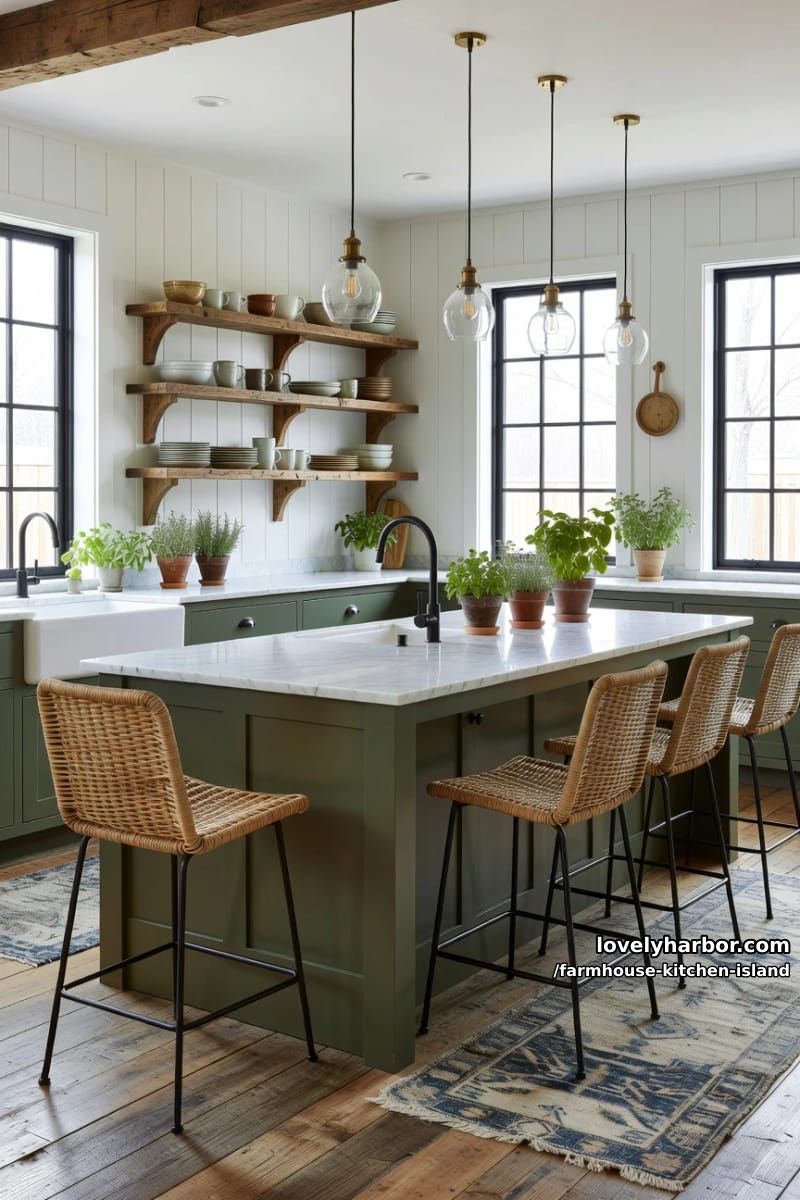
Olive is the warmest of the farmhouse greens, leaning brown and yellow, which is why it sits so easily beside wood and brass. The black faucet is the detail to scrutinize before you buy: matte black finishes vary wildly in quality. The cheap powder-coated ones chip at the spout and show every hard-water spot, while a proper PVD matte black holds its finish for years. Spend the money here.
Tall grid windows (true divided light, or applied muntins over a single pane) are the most expensive and most defining element in this kitchen. If the budget is not there, slim black-framed interior grilles on your existing windows get you part of the way. For privacy without losing the light, cafe-height linen sheers or a frosted film on the lower panes keep the top half clear.
Conclusion
If you are doing this on a budget and have to sequence it, spend first on the countertop and on the seating clearance, because those are the two things you cannot fix later without tearing out cabinetry. Paint, hardware, and pendants are all reversible in a weekend, so treat the trendier choices (the distressed turquoise, the exposed bulbs, the shiplap) as the layer you swap out when you tire of it, and put real money into the dull structural decisions nobody photographs. One honest note to close on: most of the islands above look effortless because someone cleared the counter before the shot. Yours will have the mail on it. Plan a drawer for the mail.