
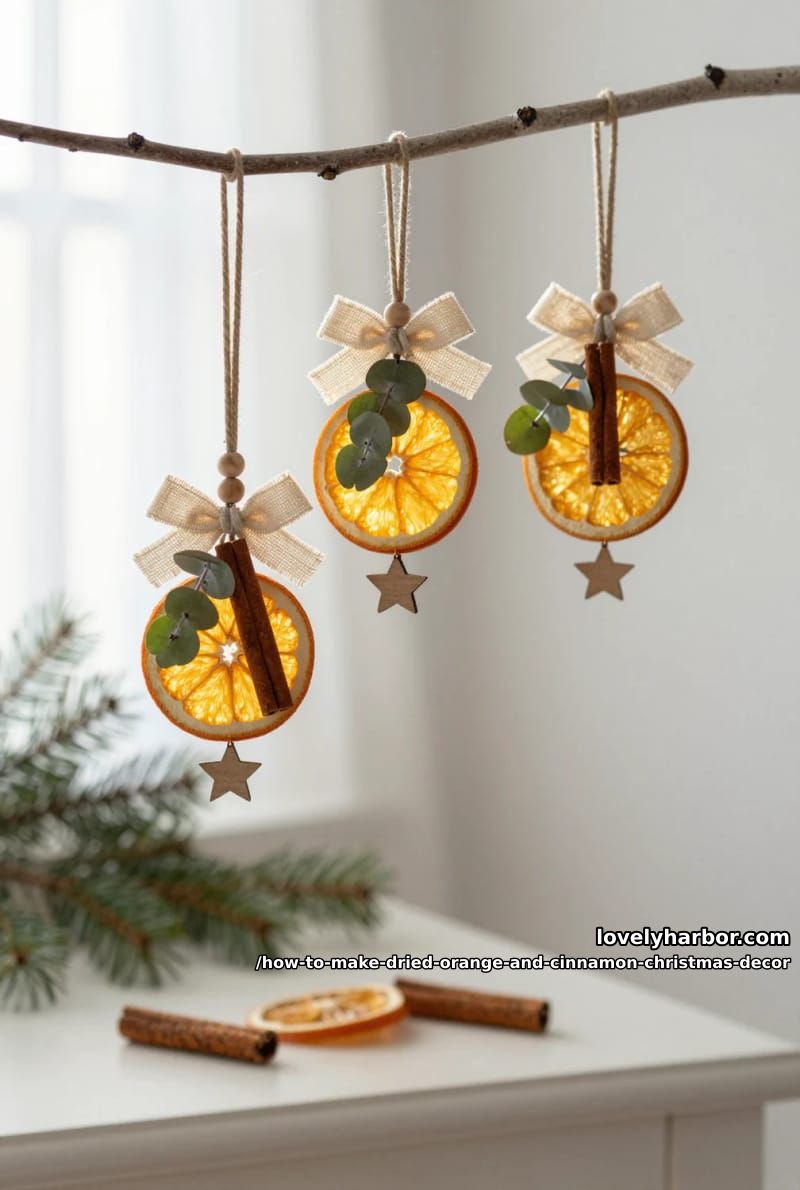
The ornament in the photo is six cheap things on a string. That's the good news, and it's also the part nobody warns you about. The distance between one that looks handmade in a nice way and one that looks like a third-grade craft project comes down to two things: how you dry the oranges and where you punch the holes. I've made plenty of these and wrecked a fair number along the way, and the failures were nearly always the same two mistakes. What follows is the version that works , exact slice thickness, oven temperature, the knots.

What you're actually building
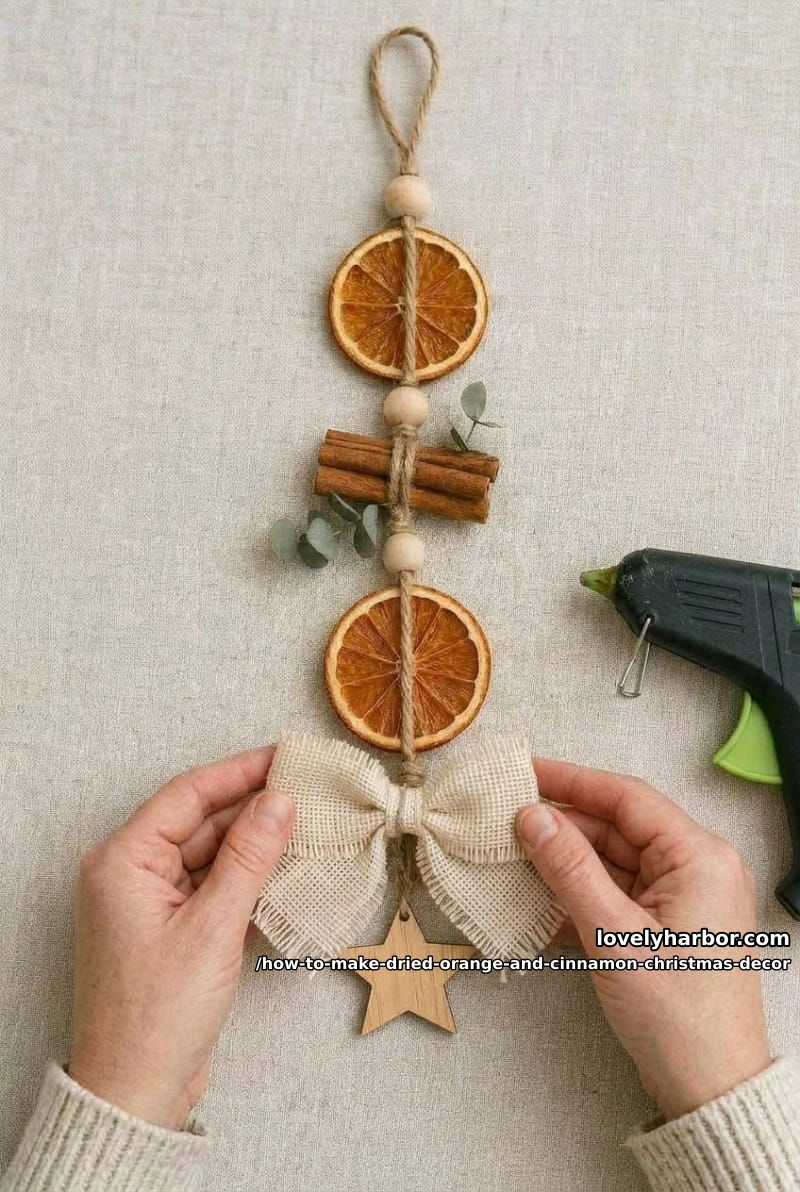
It's not a garland and it's not a wreath. One strand of jute, weighted along its length, balanced so the whole thing hangs straight down. Get the stacking order right before you cut anything. Once the oranges are threaded and knotted, there's no redoing it without starting from scratch.
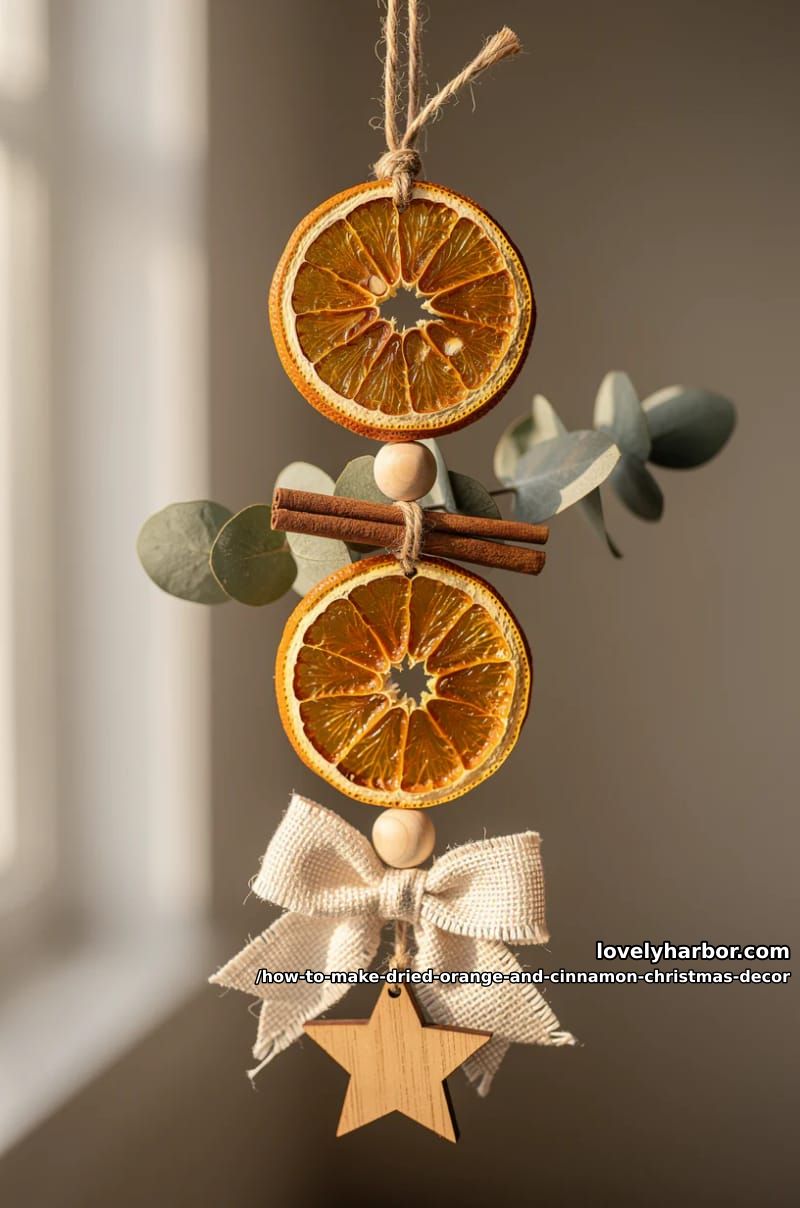
Hanging loop: a doubled length of jute twine, knotted into a loop that slips over a branch or a cup hook.
Top orange slice: the larger of your two dried slices goes here, up top, so the ornament reads heaviest at eye level.
Wood bead: one bead, doing double duty as a stopper and a visual break between the orange and the spices.
Cinnamon and eucalyptus: two or three sticks tied horizontally across the strand, with a eucalyptus sprig fanned out behind them.
Second orange slice, then another bead.
Burlap bow and wood star: the bow hides the bottom knot; the star dangles off the twine tail.
What you'll need (and what it costs)
Almost everything comes in a bulk pack that makes ten or more ornaments, so once you own the supplies the real per-piece cost is a couple of dollars. The split below separates what you burn through from what lives in your craft drawer afterward. Already own a sharp serrated knife and a glue gun? Then your tool cost is basically nothing.
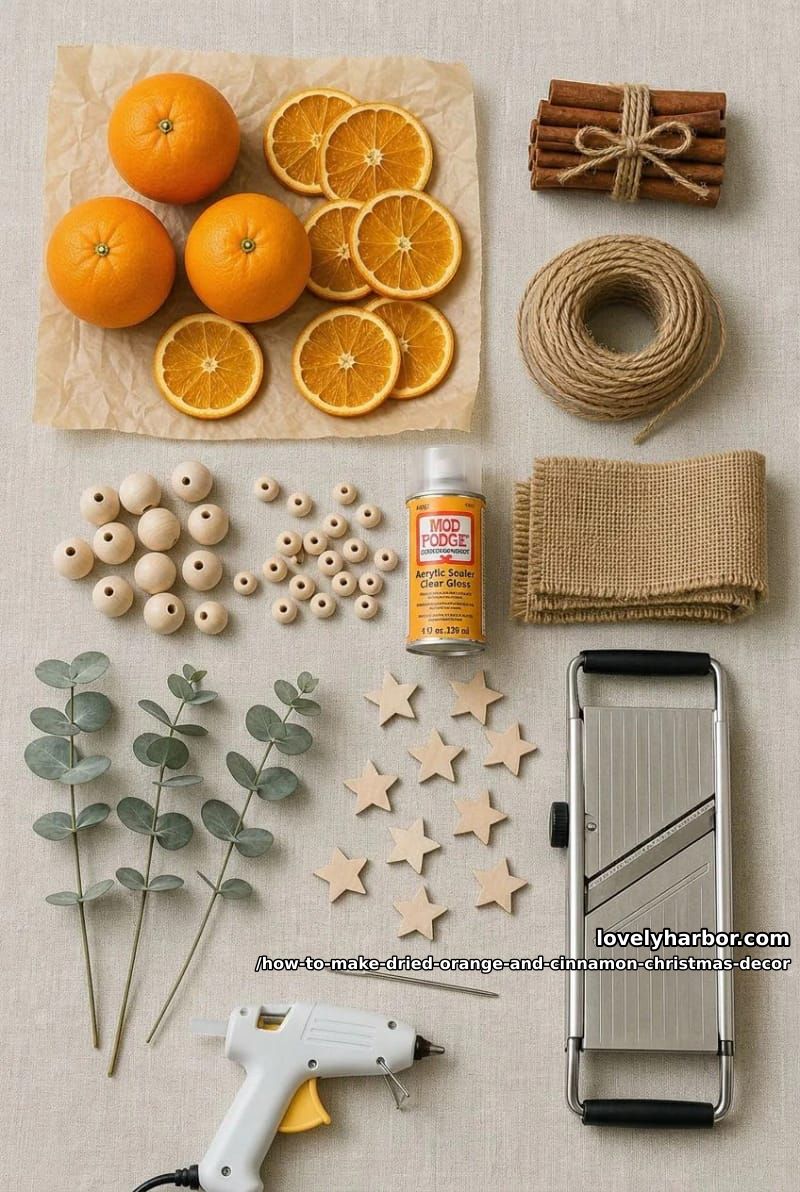
Materials (you use these up)
| Qty | Item | Spec | Price |
|---|---|---|---|
| 3 to 4 | Fresh navel oranges | firm, seedless, for slicing and drying | $4 to $8 |
| 1 | Factory Direct Craft 3-inch cinnamon sticks, 1 lb bag | decorative, not for cooking | $13 to $19 |
| 1 | Tenn Well natural jute twine, 2mm, 500 ft | 3-ply, holds a knot | $6 to $10 |
| 1 | 20mm unfinished wood beads, 10mm hole (100 pcs) | large hole fits doubled twine | $8 to $12 |
| 1 | Ribbli natural burlap wired ribbon, 2.5 inch | wired edge for a bow that holds | $7 to $11 |
| 1 | Saipro preserved silver dollar eucalyptus stems | 7 to 10 real preserved stems | $11 to $16 |
| 1 | Woodpeckers 1-inch wooden star cutouts (50 pcs) | unfinished, glue or pre-drill to hang | $6 to $9 |
| 1 | SMARTAKE unbleached parchment sheets, 12×16 (200 pcs) | for the drying tray | $8 to $13 |
| 1 | Mod Podge clear acrylic spray sealer, matte (12 oz) | optional, locks in color | $8 to $12 |
| Materials subtotal | $71 to $110 | ||
Tools (you keep these)
| Qty | Item | Spec | Price |
|---|---|---|---|
| 1 | OXO Good Grips handheld mandoline slicer | or a sharp serrated knife | $15 to $20 |
| 1 | VONEEDL large-eye blunt tapestry needles | for punching holes and threading | $6 to $9 |
| 1 | Gorilla mini hot glue gun kit with sticks | secures the bow and star | $8 to $13 |
| Tools subtotal | $29 to $42 | ||
| Combined total (buying everything new) | $100 to $152 | ||
Prices are approximate ranges as of 2026, so check before you buy. The bulk packs make 10-plus ornaments, which puts a single piece at roughly $3 to $5 in materials.
Step 1: Dry the orange slices
This is the step that decides everything else. Get it right and the slice glows like cathedral glass when the tree lights catch it. Get it wrong and you've got something brown, leathery, faintly sad. Two variables matter: slice thickness and oven temperature. Most people blow the temperature, running it too hot because they're impatient , I've stood in the kitchen willing the things to dry faster more than once, and it never works.
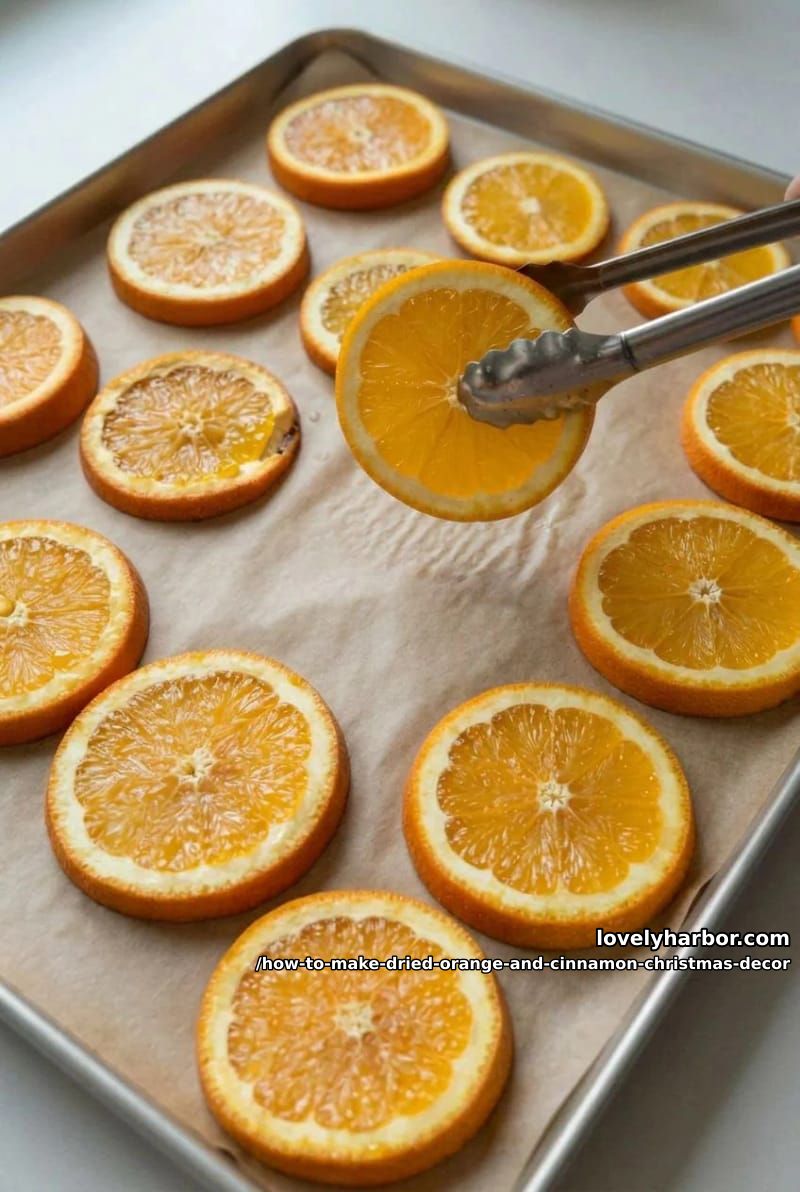
Wash the oranges, dry them and then slice across the equator, not stem to stem, so every round shows the full pinwheel of segments. Aim for a quarter inch and keep it even. A mandoline does this in seconds, and the uniformity it gives you , slices that all dry at the same rate , is the single biggest reason a batch comes out well. Then blot them. Lay the slices between two clean towels and press gently to draw off the surface juice. Wet slices take much longer and brown in patches.
Do this
- Navel or Cara Cara: thick-fleshed, seedless, and they hold their shape
- Buy firm fruit. Less juice means faster drying.
- A consistent 1/4 inch on every slice
- Blot both sides, harder than feels necessary, before anything hits the tray
Avoid
- Thin-skinned juicing oranges like Valencia , the seeds leave holes and there’s too much juice
- Anything over 1/3 inch stays gummy in the center and can mold on you later
- Paper-thin slices under 1/8 inch: edges curl and scorch
- Soft or old fruit. It turns to mush and dries slowly.
| Method | Temp | Time | Result |
|---|---|---|---|
| Oven | 200 to 225°F | 2 to 4 hours, flip every 30 min | A bit more rustic and amber-toned; watch it or it browns |
| Dehydrator | 130 to 140°F | 6 to 14 hours | Brighter, truer color and flatter slices, with almost no risk of burning |
Pull a slice when it looks and feels dry, with no soft gummy center left. A little tackiness is fine , they keep hardening as they cool. If a few of the thicker slices lag behind, leave them on a wire rack overnight and they'll finish on their own.
If the rinds go dark before the centers are dry, your oven runs hot , drop to 200°F and keep flipping. And don’t rush the storage. A slice that feels dry but came off the tray early can grow mold in a sealed bag weeks after the holidays, so give any questionable ones an extra day in open air before you box them up.
Step 2: Cut and prep the components
Lay everything out before you assemble. Sounds fussy, right up until the first time you're holding a half-threaded orange in one hand and hunting for the scissors with the other.
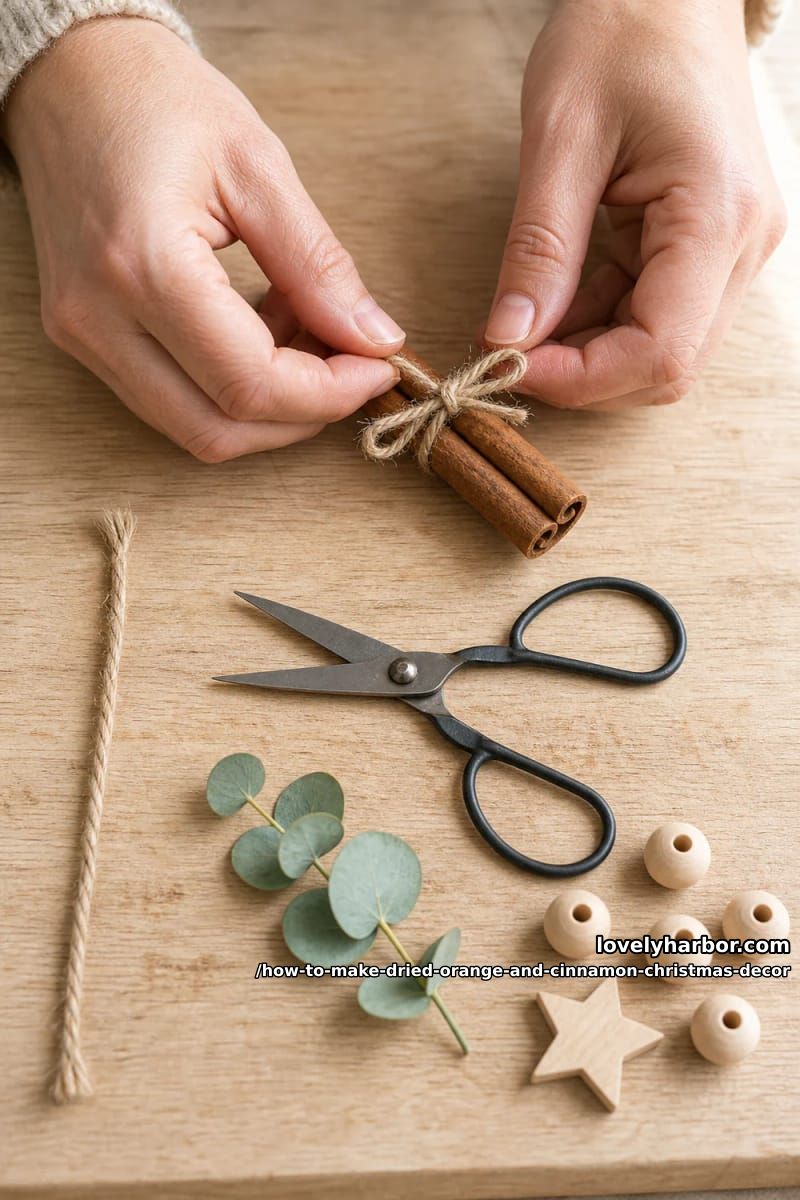
Cut and set aside
- One 16-inch length of jute for the main strand, plus a 6-inch piece for the cinnamon tie
- Two dried orange slices , pick the larger one for the top
- Two or three cinnamon sticks, trimmed to about the width of the orange slices
- One eucalyptus sprig, cut to 3 to 4 inches so it fans just past the cinnamon
- Two wood beads, one wood star
- A 10-inch piece of burlap ribbon for the bow
Keep the cinnamon a little wider than feels natural. A bundle shorter than the orange slices looks stingy, and proportion is the first thing your eye picks up on.
Step 3: Build the vertical strand
Now you thread. The one trick that keeps oranges from tearing is where you put the hole, and it's worth slowing down for.
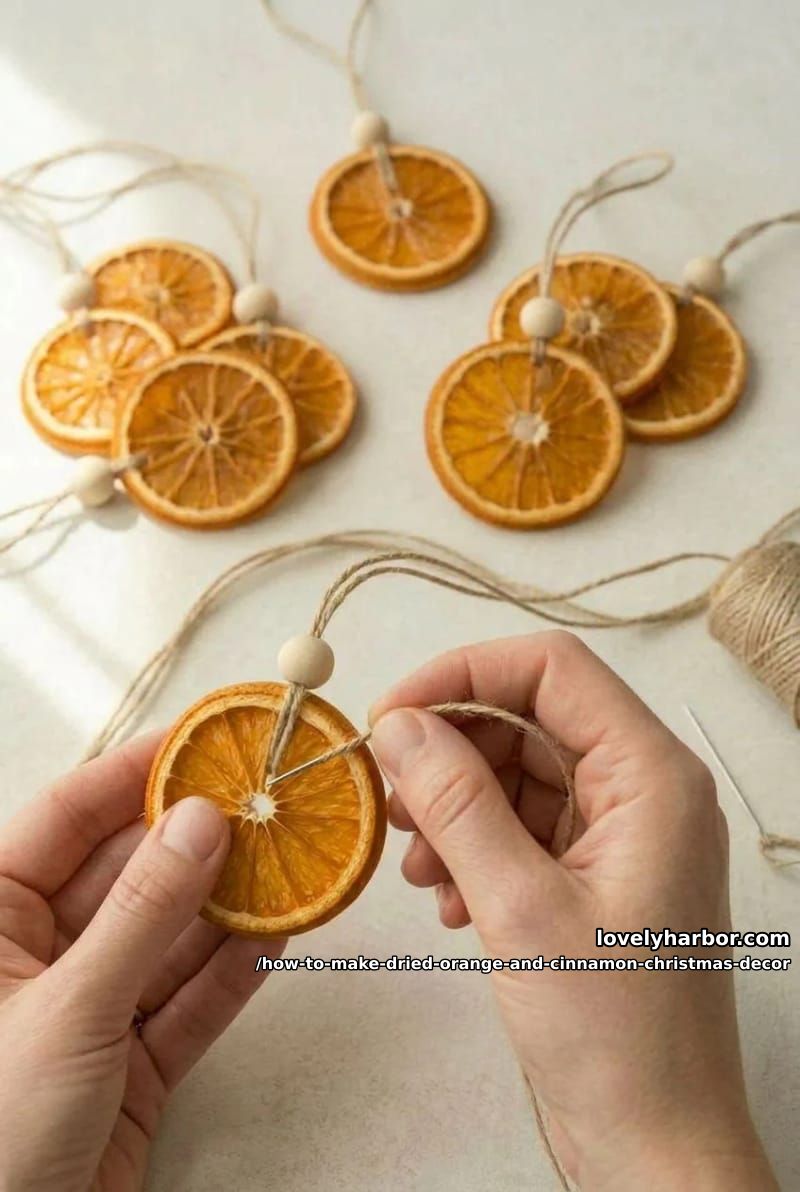
- Make the hanging loop. Fold the 16-inch jute in half, knot the folded end into a small loop, and let the two tails hang.
- Punch the hole through the rind, not the flesh. Push the blunt tapestry needle through the pith, just inside the peel at the top of the slice. The rind is the strong part. A hole through the brittle center flesh tears out the first time the ornament swings.
- Thread top to bottom. Run both twine tails through a bead, then through the top orange slice, snug everything up, and tie a tight overhand knot beneath the orange so it can’t slide.
- Leave a gap. Drop about an inch of twine before the next element so the spices have somewhere to sit , crowding the pieces is exactly what makes these look cluttered.
Pierce too close to the edge and the rind splits within a day. Keep the hole at least an eighth of an inch in from the peel. If a slice is already cracked, set it aside for a simmer pot rather than fighting with it.
Step 4: Add the cinnamon and eucalyptus
The cinnamon bundle ties across the strand instead of threading through it. Lay the eucalyptus behind the sticks first, so it reads as a backdrop, then bind the whole thing at once.
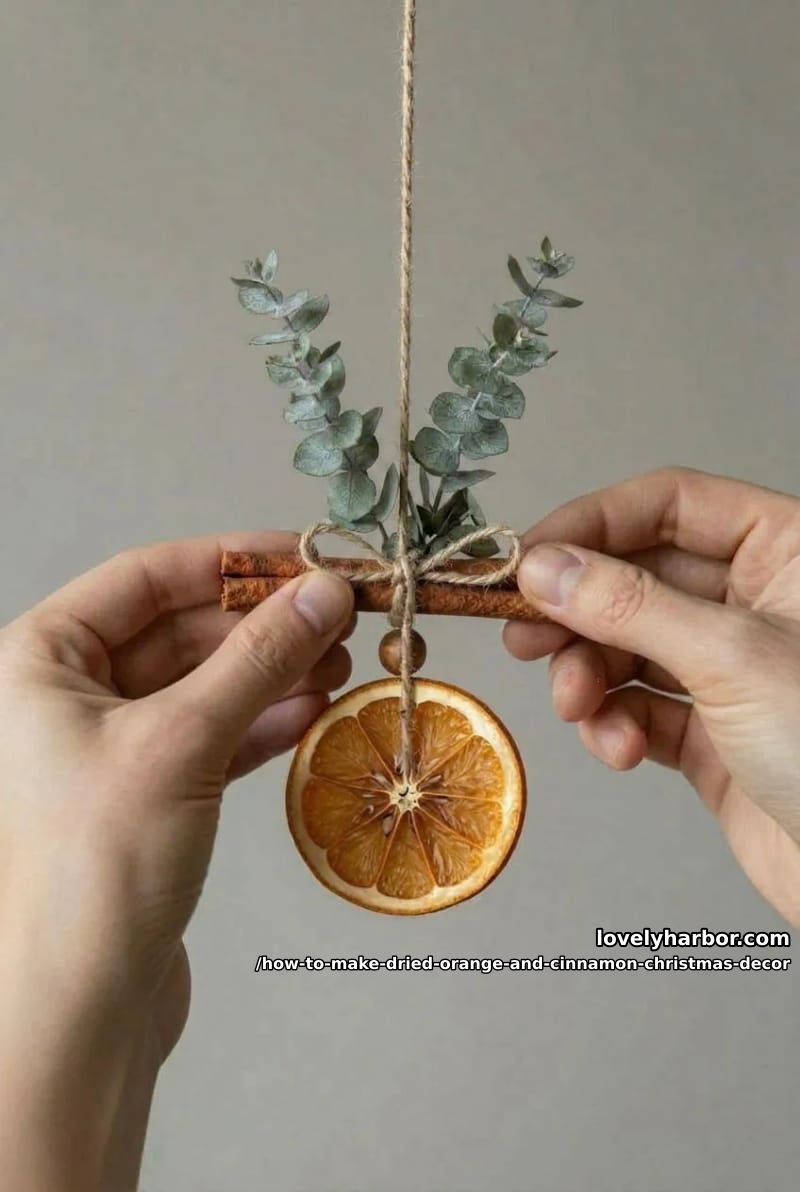
Use the 6-inch tie. Wrap it twice around the cinnamon and the main strand together, knot it tight on the back, finish with a small bow on the front. One dab of hot glue where the cinnamon meets the twine keeps the bundle from rotating , and it will rotate, every time someone brushes past the tree, if you skip the glue. Then thread the second orange slice and the second bead below the spices, knotting again underneath.
Preserved silver dollar eucalyptus stays pliable and sage-gray for years. The dried-out craft-store stuff shatters the moment you bend it.

Step 5: Tie the bow, add the star, hang
The burlap bow does two jobs: it hides the bottom knot and it gives the ornament a base, somewhere for the eye to land. Wired ribbon matters here. Unwired burlap slumps into a limp rag inside a week. A 2.5-inch width reads as a proper bow without swallowing the oranges.
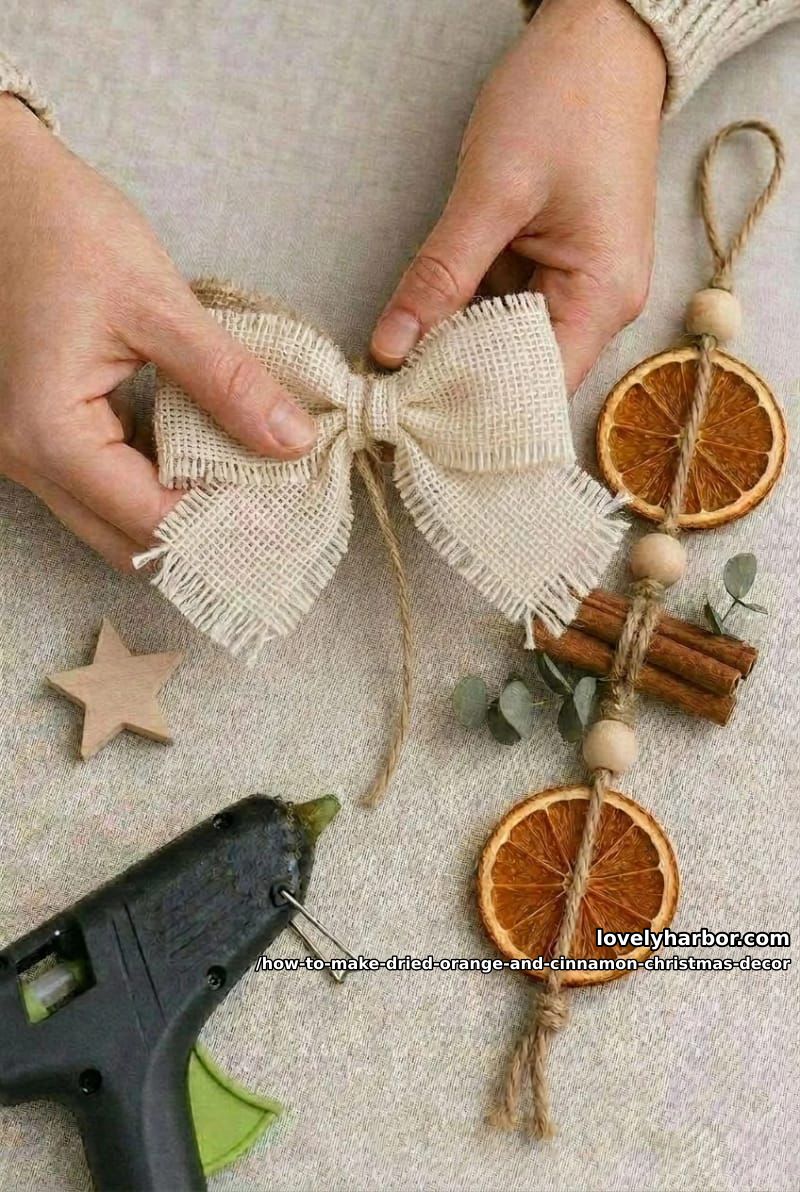
- Form the bow. Make two loops from the burlap, pinch the center, cinch it with a scrap of jute. Trim the tails at an angle and fray them a little with your fingers.
- Attach it. Hot glue the bow over the bottom knot , or tie it on with the same jute tails if you’d rather keep it removable.
- Hang the star. No hole in the star? Run the glue gun and press it onto the twine tail below the bow. If it has a hole, thread it and knot. Leave about an inch of twine showing so the star floats instead of sitting against the bow.
- Seal, optional. A light pass of matte acrylic spray slows the natural browning of the orange flesh and helps the slices last several seasons. Spray outdoors, let it cure 30 to 60 minutes, then hang.
Turning one ornament into a set of five
One afternoon of drying, one evening of assembly
Five ornaments call for about ten orange slices , so three to four oranges, since you’ll want the cleanest rounds , plus ten beads, ten to fifteen cinnamon sticks, five eucalyptus sprigs, and just under five feet of burlap. All of it comes out of the single bulk packs in the materials list, which means ornaments two through five cost almost nothing. Hang them at staggered heights along a mantel garland, or down a bare branch set in a tall vase by the entryway.
Build timeline
The project spans two sessions because of the drying. Plan around that rather than trying to force the oranges dry in one sitting.
- Day 1, afternoon: Slice, blot, dry the oranges (2 to 4 hours in the oven, longer in a dehydrator).
- Day 1, evening: Move the slices to a wire rack and leave them out overnight to finish hardening.
- Day 2, morning: Cut twine, prep the components, assemble. One ornament runs about 15 minutes once the oranges are ready.
- Day 2, before hanging: Optional matte sealer, plus 30 to 60 minutes to cure.
Mistakes that ruin this ornament
- Oven too hot. Brown, opaque slices mean you ran above 225°F. The fix is patience, not heat.
- Slices stored damp. Sealed up before they’re fully dry, they’ll mold in the box. When in doubt, give them another day in the open.
- Hole through the flesh. The brittle center tears out. Punch through the rind, always.
- Everything crammed together. With no gaps between elements, the strand reads as clutter instead of a composition.
- Unwired ribbon. The bow goes limp and the piece loses its base.
- Cinnamon left to spin. Skip that dab of glue and the bundle swivels sideways the first time anyone bumps the ornament.
Conclusion
Make one, decide you like it, and dry a full tray next time. The oranges are the bottleneck , everything else takes minutes , and they keep for two to three years in a sealed jar. So one afternoon of slicing covers ornaments, a few gift tags, and a length of garland over a doorway, with slices to spare. Here's the bit of sequencing I'd pass along: dry more slices than you think you need, and set the prettiest ones aside for the tops. That's where the light hits them, and it's the first thing anyone looking at the tree actually sees.