
Most tutorials for these hanging snowmen open the same way: buy small terracotta pots, paint them white, wait for the paint to dry, then drill a hole through fired clay without cracking it. Skip it. An upside-down white paper cup gives you the same round, slightly tapered head, weighs next to nothing on the branch, and costs about fifteen cents instead of roughly fifty to sixty cents.
We'll build the chime from the cup up , the hanging anchor, the face, the felt nose, the pom-pom hat, and the ribbon-and-bell streamers that actually make the noise.
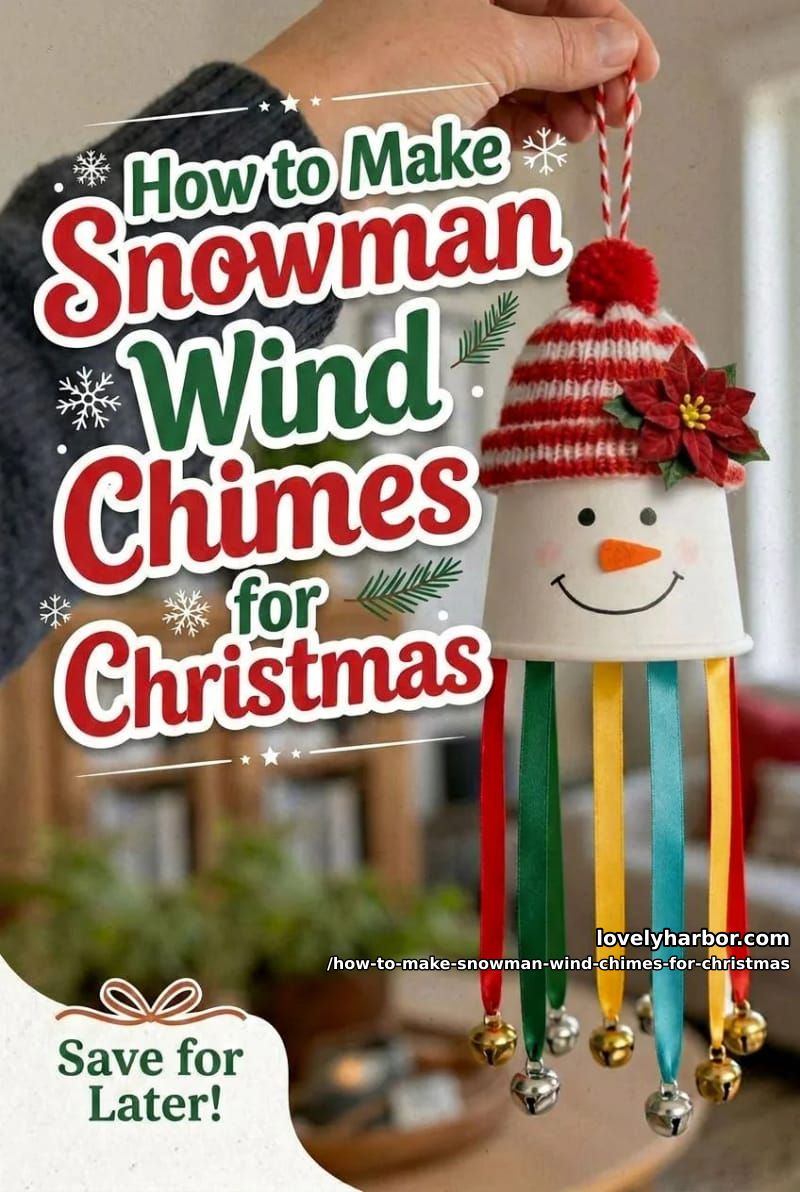
What you're actually building
The head is the only structural decision that matters, so make it first. The cup goes on upside down. The closed bottom faces up , that's where the hanging twine comes out and where the hat sits , and the wide drinking rim faces down, which reads as the snowman's chin and hands you a clean circle to hang ribbons from. An 8 oz paper cup runs about 3.5 inches tall with a roughly 3-inch rim. Account for the hat and that's the same footprint as the 2-inch terracotta pots everyone else starts with.
Do this
- Plain white 8 oz hot cups. The poly lining takes a paint pen without bleeding.
- Double-wall or “ripple” cups hold their shape better, if you want a sturdier head.
- Going outdoors? White plastic cups.
- Save a few extras , the bottoms tear if you lean on the pin.
Avoid
- Printed or logo cups. The face has nowhere clean to land.
- Thin bathroom or cone cups are too flimsy to hold a hat and bells.
- Foam, which cracks at the rim the moment you glue ribbon to it.
- Clear plastic loses the snowman-white entirely.
If you genuinely want the heavier ceramic look and don’t mind the extra work, the original calls for 2-inch clay pots, and a bulk box runs about $20 to $30 for 48 of them: vensovo 2-inch mini terracotta pots, 48-pack. Then you paint them white and wait for them to cure. That waiting is the whole reason I switched to cups.
Materials and tools
The bulk packs below make somewhere between a dozen and twenty chimes, so the real per-chime cost lands around $3 to $6 once you split everything up. Buy once, make a windowsill full, hand them out. I've kept the consumables separate from the glue gun and pens, since those you keep.
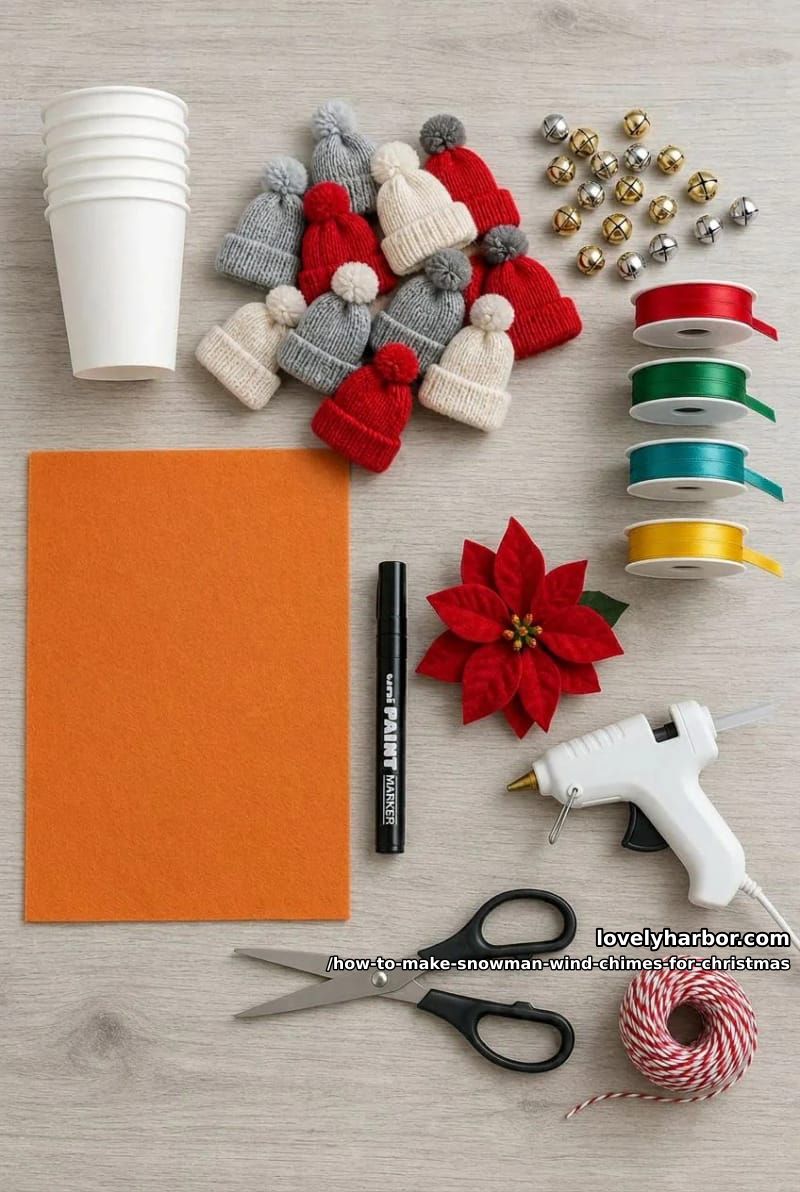
Materials (consumables)
| Qty | Item | Spec | Price |
|---|---|---|---|
| 1 | Plain white 8 oz paper cups, 50-pack | One cup per snowman; buy extras for torn bottoms | $6 to $10 |
| 1 | Mini knit hats with pom-poms, 80-pc assorted | ~2 in tall; gray, cream, and red mix | $10 to $16 |
| 1 | Jingle bells, 100-pc (50 gold, 50 silver), 0.5 in | 5 to 7 bells per chime | $7 to $11 |
| 1 | Satin ribbon, 3/8 in, 20-roll rainbow set | 100 yards total; cut 8 to 14 in strands | $9 to $14 |
| 1 | Black acrylic paint pens, 6-pack, 2 to 3 mm tip | Faces; reusable, so split with the tools below if you like | $8 to $12 |
| 1 | Orange acrylic felt sheet, 12 x 18 in | One sheet makes dozens of carrot noses | $2 to $4 |
| 1 | Red-and-white baker’s twine, 328 ft | Hanger loop; ~12 in per chime | $6 to $9 |
| 1 | Red velvet poinsettia picks, 6-pack (optional) | Cut a single bloom off the stem for the brim | $10 to $15 |
| Materials subtotal | $58 to $91 | ||
Tools (one-time, reusable)
| Qty | Item | Spec | Price |
|---|---|---|---|
| 1 | Mini hot glue gun with 30 glue sticks | Low-temp is fine and safer near kids | $13 to $18 |
| 1 | Scissors | Sharp enough to cut ribbon clean, not fray it | Owned |
| 1 | Pushpin, thumbtack, or bamboo skewer | Makes the hanger hole; from a drawer | Owned |
| Tools subtotal (if buying the glue gun) | $13 to $18 | ||
| Combined total from scratch | $71 to $109 | ||
Prices are approximate ranges as of 2026; verify before purchase.
Step 1: Turn a cup into a snowman head
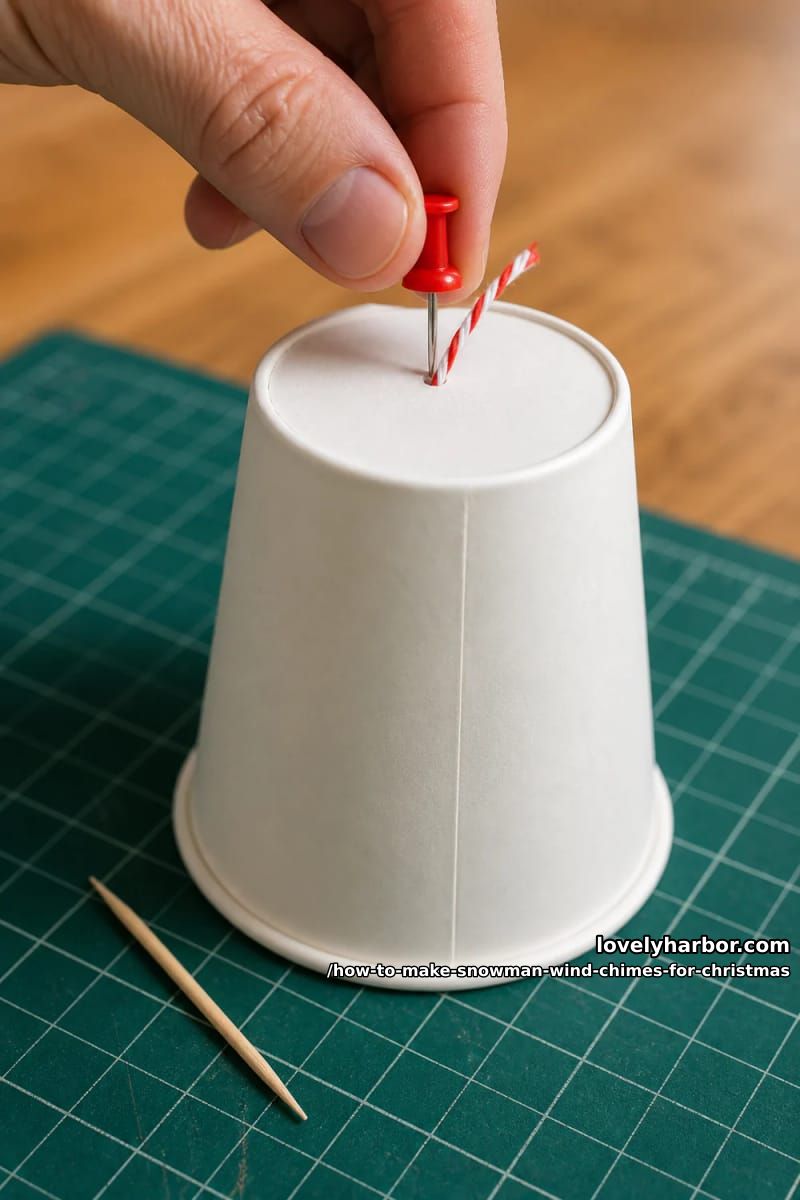
This is the only step where order matters. Once the hat goes on you can't reach inside the cup anymore, so anchor the hanger now.
- Make the hole. Push a pushpin or skewer through the dead center of the closed cup bottom (the end facing up). Work it out to about 2 mm , any bigger and the knot slips through.
- Cut the hanger. Snip about 12 inches of baker’s twine and fold it in half into a loop.
- Thread from the inside out. Push both cut ends up through the hole from inside the cup, so the folded loop stays inside.
- Anchor it. Lay a toothpick across the loop inside the cup and tie the loop tight around it, or knot the ends to a button. The crossbar can’t pull back through the hole, so the chime can’t drop off the branch.
One thing people miss: leave the loop on top long enough to clear the pom-pom, around 4 to 5 inches above the cup. It threads through the hat in Step 4, and a stubby loop just disappears into the yarn.
Step 2: Draw the face
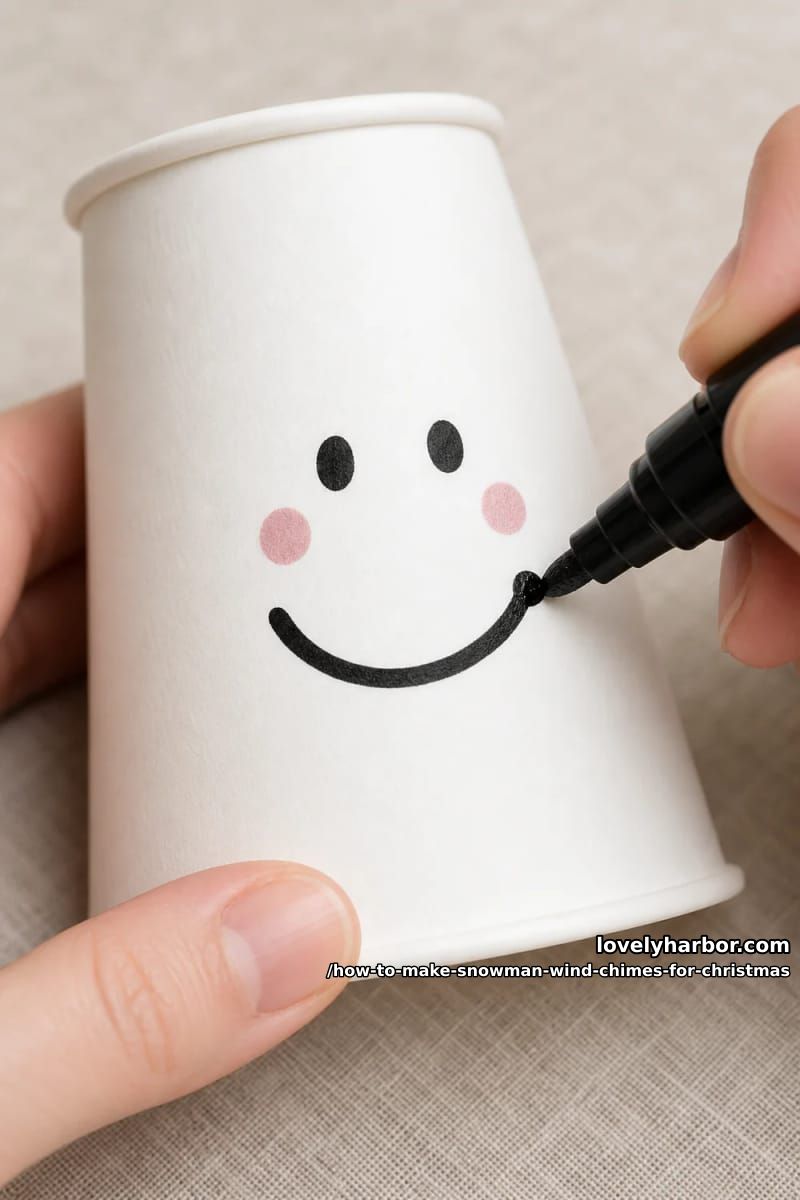
Work on the side of the cup that faces out, roughly the middle third of the height. The black acrylic paint pen sits on the poly coating without bleeding; a regular marker won't, at least not reliably. Two dots for eyes, about an inch apart. For the mouth, draw five or six small dots in a shallow downward arc rather than a solid line. That dotted curve is what reads as a smile instead of a frown.
Cheeks are two soft pink circles just below the eyes. A pink paint pen does the job, but honestly a fingertip of powder blush rubbed in looks more like an actual flush and costs nothing. Let any wet ink set for a minute before you handle the cup , acrylic pen smears for the first 30 seconds.
Step 3: Add the carrot nose
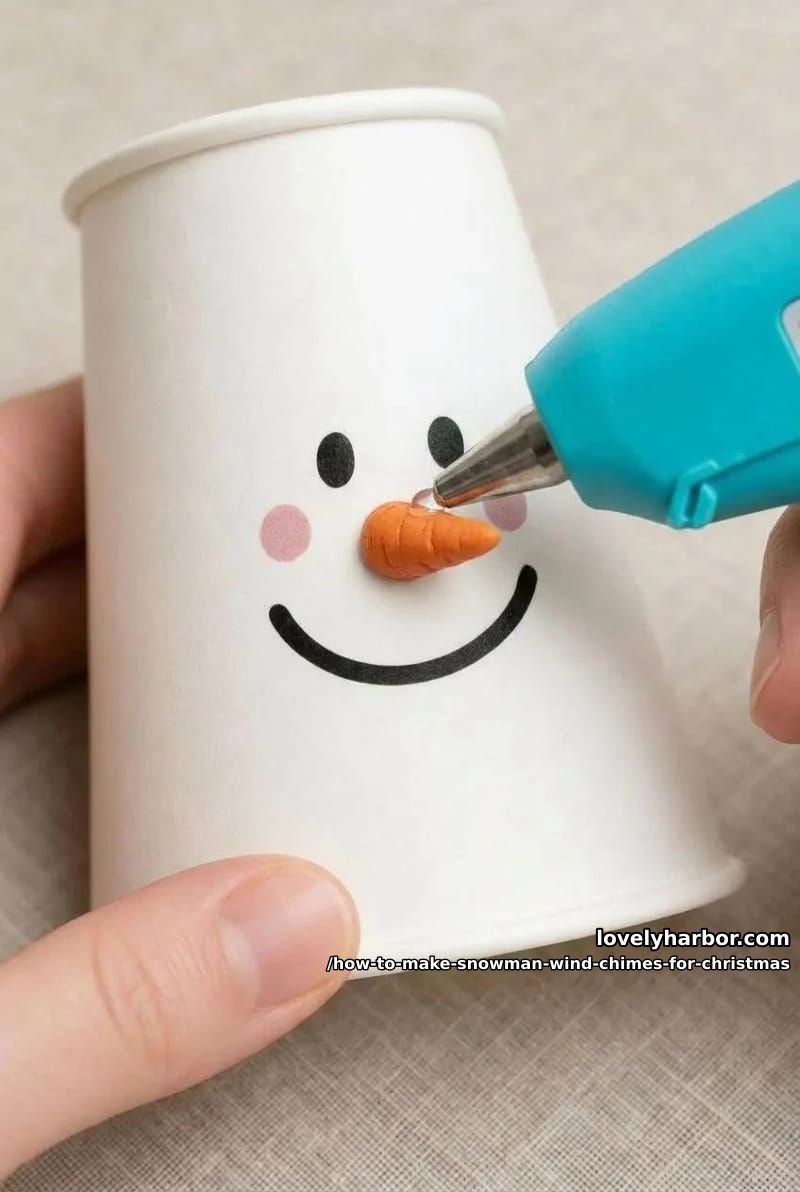
The noses in the reference photo are little three-dimensional cones, not flat triangles. That bit of depth is the whole difference between a snowman and a sticker. Felt is the cheapest way to get it.
- Cut a triangle. From the orange felt, cut a narrow triangle about 1.5 inches long and 0.75 inch wide at the base.
- Roll it into a cone. Start at one long edge and roll tight until it looks like a little carrot. A dab of hot glue along the last edge holds the roll.
- Glue it on. Trim the wide end flat, add one dot of glue, and press it to the face between the eyes and mouth. Hold for ten seconds.
Step 4: Cap it with a hat
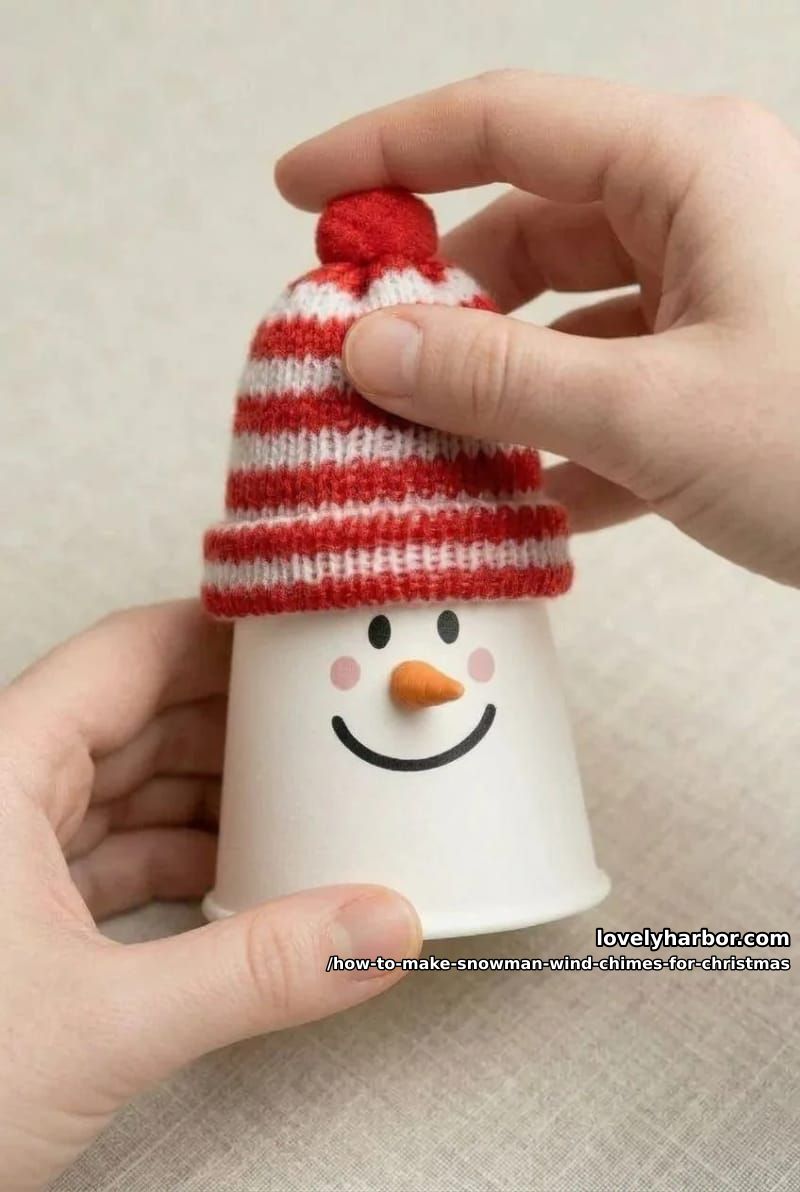
Pull the twine loop up through the top of the hat first , poke it between the stitches near the pom-pom with the skewer , then slide the hat down over the cup base until the loop pokes out at the crown. Tug it through until the brim sits where you like it. Run a thin bead of glue under the brim, two or three spots, and press.
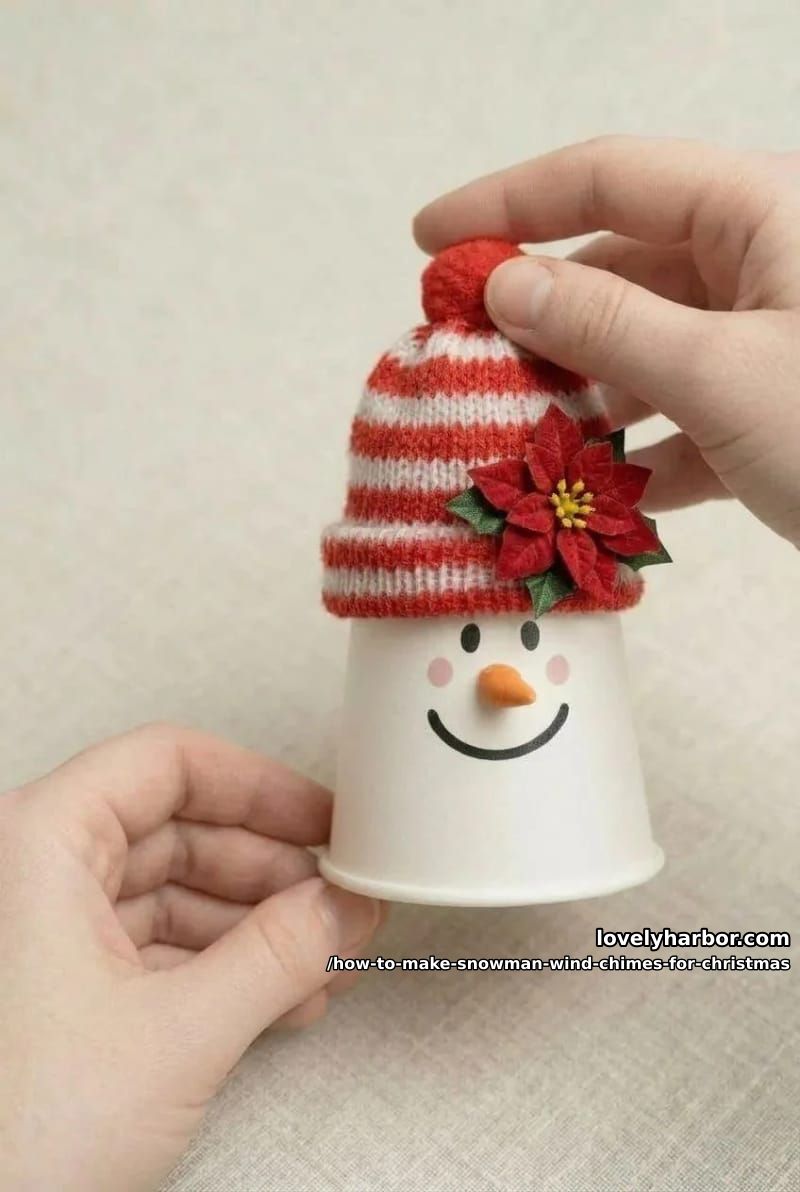
Here's where I'll argue with the kit I just recommended. Those 2-inch craft beanies sit a little shallow on an 8 oz cup, and the brim has a habit of riding up. Want a deeper fold-over brim that actually grips? Cut the ribbed cuff off a thrifted sweater or an old wool sock, fold it double, glue a pom-pom on top. Costs nothing, and it looks far less mass-produced , this is the version I'd build for myself. On two of the four snowmen, tuck a single red poinsettia bloom (snipped off one of the picks) into the brim before the glue sets.
Step 5: Hang the ribbons and bells
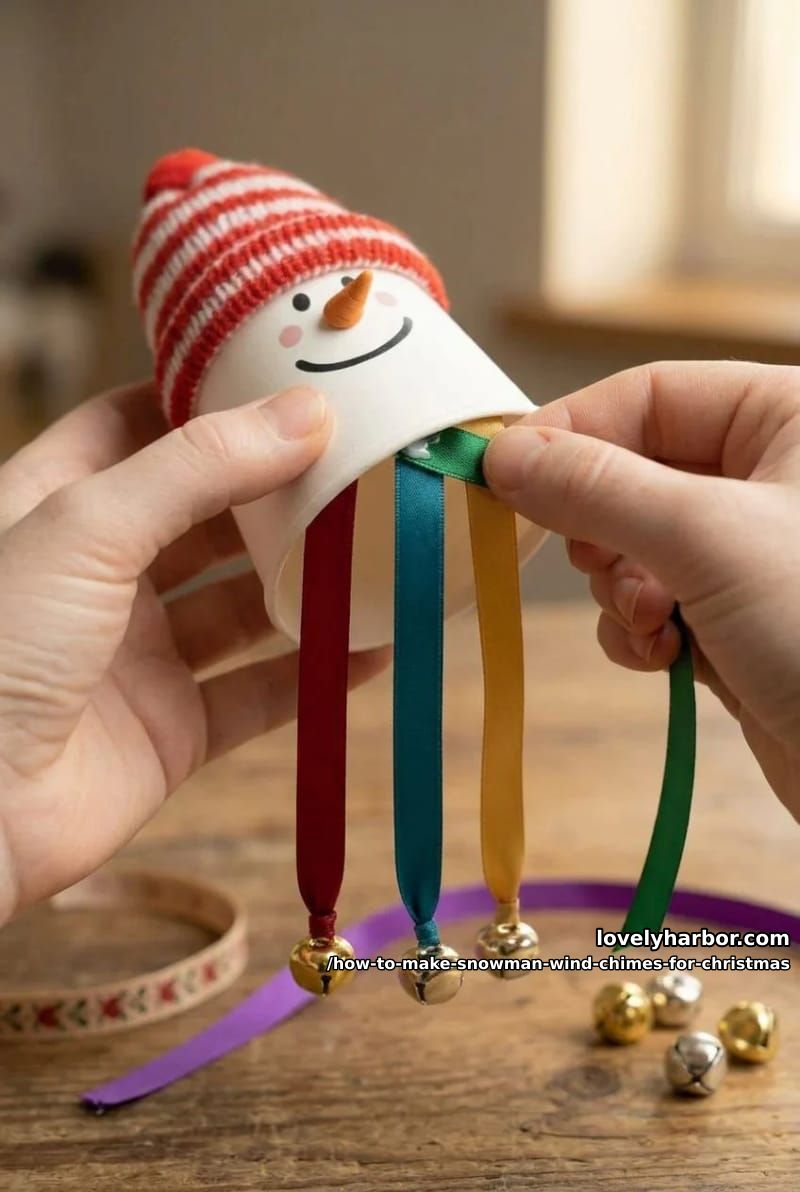
This is the part that turns a craft into a chime. It's also the part I got wrong the first time around , I glued the bells straight onto the rim and they barely moved, let alone rang. Bells need ribbon slack to swing and tap each other. That's the whole trick.
- Cut ribbons at staggered lengths. Five to seven strands, anywhere from about 8 inches up to 14 inches, so the bells end up at different heights.
- Attach a bell to each. Thread the ribbon end through the bell’s loop and tie a small knot, or fold it over and glue. Gold and silver mixed together looks closest to the reference.
- Glue the tops inside the rim. Space the ribbon tops evenly around the inside of the cup rim and tack each one with hot glue. Even spacing is what makes it hang straight.
- Vary the bell sizes if you’ve got them. A couple of bigger bells on the longest strands give a lower tone; small ones up top tick along brighter.
Gold and silver in one bag means you skip buying two packs to match the photo, and 100 bells covers a whole batch — with spares for the duds that arrive silent.
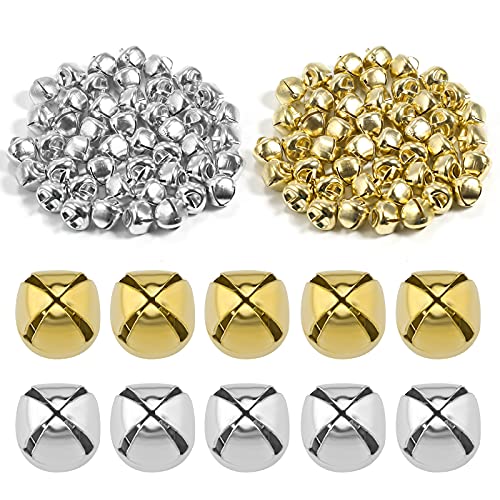
Even radial spacing: spread the ribbon tops at roughly equal angles around the rim. Bunch them on one side and the cup tilts, the face ends up aimed at the floor.
Slack equals sound: bells ring when neighboring strands swing into each other, so the small gap between hanging bells matters more than how many you use.
Weight at the bottom: a paper cup weighs almost nothing, so the bells double as ballast. Five to seven keeps the whole thing from spinning in a draft and tangling the twine.
Step 6: Thread the hanger and balance it
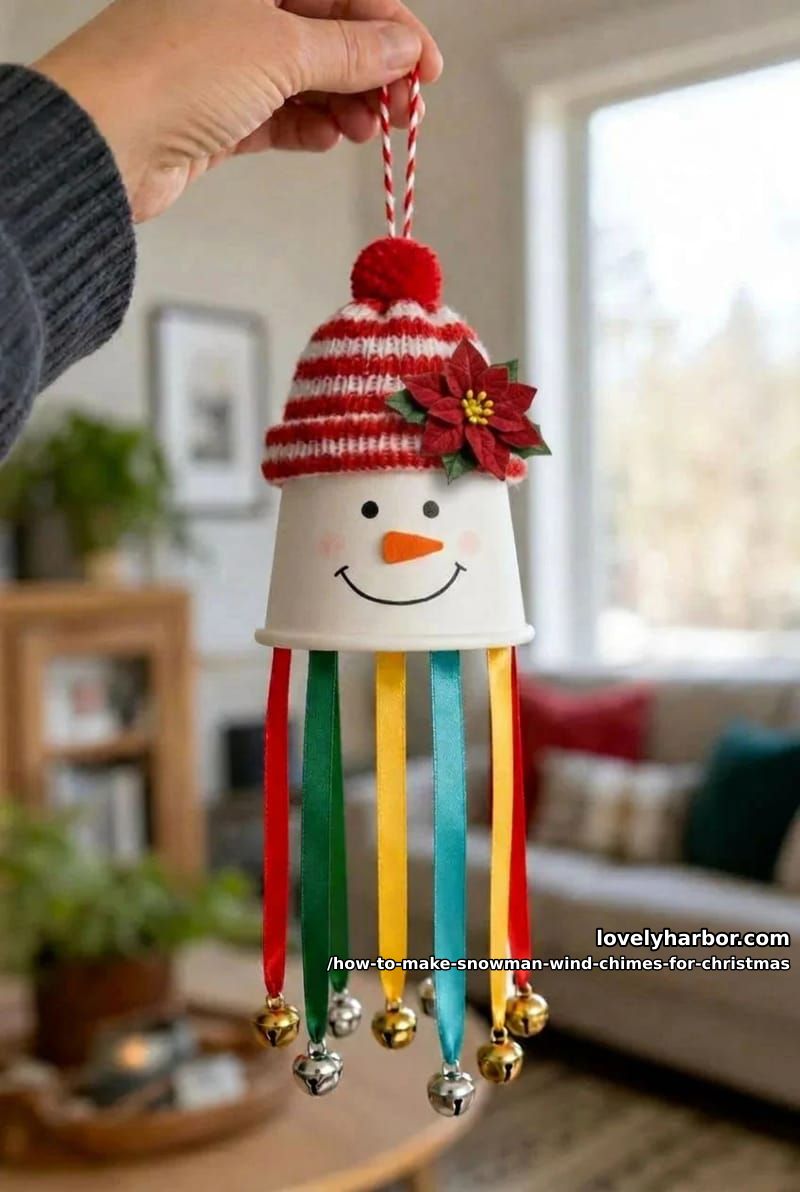
Hold the finished chime up by its loop and let it settle. Then run this quick check before you hang it for good.
Before you hang it
- Face forward , not tipped up, not staring at the floor. Nudge the ribbon spacing if it’s off.
- Is it hanging level? A tilt means the ribbons bunched on one side.
- Bells clear each other and actually ring when you tap the cup.
- The hanger loop sits on a crossbar inside, not just knotted at the hole.
- Glue strings: pull them off while they’re still cool.
Hang them from a bare branch laid across a mantel, a curtain rod, a length of driftwood , the way the reference set is grouped. Three or four together at staggered heights read as a display. One on its own reads as a test run.
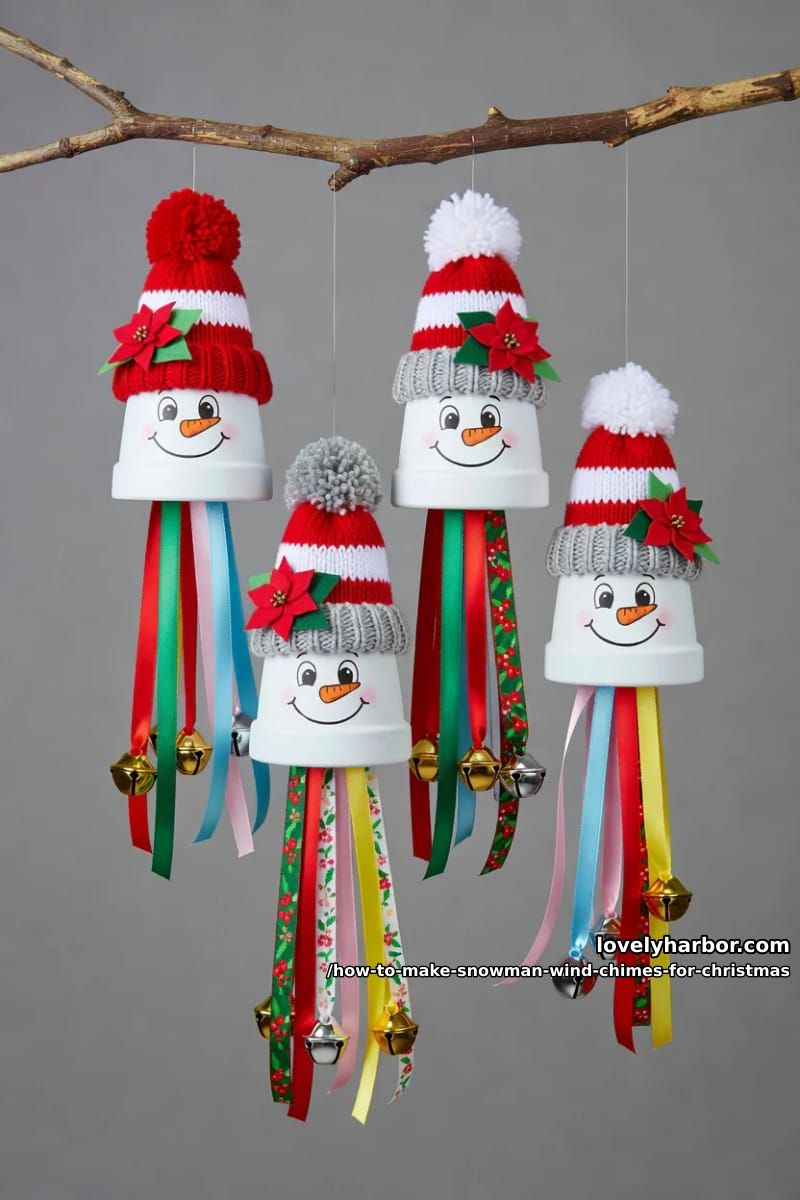
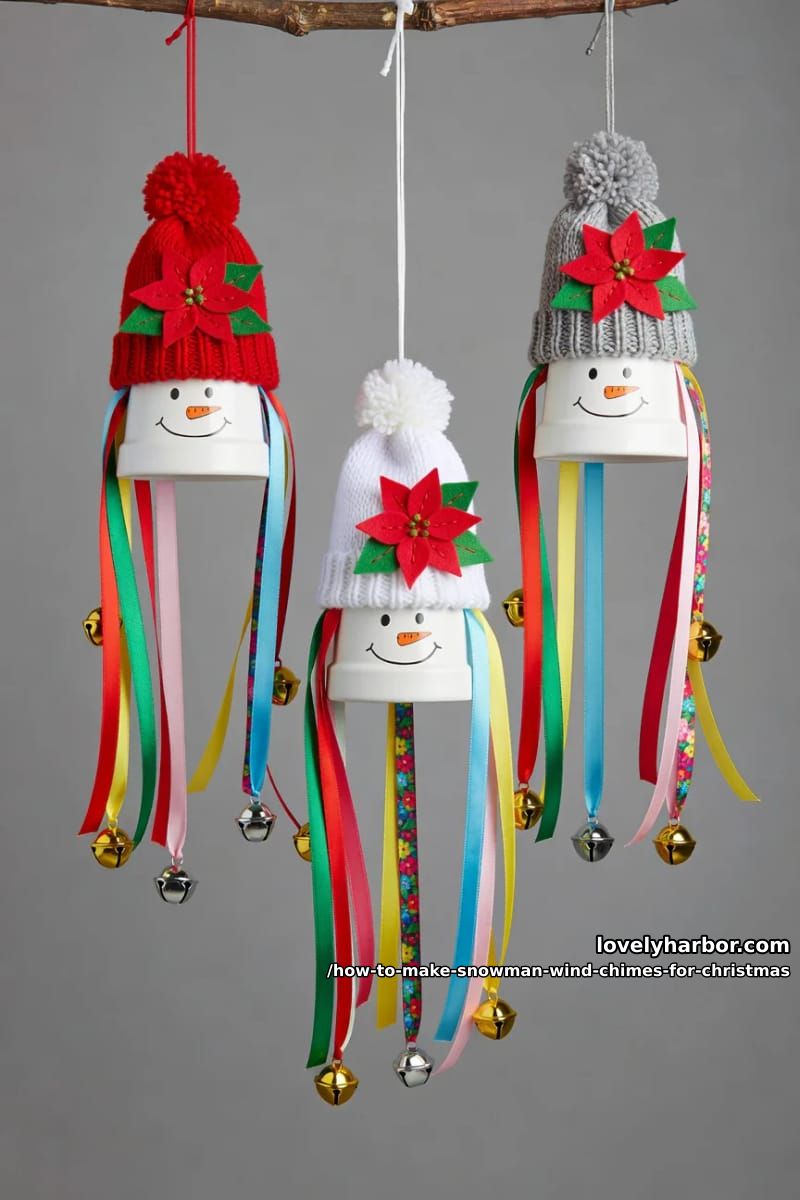
Oh, and you can make this variant too, where the pendants are the hair of the snowmen. Simple and super cute!
Mistakes that ruin snowman wind chimes
None of these will sink the project on its own. They're the difference between a chime that lives in the front window and one you quietly retire to a drawer.
- Hanging a paper-cup version outdoors in the rain. Paper cups go soft and warp within a day of real weather. Keep them indoors or on a covered porch, or build the outdoor ones from white plastic cups.
- Drawing the face with a regular marker. Ballpoint and washable markers bead up and rub off on the poly coating. The acrylic paint pen is the one that actually sticks.
- Gluing bells flat to the rim. No slack, no swing, no sound. Always put the bell on the end of a ribbon.
- One giant hanger hole. If the hole is wider than the knot, the snowman drops. Anchor the twine to a toothpick or button inside the cup.
- All ribbons the same length. The bells line up and clack as one lump instead of layering. Stagger them by an inch or two.
- Skipping the inside-out order. Glue the hat on before anchoring the twine and you’ve sealed yourself out of the cup. Hanger first, always.
Build sequence for a batch
Four or more go faster assembly-line than one at a time. The only real wait is glue cooling , seconds, not hours , unless you're spray-sealing plastic cups for outdoor use.
- First pass: punch holes and anchor every twine loop on all the cups.
- Second pass: draw all the faces, then let the ink set while you cut noses.
- Third pass: glue on noses, then hats, then poinsettias.
- Fourth pass: cut and bell all the ribbons, then glue them around each rim.
- If sealing plastic cups for outdoors: spray clear acrylic before any gluing and give it 24 hours to cure, then assemble.
Conclusion
You'll tear at least one cup bottom learning how hard to push the pin. Count on it, and keep three or four spares within reach from the start , stopping mid-project to draw a fresh face is the kind of small annoyance that ends a craft afternoon early. Do all the heads and faces before you touch a single ribbon; the faces want patience and the ribbons are the fun part, so save the fun for last. One honest caveat, since I keep recommending these over clay: a paper cup is still a paper cup. Mine get a couple of seasons in the window before the rims soften, and at fifteen cents a head I've made my peace with that.