
Every photo of a framed succulent wall skips the part people actually get stuck on: what stops two inches of dirt from sliding out the front the moment you hang it. The answer is a three-layer sandwich (solid backer, packed sphagnum moss, wire mesh) plus a rooting period where the frame lies flat and the plants knit themselves into a living net.
This guide covers the full build for an 18×24 frame: the shadow box that gives a shallow picture frame real depth, the mesh-and-moss layer that locks soil in place, which succulents survive vertical life and which fail by August, and the one timing mistake that empties most first attempts onto the patio.
What holds the dirt in: the anatomy of a succulent frame
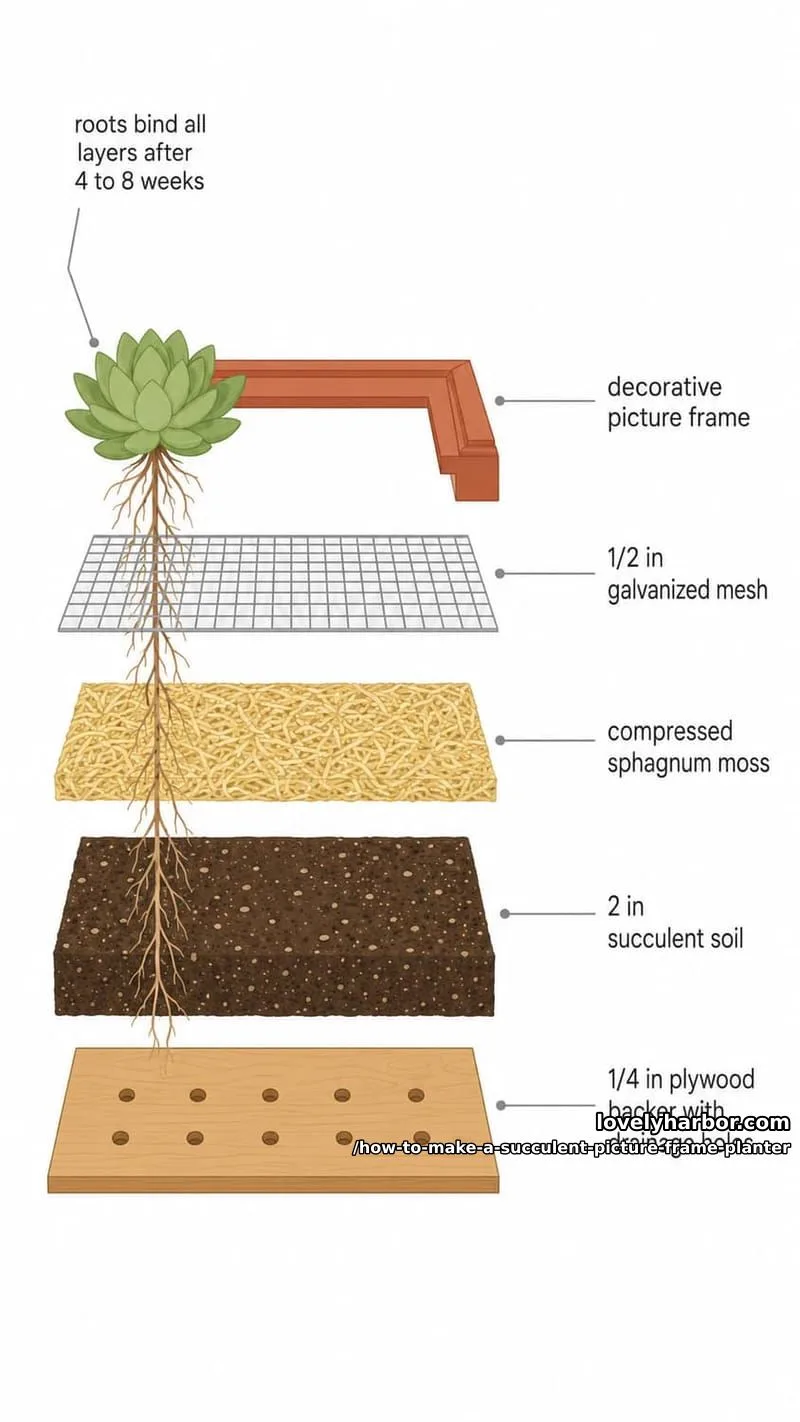
Three things hold the soil, and none of them is glue. The back is sealed by a plywood panel, so soil can only exit through the front. The front is covered by half-inch galvanized mesh, stapled to the frame, and the openings are too small for packed soil to pour through. Between mesh and soil sits a layer of long-fiber sphagnum moss, pressed up against the wire from behind; the moss is the actual gasket, catching the fine particles that would otherwise sift out every time you water. Then, over the first month or two, the succulents root through all of it and the root mat takes over as the primary retention layer. A mature frame would hold its soil even if you cut the mesh away. A freshly planted one would dump everything in an afternoon, which is why the flat rooting phase in Step 5 is not optional.
Plywood backer (1/4 in.): sealed back wall, screwed to the shadow box, with 4 to 6 small drainage holes drilled through it.
Soil layer (about 2 in.): cactus/succulent mix filling the shadow box cavity.
Sphagnum moss (1/2 to 1 in. compressed): packed against the inside of the mesh, the particle barrier.
Galvanized mesh (1/2 in. openings, 19 gauge): stapled to the shadow box face, holds moss and plants under tension.
Decorative frame: sits over the mesh edge, hides the staples, carries the look.
A standard photo frame is too shallow for any of this. Most are under 1.5 inches deep, and succulents need roughly 2 inches of substrate to root and to buffer between waterings. So you either buy a shadow-box frame with real depth, or you do what this guide does: build a simple 1×3 box and attach your decorative frame to its face. The second option costs around $15 in pine and lets you use any thrifted frame you like, including ornate ones that were never meant to hold anything heavier than a print.
The frame itself is the only part of this project that requires real construction. If you’d rather skip the woodworking entirely, see the pallet-crate method below before buying lumber.
The Wooden Pallet Crate Method (No Woodworking Required)
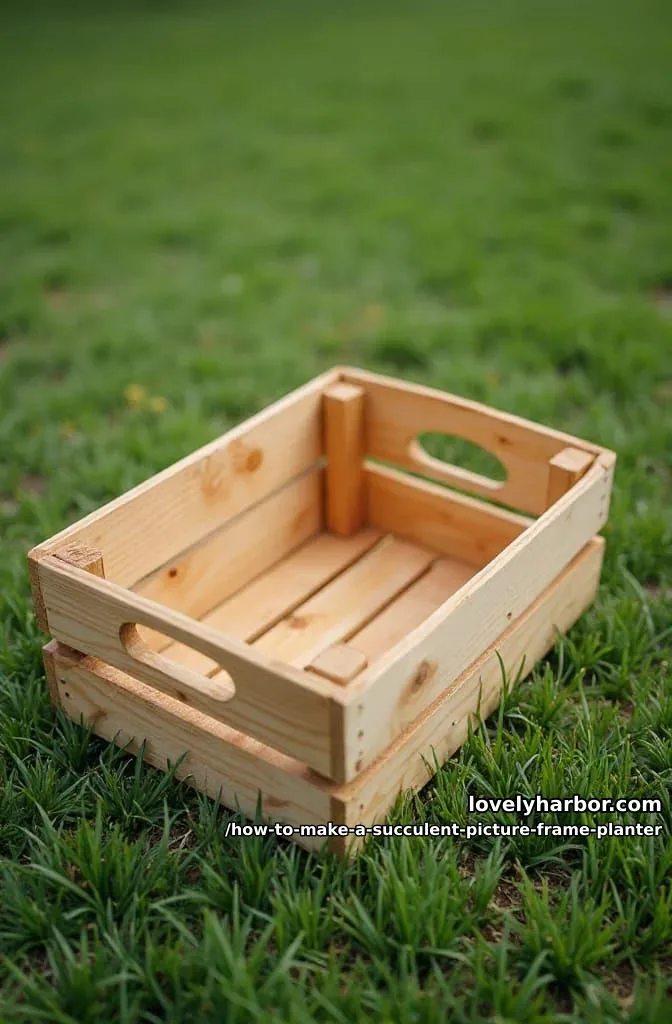
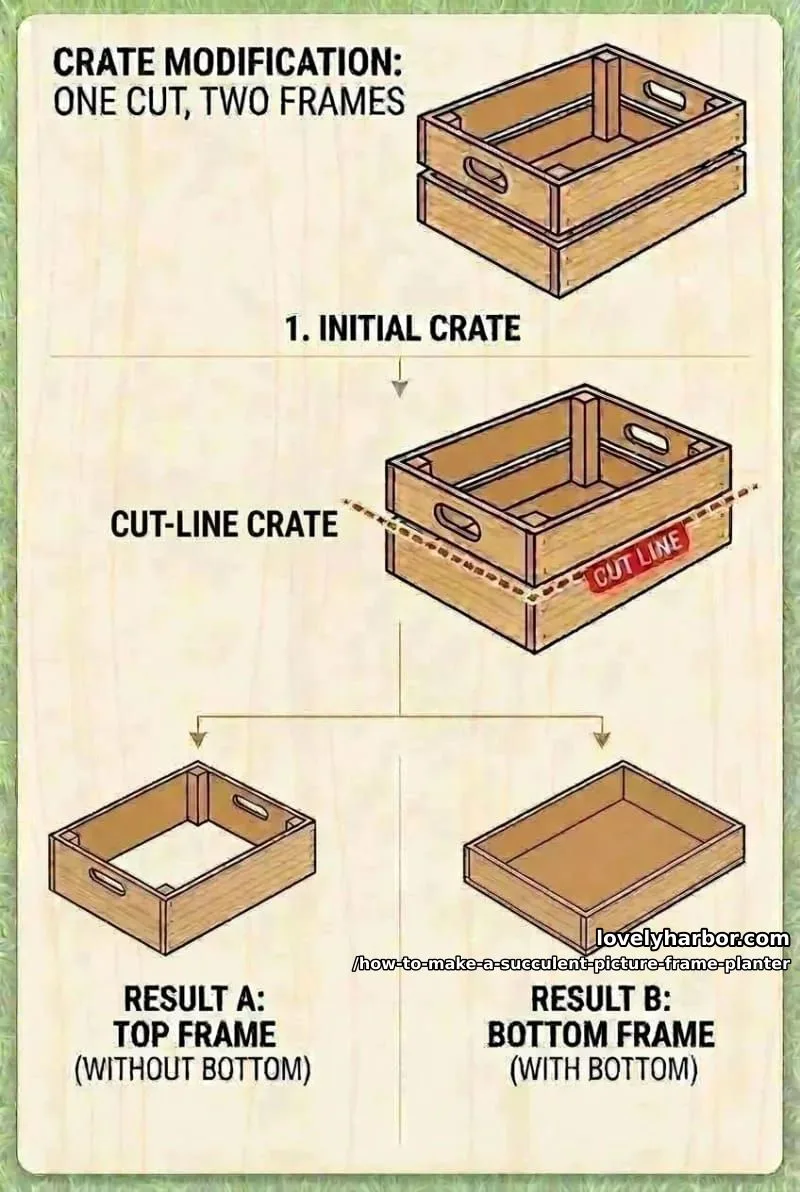
If you want to skip the carpentry completely, a wooden pallet crate can do most of the work for you. Many decorative crates already provide the 2- to 4-inch depth that succulents need, include built-in drainage gaps, and cost less than buying lumber. Better yet, a deeper crate can often be cut into multiple shallow planting frames, turning one container into two or three succulent displays.
Best for: budget builds, reclaimed materials, and gardeners who prefer upcycling over woodworking.
A deep produce crate or pallet crate can often be sliced horizontally into several shallow sections. Each section becomes a ready-made succulent frame with almost no fabrication required. Middle sections that lose their bottom simply need a layer of galvanized mesh attached underneath.
Many decorative pallet crates are assembled with light-duty staples intended for storage rather than structural loads. Before planting, inspect every corner and reinforce loose joints with exterior screws if needed. A fully planted 18×24 succulent frame can weigh 20 to 30 pounds after watering.
Budget-Friendly Option: Decorative pallet crates are widely available online, but reclaimed produce crates, wine crates, and pallet boxes often work just as well for free. The only requirements are solid corners, at least 2 inches of depth, and enough strength to support the finished weight.
- Inspect the crate. Tighten loose joints and add screws if the corners feel weak.
- Add a retention layer. Cover large bottom gaps with galvanized hardware cloth. Staple it securely to the underside.
- Add a particle barrier. Lay landscape fabric or a layer of long-fiber sphagnum moss over the mesh so soil cannot wash out.
- Fill with cactus soil. Pack the cavity firmly, just as described in Step 3.
- Install the front mesh. Stretch galvanized mesh across the front opening and staple it tightly to the frame.
- Plant and root flat. Follow Steps 4 and 5 exactly as written, including the 4- to 8-week rooting period before hanging.
If you decide to use this method, you can skip Step 1 of this guide.
Shopping list
Lumber stays unlinked because shipping an 8-foot board makes no sense; a Home Depot or Lowe’s cuts 1x3s to length for free if you ask at the panel saw. The mesh roll is more than one frame needs, which is fine, because nobody builds just one of these. Everything else below is a verified product matching the spec column.
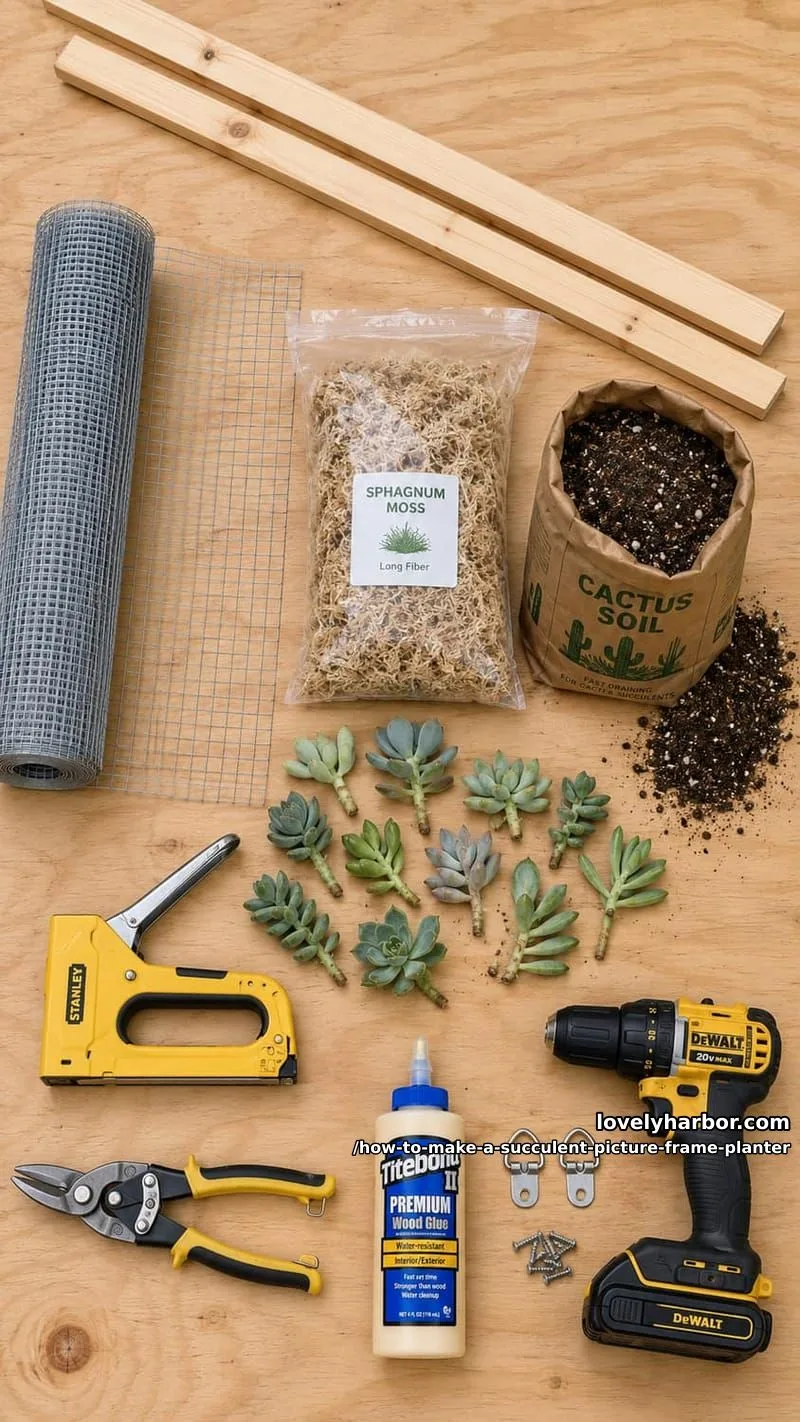
Materials (consumables)
| Qty | Item | Spec | Price |
|---|---|---|---|
| 2 | Pine 1×3 boards (Home Depot/Lowe’s, cut in store) | 8 ft. lengths, standard pine | $12 to $18 |
| 1 | Plywood backer panel | 1/4 in., cut to 18×24 (scrap works) | $0 to $12 |
| 1 | LAN JIA 1/2 inch galvanized hardware cloth, 24 in. x 50 ft., 19 gauge | 1/2 in. openings, hot-dip galvanized | $20 to $35 |
| 1 | Better-Gro long-fiber sphagnum moss, 240 cu. in. | Long fiber, untreated | $8 to $14 |
| 1 | Hoffman 10410 organic cactus and succulent soil mix, 10 qt. | Fast-draining cactus mix | $10 to $18 |
| 1 | Succulent Market assorted succulent cuttings, 50 pack, 2 to 3 in. | Unrooted, mixed rosette varieties | $30 to $60 |
| 1 | Titebond III Ultimate waterproof wood glue, 8 oz. | Type I waterproof, exterior rated | $6 to $10 |
| 1 | Exterior wood screws (hardware store) | #8 x 1-1/4 in., box of 25+ | $5 to $8 |
| 1 | PHS extra large heavy duty D-ring hangers, 2 pack, 200 lb. capacity | 5 in. steel strap, screws included | $8 to $14 |
| Materials subtotal | $99 to $189 | ||
Tools (one-time, reusable)
| Qty | Item | Spec | Price |
|---|---|---|---|
| 1 | Arrow T50 heavy duty staple gun kit with 1875 staples and remover | Uses 3/8 in. T50 staples | $22 to $35 |
| 1 | Crescent Wiss M3R MetalMaster straight-cut aviation snips | Cuts up to 18-gauge steel | $15 to $25 |
| 1 | Drill/driver with bits (assumed owned) | Any cordless drill | $0 |
| 1 | Hand saw or miter saw (or free store cuts) | Crosscut capable | $0 |
| 1 | Spray bottle | Any clean 16 oz.+ mister | $2 to $5 |
| 1 | Heavy-duty leather work gloves | For handling sharp wire mesh | $0 to $10 |
| 1 | Safety glasses | ANSI Z87.1 rated for flying wire snips | $0 to $5 |
| Tools subtotal | $39 to $80 | ||
Combined total (buying everything from scratch)
| All materials and tools | $138 to $269 | ||
Prices are approximate ranges as of June 2026; verify before purchase. With tools already owned and free cuttings propagated from existing plants, the real project cost drops to roughly $50 to $90.
Step 1: Build the shadow box
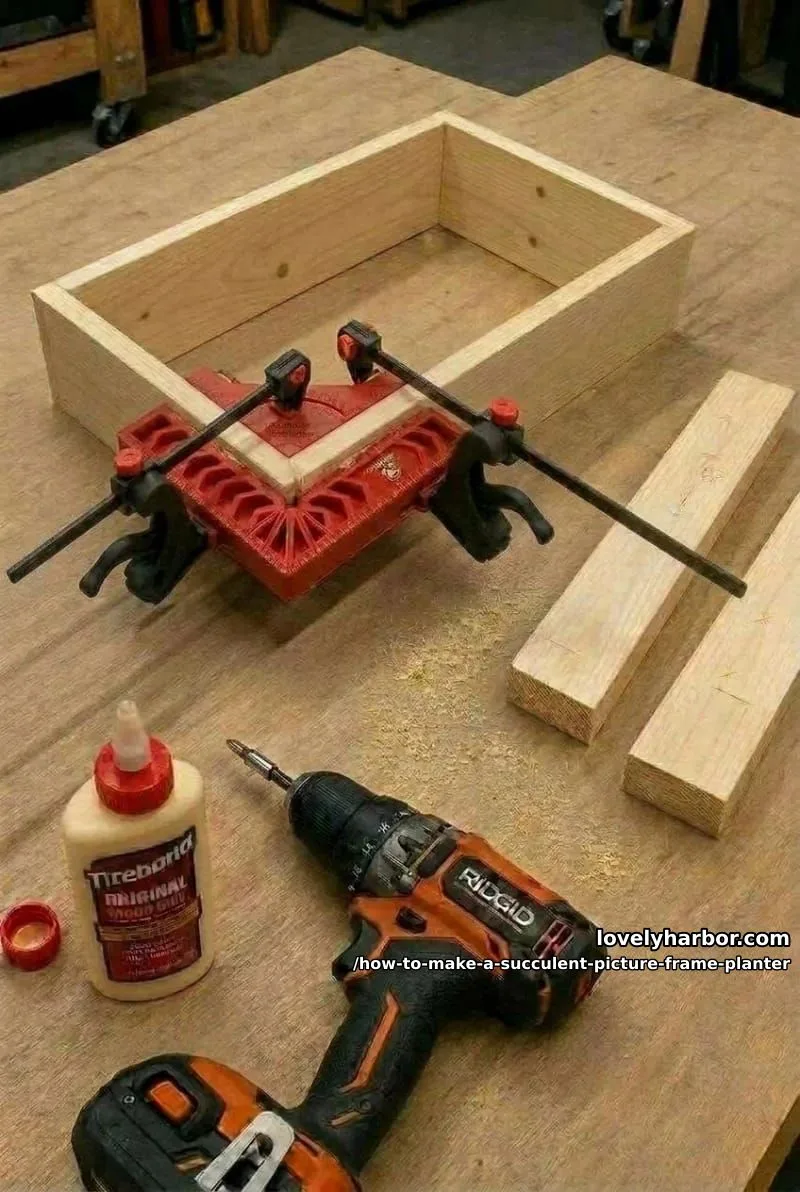
The shadow box is just four pieces of 1×3 joined into a rectangle, with the 2.5-inch face of the board becoming the depth of your planting cavity. Build it to match the back of your decorative frame, measuring the frame’s inner opening rather than its outer edge so the box hides behind the molding when viewed from the front.
- Cut to size. For an 18×24 interior: two pieces at 24 in. and two at 16.5 in. (the shorter pieces sit between the longer ones; 18 minus two board thicknesses of 0.75 in. each).
- Glue and screw the corners. Run Titebond III on each mating face, square the corner, then drive two 1-1/4 in. screws through the long board into the end grain of the short one. Pre-drill or the pine will split, and it will split at the last corner, when you’re nearly done.
- Check square. Measure both diagonals; equal diagonals mean a square box. Adjust before the glue sets, which gives you about ten minutes of open time.
- Attach the backer. Screw the 1/4 in. plywood panel across the back every 6 inches or so, then drill 4 to 6 drainage holes (1/4 in. bit) through it. Skipping the drainage holes turns the box into a bathtub, and succulents rot in standing water faster than almost any other plant family.
Step 2: Cut and staple the mesh
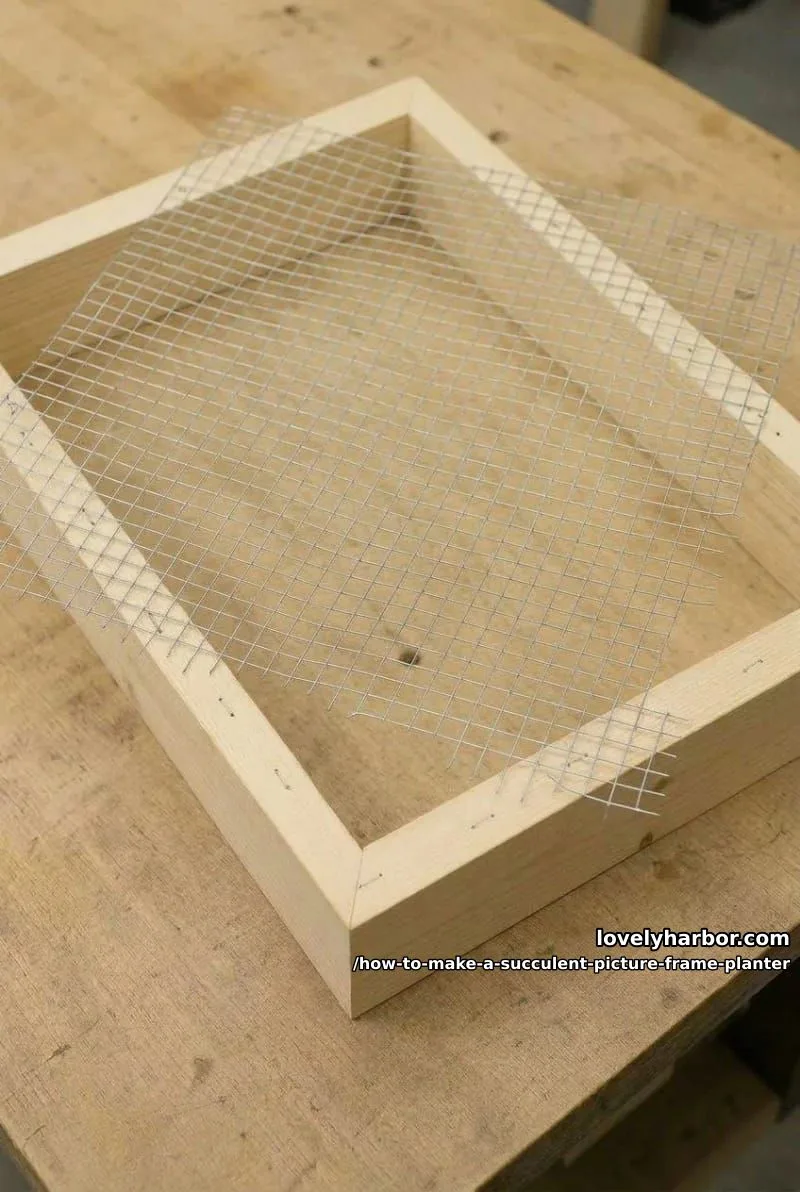
The mesh goes on the open front face, and tension matters more than placement. Loose mesh bellies outward once soil presses against it and the whole composition sags into a pouch within weeks.
Galvanized wire mesh is stiff and unforgiving. When you cut 19-gauge wire, the edges become razor-sharp needle points that can easily slice skin or catch an eye. Do not skip the work gloves and safety glasses for this step.
- Cut the panel oversized. Snip a piece roughly 1 in. larger than the box opening on all sides with the aviation snips. The 19-gauge wire is no match for them; scissors, on the other hand, will lose.
- Staple one long edge first. T50 staples every 2 in., set into the face of the 1×3.
- Pull and staple the opposite edge. Pull the mesh taut with pliers or gloved fingers as you go. You want drum-tight, not merely flat.
- Finish the short edges, then trim. Snip the overhang flush and hammer down any staple that didn’t seat fully. Stray wire ends here are what will scratch you for the rest of the project, so deal with them now.
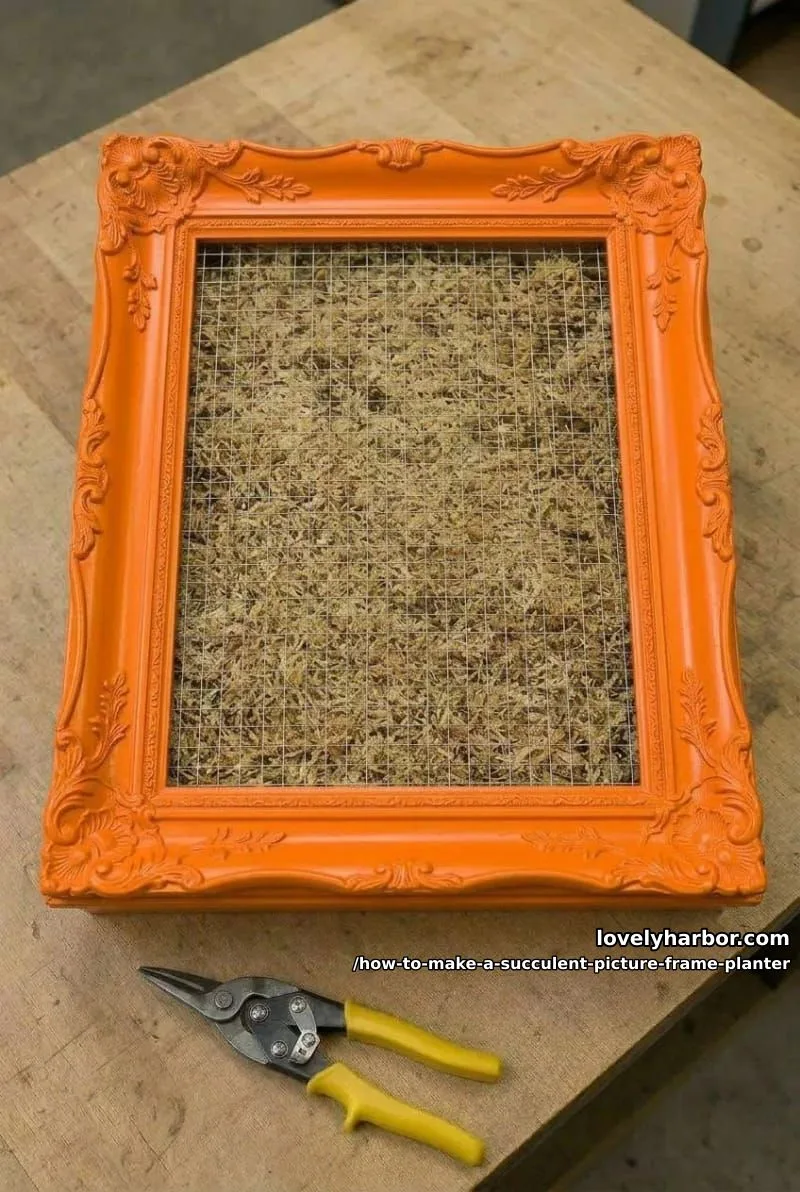
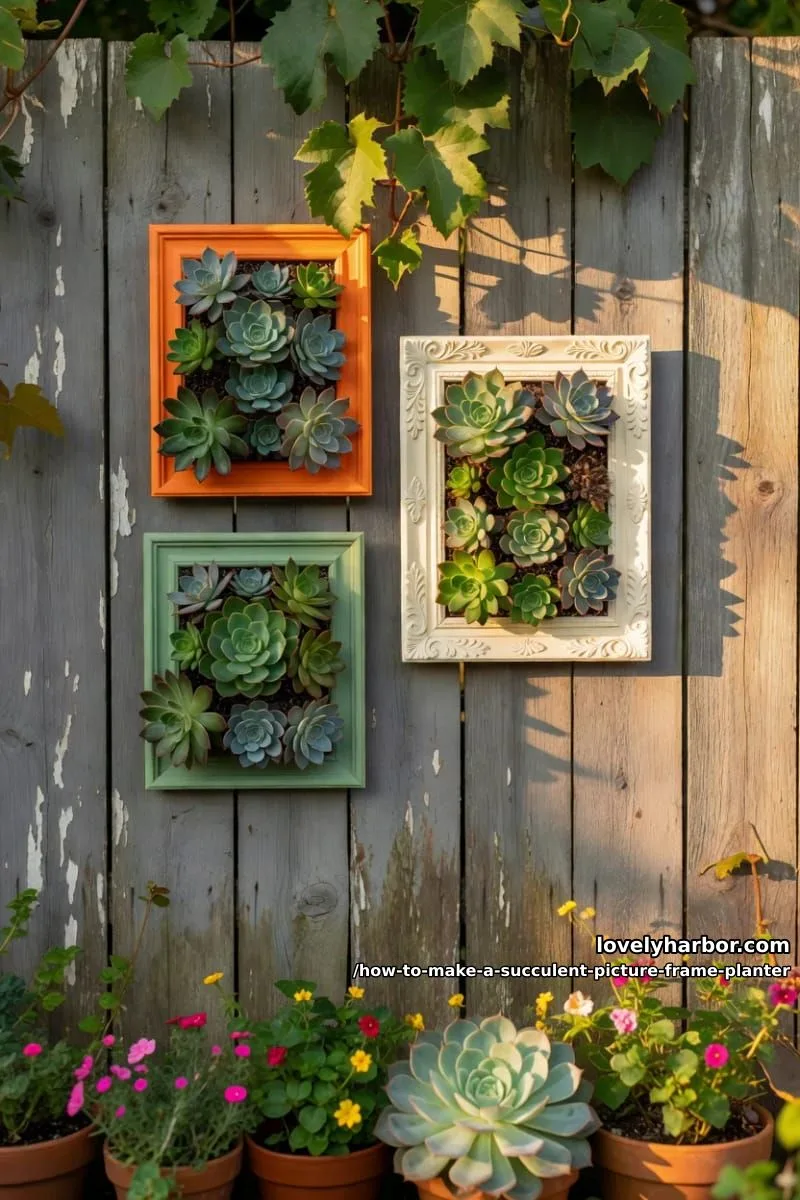
- Paint and seal the decorative frame. Paint the vintage decorative frame with a bright color, make it dry then seal it.
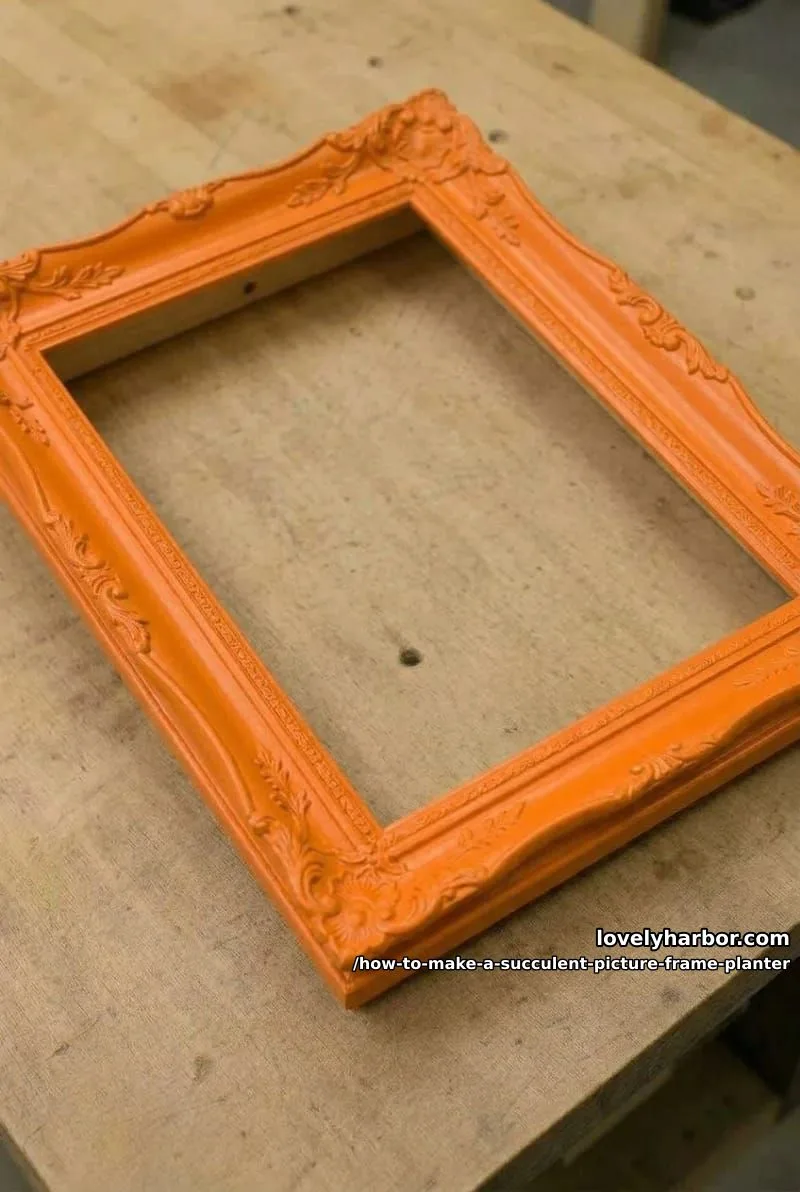
If your decorative frame is going outdoors, seal it first: two coats of exterior polyurethane on bare or thrifted painted wood. An unsealed frame in contact with damp soil delaminates in one season, and ornate gesso frames (the carved-looking ones) shed their detail in chunks once water gets behind the finish. Seal before assembly, not after, since you can’t reach the back later.
Step 3: Pack the moss and soil
This step happens through the mesh, with the frame lying face-up, and it answers the question everyone asks: the moss goes in first, against the wire, because it is the layer that keeps soil from washing out of those half-inch openings. Soak the sphagnum in a bucket of water for 15 minutes, wring it to damp, then push walnut-sized wads through the mesh and spread them into a continuous half-inch to one-inch blanket across the entire wire face. No gaps. Anywhere you can see daylight through moss is where a soil stream will appear at first watering.
Then you can attach the mesh using the staple gun. This helps to keep the soil and moss in the box without falling down when you will hang the frame.
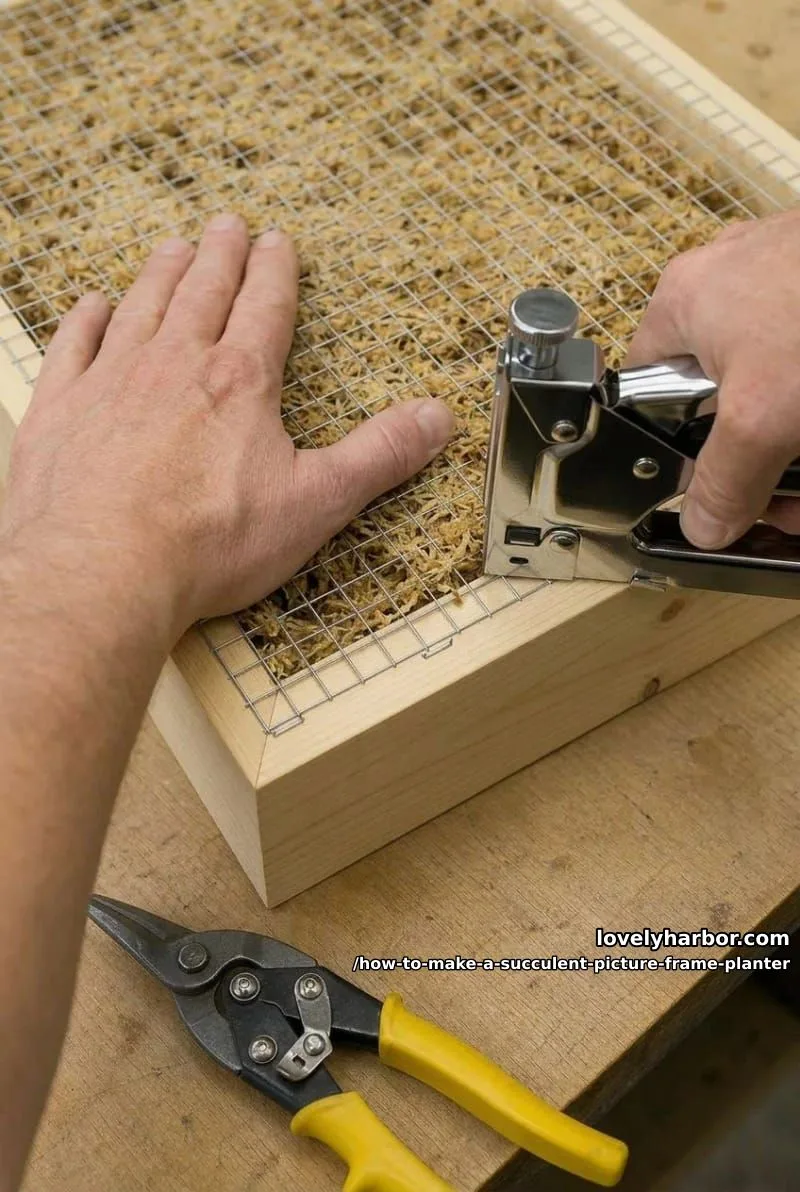
Mount the decorative frame. Glue and screw your thrifted frame face-down onto the stapled side, sandwiching the mesh edge. The molding hides every staple.
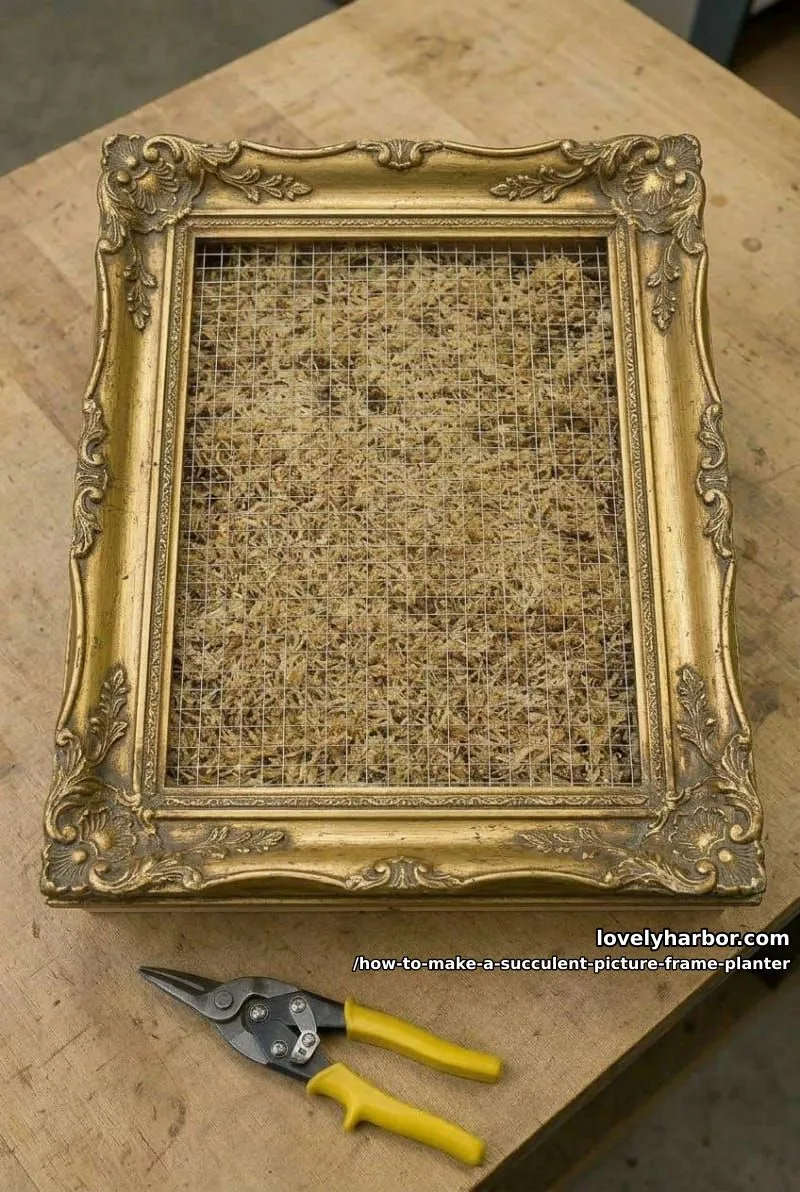
If you decided to paint the vintage frame before sealing it, then here’s how it would look like.
Then pour cactus mix over the mesh and work it through the openings with your fingers, shaking the frame every few handfuls so it settles into corners. Keep going until the cavity is full and firm; press down and add more, because loosely filled frames develop an air gap behind the moss within a month and the plants above the gap die of drought while the ones below stay fine. A full 18×24 frame takes most of a 10-quart bag. Do not use standard potting soil here, whatever you have left over from other projects: it holds water against the roots and compacts into a brick when it finally dries.
Step 4: Plant through the mesh
Cuttings, not potted plants. A rooted 2-inch succulent from a nursery six-pack has a root ball that won’t fit through a half-inch opening without cutting the grid, and every wire you cut weakens the retention layer. A cutting is just a rosette on a bare stem: poke a pencil-sized hole through the moss, insert the stem an inch deep, firm the moss around it. If your cuttings are fresh, let them sit in a dry shaded spot for 2 to 3 days first so the cut end callouses; planting a wet-cut stem into damp moss is how rot starts.
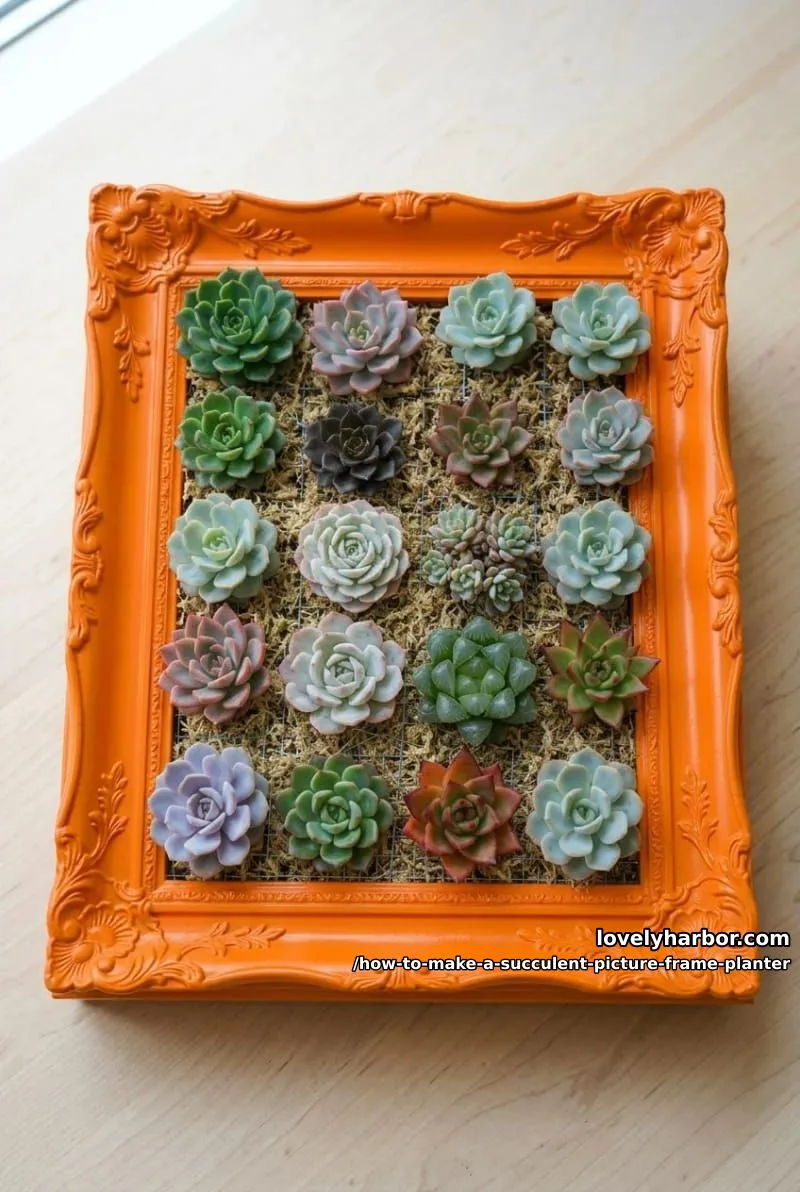
- Place the anchors first. Position your largest rosettes (echeveria, aeonium offsets) where you want focal points, working from the photo or sketch you like.
- Fill with mid-size cuttings. Sedum and graptopetalum knit the spaces between anchors. Plant one per opening or every other opening; an 18×24 frame swallows 50 to 80 cuttings depending on size.
- Plug the gaps with sempervivum pups. Hens-and-chicks tolerate the tightest spots and the coldest winters, which matters if your frame lives outside year-round.
- Mist once, lightly. Settle the moss around the stems. Then put the watering can away for two weeks.
Plant these
- Echeveria: the classic rosette, stays compact and flat
- Sempervivum (hens-and-chicks): cold-hardy, spreads by pups
- Sedum (stonecrop types): fast filler, roots through moss readily
- Graptopetalum: blush-toned rosettes, tolerates neglect
Avoid
- Burro’s tail: trailing stems elongate fast and snap off, wrecking the composition within a season
- String of pearls: rots in moss contact and pulls out under its own weight
- Aloe and large agave pups: get too heavy and lever themselves out of the grid
- Jade cuttings: grow into top-heavy shrubs that a vertical frame can’t carry
Step 5: The flat phase (the step everyone skips)
The frame now lies flat, in bright indirect light, for 4 to 8 weeks. Unrooted cuttings are held in place by nothing but friction; hang the frame early and gravity works each stem loose as the soil settles, until plants start dropping off the face one by one. I hung my first frame at three weeks because the top half looked rooted, and the bottom half was on the ground within a month. Tug-test instead of guessing: grip a rosette gently and pull. Real resistance means roots; if it lifts, give the whole frame two more weeks. Begin light watering about 10 days after planting, misting until the moss is damp, and let it dry fully between sessions.
Hanging, watering, and keeping it alive
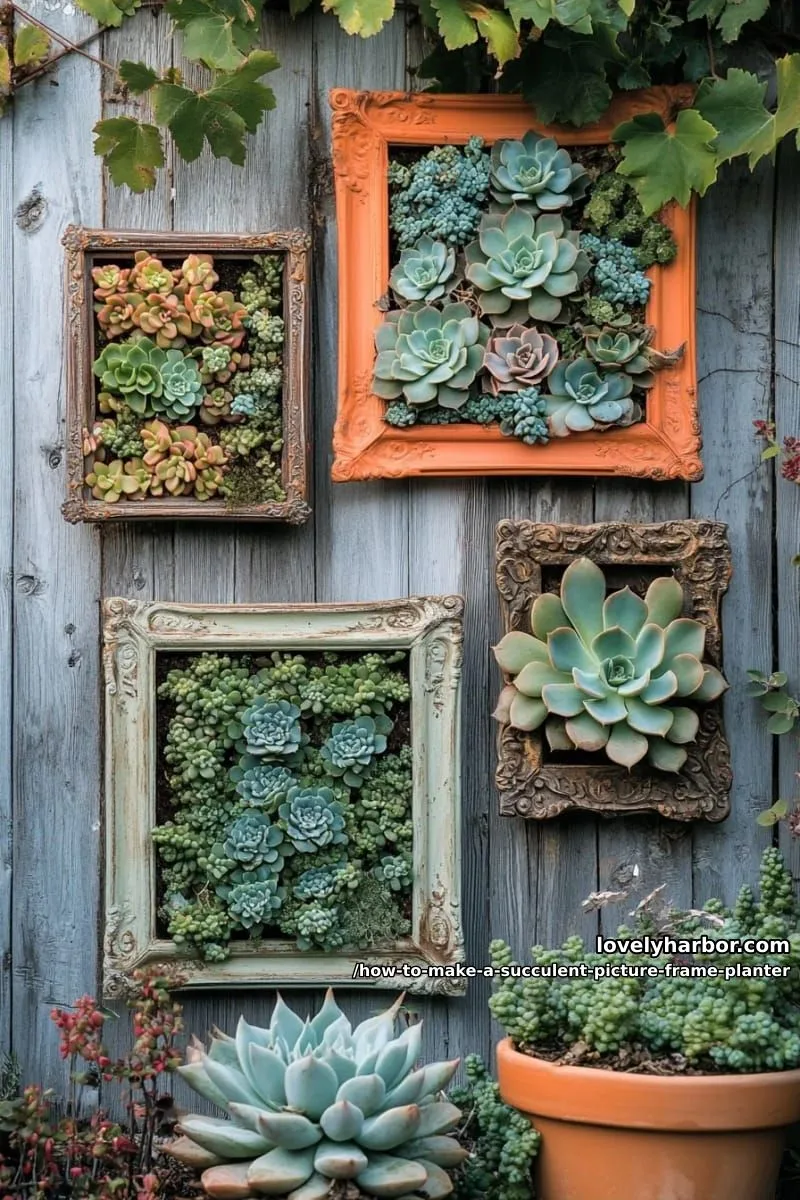
A planted, watered 18×24 frame weighs 20 to 30 pounds, which is why the shopping list specifies 200 lb. D-rings and not the sawtooth hangers that came on your thrifted frame. Screw one D-ring into each side of the shadow box (into the 1×3, not the thin backer), and hang on two lag screws driven into fence posts or wall studs, never drywall anchors.
A damp, 30-pound planter resting completely flush against indoor drywall or wood siding is an invitation for mold and rot. To prevent trapped moisture, stick self-adhesive rubber bumpers (the thick kind used for cabinet doors) onto the four back corners of your plywood panel. This creates a critical 1/4-inch air gap that allows ventilation behind the frame.
Outdoors, pick a spot with morning sun and afternoon shade; full western exposure scorches echeveria even though the plant labels say full sun, because a vertical frame presents every rosette broadside to the low afternoon light.
Watering changes once the frame is vertical. Mist thoroughly every 7 to 10 days in warm months, less in winter, aiming at the moss rather than the rosettes. For a deep soak once a month, take the frame down, lay it flat, water, and let it drain for an hour before rehanging; this is also the moment to rotate it 180 degrees so both ends take turns being the top, since the top of a vertical frame always dries first and the bottom always stays wettest. Granted, the take-it-down routine is a chore, and it’s the honest cost of this project that no Pinterest caption mentions.
Mistakes that ruin a succulent frame
- Hanging before roots. The single most common failure. Tug-test every zone of the frame, not just the corner that looks best.
- Skipping the moss layer. Soil alone sifts through half-inch mesh a little more with every watering until the cavity hollows out behind a crust of survivors.
- No drainage holes in the backer. Sealed boxes hold water against the roots; rot announces itself with rosettes that turn translucent and detach at a touch.
- Using regular potting soil. It stays wet too long, compacts, and feeds the rot described above.
- Loose mesh. Under-tensioned wire bows outward and the soil mass slumps toward the bottom of the frame, leaving the top inch unplantable.
- Watering on a schedule instead of by touch. Push a finger into the moss; water when it’s dry a knuckle deep, whatever the calendar says.
Build timeline
- Day 1, morning: cut lumber, assemble shadow box, attach backer, drill drainage.
- Day 1, afternoon: staple mesh, mount and seal the decorative frame; take cuttings if propagating your own.
- Days 1 to 3: cuttings callous in a dry, shaded spot.
- Day 3 or 4: soak moss, pack moss and soil, plant through the mesh, one light mist.
- Day 14: first real misting; moss damp, not soaked.
- Weeks 4 to 8: tug-test weekly; hang only when every zone resists.
- Month 2 onward: vertical misting every 7 to 10 days, monthly flat soak, rotate 180 degrees quarterly.
Conclusion
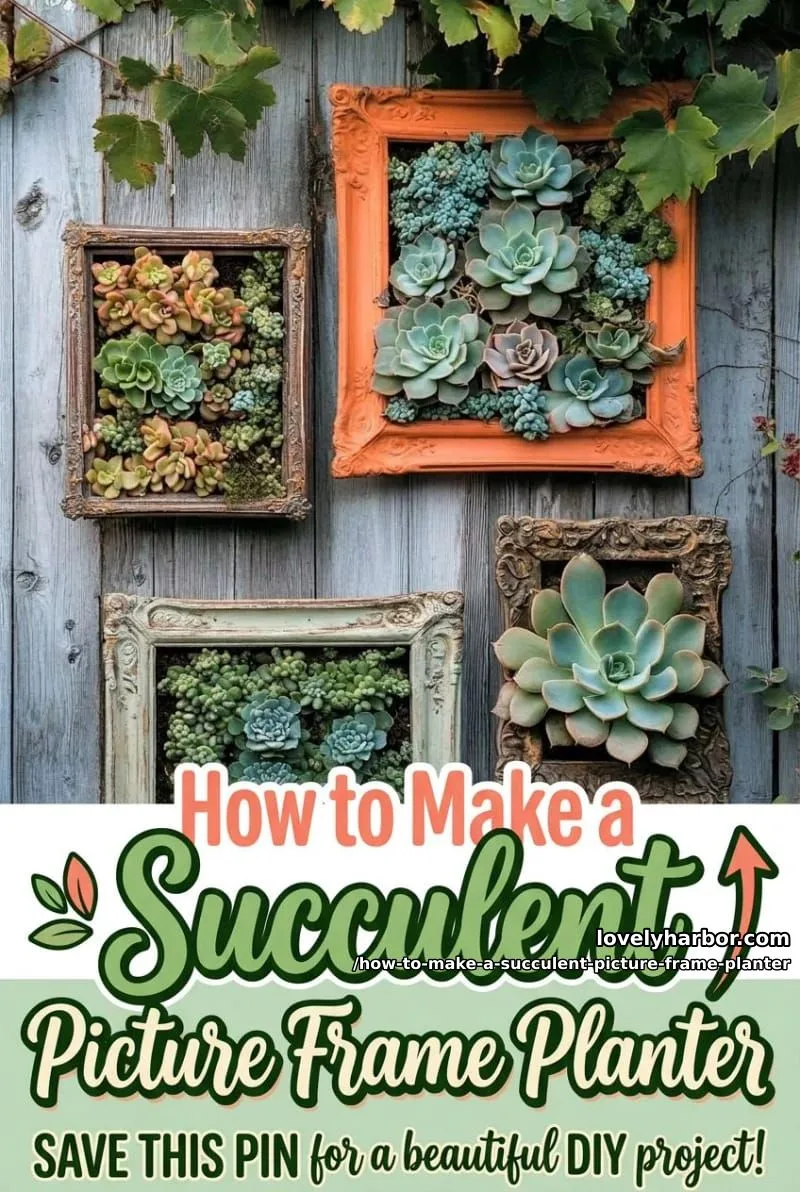
The gallery in the inspiration photo is really six or seven of these small builds staggered over a couple of seasons, which is also the cheapest path, since by the second frame your first one is producing free sedum and sempervivum pups faster than you can replant them. Start the lumber cuts on a Saturday morning and the only part that requires patience arrives at week four, when the frame looks finished and the tug test says it isn’t.
If you build only one thing from this guide before committing to the full wall, make it the smallest version: a single 8×10 frame uses offcuts from the same two 1×3 boards, maybe a dozen cuttings, and teaches you the moss-packing and tug-test rhythm on something you can afford to get wrong.