
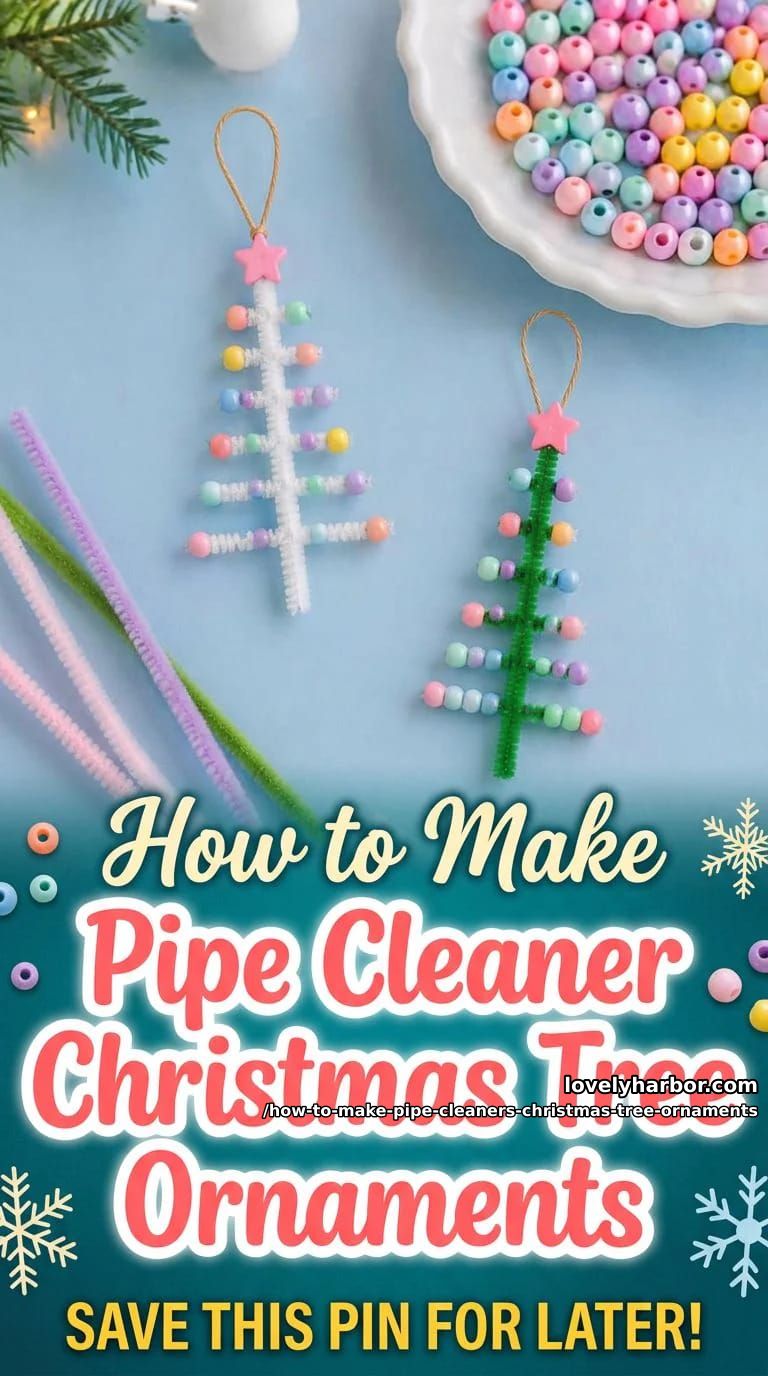
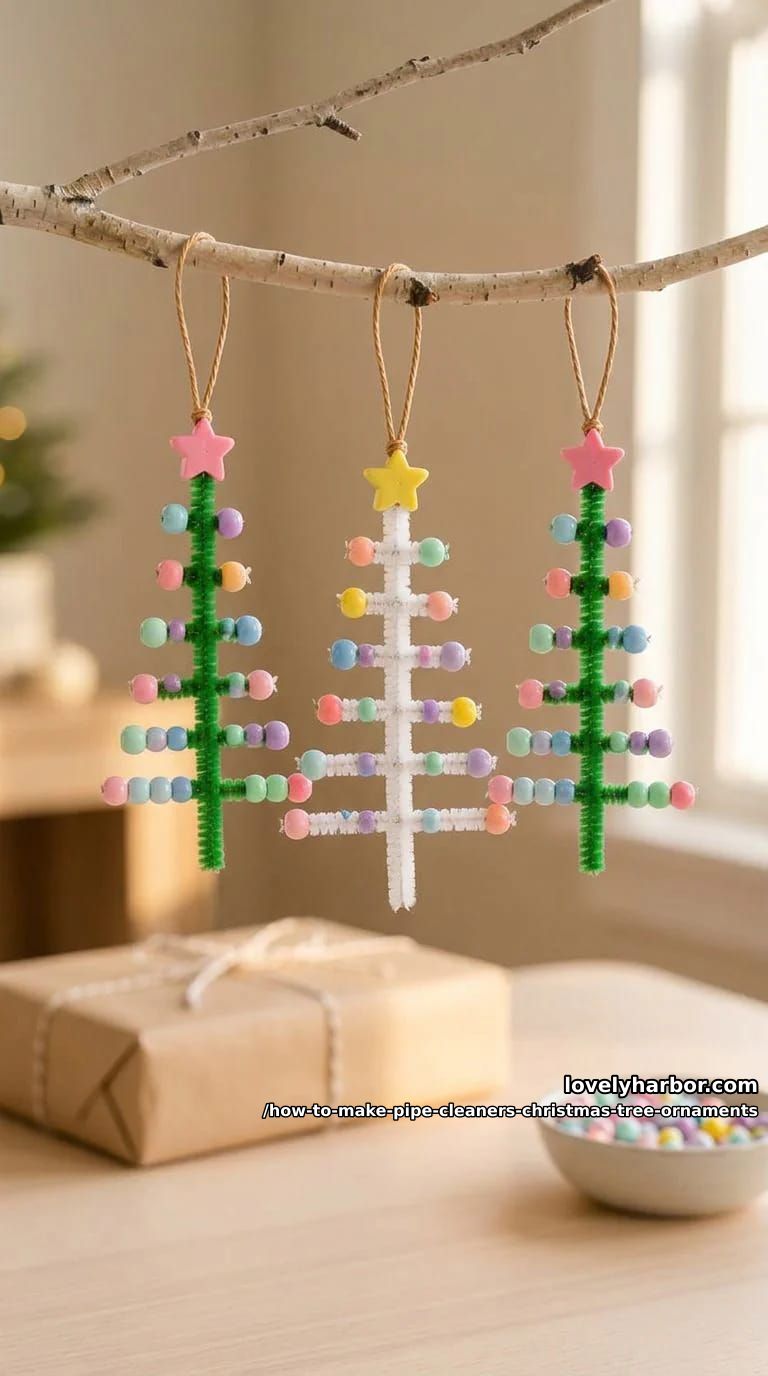
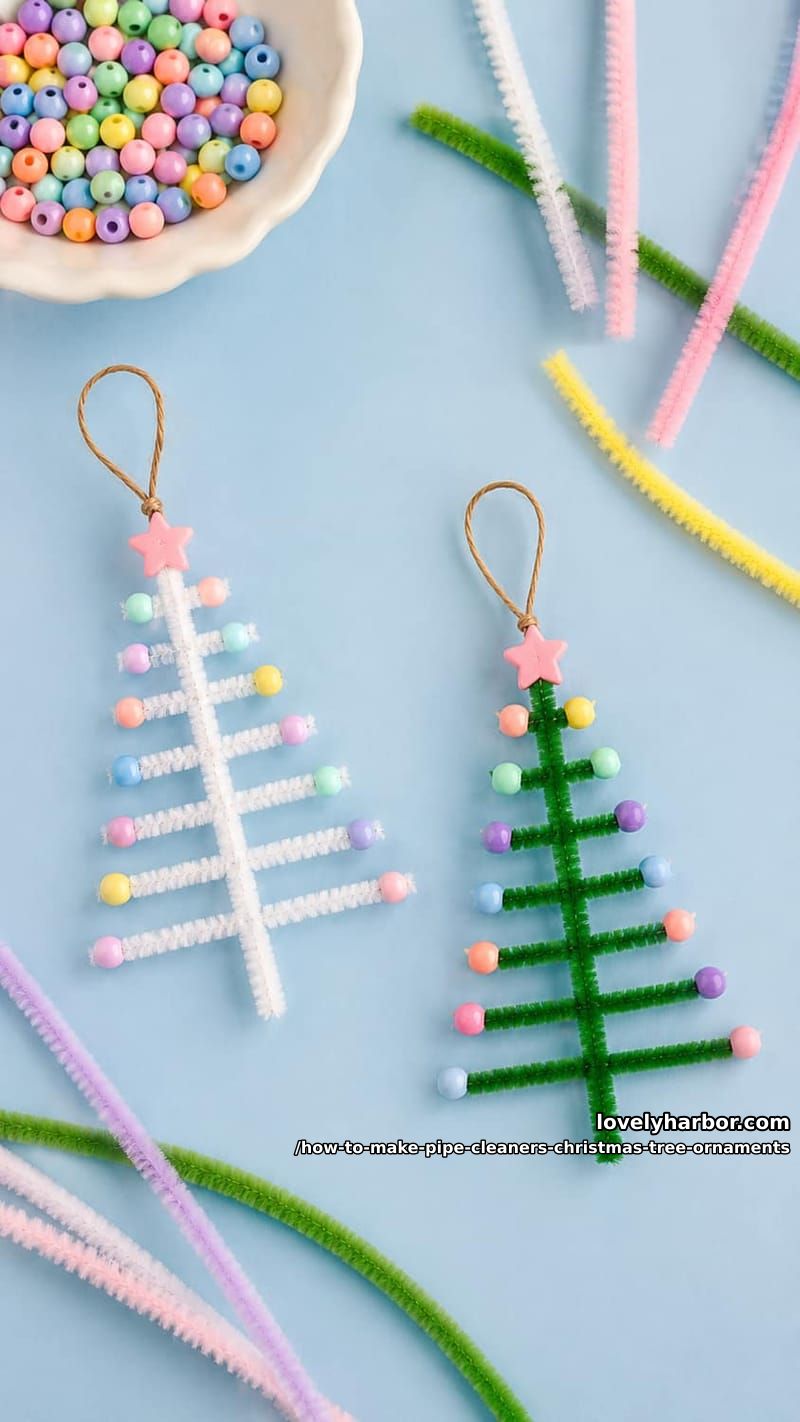
No glue, no drying time, almost nothing you can wreck. You twist branches onto a trunk, push beads onto the tips, and the fuzzy chenille grips them by friction , that's it, that's the craft. I'll walk through both versions in the photo, the green fir and the snowy white one. You'll get the exact branch-cutting chart so your tree reads as a tree and not a bottle brush, and I'll flag the one material swap that quietly wrecks this whole thing for most people.
Two trees, one method
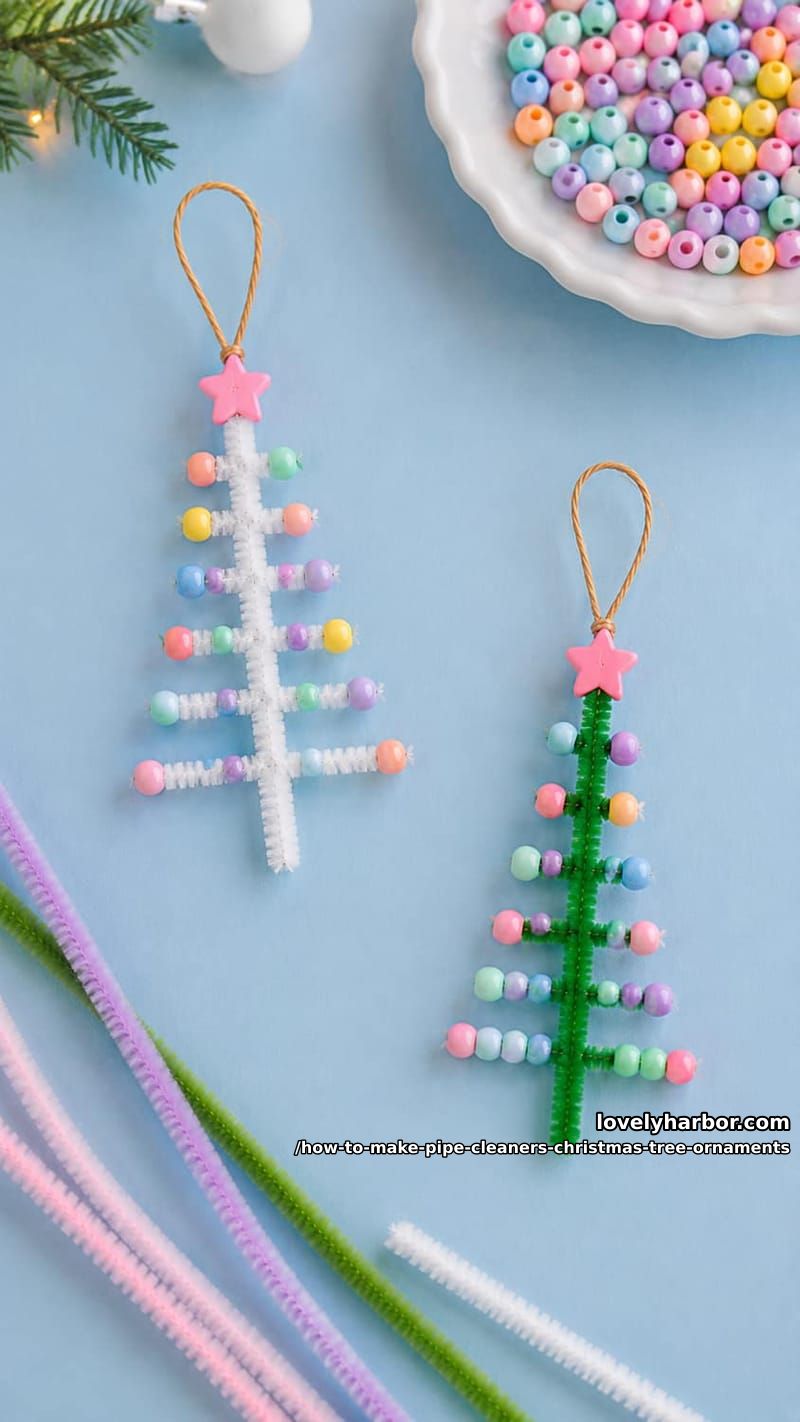
Both ornaments share the same skeleton. One vertical stem for the trunk, eight shorter stems twisted on as branches, longest at the bottom. Change the color of the chenille and you've got the other tree. Here's the thing the photo undersells: the white glitter version photographs better. Pale beads kind of sink against green, but they snap against white. So if these are going to someone else, or onto a board, lean white.
The classic green fir
Standard kelly-green or dark-green chenille stems. It reads as a traditional little evergreen, and green forgives sloppy twisting in a way white never will.
The snowy white tree
White or iridescent tinsel stems, for that flocked, frosted look. Pastel beads stand out hard against all that white , which is exactly why this one wins on camera.
Materials and tools
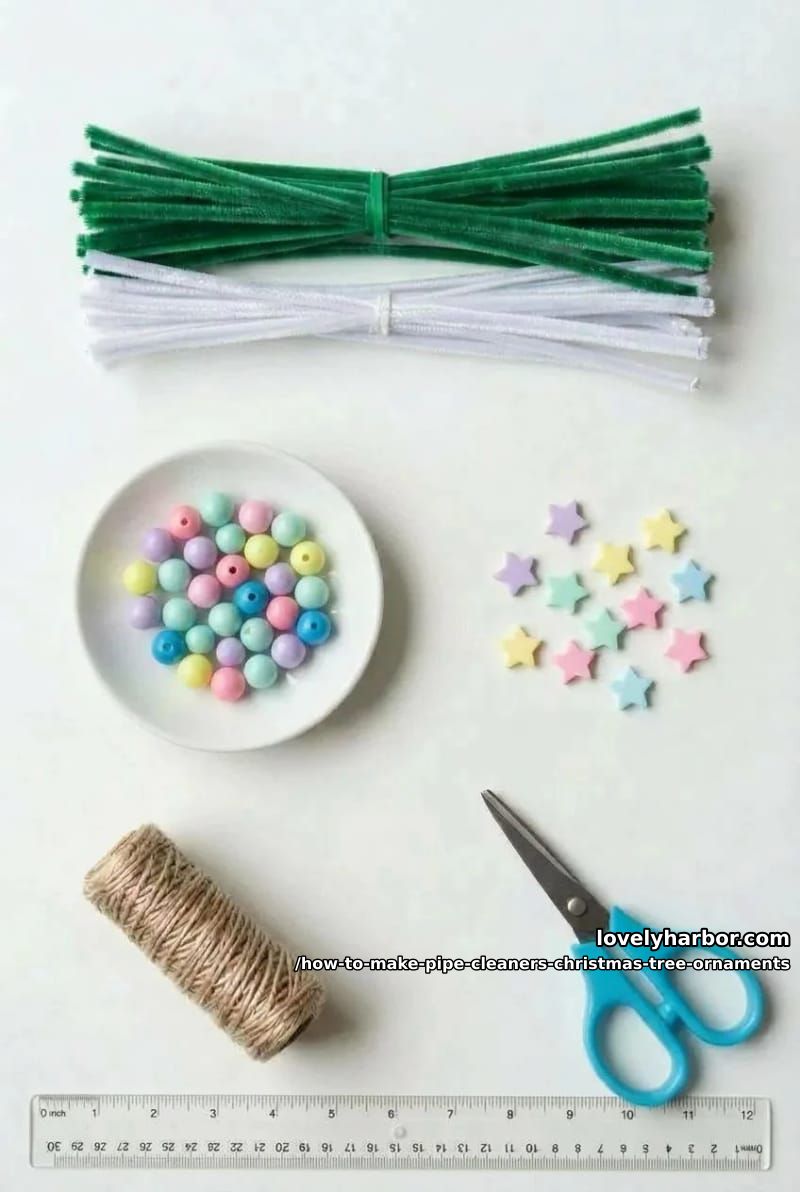
Three or four supplies, that's the whole list. If you're stocking a classroom or a craft party, here's the reassuring part: everything sells in bulk packs. One bag of beads makes dozens of trees, so the real per-ornament cost is much closer to pocket change than the totals below make it look.
Materials (what you use up)
| Qty | Item | Spec | Price |
|---|---|---|---|
| 3 | Green chenille stems, 6mm x 12 inch | Per green tree; 100-pack makes ~30 trees | $4 to $7 |
| 3 | Carykon iridescent white tinsel stems, 12 inch | Per snowy tree; optional if going green only | $6 to $9 |
| ~30 | Pastel acrylic round beads, 6mm, 1.9mm hole | Per tree; 2,000-count bag | $9 to $14 |
| 1 | Pastel acrylic star beads, 11mm | Topper; 1,000-count bag | $7 to $11 |
| 10 in | Tenn Well natural jute twine, 2mm x 500 ft | Hanging loop; one spool lasts for years | $6 to $9 |
| Materials subtotal | $32 to $50 | ||
Tools (one-time, reusable)
| Qty | Item | Spec | Price |
|---|---|---|---|
| 1 | Fiskars 5-inch pointed-tip kids scissors | Adult cuts the wire-core stems | $4 to $7 |
| 1 | Mr. Pen clear 12-inch plastic rulers (3-pack) | For measuring branch lengths | $5 to $8 |
| Tools subtotal | $9 to $15 | ||
If you’re buying everything from scratch
| Materials + tools, all-in | $41 to $65 |
| Combined total | $41 to $65 |
Prices are approximate ranges as of 2026; check before you buy. The quantities are per tree, but remember every pack makes many.
Pick beads that actually stay on
This is the decision the whole project lives or dies on, so I'll spend a minute here. The beads have to hold onto a fuzzy stem with nothing but friction, which means the hole has to be small. Aim for roughly 5mm to 8mm beads with a 1mm to 2mm hole. A 6mm acrylic bead with a 1.9mm hole grabs a standard chenille tip and stays put even when the ornament swings.
Now the unpopular part. Skip pony beads. They're the default thing in everybody's craft drawer, and that's the trap , their 4mm holes slide right off a 6mm stem the instant you tip the tree. Picture it: a kid finishes decorating, lifts the thing up to admire it, and watches half the "ornaments" rain onto the floor. Seed beads fail the other direction. They barely show, and they're maddening for small fingers. And heavy glass beads just drag the thin branches down into a sag.
Do this
- 6mm round acrylic beads, hole somewhere between 1mm and 2mm. The fuzz fills that hole and the bead just wedges in.
- Matte or pearl pastels. They read clearly whether the tree is green or white.
- Plain 6mm fuzzy chenille , the fuzzy kind grips, which is the whole point.
Avoid
- Standard 6x9mm pony beads. The 4mm hole slides straight off, every time.
- Seed beads, which are too small to see and too fiddly for little fingers anyway.
- Heavy glass, which pulls the branch into a droop.
A 2,000-bead bag of 6mm pastels in mixed colors — and crucially, that small 1.9mm hole, which is the whole difference between beads that stay on and beads that bail.

Step 1: Cut the branches
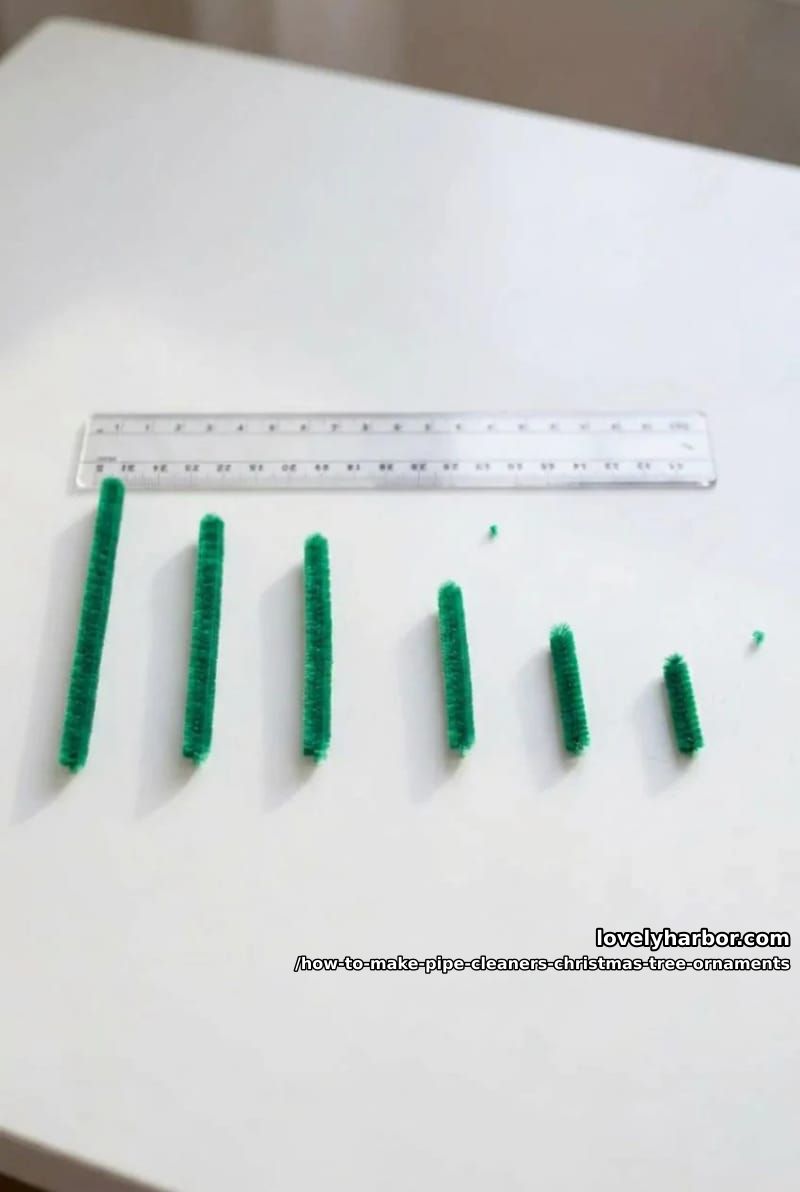
Those graduated lengths are the whole illusion , they're what makes the silhouette read as a tree instead of a green stick. Cut eight branch pieces per tree and set one full 12-inch stem aside for the trunk. Let an adult do the cutting: the inner wire dulls scissors fast, and the cut ends are sharp.
| Branch position | Length |
|---|---|
| 1 (top) | 1 in |
| 2 | 5 in |
| 3 | 2 in |
| 4 | 5 in |
| 5 | 3 in |
| 6 | 5 in |
| 7 | 4 in |
| 8 (bottom) | 5 in |
The eight branches add up to 22 inches, so two 12-inch stems cover them with a little to spare. Add the trunk and you're at about three chenille stems per tree. Before you build anything, lay the cut branches out smallest to largest , it saves you squinting into a pile halfway through assembly.
Step 2: Build the trunk and loop
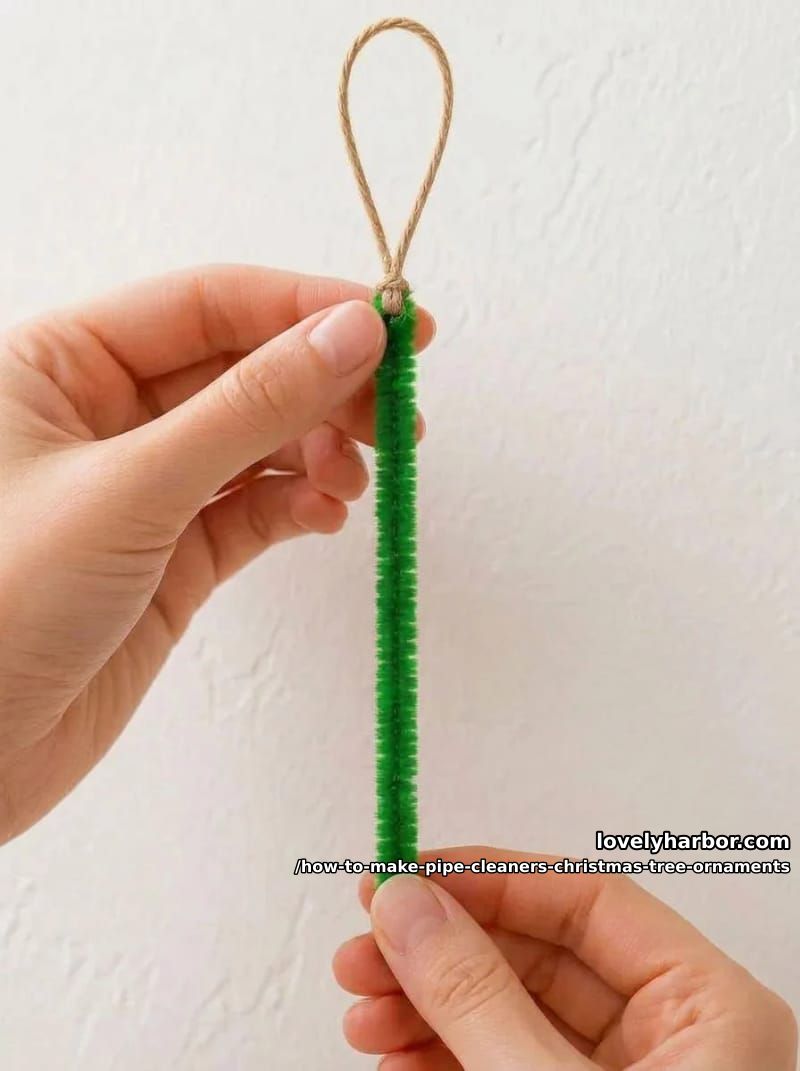
Fold the full 12-inch stem in half. Leave a small loop at the fold , that's your hanger anchor , and twist the two halves together down the length into one firm trunk. Twisting doubles the wire, so the trunk holds its shape instead of flopping.
- Fold the trunk stem in half, leaving a loop about the size of a pea at the top.
- Twist the two tails together, starting just under the loop and running to the bottom.
- Cut a 10-inch length of jute twine.
- Thread and knot the twine through the top loop with a simple knot, and it’s ready to hang.
Step 3: Twist on the branches
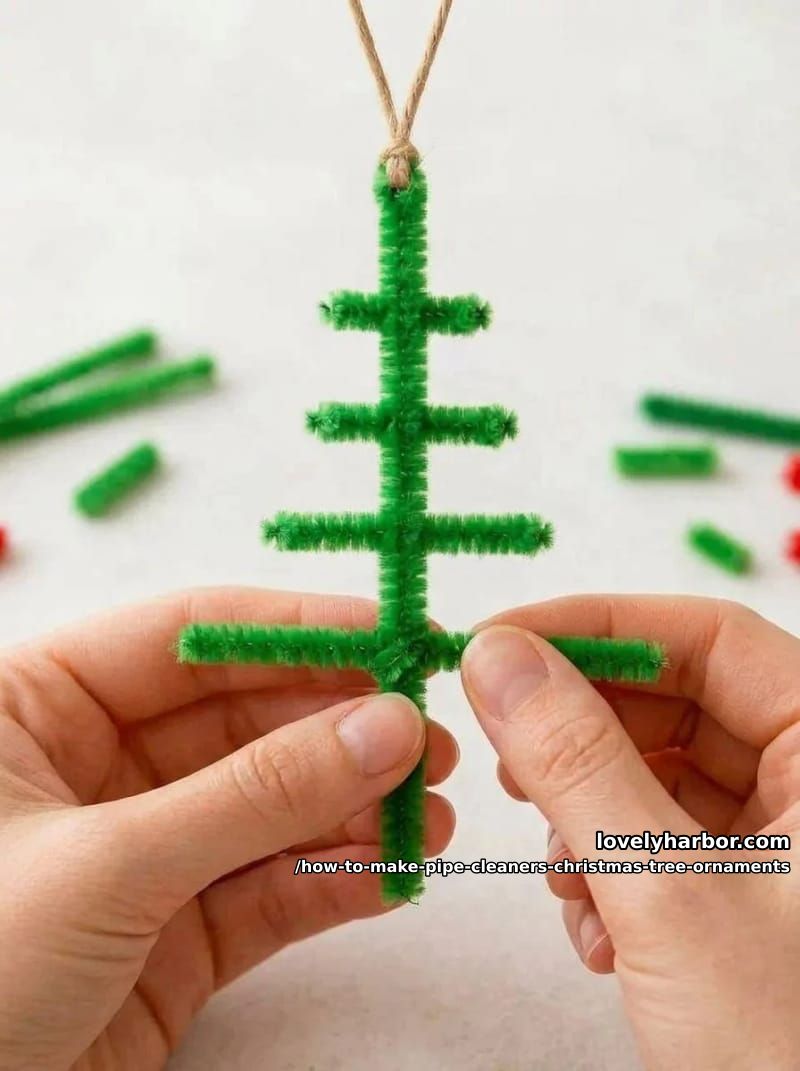
Work top to bottom. Start about half an inch below the loop with your shortest branch, the 1-inch one, lay it across the trunk, and give it a turn or two at the center so it locks in horizontally. Each branch after that goes about half an inch lower and runs a little longer. By the third or fourth, the tree shape announces itself.
White glitter and tinsel stems run on a thinner, more brittle wire than standard green chenille. Twist a branch more than two full turns and the wire fatigues, then breaks off in your hand. One firm twist does it. Save the over-twisting for the sturdier green stems.
Want these to survive years in a storage bin? Once the tree's built, run a thin line of craft glue down the back of the trunk and let it dry overnight. It locks every branch twist in place. Skip it if the ornament's a gift this week and you're short on time.
Step 4: Thread the beads
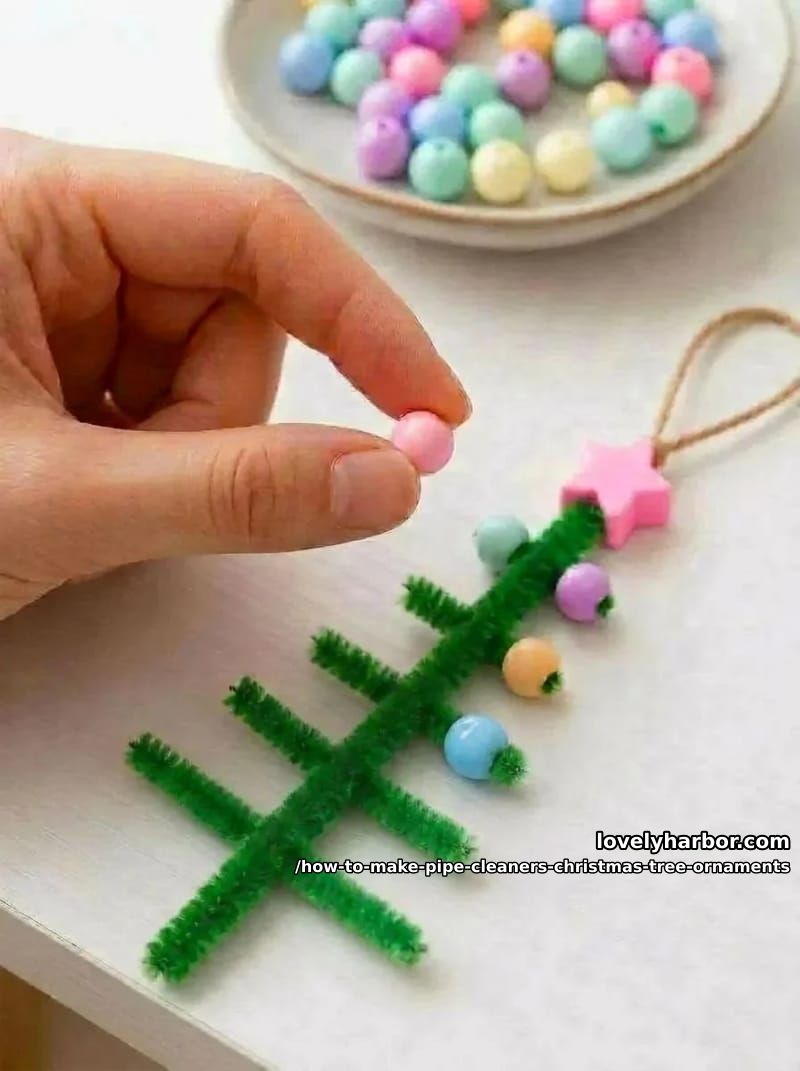
Push beads onto the branch tips and slide them toward the trunk, leaving a little fuzz showing at the end. One to three beads per branch is plenty. Fewer beads with space between them looks like ornaments; a packed branch looks like a kebab. Color and pattern are entirely the kid's call here, which is the point.
- Slide on one to three beads per branch, working from the tip inward.
- Leave a gap so the beads can shift and you can space them out evenly.
- Bend the tip of each branch back about 3mm to 4mm so nothing escapes, then tuck it down out of sight.
Stem diameter: a standard chenille branch is about 6mm of fuzz over a thin wire core.
Right bead hole: 1mm to 2mm. Smaller than the fuzz, so the bead compresses the pile and wedges in place.
Wrong bead hole: a 9mm pony bead’s 4mm opening is wider than the fuzz can fill, so gravity wins. On smoother tinsel stems, bend a slightly larger hook at the tip, since glitter stems grip less than matte green.
Step 5: Top it off
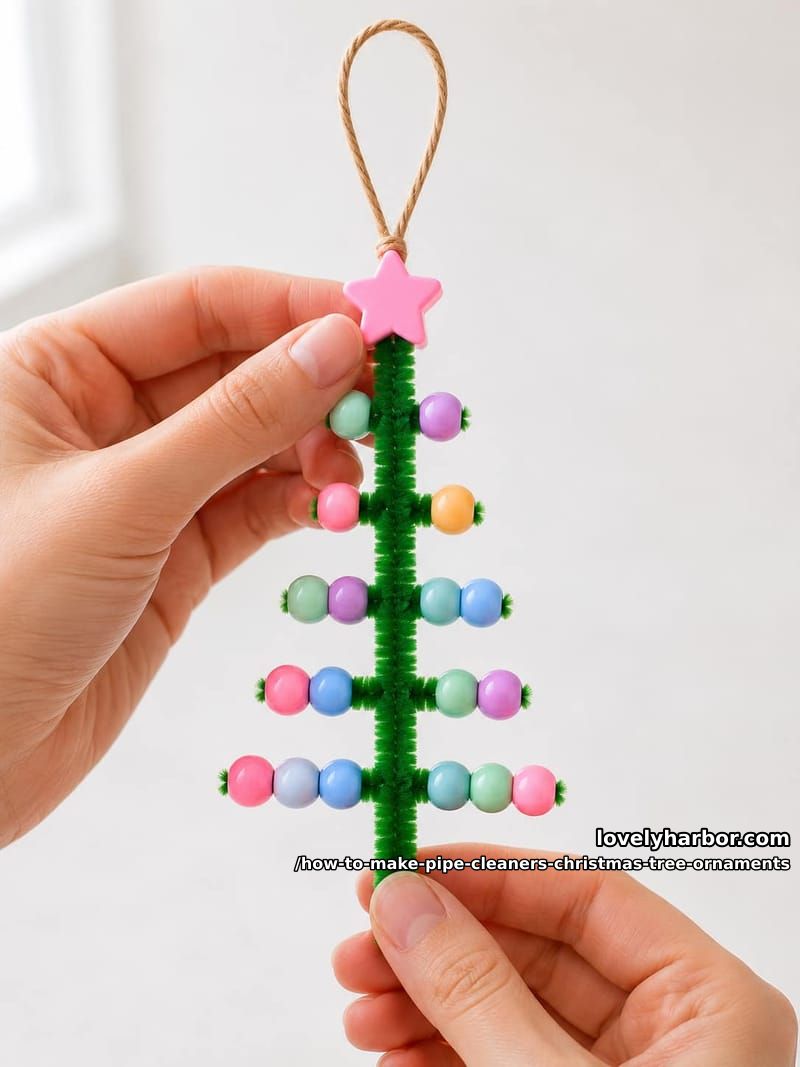
Thread a star bead onto the very top of the trunk, snug under the twine loop, so it crowns the tree the way the pink star does in the photo. The original method used a flat star button, but a threaded acrylic star bead sits more securely and matches the rest of the beadwork. Star sequins work too, if you'd rather glue on something flat and tiny.

Mistakes that ruin the tree
None of these is fatal. But each one is the difference between an ornament you hang and one that ends up forgotten in a drawer.
- Using pony beads. The most common mistake by a mile , the holes are too wide, and the beads slide off the second the tree moves.
- Cutting every branch the same length. You get a cylinder, not a tree. That graduated chart in Step 1 exists for exactly this reason.
- Spacing branches too far apart. More than half an inch between them and the tree goes bare and gappy. Keep them close.
- Over-twisting glitter stems. Two turns max on tinsel, or the brittle wire snaps and there goes a branch.
- Overloading one branch. Five beads on the 1-inch top branch and it sags forward; match the bead count to the branch length.
- Forgetting to bend the tips. Skip that little hook and you’ll spend the evening rethreading escaped beads.
Ways to change it up
Once you've made one, the base method bends in a lot of directions. A few that work:
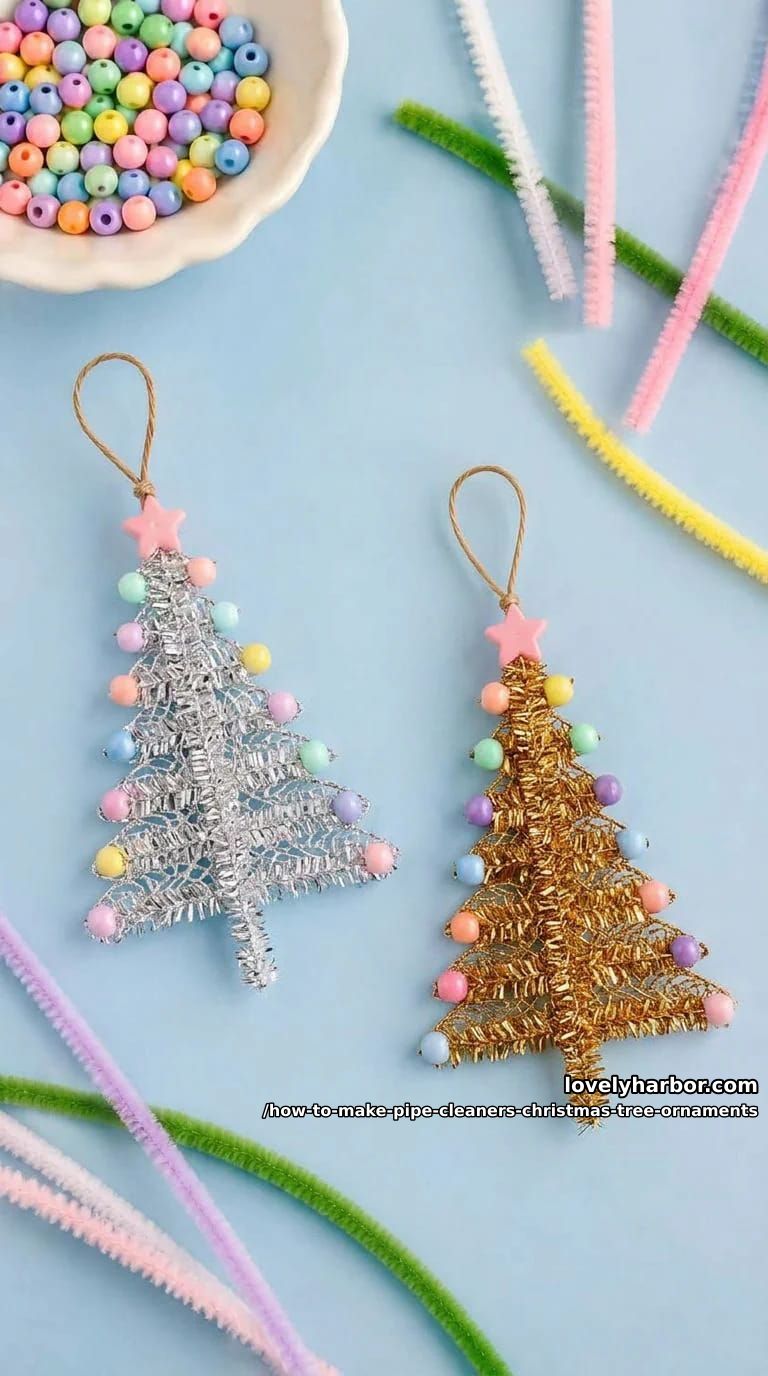
- Metallic and snowy. Silver or gold tinsel reads more grown-up than the kid-bright green , nice for a coordinated tree.
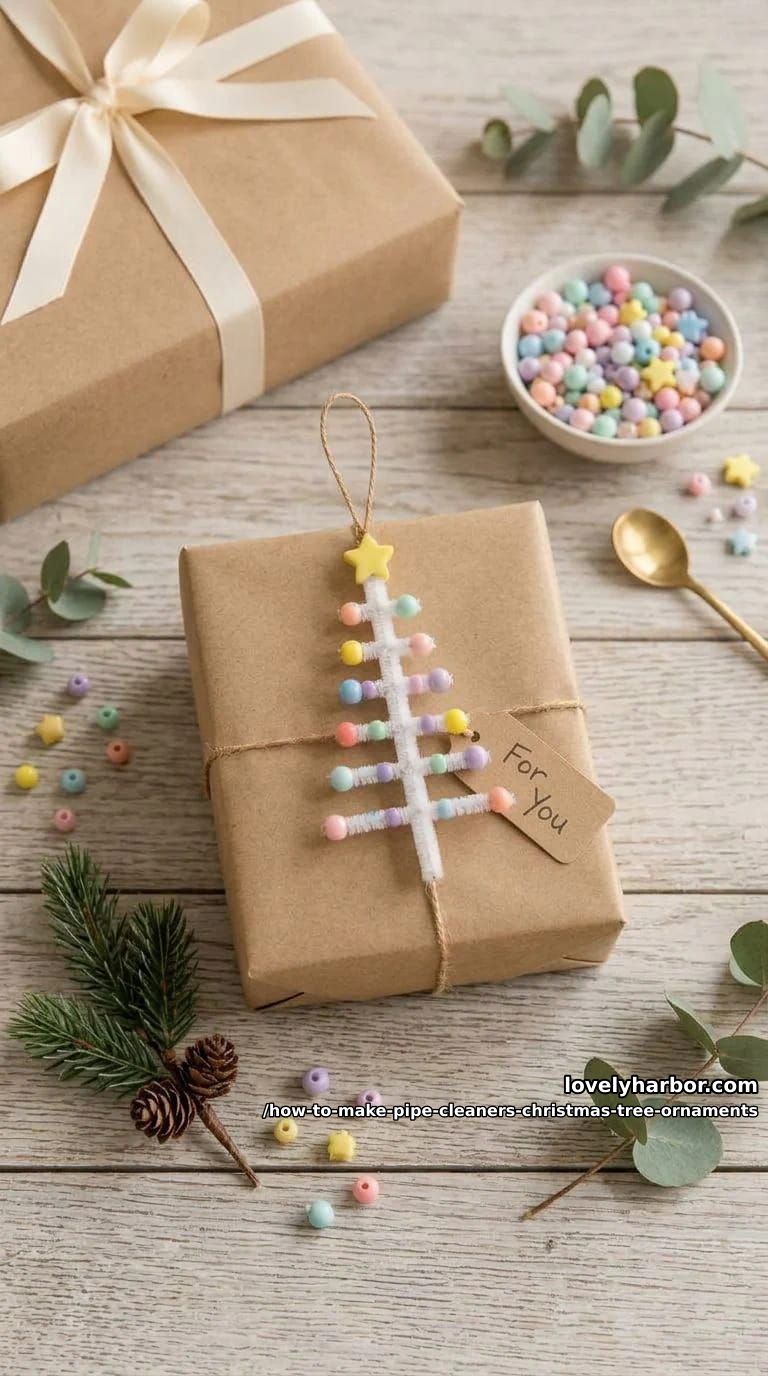
- Gift topper. Tie one to a kraft-wrapped present by its jute loop instead of a bow, and it doubles as a tiny keepable gift.
- Place card. Slip a name tag onto the twine and set one at each seat for a holiday dinner.
- Classroom garland. Each child makes a tree, then you string them all along a length of twine for a class display.
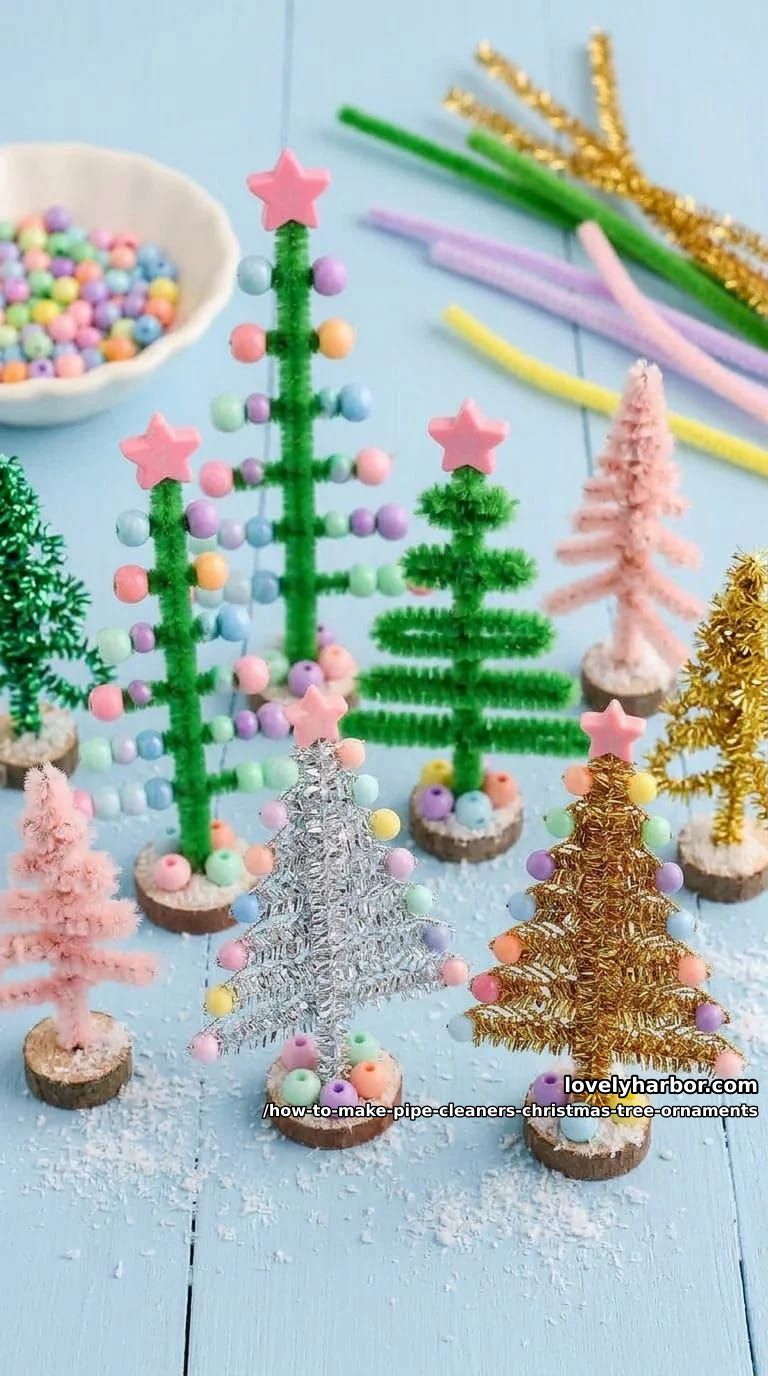
- Standing mini-forest. Twist a short stem into a flat base at the bottom and the tree stands on a mantel instead of hanging.
Conclusion
Batch tip first: cut every branch you'll need , all of them, every tree's worth , before you build a single trunk. Bouncing between the scissors and the twisting is how a quick afternoon turns into a long one. For gifts, or anything headed to a Pinterest board, build the white glitter version and grab the palest beads you've got; that contrast is what carries in a photo. Green is the kinder material to learn on, so that's where I'd start a five-year-old who's never twisted a pipe cleaner. And honestly, that glue step back in Step 3 , I keep calling it optional and then regretting it every January, when some branch has wriggled loose in the box.