
Drive through any neighborhood in the second week of December and the first-timers give themselves away: one strand of blue-white icicle lights on the gutter, a four-foot inflatable listing sideways in the wind, and nothing tying it together. The fix is not more stuff. A beginner gets a better-looking yard from three or four pieces chosen to work together than from a panicked big-box run on the 18th, and almost none of the projects below need a tall ladder, a staple gun, or any wiring you'd call electrical work. Here are nine that punch above their effort, in roughly the order I'd add them.

1. Run warm-white string lights along one line, not the whole house
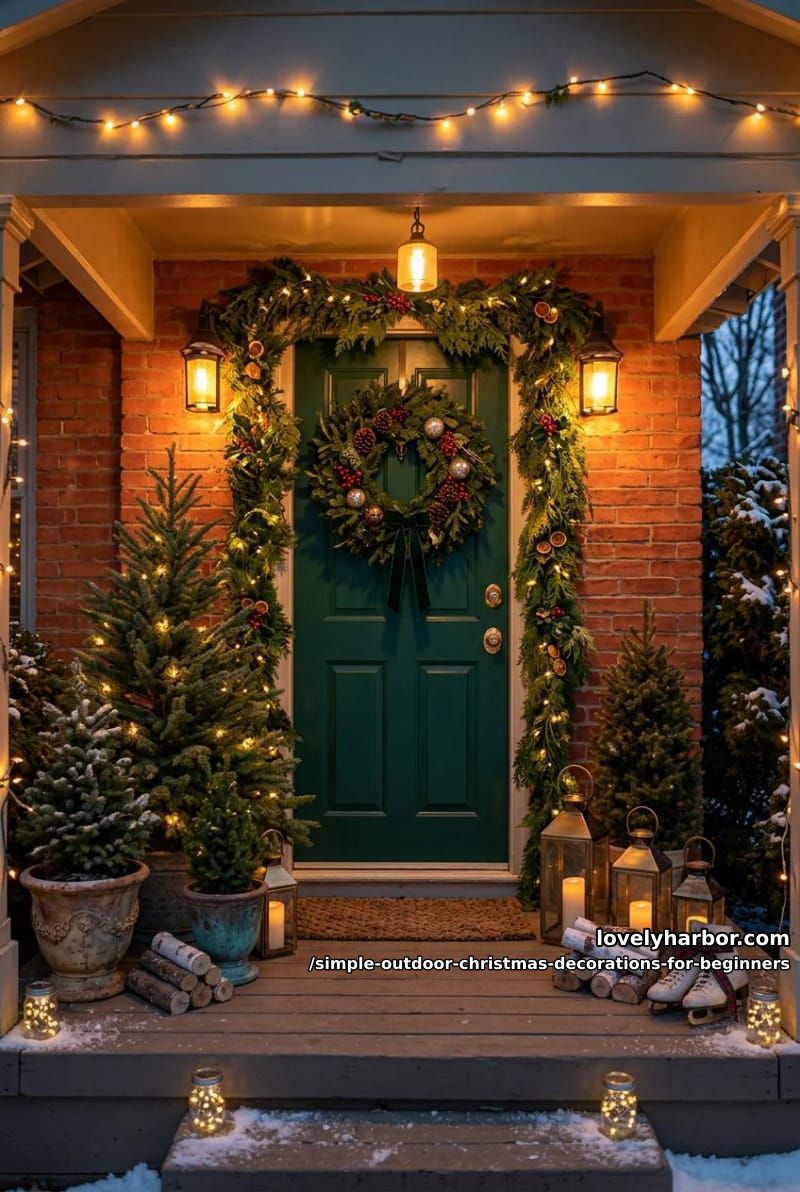
Pick one run of the house and light only that. A porch eave, a single railing, the frame around the front door: one clean line of warm-white lights reads more deliberate than the same budget scattered across the roof, two shrubs, and the lamppost. The temperature of the light matters more than where you put it, and it's the part most first-timers skip.
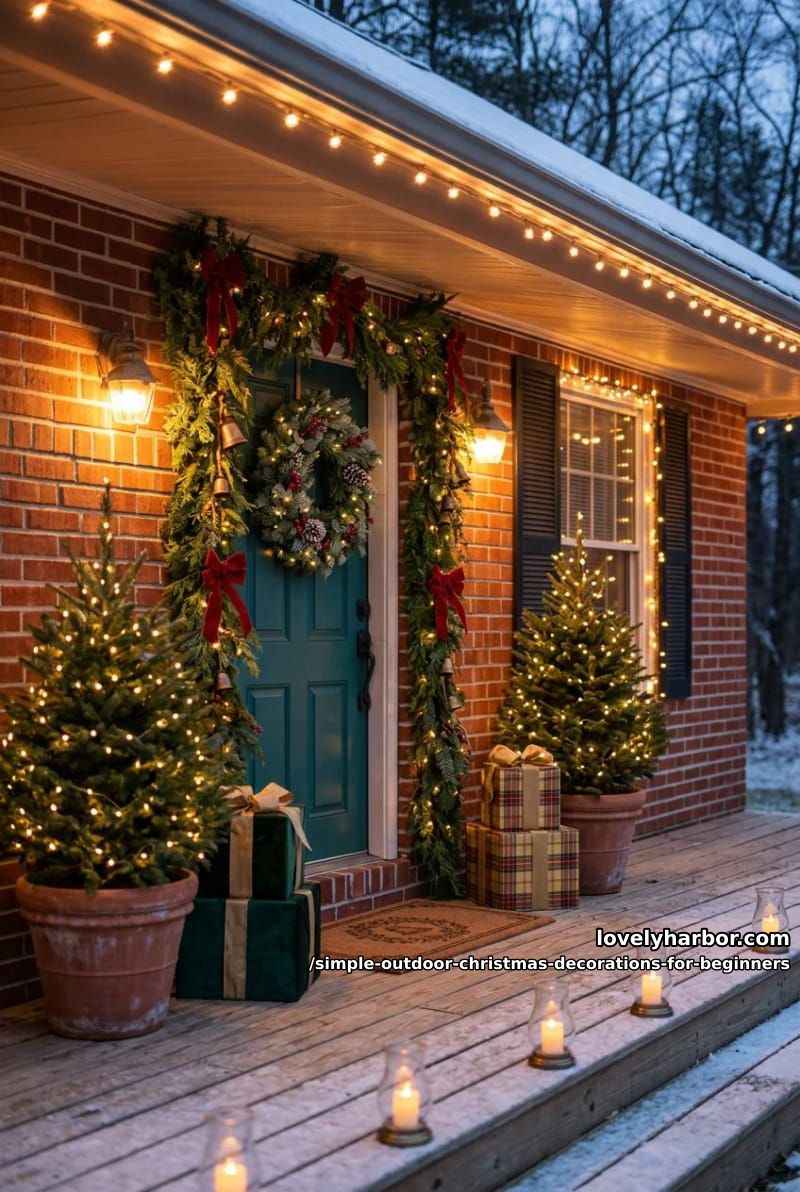
Pick one white and commit
Warm white runs roughly 2700K to 3000K, the yellow-leaning glow that mimics old incandescent bulbs; cool white starts around 5000K and reads blue and clinical against brick. Neither is wrong on its own, but mixing them on one facade is. The catch is that "2700K" from one brand and "2700K" from another rarely match exactly, so buy every strand in a single purchase, same brand, same product. I spent one December running three different "warm whites" on a single porch, and you could see the seams from the street.
Hanging them without nails or a second trip up the ladder
Skip the staple gun. Plastic light clips slide onto shingles or the lip of a gutter and hold the strand against wind without putting a hole in anything, and they come off in March without a fight, like these Sewanta all-purpose shingle and gutter light clips. A few rules that save a return trip:
- Pace the run first, then buy a third more than that for sag and the path back to the outlet.
- Outdoor-rated only. The box has to say outdoor; indoor strands go brittle in the cold.
- Everything plugs into a GFCI outlet. If yours isn’t one, a plug-in GFCI adapter runs about $15 and is the cheapest insurance on this whole list.
- Timer plug, every time.
2. Flank the front door with two lit winter planters
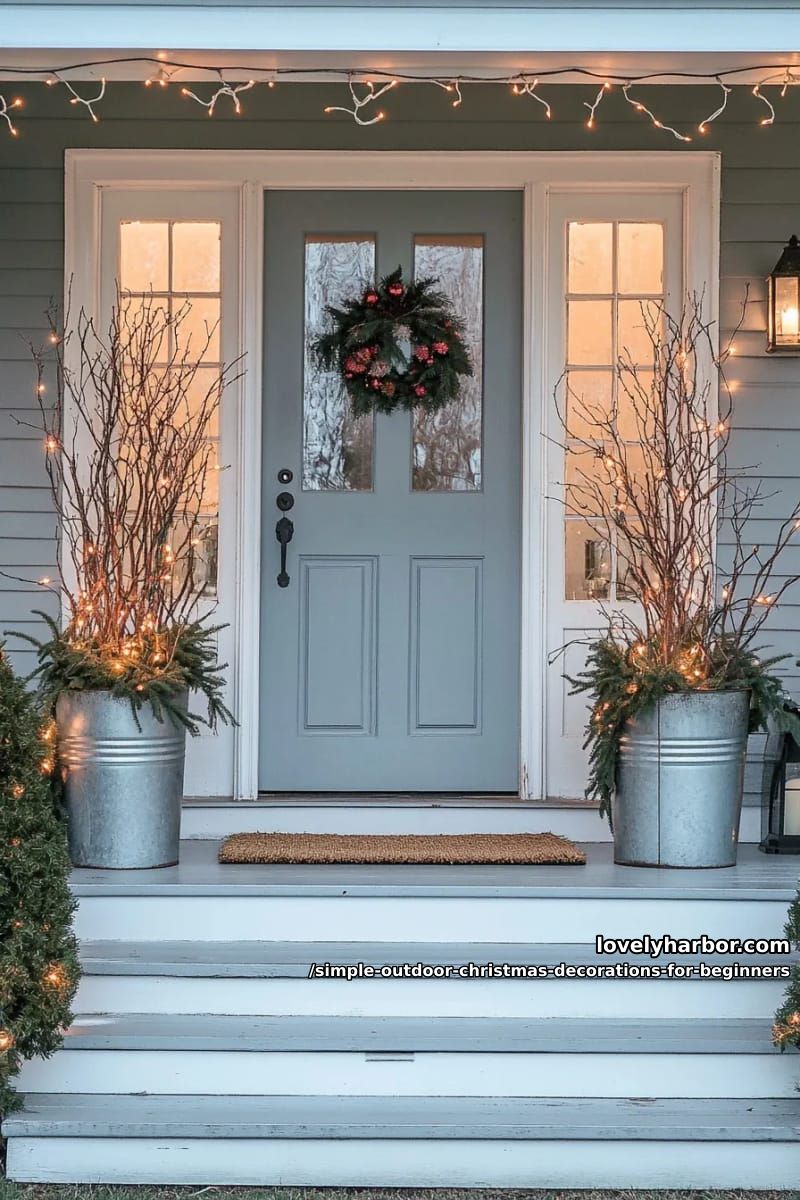
Two filled containers at the door do more for a beginner's curb appeal than anything you'll put on the lawn, because they frame the part of the house people actually walk toward.
What goes in the bucket
A pair of galvanized buckets or cheap urns runs about $12 to $20 each. Pack each one with cut evergreen branches (trim your own tree, or ask the lot for a bunch from the scrap pile, often a few dollars), then build height with bare birch or red-twig dogwood stems poking up from the center. Wedge a brick or a bag of gravel in the bottom so a gust doesn't tip the whole thing over the steps.
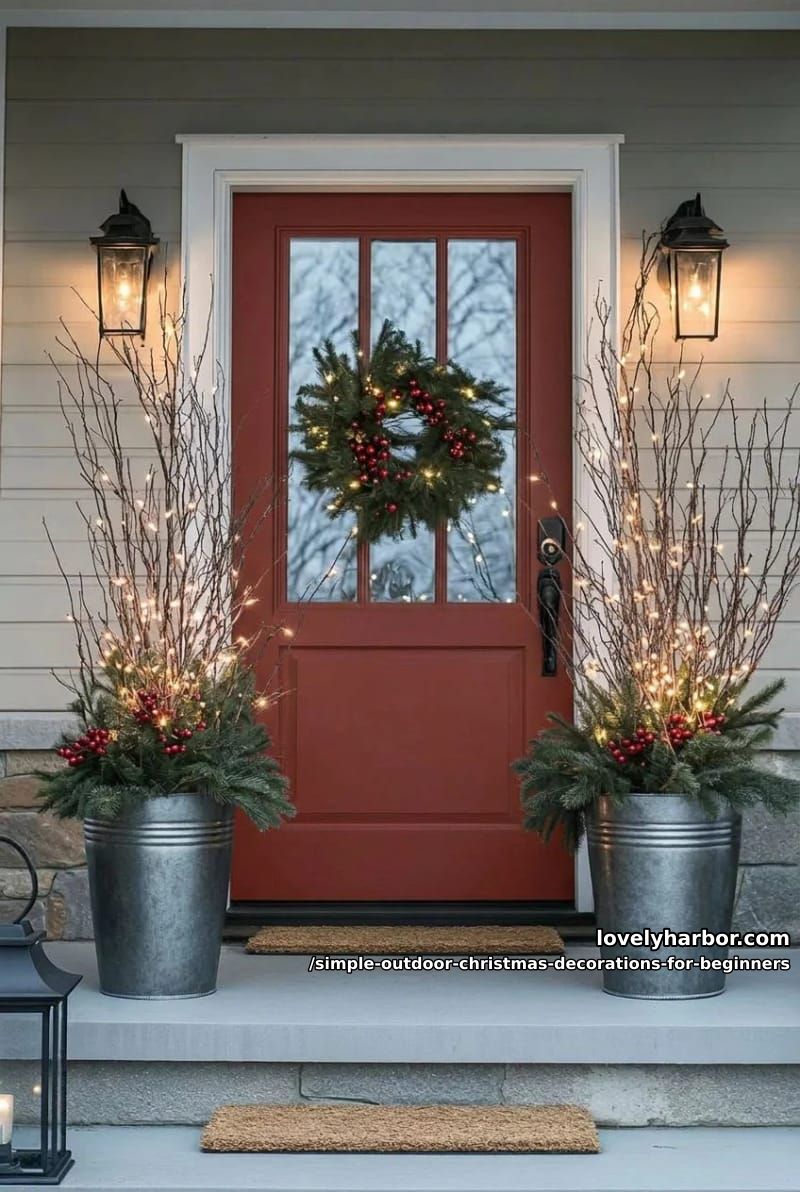
Lighting it so it reads after dark
Weave a strand of battery-powered fairy lights (the thin copper-wire kind) down through the greenery rather than around the outside, so the bucket glows from within. Most front steps have no outlet, which is exactly why battery wins here. A set of AA packs lasts the season on a six-hours-on timer.
3. Hang one oversized wreath, not a small one
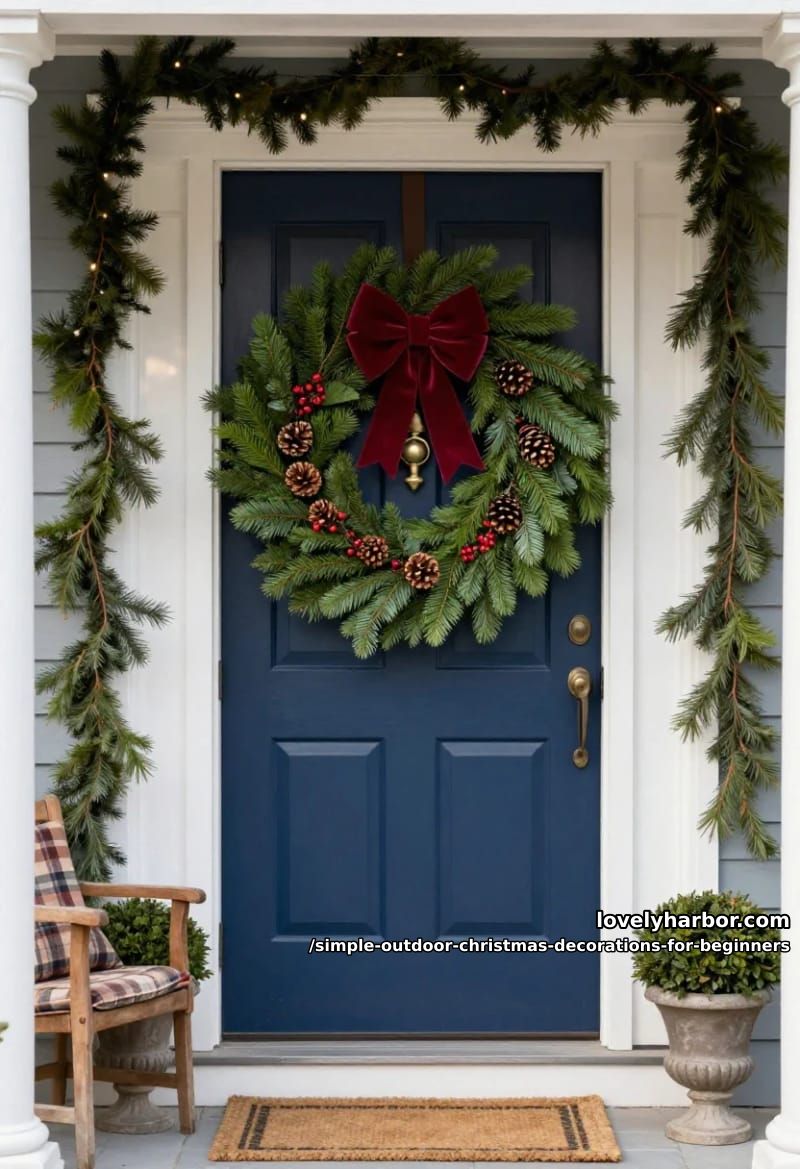
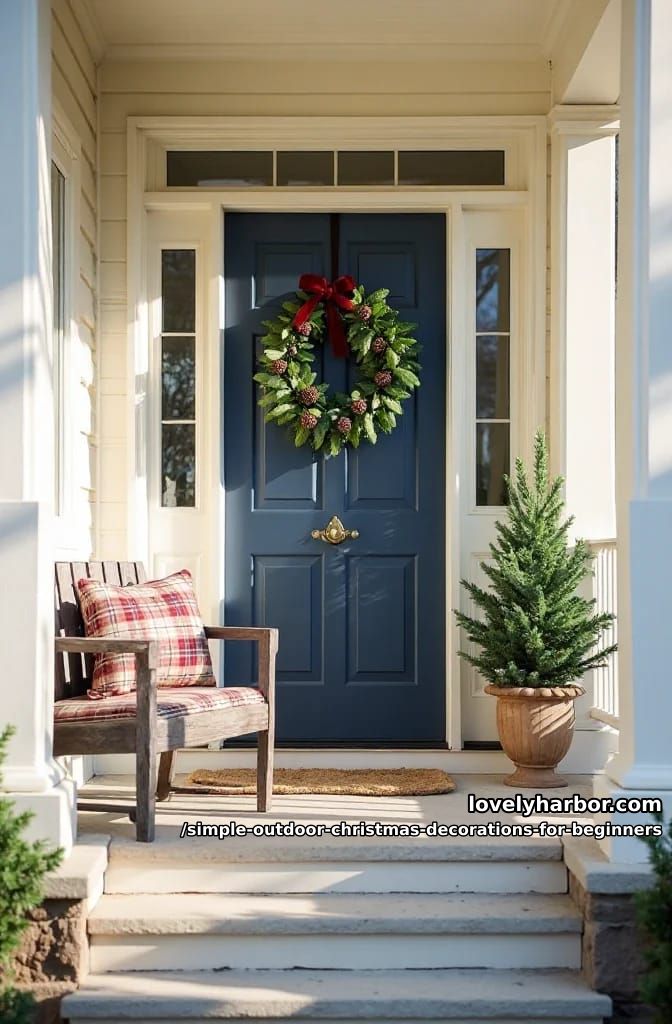
Granted, a wreath is the least original thing on this list. It's also the single highest-impact piece a beginner can hang, on one condition: size up. The wreath that looks generous in the store looks like a bath-towel ring once it's on a 36-inch door. For a standard front door, 28 to 30 inches across is the floor, not the ceiling.
You don't need to drill. An over-the-door metal hanger or a clear Command hook rated for the weight does the job and leaves the door alone. Fresh fir from a lot runs about $25 to $45 and smells like the season, then drops its needles by New Year's; a good faux one costs triple and you'll be storing it in the garage in a leaf bag like everyone else.
4. Cluster oversized ornaments in a bare flower bed
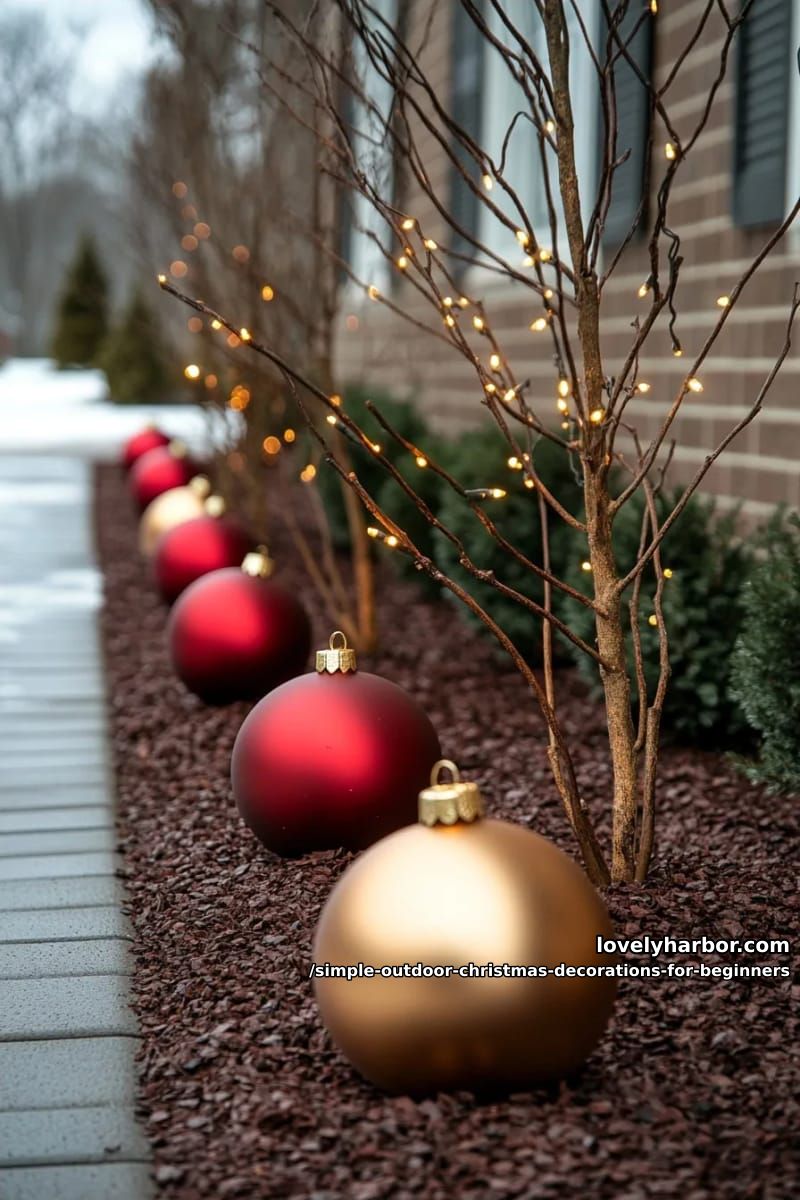
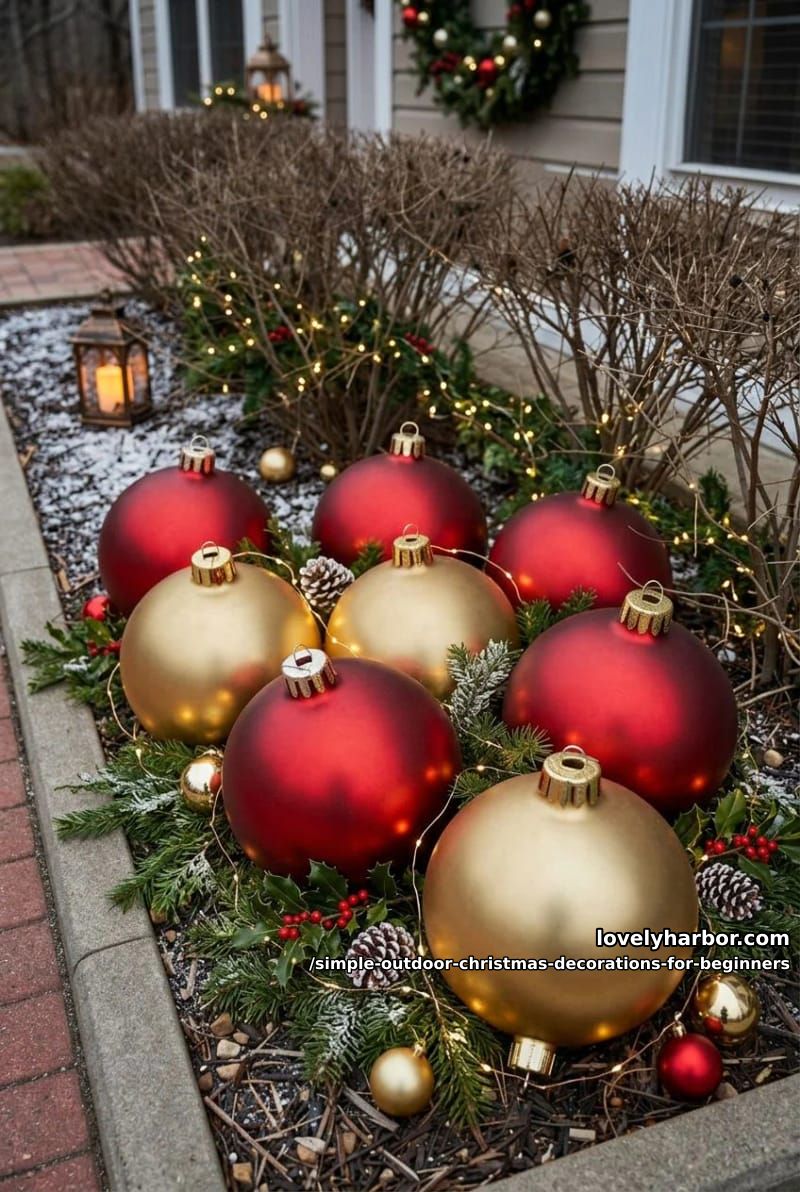
An empty flower bed in December is dead space, and a cluster of jumbo ball ornaments fills it for almost nothing. Buy shatterproof plastic, not glass, in matte finishes (gloss throws glare and looks cheap in daylight), group them in odd numbers, and anchor each one on a bamboo skewer or a loop of florist wire so they don't roll into the neighbor's yard. A set of large ones runs maybe $15 to $30, and one set is usually plenty.
5. Build a tomato-cage light tree
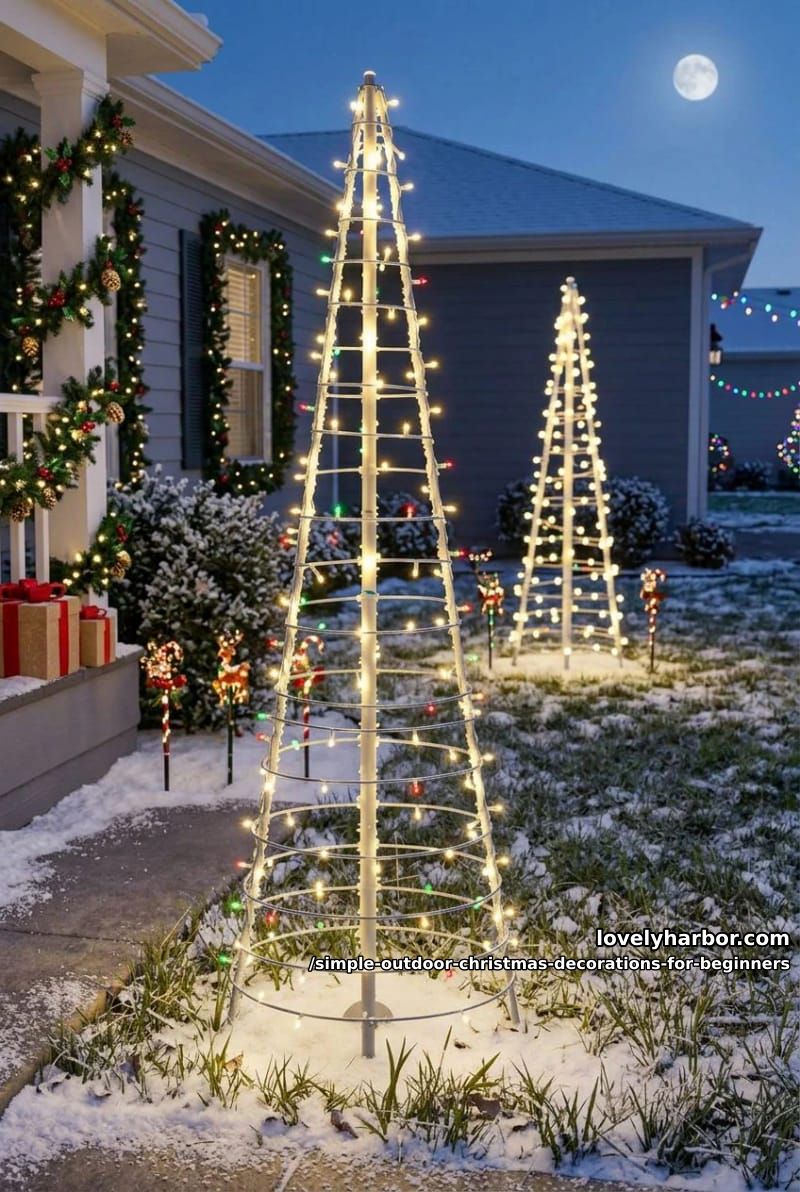
This is the project that looks like you bought something and costs under twenty dollars. A wire tomato cage flipped upside down is already a cone; wrap it in lights and at night people see a small tree, not a garden-center reject.
Stacking and wrapping the cage
Flip the cage so the prongs point up, squeeze them together into a point, and bind them with a heavy-duty zip tie (pliers help, because the wire is stiff). Wrap outdoor-rated mini lights from the top down, circling each ring as you go; figure roughly 6 to 10 feet of lights per 3-foot cage, more if you want it solid rather than sparse. For real height, stack two same-size cages and twist one a quarter turn so the vertical wires don't line up.
Anchoring it so wind doesn't win
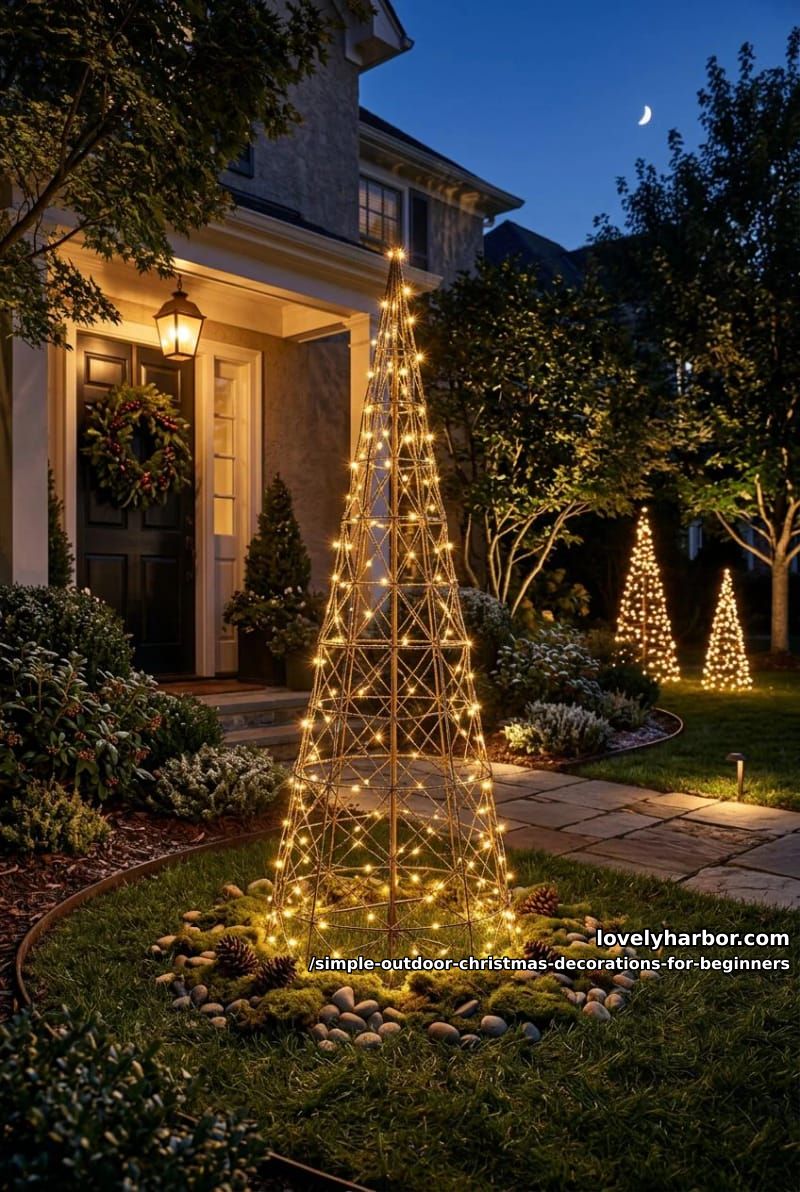
Leave the cage's ground stakes on if it has them and push them into the lawn, or drive two landscape staples over the bottom ring. A cone this light turns into a tumbleweed in a real gust. Set it where an outlet or an outdoor extension cord can reach, or run a battery strand for a corner with no power.
- Wire tomato cage, 33 to 54 inches tall (about $5 to $10 at any hardware store)
- One or two strands of outdoor-rated warm-white mini lights
- A handful of heavy-duty zip ties, plus pliers if your hands hate you
- Landscape staples, or the cage’s own stakes, to pin it down
6. Line the walk with solar candy cane pathway markers
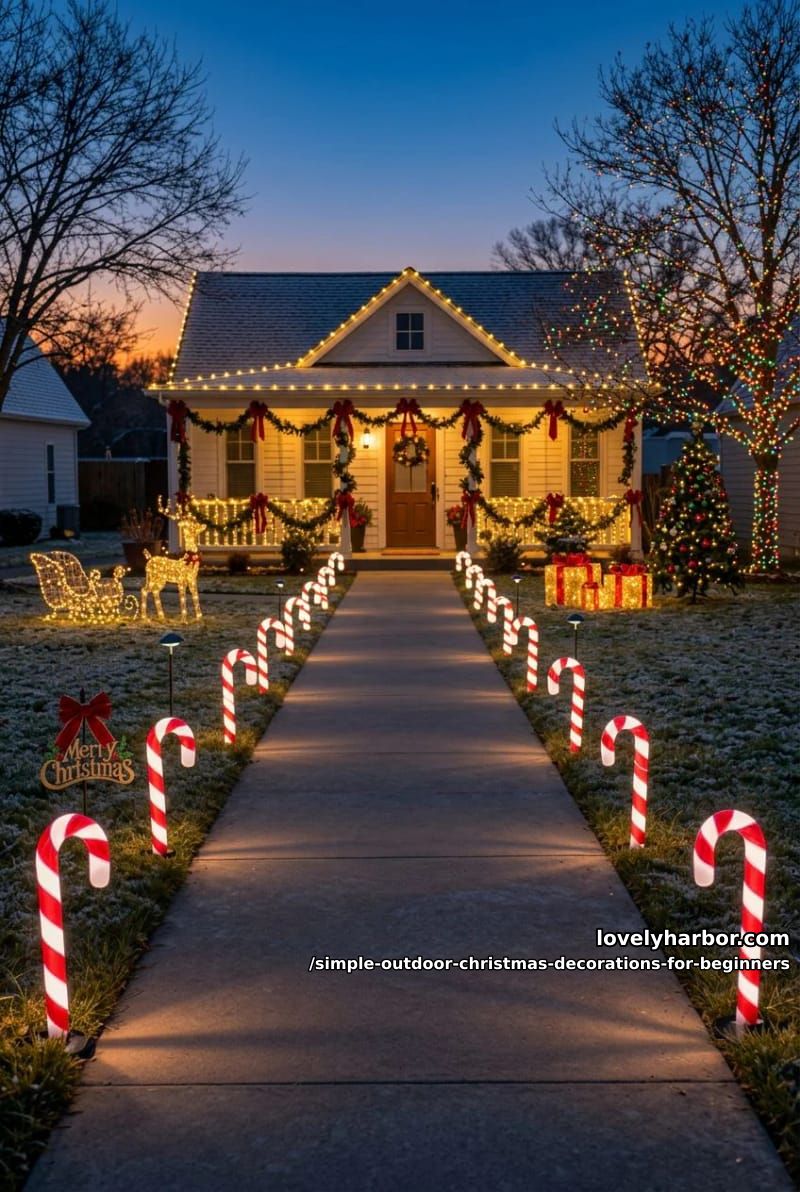
Pathway markers are the cheat code for a yard that has nothing else going on, because they draw a line that pulls the eye straight to the door. Solar versions skip the cords entirely, which for a beginner is the whole point; they charge during the day and switch on at dusk on their own. A 10-pack covers most front walks, and the solar-plus-plug sets are worth the couple of extra dollars for the gray days when the panel can’t keep up, like these Brightown 28-inch solar candy cane pathway markers (10-pack). Space them about two feet apart, push the stakes into soft ground (water it first if it’s frozen hard), and expect runtime to drop on short days.
7. Put a candle in every front-facing window
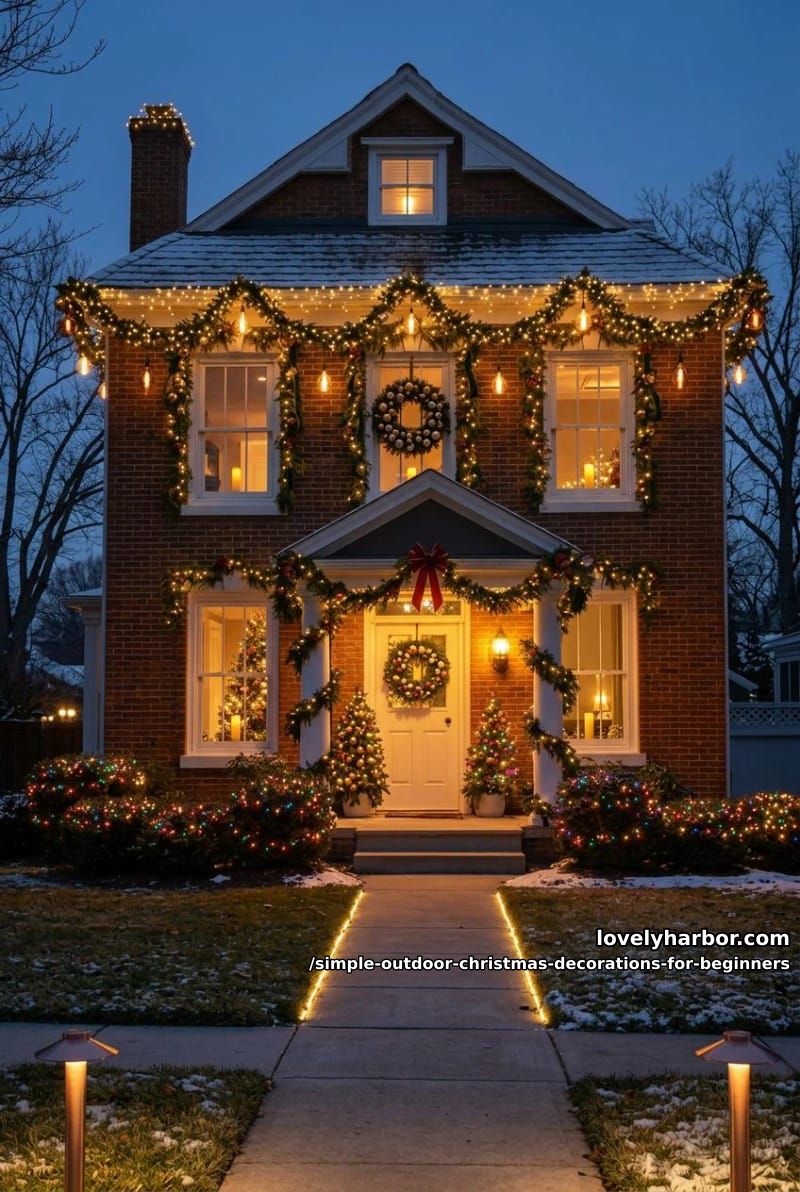
A candle in every front window is the oldest exterior decoration there is, and it still reads as intentional when half the block is over-lit. The trick is uniformity: same candle, same position on the sill, every front-facing pane; one rogue candle on a side window breaks the whole effect. Battery LED versions with a dusk timer cost about $20 to $35 for a set of six to nine, sit on the sill with no cord, and won't scorch the curtains the way the old plug-in ones occasionally did. This is also the one idea here that works for an apartment or a rental, where you can't touch the building's exterior but the inside of the window is fair game.
8. Wrap a porch post or railing in pre-lit garland
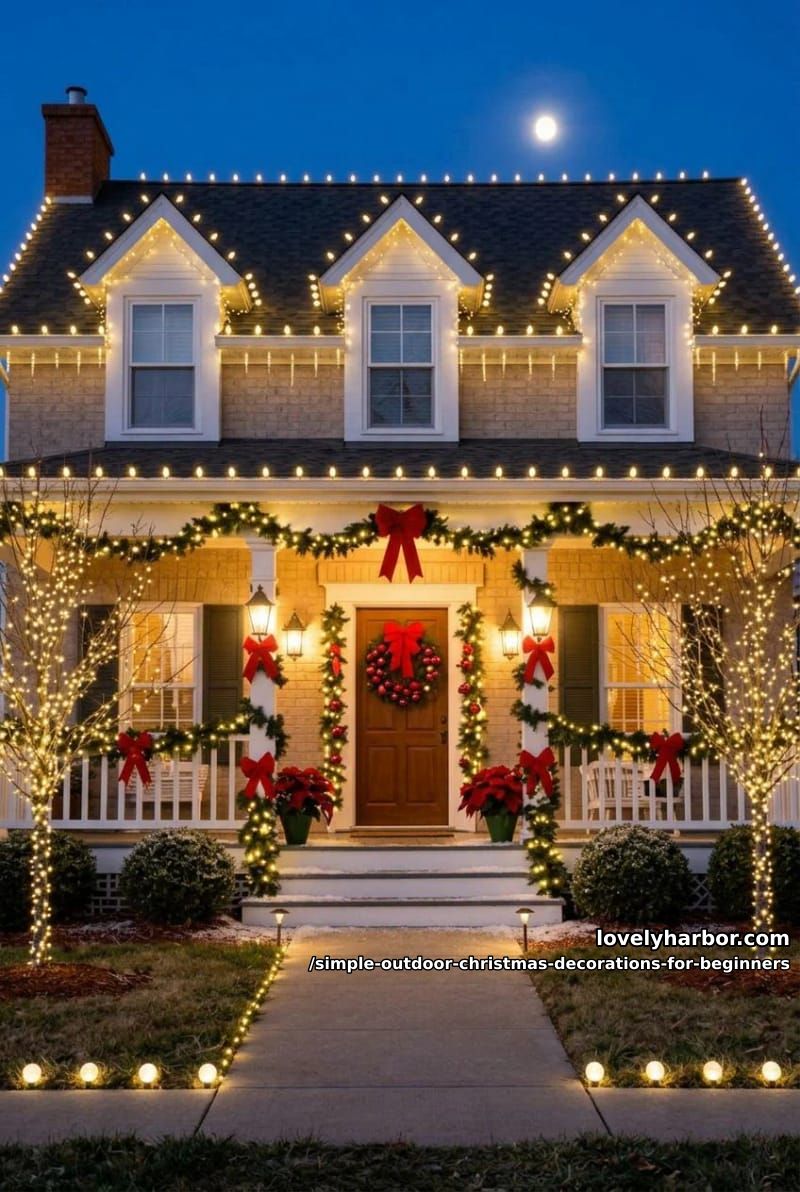
Garland down a porch post or along a railing is the architectural cousin of the wreath, and pre-lit saves a beginner the misery of threading a separate light strand through the greenery. The trade-off is that cheaper pre-lit garland reads plastic up close, and the built-in lights tend to die as a unit when one bulb fails, so you toss the whole thing; I'd rather buy unlit garland and add a warm-white strand I can actually replace. Attach it with florist wire or zip ties looped around the rail every couple of feet, and let a little spill off the bottom of the post instead of cutting it flush.
9. Pick one inflatable as a focal point, not a crowd
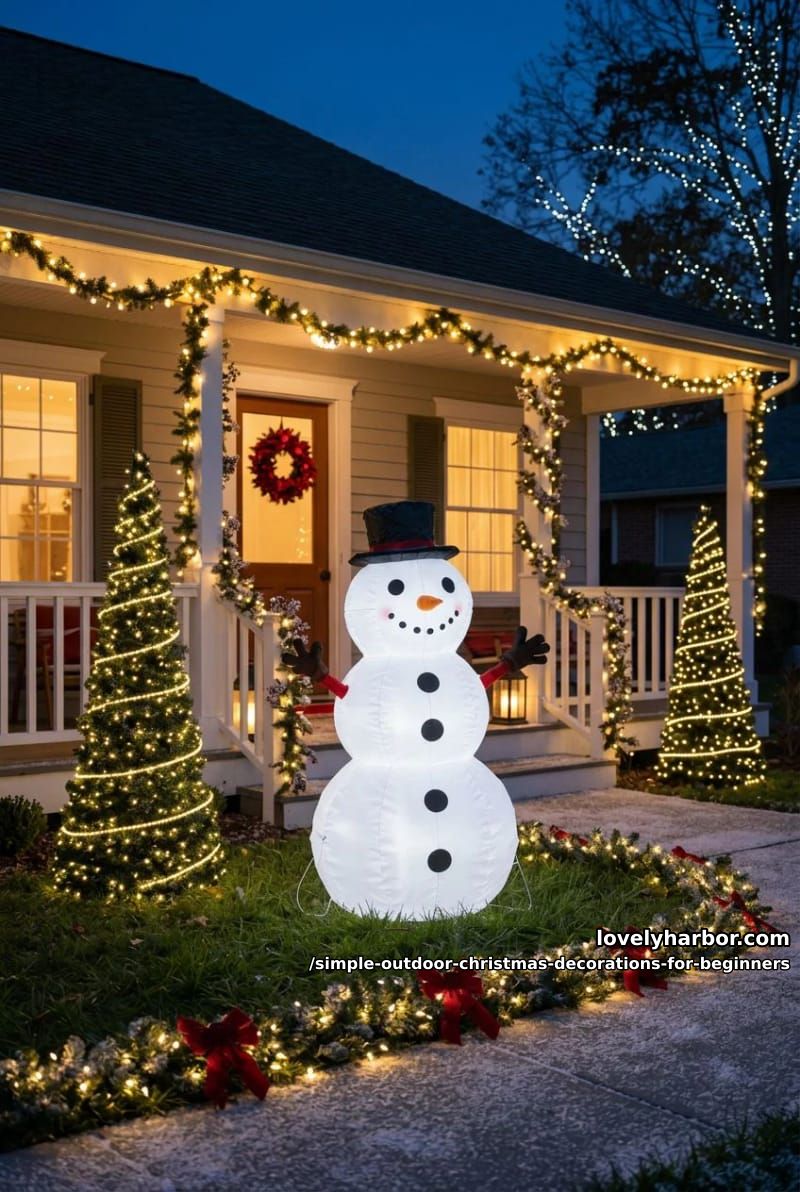
If you want an inflatable, buy one good one and give it the whole lawn. A single six-foot snowman or gnome lit from inside reads as a focal point; five of them crammed together reads as a clearance sale (I cap it at one per yard, and I will not be taking questions). Expect to pay $40 to $90 for a four-to-six-foot model, fan and stakes included. Stake it down and run the tethers, because a deflated inflatable face-down in the frost at 7 a.m. is the saddest sight on the street, and these things catch wind like a sail.
Conclusion
If you do all nine you'll have overshot the assignment, which is fine, but you don't have to. The two pieces that carry the most weight for the least effort are the warm-white lights on one line and the pair of filled planters at the door; start there and you have a finished-looking entry before you've touched the lawn.
After that it's a matter of layering outward at your own pace: a wreath and the window candles on the same weekend, the candy cane path and a tomato-cage tree once you're comfortable, the inflatable last if at all. The one thing worth carrying through every step is restraint on color temperature. Decide on warm white early, buy it all in one go, and you can add almost anything else later without the whole yard fighting itself.