
Modern porch decorating fails in one specific way: people buy contemporary pieces and then arrange a dozen of them, which is just a traditional porch in a cooler palette. The ideas below are built around restraint as the actual design move, so a single lit tree, one oversized bow, or a pair of matte planters does the work that ten ornaments usually try to. Most cost less than the cluttered version, and the section on warm versus cool light is the one people argue with me about.

1. Flank the door with matte black planters and one upright evergreen each
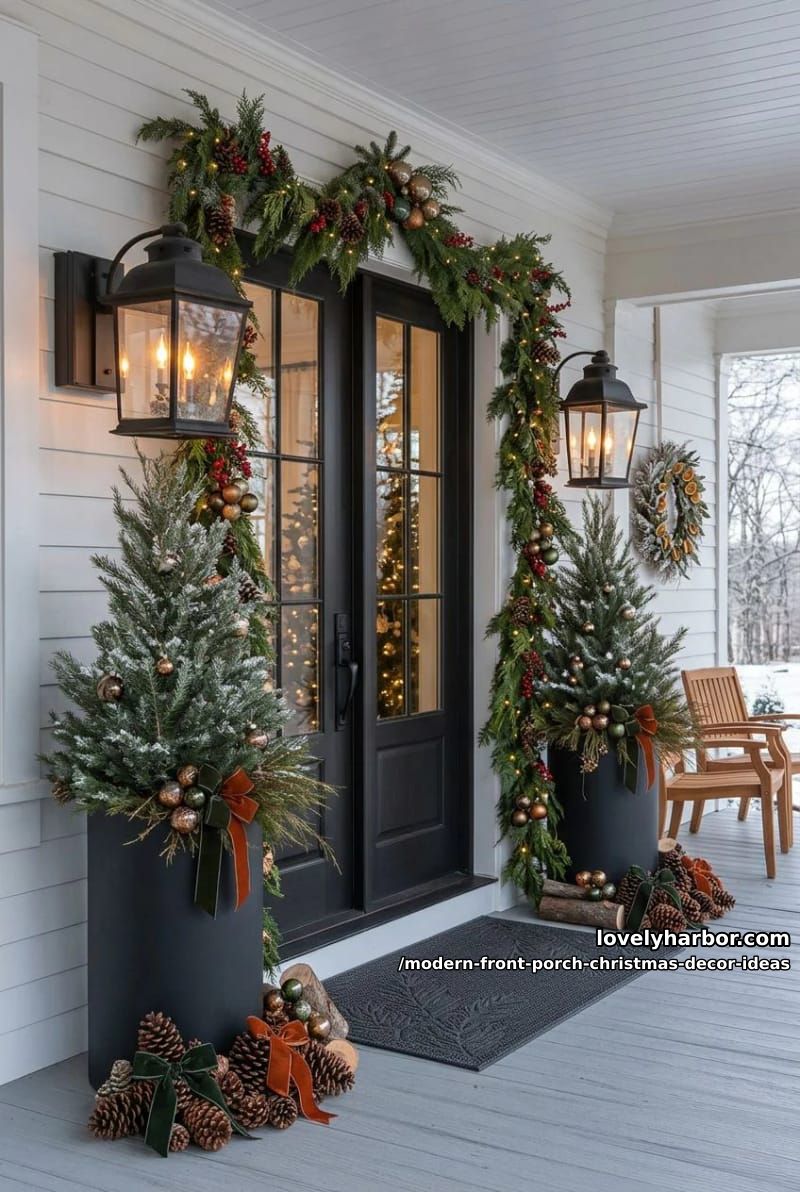
A symmetrical pair of tall matte planters is the single most modern thing you can put on a porch, because the silhouette reads as architecture rather than decoration. Skip the glazed ceramic; matte fiberglass holds the clean line and survives a freeze that cracks resin and terracotta. Steel-reinforced fiberglass in the 28 to 30 inch range runs roughly $250 to $350 each from makers like NMN Designs or Jay Scotts, and the walls stay plumb under wet soil. If that is out of reach, a plain black resin cylinder from a garden center at $30 to $60 looks nearly identical from the sidewalk, which is the only distance that matters here.
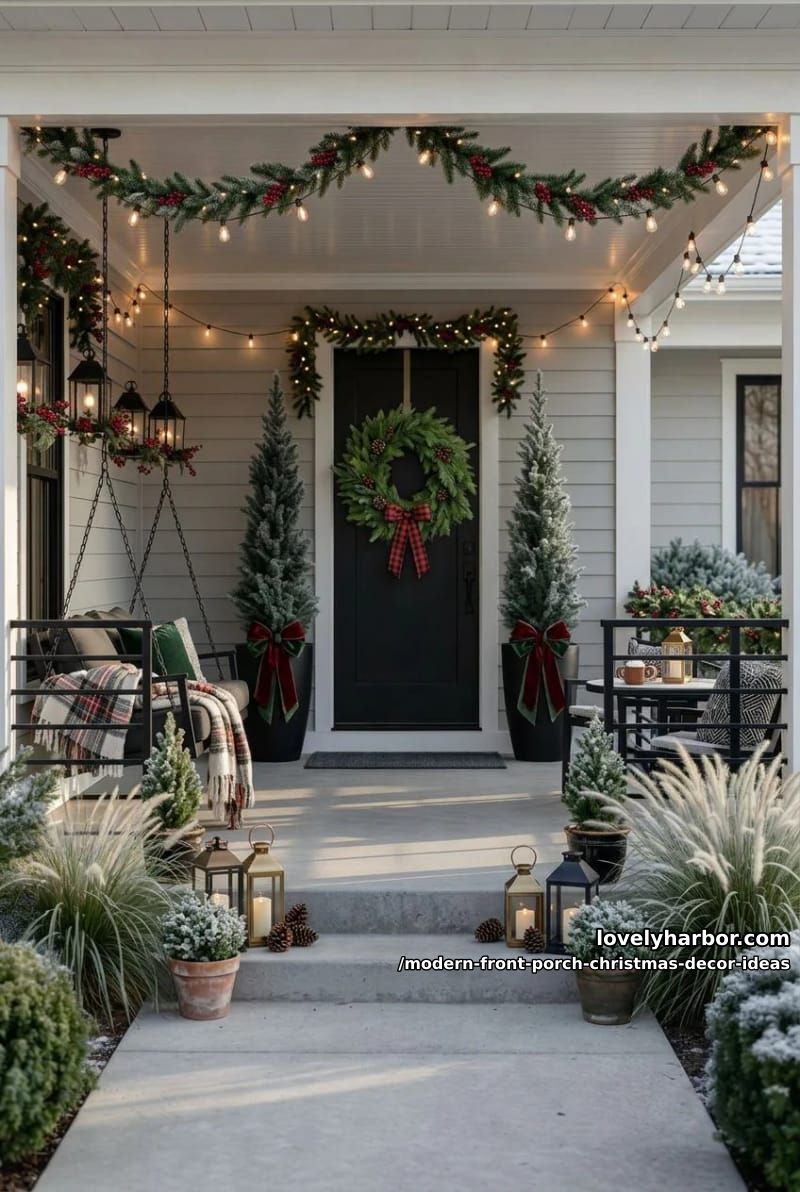
Plant one thing per pot and let it stand straight: a slim upright juniper, a boxwood cone, or a dwarf Alberta spruce. The restraint is the point, so resist the urge to stuff the base with picks and ribbon.
2. Replace the wreath with one oversized bow on the door
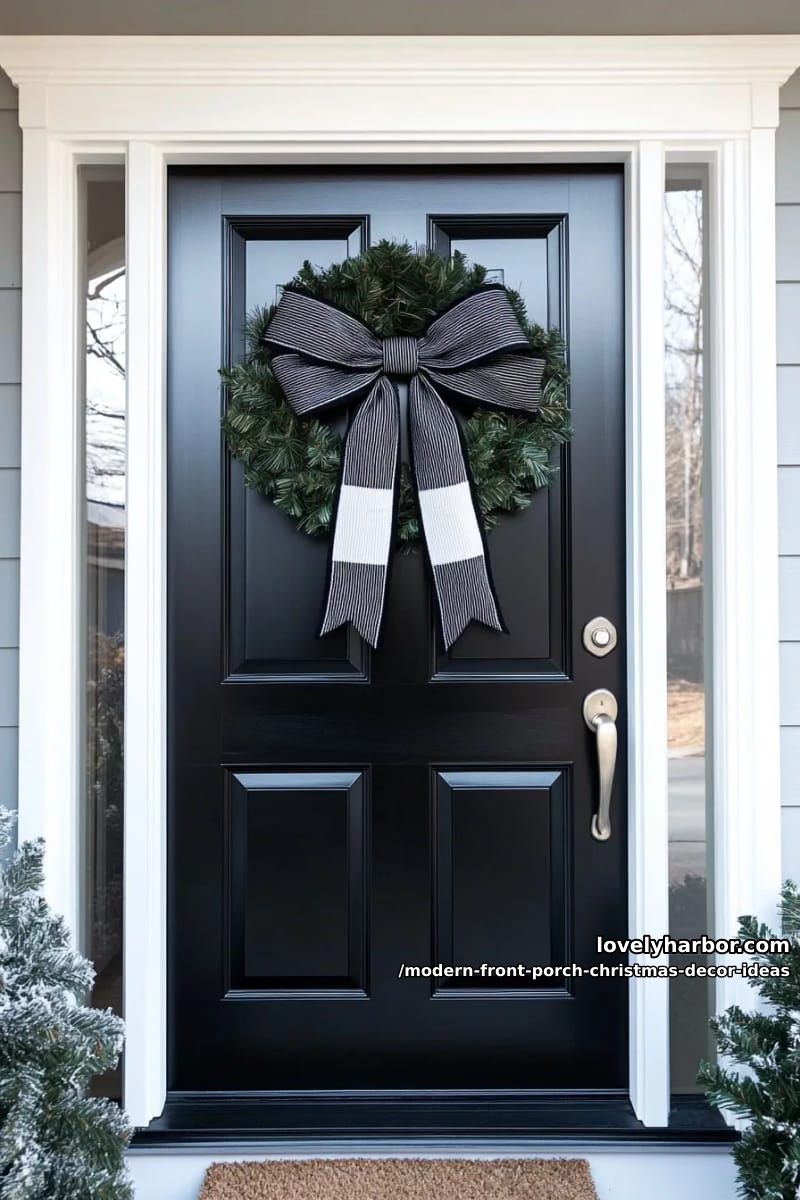
An oversized bow where the wreath usually goes is the trend doing the heaviest lifting on modern porches right now, and it photographs better than most $80 wreaths. The move is scale: a 30 to 36 inch bow with long tails, in one solid color or a single wide stripe, not the small wired ribbon you tie around a banister. Black-and-white stripe and flat neutral linen read contemporary; red velvet swings traditional, which is fine if that is the goal but it is not this one.
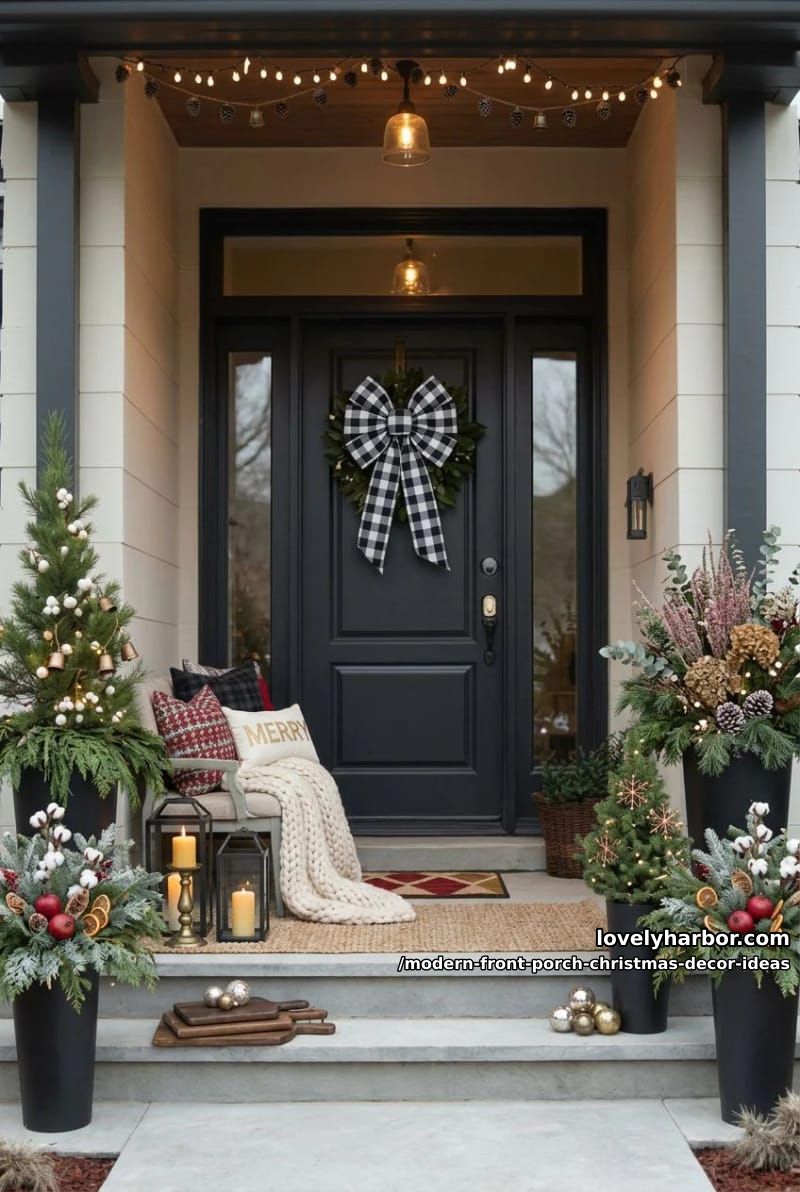
Etsy makers sell weatherproof versions in the $40 to $90 range, or you can build one from a few yards of canvas ribbon and floral wire in an afternoon. Hang it high and let the tails run long; a bow stuck dead-center on the door looks like a gift tag.
3. Use warm white light only, and ignore the advice to go cool for a modern look
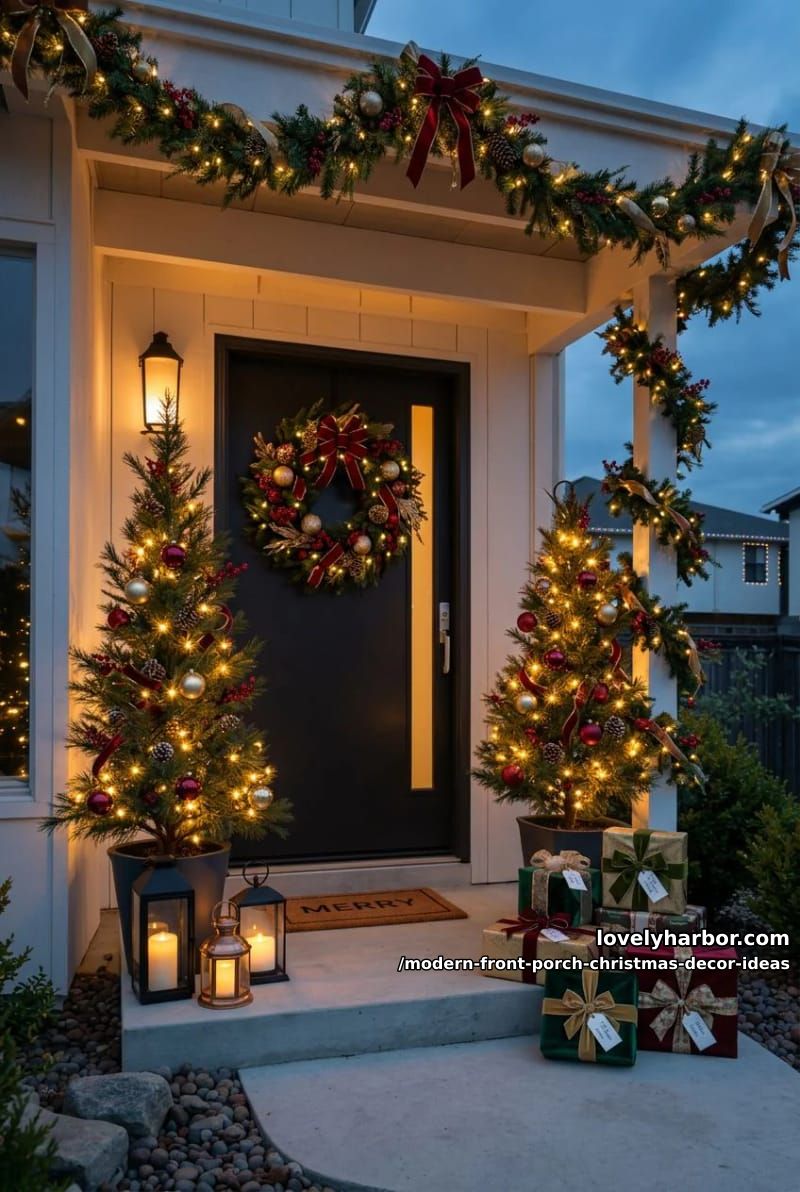
Choose warm white, around 2700K to 3000K, even though half the internet tells you cool white at 5000K to 6500K is the modern choice. Cool white reads clean in a showroom and clinical on a house at night; the bluish cast makes evergreens look grey and skin look ill when you open the door to guests. Warm white keeps the greens rich and the entry inviting, which is the whole job of a porch.
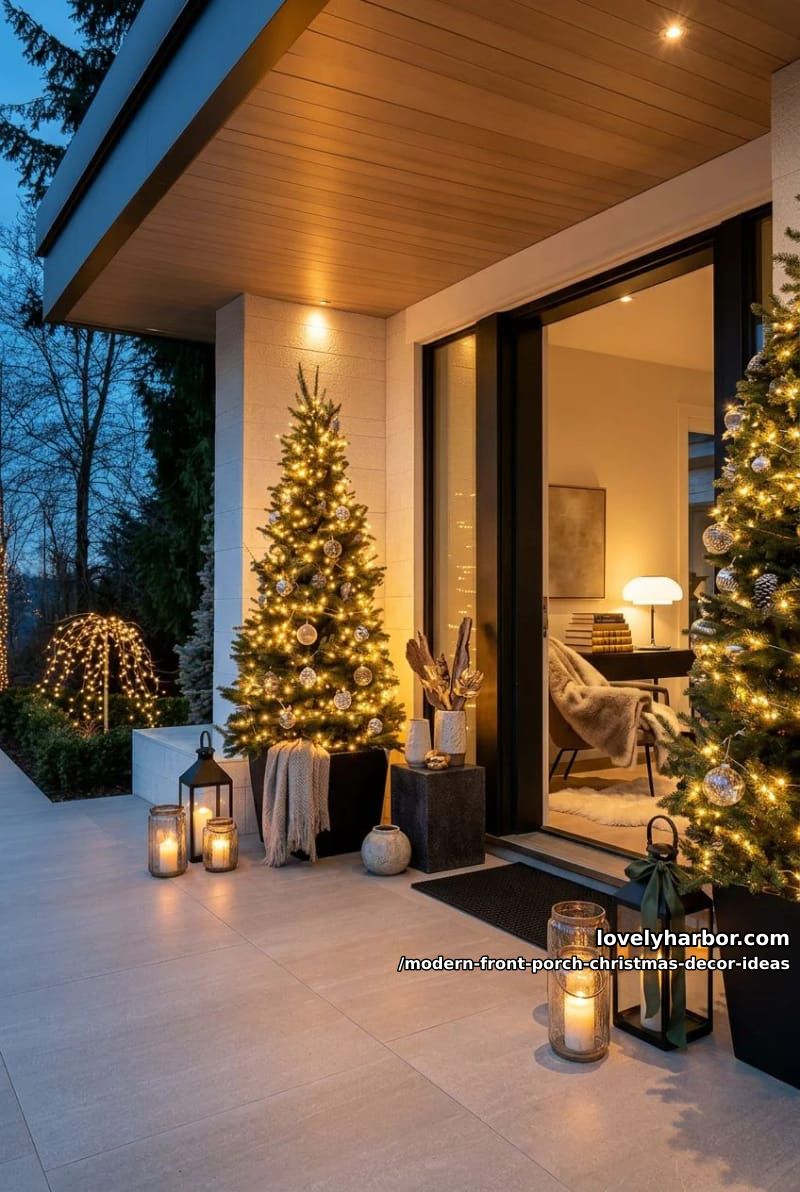
The catch is consistency. Two strands both labeled "warm white" from different brands can sit at 2700K and 3000K and clash visibly once they are next to each other.
Mixing warm and cool white on the same porch is the single most common modern-decor failure. One strand of leftover cool-white from the garage next to a new warm-white set, and the eye reads the whole display as a mistake. Buy all your white lights at once, in the same SKU, and check the Kelvin number on the box rather than trusting the word on the front.
4. Hang one asymmetric wreath, oversized and weighted to one side
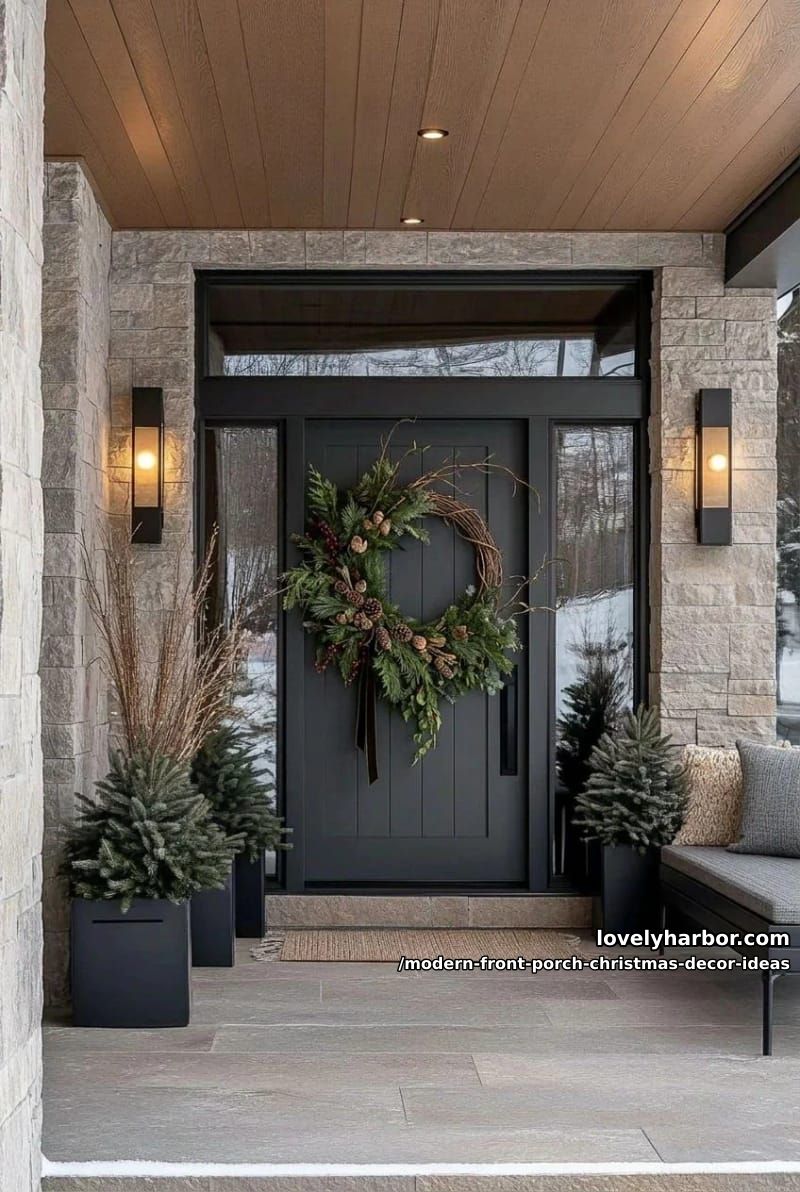
An asymmetric wreath looks deliberate where a perfectly round one looks bought. Weight the greenery heavily to one side and let the opposite arc thin out to bare vine, so it reads as composed rather than uniform. Mixed natural textures do more than a single species: fold dried eucalyptus or seed heads into fresh fir and the thing gains depth that a flat boxwood ring never has. Go big. A 30 inch wreath on a standard door looks intentional; the 18 inch one most people default to looks like it shrank in the wash.
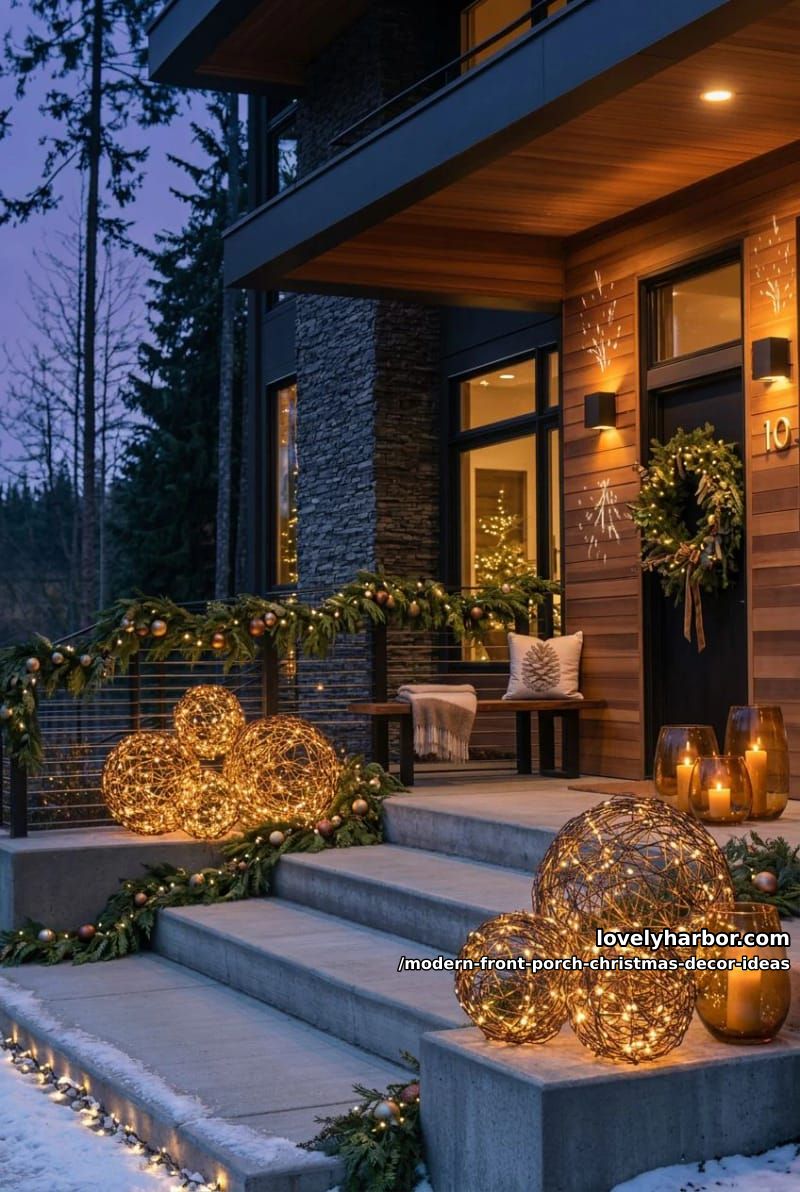
5. Cluster lit grapevine orbs on the steps in odd numbers
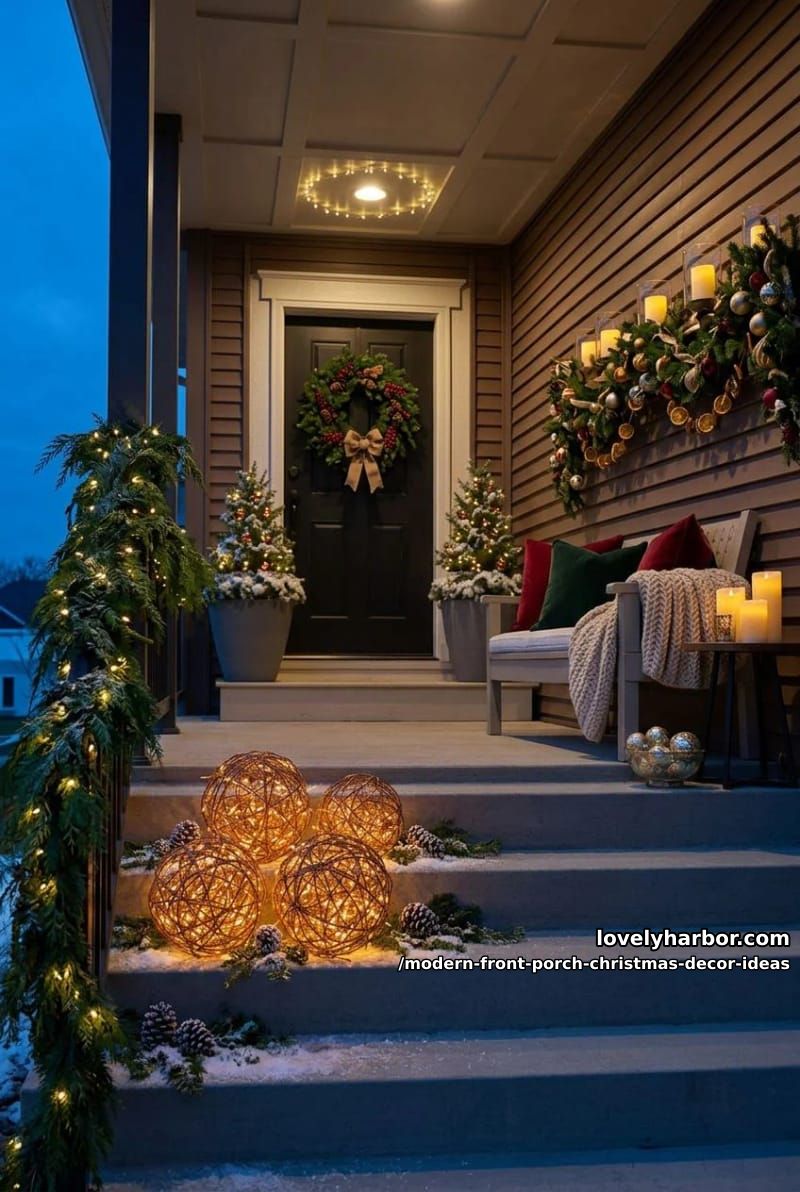
Lit grapevine orbs are the easiest contemporary lighting object to add, and grouping them in odd numbers keeps the arrangement from looking staged. Three spheres in graduated sizes, set off to one side of the steps, beats a tidy symmetrical row every time. Pre-lit versions run about $20 to $40 each depending on size, or you can wrap plain vine balls from a craft store with a strand of battery micro-lights and a timer. Keep the wattage low and the bulbs warm; the glow should come from inside the vine, not blast off the surface.
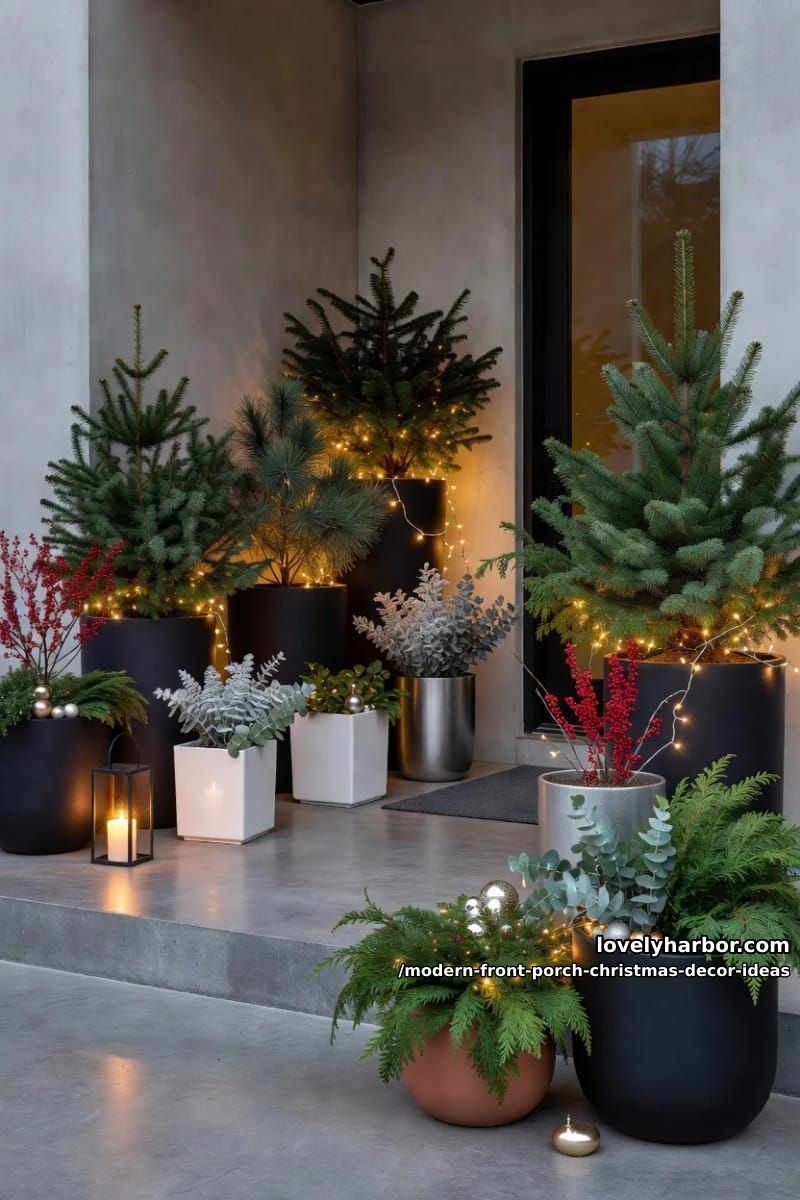
6. Skip the matching pair and build a grove of mismatched planters
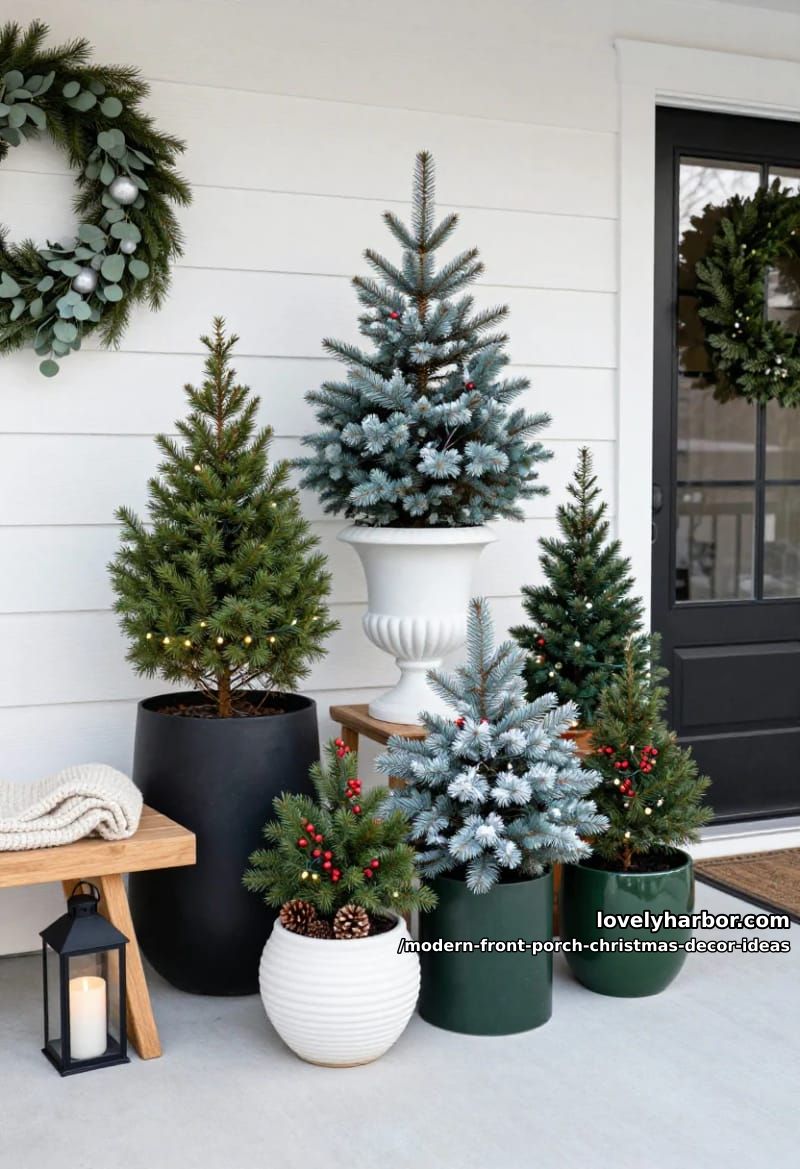
A staggered grove of three planters at different heights is the modern answer for anyone whose entry is not symmetrical to begin with, which is most entries. Vary the height, vary the finish slightly within one tonal family (charcoal, concrete grey, matte black all coexist), and plant a different thing in each. The eye reads the cluster as intentional landscaping rather than holiday clutter. This also lets you spend unevenly: one good tall planter plus two cheap shorter ones around it, and nobody clocks the difference.
7. Light one architectural element instead of outlining the whole house
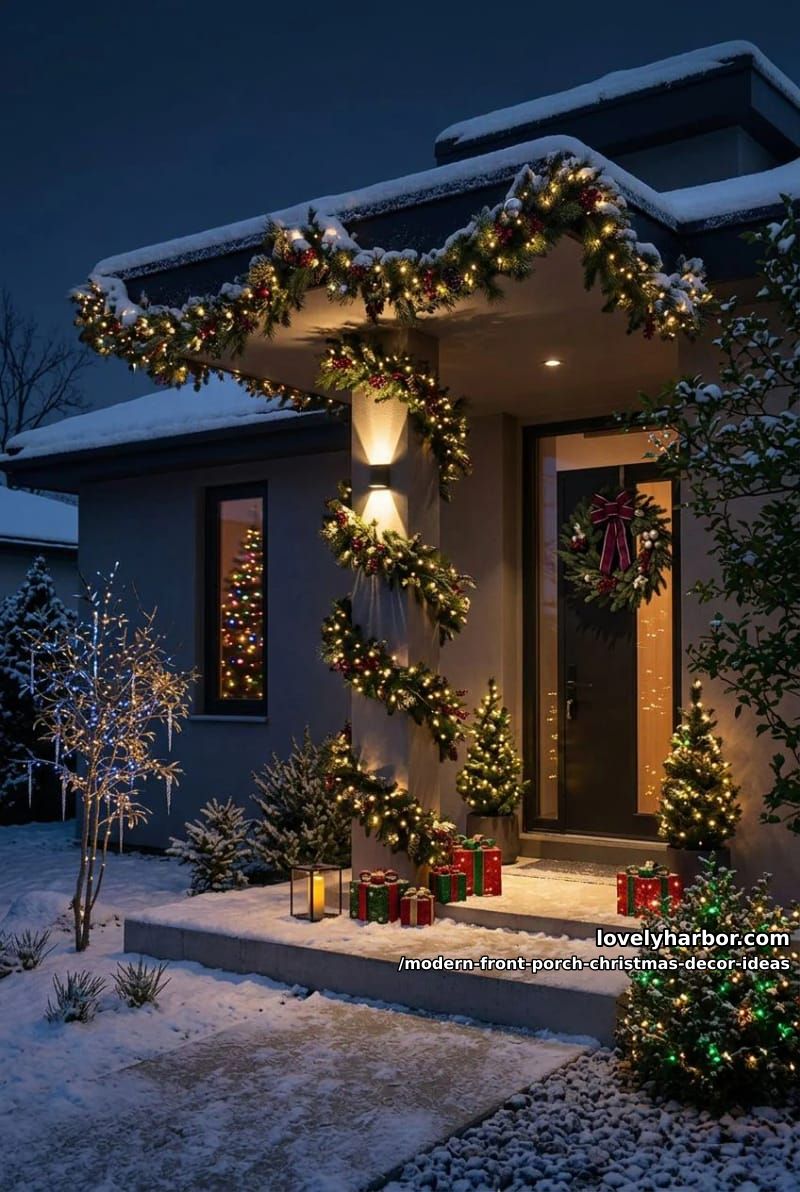
Pick one element and light it well rather than tracing every edge of the house. A single warm uplight at the base of a column, or a low wash across the door surround, gives a modern facade the gallery treatment: the architecture becomes the subject and the light is just serving it. This is the opposite instinct from the classic roofline-outline approach, and it is why a minimally lit modern house can out-class a fully wrapped one. A pair of low-voltage spotlights with stakes or surface mounts costs less than a few boxes of net lights, and there is far less to install and take down. One good gesture, then stop.
On a modern porch, the number of decorative objects is inversely related to how expensive the result looks. Three considered elements photograph as design; ten of the same elements photograph as a store display. When a porch is not working, the fix is almost always subtraction, not another trip to the garden center.
8. Layer a flatweave rug under the doormat to set the scale
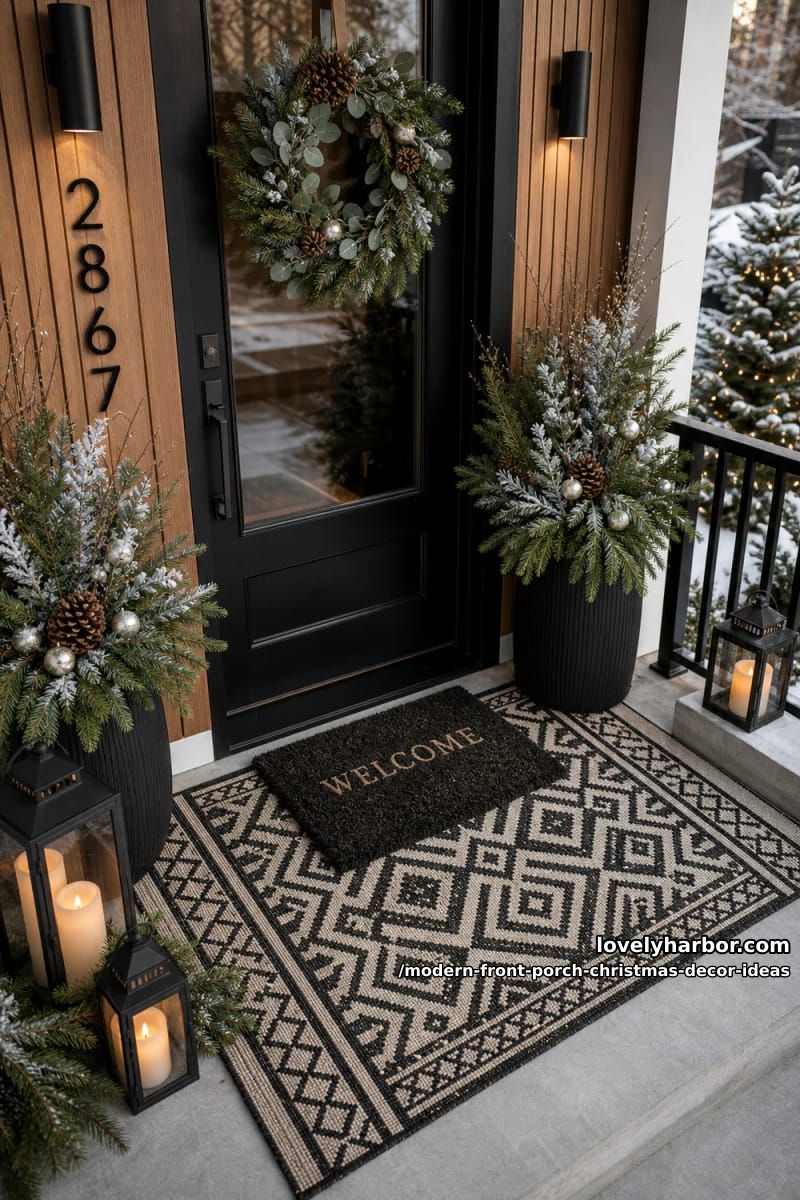
Layering a larger rug under a smaller doormat is the trick stylists use to make an entry feel finished, and almost nobody does it on their own porch. The base rug sets the scale and grounds the planters and door so the whole zone reads as one composition instead of scattered pieces. Use a flatweave outdoor rug with a tight geometric or solid pattern, then a coarse coir mat on top for texture contrast. A poly-weave outdoor rug in the $40 to $90 range handles weather fine; just size up, because a rug that is too small does the opposite and makes everything look stranded.
9. Let one sculptural figure be the entire display
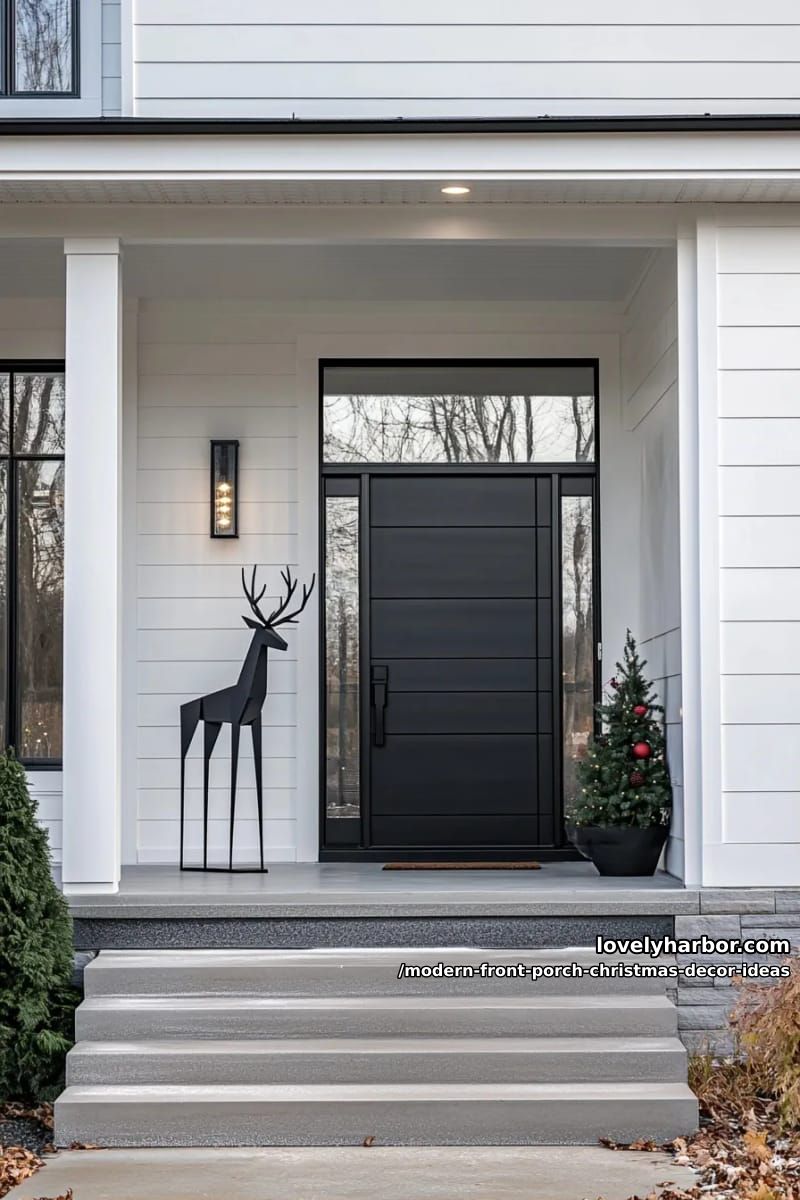
One sculptural piece on an otherwise bare porch is the most confident version of modern, and the hardest to commit to. A single matte black or weathered-metal reindeer, a geometric light form, or an oversized minimalist lantern, set alone with real space around it, reads as a design choice. Add a wreath and two planters and a doormat to it and you have lost the whole idea. This works best on a porch with clean lines and a solid wall behind it, where the negative space can do its job. It will not work if the porch is already busy with furniture and railings competing for attention.
10. Go fully neutral with bleached and dried natural elements
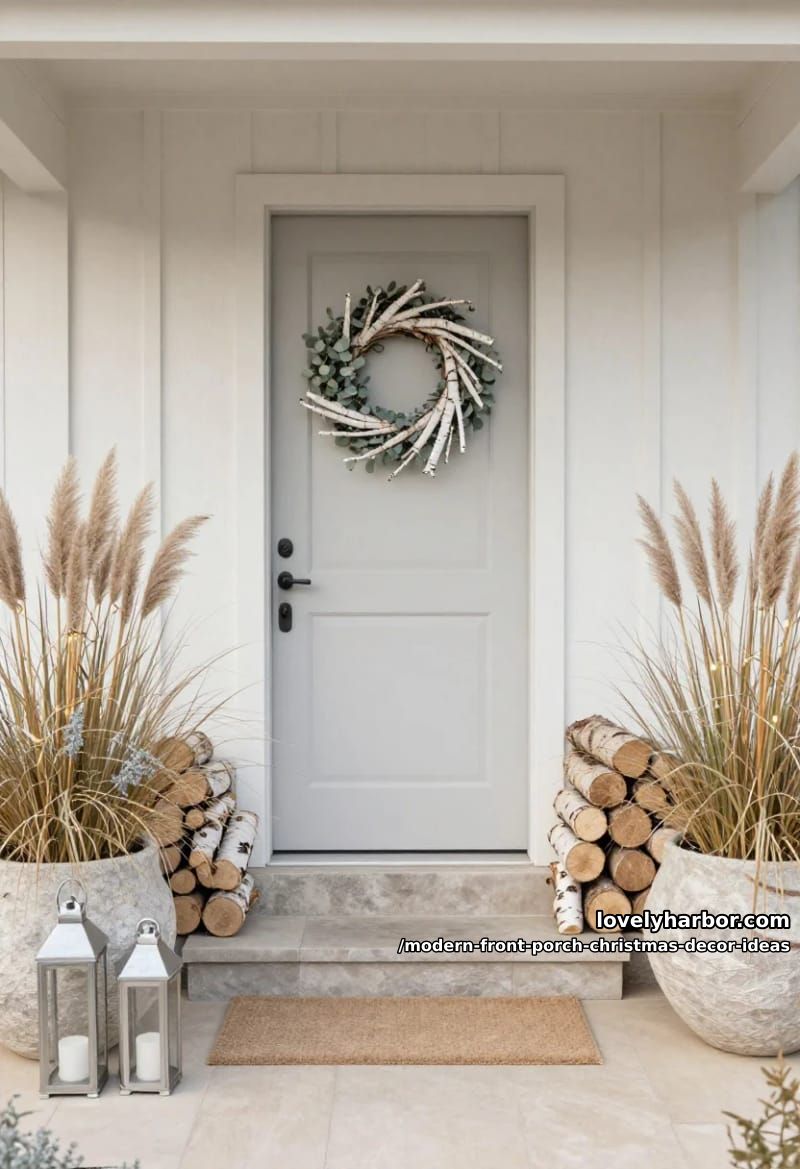
A fully neutral palette, built from dried and bleached natural material, is the Scandinavian take and it photographs as expensive even when it is mostly foraged. Bleached pampas, dried wheat, birch logs, and frosted eucalyptus give you texture and a wintry feel without a single red ornament. The whole look leans on materials and light rather than color, so a strand of warm micro-lights tucked into the stems is all the sparkle it needs.
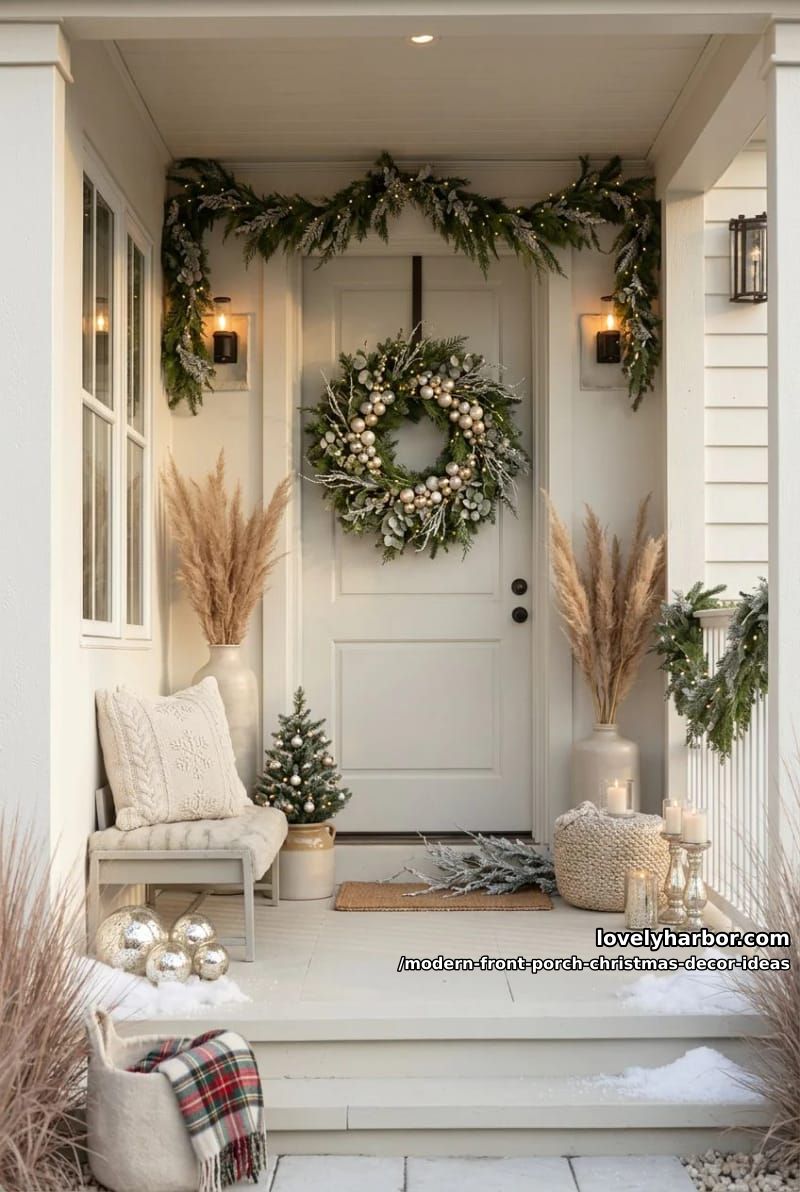
| Modern palette | Core materials | One accent only |
|---|---|---|
| Monochrome | Black planters, white house, deep green evergreen | White stripe bow |
| Scandi neutral | Birch, dried wheat, bleached eucalyptus, oatmeal rug | Warm micro-lights |
| Moody | Charcoal door, dark fir, weathered metal | Brass lantern |
11. Scale the whole thing down for a small porch or apartment landing
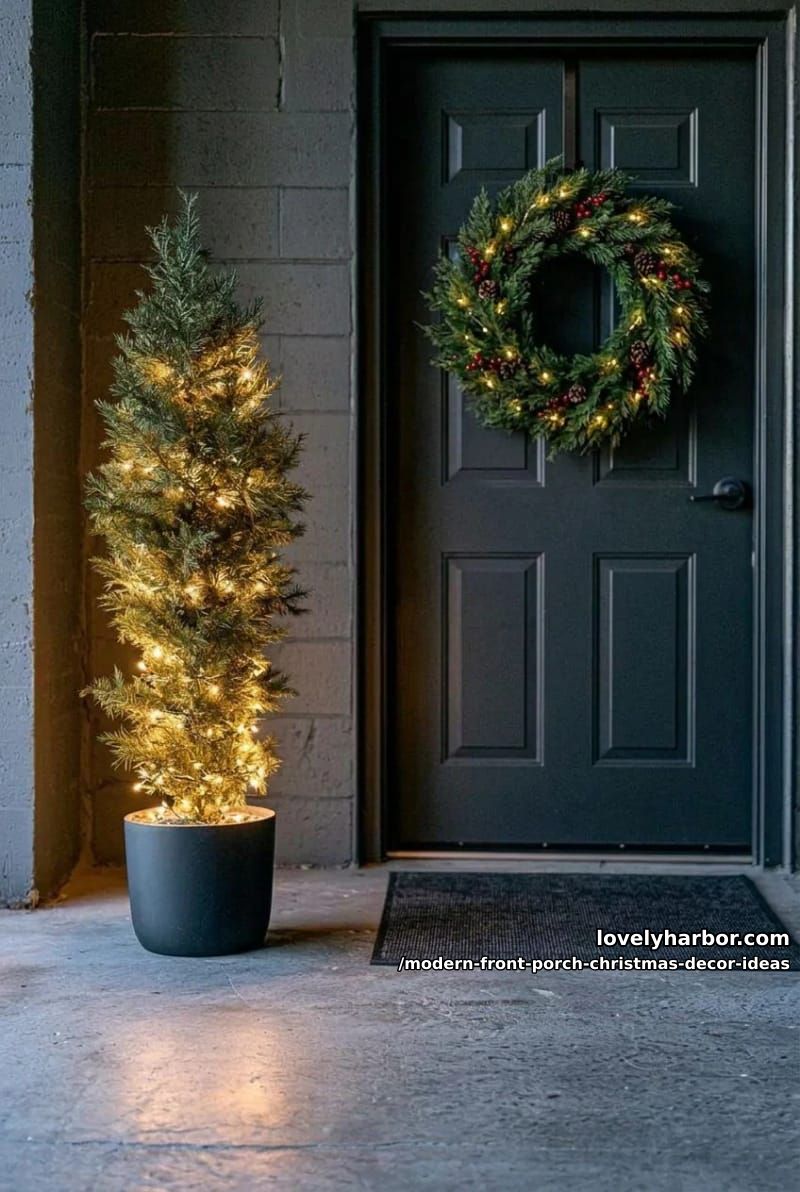
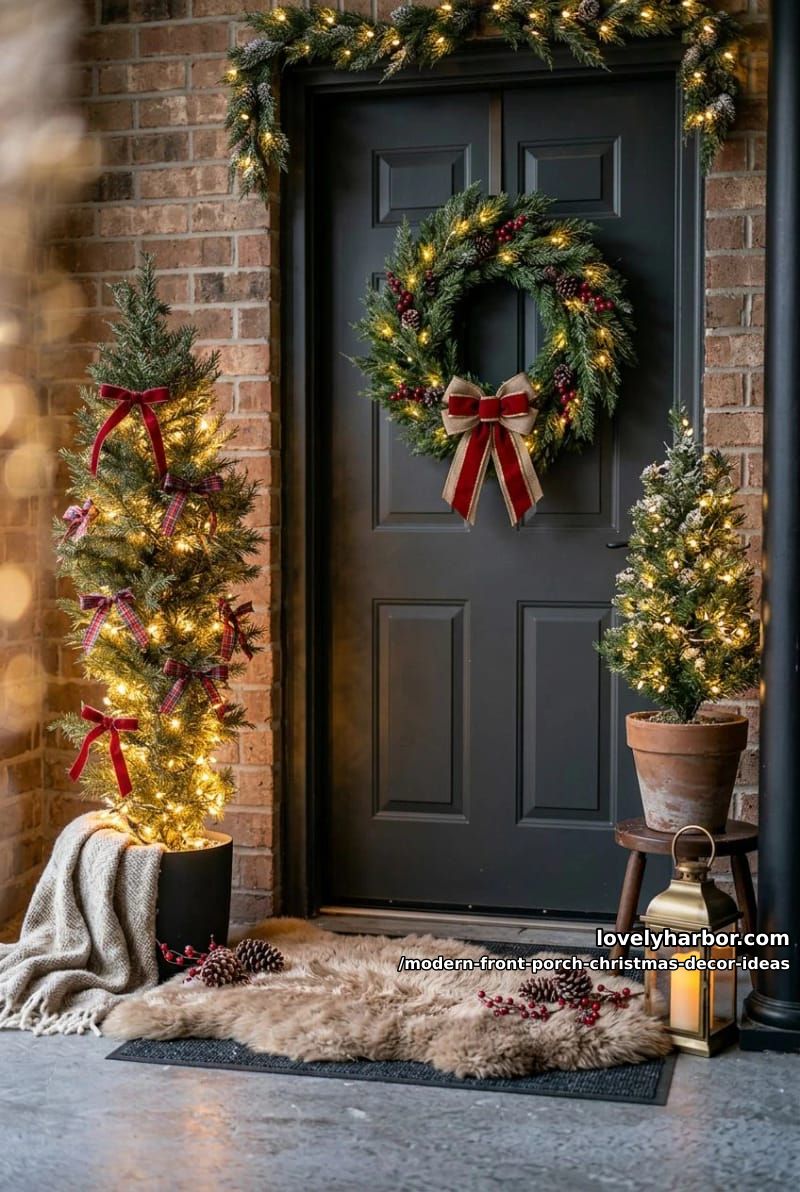
On a small porch or an apartment landing, the modern approach is not a shrunken version of a big display but a single committed gesture. One slim lit potted tree to the side of the door, plus a good doormat, is a complete look in a few square feet. The mistake on a tight space is trying to fit a planter pair, a wreath, and a garland into a footprint that cannot hold them; it reads as cramped rather than minimal.
Do
- Pick one statement element and give it room.
- Keep every light on the porch the same warm Kelvin.
- Size up: one big wreath or bow beats three small ones.
Avoid
- An inflatable anything. It cancels the entire look in one move.
- Spreading small objects evenly along the railing.
- Mixing four finishes when two would hold together.
Conclusion
If you do only one of these, make it the warm-white light from section three, because the wrong color temperature undermines everything else no matter how good the planters are. Build outward from there in order: get the light right, add the pair of matte planters or the single grove, then choose exactly one door element, a bow or an asymmetric wreath but not both. The layered rug in section eight is the finishing move most people skip, and it is what separates a porch that looks decorated from one that looks designed. Everything after that is subtraction.