
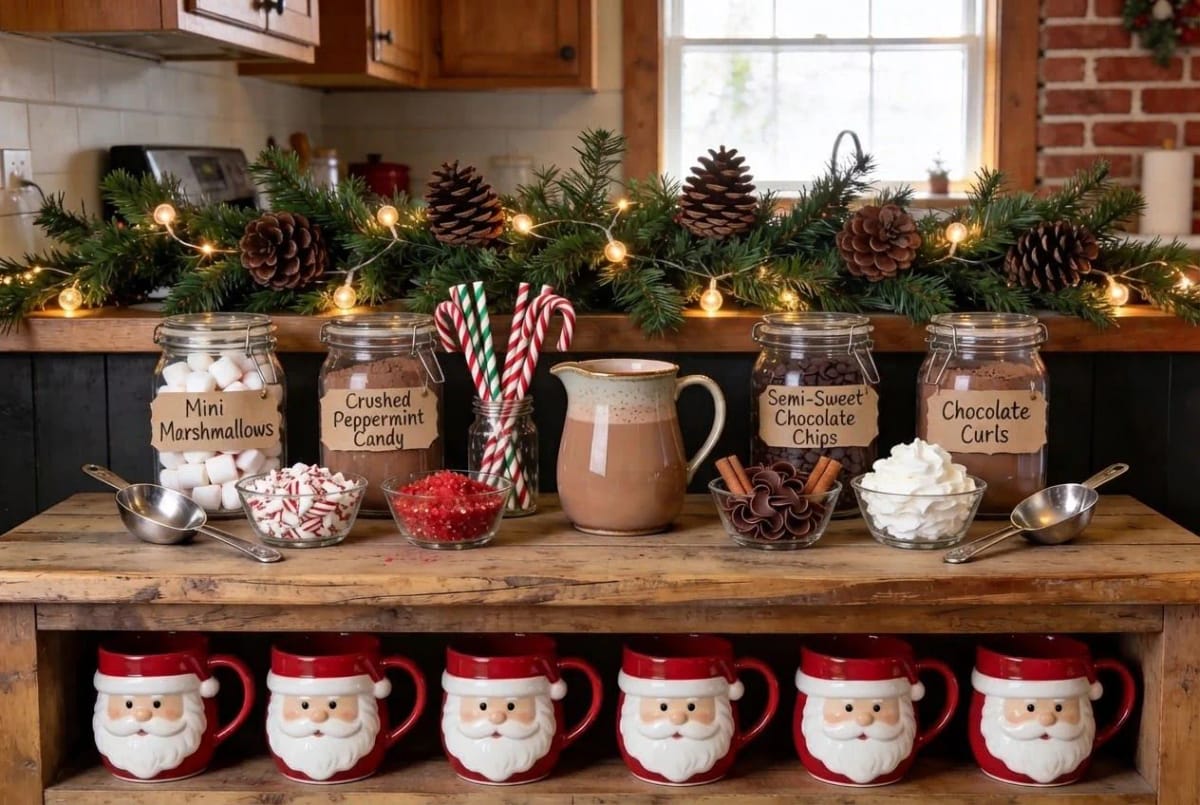
By the second week of December, most hot cocoa bars have a ring of dried cocoa around the jar lid, one Santa mug holding pens, and a bag of mini marshmallows that has gone to concrete. The setup photographed beautifully on December 1st. It stopped working on December 6th, when someone actually made cocoa at it.
That gap is what this piece is about. Not the styling that looks right in a single frame, but the arrangement that survives a family night, a school break, and three weeks of a nine-year-old reaching past the pine sprigs for a marshmallow.
Seven setups follow, sized from a 24-inch corner of counter up to a full sideboard for a party. Santa mugs are the through-line, because they are the one piece of this whole category that people already own, inherited, or keep buying, and because they are much harder to style than anyone admits.
1. Put the Whole Cocoa Bar on One Tray and Refuse to Let It Spread
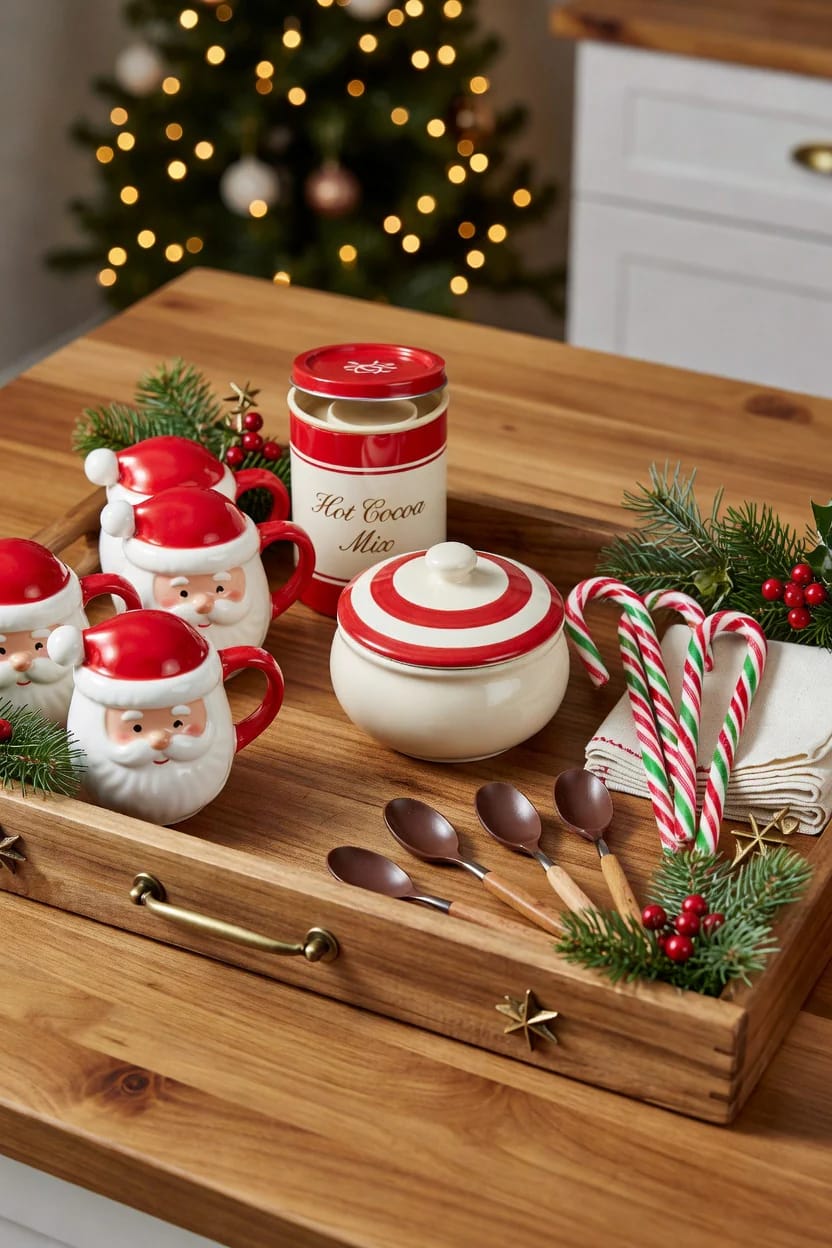
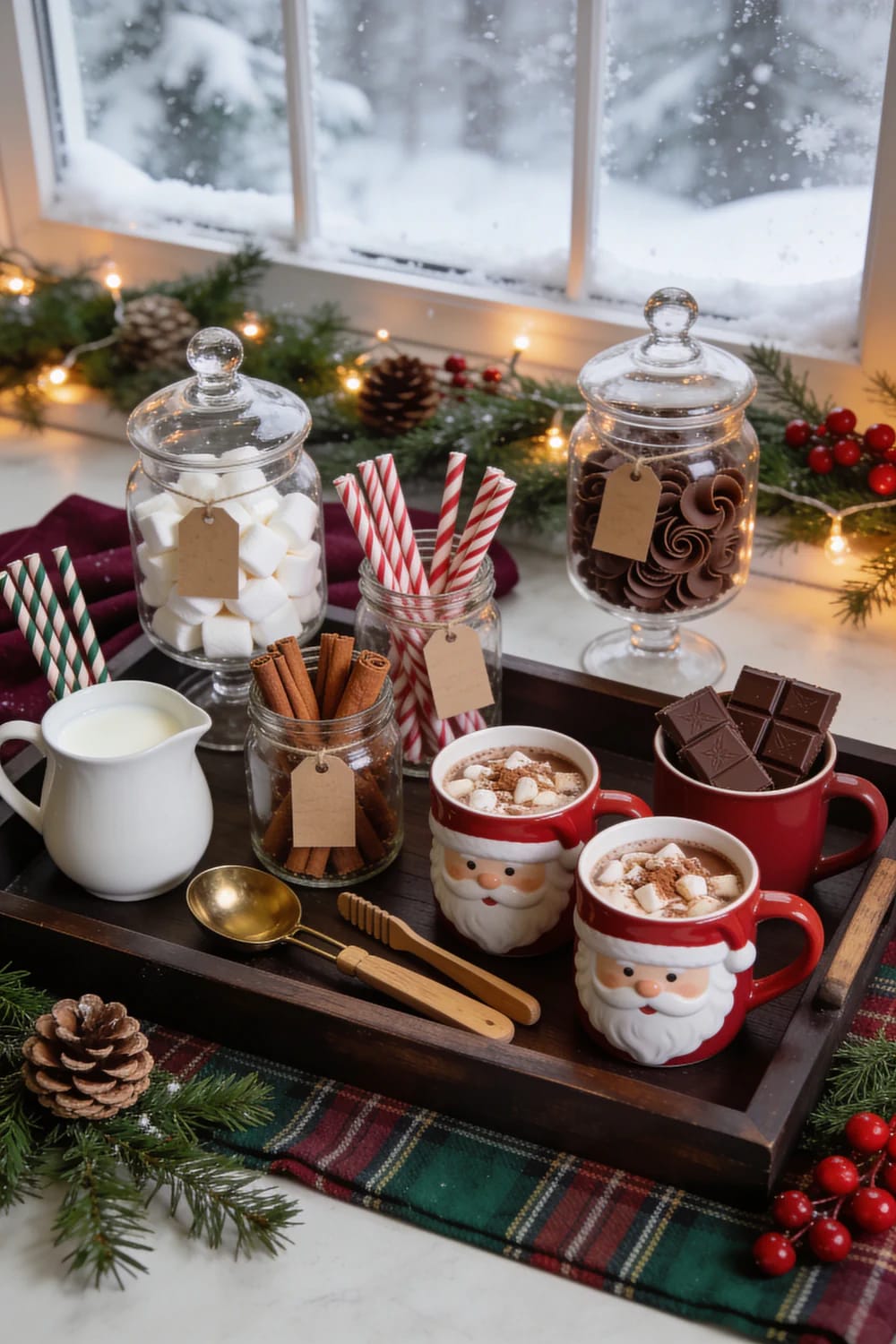
A tray is not a styling accessory here, it is the boundary. Everything that belongs to the cocoa bar sits on the tray; anything that will not fit does not belong to the cocoa bar. That single constraint does more for how the corner looks on December 20th than any amount of greenery, because the failure mode of a hot cocoa station is not ugliness, it is creep.
Sizing the tray to the counter you actually have
A 12 by 18 inch tray holds four Santa mugs, two jars, and a small stack of napkins with nothing touching. A 15 by 20 gives you a third jar or a low stand. Beyond that you are not building a cocoa bar, you are dressing a countertop, which is a different project with different rules. Most kitchens can spare 18 to 24 inches of run next to the kettle without losing prep space, and that is the whole footprint.
Wood and lacquer both work; metal-rimmed trays with a lip are the practical pick because cocoa powder does spill and a lip means you wipe one surface instead of the counter, the backsplash, and the drawer pull below. If the tray sits on an island rather than against a wall, treat it as a piece that gets seen from four sides and keep the tall items centered, which is the same logic behind good holiday styling on a kitchen island where nothing has a back.
Do not put the kettle or the cocoa pot directly under an open shelf or a low cabinet. Steam coming off a boil hits the underside at close range every single time someone makes a mug, and over a few weeks it lifts paint, swells the front edge of a particleboard shelf, and leaves a cloudy patch you will notice in January. Keep the heat source out from under the shelf line, even if it means the kettle lives 18 inches to the left of the tray.
What earns a spot on the tray
- Mugs, obviously, but only the number you would actually pour at once. Four out, the rest stored.
- Two toppings, three at the outside. A cocoa bar with seven jars is a snack station wearing a costume.
- Something to stir with, standing upright in a small vessel so nobody digs through a drawer mid-pour.
- Napkins. Flat, folded once, under the edge of a jar so they stop sliding.
- The chalkboard sign that says HOT COCOA. This is the first thing I would cut. Everyone can see it is cocoa.
2. Move the Santa Mugs Up: Open Shelves and Under-Cabinet Hooks
Counter space is the scarce resource, so the mugs should come off it. Hanging or shelving the Santa mugs solves storage and display in the same move, and it puts the most recognizable objects in the setup at eye level where they read from across the room instead of from directly above.
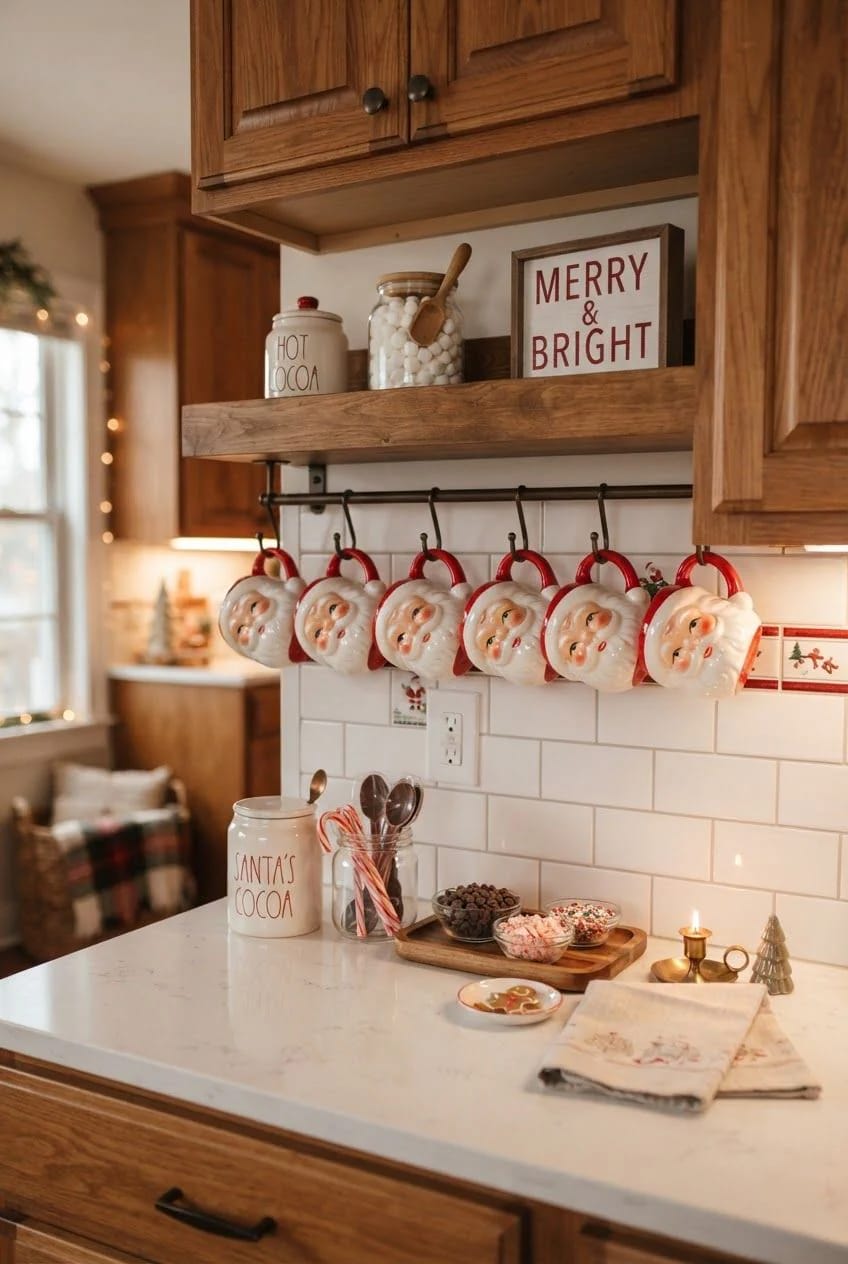
Hook spacing for a mug with a sculpted face
Slim modern mugs hang happily on cup hooks at 4 inches on center. Sculpted Santa mugs do not: the classic ceramic Santa head runs roughly 5.5 inches from the tip of the handle to the front of the beard, so hooks want 5 to 6 inches of separation or the hats knock together every time the cabinet door swings. Screw-in brass cup hooks into the underside of a shelf take about ten minutes and a bradawl. Adhesive hooks are fine on a rented shelf, but derate them hard, because a full 14-ounce ceramic mug is a different load than an empty one.
| Where the mugs live | Realistic capacity | What goes wrong |
|---|---|---|
| Cup hooks under a shelf | 6 to 10 | Handles collide under 5 in spacing; sculpted mugs need the wider gap |
| Single row on an open shelf | 4 to 6 | Dust settles in the rims by week two if they are not in rotation |
| Tiered stand on the counter | 3 to 4 | It eats the counter space the tray just liberated |
Keep the drinking mugs low
Put the collectible ones high and the four you actually pour into at hand height. It sounds obvious and almost nobody does it, because the impulse is to display the good ones where they can be seen, which happens to be the shelf you need a stool to reach. A shelf you have to climb for is a shelf that ends up half empty by Christmas Eve with four mugs abandoned in the sink. There is more on rotation, spacing, and what to do with the twenty mugs that do not fit in our guide to building a shelf display that holds up for a full season.
 How to Display a Santa Mug Collection The hardware, spacing and edit for twenty-plus mugs, so a collection reads as a display instead of a cabinet emptied onto a shelf.
3. Let the Santa Mugs Set the Palette, Because Two Reds Is One Too Many
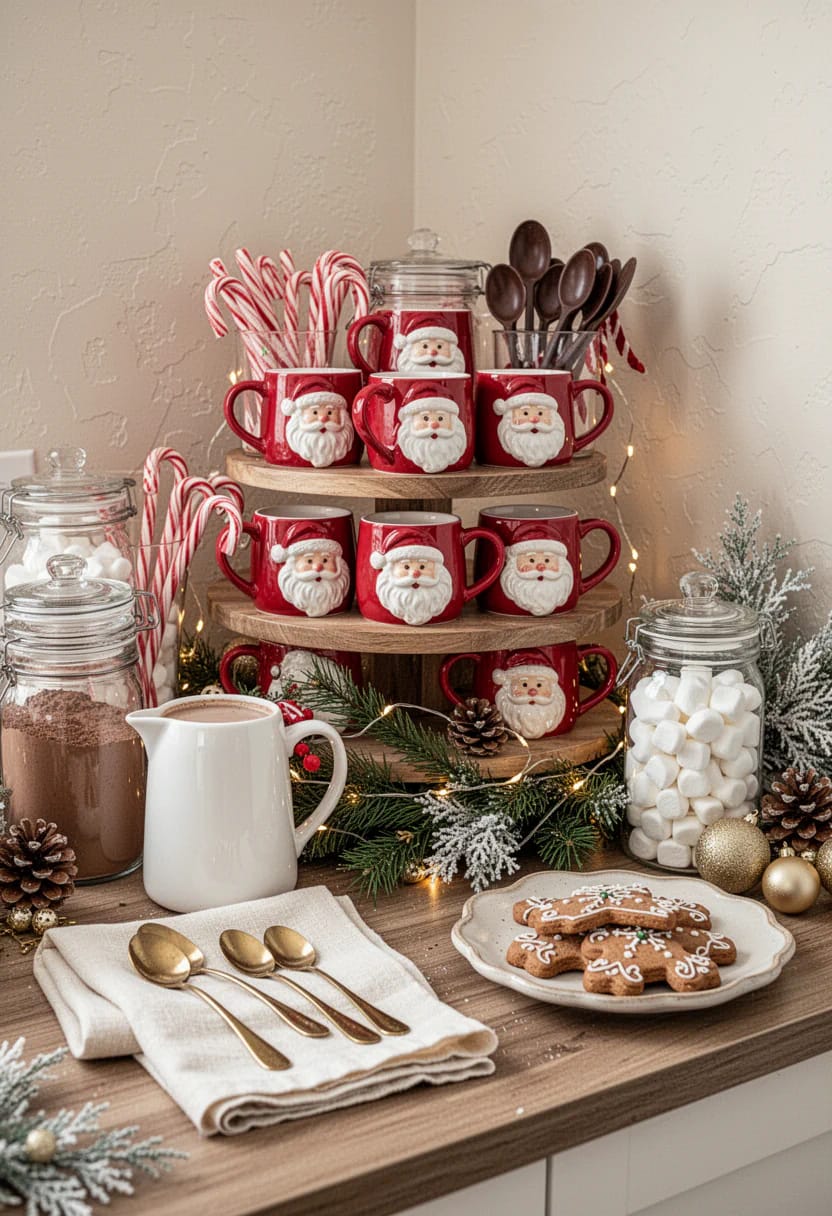
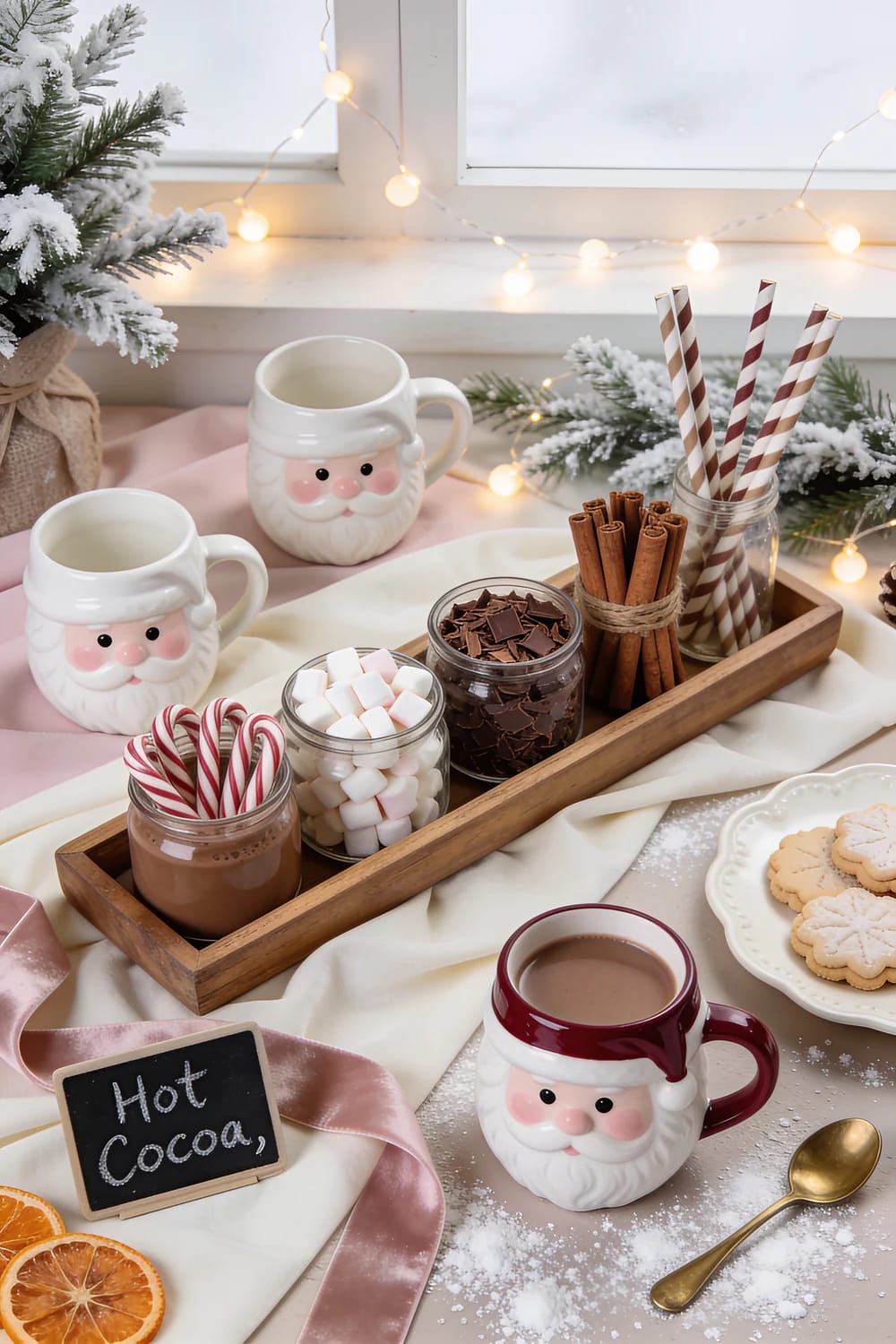
The Santa mugs decide the color scheme, not the other way around, and this is where most cocoa bars quietly fall apart. Vintage and vintage-style Santa ceramics are painted in a warm, slightly orange red with a cream white that has yellow in it. Buffalo check, most modern ribbon, and nearly every "Christmas red" plastic bin are a cooler blue-red against a bright optical white. Put them within a foot of each other and both look wrong; neither is at fault, they are simply two different reds having an argument on your counter.
Pick a lane and commit
If the mugs are vintage or vintage-styled, run the whole tray warm: cream linen, unbleached kraft labels, brass or unlacquered copper, natural pine. If the mugs are modern and graphic, go the other way with crisp white, black, and the cooler red, and skip the aged brass entirely. What does not work is splitting the difference and hoping the greenery covers it, which is the standard advice and which produces a counter that photographs muddy.
Thrifted mismatched beats the matched set of four
Buying a coordinated set of four identical Santa mugs is the safe move and it is the one that makes the whole corner look bought. Five mismatched Santas from three decades, all sharing that same warm red, reads like a collection that accumulated. Thrift stores price them at a few dollars each in November and considerably more once someone has labeled the shelf "holiday." If you want a reliable base to build the mismatched pile around, a plain sculpted set gives you the anchor without committing you to a matched look forever.
Classic sculpted Santa heads in the warm red and cream, sized around 5.5 inches with the handle, which is the dimension your hook spacing has to accommodate. Hand wash only, so keep them out of the dishwasher rotation.
Cosmos Gifts classic Santa head ceramic mugs, red and white, set of 4One caution on the genuinely old ones. Mid-century novelty ceramics were not all made to food-contact standards, and a crazed glaze or hand-painted decoration on the inside surface is a reason to retire that mug to holding stirrers rather than cocoa. If you like the idea of making your own instead, the same warm-red palette is achievable at home, and hand-built holiday pottery projects cover the glaze choices that survive hot liquid.
4. No Spare Counter? Roll the Cocoa Bar In
A three-tier cart is the answer for kitchens where every inch of counter is already spoken for, and it has one advantage over any fixed setup: it moves to where people are. The cart lives against the wall in the kitchen on a Tuesday and rolls to the edge of the living room on Christmas Eve.
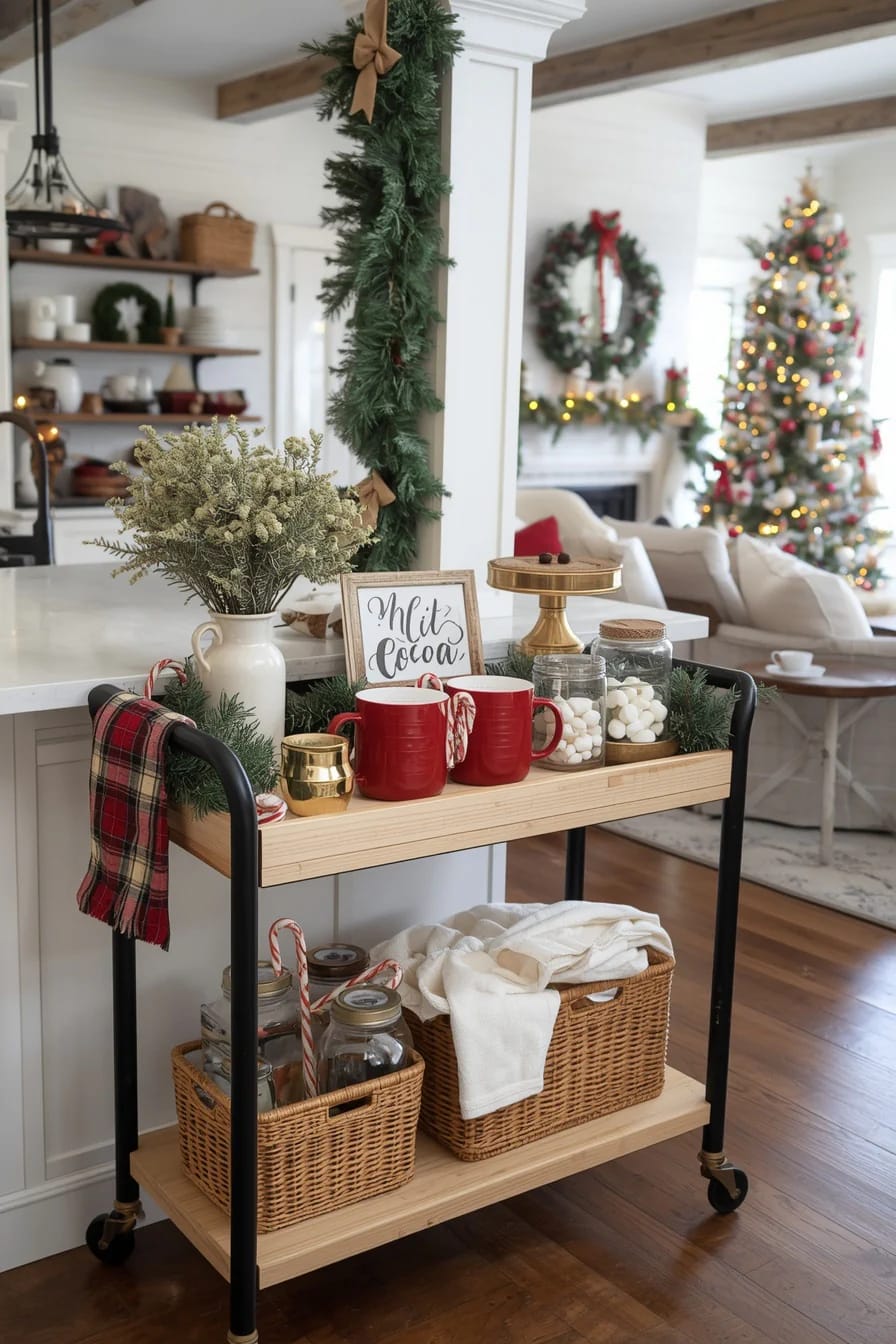
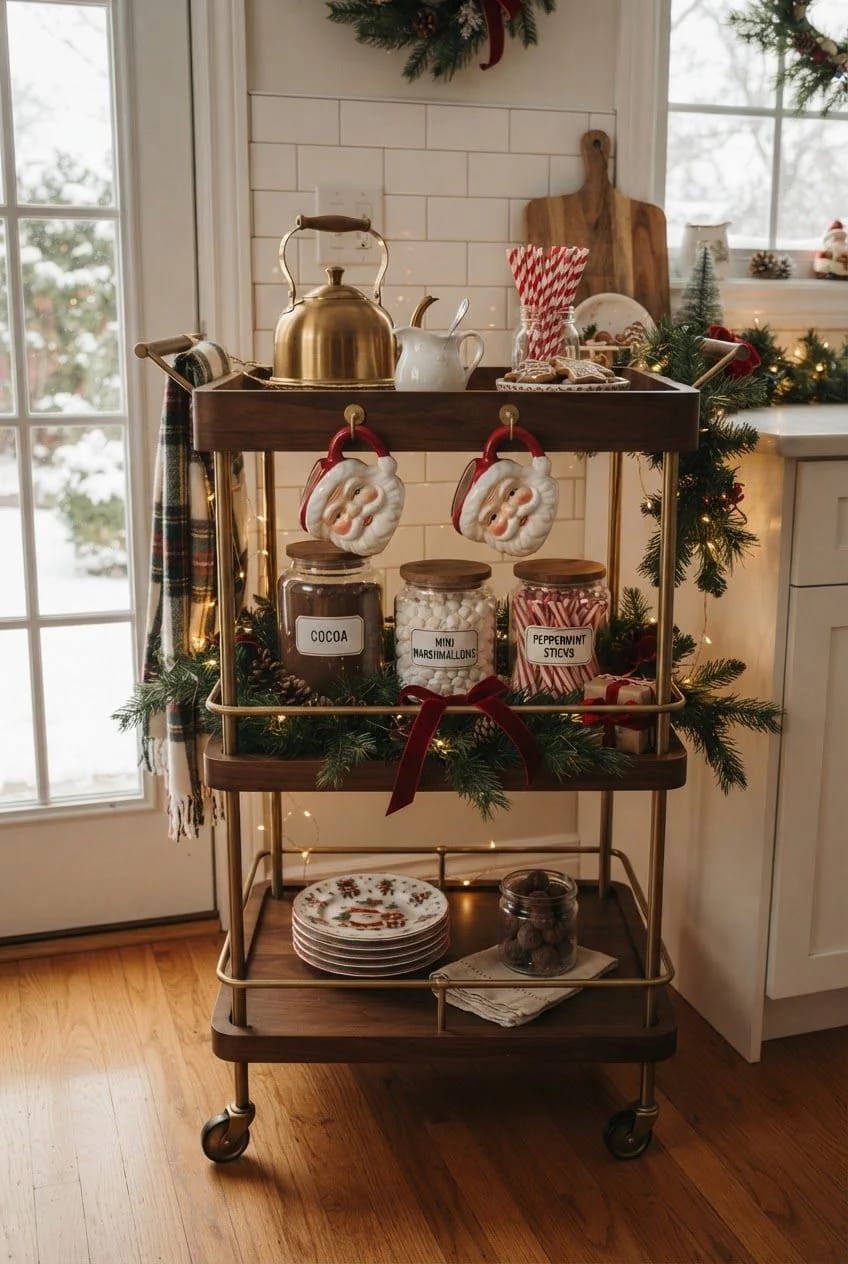
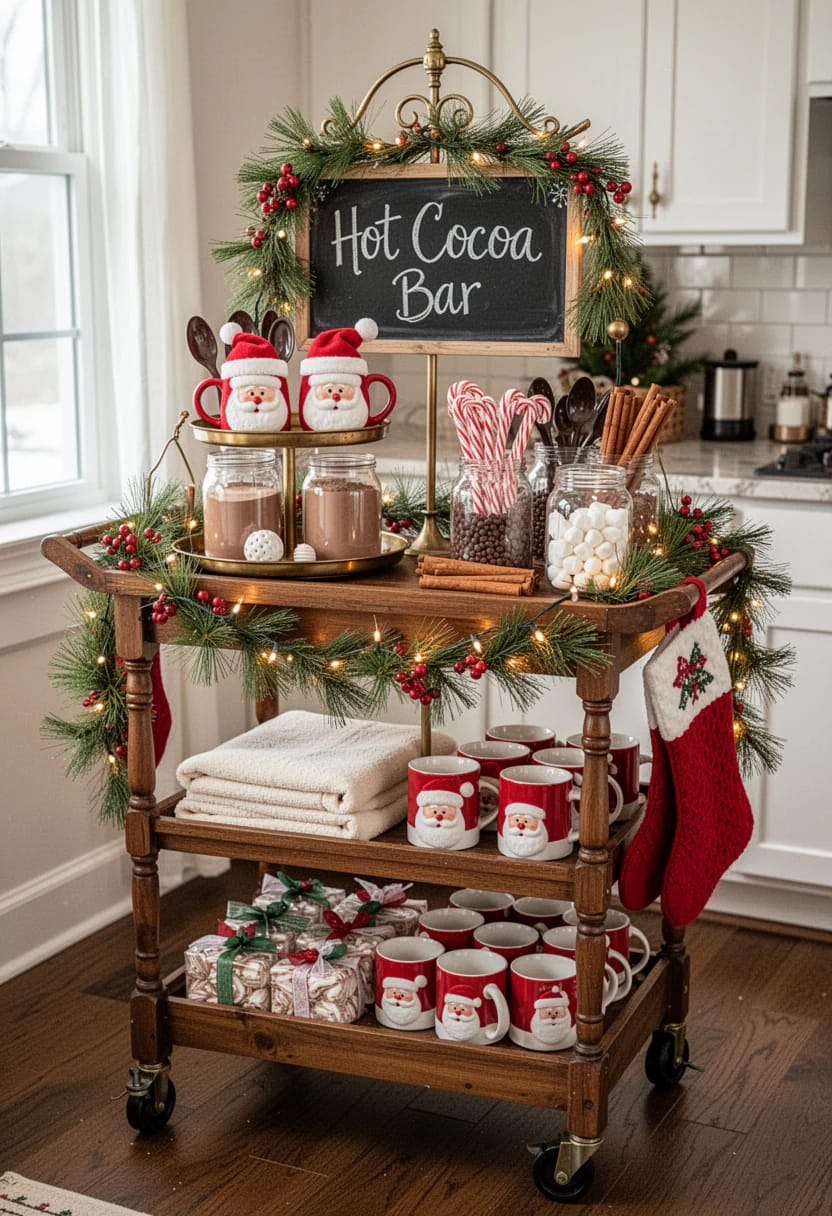
Watch the height difference. Carts typically stand 31 to 34 inches tall against a 36-inch counter, so a kettle on the top shelf pours at an awkward angle and a heavy pot sits higher than its center of gravity likes on castors. Keep the heat source on the counter and let the cart carry mugs, toppings, and napkins. Expect to spend somewhere in the range of $70 to $150 for a cart with wheels that actually roll on a rug, and check the castor diameter before you buy, because the 1-inch wheels on cheaper carts stop dead at a threshold strip.
5. Light It at 2700K and Throw Out the Cool White Strand
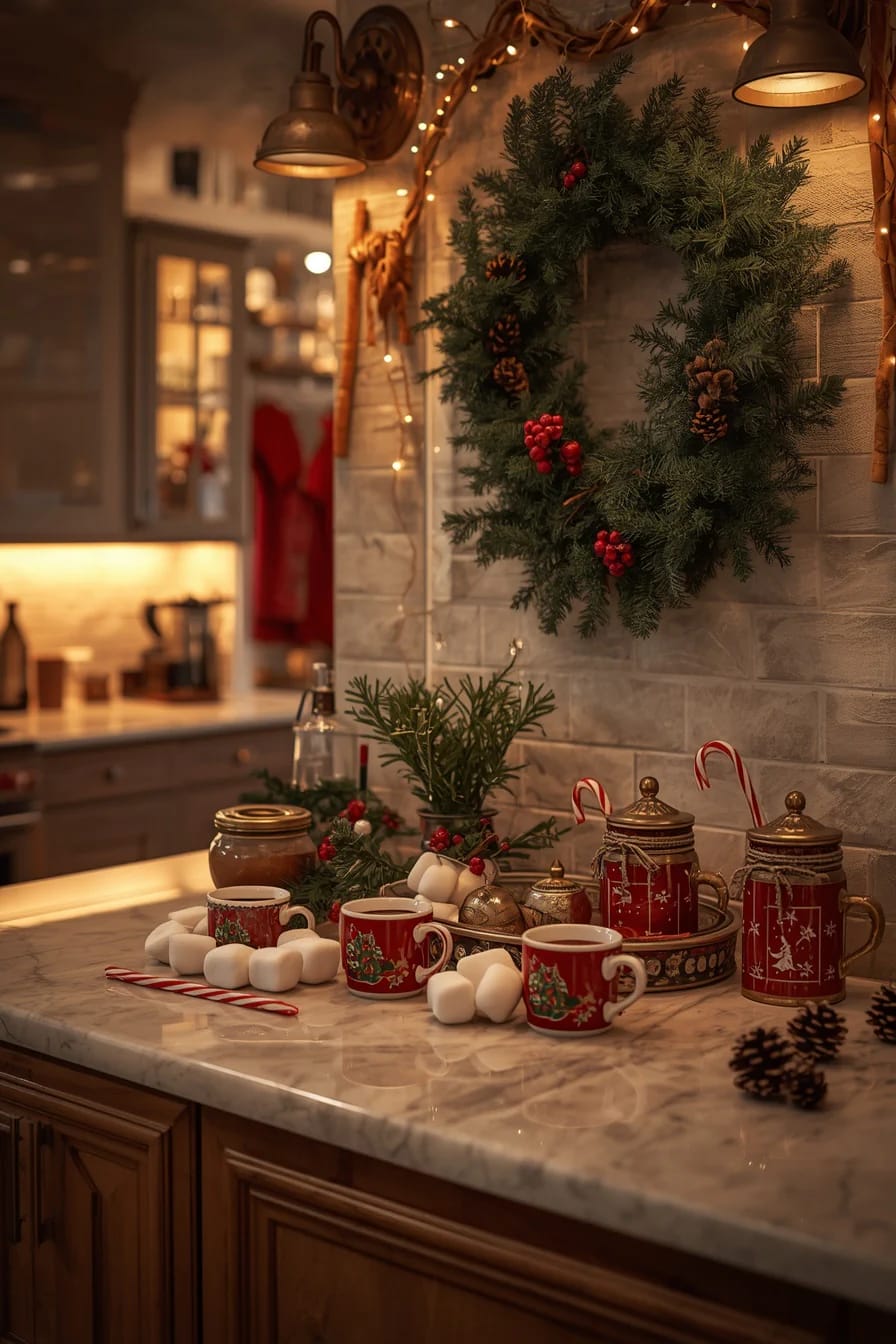
Cocoa bars are almost always shot at night, and the light source decides whether the whole thing looks cozy or looks like a break room. Standard "cool white" holiday strands run 5000K and up, which pushes the cream in a Santa beard toward grey and turns warm red flat. Warm white LED sits around 2700K and the "warm glow" or "vintage" strands closer to 2200K. For this corner, 2700K is the target, and 2200K if the mugs are genuinely old and yellowed.
Two sources beat one
Put a small lamp on the kitchen counter. This is the single suggestion here that people resist, because lamps belong in living rooms and kitchens have downlights. A 40-watt-equivalent bulb in a shaded lamp at counter height does something no under-cabinet strip can, which is throw light sideways across the mugs so the sculpted faces get shadow and read as objects rather than as flat red shapes. Under-cabinet lighting alone lights the counter and leaves everything standing on it in silhouette, which is exactly why so many cabinet and shelf decorations photograph better in daylight than they look at 8pm.
6. Toppings Go in Glass, Not in Their Packaging
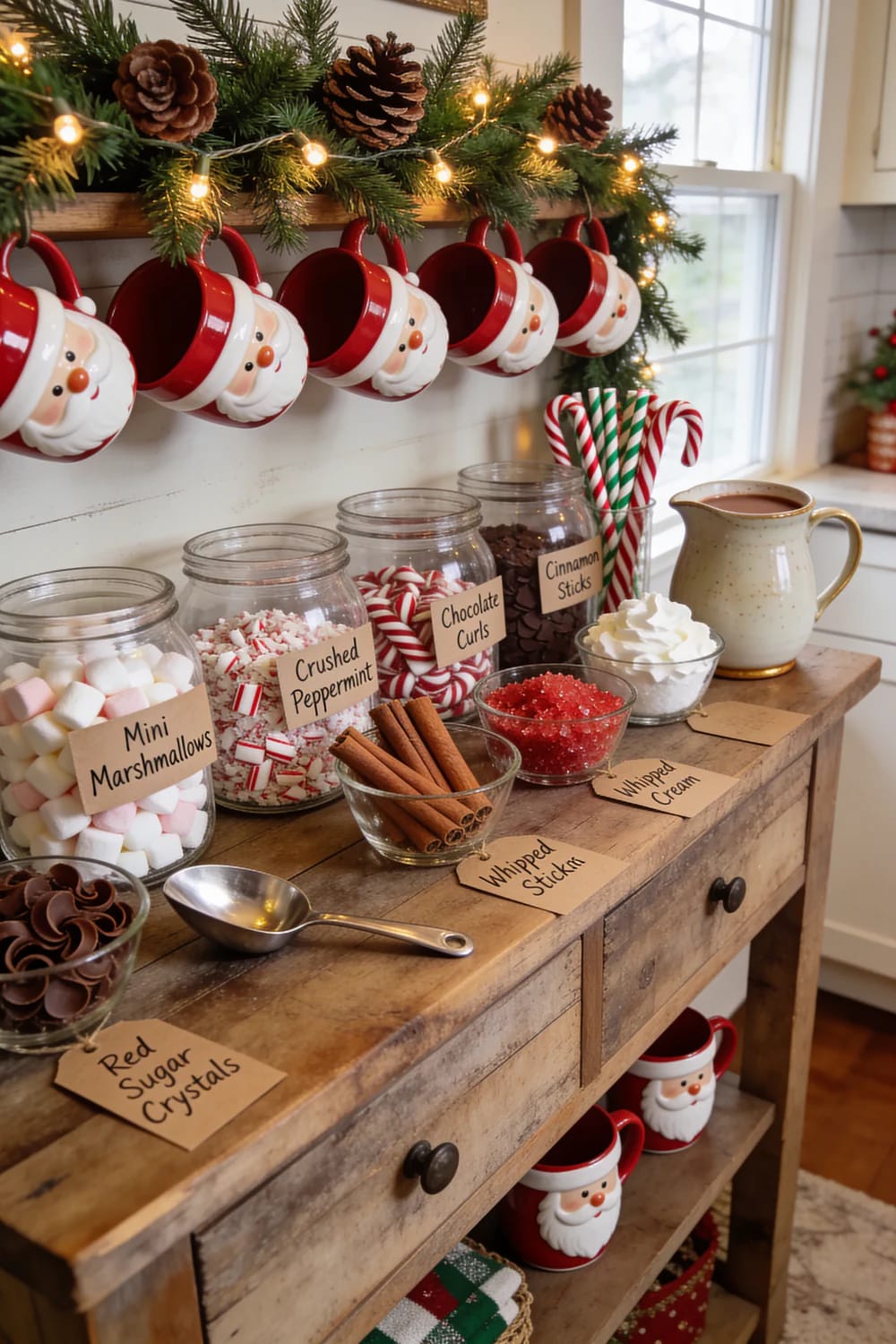
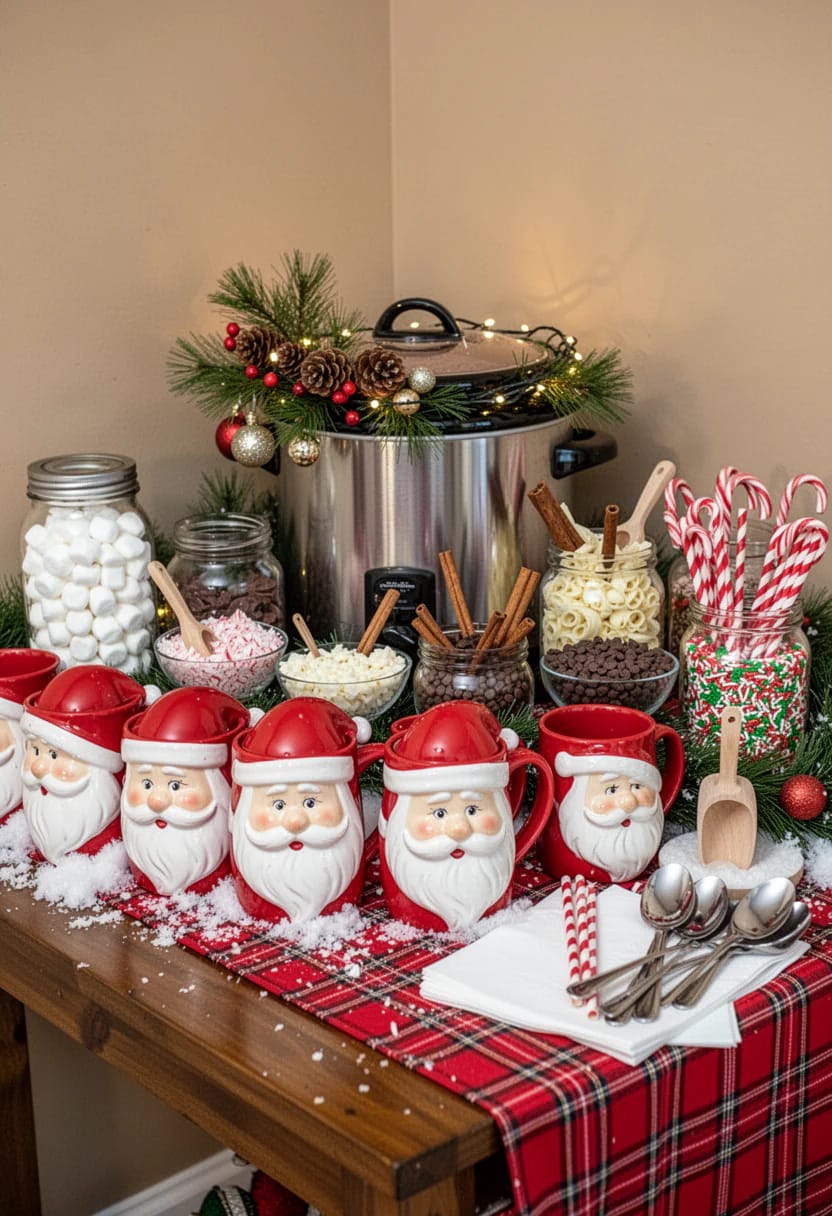
Decanting is the difference between a cocoa station and a countertop with groceries on it, and it is also a food question, not only a styling one. An open bowl of mini marshmallows on a kitchen counter is hard and unpleasant within about three days; the same marshmallows in a jar with a sealing lid stay soft for the length of the season. Peppermint is worse, because sugar pulls moisture out of the air and candy canes left uncovered go tacky and cloudy fast.
What actually survives three weeks in an open jar
- Mini marshmallows: fine in a sealed jar for the season, hard in three days in an open bowl.
- Crushed peppermint: keep it small-batch and refill, because it clumps into a single disc once humidity gets at it.
- Cocoa powder: seals well, but scoop it with a dry spoon or the surface cakes.
- Chopped chocolate: this is the one that fails quietly. Above roughly 75°F it blooms grey on the surface, which is harmless and looks like mold to everyone who is not you. Keep it out of the sun and in the smallest jar on the tray.
- Whipped cream in a can. Not shelf-stable, no matter how much better it looks standing next to the jars.
Graduated jar sizes do the visual work that a matched set cannot: a run of four identical canisters reads as pantry storage, while a 58-ounce jar next to a 21-ounce one reads as an arrangement. The classic clear apothecary shape with a glass ball lid is the one that disappears into any palette, warm or cool.
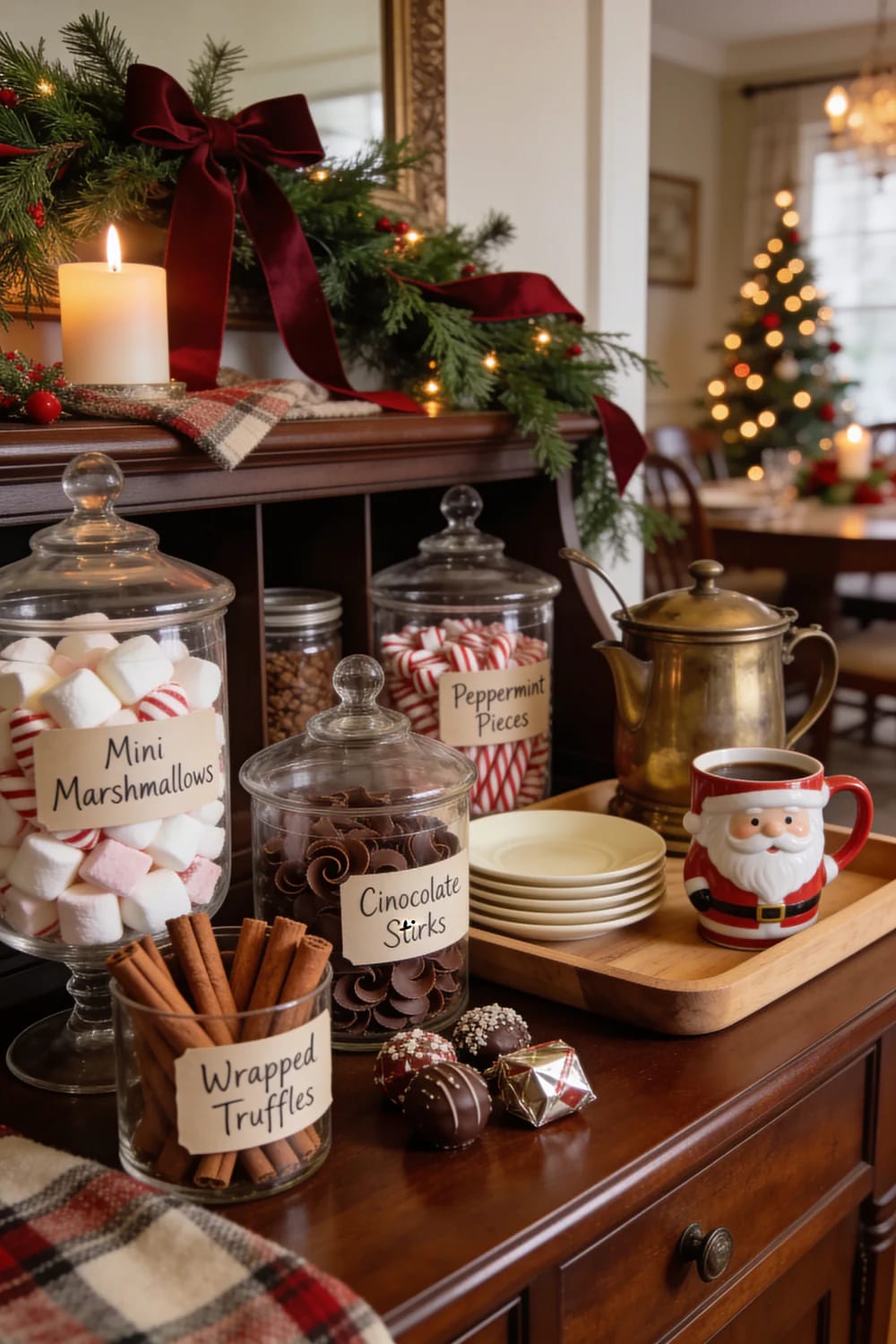
Anchor Hocking clear glass apothecary jars with ball lids, 4-piece set covers the range in one purchase at 58, 46, 27 and 21 ounces, which is more capacity than a cocoa bar needs and exactly the size spread that keeps the row from looking regimented. Sets like this typically run $30 to $50. Label them or do not, but if you do, write on kraft tags in pen rather than buying a vinyl lettering kit, because the machine-cut font is the single clearest tell that a station was assembled for a photograph. The same restraint applies across the rest of the room, and our broader kitchen Christmas decor ideas lean the same way.
7. The Party-Scale Version: Sideboard, Carafe, One-Way Traffic
For twelve people, the counter setup collapses, because twelve people in a kitchen at once is a bottleneck with a kettle in the middle of it. Move the whole thing to a dining room sideboard or a console table and lay it out as a line: mugs at the left end, cocoa in the middle, toppings at the right, napkins at the far end. People fill and move rather than circling and reaching across each other.
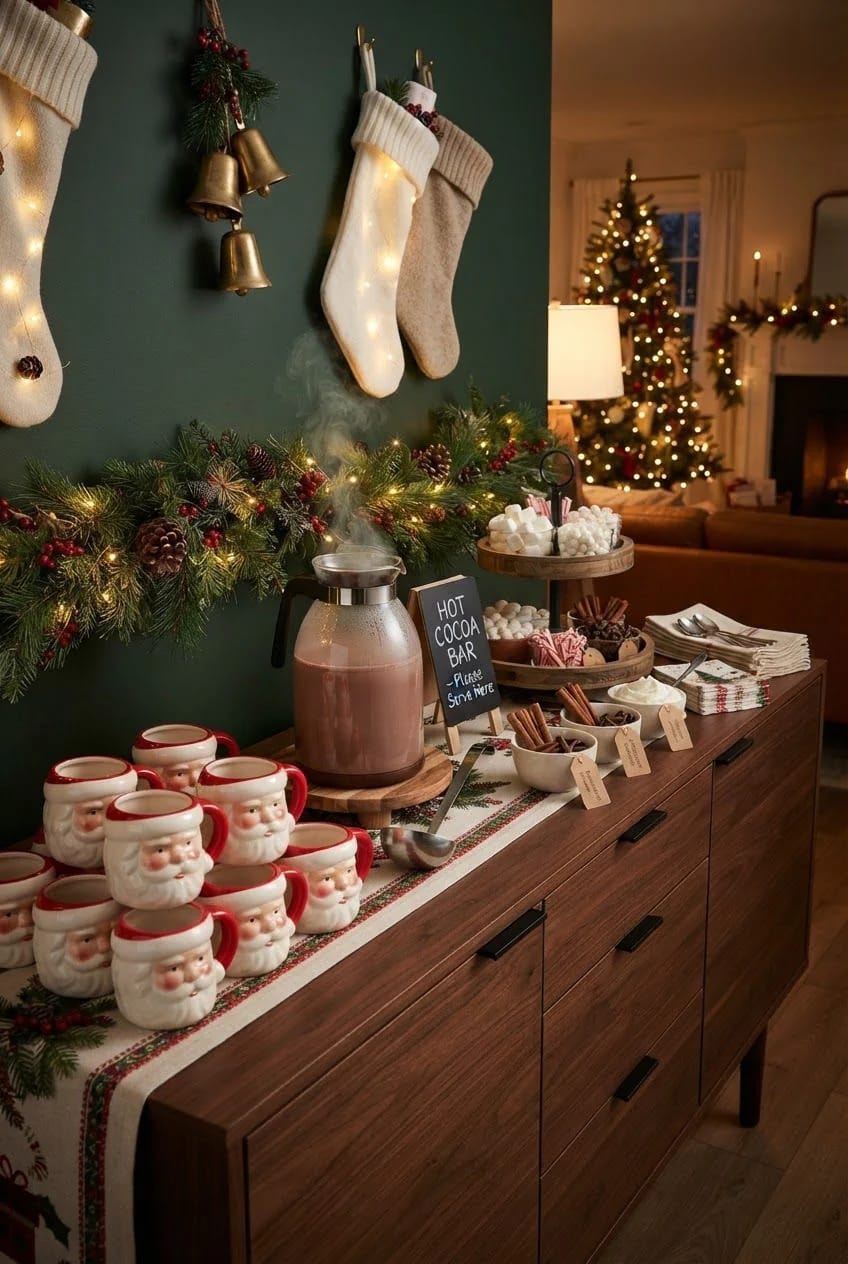
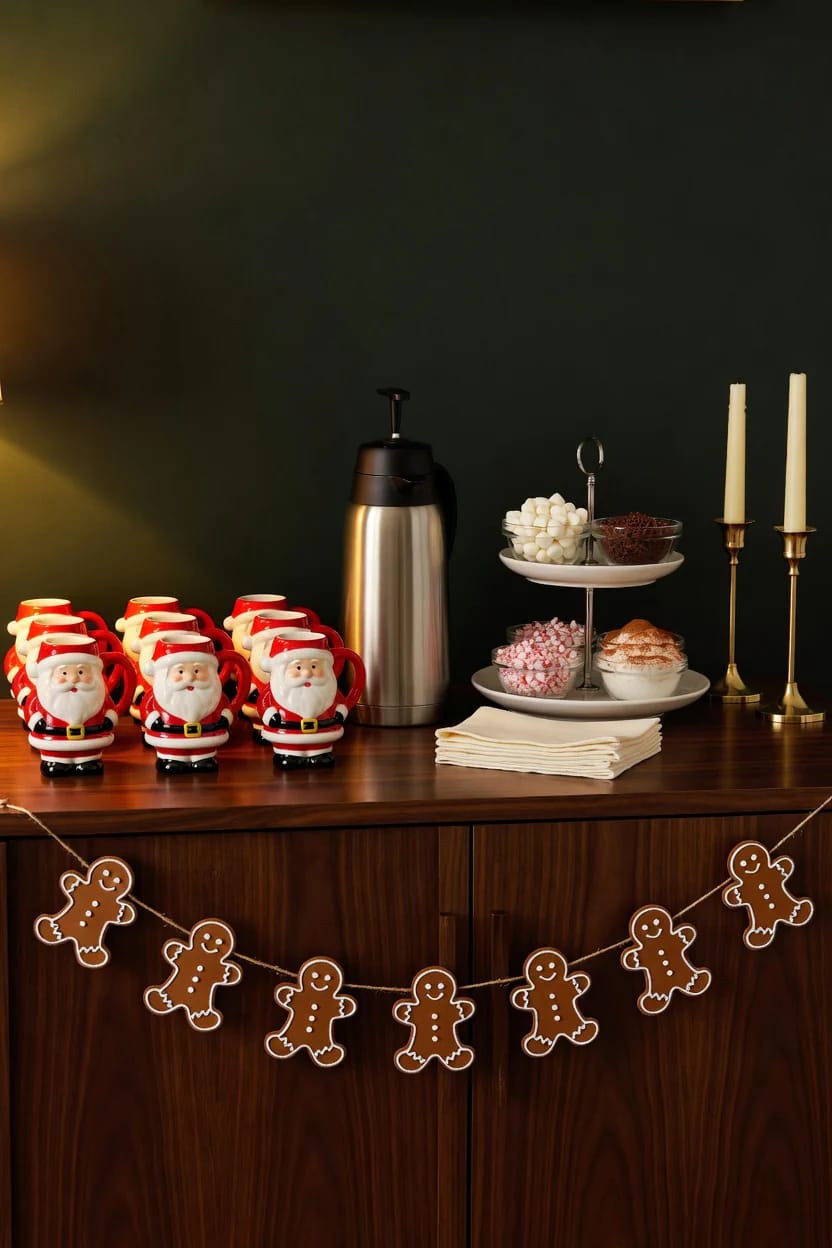
An insulated pump carafe is what makes this work: it holds cocoa hot without a burner, does not skin over the way a slow cooker on warm does, and it removes the one thing you do not want at a party, which is an appliance drawing power across a runner. The 3-liter Zojirushi SR-AG30 stainless steel Air Pot beverage dispenser, 101 oz is the workhorse version, rated by the manufacturer at 169°F after ten hours from a near-boiling fill, which is comfortably past when the last guest leaves. Fill it with cocoa made slightly stronger than you would drink, because it will be poured over marshmallows and a scoop of crushed peppermint that dilute as they melt. If the sideboard also has to carry a centerpiece that night, keep it low and at the far end, well clear of the pour zone, and take the sizing cues from arrangements built to sit near where people are eating.
Order of operations matters more than any single piece of this. Fix the lighting first, because a 2700K strand changes how every red in the setup reads and there is no point choosing linens under a 5000K glare. Then place the mugs, since they set the palette. Toppings last, in whatever jars the palette has already decided for you. Doing it in the reverse order is how people end up with a beautiful tray they quietly restyle twice before the 15th.
One honest gap: I could not find reliable pricing on vintage Santa mugs, and I do not think anyone can. The same 1960s ceramic head runs $3 at a church sale in October and $28 on a resale app in December, and the only consistent advice is to buy them out of season and hang them the week after Thanksgiving.
Related Posts
- How to Display a Santa Mug Collection
- 21 Magical Christmas Decor Inspiration for a Cozy Home
- 29 Stunning Christmas Home Decor Ideas for a Cozy Holiday Glow
- 21 Cozy Christmas Cabinet Decor Ideas for a Festive Home
- 23 Christmas Table Centerpiece Ideas for a Magical Holiday Setting
- Christmas Mantel Decorating Ideas That Actually Hold Up All Season