
Most antique garden decor roundups skip the part that decides whether any of it works: half these objects rust into a hazard or rot through within two seasons, and the photos never tell you which.
What follows is the list I keep coming back to after years of hauling junk off barn floors and flea-market tables, with the plain note on each piece about what survives outside, what needs a drainage hole before it drowns a plant, and which pinned-everywhere ideas (the teacup ladder, the mirror trick) actually hold up and which mostly don’t.
1. Cluttered flea market table with vintage gardening tools and rustic garden decor.
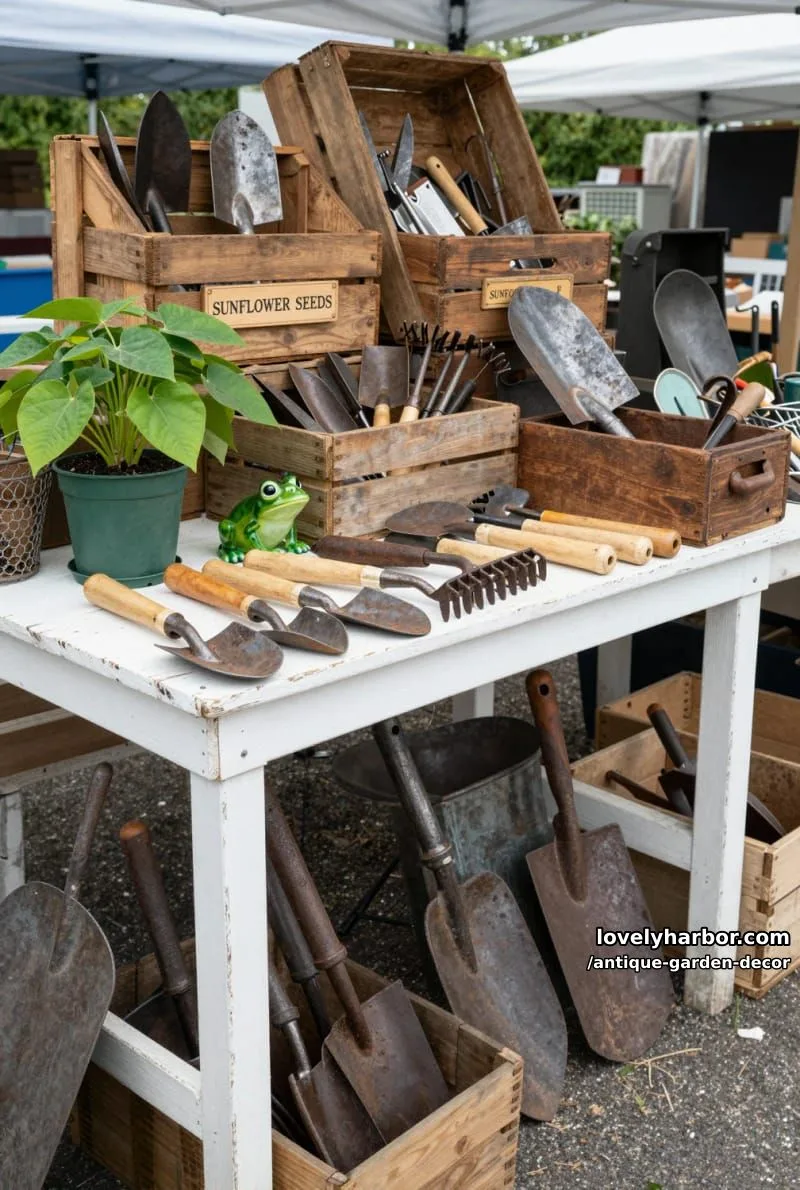
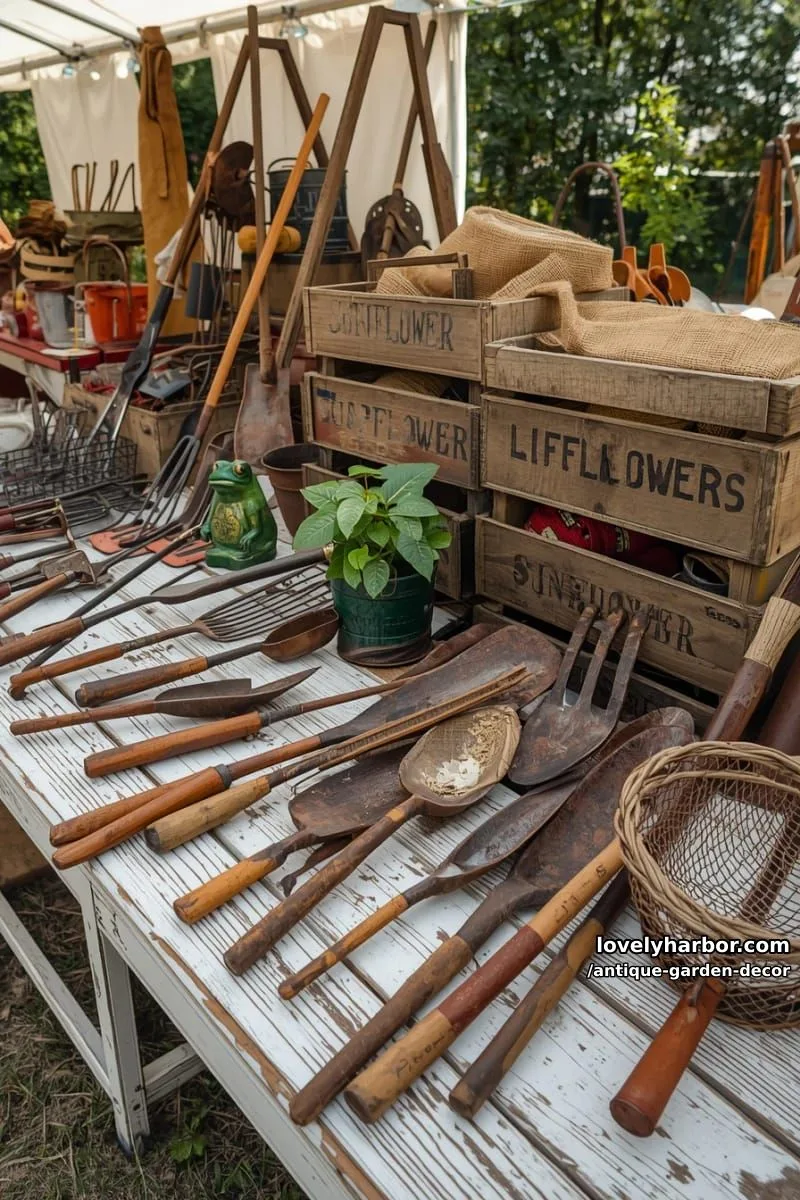
The flea-market table is where this whole look lives or dies, and the trick is to buy material, not objects. A galvanized watering can, a stoneware crock, a cast-iron boot scraper: those were built to sit outside and they will outlast you. The cute thin-tin reproduction caddy will be a rust-lace doily by next spring, and no amount of styling saves it.
Haggling works because most sellers price by the table, not the piece, so offer for three things at once. One warning from my own first season: I overpaid for a “rare” seed tin that turned out to be a 2015 import, so check for a maker’s mark and a real patina (uneven, dirt packed into the crevices) versus the even brown spray “aging” that wipes off on a wet thumb.
Grab these
- Galvanized or zinc tubs, buckets, and watering cans, which barely rust.
- Cast iron and stoneware crocks, heavy enough not to blow over.
- Solid wood crates with through-nails, not staples.
Leave these
- Thin stamped-tin repro signs and caddies, which rust through in a season.
- Chrome or nickel-plated anything, because the plating flakes outdoors.
- Particleboard “vintage” boxes, which swell and delaminate in the first rain.
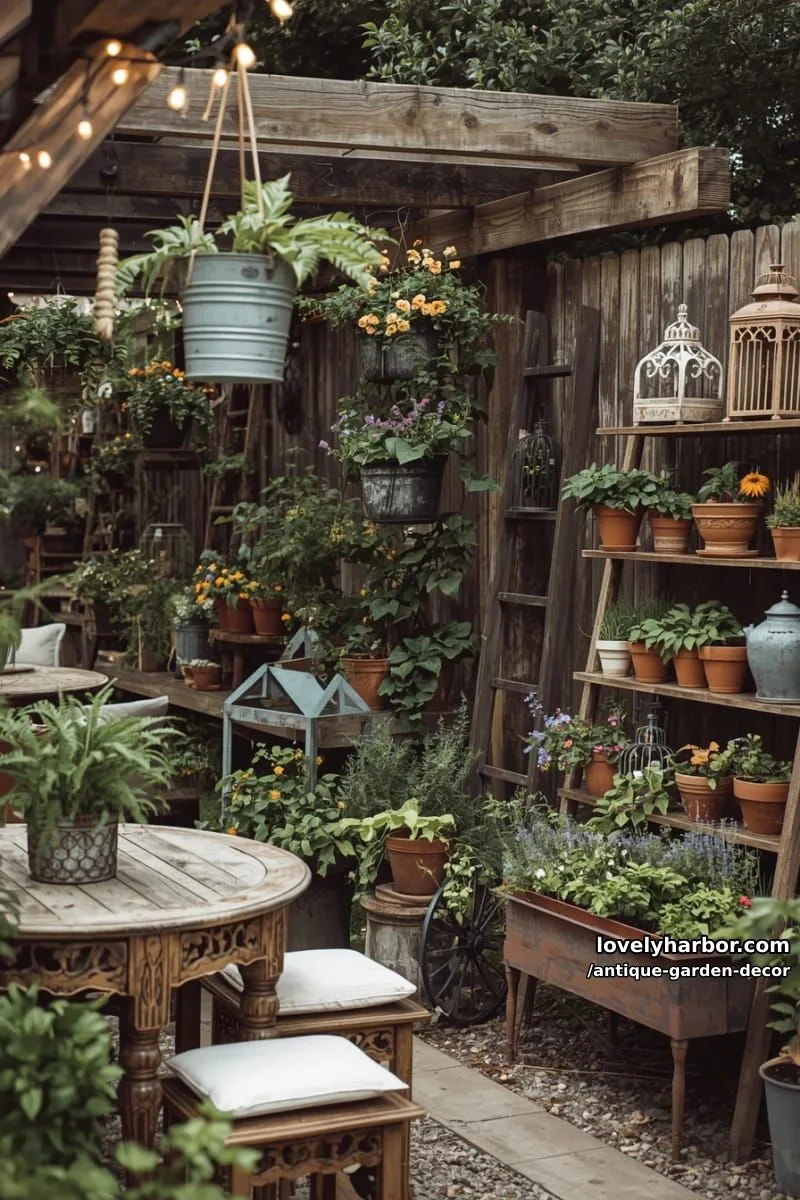
2. Rustic garden with vintage decor, repurposed planters, and lush blooming flowers.
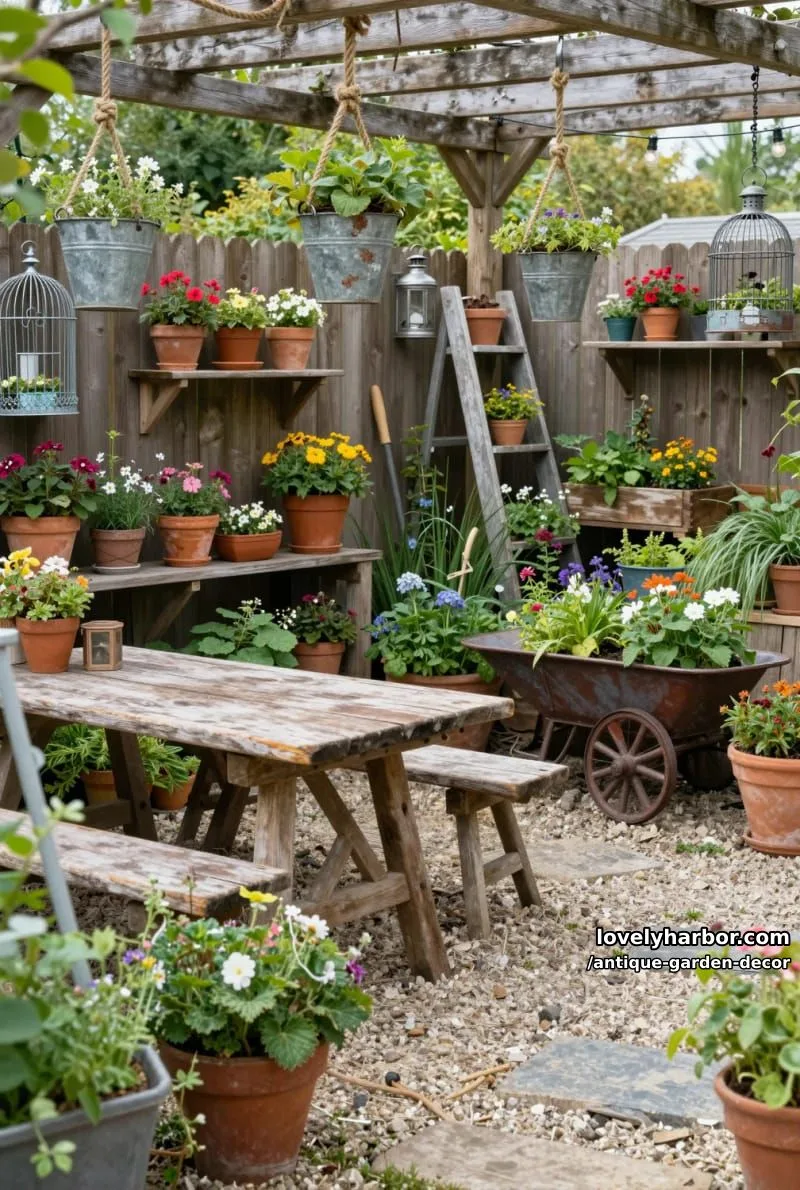
A repurposed planter earns its spot only when the container outlives the planting, which rules out most of what gets pinned. A chipped wheelbarrow of marigolds photographs well, sure, but a steel barrow with no exit for water holds a swamp and cooks the roots by the second hot week.
The fix is dull and it works: drill the lowest point, or tip the piece so it drains to one corner. Lush blooms spilling over the rim hide the hardware, so set the dramatic, leggy plants at the edge and keep the upright stuff toward the back where the rust shows least.
3. Lush garden path bordered by flowers and antique garden decorations.
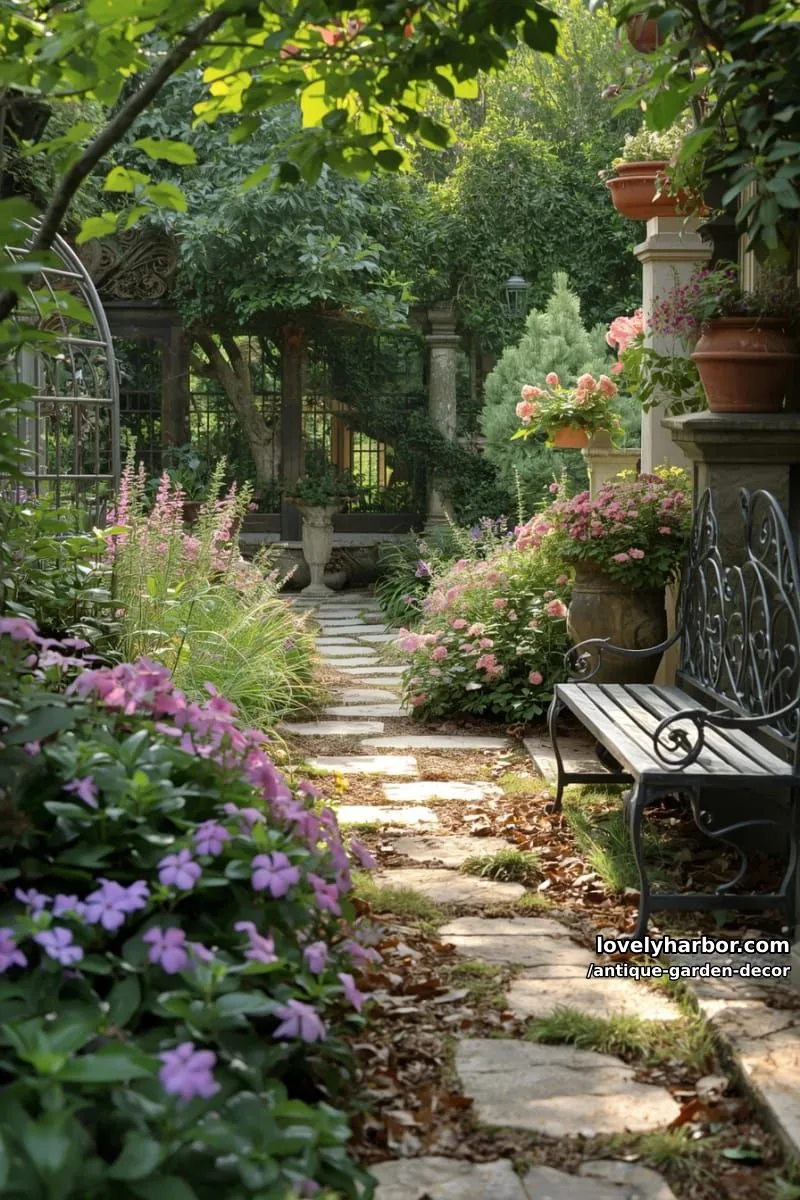
Edging a path with iron urns and lanterns has one catch the photos never show: rust runs. Set a cast-iron urn straight onto pale limestone or poured concrete and within a season you have an orange tide line under it that a pressure washer will not fully lift.
Stand the heavy pieces on a couple inches of gravel or a hidden paver so runoff drains away from the surface you care about, and reapply a coat of paste wax each spring to slow the staining without sealing in the aged look. Save the lighter relics, a worn finial or a one-handled urn, for spots inside the planting where leaves cover the base.
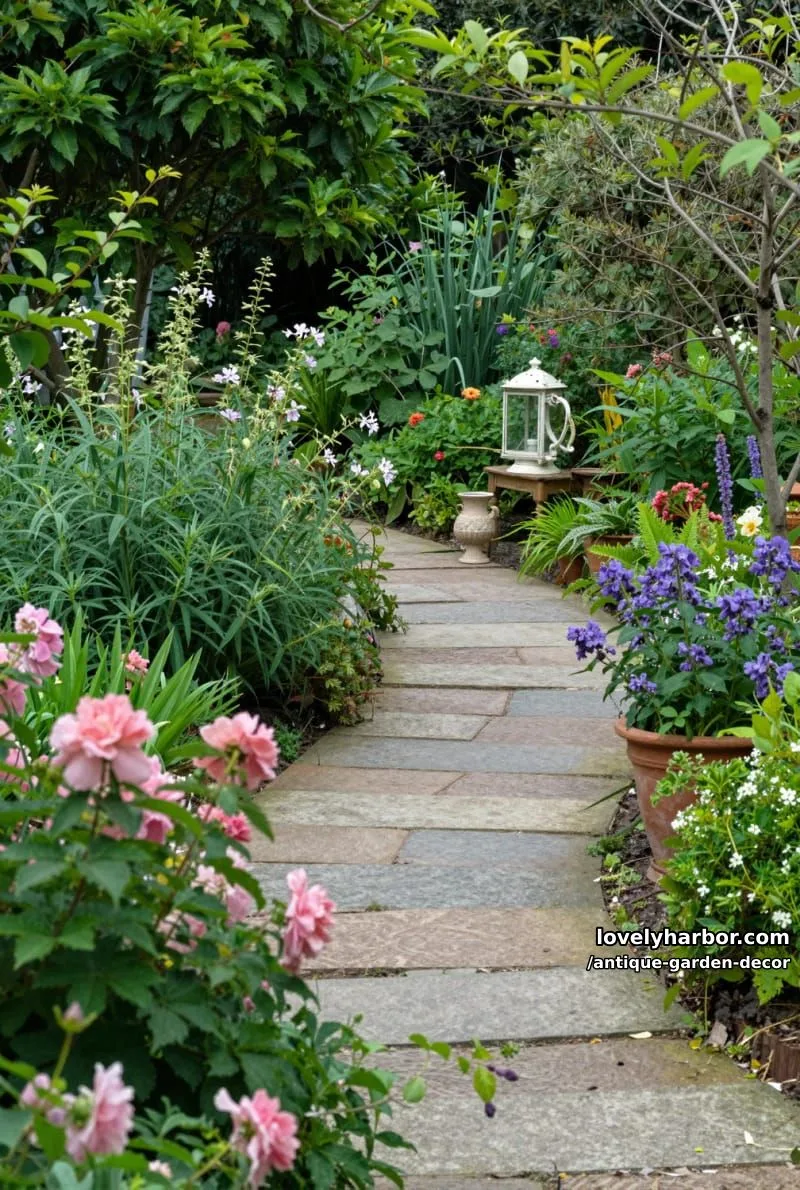
4. Rustic garden with lanterns, wooden planters, and vintage farmhouse accents.
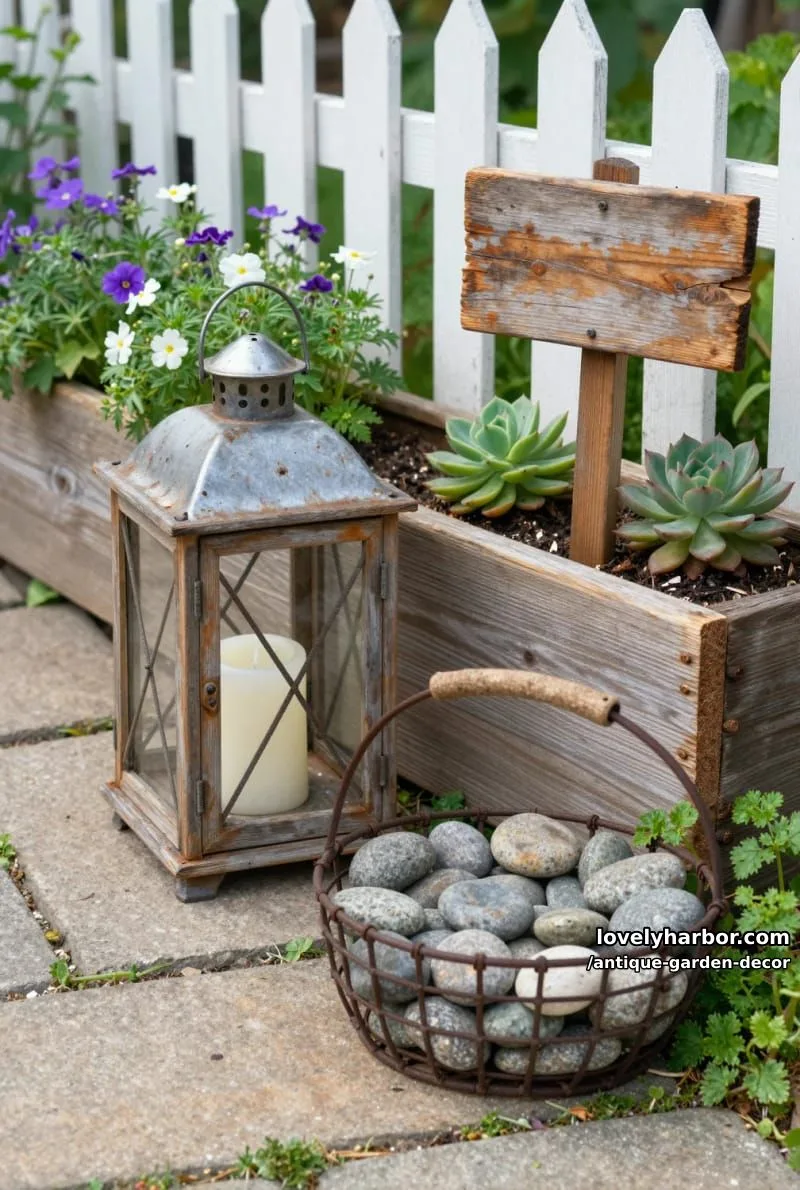
Lanterns carry this look, but solar and real-flame versions send completely different signals, and the metal matters more than either. Powder-coated lanterns shrug off weather; raw iron ones streak and seize at the hinge inside a year unless you wipe them down and put a drop of oil on the joints.
Wooden planters belong on pot feet or two bricks, never flat on soil. The contact line is where rot starts, so lifting a wooden box an inch off the ground buys you years.
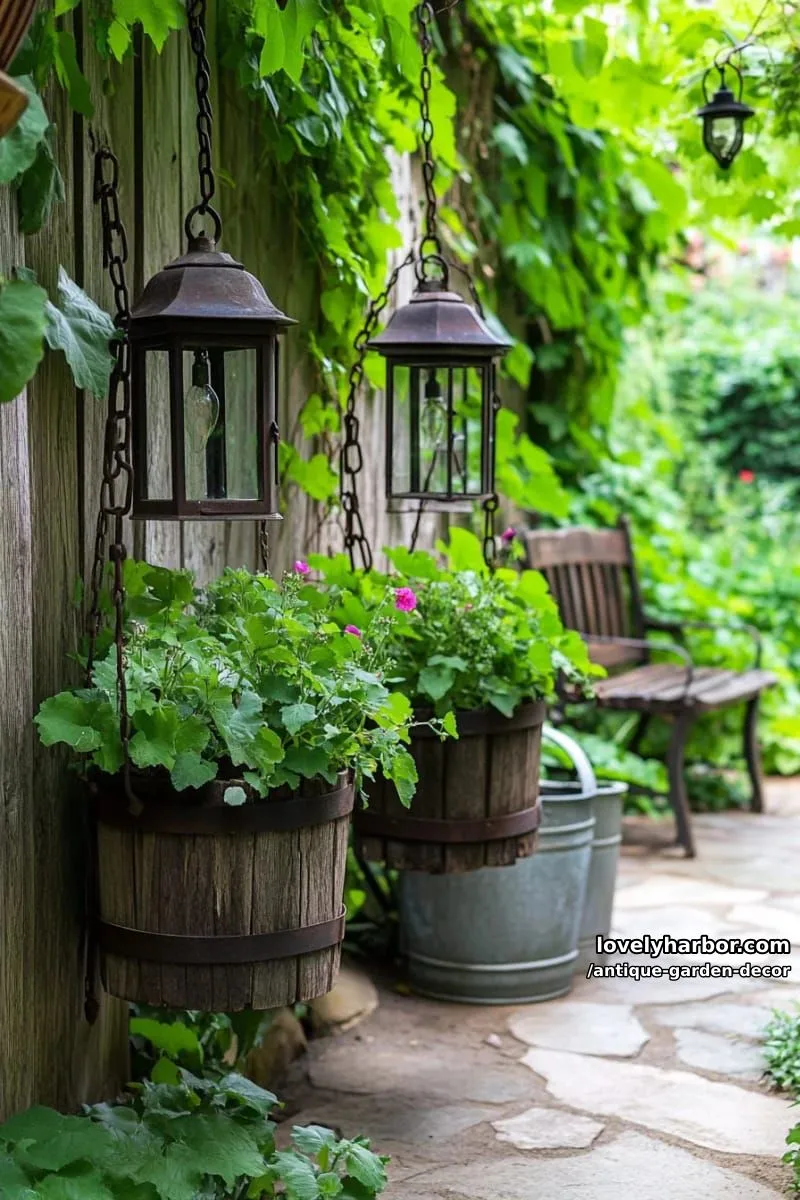
Enamel pots and an old wheelbarrow read as farmhouse without trying, and the chips are the look, not a defect. The catch is the chip edge: where the enamel breaks, bare steel shows and rusts, and the edge is sharp enough to catch a knuckle, so file the worst ones flat.
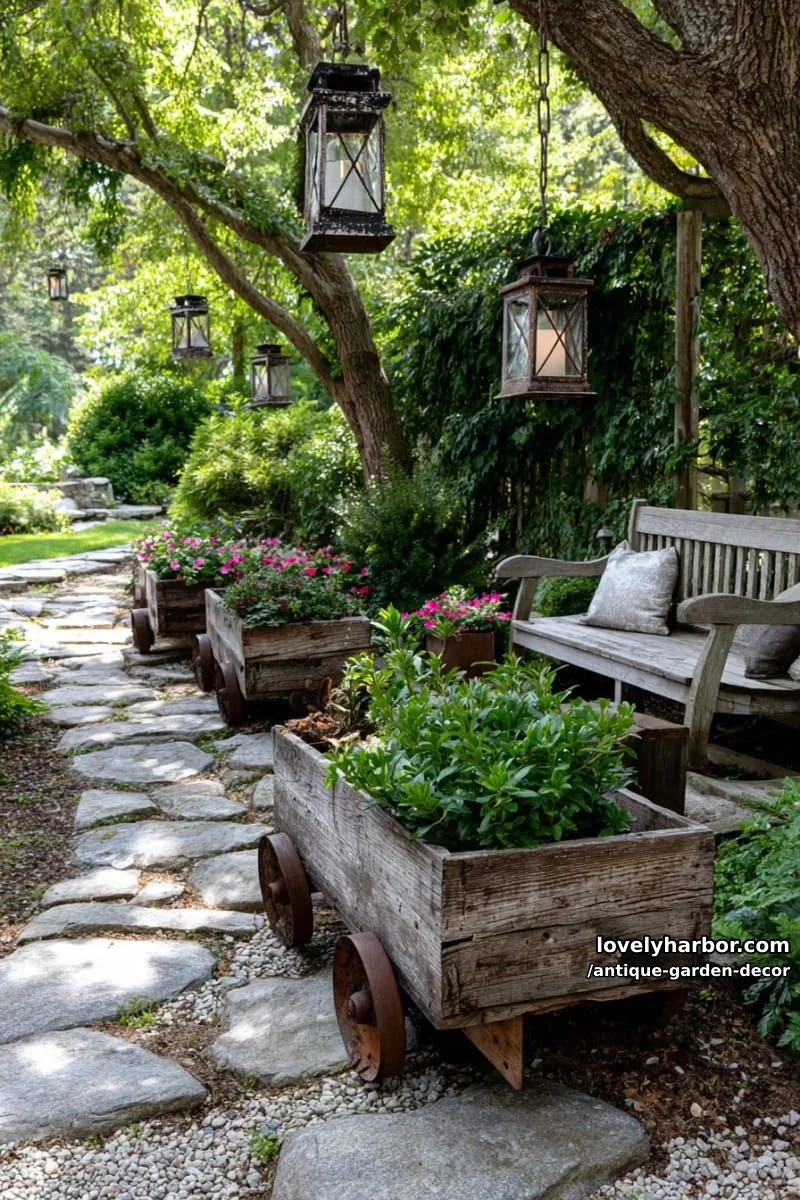
5. Rustic garden with creative vintage planters using teacups, ladders, and colanders.
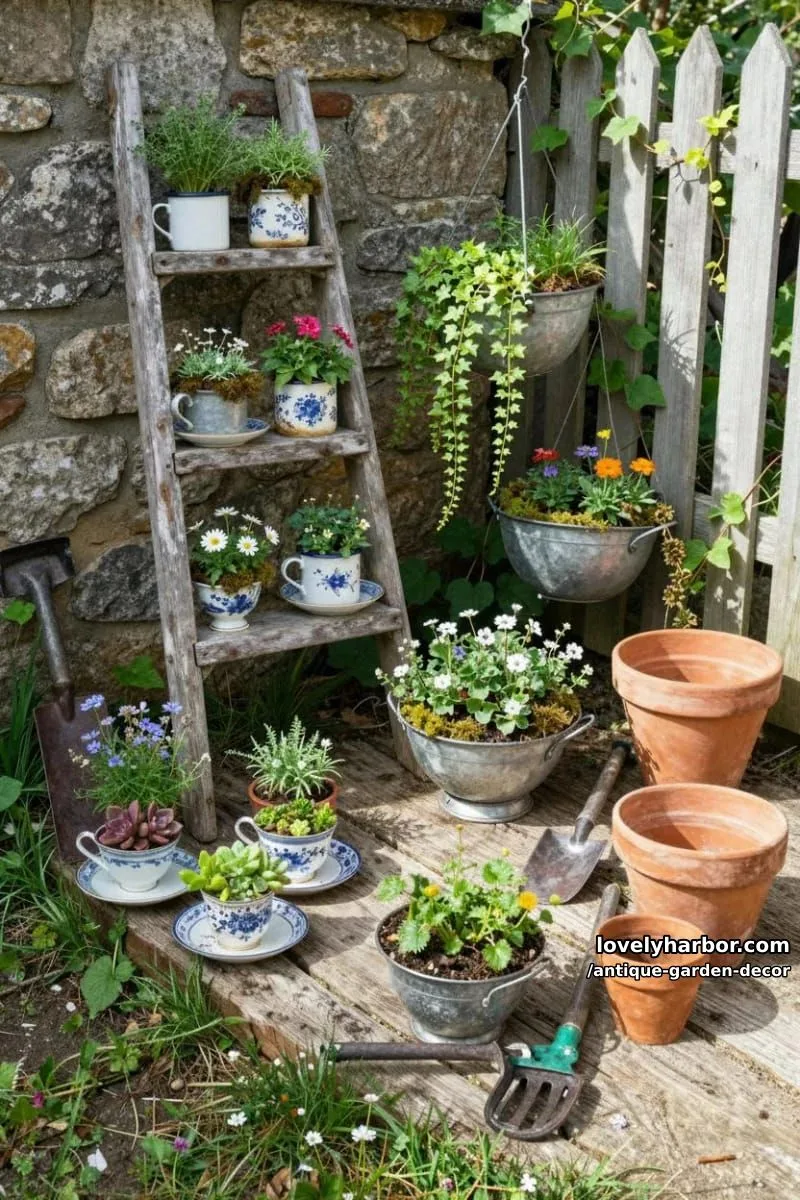
A ladder staged with teacups and colanders is one of the most pinned and most disappointing ideas on this list, because the teacup holds almost no soil and dries out by noon. It works if you treat it as a display you refresh, not a self-sufficient garden: succulents and sedum in the cups, herbs you cut down constantly, nothing that wants steady water.
Colanders are the genuinely smart piece here, since the holes are drainage you didn’t have to drill, which is perfect for trailing plants. Lean the ladder at an angle and wedge it so it can’t walk forward in a breeze. Skip the cheap solar fairy lights threaded through the rungs; most die over their first winter and you will be restringing them in March.
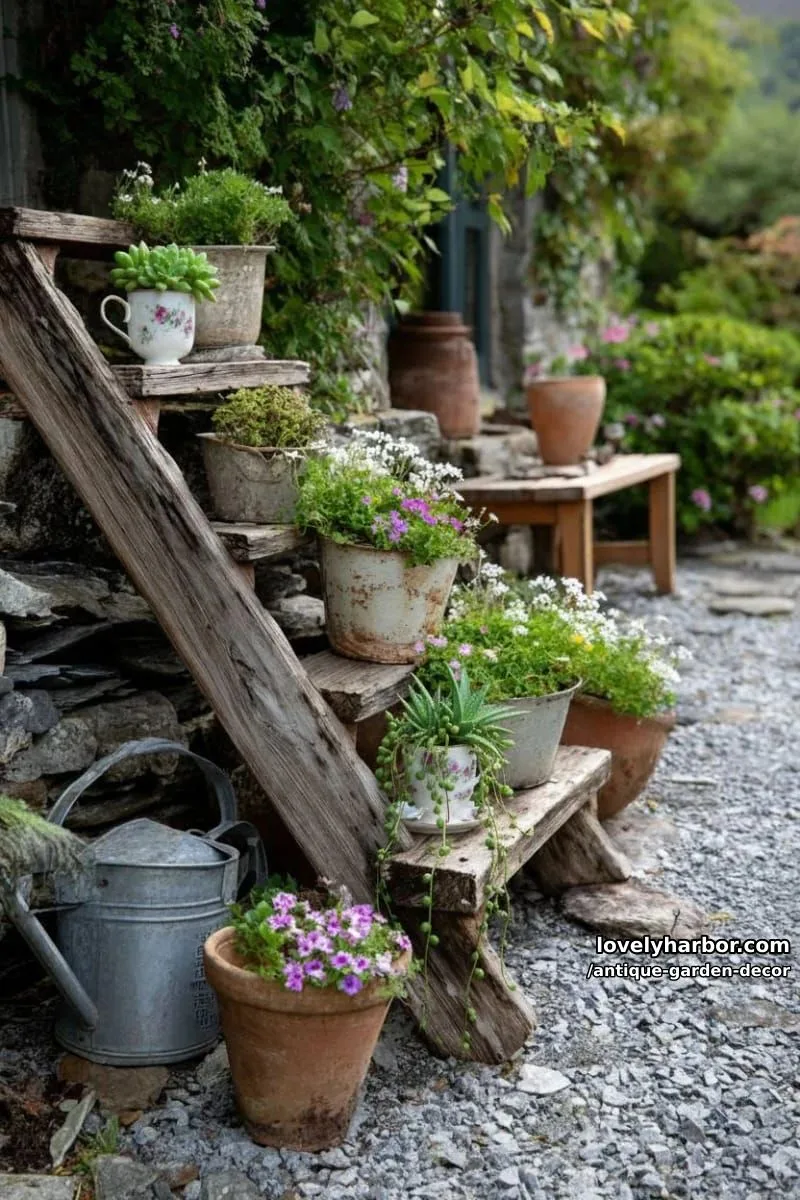
6. Outdoor scene with upcycled metal planters, barrels, and rustic wood textures.
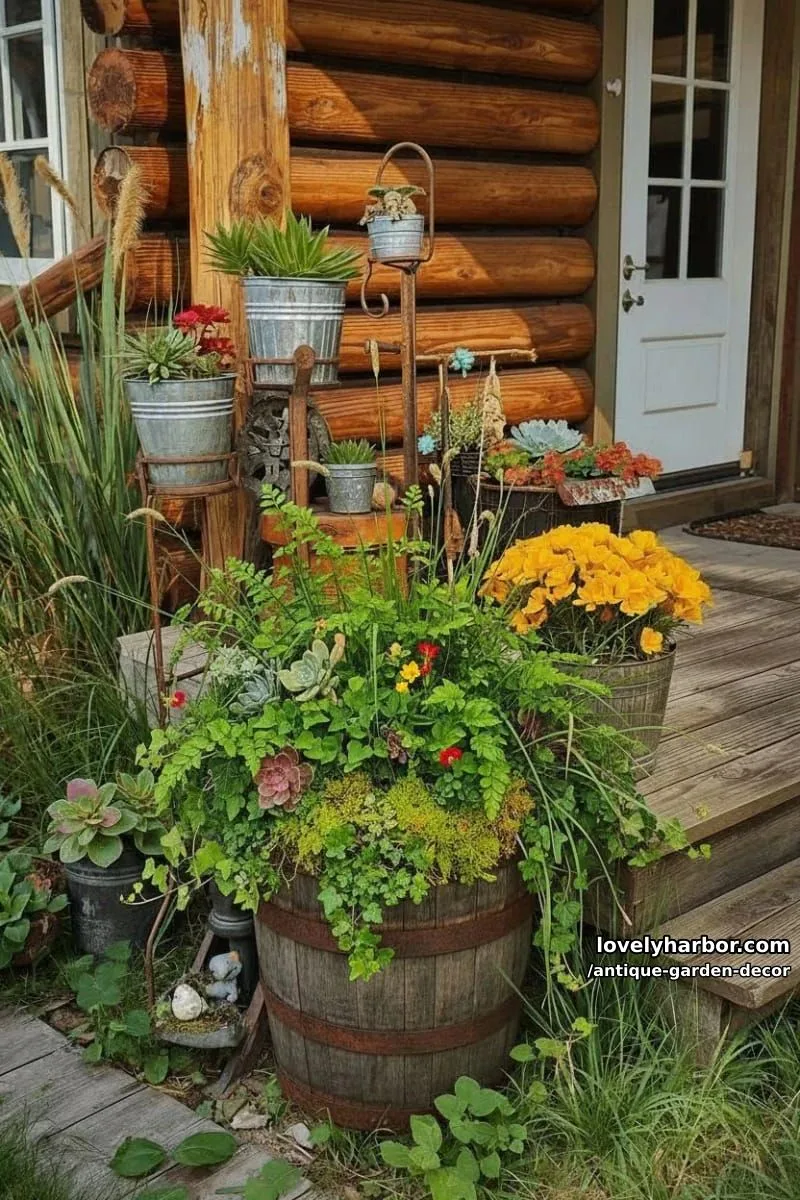
Old milk cans and barrels read as the real thing because they were, which is also why they fight you as planters. Mix them with a weathered bench or a stack of crates and the corner looks like it grew there over decades rather than arriving in one trip from the garden center.
A sealed can or barrel with no exit for water is a bucket, and roots sitting in trapped water rot in days, not weeks. Drill three or four holes in the lowest point with a metal bit, add an inch of gravel, then a scrap of landscape fabric so soil doesn’t wash down and clog them. If the piece is too good to drill, hide a plain nursery pot inside and lift that out to water.
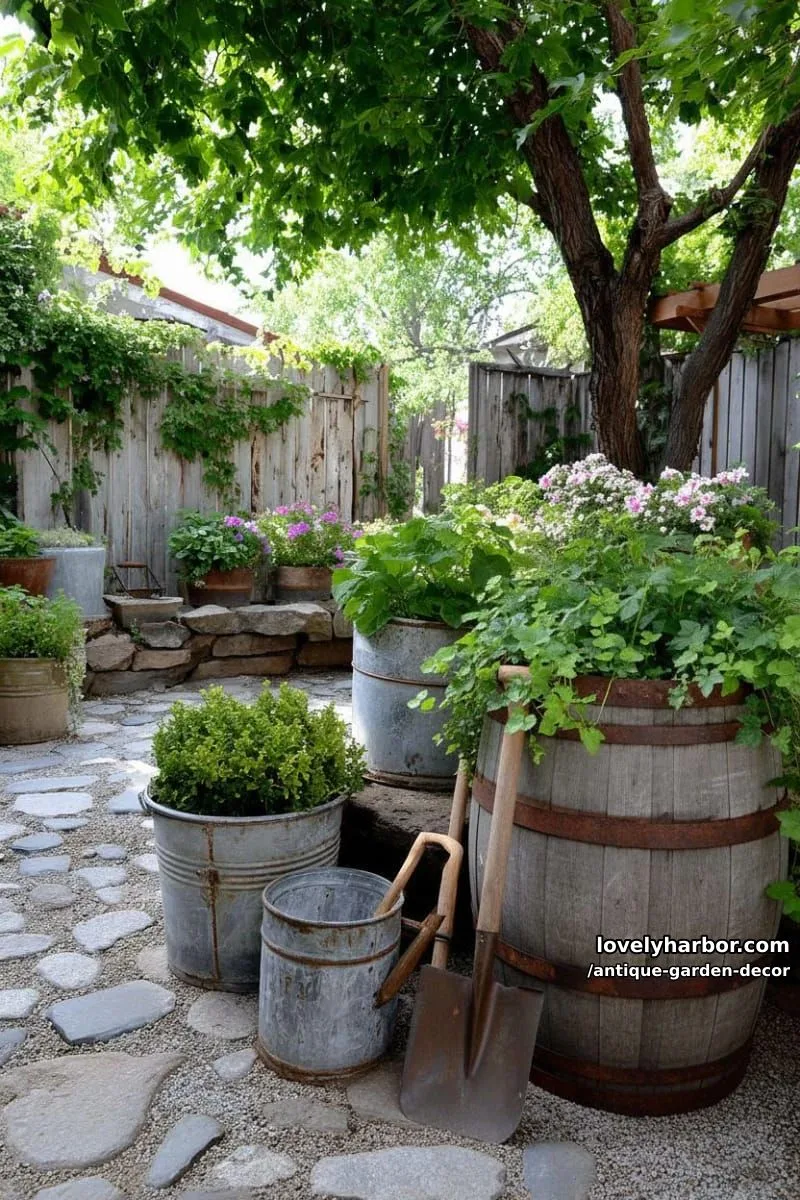
One thing I can’t fully explain: a seventy-year-old galvanized wash tub outlasts a five-year-old steel planter from the store, no contest. The zinc coating clearly does something the new stuff doesn’t, so when you see an old galvanized tub or can, that’s the one to carry home.
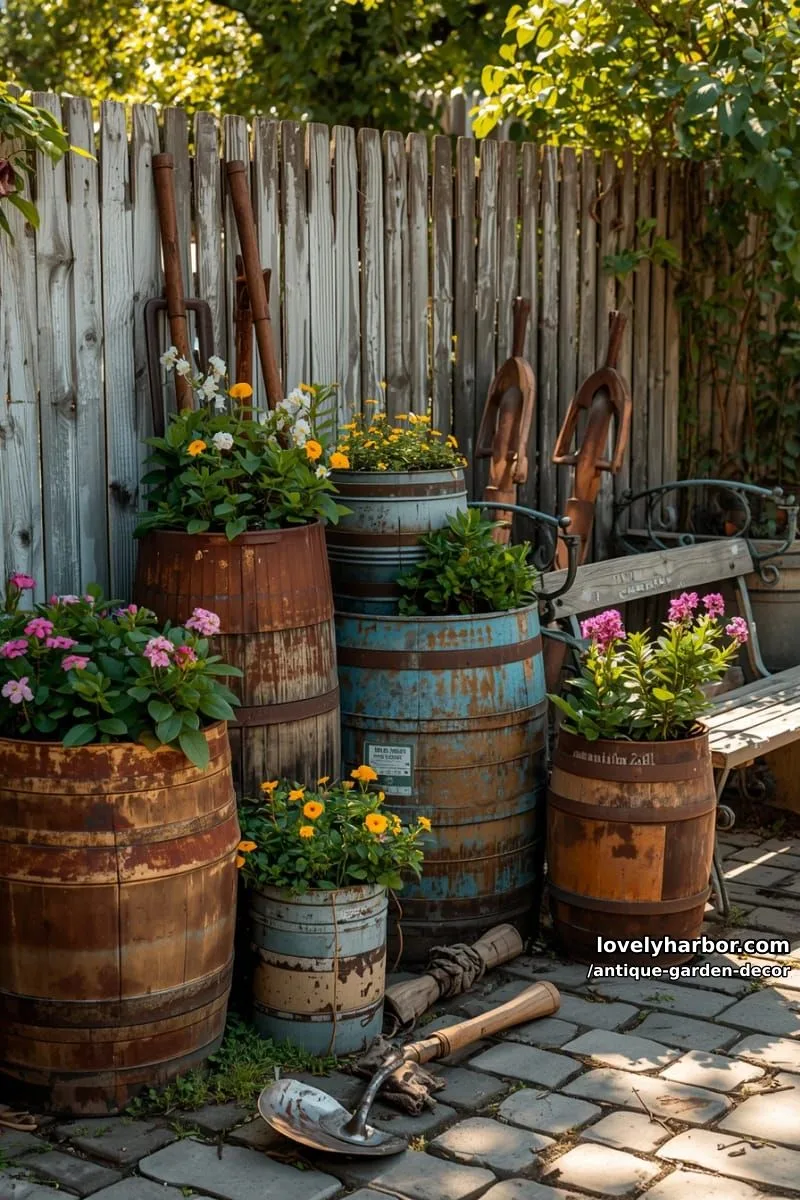
7. Rustic corner featuring repurposed metal objects and lush green plants.
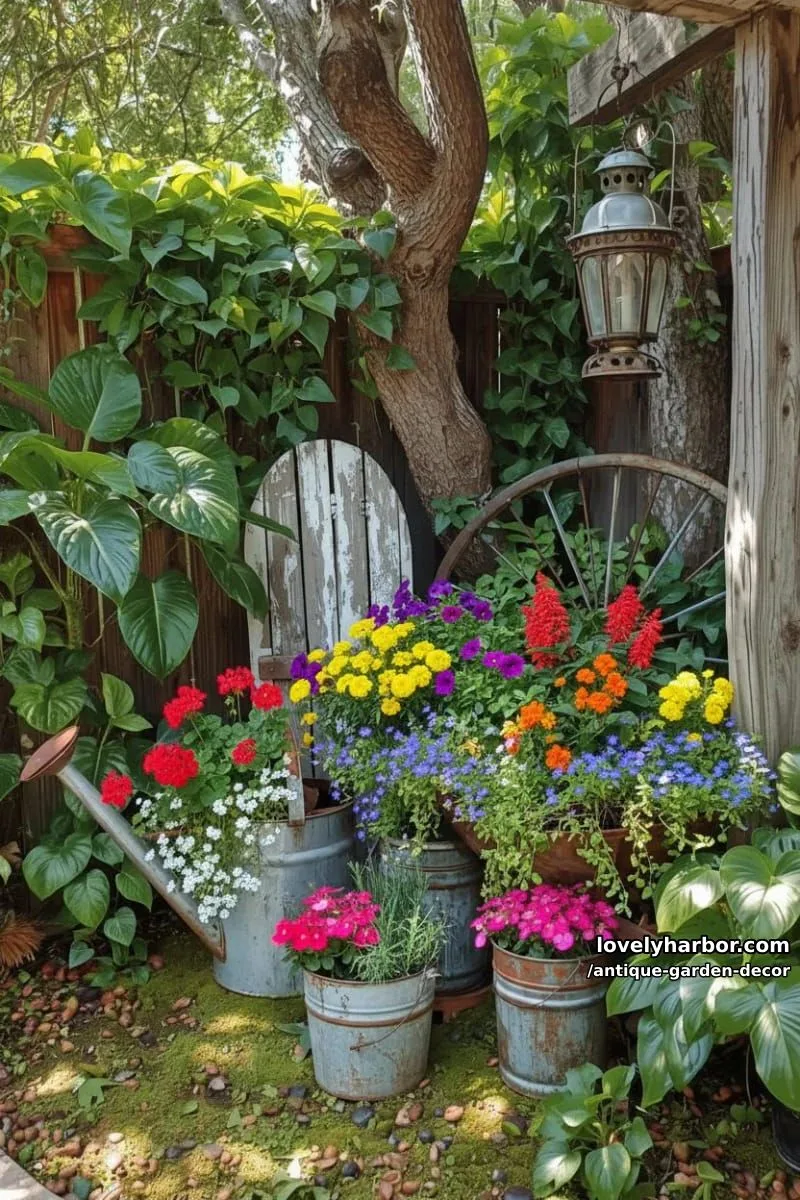
A rusted watering can next to a stand of ferns works because ferns want the exact shady, damp conditions that keep old metal from baking. Pair the two and the corner reads timeless without any effort beyond placement.
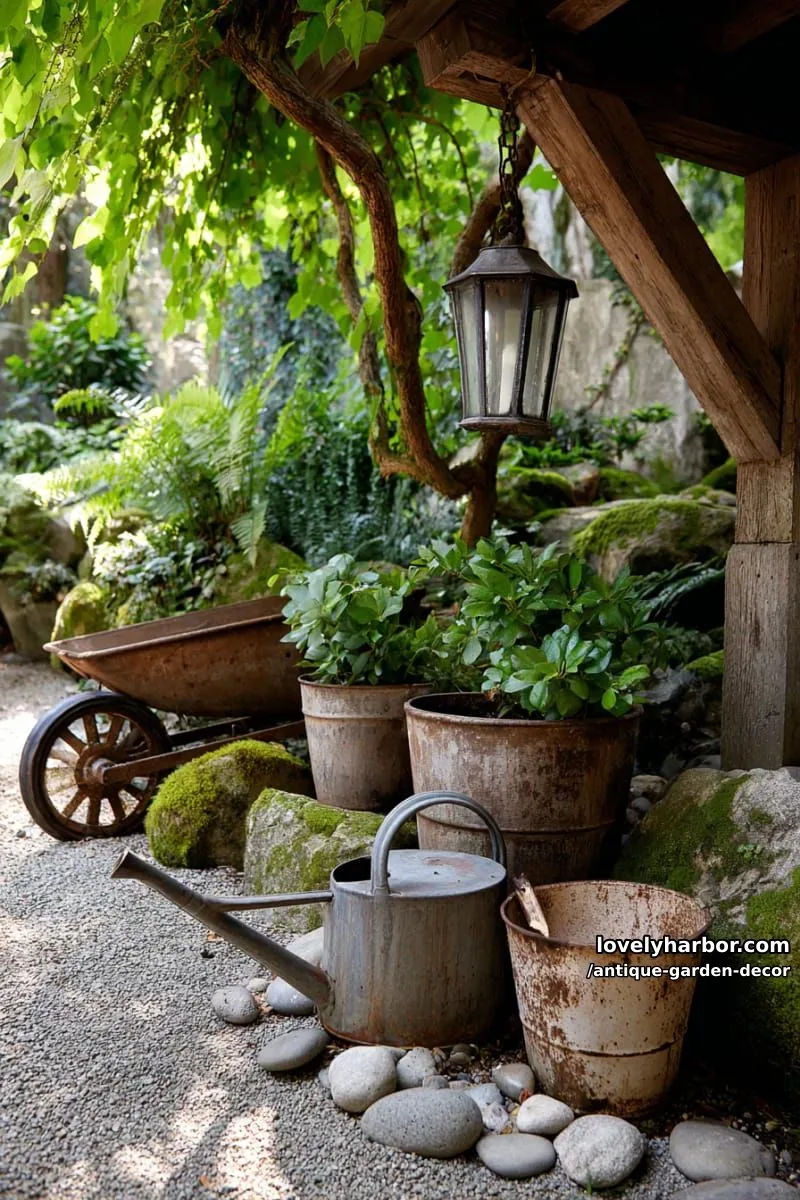
Three things make this corner hold up: dappled or north-facing light so the metal doesn’t roast; a moisture-loving understory like ferns or hostas that thrives in that spot anyway; and pieces heavy enough not to topple in a storm. The one mistake to avoid is putting dark metal in full afternoon sun, where it gets hot enough to scorch shallow roots through the wall of the pot; if the leaves nearest the metal wilt and crisp, move it to the cool side of the bed.
8. Close-up of recycled garden decor using toolbox planters and rusty metal.
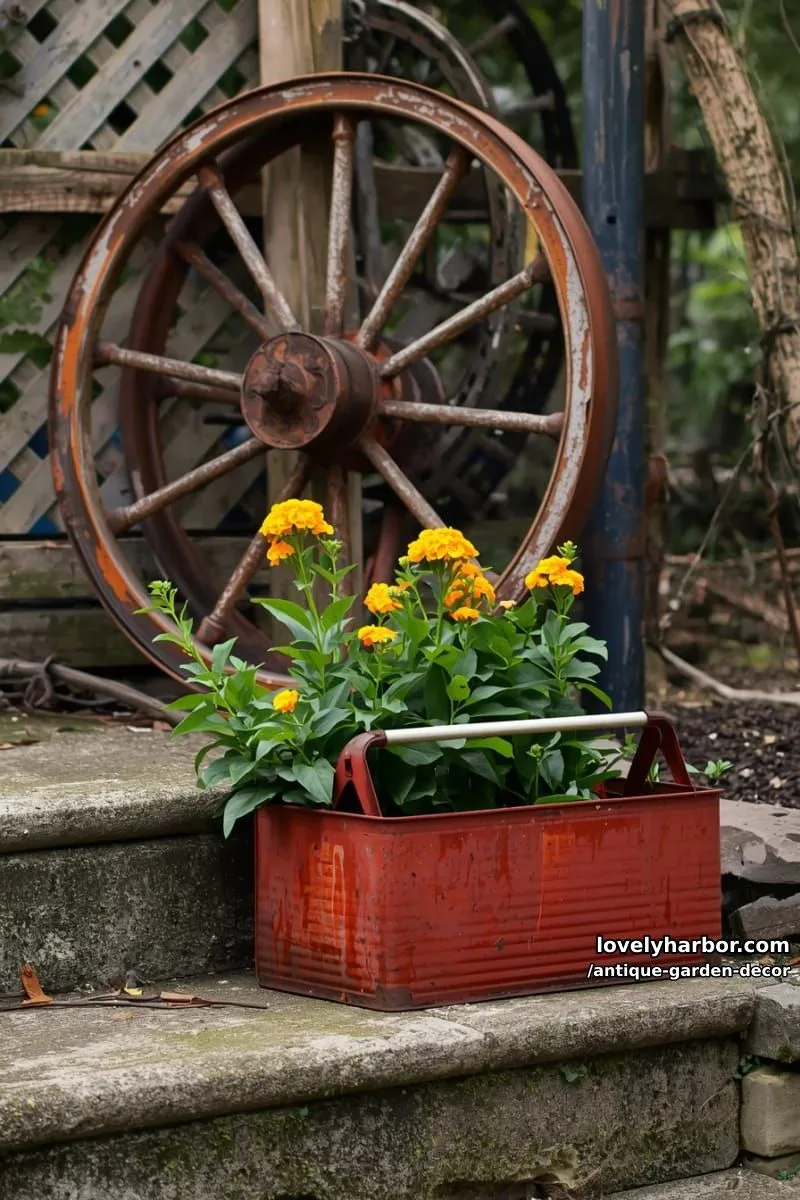
A wooden or metal toolbox makes a good planter because it already has the depth a windowsill pot doesn’t, plus a handle that lets you move it. Before you plant anything, though, look hard at the paint.
Anything painted before the late 1970s may be lead paint, so keep edibles out of old painted metal and grow flowers or non-edibles in it instead. Line the inside with landscape fabric, drill the bottom, and the chipped finish and worn handle do the styling for you. Watch the cut edges on rusted steel, because a sharp lip on an old toolbox is a fast way to ruin an afternoon (ask me how I know).
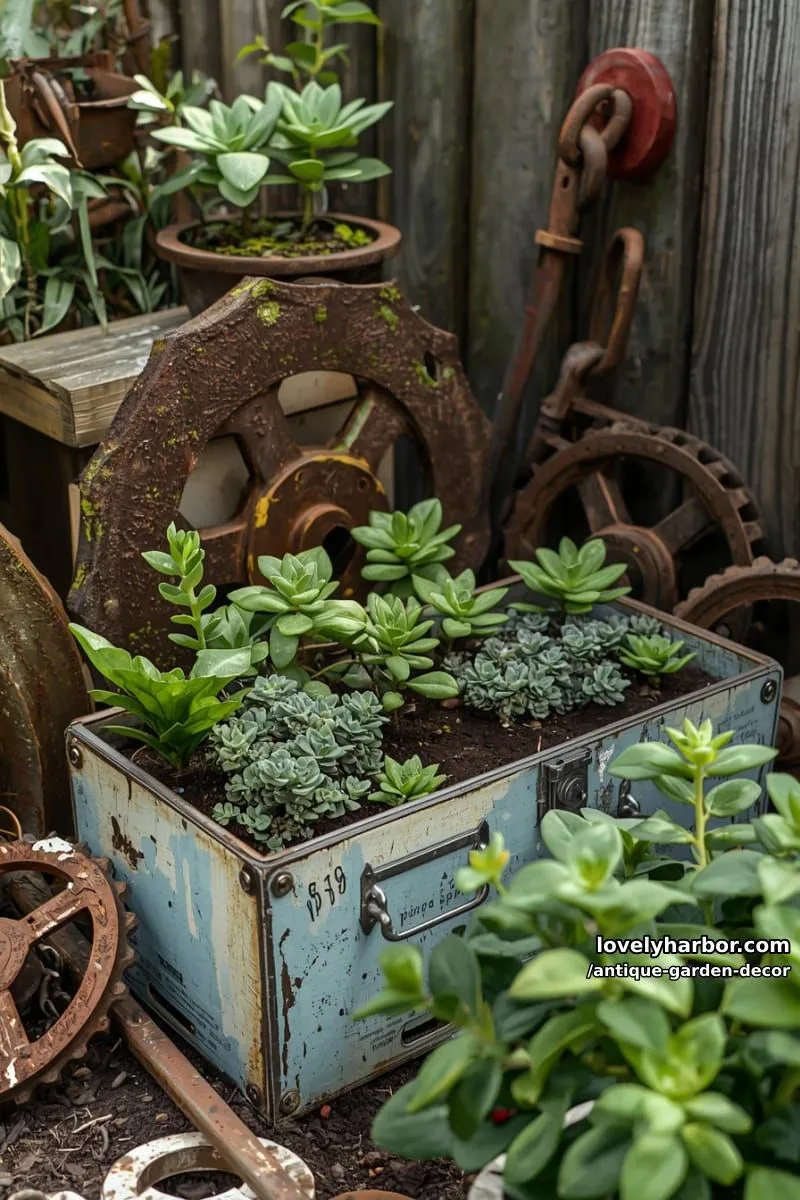
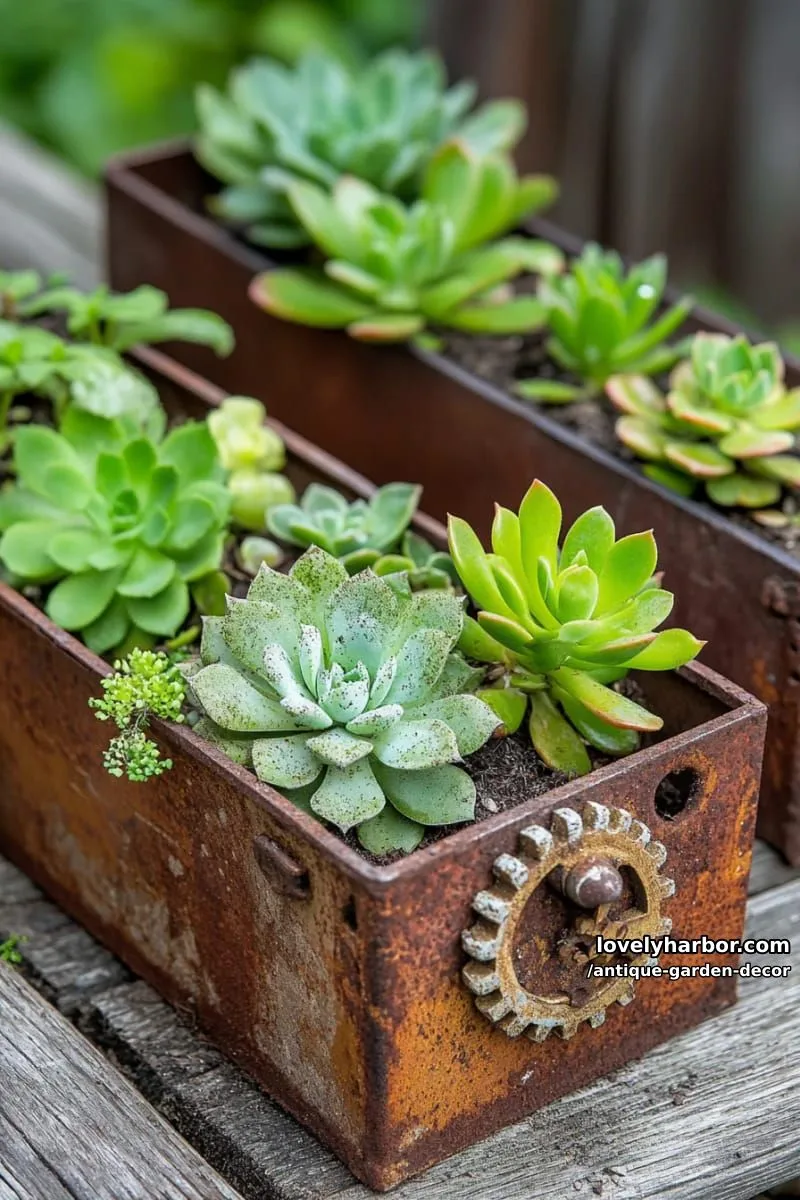
Loose rusty bits, old gears and buckets and brackets, do work as accents, but a pile of them just reads as a pile. Pick one or two and give them room, and let the greenery climb through rather than smothering everything in objects.
9. Lush garden with antique mirrors reflecting greenery and forest views.
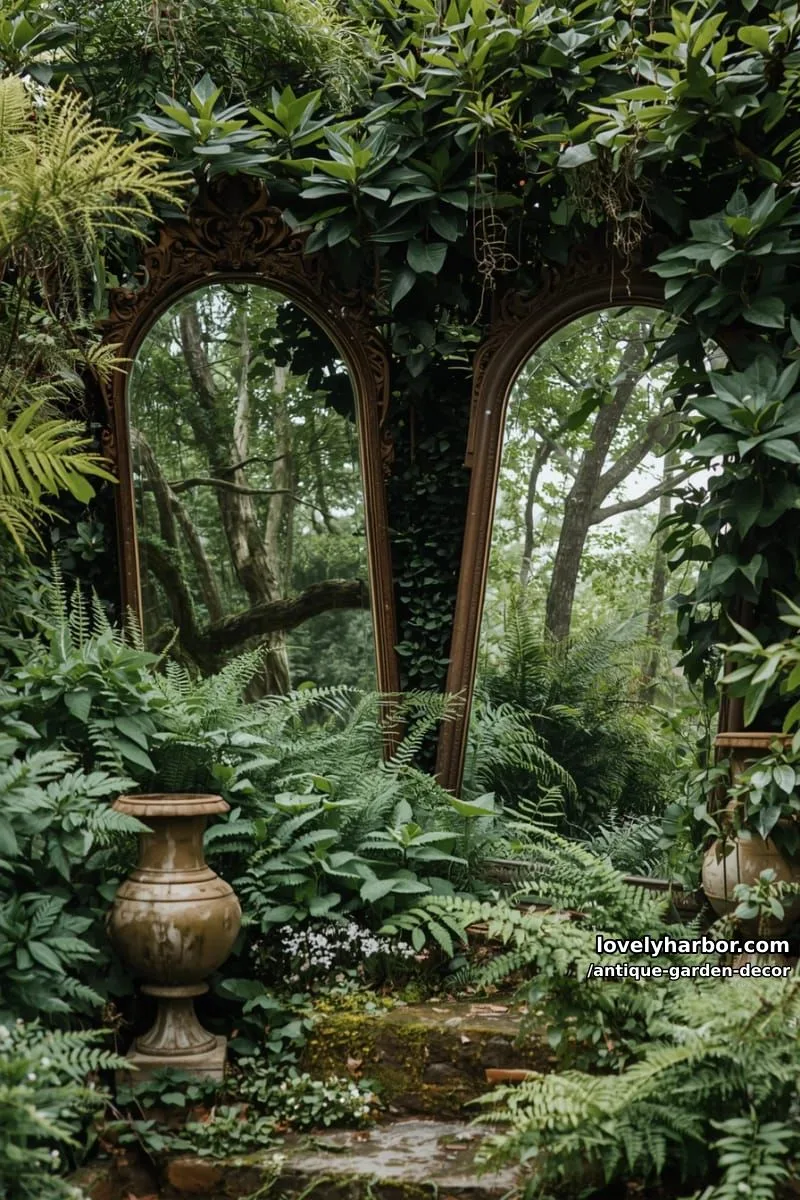
An antique mirror angled into a planting genuinely doubles the depth of a small garden, and it’s the cheapest trick on this list. A tarnished or chipped frame reads better outdoors than a clean one, so don’t restore it.
People email asking whether the bird-strike problem is overblown. It isn’t. I leaned a mirror in a border one June and spent the season finding dazed robins on the grass underneath it.
Angle the glass so it reflects foliage and the ground instead of open sky, mount it flat against a fence or wall rather than standing it free, and let a climbing plant break up the reflection across one corner. Done that way it stays a depth trick and stops being a window birds keep flying into.
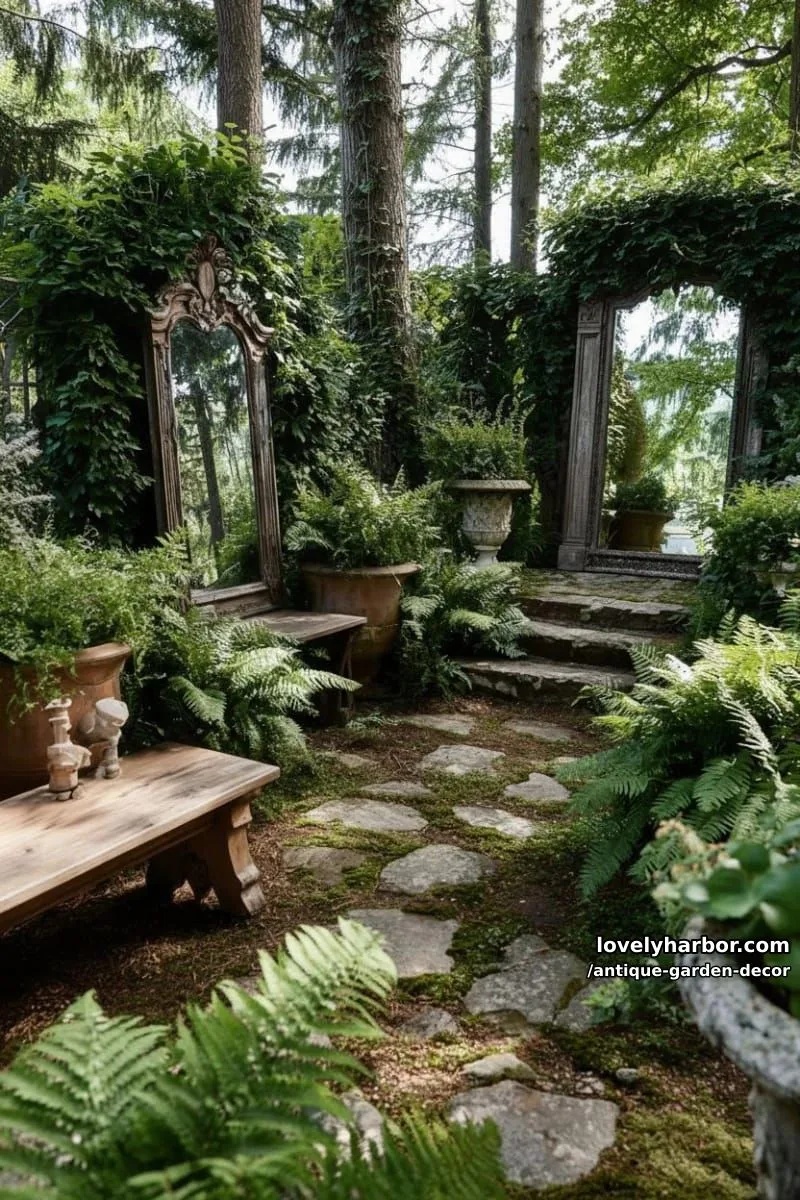
10. Vintage planters: old milk can, wooden crates, and bench among foliage.
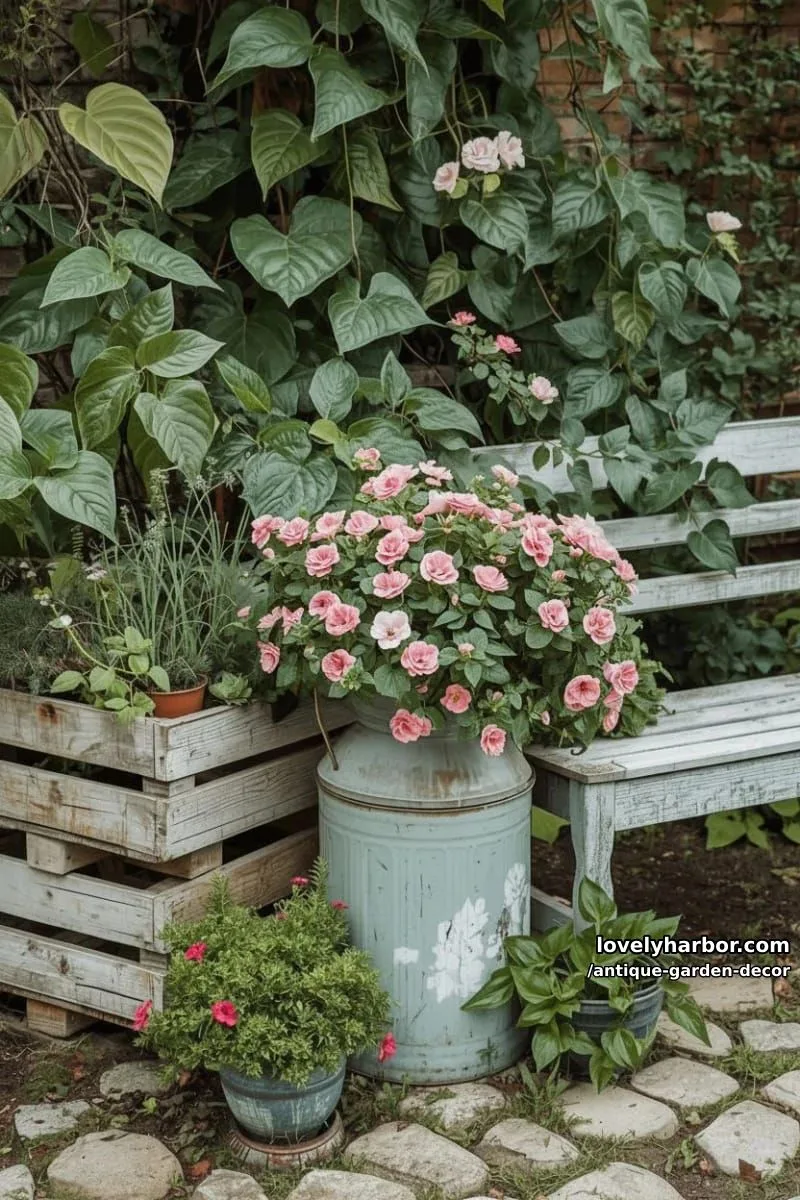
The old milk can is the piece everyone wants to plant and the one that fights it hardest: too narrow at the neck, too deep to drain, no easy way to water what’s down in there. Use it as a stand, a doorway prop, or a sleeve for a nursery pot you can lift out, and it stops being a plant-killer.
Wooden crates are the opposite, easy and genuinely useful, as long as you raise them off the ground on a couple of bricks. The bottom slat is always first to rot. A weathered bench tucked under branches then anchors the group and gives you somewhere to set a pot of ferns or a cup of coffee.
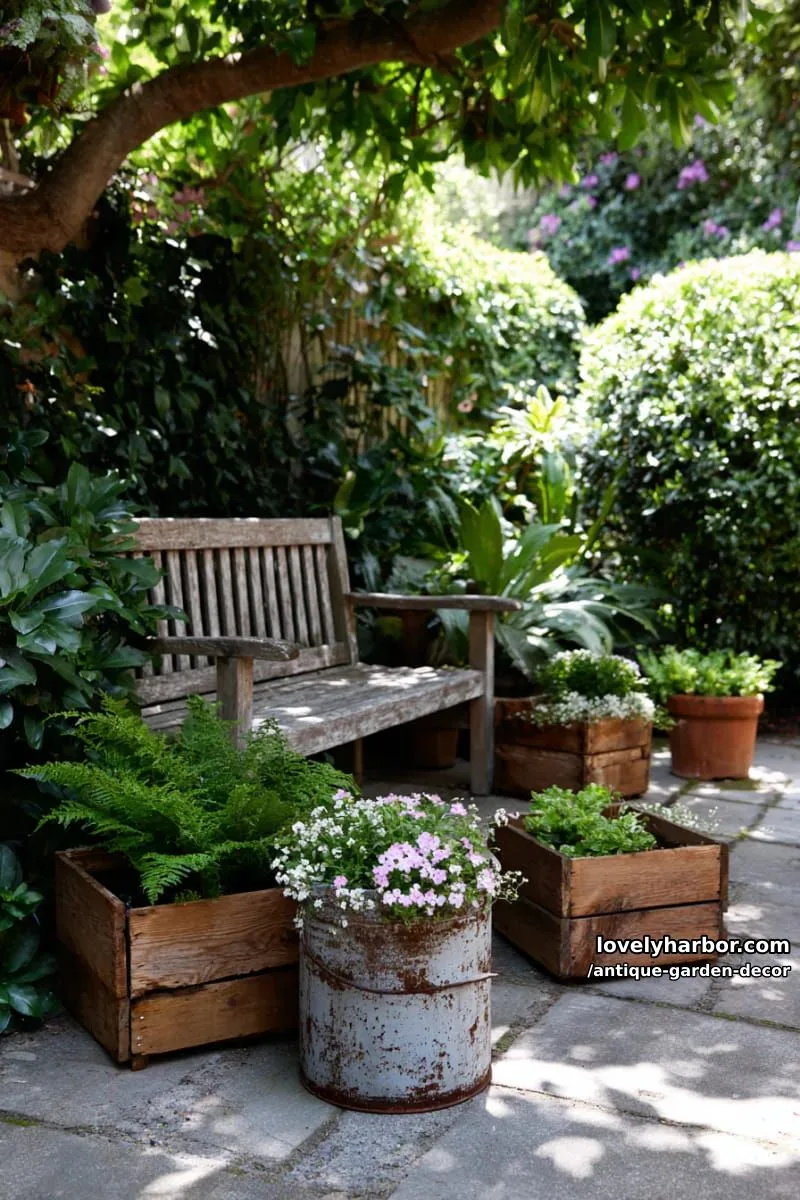
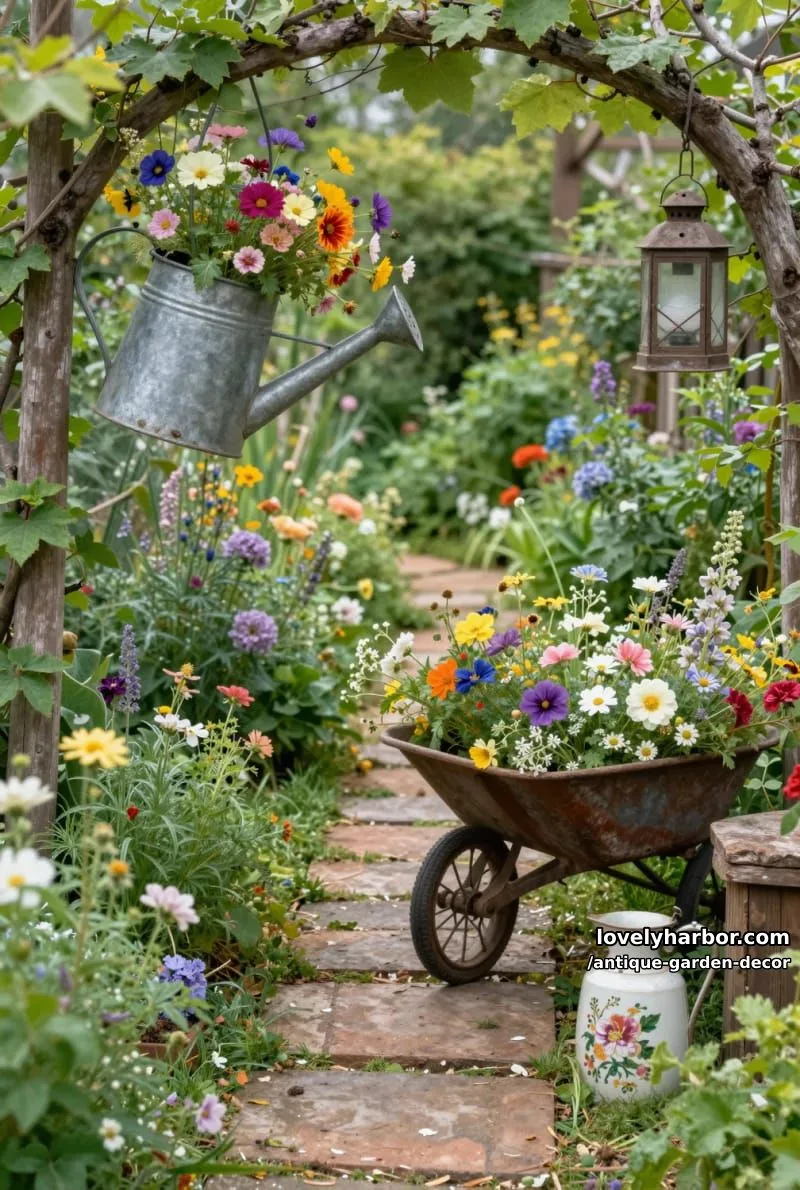
11. Vintage watering can and wheelbarrow overflowing with wildflowers and greenery.
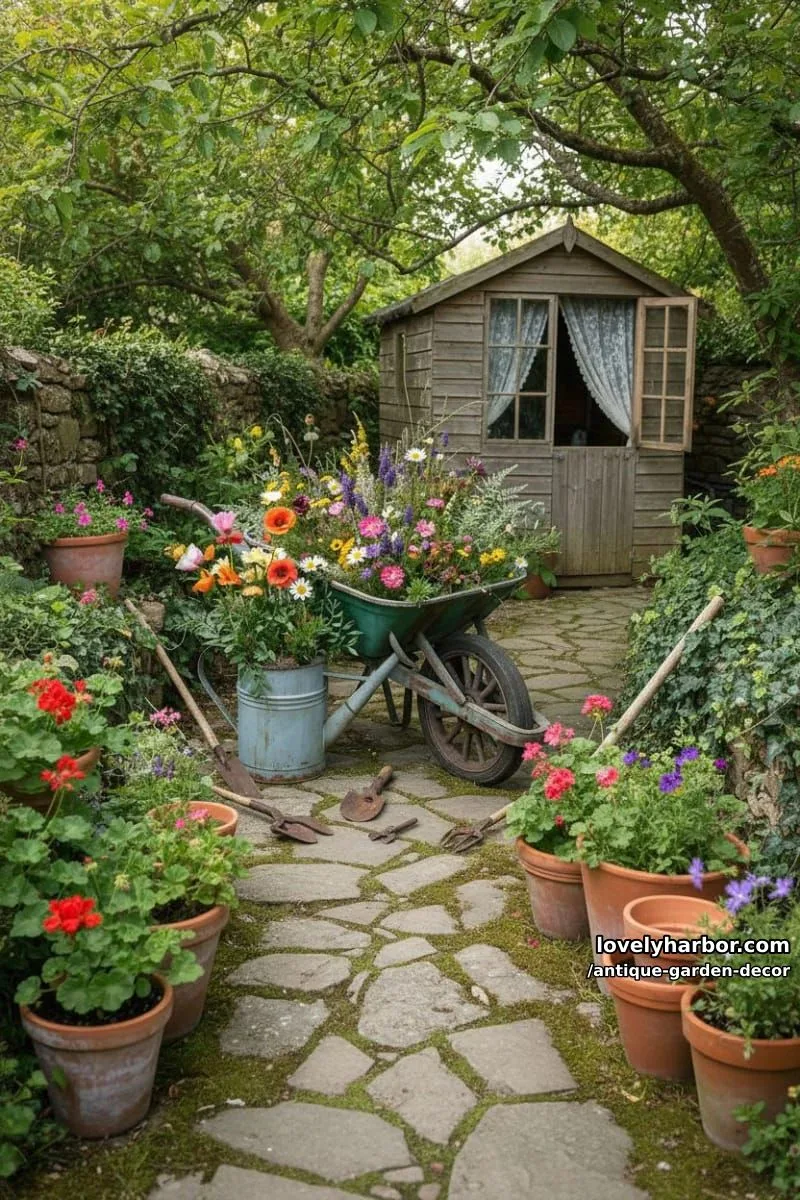
A watering can or wheelbarrow spilling wildflowers is the signature image of this style, and the only thing between the photo and a dead planting is a drain hole. Drill the lowest point of a metal can, or skip drilling and treat the piece as a cachepot, dropping a potted plant inside, watering it at the sink, and setting it back once it drains.
Keep the arrangement loose and a little overgrown. A tightly packed can looks like a florist’s centerpiece, not something that has been sitting in the yard since spring, and the whole point is the second look.
12. Shaded garden corner with antique mirrors, artwork, and vintage table decor.
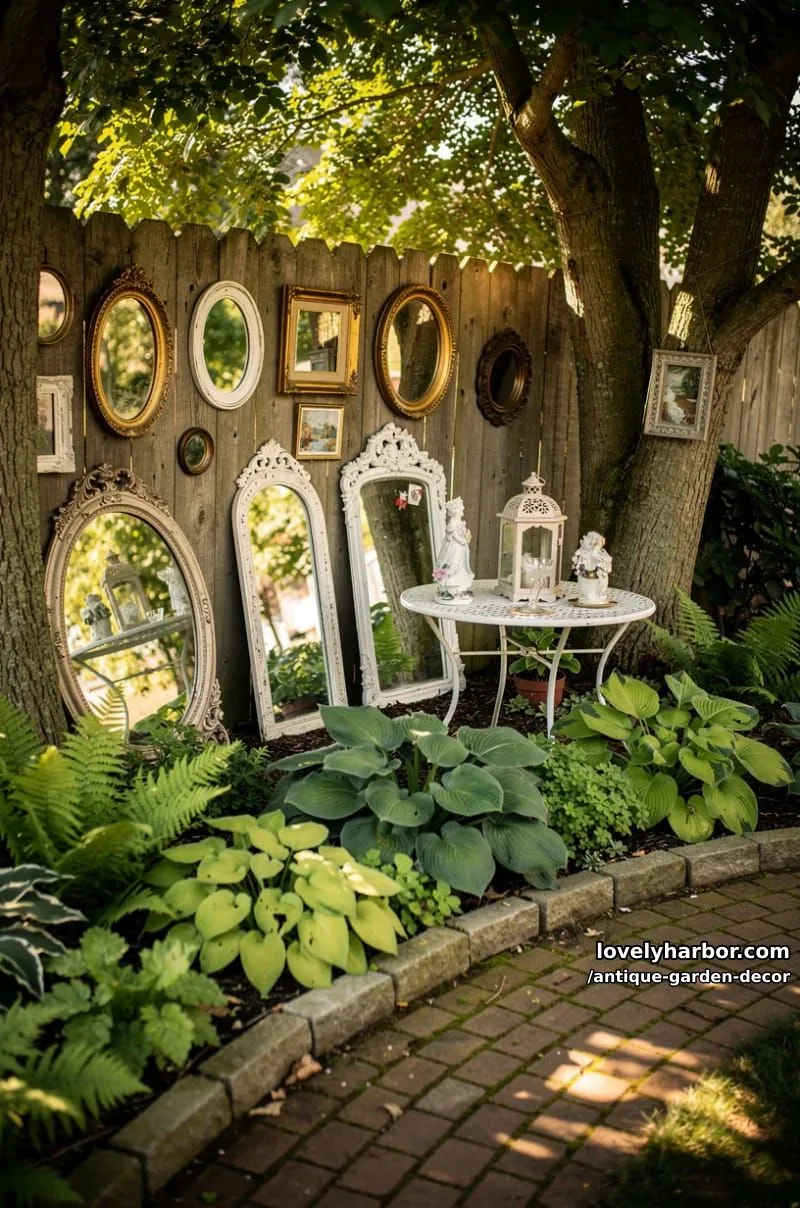
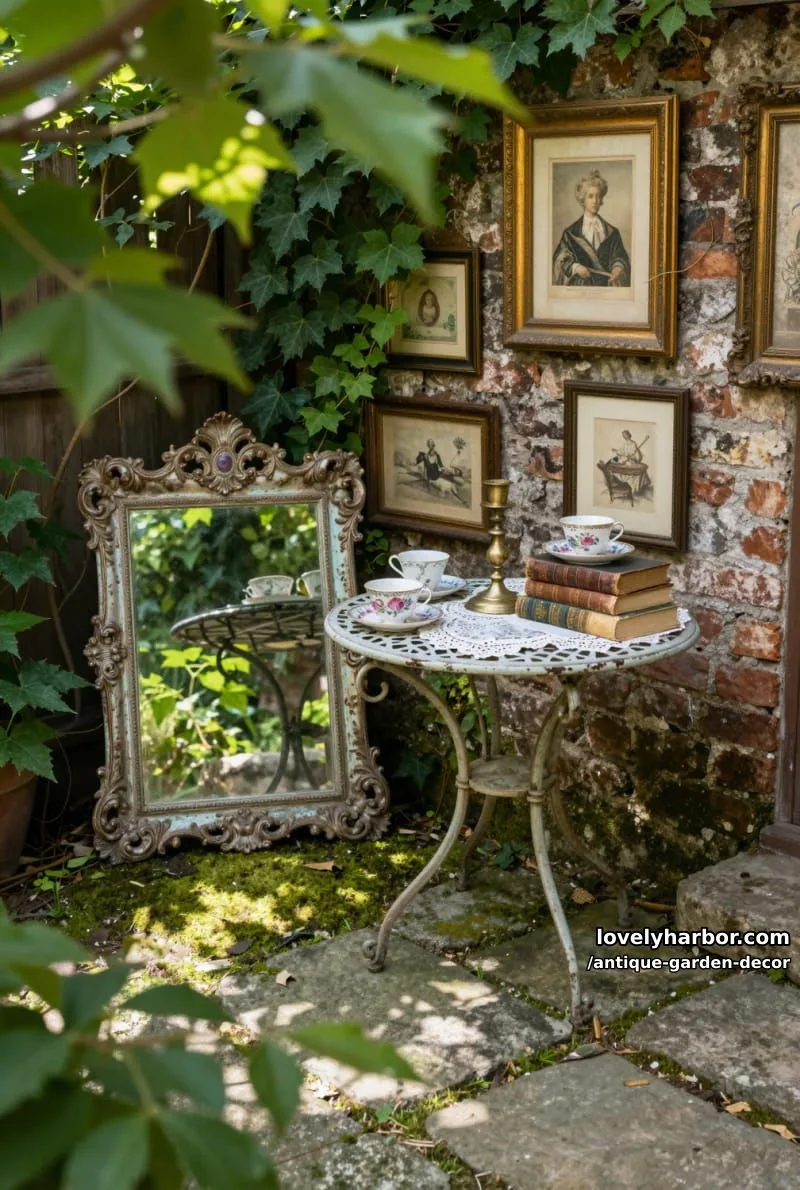
Outdoor “artwork” fails on substrate, not subject: paper prints and MDF plaques pulp in the first heavy dew. Hang things that were made to live outside, an enamel advertising sign, a slate, a galvanized tray, a piece of marine plywood, and they hold for years.
A mirror in a shaded corner is the easy win, because shade kills the glare and heat problems that open sun creates, and dappled light bouncing off the glass makes a dim spot read deeper than it is. Group a few mismatched pieces at different heights instead of hanging one centered thing; the uneven arrangement is what makes it look collected rather than decorated.
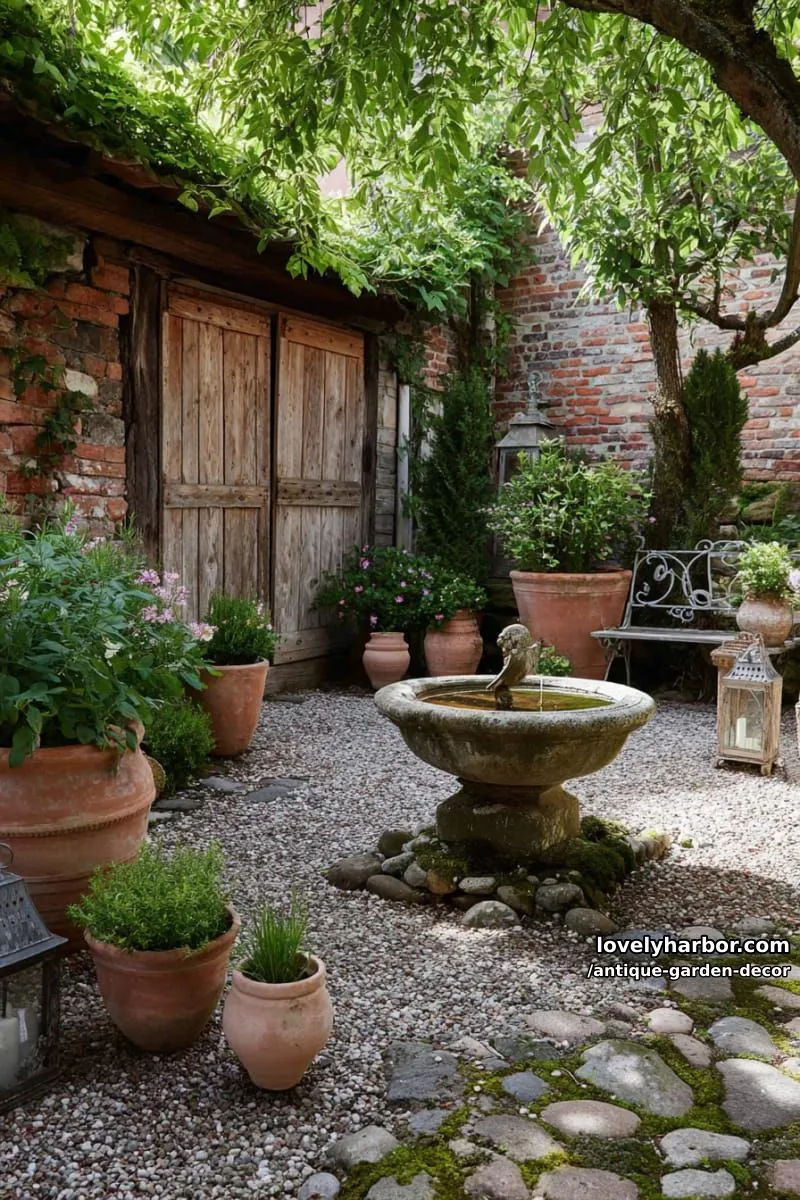
13. Vintage garden with terracotta pots, bird bath, old doors, and classic accents.
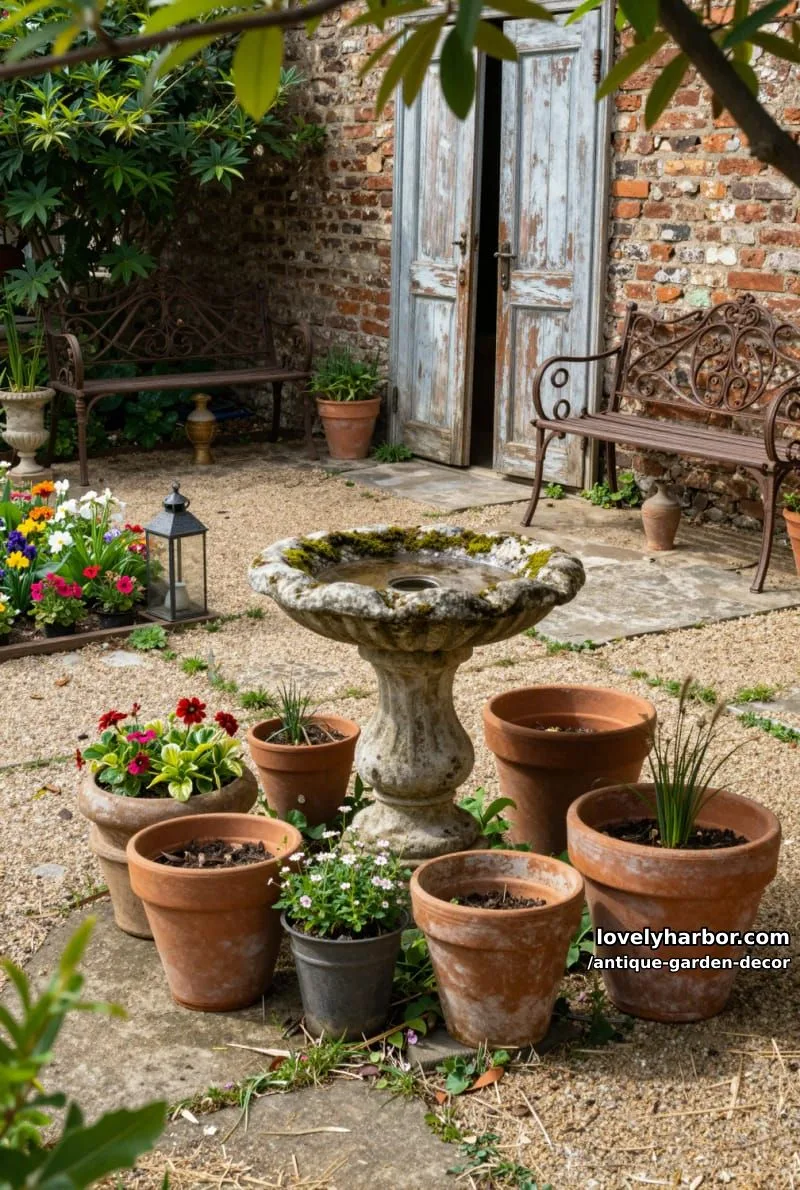
This is the section where the materials question actually decides things, because terracotta, cast iron, and old wood age in completely different directions. Old doors used as a backdrop or a gate are the anchor; lean a stripped, weathered one against a wall and it does more than a whole shelf of small accents.
| Material | Survives outdoors? | What to do |
|---|---|---|
| Galvanized / zinc | Yes, for decades | Just drill drainage; the rust is mostly cosmetic |
| Cast iron | Yes; rusts but won’t fail | Paste wax each spring to slow staining |
| Terracotta | Only if kept dry in freezes | Empty and shelter it before the first hard frost |
| Enamelware | Yes, but chips expose steel | Expect rust at chips; file the sharp edges |
| Raw steel / tin | No; rusts through fast | Seal it or accept a one to two season life |
| Wood | Only if kept off the ground | Raise on feet or bricks; reseal yearly |
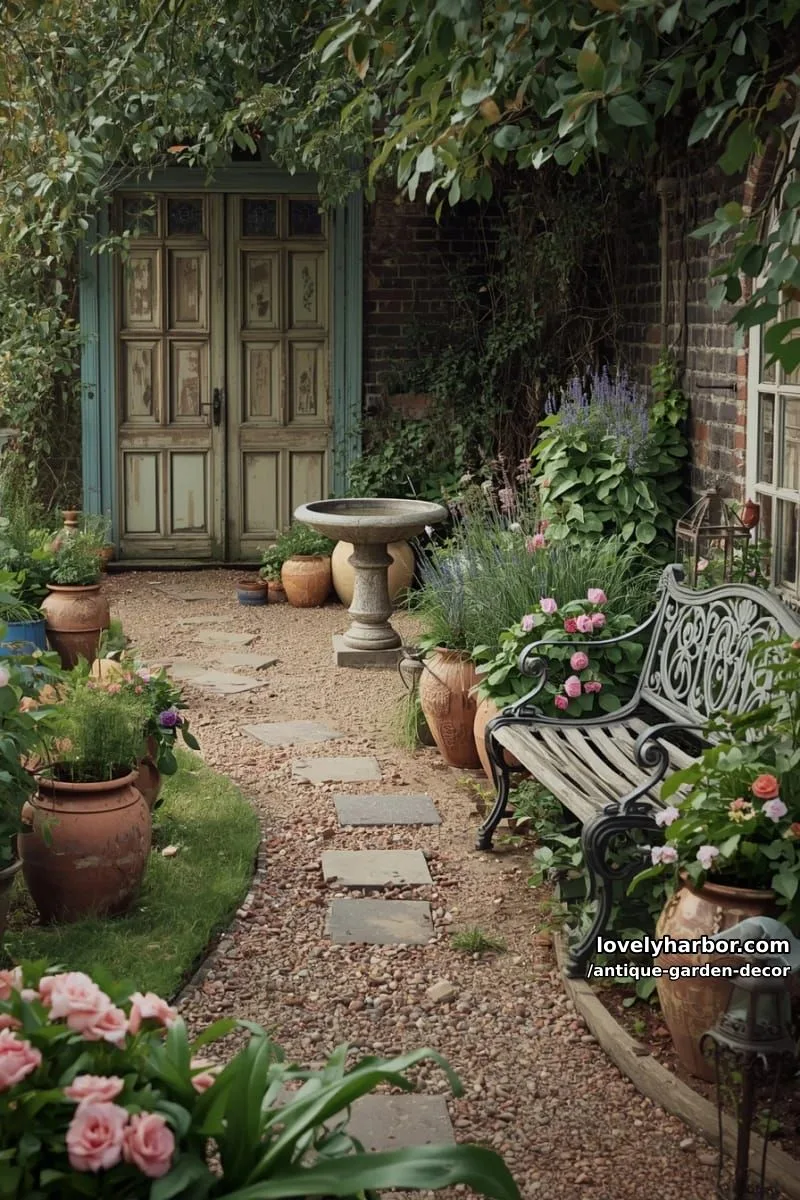
Terracotta is the one that surprises people: it handles sun fine but spalls and flakes apart if it freezes while wet, so empty and shelter it before the first hard frost. The birdbath needs its water changed twice a week or it turns into a mosquito nursery, which is less storybook than it sounds.
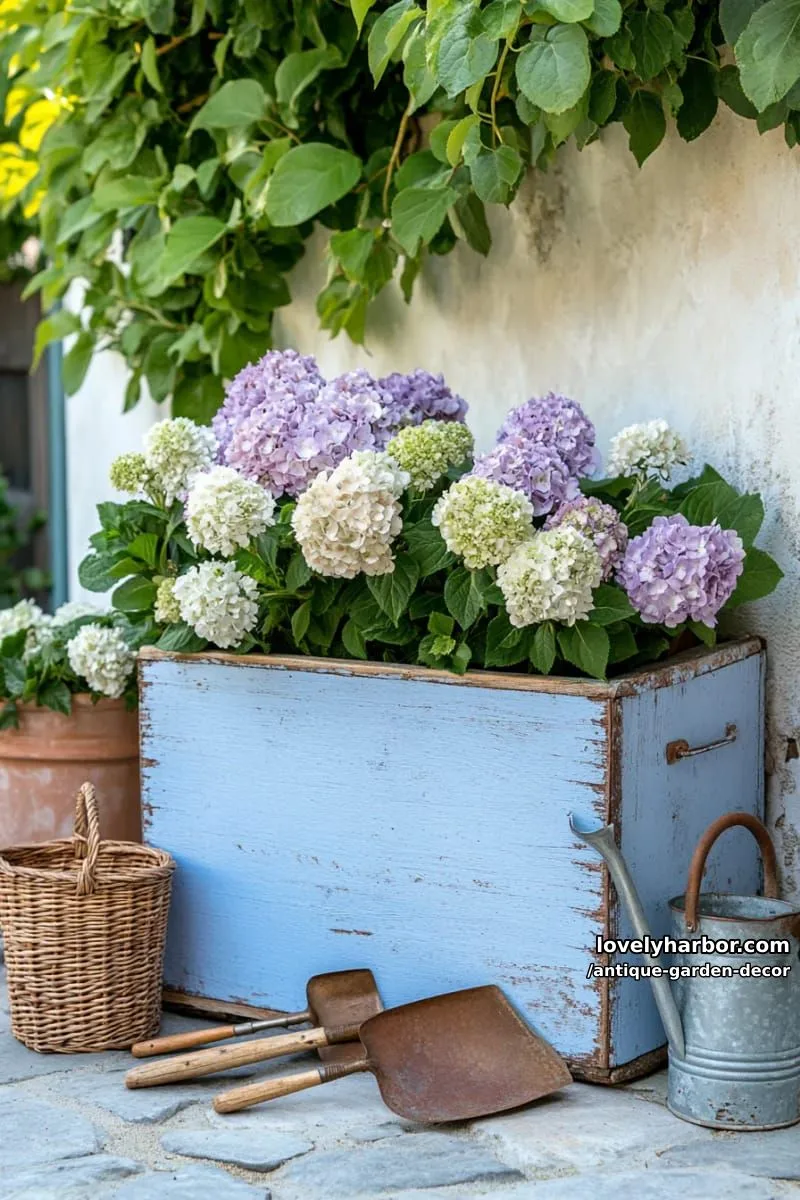
14. Blue wooden toolbox of vintage tools with large woven wicker baskets nearby.
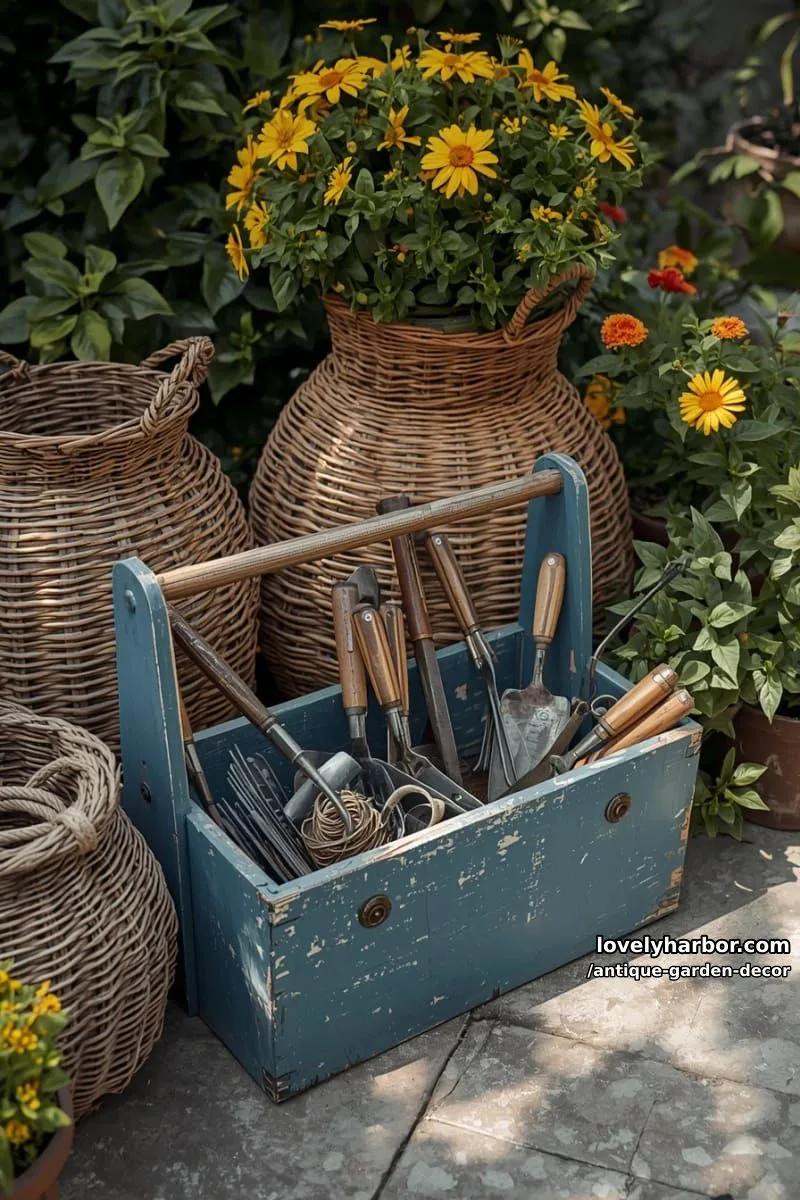
A painted wooden toolbox packed with old tools makes a strong centerpiece, and the faded blue against green planting is the kind of color pairing you couldn’t buy new. The wicker baskets beside it, though, are the weak link in the picture.
Granted, woven willow and rattan look right with this style. But they’re an indoor material outdoors: a season or two in the weather and they unravel and go grey-black with mildew. Keep them under a porch roof, use them for dry storage you carry in and out, or swap to a poly-rattan reproduction if they have to live in the open and you don’t want to replace them every year.
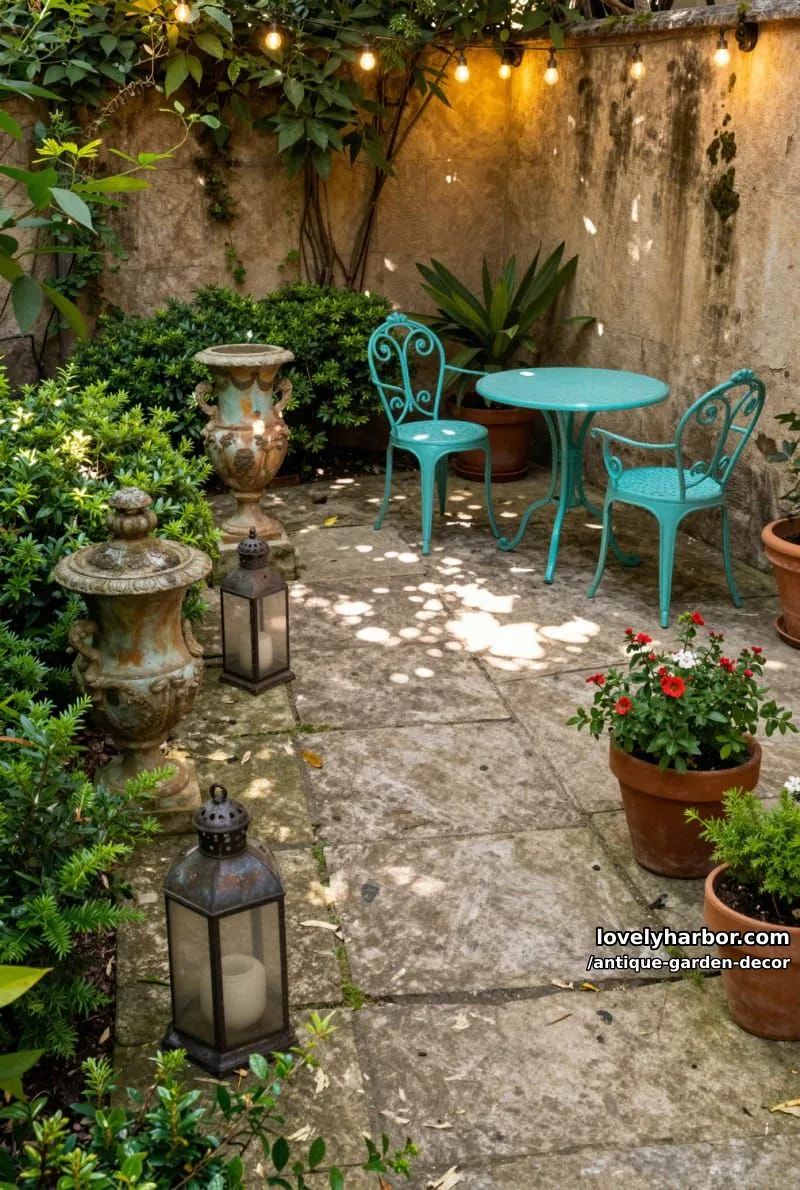
15. Patio with antique urns, lanterns, turquoise metal furniture, and string lights.
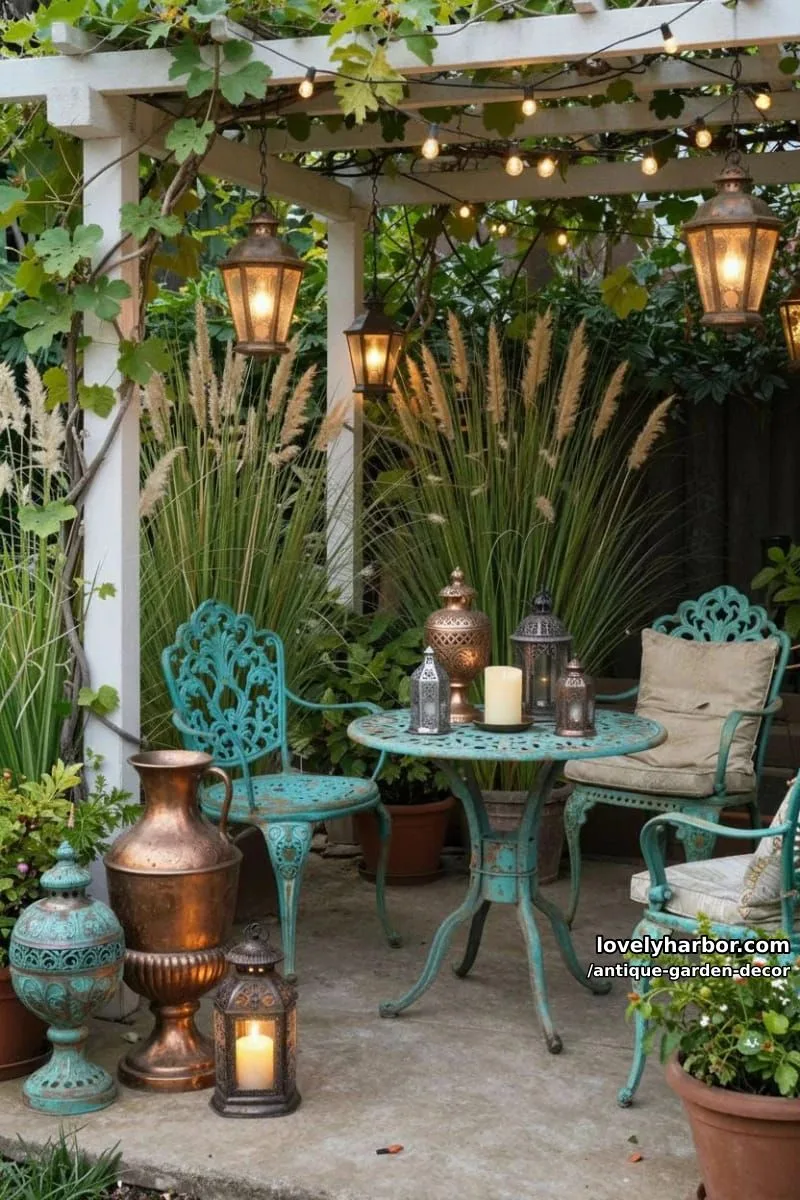
Big urns flanking a patio do one practical job beyond looking the part: they anchor the eye and pull it off cracked paving or a patchy edge you can’t easily fix. Heavy cast-stone or concrete urns also won’t tip in wind the way lightweight resin ones do, which matters if you’re using them as a screen.
For the lights overhead, commercial-grade string lights with replaceable bulbs last seasons where the cheap shrink-wrapped sets quit by the second winter. The turquoise metal furniture is a real opinion you’re committing to, and I’ll say it plainly: a strong color dates a patio faster than neutral pieces do, so treat it as a paint job you’ll redo, not a finish you live with forever.
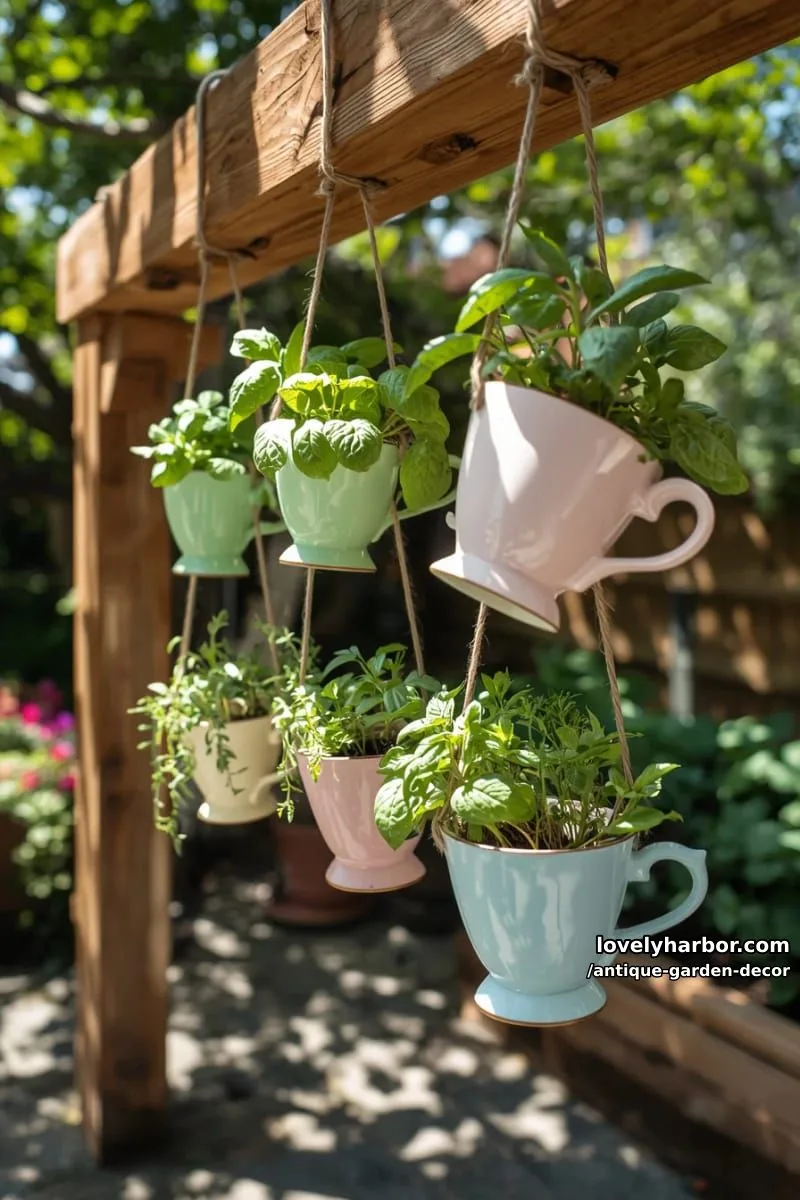
16. Hanging herb planters using vintage pastel teacups and wooden beam outdoors.
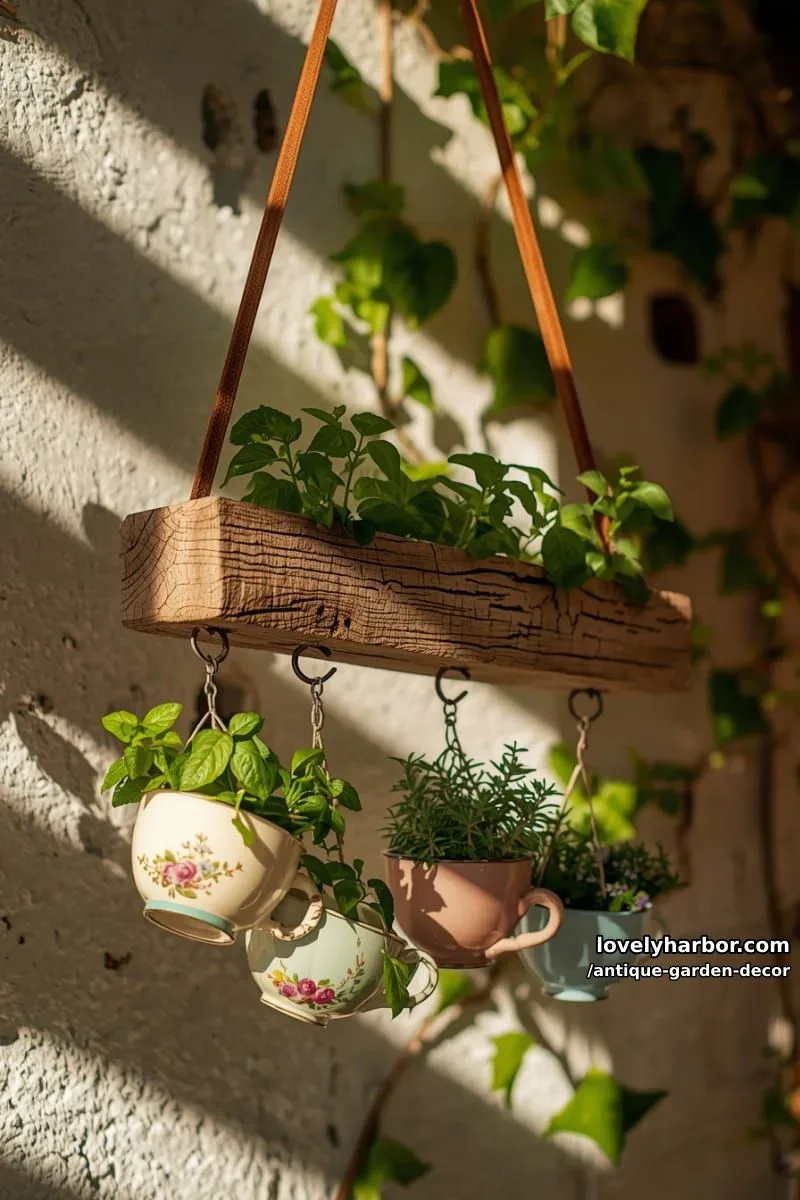
Pastel teacups strung along a beam make a charming hanger and a poor long-term planter, so plant for the constraint: shallow-rooted herbs you cut often, or sedum that wants to dry out. A teacup holds maybe a quarter cup of soil, which means it dries out by midday in July and basil sulks, while mint and thyme cope.
To drill a drainage hole without shattering the cup, use a diamond bit, keep it wet, and go slow with almost no pressure. Hang the cups on wire rather than string, because a watered cup is heavier than it looks and a gust will swing it into the next one.
17. Upcycled garden: bicycle, wheelbarrow, ladder, and metal tubs as planters.
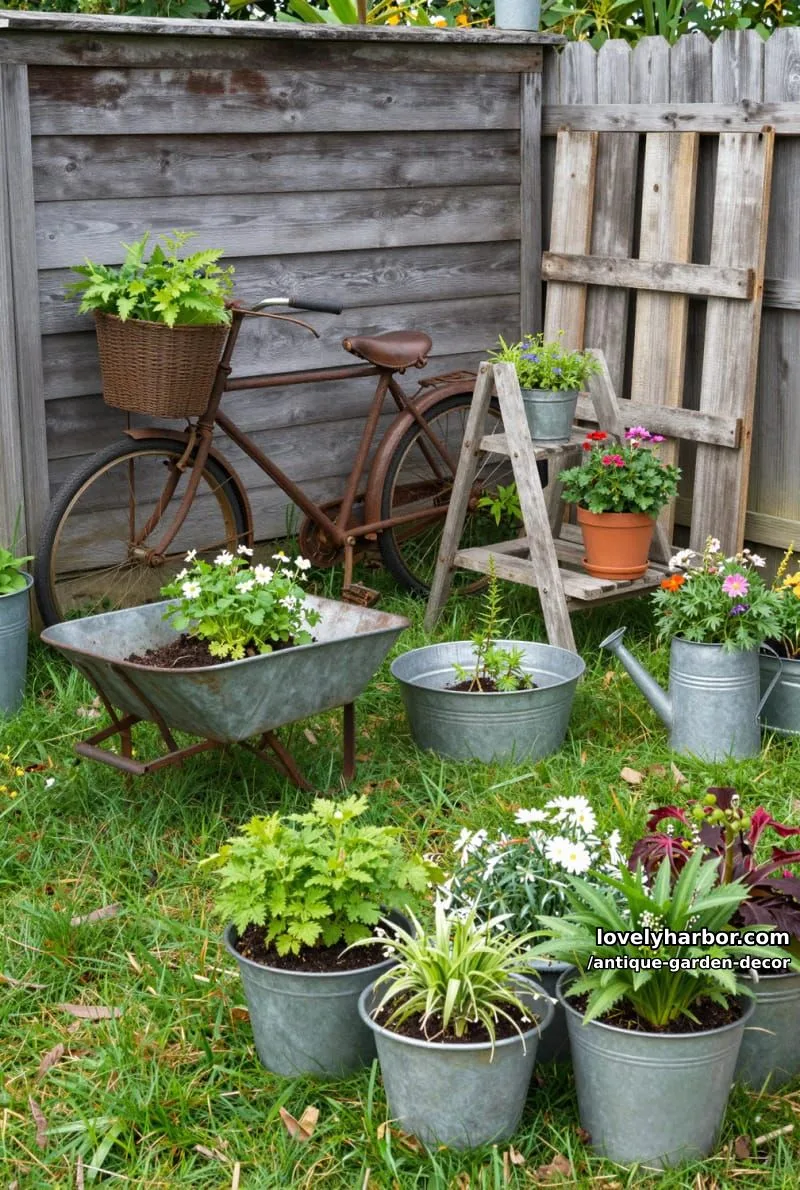
The bicycle planter is the showpiece and the one most likely to disappoint, because a bike loaded with soil-filled baskets is heavy and rusts solid at every joint within a year or two. It also wants to fall over, usually onto whatever is most expensive nearby.
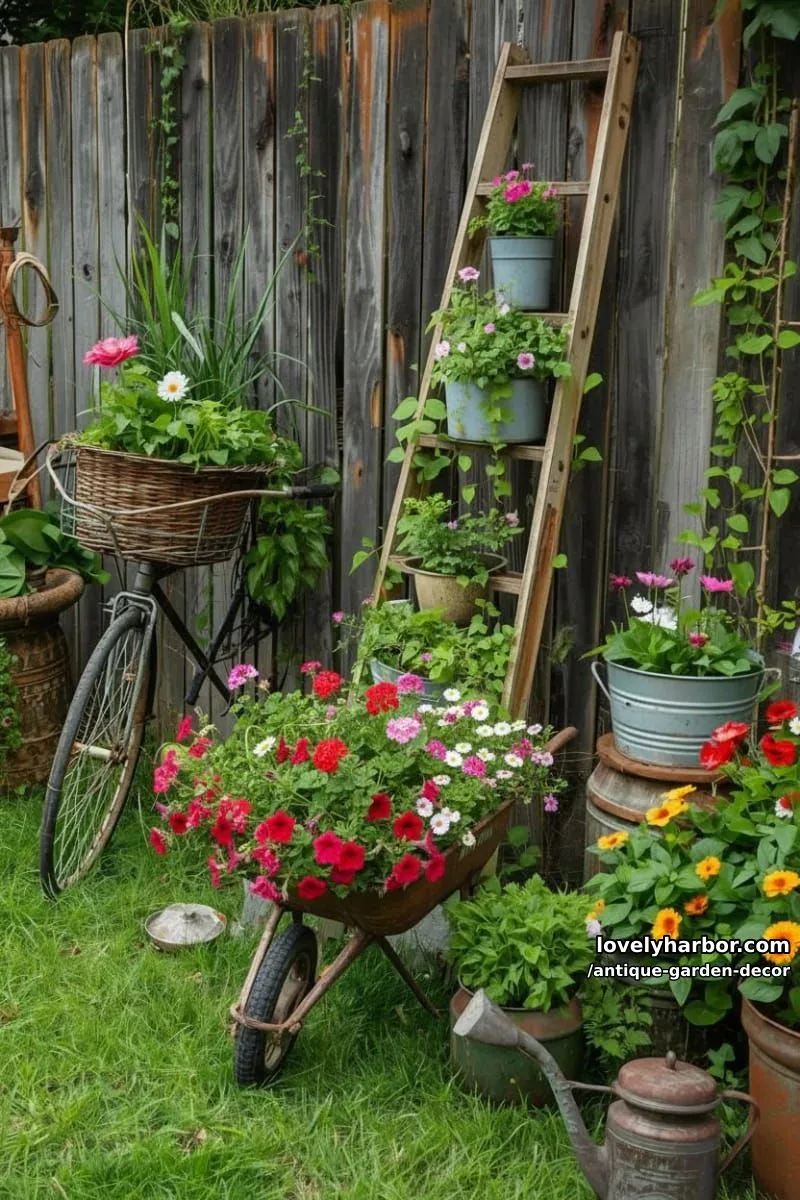
That said, bolt or wire it firmly to a fence so it can’t go anywhere, treat the baskets as cachepots instead of filling the frame with dirt, and it holds up. Ladders are the easy member of this group: lean them, never free-stand them, and use the rungs as a vertical shelf for small pots, which sidesteps the whole drainage question because each pot drains on its own. Metal tubs just need a few holes.
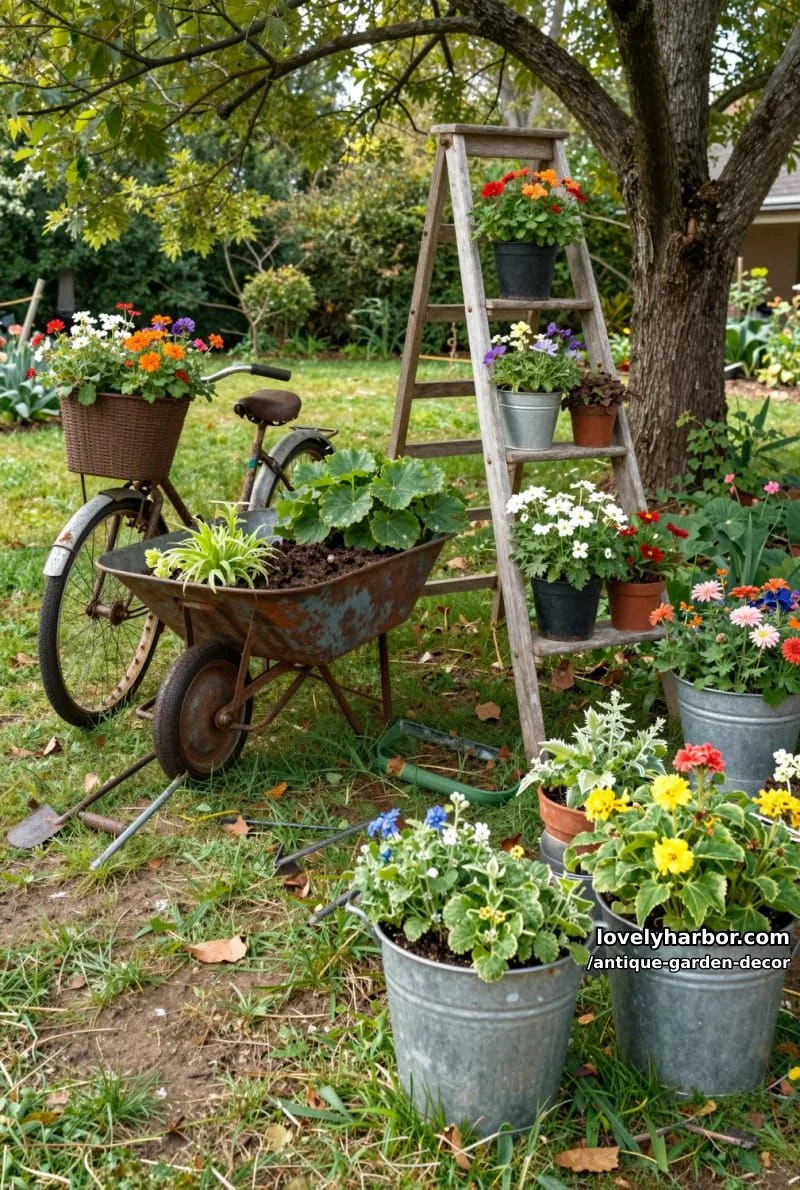
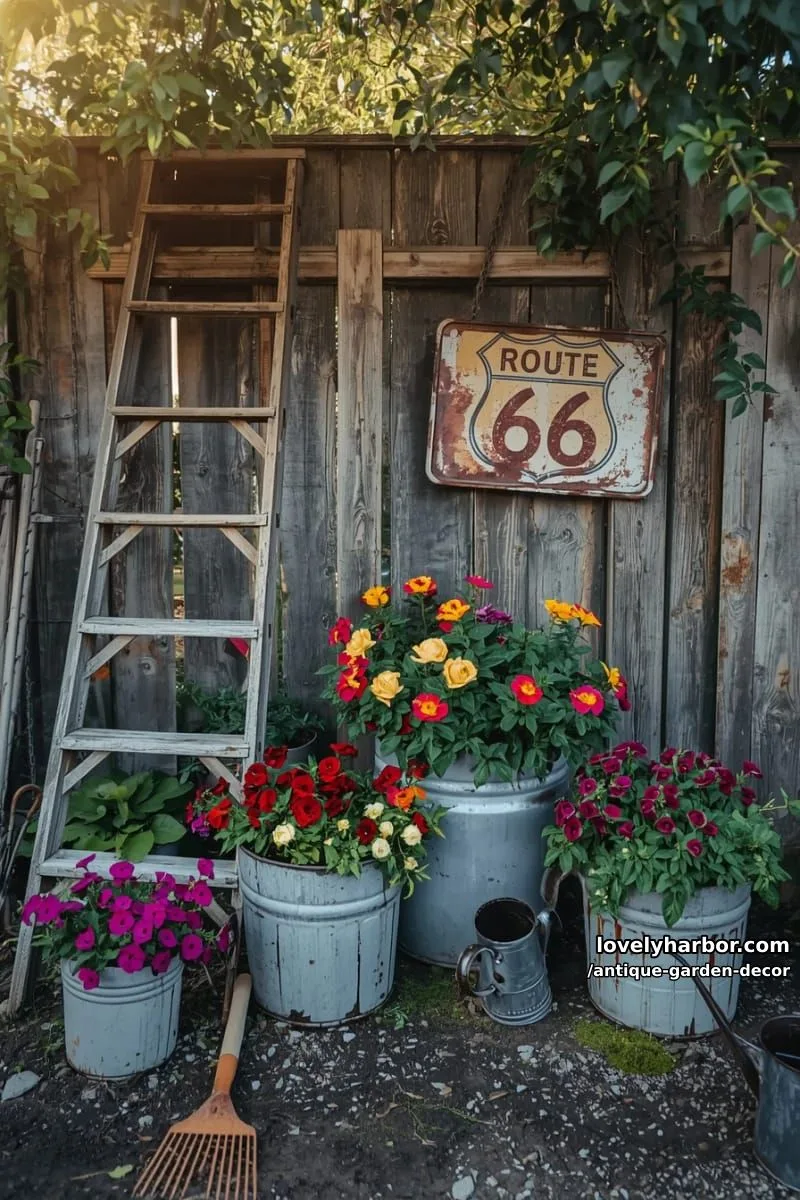
18. Rustic garden with ladder, Route 66 sign, metal tubs, and colorful blooms.
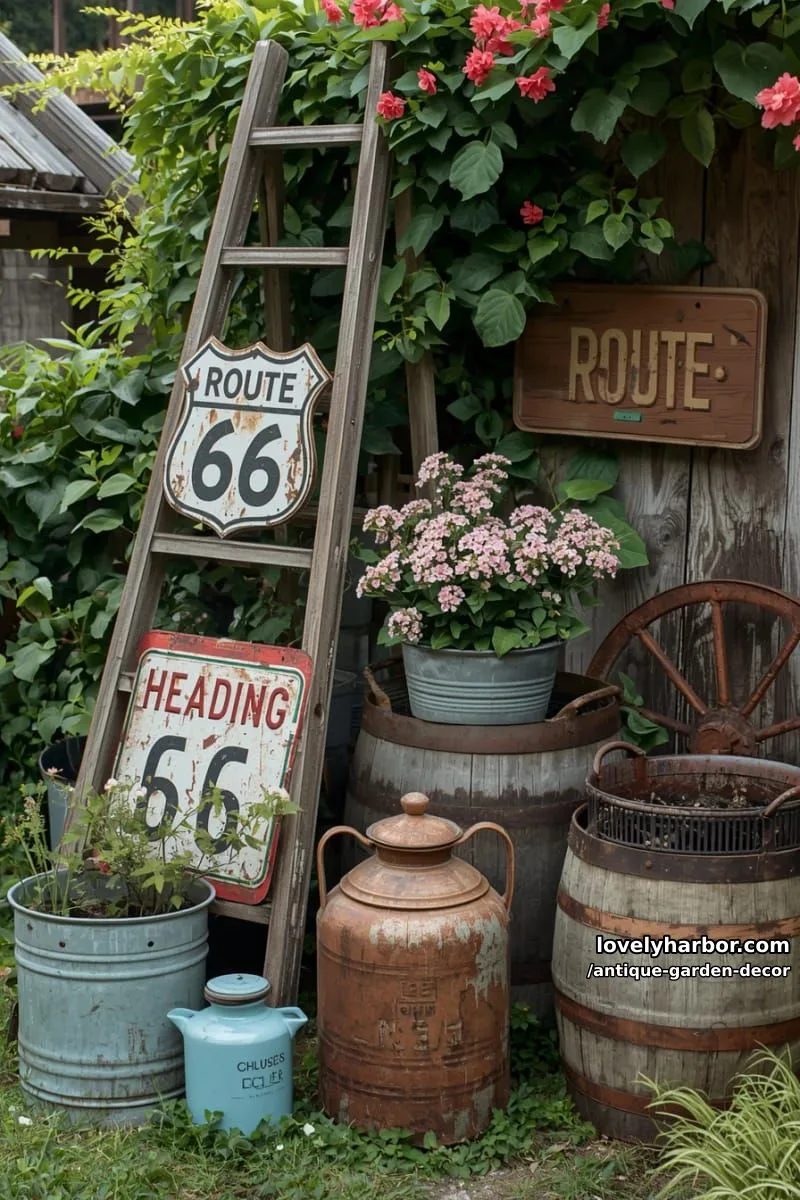
This is the one spot where a reproduction sign is fair game, because the look here is deliberately mixed and a little kitschy, not museum-correct. A repro Route 66 tin holds its paint better than a genuinely old one anyway, and nobody is fooled either way.
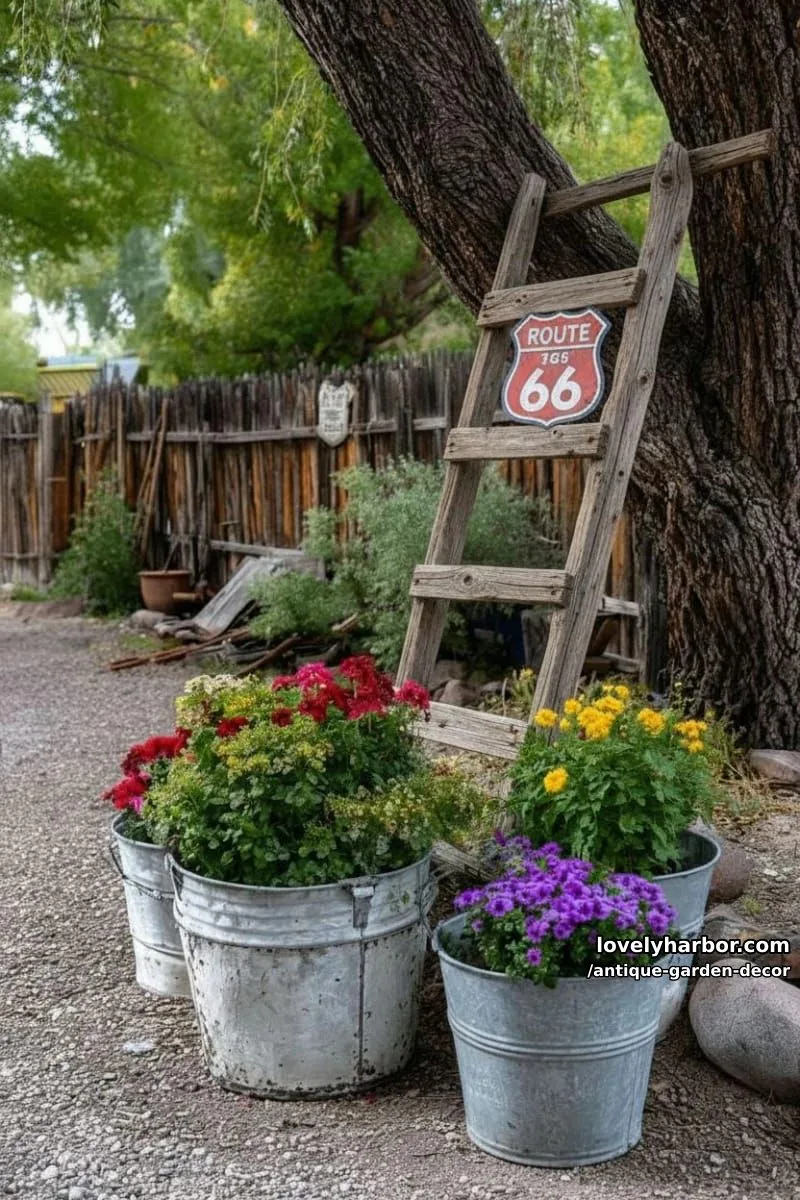
Lean the ladder against something solid rather than standing it free; a loaded ladder is a tip hazard in a windstorm. Mixing industrial metal with cottage flowers is a taste call, and some people find it busy, which is a fair complaint, so let one element lead, the sign or the tubs, and keep the rest quiet. Metal tubs full of zinnias or daisies carry color at ground level without competing.
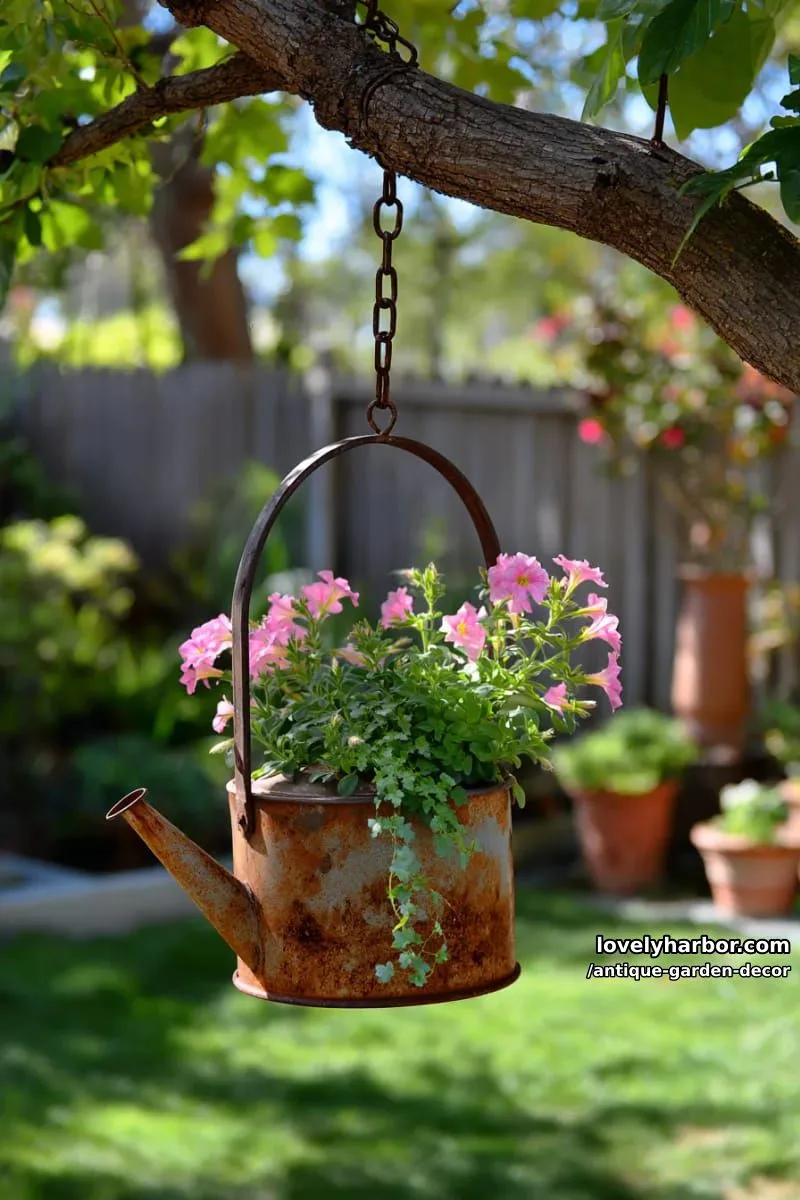
19. Rusty metal teapot planter with flowers hanging in a sunny garden.
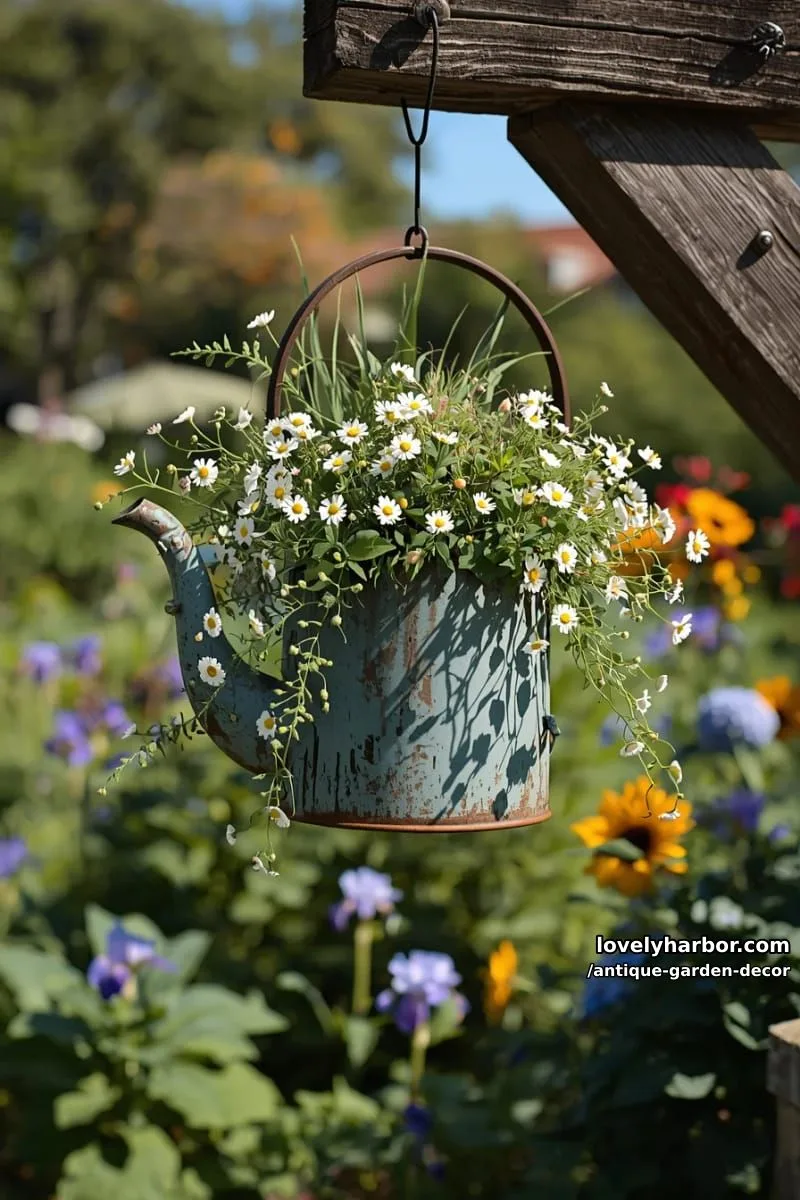
A rusted teapot is a one-plant vessel at most: a single sedum, a clump of hens-and-chicks, something that wants to be left alone and kept dry. The spout and the handle give it character a plain pot doesn’t have, and in full sun the rust deepens to a warm brown that flatters bright flowers.
Old teapots almost never have a drain hole, so either drill one or stick to a succulent that tolerates a little standing water; anything thirstier sits in a puddle and rots. Hang it where the runoff won’t streak rust down a wall or a good fence, because it will, and the stain is stubborn.
20. Old wheelbarrow filled with flowers and garden tools in front of shed.
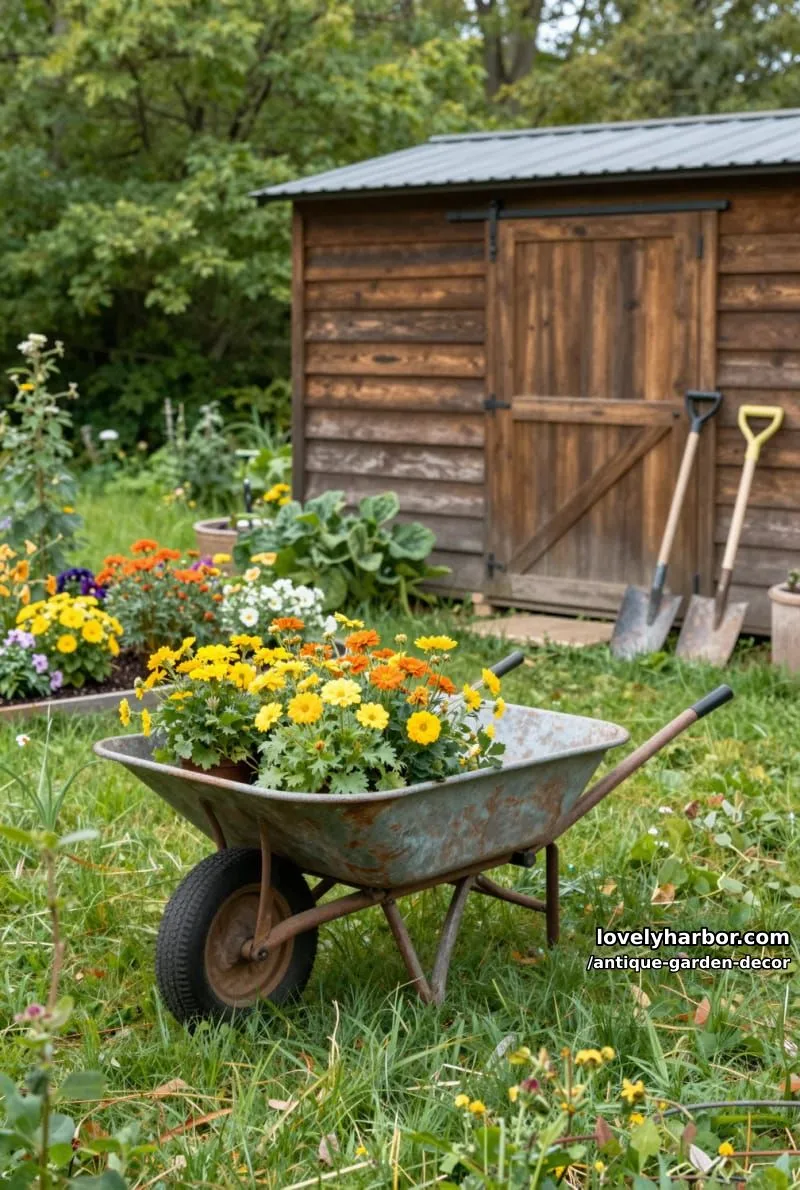
A planted wheelbarrow parked by the shed has one advantage no fixed planter has: you can wheel it to follow the sun or roll it under cover before a storm. Plant it up and actually use that, chasing afternoon light for tomatoes or getting it out of a hailstorm before the leaves shred.
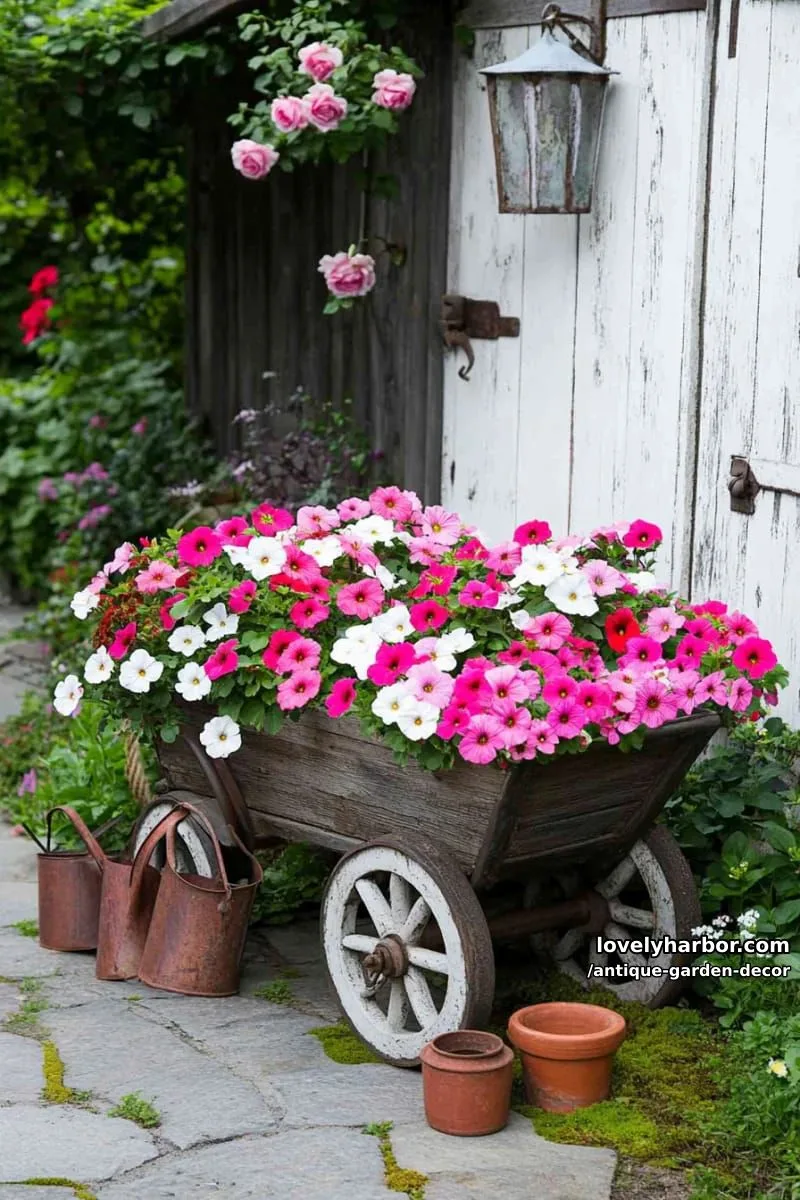
The handles are the part that fails first; raw wood rots at the metal collar where water collects, so a yearly coat of exterior oil or a quick handle swap keeps it usable instead of ornamental. Grease the axle too, or the wheel seizes and you’ve built a heavy planter that won’t actually go anywhere.
Conclusion
If you buy one thing this week, make it the durable end of the list: a galvanized tub, a cast-iron urn, a stoneware crock. Put it where you’ll actually see it from a window, plant it loosely, and skip the matched “set” that turns a yard into a theme park.
The piece I get the most compliments on cost two dollars at a barn sale and has a dent in one side that I gave up trying to hide three summers ago.
Related Posts
- Vintage Garden Decor Ideas
- Garden Art Ideas
- Creative Garden Decor Ideas
- Rustic Farmhouse Garden Decor Ideas
- Metal Garden Art Ideas


