
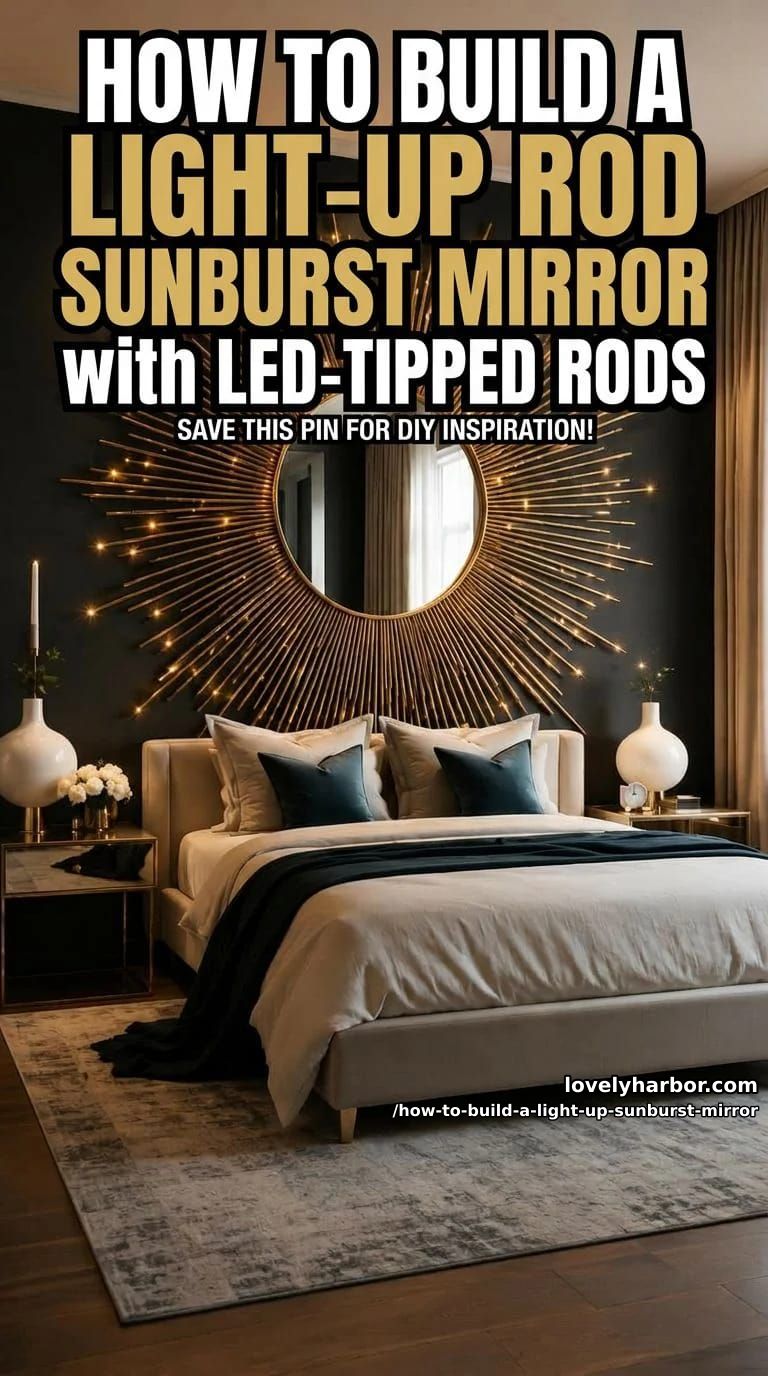
This runs a warm-white LED at the tip of selected rods, each wire threaded down a hollow rod to one hidden 12V hub behind the mirror, with a remote to switch it on. Nothing like it seems to sell ready-made, which is half the reason to build it.
The make-or-break details are small: the rod bore has to match the LED head, every rod gets painted before it is wired or mounted, the long rods need to root deep to stay rigid, and the backing has to carry the mirror plus a couple hundred rods. Below is the parts list with a real rod-count estimate, the build in the order that works, the weight math, and the wiring and mounting safety this deserves over a bed.
Note: This guide is only intended as general high level guidance for expert artisans or DIY crafters. As such, it does not cover all the details involved into the creation of this item.
The parts that make it work
On 1/4 inch outer-diameter aluminum tube, the wall thickness sets the bore, and that bore must clear the LED head at the tip. The common longer tubes run about a 0.034 inch wall, leaving roughly a 4.6mm bore: a 5mm LED head jams, a 3mm head drops in with room. The thin pre-wired leads were never the constraint; they pass freely.
1/4 in OD aluminum is 6.35mm outside.
A 0.034 in wall leaves about a 4.6mm bore.
The head nests at the tip, so the bore must clear the head: 5.0mm jams, 3.0mm fits.
Light a rod longer than about 8 inches and the factory lead will not reach the hub, so splice on extension wire.
How many rods, and roughly what it costs
Plan on 210 to 270 rods for a dense five-footer; below about 150 it looks sparse. Get all of them and cut to length before you paint or wire anything. Run your own size through an estimator first, because rod count, weight, and cost all swing hard with the mirror diameter and the overall span. Here is a workable breakdown off a 20 inch mirror reaching a 30 inch radius.
| Tier | Rough length | Count | Roots where |
|---|---|---|---|
| Long | 22 to 26 in | ~50 to 60 | near center, hidden under the mirror |
| Medium | 14 to 18 in | ~70 to 90 | mid-disc |
| Short | 6 to 10 in | ~90 to 120 | at the mirror rim |
Light only about 60 to 80, weighted toward the long and medium rods so the points land across the outer band. That much aluminum, LED, and labor runs $400 to $850 in materials. The commercial comparison barely exists: a lit version this size was not something I could find for sale at all, and the closest piece, a larger unlit sunburst, ran about $1,800, so a finished lit one would realistically be a $2,000 to $3,000 object if anyone made it.
More distance between a rod’s two bearing points means a stiffer rod. Root the long rods near the center so they bear both at that socket and again where they cross the disc rim, and they hold a 20-plus inch reach without sagging. Short rods need only a single rim socket. Spreading the roots across several rings this way also fits far more rods than cramming every root into one ring at the mirror’s edge.
You can estimate weight and cost based on the size of your mirror using the calculator below (approximate):
DIY build planner
Set your mirror size and the full span including the longest rays, then get the rod count, finished weight, and rough materials cost, with a live preview.
Gold rods radiating from the mirror, lit tips glowing.
–
Rough estimate for planning. Lit rods are quarter-inch aluminum tube (a 3mm LED nests in the bore); unlit can be dowel or aluminum. Weight is mostly the mirror and rods. Round up and keep a buffer.
Will the backing hold it, and how the rods attach
Yes, with room to spare, and the wall mount is not the limit. A dense five-footer finishes around 5 to 7 kg, roughly 11 to 15 lb, and a French cleat into two studs is rated for several times that. The parts that actually carry the load are the backing disc and each rod-to-disc joint, and at these weights both have large margin once the rods are socketed rather than surface-glued.
| Component | Approx weight | Note |
|---|---|---|
| Round mirror, 20 in glass | ~2.0 kg | the single heaviest piece |
| Rods, ~240 | ~2.3 kg | aluminum lit, dowel unlit |
| Backing disc plus hardware | ~1.5 kg | 1/2 in plywood, standoffs, cleat |
| LEDs and wiring | ~0.3 kg | negligible per LED |
How to fix each rod to the hub
- Drill a 1/4 in socket about 1/2 in deep per rod, through-drilled on lit rods to pass the wire, and bed the rod butt in two-part epoxy. That epoxied socket resists the rod’s small cantilever load with enormous margin.
- Root the long rods near the center and let them also bear on the disc rim, so each long rod has two spaced supports.
- Bond the mirror over its whole back, not a center dot, since it loads the disc center.
Avoid
- Surface-gluing rods to the face. A foot of cantilever peels them.
- Cramming every socket into one rim ring, which perforates and weakens that band.
- A thick, heavy mirror. Use thinner glass or acrylic to cut the biggest single weight.
Use 1/2 inch or thicker plywood or MDF, spread the sockets across two or three rings so no single zone is riddled with holes, and screw the cleat into the disc, not just glue it. The disc carries everything to the cleat, and the cleat goes into studs.
Shopping list and budget
Materials
| Qty | Item | Spec | Price |
|---|---|---|---|
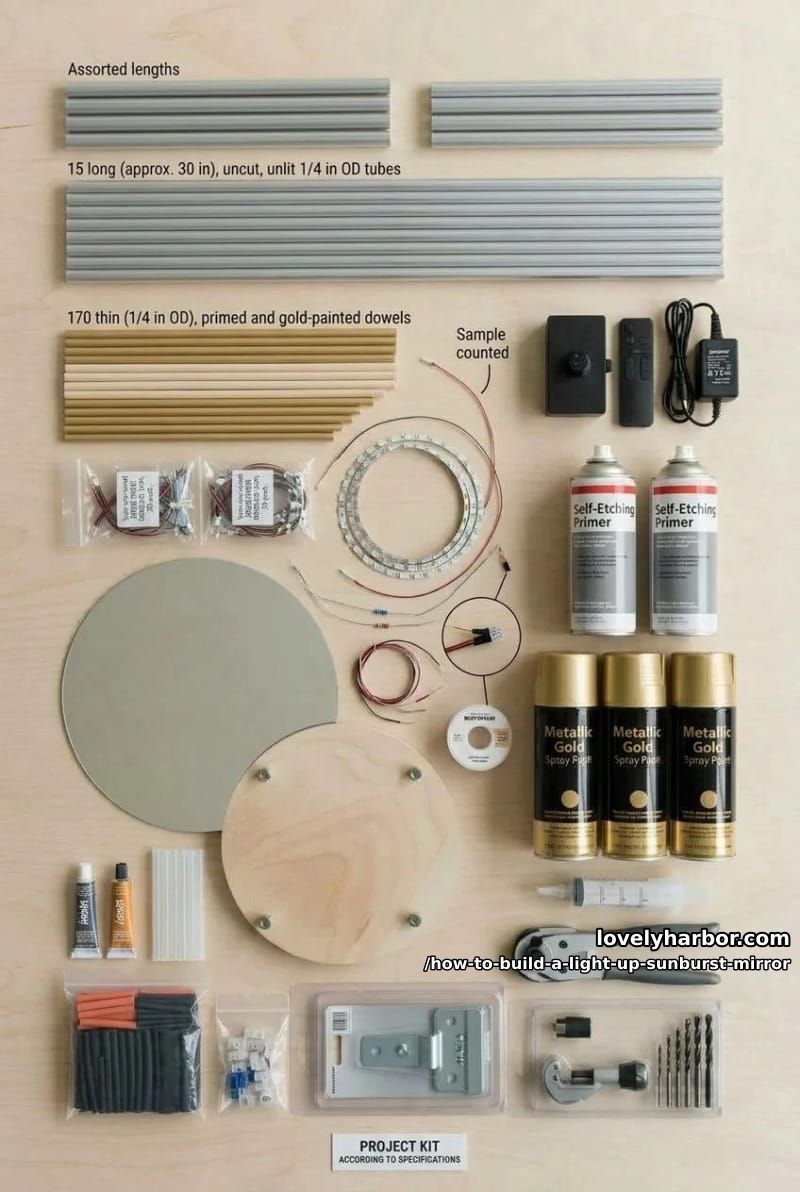
| 2 to 4 packs | Aluminum tube, assorted lengths 1/4 in OD aluminum tube, assorted-length pack | 1/4 in OD, ~0.034 in wall, ~4.6mm bore | $15 to $40 each |
| 10 to 20 | Aluminum tube, 30 in 1/4 in OD aluminum tube, 30 in | for the longest lit rays, uncut | $4 to $8 each |
| ~170 | Wood dowels, unlit rods | 1/4 in, primed and painted gold | $80 to $180 |
| 1 to 2 packs | 3mm pre-wired LEDs EDGELEC 3mm 12V pre-wired warm-white LEDs, wide-angle, 50-pack | 12V, resistor built in, ~8 in lead | $8 to $15 each |
| 1 | Thin hookup wire | extending leads on long lit rods | $8 to $15 |
| 1 | RF remote dimmer 12V single-color RF wireless LED dimmer with remote | 12 to 24V DC, on/off plus brightness | $8 to $15 |
| 1 | 12V DC adapter or battery pack | 12V, 2A covers ~80 LEDs with margin | $8 to $15 |
| 1 | Round mirror | 14 to 24 in, thin brass rim, thin glass or acrylic to save weight | $15 to $50 |
| 1 set | Plywood disc plus standoffs | 1/2 in disc smaller than mirror, 1 in standoffs | $12 to $30 |
| 2 to 3 | Self-etching primer | adhesion on bare aluminum | $8 to $12 each |
| 3 to 5 | Metallic gold spray paint Rust-Oleum Specialty metallic gold spray, 11 oz | topcoat over primer | $7 to $10 each |
| 1 | Epoxy, hot glue, terminal block, heat-shrink | socketing and bus wiring | $20 to $40 |
| 1 | French cleat or heavy-duty hanger | rated above finished weight | $10 to $20 |
| Materials subtotal | $400 to $850 | ||
Tools
| Qty | Item | Spec | Price |
|---|---|---|---|
| 1 | Drill and 1/4 in bit | socket holes | $0 to $60 |
| 1 | Tube cutter or rotary tool | cutting aluminum to length | $0 to $40 |
| 1 | Soldering iron and strippers, or crimps | lead extensions and the bus | $0 to $30 |
| 1 | Jigsaw or store-cut disc, hot glue gun, tape, drop cloth | backing and masking | $5 to $70 |
| Tools subtotal | $5 to $200 | ||
| All-in from scratch | $405 to $1,050 |
| A made-to-order lit equivalent, if one existed | $2,000 to $3,000 |
Prices are approximate ranges as of June 2026; verify before purchase. Tube links are the ones you specified.
Step 1: Backing, hub, and the socket plan
- Cut the disc a few inches smaller than the mirror so it hides behind it, raised on standoffs for a wiring cavity.
- Drill the sockets in rings: an inner ring under the mirror for the long-rod roots, a mid ring, and a rim ring for the short rods, all angled shallow.
- Mount the hub: dimmer, terminal block, and cleat plate in the cavity, the 12V adapter wired to the dimmer input and kept reachable.
- Bond the mirror over its full back and let it cure overnight.
Step 2: Cut every rod to length
Cut and sort the full set now, before any paint or wiring, because lengths drive everything downstream. Keep the three tiers in separate piles so you are not measuring mid-assembly.
Step 3: Prime and paint every rod, before wiring
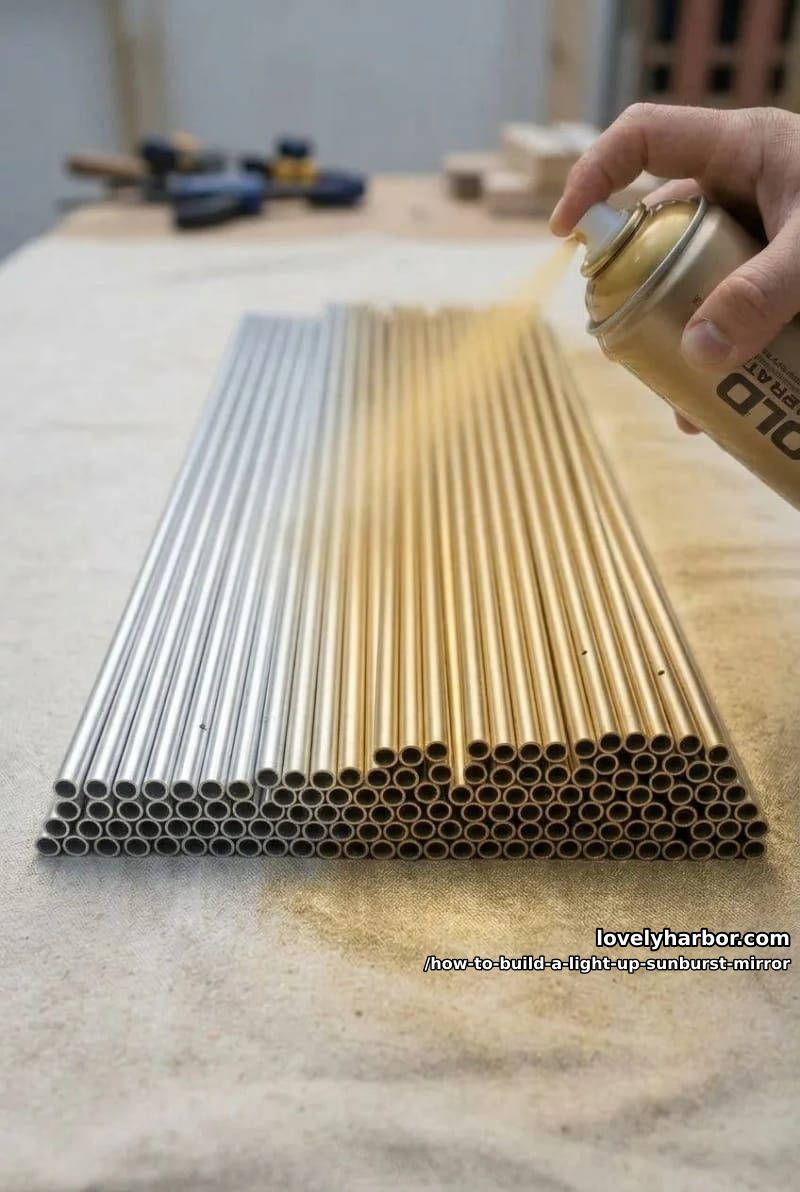
- Scuff and degrease the aluminum, then lay down self-etching primer so the gold bonds. Dowels take ordinary primer.
- Two light coats of gold over everything, so aluminum and wood read as one material.
- Keep the tip bores clear, and ream any that clog so the LED still seats.
Step 4: Wire the lit rods
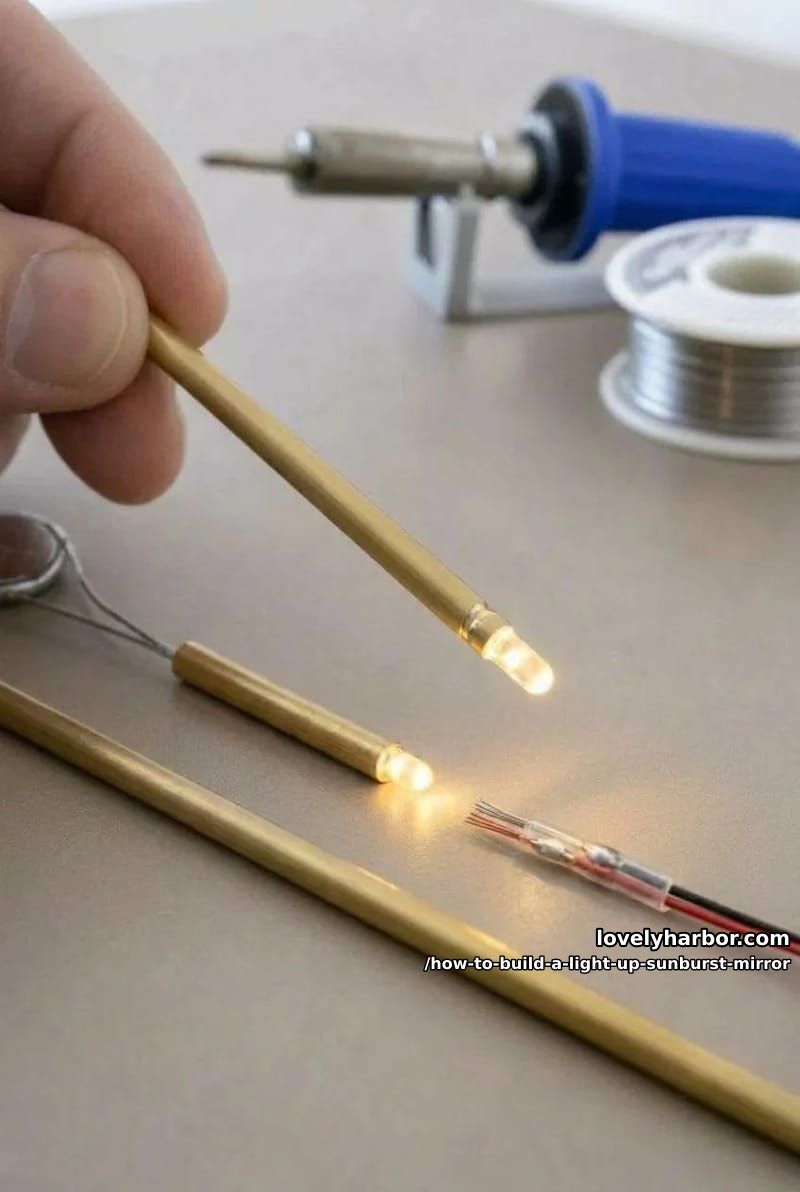
- Seat a 3mm LED at each lit tip and dab epoxy to hold it, keeping the lens clean.
- Extend the long leads with wire and heat-shrink on any rod longer than about 8 inches.
- Keep polarity straight, colored wire to positive, black to ground.
- Bench-test each rod on 12V before it goes in.
Step 5: Socket the rods, long ones first
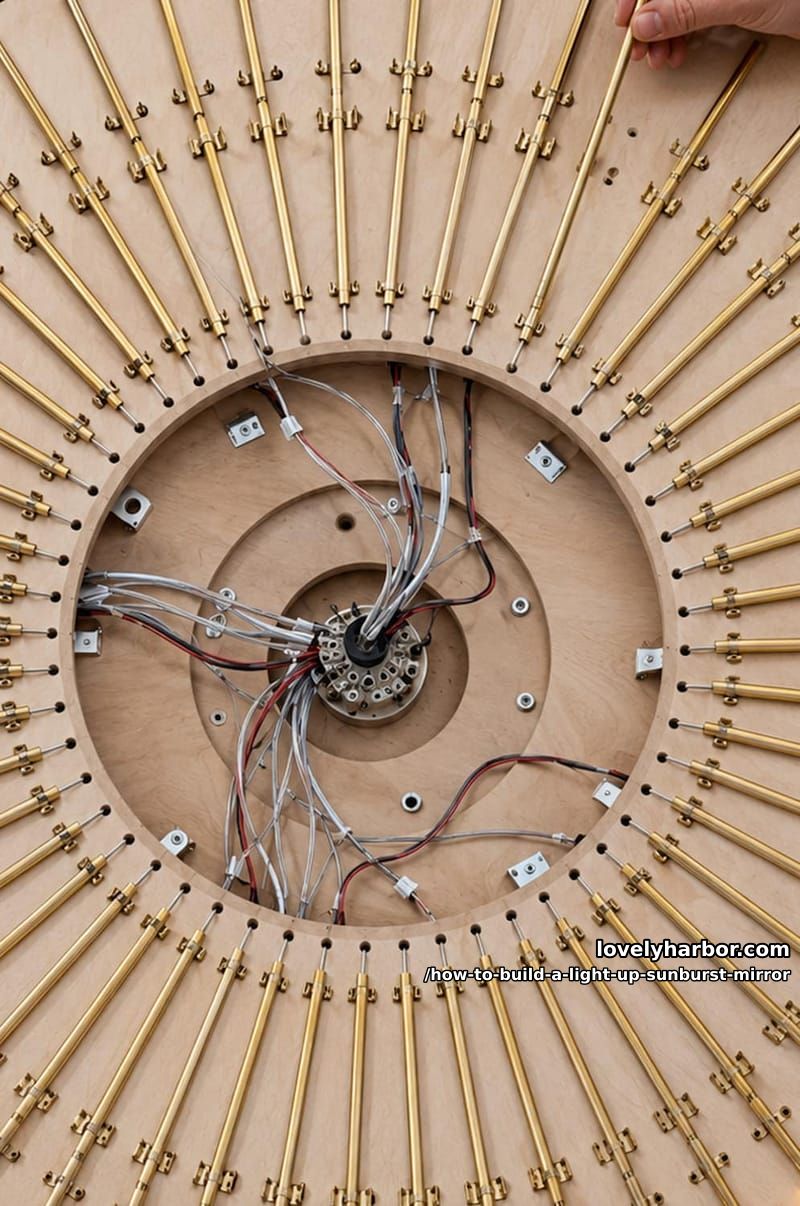
- Set the long rods first from the inner ring, feeding their wires to the cavity.
- Fill with mediums, then shorts at the rim until the outer edge reads dense.
- Build a dual-ring bus wire: To avoid a massive, unmanageable tangle of 80 separate leads meeting at one point, hot-glue two concentric rings of bare solid copper wire (one for $+12\text{V}$, one for ground) around the backing disc cavity. As you slide each rod into its socket, snip the lead to length and solder or crimp it directly to these main bus rings.
- Power up in the dark and confirm the lit pattern before hanging.
Thread the LED wire completely through the socket into the cavity first, then apply a thin bead of epoxy around the outside collar of the rod butt before seating it. Never drop epoxy directly into the hole, or you will trap the wire or completely clog the hollow tube.
Wiring and mounting safety
Power it from a UL-listed 12V adapter or a battery pack, never spliced mains, unless you are a qualified electrician. Size the adapter above the total draw with margin, about 20mA per LED, so eighty lit rods pull under 2A. The real risks are a buried connection you cannot reach and a heavy piece on a weak hook, so hang it on a French cleat into studs and keep the adapter and dimmer receiver accessible behind the disc.
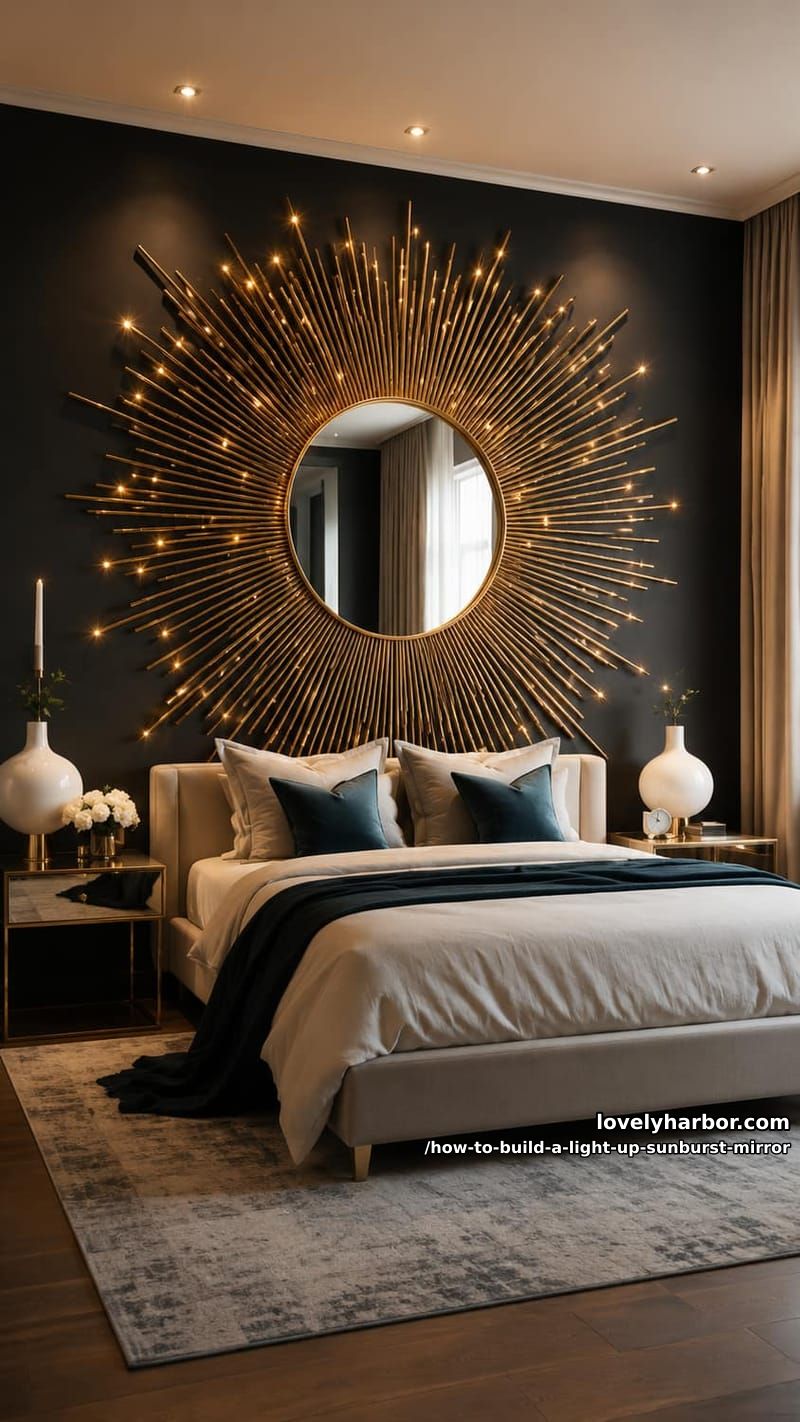
A dense 5-foot lit sunburst over a king bed
20 in mirror, ~14 in disc on standoffs, ~240 rods to a 30 in radius, ~70 lit with 3mm LEDs
Figure roughly 240 rods, about 70 of them aluminum tubes carrying 3mm LEDs with extended leads on the long ones, the rest gold dowels. It finishes near 6 kg, about 13 lb, mostly mirror and rods, which a stud-mounted cleat carries easily. Materials land around $500 to $700. Budget three weekends, because cutting, painting, and wiring 240 rods is the work and the gluing is the easy part.
Mistakes that ruin a lit rod sunburst
- Painting after assembly. Paint the rods before wiring or mounting, or you coat the lenses and the wiring.
- Skipping etch primer on aluminum. Plain spray peels; scuff and self-etch first.
- 5mm LEDs in a 4.6mm bore. Match the LED to the bore.
- Short leads on long rods. Extend the wire or the LED never reaches the hub.
- Surface-gluing rods or over-drilling one ring. Socket them, and spread the sockets so the disc stays strong.
- A heavy mirror on a light hook. The mirror is the heaviest piece; keep it thin and put the cleat in studs.
Build-day sequence
- Day 1, evening: cut and drill the disc in rings, mount the hub and cleat, bond the mirror, weight overnight.
- Day 2: cut all rods to length and sort into tiers.
- Day 3, morning: scuff, etch-prime, and gold-coat every rod; let cure.
- Day 3, afternoon: seat LEDs, extend long leads, bench-test each lit rod.
- Day 4: socket the rods long ones first, build the fan, join the bus, test lit in the dark.
- Day 4 or later: hang on the cleat, connect power, final remote test.
Conclusion
The structure is the easy part to worry about and the easy part to get right: at roughly 6 kg, a stud-mounted cleat is nowhere near its limit, and an epoxied 1/2 inch socket holds a single rod with margin to spare, so the disc and the deep-rooted long rods carry the whole thing comfortably.
Spend your attention instead on sequence and fit, cut then paint then wire then mount, and the 3mm LED in the 4.6mm bore. It is three weekends and a few hundred dollars in tube and LED, for an object you cannot actually buy lit at any price I could find.