
These two styles live next door to each other on Pinterest, share roughly the same palette swatches, and get conflated constantly in shelter magazines that should know better. They are not the same room. One comes out of Antwerp and a Belgian obsession with shadow. The other comes out of California and a tradition of rooms built to handle a 4 p.m. sun without flinching. If you've been pinning both and wondering why your living room won't commit, the issue is probably that you're halfway between them and the materials are arguing.
Warm minimalism vs modern coastal: what is the actual difference?
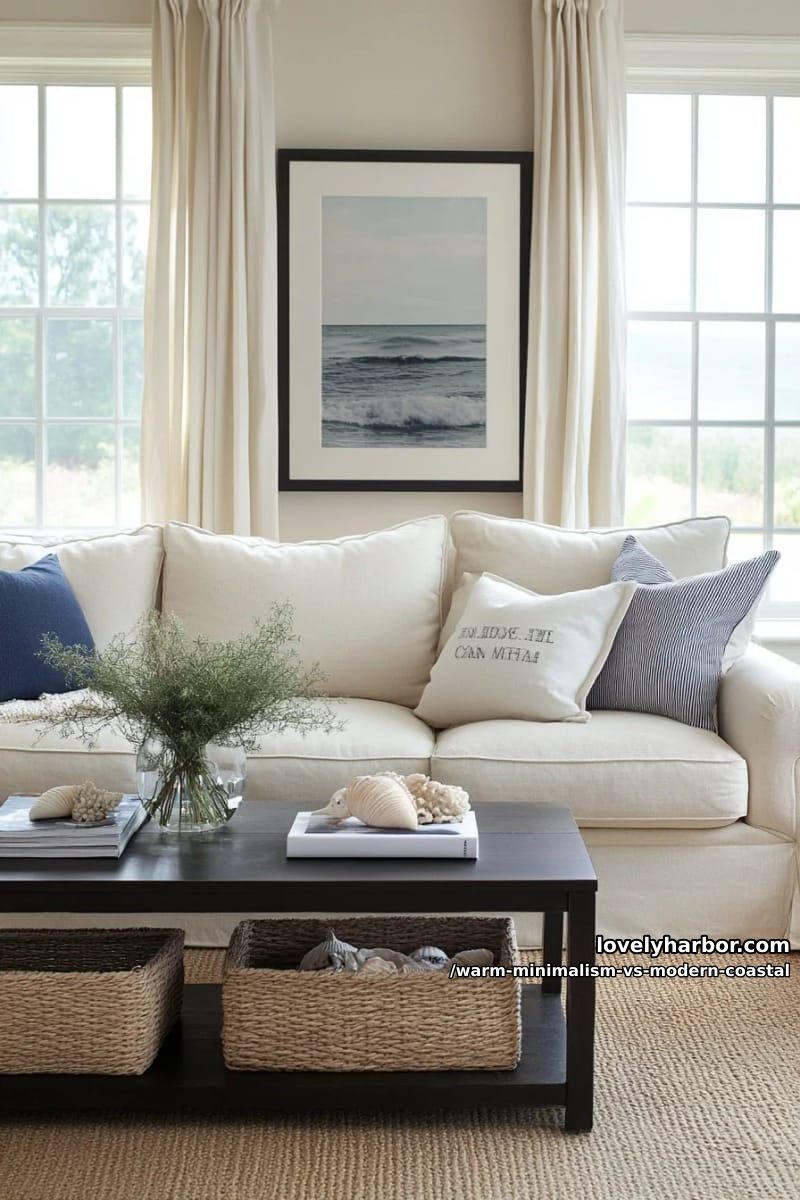
Warm minimalism vs modern coastal comes down to light philosophy and material weight. Warm minimalism, rooted in Belgian and Japanese restraint, leans on plastered walls, deep oak, putty and clay tones, and a deliberately dim, shadow-conscious palette. Modern coastal evolved from California’s love of bright, reflective rooms: lighter oak, slipcovered seating, soft blues and sand, more pattern, and more daylight bouncing off white trim.
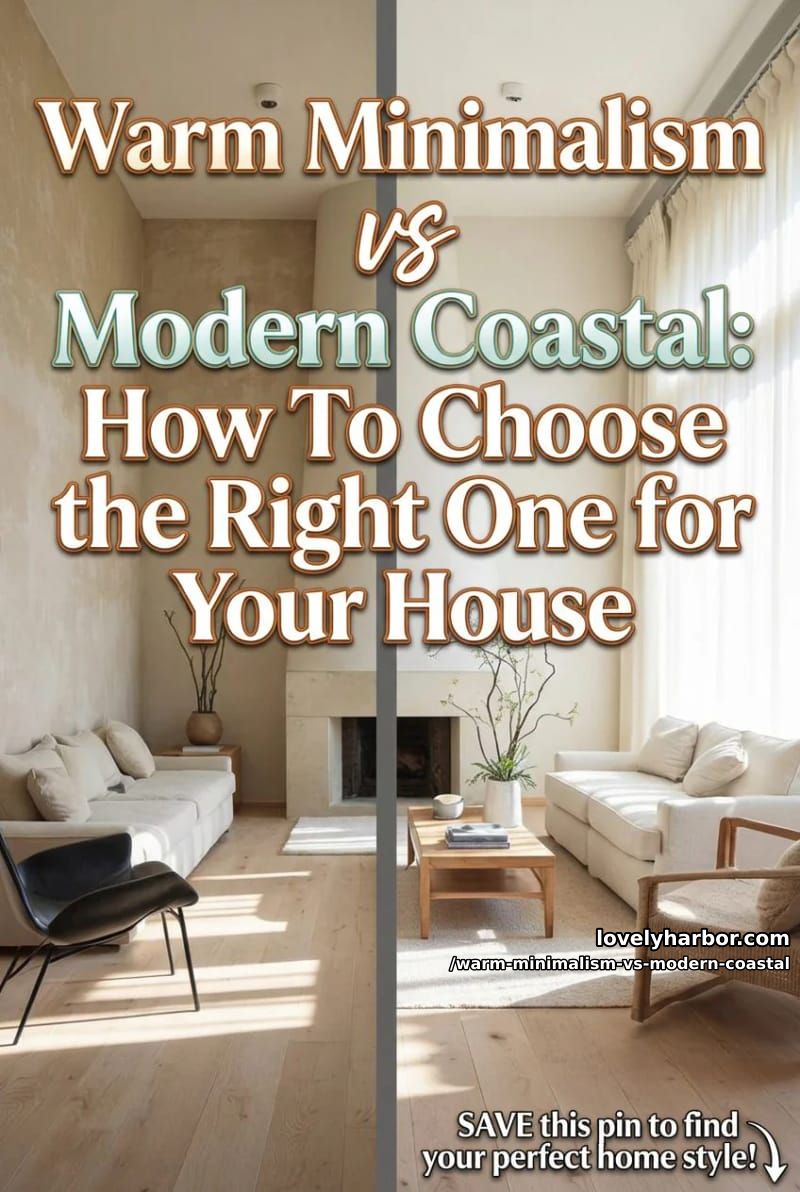
1. Where Each Style Actually Comes From
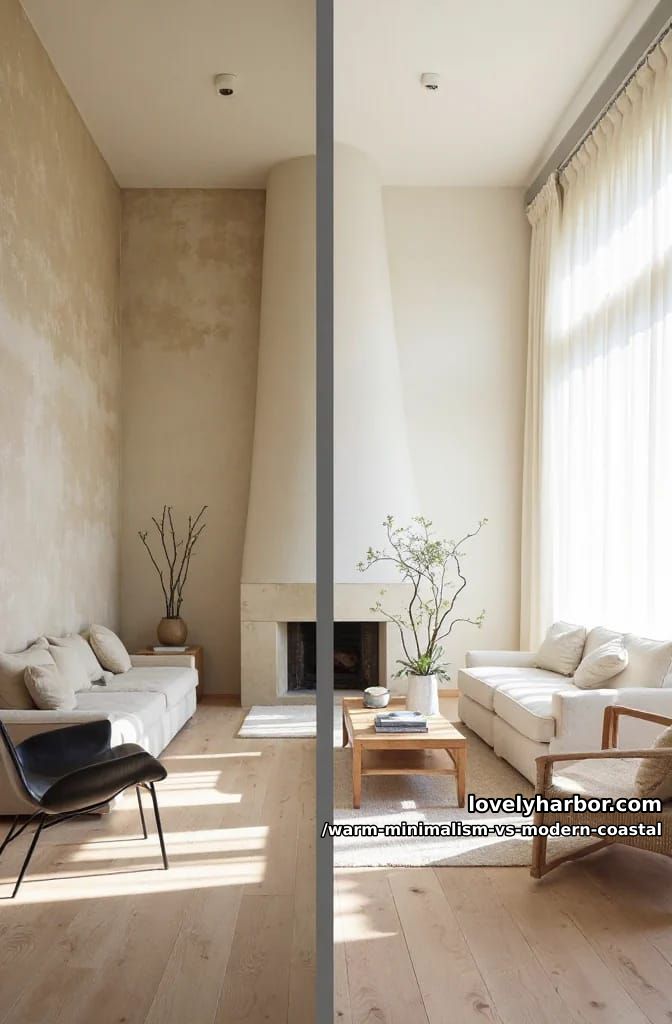
Warm minimalism owes its DNA to a small group of Belgian architects who reframed minimalism so it didn’t feel like a dentist’s office. Vincent Van Duysen has been openly skeptical of the term himself, preferring “traditional modernist.” But the school he and Axel Vervoordt represent has become shorthand for rooms that are spare without being austere: putty plaster, dark oak, a single piece of art, a window facing a wall instead of a view. Strip the marketing language and what’s left is a style organized around shadow. These rooms are designed for north-facing windows and rainy Antwerp afternoons, and they reach full effect when half the room is dim.
Modern coastal grew out of something else entirely. Drop the Hamptons baggage , the seashells, the captain's wheels, the navy and white stripes that read like a children's book , and what is left is the California reinvention. Amber Lewis, Studio McGee, Marie Flanigan, designers working with too much sun and a client base that wants rooms to feel breezy at noon. The reference materials are coastal cottages and Mediterranean farmhouses, but the brief is more specific than the moodboards admit: make this room handle 3,000 lumens of natural light without looking washed out at 1 p.m.
Origin and reference
Antwerp 1990s. Van Duysen, Vervoordt, Glenn Sestig. Wabi-sabi influence via John Pawson and the Japanese tea house. Designed for diffuse, dim, north-facing light.
Origin and reference
California 2015 onward. Amber Lewis, Shea McGee, Erin Fetherston. Mediterranean farmhouse and Hamptons cottage filtered through a clean, less nautical lens. Designed for abundant midday light.
2. The Color Palette Side-by-Side
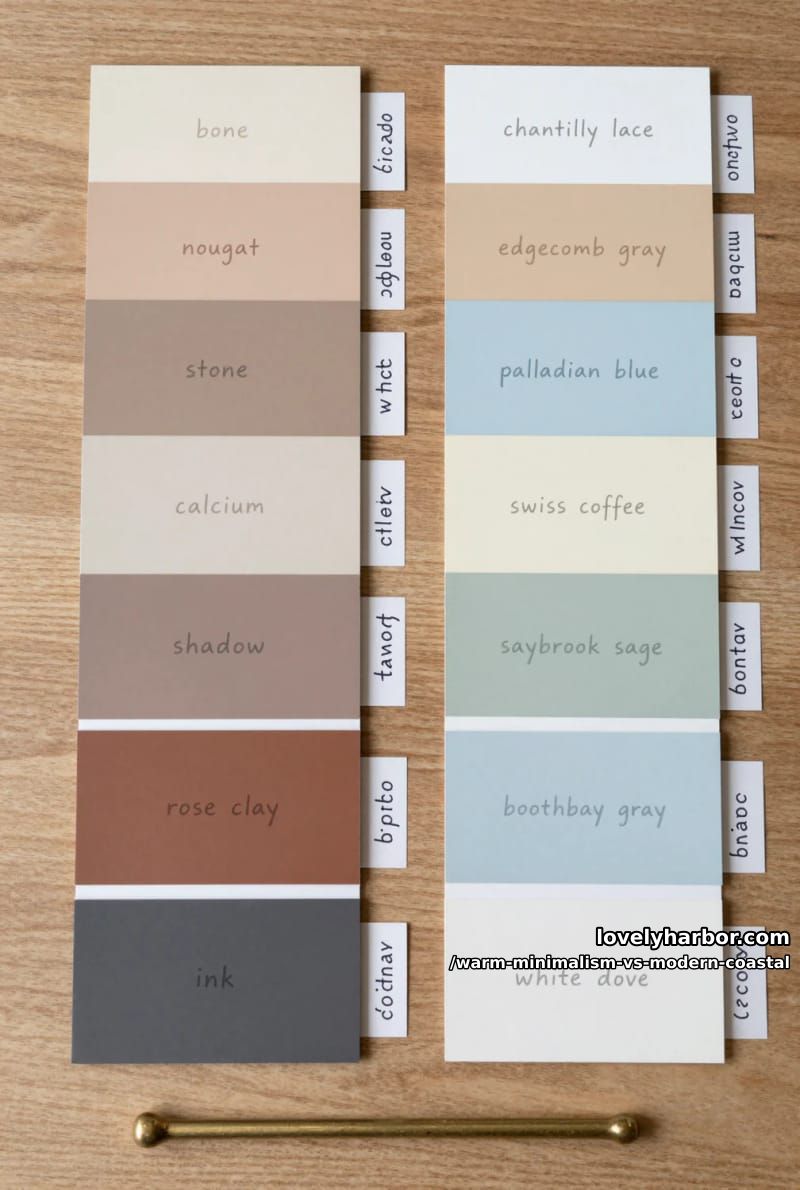
The palettes overlap on the surface. Both lean neutral. Both avoid saturated color. Both feature off-white and beige. They diverge on temperature and humidity. Warm minimalism palettes feel arid and earthy , plaster pinks, mushroom, rosé clay, stone, the colors you'd see on the wall of a Greek farmhouse interior at dusk. Modern coastal palettes feel washed and humid: chambray blue, sand, seagrass, off-whites with green undertones rather than pink.
The single biggest tell is the white. Warm minimalism wants a white with pink or yellow under it (Farrow & Ball Wimborne White, Portola Bone, Benjamin Moore White Heron). Modern coastal wants a white with green or blue under it (Benjamin Moore White Dove or Chantilly Lace, Farrow & Ball Strong White). Put a Wimborne White wall next to a White Dove wall and they look like different paint jobs in different houses. They are. Pick the wrong white for the style you're trying to commit to and the room will fight you forever.
| Warm minimalism | Modern coastal | |
|---|---|---|
| Anchor white | Pink or yellow undertone (Wimborne White, Portola Bone) | Cool green or blue undertone (White Dove, Chantilly Lace) |
| Neutral mids | Putty, mushroom, stone, clay | Sand, greige, soft taupe, oatmeal |
| Accent color (if any) | Rust, charcoal, deep terracotta, ink black | Soft blue, sage green, faded chambray |
| What it avoids | Anything that reads “fresh,” sky blue, mint, true white | Anything muddy, true brown, raw umber, cold gray |
| Mood it produces | Dusk indoors at any hour | Bright morning at any hour |
3. Wall Treatments: Where the Distinction Lives or Dies
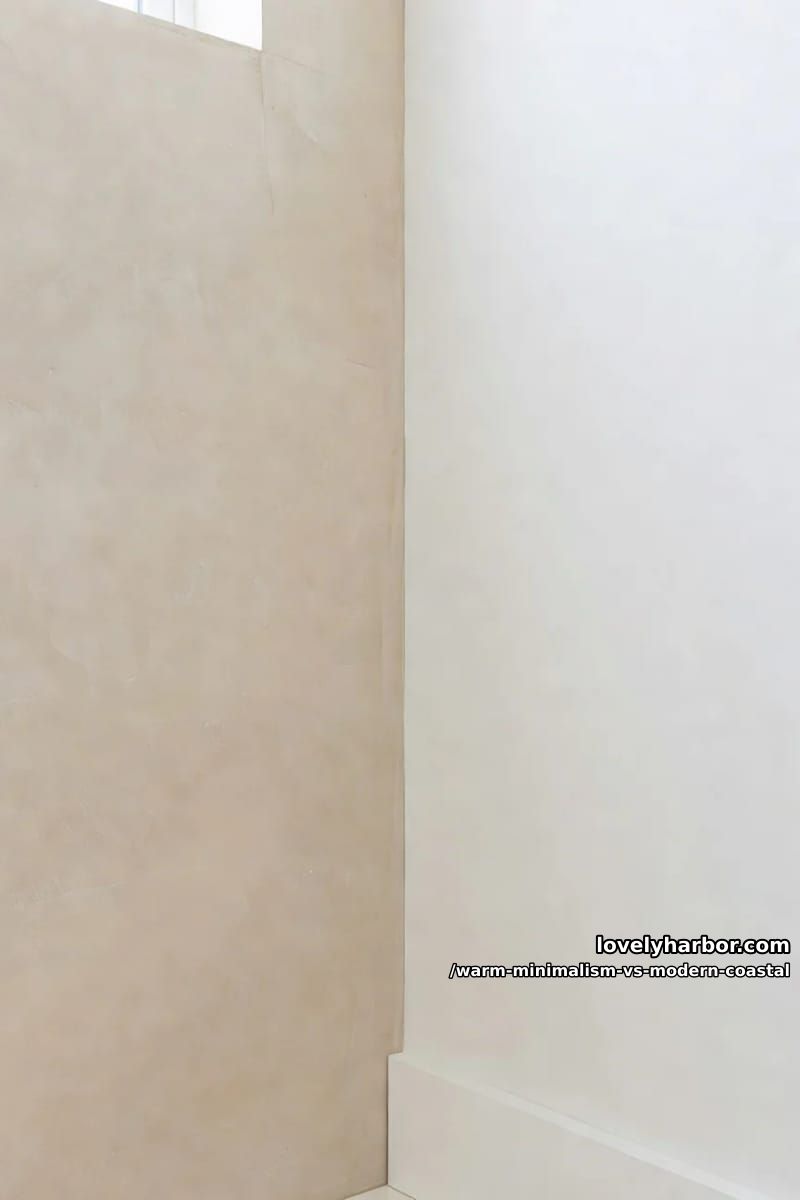
This is where the two styles separate the most. It’s also where the most money gets spent badly. Warm minimalism is a plaster style. The wall has to be doing visible work , limewash, Roman clay, tadelakt, real lime plaster troweled by someone who knows what they’re doing. A flat-painted drywall surface will never deliver the depth that the rest of the look depends on, and no amount of furniture compensates. Bauwerk Limewash, applied at a coverage rate of about 60 square feet per quart for two coats, costs more than standard paint and behaves differently. You can fake it with a textured paint and a sponge. I’ve recommended people try this for a single accent wall before committing. The cheats don’t really hold up after a year.
Modern coastal does the opposite. Walls clean and flat. High-quality matte paint. The texture lives in the millwork: paneled wainscoting at 36 inches, occasional shiplap on a single accent wall (used sparingly, never the whole house), beadboard on a porch ceiling, crisp white shaker baseboards at 5 to 7 inches. Sherwin-Williams Emerald in matte or Benjamin Moore Aura in matte are the working specs. Plaster walls plus shiplap is the combination that lands you in no-man's-land.
If you want the warm minimalism wall but not the plumber-quoting-on-a-plaster-job stage, Roman clay applies with a putty knife over primed drywall and gets you most of the depth at a fraction of the labor.
Portola Paints Roman Clay in Bone or Nougat (1 kilo covers approximately 20 to 25 square feet)4. Materials Tell on You Faster Than Furniture

You can buy the same sofa and put it in either room. The materials around it decide which one it joins.
Warm minimalism leans heavy: unpolished travertine, blackened steel, brushed bronze, reclaimed oak with visible grain, hand-thrown ceramics with chalk glazes, real linen that drapes with weight. Van Duysen describes his own palette in terms of natural materials , woods, stones, plaster techniques derived from chalk, wools, linens, and cottons rather than synthetics. Modern coastal leans lighter and more textural: pale white oak, woven jute, sisal, rattan, seagrass, ceramic with a slight glaze and the occasional hand-painted detail, performance linens that look casual but wipe clean.
Warm minimalism materials
- Unpolished travertine, limestone, soapstone
- Reclaimed or stained oak, walnut, blackened ash
- Heavy Belgian linen (220 to 280 gsm), wool bouclé
- Hand-thrown ceramics in chalk or clay glaze
- Brushed bronze, blackened steel, oxidized brass
Modern coastal materials
- Pale white oak (rift-sawn, light finish)
- Jute, sisal, seagrass, natural rope
- Slubby cream linen, slipcover-weight cotton
- White-glazed ceramics, hand-painted blue detail
- Antique brass, polished nickel, soft brushed nickel
Some materials cross over , both styles like natural linen, both like oak , but the crossover materials change character based on what surrounds them. A 220 gsm Belgian linen curtain in a putty plaster room reads warm minimalism. The same curtain in a white-trim room with sisal underfoot reads modern coastal. If you've already bought a curtain you love, you can still decide either way. The floor and the walls do the voting.
5. Furniture Silhouettes Diverge More Than People Realize
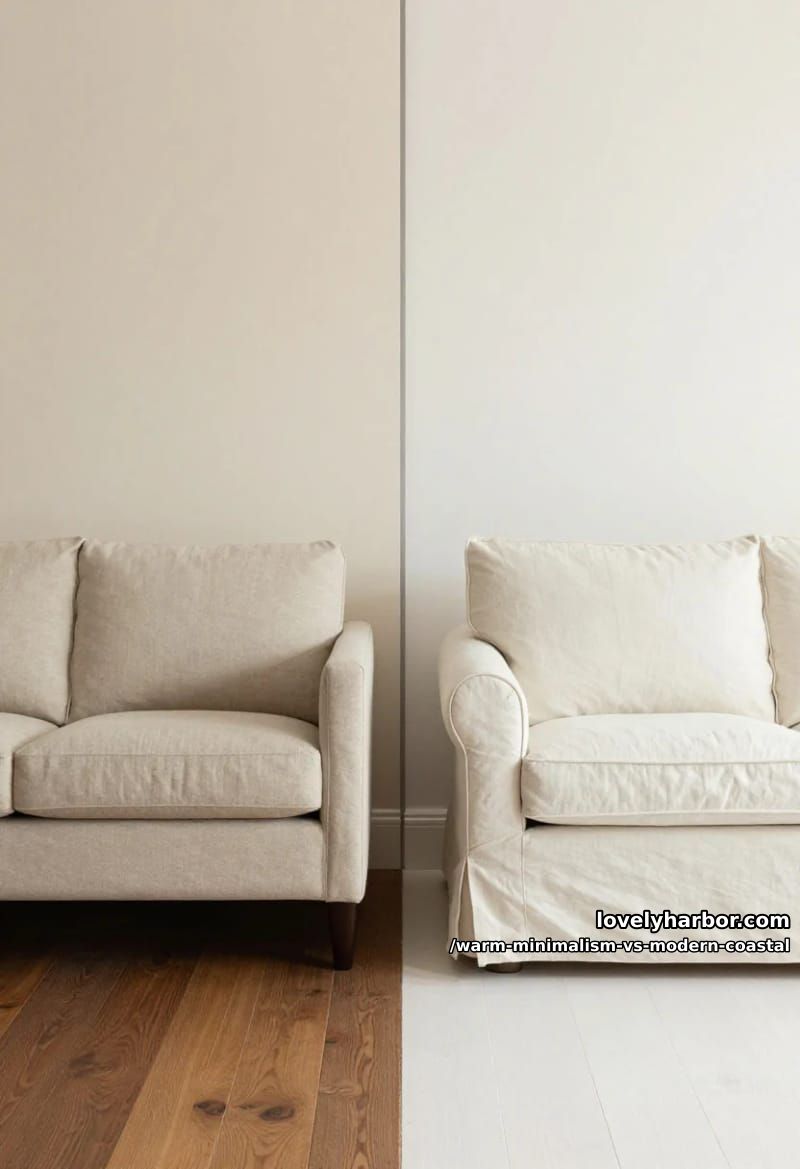
The defining silhouette of warm minimalism is the low, deep, architectural sofa. Antonio Citterio for B&B Italia, Vincent Van Duysen for Molteni&C, or the DePadova catalog from any decade. Seat depth often 28 inches or more, back height under 30, block feet, fabric pulled tight enough to read as sculpture. The companion pieces are equally severe , a single Pierre Jeanneret chair in repro, a travertine plinth as a coffee table, a long bench under a window with one stack of books on it. Everything in the room is heavy and there isn't much of it.
Modern coastal goes the other way. The hero piece is the slipcovered sofa with a skirt to the floor, often in two cushions rather than three, often with a gentle rolled arm. Belgian roll arm sofas from Restoration Hardware spawned a hundred imitators; the Cisco Brothers Acacia is a quieter version of the same idea. Coffee tables tend to be small turned-wood rounds or rectangular pieces in pale oak. Side tables are pedestals or small painted gueridons. The visual weight is lower per object but the object count is higher.
6. Lighting Is the Most Misunderstood Difference
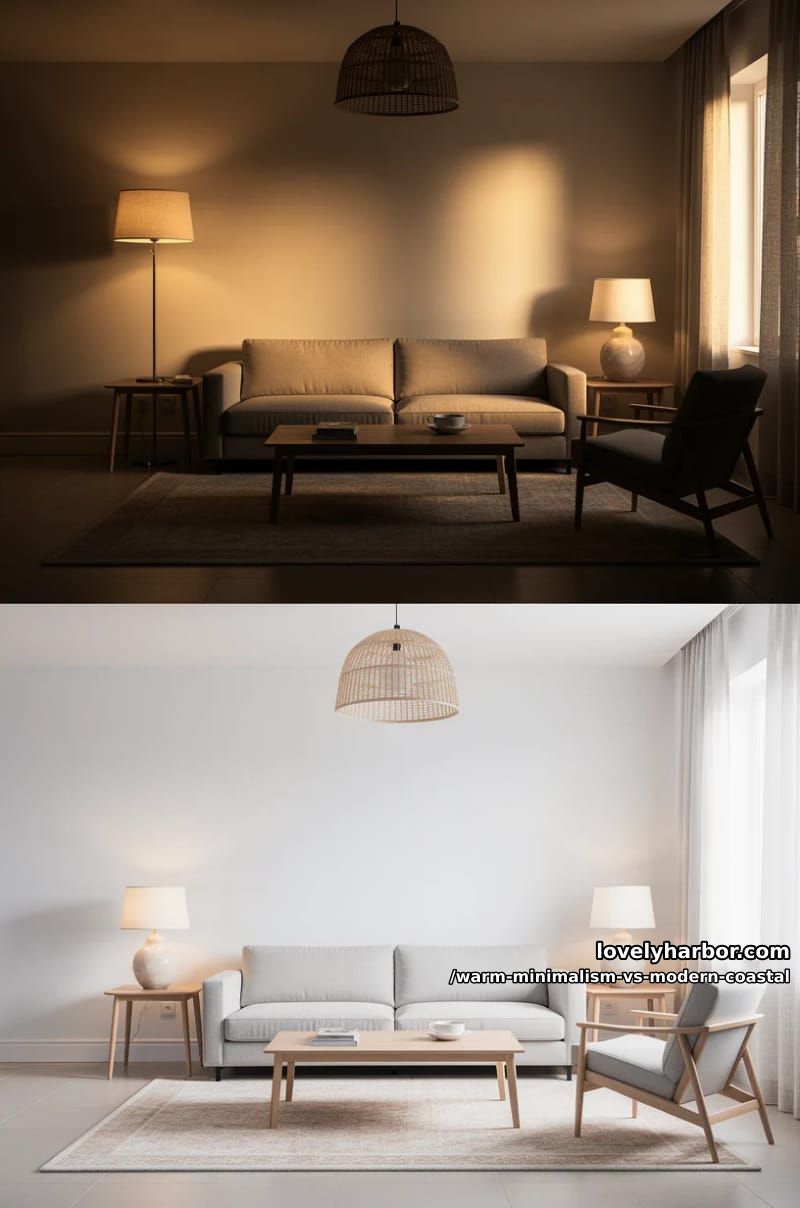
People assume warm minimalism uses warm lighting because it has "warm" in the name. The deeper reason is that the style is built for low-light moments. Lighting design follows: 2700K or warmer across the board, dimmers on everything, sparse fixture count, statement floor lamps with parchment or alabaster shades, no overhead can lights doing the work. A Van Duysen room at 4 p.m. on a cloudy day in Antwerp is the brief, and the brief is rigid.
Modern coastal wants a bright room at noon and a still-bright room at 8 p.m. Lighting is more layered and more democratic: a ceiling fixture (often a woven rattan pendant or a Visual Comfort lantern), two matched table lamps with linen drum shades, a tall floor lamp, sconces flanking the fireplace. The lamps stay lit. The room never goes dim. If you have a south-facing room and you want it to feel calm at midday, modern coastal will deliver. Warm minimalism in the same room will fight the sun.
Turn every lamp on at 2 p.m. on a sunny day. If the room still feels softly contrasted with some shadow, it’s a warm minimalism room. If the room reads evenly lit and bright, it’s a modern coastal room. The wall finish, paint color, and material choices either support that lighting brief or undermine it. Most “doesn’t quite work” rooms are mismatching the brief.
7. Textiles, Pattern, and the Rug Question
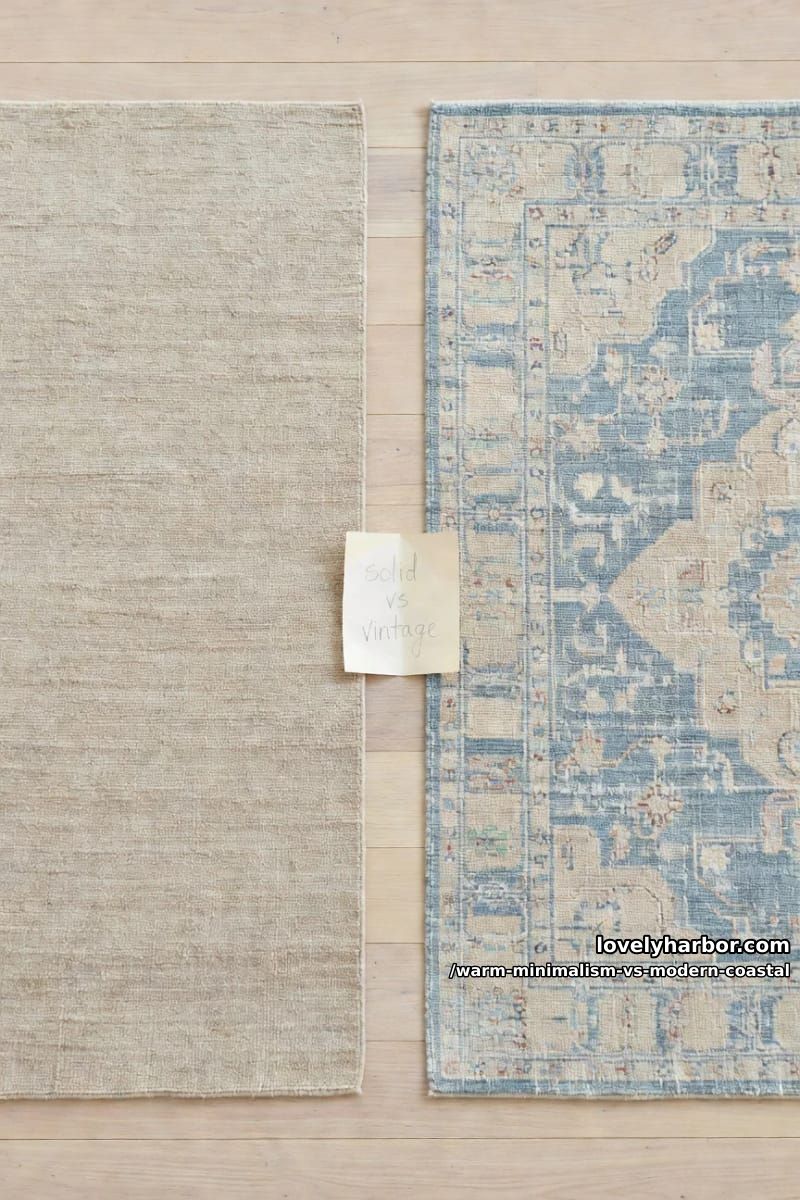
Both styles use a lot of linen. They use it differently. Warm minimalism wants heavy linen in solid colors only: oatmeal, putty, sand, charcoal. The texture of the weave is the visual interest. Modern coastal allows stripes (Hudson Bay, ticking, awning), block prints in soft blues, and the occasional small-scale floral. Patterns are restrained but present. This is the cleanest single test: if a room has a striped or block-printed pillow, it isn't warm minimalism.
Rugs split the same way. Warm minimalism is a solid-rug style , flat-weave wool, jute, undyed Berber. Modern coastal embraces the vintage-Persian-in-faded-tones look that Amber Lewis basically invented as a category. The Loloi Georgie Collection achieves the vintage look through a printed construction with low, flat pile that is reminiscent of time-worn antiques. Both are good choices. The trap is the rug that wants to be both, which usually ends up as a beige pattern with no commitment in either direction.
If you’re building a modern coastal room and you only buy one thing from the trend, make it the faded vintage-style rug in ocean and sand. It does more work than any single piece of furniture.

8. Mistakes That Drag Both Styles into Pottery Barn 2009
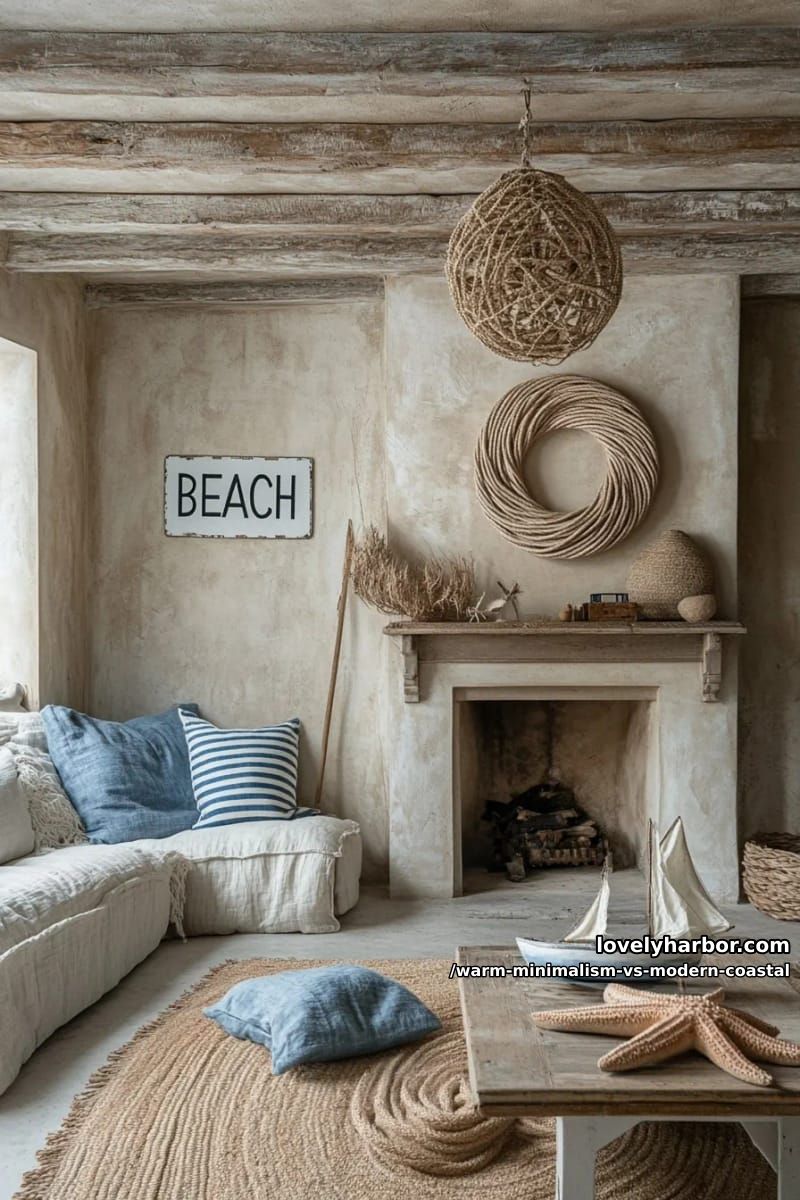
The single biggest failure across both styles is reference confusion. People who say they want modern coastal often pin photos that are actually Hamptons coastal 2009: ropes, starfish, painted signs that say BEACH, navy stripes everywhere, a model sailboat on the mantel. None of that belongs in a modern coastal room in 2026. The current version drops the nautical kitsch entirely and reads more like a Mediterranean farmhouse in a slightly cooler palette. If the article you're reading uses the word "nautical" without qualification, it's an old article.
The warm minimalism failure mode is the opposite. People strip a room down to zero objects, paint it a flat off-white, install pale floors, and end up with a sterile box. Van Duysen has been explicit that minimalism stripped of objects and art is not the way he sees minimalism at all. Warm minimalism needs texture , plaster, heavy linen, wood grain , doing the work that color and pattern do in other styles. Skip the textured layer and you get the dentist's office Van Duysen has spent thirty years rejecting.
Warm minimalism failures: flat off-white paint instead of plaster; light pale floors instead of rich oak; furniture too small for the volumes (warm min wants a few large pieces, not many small ones); overhead can lighting that flattens the room.
Modern coastal failures: any literal nautical motif (rope, starfish, ship’s wheel); navy and white in 50/50 ratio (it now reads as the children’s room version); shiplap on every wall (one accent is the ceiling, max); brown leather sofas (the leather goes in warm minimalism, not here).
9. When to Pick Which: A Practical Decision
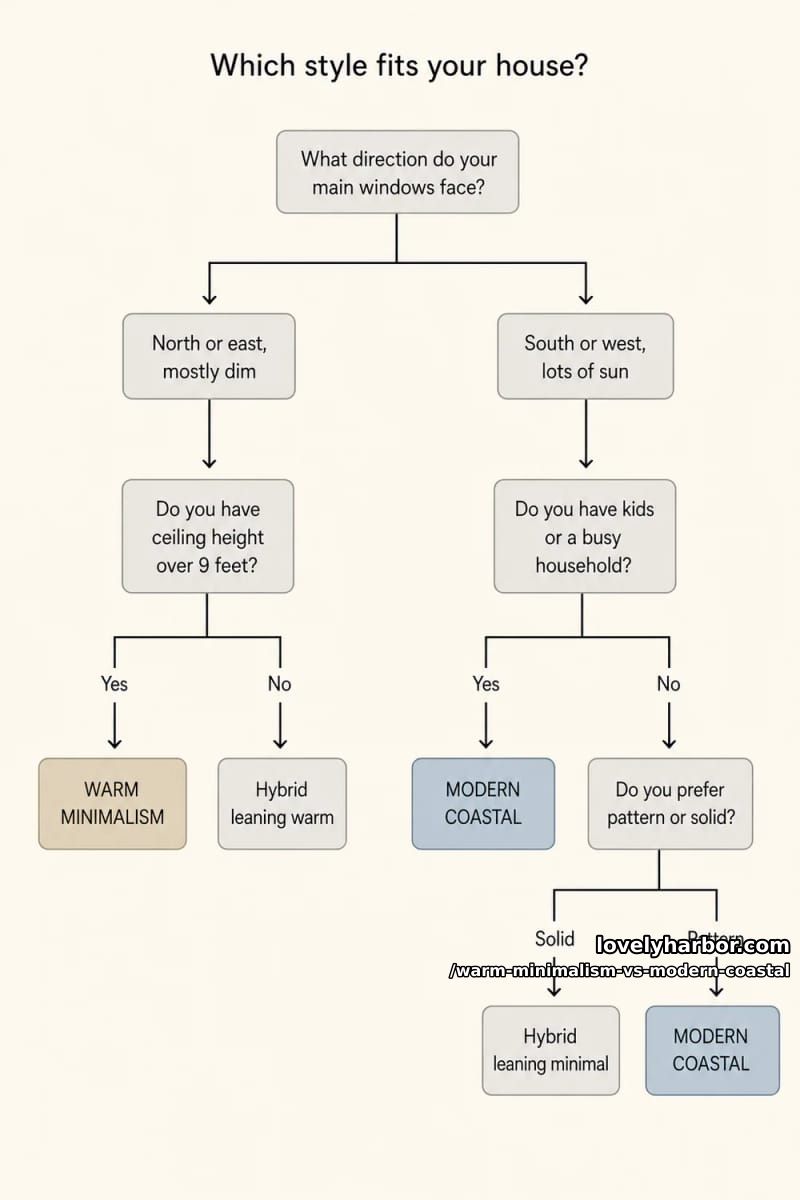
Pick warm minimalism if your house has low light, ceilings over nine feet, good bones already (real plaster or the willingness to install it), and you live alone or with someone who agrees to keep horizontal surfaces empty. The style fails in busy households because it requires editorial control. Three magazines on the coffee table, a basket of toys in the corner, a dog bed by the window, and the whole effect collapses.
Pick modern coastal if your house has abundant natural light, you have kids or pets or both, and you want a room that reads cheerful at dinner. The style is more forgiving of life happening in it. A throw on the sofa and a stack of cookbooks on the counter doesn't destroy a modern coastal kitchen the way it would destroy a warm minimalism one.
10. Can You Mix Them? Honestly
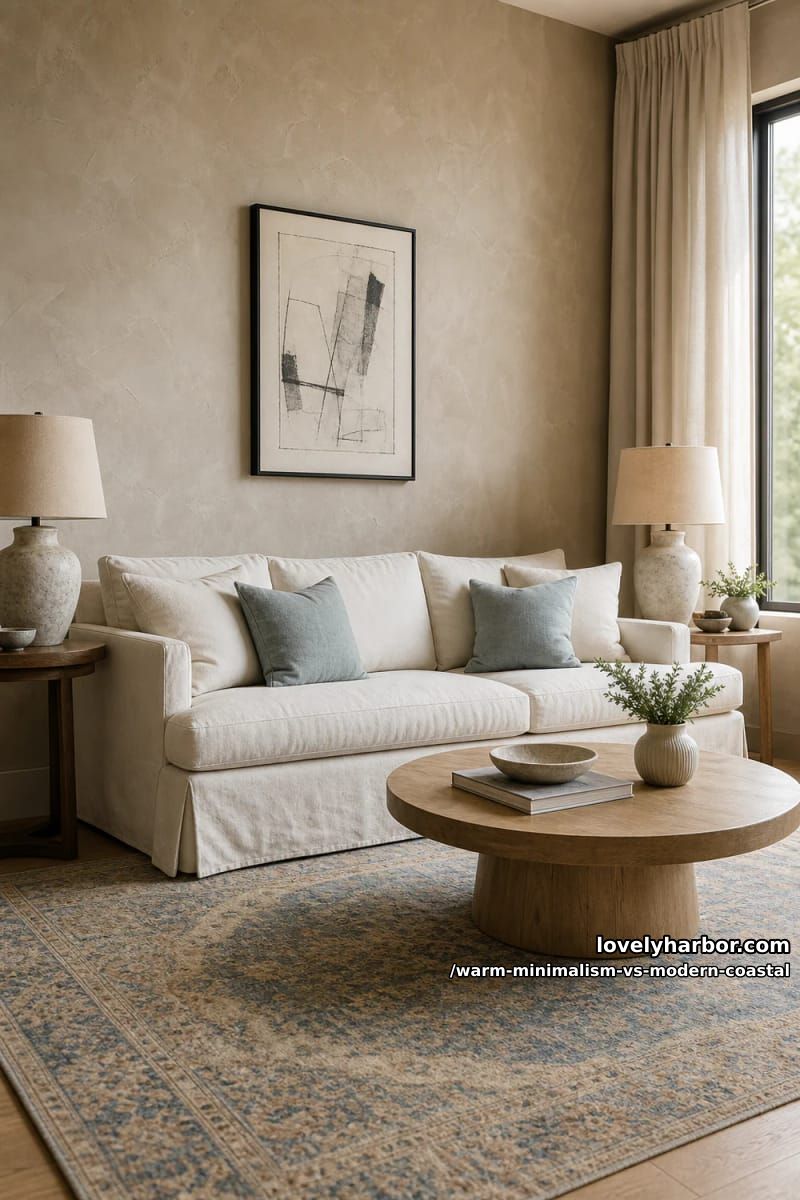
Yes, with rules. The cleanest hybrid I've seen consistently is warm minimalism for the walls and floors (real plaster, dark oak), modern coastal for the upholstery and rugs (slipcovered sofa, vintage Persian in faded blue). The architectural envelope reads moody and dim. The soft furnishings warm it up and add pattern. It works because the two styles are arguing about lighting brief, not taste, and you've split the brief intelligently: heavy materials hold the room, lighter ones make it livable.
What doesn't work is splitting the other direction. Modern coastal walls , flat warm white, shiplap, white trim , with warm minimalism furniture (low slung B&B Italia sofa, travertine plinth) looks like a furniture showroom where someone forgot to finish the renovation. The architecture and the furniture have to agree on whether the room is dim or bright. Furniture goes where light goes, not the other way around.
Pick one style for the architectural envelope (walls, floors, ceiling, windows, lighting) and let the other contribute only through soft furnishings (upholstery, rugs, textiles, art, decorative objects). Never split the other way. The envelope sets the lighting brief, and the furniture has to live inside that brief or look stranded.
Conclusion
Walk into the room at 11 a.m. on a sunny day, 4 p.m. on a cloudy one, and 8 p.m. with the lamps on. Whichever of those three moments is the one you actually want to live in is your style. Build for that moment, and let the others take care of themselves. If you can't decide, look down: pale oak says modern coastal, dark oak says warm minimalism, and refinishing floors costs more than reupholstering a sofa.