Why the Spanish colonial courtyard logic still works, how to translate it to your actual space, and three worked examples at small, medium, and large scale.
Most articles about Mexican patios show you finished spaces and trust you to figure out the floor plan from photos. That’s where projects break.
A photo of a patio in San Miguel de Allende sitting in a 1,500-square-foot interior courtyard does not translate to a 12×14 ft rectangle behind a tract home in Phoenix. The pieces (Talavera, equipales, bougainvillea, fountain) are the same; the spatial logic that makes them feel cohesive is what gets lost.
This guide is the design part of building a Mexican patio. It covers the cultural and architectural reasons the style is laid out the way it is, the five real-world layout archetypes most readers are actually working with, the zoning rules that hold across all of them, and three worked floor-plan examples, small, medium, and large, with specific dimensions and furniture placements you can copy.
What’s in this guide
- The cultural logic: why the layout matters
- The five layout archetypes
- The conversational anchor: choosing your center
- The five zones of a Mexican patio
- Sizing chart: clearances and furniture dimensions
- Traffic flow: the four rules that determine “did it work?”
- Planting: perimeter strategy and vertical layering
- Common layout mistakes
- Three worked examples (10×12, 15×20, 20×30 ft)
1. The cultural logic: why the layout matters
The Mexican patio descends from two architectural traditions that fused during the Spanish colonial period: the patio interior of Andalusian Spain (which itself inherited from Roman atrium houses and Moorish courtyard design) and the open-air communal spaces of pre-Hispanic Mexican architecture.
The result is a space organized around four principles that haven’t changed in 500 years.
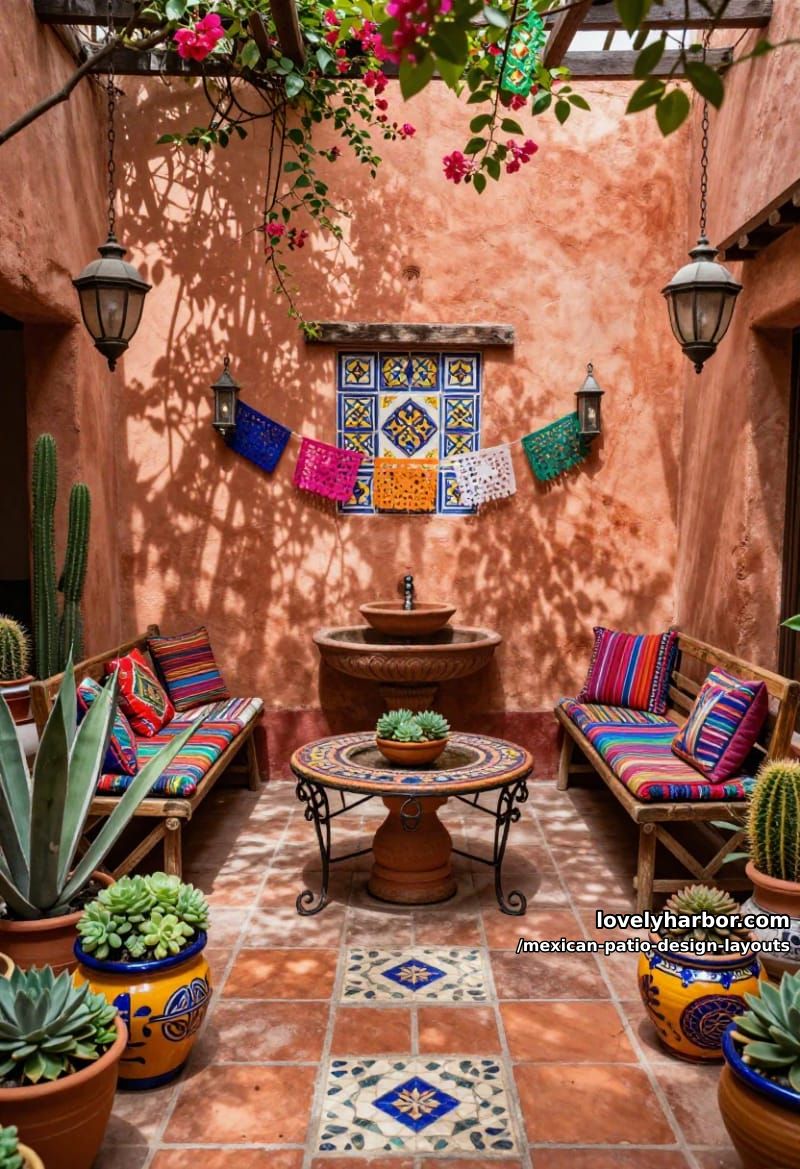
In Anglo-American design, the patio is “added on” to the back of the house. In hacienda design, the courtyard is thecenterof the house , every interior room opens onto it, and the rooms exist to frame the patio rather than the patio existing to extend the rooms. Even when you only have one wall of structure to work with, the principle still applies: the patio is the destination, not the leftover space.
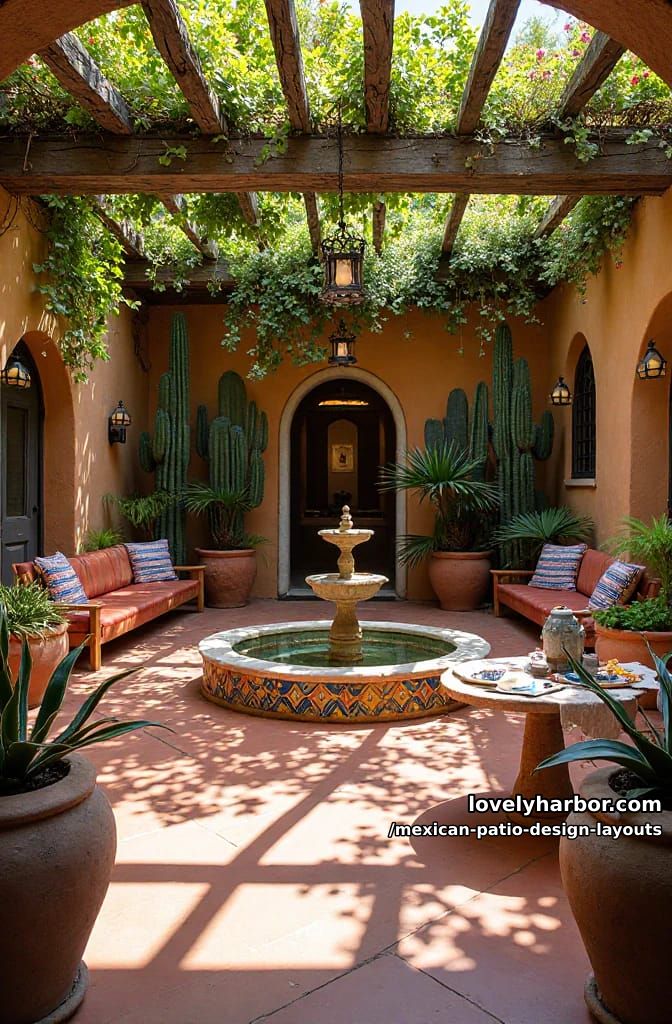
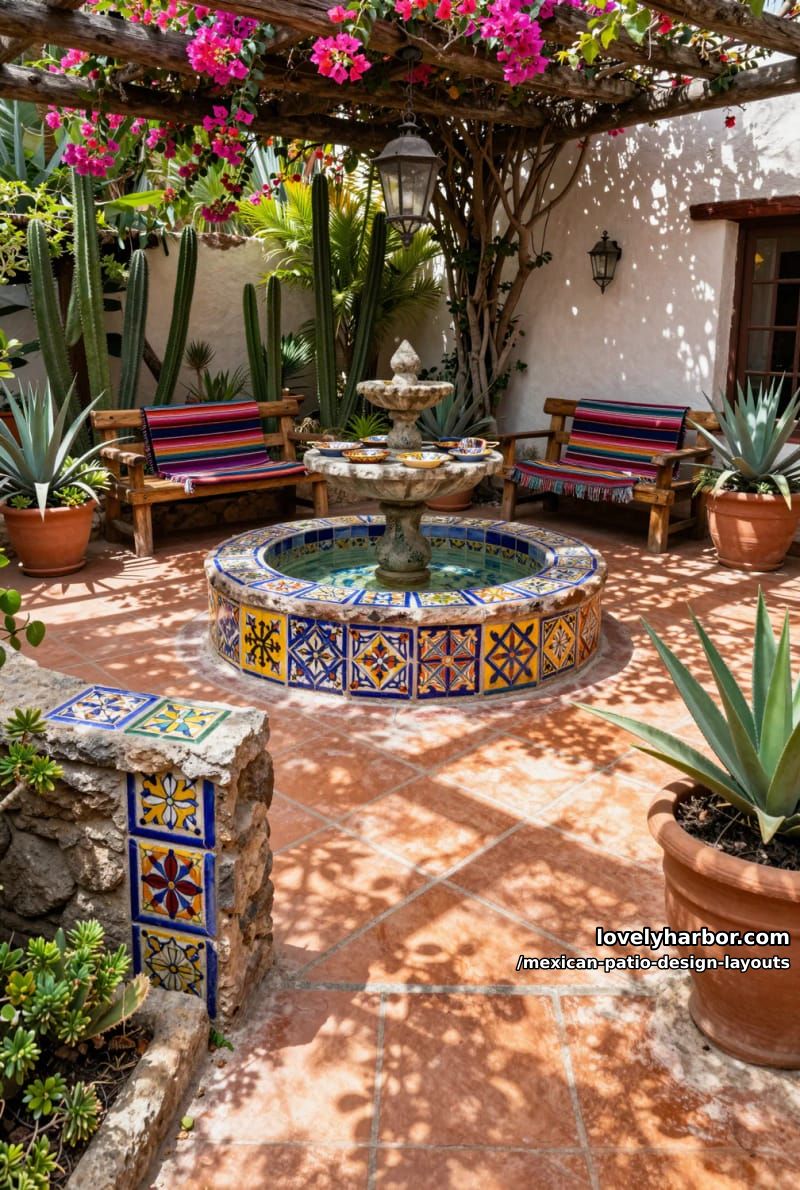
Traditional courtyards have one focal element , usually a fountain, sometimes a single specimen tree, sometimes a fire pit in modern interpretations. Everything else in the courtyard orbits that anchor. Two competing anchors split the space into halves that don’t speak to each other; zero anchors leave the eye wandering. The single-anchor rule is the most-broken layout principle in DIY Mexican patios.
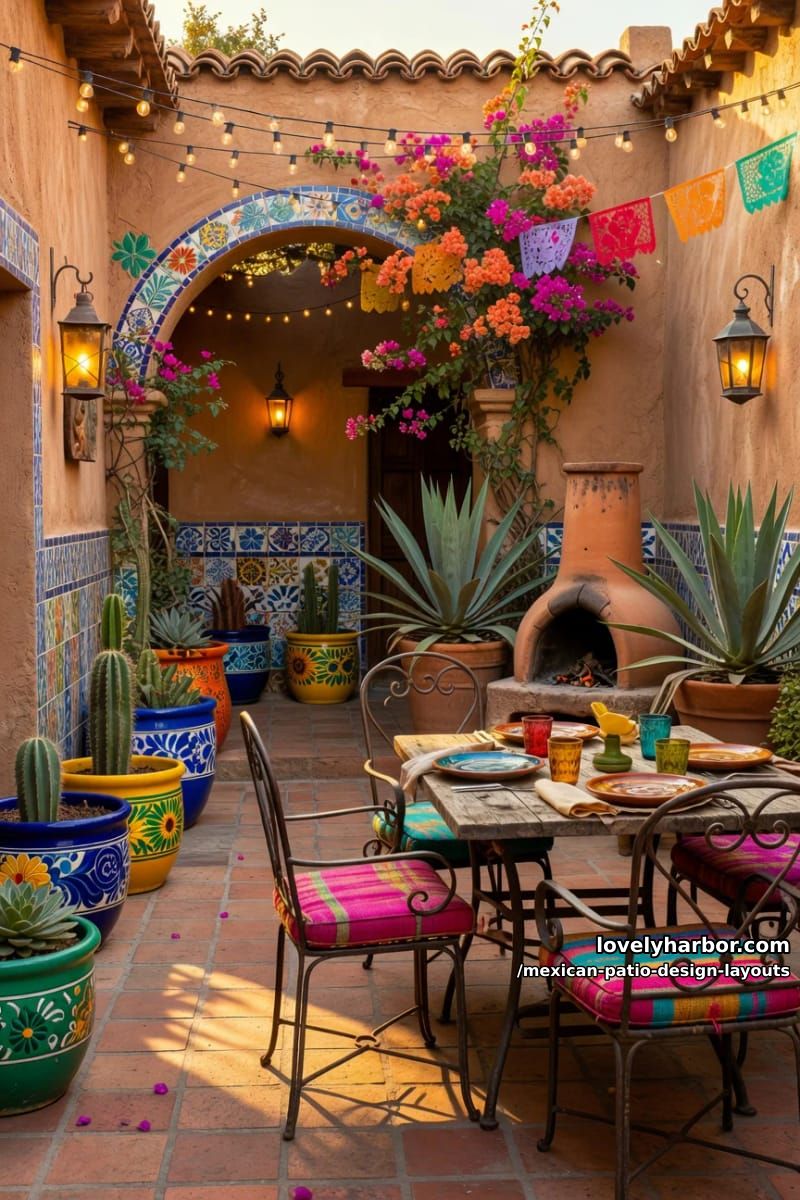
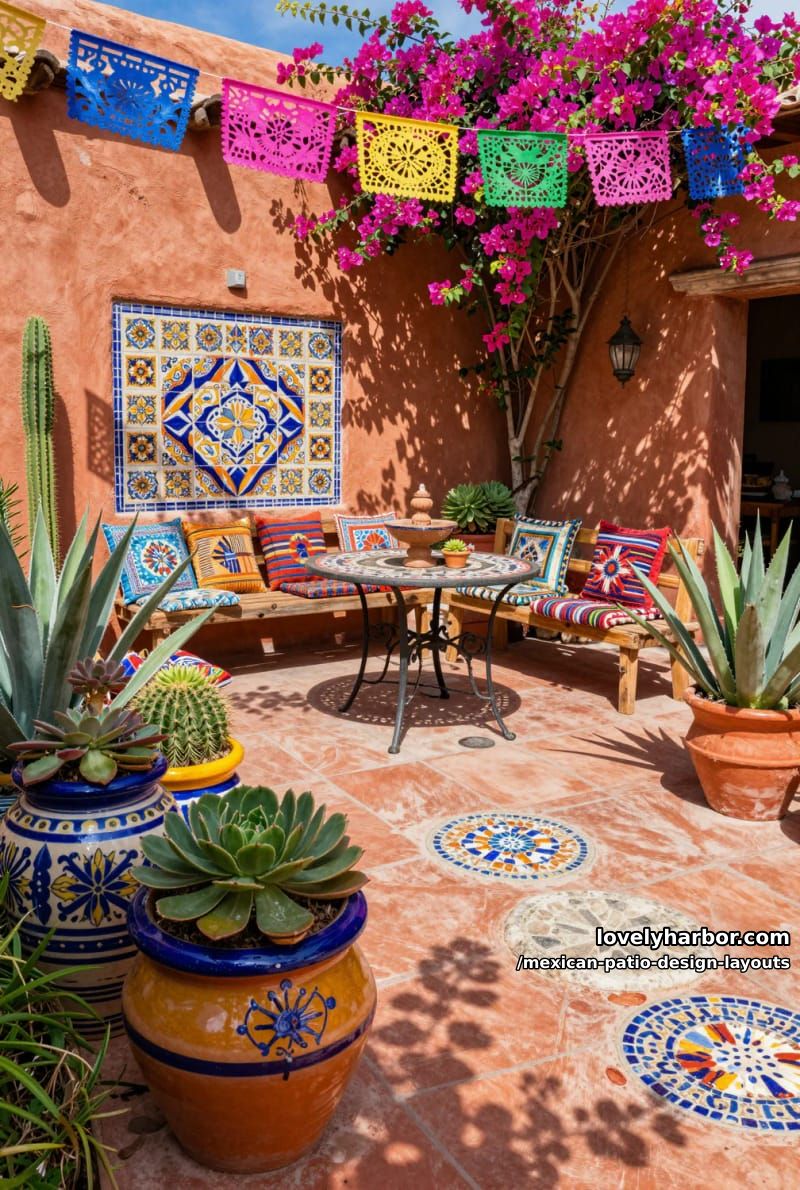
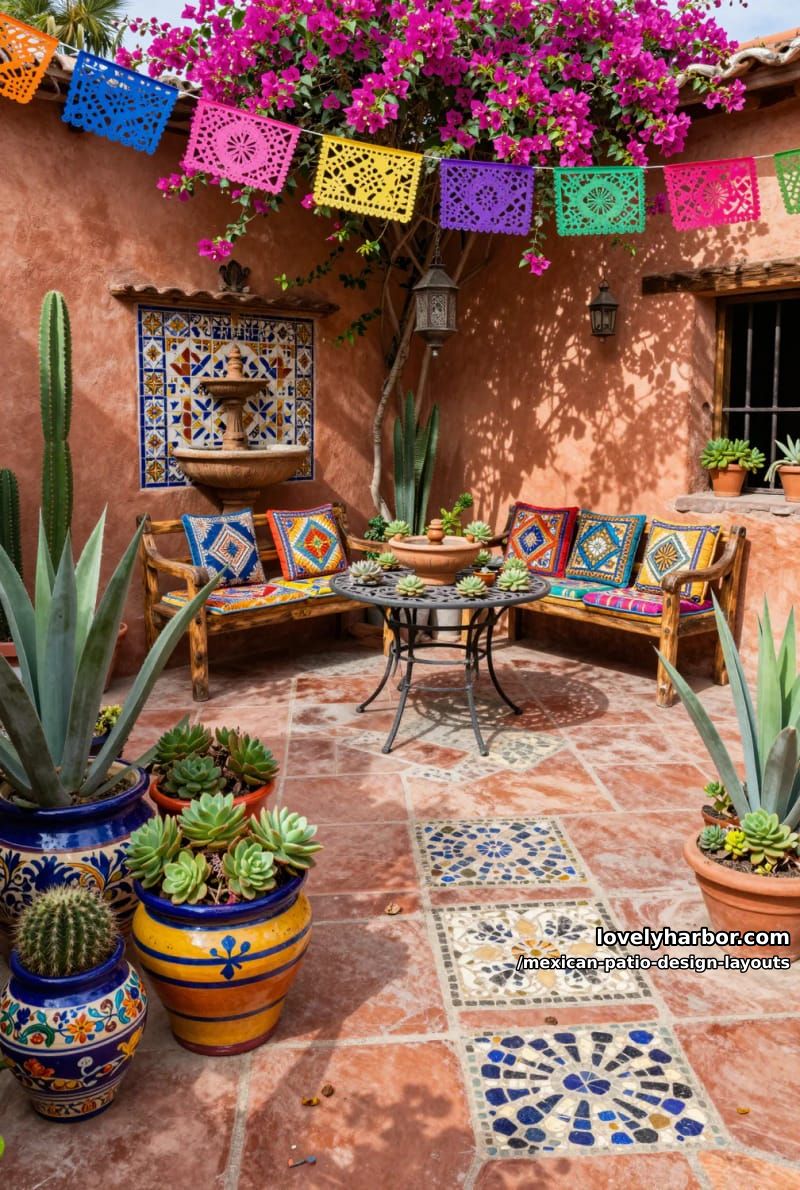
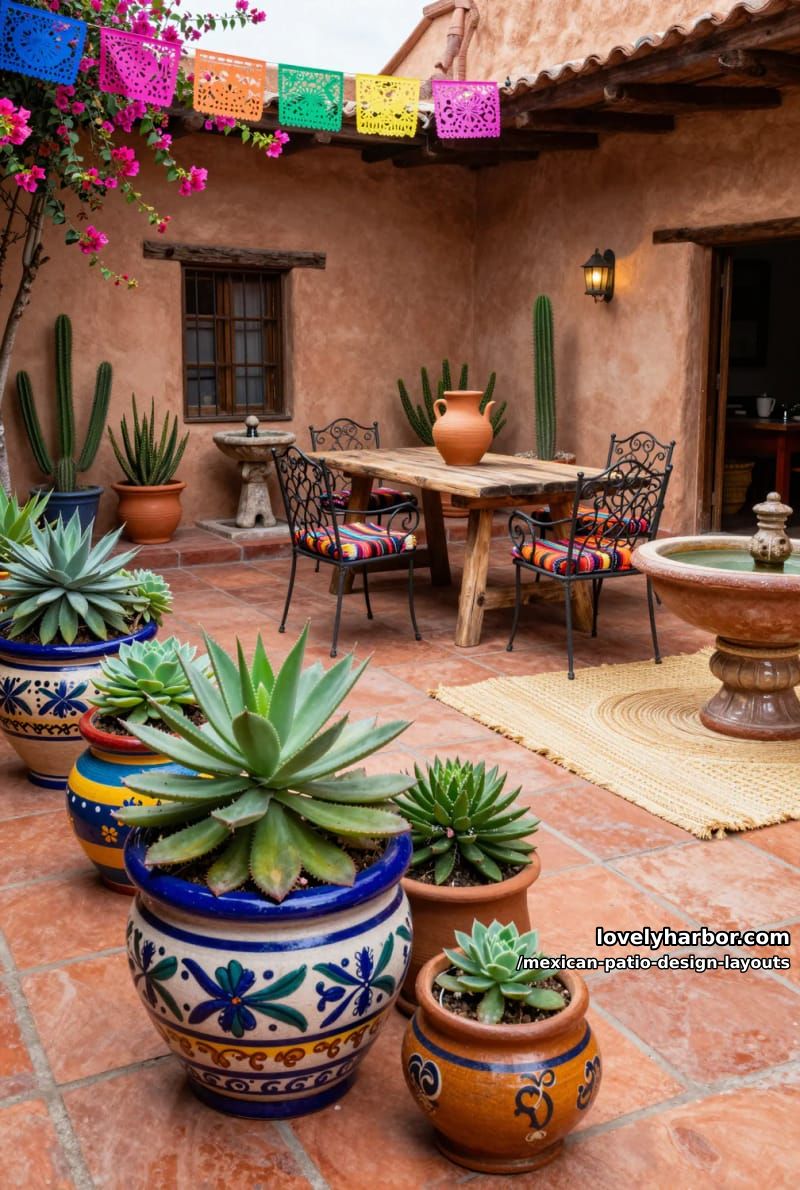
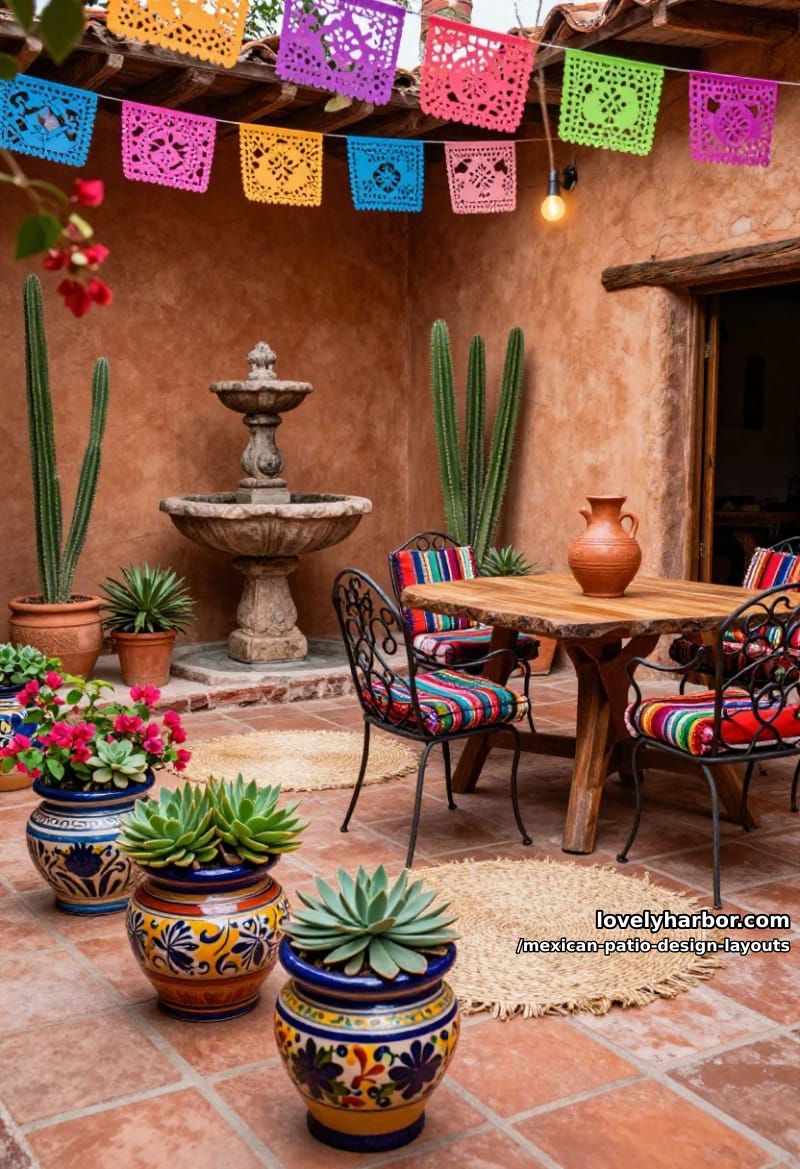
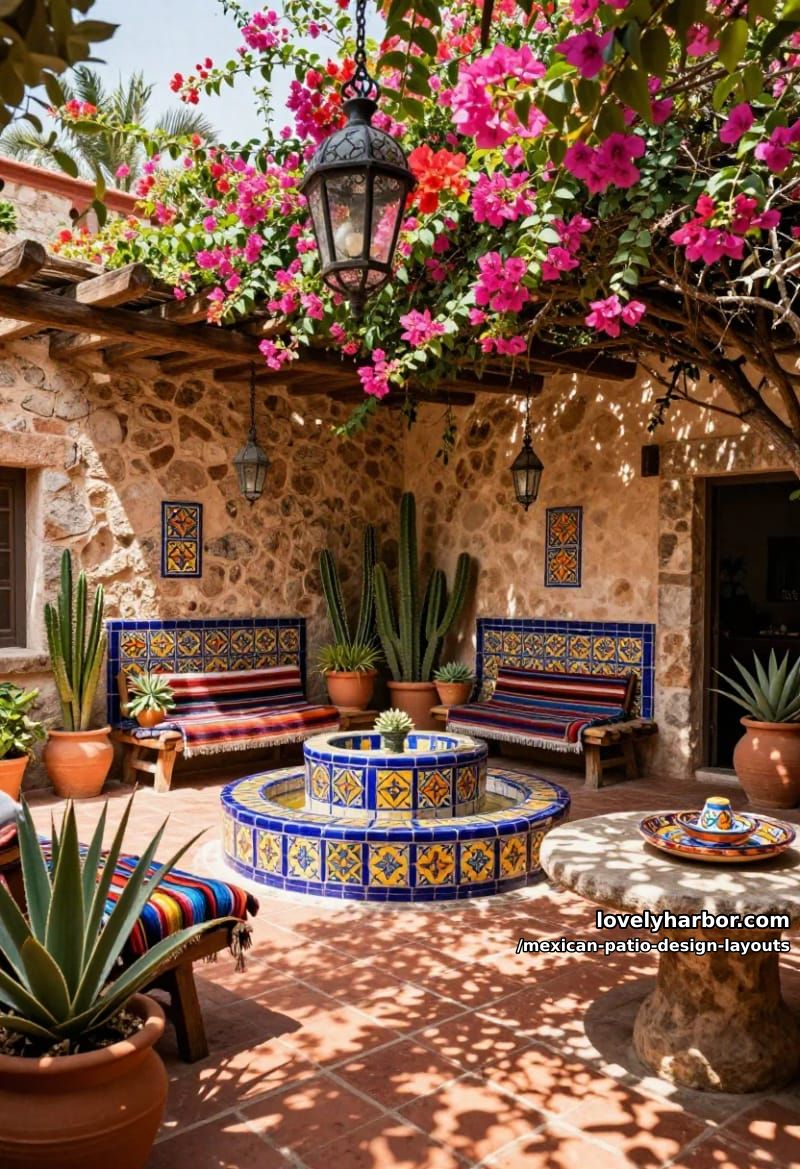
In a Spanish colonial courtyard, the floor stays relatively open. The visual richness , bougainvillea, painted planters, Talavera tile walls, hanging lanterns, tin mirrors , lives along the perimeter. This isn’t decorative preference; it’s a circulation rule. People move through the center; decoration lives on the edges where it doesn’t get bumped, kicked, or walked over.
Spanish colonial design inherited Renaissance symmetry from European tradition , paired chairs, balanced planters, axial alignment from the doorway through to the anchor. Mexican hacienda design loosens that symmetry with handmade tile variation, asymmetric plant clustering, and irregular pottery groupings. The discipline is in the framework (axes, alignments); the relaxation is in the surface (color, texture, asymmetric details).
These four principles are the test for whether a layout is working. If you can identify your single anchor, see that the perimeter is doing the visual work, find an axis from the doorway to the anchor, and feel that the floor reads open rather than crowded , the layout is sound.
If two of the four are missing, it’ll read as “Mexican-ish” without quite landing.
2. The five layout archetypes
Almost every Mexican patio you’d realistically build fits into one of five spatial archetypes, defined by how the patio relates to the structure of the house. Knowing which archetype you have determines the layout rules that apply.
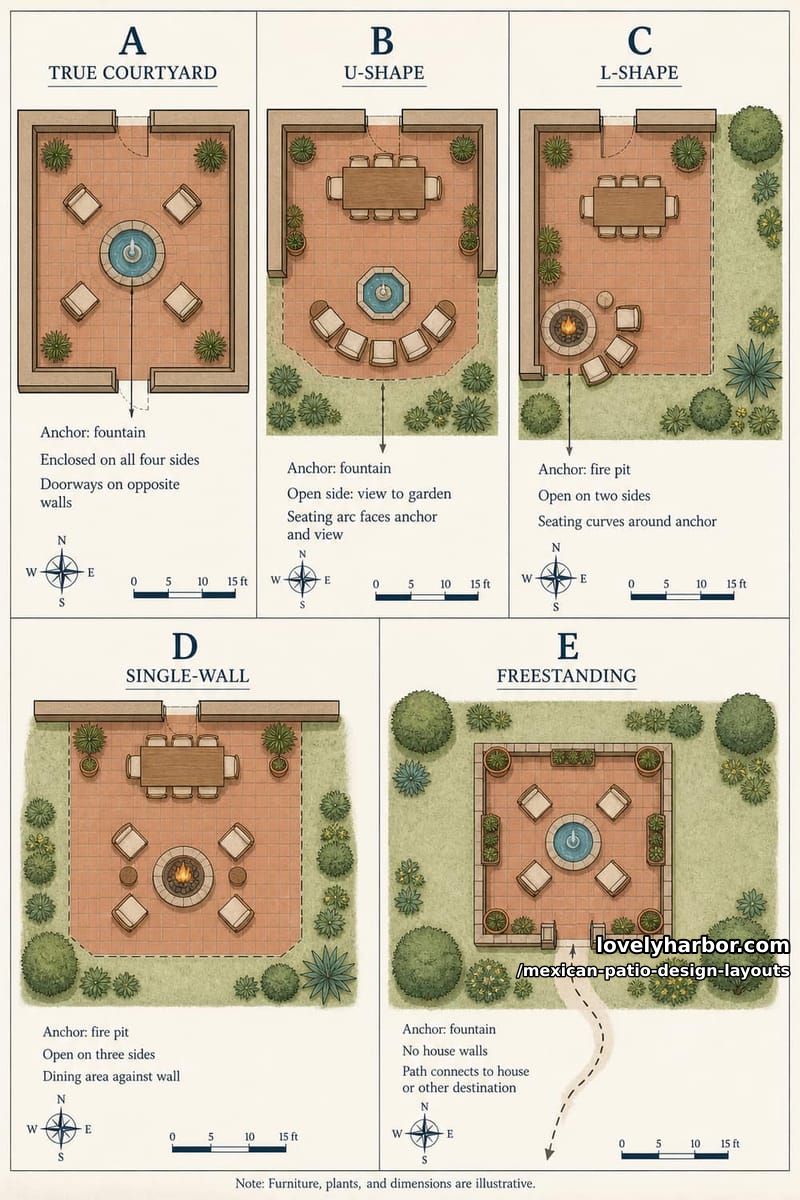
True Courtyard (4-sided)
Structure or wall on all four sides , the original hacienda model. The patio is fully enclosed and reads as an outdoor room of the house. Rare in new construction but the gold standard.
U-Shaped / 3-Sided
House wraps the patio on three sides; one side opens to a garden, view, or the rest of the yard. Very common in mid-century and Mediterranean-revival homes in the Southwest.
L-Shaped / 2-Sided
Two adjacent walls of the house frame a corner of the patio; the other two sides open. The most common archetype in typical American backyards.
Single-Wall (1-Sided)
One wall of the house borders the patio; the other three sides open to yard or garden. The classic American backyard patio shape.
Freestanding (0-Sided)
The patio sits in the middle of a yard with no direct connection to the house , a destination space connected by a path. Visually challenging but a strong option for larger lots.
Narrow / Side-Yard
Long, narrow strip alongside the house , 6 to 10 ft wide by 20 to 40 ft long. Not a true archetype but a common shape that needs a fundamentally different approach (no central anchor; linear flow instead).
3. The conversational anchor: choosing your center
Every Mexican patio needs one anchor , the visual and functional element everything else orbits. Three options have historical precedent, and your climate, use pattern, and budget should determine which one fits.
| Anchor | Best climate | Use frequency | Footprint | Realistic cost |
|---|---|---|---|---|
| Fountain (water) | Hot & dry; mild winters | Constant , visual + audio anchor any time | 4–6 ft diameter base + clearance | $800–8,000+ (Cantera carved) |
| Fire pit | Cool evenings, year-round use | Seasonal / nighttime , anchor when lit | 3–4 ft diameter + 36–42″ clearance | $300–10,000 (DIY vs. built-in mosaic) |
| Heavy stone table | Any climate | Daily use (dining, gathering) | 3×6 ft typical + 36″ chair clearance | $1,500–4,000 (mezquite or stone) |
| Specimen tree / planter | Any (variety by zone) | Visual only , passive anchor | 4–8 ft diameter mature spread | $200–1,500 (size at install) |
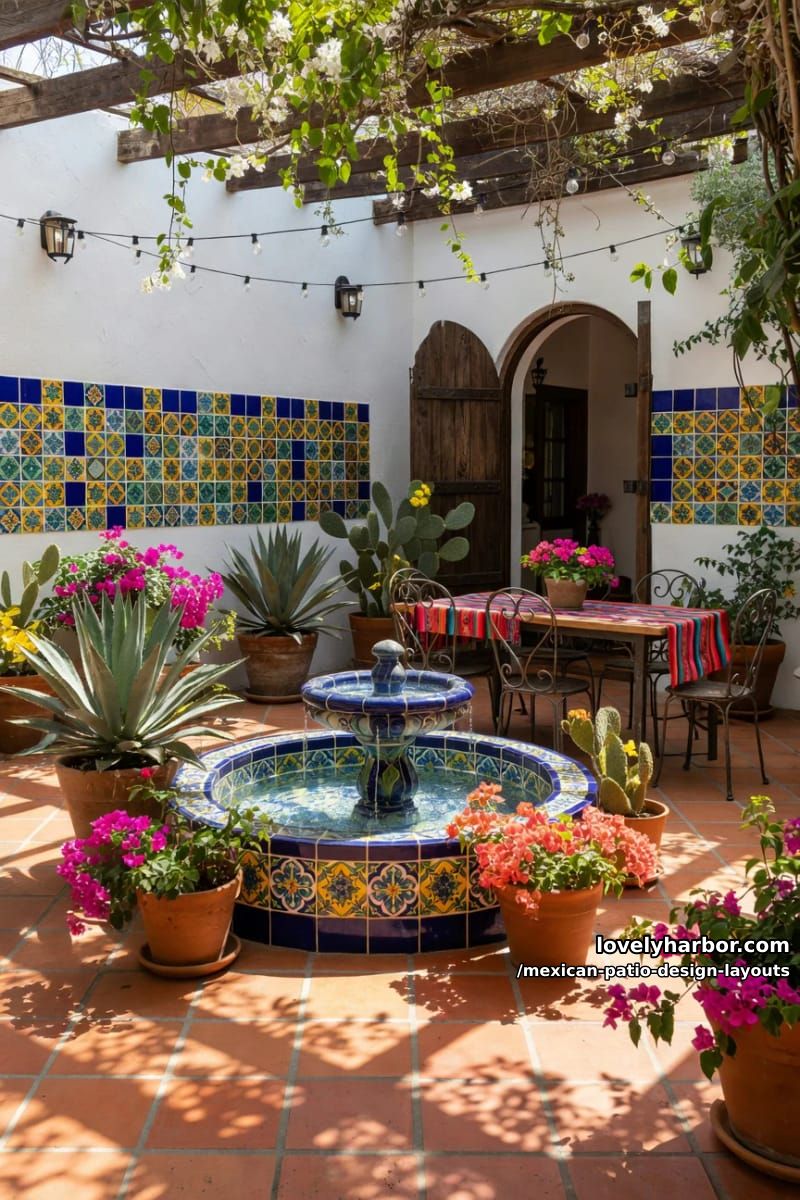
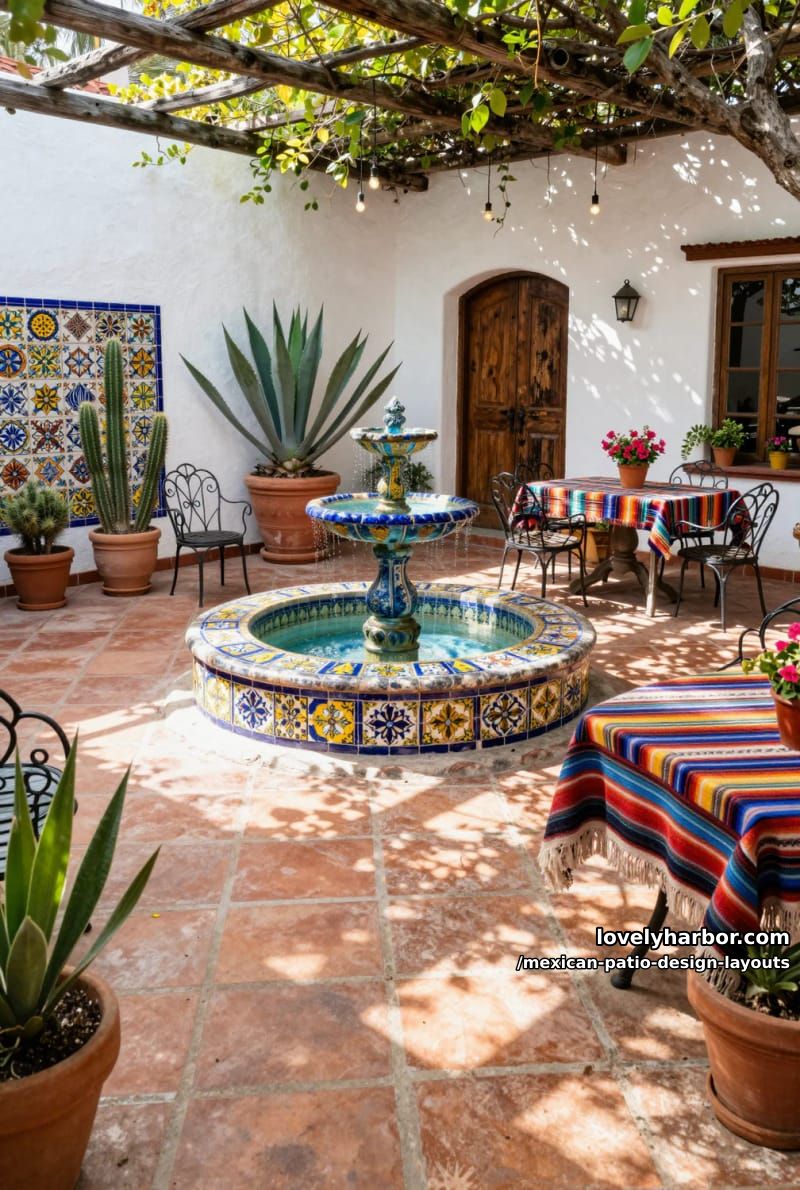
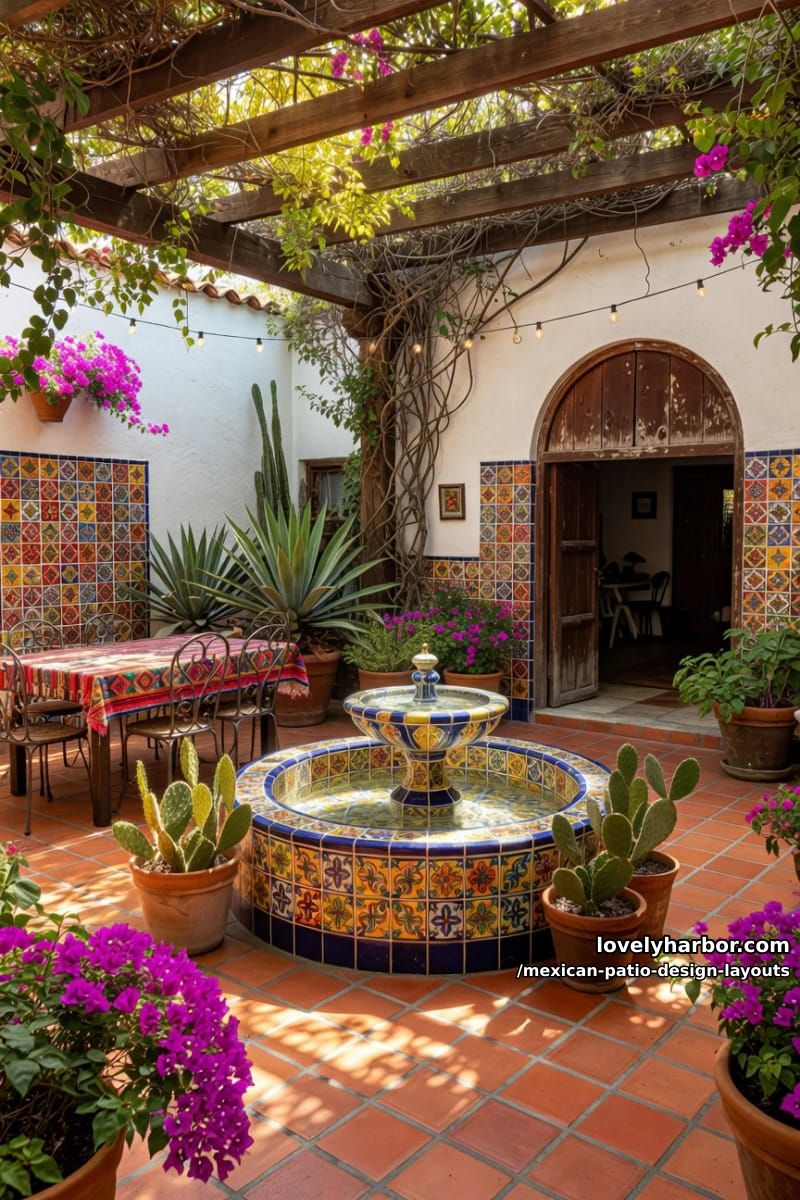
The historical default is a fountain. In Andalusian and Mexican colonial design, the fountain centered the courtyard, provided cooling evaporative humidity, and produced the constant low sound that masked street noise. If you live in a climate where a fountain makes sense (no hard freezes, low water cost, dry enough that humidity is welcome), and you’re building toward a true Tier 2 or Tier 3 patio, the fountain is the most historically grounded choice.
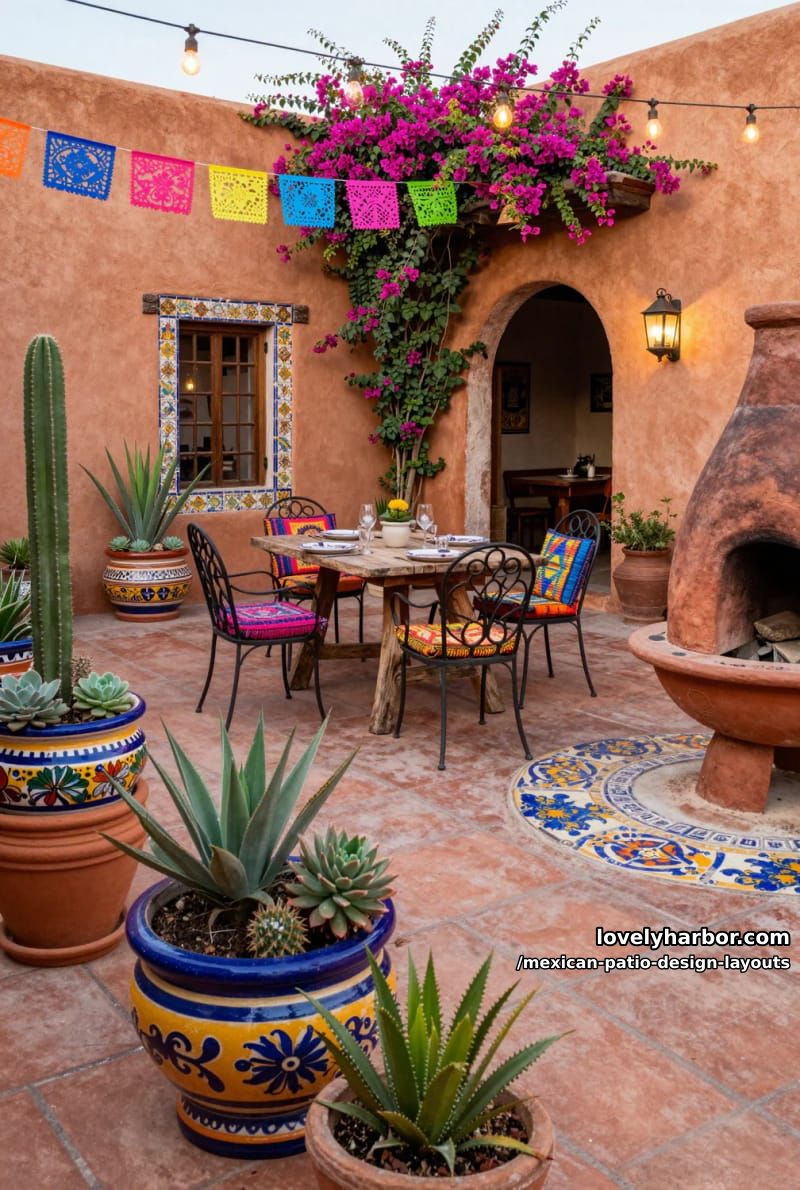
The modern default is a fire pit. In climates where a fountain would freeze in winter or where evaporation is a maintenance burden, fire pits have become the standard anchor, they give you the same “everyone faces the center” geometry and add an active reason to gather at night. The catch: a fire pit only does its job when lit. During the day it reads as a circular gap, so consider what fills that visual role between dusk and dark.
The “Sourcing Guide”: Covers the aesthetic choices, Talavera vs. Cantera, furniture, lighting, and authentic plants.
The “Build Guide”: Covers the engineering—substrate cross-sections, drainage slope, expansion joints, and freeze-thaw protection.
A heavy stone or mezquite table works as the anchor in patios that exist primarily for dining. If you’ll use the patio mostly for meals and the fountain/fire-pit option doesn’t fit your climate or budget, a substantial center table can carry the same gravitational role. The key word is heavy, a lightweight rectangular outdoor dining set doesn’t anchor a space the way a 6-foot mezquite slab does.
A specimen tree or large planter works as a passive anchor in smaller patios or in archetypes where mechanical anchors (water, fire) feel like overkill. A single mature potted olive, citrus, or agave in a Talavera-glazed planter centered in a 12×12 ft patio earns the same role for $300 instead of $3,000.
4. The five zones of a Mexican patio
Every well-designed Mexican patio breaks into the same five functional zones, regardless of archetype or size. The zones scale up and down with the space, and at very small sizes some zones merge or disappear, but the framework holds.
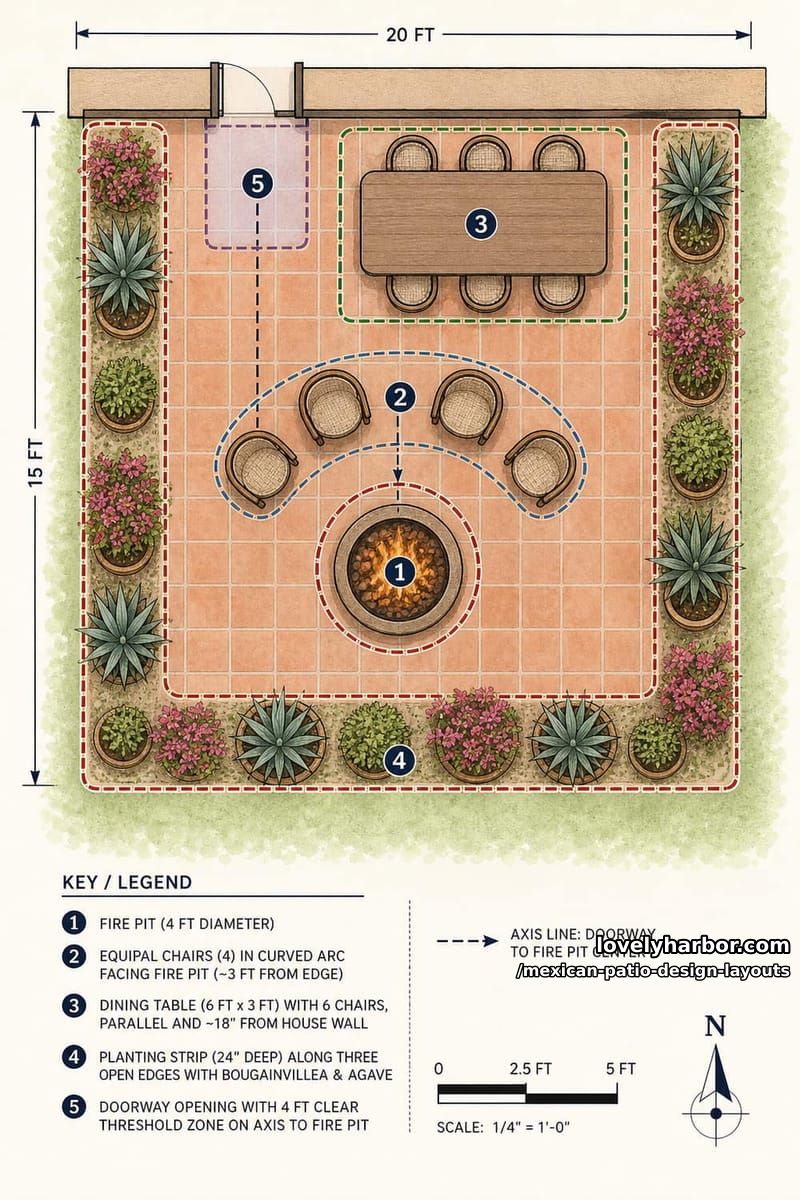
Zone 1 , The conversational anchor.Center of the patio with 6–8 ft of clear surrounding area. This is the fountain, fire pit, or stone table from Section 3. Everything else takes its orientation from this point.
Zone 2 , The seating ring.Curve or partial circle around the anchor, 36–42 inches from the anchor’s edge. Four to six equipal chairs (or a built-in mosaic bench in a curve or L-shape). Leave at least one full chair-width gap for circulation in and out of the seating cluster.
Zone 3 , Dining area.Offset from the anchor, typically against the longest wall of the patio (in Archetypes B, C, D) or in a quadrant of the patio (Archetype A). 6–8 person table with seating clearance. Aligned on a sightline that lets diners still see the anchor , not pushed into a back corner.
Zone 4 , Planting perimeter.Continuous band along the open edges of the patio (the sides without house walls), 18–36 inches deep. Tall pieces (bougainvillea pots, citrus trees, large agaves) anchor the corners; medium and low planters fill the runs between. The perimeter does the visual work; the floor stays open.
Zone 5 , The threshold.The first 4–6 feet inside the doorway connecting the house to the patio. Stays uncluttered so the patio “opens up” to the viewer entering. A single piece of decor , a tin mirror, a punched-tin lantern, a small statement planter , welcomes you in but doesn’t crowd the entry.
5. Sizing chart: clearances and furniture dimensions
Most design articles wave their hands about furniture sizing. Here are the actual numbers, clearances, dimensions, and the minimum patio size each scenario needs to work. If your patio is smaller than the minimum, you need to either drop the element or modify the layout (covered in the small-patio example at the end).
| Element | Footprint | Required clearance | Min. patio dim |
|---|---|---|---|
| Round fire pit (4 ft) | 4 ft diameter | 36–42″ all sides for seating | 10×10 ft |
| Square fire pit (3 ft) | 3×3 ft | 36″ all sides | 9×9 ft |
| Small fountain | 3–4 ft diameter | 24″ circulation; 36″ seating | 10×10 ft |
| Equipal chair | 22–26″ diameter | 30″ behind chair to pull back | n/a (modular) |
| Dining table (4-person) | 3×4 ft | 36″ behind chairs all sides | 9×10 ft (for table zone) |
| Dining table (6-person) | 3×6 ft | 36″ behind chairs all sides | 9×12 ft (for table zone) |
| Dining table (8-person) | 5×8 ft | 36″ behind chairs all sides | 10×14 ft (for table zone) |
| Built-in curved bench | 18″ deep, 18″ tall | 30″ walking aisle behind | n/a (perimeter) |
| Hammock (matrimonial) | 12–13 ft end-to-end | 6 ft swing arc + 3 ft clearance | 13×10 ft area |
| Large planter (24″+) | 2×2 ft footprint | Plant spread up to 6 ft mature | n/a (perimeter) |
The 36-inch rule. Most clearance numbers in patio design come back to 36 inches, that’s the width of a comfortable walking path, the distance you need behind a dining chair to pull it out and stand up, and the minimum space between a seating bench and a fire pit edge for safety and comfort. If you’re sketching a layout and a passage is under 30 inches, it’ll feel cramped; under 24 inches, it’s unusable.
The threshold rule. The doorway from house to patio needs at least 4 feet of clear floor inside the patio before any furniture begins. Less than that and the patio feels like a closet, you exit the door and immediately hit a chair.
6. Traffic flow: the four rules that determine “did it work?”
When a Mexican patio feels “off” but you can’t name why, it’s almost always a circulation problem. The decor is correct, the materials are authentic, but moving through the space feels awkward. Four rules govern this, and they apply at every scale.
Rule 1 – Establish the primary axis
Stand at the main doorway leading into the patio. Draw an imaginary line through the doorway, straight ahead, all the way to the patio’s far edge. That line should land on something meaningful, the anchor, the view through to a garden, or the most prominent vertical element (a large planter, a fountain, a tin mirror on the far wall).
When someone walks into the patio, this is the sightline they see first. If the axis ends in a blank wall or in a chair back, the entry reads as accidental.
Rule 2 – Keep the circulation route obvious
From the doorway, the path to the dining table, the path to the seating cluster, and the path to the lawn (or pool, or garden gate) should each be intuitive without explanation.
A patio where guests pause to figure out how to walk through it is one where the furniture is placed in the path. Walking paths should be at least 30 inches wide and shouldn’t require turning sideways past planters or chairs.
Rule 3 – Use the perimeter, not the middle
Tall objects , planters above 24 inches, statement pottery, mirrors, lanterns , go on the perimeter. Low and horizontal objects , the anchor, the seating, the rugs , go in the middle.
Reversing this (tall things in the middle, low things on the edges) makes the patio feel claustrophobic from any sight line and blocks the cross-views that make small spaces feel larger.
Rule 4 – Sightlines connect, not divide
Someone seated in the dining area should be able to see someone seated in the seating cluster, and vice versa. The two zones connect through line of sight even if they’re across the patio from each other.
The biggest mistake: placing a tall hedge, large planter, or screen between the two zones to “define” them, that visually severs the patio into two smaller spaces. Define zones with floor materials (a rug under the seating, tile pattern change near the dining area) or low edging, not vertical barriers.
7. Planting: perimeter strategy and vertical layering
Planting in a Mexican patio follows a specific logic that’s different from English garden design. There’s no border bed of mixed perennials, no foundation planting against the house, no flowering meadow. Instead, planting is concentrated in container groupings at strategic points and uses vertical layering rather than horizontal sweeps.
Tier 1 , Tall corner anchors (4–8 ft).Each open corner of the patio gets one tall vertical element: a bougainvillea trained up a trellis or wall, a mature potted citrus (lemon, lime, kumquat), a large agave (americana, ovatifolia, parryi), or a small olive tree. These visually “frame” the patio when you look out from any seat.
Tier 2 , Medium mid-runs (18–30″).Between the corner anchors, place medium planters at irregular spacing. Folk-art Talavera planters with single-species plantings (one rosemary, one sage, one cycas, one dwarf yucca). Avoid mixed annual arrangements , they fight with the painted pots.
Tier 3 , Low groundcover or trailing (under 18″).Fills gaps at planter bases or in raised beds along the perimeter. Trailing rosemary, lantana, low sedums, creeping thyme. Soft visual base that ties the perimeter together.
Plant choices by climate zone
The plant palette of a Mexican patio isn’t transferable between climates without substitution. The original Andalusian/Mexican palette assumes USDA zones 9–11; everywhere colder needs adaptation.
| Role | Zones 9–11 (original) | Zones 7–8 | Zones 5–6 |
|---|---|---|---|
| Corner anchor | Bougainvillea, citrus, olive, agave americana (zones 8–11 with good drainage) | Cold-hardy agave (parryi, ovatifolia), yucca rostrata, pomegranate | Hardy yucca, dwarf Russian sage, juniper “Skyrocket” |
| Mid-tier planter | Rosemary, lavender, plumeria, hibiscus | Rosemary, lavender, salvia, cordyline | Russian sage, salvia, sedum, ornamental grasses |
| Groundcover | Trailing rosemary, lantana, gazania | Creeping thyme, trailing rosemary, dianthus | Creeping thyme, sedums, hens-and-chicks |
| Specimen tree | Olive, citrus, palm (king, queen, fan) | Mexican olive, desert willow, vitex | Crabapple, serviceberry, dwarf pine (Mediterranean substitute) |
The substitution principle: each adapted plant should preserve one of the original’s three signatures (gray-green foliage, drought tolerance, or strong vertical/architectural form). A Mexican patio in zone 5 won’t look identical to one in zone 10, but it can hold the same spatial logic if the plant forms are right.
8. Common layout mistakes (and the fix for each)
Mistake 1: No anchor, or competing anchors
Two seating clusters at opposite ends of the patio facing each other, a fire pit in one corner and a dining table in another, a fountain plus a TV mounted on the wall.
Fix: pick one anchor. Demote the others to supporting roles or remove them. Daily-use elements (dining) can coexist with a passive anchor (fountain, tree) but cannot themselves serve as the focal center.
Mistake 2: Anchor pushed against a wall
Fire pit set against the back fence; fountain mounted on the house wall as a wall feature; “centerpiece” planter shoved into a corner.
Fix: move the anchor into the interior of the patio. The anchor needs to be approachable from at least two sides, ideally three.
Mistake 3: Furniture floating in the middle, decor against walls
Loose seating cluster floating in the patio interior; planters and decor lined up against the perimeter walls.
Fix: reverse it. Seating curves around the central anchor (in the middle). Decoration and planting populate the perimeter.
Mistake 4: Too many small pieces, no large statements
Twelve small terracotta pots scattered around the perimeter, four small lanterns on stakes, three small wall plaques.
Fix: consolidate. One 18-inch corner planter beats four 6-inch ones. One large pierced-tin star pendant beats six small punched-tin lanterns on stakes. Mexican design uses fewer, bigger pieces.
Mistake 5: The doorway opens onto a chair back
The patio door opens directly into the back of a dining chair, or into the side of a planter.
Fix: recheck the primary axis (Rule 1, Section 6). The view from the doorway should land on something meaningful — the anchor, a vista, or a vertical element, and the first 4 feet of patio should stay clear.
Mistake 6: No transitions between materials
The patio tile butts directly against grass or against driveway concrete with no border or edge.
Fix: use a metal edge profile (Schluter SCHIENE), a low brick edging course, or a band of pea gravel between the tile and what’s next to it. Even a 6-inch transition band reads as intentional design rather than accidental adjacency.
Mistake 7: Symmetric on the wrong axis
A long narrow patio (say 8×20 ft) treated symmetrically across its short axis, with seating on both long walls facing each other across the narrow gap. Reads like a bowling alley.
Fix: orient symmetry along the long axis instead, anchor at one end, seating along the run, dining at the other end, or seating at one end and dining at the other with a path connecting them.
The “Sourcing Guide”: Covers the aesthetic choices, Talavera vs. Cantera, furniture, lighting, and authentic plants.
The “Build Guide”: Covers the engineering—substrate cross-sections, drainage slope, expansion joints, and freeze-thaw protection.
9. Three worked examples
Theory only goes so far. Below are three complete layout plans at the most common patio sizes , small (10×12 ft), medium (15×20 ft), and large (20×30 ft) , with specific furniture choices, anchor placement, circulation patterns, and a full shopping list with quantities, sizes, and 2026 price ranges for each.
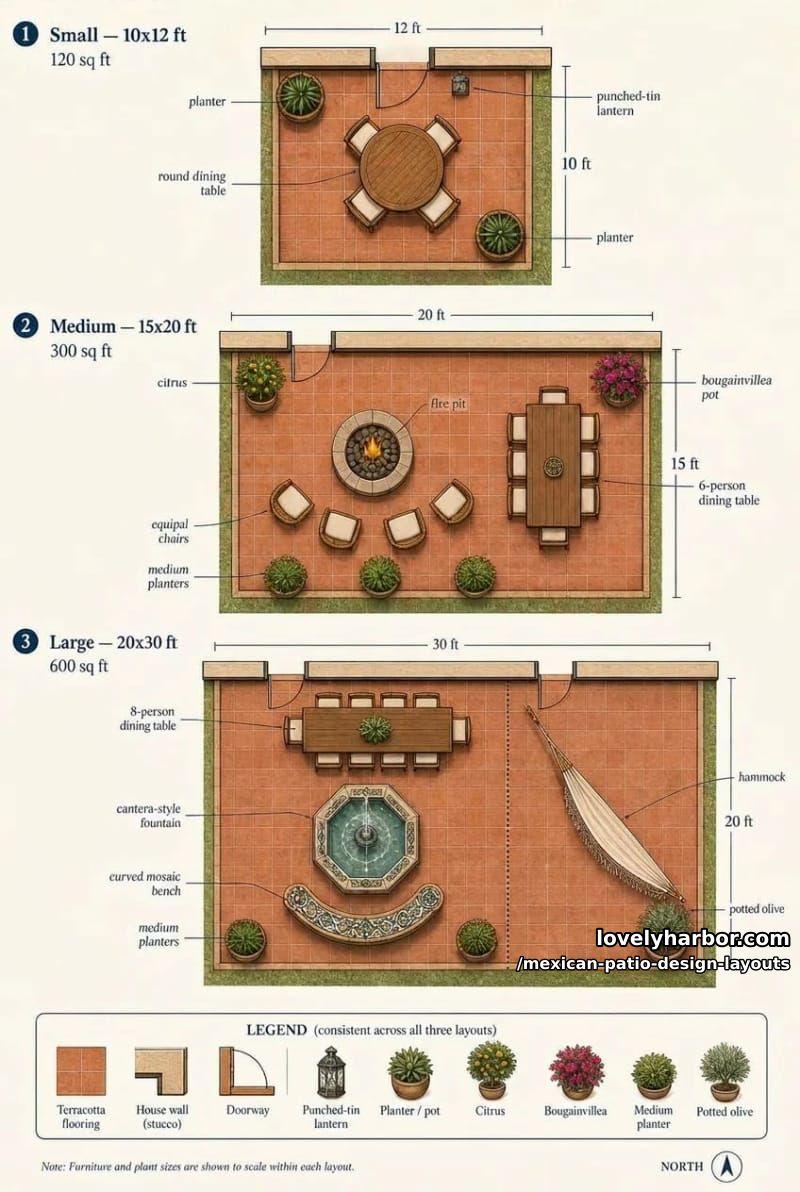
Each is built for Archetype D (single-wall) because that’s the most common backyard shape.
10 x 12 ft patio (120 sq ft) , intimate, two-purpose
House wall: 12 ft (long side). Open sides: three.
The challenge:at this size, you cannot have a full anchor + seating + dining setup. One zone has to disappear or merge.
The layout:dining table becomes the anchor. A round 4-ft mezquite or stone-topped table sits centered in the patio at the geometric middle, with 4 equipal-style chairs around it. The table itself plays both roles , focal element and dining surface.
Perimeter:two large Talavera-glazed planters (24″+) anchor the two outer corners on the open side, planted with single specimens , one mature potted citrus, one bougainvillea trained up a small trellis. Mid-runs along the open edges hold three to four medium folk-art planters with single-species plantings. The wall side stays cleaner: one tin mirror (28–32″) centered on the wall behind the table, one wall-mounted pierced-tin star pendant overhead at 8 ft height.
Threshold:doorway centered on the house wall; 3.5 ft clear from door to the table edge (just enough). Punched-tin lantern on a small wall hook beside the door welcomes you in without crowding.
What you give up:separate seating cluster. The dining chairs serve as the only seating. Acceptable trade-off at this scale.
🛒 Shopping list , Small (10×12)
| Item | Spec / note | Cost | |
|---|---|---|---|
| 1 | Round mezquite or stone-topped table | 48″ diameter , anchor + dining | $600–1,400 |
| 4 | Equipal chairs | Authentic, from Jalisco workshop | $1,000–1,400 |
| 2 | Large Talavera-glazed planters | 24″+ diameter, corner anchors | $160–400 |
| 1 | Mature potted citrus tree | 5-gal nursery, zone-appropriate | $60–120 |
| 1 | Bougainvillea + small trellis | 3-gal plant, $30 trellis | $50–90 |
| 3 | Medium folk-art planters | 12–14″ diameter, single species each | $120–240 |
| 1 | Tin mirror (hojalata) | 28–32″ diameter, on covered wall | $120–250 |
| 1 | Pierced-tin star pendant | 16–20″ diameter, 2700K LED bulb | $80–180 |
| 1 | Punched-tin wall lantern | Beside doorway, flicker-flame LED | $40–80 |
| 1 | Saltillo serape table runner | Coahuila-sourced, 14×80″ | $80–150 |
| Total range | $2,310–4,310 | ||
Tier 2 (mid-range) build. For Tier 1 (under $1,000), substitute equipal-style importer chairs ($200 set of 4), big-box terracotta planters with painted DIY accents, and Mexican Connexion / NOVICA for mid-market mirrors and lanterns.
15 x 20 ft patio (300 sq ft) , full Mexican patio
House wall: 20 ft (long side). Open sides: three. Doorway on left half of long wall.
The challenge:the most common real-world size, and the size where you can actually have all five zones. The challenge is restraint , not overstuffing.
The layout:
- Anchor (Zone 1):4 ft diameter fire pit (Solo Stove or DIY mosaic base) positioned at the geometric center , 10 ft from house wall, 7.5 ft from each side.
- Seating ring (Zone 2):4 equipal chairs in a curve facing the fire pit on the side opposite the house. Each chair 3 ft from fire pit edge.
- Dining (Zone 3):3×6 ft mezquite table with 6 chairs, parallel to the house wall, on the RIGHT half of the patio (opposite end from doorway). Lets diners see both fire pit and the garden beyond.
- Perimeter (Zone 4):tall bougainvillea pot in far right open corner, mature potted citrus in far left open corner. 3–4 medium folk-art planters along the front (away-from-house) edge between the two corners.
- Threshold (Zone 5):4 ft clear inside doorway. Pierced-tin star pendant overhead at 8 ft, hung directly over the axis from doorway to fire pit. Sightline from doorway: through threshold, past fire pit, to bougainvillea in the far corner.
Why it works:all four cultural principles hold. Single anchor (fire pit). Perimeter does visual work (planters). Clear axis (door → fire pit → corner anchor). Floor stays open (no clutter between zones). Plus the dining area and seating ring connect via sightline across the fire pit , both zones “see” each other.
🛒 Shopping list , Medium (15×20)
| Item | Spec / note | Cost | |
|---|---|---|---|
| 1 | Solo Stove Bonfire 2.0 fire pit | 19.5″ dia. × 14″ H, 304 stainless steel; stand included or purchased separately | $280–400 (MSRP ~$350; sales frequent) |
| 4 | Equipal chairs | Authentic Jalisco workshop, $250–350 ea | $1,000–1,400 |
| 1 | Mezquite dining table | 3×6 ft, seats 6 , anchor of dining zone | $1,500–2,500 |
| 6 | Dining chairs (equipal or painted pine) | Mix with dining table; armless preferred | $600–1,500 |
| 2 | Tall corner planters (Talavera-glazed) | 24–30″ for bougainvillea & mature citrus | $200–500 |
| 4 | Medium folk-art planters | 14–18″ diameter, single species each | $200–400 |
| 1 | Bougainvillea plant (corner anchor) | 3–5 gal, magenta or orange variety | $40–80 |
| 1 | Mature potted citrus tree (corner anchor) | 7–15 gal, zone-appropriate | $100–250 |
| 1 | Pierced-tin star pendant (overhead) | 24″ diameter, hardwired or hook-mounted, 2700K LED | $150–250 |
| 3 | Punched-tin tabletop lanterns | For dining table & side tables | $120–240 |
| 1 | Saltillo serape table runner | Coahuila-sourced, fits 6-ft table | $100–200 |
| 1 | Olinalá lacquered serving tray | 16–20″ for the dining table | $60–150 |
| Total range | $4,370–7,870 | ||
Tier 2 build. The fire pit anchor here is the budget-conscious choice , a built-in mosaic-tile fire pit with a curved bench adds $3,000–8,000 to this total and tips it into Tier 3 territory. Cushions for the equipales (Sunbrella canvas, neutral) add $200–400 for evening sitting comfort.
20 x 30 ft patio (600 sq ft) , split into two anchored zones
House wall: 30 ft (long side). Open sides: three. Two doorways: one on left third, one centered.
The challenge:600 sq ft is too large for a single anchor , the anchor “loses” the back third of the patio. The solution is two linked anchors: a primary and a secondary.
The layout:divide the patio into two zones along the long axis. Left two-thirds (20×20 ft) is the primary zone with full anchor + seating + dining. Right third (20×10 ft) is a secondary zone with a passive anchor.
Primary zone (left 20×20):
- Anchor:traditional Cantera or tile fountain, 5 ft diameter, centered in the primary zone (10 ft from house wall, 10 ft from left edge).
- Seating:built-in mosaic-tile bench in a C-curve on the side opposite the house, 3 ft from fountain edge.
- Dining:5×8 ft mezquite table with 8 chairs along the house wall, opposite the curved bench, with the fountain between them.
Secondary zone (right 10×20):
- Passive anchor:a hammock strung from the existing house wall (left side of this zone) to a wooden post anchored at the far right corner. Single mature potted olive tree in the far corner.
- Use:quiet reading / nap zone. Visually visible from the primary zone but functionally separate.
Connection between zones:NO physical barrier between the two zones , they’re divided only by a subtle change in floor pattern (tile orientation rotates 90°) and by the row of planters along the right edge of the primary zone. The eye reads both zones as part of one patio, but the function shifts.
Why it works at this size:a single anchor would be lost in 600 sq ft; the secondary zone gives the back third a purpose and a draw without competing with the primary anchor. The fountain is the “loud” focal point; the hammock is a “quiet” destination you discover.
🛒 Shopping list , Large (20×30)
| Item | Spec / note | Cost | |
|---|---|---|---|
| 1 | Cantera stone 3-tier fountain | 5 ft tall, hand-carved (Michoacán, Jalisco, or Zacatecas); freight ship | $2,500–6,000 |
| 1 | Submersible fountain pump | 400–800 GPH outdoor-rated | $80–150 |
| 1 | Built-in mosaic curved bench | DIY base + Talavera mosaic, ~12 linear ft | $1,500–4,000 |
| 1 | Mezquite dining table | 5×8 ft, seats 8 | $2,500–4,000 |
| 8 | Equipal chairs (dining) | Authentic Zacoalco workshop | $2,000–2,800 |
| 1 | Yucatecan hammock | Matrimonial, nylon, ~300-thread Especial | $120–250 |
| 1 | Hammock post + hardware | 8-ft cedar post in concrete footer + hooks | $100–200 |
| 1 | Mature olive tree in large planter | 24″+ Talavera planter, 15-gal tree | $400–900 |
| 4 | Tall corner anchor planters | 24–30″ Talavera-glazed | $400–1,000 |
| 8 | Medium folk-art planters | 14–18″ along perimeter runs | $400–800 |
| 1 | Plant material (bougainvillea, citrus, agave) | Corner anchors + perimeter fillers | $400–800 |
| 2 | Pierced-tin star pendants (overhead) | One over primary zone, one over hammock | $300–500 |
| 4 | Punched-tin tabletop lanterns | For dining table & bench side tables | $160–320 |
| 1 | Large tin mirror (hojalata) | 36″ diameter, on covered house wall | $250–500 |
| 2 | Saltillo serapes (table runner + throw) | One for dining, one for hammock | $200–500 |
| 2 | Olinalá lacquered serving trays | Large 16–20″ for dining + bench side | $120–300 |
| Total range | $11,430–23,020 | ||
Tier 2 to Tier 3 build. Cast-stone fountain alternatives (Solid Rock Stone Works and similar) bring the fountain line down to $800–1,500 and pull the total under $9,000. The mosaic bench is the most variable cost , DIY with broken craft-store tile runs $400–800; commissioned built-in benches with custom Talavera tile reach $8,000–10,000+ on their own.
Conclusion
Design is about decisions before purchases. A $50 graph-paper sketch with the anchor placed correctly and the perimeter zones blocked out beats a $5,000 patio assembled from photo inspiration.
The four cultural principles, inside-out orientation, single anchor, perimeter does the work, loose symmetry, hold across every archetype and scale. The five zones map onto every patio above 100 sq ft. The four traffic rules tell you when the layout works.
If you only remember three things from this guide: (1) identify your archetype before placing anything, the rules differ; (2) put the anchor in the interior, never against a wall; (3) use the perimeter for visual weight and keep the floor open.
Get these three right and the patio will hold together even if you change the furniture, swap the planters, or move the pottery around. Get them wrong and no amount of authentic Talavera will rescue the layout.