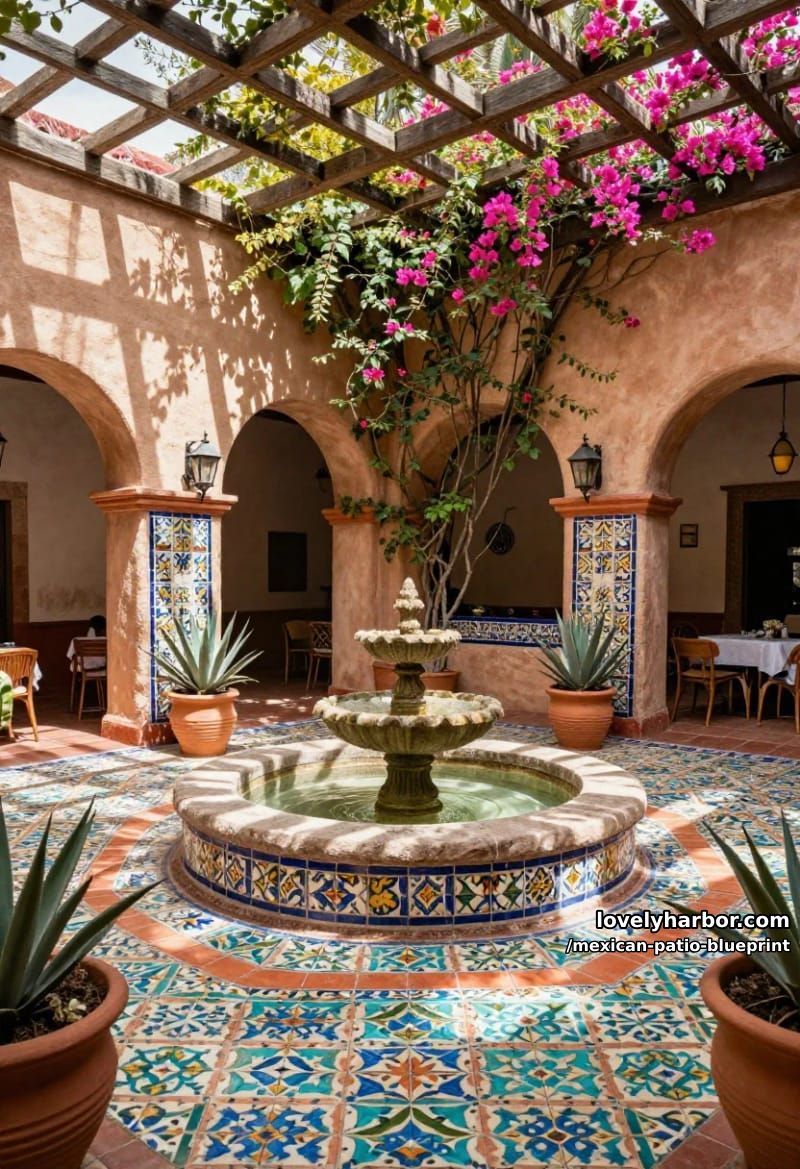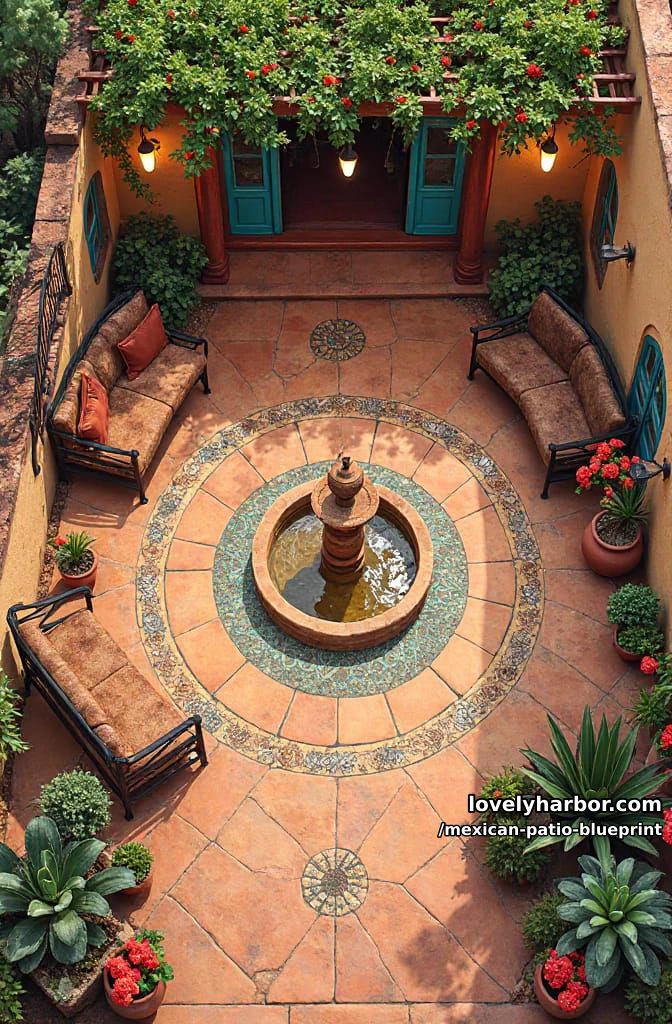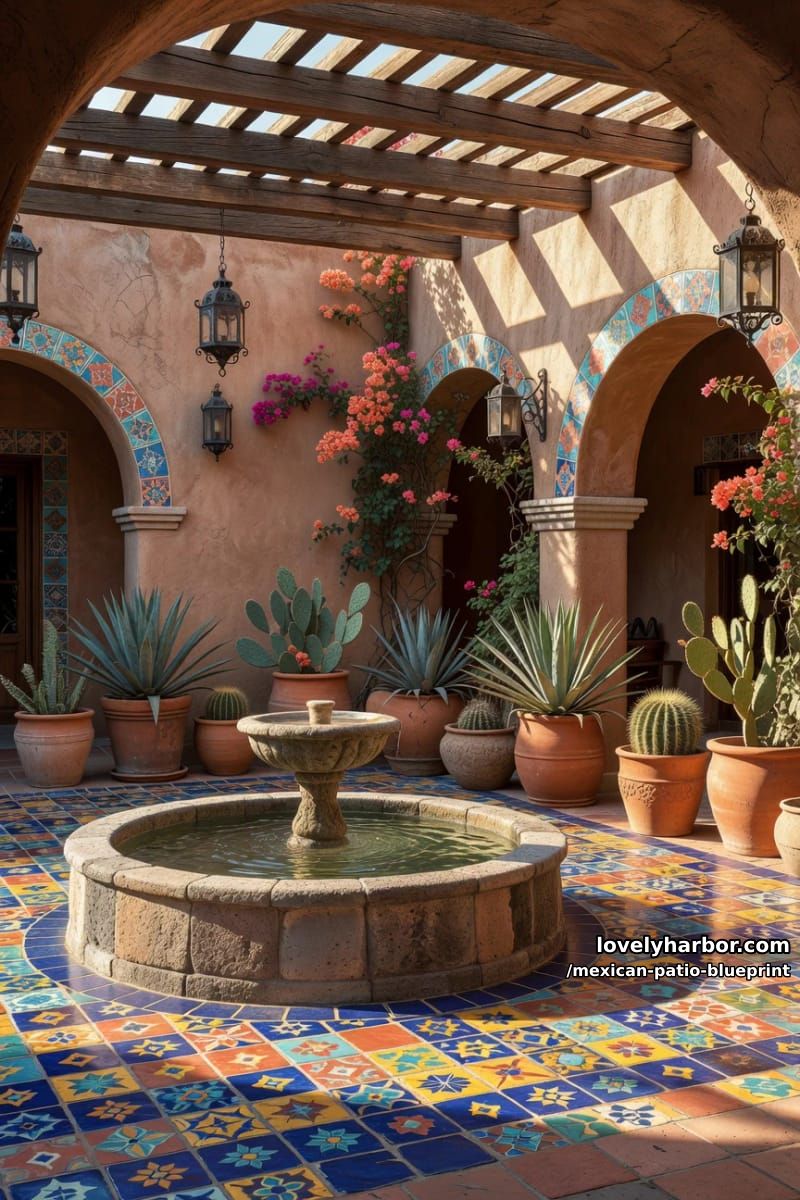
Most Mexican patios fail for the same 5 reasons, and none of them are about the tile itself.
The handmade terracotta and glazed Talavera that defines this style is more demanding than standard porcelain, softer, more porous, more sensitive to thermal cycling, and DIY installs that skip the structural fundamentals end up with cracked tiles, lifting edges, efflorescence stains, or grout that crumbles within a winter.
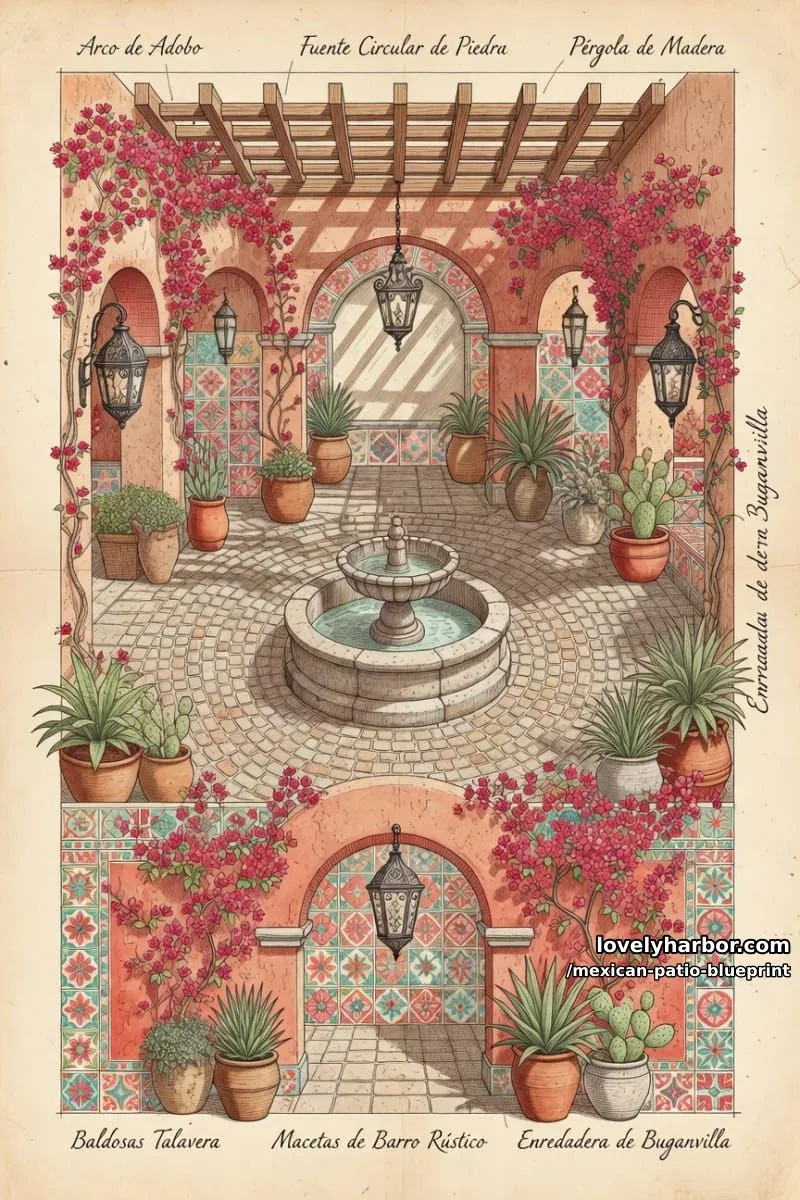
The five sections below are the engineering decisions you make before the first tile gets set, in the order they matter.
Secret 1: The substrate is doing 80% of the work
The single most common failure mode for DIY Mexican patios is laying handmade tile directly on a bare concrete slab. Saltillo and Talavera tile are dimensionally variable, porous, and bonded with thinset, they need a substrate that absorbs movement, blocks moisture, and isolates cracks.
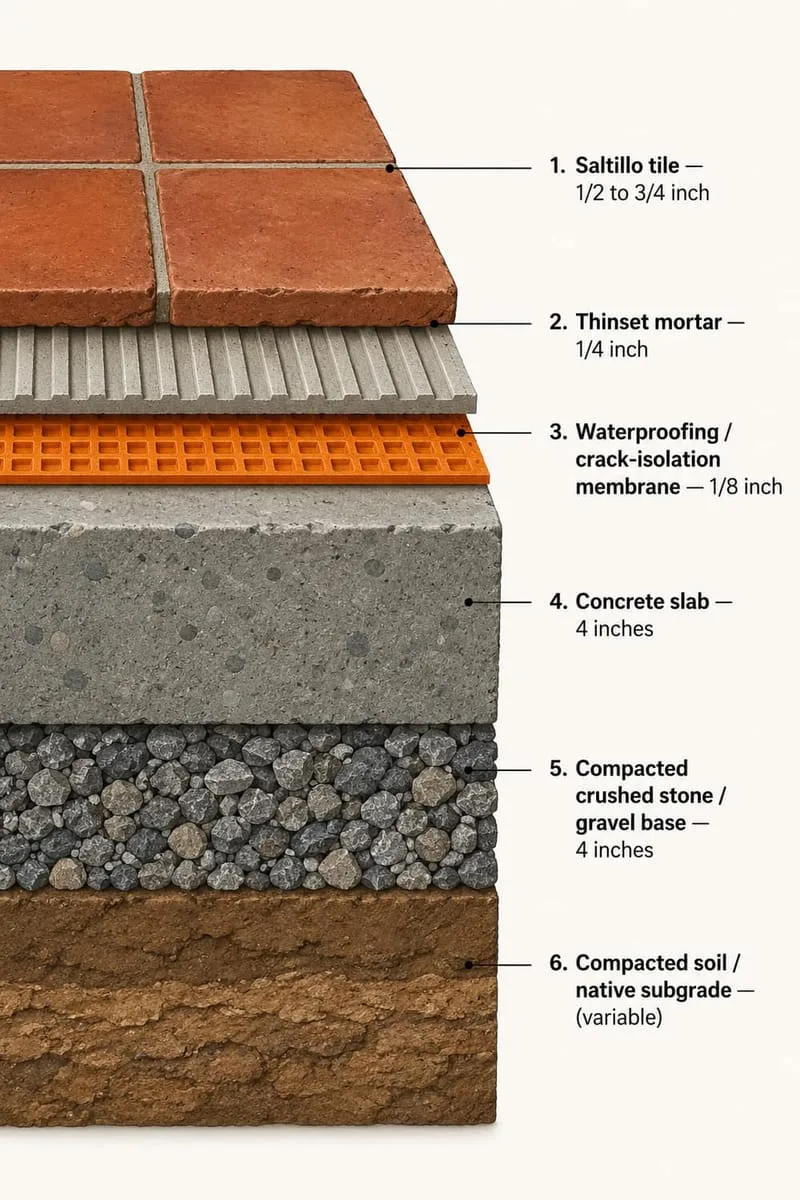
The six-layer build below is what Rustico Tile & Stone and other established Mexican tile suppliers specify for outdoor installations.
1. Saltillo or Talavera tile — 1/2″ to 3/4″ thick handmade terracotta or glazed tile. Pre-seal before installation, or soak in water for 24 hours so the tile doesn’t pull moisture out of the thinset.
2. Polymer-modified thinset mortar — semi- or full-modified (ANSI A118.4 or A118.15). Trowel with a 3/8″ notched trowel for 12×12 tile; back-butter each tile to compensate for the natural cupping (“pillowing”) of handmade pieces.
3. Waterproofing & crack-isolation membrane — full coverage across the slab. Schluter DITRA-DRAIN (the exterior-rated drainage and uncoupling membrane designed for patios and outdoor surfaces), Laticrete Hydro Ban (liquid-applied), or Rustico’s Crest 2-in-1 membrane. This is the layer most DIYers skip; it is non-negotiable.
4. Concrete slab — minimum 3½″ thick per IRC R506.1 (4″ practical standard), reinforced with rebar or wire mesh from the center to upper third of the slab (per IRC R506.2.4), sloped 1/4″ per foot away from the structure (covered in Secret 2). New pours cure 28 days before any tile work.
5. Compacted base layer — 4″ of crushed stone (3/4″ minus or similar angular aggregate), compacted in 2″ lifts with a plate compactor. Angular stone interlocks; round pea gravel does not, for a structural base, use crushed.
6. Compacted subgrade — native soil mechanically compacted. In expansive clay soils (Texas, parts of the Southwest), over-excavate 6–8″ and replace with engineered fill, or expect heave-related cracking regardless of what’s above it.
Secret 2: Slope it correctly or pay later
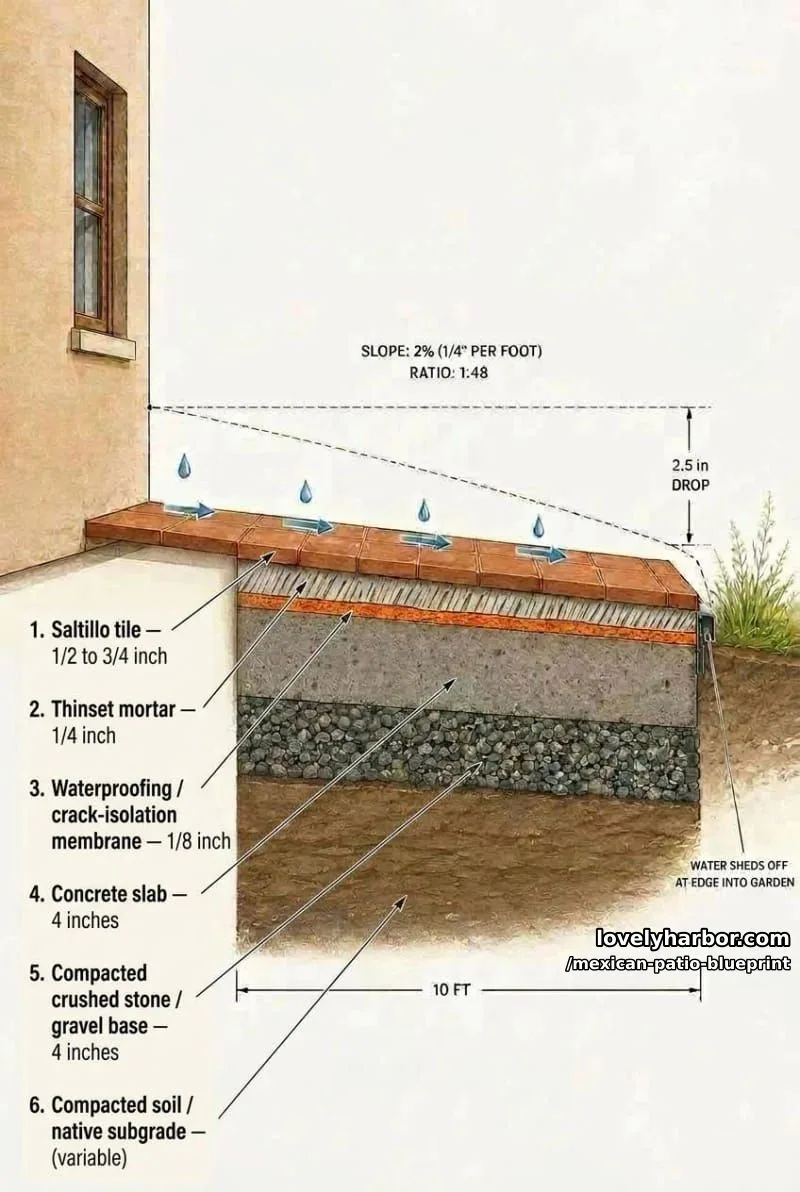
The IRC and ENERGY STAR new-home guidelines the IRC requires and ENERGY STAR recommends 1/4″ of fall per linear foot (a 2% grade) + added permeable-surface note + added permeable-surface note for any hardscape within 10 feet of a building foundation.
That’s the code minimum, and it’s not negotiable, water that pools against the house seeps into the foundation, water that pools on porous tile soaks in and freezes.
For a 10-foot-deep patio against the house, the far edge sits 2.5″ lower than the edge at the wall. For a 16-foot patio, the drop is 4 inches.
Dry climate (Arizona, New Mexico, inland Southern California): 1/8″ per foot (1%) is generally sufficient. Less standing water risk.
Standard climate (most of the US): 1/4″ per foot (2%). The IRC code minimum and the rule of thumb for most installs.
Wet climate (Pacific Northwest, Gulf Coast, Southeast, anywhere with heavy seasonal rain): 3/8″ per foot (3%). The extra slope gets water off the tile faster, which matters more for porous Saltillo than for sealed porcelain.
Clay-soil regions (Texas, parts of the Southwest): Stay at the full 1/4″ minimum regardless of how dry the climate seems. Expansive clay heaves under slabs when wet and shrinks when dry; any pooling water accelerates that movement.
Sloping in two directions. Patios that are bounded by structure on two adjacent sides (an L-shaped corner of the house) need to slope away from both walls, usually toward a single low point at the outer corner where a channel drain or French drain carries water off.
This adds complexity to the form-setting stage of the concrete pour; if you’re going to need two-axis drainage, work out the geometry on graph paper before any pour.
Secret 3: Expansion joints – the most-skipped DIY step
Tile, mortar, and concrete all expand and contract at different rates when temperatures change. Without movement joints, the differential stress at the bond line builds up until something gives, and in handmade Mexican tile, the tile itself is usually the weakest link.
This article covers the design choices, Talavera vs. Cantera, lighting, and authentic regional sourcing.
Stop guessing your layout: identify your yard archetype and get a dimensioned floor plan with a shopping list.
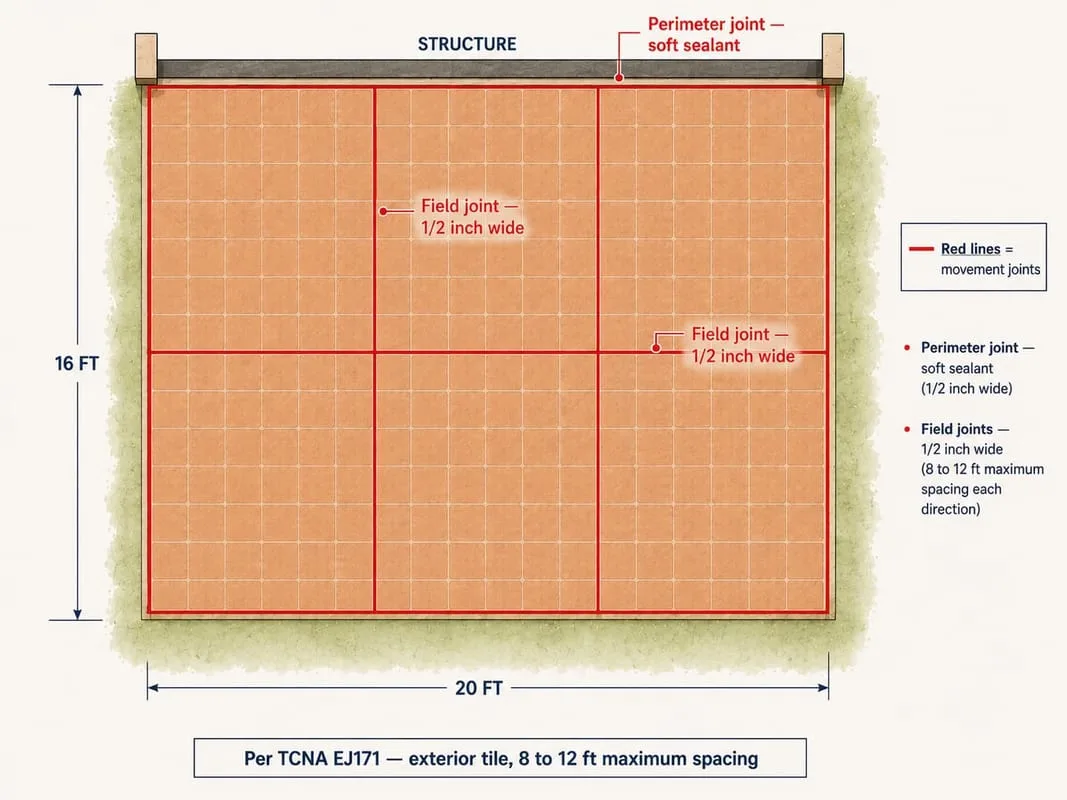
The Tile Council of North America publishes the industry standard for this in their TCNA Handbook, Method EJ171.
Field joints (within the tile area): Required every 8 to 12 feet in each direction for exterior installations. Anything over 12 ft is asking for cracks. For a 16×20 patio, you need joints in both directions, typically running at the 10-foot mark in the long dimension and 8-foot mark in the short dimension.
Perimeter joints: Required where tile meets any restraining surface, house wall, planter walls, edging, steps, columns, or another floor type. The tile must NOT be hard-mortared to the building.
Joint width: Minimum 3/8″ for joints at 8-foot spacing, minimum 1/2″ for joints at 12-foot spacing. Add 1/16″ of additional width for every 15°F of seasonal temperature swing beyond a typical 100°F annual range.
Joint filler: 100% silicone sealant or a urethane-based movement joint sealant, NOT grout. Color-matched to the grout for a clean look. Backer rod sits in the joint first to control depth and prevent the sealant from bonding to three sides.
Over slab control joints: Wherever the concrete slab has a saw-cut control joint or cold joint, the tile installation needs a movement joint directly above it. Bridging a slab joint with hard-set tile guarantees a crack, the slab will move at that joint and the tile cracks with it.
Secret 4: Freeze-thaw protection: the climate test most tiles fail
Mexican tile is low-fired clay. That gives it the warm color, the rustic texture, and the cool-underfoot feel that defines the style, but it also makes it more porous than porcelain and far more vulnerable to freeze damage.
Water gets into the tile body, freezes, expands 9% in volume, and either cracks the tile from inside or pops it off the substrate. The fix isn’t one product; it’s a system of decisions starting at material selection.
| USDA Zone | Saltillo (sealed) | Talavera (glazed) | Cantera stone | Stained concrete |
|---|---|---|---|---|
| 9–11 (no freeze) | Excellent — basic sealing fine | Excellent — full floor field OK | Excellent | Excellent |
| 7–8 (light freeze) | Good — annual sealing required | Good as accents only; risky as full field | Excellent | Excellent |
| 5–6 (hard freeze) | Covered patios only; bi-annual sealing | Vertical surfaces only (risers, walls, fountains) | Good with annual sealing | Excellent |
| ≤4 (deep freeze) | Not recommended outdoors | Indoor or fully covered only | Sealed annually; expect some patina | Best outdoor option |
Sealing strategy that actually works. Two layers of protection: a penetrating sealer that soaks into the tile body and blocks moisture absorption from the inside (Miracle Sealants 511, Aqua Mix Sealer’s Choice Gold, or Rustico TerraNano), plus an optional topcoat sealer that adds surface protection and sheen.
Penetrating sealer goes on first, before grouting. Topcoat goes on after grouting cures, and gets refreshed every 1–2 years in freeze zones, every 2–4 years in mild climates. Test with the water-bead test annually: sprinkle water on the tile; if it beads, sealer is still working; if it absorbs, re-seal before winter.
Vapor-drive matters too. Even in moderate climates, moisture migrates up through the concrete slab and saturates the tile from below. The waterproofing membrane in Secret 1 is what blocks vapor drive.
Without it, you can seal the top of the tile perfectly and still get efflorescence (those chalky white deposits that bloom through the surface) within a year, because the moisture is coming from underneath.
Secret 5: Grout and edge details: where most installs visibly fail
Even a structurally sound install can look bad in two years if the grout choice or edge detail was wrong. These aren’t structural failures in the technical sense, the tile is still bonded, but they’re where the eye lands first, and they’re surprisingly easy to get wrong.
Grout type by application
Sanded cement grout (regular mortar mix) is what most Mexican tile suppliers recommend for standard Saltillo and Talavera installs. Grout joints with handmade tile are wide, typically 1/2″, so unsanded grout doesn’t work; the sand is what keeps the joint stable. Sanded grout is inexpensive, easy to mix, and color-matches the rustic style. Downside: it stains, and it can crack at thermal-stress points like fire pit surrounds.
Epoxy grout (Laticrete SpectraLOCK, Mapei Kerapoxy) is the right choice for fire pit benches, pool surrounds, outdoor kitchen counters, and anywhere thermal cycling or harsh chemicals come into play. It’s stain-proof, doesn’t need sealing, and survives thermal cycles that crack cement grout. Downside: more expensive ($60–100 per bag vs. $20 for cement grout), shorter working time during install, and the color/finish reads slightly plastic compared to traditional cement grout.
What to avoid: unsanded grout in joints over 1/8″ (which is everything in a Mexican tile install). Pre-mixed acrylic grout in tubes, designed for small repairs, not full installations.
Grout color strategy
Stark white grout is the most common aesthetic mistake. It looks crisp on day one and gray-brown by month three from foot traffic and weather. Warm gray, sand, or buff-colored grout hides dirt and keeps the eye on the tile itself. For Antique Saltillo and similar darker terracotta tones, a brown or tan grout reads as one continuous warm floor; for cooler Manganese Saltillo, a medium gray works.
Edge details that hold up
The transition from tile field to whatever’s beyond it, grass, gravel, a step down, a wall, is where edges fail first. Three options ranked by durability:
- Bullnose tile — purpose-made tile with a rounded finished edge. The most durable and most expensive option ($8–20/linear foot in Saltillo). Use at any edge that gets foot traffic or where the tile transitions to a step or planter wall.
- Metal edge profile — Schluter SCHIENE or Jolly profile in anodized aluminum or brass. Hides cut tile edges, protects from chips. Best where the tile field meets a different floor material or a planter bed. Around $4–8 per linear foot.
- Mortar bullnose — a sloped mortar fillet from the tile edge down to the surrounding grade. Cheapest, looks rustic, but cracks within a few years and needs occasional refresh. Acceptable for low-traffic garden-edge applications.
Pre-Start Checklist
Before the first bag of thinset opens, walk this list. Items are ordered by when you’ll need to make the decision, the earlier ones are harder to fix later.
Site & slab (before any pour)
- Identify the lowest natural drainage point of the patio area; the slope direction is dictated by it
- Mark elevation points: high point at house wall, low point at outer edge with a 1/4″-per-foot drop minimum
- Test soil — expansive clay needs over-excavation and engineered fill
- Compact subgrade in 2″ lifts with a plate compactor before any base material
- Spread 4″ of crushed stone (3/4″ minus), compact in 2″ lifts
- Set forms with the correct slope built in; check with a string line and level before pouring
- Plan slab control joint locations now — they will determine where tile movement joints go later
Membrane & thinset (before tile)
- Cure the slab at least 28 days before any tile work
- Pressure-wash slab and let dry fully — moisture content under 5% for thinset adhesion
- Mark slab control joints with chalk line so they aren’t bridged during tile layout
- Apply waterproofing / crack-isolation membrane in full coverage; cure per manufacturer (DITRA-DRAIN: install tile same day; liquid-applied: 24-hour cure typical)
- Stock semi-modified or fully-modified thinset (ANSI A118.4 or A118.15) — not cheap unmodified
- Pre-seal tile or soak in water 24 hours before laying — porous tile pulls water from thinset and weakens the bond
Layout & movement joints (before any tile gets stuck down)
- Chalk-line the field joint layout: 8–12 ft maximum in each direction
- Mark perimeter joint locations along all walls, steps, and adjacent floor materials
- Verify joints align with slab control joints — bridging a slab joint with hard-set tile guarantees a crack
- Lay out one full row dry to verify spacing and grout joint width (typically 1/2″ for handmade tile)
- Mix tiles from multiple boxes during layout to randomize color variation
Finish (after tile is set)
- Wait 24 hours after setting before grouting
- Use sanded cement grout (or epoxy near fire pits / pools); avoid white grout for outdoor use
- Fill movement joints with 100% silicone or urethane sealant — color-matched to grout — NOT grout
- Apply topcoat sealer once grout has fully cured (typically 72 hours)
- Install Schluter profile or bullnose at all exposed edges
- Schedule the first re-seal for 12–18 months out; mark the calendar
When DIY stops making sense
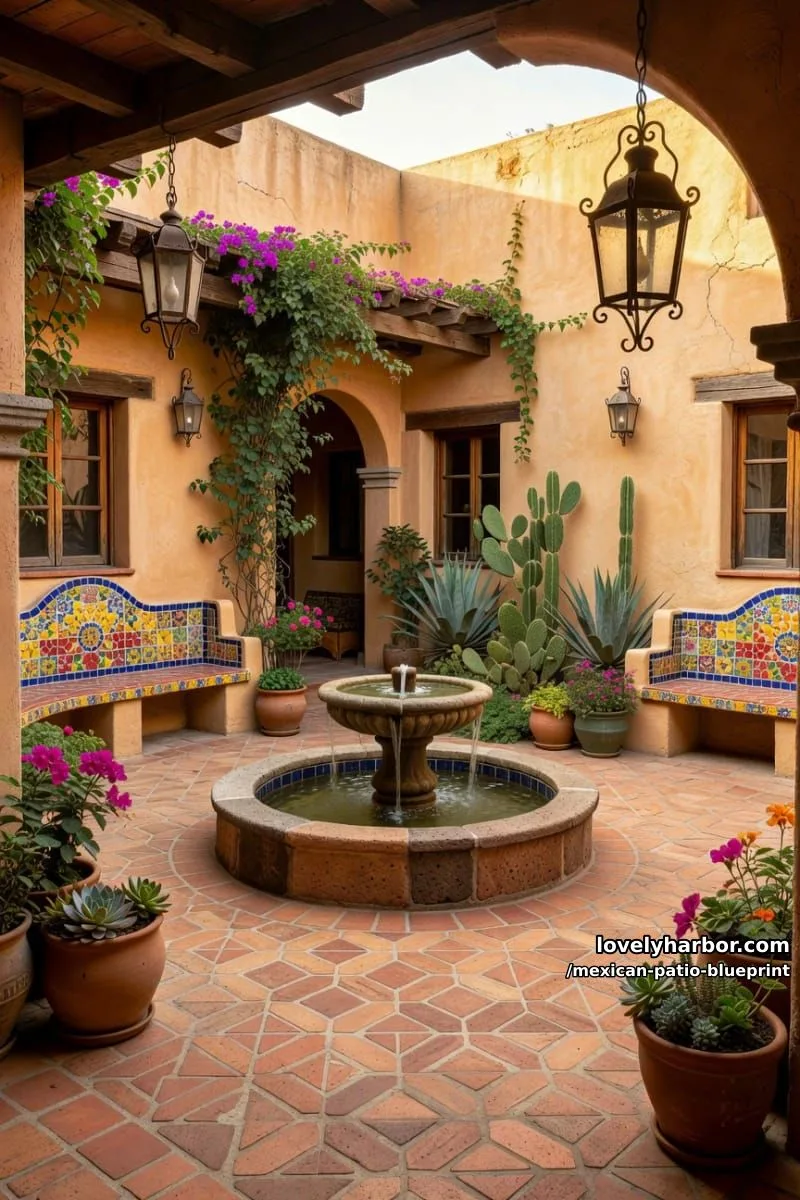
The honest answer: a 200-square-foot covered patio in a mild climate with an existing well-poured slab is a realistic weekend-warrior project for a DIYer with tile experience. Anything beyond that, and especially these red-flag scenarios, is where pro install pays back its cost in avoided failures.
- New slab pour required. Slope, reinforcement, and control joints in a new exterior slab need experience; mistakes show up years later as cracks. Hire a concrete contractor for the slab even if you tile it yourself.
- Freeze-zone install (zones 5–7) with full tile field. The membrane and edge details have less margin for error. A pro who has done freeze-zone installs before knows the local code overlays and which products survive in the climate.
- Two-axis drainage. Sloping a slab in two directions to a single low point or a channel drain is a forming-and-finishing skill that takes practice. Worth hiring out.
- Cantera stone or hand-carved feature pieces. The stone is softer than granite, harder than tile, and needs different cutting and setting techniques than Saltillo. Importers like Rustico Tile typically have installer recommendations.
- Fountains, fire pits, or built-in mosaic benches. These integrate plumbing, gas, or structural masonry with the tile install. Hire a specialist; they’re not generic patio work.
This article covers the design choices, Talavera vs. Cantera, lighting, and authentic regional sourcing.
Stop guessing your layout: identify your yard archetype and get a dimensioned floor plan with a shopping list.
The Bottom Line
The structural decisions in this guide cost almost nothing to get right the first time and almost everything to fix later. A correctly poured slab with proper slope is the same cost as an incorrectly poured one. A $50–150 waterproofing membrane is the same labor to install whether you use it or skip it.
Movement joints are silicone bead work, not a budget line item. The aesthetic side of a Mexican patio is where you spend money; the structural side is where you spend attention.
If you only remember three things from this guide: (1) the waterproofing membrane between slab and thinset is the single best survival predictor for outdoor tile installs, (2) 1/4″ per foot slope away from the house is code and not optional, and (3) TCNA EJ171 movement joints at 8–12 ft maximum spacing are non-negotiable in any exterior install.
Skip these and the tile choices that follow don’t matter, the patio will fail. Get them right and Saltillo, Talavera, or Cantera will look the way they did the day they were laid for two to three decades.
Related Posts
- Mexican Patio Ideas: 15 Authentic Design Elements
- Patio Garden Ideas
- Patio Decorating Ideas
- Outdoor Patio Ideas
- Backyard Patio Designs