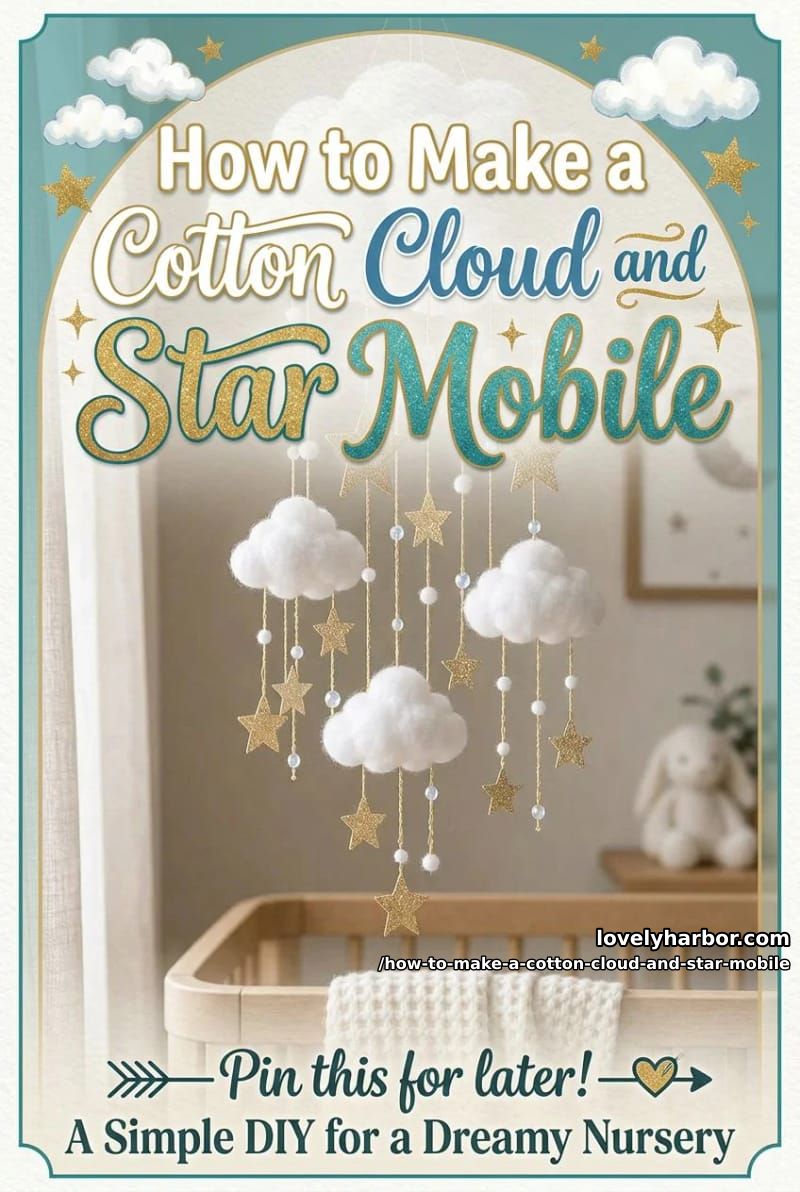
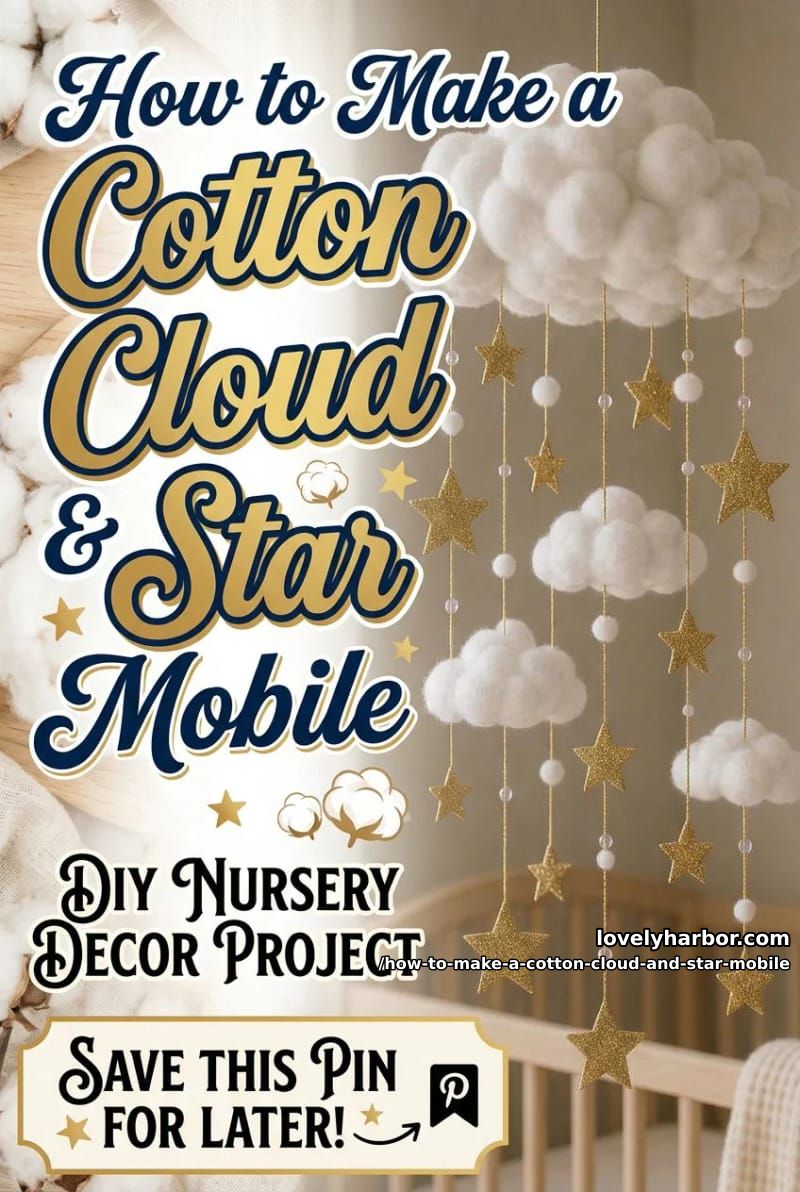
The cloud-and-stars mobile is one of the few nursery DIYs that actually survives the trip from Pinterest to your ceiling, but the cloud body has to be right. Most tutorials online hand you a paper lantern or a styrofoam ball and walk away, which is why the results look like cauliflower. The build below uses a wooden embroidery hoop as a hidden armature, wraps it in polyester fiberfill in directional clumps, and hangs the drops from the inner ring so they fall into a real cone instead of a flat curtain. Allow about three hours start to finish, plus drying time.
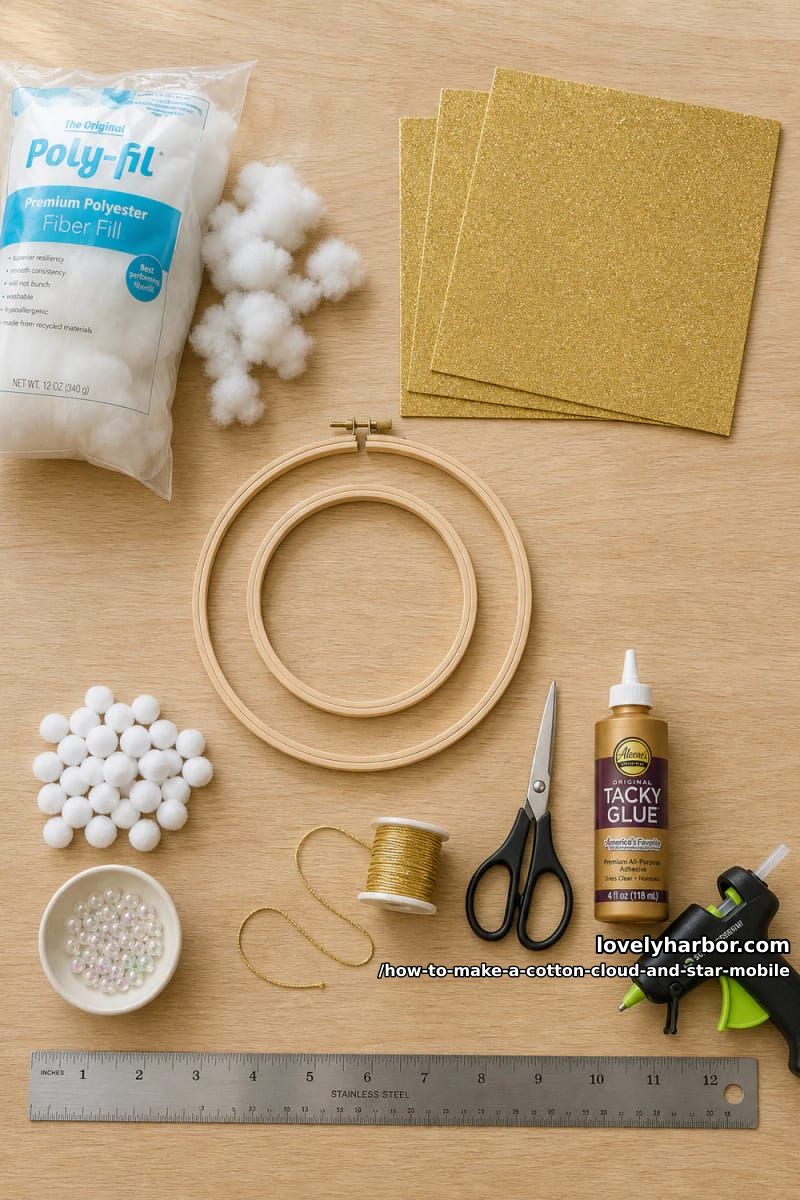
Materials and tools
The split below assumes you're starting from zero. If you already own scissors, a glue gun, and a ruler , and most people do , the real outlay is closer to $35.
Materials (consumables)
| Qty | Item | Spec | Price |
|---|---|---|---|
| 1 | Poly-Fil Premium Fiber Fill, 12 oz bag | 100% polyester, hypoallergenic | $8 to $11 |
| 1 | Darice 10 inch wooden embroidery hoop | Round, natural wood, two-ring | $3 to $5 |
| 2 | American Crafts gold glitter cardstock, 12 x 12, pack of 15 | Glitter on one side, white reverse | approximately $40 to $45 (pack) |
| 1 | Gold metallic cord, 1mm, 109-yard spool | Tinsel string, non-stretch | $7 to $9 |
| 1 | 5 inch white craft pom-poms, 100 pieces | Polyester, soft fluff | $5 to $7 |
| 1 | Matte aurora moonstone beads, 8mm | Iridescent, 2mm hole, single strand | $8 to $10 |
| 1 | Aleene’s Original Tacky Glue, 4 oz | Nontoxic, dries clear | $3 to $5 |
| Materials subtotal | $47 to $64 | ||
Tools (reusable)
| Qty | Item | Spec | Price |
|---|---|---|---|
| 1 | Surebonder H-195FBS mini hot glue gun + 12 sticks | 20W, detail tip, high-temp | $13 to $17 |
| 1 | Sharp paper scissors | 5 to 8 inch fabric or paper shears | $8 to $15 |
| 1 | Star template, hand-drawn or printed | 2 inch and 3 inch sizes, cardstock | Free |
| 1 | Embroidery needle or thin tapestry needle | Eye large enough for 1mm cord | $3 to $6 |
| 1 | Ruler or measuring tape | Standard | $2 to $5 |
| Tools subtotal | $26 to $43 | ||
| Combined total (everything from scratch) | $73 to $107 | ||
Prices are approximate ranges as of late 2025; verify before purchase.
Step 1: Build the cloud frame
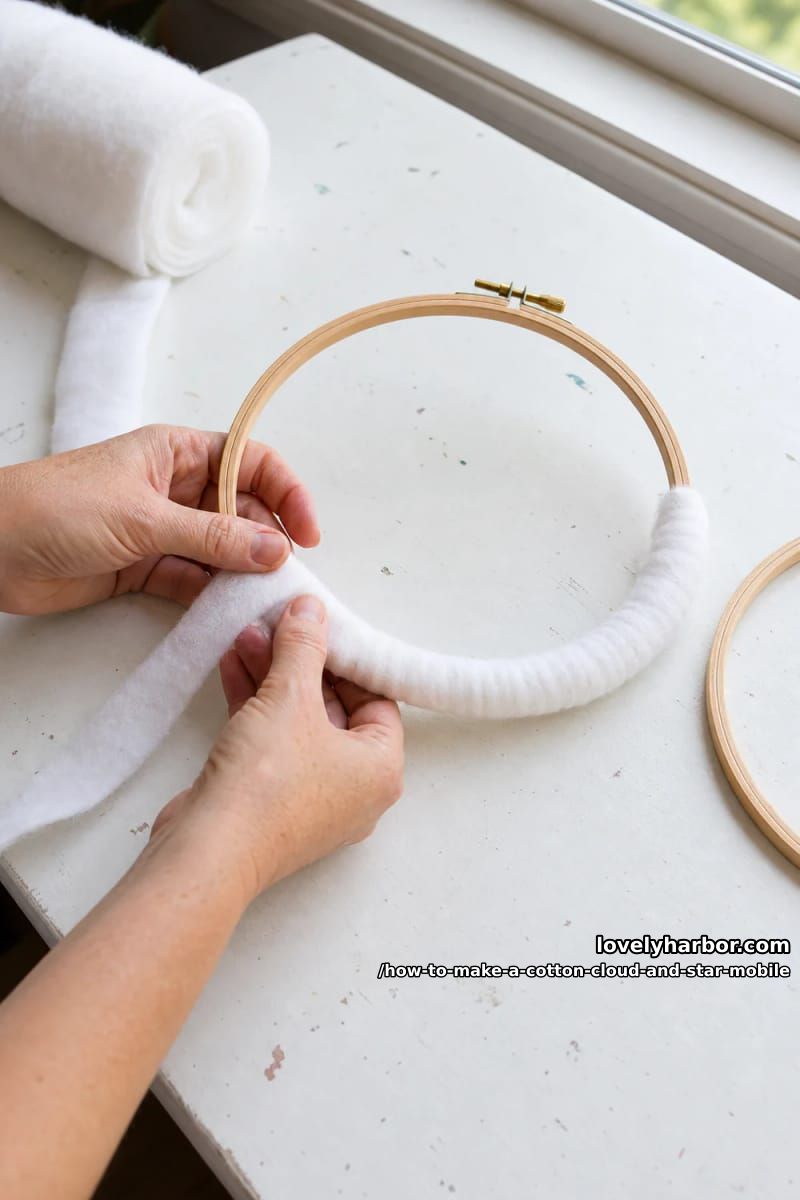
The hidden ring is the whole architecture. Skip it and the cloud sags into a limp blob within a week. The 10-inch hoop is the sweet spot for a standard crib mobile , smaller and the drops cluster, larger and you get a UFO. You only need the inner ring. Set the outer one aside; it's useful later for a second mobile, or, you know, actual embroidery.
- Wrap the ring in a thin layer of fiberfill. Pull off a long strip about an inch thick and four feet long. Wrap it around the inner ring like gauze, overlapping each pass by half. The visible fiberfill grips onto this under-layer.
- Tack the wrap with tacky glue, not hot glue. A few dabs of Aleene’s every six inches is plenty. Hot glue at this stage seeps through and shows up as glossy dots once you start layering.
- Drill or punch four small holes in the inner ring at the 12, 3, 6, and 9 o’clock positions, a quarter inch from the inner edge. A push pin followed by a 1/16 inch hand drill bit does it cleanly. Do this before any more fiberfill goes on , once the ring’s covered, you’ll never find your marks.
- Cut and thread the four top strings. Cut four 24-inch lengths of gold cord. Pass one through each hole and tie a small overhand knot on the underside so it can’t pull through. Gather the loose ends about 12 inches above the ring and tie a single master knot. That knot is your hanging point.
Step 2: Wrap the main cloud
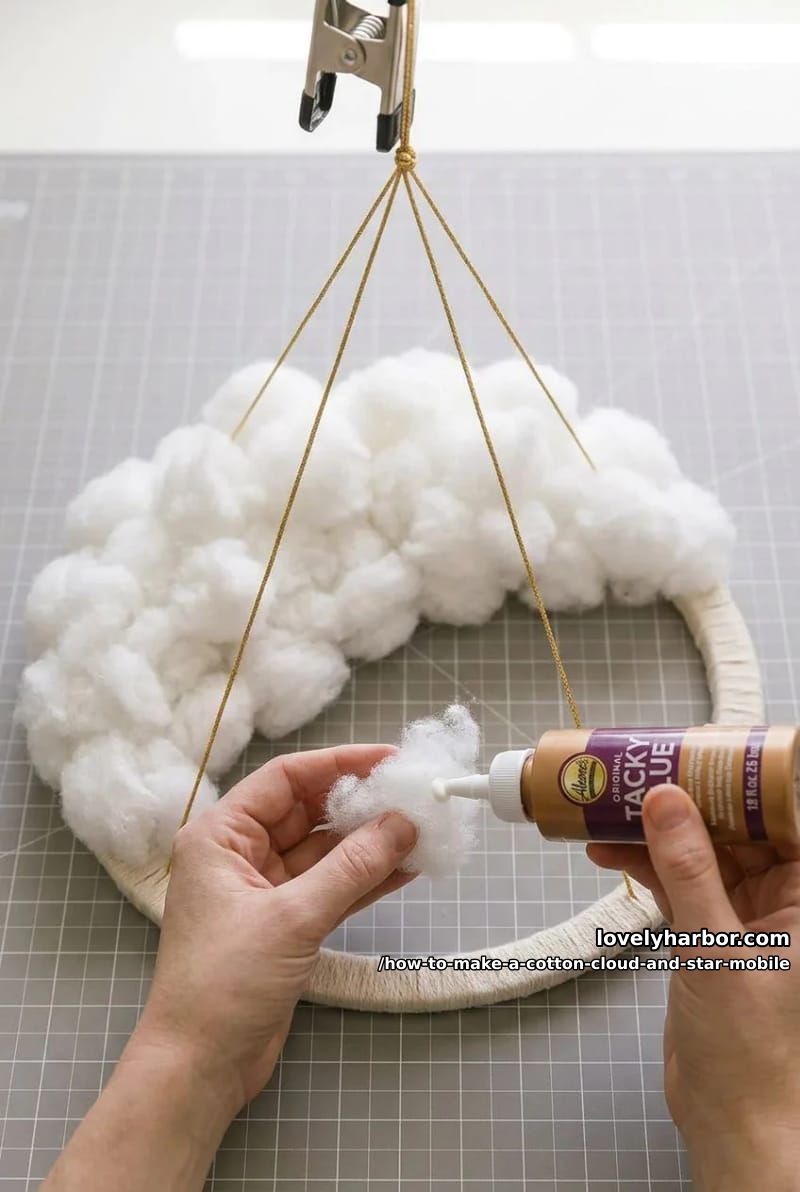
This step is the one. It's where a cloud-shaped object becomes a cloud, or doesn't. Look at a real cumulus for thirty seconds and you'll see what most tutorials miss: clouds are not pillows. They have directional bulges. Round and stacked on top, often flatter underneath, with secondary lobes shoving out at angles that don't make geometric sense. Your job is to fake that asymmetry by layering fiberfill in clumps, not by smoothing it into a dome.
Hang the hoop from the master knot you tied in Step 1 , a closet rod, a doorway hook, anything. Sculpting in mid-air is non-negotiable for this build. You need to see every side as you go, and especially the underside, because the underside is the side a baby actually sees from the crib. If you do this flat on a table you will produce a cloud that looks perfect from above and like a deflated dumpling from below.
- Build the top dome first. Pull off a fist-sized clump of fiberfill, dab tacky glue across the bottom of it, and press it onto the top of the hoop. Three to five clumps, varying in size. Resist the urge to make it symmetrical. You want one dominant peak and two or three smaller lobes leaning off it at different angles.
- Wrap the underside. Tear off a long thinner sheet of fiberfill and drape it across the bottom of the hoop. Tack it to the ring with tacky glue. Keep this side flatter than the top , a gentle bulge or two is enough. Do not bury the ring. You’ll need access to it for the drops in a few steps.
- Blend the seams. This is the secret step. Pull thin wisps of fiberfill from the bag and lay them over any spot where you can still see the ring, a glue dab, or the under-wrap. Press lightly and they stick to the existing fiberfill on their own, no glue needed. Plan on 10 to 15 minutes here. It feels like too long. It isn’t. This is what makes the cloud look photographed instead of crafted.
- Let the glue cure for at least two hours before you hang anything from it. Tacky glue grabs on contact but doesn’t reach full strength for a while.
Do this
- Layer in clumps of varied size, biggest in the center
- Tear wisps for the surface , don’t cut
- Sculpt with the hoop hanging
- Leave the inner ring edge accessible from below
Avoid
- Cotton balls. They look pebbly and matte; the whole point is polyester fiberfill.
- Hot glue on the surface , those glossy spots flash in photos.
- Compressing the fiberfill flat against the ring.
Step 3: Cut the glitter stars
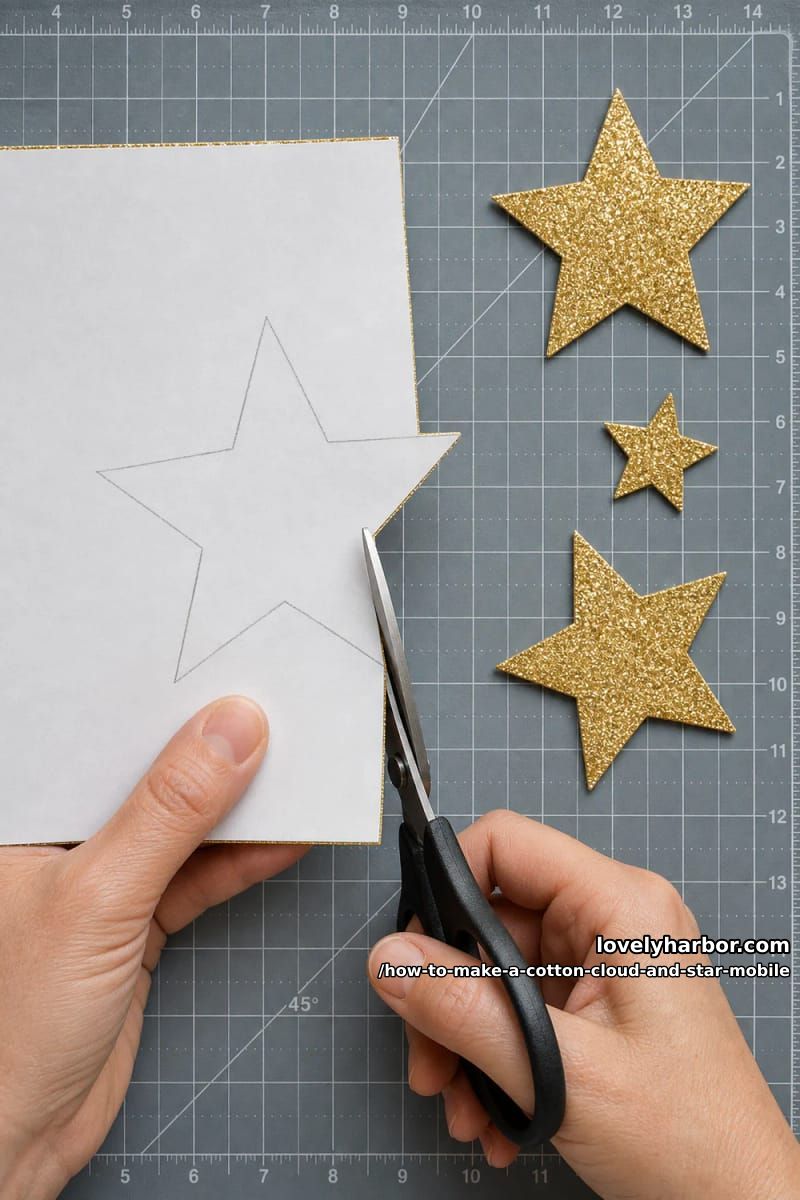
Stars give the mobile its visual rhythm. The reference uses about 14 of them in two sizes, with the larger stars hung lower on the drops and the small ones higher up. This puts visual weight at the bottom, which is what keeps the whole thing from reading as flat.
Cut your template by hand: one 2-inch star and one 3-inch star, both five-pointed. Skip the Cricut. Glitter cardstock dulls blades almost immediately, and hand-cut stars have a slight wobble to their edges that looks better in real life than die-cut precision does. I learned this on a cake-topper job after burning through two replacement blades.
- Trace, don’t print. Lay your template glitter-side-down on the white reverse and trace with a sharp pencil. Pencil sits cleanly on the white back; pen bleeds through the cut edge.
- Cut 8 small stars and 6 large. Slightly more than you’ll need. Cut a few extras , some will tear, some will look off, and the spares give you placement flexibility later.
- Punch the hanging hole at one point. Use the embroidery needle, a quarter inch from the tip. It’s for threading, not tying, so keep it small.
- Optional: glue stars back-to-back for double-sided sparkle. The reference mostly uses single-sided stars, which is fine when the viewing angle is from below. If you want both sides to catch light, glue pairs with the cord sandwiched.
Step 4: Make the satellite clouds
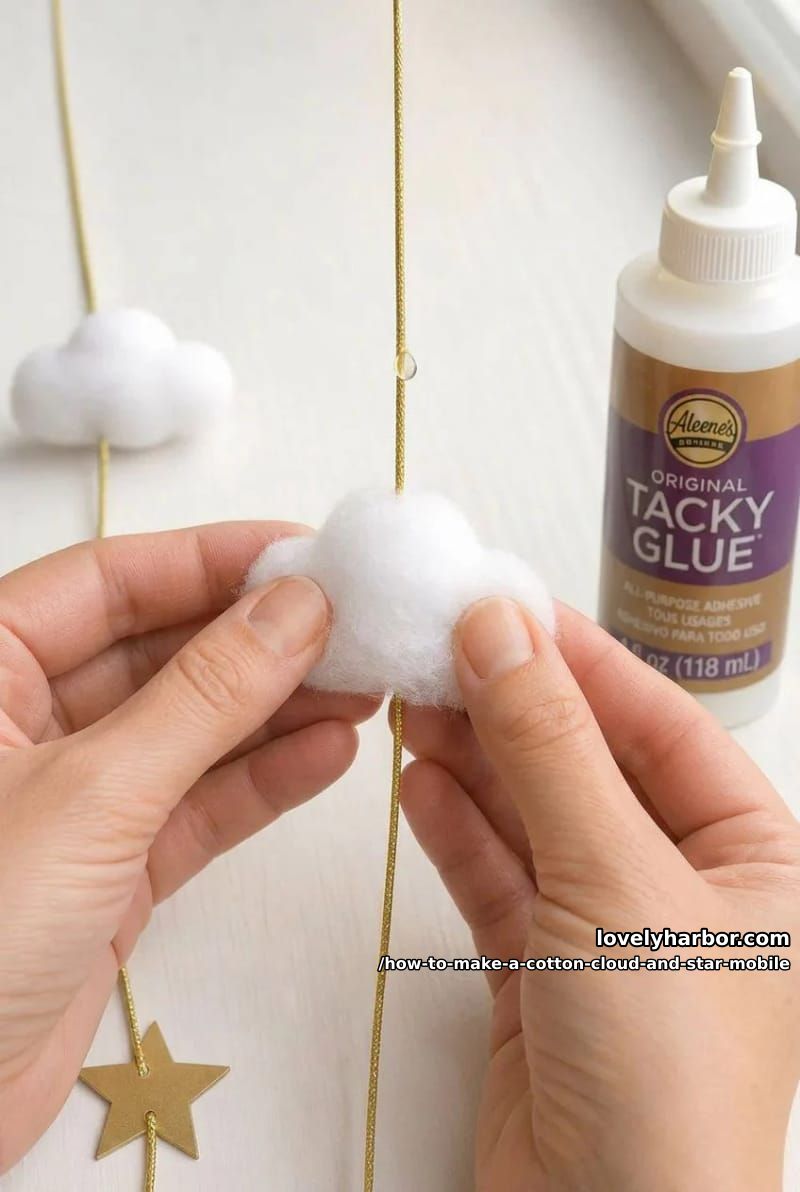
The three satellite clouds give the mobile depth. Without them, the stars hang in a single plane and the whole thing flattens. With them, the eye reads three layers: the main cloud at the top, the satellites in the middle, the stars beneath. Each should be roughly 2 to 3 inches across , irregular, definitely not symmetrical, smaller than your fist.
One trick nobody mentions: thread the cord through the cloud, not around it. Glue cord to the outside of a fiberfill puff and the cord catches on the surface, the cloud rotates oddly on its drop, and you’ll spend the rest of the night swearing at it. Run the cord straight through the middle with a drop of glue at the entry and another at the exit, and the satellite sits square.
- Pre-cut three drop cords first, each 18 to 24 inches. Different lengths on purpose , you want the satellites at different heights.
- Thread the cord through. Use the embroidery needle to pull the cord through a loose fiberfill clump at whatever height that satellite should sit on its drop.
- Glue and sculpt around the cord. One drop of tacky glue where the cord enters, one where it exits. Layer wisps around the body, pinch gently to shape. Hold for thirty seconds.
- Let them dry flat for at least 30 minutes before you go on with the rest of the drop.
Step 5: String the drops
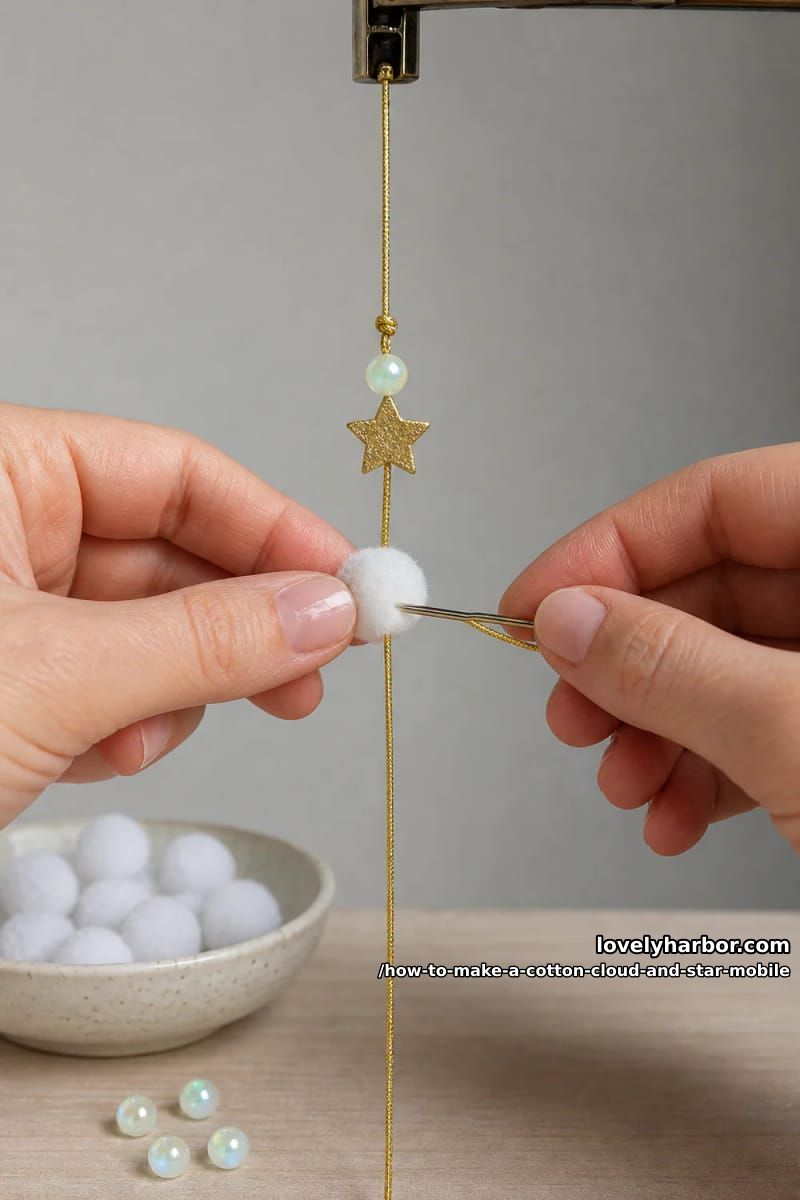
Each drop is its own small composition. The reference mobile runs about twelve drops, each carrying two to four elements stacked at varying intervals. The key move is staggering: no two adjacent drops should have a star at the same level. Across the mobile you should see scattered points, not a row.
I'll be honest. This is the slow step. Put a podcast on. Budget an hour.
Top end: small loop knot for tying to the hoop ring later. Leave 3 inches of cord above the knot for tying.
Element spacing: 2 to 4 inches between elements is the rhythm that reads well. Closer reads cluttered, wider reads sparse.
Element order (top to bottom): Vary across drops. Some end in a large star, some in a small star, one or two end in a single iridescent bead. Mix pom-poms and beads between stars.
Drop length: Cut cords between 16 and 28 inches. Shortest near the cloud center, longest at the outer edge of the hoop.
Securing each element: One tiny drop of tacky glue at the cord hole on each star or pom-pom. Don’t tie knots above and below every element , the cord gets visually busy fast.
- Cut 12 drop cords in varying lengths between 16 and 28 inches.
- Thread each drop bottom-up. Start with the bottom-most element and work upward, so the bottom anchors everything. A small knot just under the lowest piece keeps it from sliding off.
- Go easy on the moonstone beads. One or two per drop, no more. They’re the accent. Overdo them and it reads like a bead curtain.
- Lay the finished drops out in order before you go near the hoop. Adjacent drops should look different. Rearrange until the pattern feels varied rather than alternating.
Step 6: Mount the drops and hang

The cone silhouette depends entirely on where each drop ties to the ring. Long drops on the outer edge, short drops nearer the inner edge , that's the geometry. Attach everything to the same point and you get a tight tassel instead.
Hang the mobile from its master knot before you attach a single drop. Working in the air shows you immediately when a drop is too long, too close to a neighbor, or competing visually with the one beside it.
- Mark twelve points around the inner ring with a pencil, roughly an inch apart. Don’t aim for exact spacing , slight irregularity reads more natural.
- Attach outer-to-inner. Longest drops go to the outer edge of the ring, where it meets the outside of the cloud. Shortest go to points closer to the center.
- Double knot each one, then secure with one dot of tacky glue. The knot holds it; the glue keeps the slippery metallic cord from working the knot loose.
- Trim tails to about a quarter inch.
- Step back across the room and look at the silhouette. Any drop crowding another can be untied and re-tied a centimeter over. Don’t settle for the first arrangement just because your back hurts.
- Install a ceiling hook rated for at least 5 pounds , wildly overkill for something this light, but the peace of mind is free. Loop the master knot over the hook and adjust the four harness strings so the hoop hangs level.
Mistakes that ruin the mobile
- Cotton balls instead of polyester fiberfill. Cotton balls compact into hard little pebbles and read matte. Poly-fil is the correct material , cloud builds are literally listed as a recommended use on the bag.
- Skipping the hoop. A cloud built around nothing collapses inward within the first week. The ring is invisible and does all the structural work.
- Hot-gluing the surface. Hardens into shiny dots that catch light. Tacky glue dries clear and flexible. There’s no good reason to reach for the hot glue gun on the visible layers.
- Scissors on fiberfill. Cut edges look like a torn pelt. Tear it.
- Too many drops. Twelve is the ceiling for a 10-inch hoop. Fifteen reads as chandelier.
- Identical drop heights , instant valance. Vary lengths between 16 and 28 inches.
Build-day timing
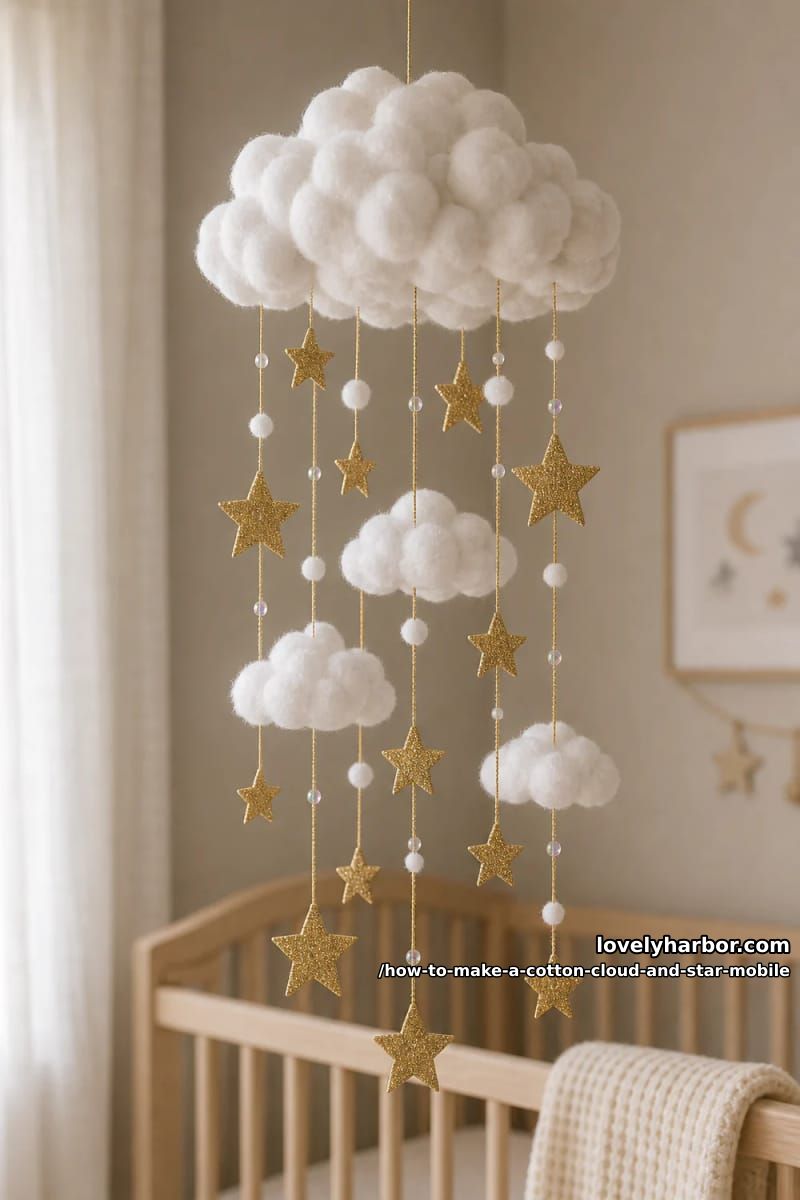
One-day project if you start in the morning and don't get precious about the cloud. The cure windows are the only forced pauses.
- 0:00 to 0:30: Wrap the hoop, punch the harness holes, tie the four strings.
- 0:30 to 1:30: Build the main cloud body , layers, lobes, wisps.
- 1:30 to 3:30 (cure break): Cut stars and prep drop cords while the glue sets.
- 3:30 to 4:00: Build the three satellite mini-clouds.
- 4:00 to 5:00: Thread the drops.
- 5:00 to 5:45: Attach drops to the hoop, check the silhouette, glue the knots.
- Overnight: Leave the mobile hanging from a closet rod to confirm nothing slips or sags before it goes into the nursery.
Conclusion
One thing I'd add, having built a few of these: photograph the finished mobile from directly underneath before you install it. That's the view the baby actually gets, and it's a completely different composition than the side angle you've been sculpting toward. Twice now I've moved a star or two after seeing the from-below shot. The build comes in around $73 from scratch, $35 if you already have scissors and a glue gun. If you want a quieter version than the reference, drop the star count to eight and add one extra satellite cloud , the silhouette gets softer and the gold reads as accent instead of subject.
Related Posts
- Spring Butterfly Craft
- How To Make Butterfly Suncatchers
- How To Make Pinecone Owls And Santa
- How To Make Mini Wreaths From Pipe Cleaners
- Christmas Craft Decorations