
Most farmhouse laundry roundups recycle the same five Pinterest photos and call shiplap cozy. This one is organized around the choices that actually cost money or cause regret later: which countertop survives a humid room, whether open shelving is a good idea somewhere that makes lint by the load, and where a sliding barn door makes sense versus where it just looks the part. Expect real prices, a few opinions you can argue with, and 21 rooms to steal from.

1. Cozy farmhouse laundry room with wooden cabinets, brick backsplash, and open shelving.
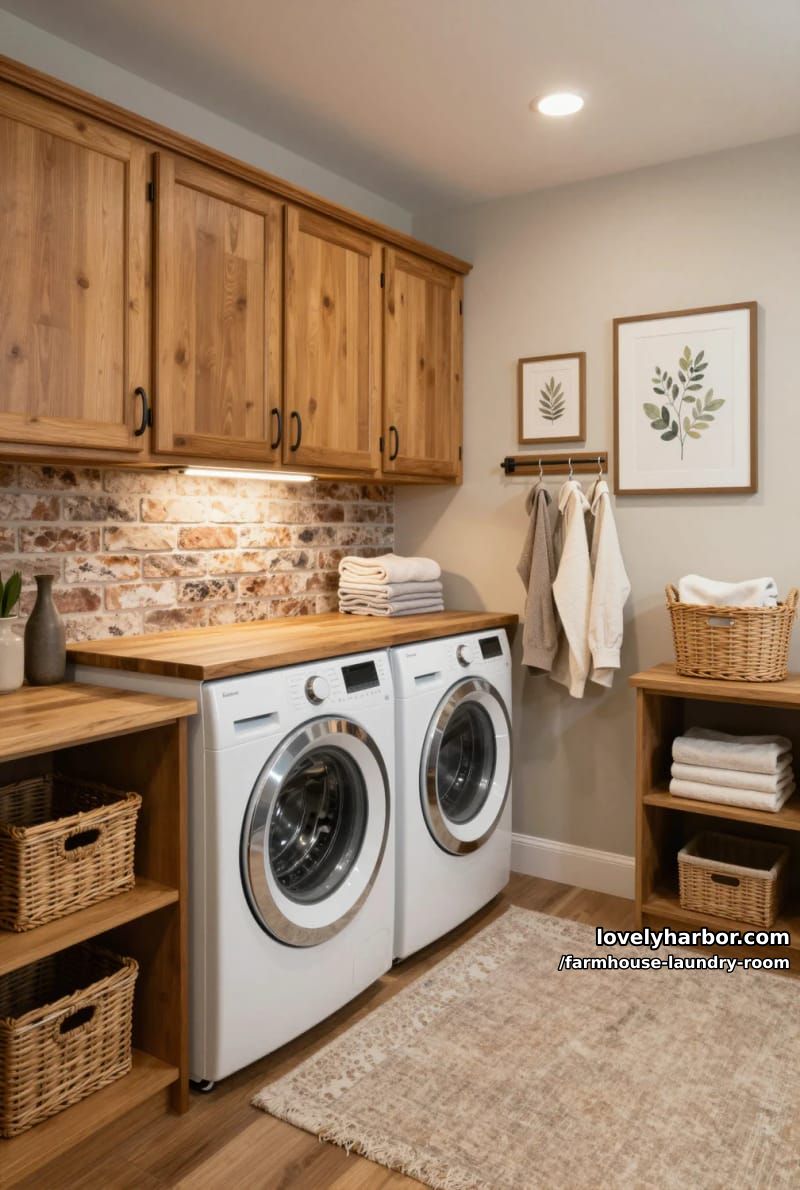
Wood-front cabinets against a brick backsplash give you the warmth most all-white laundry rooms are missing. Thin brick veneer (the real-clay kind, around half an inch thick) sets into mortar on drywall and reads as genuine. Printed brick wallpaper gives itself away the second light hits it at an angle.
Open shelving is the part people get wrong, including me. I used to spec open shelves into every laundry room I styled, then watched a client's go lint-grey in one season because the dryer vented two feet away. Keep open shelves for the things you touch every week, and put everything else behind a door.
Do this
- Open shelves for daily-use items: detergent, dryer sheets, a stack of folded towels
- Closed cabinet for backstock, cleaning chemicals, and anything you’d rather not look at
Avoid
- Open shelves directly in the dryer’s vent path, where lint settles fastest
- Loading floating shelves past their bracket rating (cheap brackets are rated for only 15 to 20 lbs)
2. Bright laundry room with white brick wall, rustic countertop, and decorative baskets.
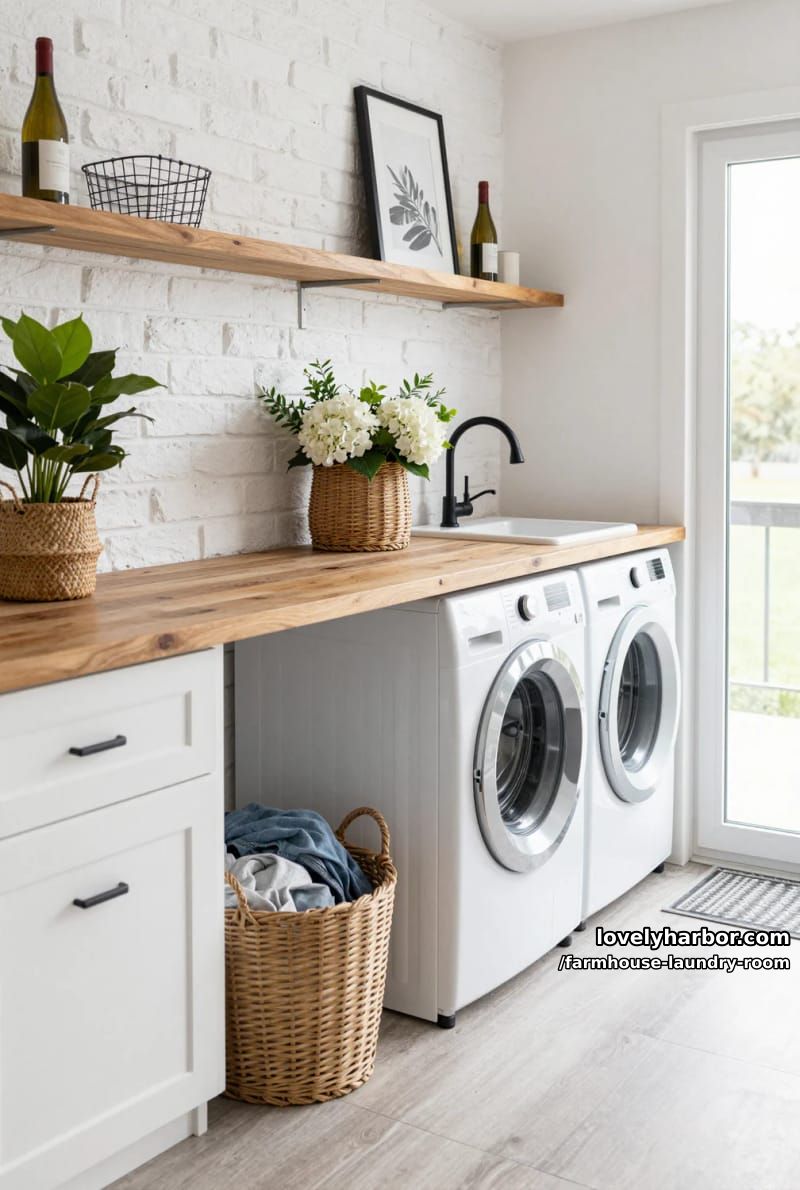
Whitewashed brick gives this room its light, and you have three ways to get the effect at very different prices: a German schmear (mortar dragged over the face), a thinned limewash that lets brick texture show through, or peel-and-stick faux-brick panels at roughly $20 to $40 a panel if you rent and can't touch the real wall.
White brick hides less than people expect. Detergent drips and splashes show on it faster than on the cream or grey versions, so keep a melamine sponge nearby and don't put the whitest stretch right behind the sink.
A wood counter and a couple of woven baskets stop the white from reading clinical, which is the actual job here.
3. Modern farmhouse laundry room with shiplap walls, wooden shelf, and natural light.
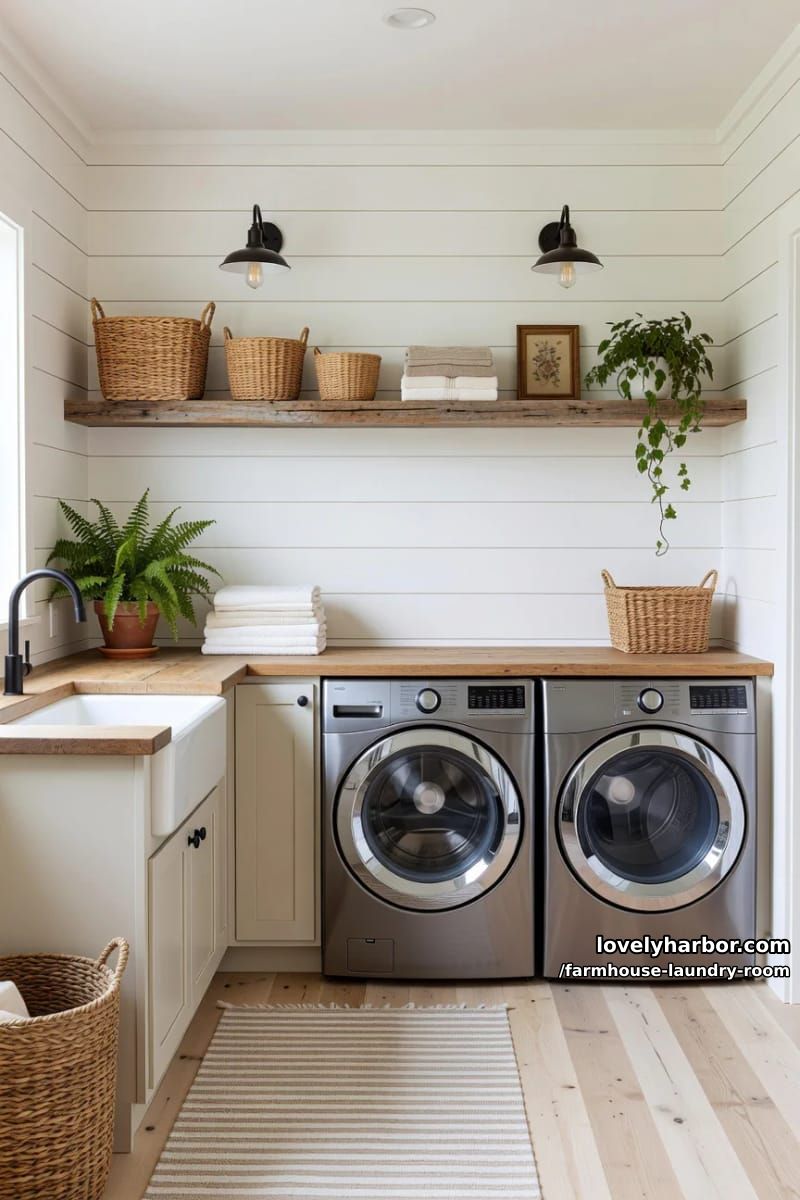
Real nickel-gap shiplap and the stuff sold in peel-and-stick rolls are not the same product, and the gap shows from across the room. MDF nickel-gap boards run roughly $1 to $3 a square foot before paint, which makes them the cheapest honest way to add texture to one wall.
Paint shiplap in satin or eggshell, never flat. A laundry room throws detergent splatter, and flat paint stains where you can't wipe it without leaving a mark. The wooden shelf above the machines keeps soap and a folded towel within reach without adding a cabinet's bulk.
4. Farmhouse laundry room with white cabinetry, herringbone tile floor, and pendant lighting.
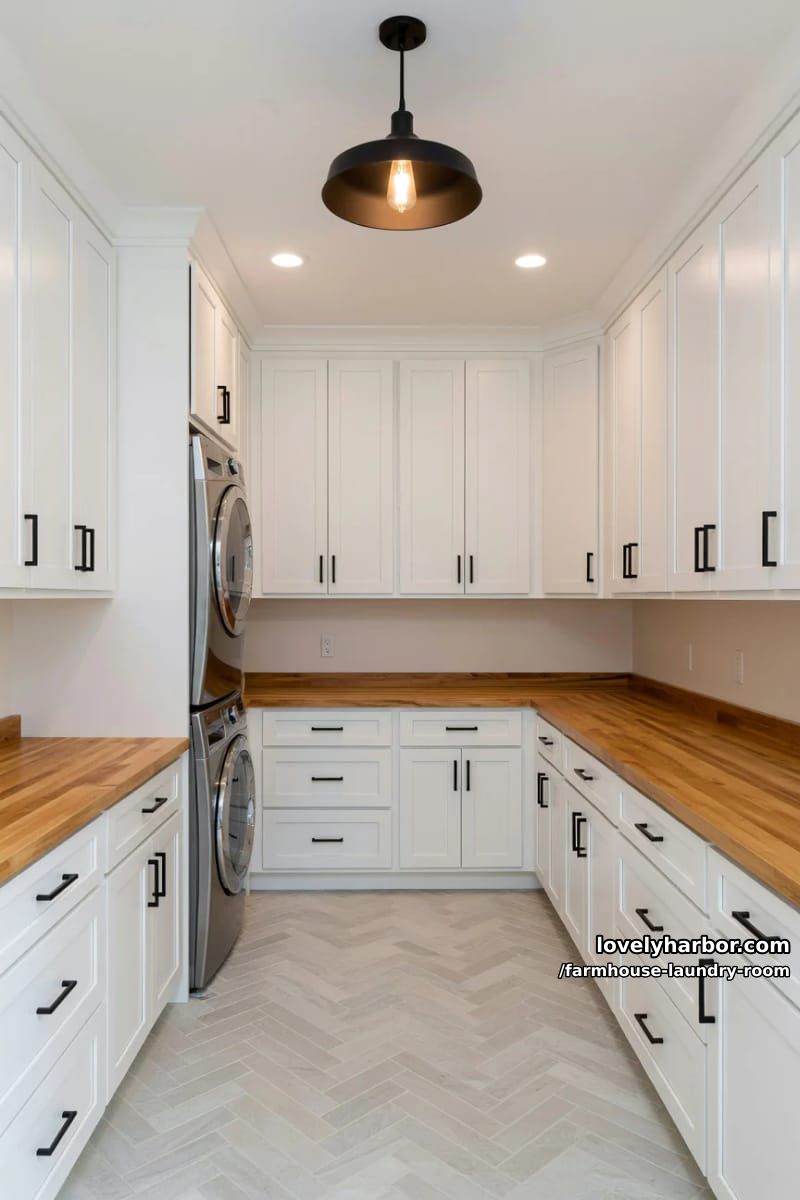
Herringbone tile is the upgrade that costs you in labor, not materials. The angled cuts generate roughly 10 to 15 percent more waste than a straight lay, and installers charge for the extra fitting time, so budget for the pattern, not just the tile.
White cabinetry reflects what daylight you have and keeps a windowless room from feeling like a closet. For the pendant, matte black or aged brass both read farmhouse; just hang it where nobody clips their head sorting a basket, which rules out the dead center of a folding counter.
5. Compact laundry room with side-by-side machines, wooden countertop, and floating shelves.
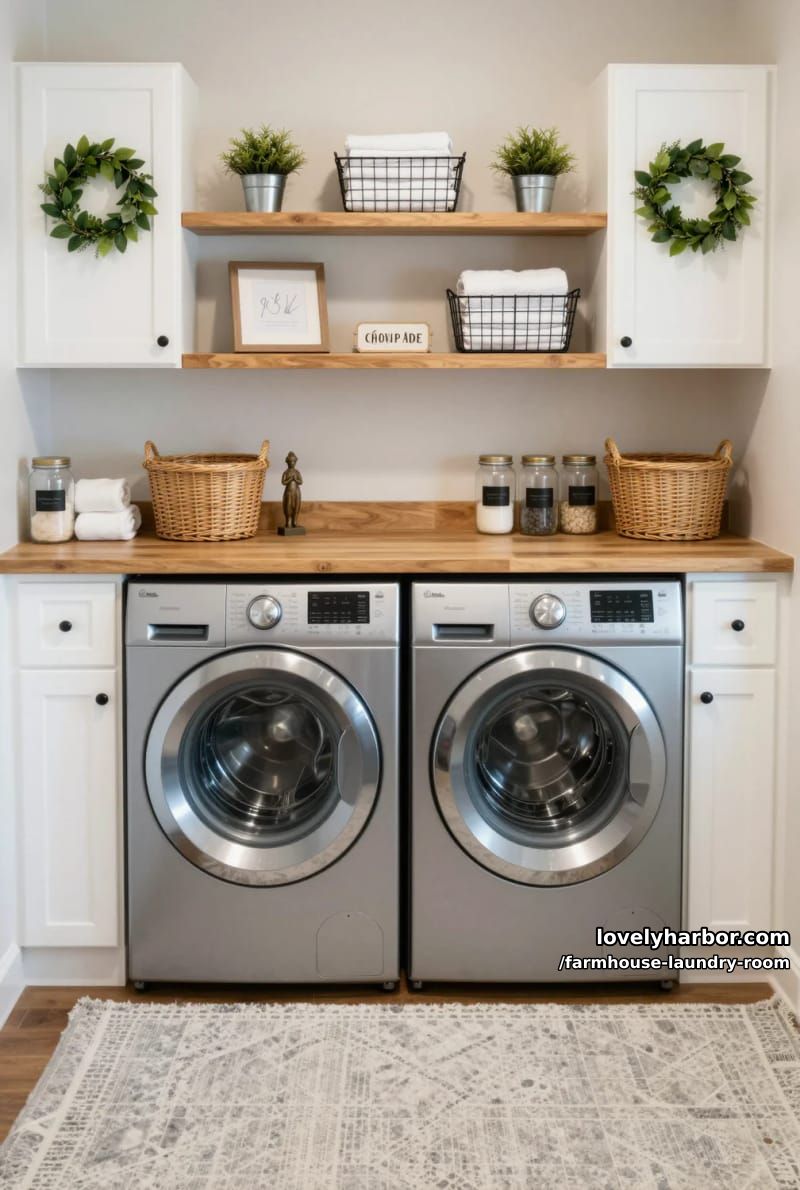
A wood counter spanning two front-loaders turns dead appliance tops into a folding station, but it only works if your machines are true front-loaders. A top-loader's lid kills the idea before you start. A pre-cut butcher-block slab from a home center runs about $200 to $500 for a 6-foot section, less than custom and well within DIY range if you can cut and seal it.
Oil the wood every 4 to 6 weeks or a steamy room will dry it out and open the grain. The floating shelves above are for light things only; see the bracket math in idea one.
6. Farmhouse laundry room with big windows, wooden countertops, and open shelves.
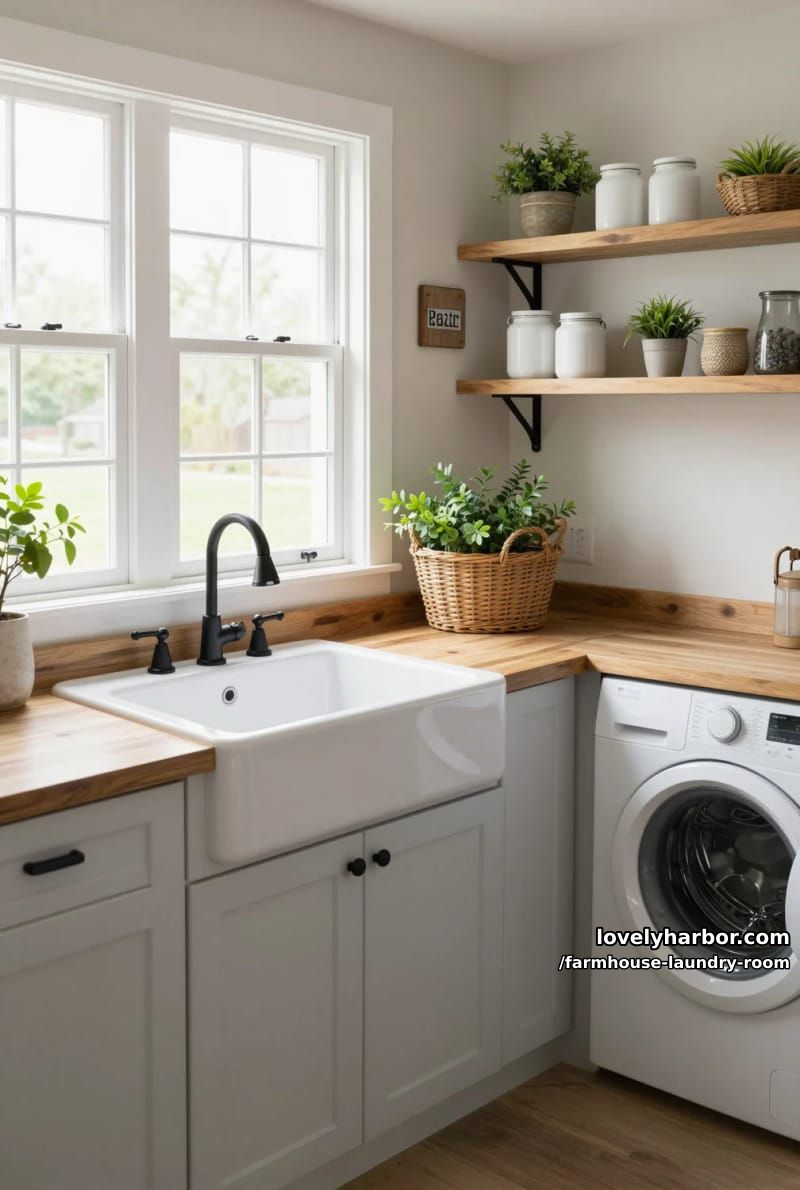
Big windows are the single biggest mood upgrade a laundry room can get, and they do real work: daylight catches the stains you'd miss under a dim ceiling bulb, before the load goes in. There's a catch nobody mentions, which is that years of direct sun fade both wood and fabric, so finish wood counters with a UV-resistant topcoat if the window faces south or west.
Open shelves under good light look intentional only if what's on them matches. Decanting detergent into a row of identical jars is the cheapest way to make that happen.
Decanting detergent into matching jars is pure theater, and it works: a tidy shelf reads styled even when the rest of the room isn’t.

7. Rustic laundry room with wooden cabinets, floral wallpaper, and exposed bulbs lighting.
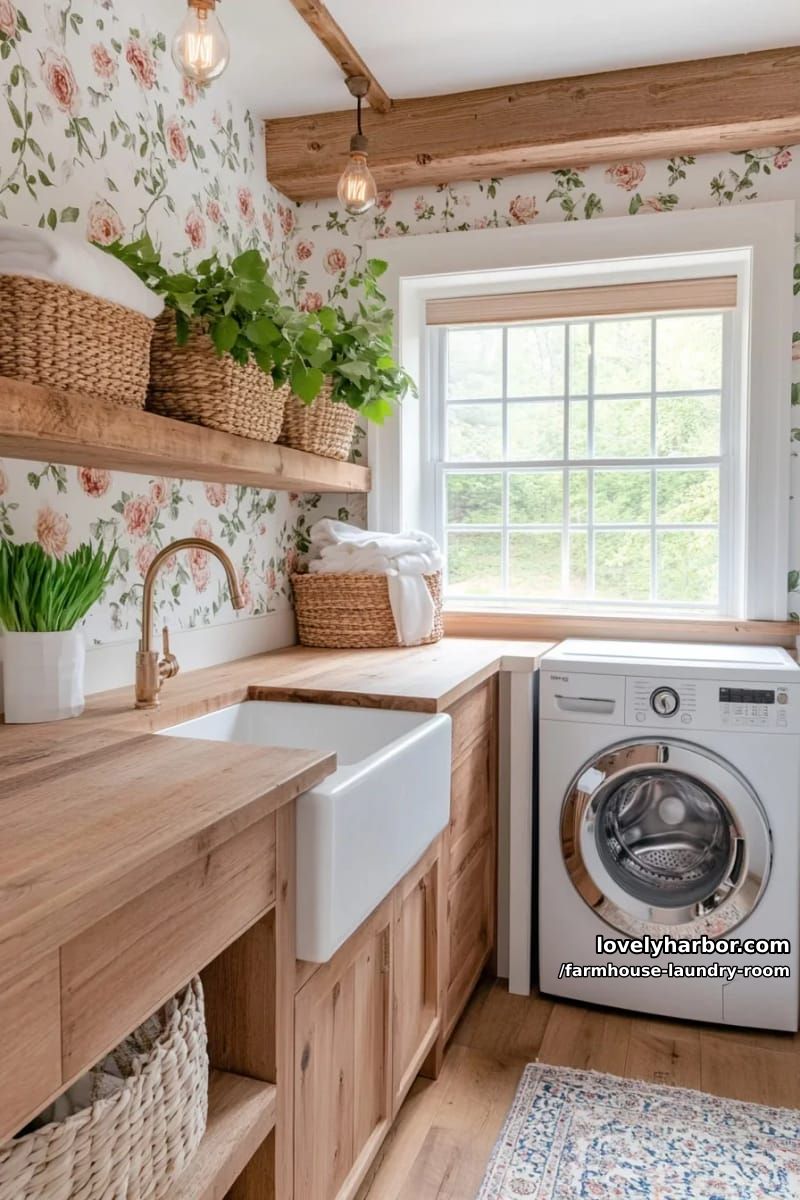
Floral wallpaper plus exposed bulbs is the riskiest combination on this list, and it tips into grandma's-bathroom fast if you skip two specifics. In a humid laundry room, use vinyl-coated or otherwise washable wallpaper; uncoated paper lifts at the seams within a year. (The oversized-bloom papers everyone pins look great in a photo and overwhelming on four real walls, so scale the print down to the room.)
For the bulbs, a low-watt LED filament around 2700K on a dimmer keeps the warm glow without the glare. A bare 60-watt bulb hanging over a folding counter is genuinely unpleasant to work under, which is the kind of thing you only learn after living with it.
8. Well-lit farmhouse laundry with cream cabinetry, green plants, and shiplap walls.
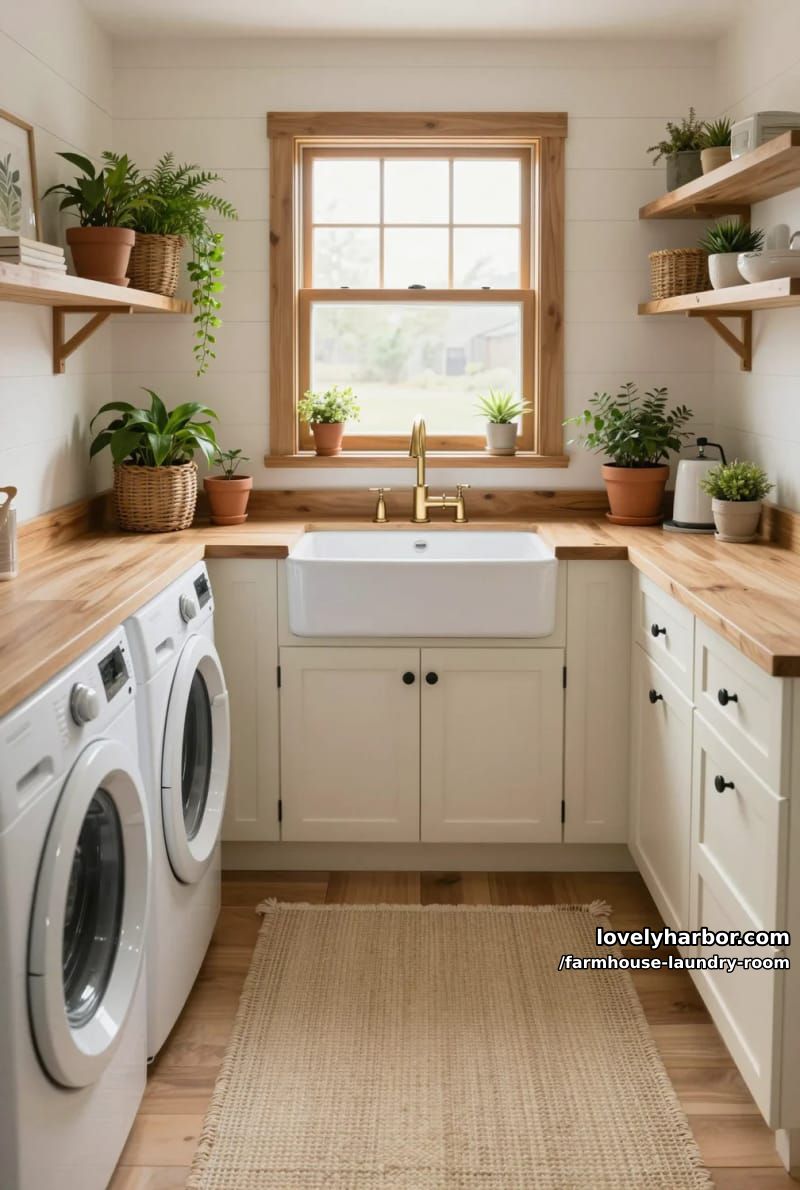
Cream cabinets beat bright white in a laundry room for one unglamorous reason: cream hides the dust, lint, and fingerprints that show instantly on pure white. Benjamin Moore Navajo White or Sherwin-Williams Creamy land in the right range without going yellow.
For plants that survive low light and the humidity, pothos, snake plant, and ZZ all do fine here, where a fussier plant would sulk. The shiplap gives them a textured backdrop, and the steam they'd hate in a dry living room is exactly what keeps them happy by the dryer.
9. Farmhouse laundry room with white appliances, wooden shelving, and decorative greenery.
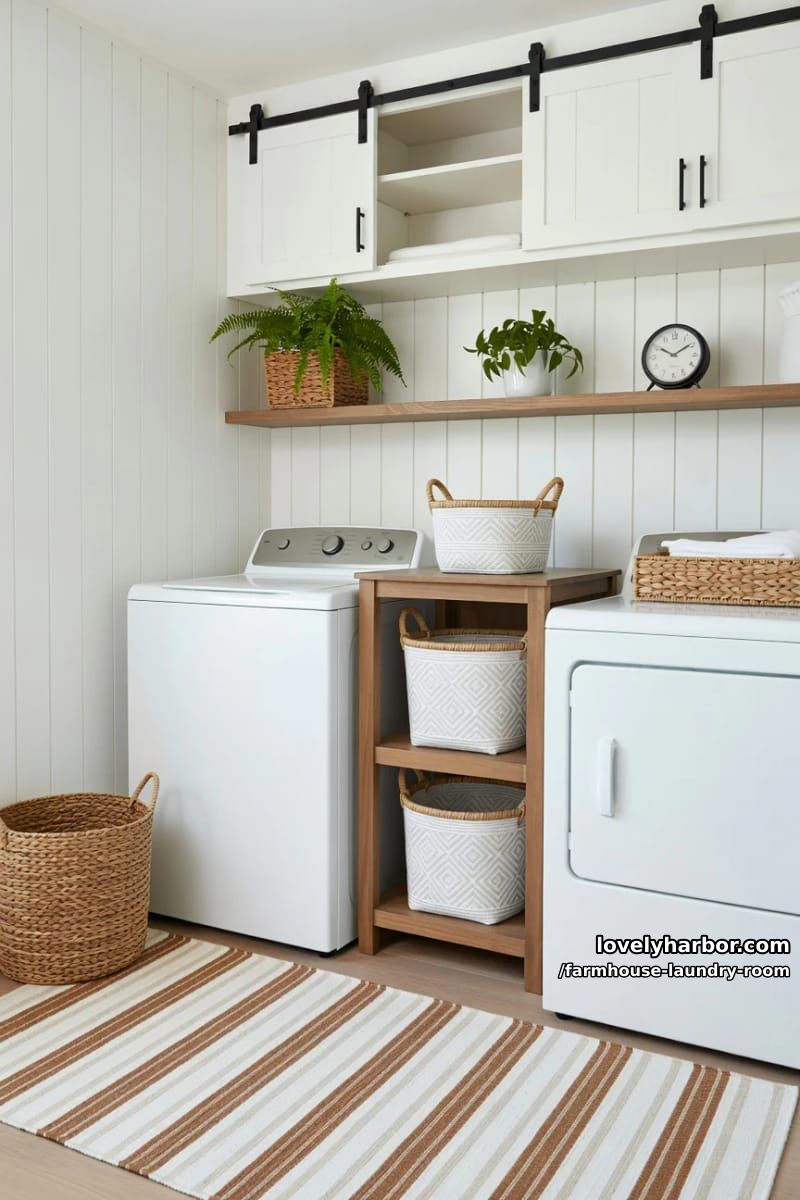
Wooden shelving in a laundry room lives or dies on whether you seal it. Steam and the odd splash will warp or stain bare wood within a year, so finish it with a water-based polyurethane (low odor) or a spar varnish meant for damp conditions.
White appliances cost far less than panel-ready units and are easy to match across brands, which is half the reason this look keeps showing up. The greenery, again, thrives on the humidity that's a problem for everything else in the room.
Seal the undersides and the cut edges, not just the top face. Moisture wicks up from below and travels through exposed end grain, and an unsealed edge is where the first water stain and the first warp always show.
10. Modern farmhouse laundry room with barn door, wood countertop, and subway tile backsplash.
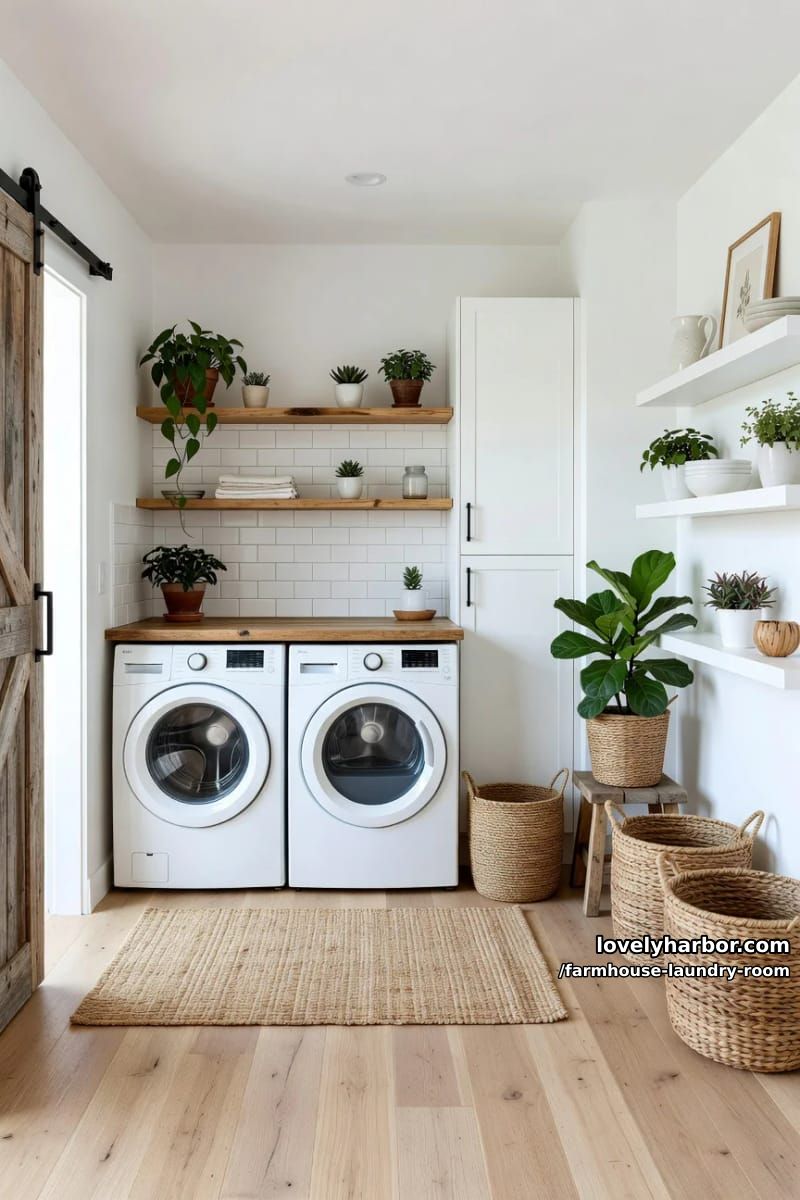
A sliding barn door reclaims the floor space a swinging door wastes, which is why it shows up in so many small laundry rooms. The number that trips people up: the track has to run at least twice the door's width so the door clears the opening completely. A 36-inch door needs a 72-inch track, minimum. Order a track sized to the opening instead and you get a door that slides halfway and stops.
Wood counters and subway tile both pull their weight here, but the grout is the maintenance trap. Use epoxy grout, or seal cement grout, especially in the splash zone behind a utility sink where it discolors fastest.
11. Farmhouse laundry with X-pattern gray cabinetry, open shelves, and labeled baskets.
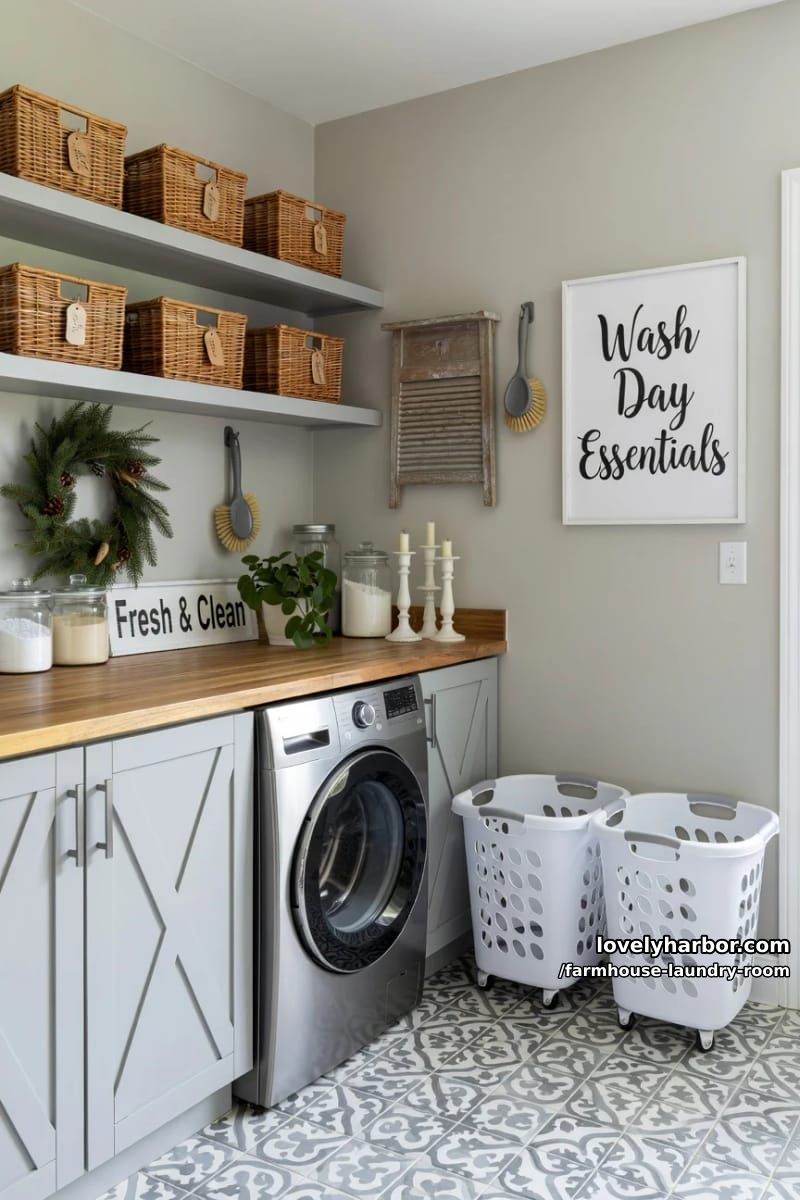
Labeled baskets are what make open shelving actually work instead of just photographing well. The X-pattern (board-and-batten X detailing on the cabinet doors) carries the rustic note; matching woven baskets with labels keep the open shelves above from sliding into clutter.
Grey cabinets give you a softer alternative to white or wood, and the closed lowers are where the bleach and the spare parts go. The one rule that matters: buy the baskets in a set so they match.
Decanting detergent into matching jars is pure theater, and it works: a tidy shelf reads styled even when the rest of the room isn’t.
12. Laundry room with sliding barn door, stainless appliances, and stone countertop.
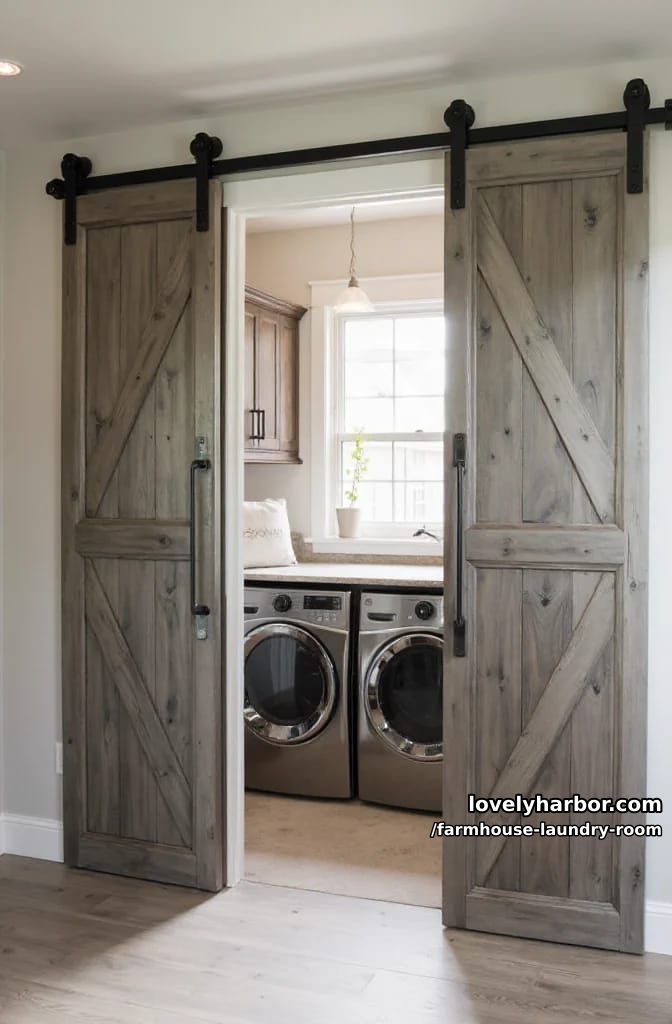
Stone in a laundry room is overkill for durability and pays off in zero maintenance, and quartz specifically beats granite here because it's non-porous and never needs sealing. Granite is real stone but wants resealing periodically; in a room where you're already managing one wood surface, that's one chore too many.
Stainless appliances show fingerprints, so black stainless or a matte finish hides daily life better. Here's how the common laundry-counter surfaces actually compare once you stop looking at the photos.
| Surface | Needs sealing? | Holds up to humidity | Relative cost |
|---|---|---|---|
| Butcher block | Yes, oil every 4 to 6 weeks | Yes, once sealed | Mid |
| Quartz | No | Yes | Mid to high |
| Laminate | No | Yes | Low |
| Granite | Yes, periodically | Yes | Mid to high |
13. Narrow laundry room with shiplap, farmhouse sink, and French doors for natural light.
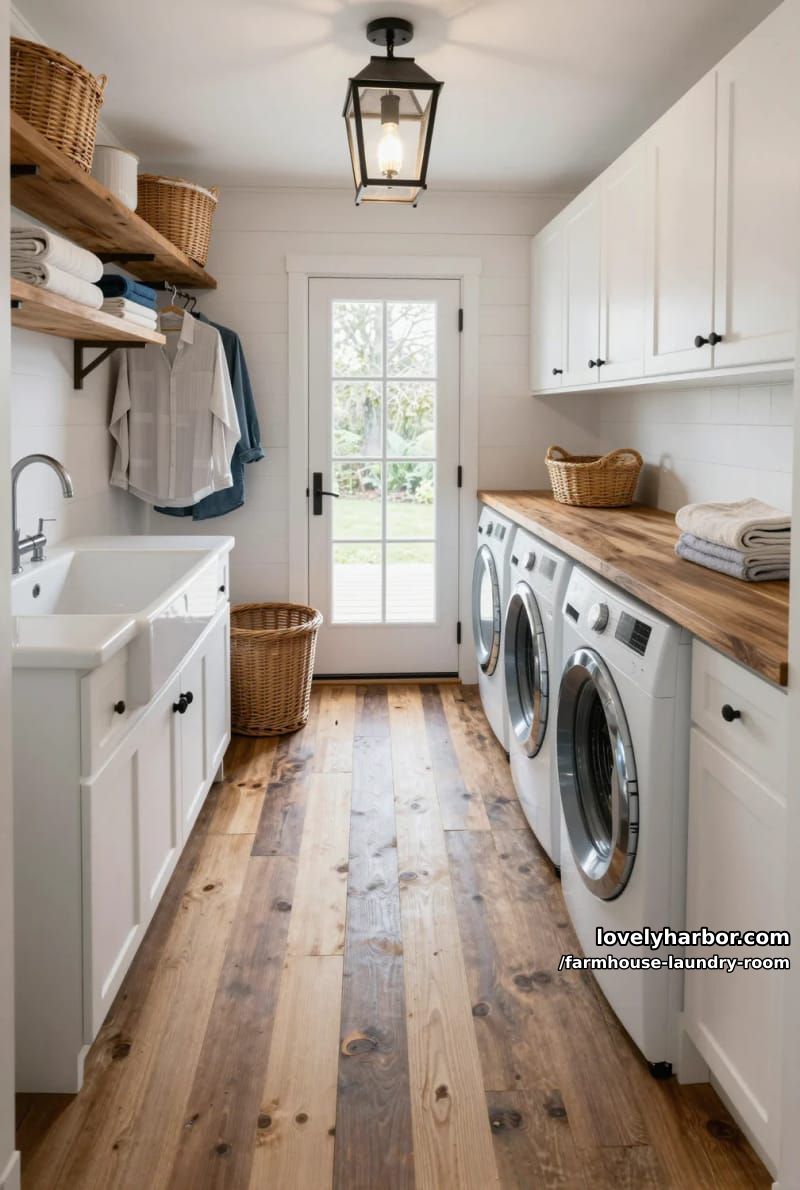
A farmhouse apron sink makes more sense in a laundry room than in most kitchens, because the deep basin (look for 9 to 10 inches) is built for soaking stained clothes and rinsing whatever you don't want in the kitchen sink. Fireclay handles knocks well; cast iron is heavier and needs a cabinet built to carry it.
French doors flood a narrow room with light but offer no privacy, so glass-front works when the room faces a yard, not a neighbor's window. For storage in a tight footprint, go vertical: floating shelves up the wall, and a slim rolling cart tucked between the machines and the wall.
14. Rustic farmhouse laundry with exposed beams, open shelving, and a farmhouse sink.
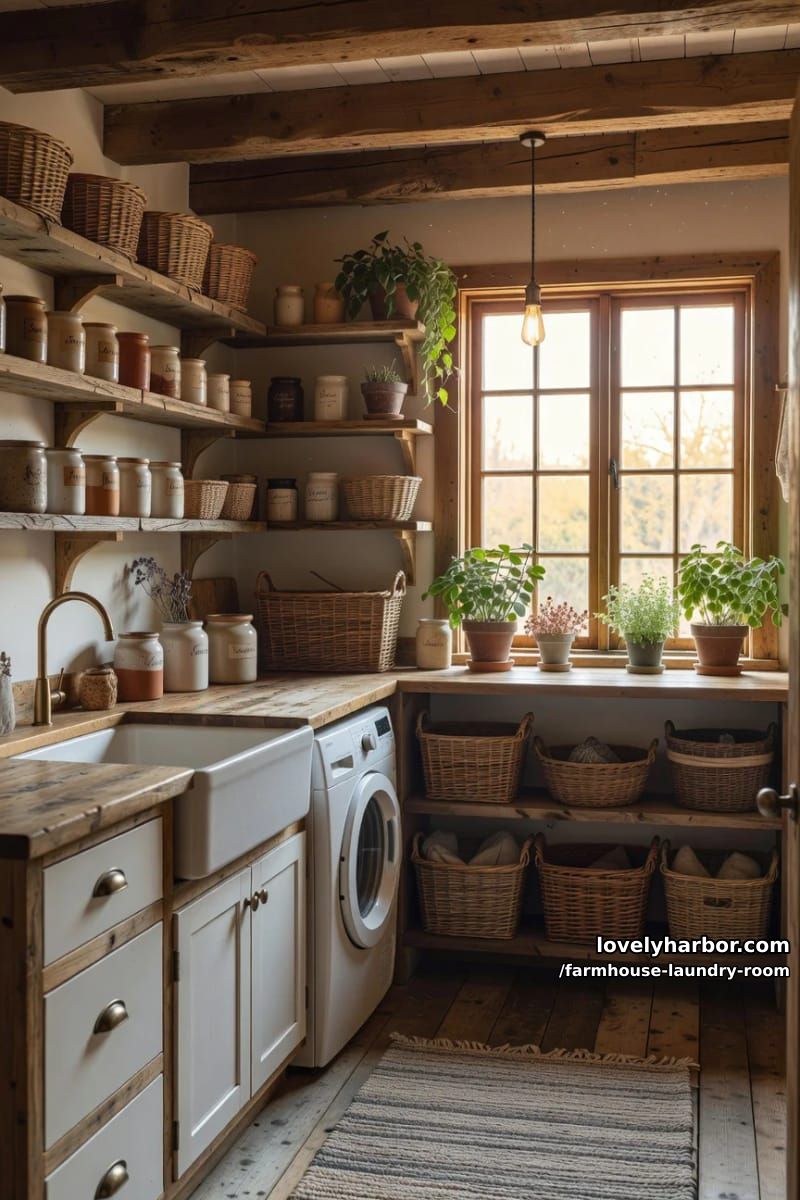
Most exposed beams in a laundry room this size are faux box beams: hollow, three-sided wood wraps glued to the ceiling, and there's no shame in that as long as they're sized right. Undersized faux beams read as crown molding that lost its way, and oversized ones look like styrofoam, which is occasionally what they're made of.
A deep farmhouse or utility sink earns its place here for soaking and rinsing paintbrushes. Mount the open shelving where you can actually reach to wipe it, because anything above eye level in a beamed ceiling collects cobwebs you won't see until guests do.
15. Rustic laundry room with wood cabinets, brass fixtures, and glass door.
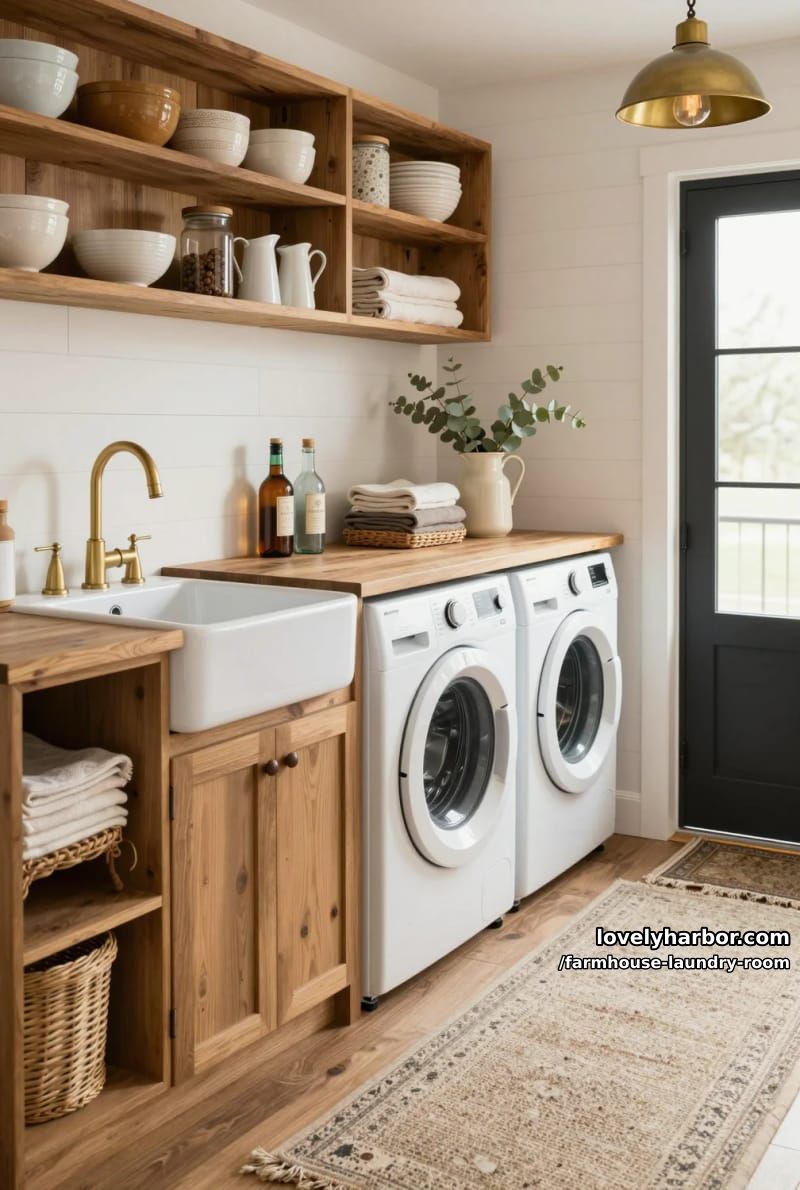
Brass comes in two kinds and the difference decides whether you'll be polishing. Unlacquered (living) brass patinas and darkens over time into that warm aged look; lacquered or PVD brass stays bright with no upkeep. If polishing fixtures sounds like a chore you'll resent, buy lacquered and skip the romance.
Wood cabinets in a humid room want sealing or reclaimed stock that's already moved as much as it's going to. The glass door does the heavy lifting on light, brightening the space and cutting the hours the overhead has to be on.
16. Modern farmhouse laundry with sliding barn door, white cabinetry, and subway tile.
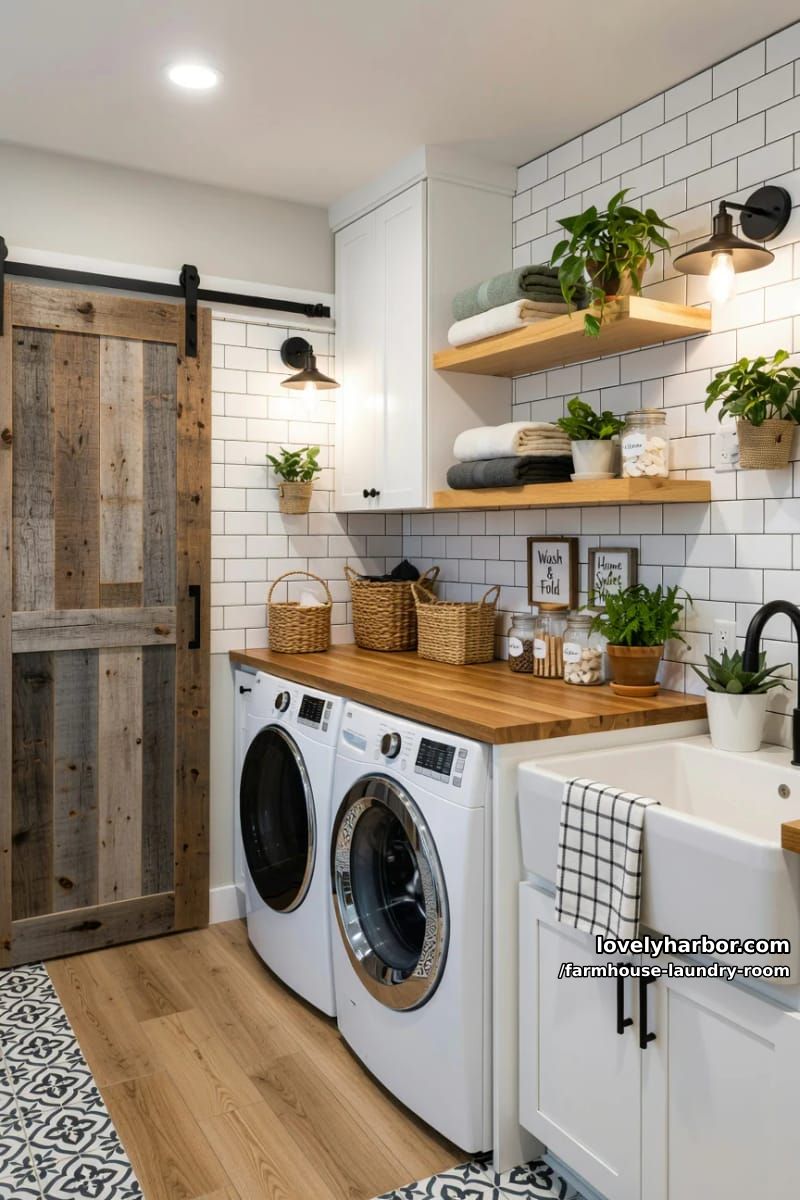
This is the cleanest version of the modern-farmhouse formula: a sliding barn door, white shaker cabinets, a subway-tile run. White cabinets show every smudge, so spec satin or semi-gloss that wipes clean; flat paint on a laundry-room cabinet is a mistake you'll be repainting.
One honest drawback before you commit to the door: barn doors don't seal against the jamb, so they leak sound and dryer rumble into whatever room is next door. If your laundry opens onto a living space, that's a real trade-off to weigh. Get the hardware right and remember the track-length rule from idea ten.
Decanting detergent into matching jars is pure theater, and it works: a tidy shelf reads styled even when the rest of the room isn’t.
17. Industrial farmhouse laundry with red brick wall, black sink, and open shelving.
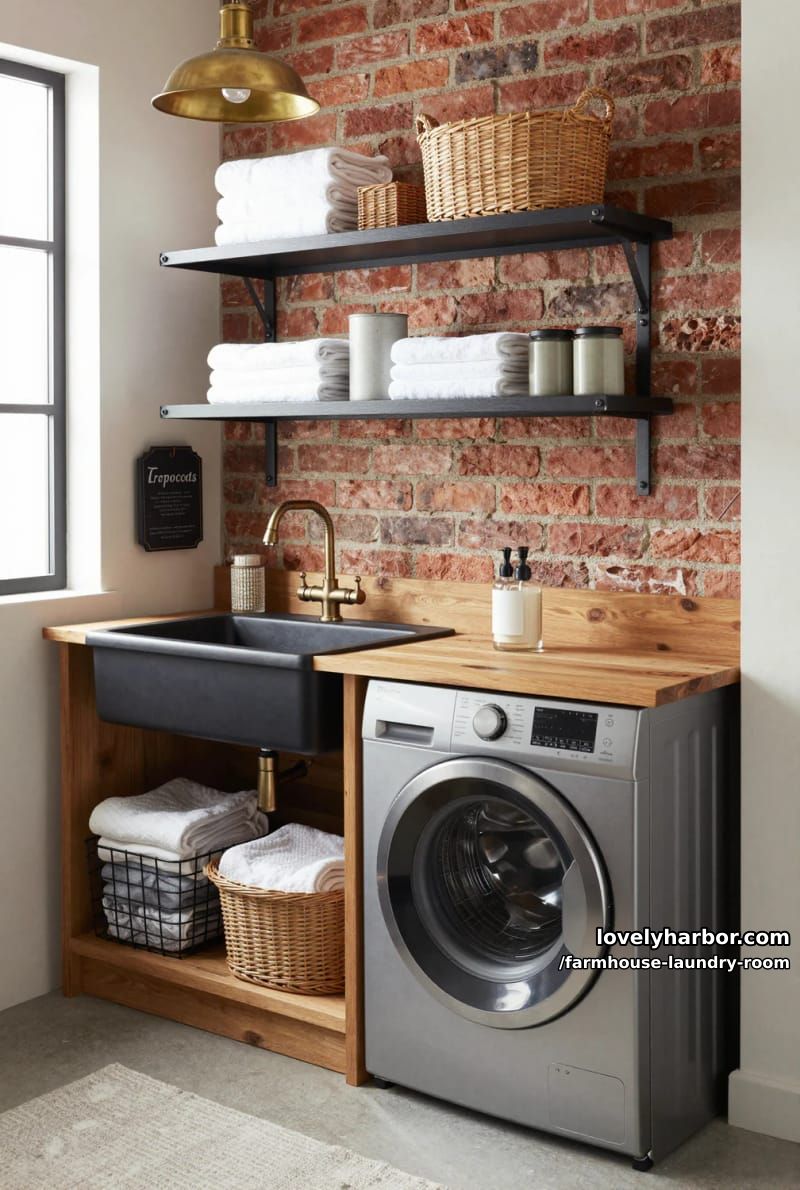
A red-brick wall is the most forgiving surface in this whole list. It hides the scuffs, dings, and detergent splatter that would show on any painted wall, which is exactly why it suits a room that takes daily abuse. For the sink, a matte-black composite-granite basin (Blanco makes the well-known ones) resists scratches and shows fewer water spots than stainless.
Open shelving against brick wants editing. Stacked towels and a few jars look curated; the moment you add a tenth random object it reads flea market, and not in the good way.
18. Compact laundry with gray cabinet, wood shelf, and dark shiplap accent wall.
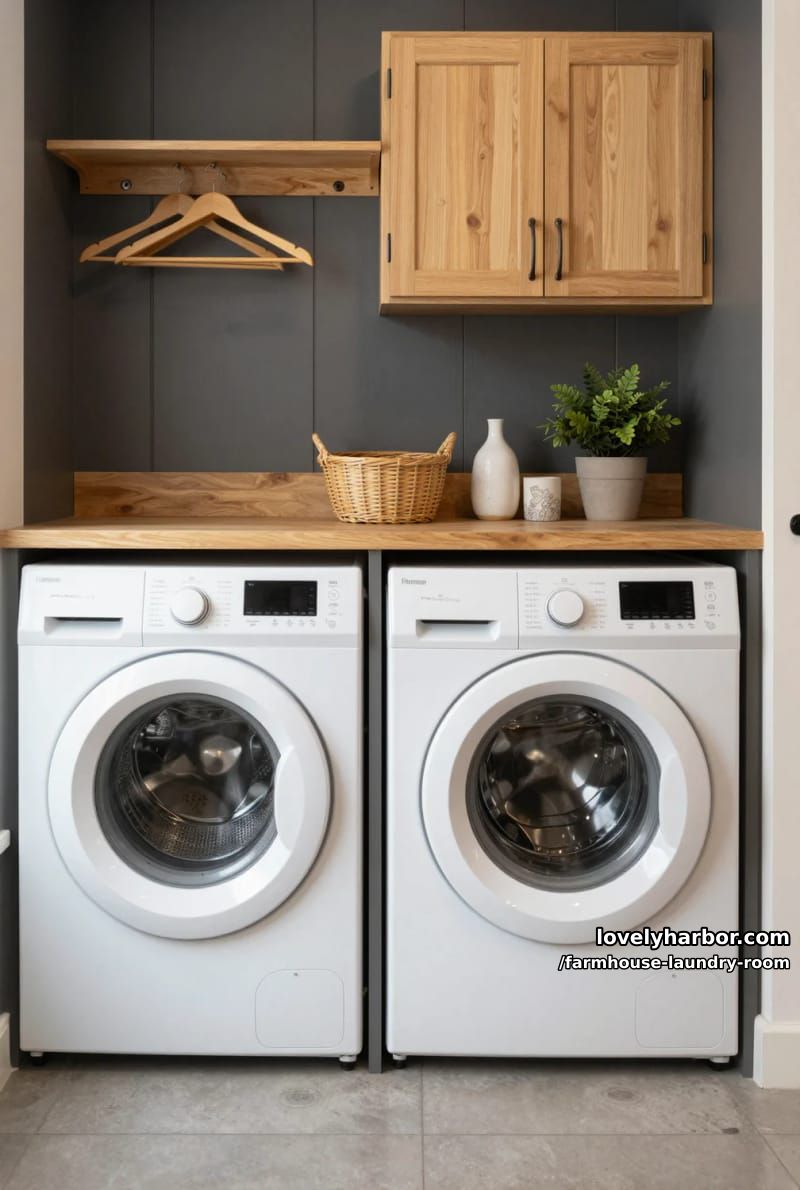
A dark shiplap accent wall adds depth to a small laundry, but it eats light, so plan the lighting before you commit to the color. Benjamin Moore Hale Navy or Sherwin-Williams Iron Ore both work; pair either with an under-shelf LED strip in warm white (2700 to 3000K) so the corner doesn't go cave-dark.
The grey cabinet and a wood shelf give you smooth-against-rough texture without much spend, and the dark wall does the brick's job of hiding scuffs in a room too small for actual brick.
19. Farmhouse laundry room with floral wallpaper, white countertop, and vintage decor.
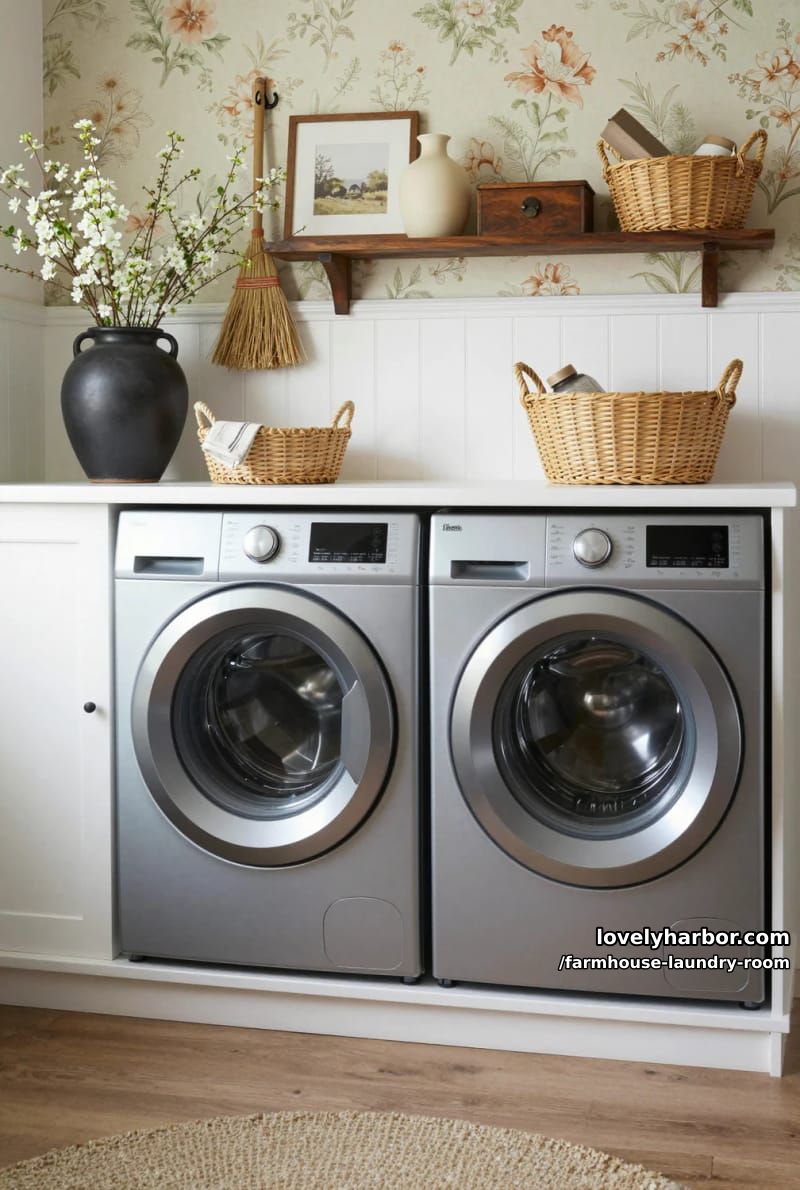
Vintage laundry decor works until it doesn't, and the line is roughly five pieces. Past that, curated tips into cluttered. Source the real stuff (enamelware, a genuine washboard, old advertising tins) from flea markets and Etsy rather than the reproduction signs at the big-box craft stores.
People ask me where to buy the cute wooden "Laundry" sign they saw online. Honestly, skip it. A real enamel basin from a flea market costs about the same and doesn't announce itself as mass-produced. A white quartz or laminate counter keeps the floral wallpaper from taking over, and washable paper survives the splashes.
20. Farmhouse laundry with sage green cabinets, wooden shelf, and shiplap walls.
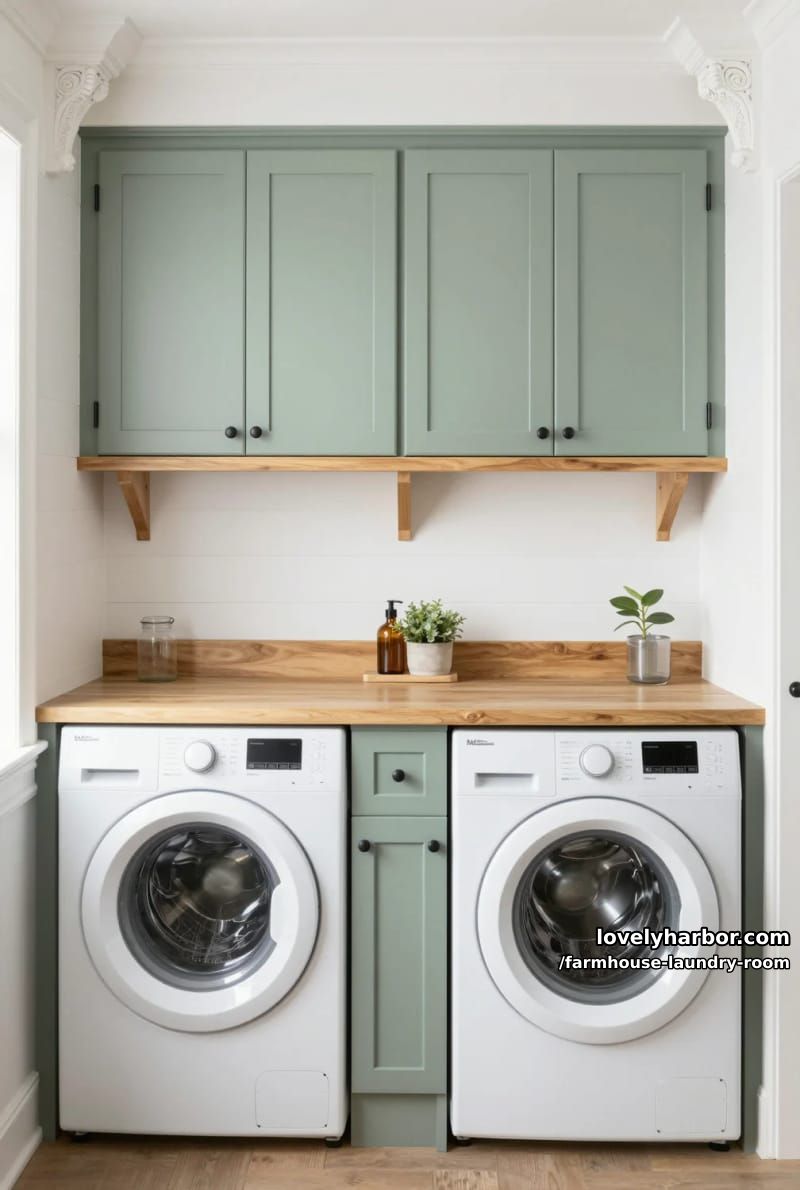
Sage green is the strongest alternative to all-white cabinets at the moment, and Sherwin-Williams Evergreen Fog (SW 9130), their 2022 Color of the Year, is the shade most of these rooms are quietly using. It's a green-meets-grey with an LRV around 30, so it reads as actual color without going dark, and the grey undertone hides marks a clean white would broadcast.
One opinion you can take or leave: sage leans English-cottage more than rustic-farmhouse, so it sits better with warm wood and unlacquered brass than with terracotta or black wrought iron. The chunky wood shelf and shiplap keep it grounded.
21. Bright farmhouse laundry with cream cabinetry, open shelving, and floral curtain.
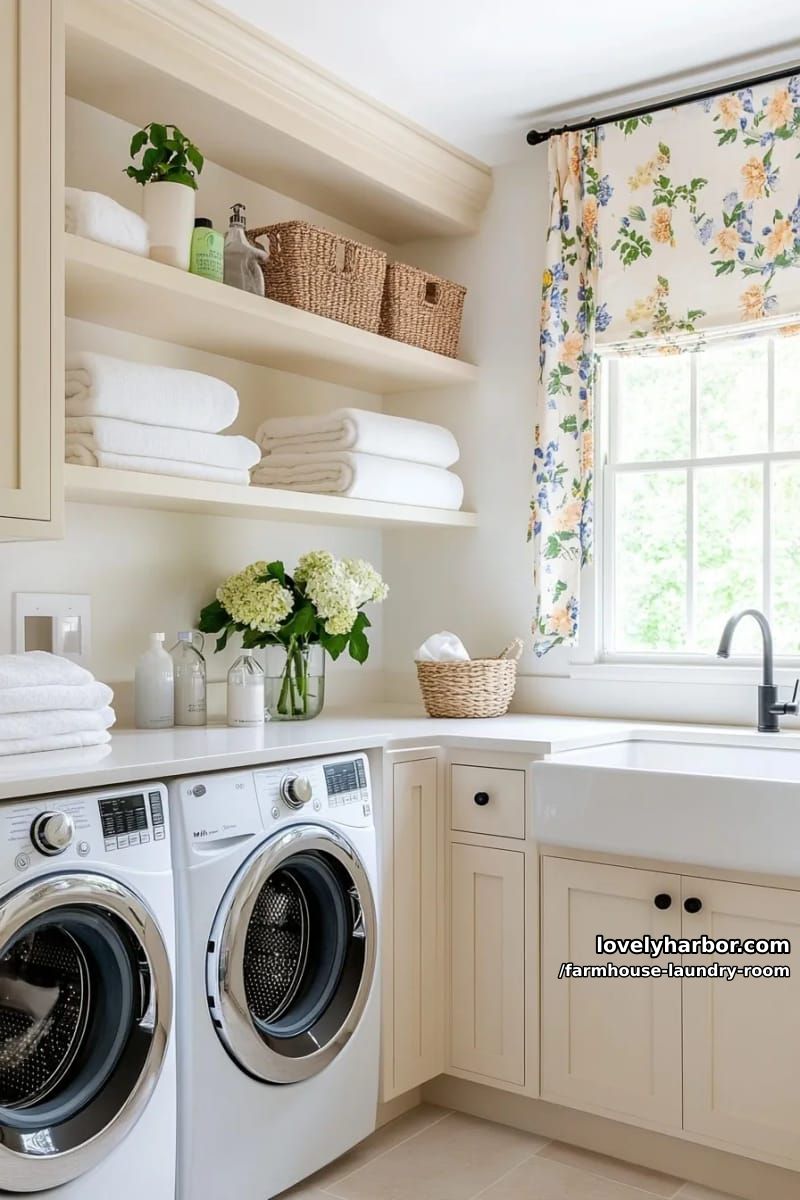
A skirt of fabric on a tension rod is the cheapest way to hide a washer, a dryer, or the open underside of a counter: roughly $20 to $40 for fabric and a rod, against hundreds for cabinet doors. Use a washable cotton or linen-blend so it survives the inevitable splash, and a floral print earns its keep here by pulling the eye away from the machines.
Cream cabinetry up top, open shelving for the daily things, curtain below. For renters especially, this trio plus peel-and-stick shiplap and a matched set of baskets gets most of the look with nothing you can't take with you.
Conclusion
If you change one thing, seal your wood. The most common regret in these rooms is a butcher-block counter or open shelf that warped or stained because nobody oiled it or sealed the edges, undersides included, every 4 to 6 weeks. After that, the choices that matter are the dull ones: quartz if you never want to think about maintenance again, a barn-door track cut to twice the door width so it actually clears the opening, and a closed cabinet for anything you don't touch weekly. The shiplap and the sage cabinets (Evergreen Fog, if you're copying the look outright) are the easy layer. Get the sealing and the storage right first, and the pretty part lasts.