
A felt flower is really just three moves. Cut a stack of petals, curve them so they don’t sit flat like coasters, and cover the center where all the glue ends up hiding. The template further down is free and sized for three flower diameters.
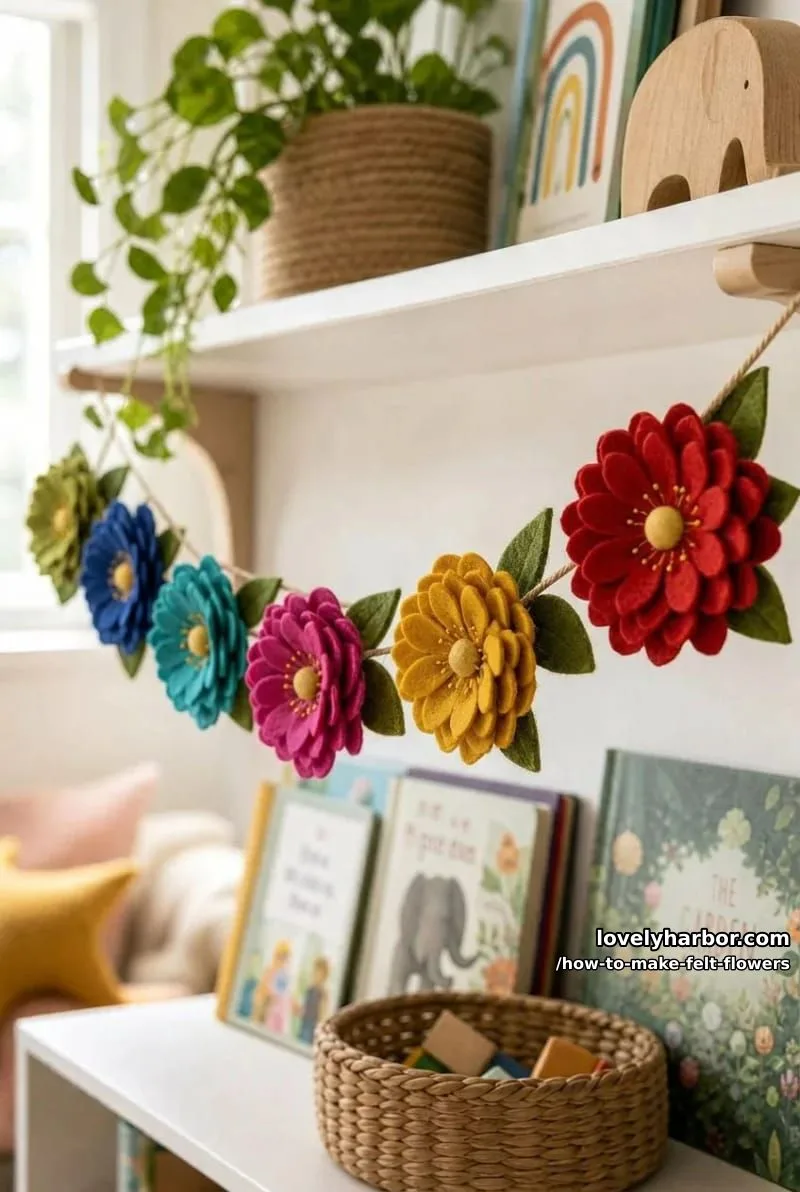
I’ll walk you through a layered daisy, the kind of rainbow bloom on the mantel above, and I’ll be honest about which felt holds a petal and which one pills into something papery. Hot glue does the work here, no sewing machine, though there’s a stitched center later if you want one.
Materials and tools you’ll need
Four materials, two tools. Most people already have the two tools, and that’s the whole reason for splitting the tables below: if there’s a pair of scissors and a glue gun somewhere in a drawer, the only number that matters to you is the materials column. Every pack in it makes dozens of flowers, so one garland barely dents any of them.
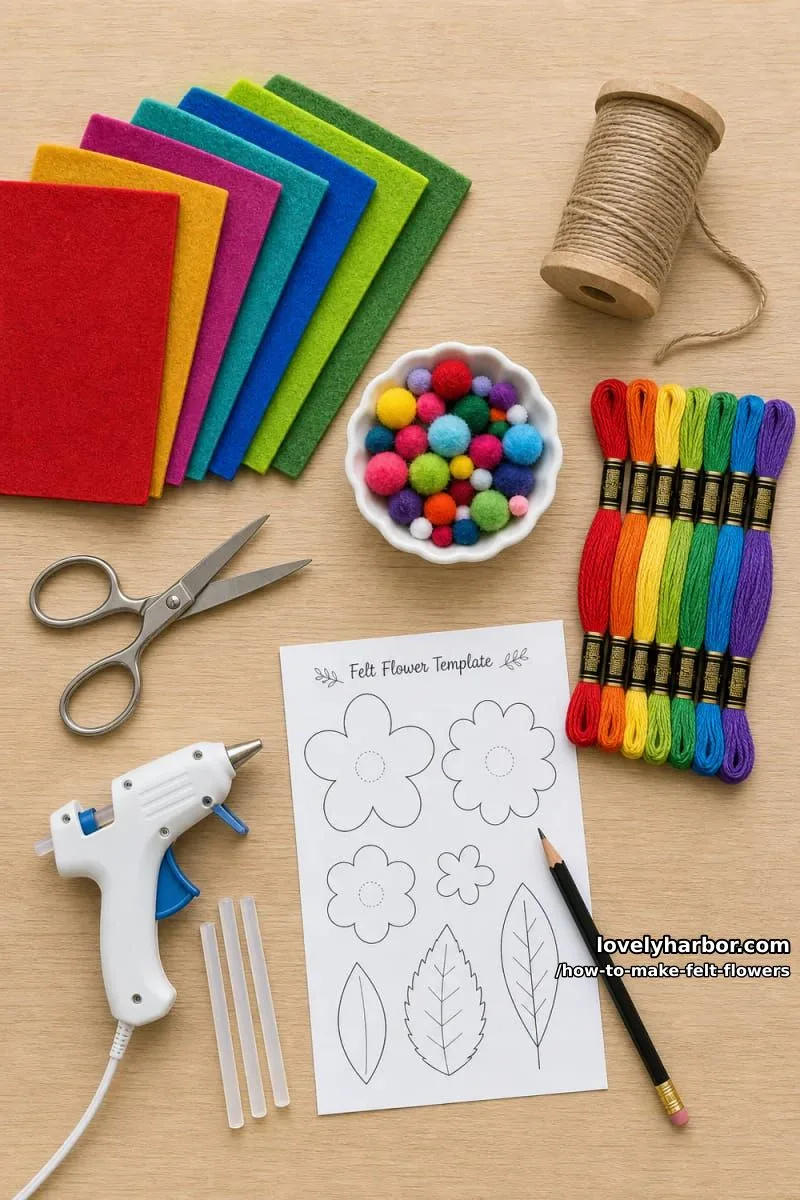
Materials (consumables)
| Qty | Item | Spec | Price |
|---|---|---|---|
| 1 | Wool-blend felt sheets, 40-color assortment | 8 in squares, 1mm, includes several greens for leaves | $20 to $30 |
| 1 | Craft pom-poms, multicolor | assorted sizes, ~1000 ct, for flower centers | $8 to $13 |
| 1 | Embroidery floss with needles | 124 skeins + 16 needles, for stitched centers | $10 to $16 |
| 1 | Natural jute twine | 2mm, ~600 ft, garland base | $6 to $10 |
| Materials subtotal | $44 to $69 | ||
Tools (reusable)
| Qty | Item | Spec | Price |
|---|---|---|---|
| 1 | Sharp fabric scissors | 8 in knife-edge dressmaker shears | $25 to $40 |
| 1 | Mini hot glue gun + 30 sticks | dual-temp, 7mm mini glue sticks | $12 to $18 |
| 1 | Petal template, cardstock, pencil | printable below; cardstock stiffens the trace shapes | Free |
| Tools subtotal | $37 to $58 | ||
If you’re buying everything from scratch
| Combined total | $81 to $127 |
Prices are rough ranges as of June 2026, so check before you buy. Each pack stretches across dozens of flowers anyway.
Choosing felt that holds a petal shape
This is the part people get wrong, so I’ll plant my flag right here: buy wool-blend felt. Not the stiff acrylic squares from the dollar-store bin. The difference is everything. Wool-blend has enough give that you can cup a petal over your thumb and it stays cupped, which is the only reason the blooms in the photo read as flowers and not as cut-paper snowflakes. Cheap craft felt pills, frays at the tight cuts, and turns papery the second glue touches it. Aim for 1mm to 1.2mm. Thick enough to stand on its own, thin enough that three stacked layers don’t end up a hockey puck.
A caveat on tools, since I just told you to spend money: you do not need $35 Gingher shears to cut felt. Anything you’ve kept away from the paper-and-tape drawer will cut clean. If you sew at all, sure, a real pair of fabric shears earns its keep. But those fuzzy, chewed petal edges beginners blame on the felt? Usually it’s just dull blades.
Do this
- Wool-blend felt, somewhere around 20 to 35% wool. That’s what lets a petal cup and stay cupped.
- 1mm to 1.2mm thick, so a stack of three stays clean.
- Grab two or three greens. Leaves eat more felt than you’d guess.
- One sharp scissors that never touches paper.
Avoid
- Stiff acrylic craft felt. It pills, and once it’s glued it looks like paper.
- Anything as thick as 3mm: the petals won’t nest and the flower gets bulky.
- Ironing wool-blend on high heat, which shrinks and scorches the wool content.
- Paper scissors , dull edges fuzz the petal tips.
A 40-color square pack hands you the full rainbow plus the greens in one box, instead of paying craft-store markup on single sheets.

Download and cut the petal template
Print at 100% and turn off “fit to page” or “shrink to fit,” then lay a ruler against the one-inch scale bar to confirm it printed true. Cut the shapes from cardstock, not regular paper, so the edge survives being traced twenty times. You get three flower sizes and a leaf, and the descending sizes are the whole trick: they let the layers nest with petals peeking through, instead of three identical shapes stacked dead-on.
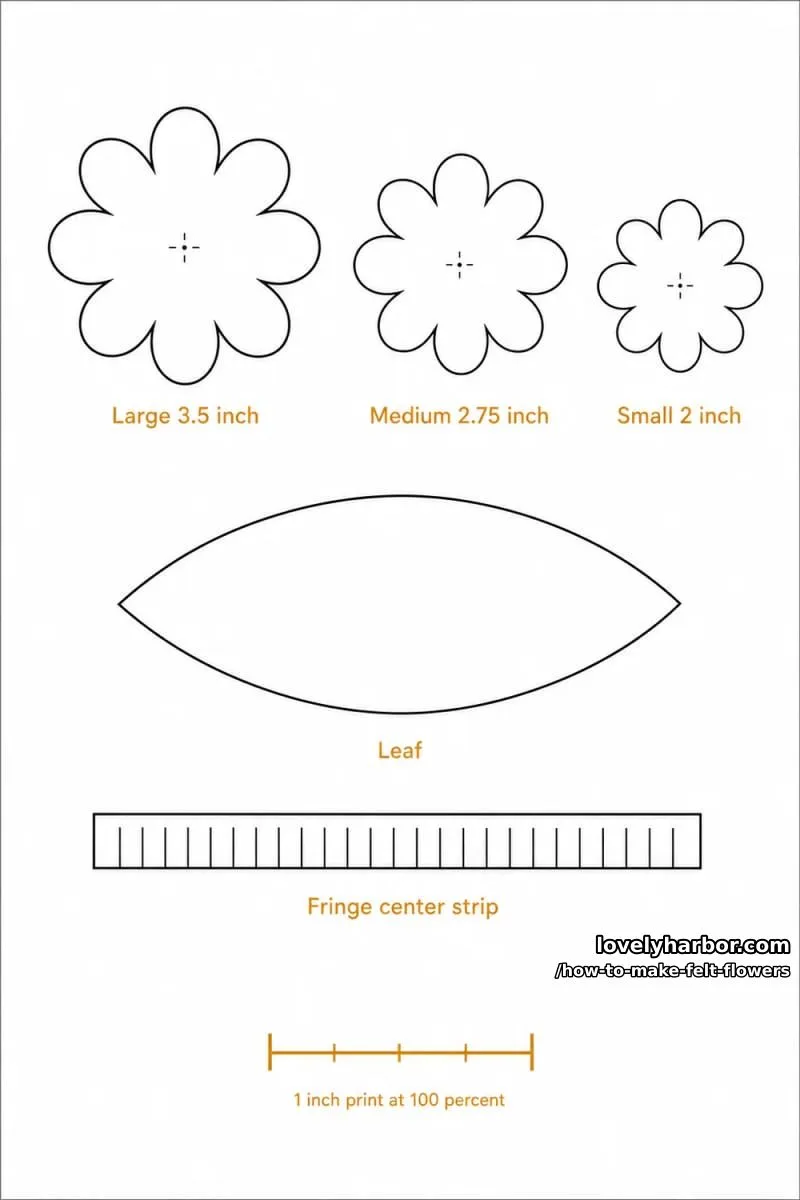
Large, 3.5 in: the bottom layer of every flower, and the ring of outer petals you actually see.
Medium, 2.75 in: the middle layer, turned so its petals land in the gaps of the large one.
Small, 2 in: the top layer that frames the center.
Leaf, 3 in: cut two per flower. Fringe strip, 1 x 3 in: optional rolled center (see Step 3).
Step 1: Cut your petal layers
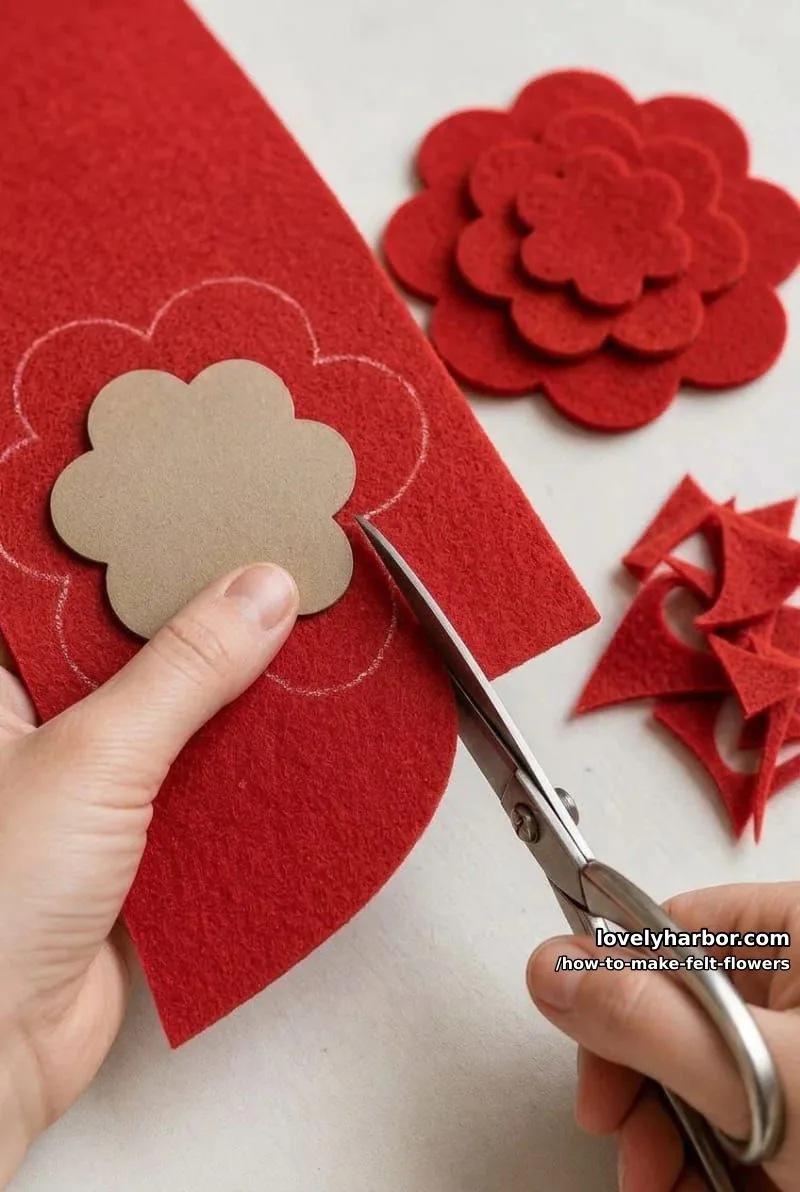
Three silhouettes per bloom, one in each size. Three reds reads classic; a magenta base under a teal top reads playful, like the garland up top. Trace on the back of the felt with a chalk pencil or fabric pen so any stray mark stays hidden.
- Trace all three sizes onto the back of the felt with the cardstock shapes.
- Stack and cut two at a time. Wool-blend is thin enough to handle two sheets at once, which halves your prep on a long garland.
- Go deeper on the notches for a daisy, shallower for a rounder zinnia.
- Save the offcuts, they become fringe centers and leaf veins later.
Step 2: Shape and stack the petals
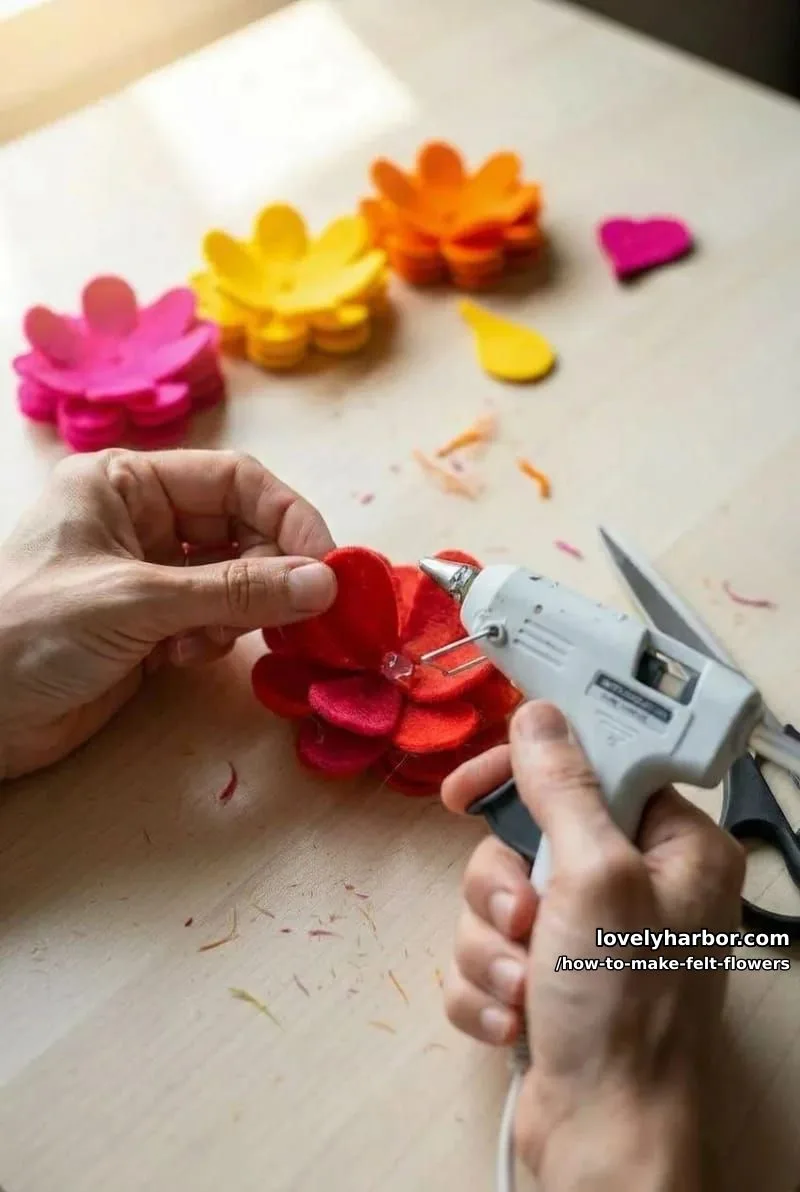
Stack largest to smallest, and turn each layer so its petals sit in the gaps of the one below. Skip the rotation and you’ve made a felt coaster. Then, before any glue, curve each petal: pinch it at the base and the wool-blend holds a soft cup, or drag it over the edge of your thumb to stretch it into shape.
- Cup each petal by pinching or stretching the base so it tips up instead of lying flat.
- Rotate every layer. The medium one sits about half a petal’s width off the large; the small one offsets the medium.
- Glue only the center, a dime-sized dot in the dead middle, nothing out toward the tips.
- Press and hold for three seconds while the glue grabs.
Don’t run glue out to the petal edges or smear it across the whole back. Glue the petals down and the cup dies; you’re left with a stiff disc. Center only, petals loose, and the flower keeps its dimension. Already flattened one? Peel the layers apart while the glue is still warm and re-set them with a smaller dot.
Note: if you prefer, it is also possible to just stitch the petals layers together at the center instead of gluing them.
Step 3: Add a center that hides the glue
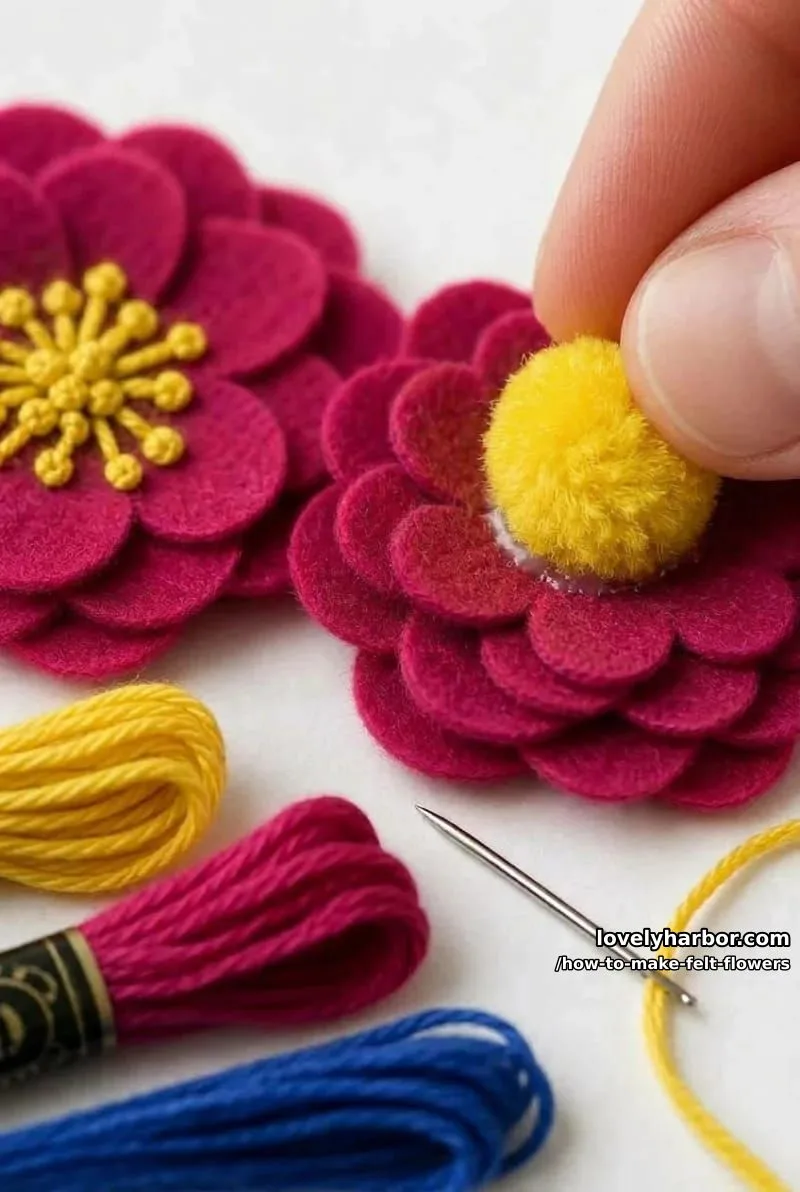
Now cover that glue dot. A pom-pom, a knot of French stitches, stacked buttons , pick whatever fits the look. The center is doing two jobs at once: it’s the focal point, and it hides the mess underneath. Pom-poms are fastest and the most kid-proof. The stitched French-knot cluster is what gives the red and magenta flowers in the photo their radiating, dotted middle, and it’s my favorite of the bunch.
| Center style | How it looks | How to attach | Good for |
|---|---|---|---|
| Pom-pom | Domed, fuzzy, bold color pop | One dot of hot glue in the dip | Speed and kids’ hands |
| French knots | Raised ring of stitched dots | 8 to 15 knots in 6-strand floss | The radiating look in the photo |
| Stacked buttons | Flat, tailored, less fuzzy | Glue a large then a small button | A calmer, grown-up center |
| Fringe burst | Tufted, rises above the petals | Snip a 1 in strip into fringe, roll, glue | Flowers that need height |
For the French-knot version, thread all six strands, wrap the needle two or three times per knot, and pack the knots tight so they read as one dense middle. A child too young for a needle can press pom-poms instead, which makes this the natural fine-motor step for smaller hands.
A 40-color square pack hands you the full rainbow plus the greens in one box, instead of paying craft-store markup on single sheets.
Step 4: Cut and attach the leaves
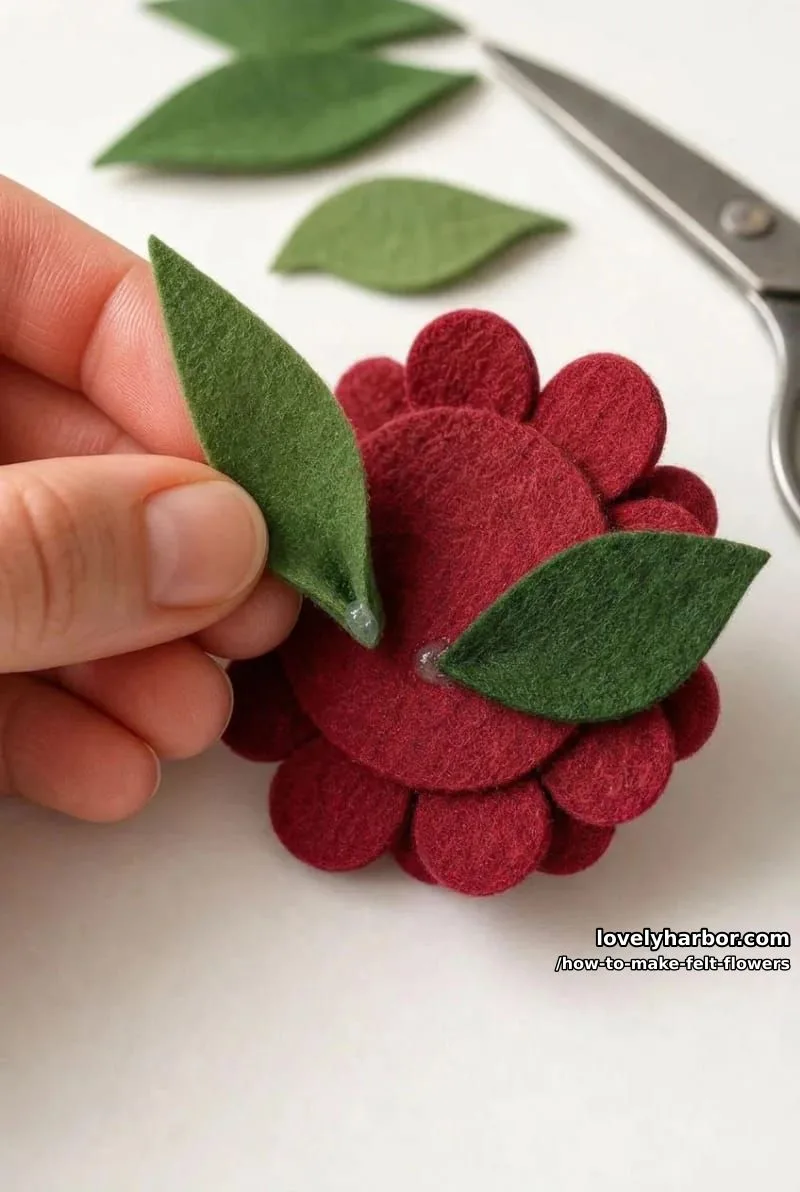
Cut pointed-oval leaves and pinch each base before gluing, so they angle off the cord instead of lying flat against it. Two per flower is plenty. They shouldn’t match , varying the size and using two greens keeps the garland from looking stamped out. Want veins? Glue a thin sliver of darker green down the middle.
- Cut two leaves per flower from the leaf template, in mixed greens.
- Pinch the base into a small fold, and a dot of glue at the pinch locks the angle.
- Glue them to the back of each flower, angled outward so they peek past the petals.
Step 5: String the garland on jute
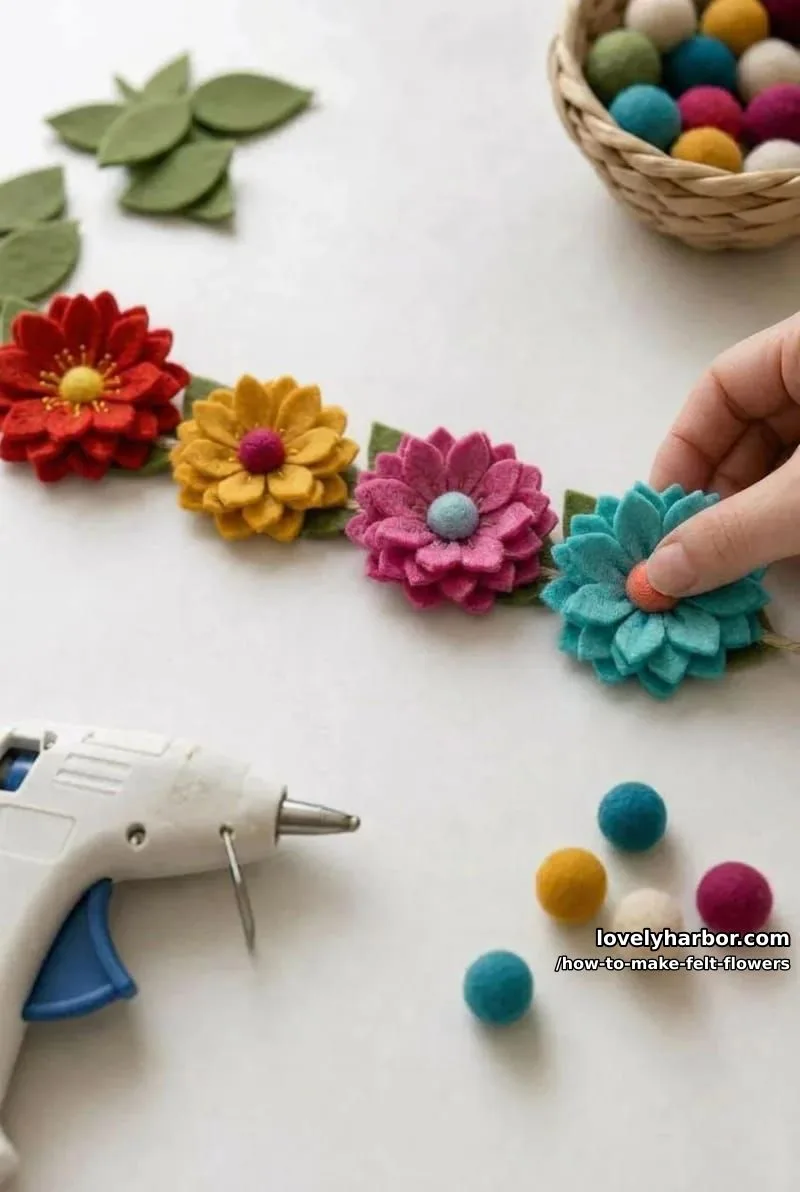
Lay the jute flat on the table, then glue each flower down by sandwiching the cord between the flower’s back and its two leaves. Working flat beats wrestling with anything that’s hanging. Space the blooms 2 to 3 inches apart; go wider and the finished garland looks sparse once it’s up on the mantel, which is the regret almost everyone has on the first try.
- Cut your cord to length plus 8 extra inches, with a loop knotted at each end for hanging.
- Glue two leaves under the cord at each flower position, the twine running across their pinched bases.
- Press a flower on top to sandwich the cord, and hold until set.
- Keep it tight, 2 to 3 inches between flowers, with an extra leaf or a lone pom-pom filling any gap.
Keep it indoors. Felt drinks up humidity and the colors can run, so a covered porch is the absolute limit. A real outdoor party is not the place for this garland.
A 40-color square pack hands you the full rainbow plus the greens in one box, instead of paying craft-store markup on single sheets.
Mistakes that flatten a felt flower garland
Felt flowers fail in a handful of predictable ways. Every one is easy to dodge once you’ve seen it.
- Gluing the whole petal down. Center-only keeps the cup. Glue the back and you get a disc.
- Stacking same-size layers. No descending sizes, no rotation, no depth.
- Printing the template at the wrong scale.“Fit to page” shrinks it, so check the one-inch bar every time.
- Spacing flowers too far apart. Looks fine on the table, sparse on the wall. Tighten to 2 to 3 inches.
- Reaching for stiff acrylic felt, which won’t cup no matter how hard you pinch the petals.
- Skimping on leaves. Bare cord between blooms reads as a gap; tuck a leaf into every space.
Conclusion
Batch it. Once you’re past the first flower or two, everything moves faster if you cut all the petal layers in one sitting, glue the flowers in the next, and string the garland last, instead of swapping between scissors, glue gun, and needle every thirty seconds. The template shapes earn a spot in an envelope too: the same three sizes give you a fall garland in rust and gold, or one oversized bloom for a hair clip. And the flat flower, the one that defeats you despite all this? Pull off the center, re-cup the petals, re-glue just the middle. Nine times out of ten that is all it needs. The French-knot centers are the one part I’d talk you out of if you’re in a hurry , gorgeous, but they take longer than the rest of the flower put together.