
The Herrnhut star hanging in half the windows of Saxony began as a geometry exercise: paper, glue, 26 points, folded by schoolboys in Niesky in the 1830s to teach them about polyhedra. Nearly two centuries later it still outperforms most of what gets sold as modern holiday decor, because it is one clear object doing one job. That is the method behind the nine ideas below, worked through the whole house, room by room.
Minimalist Christmas decor fails in a specific way, and it is not clutter. It is the house that reads unfinished: a bare tree, three white candles, and a lot of cold air where the color used to be. Restraint only works when something else carries the warmth, and in practice that something is texture and light, not more objects.
So the order of operations runs light, then palette, then objects. The rooms below start with the ones people photograph and end with the ones nobody bothers to decorate, and the final two sections are what make the rest hang together. Nothing here needs a drill.

Start with the room everyone photographs
1. Decorate the Christmas tree in one material, not one color scheme

Pick one ornament material and repeat it in three sizes. Clear glass, unglazed ceramic, folded paper, or plain turned wood: one of those, not a tasteful blend of all four. The tree stops looking like a collection and starts looking like a decision.
The neutral tree that fails is rarely overdecorated. It is over-materialed. Cream felt next to matte ceramic next to brushed metal next to a wooden bead garland gives you four textures fighting at low contrast, which is a duller problem than a red-and-gold tree but a problem all the same. Hang roughly a third of what you normally would, keep the bottom eighteen inches bare so the trunk and the stand read as part of the design, and let the branch structure show through instead of packing it.
That said, the fully undressed tree is having a moment and it does not work in every room; a bare fir in a small apartment reads as a plant you forgot to finish. It needs a tall ceiling and enough floor around it to look deliberate. And the flocked white trees stacked by the door at every big-box store are the wrong answer in any ceiling height, since under warm light the synthetic snow goes grey and the whole thing takes on the texture of a car wash brush.
2. Lay the Christmas mantel out as a single horizontal line
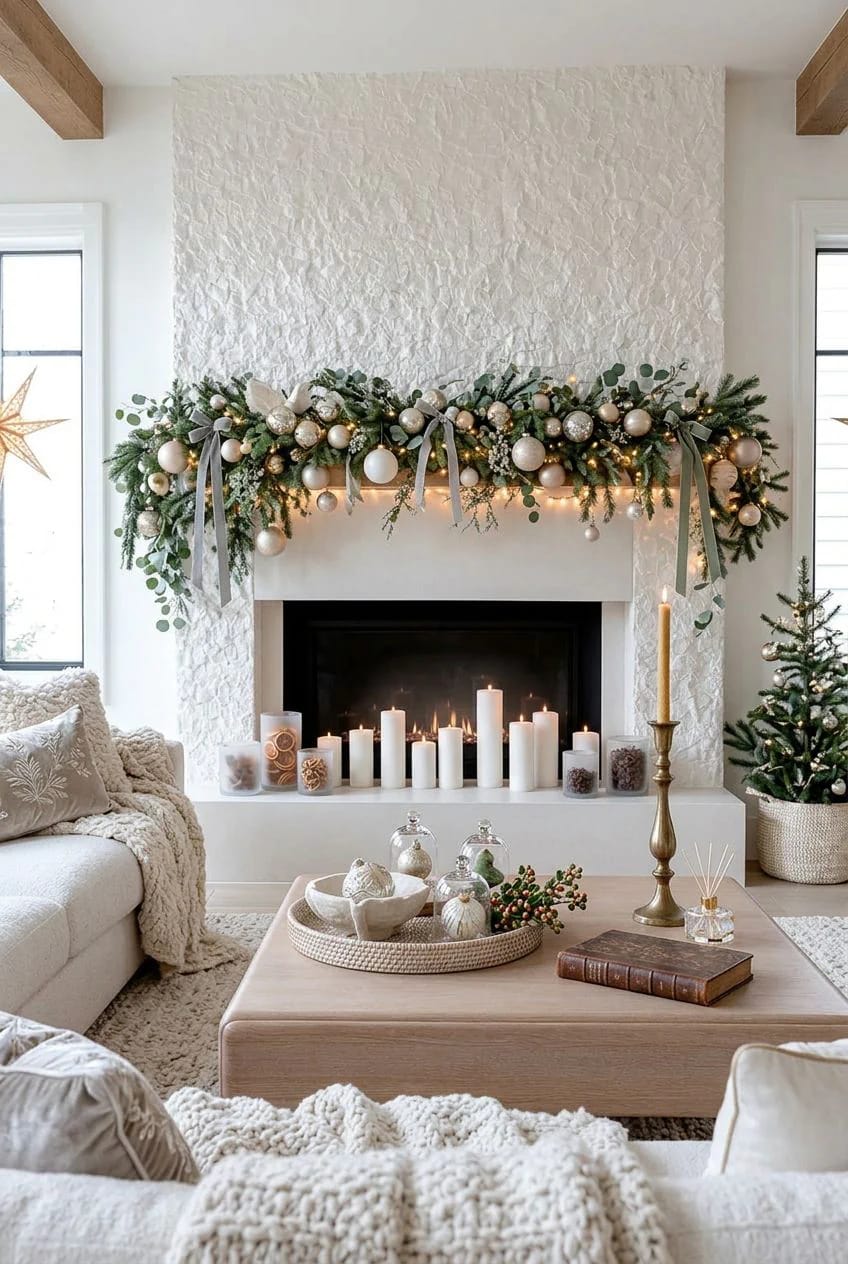
Treat the shelf as one long horizontal, break it once, and stop. A flat run of cedar or noble fir laid directly on the wood, a cluster of white pillar candles at three heights sitting about a third of the way along, and a single vertical (a leaning frame, a mirror, one tall branch) to interrupt the line. Everything else you were going to put up there is competing with the interruption.
Fresh greenery is the part people underestimate. A six-foot fresh garland runs roughly $20 to $50 depending on the species and where you are, and directly above a working fireplace it will be dropping needles inside two weeks, since the dry heat is doing to it exactly what it does to a tree. Faux is defensible here, more than anywhere else in the house, provided the needles are matte rather than plastic-shiny.
Granted, none of this fixes the deeper issue, which is that most mantels sag under their own decoration by mid-December. The fixes are mostly about quantity and physics, and what a mantel actually needs to hold its shape for a full season is worth reading before you commit to a look.
3. Build a wall-mounted Christmas tree when the floor is spoken for
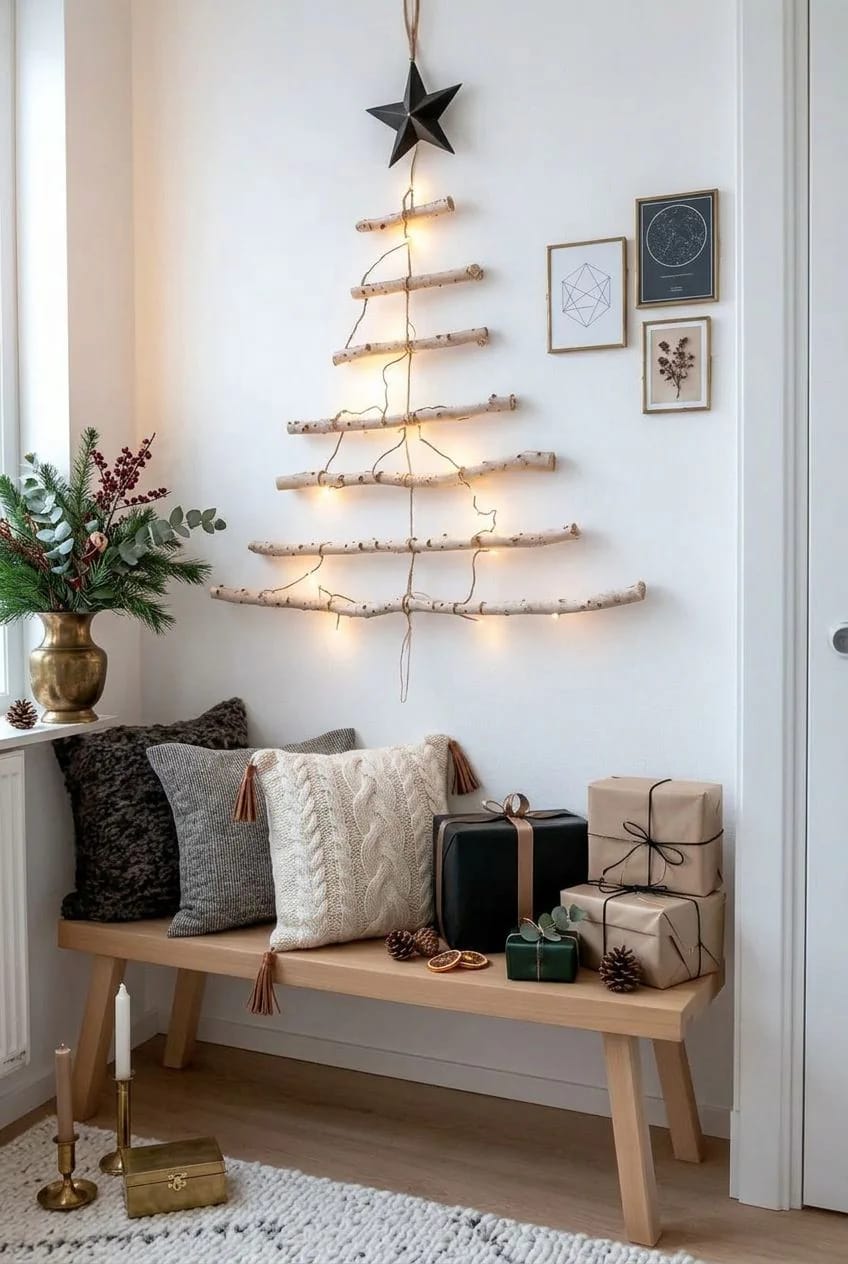
A wall tree is the only version of this idea that survives a real apartment, because it takes no floor and stores flat. Nine dowels or straight birch branches cut in decreasing lengths, hung from two lines of twine, one string of warm-white fairy lights threaded down the middle. Budget somewhere around $20 to $40 if you buy the dowels; free if you have a park and a saw.
Renters should hang it on adhesive picture strips rather than nails, and should read the weight rating on the pack rather than trusting it, because those ratings are per set and people routinely halve them by mounting on textured paint. Keep the whole assembly light: dry wood, a light string, one paper star, nothing ceramic.
 Apartment Christmas Decor for Small Spaces: 11 Renter-Friendly Ideas That Won’t Cost You Your Deposit Eleven ideas built around no spare floor, no January storage, and a lease that bans nail holes.
The rooms that usually get nothing
4. Hang paper stars in the stairwell, not on the tree

The stairwell is the largest unused volume in most houses, and one hung object owns it. Three stars at staggered heights, lit from inside, will do more for the way the house feels at seven in the evening than anything you hang on the tree. A hallway with a doormat and a coat hook is easier to decorate than the living room precisely because it is empty, and it is the first thing anyone sees.
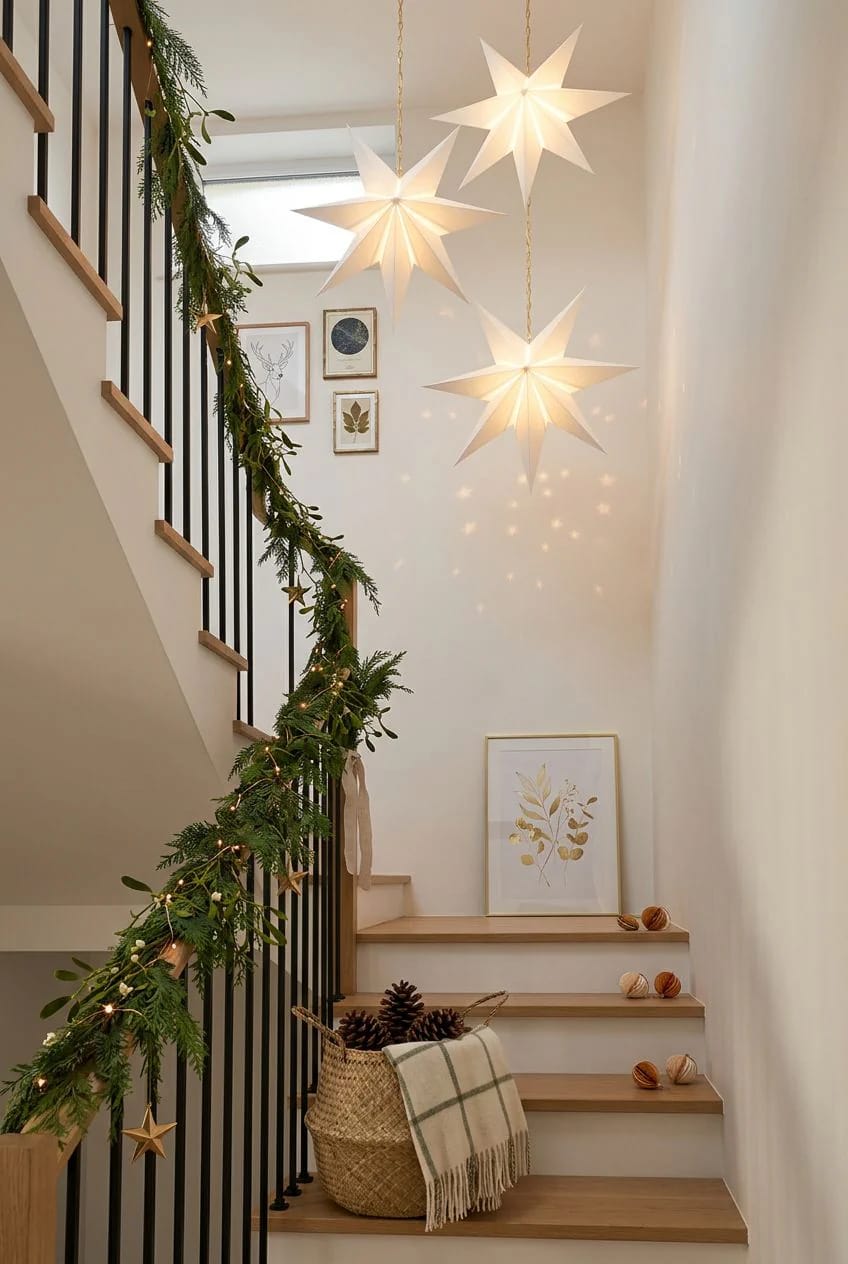
Buy the real thing if you can. The Herrnhut star has been made in Saxony since the 1830s, is traditionally hung on the first Sunday of Advent and left up until Epiphany on January 6, and the paper version is the one worth having; the plastic outdoor versions are engineered for weather, not for the way light passes through folded paper.
One caution about scale. A single 40cm star in a two-storey void disappears. If the drop is tall, go up in size rather than up in number, because three small stars in a big space read as clutter and one large one reads as architecture.
5. Give the kitchen one Christmas surface and clear everything else
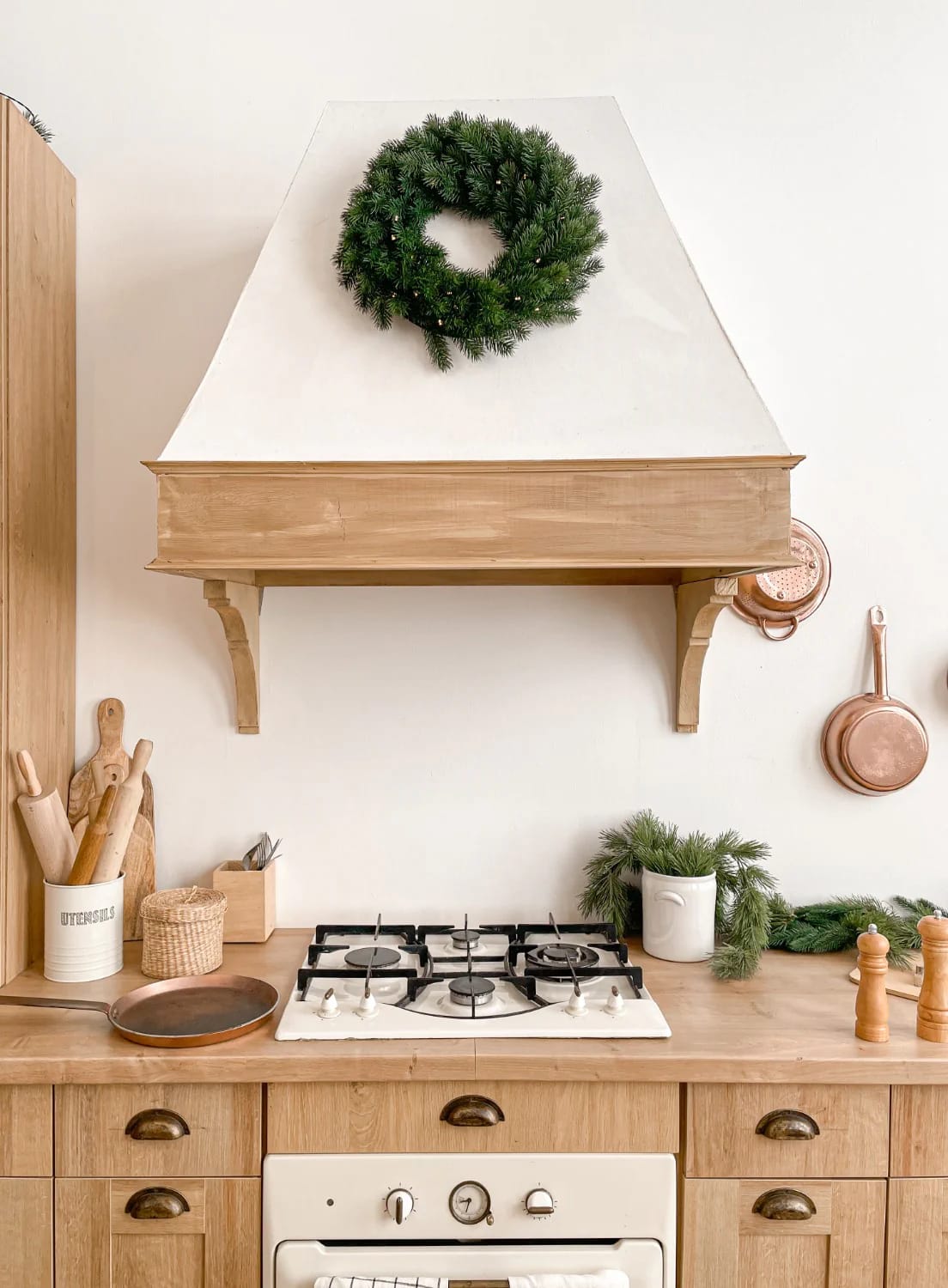
Choose one counter, put three things on it, and leave every other surface completely bare. A long wooden board, a shallow bowl of clementines, one beeswax taper in a heavy holder. The bareness of the rest of the kitchen is what makes those three objects read as decor rather than as things you have not put away, and if you do want a second surface, the island is the one to give it to.
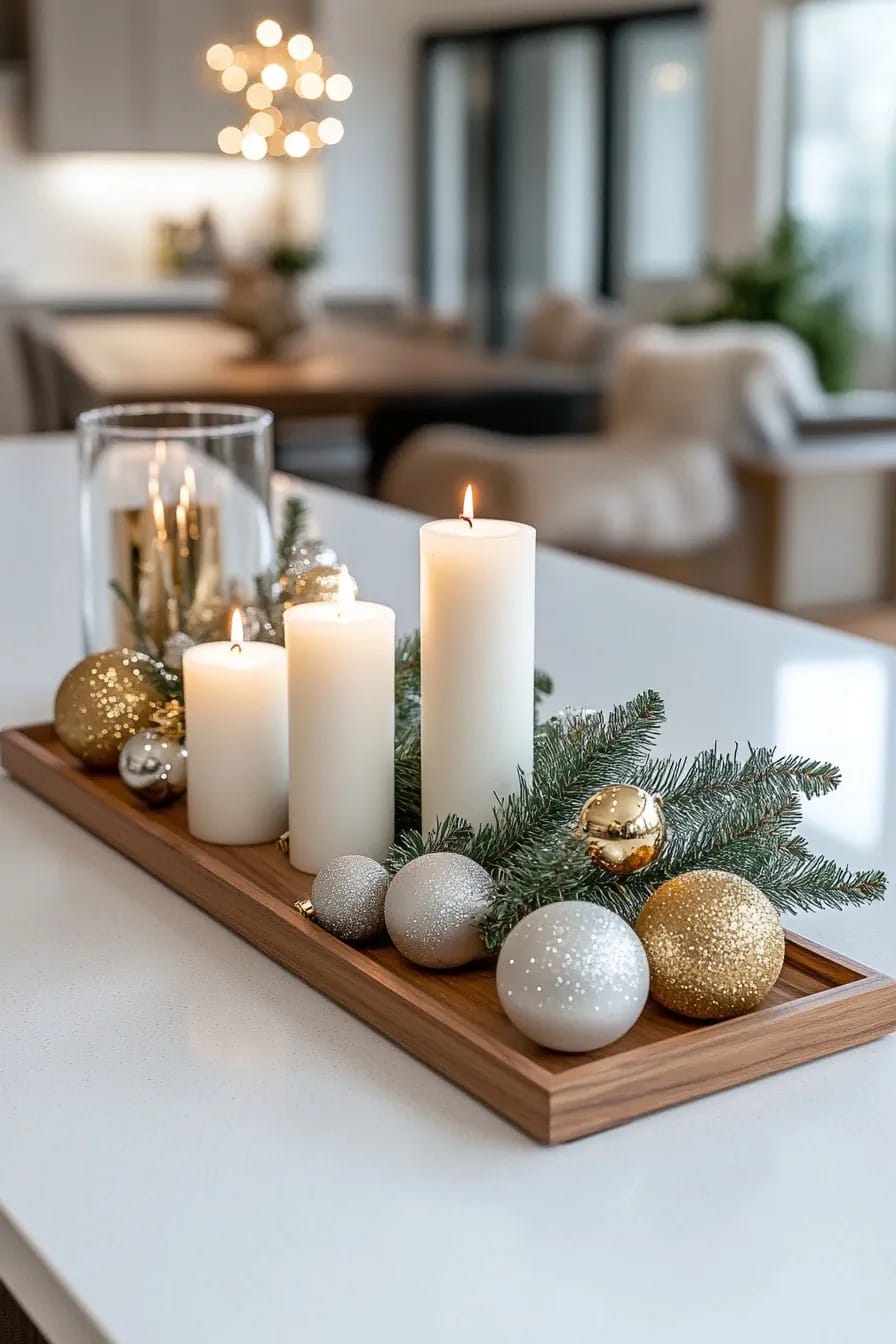
6. Set the Christmas table with linen and candles, and skip the runner
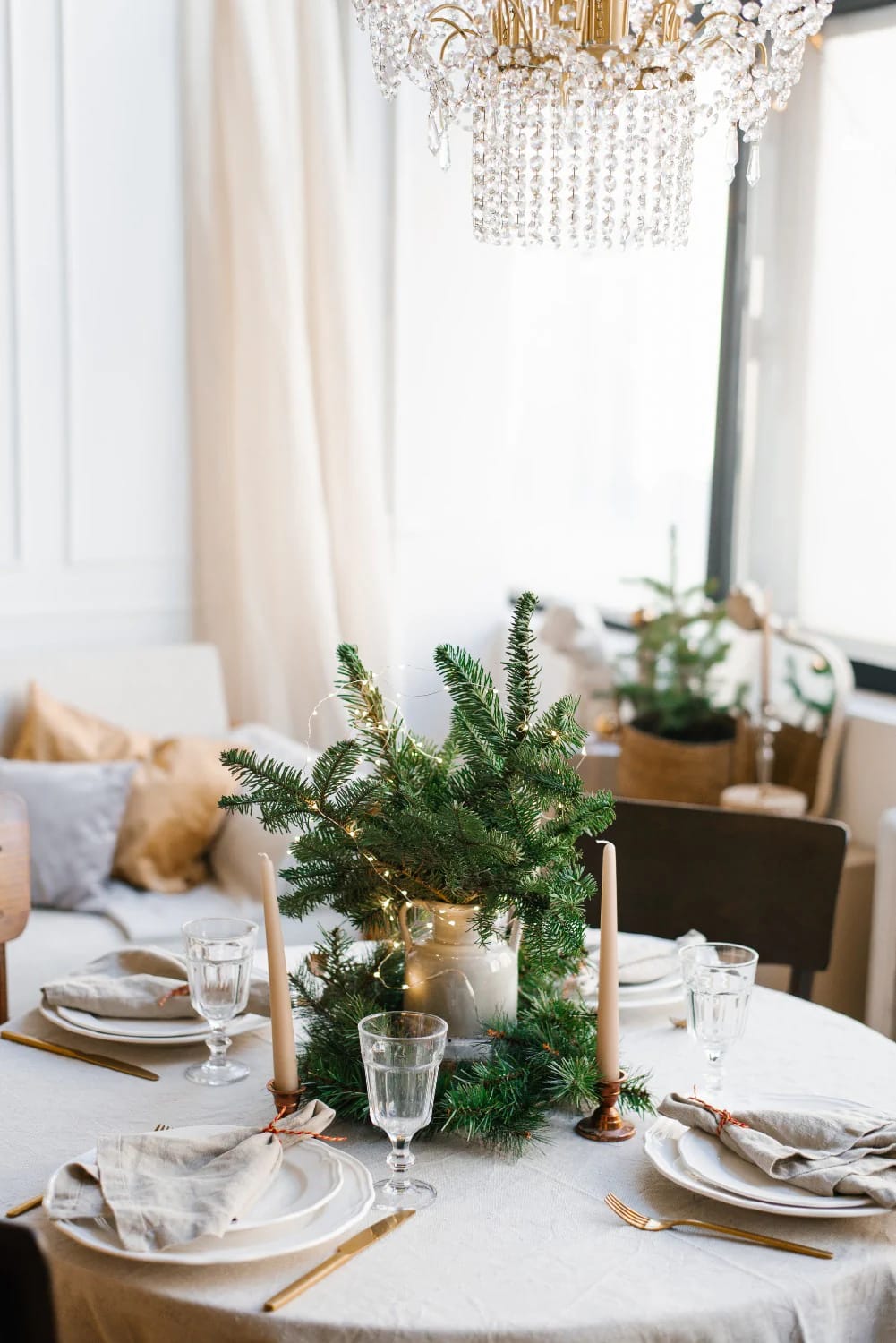
Either bare wood or a full washed-linen cloth, and no runner. A runner chops the table into a stripe with two beige margins, which is the opposite of what a long table wants, and it exists mainly because it is easy to sell. Then five or six unscented tapers down the centre in plain holders, uneven heights, and nothing between them.
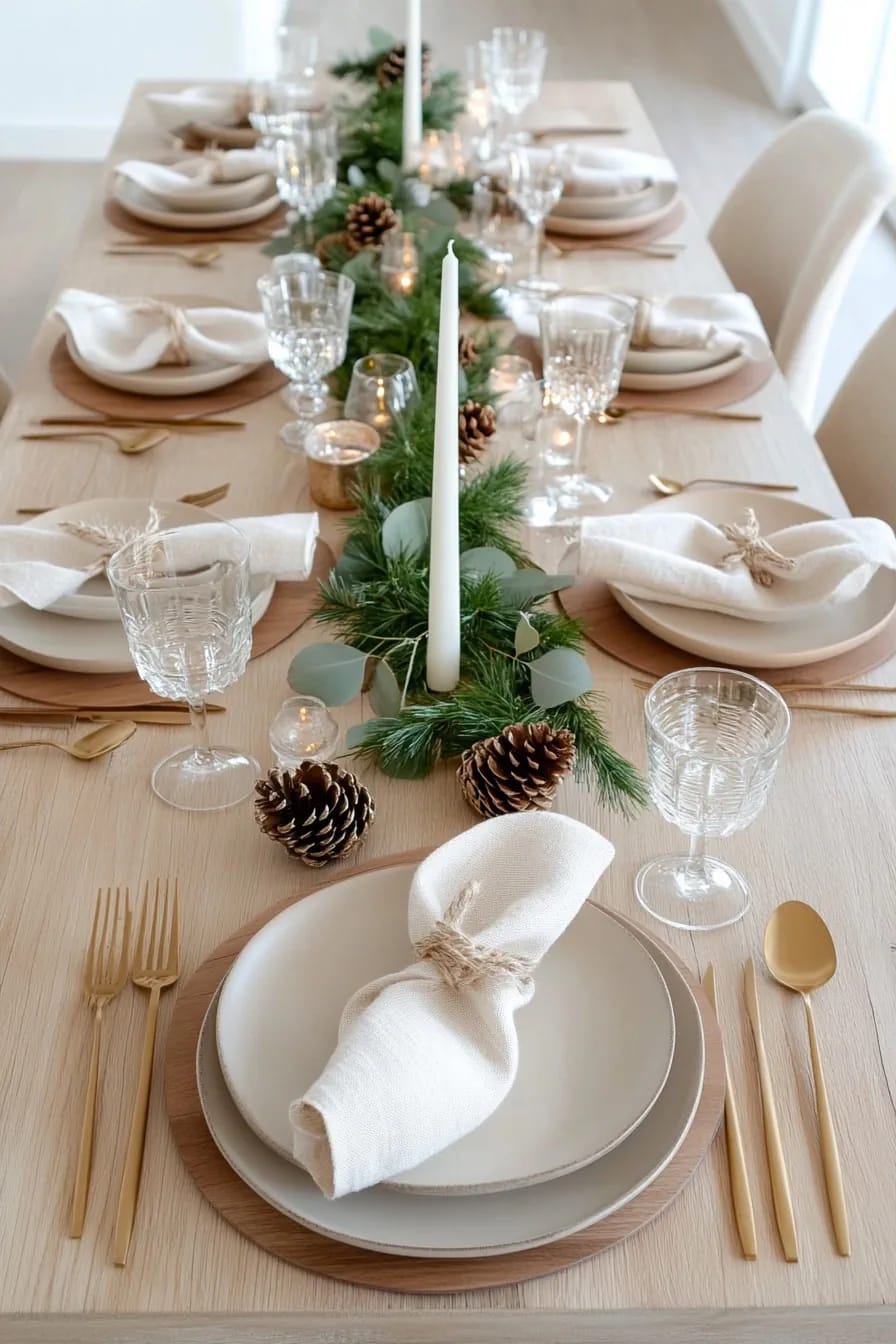
Unlacquered brass is worth the money here, because it dulls unevenly and looks better in year three than in year one, whereas a lacquered candlestick stays exactly as shiny as the day it arrived and reads as a prop. The rest of the table can stay empty, which is closer to how a simple, elegant Christmas table actually comes together than any tablescape tutorial admits.
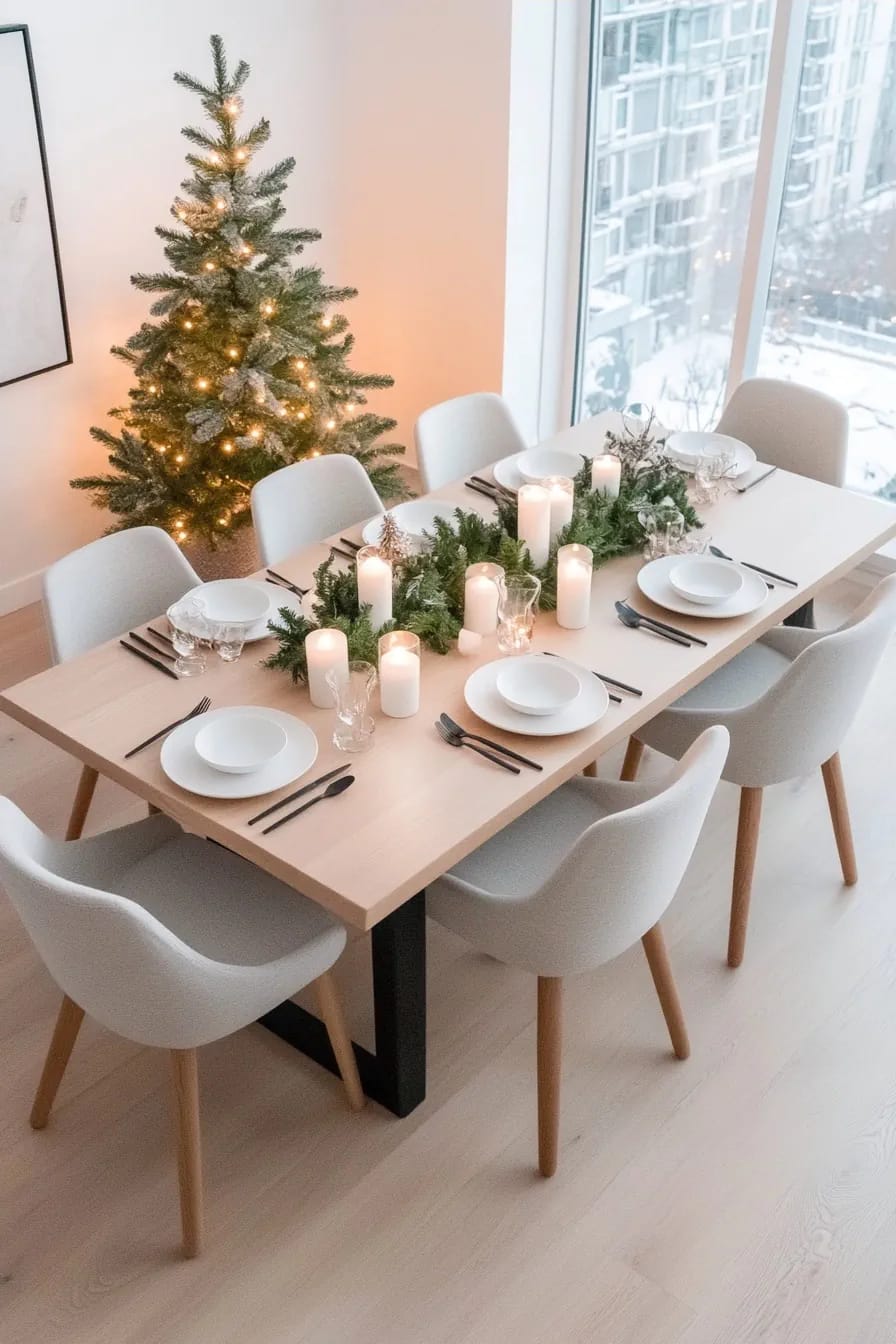
Roughly three out of every five home candle fires start because something combustible was sitting too close to the flame, and December is the peak month for them. On a minimalist table that hazard is easy to design out: keep tapers at least a foot clear of dried greenery, ribbon, and paper stars, and put nothing at all directly behind a lit candle. The NFPA’s candle safety guidance is short and worth the two minutes.
7. Leave the bedroom and bathroom almost undecorated
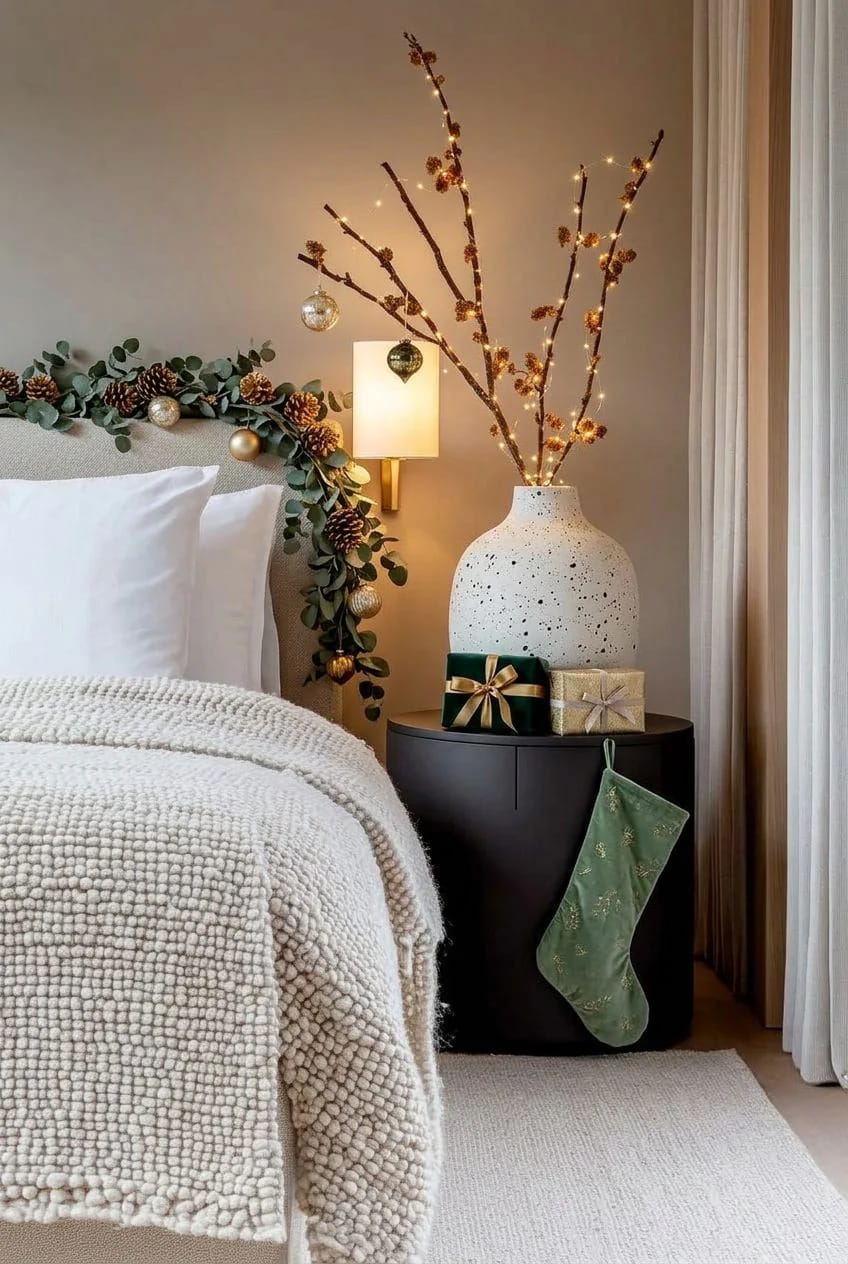
Decorate these two rooms with one object each and stop there. A bare branch in a stoneware vase on the nightstand; a stack of folded linen and a good bar of soap in the bathroom. Guests will notice both precisely because everywhere else in the house has been thinking hard.
Every room gets exactly one decorated element and no second one. The tree in the living room, the line on the mantel, the counter in the kitchen, the stars in the stairwell, the branch in the bedroom. When a room has two competing gestures, the eye reads clutter no matter how neutral the palette is.
The two layers that make the whole house read as one
8. Run one color temperature through every Christmas light in the house
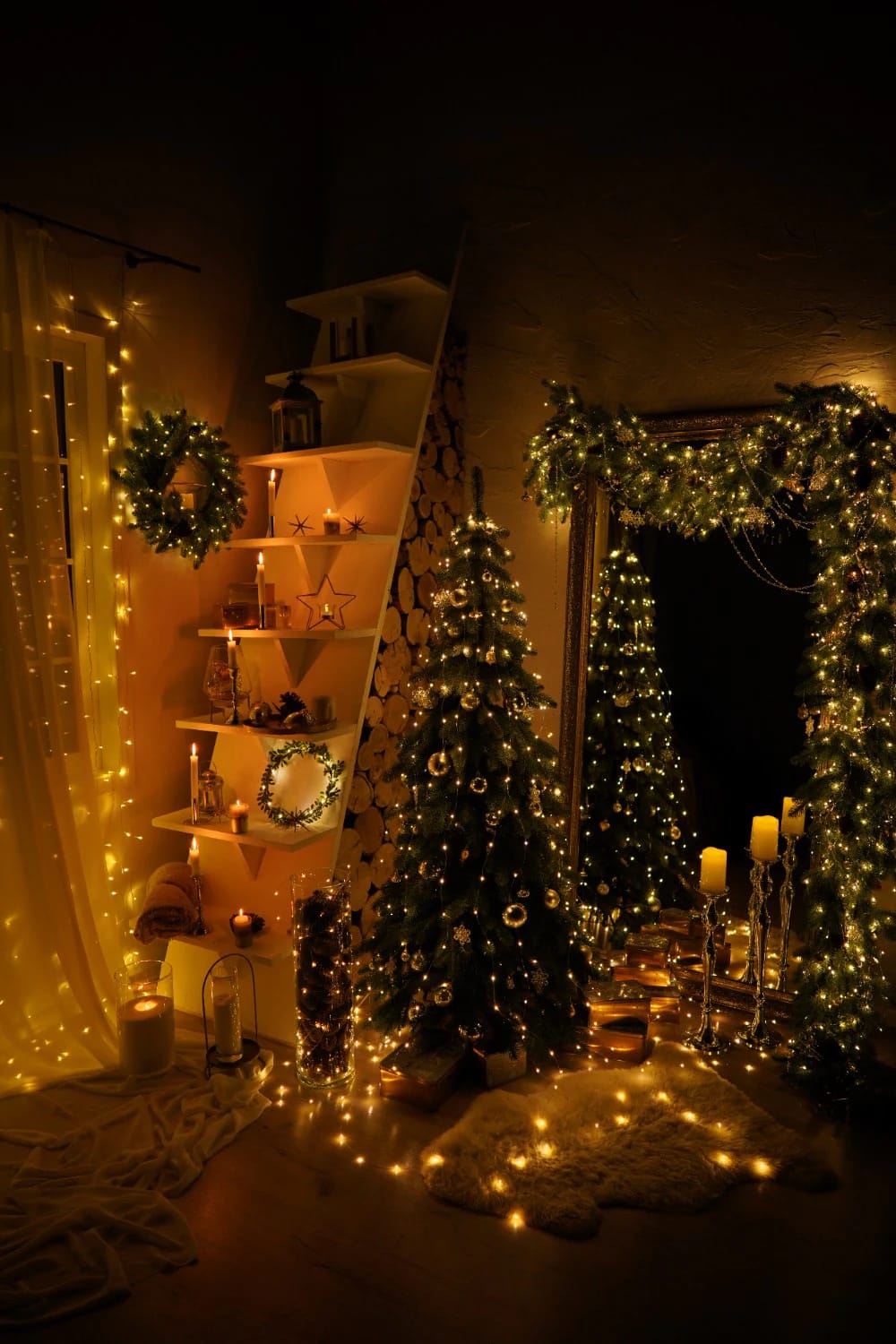
Pick 2700K, buy nothing else, and the whole house locks together. This is the single decision that separates a minimalist Christmas that looks designed from one that looks cheap, and it costs nothing, because the mismatch is what you notice: a 2700K lamp beside a 4000K string light makes the string read blue and slightly clinical, and once you have seen it in a room you cannot unsee it. Warm white is a marketing phrase, not a spec. The number on the box is the spec.
| Color temperature | What it looks like | Where it belongs at Christmas |
|---|---|---|
| 2200K | Amber, close to a candle flame | Tree strings, mantel garland, anything meant to read as firelight |
| 2700K | The old incandescent glow most people mean by “warm white” | The house default: lamps, sconces, most string lights |
| 3000K | Crisper, noticeably whiter side by side with 2700K | Kitchen task light only, and only where it already exists |
| 4000K and up | Blue-white, no yellow left in it | Nothing. This is the light that turns greenery grey |
Then turn the ceiling fixture off for the season and light the room at knee, hip, and eye height instead: a table lamp, a floor lamp, the tree string, and a candle. Windows are the exception worth planning, since one electric candle per sill, all identical bulbs, means the window works from the street and from the sofa at the same time. Mixed-temperature sills are the fastest way to undo everything above.
 11 Cozy Neutral Christmas Living Room Decor Ideas That Stay Warm Without the Red and Green What has to carry the warmth in a living room once you take the color out of it.
9. Anchor the palette in black, white, and one warm wood

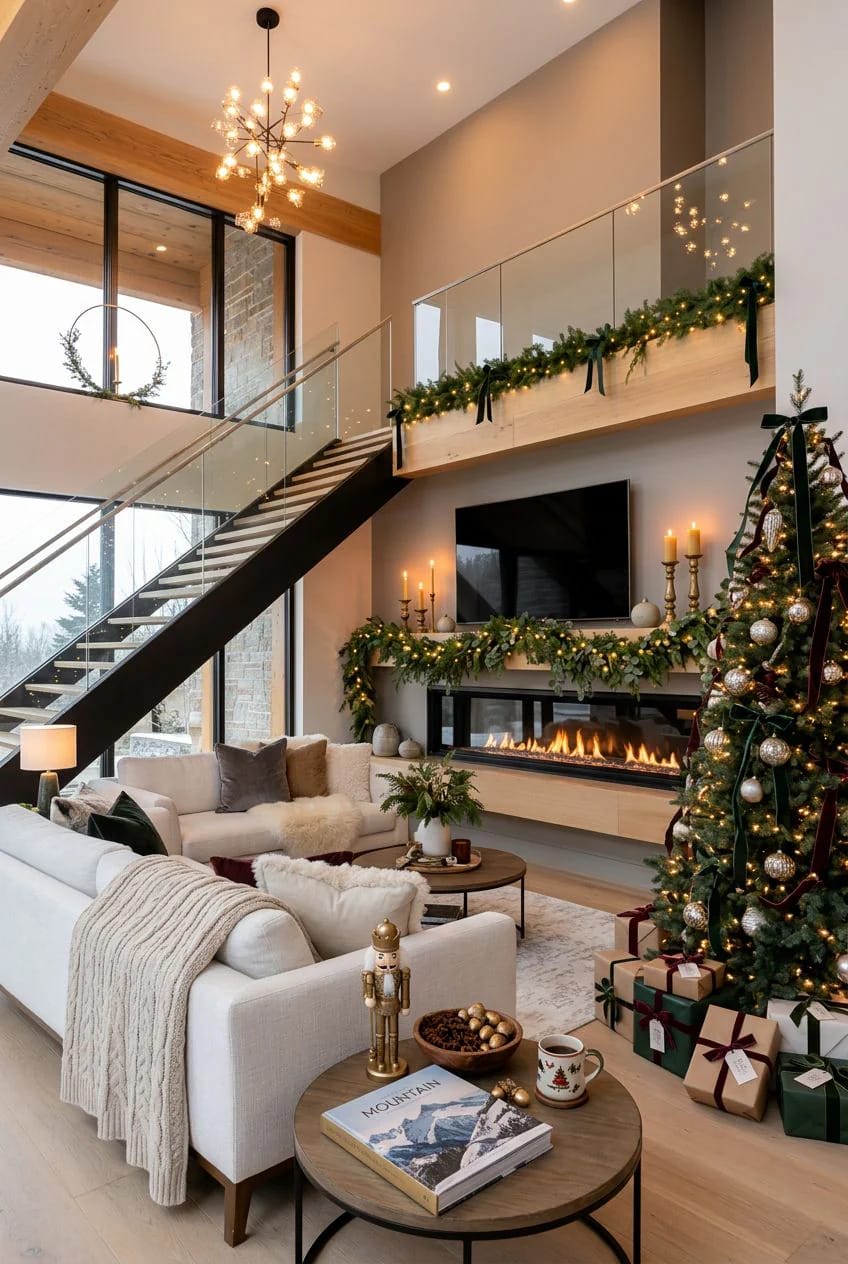
Three notes, no more: black, white, and one wood you repeat in at least two rooms. Wood is doing a specific job in that trio, replacing the warmth the red used to supply, which is why the scheme collapses into a dentist's waiting room the moment you swap oak for chrome. Pick a species and stay with it: oak, ash, or beech, with visible open grain rather than a dark stain.

Do this
- Buy the black in matte. A gloss bauble catches every bulb in the room and turns into a small white dot.
- Keep the whites in one family. Warm paper white sitting next to optic-white ceramic just looks like a mistake nobody got round to fixing.
- Repeat the wood. Two rooms minimum, ideally three, or it reads as an accident rather than a scheme.
- Let texture carry the interest: bouclé, felted wool, unglazed clay, waxed linen.
Avoid
- Brushed gold, which photographs beautifully and dates the room the moment you are actually standing in it.
- A pop of red.
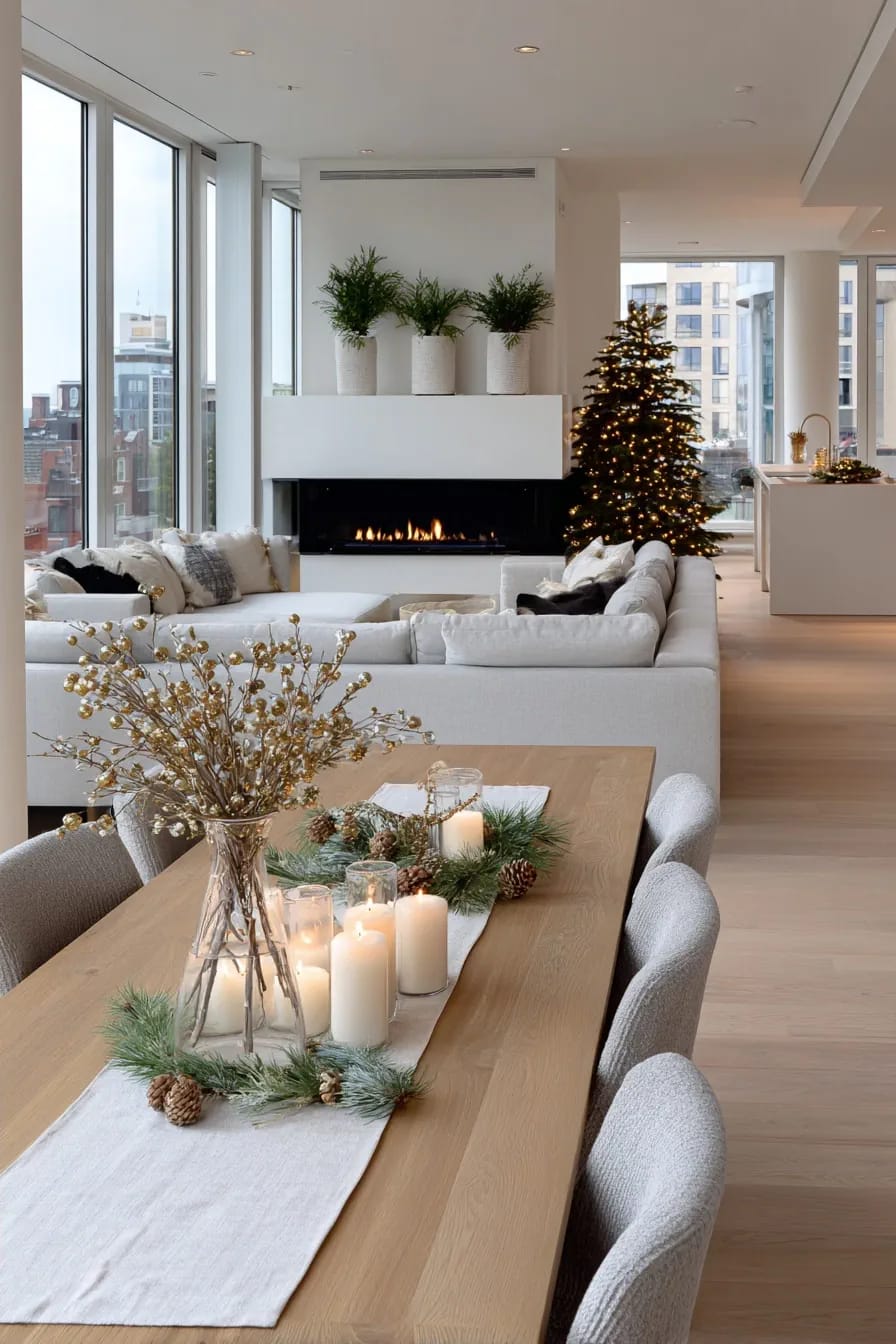
Every argument for a neutral Christmas palette you can reuse for a decade holds, with one condition: neutral cannot mean colorless. A room of cream, ivory, and bone with no black in it has no structure, and the eye slides off it. The black is not there to be seen. It is there so the whites have an edge to sit against, and two or three matte black objects across a whole floor is usually the entire dose.
Related Posts
- 23 Minimalist Christmas Decor Ideas Perfect for a Modern Home
- Minimalist Outdoor Christmas Decorations for a Modern Home
- 20 Minimalist Christmas Decor Ideas You’ll Love in 2024
- 21 Budget Christmas Decor Ideas to Elevate Your Holiday Home
- 29 Modern Christmas Decor Ideas for a Chic Holiday Home
- 29 Stunning Christmas Home Decor Ideas for a Cozy Holiday Glow