
The standard advice for a Japanese kitchen is to strip it bare, paint everything off-white, and call the emptiness "zen." That gets you a showroom, not a kitchen anyone cooks in. A real Japanese kitchen is a working room, often small, and its calm comes from where the clutter is hidden and what the surfaces are made of, not from having nothing in sight. Worth knowing before you start: most of what gets pinned under "Japanese kitchen" is actually Japandi, and Japandi leans heavily Scandinavian. The seven ideas below sort the genuinely Japanese moves from the ones that just photograph well, starting with that Japandi problem.
1. Borrow the Japandi Palette, Then Undo Its Scandinavian Default
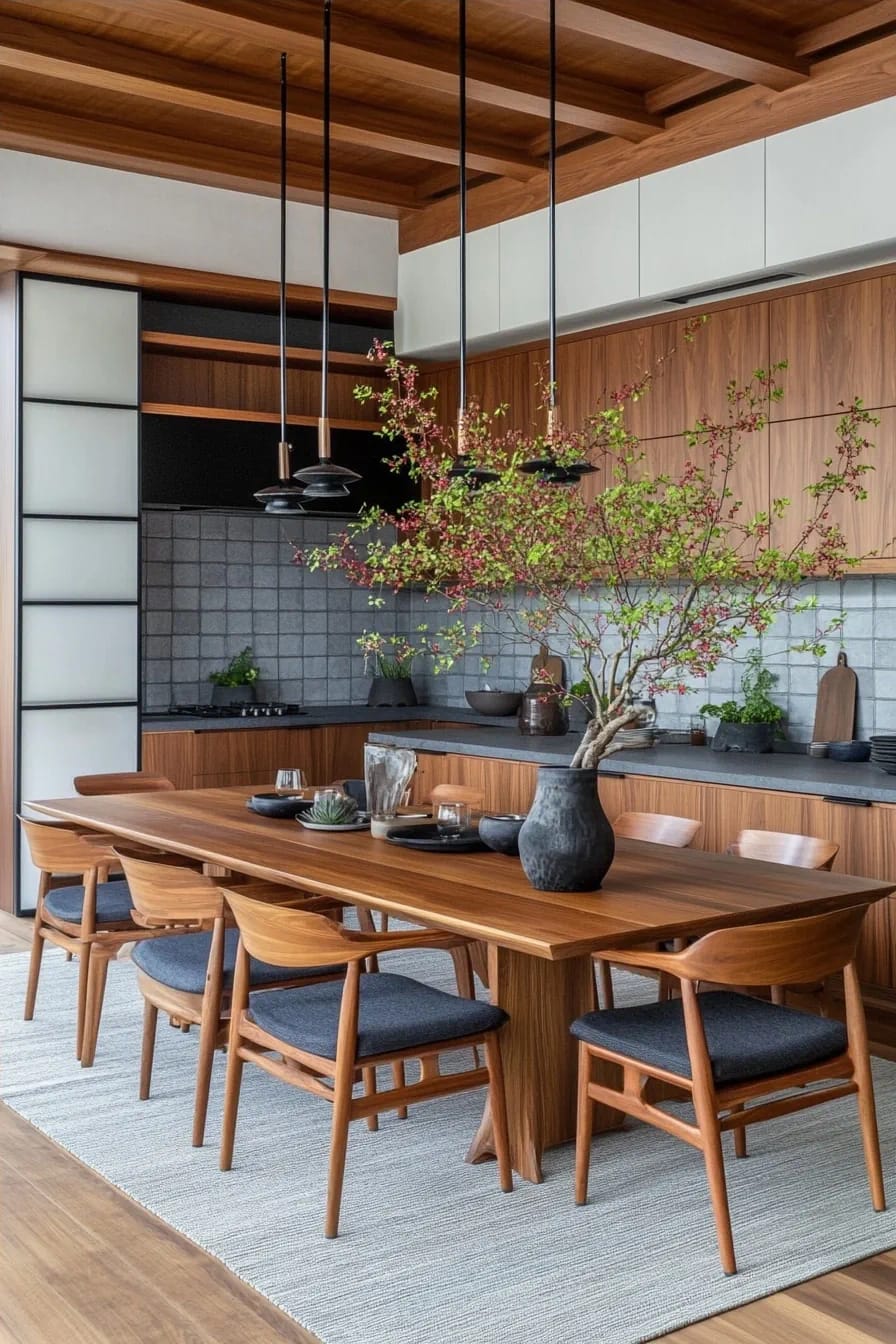
Japandi is the fastest way into this look, and there is nothing wrong with using it as a base: light oak, off-white plaster, a few black lines, a stone counter. The trouble is that the version circulating on Pinterest is about eighty percent Scandinavian. Add oak cabinets and cream walls and you have a Copenhagen kitchen, not a Japanese one. The Japanese half is the part people skip because it does not show up in a swatch.

Where the Japanese part actually lives
It lives in three things a color palette can’t carry: low horizontal lines instead of tall stacked cabinetry, a real connection to the outside (a window, a courtyard, a single plant that is clearly alive), and negative space that is deliberate rather than accidental. Keep the cabinet runs long, low, and unbroken. Let one wall stay almost empty on purpose. If you want to see the same restraint applied a room over, the oak-and-off-white palette worked into a Japandi living room reads the same way, and the kitchen benefits from matching it.
The travertine-island problem
Here is the contrarian bit. The most-saved "Japandi kitchen" pins right now are a double-tiered travertine island, cream shaker cabinets, and black pendants, sold as "quiet luxury." That look is closer to a Restoration Hardware catalog than to anything in Kyoto. It is a fine kitchen. It is not a Japanese one, and if the Japanese reference is what you are after, the giant statement island is working against you. Restraint does not scale up into a hotel lobby.
2. Steal the Logic of a Traditional Japanese Kitchen, Not Just the Look
The traditional Japanese kitchen, the daidokoro, solves one problem better than almost any Western layout: it makes a small, hardworking room read as calm. It does this through logic, not decoration, and the logic transfers even if you never buy a single “Japanese” object.
Storage that swallows everything

Old Japanese kitchens leaned on the mizuya dansu, a freestanding kitchen cupboard that held nearly everything behind sliding doors and drawers. The modern translation is simple: put the storage in one tall closed cupboard or a shallow pantry, and keep the cooking wall clear of upper cabinets. A wall of uppers is what makes a small kitchen feel like a hardware aisle. A single closed cupboard does that same work while the room stays quiet, and there are quieter cabinet styles that suit the approach if your current doors are fighting it.
The counter is empty because the room is small
People read the cleared Japanese counter as a discipline they could never keep. It is easier than that: the counter stays clear because there is almost nothing to leave on it. Edit the appliance graveyard down to what you touch daily, give the rest a drawer, and the clean surface stops being a chore. That said, do not fake it by shoving everything into a photogenic basket the day before guests arrive; the point is fewer objects, not hidden ones.
3. Let Wood and Stone Carry a Japanese Kitchen (Skip the Accent Wall)
If there is one non-negotiable, it is materials. A Japanese kitchen is carried by two or three natural surfaces doing all the talking, which is why the accent-tile-wall instinct is exactly wrong here. You do not need a feature; you need better wood.
Choosing the wood
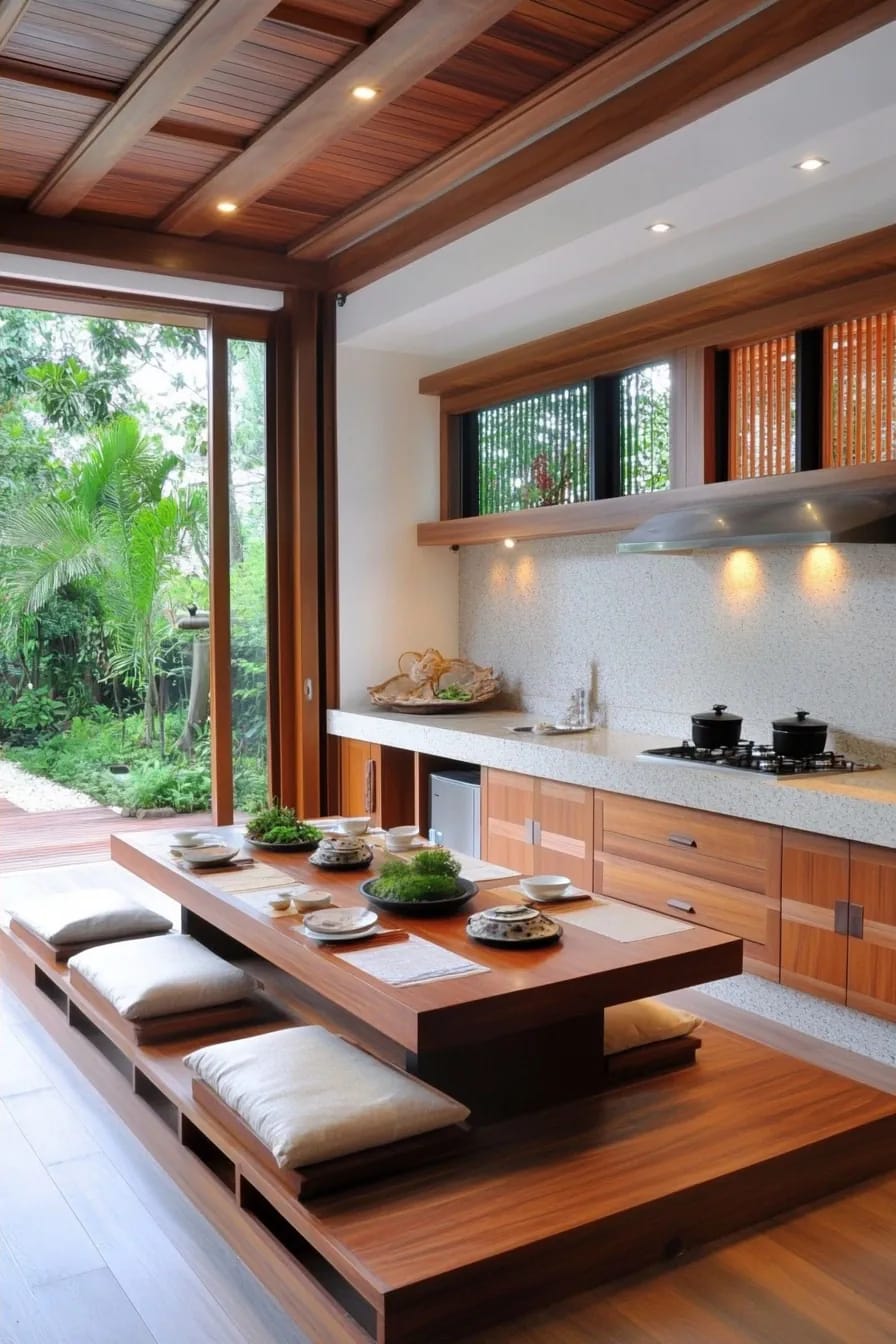
Rift-cut white oak or pale ash gives you the Japandi read: straight grain, no loud cathedral figuring, a tone that stays neutral instead of going gold. For something more specifically Japanese, hinoki (Japanese cypress) and sugi (cedar) run warmer and softer, and a hinoki cutting board is the cheapest way to get the actual material and its smell into the room. The one thing to avoid is a honey-orange stain, the kind of oak that photographs like a spray tan. It ages the whole kitchen a decade overnight, and no amount of black hardware rescues it.
One hard surface, finished with oil
Pick a single quiet counter and commit: pale limestone, honed travertine, microcement, or a simple wood butcher block, finished with oil rather than a high-gloss lacquer that reads plastic. Skip the heavily veined marble; the movement fights the calm you are building everywhere else. If cream cabinetry is the direction, the trick is putting the warm neutral on the cabinets and keeping the walls plainer, which is the opposite of what most people do.
4. Minimalism in a Japanese Kitchen Is Restraint, Not an Empty White Box
This is where the most kitchens go wrong. “Japanese minimalism” gets flattened into an all-white room with clear counters and nothing else, which is not kanso (considered simplicity) so much as a Bulthaup showroom that happens to be empty. Cold and empty is not the same as calm and edited. The good version keeps warmth in the room.
Hide the appliances, keep the toaster
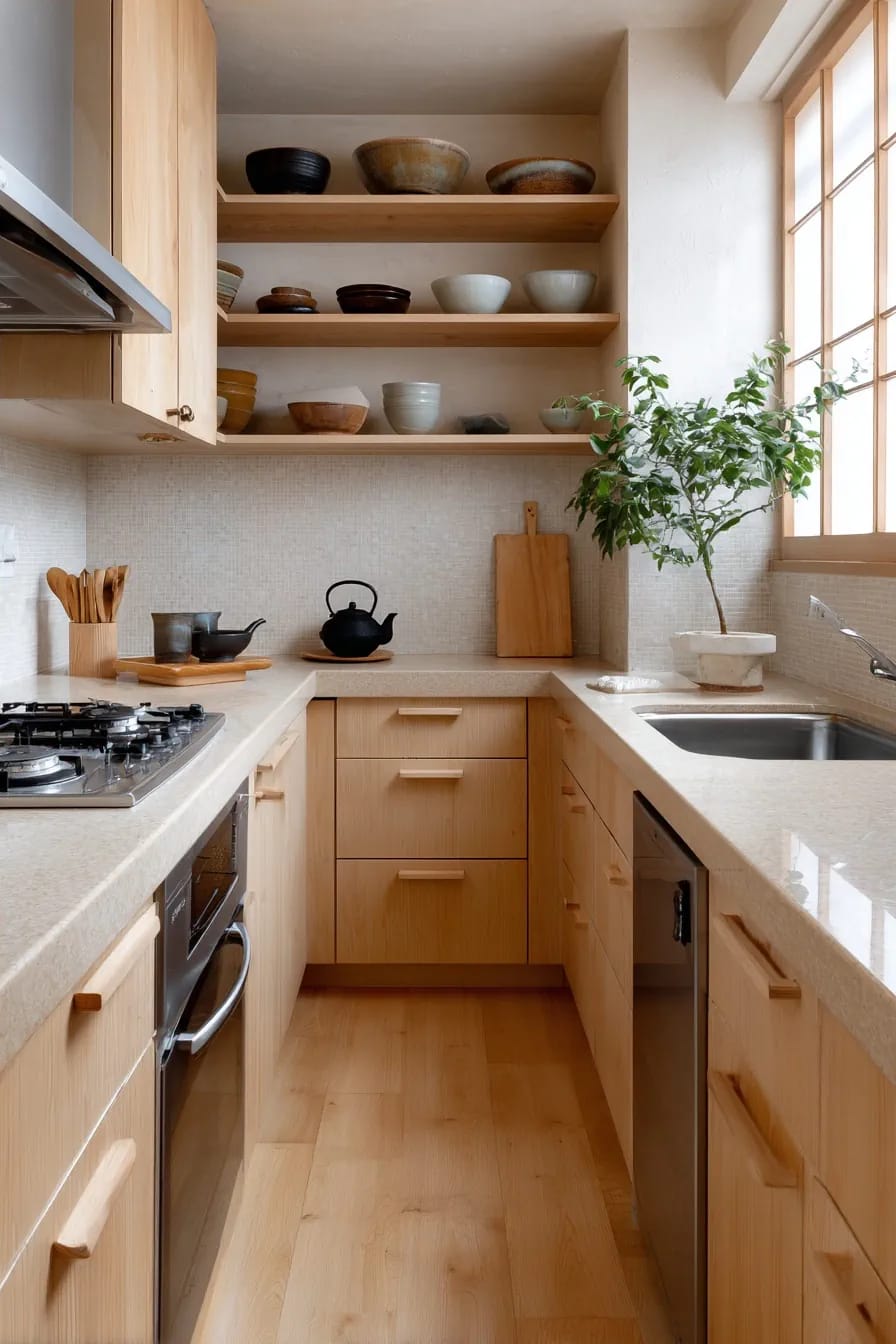
An appliance garage, a tall cupboard with a lift-up or pocket door, hides the microwave, kettle, and blender so the counter reads as one clean plane. The nuance most people miss: leave the one thing you use every single morning out. A kettle you reach for daily earns its spot, and a kitchen with a single well-chosen object on the counter looks more lived-in and more Japanese than one wiped to nothing. Where warm minimalism gets confused with the colder, coastal version of the same palette is exactly this: temperature and edit, not the absence of things.
Negative space needs something to frame
Empty space ( ma) only works if it is framing something. A blank wall next to a window that looks onto a maple, or above a single low shelf holding two objects, becomes intentional. The same blank wall with nothing to anchor it just reads as unfinished drywall. Give the emptiness a job.
5. A Small Japanese Kitchen Has an Advantage, Not a Handicap
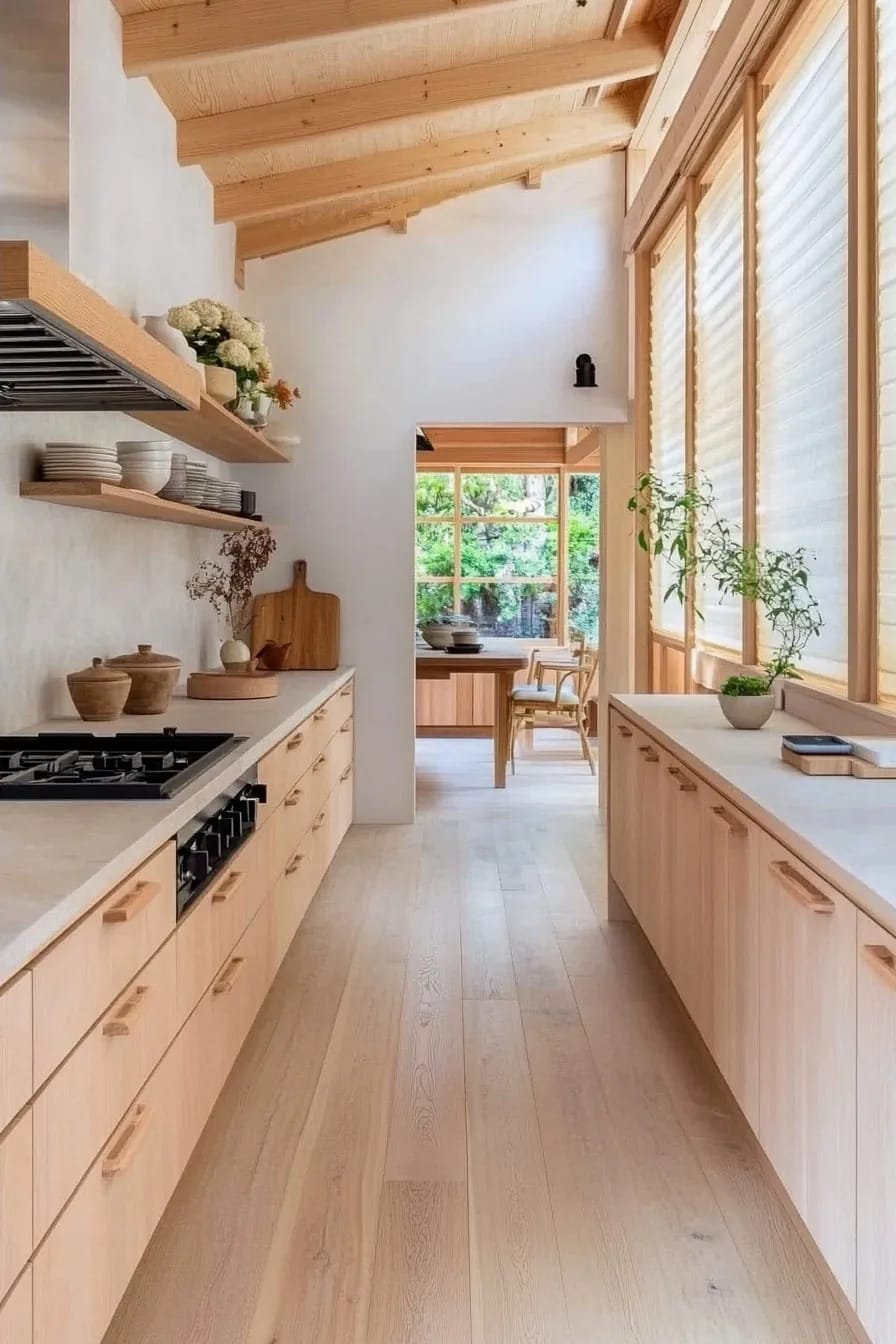
Most Japanese city kitchens are tiny, and they are calm anyway, which tells you square footage was never the point. A galley layout keeps everything within one turn; shallow forty-centimetre base cabinets and a single low shelf buy you storage without crowding the walk space. The move is to scale everything down a notch rather than cram full-size cabinetry into a small footprint and then wonder why it feels tight.
 39 Clever Small Kitchen Ideas: Maximize Your Space with Stylish and Functional Designs Layout and storage tricks for making a tight kitchen work harder without feeling crammed.
6. Wabi-Sabi Belongs on the Shelf, but Buy It Handmade
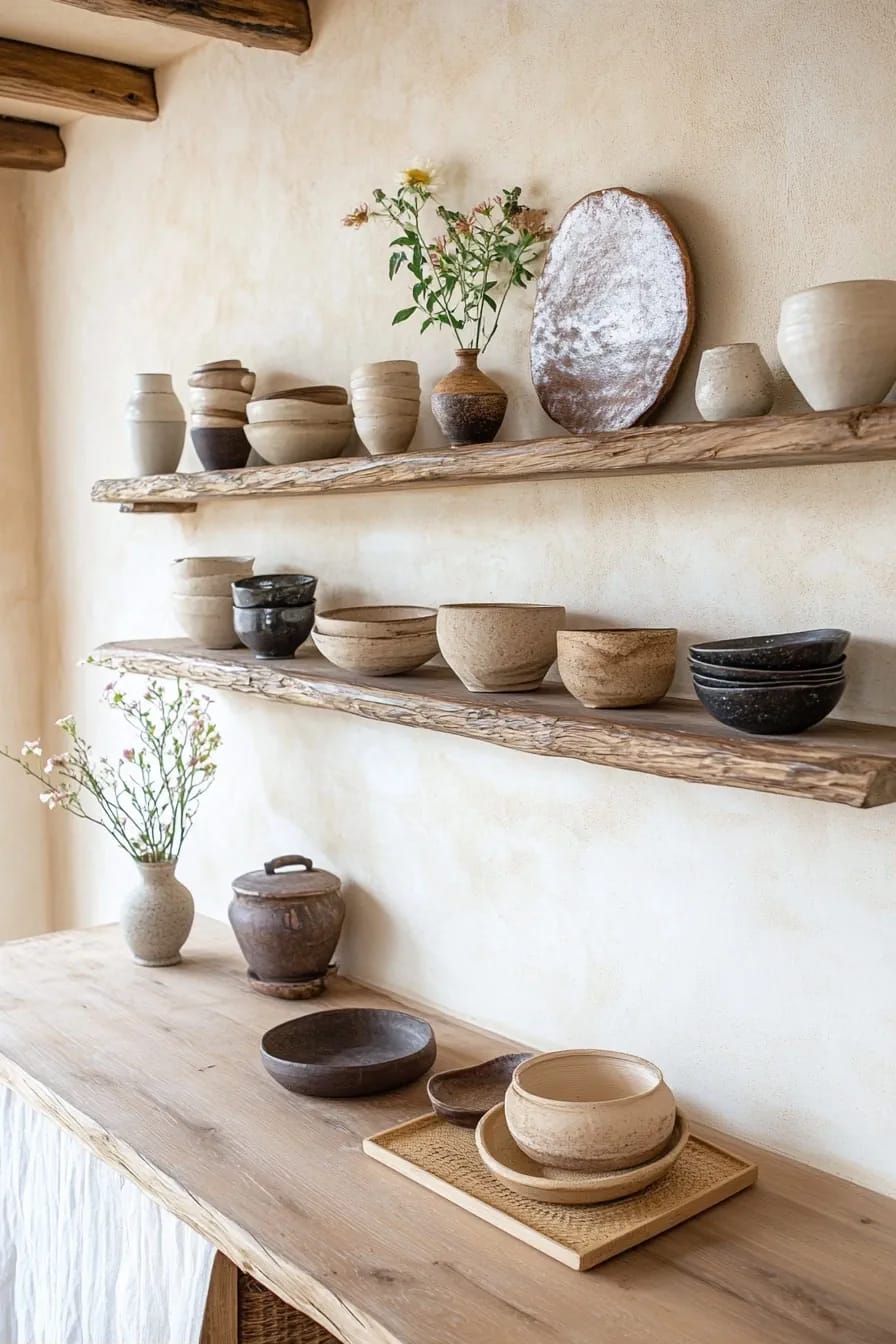
Wabi-sabi, the appreciation of the imperfect and the aging, is the piece that keeps a Japanese kitchen from tipping into cold minimalism. In practice it means a shelf of ceramics where no two glazes match exactly, a wooden spoon that has darkened with use, a bowl with a rim that isn't perfectly round. It is the human warmth that a clean-lined room needs to stay likeable.
Handmade, or the distressed knockoff
Here is the trap. Big-box stores now sell "wabi-sabi" lines: mass-produced bowls with a deliberate factory chip and a printed crackle glaze, all identical to the next thousand off the line. A manufactured imperfection reproduced by the pallet is the exact opposite of the idea. Buy from an actual potter, a local studio, or a maker's market instead, even if it is one piece at a time; the variation has to be real to do anything.
Do this
- Source from a working potter or a studio sale, where each piece varies.
- Let glazes, heights, and tones sit slightly mismatched on the shelf.
- Keep a handful of pieces you actually use, not a display collection.
Avoid
- The high-street “wabi-sabi” range with an identical factory chip on every bowl.
- Matching sets bought in one go. Sameness is what you are trying to leave.
- Filling every inch of open shelving until it reads as storage, not a still life.
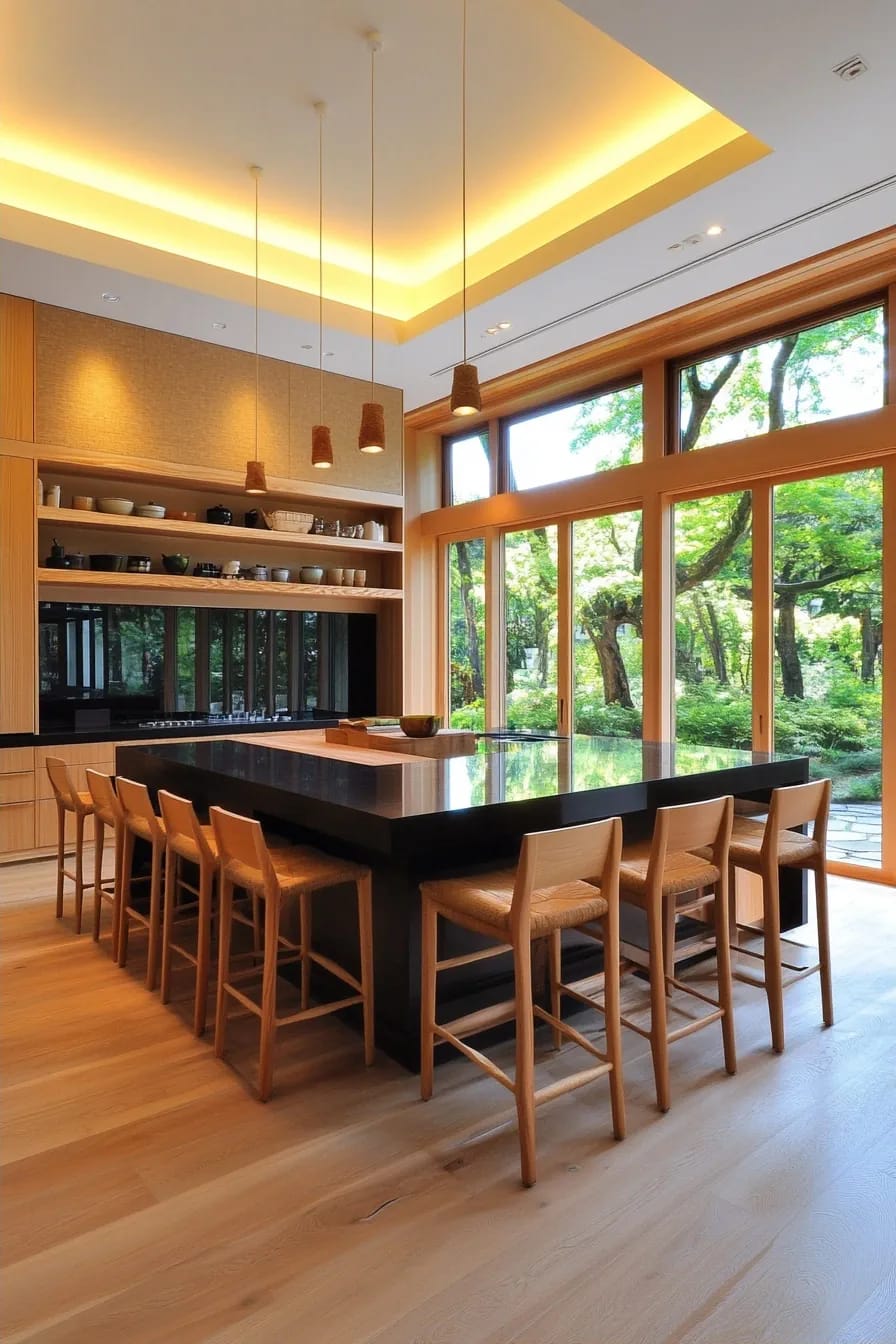
7. The Warm-Modern Japanese Kitchen: Island, Black Steel, Garden View
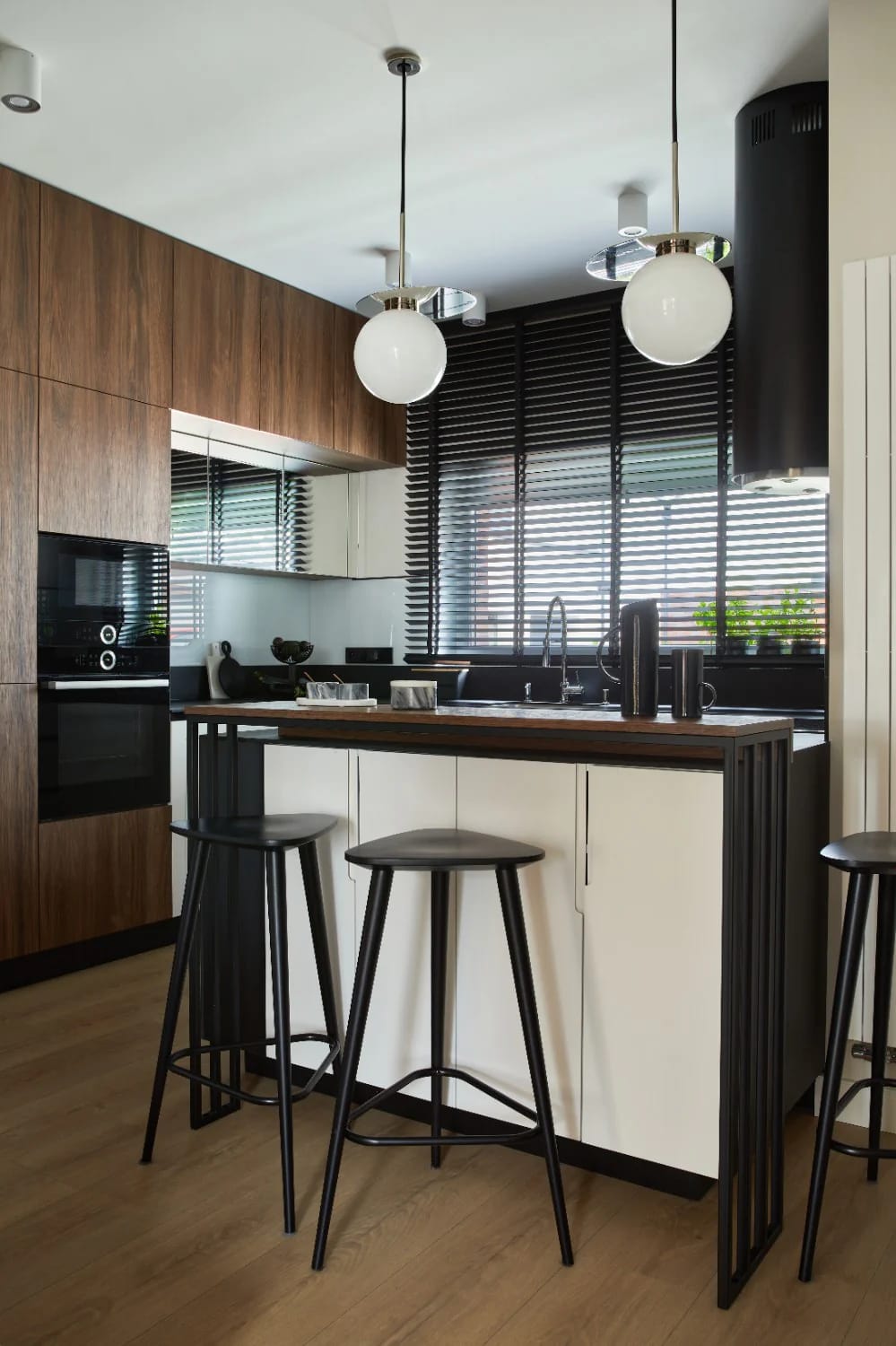
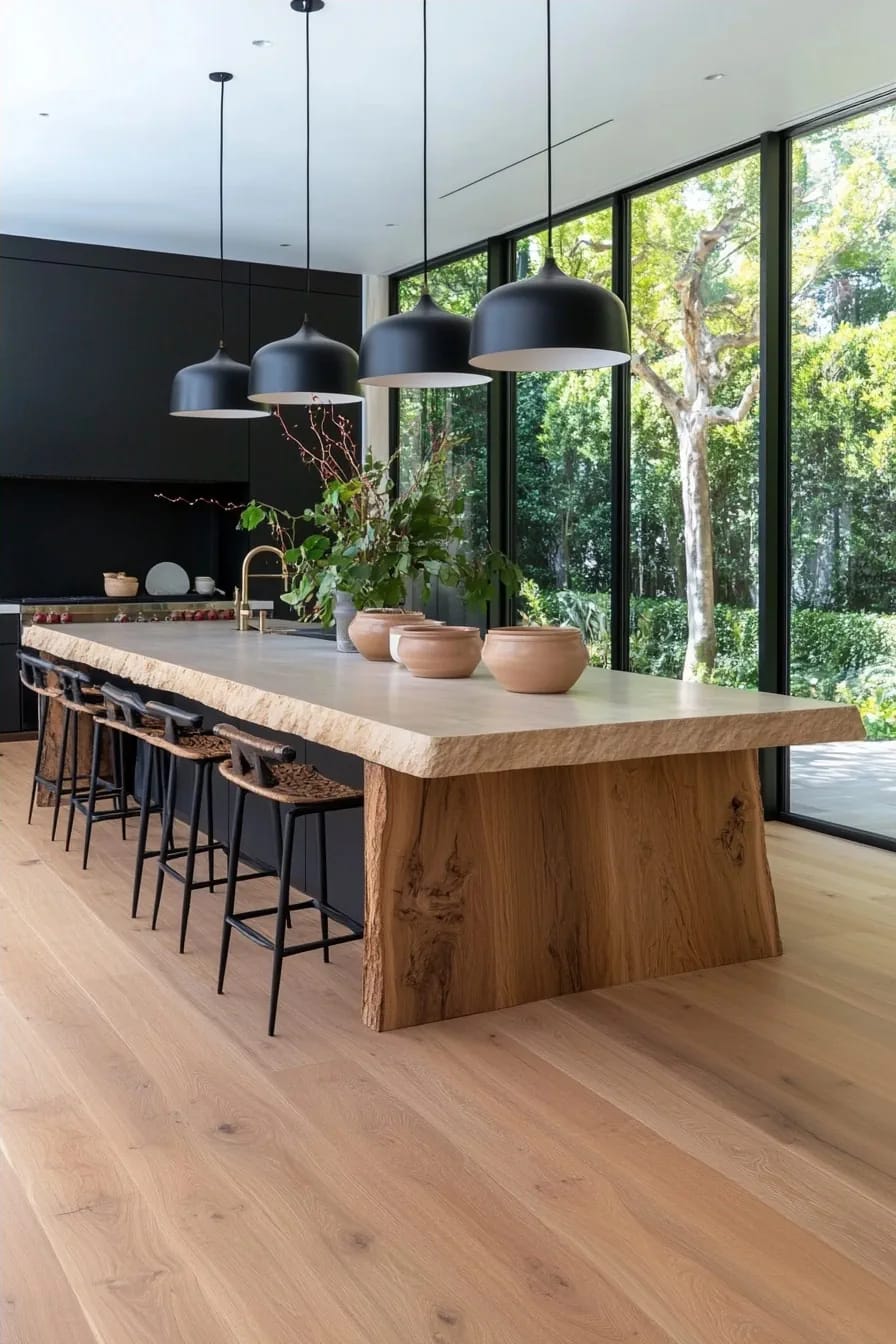
The version pulling the most engagement right now is not the pure traditional room; it is the warm-modern crossover, where Japanese restraint meets a mid-century sensibility and an open plan. Oak, one island, a little black steel, and a real line of sight to something green. It is the most livable of the seven for a Western home.
The island does the socializing
In the crossover kitchen the island is the whole social engine, so it is worth being deliberate about how it earns its footprint. Keep it a clean rectangle in oak or with a single stone top, seat two or three along one side, and resist the temptation to load it with a second sink and a wine fridge until it stops reading as a calm surface. The same discipline that governs the rest of the kitchen applies here; there is more on how an island earns its footprint if you are weighing sizes.
Black steel, used sparingly
Black is a spice, not the dish. A slim window frame, the pendant rods, a tap, maybe thin shelf brackets: that is enough black to give the oak something to push against. An entirely black “Japandi dark kitchen” can look sharp, but it drops the warmth this whole style depends on, and warmth is the harder thing to get back. The mid-century leanings you see in the best of these rooms, the walnut-and-oak tones and the tapered legs, come straight from the mid-century-modern kitchen it borrows from. Pair the island with a green backsplash behind the wood run and one door to the garden, and the Japanese part, the connection to something living outside, is the last thing you add.
Related Posts
- 15 Earthy Kitchen Inspirations for Nature-Infused Space
- 43 Aesthetic Kitchen Ideas to Transform Your Space
- 33 Modern Farmhouse Kitchen Ideas: Blending Rustic Charm with Contemporary Design
- 15 Organic Modern Kitchen Inspiration You’ll Love
- 27 Stunning Boho Kitchen Designs That Will Inspire You
- 15 Rustic Kitchen and Living Room Combos for Modern Homes