
The olive limewash look
Five rooms, one palette, and the difference between the real finish and the colour.
Olive limewash is the rare trend that earns its popularity: the wall stops being a flat backdrop and starts moving with the light, and olive is forgiving enough to sit next to oak, brass, linen and terracotta without any of them fighting. The catch is that half of what gets sold as “limewash” is ordinary paint with a borrowed name, so this guide starts by separating the finish from the colour before it gets anywhere near a brush.
Everything from the guide is on this page. The deeper sections (every colour matched in nine brands, the full technique, a budget plan for each room, the reference kit and the eight art prints) open when you subscribe, and one free sign-up unlocks all of them at once.
8 colours, one home
Hearth Cream
#EFE9DC · LRV 82ceilings · trim · soft furnishingsOat Linen
#DCD2BE · LRV 65curtains · bedding · upholsteryCabinet Cream
#DBD3C5 · LRV 66shaker cabinetry · joineryWillow Sage
#9B9A78 · LRV 31the bridge · ceramics · throwsLimewash Olive
#84805E · LRV 21the hero wall · limewash finishGarden Moss
#5A5C3C · LRV 10depth · textiles · deepest accentHoney Oak
#A6794F · LRV 22beams · shelves · floors · furnitureAged Brass
#9C8552 · LRV 24taps · hardware · lighting · metalsRoughly how much of each colour the rooms use.
| Colour | Living | Bedroom | Bathroom | Kitchen | Porch |
|---|---|---|---|---|---|
| Limewash Olive | feature wall | feature wall | full walls | walls + backsplash | render |
| Honey Oak | shelf + table | shelf + stands | floating vanity | shelf + block top | beams + bench |
| Garden Moss | knit throw | duvet | waffle towels | linen runner | throw + can |
| Cabinet Cream | sofa linen | euro shams | tub + linens | shaker cabinets | door + curtains |
| Aged Brass | floor lamp | – | taps + basin | tap + pulls | lantern + cans |
Limewash, or just the colour?
The difference shows up the moment the wall dries. Real limewash is slaked lime tinted with pigment; it soaks into the surface instead of sitting on it as a plastic film, so light passes into it and bounces back unevenly. That unevenness is the movement people are paying for, and no roller of emulsion will fake it.
The limewash finish
The authentic chalky, mottled, breathable look. Needs a speciality lime product (Passport A), tinted toward the palette.
The colours in normal paint
Love the palette but not the upkeep or the technique? Match the colours in ordinary paint (Passport B). You get the colour, not the cloud.
- Farrow & BallReal limewash
Sells an authentic limewash finish for lime render and bare masonry. The real thing.
- Romabio / Portola / BauwerkReal limewash
Speciality lime brands with authentic slaked-lime and mineral washes: the go-to for a true finish.
- DuluxReal limewash
Genuine lime wash in some regions through speciality lines (Porter’s Paints Interno Lime Wash in Australia).
- ReseneColour only
No mineral limewash, but an FX Paint Effects Medium you mix into normal paint for a faux wash.
- Sherwin-WilliamsColour only
No limewash product. ‘Limewash’ SW 9589 is a standard greige colour (LRV 67).
- Benjamin MooreColour only
No limewash product, only tutorials for a colour-washed look with standard paint and third-party glaze.
- Behr / TaubmansColour only
No true limewash, only standard colours with related-sounding names.
| Brand | Limewash Olive |
|---|---|
| Bauwerk Colour (AU · UK · EU · US) | OliveThe limewash finish |
| Romabio (US · Home Depot, Lowe’s) | Velatura Mineralwash · tint to #84805EThe limewash finish |
| Benjamin Moore | Tate Olive HC-112The colours in ordinary paint |
| Sherwin-Williams | Dried Thyme SW 6186The colours in ordinary paint |
| Behr | Oregano Spice PPU9-23The colours in ordinary paint |
| Farrow & Ball | Treron No.292The colours in ordinary paint |
| Dulux (UK) | match in storeThe colours in ordinary paint |
| Taubmans · Resene | match in storeThe colours in ordinary paint |
| Other 7 colours | In the full guide, across 9 brands |
How to apply it
Applying the cloud
The authentic method, start to finish. Budget-route painters follow the same hand movements with thinned matt paint and can skip steps 1 and 6.
- Prime to the right porosityProduct-specific. True lime won’t key to a glossy film, so previously painted walls usually need a mineral prep coat; many modern lime paints don’t.
- Mist the wallLightly dampen the surface with a spray bottle just before painting so the lime moves and self-blends instead of dragging.
- Load the block brushDip only the tip and wipe off the excess. You want the brush hungry, not dripping: thin coats are the whole secret.
- Paint in loose cross-hatchesBig irregular arcs and figure-eights, 60 to 90cm at a time, overlapping while wet. Never roll, never paint neat straight lines.
- Let it dry, then a second coatLime dries lighter and chalkier than it looks wet. Leave 12+ hours, then a second cross-hatched coat at 90° builds depth.
- Seal only where neededBehind a basin, hob or bath, brush on the maker’s mineral sealer. Leave open walls unsealed so they keep breathing and ageing.
Tool kitRound block or limewash brush · spray bottle · the right primer for your product · drop cloths and low-tack tape · stainless trowel (plaster route only) · matt or mineral sealer for splash zones · nitrile gloves (lime is alkaline).
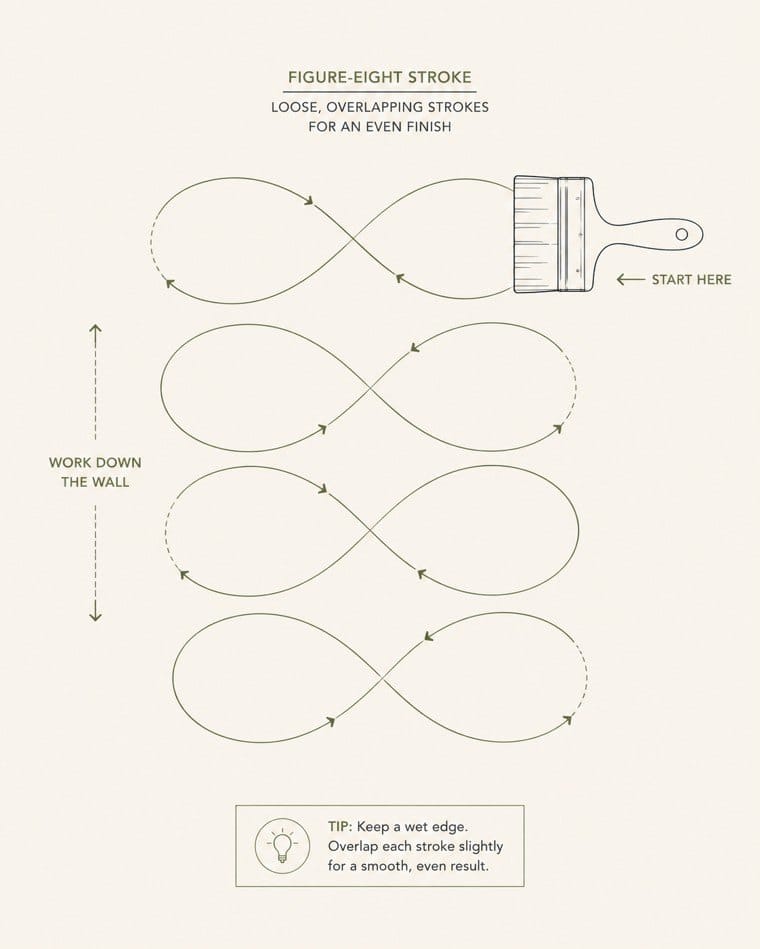
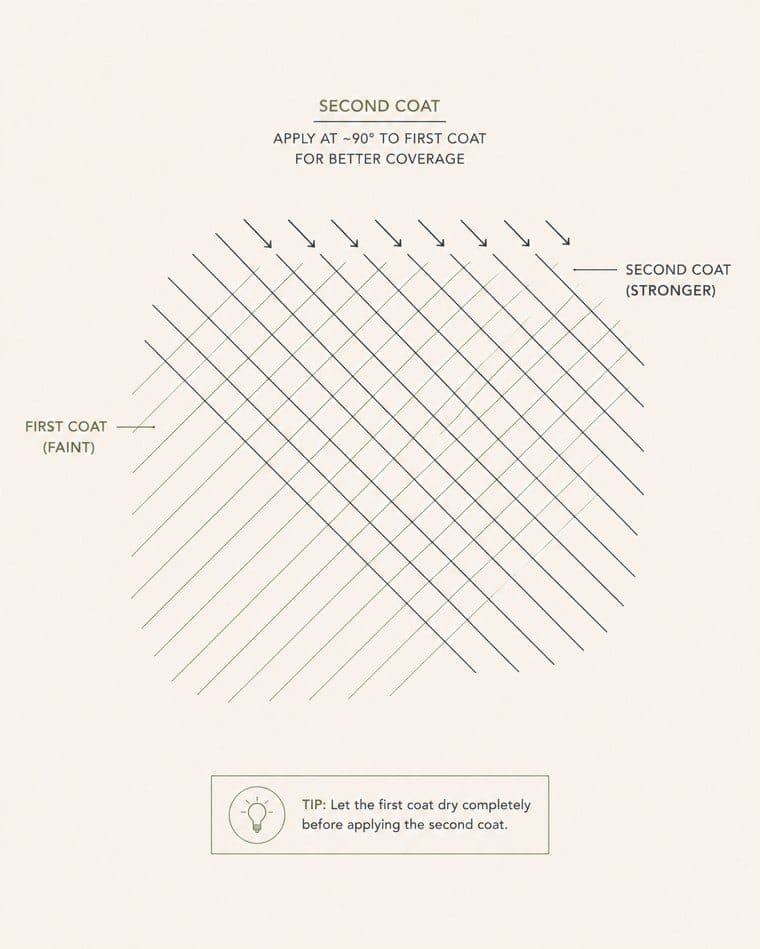
Most of the look comes from the hand, not the tin. Two thin coats, a wide brush and no straight lines will beat an expensive product rolled on flat.
| True limewash | Regular matt | |
|---|---|---|
| Look | Cloudy, layered, moves with the light | Flat and uniform |
| Feel | Chalky, mineral, slightly textured | Smooth plastic film |
| Breathability | Porous, regulates humidity | Seals the surface |
| Durability | Soft; seal splash zones | Scrubbable everywhere |
| Ageing | Patinas over years | Eventually chips and scuffs |
| Cost & effort | Higher; a learnable technique | Lower; anyone can roll it |
Room by room
The rooms below all use the same eight colours. What changes is how much of the olive each one gets and which warm material carries it.
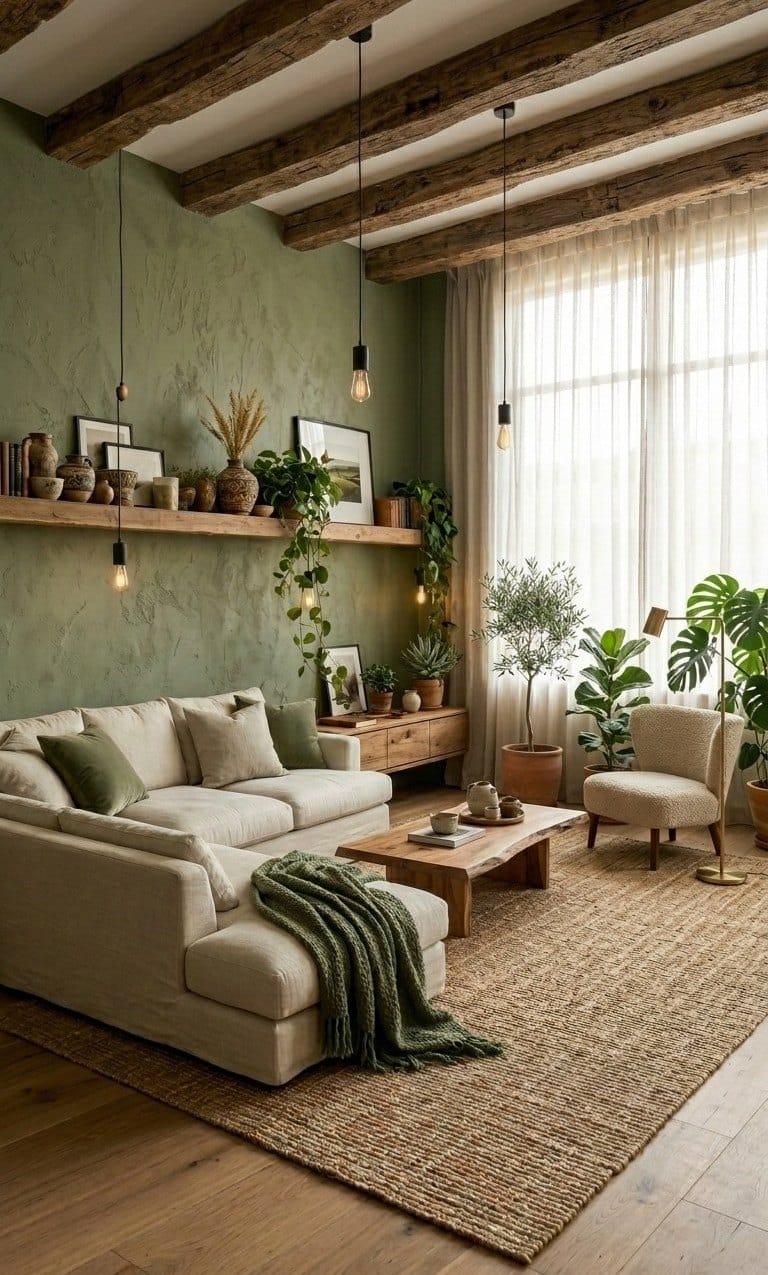
The Living Room
Beamed ceiling, limewash-olive feature wall, a deep linen sofa and one long oak shelf doing the work of a gallery.
- Limewash-olive feature wallBM Tate Olive · SW Dried ThymeOnly the shelf wall is olive; the beam bay above stays Hearth Cream.
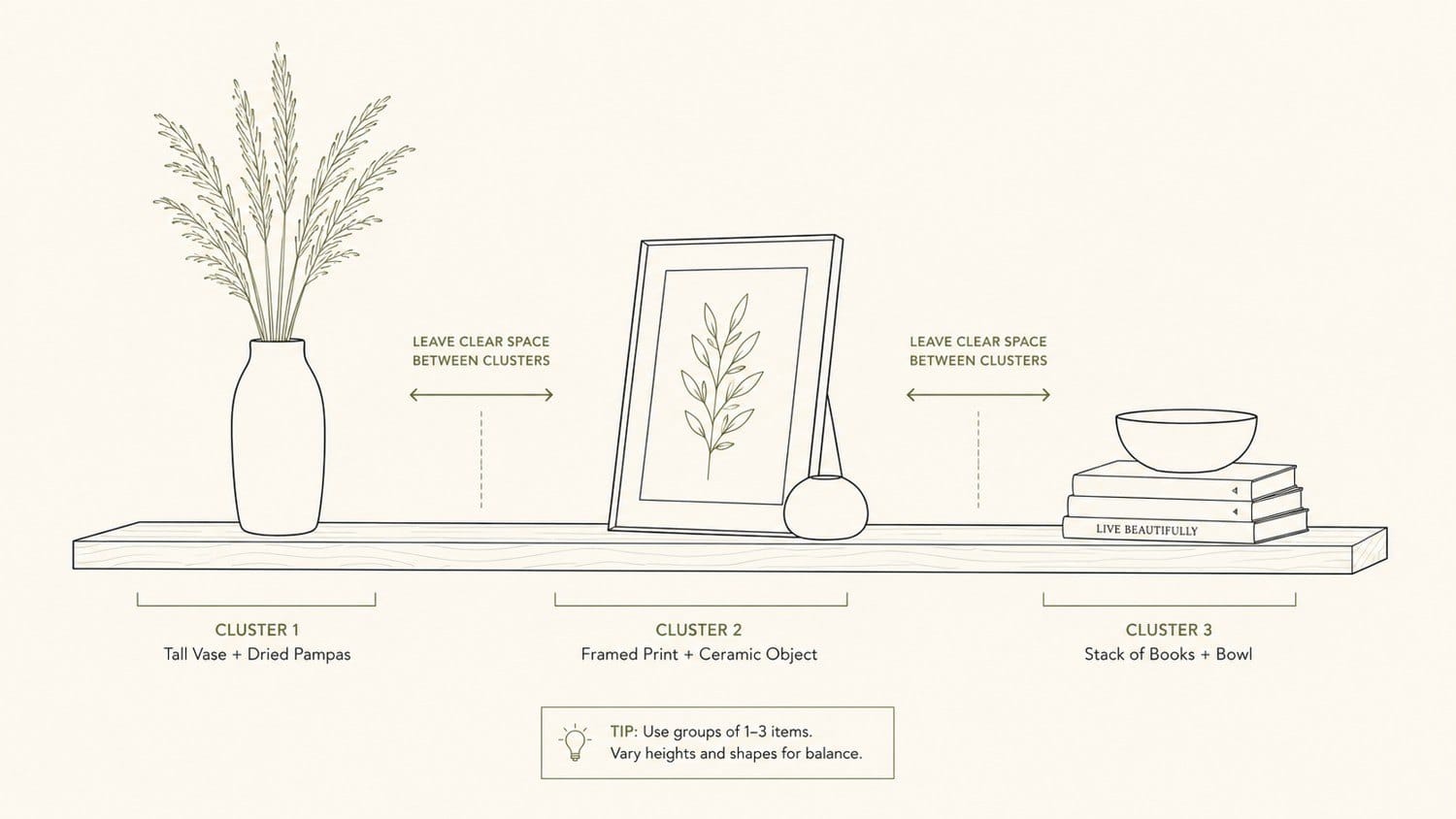
- Honey-oak floating shelfreclaimed oak, Special WalnutOne thick 1.8 to 2.4m shelf replaces art; style it in three clusters.
- Deep linen sectionalOat Linen / Cabinet CreamA loose washed-linen cover is the most expensive-looking move. Crumple, don’t smooth.
- Garden Moss knit throwchunky cable knitDrape it diagonally off one arm: the only fully dark object at eye level.
- Live-edge oak coffee tablesolid oak slabKnots and a raw edge add the rustic note the smooth sofa lacks.
- Bouclé chair + brass lampcream bouclé · aged brassOne curvy chair keeps the room from going all rectangles.
Restraint above the shelf line. The limewash texture is the decoration, so keep the upper wall and beam bay quiet and the olive reads as architecture, not an accent.
The bedroom takes the same olive and turns it down a notch: paint only the wall behind the bed, return the others to Hearth Cream, and let the darkest colours live low.
The Bedroom
A limewash-olive headboard wall, floating oak shelf and nightstands, and moss-on-cream bedding under bare-bulb pendants.
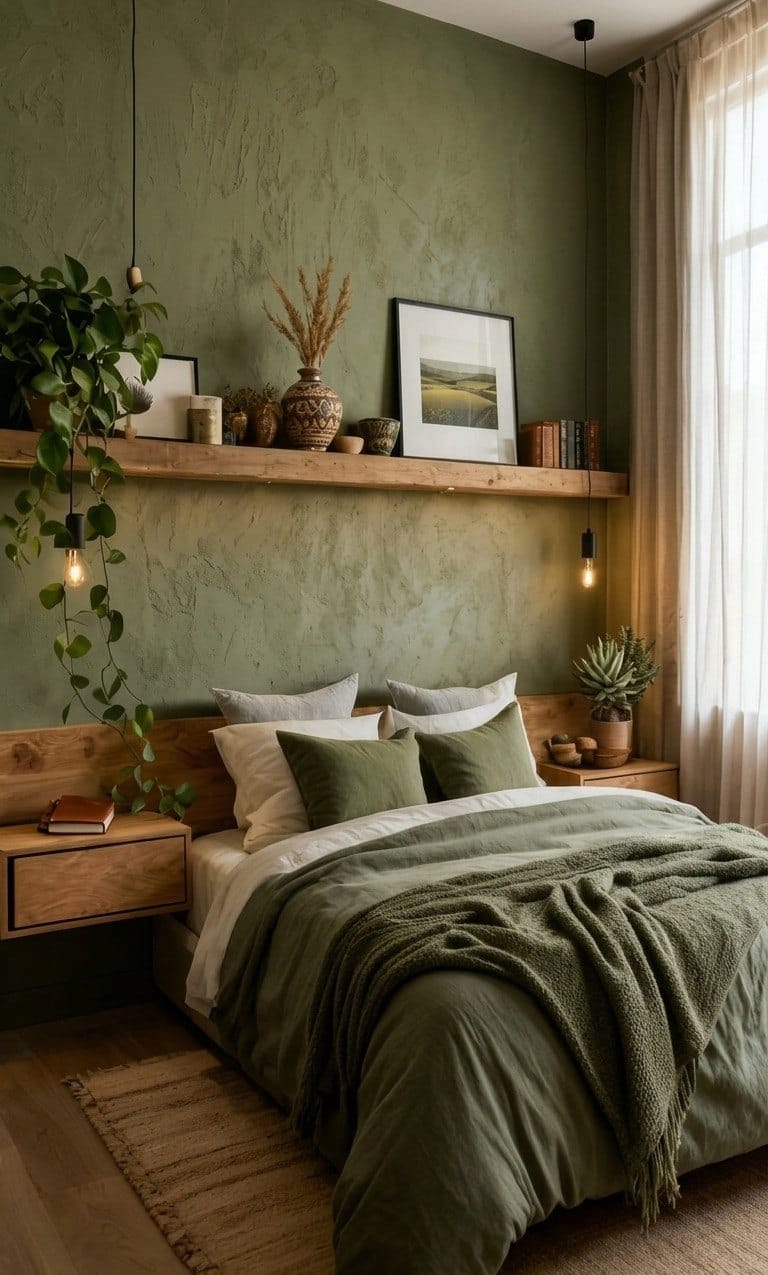
- Limewash-olive headboard wallBM Tate Olive · Behr Oregano SpicePaint only behind the bed; return walls and ceiling stay Hearth Cream.
- Honey-oak floating shelfreclaimed oak, 1.4 to 1.8mLean art and a landscape print; trail dried stems from a terracotta vessel.
- Layered moss & cream beddingGarden Moss + Oat LinenOlive duvet, cream sheet folded back, moss knit at the foot: darkest on top.
- Floating oak nightstandsMinwax Golden OakWall-mounted, so the floor stays clear and the wall reads taller.
- Plug-in cord pendantsblack cord · 2700K G80One each side replaces table lamps, with no wiring.
- Oat-linen euro shamsflax linen 65×65cmTwo euros, two sage 45cm, one cream lumbar: the 2-2-1 stack.
The dark colours live low: moss on the bed and at floor level, olive at the headboard, cream floating high on curtains and ceiling. That vertical gradient is what makes it restful.
About that wall texture: the sculpted relief behind the bed is not from limewash. Texture the wall first (skim coat or joint compound) or use a trowelled plaster.
A bathroom is where real limewash earns its keep. It is porous, so it takes up steam and gives it back instead of trapping it behind a plastic film. Seal only the splash zones behind the basin and bath, and leave the rest of the walls open.
The Bathroom
Olive limewash wrapping the whole room, a live-edge oak vanity, hammered-copper basin and unlacquered brass against a freestanding tub.
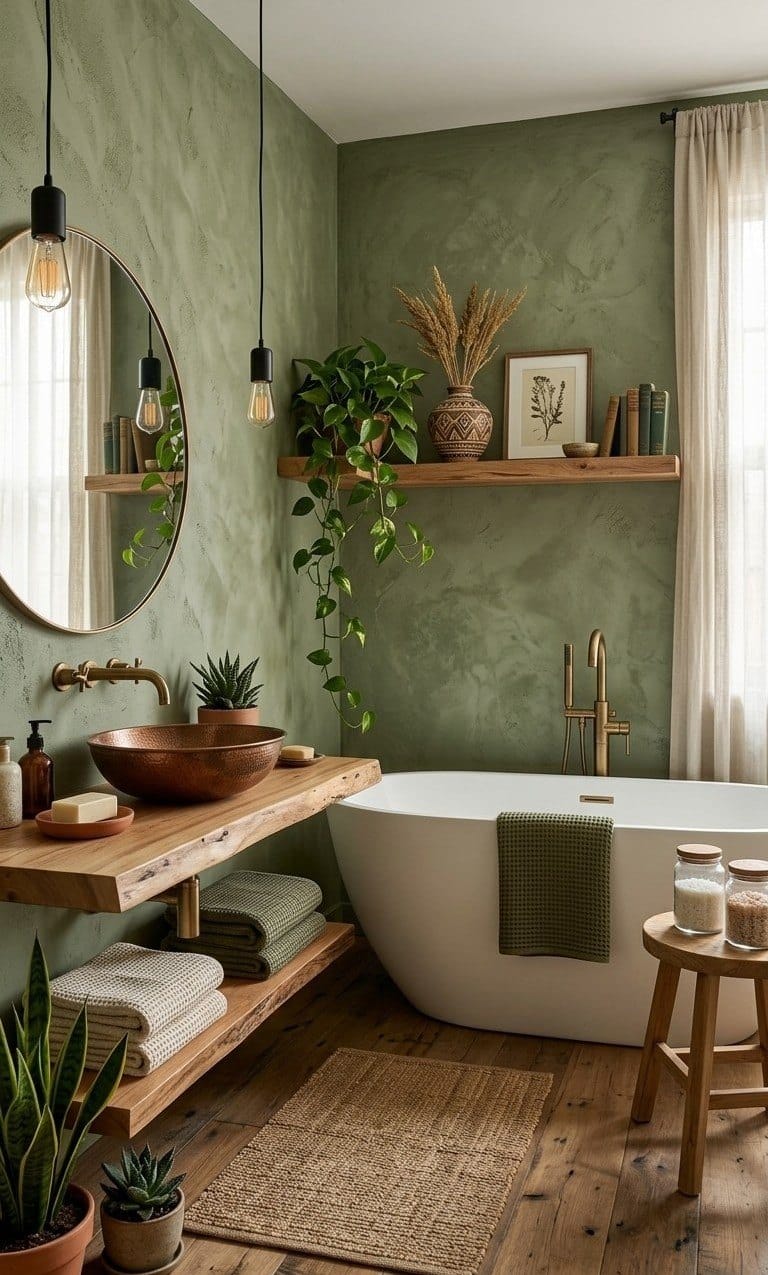
- Full limewash-olive wallsSW Dried Thyme · seal splashesLimewash regulates humidity, which suits a bathroom, but seal behind basin and bath.
- Live-edge oak vanity shelfslab on brass bracketsAn open slab feels lighter than a cabinet and shows off the basin.
- Hammered copper vessel basinaged copper + brass tapCopper and brass make olive glow. Never chrome.
- Unlacquered brass fittingswall tap + floor fillerLiving brass patinas over time: buy it to age.
- Moss waffle towelscotton waffle weaveThe textile that ties the bath back to the bedroom.
- Oak shelf + trailing pothosfloating oakOne high shelf repeats the living-room move in miniature.
Warm metals do the heavy lifting: copper basin, brass taps and an oak slab keep the olive from reading cold in a wet room. Matt limewash on open walls, sealed where water hits.
Kitchens are where the scheme earns its keep, because every hard surface can join in: cream fronts, an oak top, brass pulls and one olive wall.
The Kitchen
Cabinet-cream shaker units and a butcher-block counter under an olive limewash wall, with a fireclay apron sink and aged-brass bridge tap.
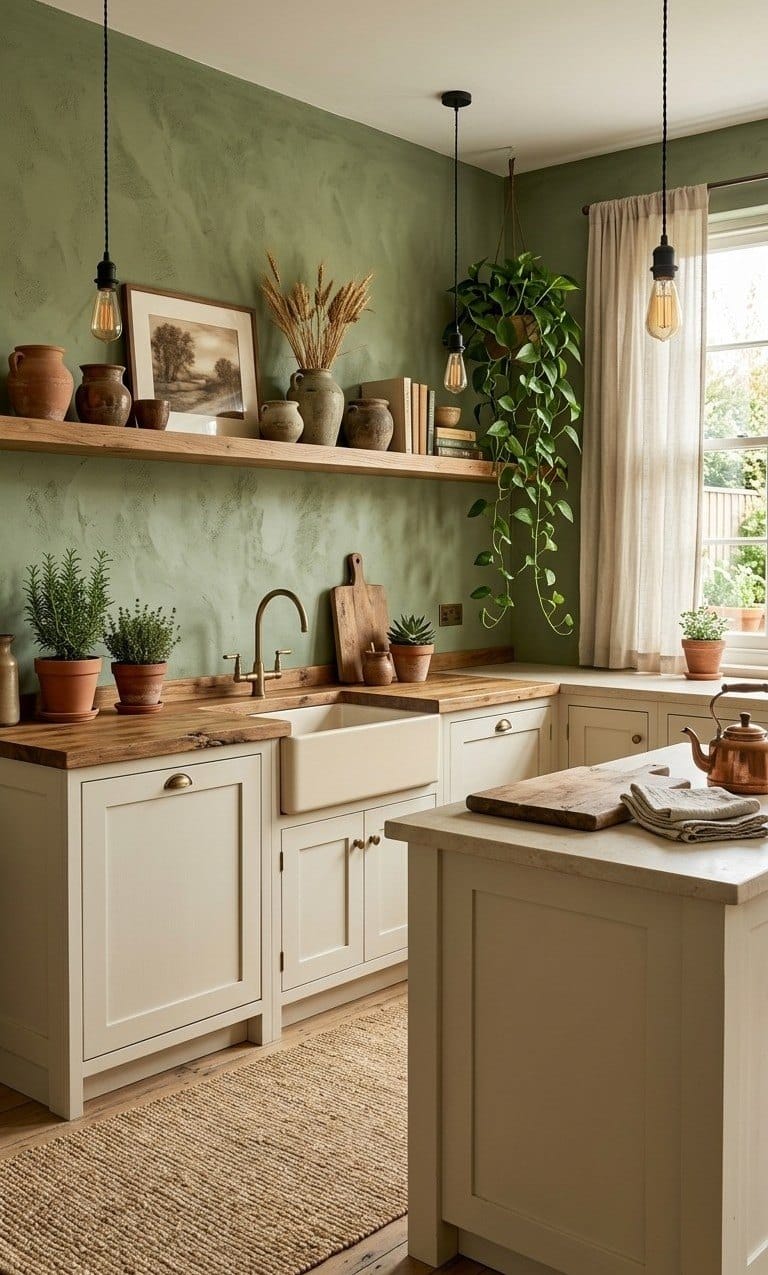
- Olive limewash wall + backsplashSW Dried Thyme · BM Tate OliveCarry the olive down behind the counter; seal the run above the worktop.
- Cabinet-cream shaker unitsBM Natural Cream · SW Accessible BeigeWarm cream, never stark white, stops the scheme feeling cold.
- Butcher-block worktopsolid oak or beech, oiledTies the counter to shelf and floor; re-oil regularly early on.
- Fireclay apron sinkcream / ivory frontA deep apron front in cream: the most farmhouse fixture.
- Aged-brass bridge tap + pullsbrushed / aged brassThe jewellery; match the shelf brackets to them.
- Open oak shelf + crocksreclaimed oakEarthenware and a landscape print over the run of cabinets.
Cream cabinets, warm wood and an olive wall is the whole formula. Keep every hard surface in the palette (cream, oak, brass, terracotta) and let the limewash wall be the only colour.
Outside, the thread keeps going. The porch reads as part of the house because it repeats the same five things: olive, oak, moss, terracotta and brass.
The Front Porch
The look steps outside: olive lime-rendered walls, weathered-oak posts and beams, a reclaimed bench and a tumble of terracotta, lavender and roses.
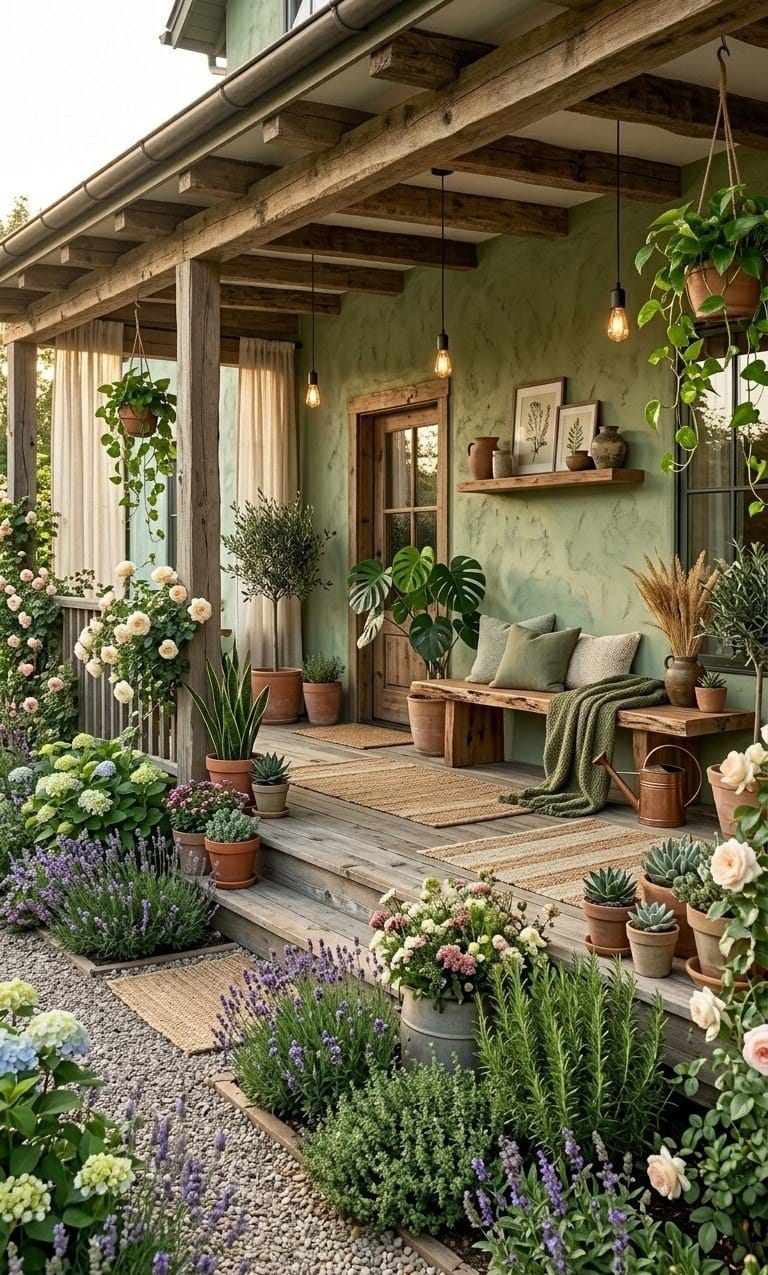
- Olive lime-render wallsRomabio / Bauwerk exteriorOutside, use a UV-stable exterior lime render in the same olive family.
- Weathered-oak posts & beamsclear matt exterior oilLet the timber silver; a clear oil protects without hiding grain.
- Reclaimed oak benchmoss throw + linen cushionsThe same moss knit and oat linen carry the thread onto the porch.
- Terracotta pot clusteraged terracottaGroup in odd numbers at varied heights; aged beats new-orange.
- Cottage plantinglavender · hydrangea · rosesPurple and cream against olive walls: soft, not municipal-bright.
- Brass & copper detailsaged brass · copper canWarm-metal lighting and a real copper can repeat the indoor metals.
The thread continues outside. The porch feels part of the house because of literal repetition: same olive, oak, moss, terracotta, brass. Cohesion beats novelty.
Exteriors need a UV-stable exterior lime render or limewash (Romabio, Bauwerk), not the same tin as the interior walls.
Fixes for the usual problems
Most limewash problems come down to three things: the wrong product, the wrong light or the wrong stroke. These are the ones readers ask about most.
I bought limewash but it’s just normal paint
FixMost brands’ ‘limewash’ is only a colour name (SW 9589, for one). For the real chalky finish, buy a speciality lime product from Passport A and tint it to the palette.
My wall is flat, with no movement
FixLimewash adds a cloud of colour, not raised relief. Build texture first with a skim of joint compound, or switch to the plaster route.
My sage looks grey and cold
FixNorth light or cool bulbs. Olive-sage needs warmth to read green: switch to 2700K and choose the warmer match (Behr Oregano Spice).
The limewash looks streaky or patchy
FixUneven porosity or straight strokes. Prime for even absorption, paint damp, work in loose overlapping arcs; a third thin coat evens most patchiness.
The full guide covers 9 fixes.
Do I even need to prime?
FixProduct-specific. Over sound latex, many modern lime paints need none; true mineral limewash usually needs a mineral prep coat. Read the data sheet.
The room feels flat and one-note
FixToo much colour, not enough texture. Add jute, loose-weave linen, a knit throw, stoneware and raw wood before any new colour.
My cream cabinets look dirty or yellow
FixThe cream is too warm for your light. Move toward a greige-leaning cream (BM Natural Cream, SW Accessible Beige) and keep trim a shade cleaner.
The wood tones clash
FixYou’ve mixed warm and cool woods. Keep every wood warm (oak, beech, walnut); grey-washed or black-stained timber flattens olive.
It looks like a showroom, not a home
FixEverything is matching and new. Introduce age: one reclaimed piece, aged terracotta, living brass left to patina, real or dried greenery.
| Surface | Finish | Why |
|---|---|---|
| Walls (open areas) | Matt / limewash | Hides texture, reads soft, breathable |
| Walls (splash zones) | Sealed matt / eggshell | Wipeable behind basin, hob, bath |
| Shaker cabinetry | Satin / eggshell | Durable, wipeable, low glare |
| Trim, doors, beams | Eggshell or matt oil | Subtle sheen; oil for raw timber |
| Butcher block | Oil + beeswax | Food-safe; re-oil every 4 to 6 weeks early on |
Aged brassLiving copperMatt black
NorthCool, blue, even
Olive drains toward grey-green and can look cold; cream can turn slightly grey.Olive: the warmer Behr Oregano Spice. Cream: BM Natural Cream OC-14.
SouthWarm, bright, forgiving
Olive glows green and rich and can read yellow at noon; cream warms up.If too warm, cool the olive to SW Dried Thyme. Cream: SW Accessible Beige.
EastGold mornings, cooler afternoons
Olive is lush at breakfast and greyer by evening.Choose for your main-use time; morning rooms hold SW Dried Thyme well.
WestFlat mornings, orange evenings
Olive can look muddy at midday, then very warm at dusk; cream may read peachy.Steady it with BM Tate Olive HC-112. Cream: Natural Cream OC-14.
The rule that beats orientation
2700K warm bulbs plus a 48-hour sample test settle most doubt. Paint two A4 boards, tape one on the brightest wall and one on the darkest, and look at both at 9am, 3pm and 8pm.
The window-size rule
Direction sets the temperature of the light; window size sets its intensity. Small windows make olive read darker; big windows can wash creams out at midday.
- Limewash finish: buy a speciality lime product (Passport A)
- Just the colours: standard paint matches (Passport B)
- Sample tested 48h in your own light
- Hero olive, limewash or matt, per room
- Hearth Cream: ceilings, trim, returns
- Cabinet Cream: kitchen and bath joinery
- Garden Moss: deepest accents and doors
- Right primer for your product and surface
- Splash-zone mineral sealer
- Round block brush + spray bottle
- Oak floating shelves
- Floating oak nightstands
- Live-edge or slab tables
- Butcher-block worktop + oil and beeswax
- Reclaimed bench (porch)
- Stain to match (Special Walnut / Golden Oak)
- Texture base coat if you want relief
- Aged-brass taps, bridge tap, cup pulls
- Hammered copper basin
- Plug-in cord pendants + 2700K bulbs
- Washed-linen bedding (oat + moss)
- Moss knit throws + sage and cream pillows
- Jute rugs and runners; waffle towels
- Terracotta pots, pothos, dried stems
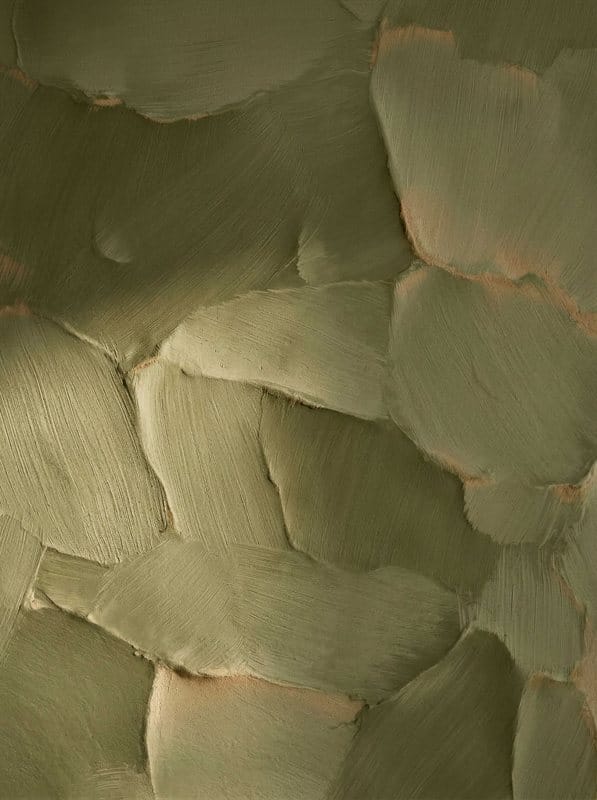
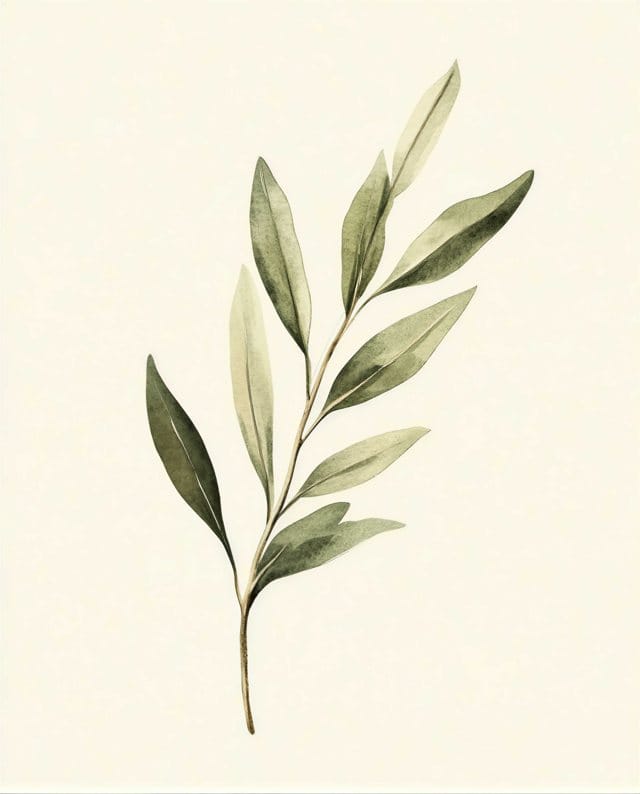
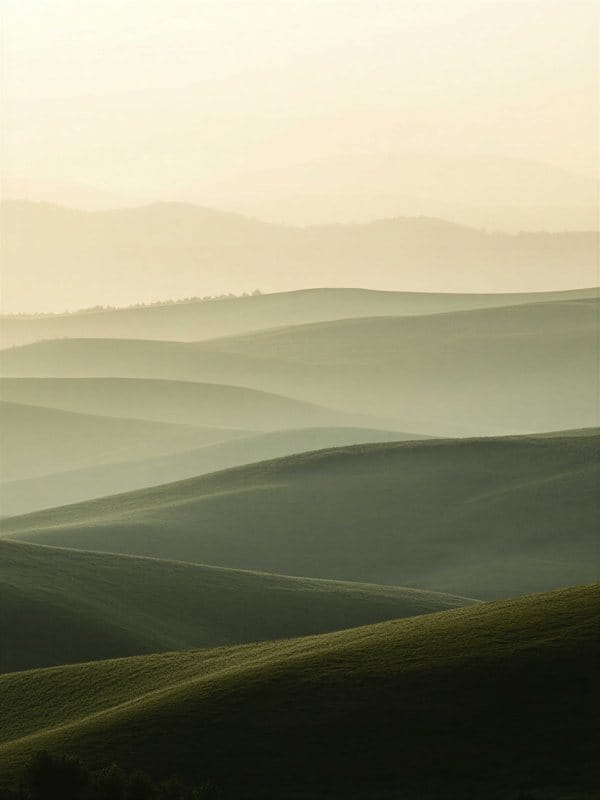
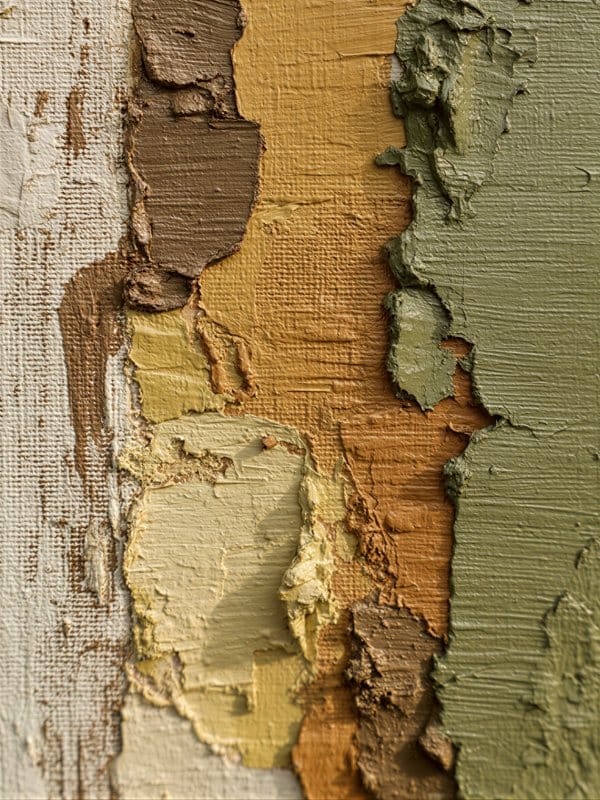
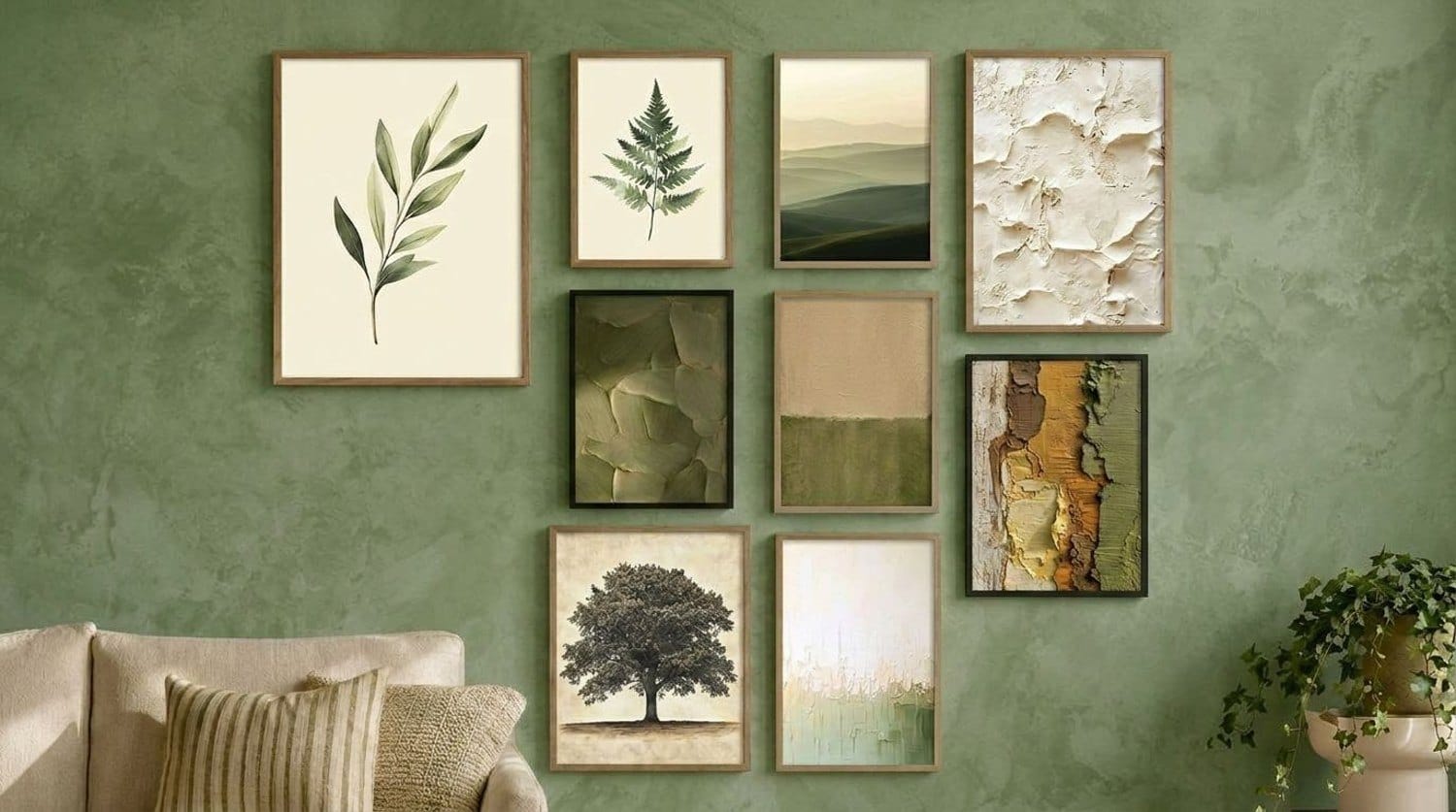
Print at the sizes below on matte, uncoated or cotton-rag fine-art paper at 300 DPI. Frame in thin oak or matte black.
- Limewash Macro I · 18×24 in
- Limewash Macro II · 18×24 in
- Botanical Study: Sage · 16×20 in
- Botanical Study: Moss · 16×20 in
- Vintage Horizon · 18×24 in
- Rustic Hills · 18×24 in
- Palette-Knife Abstract I · 16×20 in
- Palette-Knife Abstract II · 18×24 in