
Coastal vintage is one of the few decorating styles that improves the more worn it looks, which is why a thrifted dresser will always beat the showroom version for this particular room. The fifteen rooms below lean on sun-bleached color instead of primary nautical red, on real salvage instead of catalog "distressing," and on a few things you should know before you buy: that sea glass is genuinely getting scarce, that a quart of chalk paint can age a $79 pine frame convincingly, and that the line between collected and cluttered is thinner than most pin boards admit.
The single thing that separates coastal vintage from a beach-themed gift shop is the palette. Everything has been left in the sun for a decade: chalky aquas, greyed blues, sand, bone, the soft green of old bottle glass. Crisp navy and bright white read as new, and new is exactly what you are trying not to look like. When a color feels too saturated, mix in a little grey or let the existing patina do it for you.

1. Weathered wood bed frame with vintage floral quilt and seashell garland
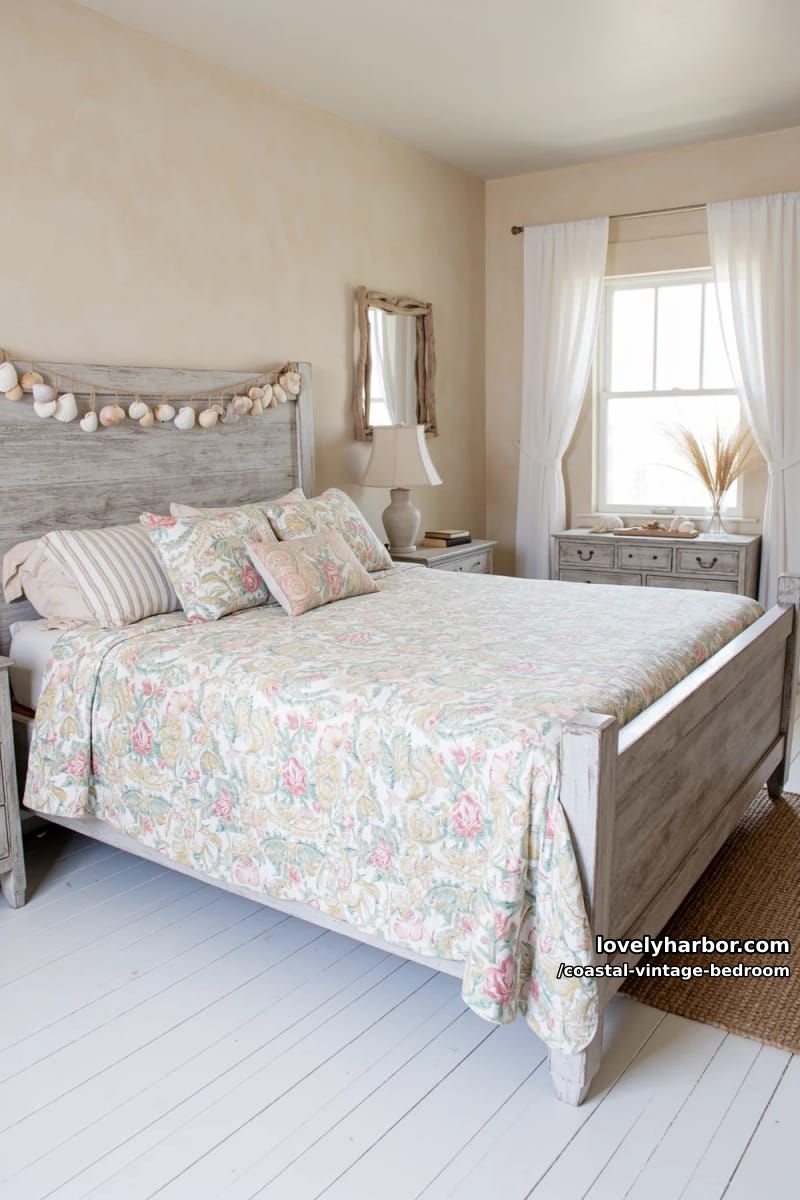
Start with the frame, because real age is the one thing you cannot fake convincingly. A genuinely weathered oak or pine frame, the kind with grey grain raised by years of humidity, carries the whole room. The factory "distressed" frames at the big chains are sanded in the same three spots every time, and once you notice it you cannot unsee it.
For the quilt, hunt the actual vintage rather than the reproduction. Feedsack-era and mid-century floral quilts turn up at estate sales for $30 to $80, faded into exactly the soft pinks and sea greens you want, and a reproduction never quite gets there because the fading is printed on rather than earned. The seashell garland is the cheap, slightly kitschy finishing note: keep it to one strand above the headboard. Two or three and you have crossed into souvenir-shop territory.
2. Antique dresser topped with driftwood sculptures and glass bottle vases
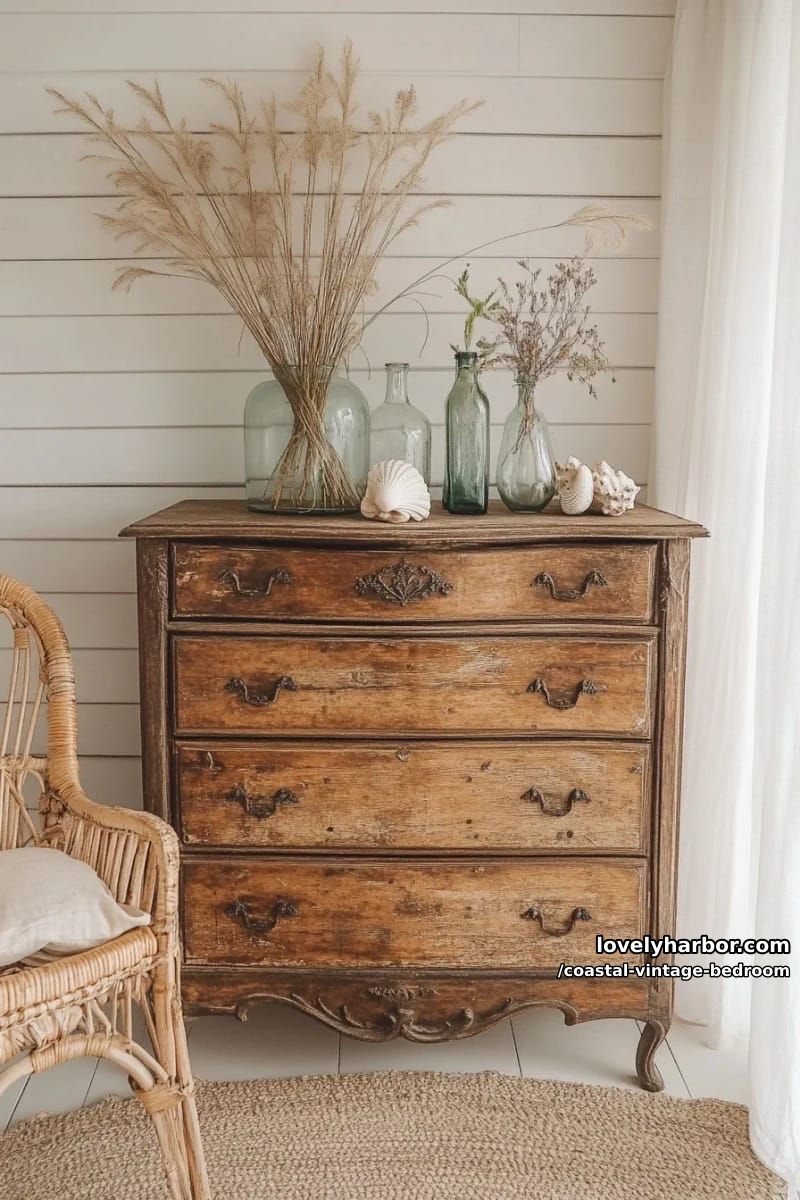
An antique dresser is where most of this look's character lives, and it is also the piece most worth refinishing yourself. If you find a solid wood dresser with good bones but the wrong finish, a single quart of Annie Sloan Chalk Paint (around $40, no sanding or priming, covers 130 to 150 square feet, so one quart handles a six-drawer chest with paint to spare) takes it to a soft, chalky finish you can sand back at the edges for age. On a tight budget, Rust-Oleum's chalked paint runs closer to $22 and behaves similarly; the color range is just narrower. I spent years telling people to strip and stain these pieces. Then I lived with a stripped one through two damp coastal summers and watched it blotch, and now I reach for paint.
The driftwood and bottles on top do the styling, and both reward restraint. Three pieces of driftwood in graduated sizes look collected; a dozen looks like a beach cleanup. One quick warning if you plan to gather your own: collecting driftwood and shells is restricted or banned in a lot of state and national parks, so check the local rule before you fill a bag. The glass bottles want to be the soft greens and aquas of old apothecary and soda bottles, grouped tight so the light pools through them, not spaced out like a museum case.
3. Layered blue and cream linens with crochet throw and rattan bench
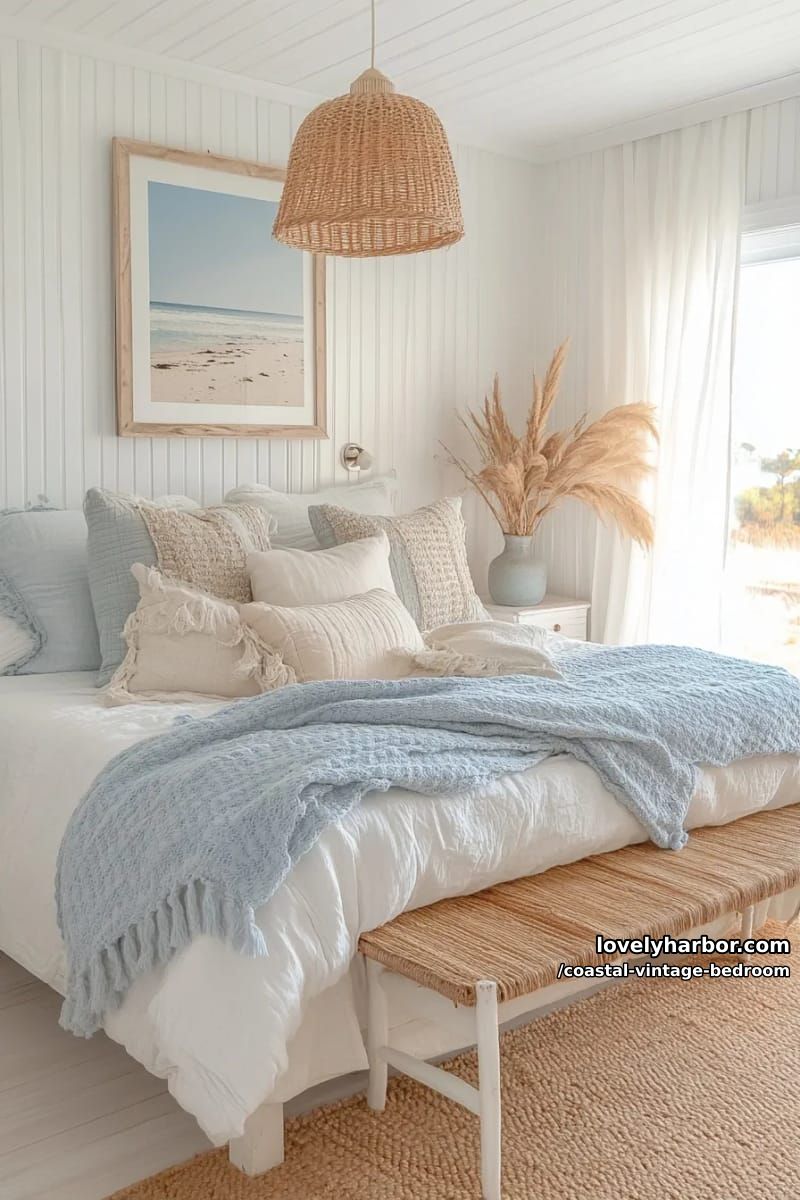
Hold the whole bed to two or three values of blue and cream and the layering reads calm instead of busy. Washed linen is the workhorse here: it softens with every wash, wrinkles in a way that looks intentional, and hides the fact that you have not ironed anything since you bought it. A hand-crocheted throw at the foot adds the one slightly homespun texture the room needs.
The rattan bench is the practical anchor, a place to sit and pull on shoes, but vintage rattan and cane are lighter and more brittle than they look, so it is a bench for sitting, not for standing on to reach a shelf. If you cannot find an old one, a new piece left to dull down for a season looks far better than fresh varnish.
4. Gallery wall of vintage seascapes in mismatched, ornate frames
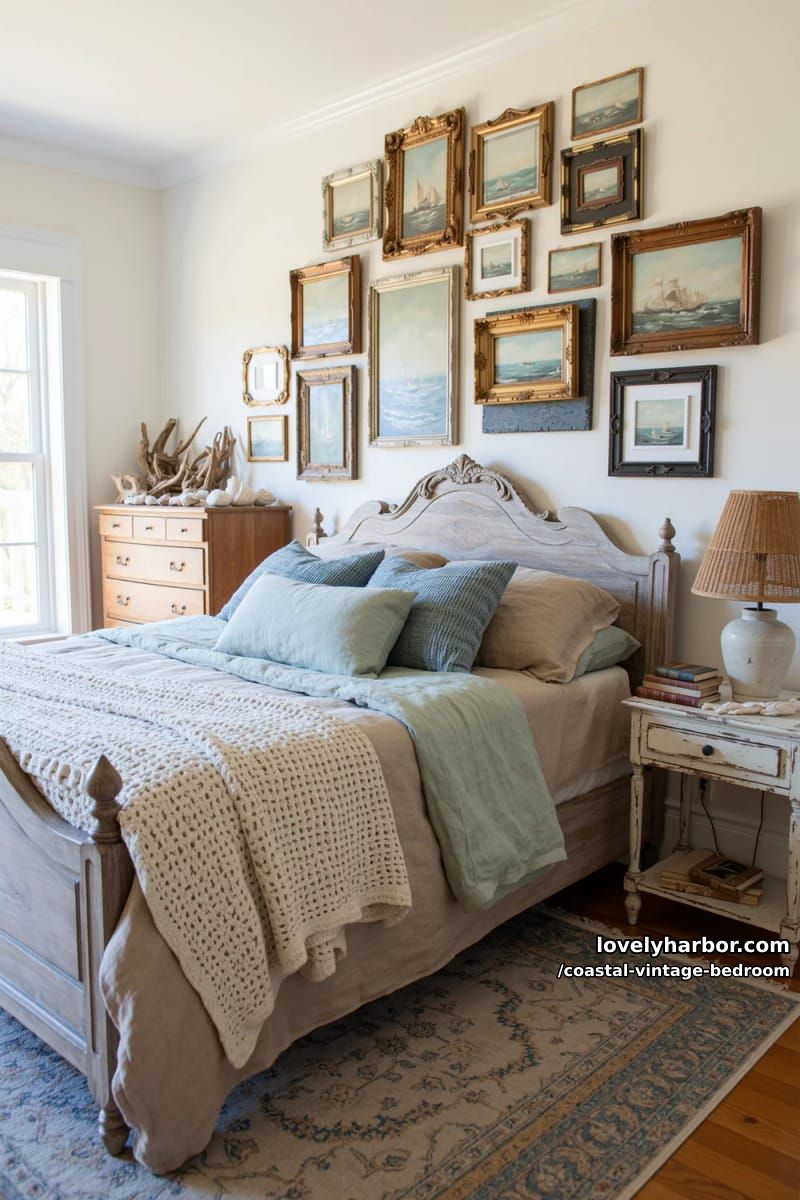
Mismatched frames are the entire point, so do not buy a matched "gallery wall set," which defeats the look before you hang it. Thrift stores and estate sales are full of amateur oil seascapes, often $5 to $20, painted by people who clearly loved the ocean and could only sort of render it, and that earnest mediocrity is exactly what gives the wall its warmth. Let chipped gilt, bare wood, and flaking white paint sit side by side.
The trick that keeps it from looking like a yard sale is purely mechanical: lay the whole arrangement on the floor first, keep the gaps between frames tight and consistent at about two to three inches, and hang to a shared bottom or center line. Vary the frame finishes wildly; keep the spacing disciplined. That tension is what reads as "collected over years" rather than dumped on a wall in an afternoon.
5. Woven baskets for storage beside an iron canopy bed draped in gauze
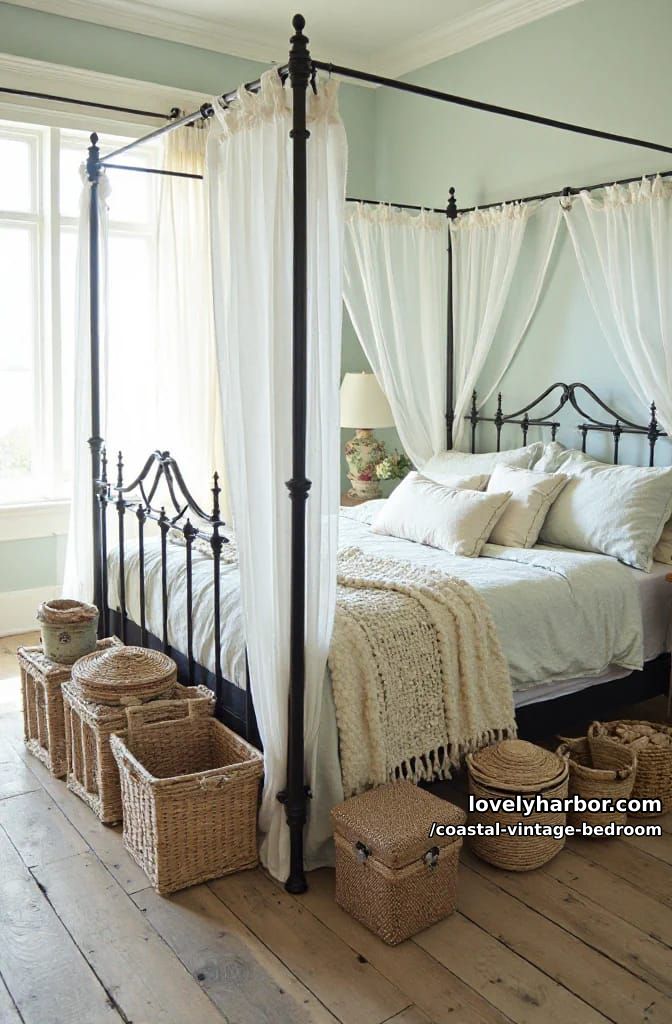
Lidded woven baskets are the storage that hides the storage, and seagrass or water hyacinth holds up better to a humid bedroom than tightly coiled paper rope. Two or three at the foot of an iron bed swallow extra quilts and the daily clutter without a single plastic bin in sight.
For the canopy, skip anything stiff and reach for cotton gauze or plain muslin, which moves in a draft and stays affordable by the yard. Iron canopy frames are heavy and unforgiving, so anchor the frame properly before you drape it.
6. Pale aqua paneled walls paired with retro botanical prints
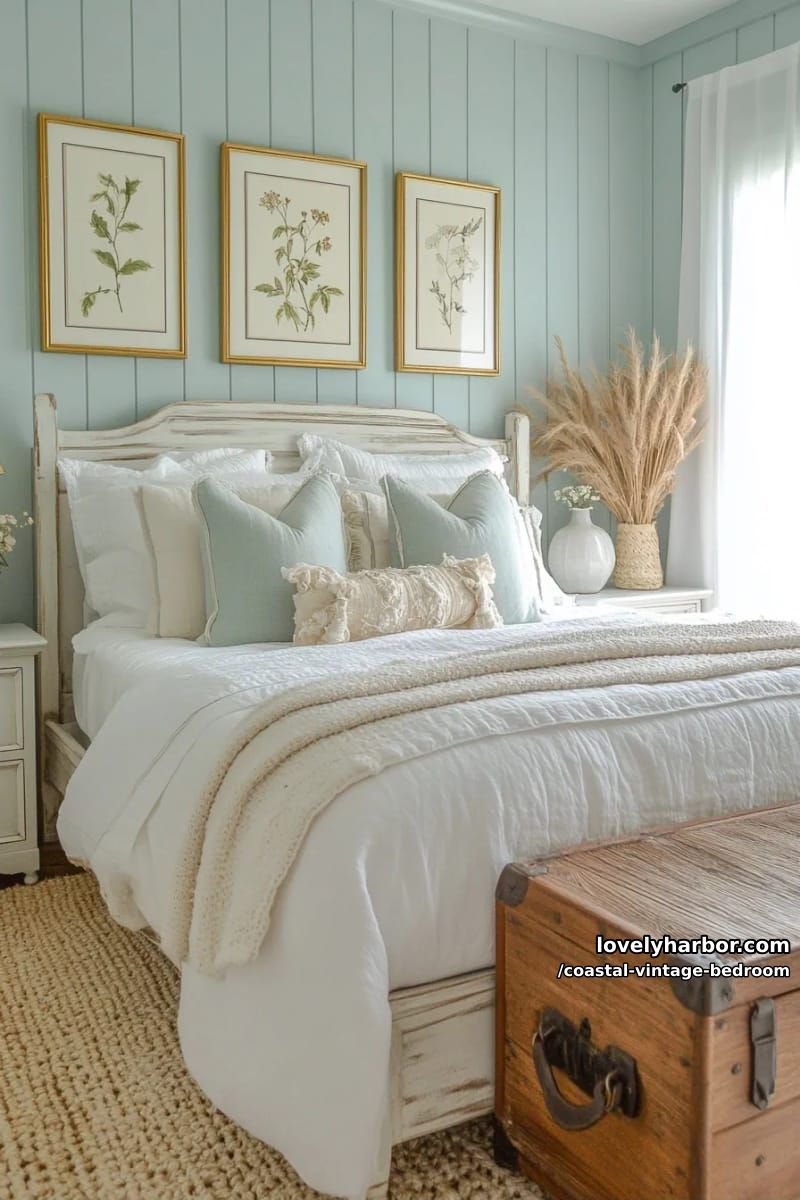
Pale aqua paneling sets the whole tone, and the color you choose matters more than the panel detail. Benjamin Moore's Palladian Blue and Farrow & Ball's Borrowed Light are the two that read coastal vintage rather than nursery, both soft enough to act as a near-neutral. Real tongue-and-groove beadboard costs more than the MDF panel sheets, but the MDF dents at the baseboard and you will see it, so spend here if you can.
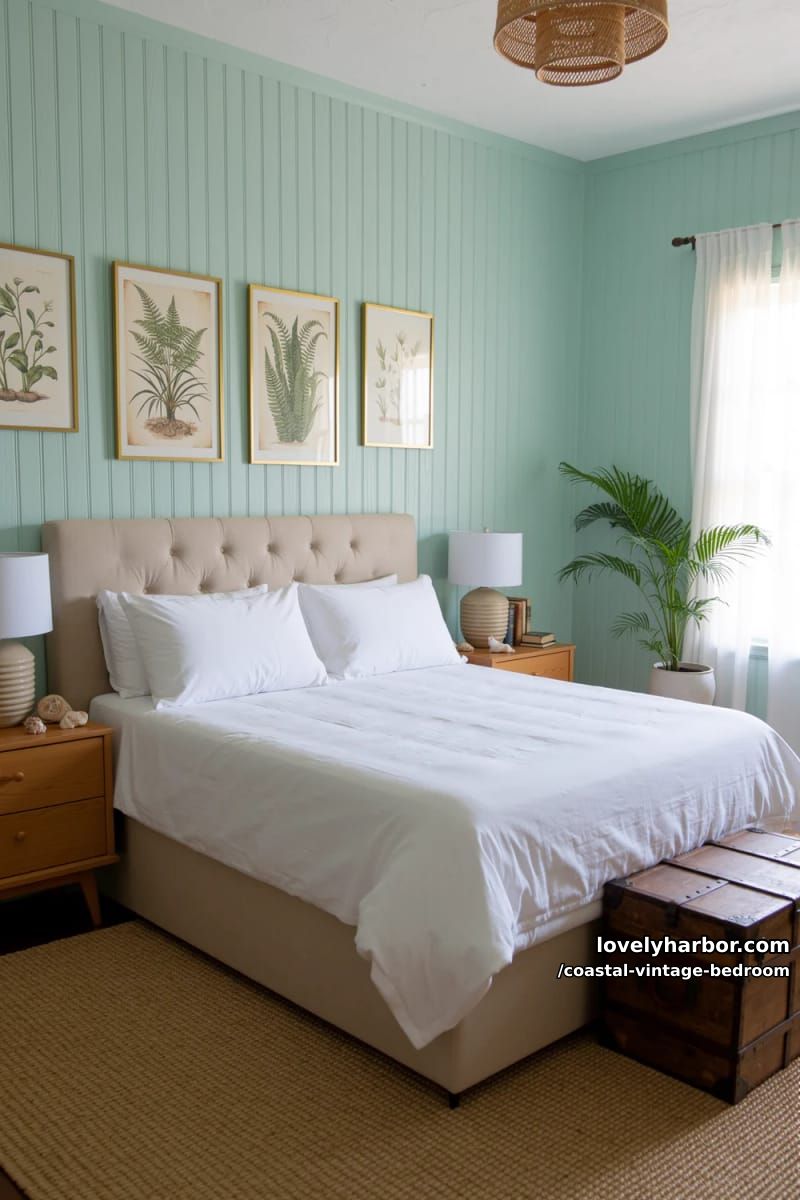
Against that wall, retro botanical prints add the lived-in note. The genuinely cheap source is old field guides and damaged botanical books: a torn spine means you can buy the book for a few dollars and frame six plates from it. Hang three or four favorites, not the whole set, or the calm wall you just painted disappears behind paper.
7. Brass bedside lamp on distressed nightstand with coral and sea glass
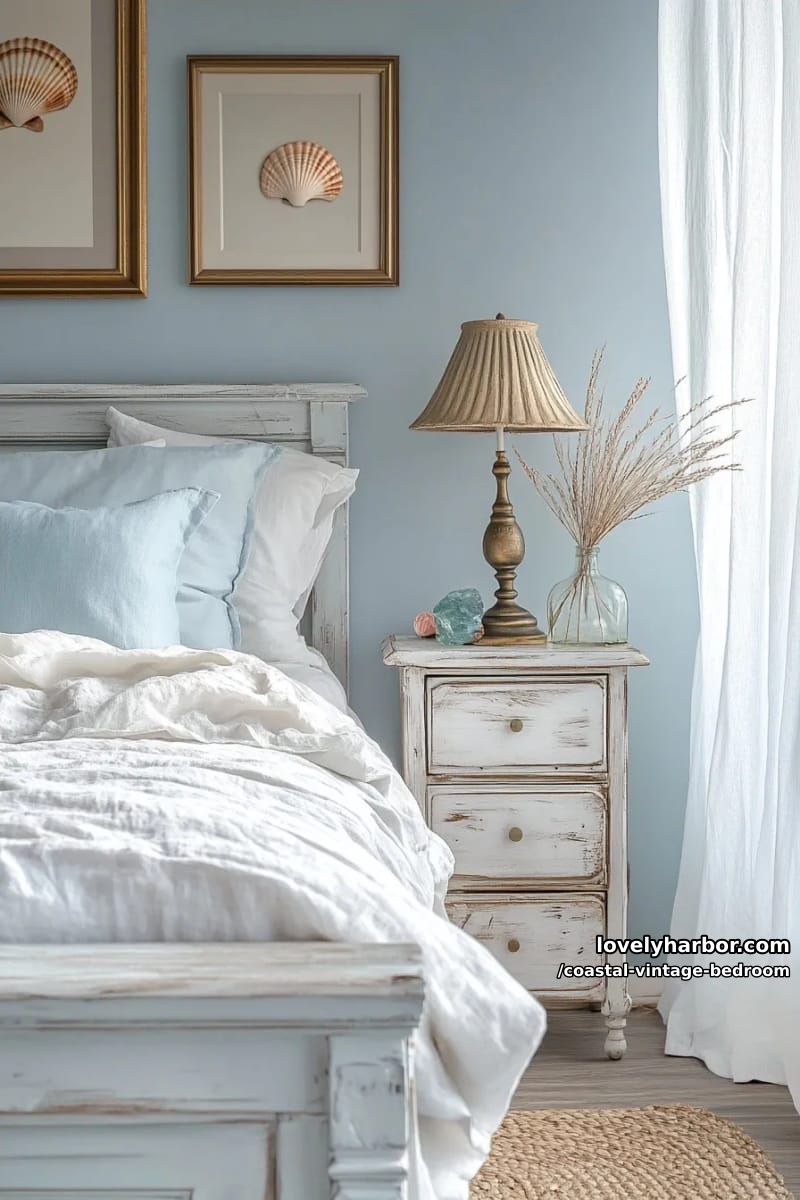
Buy unlacquered brass for the lamp, because the whole reason brass works in a vintage room is that it tarnishes, and a lacquered lamp stays a fixed shiny gold forever. Unlacquered patinas into something warmer over a year or two and you can polish it back whenever you want the shine. Cluster the lamp with a small dish of sea glass and a piece of coral on the distressed nightstand.
Two honest notes on those props. Real coral is a protected organism and most of it crosses borders under CITES restrictions, so a resin replica is both cheaper and the only choice I would make. And sea glass is quietly disappearing: it takes roughly 20 to 50 years of tumbling to form, single-use plastic replaced the glass bottles that used to feed the supply, and the 1988 Ocean Dumping Ban Act cut off another source. Most of what is sold online now is tumbled in a machine.
Machine-tumbled glass is uniformly frosted all over, like a sandblasted bead. Real sea glass is unevenly pitted, with tiny C-shaped marks and the occasional shiny spot the surf never reached. If a seller has hundreds of identical pieces in a rare color like orange or red (the colors that genuinely sell for serious money), it is tumbled. Decorative tumbled glass is fine to buy; just do not pay real-sea-glass prices for it.
8. Gingham and ticking stripe pillows on tufted headboard with lace trim
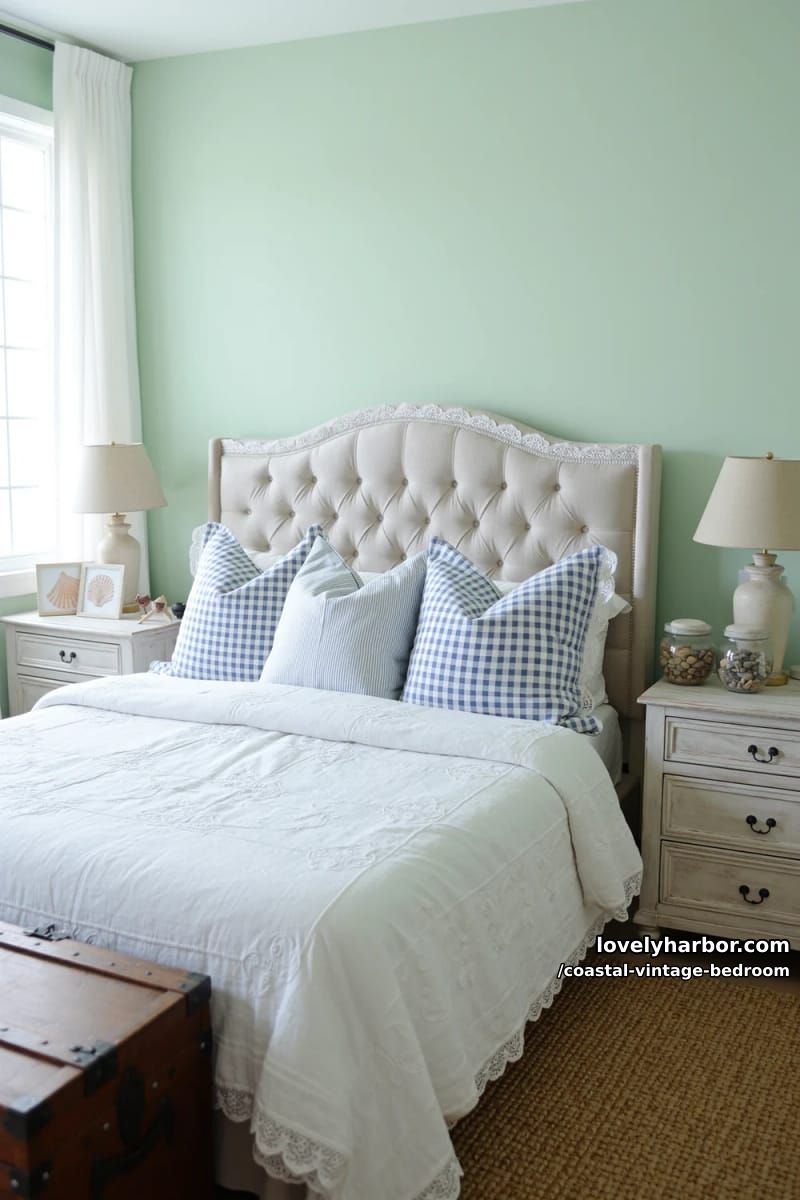
Mixing gingham and ticking works because the patterns are different scales of the same idea, a small check against a long stripe, both in soft blues and sandy tones. Ticking earns its place in a vintage room honestly: it started as the tightly woven fabric that kept feather mattresses and pillows from leaking, so it has been in bedrooms for two centuries. The lace trim on the headboard is the one delicate element, and a little goes a long way.
Do this
- Keep every pattern inside one tight color family so the eye reads texture, not chaos.
- Vary the scale. A small gingham check next to a wide ticking stripe; never two patterns the same size.
- Let one solid pillow rest the eye between the busy ones.
Avoid
- Three loud patterns and no solids, which is where a bed starts to vibrate.
- New, crisp-white lace. It reads bridal, not vintage; tea-stain it or find the yellowed real thing.
- Matching everything to a store’s coordinated “collection,” the fastest way to look like a catalog page.
9. Vintage surfboard propped against shiplap wall with soft linen curtains
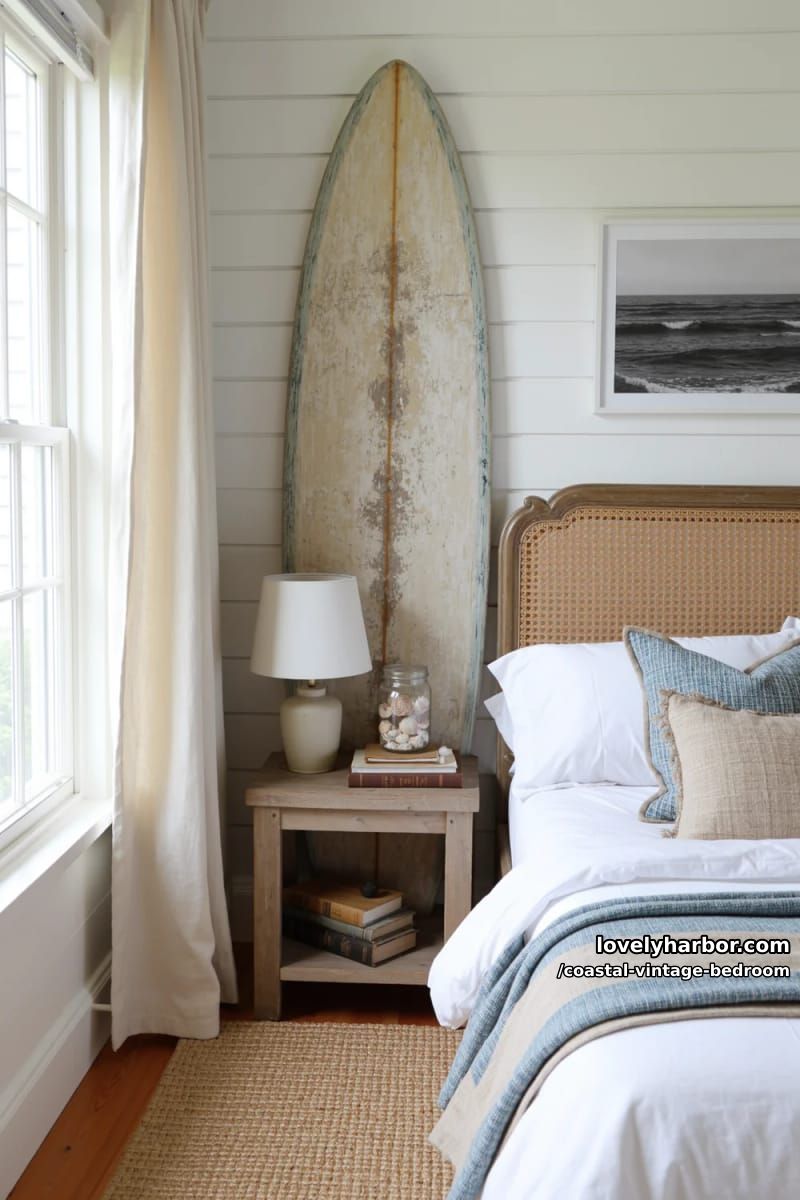
A leaning surfboard gives the room a single confident focal point, but know what you are buying. A genuine vintage longboard, especially a balsa or early foam shaped board, is a collector's item that can run into the thousands, so for pure decoration a beaten-up old foam board or a decorative repro does the job for a fraction of that. The dings and sun-yellowed glassing are the appeal; do not restore them out.
Behind it, real shiplap with its little nickel gap looks better than the painted-on grooves of a peel-and-stick panel. Granted, shiplap got worked half to death after Fixer Upper, so if it already feels tired to you, plain wide planks or even a flat painted wall let the surfboard and the soft linen curtains carry the coastal note on their own.
10. Cottagecore floral wallpaper behind whitewashed spindle bed and woven rug
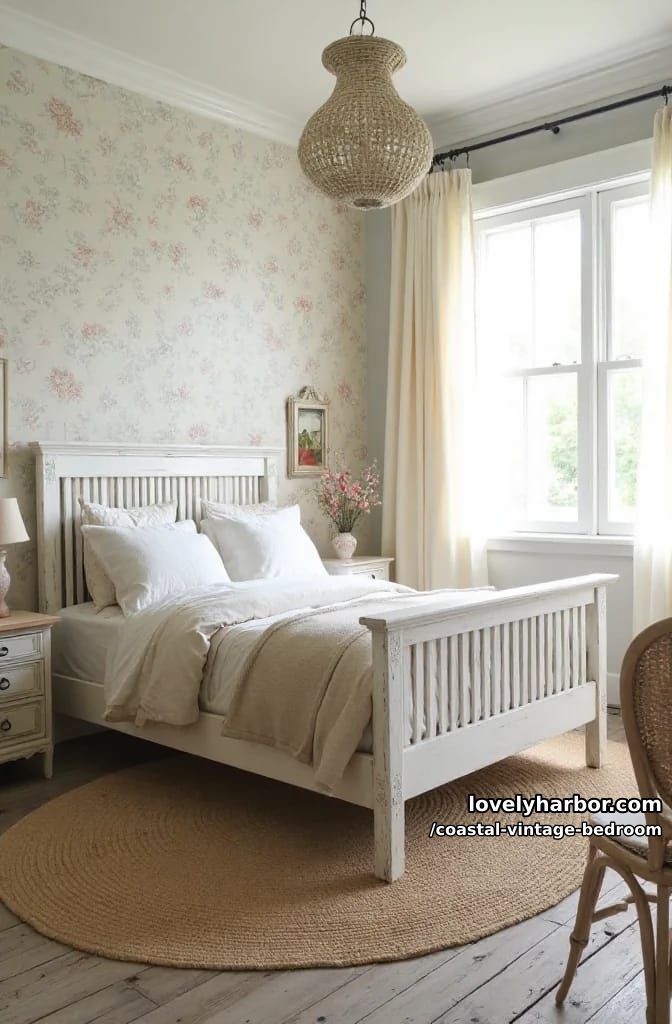
Put the floral wallpaper on one wall, behind the bed, and let the other three stay quiet. A faded small-scale floral is where cottagecore and coastal overlap, and peel-and-stick versions now look convincing enough that renters are not locked out, though traditional paste paper still beats them on color depth if you own the place.
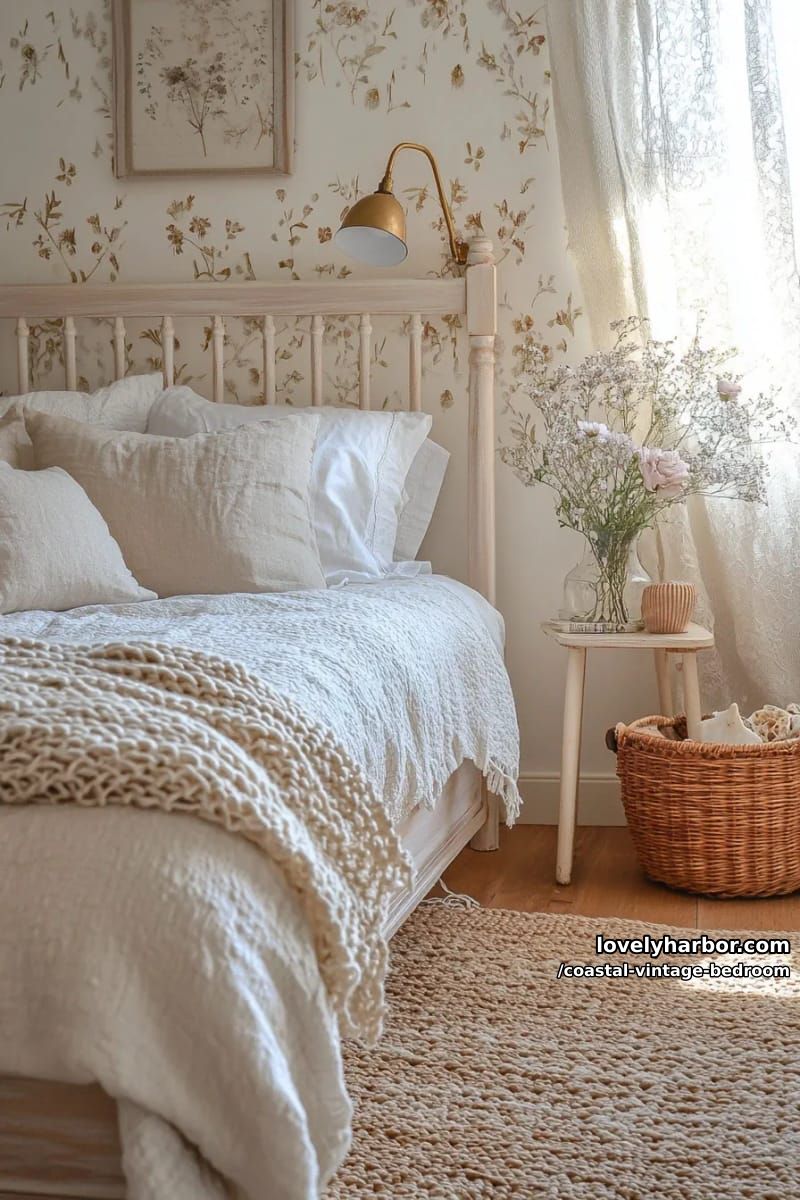
A whitewashed spindle bed keeps the wood grain visible under the paint, which a solid coat would hide, and you can mix your own whitewash by thinning white paint roughly one part water to one part paint and wiping it back with a rag. The woven rug underneath should be jute or seagrass for warmth; just know jute sheds for the first few weeks, so vacuum without the beater bar until it settles.
11. Hanging rattan pendant light over cozy reading nook with sailboat art
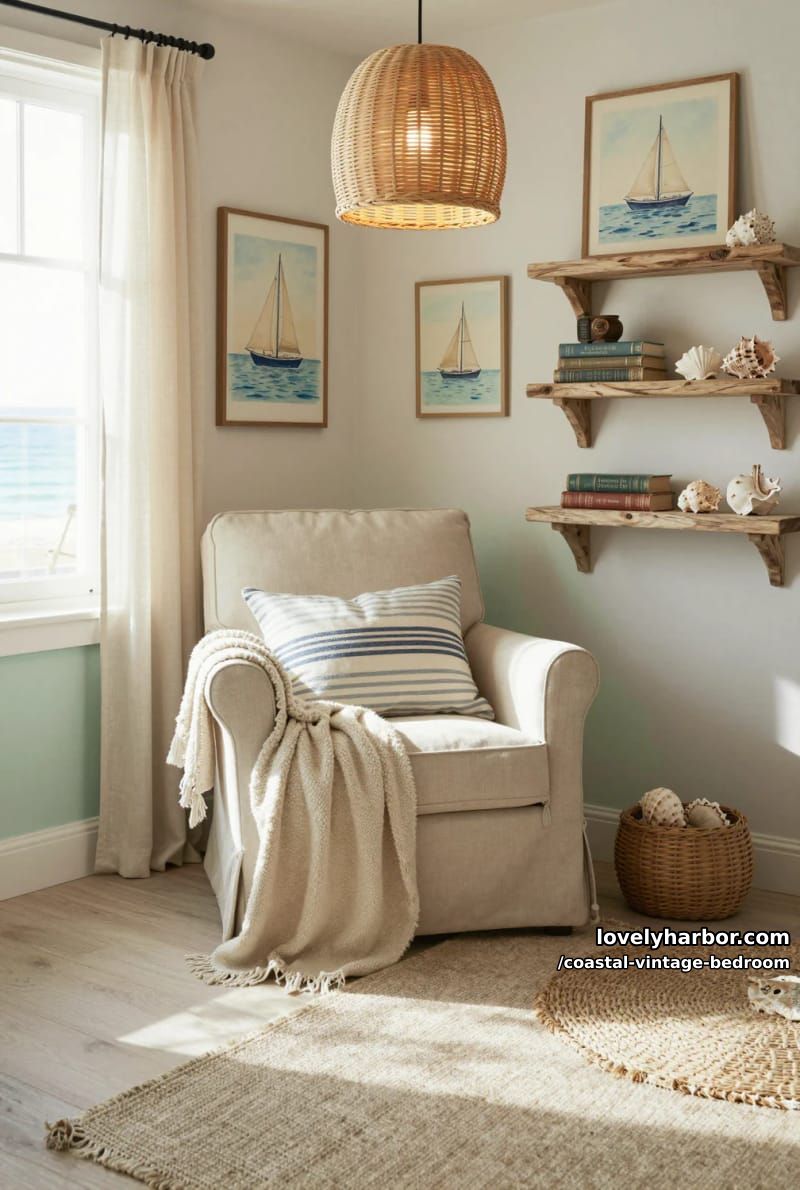
A rattan pendant casts a patterned, dappled glow that is lovely and almost useless for actually reading. Hang it for atmosphere and add a separate task lamp or a wall sconce at shoulder height for the page. Use a warm 2700K bulb so the woven shade glows amber instead of going cold and blue, and keep one small sailboat painting nearby rather than a wall of nautical clip art.
12. Layered oriental rug and sisal mat beneath pastel patchwork bedding
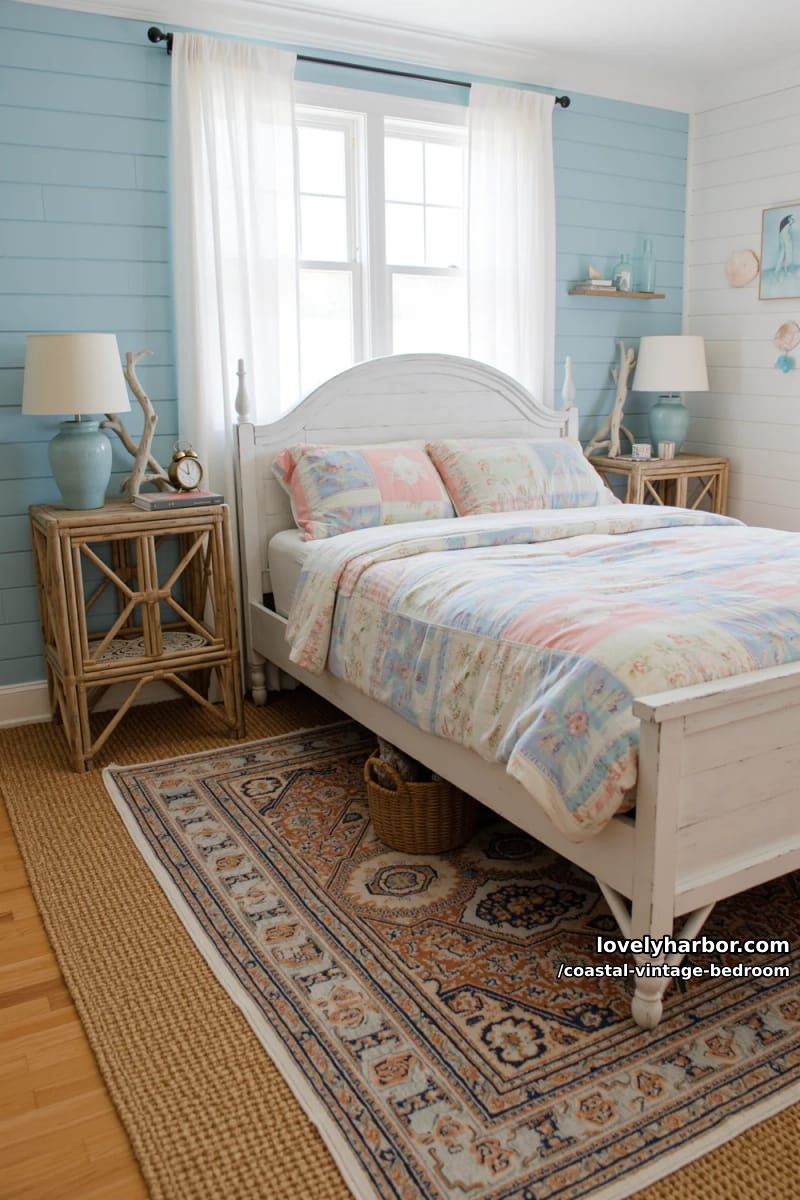
Layer the larger natural mat on the bottom and the smaller patterned rug on top, never the reverse, so the sisal frames the oriental rug like a mat frames a print. The natural base grounds the pattern and stops a busy rug from fighting the pastel patchwork on the bed.
Go for a faded or overdyed oriental in worn, low-contrast colors; a bright, high-contrast rug will pull every bit of attention off the soft bedding you chose it to complement. One practical caveat: sisal is scratchy and slick underfoot, which is fine as a layer but miserable as the thing your bare feet land on first thing in the morning, so let the soft rug cover the spot beside the bed.
13. Blue glass jug vases and antique books on coastal farmhouse shelves
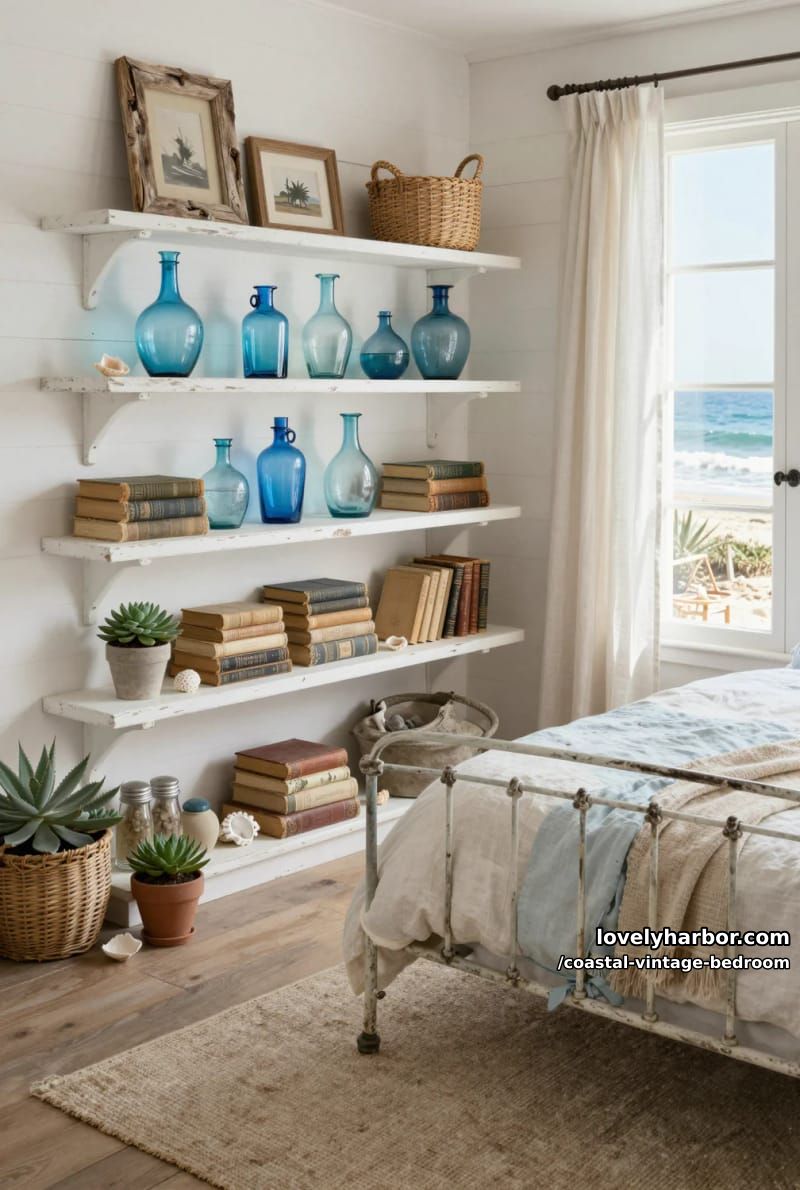
Old blue glass and a few faded books is the easiest, cheapest shelf in this whole list. Hunt vintage demijohns, carboys, and old cobalt Ball jars; thrift shelves are full of them, and they cost a few dollars each. The light through blue glass does the work, so group two or three jugs at different heights rather than lining them up like soldiers.
For the books, ignore the titles and arrange by the color and wear of the spines, cloth covers in faded blues, greens, and ochres, stacked horizontally and vertically in uneven piles. Nobody is reading these; they are texture. It is a forgiving look precisely because lopsided stacks are the goal.
14. Cane chair in corner with macramé pillow and shell mobile
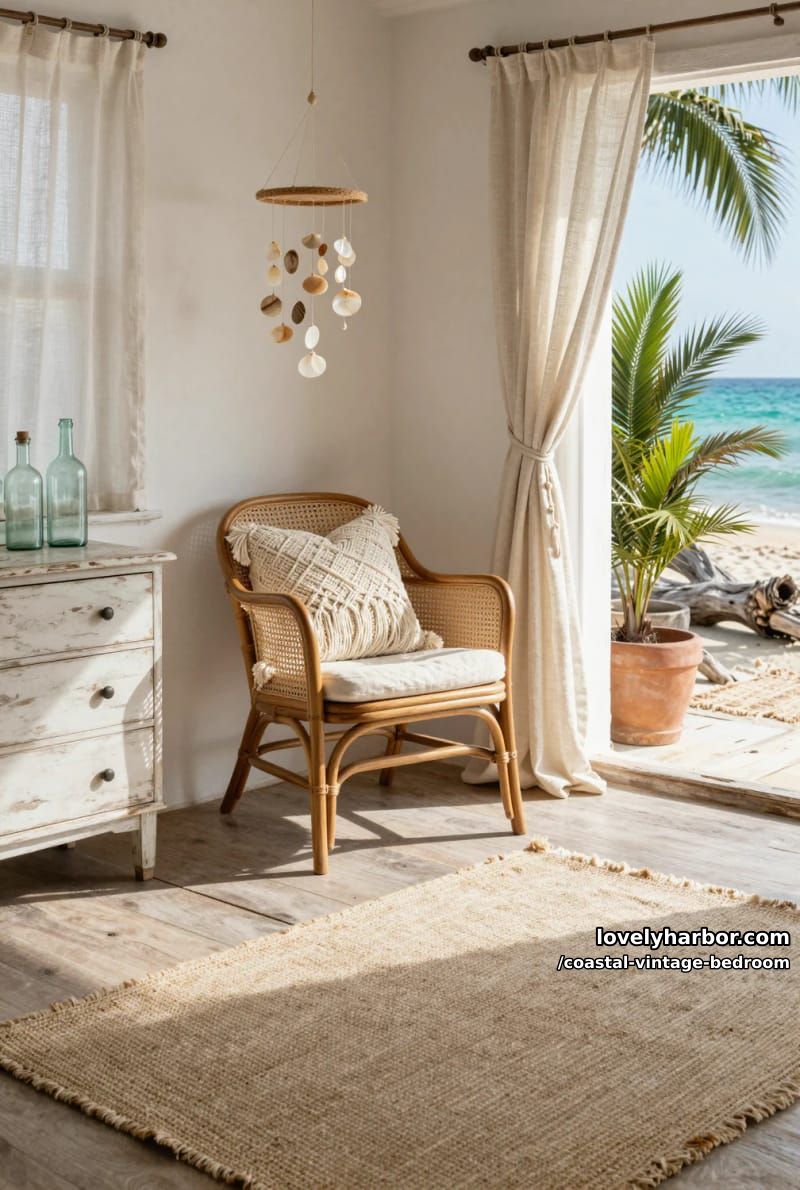
A cane chair fills a dead corner with warmth and a place to drop a sweater. Vintage cane seats are gorgeous and they do blow out eventually; re-caning a seat runs roughly $100 to $200 if you farm it out, so factor that in before you fall for a chair with a sagging seat. A chunky macramé pillow softens the frame and leans the corner slightly boho.
Hang a small shell mobile above it if you like the faint clink in a breeze, but keep it out of the main traffic path so you are not untangling it every time you walk past.
15. Old trunk coffee table at foot of bed with faded nautical maps
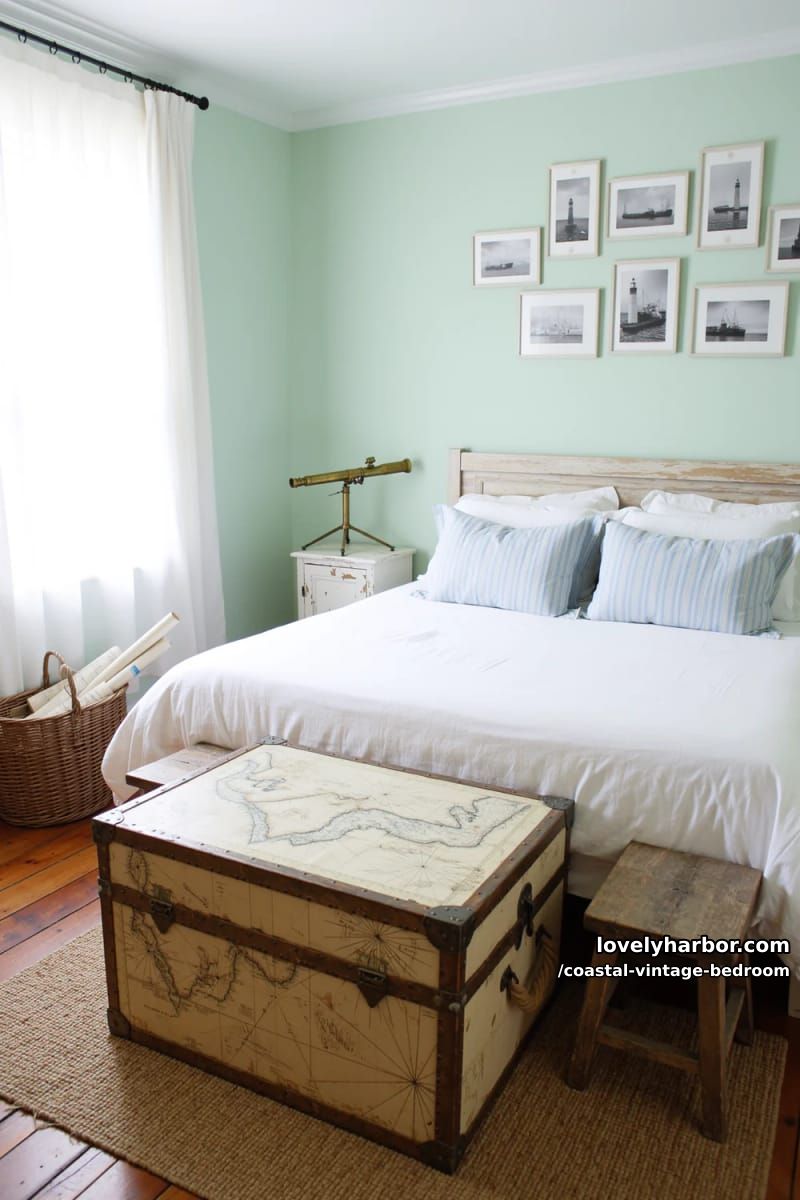
An old steamer trunk at the foot of the bed is the one piece here that genuinely earns its keep, working as a surface and as deep storage for off-season blankets. Look for solid wood and leather straps rather than the lightweight reproduction trunks; the real ones turn up at estate sales for $60 to $150 and have the dents that sell the story.
There is one thing nobody warns you about: vintage trunks almost always smell, a musty, mothball-and-cedar funk that lives in the old paper lining. Pull the lining if it is shot, wipe the interior with a vinegar solution, and leave it open in the sun for a day or two before you trust it with linens. On top, a single faded nautical chart under glass beats a pile of props; reproduction NOAA charts cost a few dollars and read just as well as a real antique map you would be nervous to set a coffee cup on.
Conclusion
If you do this in order it goes faster and costs less: settle the palette and the walls first (that pale aqua or a single floral wall), then bring in one hero piece you are willing to refinish, usually the dresser or the trunk, then let the small stuff accumulate slowly. The mistake is buying all fifteen ideas at once, which is how a room ends up looking like a coastal section at a home store instead of a place someone actually sleeps. Be patient with the sea glass especially; the real thing is getting rarer every year, and a near-empty dish of three good pieces says more than a bowl heaped with the machine-tumbled stuff.