
The gap between a hutch that reads collected and one that reads like a thrift-store booth is almost always restraint, plus a palette you can name in three colors or fewer. The ideas below run from a Swiss Coffee built-in to a dark green arched piece with brass pulls, and most of them hinge on the same two moves: leave shelves half-empty, and stop buying once the color story is told. Here is where to start.
| Hutch finish | What it does for the display | Watch out for |
|---|---|---|
| Crisp white (Chantilly Lace, White Dove) | Makes white ironstone and clear glass read intentional, almost gallery-like | Shows every fingerprint; needs a weekly wipe near handles |
| Warm cream (Swiss Coffee OC-45) | Softens the whole stack, forgiving in north-facing or low light | Goes yellow next to a cool marble or a true-white wall |
| Sage (French Gray, Saybrook Sage) | Reads neutral while still adding color; flatters wood and brass | Some sages skew English country, not American farmhouse |
| Dark green (Green Smoke) | Anchors a room, turns white dishware into the focal point | Eats light fast in a small or windowless space |
| Black with brass | Pushes the piece toward formal; high contrast with porcelain | Dust and smudges are far more obvious than on wood |
1. Distressed white farmhouse hutch with vintage floral china and potted plants.
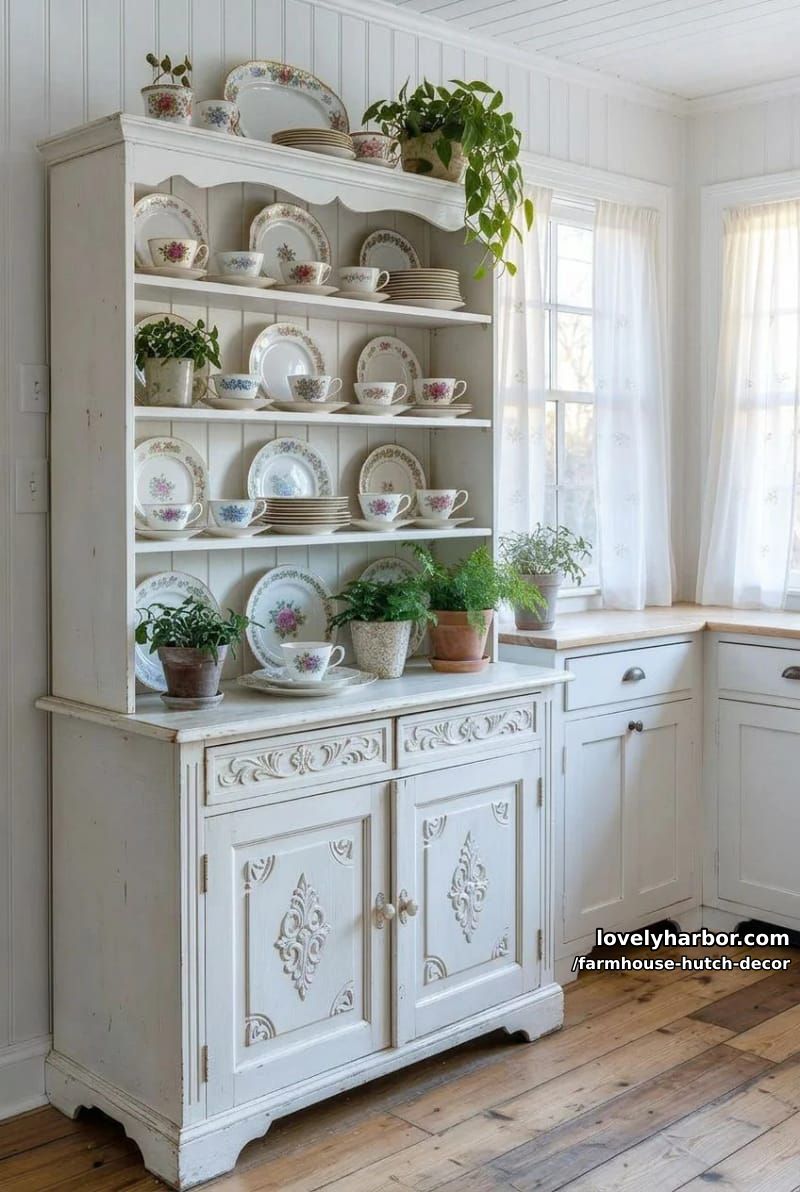
A distressed white hutch only works if the white underneath is warm. A creamy base like Benjamin Moore Swiss Coffee takes a light sanding on the edges and corners and looks aged; a cool sprayed lacquer just looks chipped. Keep the distressing to the spots a real piece would wear: door edges, the lip of each shelf, around the pulls.
For the china, vintage floral patterns from Johnson Brothers or Spode give you the faded-rose look without the eBay premium of Royal Albert. Tuck in a couple of small potted plants, English ivy or a four-inch fern, and hold the palette to creamy whites, soft greens, and one muted pink. I'll admit I used to love the heavily sanded chippy look from around 2012, then lived with a piece like that and got tired of it inside a year.
2. Bright farmhouse kitchen with white hutch and organized ceramic dishes.
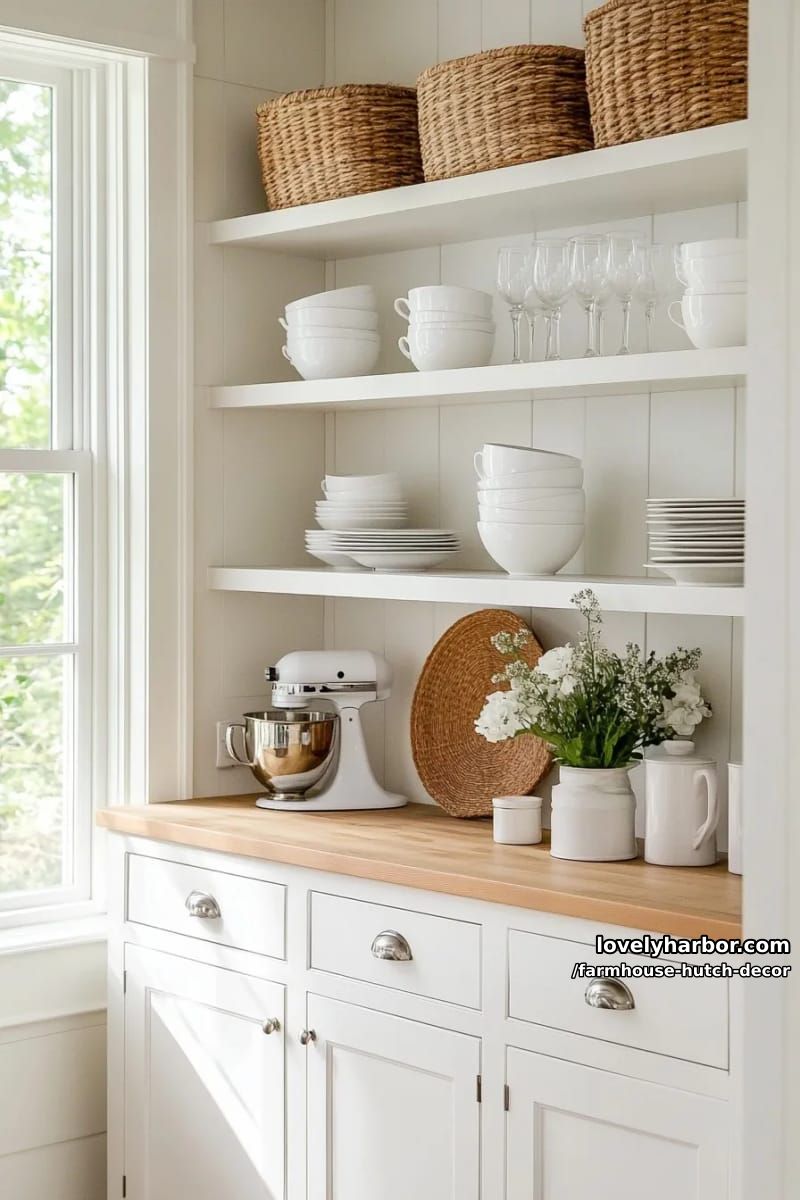
Organize by color and height, not by matching set. A white hutch turns plain ceramics into something worth looking at because the background disappears and the shapes carry the shelf. Stack plates in graduated piles, stand a row of cups behind them, and let one taller pitcher break the line.
White does show fingerprints near the handles, so a quick wipe with a microfiber cloth keeps it sharp. The cleanest result comes from limiting yourself to one or two dish colors, vintage white ironstone plus a single accent, rather than the full rainbow of mugs most of us have accumulated.
3. Sage green farmhouse hutch styled with vintage jars.
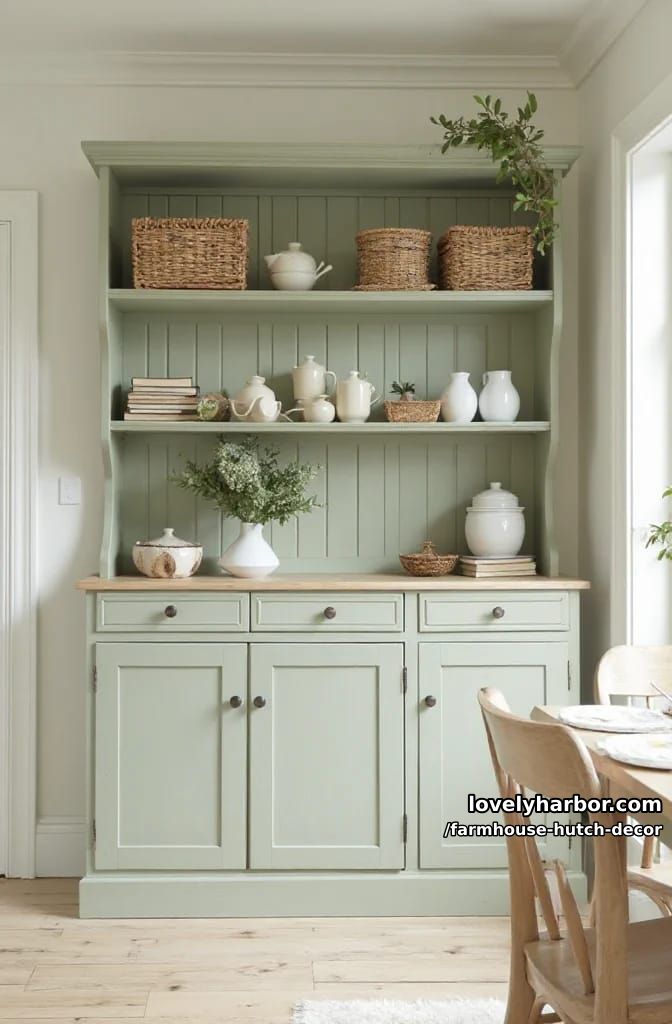
Sage is the lowest-risk color upgrade you can give a hutch, which is exactly why everyone reaches for it. The trick is picking the right one. Farrow & Ball French Gray bends almost neutral and shifts through the day; Benjamin Moore Saybrook Sage softens a room while still reading green; Sherwin-Williams Clary Sage leans herbal and a touch warmer. Avoid anything too gray-blue, which tips the whole piece toward Edwardian rather than farmhouse.
Style it with a mix of vintage jars, woven baskets, and a ceramic pitcher, then resist the urge to fill the rest. The color is doing most of the work, so a few well-spaced objects let it breathe.
On any shelf, aim to leave roughly a third of the visible length unoccupied. That negative space is what separates a curated hutch from a crowded one, and it is the single edit most people skip because empty shelf feels like wasted shelf. It isn’t.
4. Farmhouse hutch with string lights, white ceramics, baskets, and greenery.
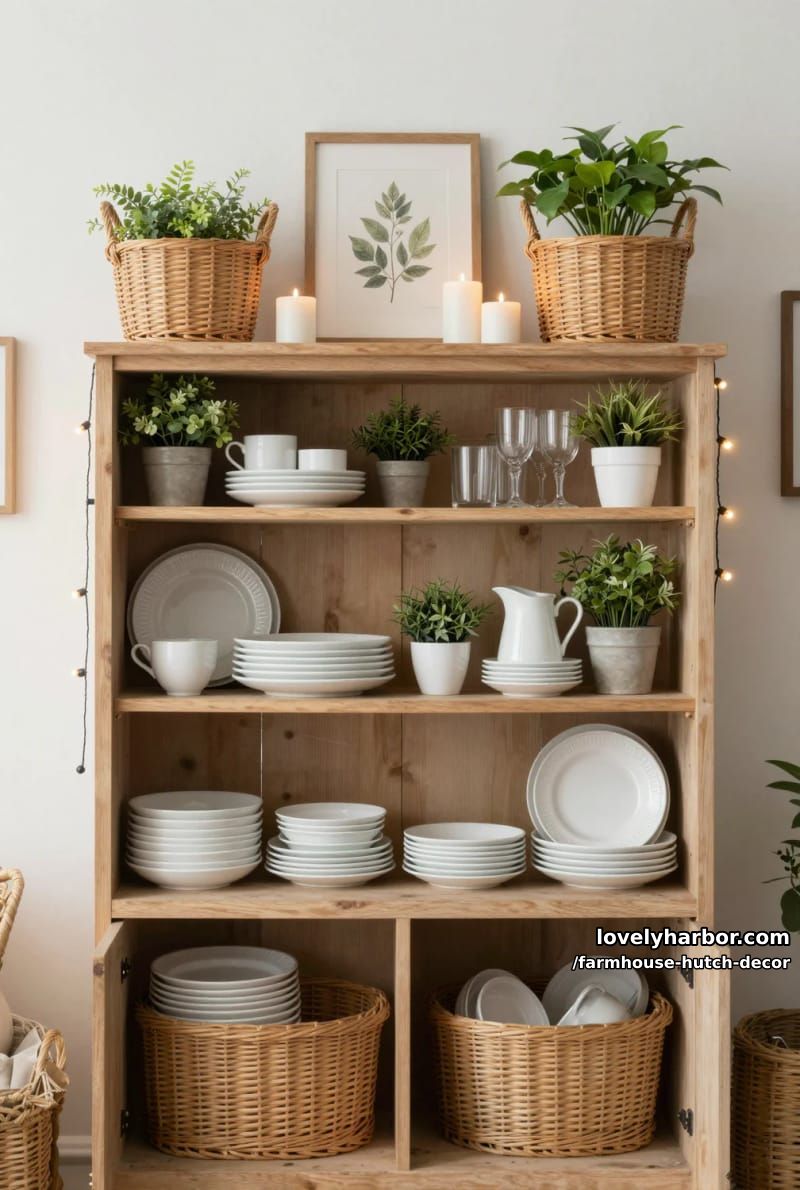
Run warm string lights along the inner edge of the hutch and the whole piece glows at dusk. Use a 2700K to 3000K warm-white set on a battery timer so you are not trailing a cord across the wall; the cool blue-white LEDs sold for outdoors will make your ceramics look gray.
Stack white plates, pitchers, and bowls for the clean base, then slide a couple of baskets onto the lower shelf to swallow the clutter. A sprig of faux eucalyptus is plenty. Go past two or three pieces of greenery and the shelf starts to look like a garden center.
5. Rustic dining room with white hutch, vintage crate centerpiece, and farmhouse decor.
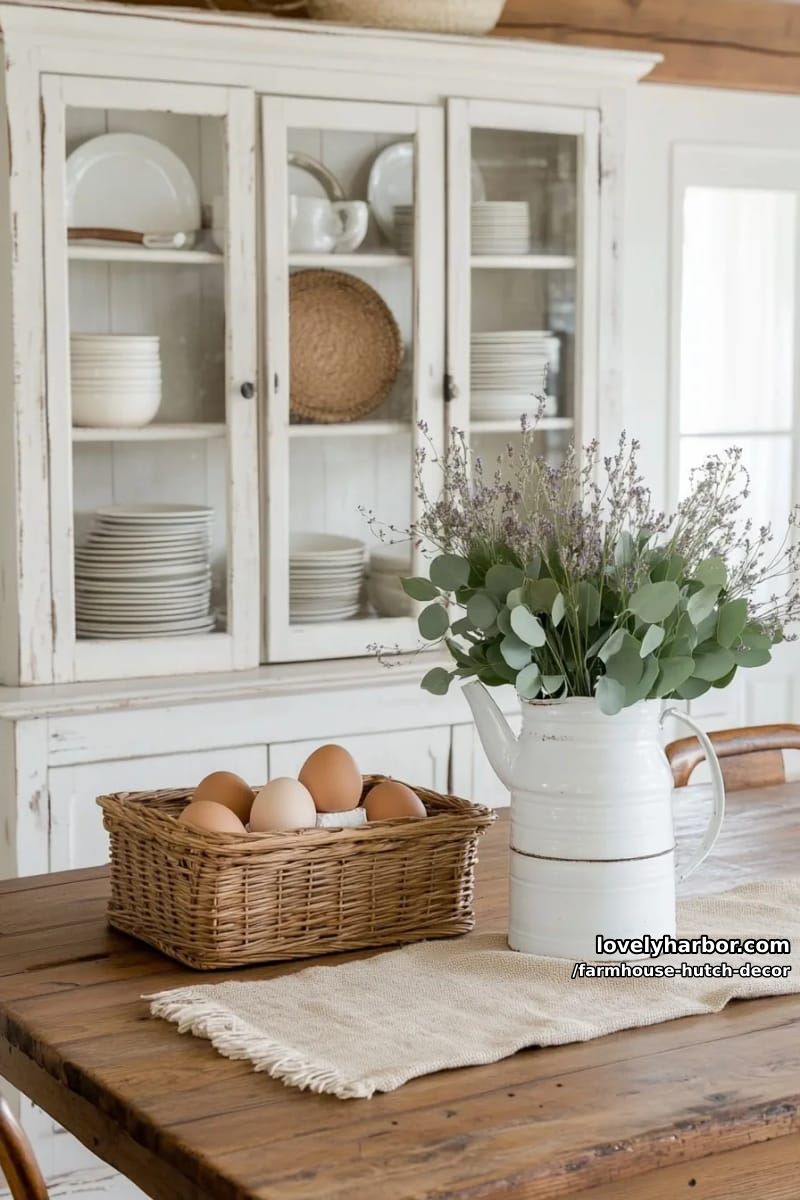
A white hutch behind the table keeps the backdrop calm so antique plates and mason jars stand out. The real workhorse here is the vintage crate centerpiece: fill it with greenery one month, candles the next, seasonal fruit the month after. The worn wood plays against the painted hutch, and you can reset the whole table look in five minutes without buying anything new.
6. Cream built-in kitchen hutch with organized whiteware, baskets, and green foliage.
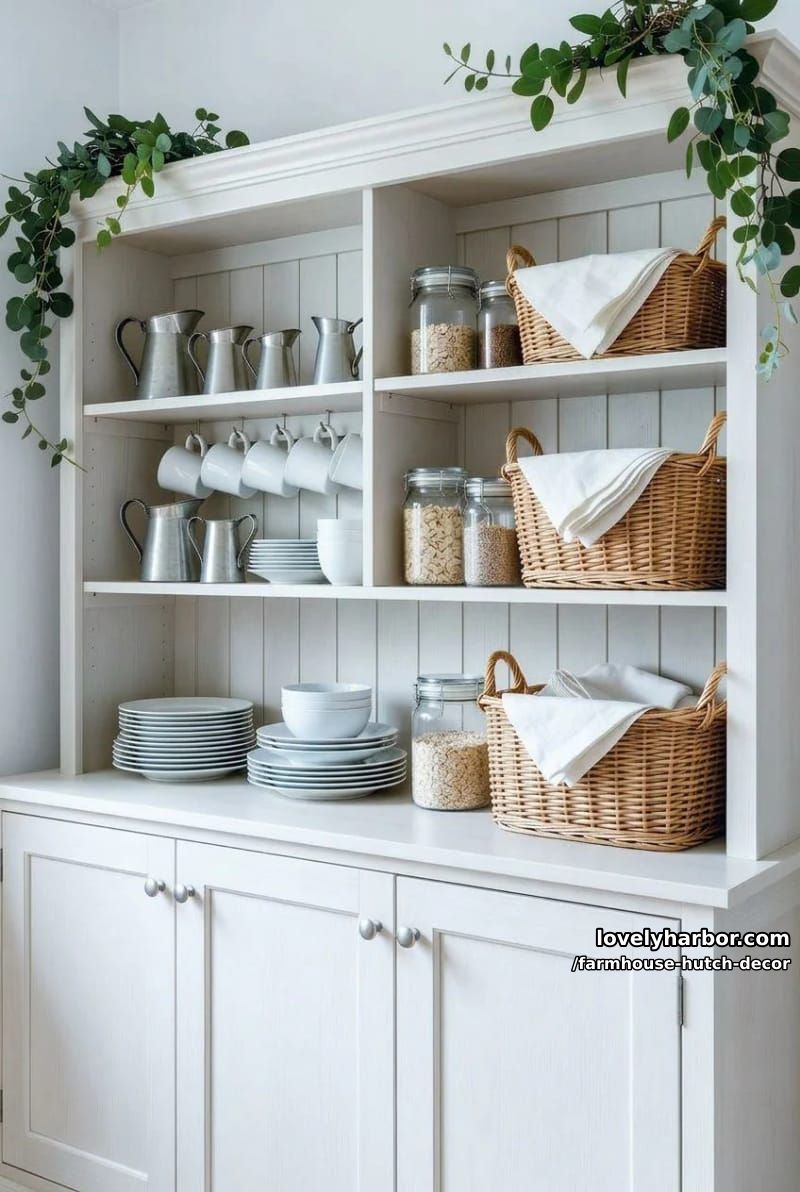
A cream built-in gives whiteware a quieter backdrop than stark white does, which is why Swiss Coffee shows up on so many cabinetry jobs in lower-light kitchens. The dishes stay the focus; the wall just recedes.
Lined baskets handle the napkins and stray utensils, and a single trailing plant brings the shelf to life. One honest caveat: open baskets collect dust along their rims, so pull them out and shake them every couple of weeks. If natural light is thin, faux foliage holds up better than a struggling pothos.
7. White hutch with dark countertop, filled with farmhouse kitchen decor and ceramics.
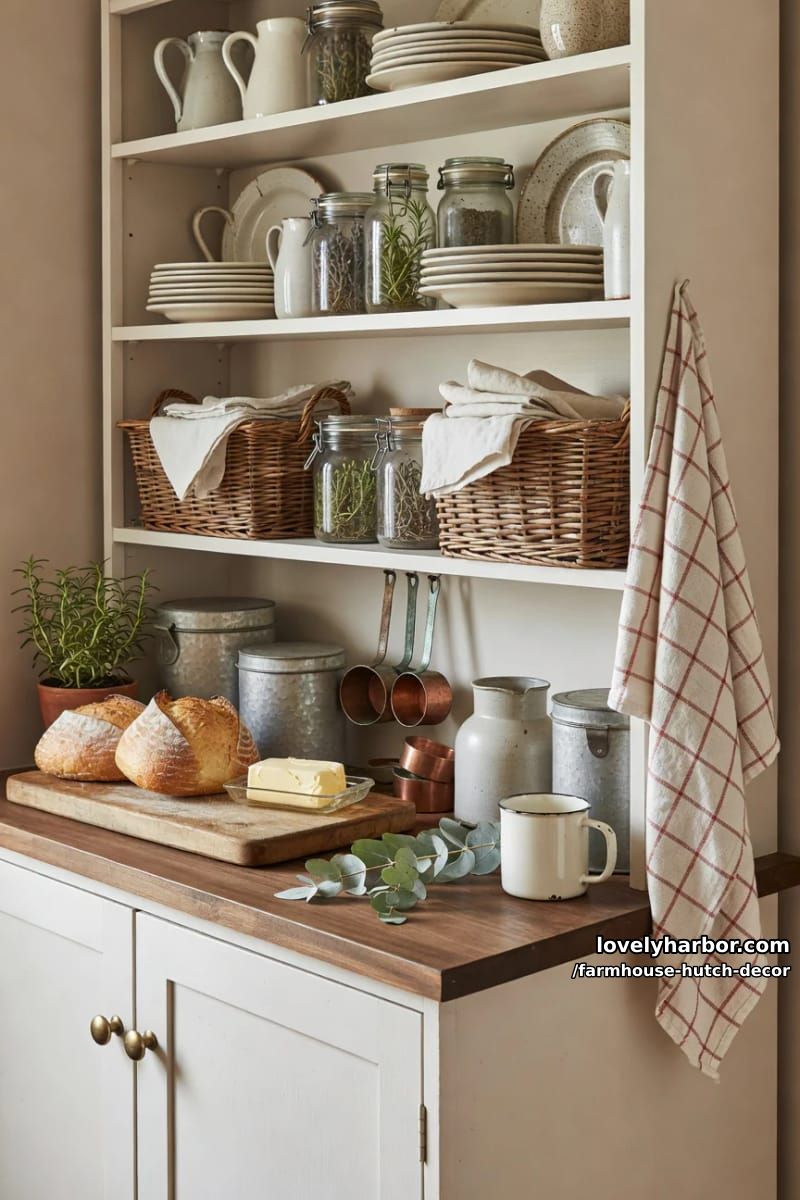
The dark counter is what makes this combination work, grounding the white body and giving the eye somewhere to land. Stack vintage pitchers and speckled bowls next to a woven basket, add a wooden spoon crock and a gingham runner, and stop there.
Give each ceramic piece room. A chipped butter crock next to a new mason jar reads as a real collection; a shelf packed edge to edge reads as storage. The dark surface keeps the white dishes from washing out under bright kitchen light.
8. Eclectic wooden hutch displaying vintage kitchenware, green glass, and floral plates.
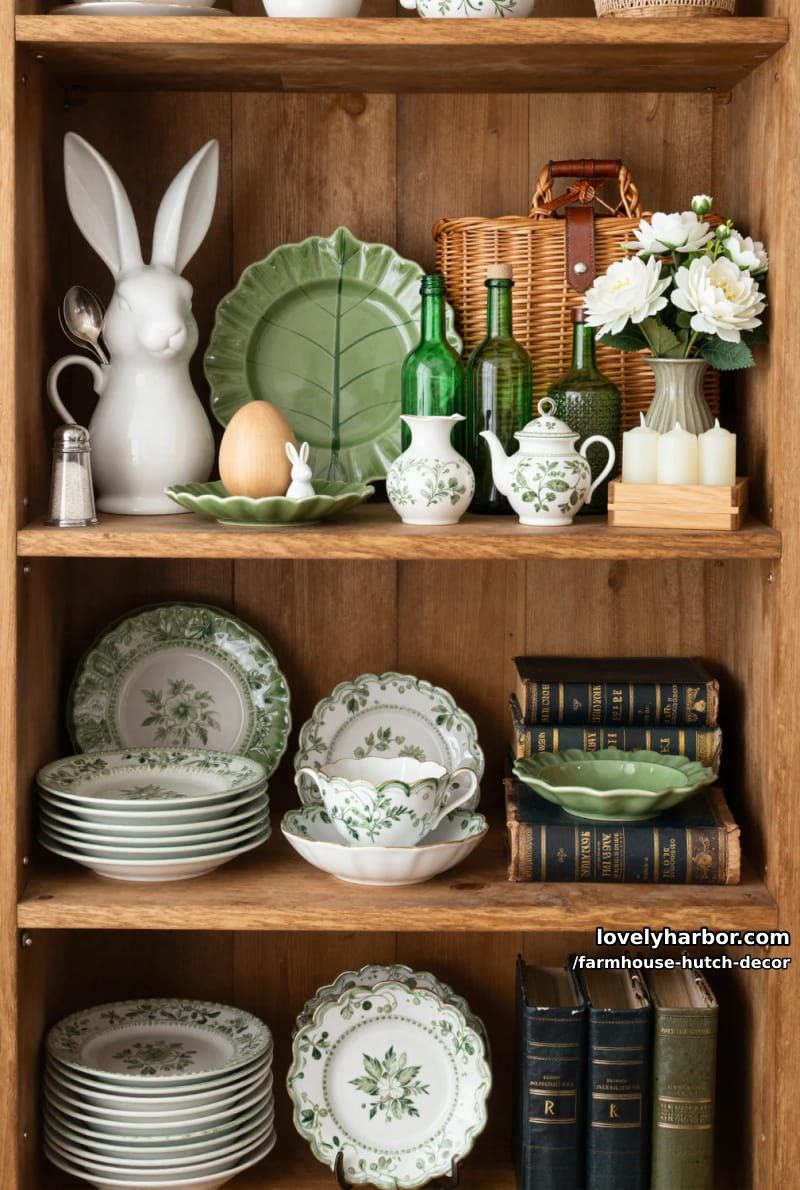
Green glass against creamy ceramics is the move that gives a wooden hutch its character. Hunt for actual vintage depression glass, Anchor Hocking in green or Fire-King Jadeite, rather than the new reproduction stuff that photographs flat. A few emerald goblets or a green pitcher catch the light in a way white never will.
Floral plates add gentle color, and nobody said farmhouse means everything matches. Group objects in odd numbers, vary the heights, and let the chips and faded paint stay. Those are the marks that say a real family ate off these, which is the whole point of buying old.
9. Weathered wood hutch in sunlit corner with white dishes and copper accents.
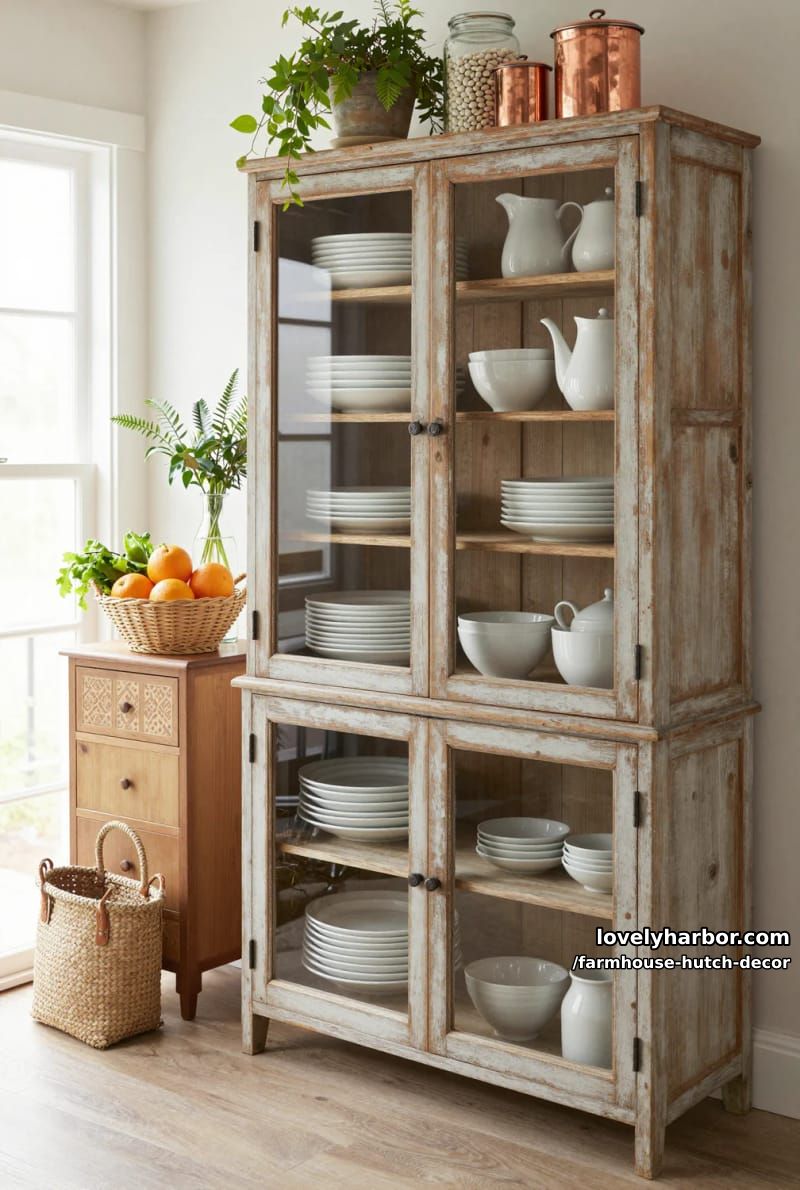
Put a weathered wood hutch in a sunny corner and the faded grain warms up immediately, with white dishes reading crisp against it. Copper is the accent that earns its keep: a small pot, a measuring-cup set, a kettle. Real copper from a maker like Mauviel or even a thrifted vintage piece develops a patina that the shiny copper-plated decor from craft stores never will.
Keep the copper to a handful of pieces, because it is both functional kitchenware and the warm metallic note in the corner. More than that and the shelf turns into a hardware display.
10. Tall vintage display cabinet with neutral ceramics and warm wood grain.
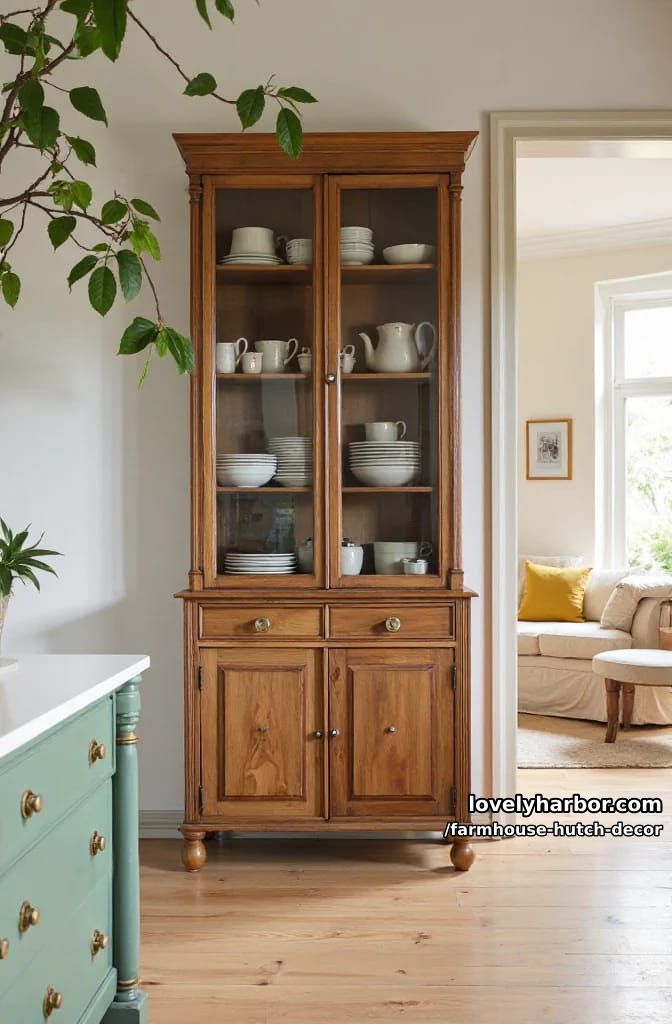
Limit the palette and vary the heights. A tall cabinet with a few neutral ceramics against warm wood grain looks composed precisely because it is sparse, and the soft creamy pottery plays well against the deeper tone of old timber. Some people will call this empty. Let them.
11. White hutch with dark wood top, monogram print, flowers, and ceramic decor.
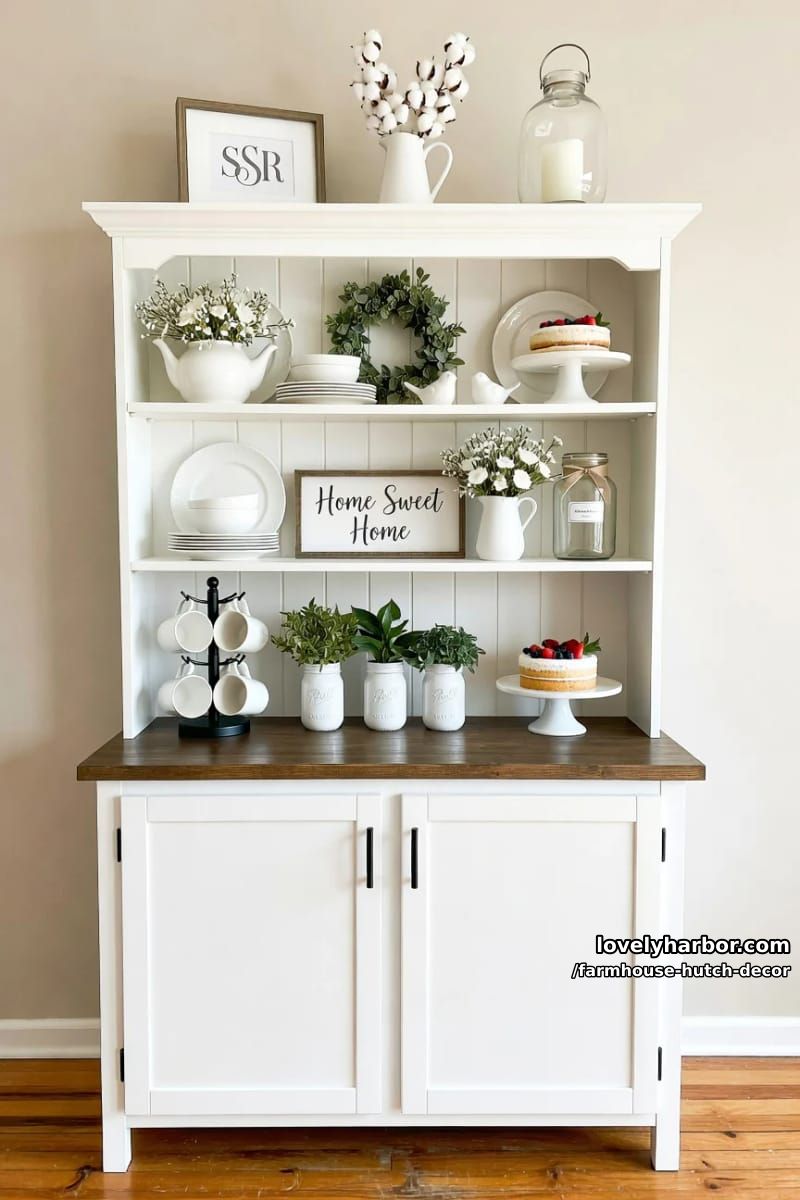
A white body with a dark wood top hands you instant contrast, and a small monogram print is the piece that makes it yours. Lean a framed initial against the back of a shelf to break up the run of ceramics and flowers without committing to a nail in the wall.
Ceramic jars and pitchers carry texture; a loose bunch of fresh flowers softens the whole thing. Mix older pieces with new freely. Swap the display each season and the dusting takes care of itself.
12. Brown carved hutch with white ceramics, vintage canisters, and rolling pins.
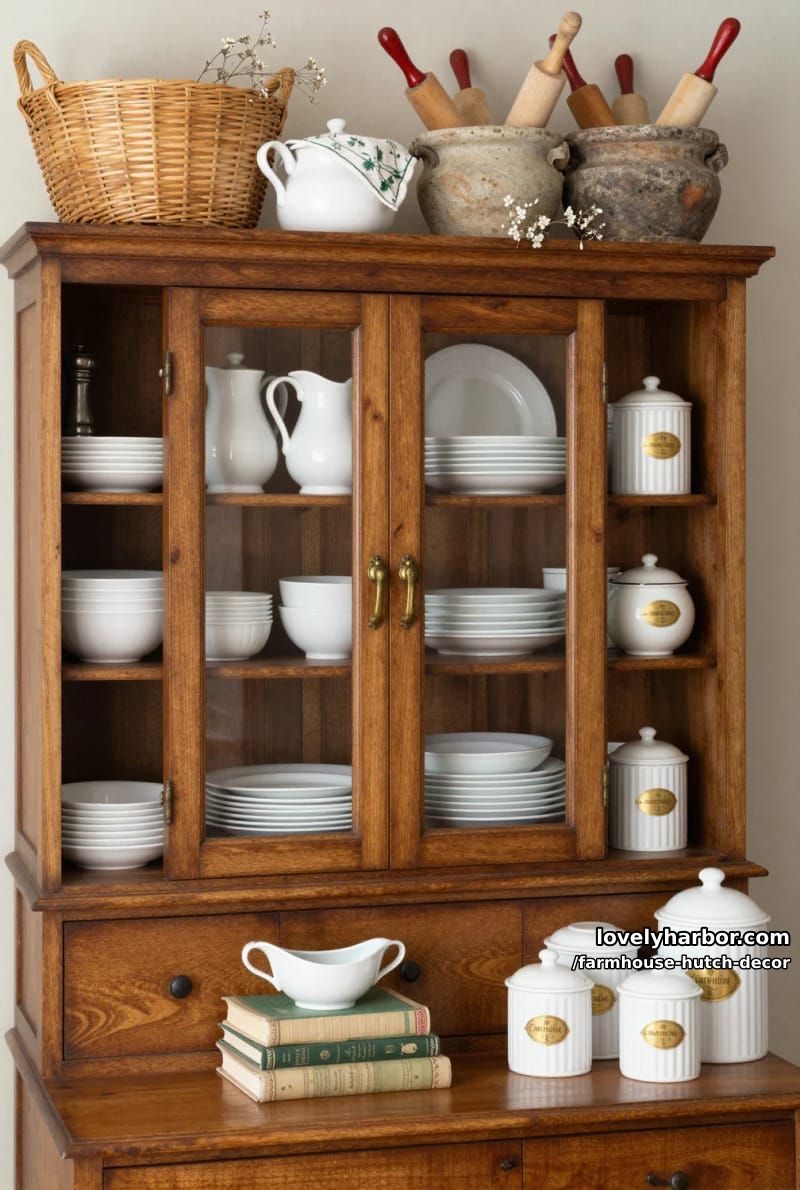
White ceramics against a dark carved hutch give you the crispest contrast in this whole list. Add vintage canisters with labels gone soft from age and a pair of wooden rolling pins, set the tall pieces at the back and the short ones in front, and the depth reads on its own.
If you have delicate transferware or thin porcelain, keep it behind the glass doors. That carved wood is a dust trap, and anything out in the open will need a wipe more often than you would like.
13. Elegant black china cabinet with gold hardware and white porcelain dishes.
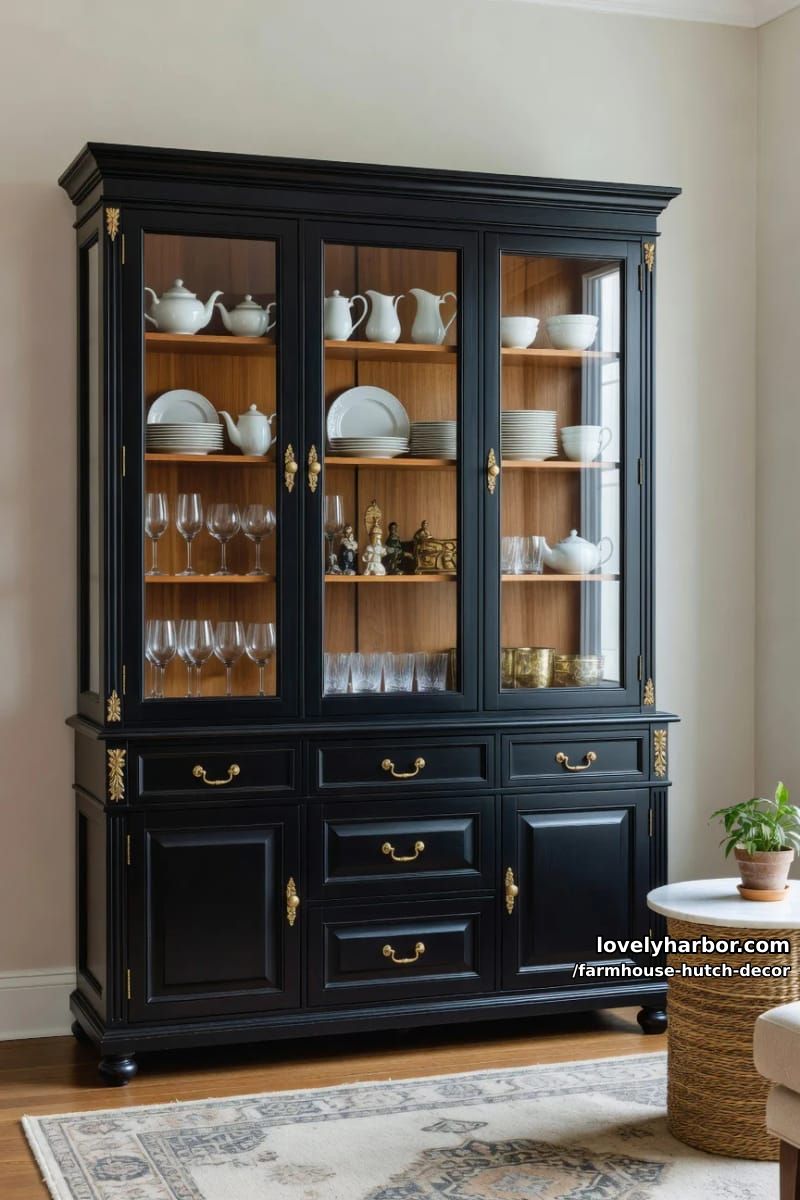
Black with gold hardware drags a farmhouse hutch toward formal, and that is the appeal. A soft black like Sherwin-Williams Tricorn Black or Farrow & Ball Off-Black reads richer than a hardware-store jet black, and crisp white porcelain pops hard against it. This is the one finish where I would skip the rustic mismatched look and go matched, because the contrast is already doing something dressy.
Here is the honest tradeoff, not a disclaimer dressed up as one: black surfaces broadcast dust and smudges far more than wood, so this piece wants a microfiber wipe roughly weekly to stay sharp. Soften the formality with a little trailing greenery or one woven basket among the porcelain.
14. Cream hutch with natural wood top, glassware, baskets, and potted plants.
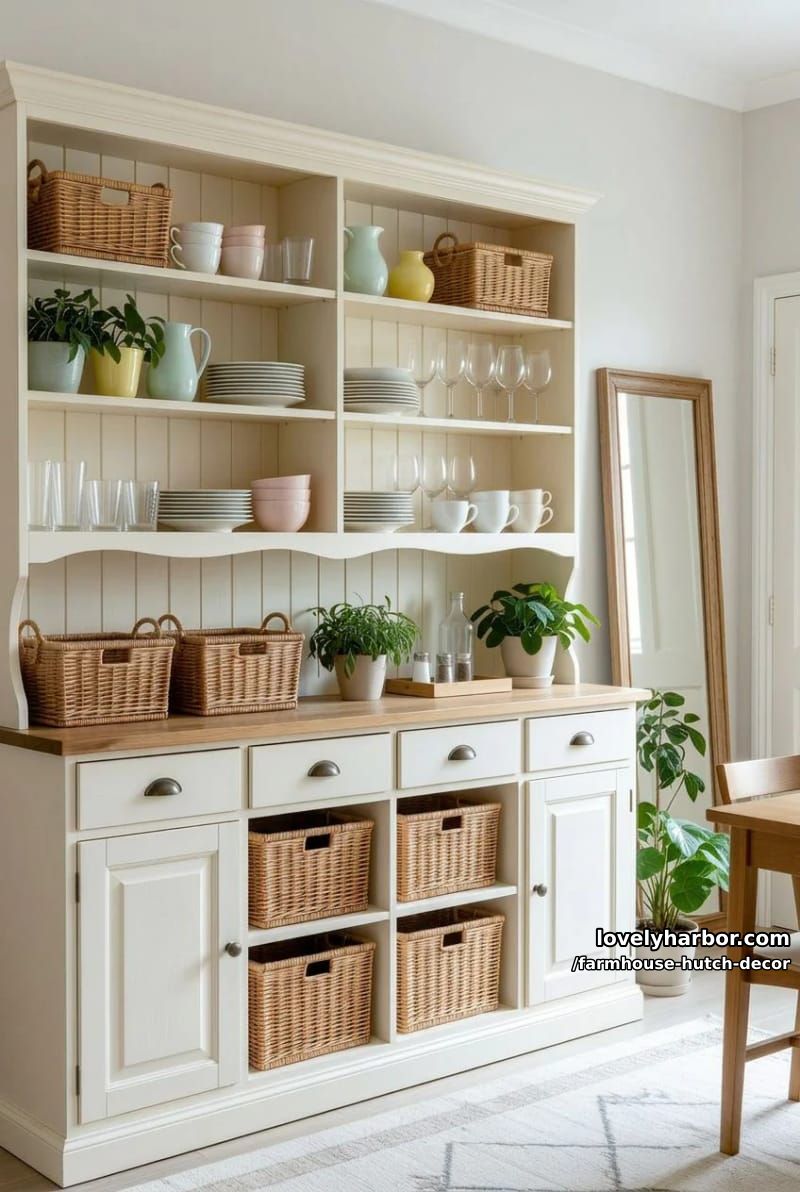
A cream hutch with a raw wood top wants clear glassware up high, where the light passes through it, and baskets down low for texture and storage. Add one or two small potted plants and stop counting.
The failure mode is overloading. A single trailing ivy, one woven basket for linens, and a short row of plain drinking glasses is the entire recipe; a basket on every shelf turns the airy look into a cluttered one fast.
15. Dark green hutch with arched doors and brass handles.
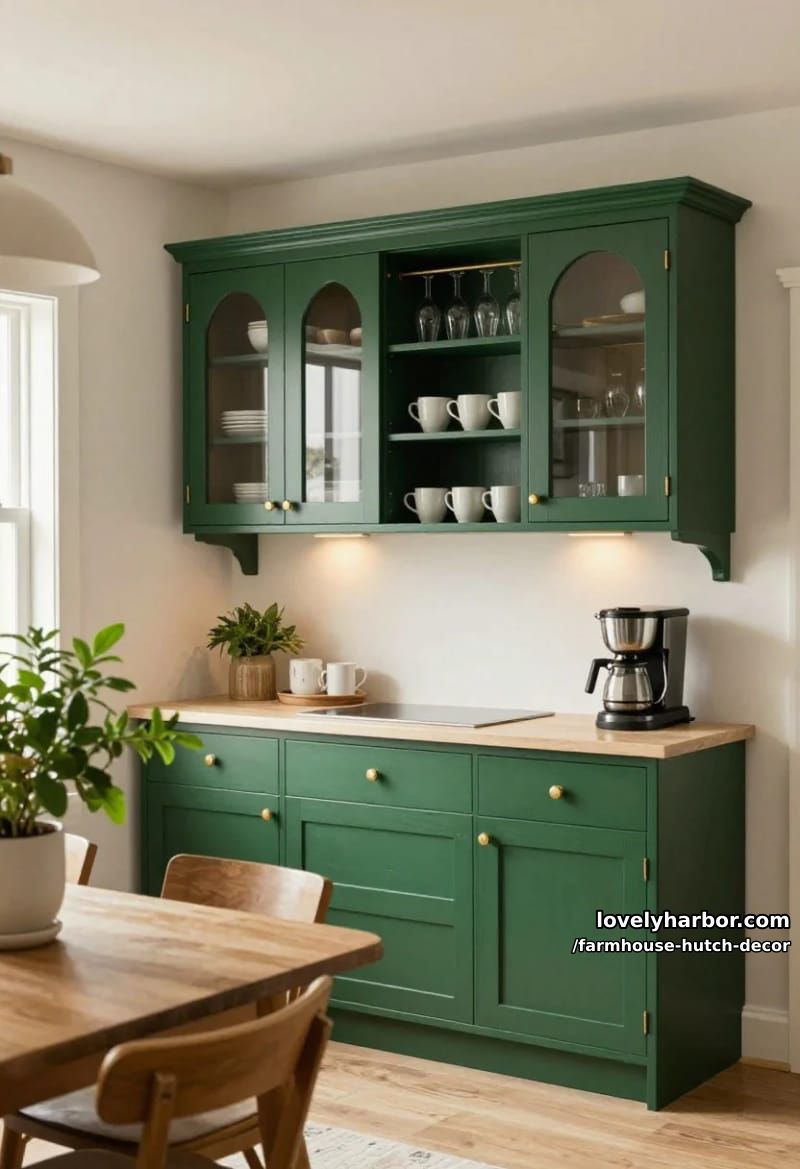
A deep green like Farrow & Ball Green Smoke turns white dishware into the brightest thing in the room, and the arched doors with brass pulls give it a slightly vintage, garden-room feel. Fill it lightly with vintage plates and a couple of baskets.
In a small or windowless room, a dark green hutch absorbs the light instead of reflecting it, and the corner can go gloomy by mid-afternoon. Reserve this finish for a room with a real window, keep the surrounding walls light, and do not stack a second dark piece nearby. Two heavy colors in one small room reads oppressive.
16. Gray hutch with patterned plates, woven baskets, plants, and framed art.
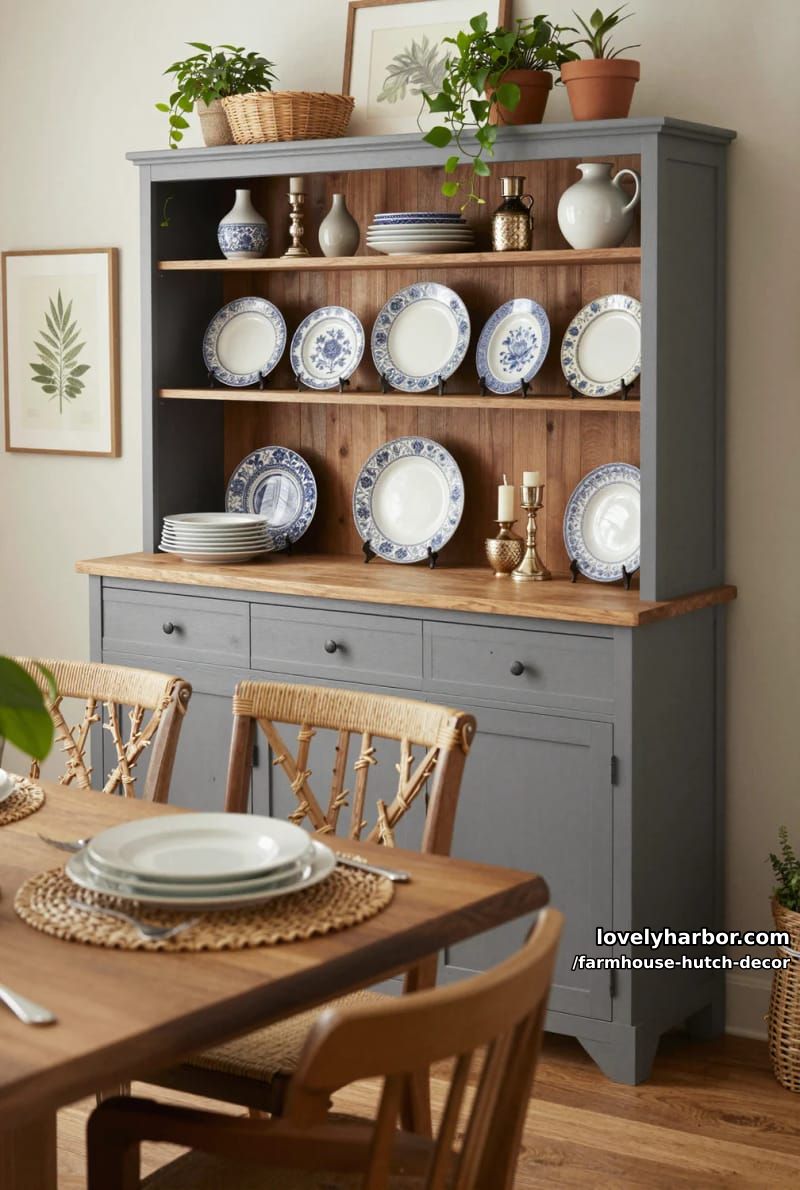
Gray is the neutral that lets decorative accents carry the shelf. Stack patterned plates for a hit of color, add a woven basket and a potted plant for warmth, and lean one framed print against the back to make the grouping feel deliberate.
The risk with gray is letting too many patterns crowd in until it reads busy. Hold to a simple color story, and swap the artwork seasonally for a refresh that costs nothing.
17. Rustic hutch with open shelves, white ceramics, blue plates, and wicker baskets.
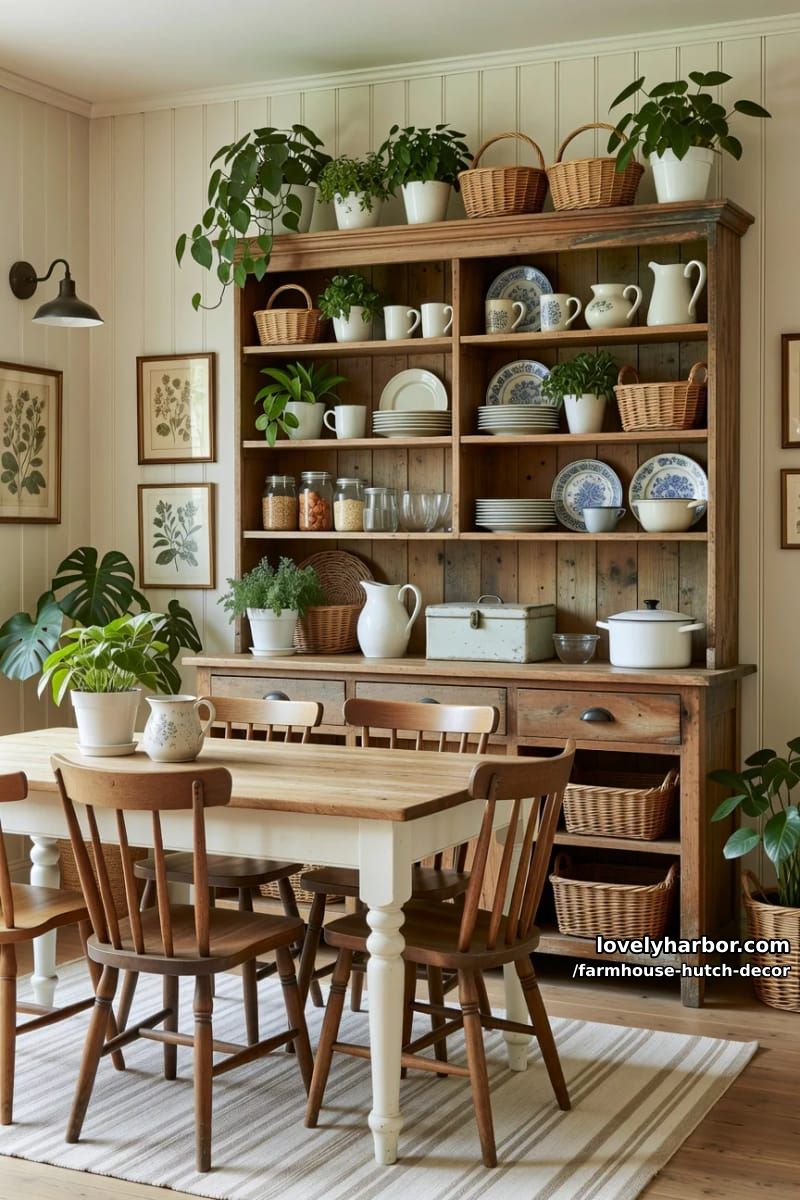
Blue and white is the oldest reliable pairing in dishware for a reason, and open shelves put it front and center. Classic Spode Blue Italian or a stack of thrifted blue willow plates against white ironstone brightens the whole hutch, with wicker baskets below for the things you would rather not see.
Open shelving means you will dust more, full stop. White ceramics and blue plates look sharp but need regular wiping, and well-used wicker frays at the handles within a few years. Worth it if you want the lived-in country look; skip it if dusting is already a chore you resent.
18. Wooden hutch with pantry jars, vintage scale, copper kettle, and hanging plant.
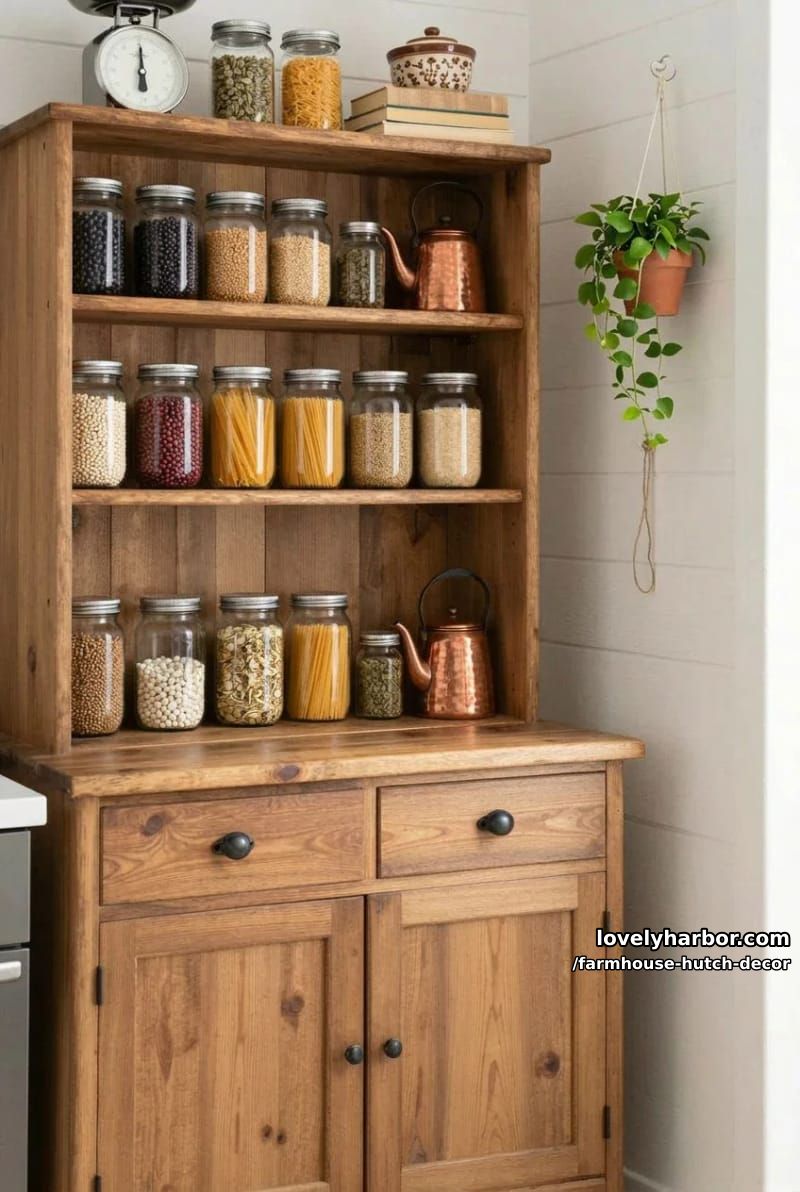
Load the shelves with pantry jars of oats, coffee, and pasta for a working-kitchen look, then add the conversation pieces: a vintage balance scale, a copper kettle left out instead of hidden. Glass jars from Weck or Le Parfait look more intentional than the plastic-lidded ones, and the food inside becomes part of the palette.
Do this
- Decant dry goods into matching glass jars so the labels stop competing
- Let the copper kettle and the scale stay out as the two anchor objects
- Hang the trailing plant from a hook above the hutch to soften the hard top edge
Avoid
- Crowding every jar shoulder to shoulder. Cozy becomes cluttered around the point where you stop being able to read individual shapes.
- Mixing five different jar styles
19. White distressed farmhouse hutch with "FARMHOUSE" decor and blue mason jars.
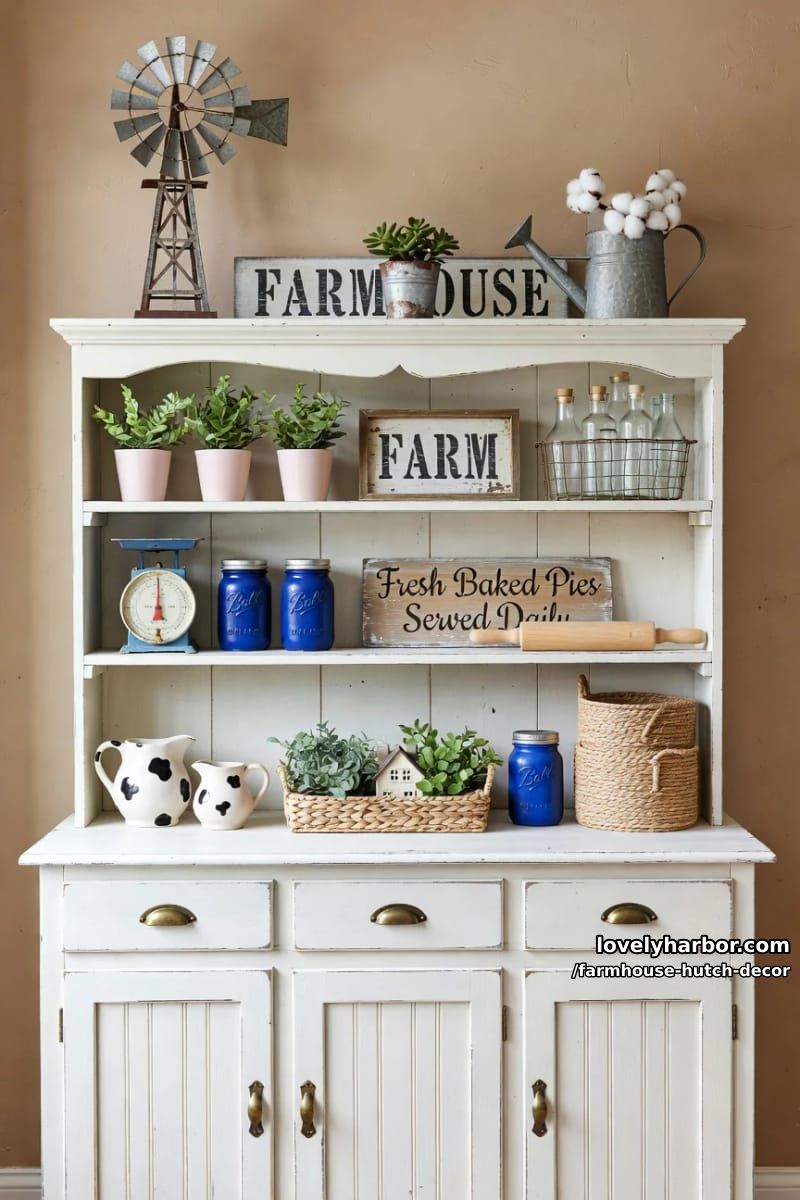
A white distressed hutch sets the scene, and aqua blue mason jars do real work on it, holding utensils or a few wildflowers while adding the one cool note against all that warm white. Hunt down genuine vintage Ball Perfect Mason jars in their aqua tint; the deliberately "antiqued" reproduction jars sold in craft aisles have a painted-on color that chips.
The "FARMHOUSE" lettering is where I will lose some of you. That word-on-the-wall trend peaked around 2018 and now reads dated to a lot of eyes, mine included. If you love it, use exactly one and let the jars and dishes carry the rest, or skip the sign and let the hutch say farmhouse on its own.
20. Rustic hutch with glass cabinets, baskets, rolling pins, and cascading plants.
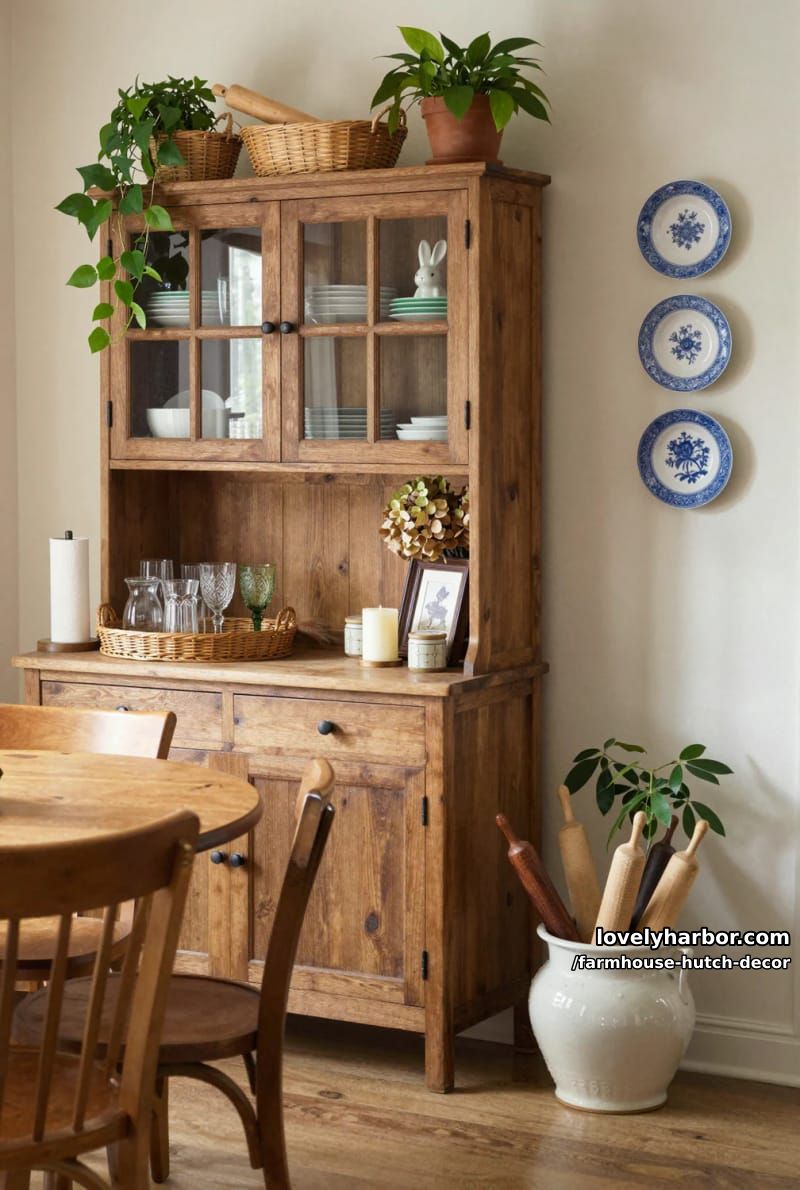
Glass cabinets let light reach the vintage rolling pins and woven baskets inside, so the storage doubles as display. A cascading plant, pothos or string-of-hearts trailing down one side, softens the rectangular wood.
Pick a few pieces that actually mean something and let one plant drape naturally rather than training three across the top. This style runs on casual comfort, not symmetry, so a slightly uneven arrangement suits it better than a balanced one.
21. Farmhouse hutch with vintage white ceramics, metal teapot, and orange flowers.
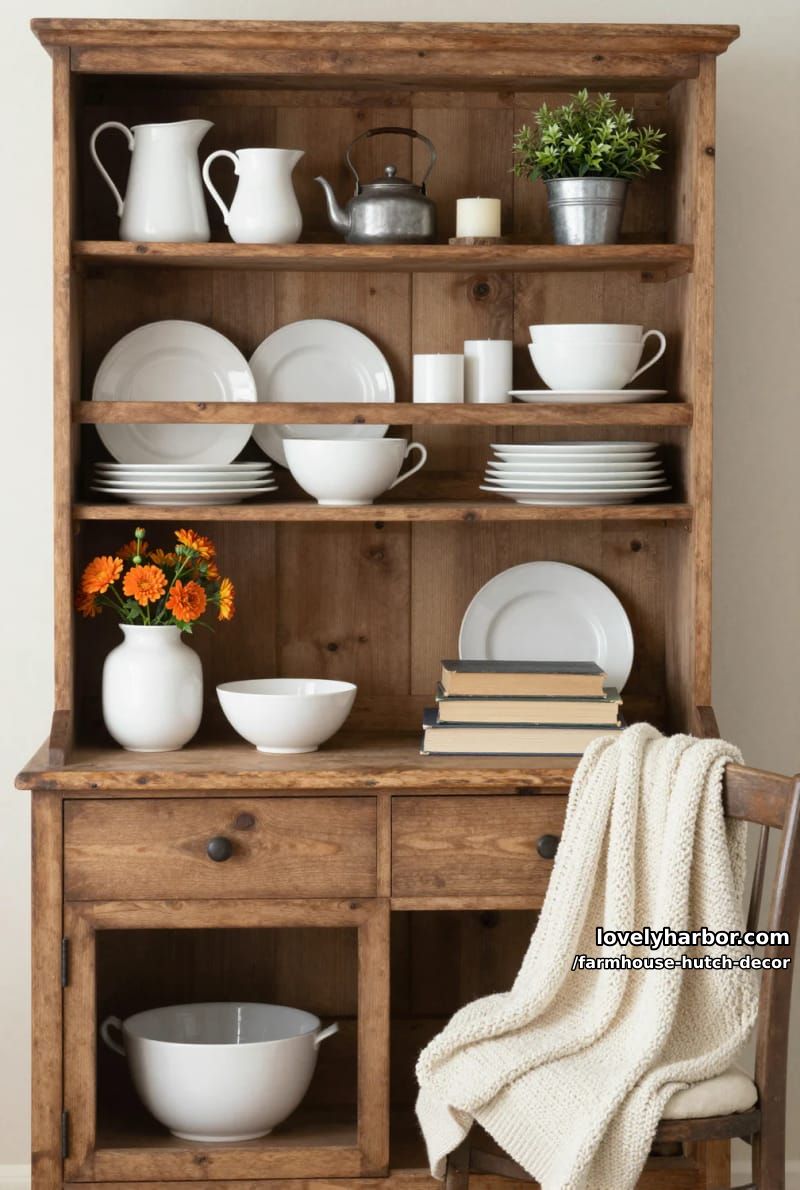
Orange flowers are the whole reason this one works. Set vintage white ceramics as the calm base, drop in a metal teapot for a cool gray-silver break, then add a small bunch of ranunculus or marigolds. The warm orange against neutral white is a complementary pairing, which is why it reads cheerful rather than random. Keep it to one loose bunch so the color stays an accent, not the headline.
22. Vintage bookshelf with cream backing, old books, framed photos, and dried flowers.
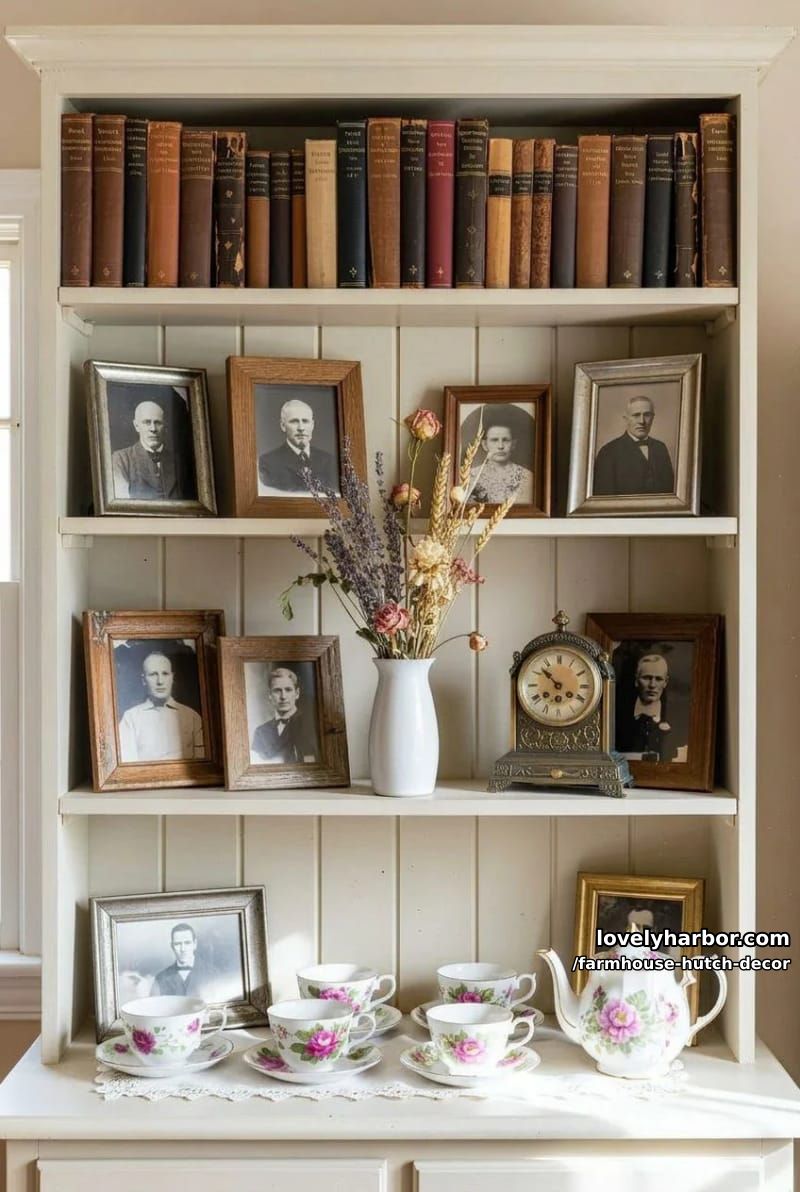
A cream-backed bookshelf cradles old books with faded spines facing out, framed family photos for warmth, and dried flowers tucked into the gaps. Dried eucalyptus or bunny tails hold their shape for a year and skip the watering.
Dust is the catch. Old book covers and dried stems collect it quickly, so this one asks for a gentle once-over more often than a glass-fronted piece would. The payoff is that guests linger here, reading spines and looking at the photos, which no sealed cabinet ever gets.
Conclusion
If you take one thing from this list, make it the half-empty shelf. Almost every setup above, from the Swiss Coffee built-in to the dark green arched hutch, succeeds because it stops short of full, and the ones that need the most editing are the open-shelf and packed-pantry looks. Start with what you already own: pull everything off, settle on a three-color story, and put back only what fits it. The vintage crate centerpiece in idea five is the lowest-effort entry point, since you can restyle it monthly without spending a cent.