
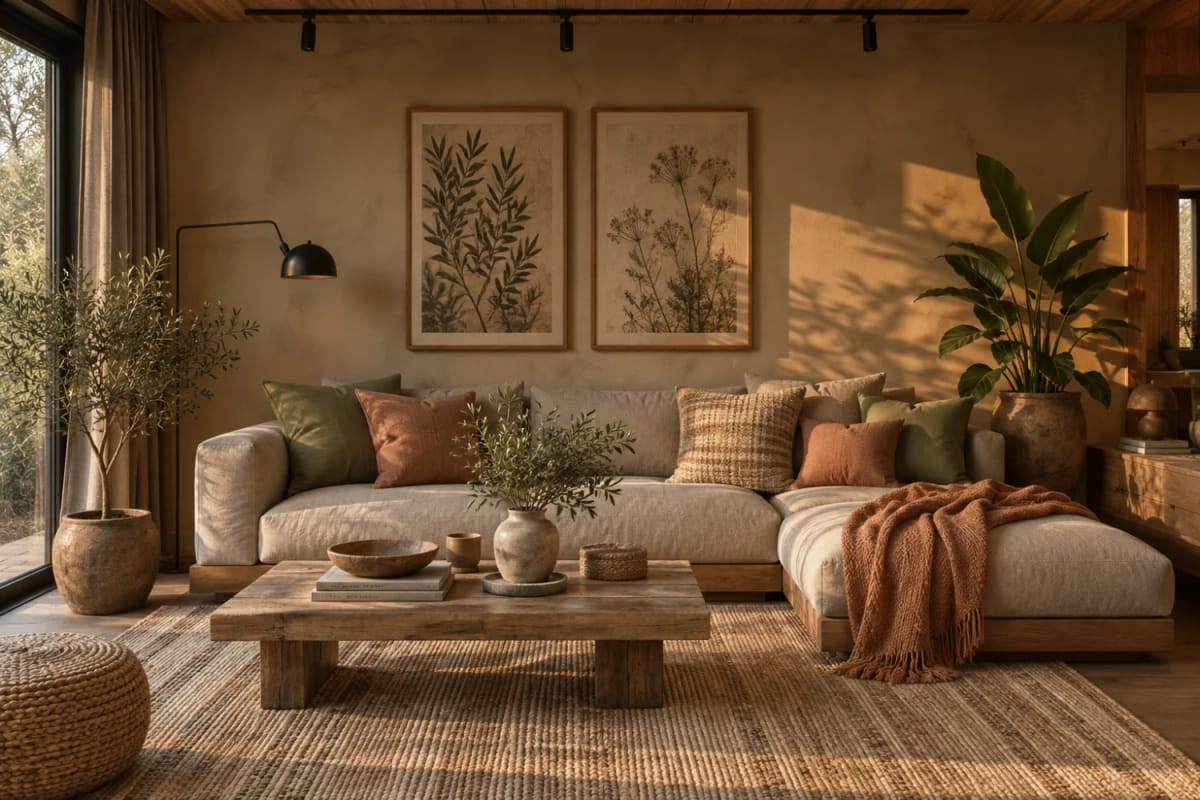
The bedroom wall is the tell: warm beige plaster, not gray and not white, with a wooden slat ceiling above it and one rust throw doing the talking.
Below: the six colors, where each lands in the bedroom, living room and dining room, the pieces that get you there, and the closest brand matches for members.
Start with the six colors
One six-color palette runs through the house; the rooms take different parts of it. Three of the six are surfaces you barely register, and three are what your eye catches first. LRV is how much light a color bounces back: Warm Plaster sits at 29, Toasted Timber 15, Deep Walnut 4, Undyed Linen 56, Field Olive 18 and Burnt Clay 20. The twenties stay warm; under 10 sits nearly black.
The rooms, wall by wall
One wall color ties the three together, and each room bends it its own way.
In the bedroom, the wall does the work
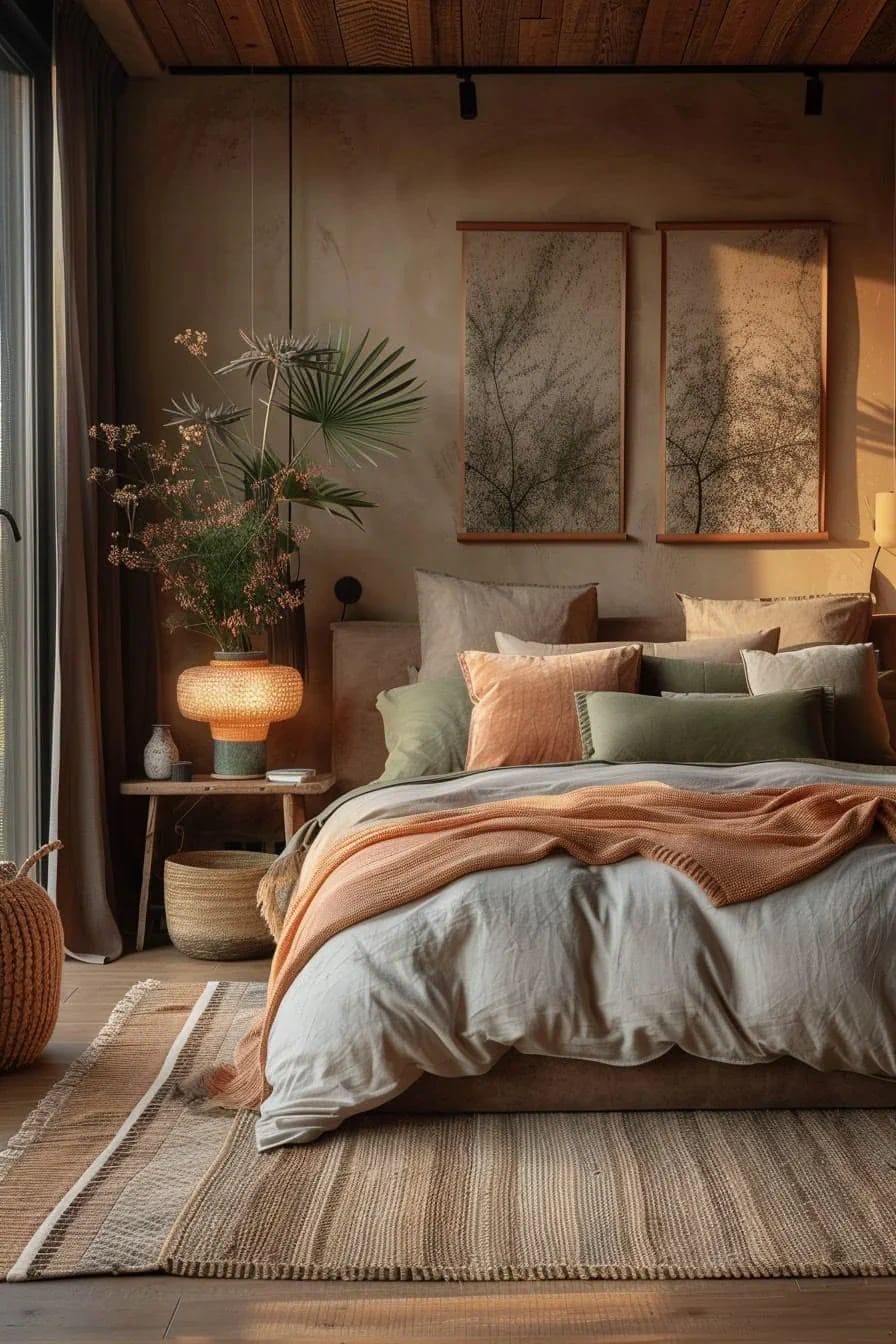
Warm Plaster goes on all four walls, and nothing else competes with it. The slat ceiling keeps its own Toasted Timber, so the bed in Undyed Linen reads soft rather than stark: nothing bright white fights it. The olive pillows are Field Olive, the rust blanket Burnt Clay.
For the textiles, a burnt-orange cotton cable-knit throw in the 50 by 60 inch size lands around $30, and olive green linen pillow covers come two to a pack for about $20. More of this look lives in the site’s earthy modern bedroom ideas.
One free sign-up opens every recipe on this page. Subscribers get the bedroom plan first: what takes the walls, what stays raw timber, the finish that keeps plaster chalky, and where the dark anchor comes from.
The living room runs greener
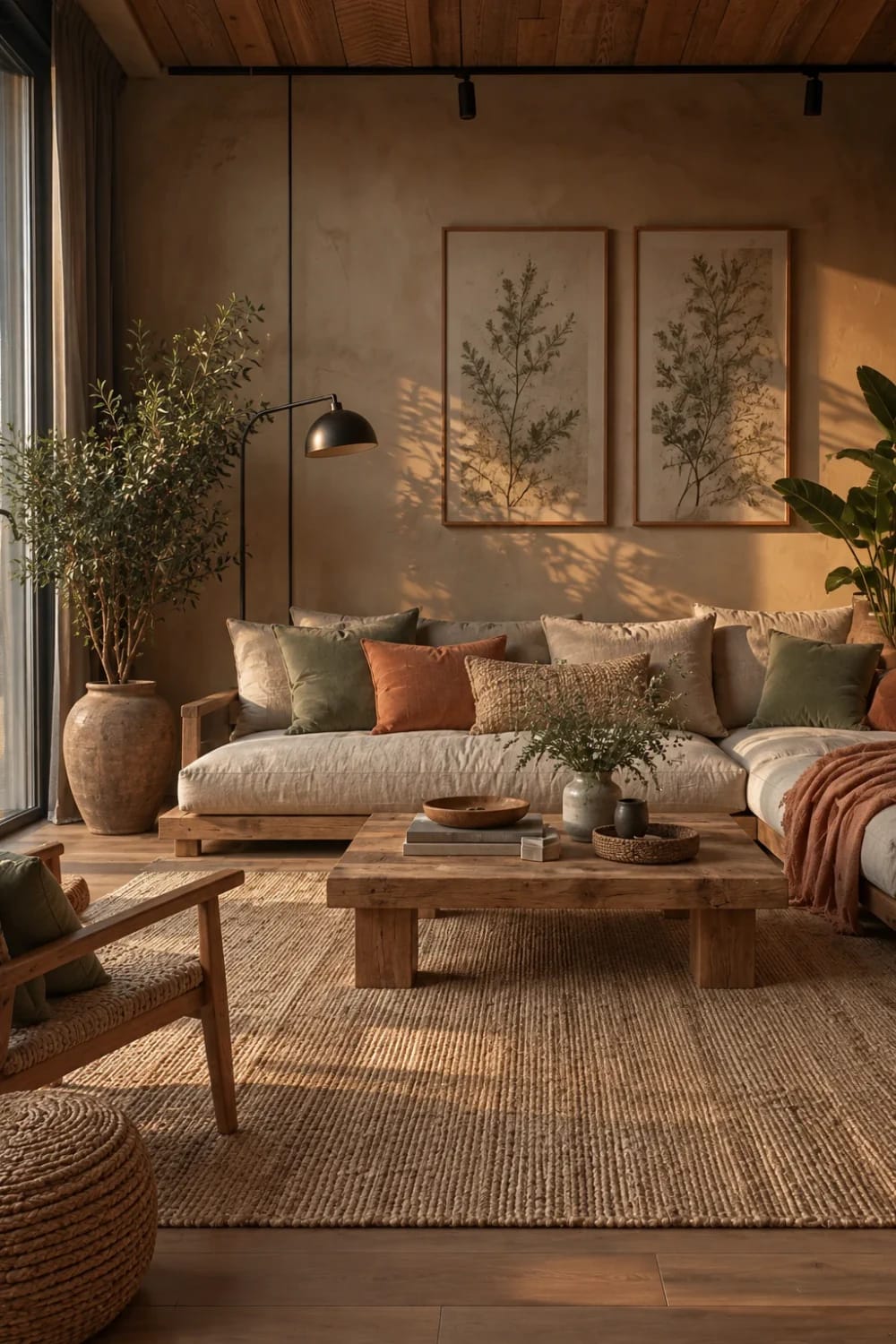
Warm Plaster continues here, but the room carries more wood against it: the ceiling is exposed boards, so it holds more Toasted Timber than the bedroom does. That is why the sectional is Undyed Linen and the rug is a large woven beige, two light fields against the brown. The cushions are where it loosens up, cream, Field Olive and a terracotta next to Burnt Clay, and the black floor lamp and track heads are the only hard lines. If you want more of these browns, the site’s earthy living room ideas go further.
A black arc floor lamp with a woven shade keeps that edge, and a natural jute rug in an 8 by 10 covers the floor in the image’s beige. Buy the rug after the samples.
The living room is a balance problem, not a paint problem. Subscribers get its plan: which surfaces take Warm Plaster, how much timber stays bare, and the cushion ratio.
This is the part that saves a wasted gallon. Members get the closest match to each of the six in Benjamin Moore, Sherwin-Williams and Behr, chosen by color science.
Dining room, where walnut and wicker take over
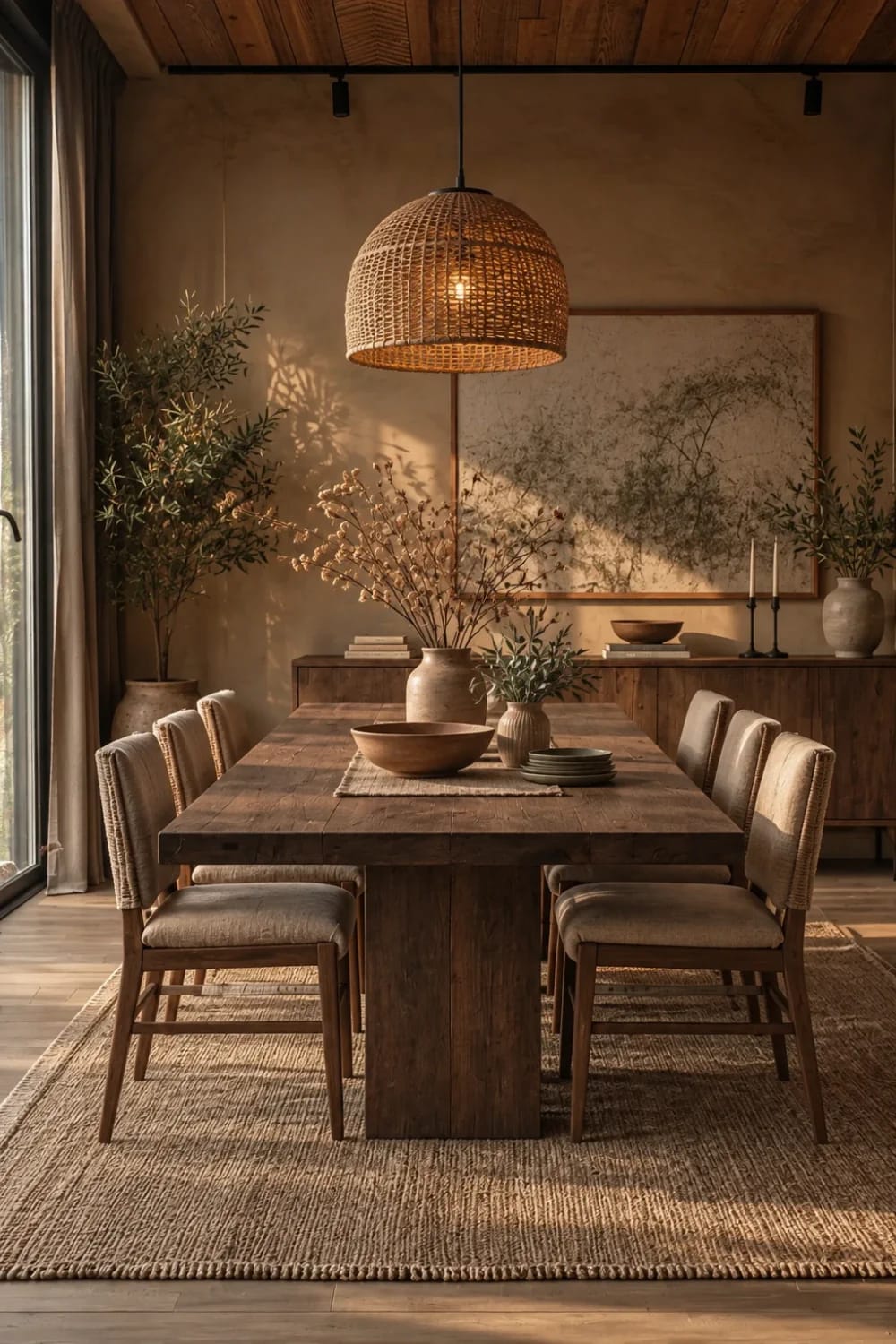
The deepest wood in the house sits in this room, so it needs the fewest new colors. The table and sideboard are Deep Walnut, the chairs are a creamy beige close to Undyed Linen, and the walls hold the same warm brown plaster as the living room. A woven wicker pendant over the table repeats the wood in a lighter, rounder form, which keeps the room open under a board ceiling. The sideboard finishes it: ceramics in off-white, black candlesticks, books, and leafy branches that pick up Field Olive, with a small clay-toned bowl for the Burnt Clay.
A dark brown woven rattan pendant in the 15 inch range does the most work here, and a set of three speckled ceramic vases gives the sideboard the group of objects it needs. There are rustic dining rooms built around a wooden table, too.
The dining room is the one where the wood is fixed and the color has to work around it. Subscribers get its plan: the wall color that holds against dark walnut, the sheen for a room with candles, and which surfaces stay natural.
Prep before the first coat
Before the paint goes on
- Wash the plaster and fill every hairline crack. A warm mid-tone shows each ridge it goes over.
- Spot-prime the patched areas, and prime the whole wall if the old color is darker than the new one.
- Settle the sheen once and write it down: flat matte on walls, satin on trim, so the edges stay crisp.
- Size the quantity off the walls, not the floor plan: measure the room’s perimeter, multiply by the wall height, subtract the doors and windows, multiply by the number of coats, then divide by the coverage printed on the can, usually 350 to 400 square feet per gallon, and round up.
- Read your light before you count the gallons. A room with one small window needs the lighter end of the palette.
The 60/30/10 that holds it together
Six colors sound like a lot until you give them shares. Roughly 60 percent of what you see should be Warm Plaster and Undyed Linen: the walls, the sofa, the rug, the bedding. About 30 percent is wood, Toasted Timber and Deep Walnut, which in these rooms is mostly already built in. The last 10 percent is Field Olive and Burnt Clay, and it belongs on things you can pick up and move. The same arithmetic runs through a warm neutral palette built on walnut, with one louder color doing the same job.
That is how the palette survives a wood ceiling. If the brown climbs past about a third of the frame, the room stops reading warm and starts reading heavy, and the fix is not more paint. It is less wood: a lighter rug, a linen slipcover, or moving the darkest piece into another room.
If your case differs, the ratio bends. A painted white ceiling? Let it count as a light field. Walls already dark? Let Undyed Linen do the lifting. No wood? Add a walnut-toned piece rather than a second accent.
That is also why the two accents repeat instead of multiplying: one green and one clay, each in more than one room, read as a decision, not a collection. A third accent in a fourth color reads as shopping.
When it all reads too brown
The failure here is rarely a wrong color. It is too much of the right one, because warm beige, wood boards and a brown floor are all the same temperature.
Do this
- Keep trim one step lighter than the wall rather than bright white. Warm rooms make bright white read blue at the edges.
- Repeat one accent in two rooms. Field Olive in the bedroom and the living room is what makes the whole house look deliberate.
- Put a light field against the darkest piece. The jute rug is there to catch the walnut, not to match it.
Avoid
- Three accents in one room. Olive, clay and a third green stops being a palette and starts being a collection.
- Cool grays and blue-greens against Warm Plaster. They fight it, and both colors lose.
- A gloss wall. Anything above matte bounces the wood color back, and the walls go orange once the lamps are on.
Test the beige on your own wall before you buy a gallon. Warm colors are the ones that move most with light: the same Warm Plaster can read gold in a west window and pink under a cool bulb, and the two rooms with board ceilings sit a full step darker than the bedroom. Get large peel-and-stick samples or paint a patch on two walls, look at them in the morning and again after dark, and give it a day before you order the full quantity.
Start with the walls, not the sofa
Choose and buy the wall paint before you buy the furnishings, then paint the plaster first and let everything else arrive after it. The wall is the surface you can least afford to redo, while the olive cushions, the rust throw and the ceramics on the sideboard are the cheapest things in the room to swap.
One thing the images cannot show: they are renders, and the two rooms with board ceilings sit darker than the bedroom, so a beige that looks generous in frame one can close in over a dining table. Test it at night before the sofa arrives.
Related Posts
- 19 Best Earthy Modern Bedroom Ideas for a Cozy Retreat
- 19 Unique Earthy Living Room Ideas for a Cozy Home Makeover
- A Modern Apartment Color Palette: Warm Neutrals, Walnut, and One Deep Teal
- Bring Nature Indoors: 15 Earthy Living Room Designs to Inspire
- 36 Earthy Bedroom Ideas for a Serene Space
- 15 Earthy Kitchen Inspirations for Nature-Infused Space