
Most farmhouse fireplace roundups recycle the same dozen photos: red brick, white shiplap, a reclaimed beam, repeat. The 23 ideas below are sorted by the one decision that actually changes how a room feels, the surround material and how dark you let it go, with the brand names, the color codes, and the upkeep nobody mentions until you’re already living with it. A few of these I’d talk you out of.
1. Rustic farmhouse living room with red brick fireplace and wood mantel.
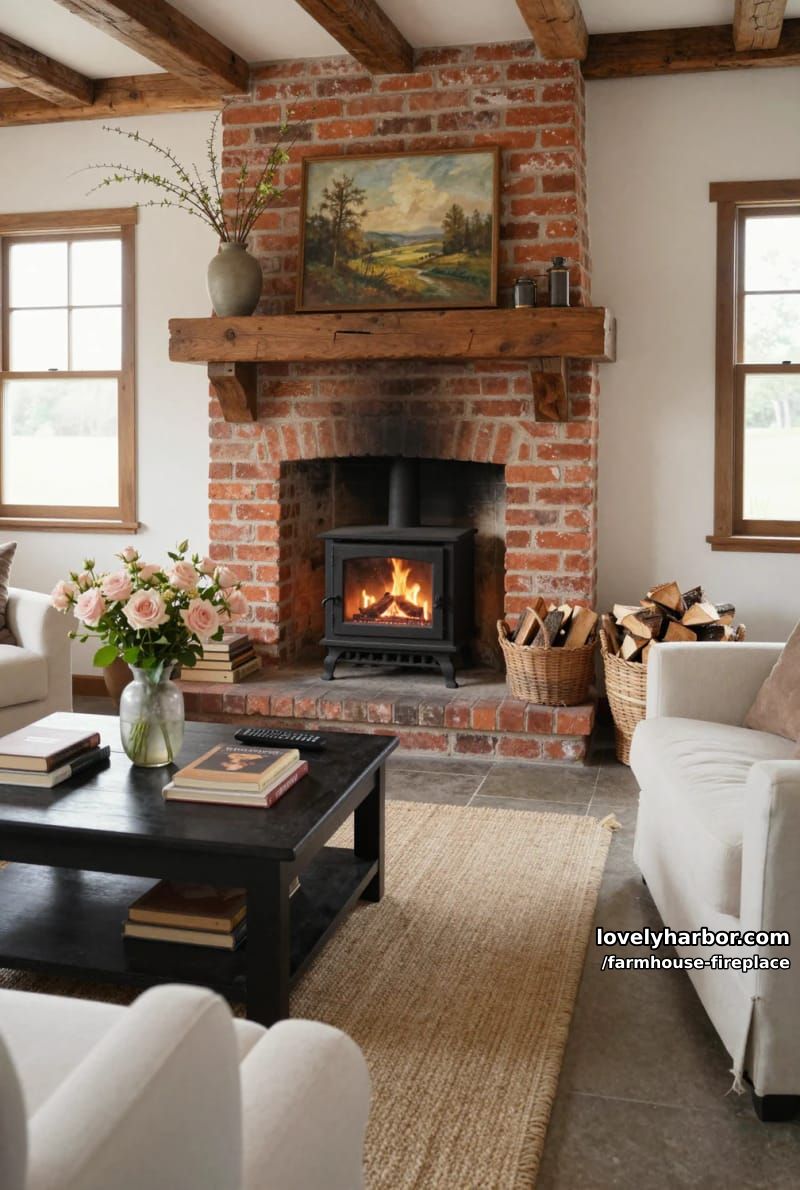
Red brick reads warm because of the iron in the clay, and the fastest way to wreck it is a high-gloss masonry sealer that turns the whole wall into something wet-looking and plastic. Matte sealer or nothing.
For the mantel, skip the slim floating-shelf look here. A solid timber with visible saw marks, ideally a genuine reclaimed barn beam (those run roughly $150 to $400 depending on length and provenance), gives the brick something with equal weight to sit under.
If the brick is a builder-grade orange you can’t live with, a German smear or a limewash dials the color back without burying the texture, and you can still read the individual bricks under the haze.
2. Cozy corner with stone fireplace, built-in bench, and woven decor.
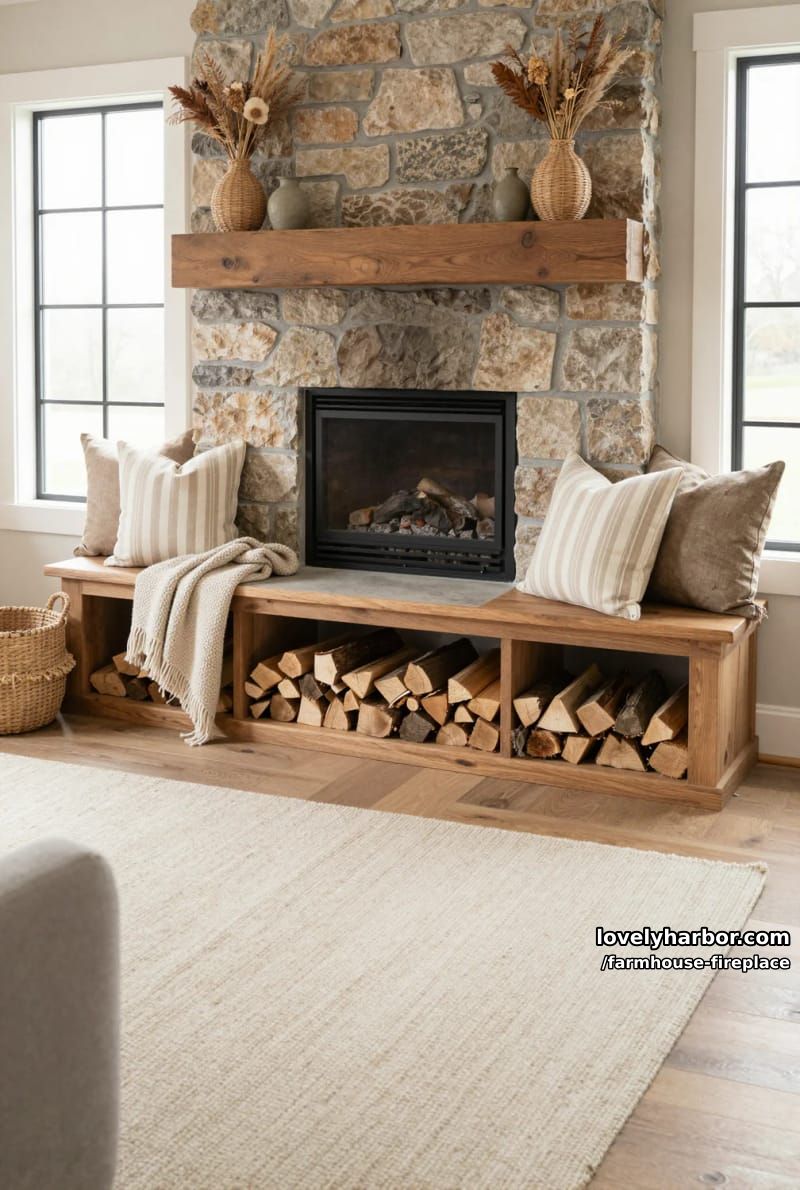
A built-in bench beside the hearth only works if you size the cushion right. A thin 3-inch foam pad reads like a church pew. You want at least 4 to 5 inches of high-density foam if anyone is going to sit there through a whole movie.
Stone plus woven texture is the safe pairing, but watch the basket sprawl: two or three large baskets beat a dozen small ones, and seagrass shrugs off firewood splinters better than the softer water-hyacinth weave, which frays at the rim.
Dust does collect in the stone joints. A dry paintbrush gets into the grooves faster than any vacuum attachment, which is the kind of thing nobody tells you until you own the fireplace.
3. Bright living room with black brick fireplace and white shiplap walls.
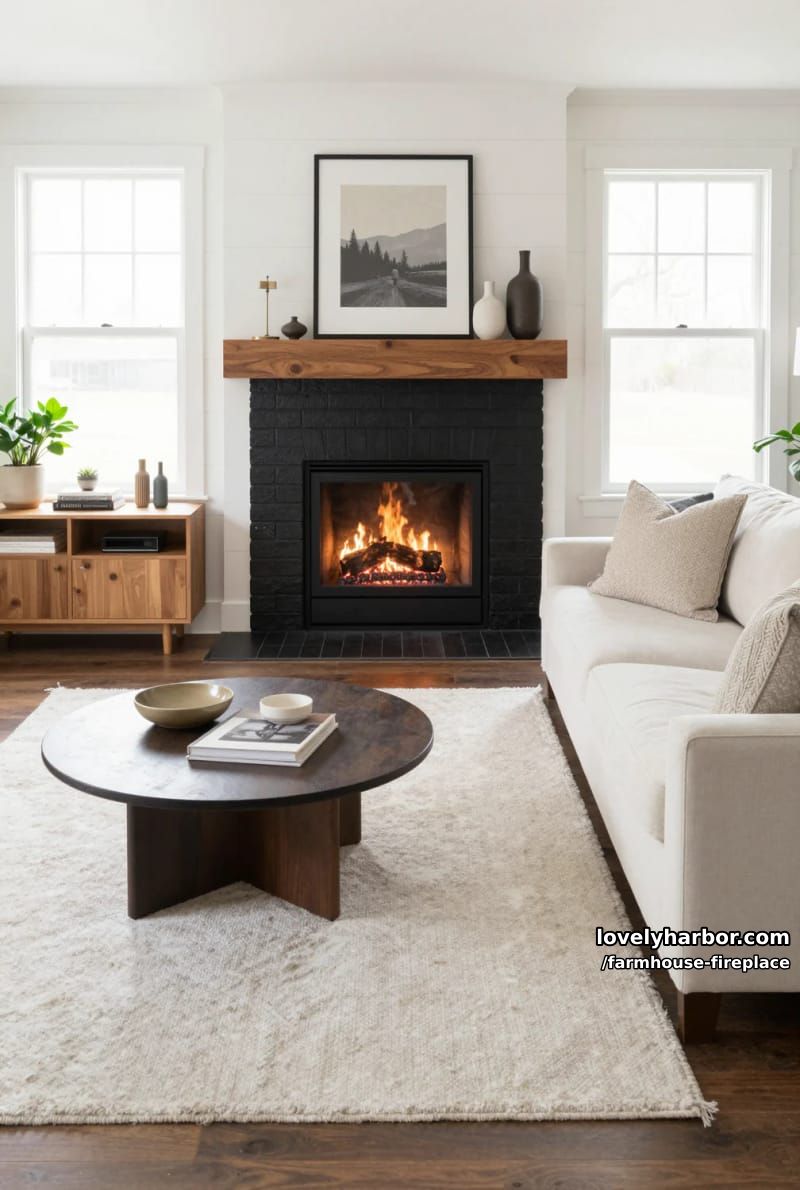
Black brick against white shiplap is high contrast on purpose, and the finish decides whether it reads architectural or cheap. Flat or eggshell. Never gloss. Sherwin-Williams Iron Ore is the color most designers reach for because it lands almost-but-not-quite black, which photographs softer than a true black.
The wall behind it matters more than people expect. A bright clinical white can go cold next to all that black, so a warm white like Alabaster keeps the room from feeling like a gallery.
One caution before you buy paint. If you’re going over real brick, black is close to permanent, and stripping paint back off masonry is genuinely miserable, so prop a painted sample board against the firebox for a week before you commit the whole thing.
4. Modern vaulted living room with stone fireplace and built-in shelves.
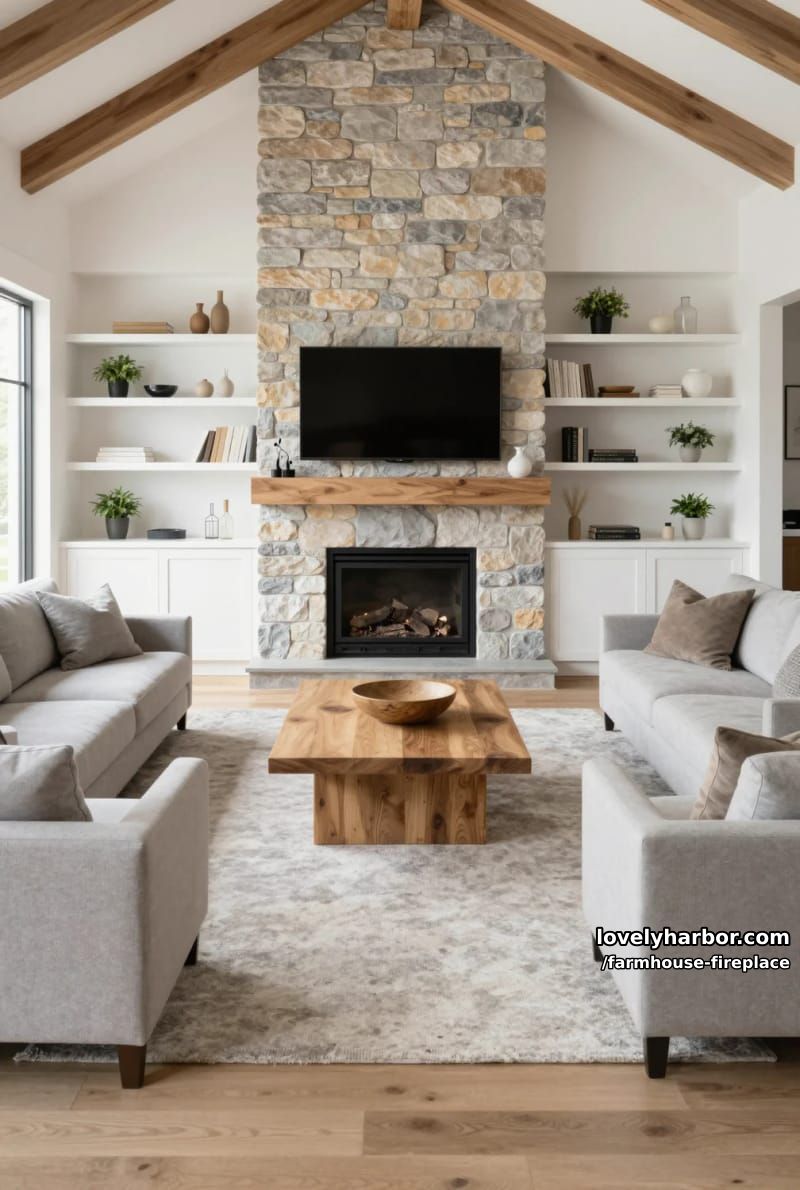
A vaulted ceiling wants the stone to climb. Stopping the masonry at standard mantel height in a 16-foot room leaves a stranded band of stone with a wall of blank drywall floating above it, which is the most common miss in vaulted rooms.
Flank it with built-ins, but style the shelves at about 70 percent full. Packed shelves read like storage; bare ones read like a model home.
Mix the objects by height and let a couple of frames lean against the back wall instead of sitting square. Books stacked flat under a small piece of art look more collected than a row of matched ceramic.
5. Spacious vaulted living room with stone fireplace and round mirror.
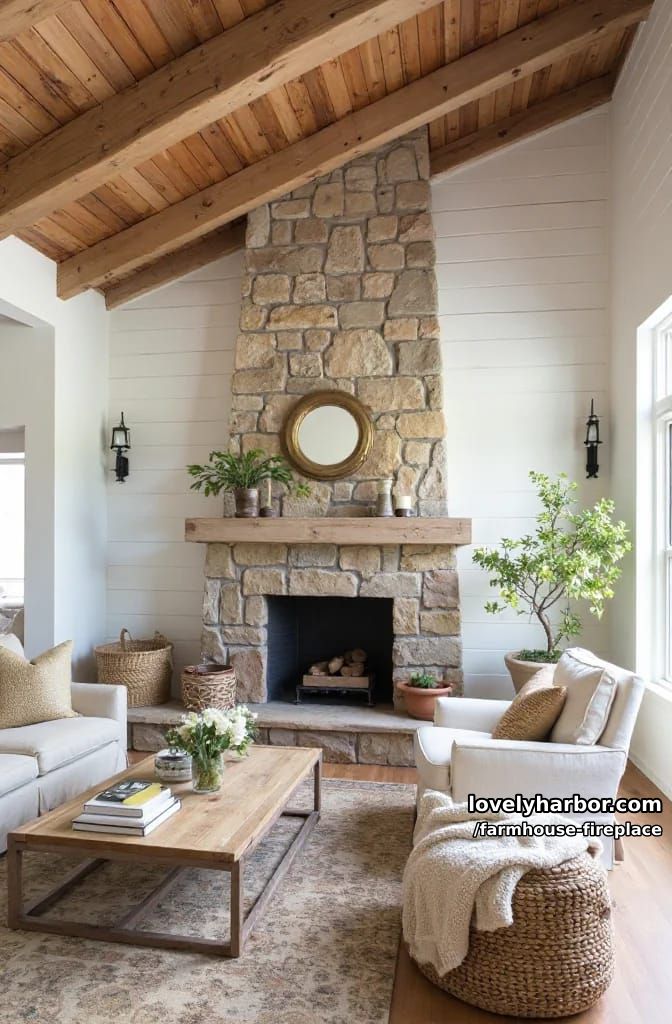
A round mirror over a stone mantel does one specific job: it softens the hard angles and bounces light back into a tall room that goes dim up high. An aged-brass or forged-iron frame keeps it from looking like something off a bathroom vanity.
Size it to the firebox, not the mantel. A mirror roughly two-thirds the width of the opening sits right; anything wider competes with the stone for attention and loses.
If a window opposite throws glare, swap the flat mirror for an antique convex one. The fisheye scatters the reflection so you’re not catching a hot rectangle of sun across the floor at 4 p.m.
6. Cozy farmhouse living room with red brick fireplace and string lights.
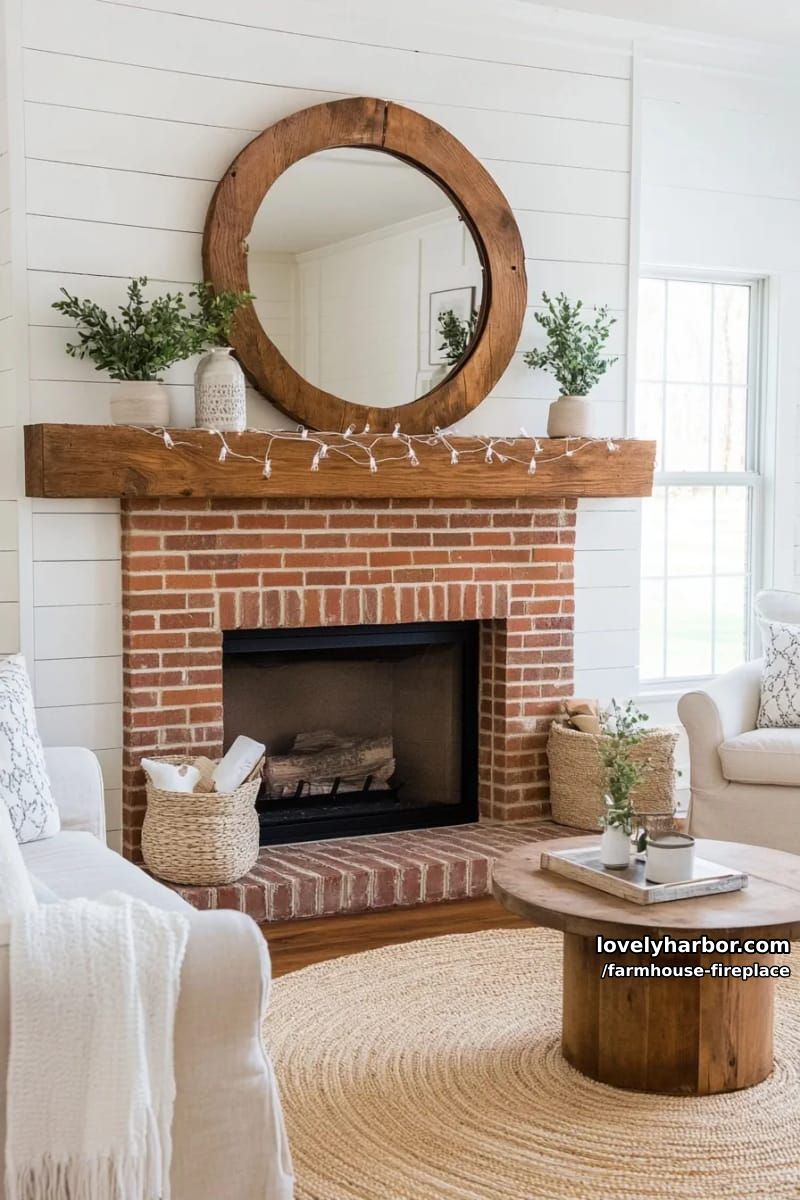
I’ll be straight: this is a divisive look. Some readers will always see Christmas leftovers or a dorm room no matter what you do, and if that’s your reaction, skip the section, the room loses nothing without it. For everyone still here, the entire fight is bulb color. Cool-white strands are what make it read cheap; warm-white or amber in the 2200K to 2700K range is the difference between “festival” and “leftover holidays.”
Drape them along the mantel edge or the beam above, not across the brick face where the cord shadows show. Thin copper-wire fairy lights disappear far better than the fat green-cord patio strands.
Painting the brick is the other route people take for this look, and I’ll say it plainly: a soft gray over red brick almost always goes dingy within a year as soot settles into it. White or limewash ages better.
7. A modern farmhouse living room with marble fireplace.
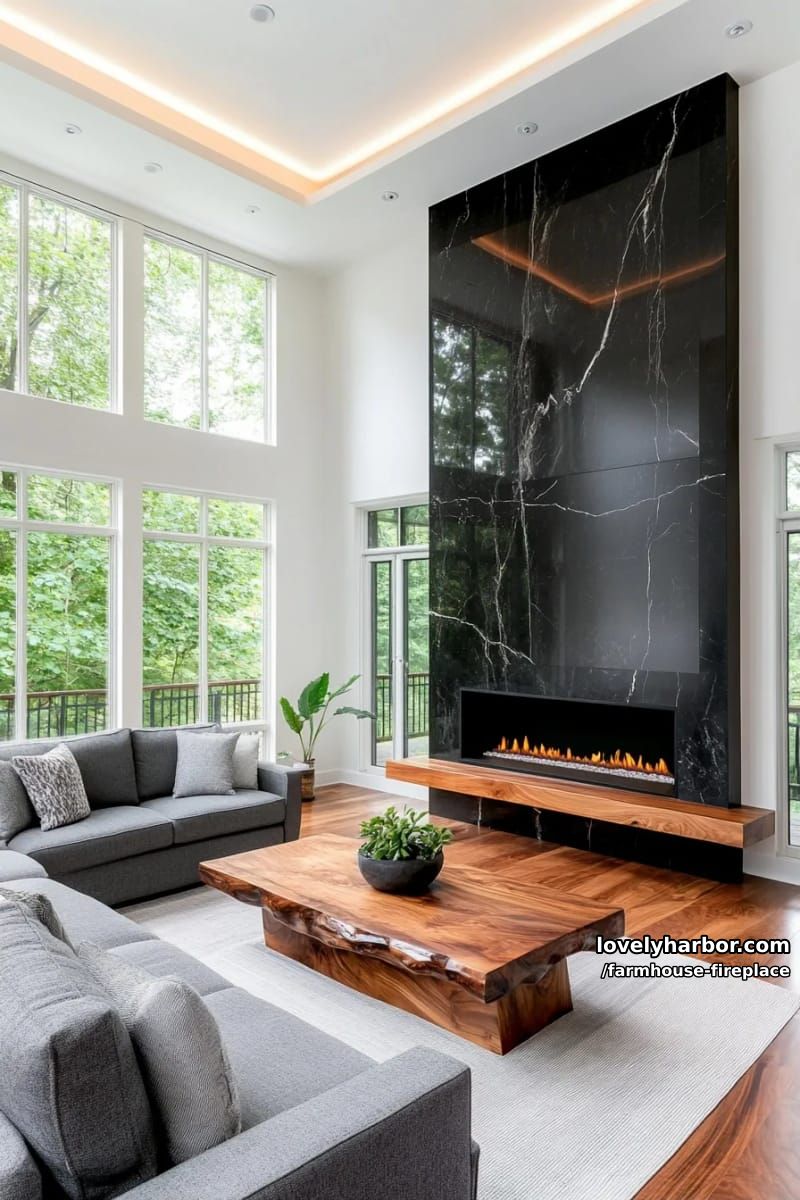
Modern farmhouse leans on one contrast: a honed marble or quartzite surround against a rough timber mantel. Use honed, not polished. The matte surface hides candle soot and the occasional water ring, while the glossy version shows every mark under raking light.
The bigger question hiding inside most “modern farmhouse” fireboxes is whether the fire is real. Electric inserts photograph convincingly now and won’t heat a cold room. Here is how the three common options actually compare:
| Firebox type | Real heat | Install cost | Ongoing upkeep |
|---|---|---|---|
| Wood-burning | Strong radiant heat, heats a room | High (chimney and masonry) | Ash removal, yearly chimney sweep |
| Gas insert | Steady, thermostat-controlled | Medium (needs a gas line) | Minimal, one annual service check |
| Electric | Ambient glow, space-heater level only | Low (plug it in) | Wipe the glass |
8. Living room with white shiplap fireplace, rustic mantel, and lanterns.
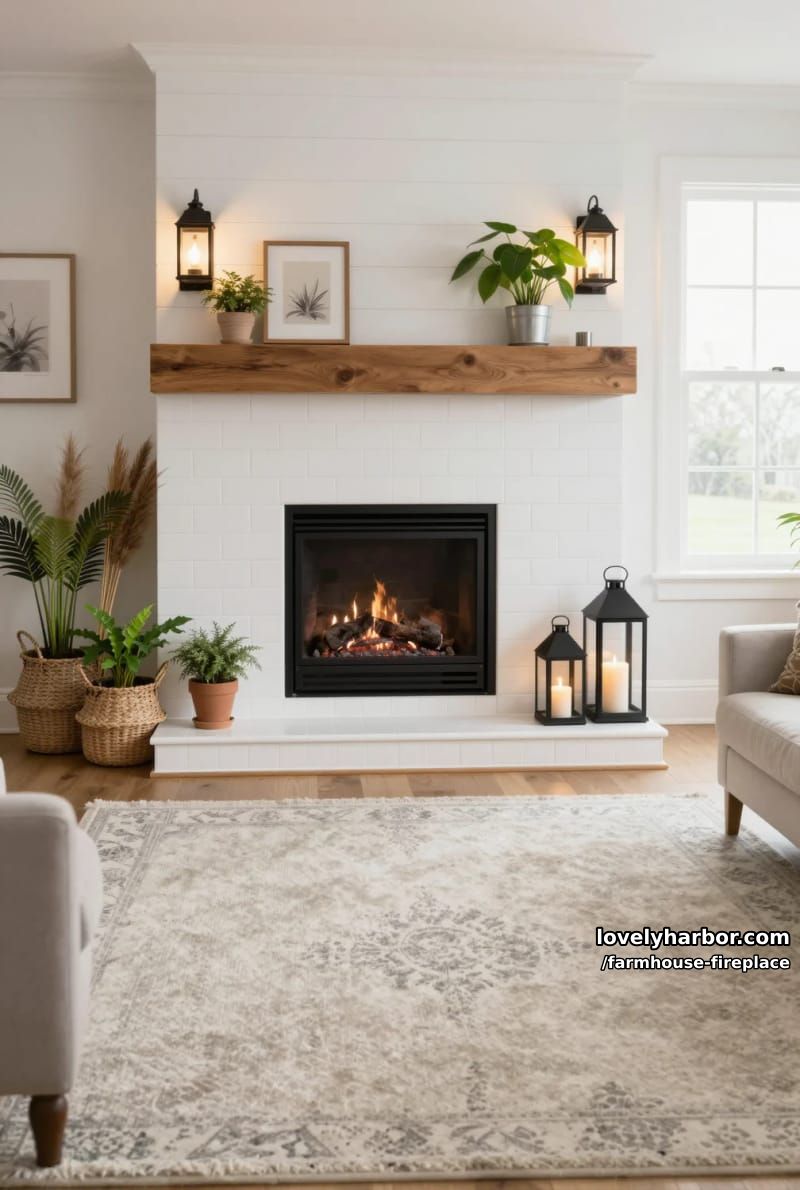
White shiplap around a firebox refreshes the whole wall, but it’s combustible, and so is the rustic mantel sitting above the heat. That’s not a styling note, it’s the one part of this look that can actually start a fire, so it gets its own warning before anything else.
Wood shiplap and a wood mantel are combustible, and a firebox runs hot enough to ignite them over time. For a masonry fireplace, NFPA 211 and most local codes prohibit combustible material within about 6 inches of the firebox opening, and anything that projects more than about 1.5 inches from the face (a mantel, a thick trim board) has to sit farther back still, commonly around 12 inches. For a manufactured or gas unit, the clearances printed in the appliance’s manual override any general rule and must be followed exactly. Confirm your local code and the unit’s listed clearances before you run wood anywhere near the opening, and if you’re unsure, a non-combustible surround board behind the shiplap is cheap insurance.
For the lanterns flanking the hearth, use flameless LED candles, not real ones. The flicker models from Luminara read convincingly from a few feet away, and you’re not adding a second open flame next to all that wood. The one ongoing chore nobody warns you about is dust: shiplap’s horizontal grooves catch the fine ash that drifts out when you open the firebox, so the real maintenance is a weekly pass with a dry microfiber.
Interactive tool
Mantel Clearance Estimator
Set how far your wood mantel will stick out from the wall. The tool returns the minimum gap to leave between the top of the firebox opening and the bottom of the mantel.
9. Living room with black herringbone tile fireplace and white mantel.
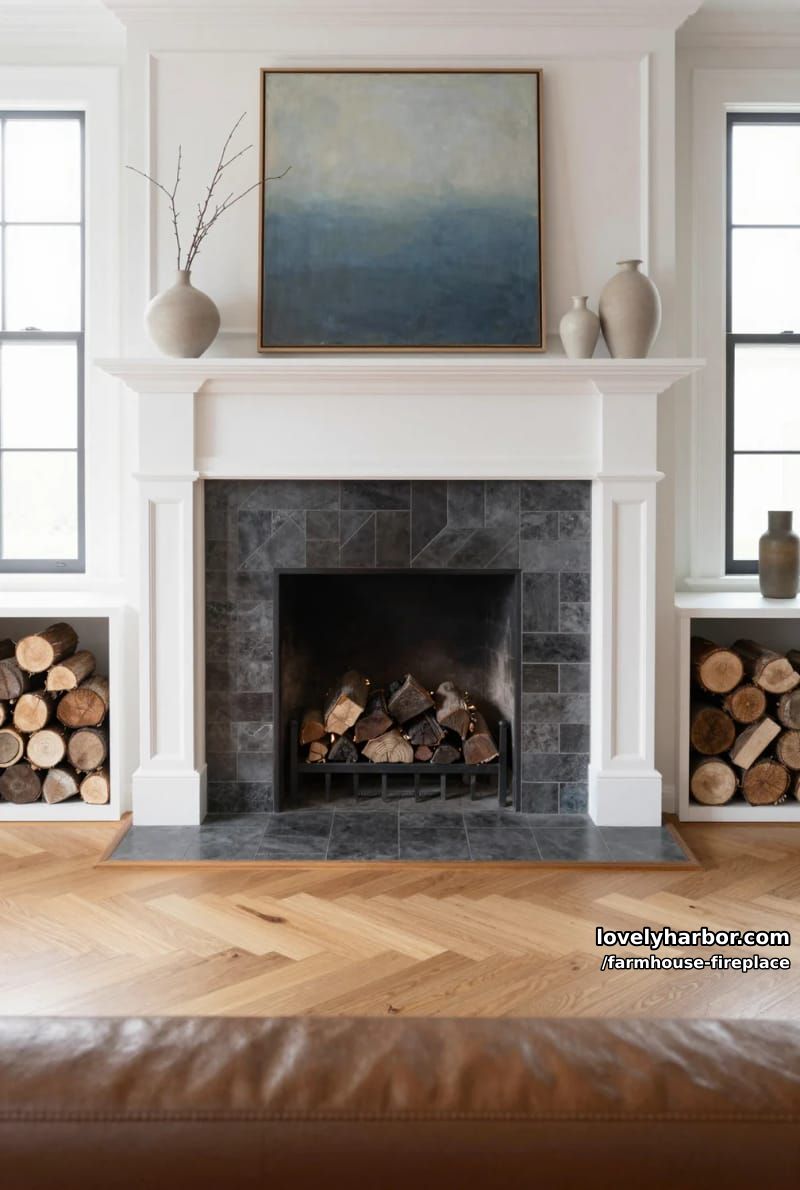
Herringbone in a firebox surround looks custom and costs more in labor than the tile itself. The diagonal cuts and the offcuts mean you should order roughly 15 to 20 percent extra material, and the install runs well above a straight-set layout because of the cutting time.
For black herringbone specifically, use a charcoal or dark grout. White grout against black tile turns the whole surround into a checkerboard and fights the very pattern you paid extra for.
A crisp white mantel above it is the standard counterweight. If the room already has a lot of white in it, an unpainted oak mantel warms the contrast without giving up the graphic snap of the tile.
10. Farmhouse living room with rustic fireplace, beams, and vintage decor.
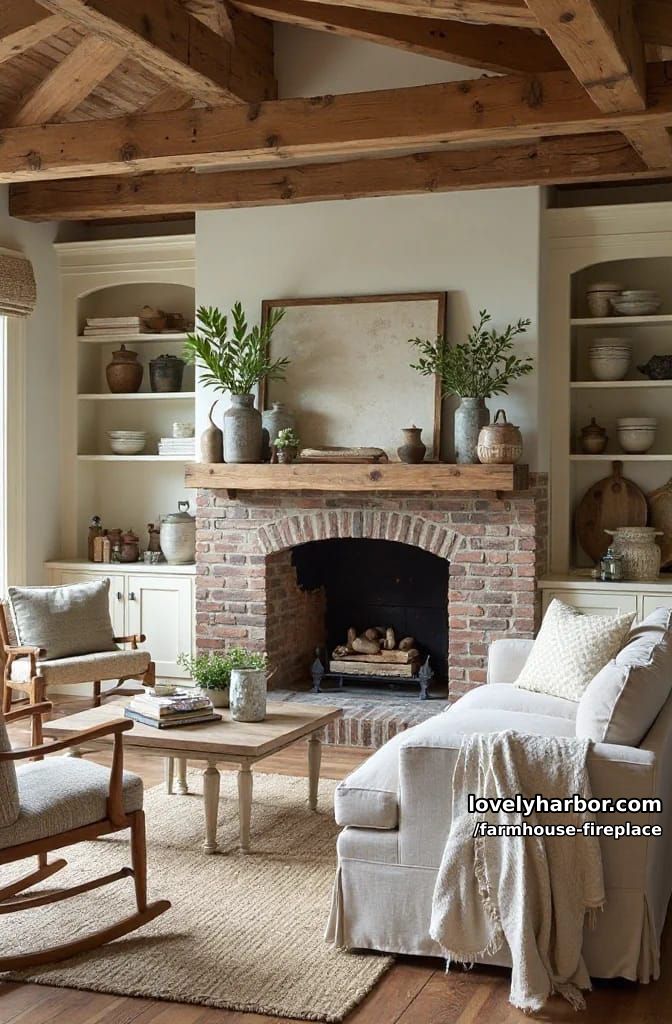
Real rustic rooms earn the look through actual objects with history, which is hard to fake and easy to overshoot. The working line between collected and cluttered is about one statement piece per surface. That chipped enamel jug on the mantel works because it’s up there alone.
Reclaimed beams are sold by the linear foot and the price climbs with provenance. A plain Douglas fir beam costs a fraction of a hand-hewn oak one with visible adze marks, and most rooms genuinely can’t tell the difference from six feet away.
If you’re buying “vintage” at a chain store, you’re usually buying new resin made to look old. Estate sales and Facebook Marketplace beat the Magnolia-style reproductions on both price and on actual patina.
11. A modern farmhouse living room with wood panel fireplace.
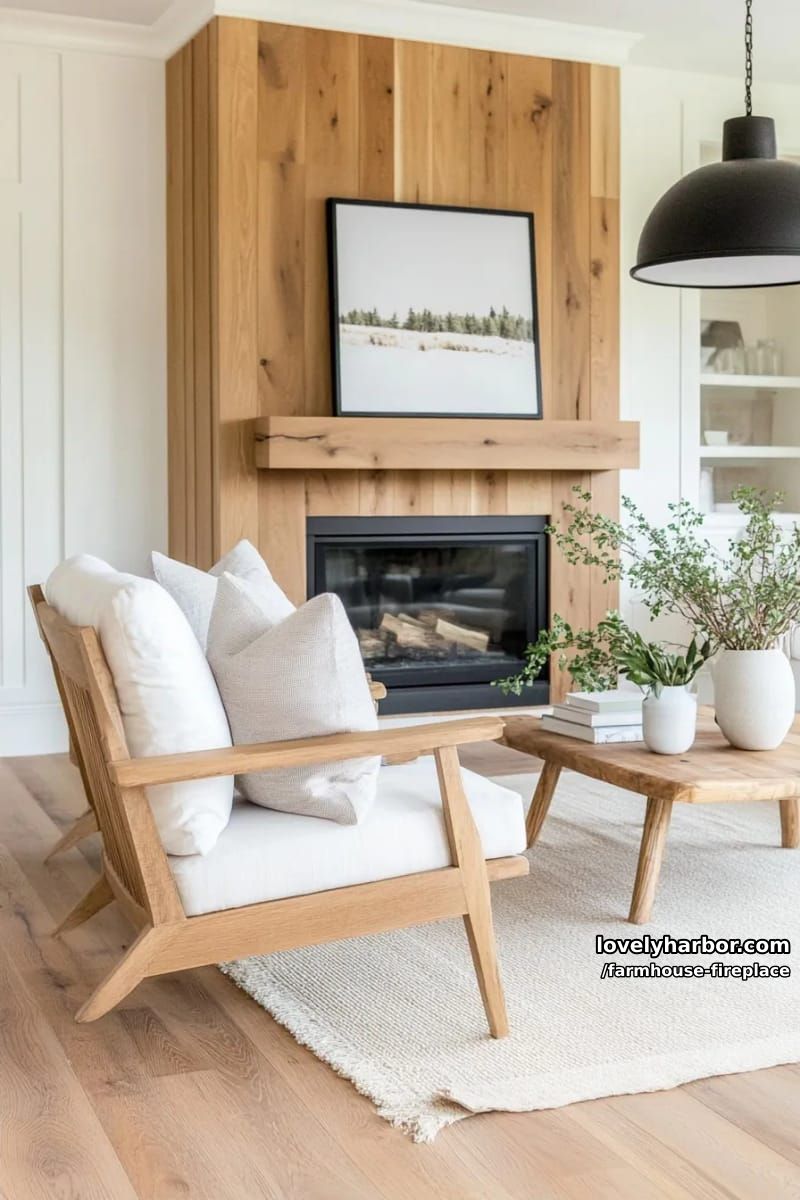
Wood paneling around a fireplace splits into two looks: vertical tongue-and-groove for height, or wide horizontal planks for a lower, calmer wall. Vertical suits a short room. Horizontal suits a long one.
The material choice matters near heat. Solid wood moves and can scorch close to the firebox, so most of these surrounds are wood-look porcelain or a non-combustible panel veneered in wood and kept well back from the opening.
Color-wise, stain beats paint here. Paint on a fireplace surround chips at the edges where people set down candles and remotes, and touching up a stain is far more forgiving than trying to match an old paint sheen.
12. Spacious living room with floor-to-ceiling stone fireplace and tall windows.
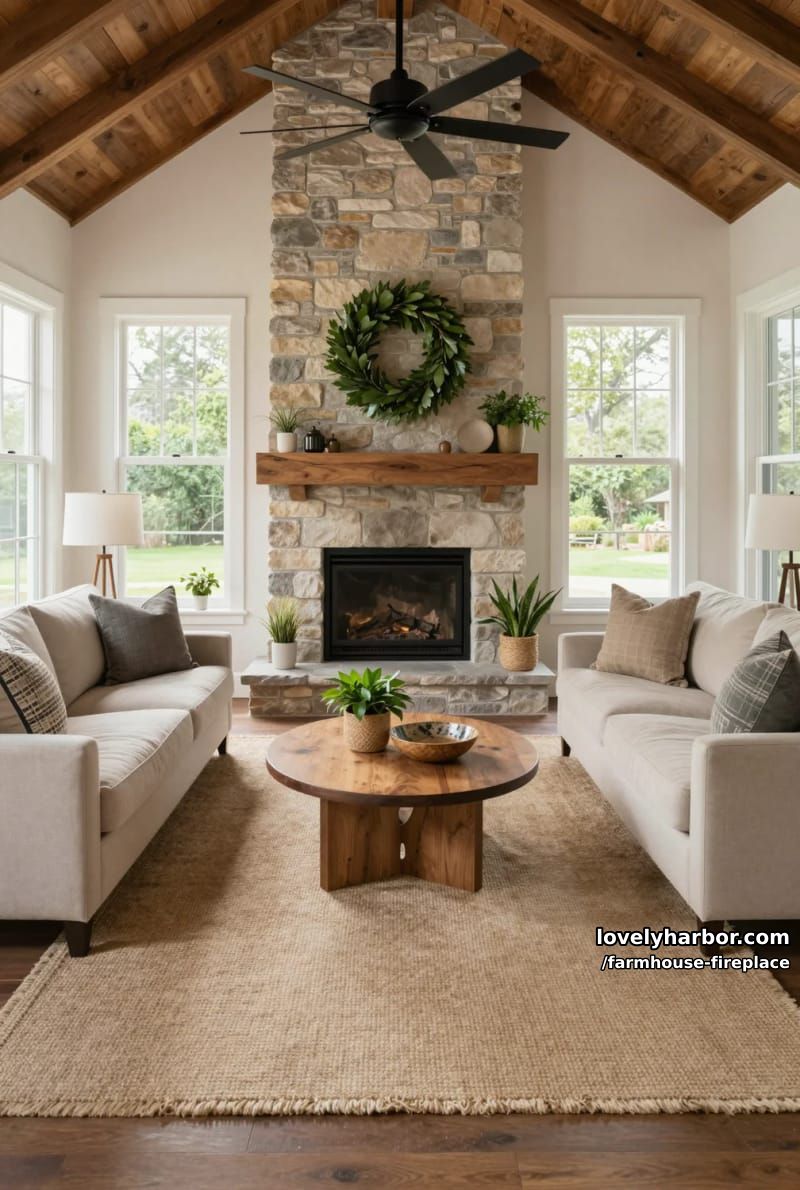
A floor-to-ceiling stone wall is the most expensive idea on this list to do for real, and the whole thing lives or dies on the stone you pick. These four cover most of what you’ll actually be choosing between.
Fieldstone
Rounded, irregular, heavy and very rustic. Reads cabin more than refined farmhouse.
Ledgestone
Thin linear courses stacked tight, the tidiest of the rustic options.
Limestone / chalk
Pale, soft-edged, European in feel. Keeps a tall wall light instead of heavy.
Manufactured veneer
Lightweight cast concrete that installs over drywall. The budget route.
Manufactured veneer runs roughly $6 to $12 a square foot in materials, against far more for quarried stone, and from across the room most people can’t tell. Up close, the repeating mold patterns give it away, so spend on real stone only where people stand right next to the wall.
13. Farmhouse living room with whitewashed brick fireplace and wooden mantel.
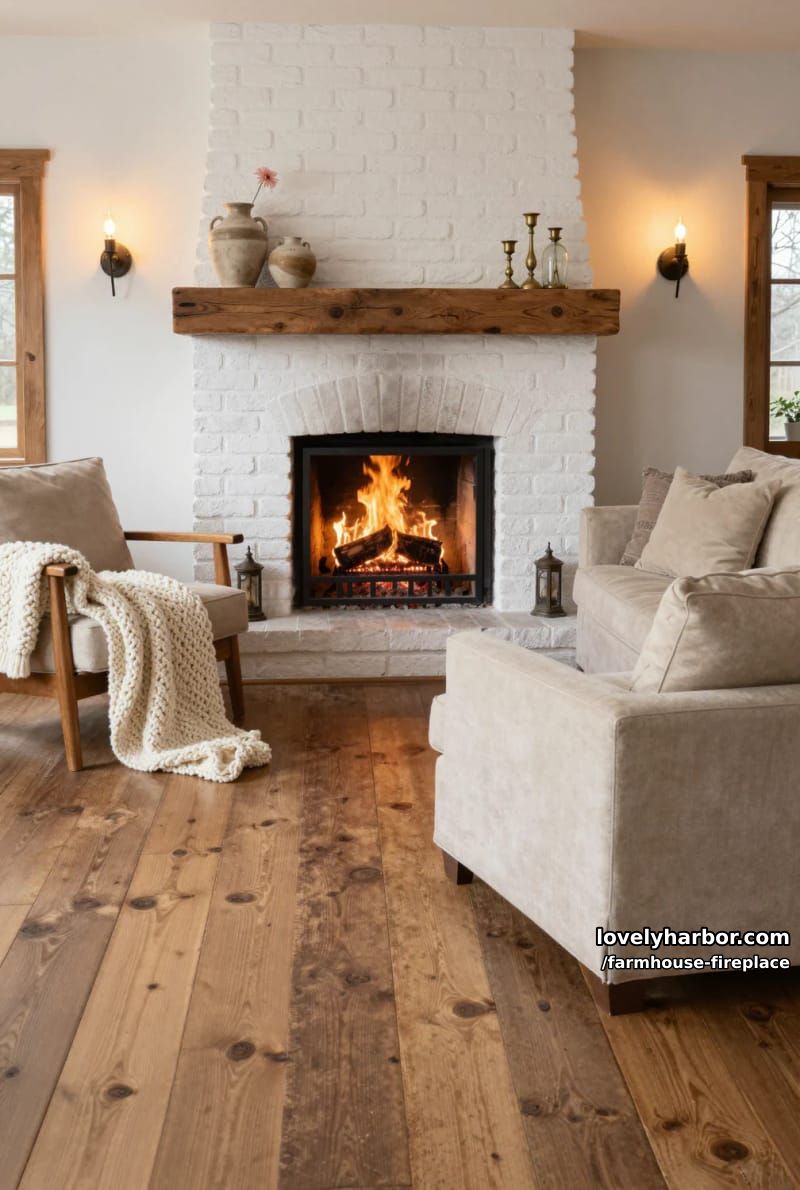
I used to tell everyone to paint a tired brick fireplace solid white. I’ve walked that back. Solid paint seals the brick and flattens all the depth out of it, while whitewash and mineral limewash let the brick breathe and keep some of the original color reading through the haze.
Do this
- Use a mineral limewash such as Romabio Classico, thinned more for greater brick show-through
- Test on one hidden brick first and let it dry fully before judging the color
- Wipe a few bricks back while the wash is still wet for a worn, uneven look
- Wash the soot off the brick before you start
Avoid
- Latex paint straight from the can (it seals and looks flat)
- One thick opaque coat that hides the mortar lines entirely
- Skipping the test patch, since color shifts as it cures
- Applying over greasy, unwashed brick where it won’t grab
Limewash is also reversible within the first few days if you hate it, which is more than you can say for paint. A gallon of Romabio typically runs around $50 to $80 and covers a standard fireplace in two coats.
14. White fireplace with patterned tile surround and wood mantel shelf.
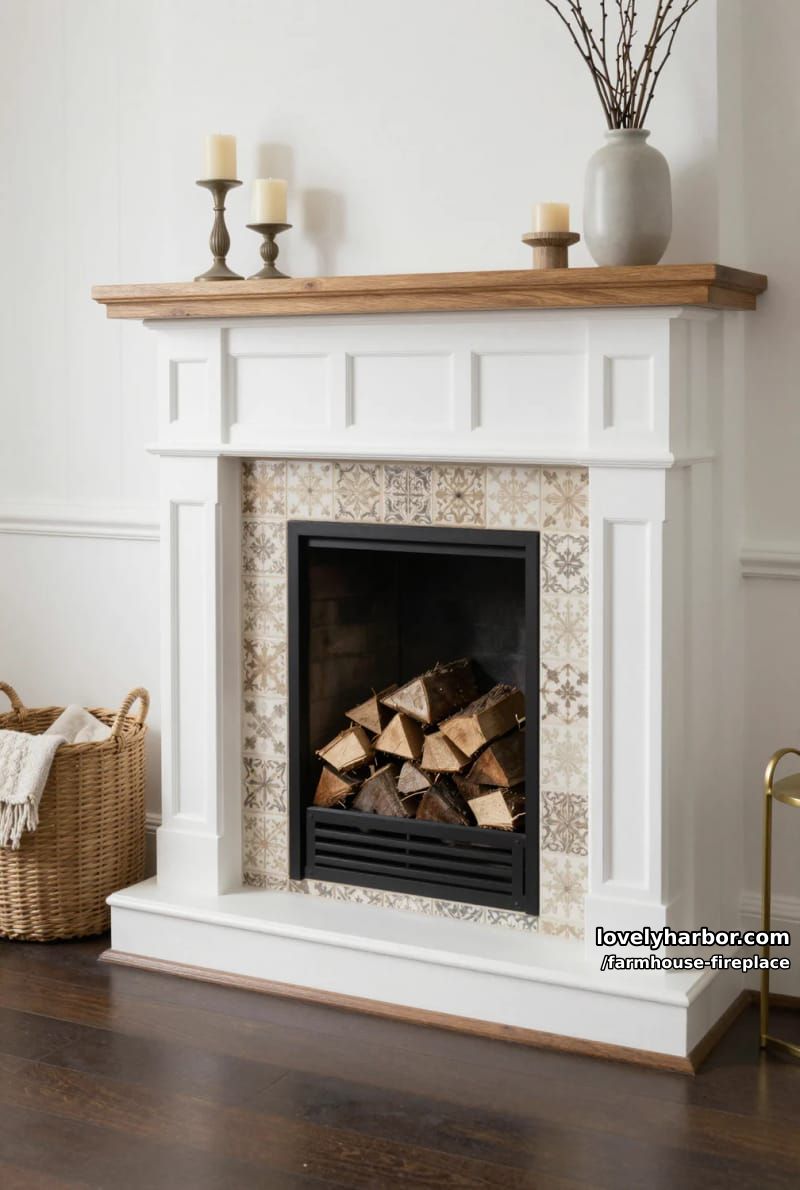
Patterned cement or encaustic tile around a white firebox is where farmhouse quietly borrows from Spanish and Portuguese tradition. Keep the pattern on the surround only. Running it across the hearth floor and up the wall too turns charming into busy fast.
Cement tile is porous and soot will stain it, so it has to be sealed. A penetrating sealer before grouting and again after saves you from the permanent gray shadows that otherwise creep around the opening.
If real encaustic blows the budget, the porcelain look-alikes from Bedrosians or Cle handle heat better anyway and skip the sealing routine entirely.
15. Cozy corner with stone fireplace, wood stove, and brass accents.
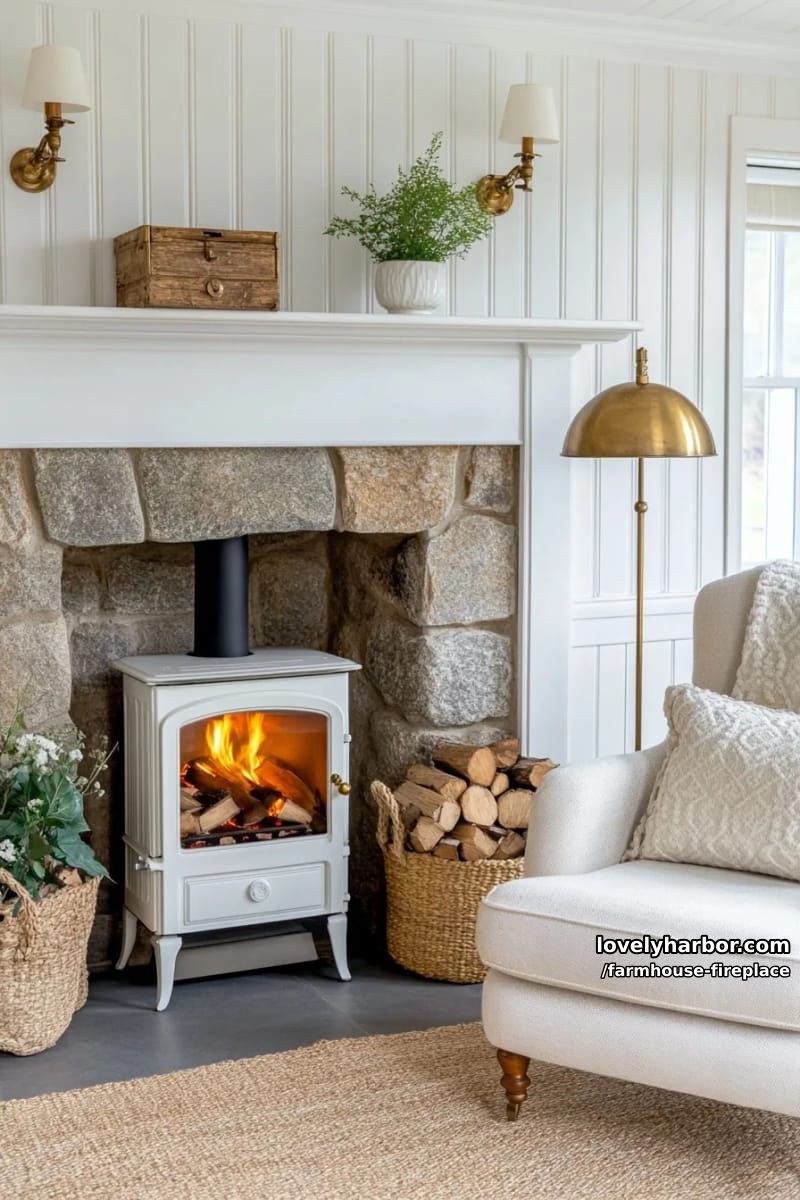
A freestanding wood stove on a stone hearth is the one setup here that heats an actual house, not just the room it’s in. A mid-size cast-iron stove from Vermont Castings or Jotul throws real warmth, and the stone behind it doubles as a heat shield and the code-required clearance backing.
Brass trim reads warmer than the all-black stove look, but raw brass tarnishes fast near heat and you will be polishing it. Lacquered brass holds its color and asks for nothing, though once the coating wears you can’t re-polish underneath it.
Burn seasoned hardwood under 20 percent moisture or you’ll glaze the glass black and gum up the flue. A $20 to $30 moisture meter pays for itself the first winter.
16. Bright living room with tall stone fireplace and exposed beams.
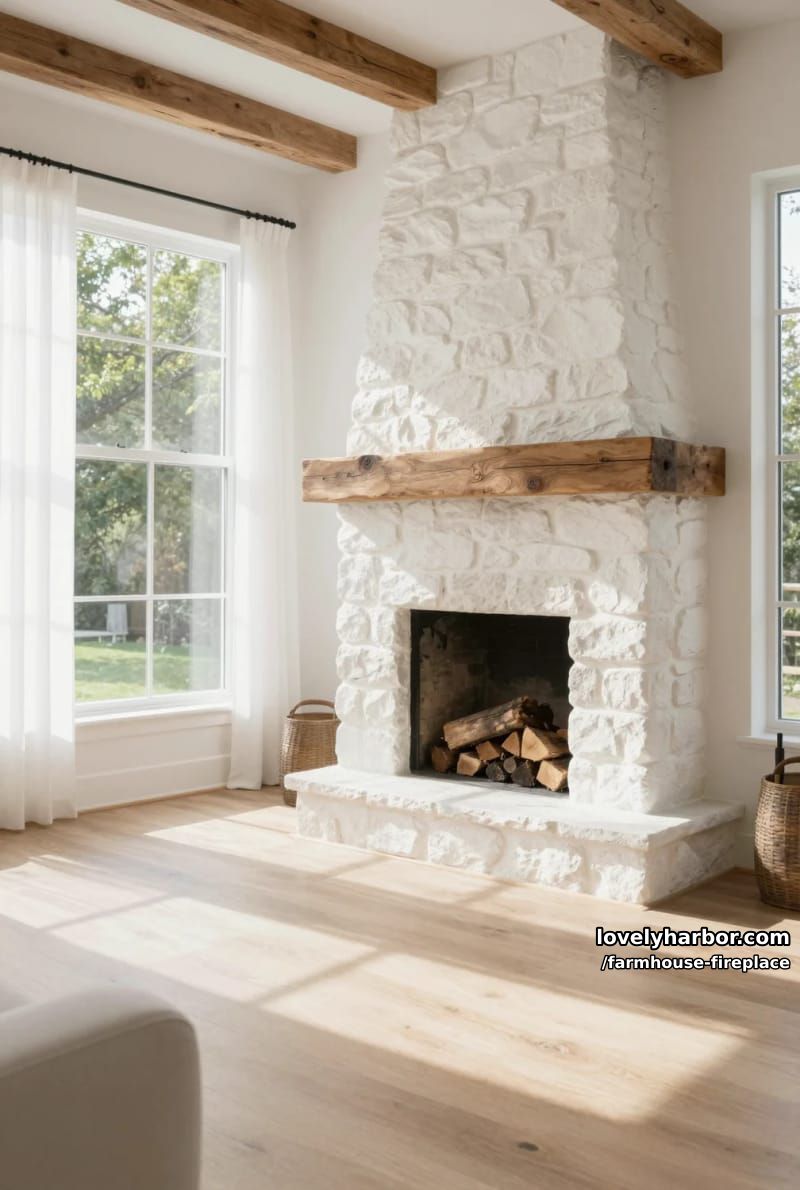
Pairing pale stone with dark beams is a deliberate value contrast. The light masonry keeps the room bright while the beams pull the eye up and stop the ceiling from reading flat. Whitewashed limestone with walnut-stained beams is the cleanest version of this.
A tall stone chimney breast can take over the room, and the fix is horizontal weight at sitting height. A long low sofa or a wide console across from it balances the vertical mass of the stone.
Skip the matching stone-veneer TV niche if you possibly can. Cutting a black rectangle into the stone almost always cheapens the wall, and a media cabinet set off to the side keeps the masonry intact.
17. Rustic farmhouse living room with stone fireplace and greenery mantel.
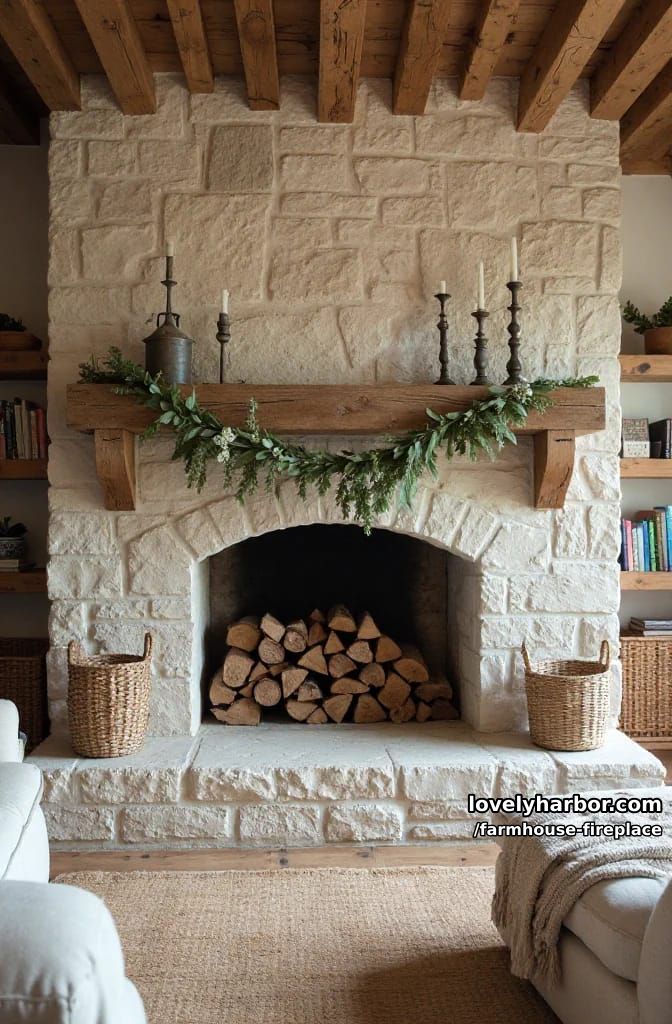
A greenery garland is the cheapest seasonal change you can make to a mantel, and the species behaves very differently. Eucalyptus dries silvery and lasts months. Fresh cedar or pine smells better but sheds needles and browns within two weeks near a working fire.
For faux, the line between convincing and plastic comes down to stem density and a matte finish. The better Afloral and Pottery Barn garlands hold up at arm’s length, while the shiny dollar-store stems announce themselves from across the room.
Keep any real or dried greenery well back from the firebox opening. Dried eucalyptus is essentially kindling, and people forget that every single December.
18. Stone and wood fireplace with thick mantel and herringbone tile firebox.
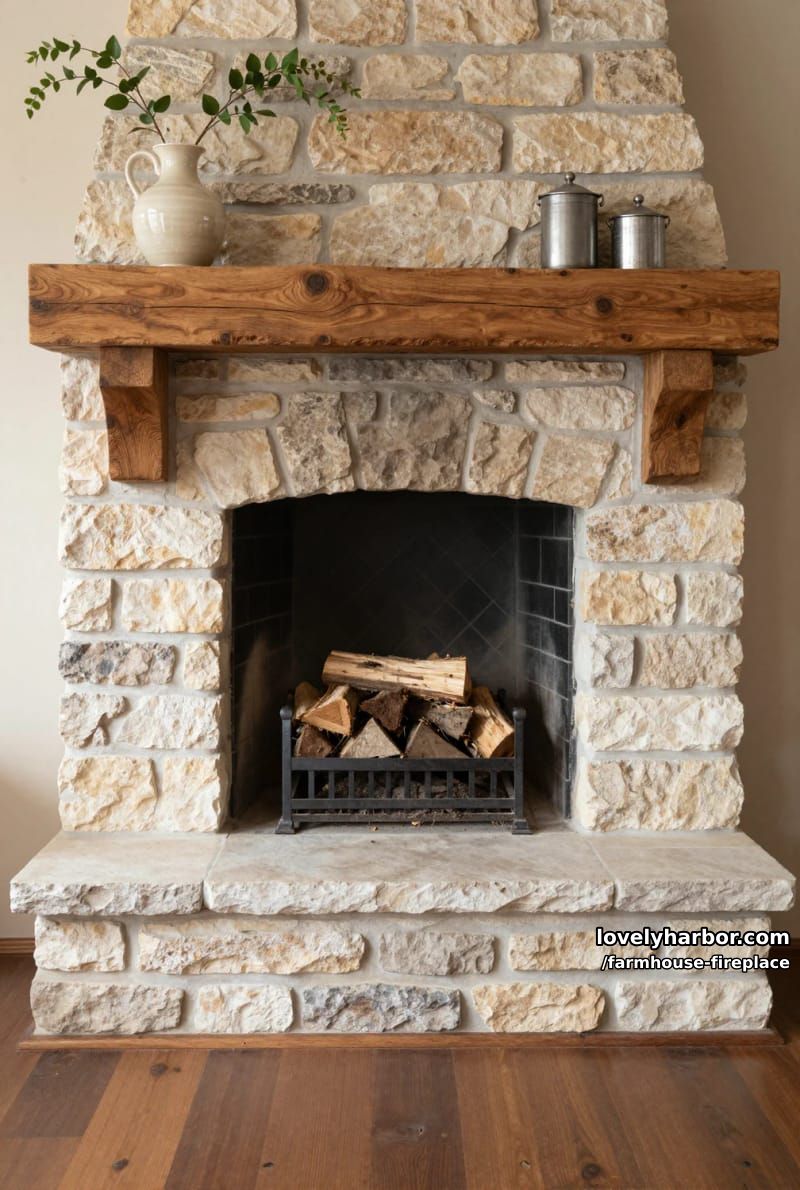
A thick mantel that actually carries weight needs real anchoring. A 6-inch by 8-inch timber loaded with books and a clock should be lagged into studs or set on a steel mantel bracket let into the masonry, not glued to stone with a bead of construction adhesive.
Herringbone inside the firebox itself has to be heat-rated. Standard ceramic or porcelain can crack from thermal shock, so firebrick or a refractory-rated tile is the only safe choice in a wood-burning box.
The combination of rough stone, smooth timber, and tight herringbone packs three textures into one wall. That’s plenty. If the surrounding walls and furniture are also busy, the fireplace and the room start competing for the eye and the whole thing reads noisy.
19. Built-in entertainment wall with electric fireplace and chevron accent.
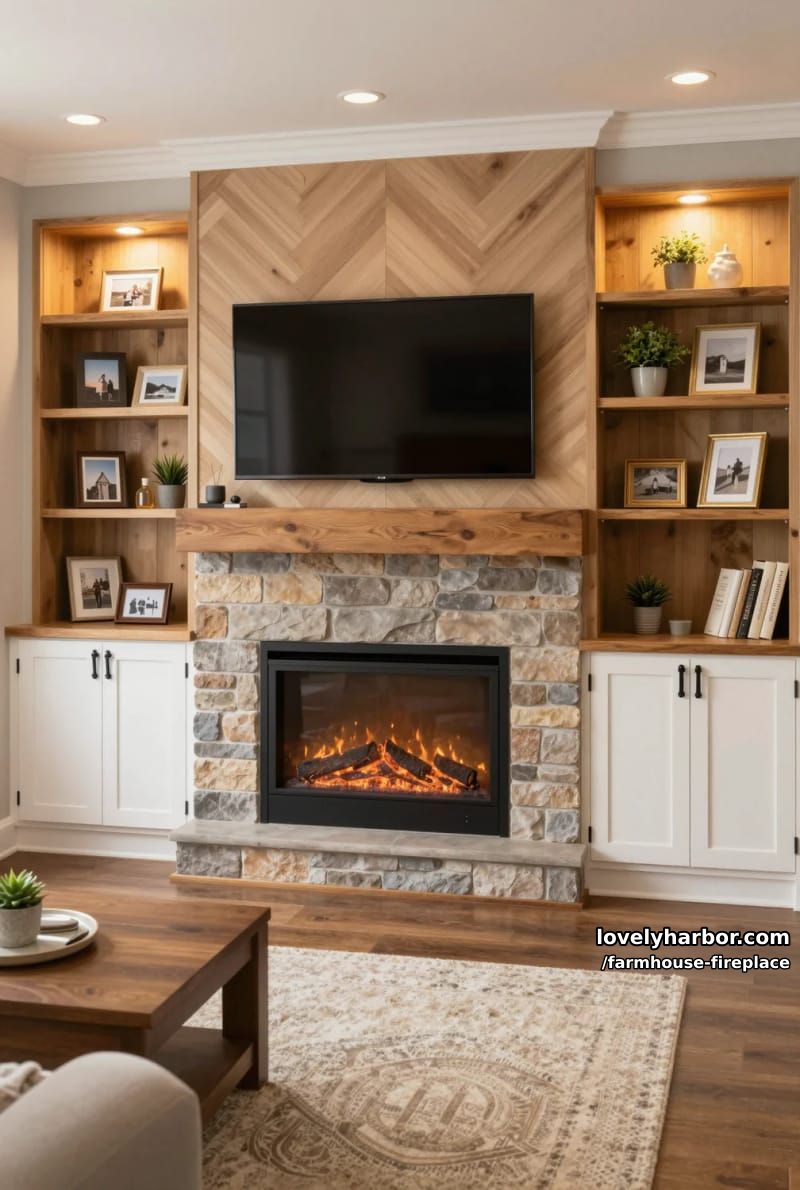
An electric firebox under a mounted TV is the practical modern-farmhouse compromise, and the linear inserts from Touchstone or Dimplex give a decent flame without a gas line. The wall-recessed models sit flush and look built-in, not bolted on.
Mounting a TV over any fireplace, electric included, usually puts the screen too high for comfortable viewing and tips your neck back for hours. If you must do it, use a pull-down mount and confirm the firebox vents its heat forward, not up into the TV cavity. Wood and gas units make this worse, so check the manufacturer’s required clearance above the opening before you put a single screw in the wall.
A chevron or board-and-batten accent on the surrounding wall hides the fact that you’re looking at a flat built-in. Run the accent on the fireplace wall only. Wrap it around the whole room and it starts to feel like a feature wall from 2016.
20. Modern living room with stone fireplace, wood mantel, and built-ins.
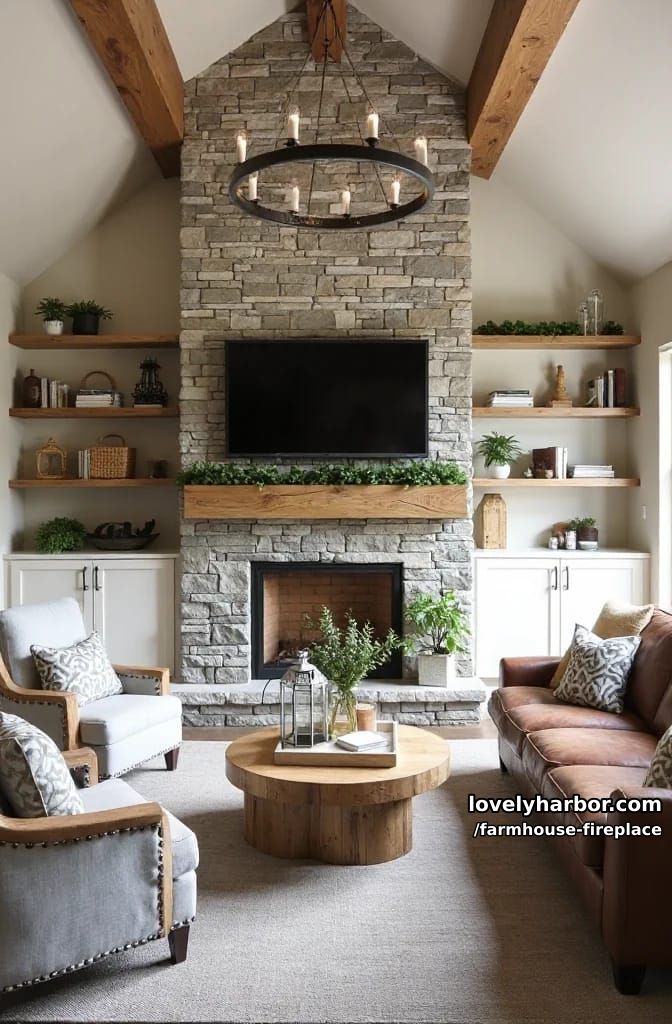
Symmetrical built-ins flanking a stone fireplace are the most resale-safe layout on this whole list, which is exactly why they can feel a little expected. Break the symmetry slightly, open shelves on one side and a cabinet door on the other, and it stops looking like a builder package.
In a small room, light the stone instead of buying more of it. A pair of recessed wall washers grazing the stone face adds all the texture and shadow without the bulk of a deeper surround.
Keep the built-in depth honest. A 12-inch shelf holds books and frames cleanly; the 16-inch ones builders love just collect a deeper layer of clutter.
21. Farmhouse living room with stone fireplace, wooden mantel, and neutral seating.
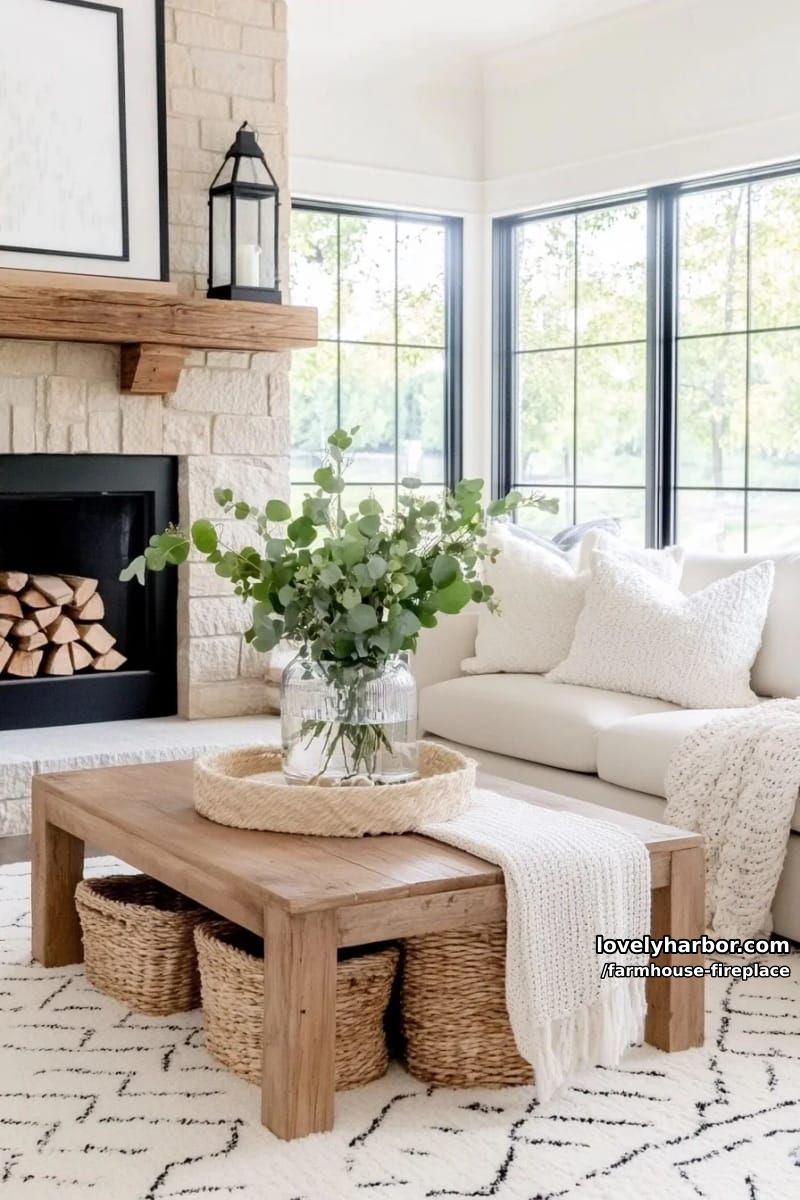
Neutral seating around stone is the catalog-default farmhouse look, and it works precisely because the stone supplies all the texture the beige can’t. The risk is flatness, so the neutrals have to vary in tone and material instead of matching out of one collection.
Layer a flax linen, a chunky wool, and a smooth leather instead of three cotton weaves in the same oatmeal. Different fibers catch light differently, and that is what keeps an all-neutral room from looking dead in photos.
A lighter, slimmer mantel helps a small room here. A chunky 8-inch beam crowds a low ceiling, while a 4-inch to 5-inch mantel still reads farmhouse without eating the wall.
22. Living room with gray shiplap accent wall and wood mantel fireplace.
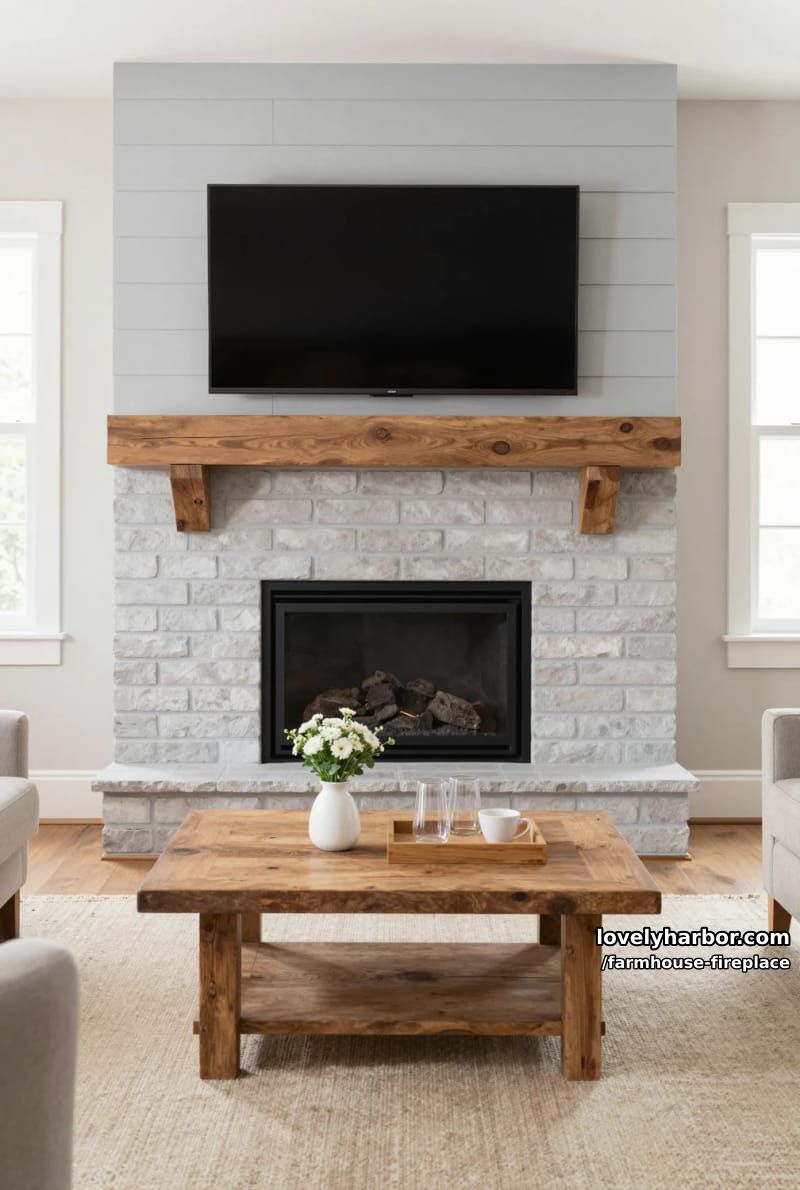
Gray shiplap dates faster than anything else in this category. The cool grays everyone painted between roughly 2015 and 2019 now read flat and a little sad, and the only grays aging well are the warm greiges with a brown base underneath.
If you’re committing to gray, go warm. Something like Sherwin-Williams Agreeable Gray or Repose Gray, never a blue-gray. And put a real wood mantel against it, because gray walls plus gray-stained wood is the single coldest combination you can land on.
A north-facing room makes any gray colder still. In that low light, hang a warm-metal piece nearby, an aged-brass sconce or a copper vessel, to put some heat back into the wall.
23. Modern corner with floor-to-ceiling shiplap wood fireplace and glass insert.
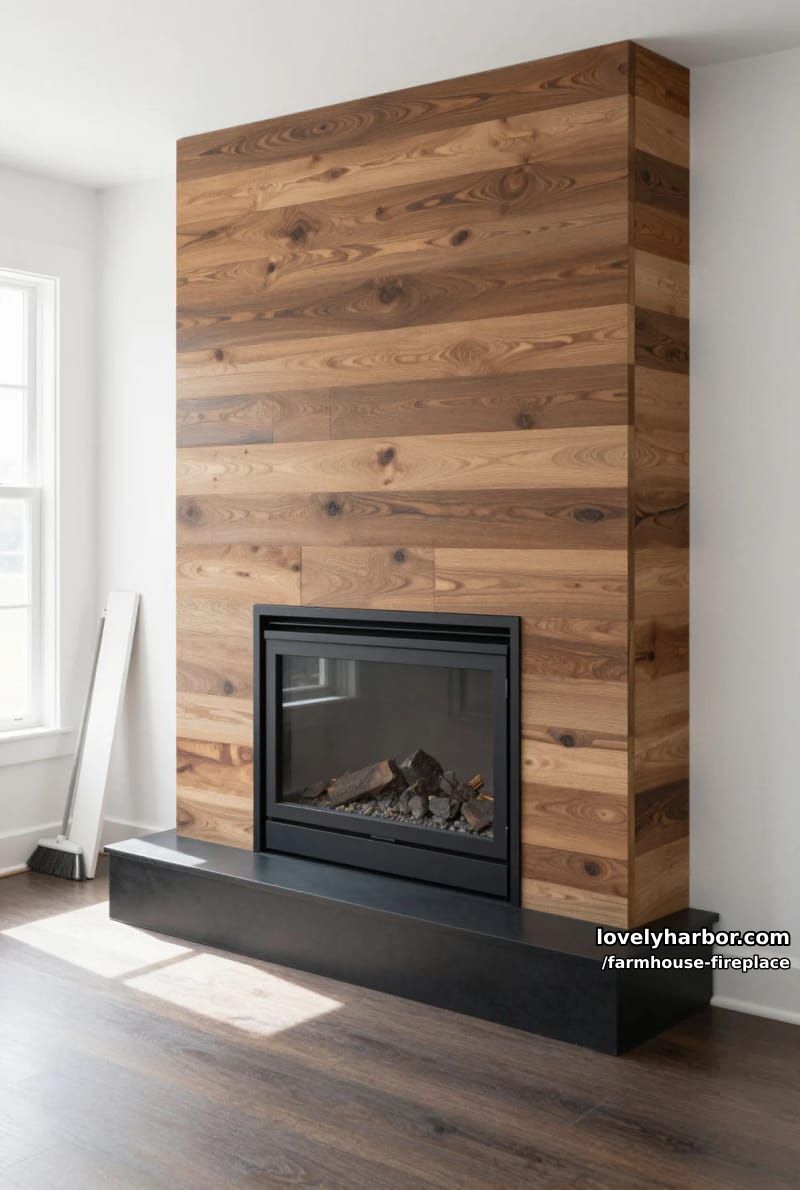
A corner fireplace is the awkward-room solution, and a floor-to-ceiling shiplap surround makes the corner look intentional instead of leftover. The strong vertical line draws the eye up and disguises the fact that the firebox is wedged into a 45-degree wall.
The glass insert is the part that shows fingerprints and soot first. A gas or electric unit with a sealed front stays cleaner than an open wood box, and for the haze, ceramic glass cleaner with newspaper beats paper towels, which leave lint.
Angle a pair of oversized chairs into the corner so the seating follows the fireplace’s diagonal. Done right, the corner stops feeling like dead space and starts pulling the rest of the room toward it.
Conclusion
If you’re starting from a builder-grade brick box, change the color before you change anything else. The limewash and German smear in sections 1, 6, and 13 do more for a room than a new mantel ever will, and they cost a fraction as much. After that, the mantel and the surround material set the tone, and everything on top, the baskets, the garland, the lanterns, is seasonal and cheap to swap whenever you get bored.
The one place to spend real money is the firebox itself. If you actually want heat and not just a glow, the wood stove in section 15 or a gas insert will beat the electric inserts that only look the part on a cold February morning.