
Stone is the difference between a pool that looks like it grew out of the garden and one that looks craned in over the fence. Shape matters less than people assume; the stone you set around and under the water is what decides whether the surface scalds bare feet at noon, grows a skating-rink film after rain, or flakes apart on its third winter.
These fifteen ideas run from a fern-edged plunge pool to a built grotto, and for each one I have flagged the stone I would actually specify and the one that ends in a re-do.
1. Curved stone pool edged with wild ferns and lush greenery for a secret garden feel
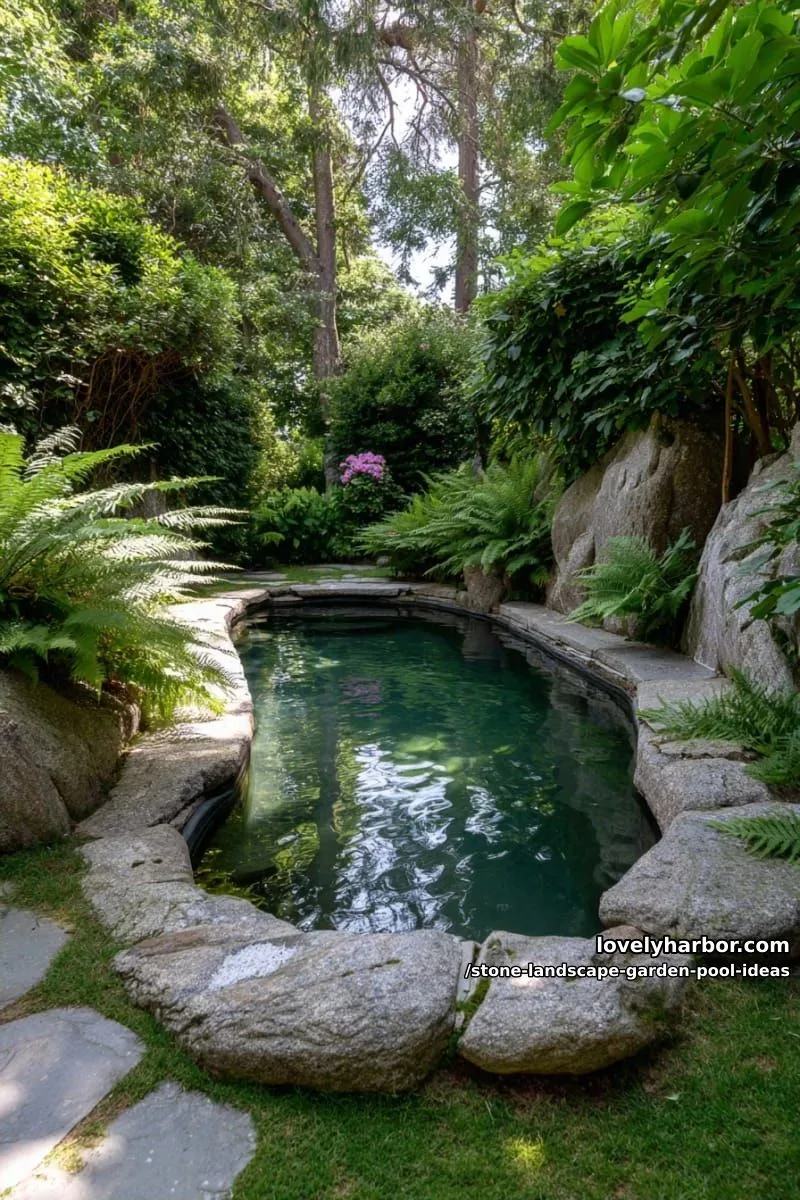
A free-form curve reads soft and woodland, and it also reads 1987 if the curve goes wrong. Aim for one long sweeping radius instead of the kidney-bean wiggle pool builders fell in love with decades ago; that wiggle dates an older pool faster than any tile choice.
Ferns only deliver this in shade and steady moisture. Plant them where the afternoon sun lands and they crisp brown by mid-July, which is the most common way the look actually fails. If your yard bakes, autumn fern and the hardier wood ferns hold up far better than the delicate maidenhairs everyone reaches for first, and a low sedge can fake the same spilling edge on a fraction of the water.
Native, loosely planted, a little overgrown. That is the whole assignment, and it is harder than a clipped boxwood hedge, because nobody can tell artful wildness from plain neglect except you.
2. Flagstone patio with sunken fire pit beside turquoise swimming pool
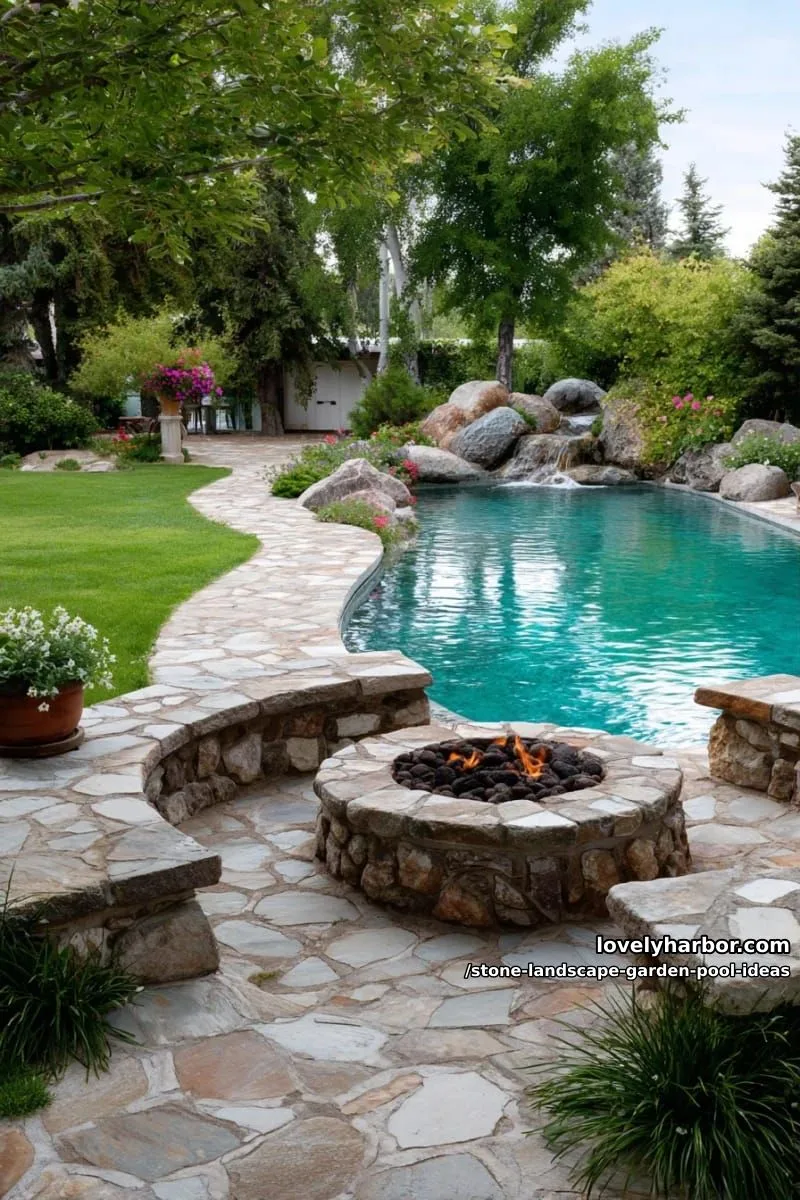
Flagstone gives you the irregular, jointed look most people want around water, but the word covers a dozen stones of wildly different quality. Pennsylvania bluestone in a thermal (not honed) finish gives you grip and survives freeze-thaw. The soft sandstone flags off a discount pallet shed grit into the pool and cup standing water in every depression.
Set the fire pit a sensible distance back from the coping. A sunken gas pit right at the water's edge looks great in a photo and turns into a bathtub the first hard rain if the drainage was an afterthought.
- Wet-slip. Smooth, polished, or honed flags around a pool are a fall waiting to happen. Spec a thermal or cleft finish rated for wet areas.
- No drainage on the pit. A sunken fire feature needs a real channel drain and a gravel sump, or it holds water and won’t light.
- Gas line clearance. A gas pit near combustible decking or under-clad seating has code clearances; a permitted install is cheaper than the alternative.
3. Multi-level waterfall cascading into a lagoon-style pool with boulders
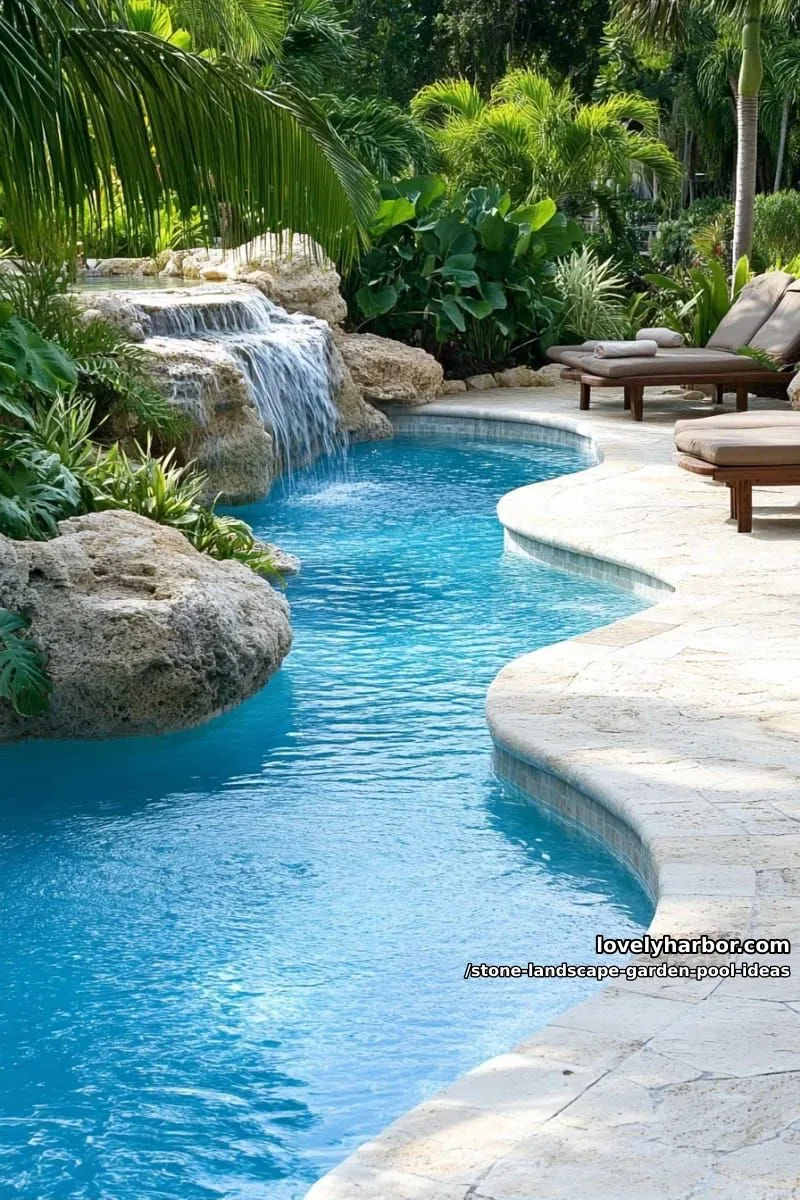
People ask me about boulder waterfalls more than any other feature on this list, and the honest answer is that most of them age badly. The cheap version, a heap of rounded river boulders glued around a black-lined pool, reads less mountain spring and more crazy-golf course within a couple of seasons.
If you want falling water, spend on the rockwork or skip it. Real quarried, angular stone set by someone who builds dry-stone walls looks like geology. A kit of uniform fake-rock from a big-box landscape aisle never does, and the gaps between the stones become a leaf-and-algae trap you end up clearing by hand.
There is also the running cost nobody mentions at the showroom. A multi-tier fall needs a serious pump, and on a hot, still evening you can hear the electricity bill before you hear the water.
4. Above-ground pool wrapped in stacked stone and surrounded by manicured shrubs
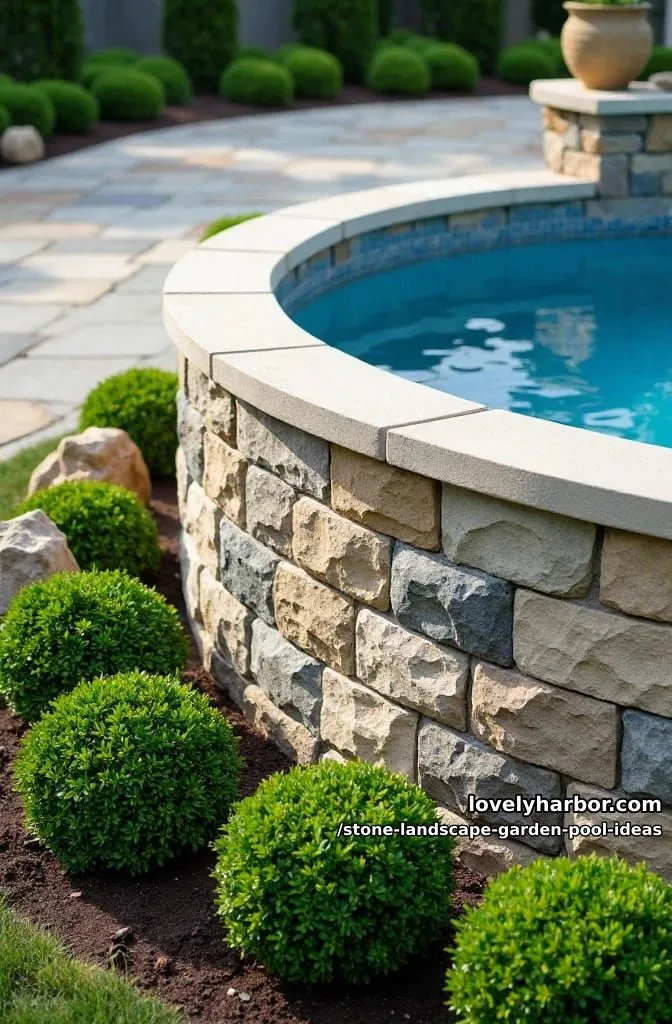
The promise here is fair: dress an above-ground pool in stacked stone and it stops looking like a stock tank. The catch is what "stacked stone" usually means in practice, which is thin veneer panels glued to a frame.
Those panels crack at the corners and peel along the bottom edge where splash keeps them wet, and once one lets go the repair is obvious from across the yard. Real dry-stacked stone is heavy enough to need its own footing, which on an above-ground pool defeats the point. I would either commit to a low stone surround built on a proper base, or use a good composite cladding and stop pretending it is rock.
The manicured shrubs soften the base either way. Boxwood if you have the patience for clipping, dwarf yaupon holly if you don't.
5. Sleek infinity pool with granite coping and geometric hardscape paths
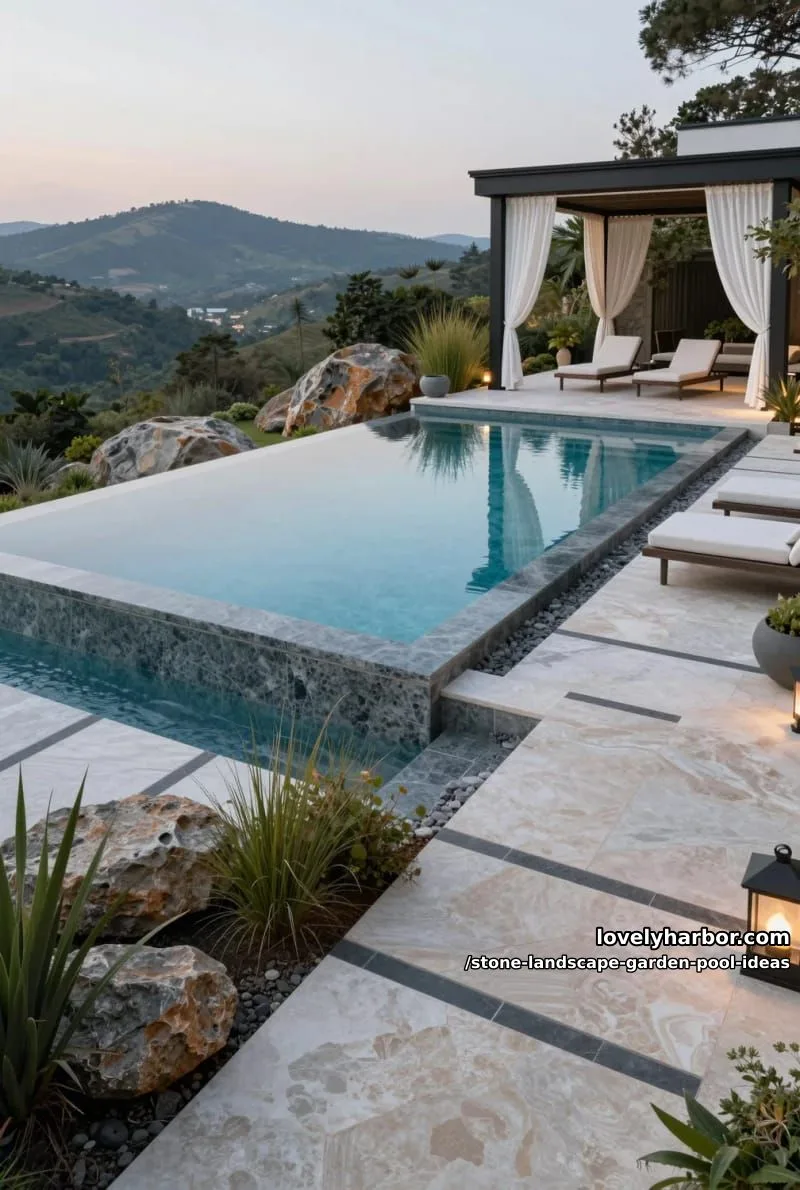
An infinity edge needs somewhere to fall toward: a view, a slope, a lower garden. Build one on a flat suburban lot and you have paid a large premium for an effect nobody can see, because the vanishing edge only reads when you look across the water at something beyond it.
Granite coping is the right instinct for the clean modern look, but flamed or honed, never polished. Polished granite by a pool is a lawsuit. On heat: dark granite in full sun gets hot enough to hurt, so either go pale or accept that the deck is a barefoot no-go zone from noon to four. Geometric paths in the same stone tie the whole thing together, as long as the joints stay tight, because a sharp grid only looks sharp while the lines stay clean.
Minimal does not mean low-maintenance here. The cleaner the geometry, the more a single shifted paver or a smear of algae announces itself.
6. Sunken lounge area within the pool, surrounded by smooth river stones
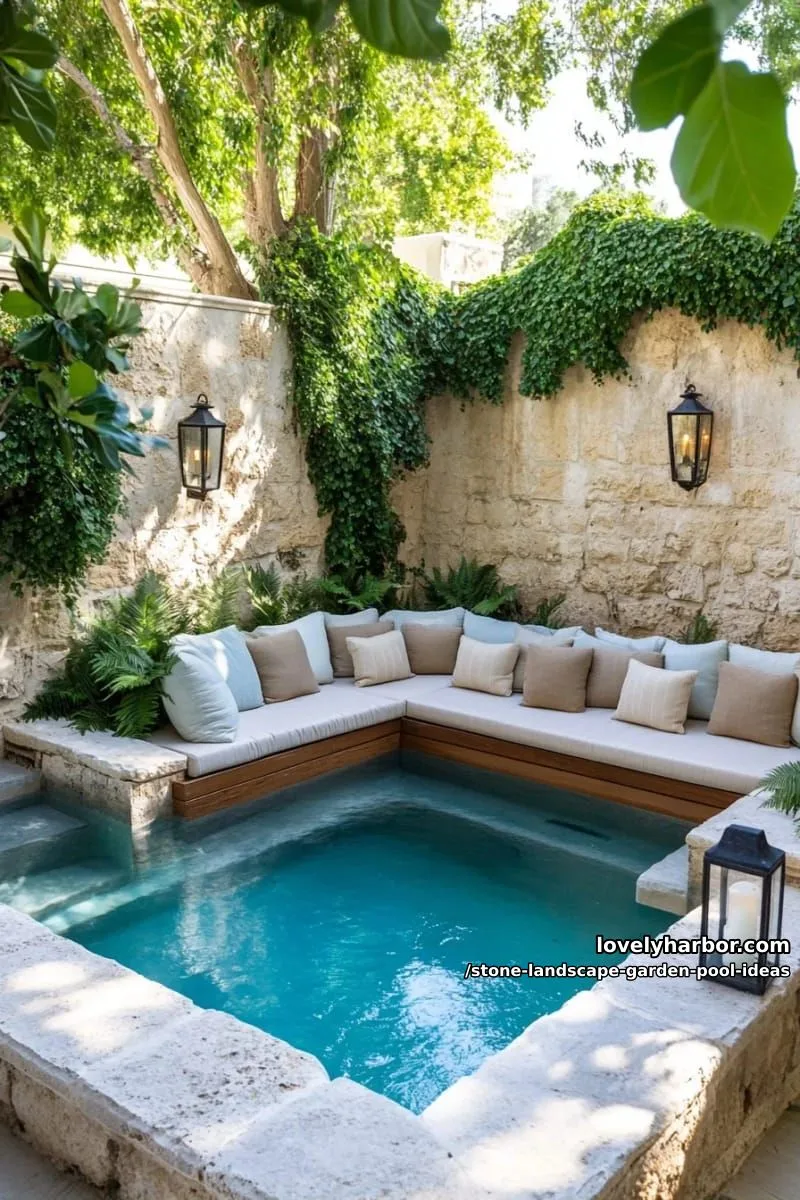
A sunken seating well, the in-pool version of a conversation pit, is one of the few features here I would actually fight for. Water at ankle height, a real bench, shade over the top, and you finally have somewhere to sit at a party that isn't a soaked plastic lounger.
The smooth river stones are the part I would push back on. Underwater, rounded stone is slick, and as a floor finish in a wet seating area it is asking for a fall. Use them as a decorative band above the waterline and put a textured, slip-rated tile where feet actually land. Cleaning matters too: any stone texture below water grows a biofilm, and a sunken well with weak circulation is exactly where it shows up first.
7. Raised spa encircled by irregular flagstones and flowering vines
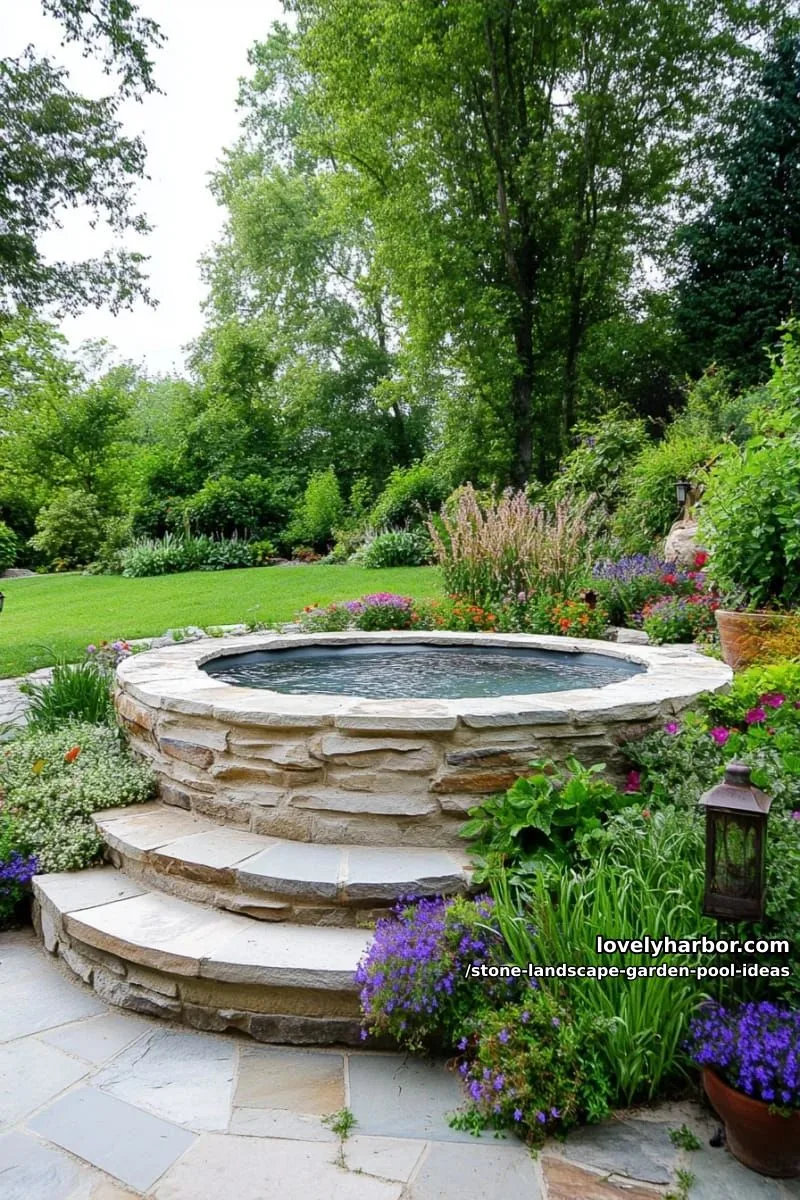
A raised spa reads better than a flush one for a plain reason: the extra height gives you a wall to clad, and irregular flagstone on a curved spa wall is genuinely good-looking. It is also fiddly. Fitting random flags around a radius is a slow puzzle, and the labor, not the stone, is where the money goes.
Flowering vines are where I would slow you down. Anything you train near a spa drops leaves and spent blooms straight into the water, and a wisteria or trumpet vine will also try to pry apart whatever it climbs. Star jasmine on a separate freestanding trellis, set back a foot or two, gives you the scent and the flowers without feeding the skimmer all summer.
8. Cobblestone deck with vintage lanterns and Mediterranean-inspired poolscape
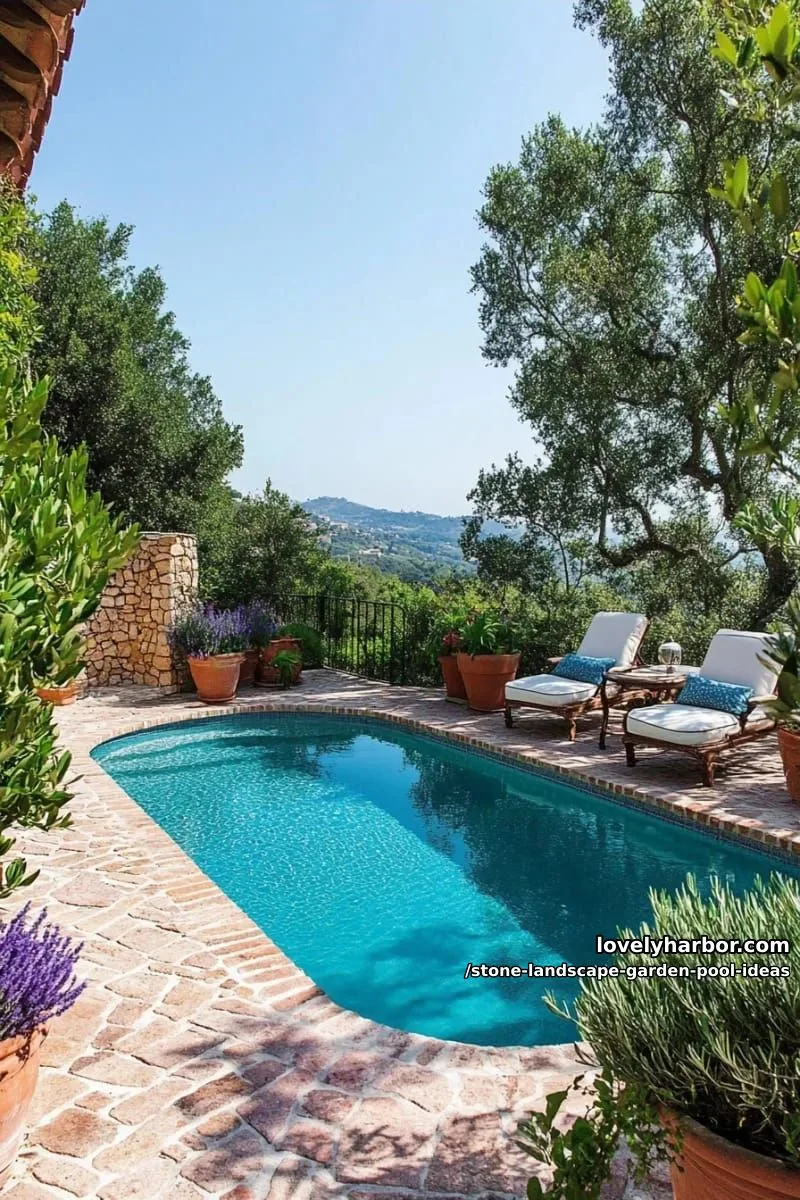
Real cobblestone around a pool photographs like the south of France and feels like a reflexology mat under bare feet. The rounded tops that make it charming are the same tops that wobble chairs, catch heels, and trip anyone walking up from the water with their eyes half shut. If you love the look, tumbled rectangular pavers in a warm buff give you the old-world color on a surface you can actually stand on.
The lanterns and a couple of olive trees do most of the Mediterranean work anyway. One note for cold climates: olives aren't reliably hardy below about 15 to 20°F, so across much of the country they live in pots that come indoors, or you fake the silvery foliage with a hardier willow-leaf pear.
9. Naturalistic pond pool with lily pads, mossy rocks, and aquatic plants
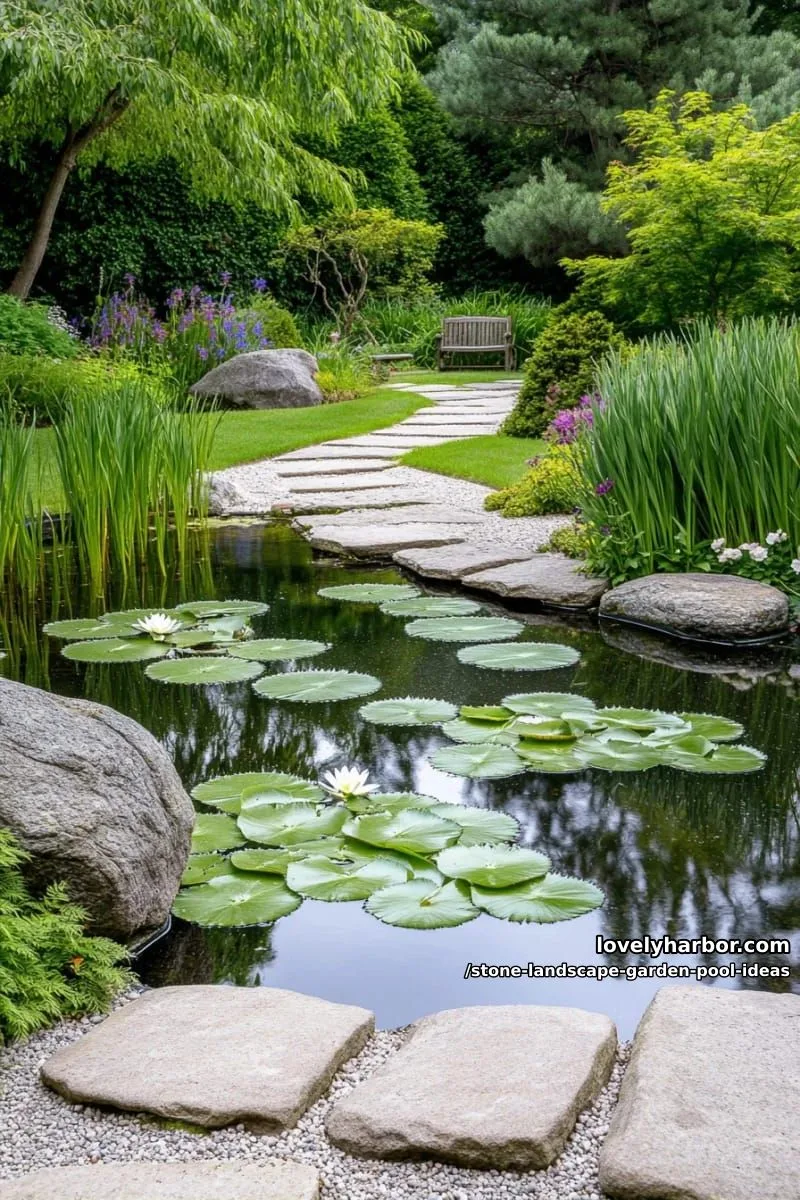
A natural-style pond pool, the kind with a gravel-bottom regeneration zone instead of chlorine, is the one design here that gets better the less you fight it. Built right, it filters itself through plants and looks like a woodland pool you'd swim in on a hike.
Built wrong, it's a bowl of green soup. The whole system lives or dies on the ratio of planted filtration zone to open swimming water, and on choosing plants that belong where you live rather than whatever the garden center had in stock.
Do this
- Size the planted regeneration zone to roughly half the total surface so the filtration can keep up.
- Use native marginals: pickerelweed, water iris, hardy waterlily for shade and oxygen.
- Build the stone edge with uneven sizes and a shallow shelf, so plants and wildlife have a foothold.
Avoid
- Invasive spreaders like water hyacinth: illegal in some states and a clog risk everywhere.
- Koi in a swim pond: they uproot plants and foul the water you want to swim in.
- Full sun with no plant cover: that combination is what turns it to algae by July.
10. Modern rectangular pool bordered by slate slabs and architectural grasses
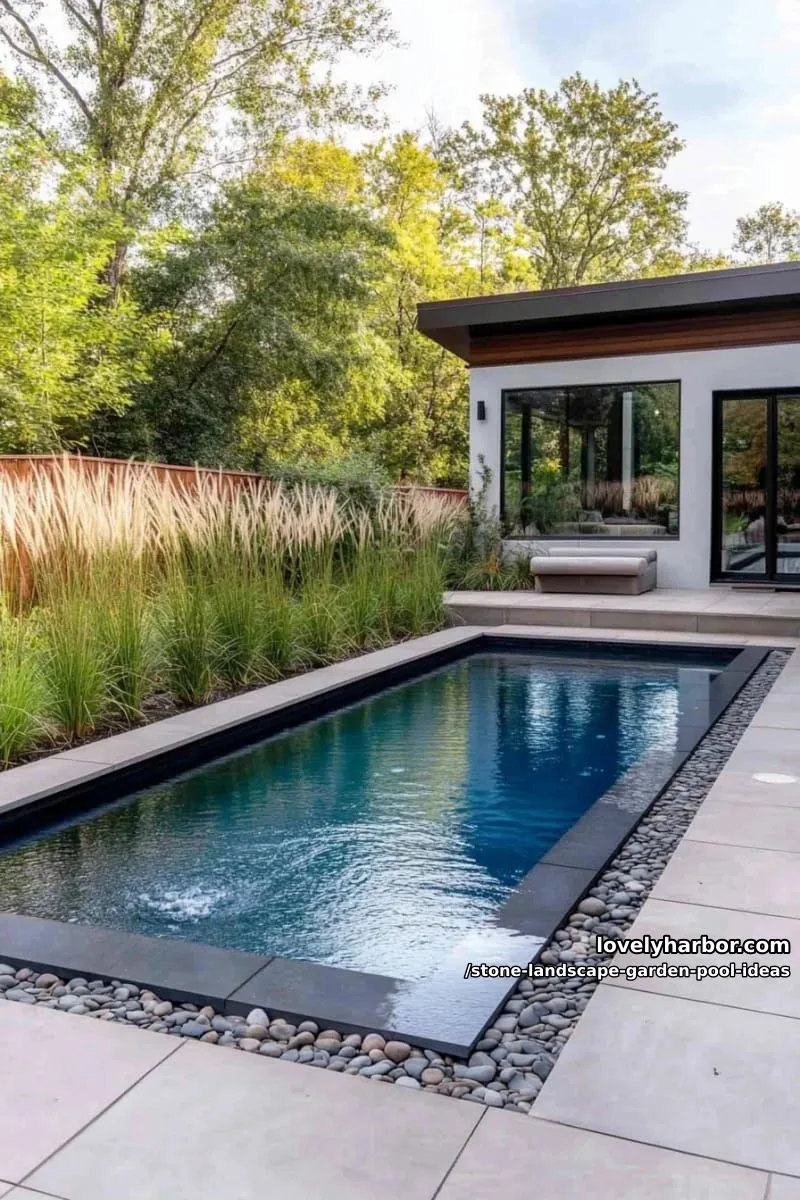
I'll say the unpopular thing: slate is the wrong stone for this. I specified a slate surround on a job years ago because the color was exactly right, and within two winters it was spalling, peeling thin sheets off the surface wherever water sat and froze. Sharp on day one, tired by year three.
Get the same rectilinear, architectural look from a stone that can take the abuse. The grasses are the easy part: calamagrostis "Karl Foerster" for stiff vertical lines, or a lower miscanthus if you want movement. Here is how the common poolside stones actually compare:
| Stone | Grip when wet | Summer heat | Freeze-thaw | Notes |
|---|---|---|---|---|
| Thermal bluestone | Good | Moderate (mid tones) | Excellent | The safe default for most US climates. |
| Travertine (tumbled) | Very good | Stays cool | Good if sealed | Cool underfoot, but tumbled or honed only: polished travertine is dangerously slick wet. Seal it or it stains. |
| Granite (flamed) | Good | Hot in dark tones | Excellent | Go pale; never polished by water. |
| Slate | Fair | Hot | Poor | Spalls in freeze-thaw; avoid as coping. |
| Limestone | Good | Stays cool | Varies by grade | Softer types etch from pool chemicals. |
11. Rustic stone outdoor fireplace paired with a lagoon pool and wooden loungers
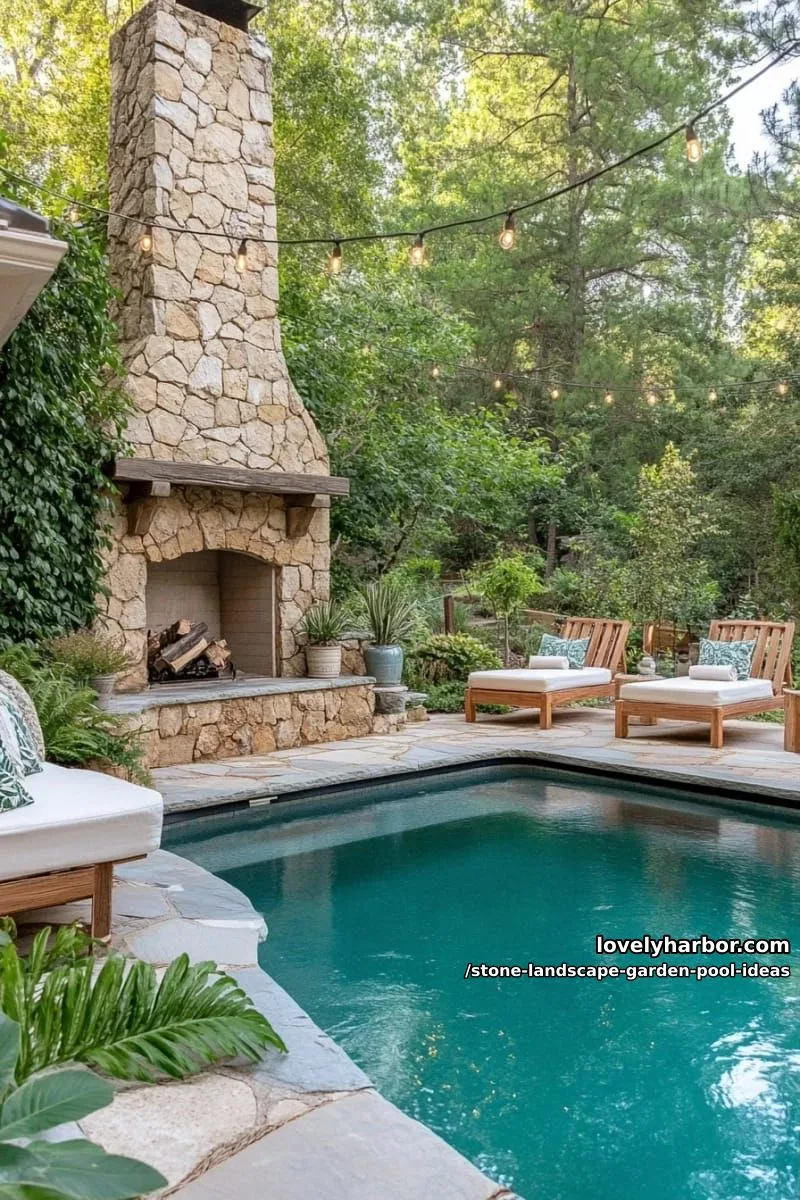
Extending the pool into cool evenings with a fire is the most-used upgrade in this whole list, because it is the one that gets people outside the other nine months of the year. A masonry fireplace anchors a corner and throws real heat; the lagoon shape beside it is mostly set dressing.
Two practical notes. Unsealed stone above a wood fire collects soot and stains, so spec a stone you can clean or one dark enough to hide it, and seal it. And the wooden loungers: teak silvers gracefully and shrugs off weather, while the cheaper acacia and "eucalyptus" sets sold as teak-look will gray, split, and wobble within a couple of seasons unless you oil them on a schedule you already know you won't keep.
12. Circular plunge pool with pebble mosaic floor and ivy-clad stone walls
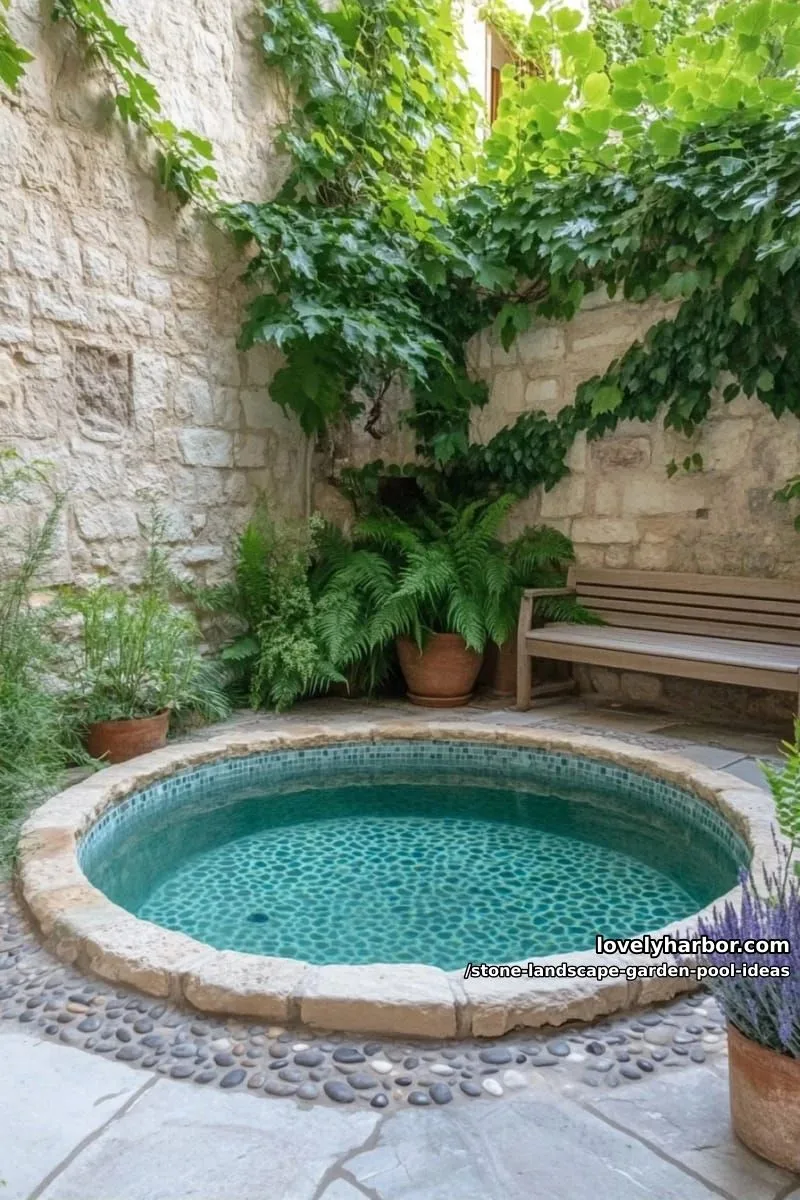
A circular plunge pool is the smart call for a small garden: tight footprint, deep enough to cool off in, cheaper to heat than a full pool. A pebble mosaic floor turns the bottom into something worth looking at, though pebbles are firm underfoot and a chore to scrub clean in the grout lines, so pick a smooth, rounded pebble rather than a crushed angular one.
The ivy is the thing I would talk you out of. English ivy roots into lime mortar and pries it apart, and on an old stone wall the damage is slow, costly, and invisible until a whole course of stone shifts. If you want the green-on-grey look, run a discreet wire and grow a climber you can actually control, or go in clear-eyed that the ivy is a ten-year problem you are planting on purpose.
13. Geometric checkerboard lawn and stone paths leading to a classic swimming pool
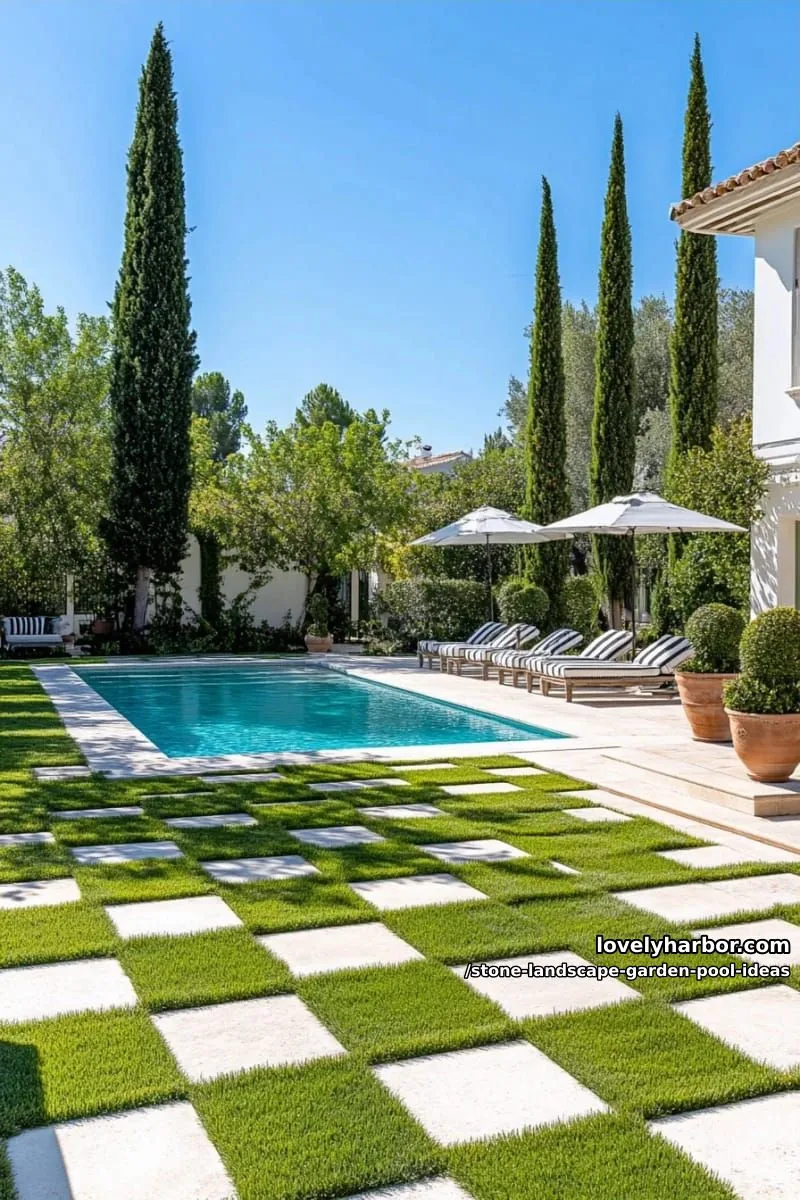
The checkerboard of turf and pale stone is a real garden tradition, not just an Instagram trick, but it is a maintenance trap next to a pool. Grass in the joints between pavers needs edging every couple of weeks to stay crisp, and the squares closest to the water get compacted and worn to mud by wet feet taking the same line in and out all summer.
The mistake almost everyone makes copying this off Pinterest is using ordinary lawn turf in those joints, then watching it die where the pool water lands. Here is what to plant instead and where:
Do this
- Plant joints with a tough, walkable groundcover: dwarf mondo grass, creeping thyme, or dymondia.
- Run a wide solid stone band on the actual route to the water, where wet feet take the same line.
- Keep the planted grid back from the splash zone, out of reach of chlorine and salt.
Avoid
- Fine lawn turf in the joints: it wears to bare mud at the pool edge within a season.
- Any grass right at the waterline: pool chemistry burns it brown and patchy fast.
- Thin paver joints with no soil depth: nothing roots, so you just get gaps.
14. Swimming pool in a hidden grotto with arched stone entrance and tropical plantings
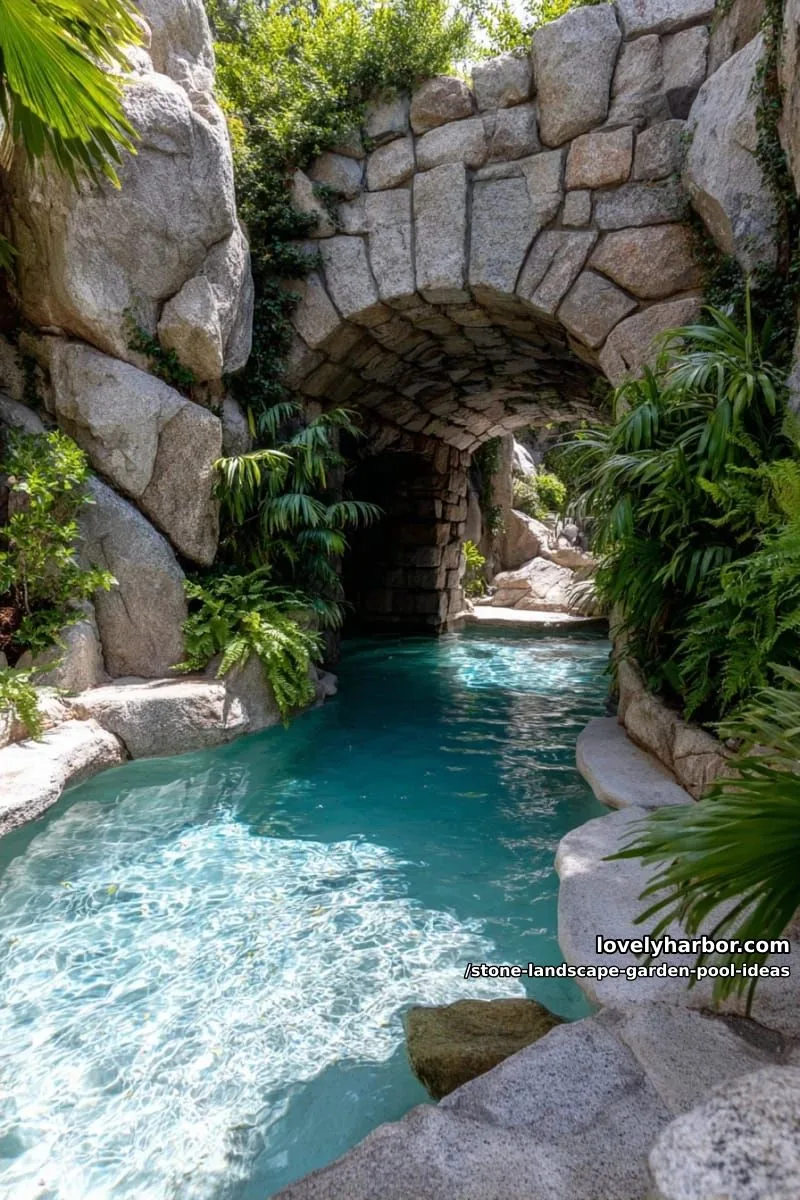
A grotto is the highest-risk idea on this list. Built by a real mason in real stone, with an arch that actually carries its load, it makes a garden feel old in the good way. Built in sprayed concrete tinted to look like rock, it is a water-park feature, and the difference is obvious to everyone who walks up to it.
The practical enemy is trapped damp. A roofed-over pool grotto with poor airflow grows slime on every surface and stays slippery in the shade, so it needs a slip-rated floor, real ventilation, and light. The tropical plantings only suit a frost-free climate; everywhere else they are summer annuals or potted specimens you overwinter indoors, which is a lot of hauling for a jungle that lasts from June to September.
15. Backyard garden with serene rectangular swimming pool with waterfall wall clad in stacked stone
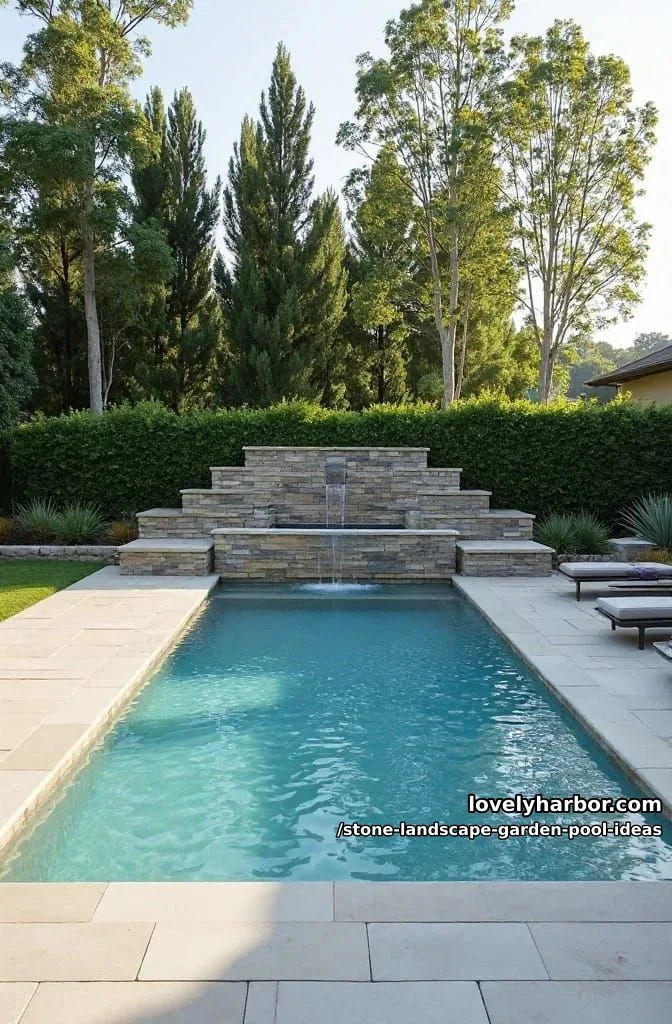
A flat sheet of water down a stacked-stone wall is the restrained cousin of the boulder waterfall back in idea three, and it ages far better because nothing is trying to imitate nature. A spillway with a clean weir gives you the glassy sheet; the stacked stone gives you texture behind it. Light it from the side, not head-on, so the stone actually reads.
The maintenance reality is mineral scale. Hard water leaves white deposits on the stone face exactly where they show most, so plan on a descaling routine or a sealed, non-porous stone, and hold your pool chemistry steady instead of chasing it after the fact. A wall that looks sharp wet and chalk-streaked dry is the standard way this one disappoints.
Conclusion
If you take one thing from this, spend your money on the stone you stand on and put your hands on, the coping and the deck, and be stingy with the stone that is only there for show. A thermal bluestone surround you walk on every day matters more than a boulder waterfall you'll be fishing leaves out of by August.
Build in this order: get the water shape and the coping right first, plant second, and add the fire, the falls, and the lighting last, once you've lived with the space for a season and know where you actually sit. The grotto and the waterfall wall are the two I would think hardest about before committing, because they are the most expensive to undo. The fern edge and the plunge pool are the two I would happily build twice.