
If you bought into modern farmhouse between 2015 and 2020, the inventory is predictable: black iron hardware, a shiplap accent wall, a few painted wood signs, and a sofa that came in either gray linen or buffalo plaid. Modern coastal is the natural next move. The encouraging part is that maybe 30% of what you already own survives. The other 70% has to leave, get painted, or get demoted to the guest room. Here's the order to do it in.
What does it mean to transition from farmhouse to modern coastal?
Transitioning from farmhouse to modern coastal means lightening the palette from contrast-heavy black and white to warm whites and muted ocean blues, swapping distressed wood and buffalo plaid for natural oak, linen, and rattan, replacing black iron hardware with unlacquered brass or brushed nickel, and editing out farmhouse kitsch (mason jars, painted signs, barn doors) in favor of ceramic vessels, abstract art, and a more restrained, light-filled aesthetic.
1. Sort what you actually own into one of three buckets
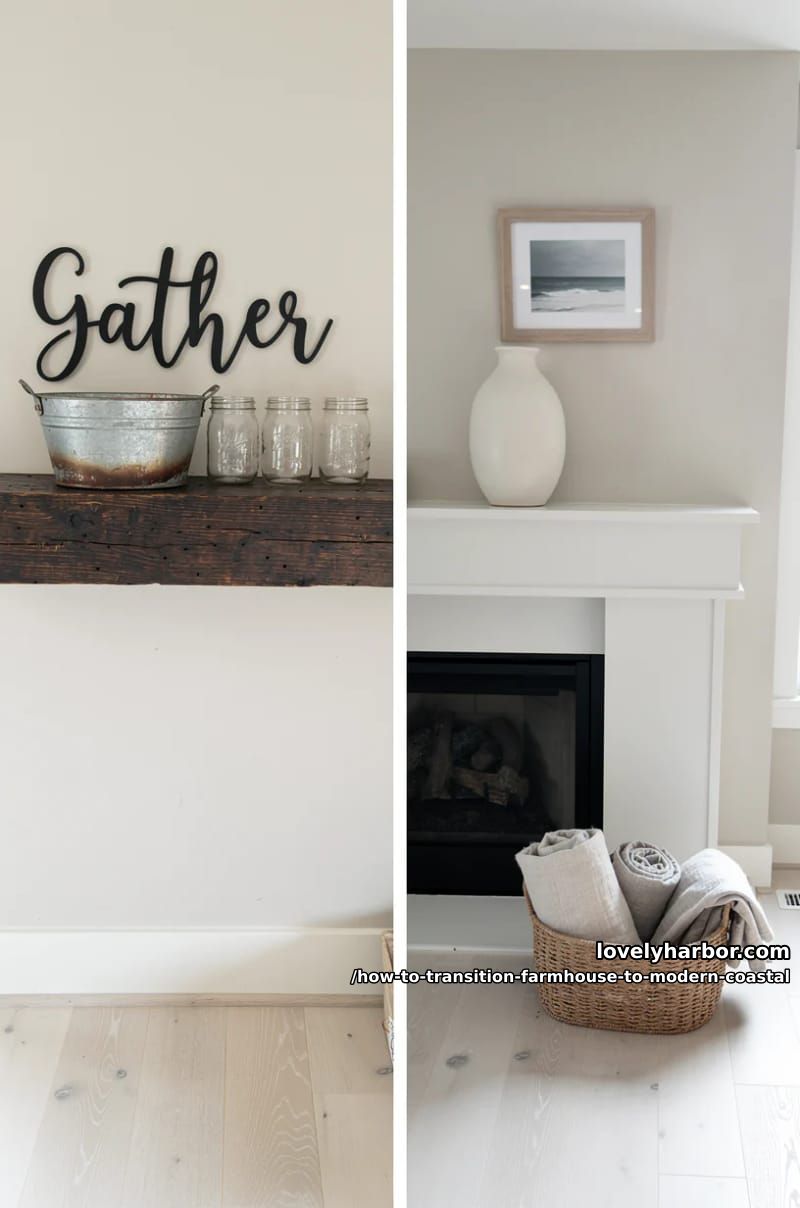
Before you buy anything, do an honest sort. Most farmhouse homes settle into one of three flavors, and the lift depends on which yours is. The black-window, shiplap, industrial-pendant version , call it Magnolia-era , is the heaviest because the bones lean dark and graphic. The cream-and-cane cottage-farmhouse version is already most of the way there. The Joanna-Gaines-meets-French-Country version with chunky distressed beams and oil-rubbed bronze sits somewhere in between.
Magnolia-era graphic farmhouse
Black windows, white shiplap, sliding barn doors, oil-rubbed bronze or matte black hardware, buffalo check, painted wood signs. Repaint trim warm white, hide or sell the barn door, swap every piece of metal, lose the signs.
Cottage-farmhouse
Slipcovered sofas, jute rugs, ironstone, white-painted built-ins, the Diane Keaton “Something’s Gotta Give” energy. You’re already 70% modern coastal. Cool down the blues, swap a few brown-toned art pieces for abstracts, retire the roosters.
French-country farmhouse
Heavy distressed beams, chunky reclaimed wood tables, oil-rubbed bronze, warm cream walls, toile or ticking stripes. Strip the toile. Lighten the wood tones where you can. Keep the bones and lean into linen and softer blues.
Tractor-supply farmhouse
Galvanized everything, “Live Laugh Love” wall, signs from HomeGoods, antlers, burlap runners, sliding doors as decor. The biggest editing job of the four , less because the bones are bad and more because the layered kitsch fights modern coastal’s restraint.
2. Repaint walls and trim before you swap a single object
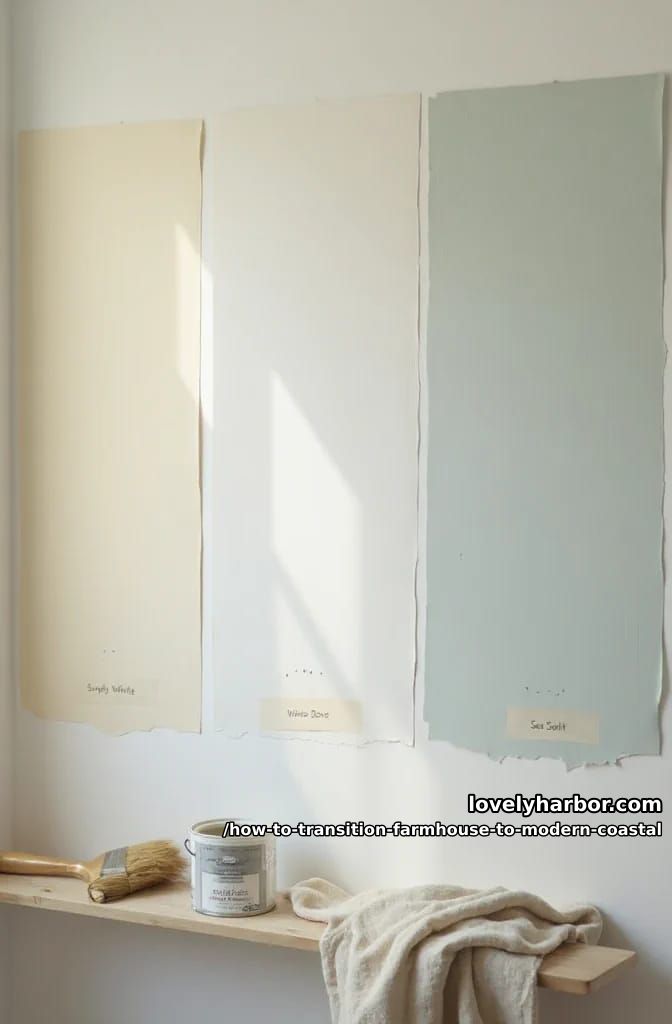
Wall color is the highest-leverage change you can make, and the only thing more frustrating than painting a room twice is buying a $2,000 sofa to match a wall color that turns out wrong. If your trim is already bright white , Sherwin-Williams Pure White, say, or Benjamin Moore Chantilly Lace , leave it. The wall is the issue. Farmhouse-era walls trend either toward greige (Agreeable Gray and its cousins) or a cool stark white that picks a fight with every warm wood you're trying to bring in.
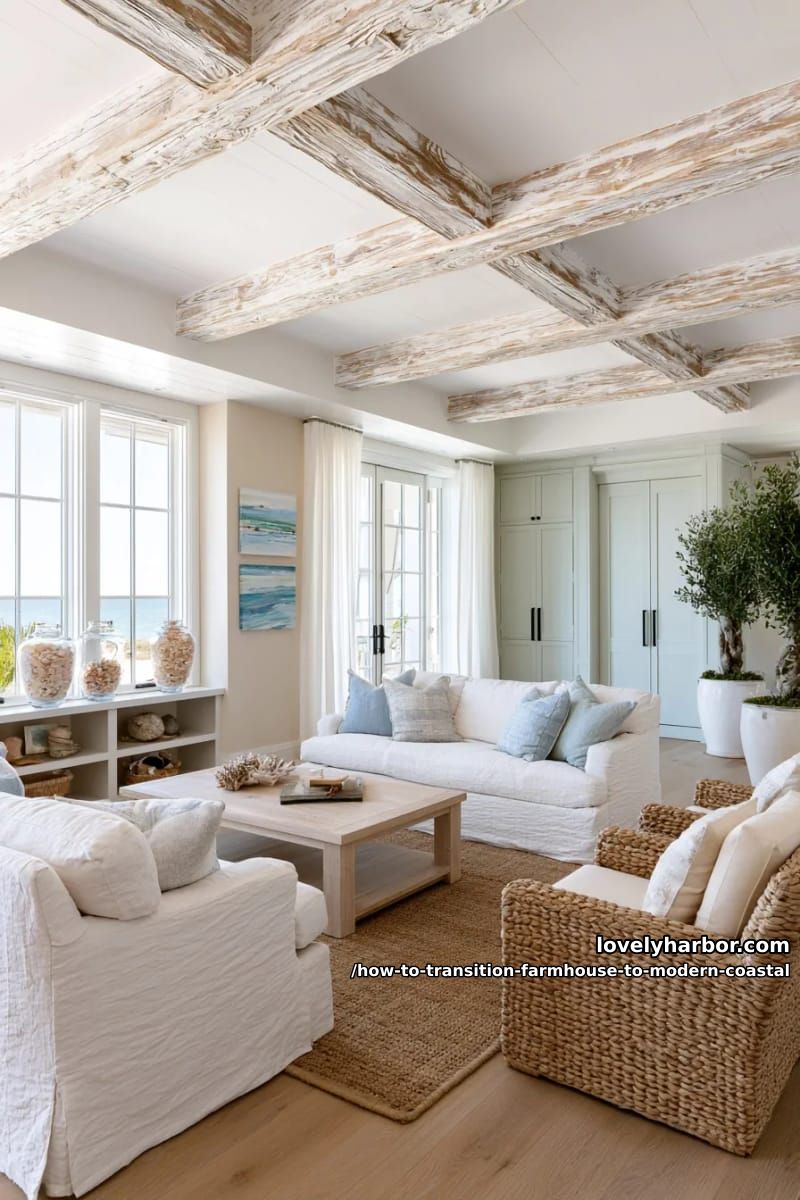
60% of your visible surfaces should be a warm white (walls, trim, ceiling), 30% a sand or oat neutral (rugs, large upholstery, woven baskets), and 10% a muted ocean color (an accent wall or cabinet, throw pillows, a single piece of pottery). Reverse those proportions and you end up with a navy living room that looks like a yacht club.
| Surface | Don’t use | Use instead | Why |
|---|---|---|---|
| Main walls | Pure cool white, gray | BM Simply White (OC-117) or BM White Dove (OC-17) | Warm enough to flatter linen and oak; doesn’t fight natural light |
| Accent wall or cabinet | Hale Navy, jet black | SW Sea Salt, BM Wythe Blue (HC-143), Farrow & Ball Pavilion Blue (No. 252) | Muted, gray-cast blues read coastal; saturated navy reads nautical theme |
| Existing shiplap | Keep crisp bright white | Same warm white as walls, color-drenched | Removes the graphic contrast that made it feel farmhouse |
| Trim and doors | Black, contrasting | Match the walls, or one shade warmer | Low-contrast trim is the single biggest tell of modern coastal |
| Ceiling | Builder flat white | Wall color at 50% strength, or BM Decorator’s White | Removes the stark “lid” effect; expands the room visually |
3. Furniture: keep these, sell those on Marketplace
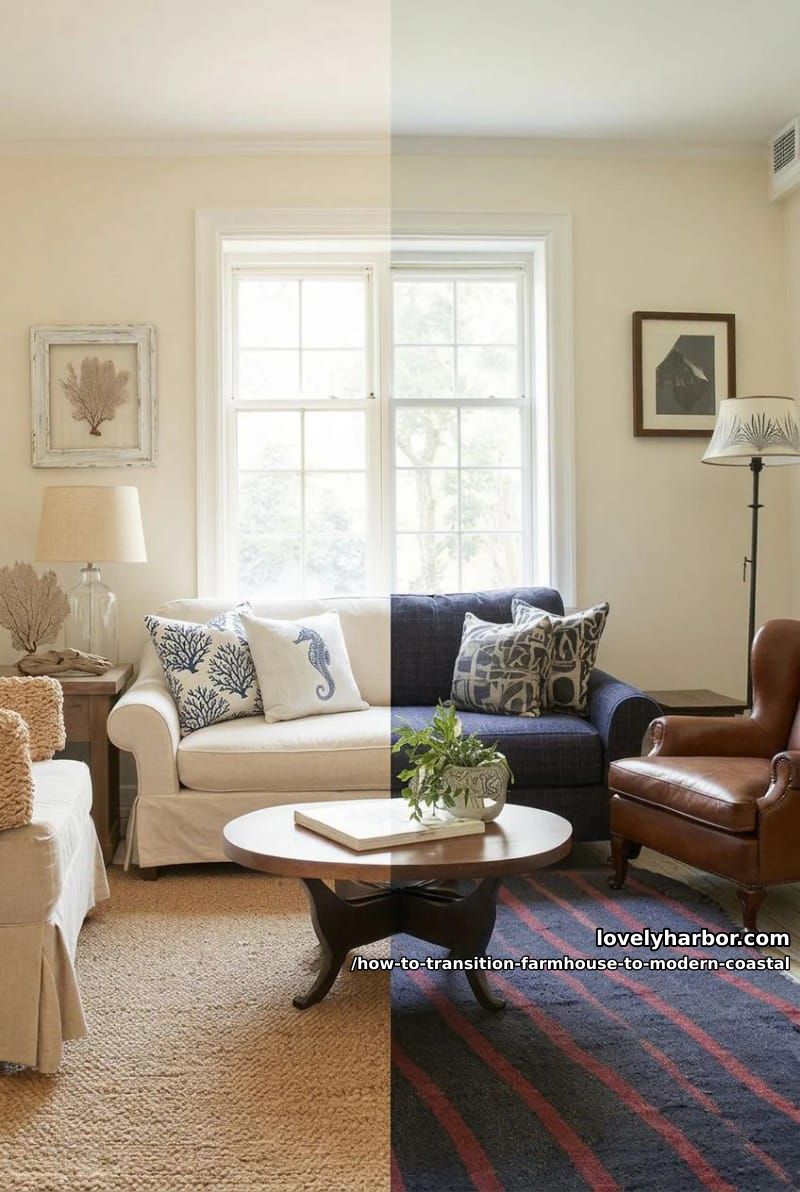
Most distressed-wood farmhouse pieces don't make it through the transition. I know the maker movement was beautiful, and I know your aunt made the bench. A heavy dark reclaimed-pine table with X-braced iron legs will read farmhouse no matter what you set on top of it. Sell, gift, or move to a basement playroom. What survives: slipcovered upholstery, light oak or natural pine, anything woven.
Keep these
- Slipcovered sofas and chairs in white, oat, or cream cotton-linen blends.
- Light oak, ash, or natural pine , anything with a simple silhouette.
- Anything woven. Wicker, rattan, cane, seagrass, all of it.
- Jute and sisal rugs.
- Galvanized buckets and ironstone pitchers earn their keep as vases, used sparingly.
- Shaker built-ins stay. They just want a repaint.
Sell or relocate these
- Dark distressed reclaimed wood with iron bracing.
- Anything stenciled with “Gather,” “Bless,” or coordinates.
- Buffalo check and red ticking stripes.
- Interior sliding barn doors. Exterior ones can stay.
- Heavy leather wingbacks and chesterfields , too British for what you’re doing.
- Most galvanized metal. A pail or planter is fine; the rest goes.
On slipcovered sofas: the IKEA Uppland with the white Blekinge slipcover runs about $849 and works well enough that I no longer recommend the Pottery Barn York to anyone under 35 without a specific reason. The PB twill is softer and the frame lasts longer, but you're paying roughly four times the price for a sofa most readers will replace inside ten years anyway. Put the difference into a better rug.
4. The textile swap that does most of the work
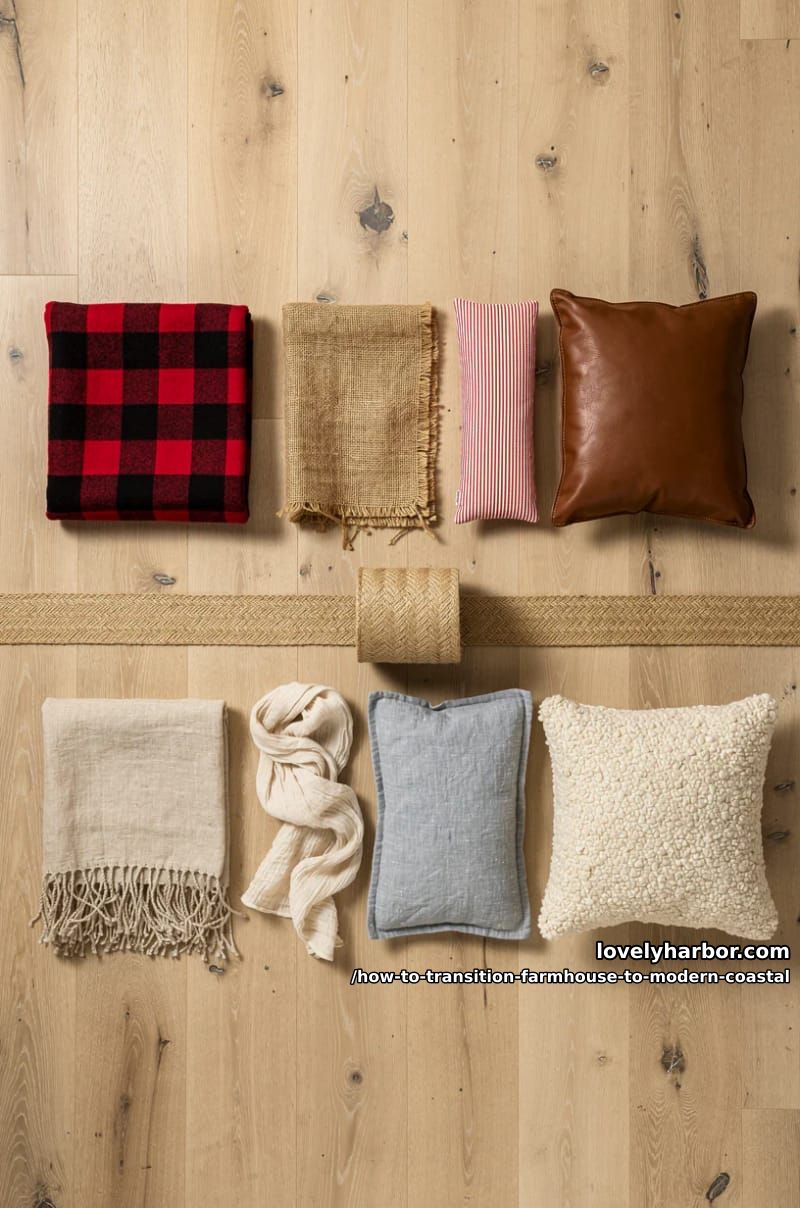
If you only do one thing on this list, swap your textiles. Soft goods carry more visual weight than people realize. Change the throw, the curtains, the pillows, and the rug, and a room shifts styles overnight without touching the bones. The replacement palette is deliberately narrow: oat, bone, soft sand, washed pale blue, fog gray. Anything with a stamped pattern, skip.
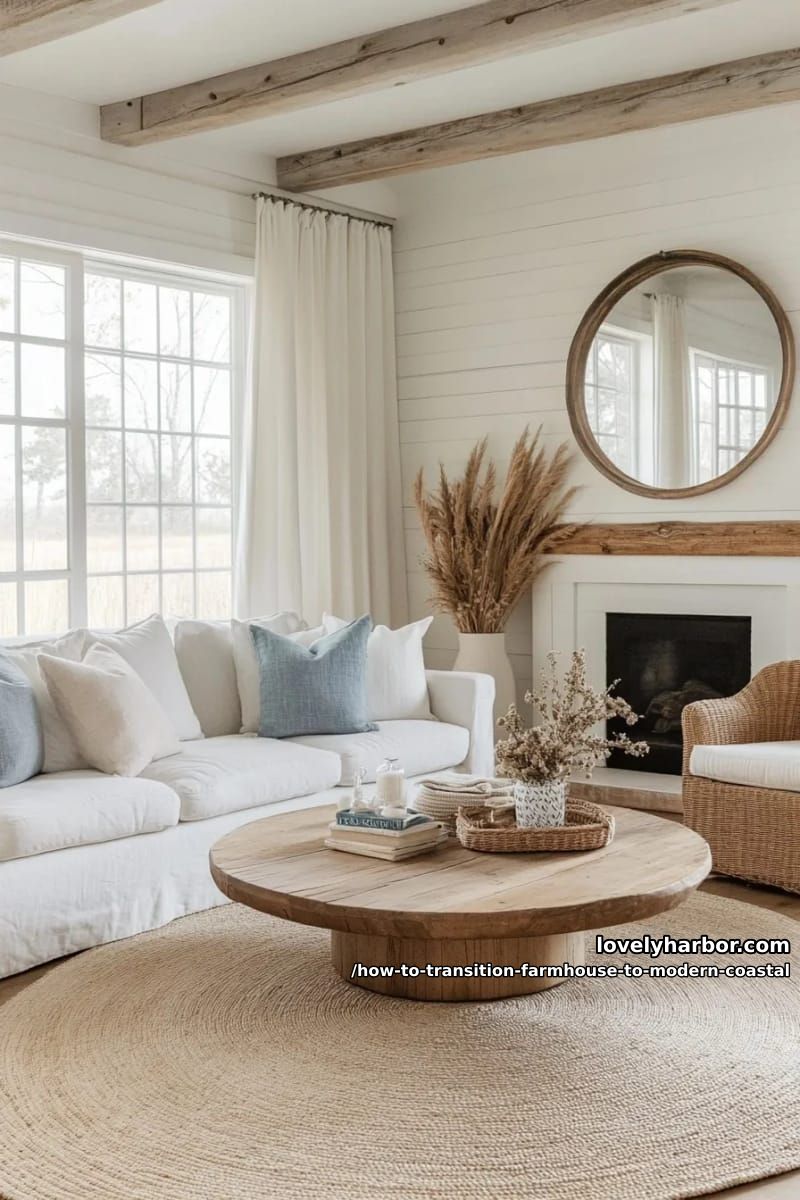
Natural linen, semi-sheer, the color of unbleached oatmeal. Install these before you do anything else, because the light they filter changes how every other color in the room reads.

| Item | Farmhouse version | Modern coastal swap |
|---|---|---|
| Curtains | Burlap, buffalo check, blackout panels | Natural or oat semi-sheer linen, floor length |
| Throw blanket | Chunky chenille in cream, red plaid | Loose-weave linen or cotton gauze, fringed |
| Pillow covers | Ticking stripe, grain sack, “Home” lettering | Washed linen, slubby cotton, knife-edge solids |
| Bedding | White ruffles, lace, gingham | Washed linen duvet in oat, cream, or fog |
| Kitchen towels | Embroidered farm scenes, gingham | Striped flax, French jacquard, plain waffle |
| Rug | Distressed Persian, kilim, plaid runner | Chunky jute, flatweave wool in cream or pale stripe |
5. Replace every piece of black iron with brass or nickel
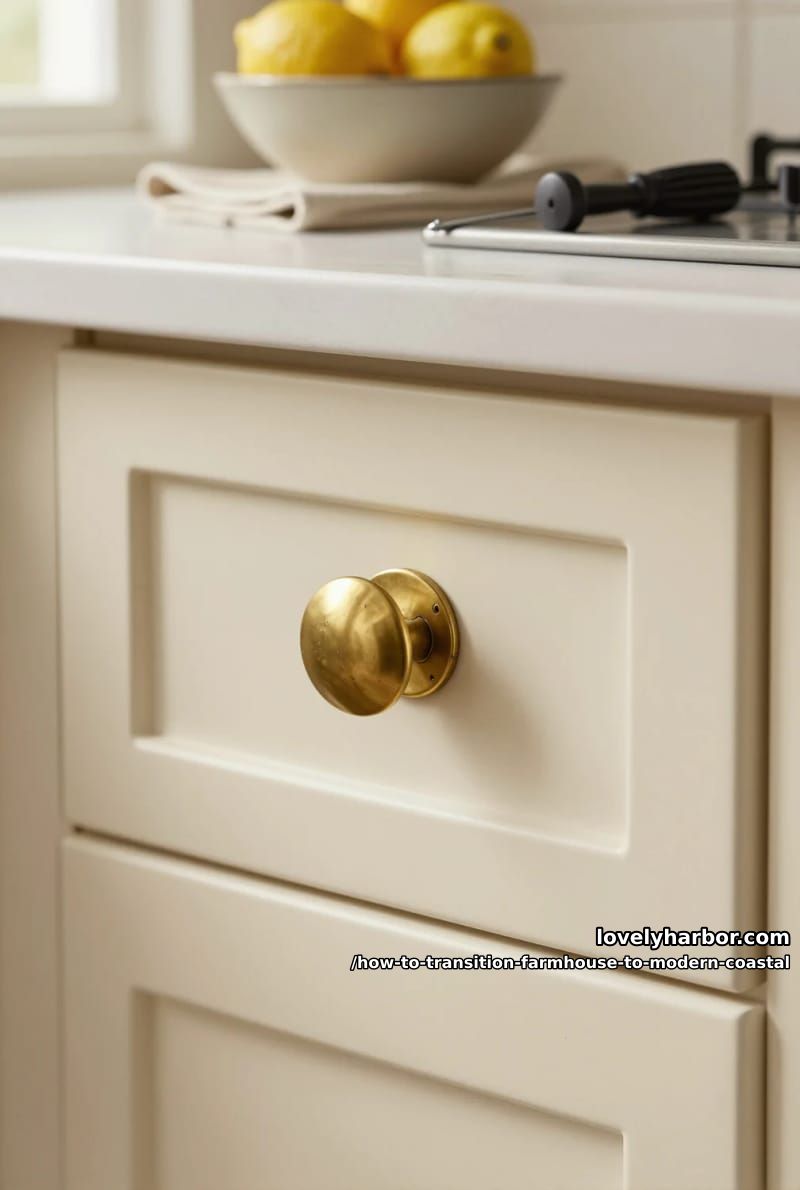
Black iron hardware is the single loudest identifier of the 2018 farmhouse kitchen. After the cabinets get repainted, the walls warmed up, the lighting changed , black pulls will still hold the room in farmhouse mode. The swap is unlacquered brass or polished nickel. Brushed nickel works as a safe middle path. Skip oil-rubbed bronze. That's the color that got you here.
Unlacquered brass is what I'd push you toward if you can stomach a living finish , it dulls and patinas in a way that, ten years from now, reads like a Charleston single house instead of a 2024 kitchen renovation. If the idea of inconsistent darkening makes you anxious, polished or satin nickel does most of the same work and stays uniform. Two metals in one room is fine. Three is where it falls apart.
Round ball knob in solid unlacquered brass — the kind of small detail that quietly fixes a whole kitchen, assuming you commit to replacing all 22 of them at once on a Saturday.

6. Swap industrial pendants for woven, glass, or rope
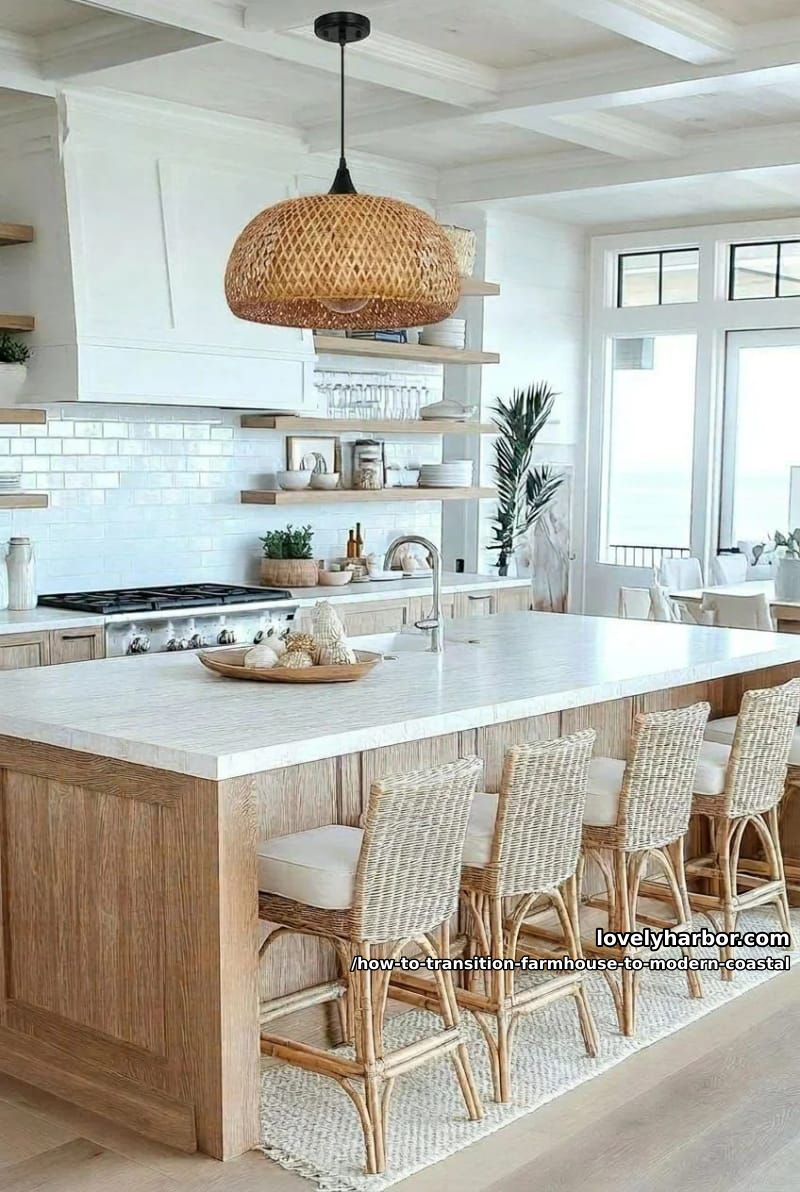
The Edison-bulb-on-black-pipe pendant was the lighting equivalent of a fedora. It needs to go. The modern coastal replacement is a woven rattan or seagrass shade, a hand-blown clear glass globe, a brass-banded lantern, or a simple rope-wrapped fixture. Pure Salt Interiors built most of their portfolio on one trick: replace every farmhouse light fixture with a woven shade and photograph it in California afternoon light. You can do the same with a $90 pendant from Amazon and a south-facing window.
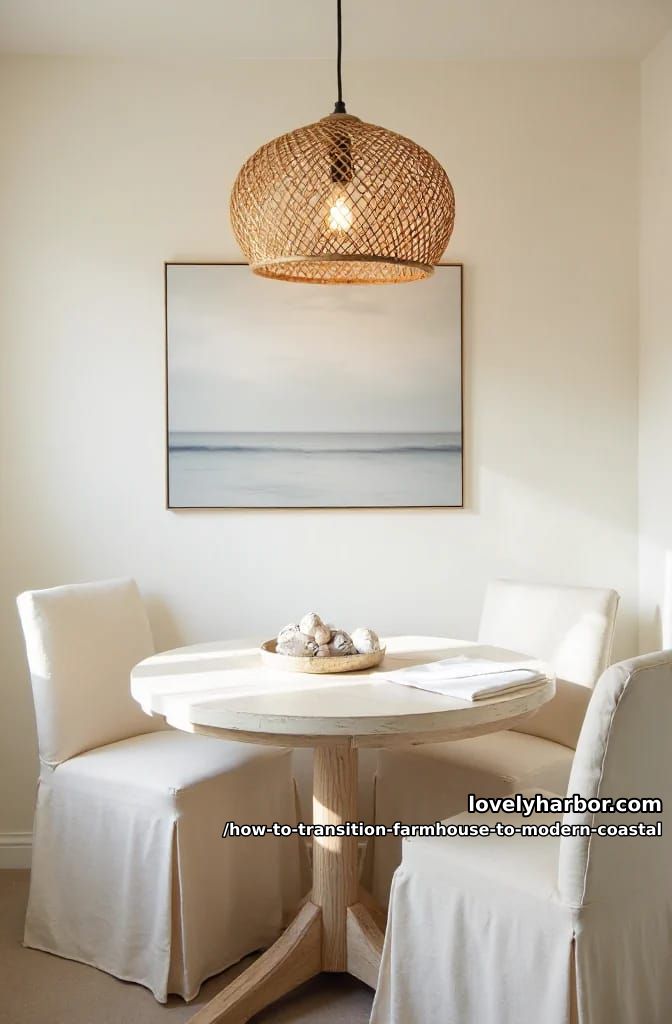
A 16-inch woven rattan dome that reads convincingly Serena & Lily from across the room, for roughly a tenth of the Serena & Lily price. Hang it over the kitchen sink or breakfast nook before anything else.

7. Edit the decor without going full Cape Cod gift shop
The trap on the decor side is overcorrecting. You spend a Saturday purging mason jars and signs, drive to Target, panic-buy starfish, a wooden boat, three pieces of coral, an anchor, and a rope-wrapped lantern. Congratulations, different theme park. The principle: modern coastal is restraint. One oversized ceramic vessel does more work than fifteen small seashells.
Decor that earns its place
- One oversized ceramic vessel per surface, in matte cream, bone, or sand.
- Stacks of two or three art-photography books with linen or bone covers.
- A single piece of art per wall, sized generously. Abstract or photographic, your call.
- Driftwood, capped at one piece per room and displayed flat.
- Open-weave baskets used as actual storage, never as decor.
- Real plants. Olive tree, fiddle leaf fig, pothos.
Decor that announces the theme
- Anchors, ship wheels, lighthouses, sailboat models.
- Bowls of dried starfish or shells.
- Red-white-and-navy nautical-stripe pillows together.
- Anything that says “Beach Life” or “Salt Water Cures.”
- Wooden directional signs to “The Beach 1 mile.”
- Glass jars labeled “Sand from [place we visited in 2017].”
The Pottery Barn version of modern coastal reads like a hotel lobby precisely because it follows none of these edits. They merchandise everything in threes , three shells, three candles, three vases on a tray , and the cumulative effect is overcooked. If you catch yourself styling like a catalog photo, halve the number of objects on every surface and walk away.
8. Worked example: an $800 living room reset
14×16 ft farmhouse living room, working with what you have
Starting state: gray walls, white slipcovered IKEA sofa (keeping), distressed coffee table (selling), black iron pendants (replacing), buffalo check curtains (replacing), small Persian-style rug (replacing).
The point of this scenario is that you do not need to replace the sofa. Most of the budget goes to paint, one statement light, soft goods, and a rug. The coffee table is the only piece of furniture being replaced, and even that’s optional if you can sand and limewash the existing one.
Shopping list
| Qty | Item | Spec | Price |
|---|---|---|---|
| 2 | Wall paint, BM Simply White | 1-gallon Regal Select, eggshell | $110 to $130 |
| 1 | Chunky jute rug, 8×10 | Safavieh NF447A, natural brown | $180 to $260 |
| 2 | Natural linen curtain pair | 84-inch grommet, oat color | $60 to $90 |
| 1 | Rattan pendant light | 16-inch hand-woven, hardwire | $80 to $120 |
| 4 | Washed linen pillow covers | 20-inch, oat / fog / cream mix | $60 to $100 |
| 1 | Loose-weave linen throw | Cotton-linen blend, fringed | $40 to $80 |
| 1 | Oversized ceramic vessel | 14 to 18 inch matte bone | $50 to $90 |
| 1 | Round white oak coffee table | 36-inch Article or Wayfair | $250 to $400 (optional) |
| Total without coffee table | $580 to $870 | ||
Prices are approximate ranges as of late 2025; verify before purchase.
The rug spec above isSafavieh’s Natural Fiber NF447A in 8×10, a chunky 1-inch jute weave that handles modern coastal and farmhouse interchangeably. That’s exactly the bridge piece this room needs.
9. Mistakes that turn the transition into a costume change
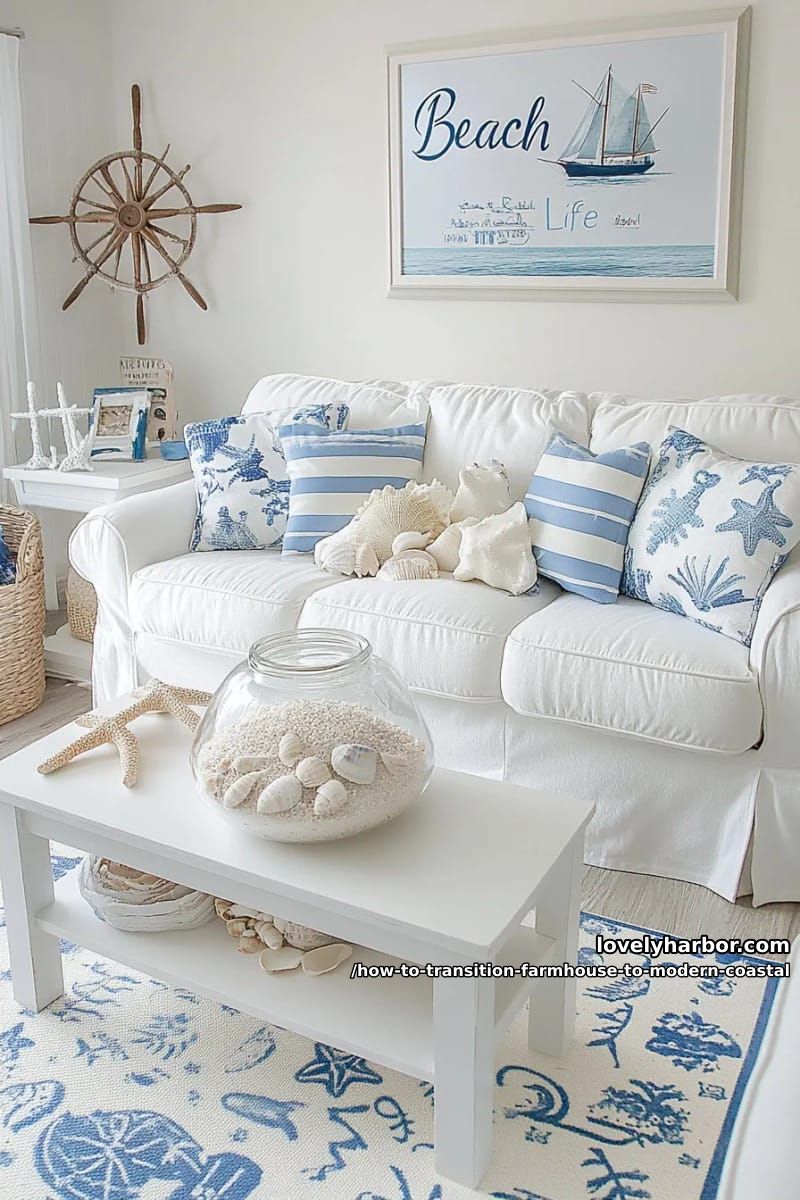
Most failed transitions fail not because the homeowner picked the wrong colors, but because they kept layering on theme markers until the room turned into a theme park. The fix is editing, not adding. If a room still feels off after the swaps, the answer is almost always to remove three objects before adding one.
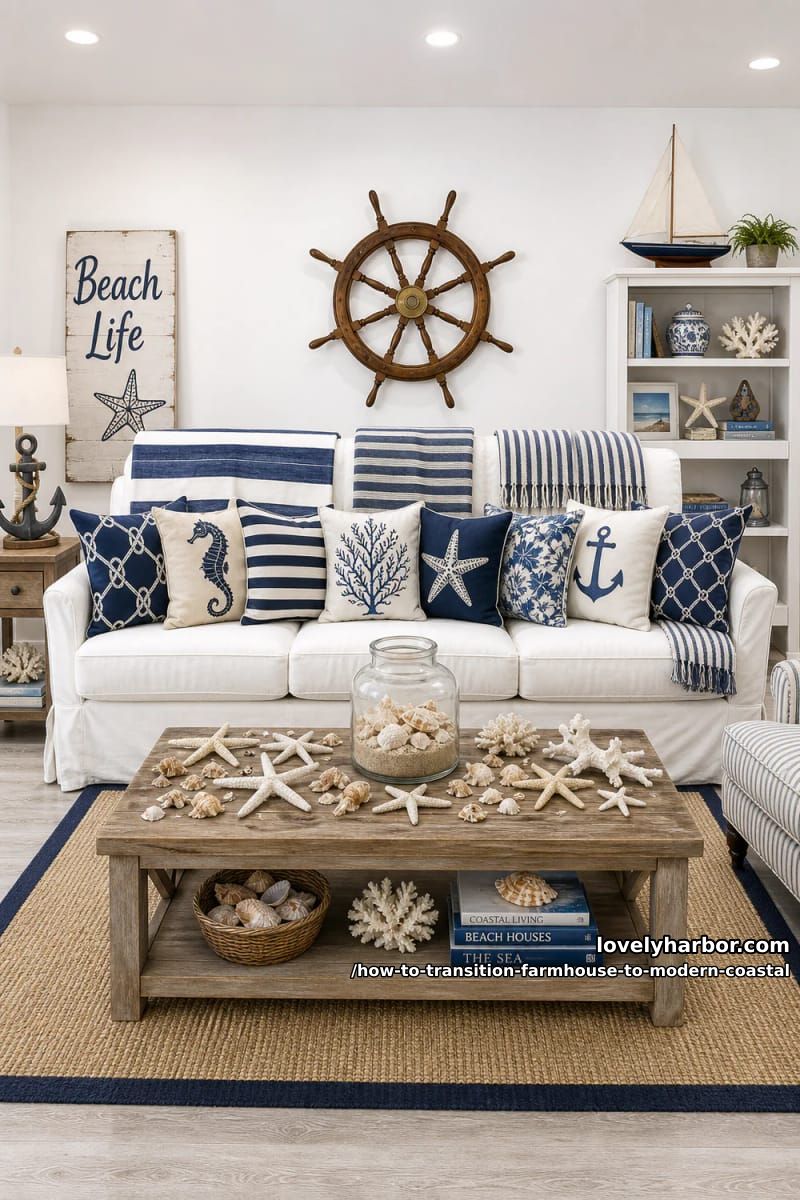
Going navy and red instead of muted blue and oat. Saturated navy paired with bright white and red is yacht club, not coastal. The blues you want sit between gray-blue and seafoam.
Keeping black-framed windows alongside warm white walls. Black windows are the single most farmhouse-signaling architectural feature in the house. If replacing them isn’t in the budget, paint the interior frames to match the trim.
Buying everything from one collection. Coastal “collections” at Pottery Barn or HomeGoods are merchandised to sell as a set, and they read like a catalog. Mix your sources. Amazon for hardware and lighting, Marketplace for vintage rattan, McGee & Co. or Jenni Kayne for one anchor piece per room.
Layering five different woven textures. Jute rug, seagrass basket, rattan chair, cane sideboard, wicker pendant , all in one room. Cap natural-fiber pieces at three. Let the rest of the textures come from linen, ceramic, oak, or smooth painted wood.
Treating shiplap as the problem. Shiplap itself is fine. Shiplap painted in bright contrast white is the problem. Color-drench it in the wall color and it stops announcing itself as architecture and starts behaving like wall.
Conclusion
I've watched three friends now order a sectional in the wrong undertone of cream because they were looking at the swatch under farmhouse-gray walls. So if there's one piece of advice in here to actually take: do not buy a new sofa until you've lived with the new wall color for at least two weeks. The order , sort, paint, soft goods, lighting, hardware, decor , exists mostly to keep you from spending money twice. Wall paint and curtains alone get you 60% of the way there for under $300, and most readers can sit with that for a season before committing to anything else. Paint first.