
The standard "coastal kitchen" article defaults to whitewashed shiplap and rope pendants. Assume you've already opted out of that. The brief here is the architectural version , rift-sawn oak, plaster, a sink that doesn't apologize, a slab of veined quartzite doing the work aqua tile and starfish used to do. Eleven specific decisions follow.
1. Sea Pearl, the only "ocean" quartzite that doesn't read as themed
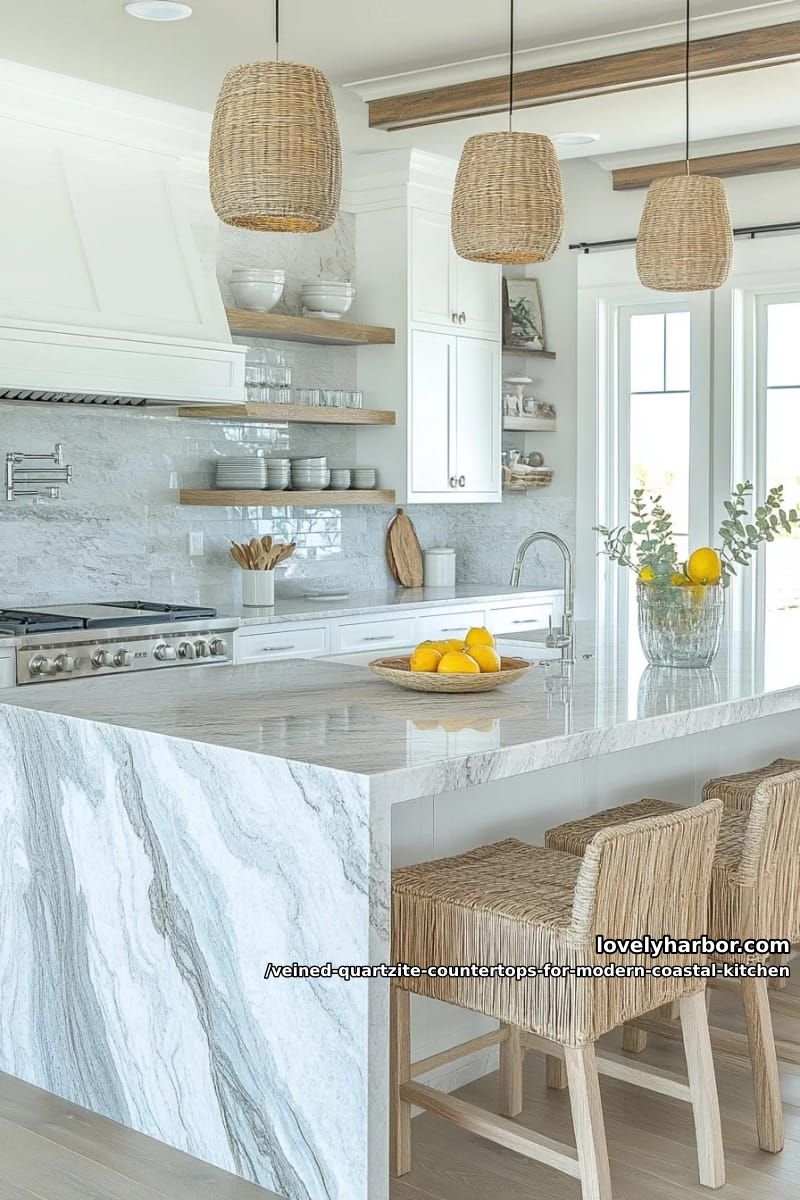
Sea Pearl moves in pale gray-green waves with a faintly opalescent sheen, and it's the only quartzite in the looks-like-water category that doesn't immediately announce itself as a coastal cliché. Pair it with rift-sawn white oak, deep sage, unlacquered brass , anything other than white cabinets , and the stone's natural movement carries the maritime reference. You don't need to add anchors anywhere.
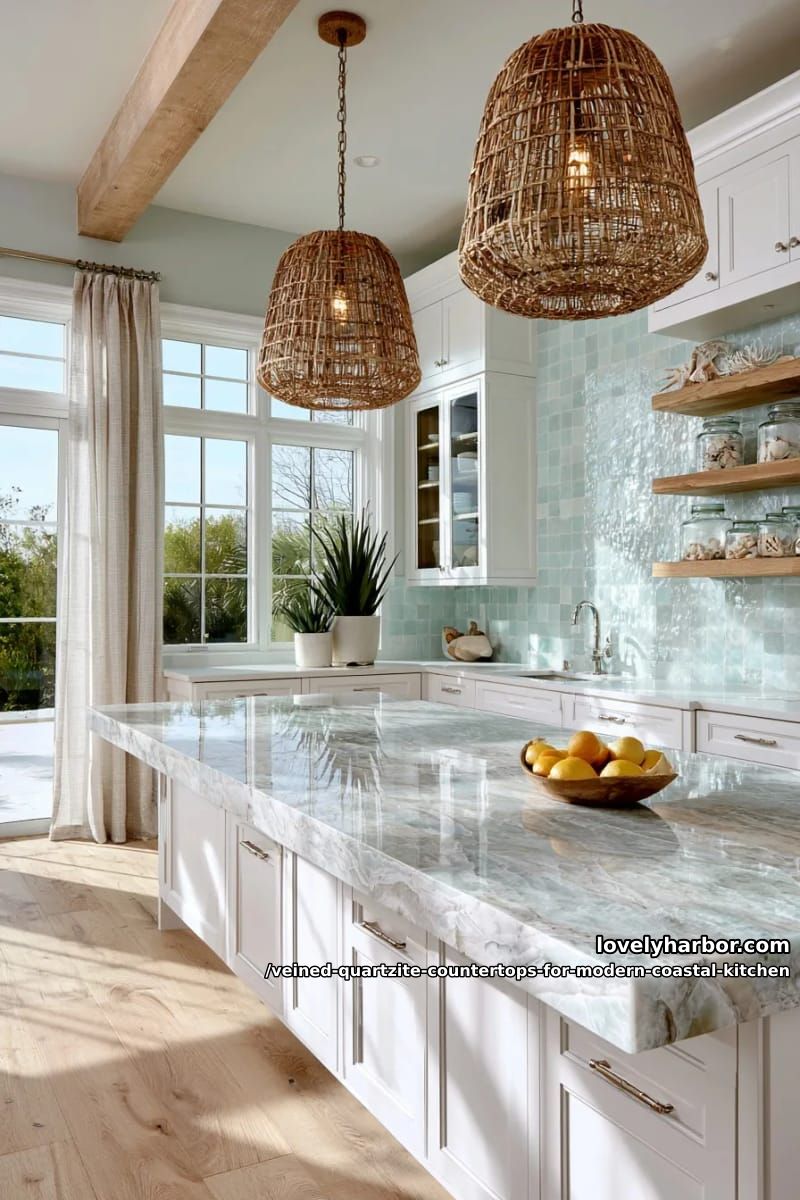
Installed pricing lands in the $90 to $140 per square foot range for 3cm slabs, which puts it mid-shelf among veined quartzites. The leathered finish is worth seeing in person: Granite Guy’s writeup describes leathered Sea Pearl as “ocean water frozen in stone,” which is one of the few times that phrase is earned by the material.
2. Honed, not polished. Or you'll regret it by the second summer
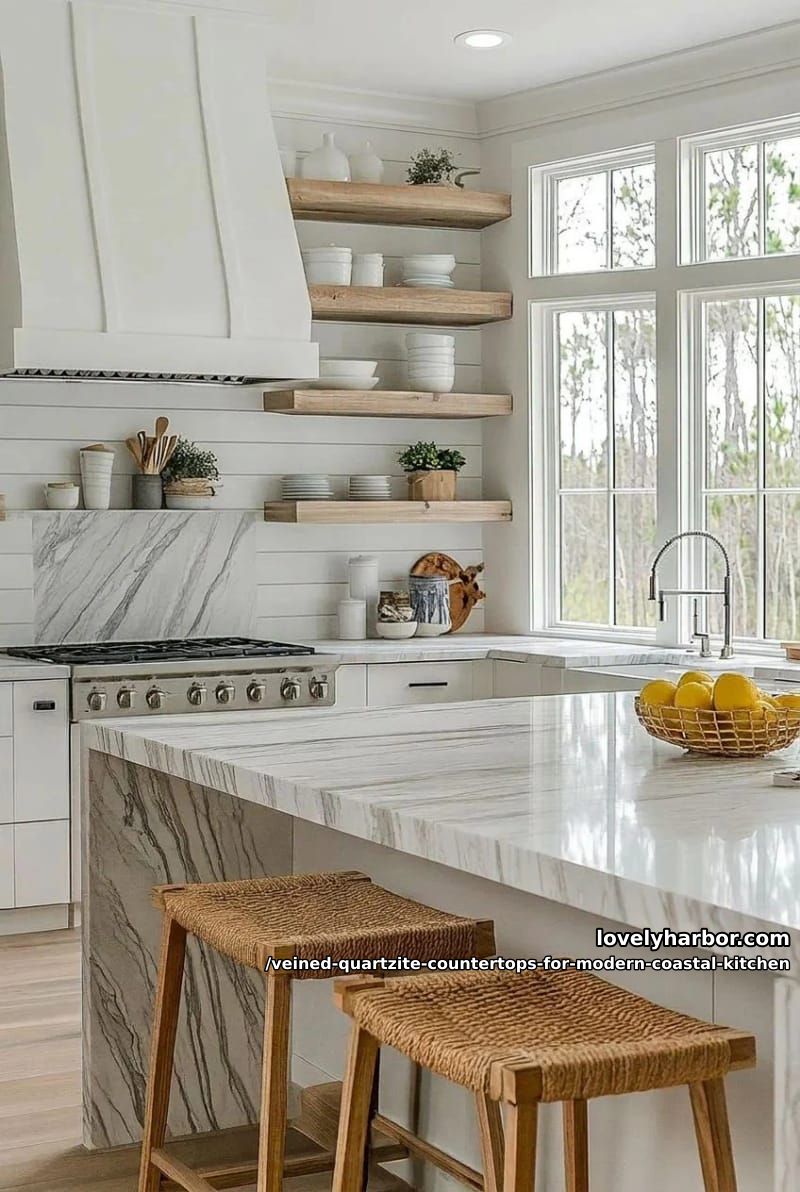
Coastal kitchens see more direct sun and more bounced glare off water than inland kitchens do. Polished quartzite in that environment behaves like a mirror , every fingerprint, every droplet, every cloud overhead bouncing back at you. Honed kills the glare. Leathered hides smudges and minor wear by burying them in micro-texture. Both stay matte, and neither costs much extra in the scheme of a stone budget.
Do this
- Honed gives you a smooth feel under the hand and a calm visual read. Expect a $10 to $20 per square foot upcharge over polished.
- Leathered for fingerprints; $15 to $25 per square foot upcharge.
- Stand under a slab in the yard at midday before deciding. Bring a damp paper towel, wipe a spot, watch how it dries , that’s the test, and a sample tile won’t simulate it.
Avoid
- Polished anything in a west-facing kitchen with an island. The 4pm reflection will drive you out of the room.
- Honed dark quartzites with unsealed seams. They go blotchy at every joint.
- Picking finish from a sample tile.
3. Mont Blanc paired with rift-sawn white oak (the actual modern coastal palette)
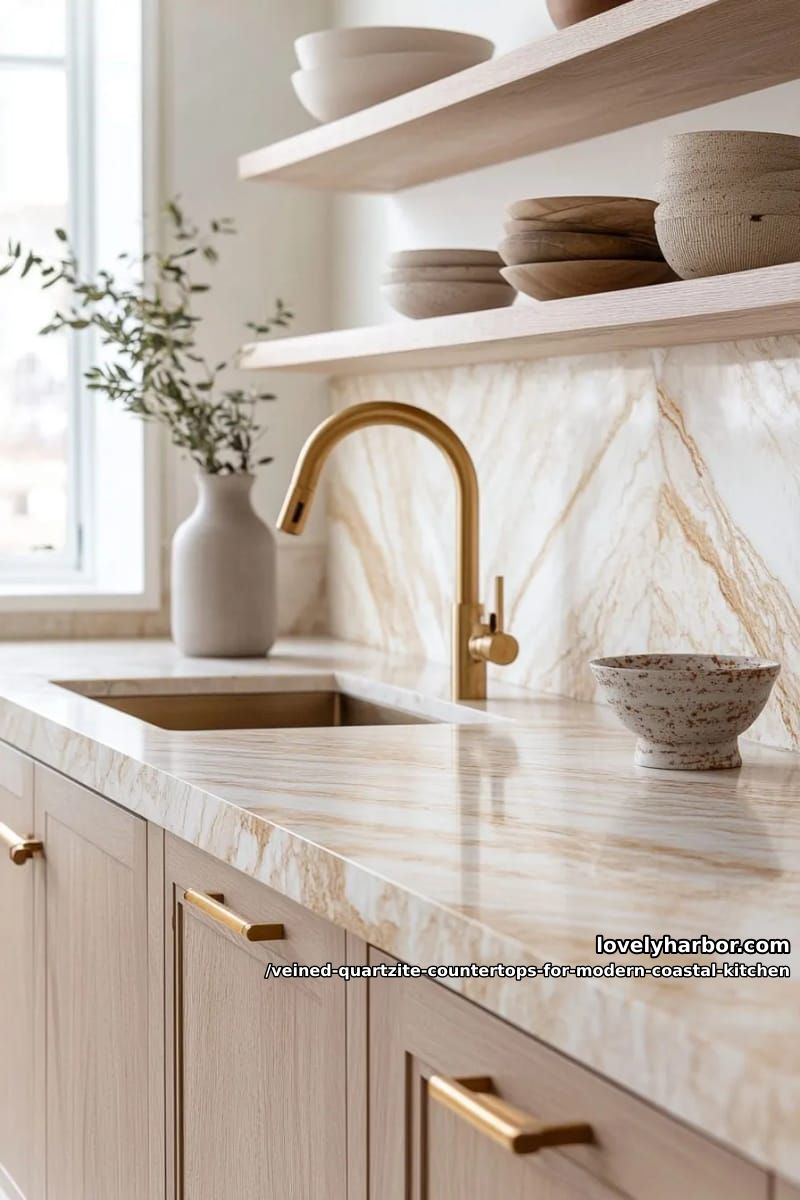
Mont Blanc is the warm-white-with-thin-gold-and-gray-veining slab that most quartzite articles eventually circle back to, and there’s a reason. It’s a Brazilian quartzite with a predominantly white background and gray and taupe veining, often punctuated by hints of black. Intensity varies slab to slab, quiet to bold, so this one you pick in person. Not from a digital sample.
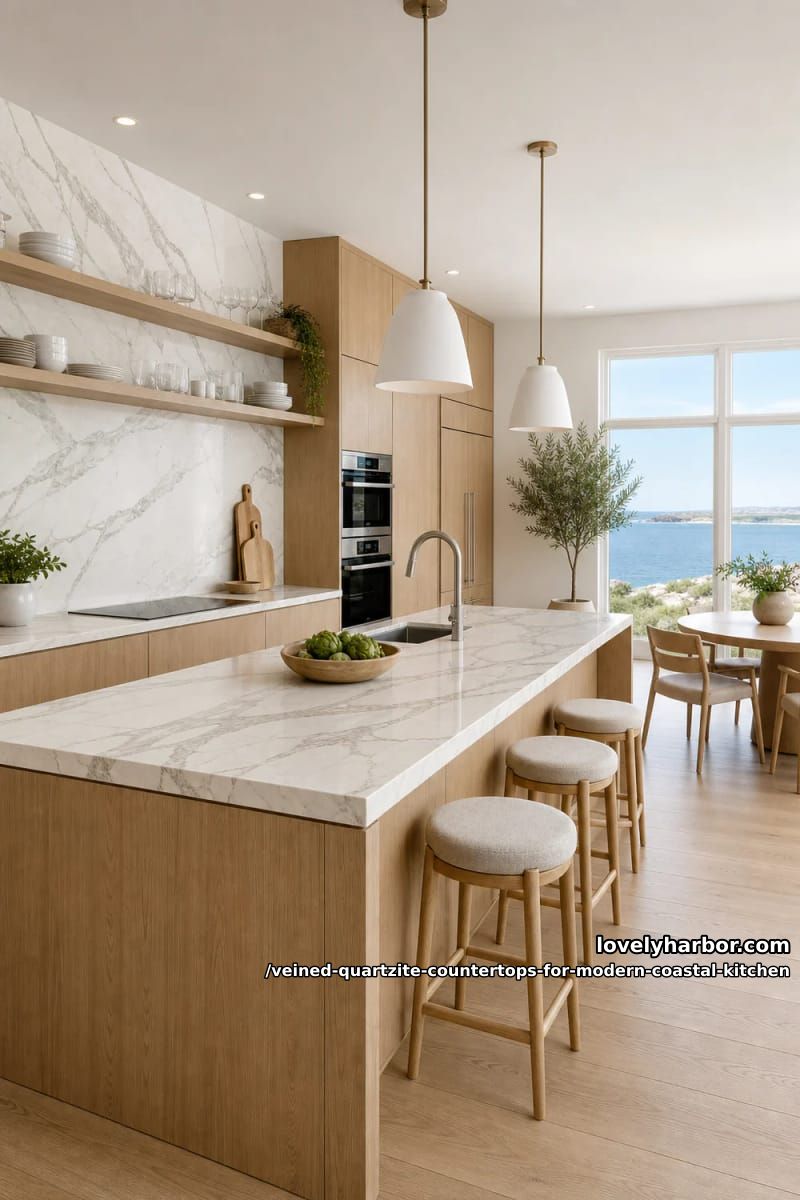
The pairing that works for modern coastal: Mont Blanc with rift-sawn white oak, vertical grain only. Flat-sawn oak introduces cathedral grain that pulls the whole kitchen toward farmhouse before you've decided anything else. Skip the upper cabinets on at least one wall and run a single horizontal shelf in the same wood at eye height. Brass faucet, unlacquered so it patinas. Chrome and polished nickel fight the stone's warm undertones.
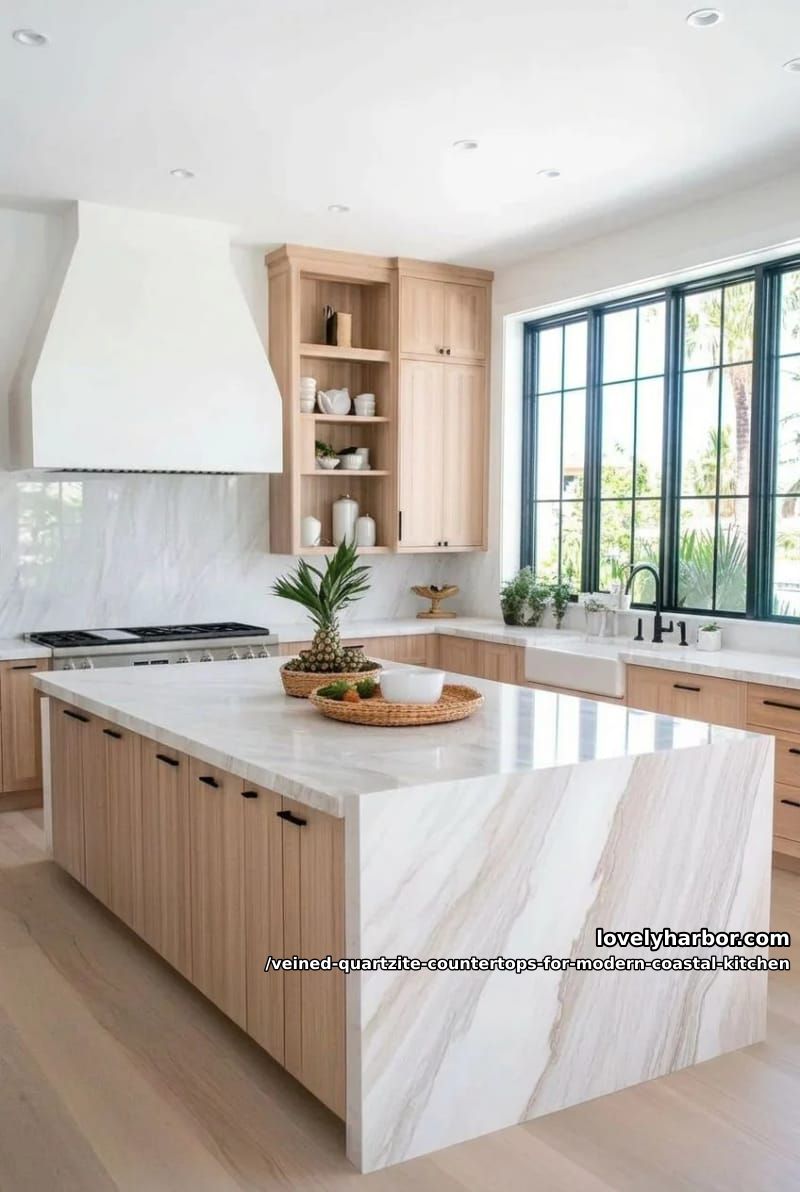
4. A bookmatched waterfall island with the hero vein dead center
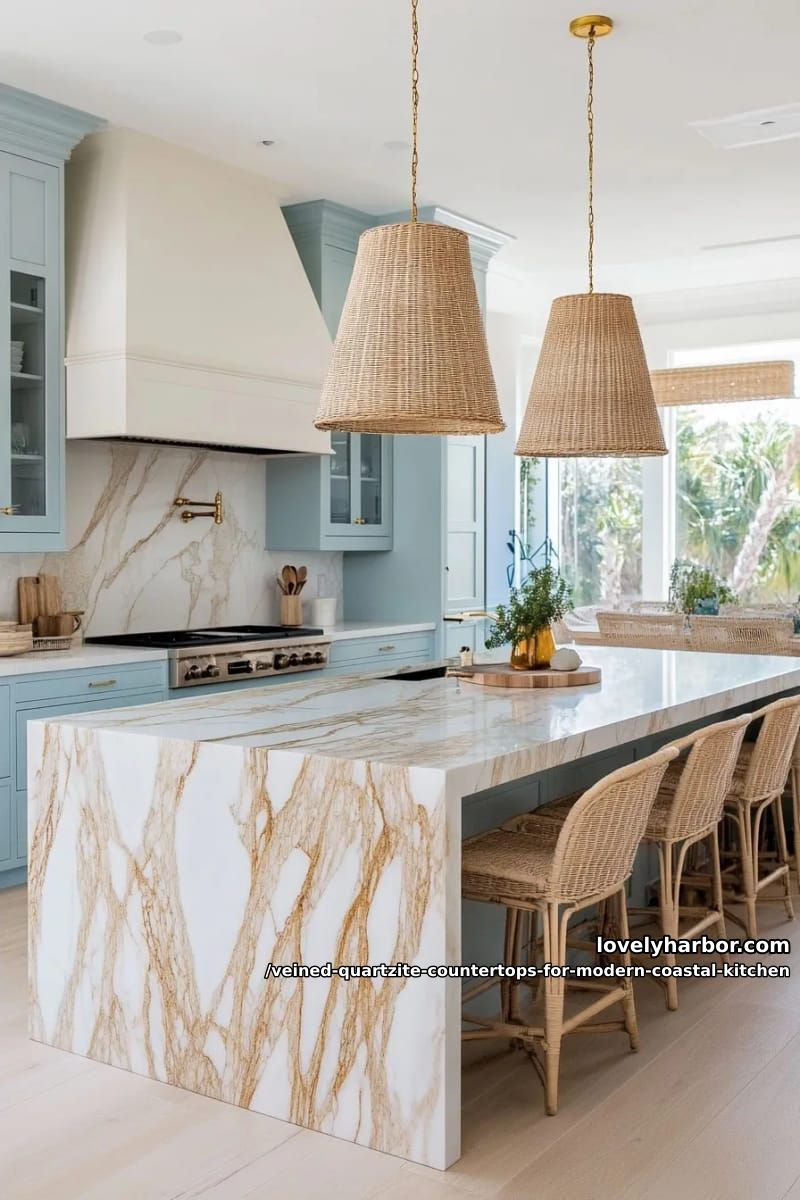
A bookmatched waterfall is two slabs sliced from the same block, split, and flipped so the veining mirrors across the seam like a butterfly’s wings. The technique creates a symmetrical effect that highlights the natural pattern of the stone, which is the entire point of paying for it. Center the primary vein along the island’s long axis so the pendant lighting lands on it. Offset compositions photograph as dynamic and live as unbalanced , there’s no recovering from that once the slab is cut, so look at the digital layout for ten minutes longer than you think you need to.
Material premium: bookmatched waterfalls eat roughly 25 to 40% more slab than a flat top. You need consecutive slabs from the same block and you accept more waste cutting for vein alignment.
Mitered joint vs. butt joint: a mitered 45-degree corner reads as a continuous monolith. A butt joint shows a visible seam line at the corner. Mitered is the modern choice and costs more in labor, typically$15 to $30 per linear foot on top of the slab price.
Hidden reinforcement: long waterfall faces need concealed steel angle behind the vertical drop. A good fabricator brings this up unprompted. If they don’t, find a different fabricator.
5. Run the slab up to the underside of the upper cabinets, not tile
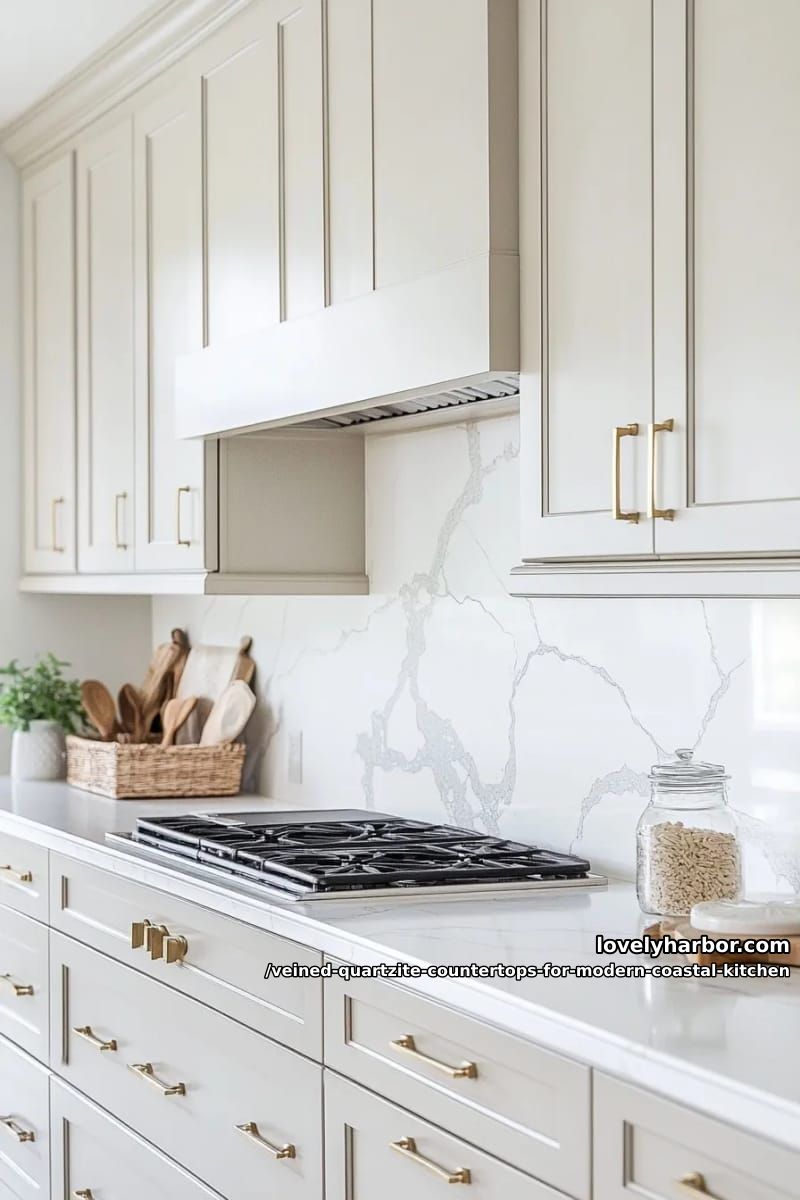
Tile backsplashes in coastal kitchens are a maintenance trap. Grout absorbs humidity, discolors at the edge of the sink, harbors salt residue if you're anywhere near an actual coast. A slab backsplash from counter to upper cabinets eliminates that. The catch: roughly 30% more square footage of stone in your order, and the slab match between countertop and backsplash matters more than people expect.
Don't try to continue the vein pattern from counter to backsplash around a 90-degree angle. The logic doesn't work; it reads as a mistake. Pick a complementary panel from the same block, oriented vertically so the veins move up the wall rather than around the corner. Showroom selection beats catalog selection every time.
6. Calacatta Macaubas for the marble look without the marble anxiety
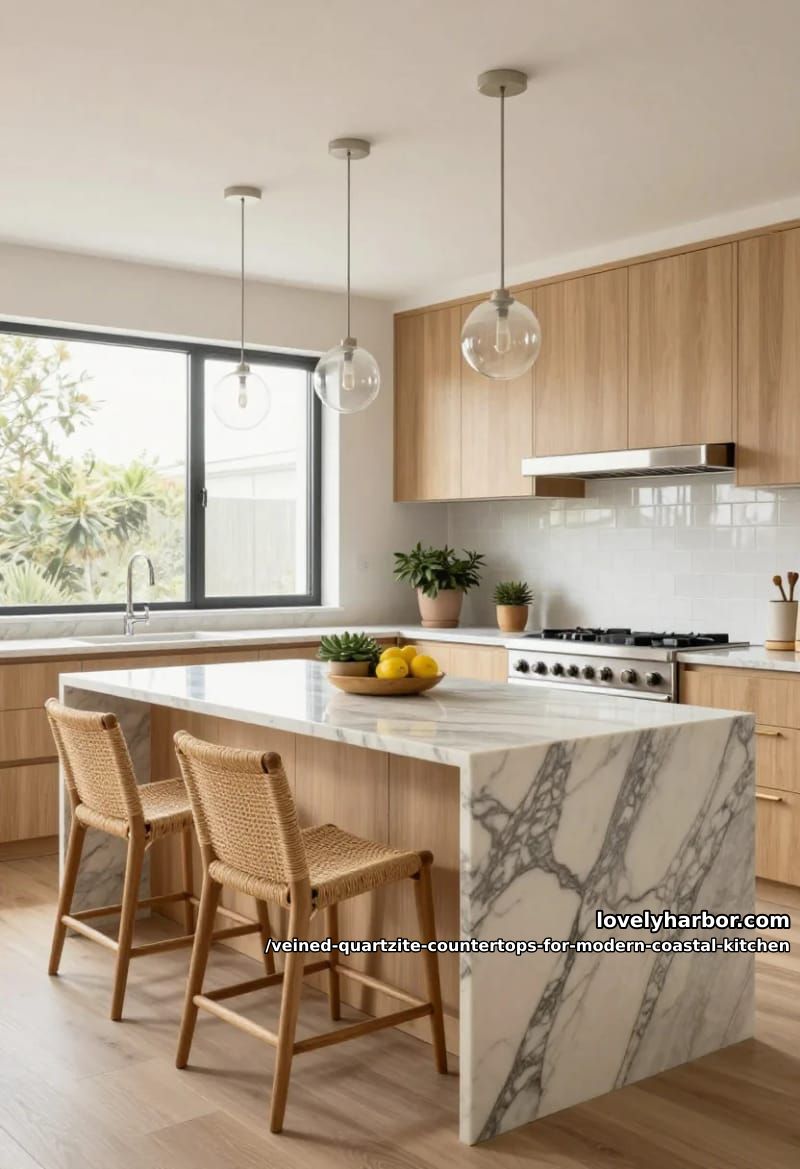
Calacatta Macaubas displays smoky gray veining across a soft white background, much like Calacatta marble, but with quartzite’s heat resistance and far better stain behavior. It’s the right slab for clients who want the look of Italian marble but cook three meals a day and have no interest in negotiating with lemon juice.
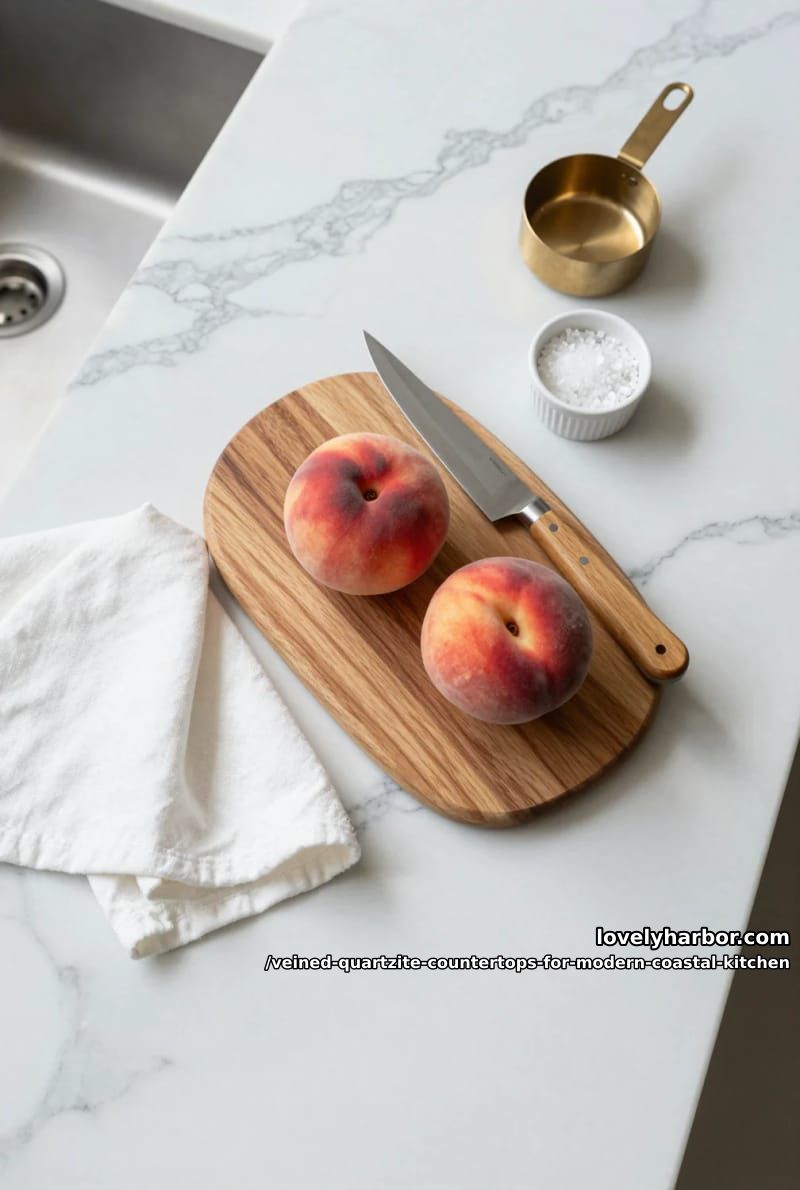
The pairing that earns this slab is painted blue cabinetry in the muted, dustier register. Hague Blue from Farrow & Ball. Inchyra Blue. Stiffkey Blue. Calacatta marble fights those colors because the veining is cooler and more graphic; Calacatta Macaubas sits with them. Add an unlacquered brass single-bowl 16-gauge stainless undermount sink, and stop adding things. The Pottery Barn version of this kitchen has a navy island with a wine fridge cutout and reads like a hotel lobby. Don't do that.
7. Cristallo as a backlit island front (the showpiece move)
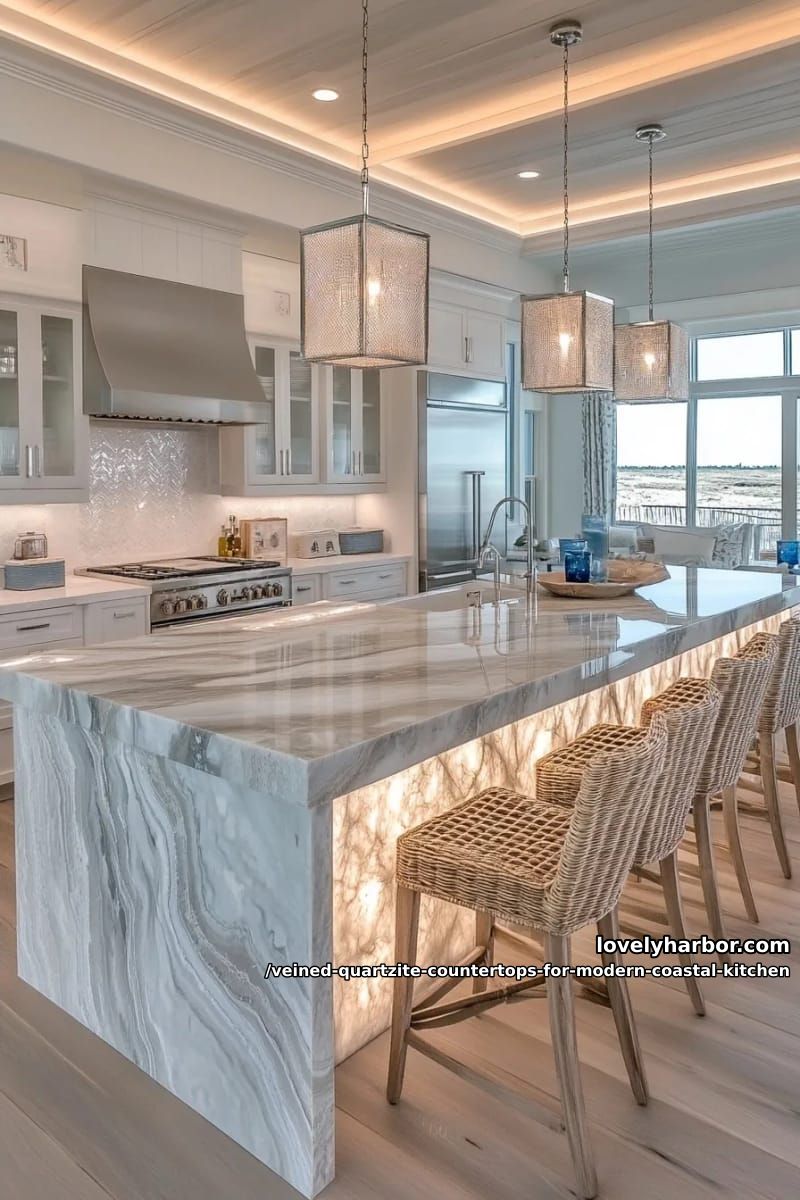
Cristallo is one of the few quartzites with genuine translucency. It often has a translucent quality, allowing light to pass through the stone to some extent, which means you can backlight it. Run a waterfall island front with concealed LED cassettes behind the slab and you get a glowing piece of architecture at night , no visible fixture, no obvious source.
Honest caveats. Cristallo runs $150 to $300 per square foot installed for premium slabs. You need a fabricator who has done backlit work before, because the slab thickness has to be right and the lighting plane has to be aligned, not stuffed behind a panel. It photographs poorly in most lighting and is genuinely worth seeing in a finished installation before committing. I've talked clients out of this once and into it twice. Both wins were open-plan kitchens where the island was visible from a darkened adjacent room.
8. Ocean Blue as one surface only, never two
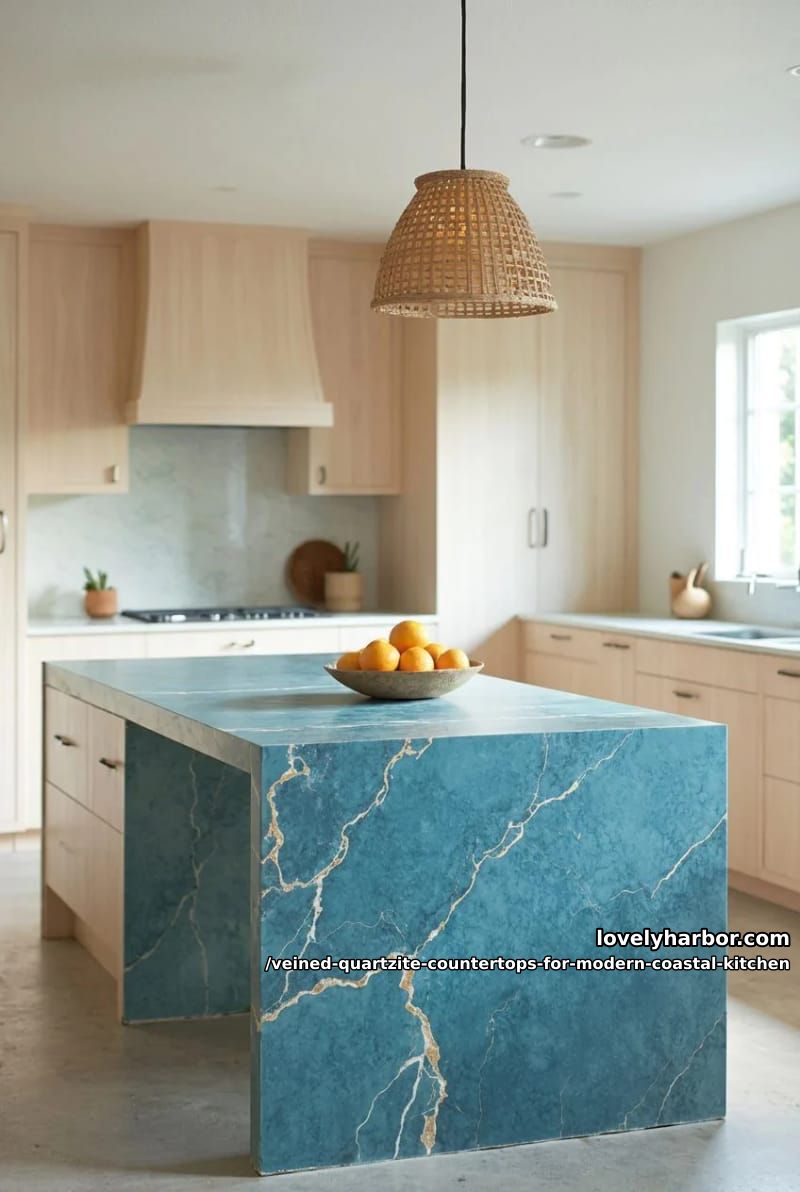
Ocean Blue and Azul Imperiale are the dramatic blue quartzites that show up in every "exotic countertops" listicle. They earn the reputation. They also overwhelm a room the moment you run them on perimeter and island both. Pick one surface, usually the island, and let it be the loud thing.
The pairing I see most often in catalogs is Ocean Blue with espresso flat-panel cabinets, which MSI's marketing leans into. It looks like a 2007 condo flip. Light unfinished white oak works better, or painted off-white cabinets in a chalky finish , Benjamin Moore White Dove, nothing cool-toned. Perimeter in honed Sea Pearl or Mont Blanc keeps the room quiet enough to let the island read as furniture.
9. A mitered 2.5-inch edge instead of bullnose
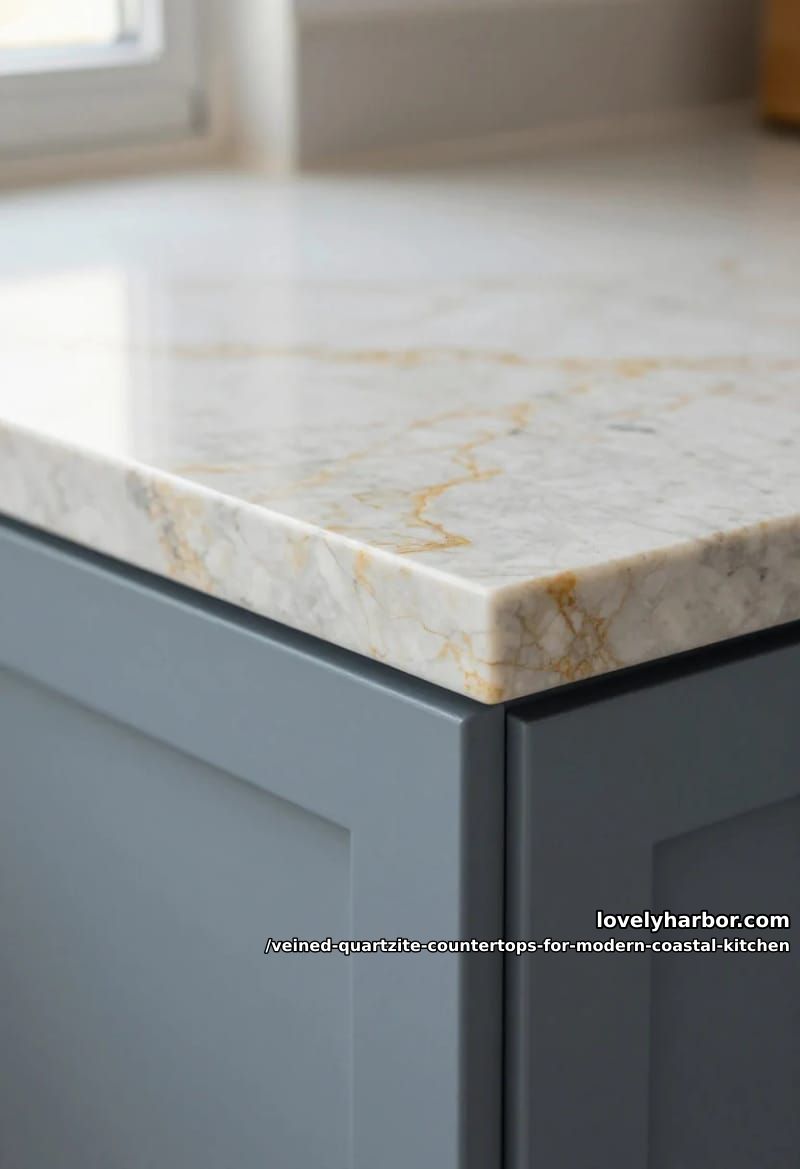
Bullnose has been the default kitchen edge for so long that most homeowners don't know there are other options. There are. For a modern coastal kitchen, the right edge is a square or mitered build-up that doubles the apparent thickness of the slab without doubling the cost of stone.
| Edge profile | Look | Cost upcharge | Right for modern coastal? |
|---|---|---|---|
| Square / eased | Crisp 3cm edge, no detailing | $0 (standard) | Yes, the safe default |
| Half bullnose | Rounded top only | $10 to $12 per linear foot | No, reads traditional |
| Full bullnose | Fully rounded edge | $10 to $12 per linear foot | No, ages the kitchen |
| Mitered 2.5″ build-up | Architectural thick slab look | $15 to $30 per linear foot | Yes, especially on islands |
| Ogee / decorative | Traditional carved profile | Up to $40 per linear foot | No, wrong vocabulary |
A mitered build-up to 2.5 or 3 inches gives an island the visual mass of a stone bench without you committing to a full waterfall. It's the move that elevates a perimeter counter from kitchen-renovation to designed-by-a-person-who-thought-about-it. Whether it looks correct or looks like a furniture-store nightstand comes down entirely to your fabricator's mitering quality.
10. The Super White trap, and how to avoid it
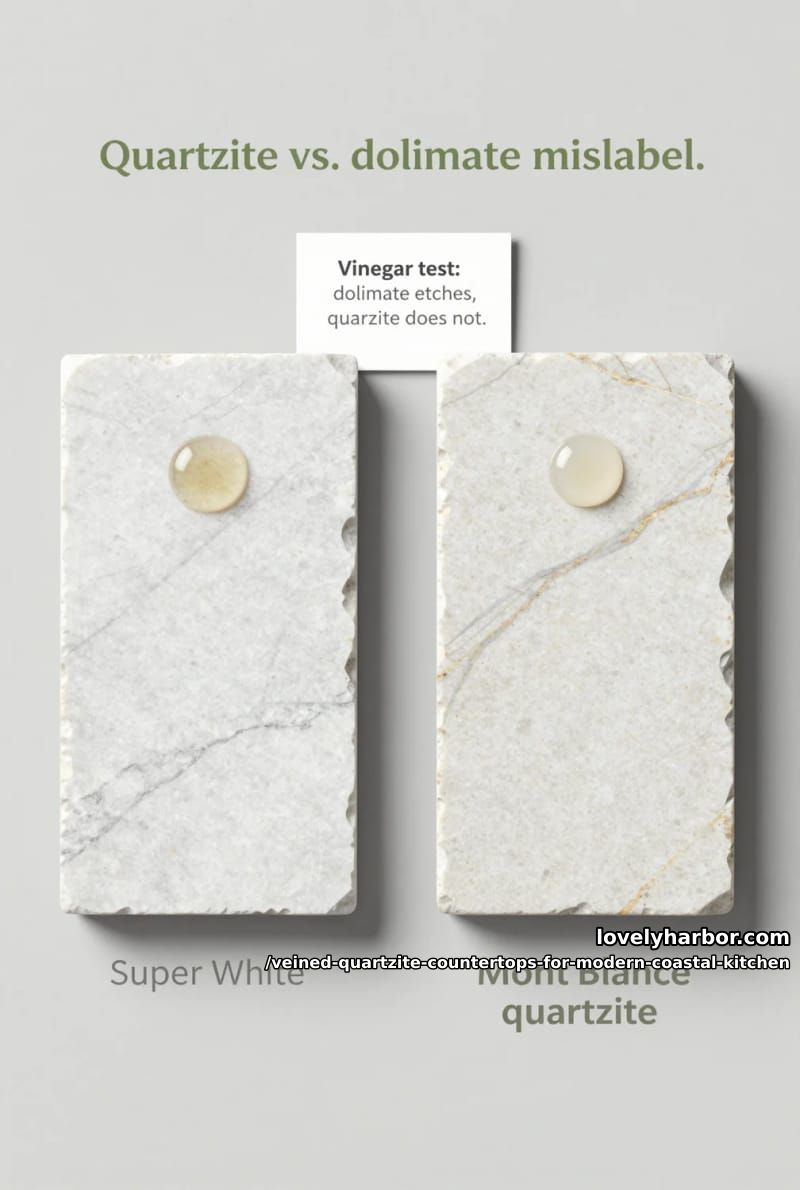
Brazil ships a lot of white stone to American stoneyards, and not all of what’s sold as quartzite is quartzite. Many white stones from Brazil that look like quartzite are actually dolomite or marble. Super White is the textbook example, sold as quartzite for years until customer complaints made the truth obvious. Dolomite behaves like marble. It etches from lemon juice, vinegar, tomato sauce. If your countertop is etching when it shouldn’t, you don’t have quartzite.
11. A penetrating sealer and a calendar reminder you'll actually use
Quartzite is naturally porous, and even the densest slabs benefit from sealing. Sealing at least once a year is recommended to prevent stains, though coastal kitchens with high humidity and salt exposure should bump that to every eight to ten months. Use a penetrating impregnator. Topical sealers sit on the surface, wear off in patches, and look terrible doing it.
To check whether your seal is still working: pour a quarter cup of water on the counter and walk away for 30 minutes. Come back. If the spot is darker than the surrounding stone, water has penetrated and it’s time to reseal. Granite Gold publishes the same protocol, and it works for every penetrating sealer I’ve tried.
The professional fabricator standby. Made in Italy, dries invisible, doesn’t change the color or sheen of the slab. One quart seals roughly 150 square feet, so a kitchen’s worth of stone uses about a third of the bottle per application.

If a quart of solvent-based sealer is more than you want to commit to for a small kitchen, the water-based spray version handles the second-tier job , lower volatility, food-safe, fifteen minutes to do the whole counter. It won't last as long between reapplications, so budget for twice-yearly resealing instead of annual.

Conclusion
One sequencing point gets ignored. Most coastal kitchens are designed cabinets-first, and then the homeowner goes shopping for a stone that "works" with what's already specified. That's backward for a veined quartzite project. The slab is the only element in the kitchen with a fixed personality you can't repaint or refinish, so pick the actual physical slab first , not a color name, not a sample, the slab itself, tagged with your name in the yard , and then build the cabinet color, the brass, and the backsplash around what that slab is doing. ABC Stone and Marble Unlimited both let you reserve slabs in the New York and Boston areas while you finalize the rest. Walk the yard at midday. Bring the vinegar.