
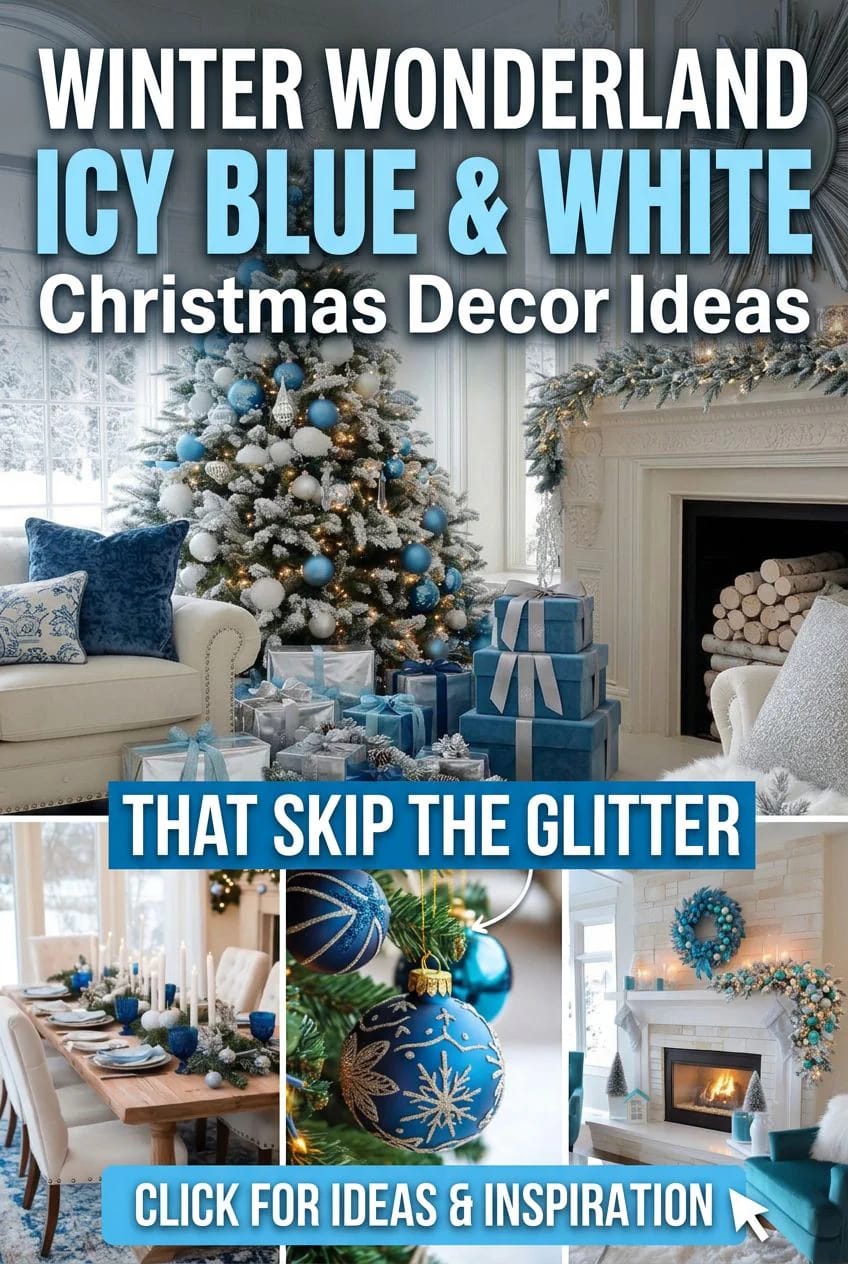
Most advice on this palette tells you to add: more blue ornaments, more silver, more sparkle on every surface until the room reads frozen solid. That produces something closer to a party supply aisle than a winter wonderland. The icy blue and white rooms actually worth copying are mostly white, hold their blue to a narrow band of the visual field, and carry almost no glitter at all. The eight ideas below are built on that split, from the tree and the mantel down to a set of ice lanterns you freeze overnight in a bucket on the back step.
1. Build the room in three whites, then add one narrow band of blue
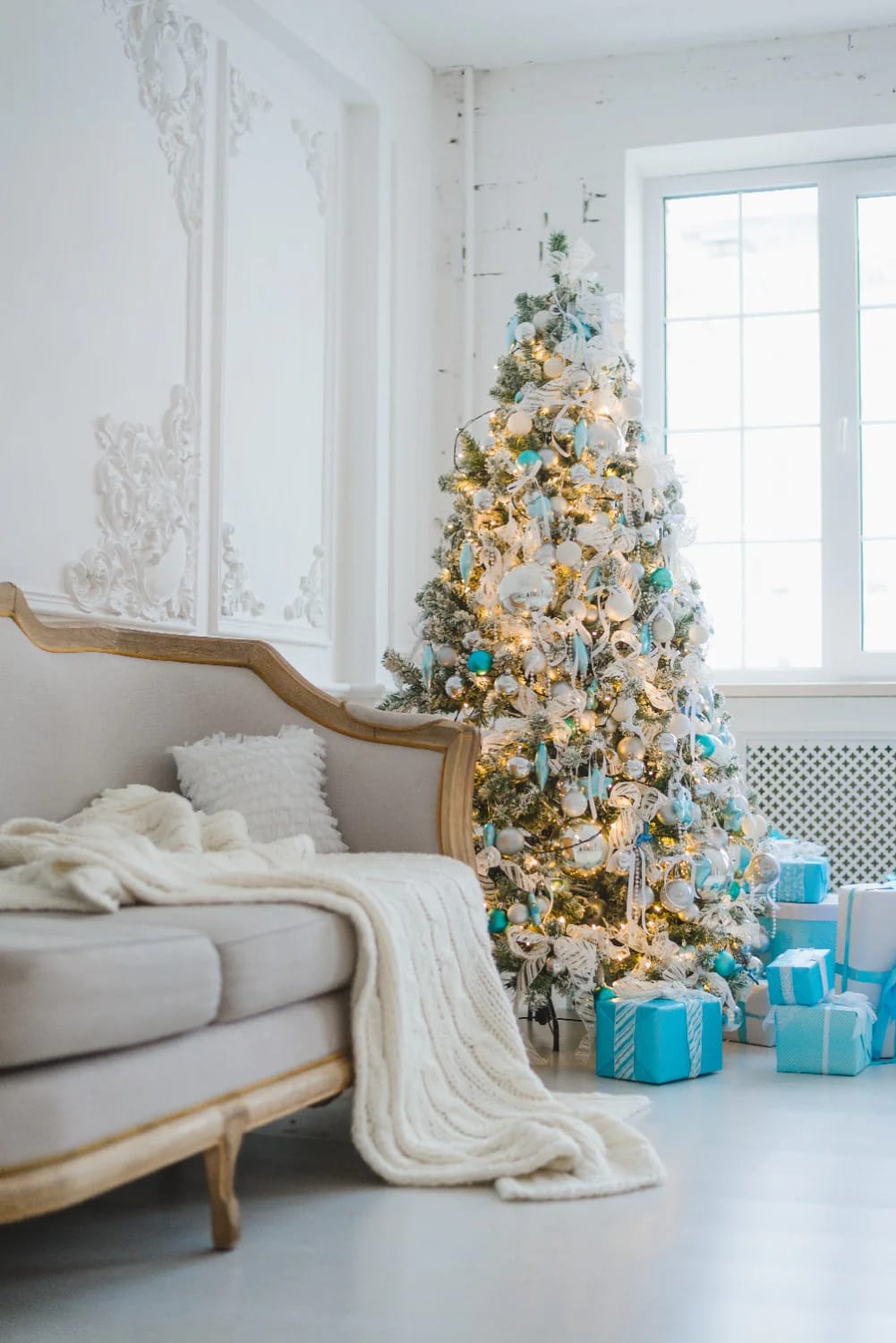
Blue should cover about a fifth of what you can see in the room, and white should carry the rest. That ratio is the difference between a space that reads as snow and one that reads as a corporate holiday party, and almost everyone searching for this look gets it backwards by buying blue first.
Why one white is never enough
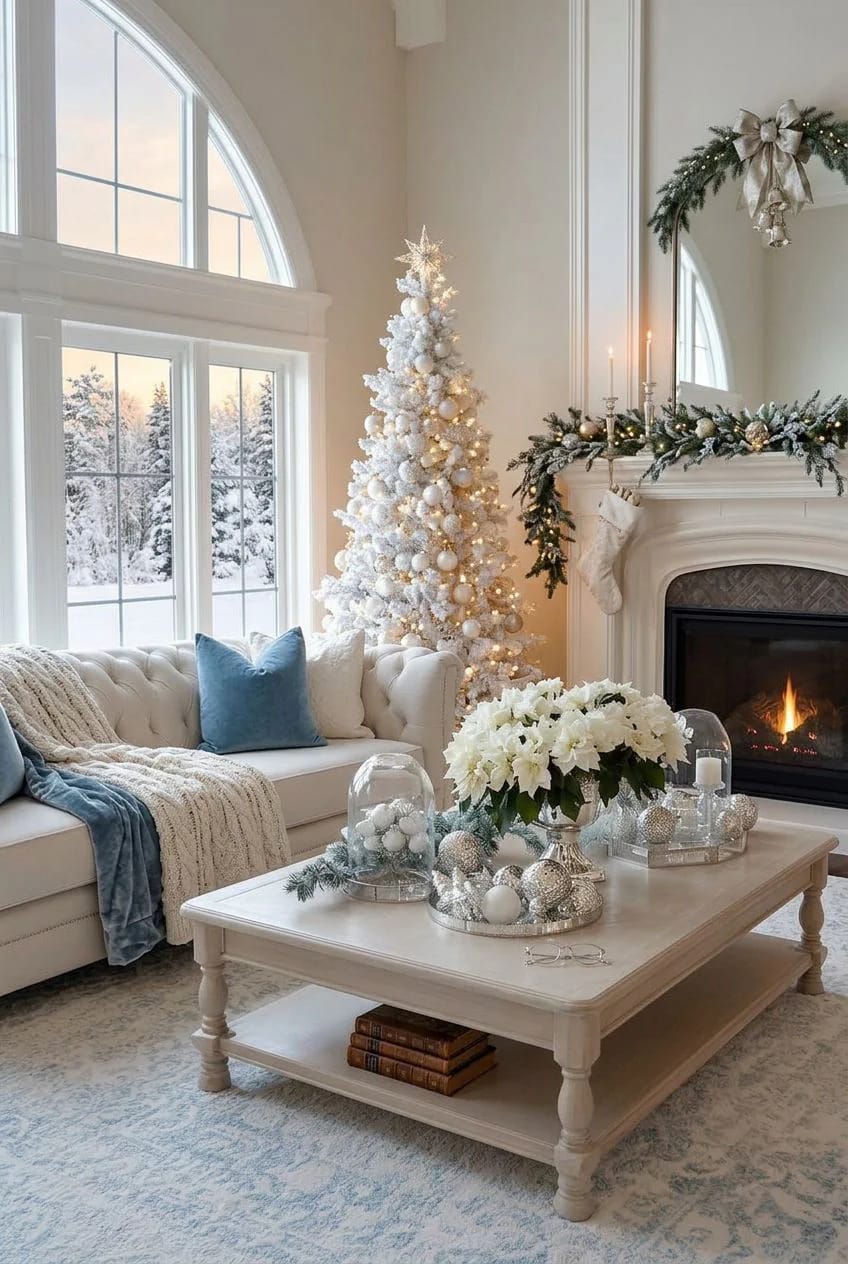
A room done in a single white goes flat under lamplight; the shadows all land in the same value, nothing separates, and the whole thing photographs like a blank wall. Use three instead: a bright optic white for paper, ceramic and candles, a warmer cream or oyster for the big soft things, and one grey-leaning white for the pieces you want to recede. Put the coldest white next to the blue and the warmest white furthest from it.
The whites you cannot buy in a can
Texture is doing most of the work here, and it is the part that keeps an icy scheme from feeling like a fridge. Bouclé, cable knit, long-pile faux fur, raw linen, matte ceramic, milk glass. Six surfaces in nearly the same color, all catching light differently, will read warmer than a room with a single blue throw doing all the heavy lifting. If you want to see the extreme version of this before committing, a full house done in whites and soft silvers is a useful reference for how far the texture argument can be pushed.
2. Freeze ice lanterns in a bucket and line the front steps
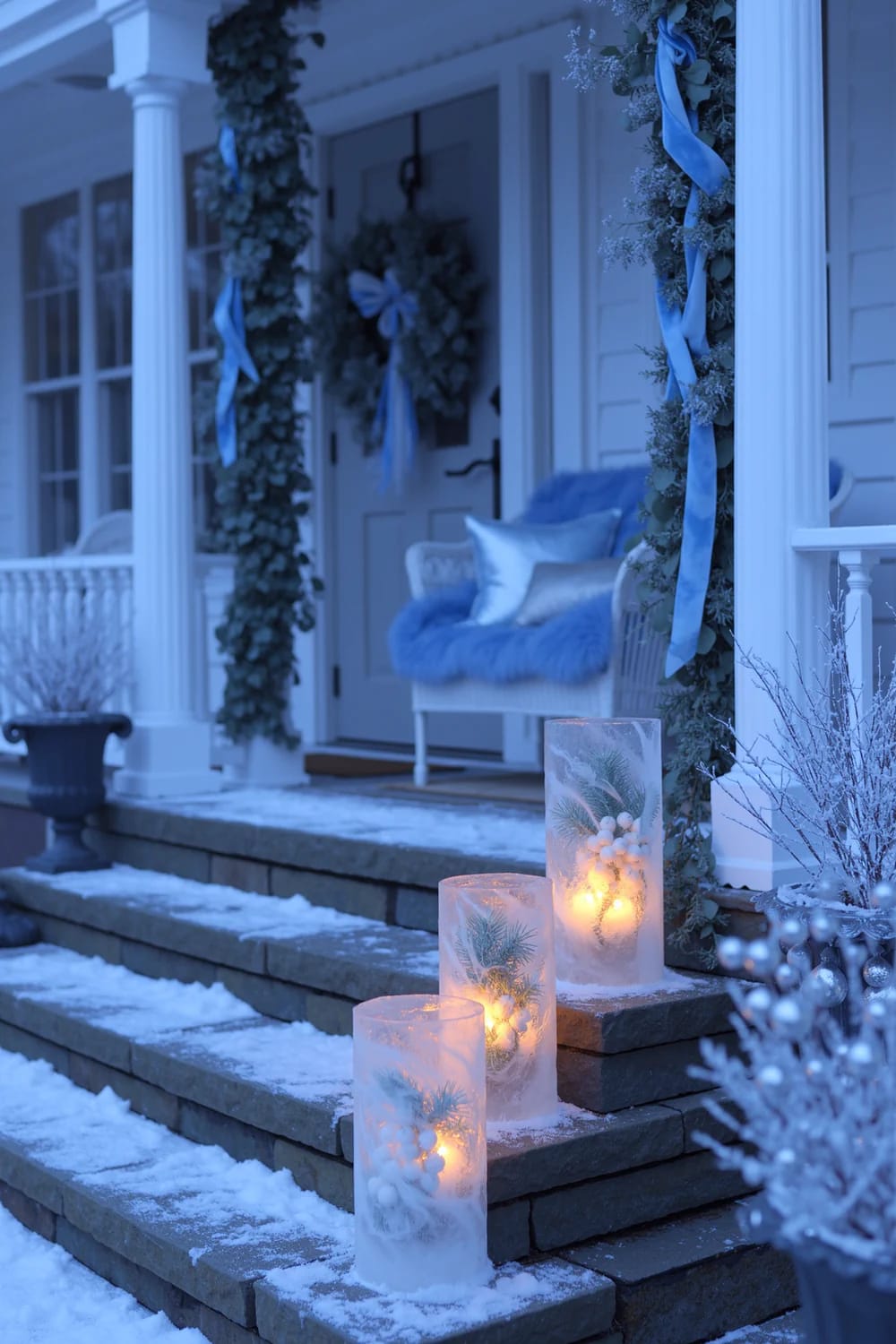
The one genuinely icy thing in an icy blue Christmas scheme should be actual ice, and it costs nothing but water and a cold night. Fill a five-gallon bucket to about an inch below the rim, set it outside on something insulated, and leave it. Water freezes from the outside in, so after roughly a day at around 15°F you get a shell an inch and a half to two inches thick with liquid still trapped in the middle. Punch through the top, pour the middle out, run warm water down the outside of the bucket, and the lantern slides free. Drop in a battery tea light.
Where these go wrong
Three failures account for most of it. Glass containers crack, so use plastic. Anything with ridges or a rim wider at the bottom will not release, so pick a tapered bucket. And if your overnight low hovers near freezing rather than well below it, you get slush at 24 hours and a puddle by morning; this idea belongs to people whose winters actually cooperate. Slip a few sprigs of white pine or a handful of cranberry-sized white berries into the water before it sets and they suspend mid-wall, which is the version worth the effort. They will hold as long as the cold does, which in a good week means the rest of the front-of-house display can stay minimal and let the ice carry it.
3. Keep the green tree and put the blue in the ornaments
Do not buy a white flocked tree for this palette. It is the most common purchase people make when they commit to icy blue and white, and it is the one that reliably kills the effect: white ornaments vanish against white branches, pale blue ornaments go grey, and the tree ends up as one large indistinct shape in the corner. Green needles are the dark value that makes pale blue register as pale.
Three blues, one of them nearly navy
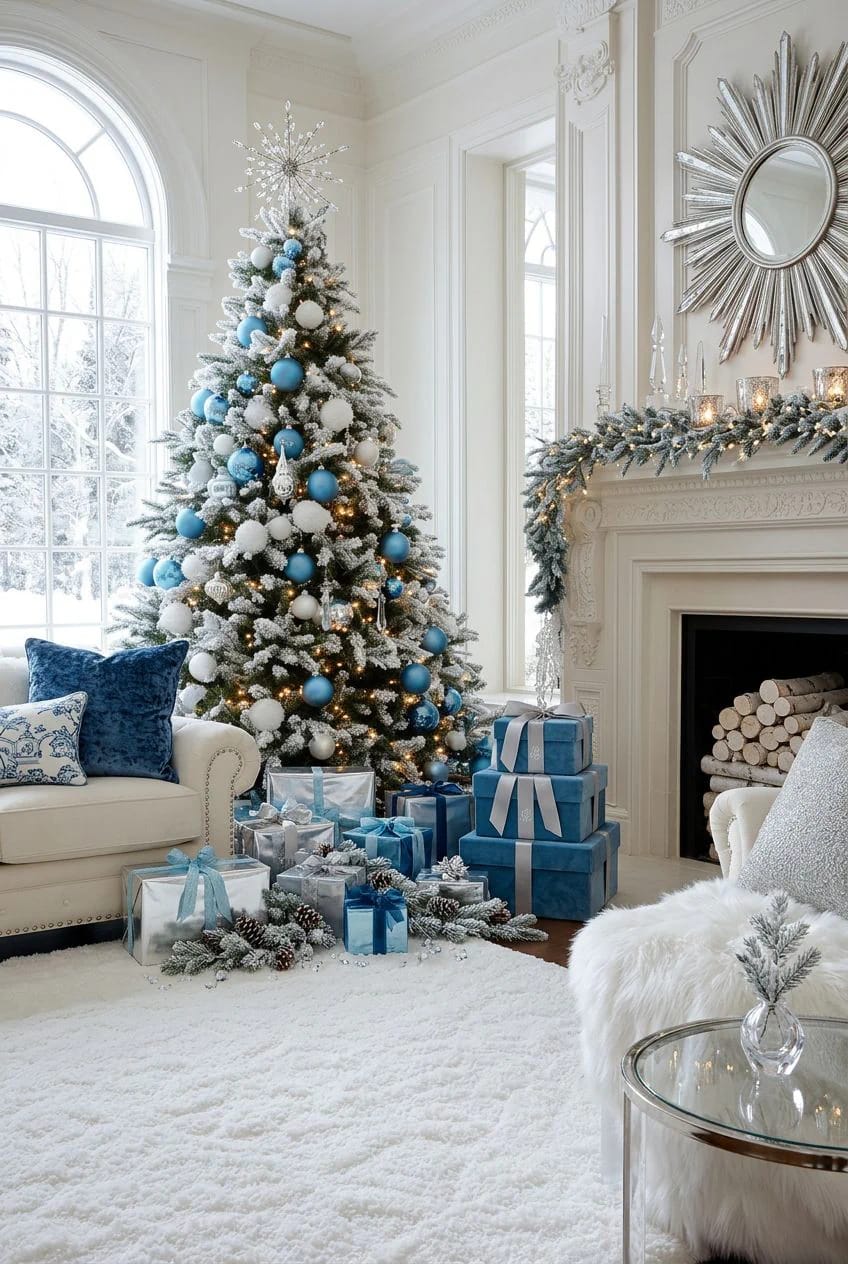
Buying one blue is the second mistake. A tree hung entirely in the same ice blue looks printed. You want a pale, almost white-blue for the majority, a mid dusty or French blue for maybe a quarter of the ornaments, and a small number in something close to navy, placed deep in the branches where they read as shadow rather than as ornaments. The dark ones are what create depth; without them the tree is a flat plane of light colors. Plenty of wider blue Christmas schemes lean on exactly this three-value structure once you start looking for it.

Buy more icicles than baubles
Round ornaments in this palette start to look like a bowl of eggs. Elongated shapes carry the theme better: glass icicles, teardrops, long finials, flat laser-cut snowflakes that catch and lose the light as they turn. Hang the icicles at the branch tips where they swing, keep the round ones close to the trunk.
4. Choose frosted, matte and mercury finishes over glitter
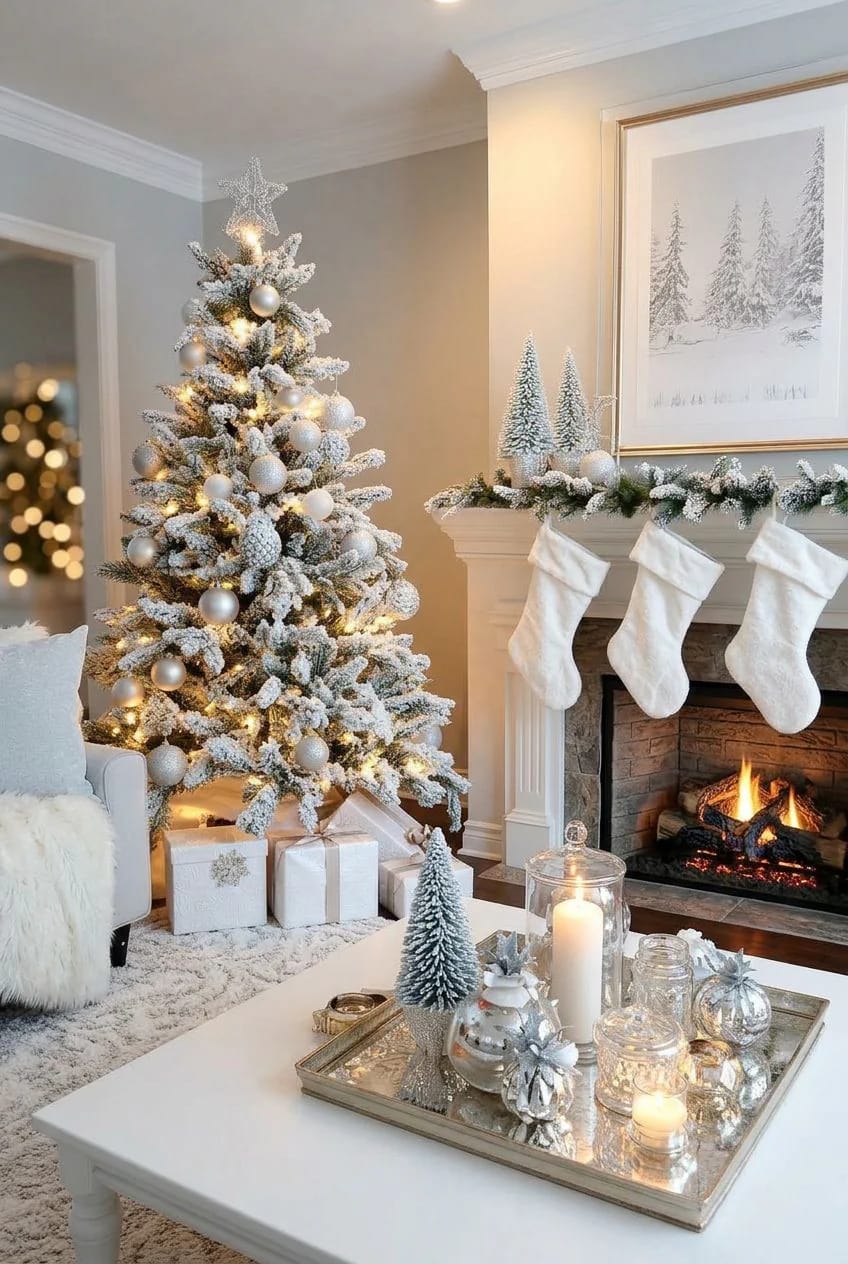
Glitter is the single thing that makes this palette look cheap. Real ice is translucent and mostly matte; it scatters light through itself rather than bouncing a hard highlight back at you. Glitter does the opposite, and it sheds onto everything it touches for the next eleven months.
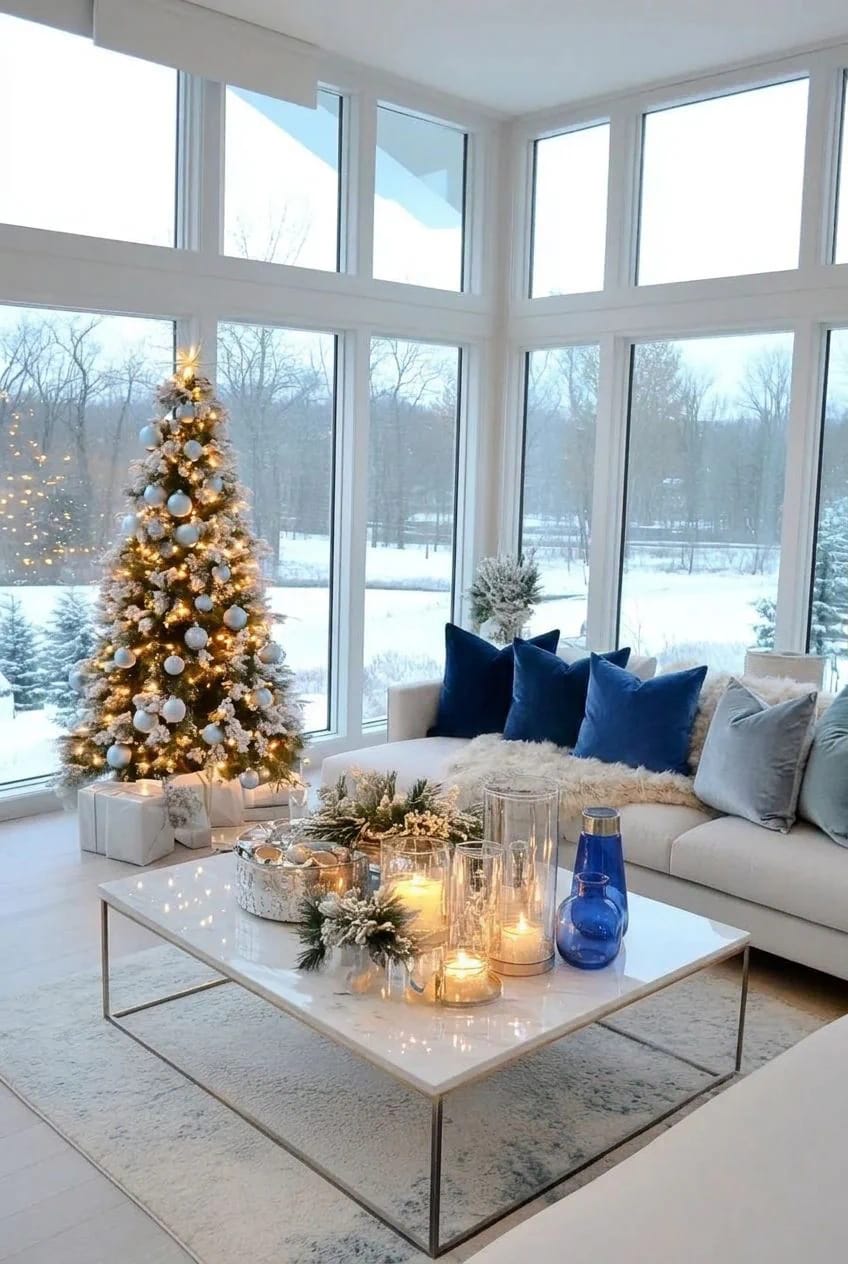
Aim for roughly six matte or frosted pieces to three satin ones to one properly mirrored piece, and let the mirrored one be genuinely reflective rather than sparkly: antiqued mercury glass, a small silvered votive, one polished finial near the top of the tree. Frosted glass reads as ice at any distance. Glitter only reads as ice in a product photograph shot under a ring light. Scandinavian holiday styling has been making this argument for years, and the Nordic version of a pared-back Christmas is the clearest place to see matte-over-shiny working at whole-room scale.
5. Hang paper snowflakes in a curtain, not taped to the glass
Snowflakes stuck flat against a window read as a classroom; hung on line in a layered curtain a foot in front of it, the same snowflakes read as weather. The trick is depth. Cut them at genuinely different sizes, from about two inches to seven, and hang them on clear line at staggered drops so no two sit in the same plane. Light passing through the window then hits them at different distances and throws overlapping shadows on the wall behind, which is the whole effect.
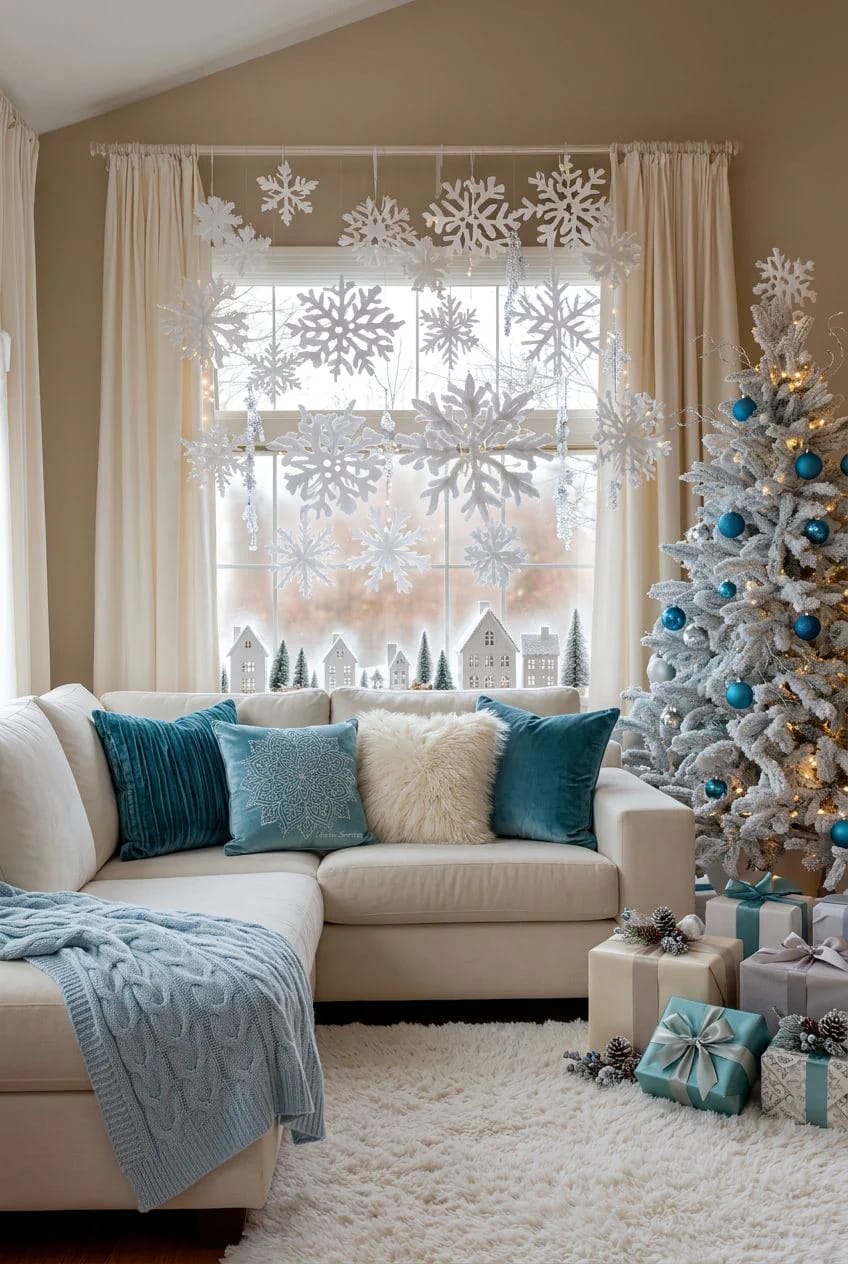
Practical notes: use cardstock rather than copy paper or they curl within a week, thread them on 6 lb fishing line, and hang the line from adhesive hooks along the top of the window casing if you rent. Total cost is a few dollars, which makes this the cheapest idea here by a wide margin and the one most worth handing to a child. There are other paper and yarn projects in the same white family if you want a matching set rather than one lonely window.
6. Weight the mantel garland to one side and hang one blue wreath
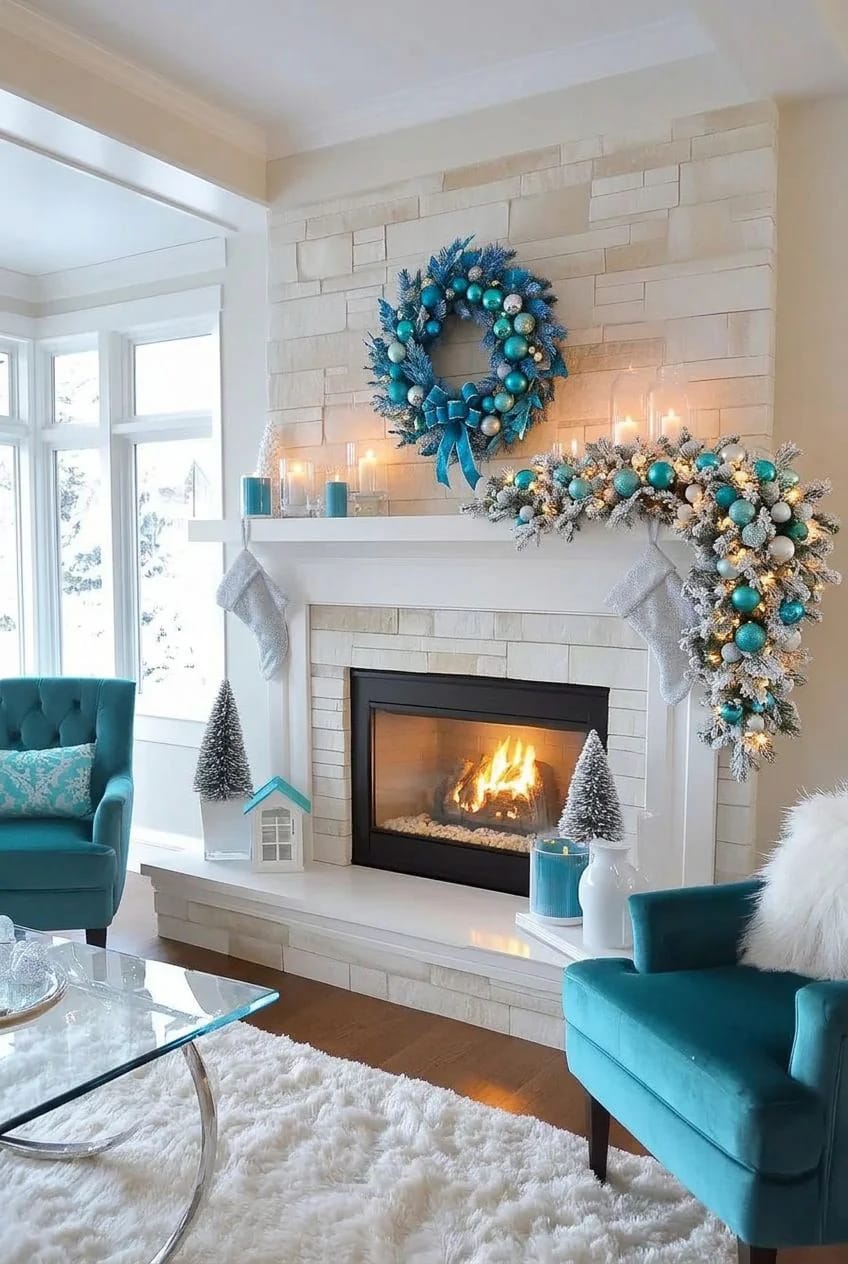
Symmetry is what makes a mantel look like a display rather than a room. Run the garland so that two thirds of the material sits on one end and falls in a long tail toward the hearth, then let the other end trail off into two or three sprigs and stop. Leave a third of the shelf genuinely empty.
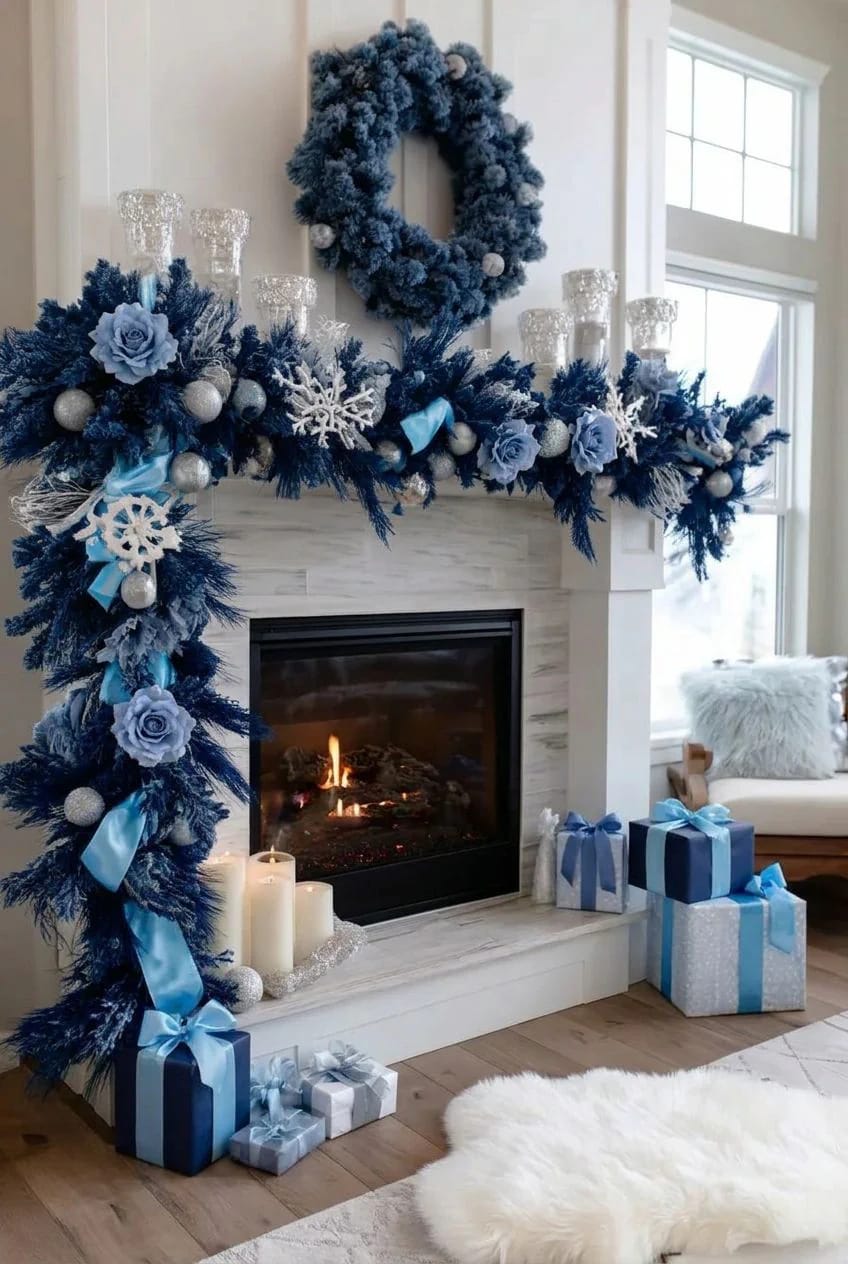
The wreath does the color
One wreath above the mantel, hung slightly off center so it does not line up with the garland’s heavy end, is where the blue belongs on this wall. Frosted eucalyptus with pale blue ribbon, or a plain white berry wreath with three or four ice blue glass ornaments wired in at irregular intervals. I would rather see one substantial wreath than a shelf covered in small silver objects, though that is a taste call and reasonable people decorate the other way. The mechanics of getting garland to sit properly, especially the density question, are covered in more depth in this piece on making mantel garland look deliberate.
7. Put every bulb at 2700K and none of them in the ceiling
Warm light, cool decor. Reverse that and the room turns clinical within about four seconds of the sun going down, which is why so many blue-and-white schemes photograph well at noon and feel unpleasant at seven in the evening. String lights sold as "cool white" or "ice white" run somewhere around 5000K to 6500K, and they render pale blue as grey and white textiles as hospital linen.
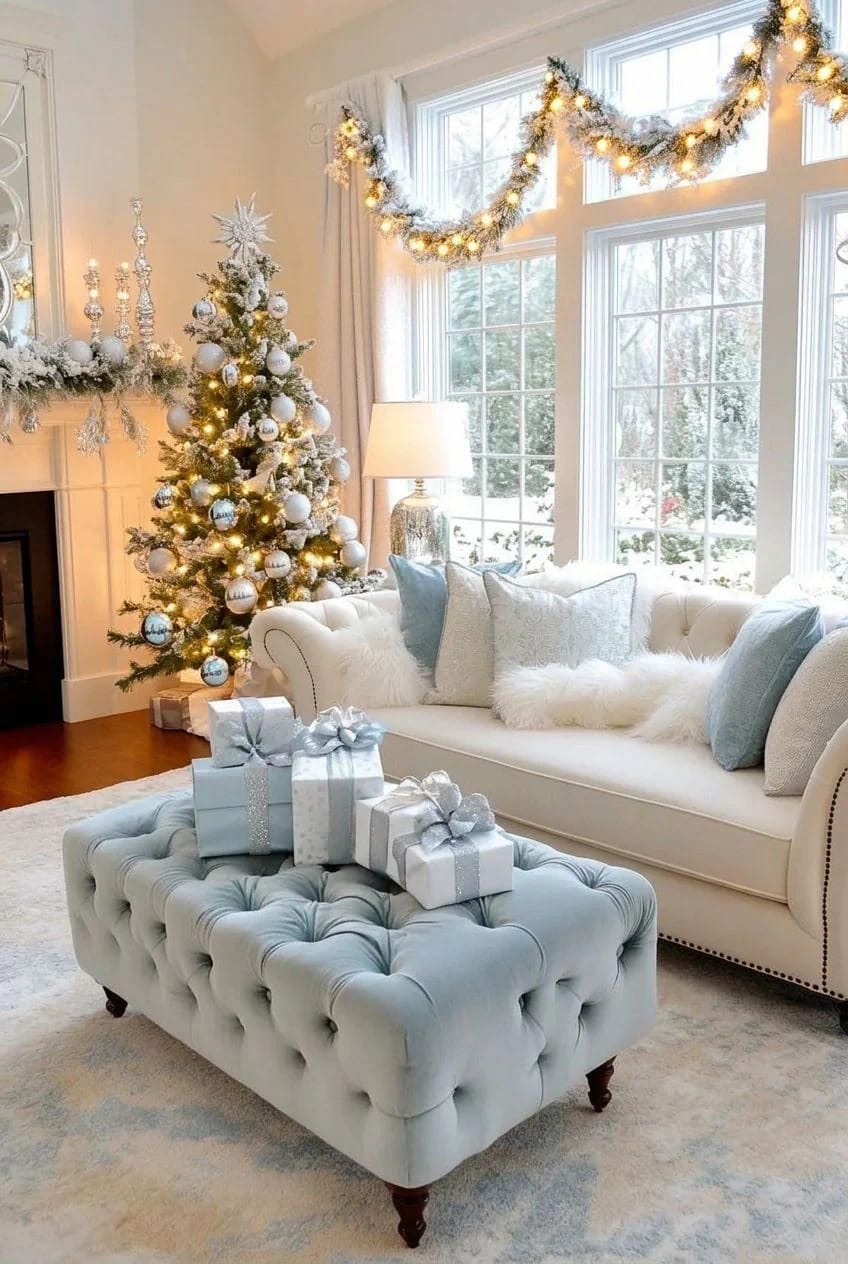
Buy 2700K strings, put a 2700K bulb in every lamp, and add candles, which sit down around 1800K to 1900K and are the warmest light in the room by a distance. Then turn the ceiling fixture off and leave it off for the season. Light the room from three heights instead: a floor lamp, a table lamp, and the candles or a low lantern on the hearth. The blue in the decor supplies all the cool the room needs.
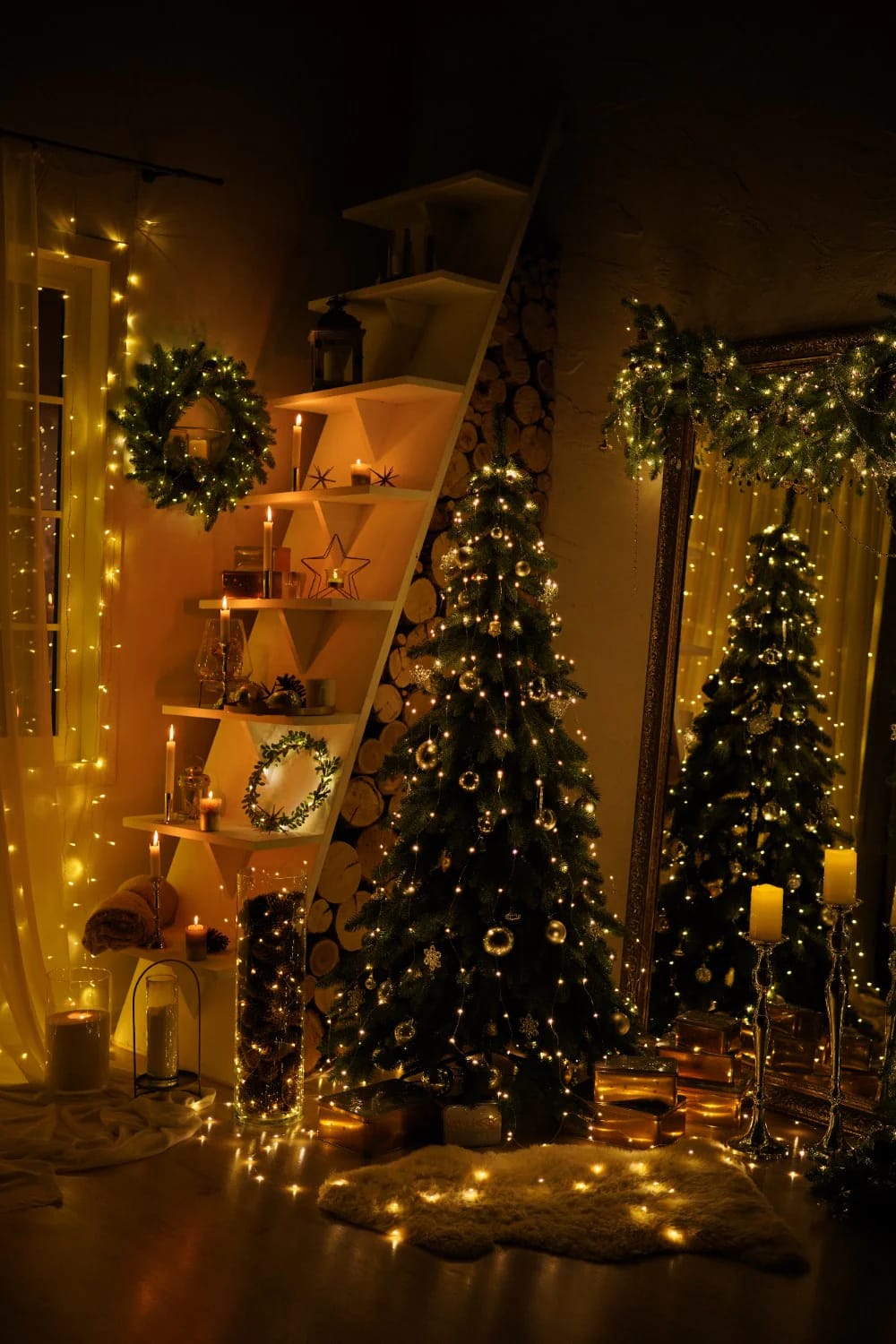
 Blue and Silver Christmas Decor Ideas for the Living Room That Don’t Read as Cold The living room version of the same argument, worked through from the sofa outward.
8. Set the table with frosted candles, blue glass and no runner
Skip the runner. A blue runner down the middle of a white table is the fastest way to make a winter wonderland tablescape look like a rental hall, because it puts a hard band of the accent color straight through the center of the composition. Leave the table bare, or lay plain white linen, and let the blue arrive as glass.
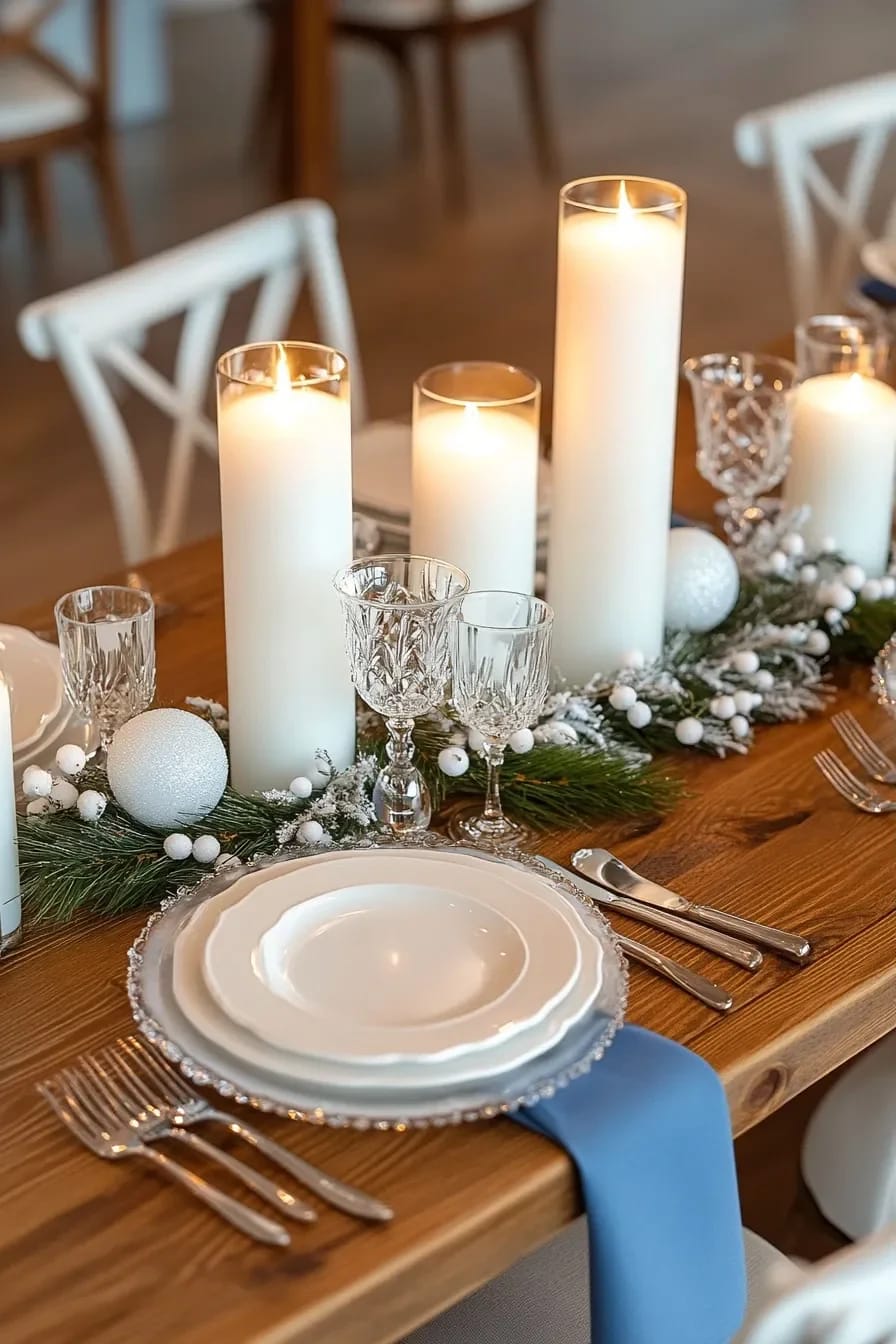
What earns its place on the table:
- Frosted pillar candles at three or four different heights, grouped rather than spaced evenly.
- Pale blue tumblers or goblets. This is where nearly all your blue should live, because it is the only blue that moves and catches light as people eat.
- Sprigs of frosted eucalyptus or blue spruce laid loose between the candles. Loose. Not wired into anything.
- Nothing taller than about twelve inches anywhere in the middle, so people can see each other.
Everything else is optional and most of it is clutter. If you want to push the centerpiece further than a candle grouping, this roundup of centerpiece arrangements has versions built around low bowls and mercury glass votives that suit the palette.
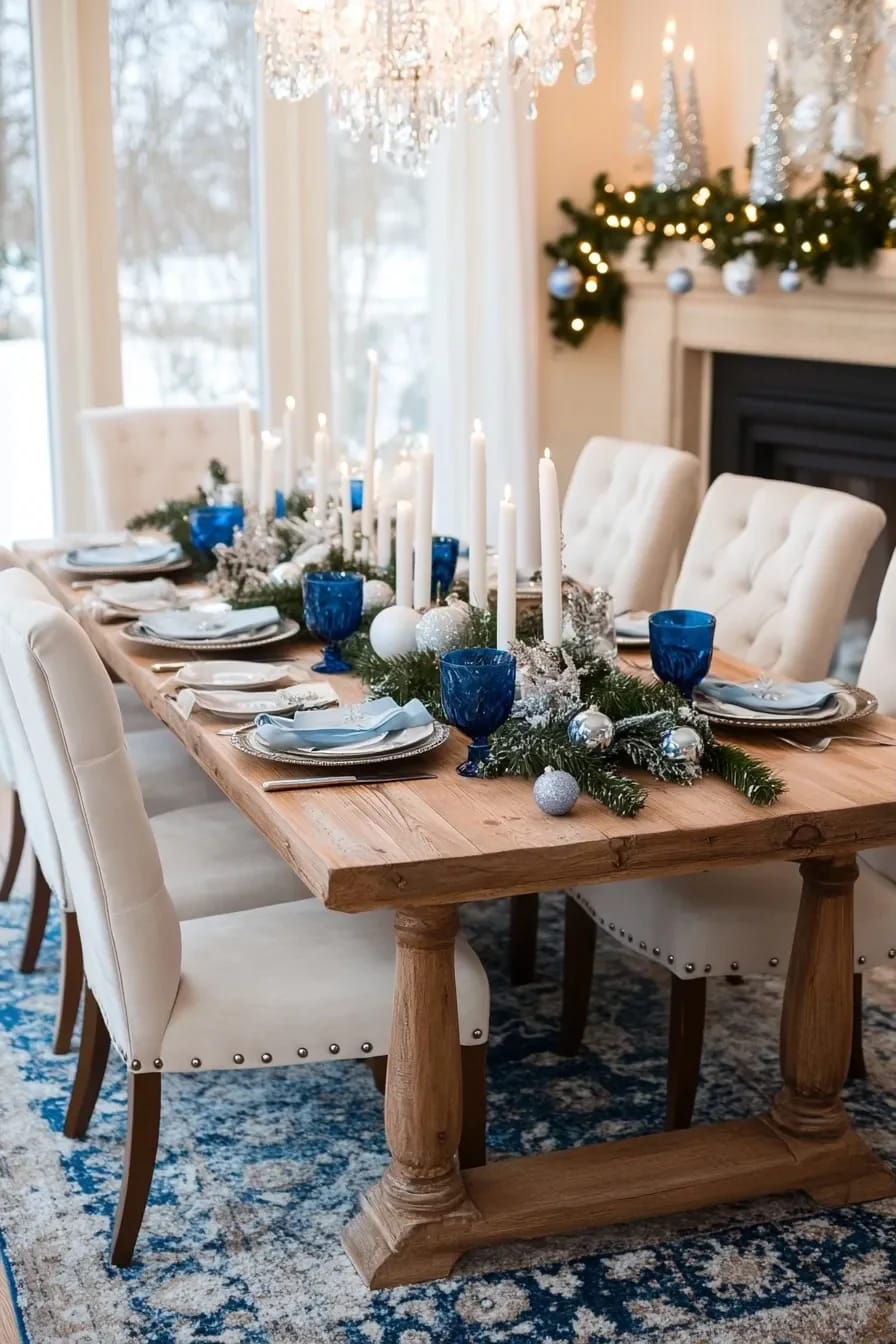
Order matters more than budget here. Get the white base in place first, the textiles and the candles and the paper, because that is what everything else sits against, and it is cheap. Then fix the lighting, because a 2700K bulb costs less than a wreath and changes more. Ornaments last. By the time you get to them you will know exactly how much blue the room can take, which is usually less than you thought when you started.
One honest caveat on the ice lanterns: they only work if your winter genuinely delivers, and I could not find reliable pricing on the frozen-flower kits people sell as a shortcut, so expect that quote to swing. If your January hovers around freezing, do the same shape indoors with frosted glass hurricanes on the hearth and accept that you are borrowing the look rather than making real ice. The rest of this holds anywhere.
Related Posts
- 21 Gorgeous Blue Christmas Decor Ideas You Must See
- 25 New Gorgeous White Christmas Decor Ideas That Wow
- 21 Magnificent White Christmas Decor Ideas
- Blue and Silver Christmas Decor Ideas for the Living Room That Don’t Read as Cold
- 21 Best Red and White Christmas Decor Ideas 2024
- 15 Creative White Christmas Decor DIY Ideas For Easy Elegant Inspiration