
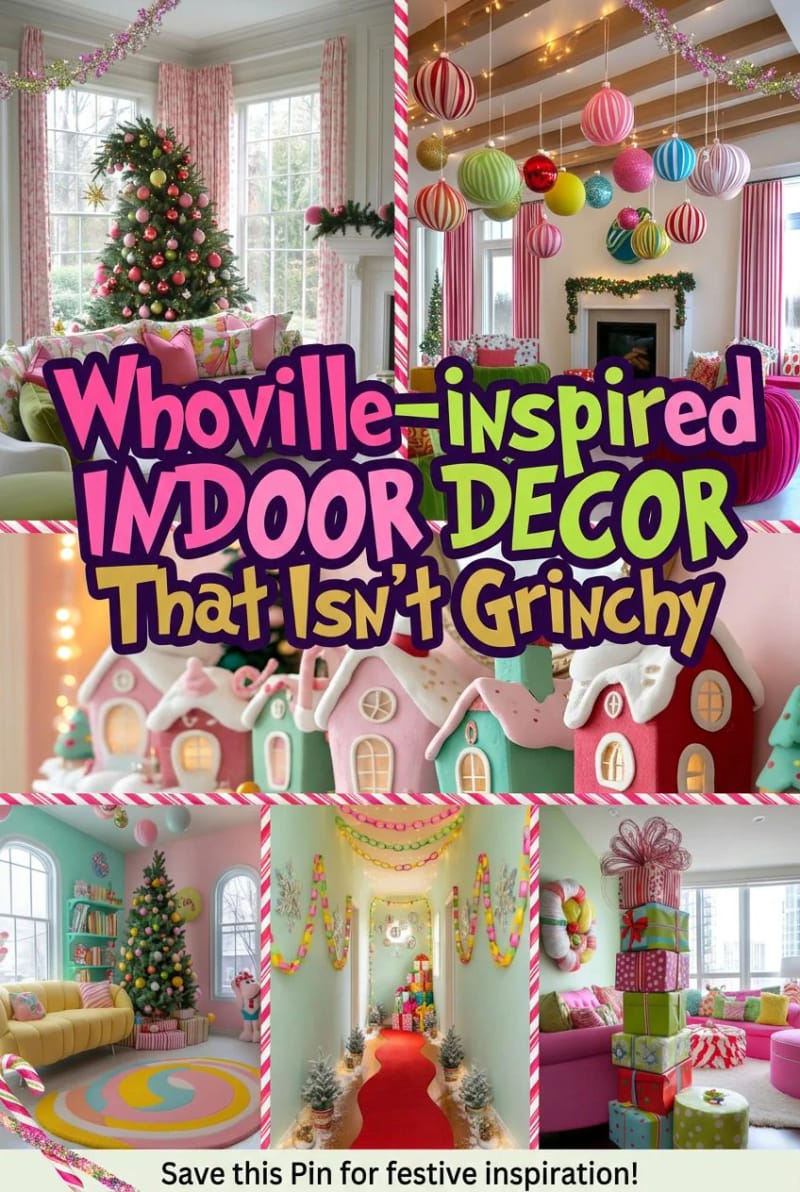
Red and green will not get you to Whoville. The town Dr. Seuss drew runs on candy brights, curved shapes, and a scale that ignores restraint, and most indoor Grinch setups miss all three by stopping at a green tree and a doormat. What follows is eleven indoor decorations that read as Whoville rather than as generic holiday, arranged roughly in the order I would build them, each with the material that makes it work and the spot where it usually goes wrong.
Bend the top of the tree into a Whoville curl
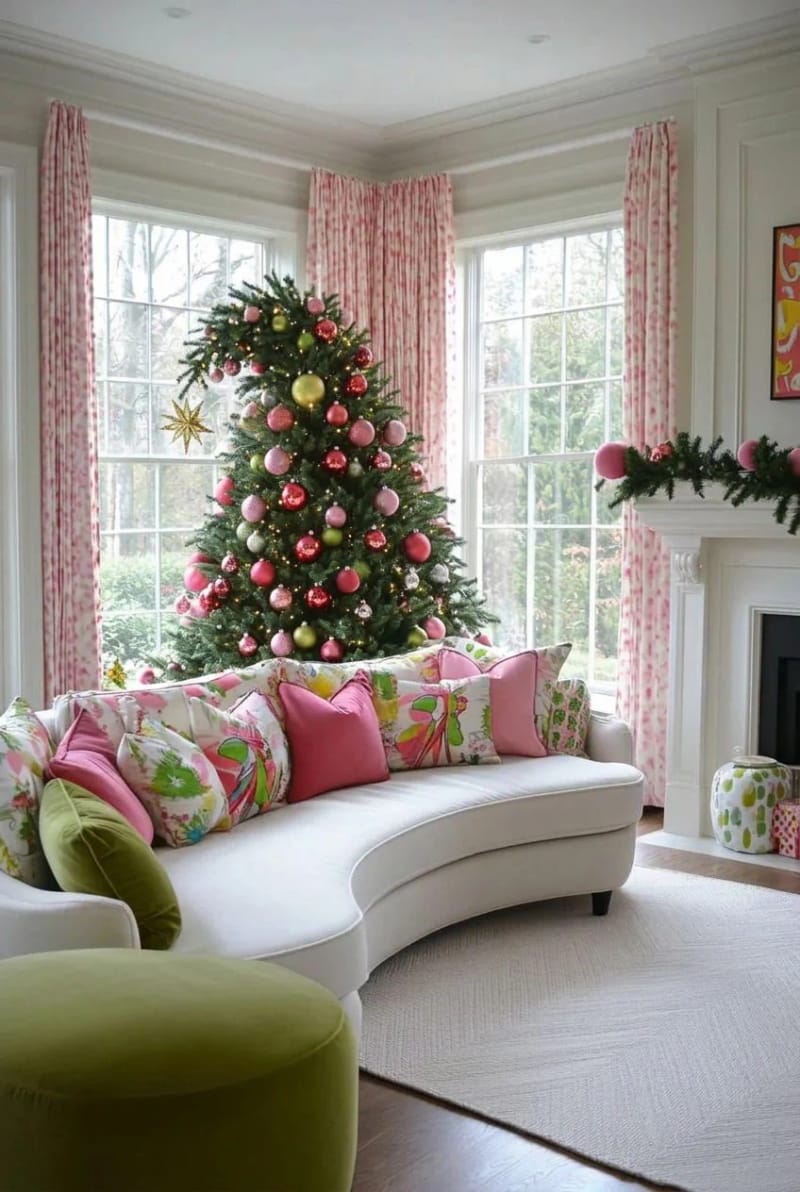
Bend the tip until it droops, wire it so it holds, and finish the curl with one oversized bauble; that drooping silhouette is what the eye reads as Whoville before it registers a single color. It is the one move that separates a Whoville tree from a green tree with themed ornaments on it.

The curl at the top
Two reliable methods. On an artificial pencil tree, gather the top eighteen inches of branches, wrap them tight with floral wire until the tip goes thin, then bend the whole thing forward and let a heavy ornament weight the end. For a bigger, more dramatic hook, bend a wire tomato cage (about $6 to $10 at a hardware store) into a candy-cane shape, wrap it in pine garland and lights, and lash it on as an oversized topper. The cage version holds a heavier curve because the wire does the work, not the branches.
Keep it half-mean, not polished
Space the ornaments out and let gaps show. Oversized matte baubles, a couple of disco balls, colored lights that sag a little rather than string in neat spirals. Overdressing the tree flattens the joke back into a regular themed tree, which is the opposite of what the bent tip was trying to say.
Hang oversized ornaments from the ceiling, not just the tree
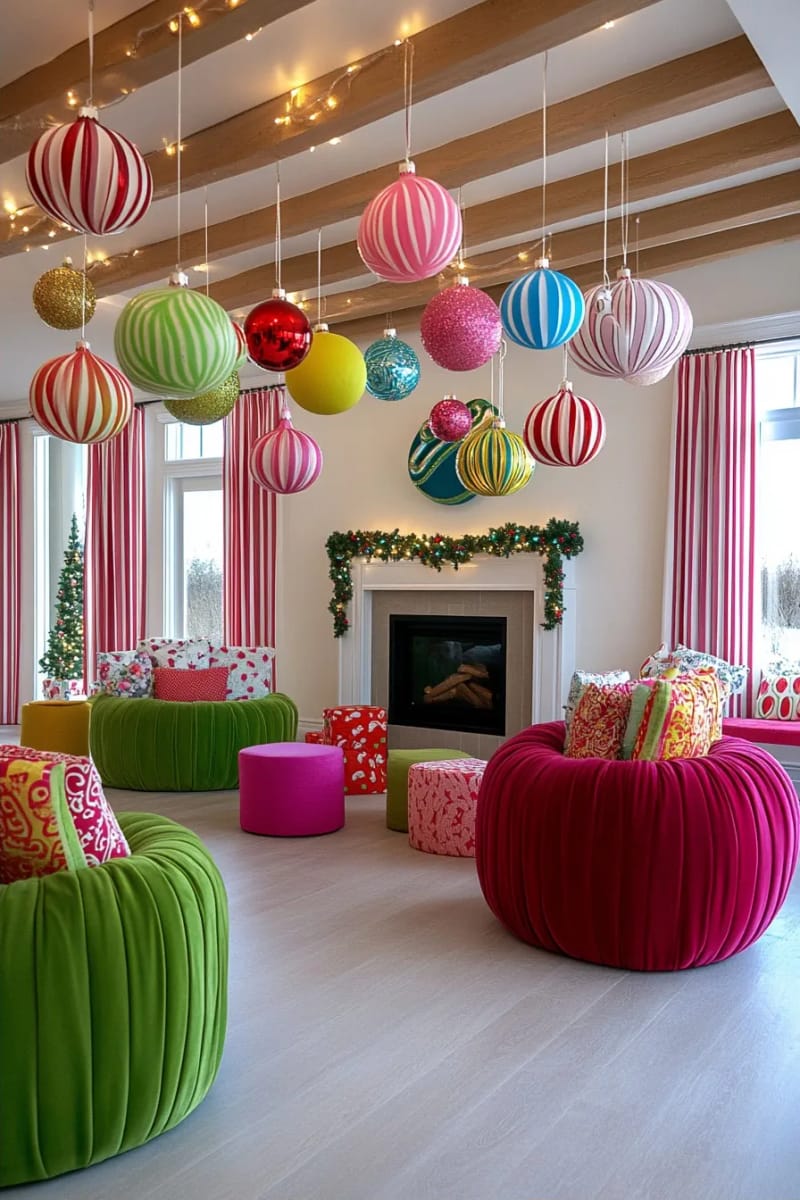

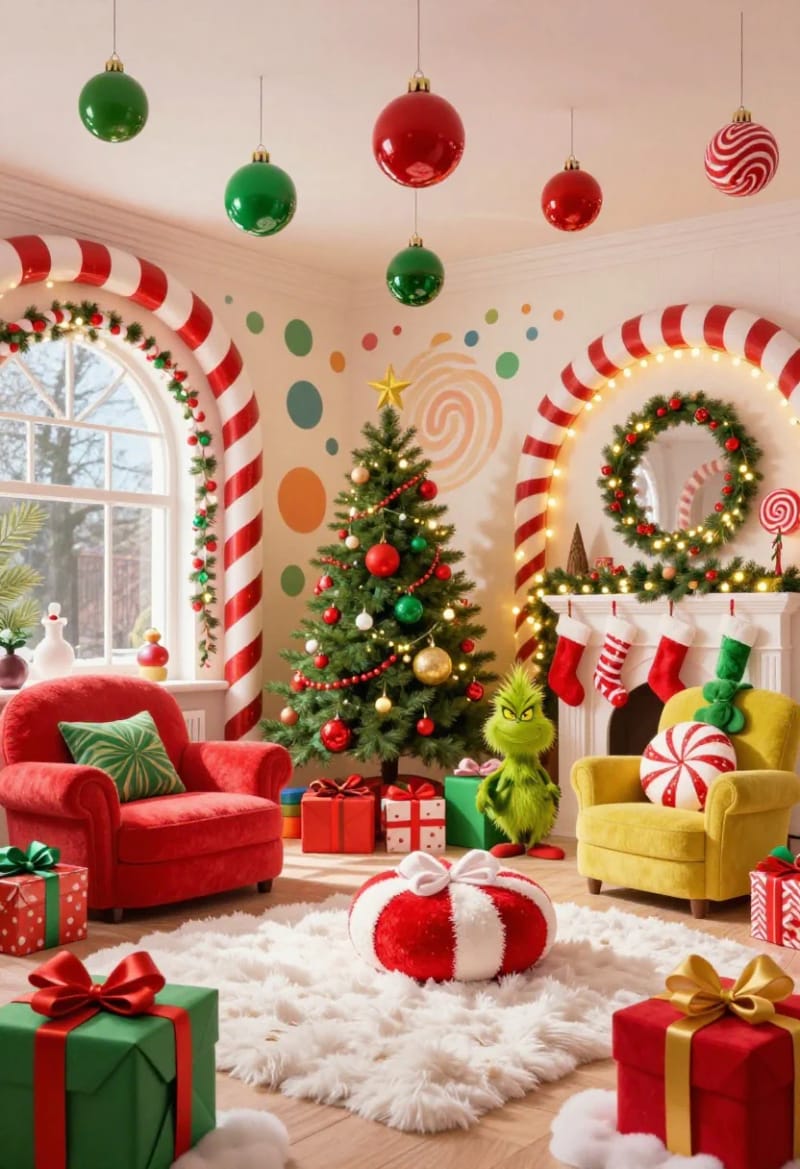
Move the baubles into the airspace. Oversized shatterproof balls on clear fishing line, dropped from ceiling hooks at staggered heights, is one of the most-saved looks in this whole theme and one of the cheapest to pull off. Command ceiling hooks hold the line without leaving marks, which matters if you rent. For a jumbo focal ball, spray-paint an old exercise ball in candy pink and hang it lowest so the cluster has an anchor.
Trade red-and-green for the candy palette that reads Whoville
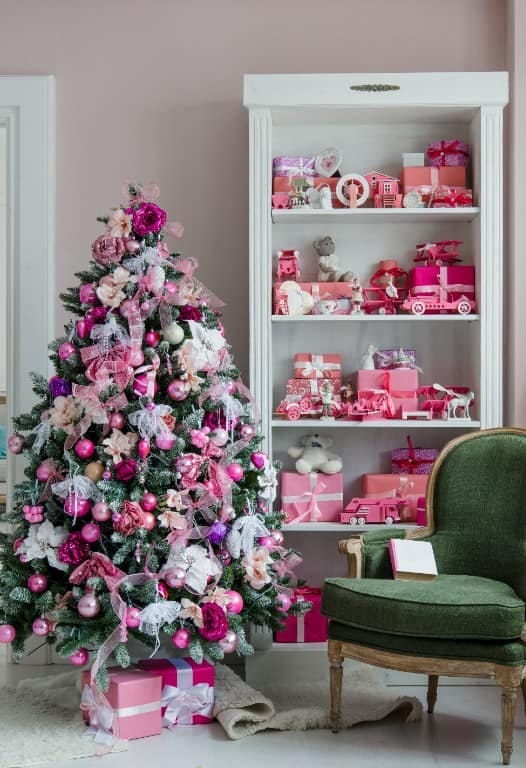
Get the palette right and the rest is downhill; get it wrong and no amount of Grinch faces will save it. I would argue the default red-and-green is where three quarters of these setups quietly die, because that combination reads Christmas generally, not Whoville specifically.
The three that do the work
Cherry red, bubblegum pink, and a sharp lime or acid green are the base trio; lemon yellow and turquoise come in as accents, not equals. Multiple Whoville home tours land on the same technicolor set, and it holds up: the pink is what most red-and-green schemes are missing, and it is the fastest single change you can make.
Where it curdles
An evenly balanced spread of the colors reads corporate, like a brand deck. And the green is where people slip: a dusty sage or a deep hunter pulls the whole room toward English country or farmhouse, not Seuss. Keep it acid.
Do this
- Anchor on cherry red plus bubblegum pink, then push the green toward lime.
- Let one color dominate a given surface instead of splitting everything fifty-fifty.
- Add lemon yellow or turquoise in small hits to keep it from reading like a two-color logo.
Avoid
- Sage, hunter, or olive greens. They read farmhouse.
- A perfectly even red-green-pink balance across every object.
- Metallics as the main event; a little silver from disco balls is plenty.
Build a tiny Whoville village along the mantel


Line the mantel or a console with little curvy houses and light them from inside. Dollar-store ceramic village pieces work, but the more Whoville route is cutting your own from cardstock: tilt the chimneys, round off the doors, and make no two the same height. A pack of battery LED tealights tucked behind each one does the glow, and a strip of quilt batting reads as snow drift for a couple of dollars.
Oversized candy canes and lollipops turn a corner into a Who-street
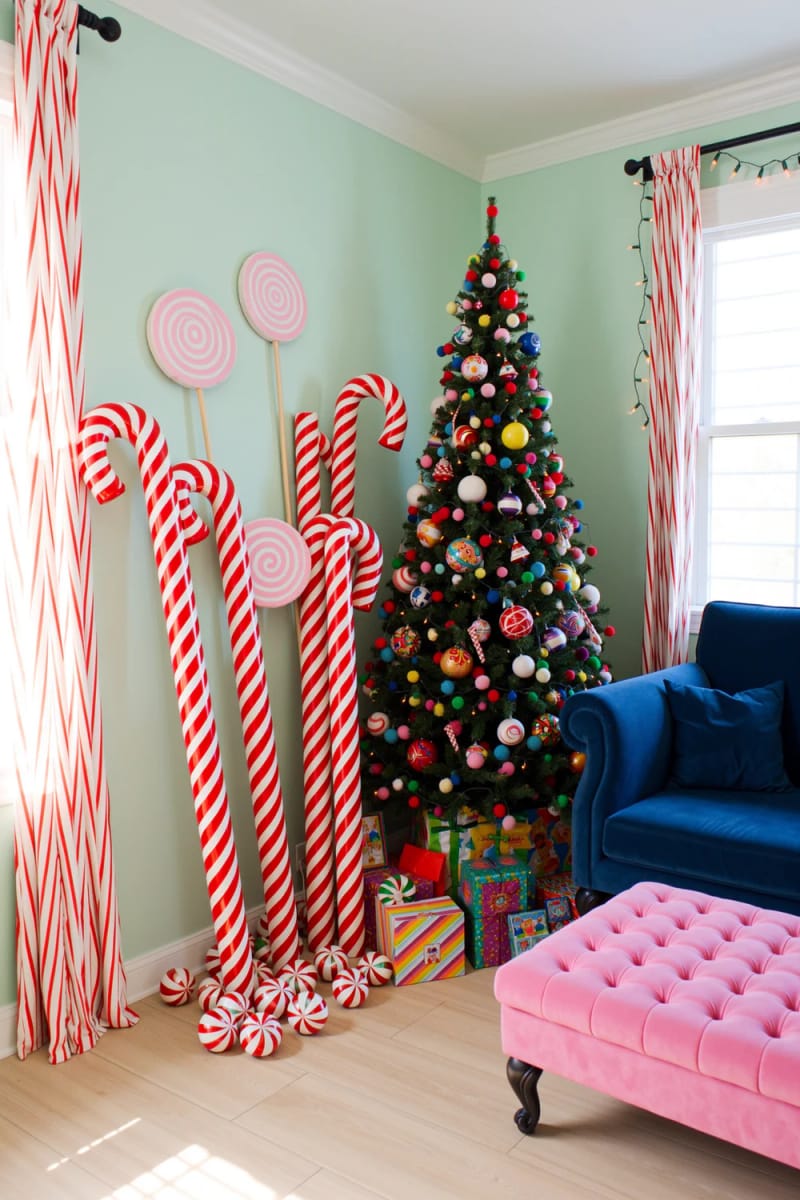
Scale the classic pool-noodle candy cane up and bring it inside. Feed heavy-gauge wire through the hollow core first, then bend the top third into the hook; the wire holds the curve so the foam does not kink or crease. Wrap it in white duct tape at a forty-five degree angle for the stripe. Group three to five at different heights in a corner, add a couple of foam-board lollipops on dowels, and you have a Who-street vignette for roughly $5 to $10 a cane. Indoors you can skip the rebar and stakes the outdoor tutorials insist on.
Stack crooked, mismatched present towers in the corner
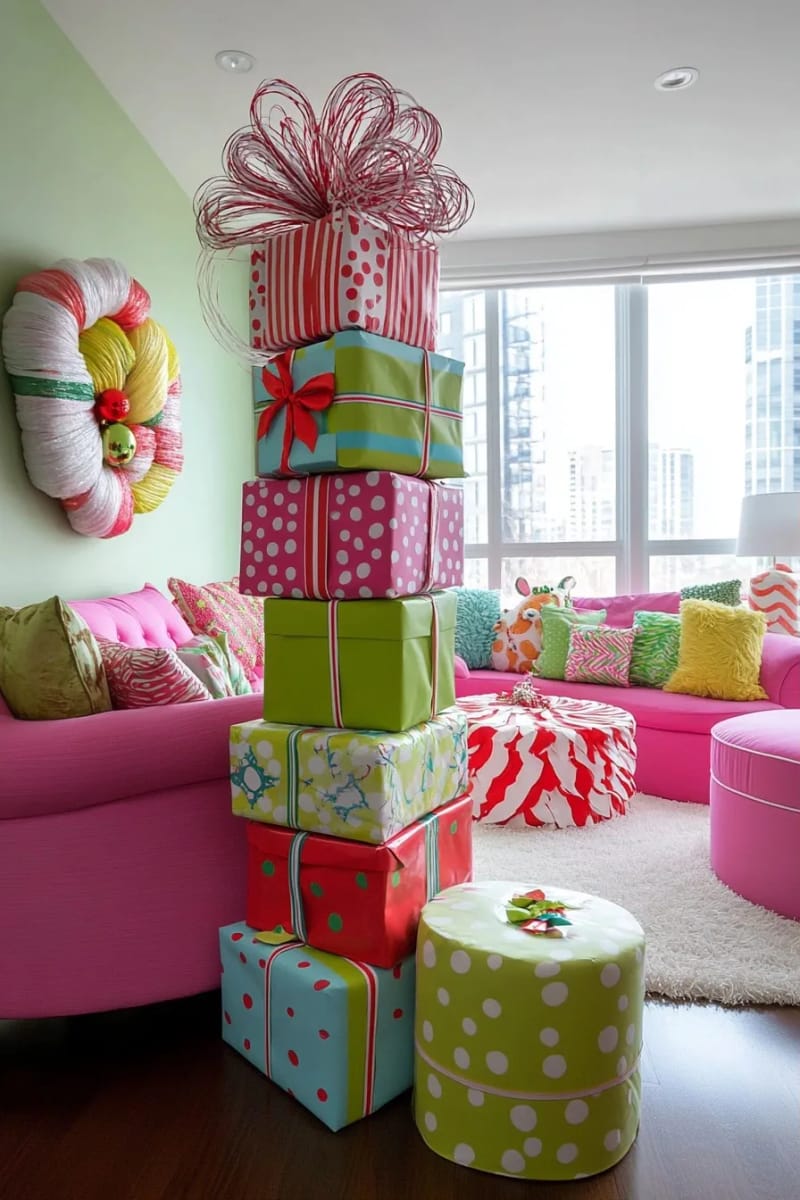
Wrap empty boxes in papers that clash on purpose, top them with bows too big for the box, and stack them leaning rather than square. The tilt is the point; a neat pile of coordinated gifts reads like a catalog, and the wobble is what makes it Seuss. Use nesting boxes or free Amazon boxes so nothing costs you but paper and bows.
Foam, cardboard, and paper towers go up fast and topple just as fast. Weight the bottom box, keep the stacks clear of heat vents, radiators, and candles, and do not build them tall right next to where kids or pets run. A tower that leans on purpose is charming until it lands on a lamp.
Turn a doorway into a forced-perspective Who-house front

Frame an interior doorway so guests walk through the front of a Who-house. This is the single most photographed move in classroom and party versions of the theme, and it scales down to a home doorway with foam board or bulletin-board paper.

Framing the arch
Cut a scalloped arch that follows the door frame, give it curved eaves and one round window above the opening, and attach it with command strips if you rent. Foam board holds a shape better than paper for the curved parts; paper is fine for the flat facing.
The forced-perspective trick
Shrink the elements as they go up: smaller shingles near the top, a chimney that tilts and tapers, trim that narrows. On a flat front, that taper is what tricks the eye into reading depth, so a two-dimensional cutout starts to look like an actual little building.
The mean, half-decorated Grinch tree is the contrarian pick

Everyone maximalists the tree. A sparse, tilting, barely-decorated one reads Grinch harder, because the joke is that he does not care and the tree shows it. I like the mean tree more than the maximalist one, and I will defend that: it is faster, cheaper, and funnier in a room that already has a bent-tip tree doing the loud work.
Cindy-Lou sweet
Pastel-leaning, pink-forward, soft bows and round ornaments. The gentle end of Whoville, good for kids’ rooms and nurseries.
Best for: bedrooms, a child’s space, anyone wanting warmth over gag.
Grinch-mean
Sparse, tilted, muted, deliberately underdone. One pop of pink to keep it from reading dead.
Best for: a second tree, an office corner, a fast statement.
Technicolor maximalist
Full candy palette, oversized everything, ceiling baubles and present towers going at once. Loud on purpose.
Best for: a living room you are willing to hand over to the theme.
A light-up marquee WHO sign or leaning signpost carries a small space

One lit sign can do the work of a whole vignette. A marquee spelling WHO in MDF letters with battery-pack bulbs is the store-bought route; the DIY version is foam-board letters backed with a strand of fairy lights. A leaning signpost with tilted arrows to Whoville and Mount Crumpit works in an entry or a cubicle where you have vertical space but no floor to spare.
Wrap a hallway or cubicle in cheer when a whole room isn't yours
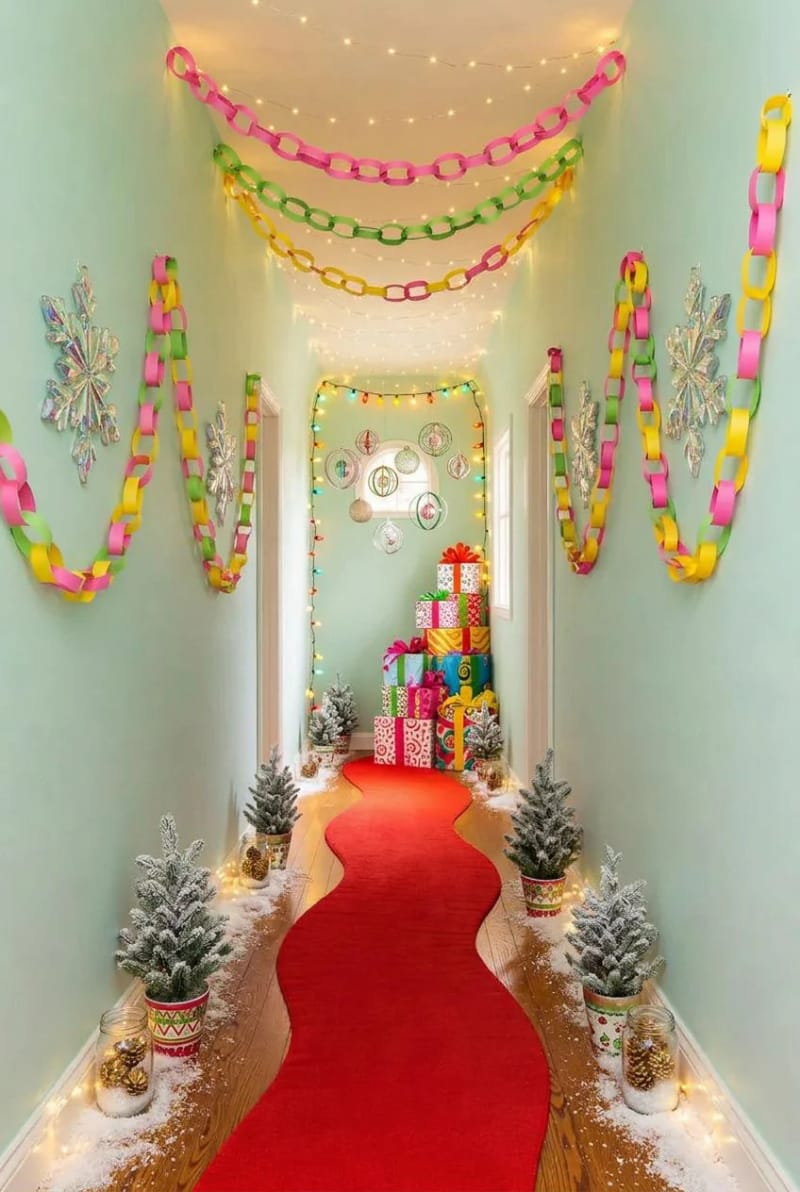
If the living room is not yours to redo, the corridor is. Paper-chain garlands strung across a doorway are a genuine Whoville signature (they show up in the home tours that started this whole aesthetic), and they cost cardstock and time. Add command hooks, a battery light strand, and peel-and-stick where you cannot use tacks. Everything comes down in January without a mark, which is the whole reason renters and cubicle people can go as hard on this as homeowners.
Let mismatched wrapping and giant bows become the room's texture

Treat wrapping paper and bows as a surface material, not filler for the base of the tree. Cover the front of a console in one clashing paper, build a small wall of wrapped boxes, tie oversized wired bows to the backs of dining chairs. Whoville home stylists wrap presents weeks early precisely so the gifts become part of the decoration, and mismatched patterns hold up better than a coordinated set here. The clash is doing something a matched palette cannot.
A console-table Who vignette for about $40
One 4 ft console or shelf, dollar-store and craft-store parts, one evening of work.
Start with a strip of quilt batting down the console as snow. Set three cardstock or ceramic houses at mixed heights toward the back, each with a battery tealight inside, chimneys tilted. Stand two mini pool-noodle candy canes at one end and a small marquee or foam-board letter at the other. Fill the front edge with a few oversized bows and two wrapped boxes so the whole thing has a low border. Keep the palette to cherry red, pink, and lime with a single yellow accent, and let the heights stagger rather than line up.
Shopping list
| Qty | Item | Spec | Price |
|---|---|---|---|
| 3 | Village houses | ceramic or cardstock, mixed heights | $4 to $8 |
| 1 | Cardstock pack | pink, lime, lemon, 65 lb | $4 to $7 |
| 1 | Battery LED tealights | pack of 12, warm white | $6 to $10 |
| 2 | Red pool noodles | hollow core, for mini canes | $2 to $6 |
| 1 | White duct tape | 2 in, matte | $4 to $7 |
| 1 | Quilt batting or poly snow | roll or bag | $5 to $8 |
| 3 | Oversized wired bows | pink and green, 6 in | $5 to $9 |
| Total | $30 to $55 | ||
Prices are approximate ranges as of July 2026; verify before purchase.
Conclusion
If you build in order, lock the palette first, because a bent tree and a mantel village in the wrong greens still miss. Then do the tree curl, since it sets the silhouette everything else answers to. Airspace and corners come next: the ceiling baubles and the oversized candy canes fill the room without needing floor. The doorway arch, the marquee sign, and the wrapping-as-texture are finishers, not openers, and a small space can stop after two or three of these and still read clearly as Whoville.
One honest caveat: the gap between Whoville and simply cluttered is narrow, so leave the gaps in on purpose, on the tree especially. And I could not find pre-made bent Grinch trees at prices worth pointing you toward, which is why the topper here is a tomato-cage curl you make rather than a product to buy. If someone tells you the whole look needs a $300 pink tree, they are selling the tree.