
Most fireplace-and-tree living rooms fail in the same spot: the mantel. People drape one even strand of garland across it, line up a matching stocking set, and wonder why the room reads like a store display instead of somewhere you'd actually want to sit. The ideas below fix the mantel and then keep going, from where the tree honestly belongs to whether an electric insert can carry the look at all.

Weight your mantel garland at the corners, not down the middle
Pile most of the garland's bulk at the two ends of the mantel and let the center stay sparse. A garland hung as an even, uniform rope is the single most common reason a mantel looks flat, because real greenery doesn't grow at a consistent diameter and the eye reads the evenness as fake. Bunch it heavy at the corners, let one end cascade six to ten inches down the side of the surround, and the whole thing gains the asymmetry that makes it look gathered rather than installed.

Granted, this only works if you start with greenery that has some heft. The pre-lit garland sold at most big-box stores is thin enough to read as green pipe cleaner the moment it's lit, and no amount of corner-weighting saves it. If you're buying faux, spend on a single fuller strand rather than two cheap ones, and fold in a few real cedar or fir clippings from the tree lot's discard pile; the real stuff is free, smells like the actual season, and covers the plastic where it shows. Fresh cuttings will dry out over a few weeks, so they're a December thing, not a Thanksgiving-through-New-Year thing.
Hang a mirror above the mantel and your tree lights count twice

A mirror over the mantel pulls the tree's lights into the fireplace wall and doubles the glow without a single extra strand. The trick is angle: hang or lean it so it catches the tree rather than the ceiling, and skip it entirely if the only thing it'll reflect is a blank wall or a ceiling fan.
Pick two colors and one metal, then stop
Choose two colors and a single metal finish, and refuse everything else. The reason holiday living rooms tip into chaos is that red, green, gold, silver, plaid, and white all arrive in the same boxes and all end up in the same room. A restrained palette, say warm cream and forest green with brass, looks intentional precisely because you can see what was left out.
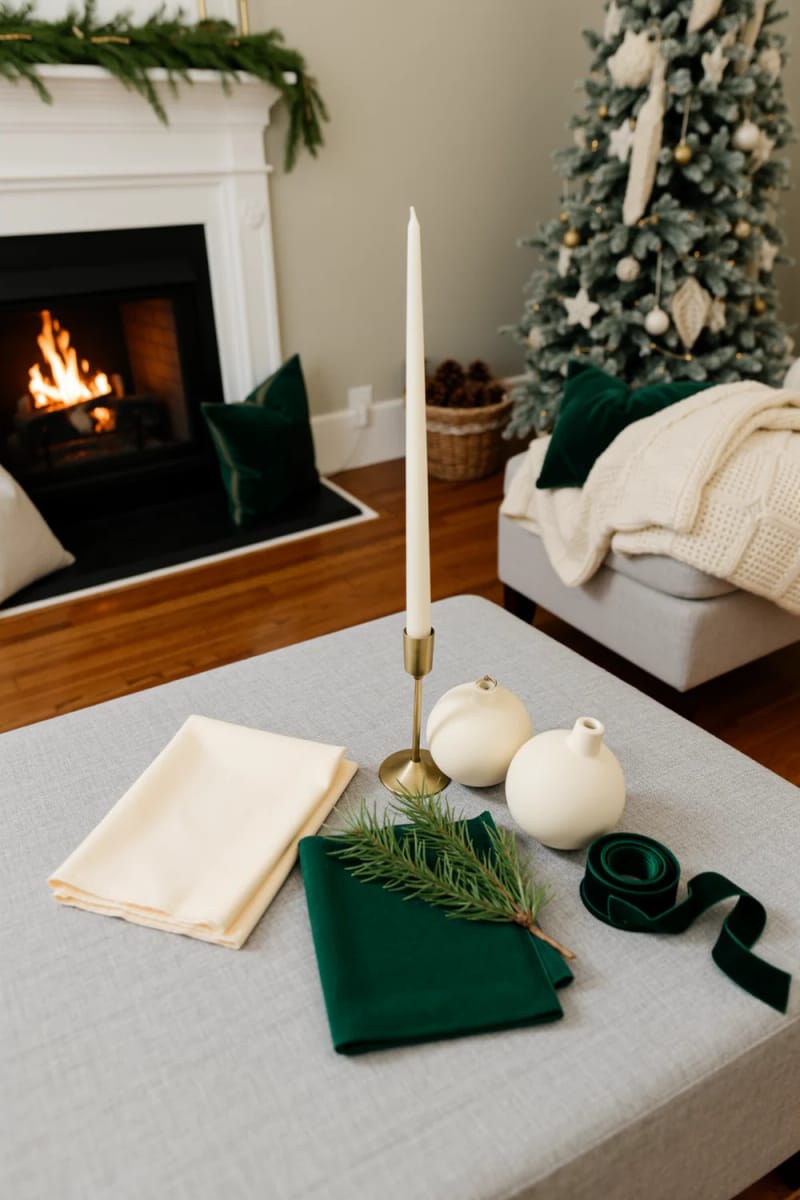
Sage green is the exception worth naming: it reads English-country, not Christmas, so if you want the room to register as festive rather than just seasonal, go darker toward forest or hunter. Metallics are where restraint matters most. Brass and gold lean warm and pair with firelight; chrome and silver go cold and fight it. Mixing the two is the fastest way to make a mantel look like leftovers.
Put the tree where the fireplace isn't
Position the tree across the room from the fireplace, not beside it, and your two focal points stop competing. Designers and fire marshals happen to agree here for different reasons. The National Fire Protection Association attributes roughly 160 home fires a year to Christmas trees, and a dried-out tree that catches a stray ember can take about thirty seconds to engulf a room, which is why the standard guidance is to keep the tree at least three feet from the side of any heat source and closer to five feet from the front.
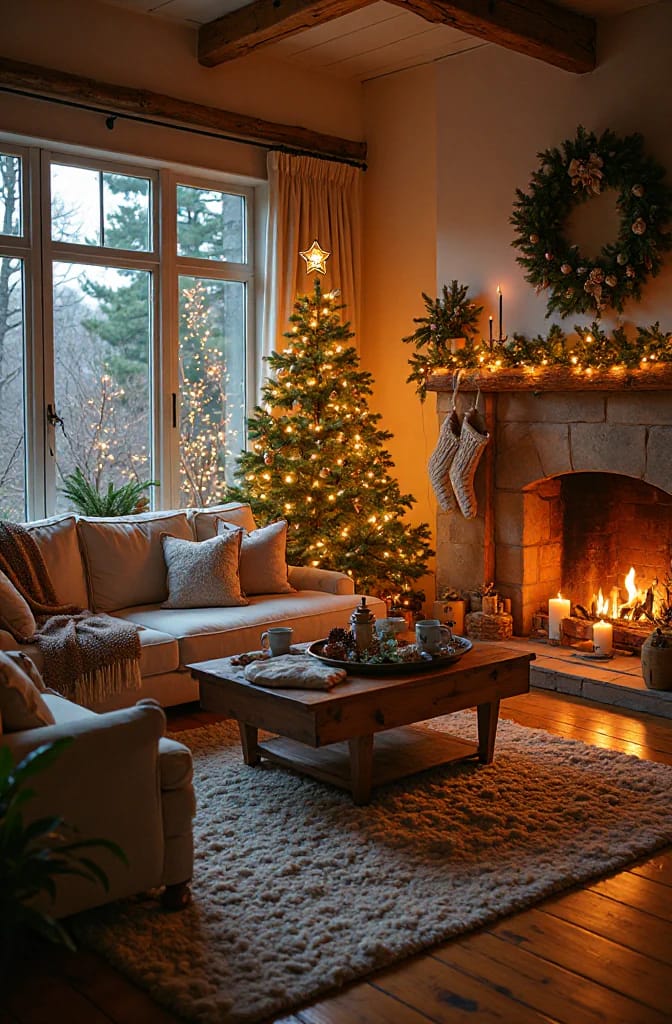
The spacing is also just better design. When the tree and the hearth sit on different walls, the room gets two reasons to look around instead of one crowded corner, and the seating in between borrows light from both. In a small living room where three feet of clearance feels impossible, the move is to shrink the tree, not crowd the fireplace: a slim 6-foot tree or a tabletop tree on a console reads as deliberate, and a half-width tree pushed against the wall opposite the hearth still holds the corner.
If the only spot that fits is genuinely close to the firebox, switch to a fire-resistant artificial tree and keep the fire screened. A live tree that close will brown and drop needles from the heat within a week regardless of safety, so you lose the look either way.
Mismatched stockings read collected; a matching set reads catalog

Mix the stockings on purpose. A set of five identical velvet stockings in graduated sizes is the catalog look, and it's fine if that's what you're after, but a row that collects a cable-knit, a thrifted needlepoint, and a plaid flannel reads like a family that's accumulated things over years. Keep them loosely in your two-color palette so the variety looks chosen rather than chaotic, and weight the heavier knits toward the center where the mantel can take the visual mass.
A Frame TV over the fireplace earns its spot with winter art
If a TV already hangs above your fireplace, the honest fix isn't to hide it; it's to put a painting on it. Samsung's Frame and the cheaper Hisense CanvasTV use a matte, UL-certified glare-free panel that genuinely stops looking like a black mirror when it's displaying art, and a snowy village or a Bruegel winter scene over the mantel does more for the room than any decoration you'd hang instead.

Two caveats worth the money. The art runs on a subscription, around five dollars a month for Samsung's library of a couple thousand pieces, though you can upload your own winter paintings for free. And in a genuinely dark room the matte panel can show a faint glow on pale images, so it sells the illusion best with some ambient light in the room, which a fireplace conveniently provides. A few Art Store pieces even include subtle motion like flickering candlelight, which is either charming or too much depending on your tolerance.
Light the hearth from three heights, never one
Stack your light sources at three different heights and the corner gets depth a single source can't fake. The fire handles the low, warm flicker. A table lamp at sitting-eye-level on a nearby side table fills the middle. A cluster of candles or a few tea lights on the mantel takes the top. What you're avoiding above all is the ceiling fixture: overhead light flattens everything it touches and kills the firelight it's competing with.

Put every fixed light on a dimmer if you can, and swap any cool-white bulbs near the fireplace for 2700K or warmer; a single 4000K bulb in a nearby lamp will read blue-gray against the fire and undo the whole effect. String lights count as a fourth, optional layer, but run them warm white rather than the bright "pure white" that photographs cold.
Layer throws in three different weights

Pile on texture rather than quantity: one chunky knit, one flat weave, one shearling or faux fur, and let them differ by weight rather than color. Three throws in the same waffle weave just look like three of the same blanket. The contrast between a heavy cable-knit and a smooth flat-weave is what the eye reads as "layered," and it photographs the way the room actually feels.
Trade one decorated surface for a hearthside reading chair
Skip decorating one surface entirely and put a chair there instead. The decorating instinct is to fill every flat plane with a vignette, but a single armchair angled toward the fire, with a throw over the arm, a small lamp, and a stack of books on a side table, does more for "cozy" than another tray of ornaments ever will, because it implies the room gets used.

Pull the chair close enough that the firelight actually reaches the page, which is closer than most people place furniture; coffee-table distance is too far for reading by the fire. A floor lamp arcing over the shoulder works if you don't have a side table, and the throw isn't styling here, it's because the spot nearest a fireplace is often the draftiest in an old house.
An electric insert can carry the whole cozy look
If you don't have a working fireplace, an electric insert will get you most of the way there, and it's worth being honest about exactly how much of the way. The flame is simulated, and a cheap LED-strip unit announces itself the moment you sit down. But the 2026 generation, using video-screen flames or ultrasonic water-vapor, fools most guests, costs roughly $500 to $2,500 against the $3,500-plus of a gas conversion, plugs into a standard outlet, and runs the flame without the heat so the room can look like December in July.

What you give up is heat and real flame; what you gain is the ability to put fire on a wall that never had a chimney. For a renter or an apartment with a sealed-up original firebox, that trade is the only one available. Here's how the four common options actually compare for a cozy living room, where realism and the flame-without-heat option matter as much as raw output:
| Fireplace type | Flame realism | Heat output | Install | Flame without heat? |
|---|---|---|---|---|
| Wood-burning insert | Real flame, crackle, scent | 30,000 to 80,000 BTU | Chimney liner, professional | No |
| Gas insert | Real flame, very convincing | 25,000 to 60,000 BTU | Gas line and venting, professional | No |
| Electric insert | Simulated, good on premium units | ~5,000 to 10,000 BTU | Plug-in 120V, DIY | Yes |
| Bioethanol | Real flame, smaller | ~10,000 to 15,000 BTU | No gas or flue, easy | No |
Build the room's scent the way you build its layers
Treat scent as part of the decorating, because a room that smells like cold pine and clove registers as "cozy" before you've consciously looked at anything. Layer it the way you layer light: a base of real greenery, a mid-note from a candle in something resinous like balsam or frankincense, and an occasional top note from a stovetop simmer of orange peel, cinnamon, and a few cloves. Synthetic "fresh linen Christmas" candles undercut the whole thing, so lean toward beeswax or soy with a single recognizable note.

The layering raises a real hazard, so it's worth one blunt note before you light anything near all that greenery.
Fresh garland and a live tree dry out fast in a heated room, and dried evergreen is closer to kindling than decoration. Keep candles, simmer pots, and the fire itself well clear of any greenery, hold stockings and garland at least three feet from the firebox opening, use a screen to catch embers, and never feed wrapping paper into a fire. A dry tree that ignites can fill a room with flame in roughly thirty seconds.
Wrap the gifts to match the room, not the wrapping aisle
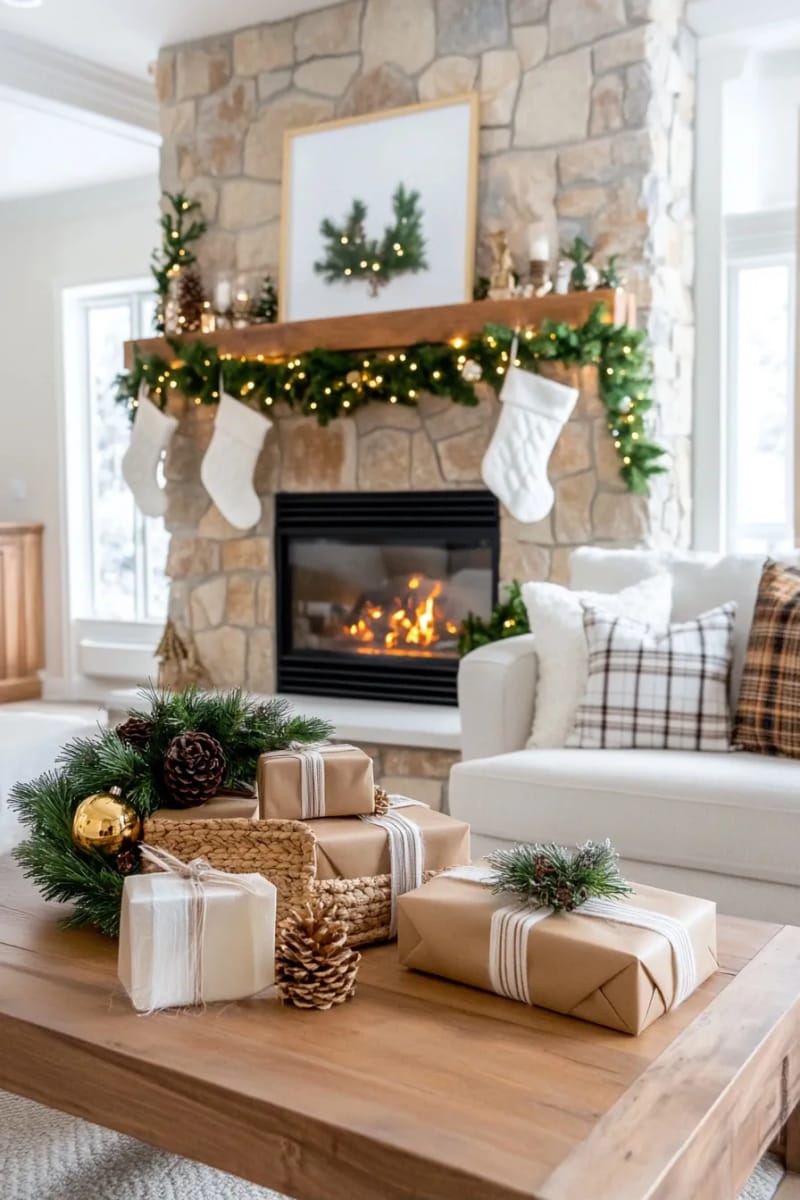
Wrap presents in your room's palette and the pile under the tree becomes part of the decor instead of a clash with it. The cartoon-Santa foil paper from the drugstore fights every other choice you've made; plain kraft paper, a single ribbon color pulled from your palette, and a sprig of real greenery tucked under the bow costs less and photographs like a magazine spread. Wrapped boxes go under the tree, never stacked in front of the firebox where embers reach.

Do this
- Stick to kraft, white, or one palette color, with a single ribbon tone across the whole pile.
- Add one real element per gift: a fir sprig, a cinnamon stick, a dried orange slice.
- Reuse last year’s ribbon; velvet and grosgrain survive being untied.
Avoid
- Mixed foil and cartoon prints that fight the room.
- Curling-ribbon explosions in five colors.
- Stacking gifts on the hearth in front of the fire.
Conclusion
If you only do three of these, do them in order: fix the tree's position first so the room has two breathing focal points, get the mantel garland weighted and the three light heights working second, and leave the shopping (a Frame TV, an electric insert, new throws) for last, once you know what the room actually needs. The fire does most of the heavy lifting on its own; nearly everything above is about not crowding it out.