
Walk a street at dusk in December and you can tell the blue and silver living rooms apart from thirty feet away. The ones that look expensive glow amber behind the glass, with the blue reading as depth. The ones that look like a dental waiting room glow white. That single difference, the color temperature of the light falling on the palette, does more work than any ornament you will buy, and almost no list mentions it.
So this one starts with the two decisions that carry the whole scheme (which blue leads, and what color your lights actually are), then moves through the tree, the mantel, the coffee table, the window, and the one accessory I would talk you out of. Ten ideas, all of them doable in a rented room with a grey or beige sofa already in it.

Let navy carry the tree and keep ice blue as an accent
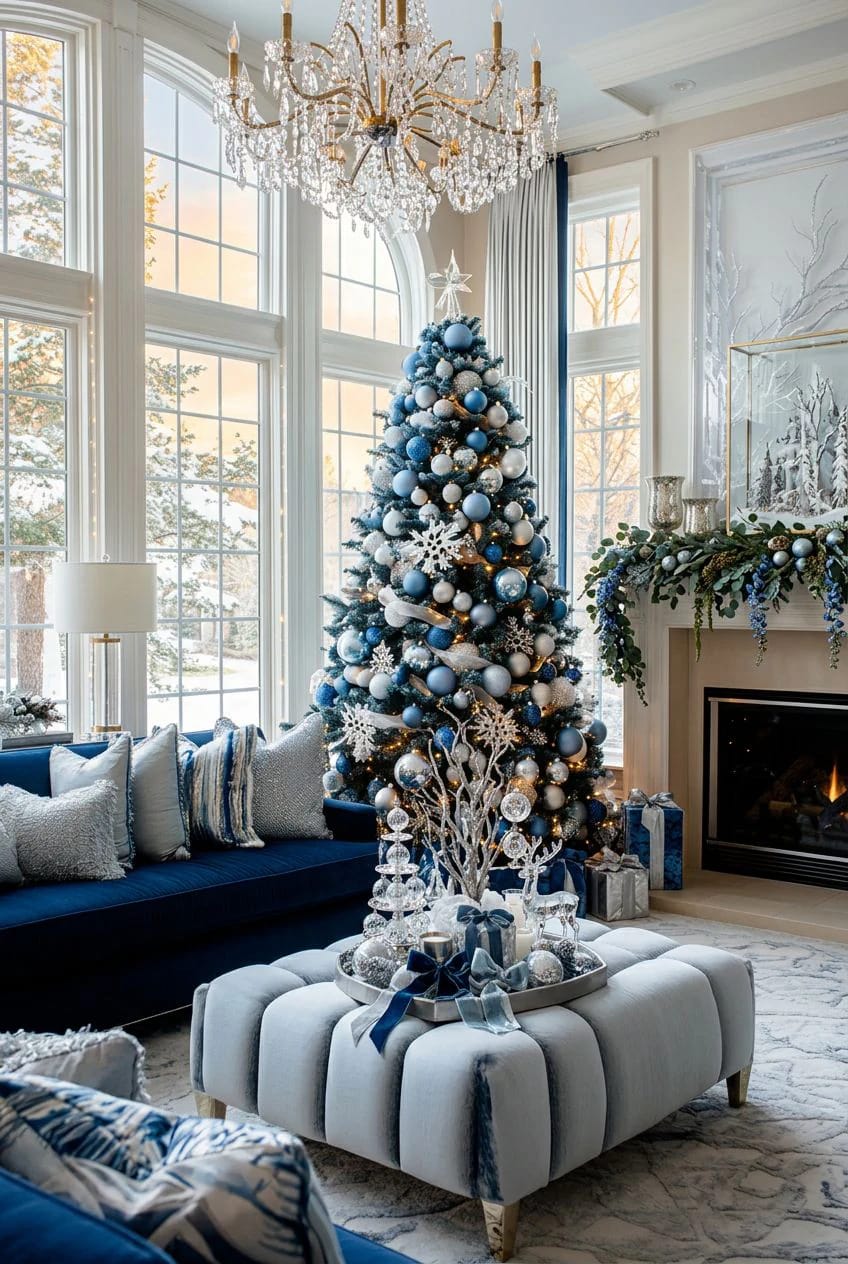
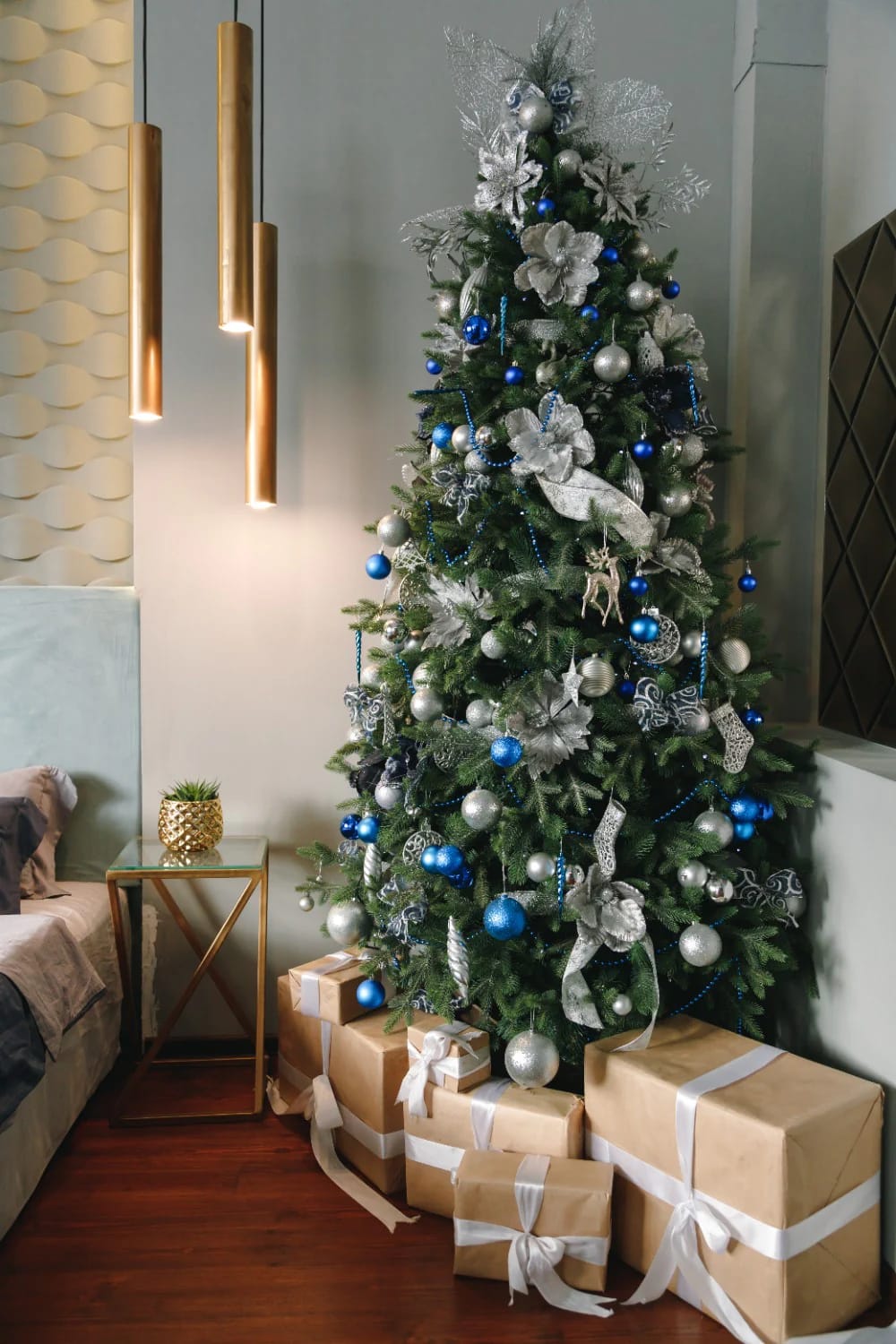
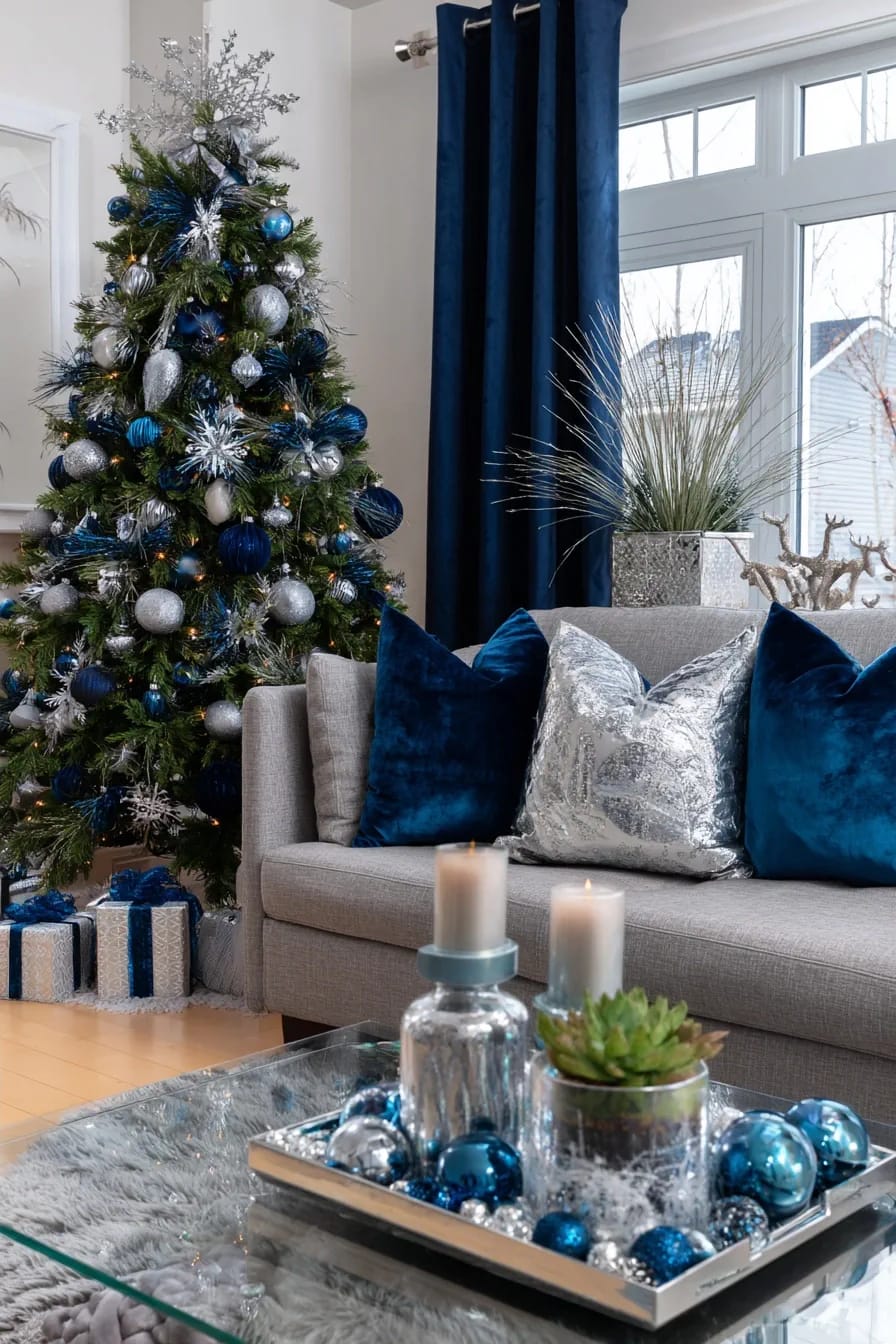
Make navy the dominant blue and let ice blue appear on maybe one ornament in eight. Silver only reads as metal when it has something dark to sit against, and a tree hung mostly in pale powder blue gives it nothing: the chrome goes grey, the blue goes chalky, and the whole thing photographs like a faded beach towel. Against navy, the same silver bauble suddenly has a highlight and a shadow.
A working split for a seven-foot tree is roughly sixty ornaments in navy and midnight (matte, glitter, and glass in about equal parts), thirty in silver, and ten or twelve in ice blue or clear glass scattered near the outer tips where the lights catch them. That is a ratio, not a rule, and you will adjust it by eye once the lights are on. What you should not do is buy the pre-boxed assorted ornament sets that mix five shades of blue in one carton, because the mid-tones are exactly the ones that muddy the scheme.
Depth comes from surface, not from more color. Three navy baubles in matte, mirror, and glitter finishes read as a considered tree. Three navy baubles that are all glossy read as a display in a garden centre.
Use warm white lights, even though the palette is cold
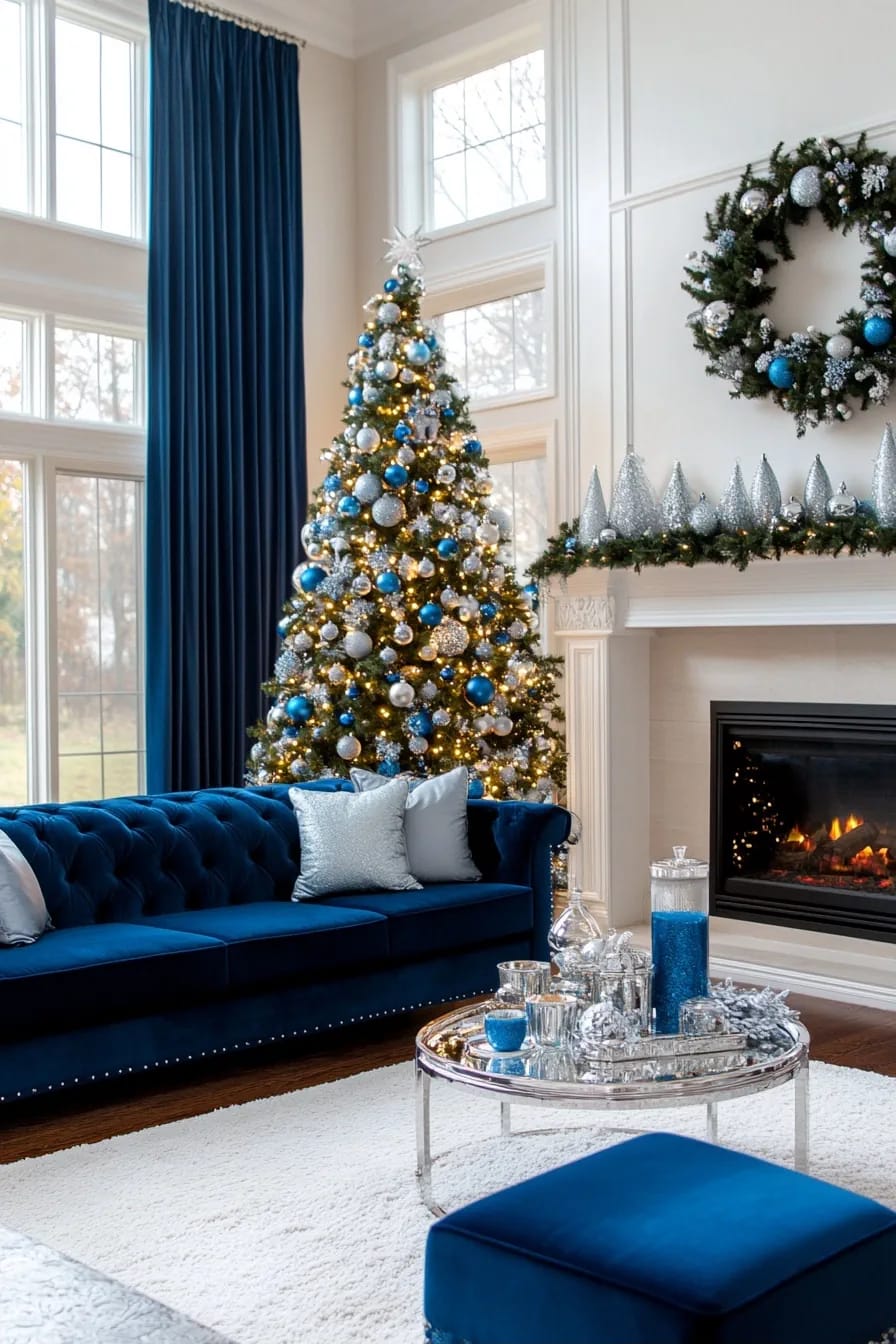
Buy warm white, 2700K to 3000K, and ignore the fact that every product photo of a blue and silver room uses the icy stuff. Cool white strings run from about 4000K up to 6500K, and at that end the light is genuinely blue, which does two unhelpful things at once: it turns navy into slate and it strips silver back to raw aluminium. The room stops reading as a color scheme and starts reading as a lit surface.
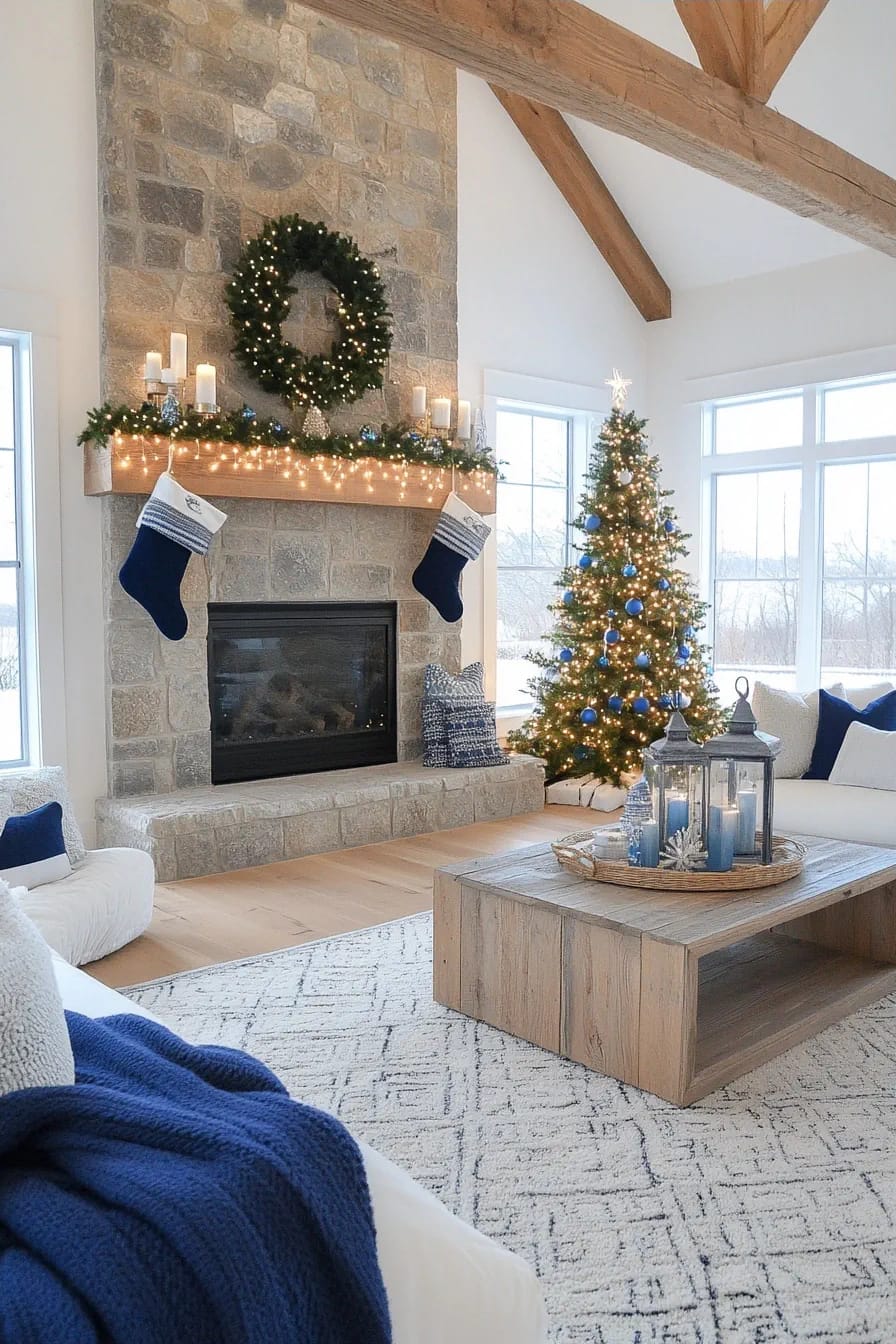
Warm light against cold color is what makes the blue look blue. That said, there is one place cool white earns its keep, and that is inside a single contained object: a lantern on the hearth, a jar of micro lights on a shelf, a string tucked behind a sheer curtain so the window glows frosty from the street. One cold zone against a warm room reads as deliberate. Cold everywhere reads as a broken bulb order.
Check the Kelvin number on the box rather than the word on the front. Brands label 2700K and 3000K both as "warm white" and they do not match when you hang them on the same branch, so buy every string for one tree in a single order.
 Cozy Christmas Living Room Ideas for You Starts at the wall switch and works out: lamp height, second tree placement, and how many soft things a room actually needs.
Buy silver in two finishes, not one
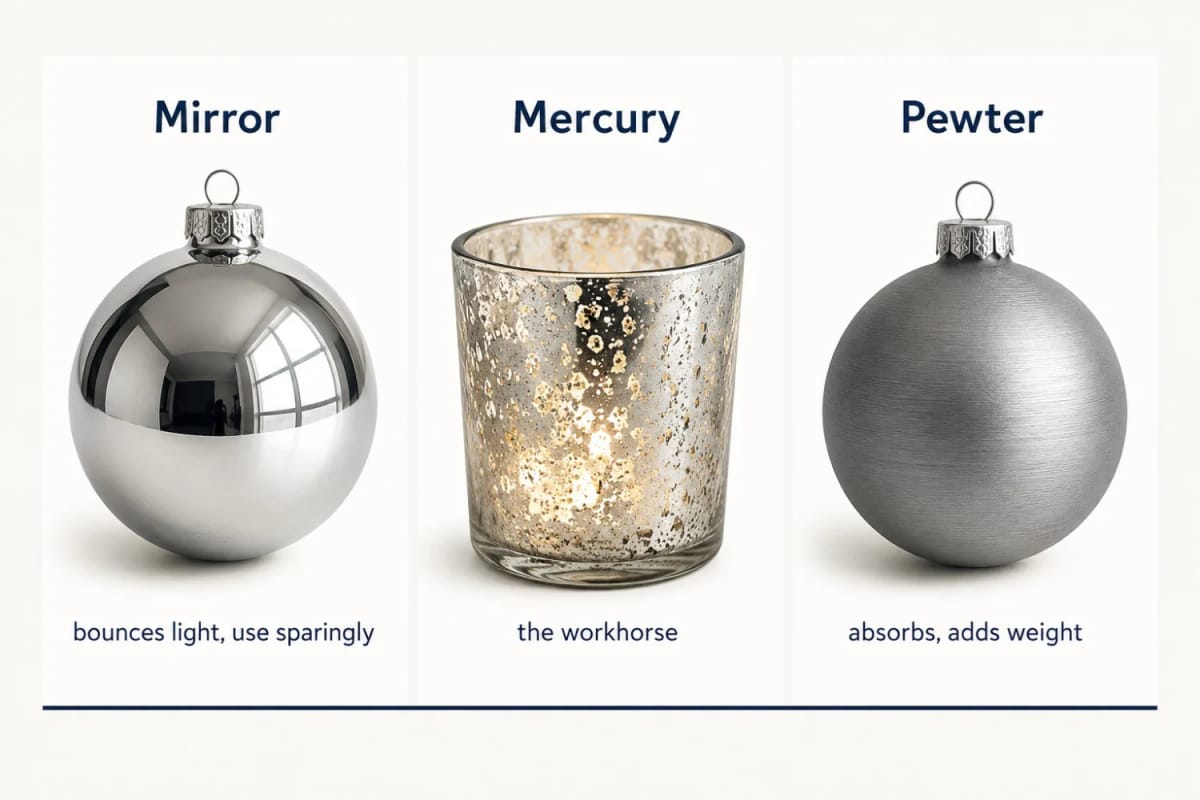
Split your silver roughly in half between mirror-bright and matte, and let speckled mercury glass bridge the two. All-polished silver flashes at every light source and the room ends up looking like a trophy cabinet; all-matte silver goes soft and dusty and the blue has nothing to push against.
Mercury glass is the piece most people skip, and it is the one doing the actual work. The silvering sits on the inside of the glass in an uneven, mottled layer, so it half-reflects and half-glows, which is exactly the middle register the palette is missing.
Get the blue into the room with velvet, not paint
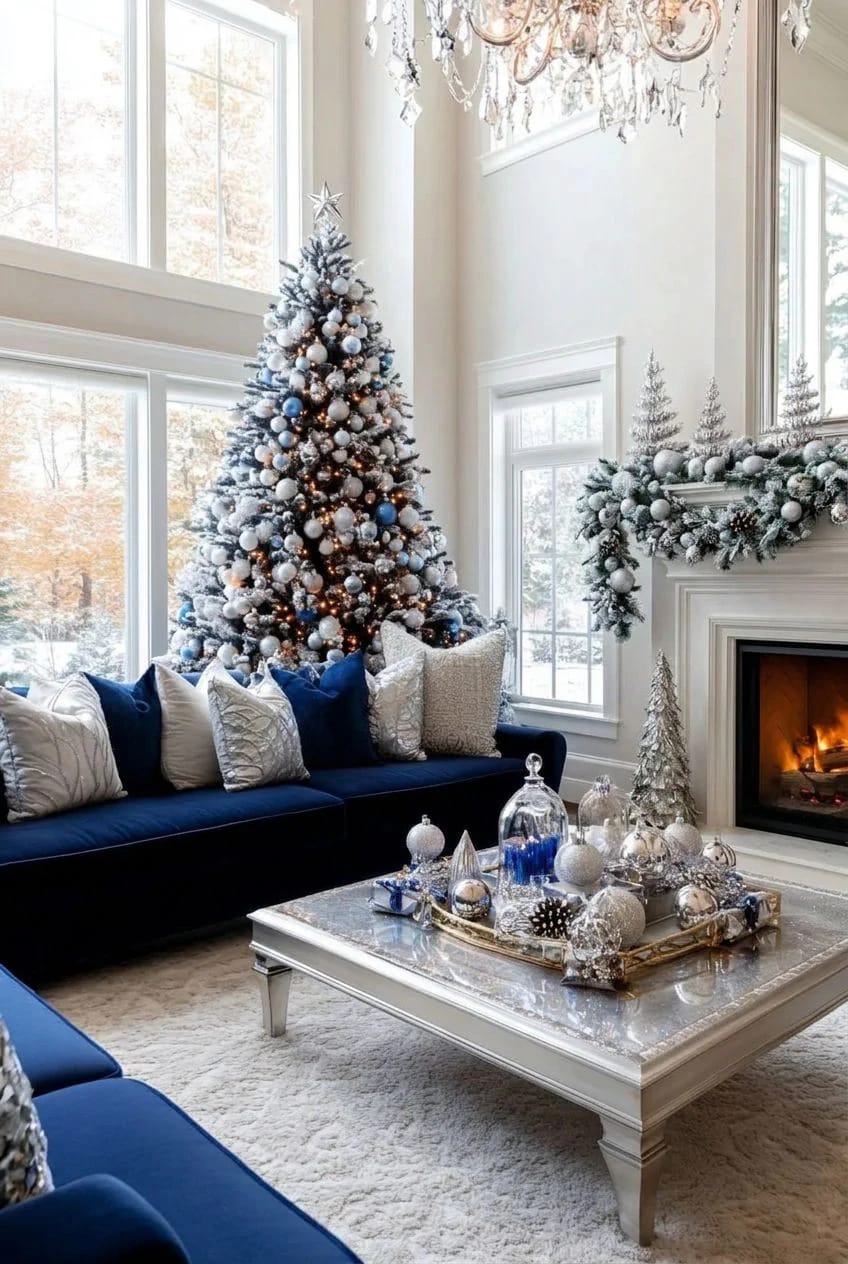
Two navy velvet cushion covers and one throw will change the room more than another box of ornaments, and they cost less. Velvet is the fabric that suits this scheme because the pile shifts as the light hits it: run your hand one way and it reads midnight, the other way and it reads a lit cobalt. Flat cotton in the same navy just sits there like a swatch.
Covers rather than whole cushions, obviously. You are borrowing the inserts you already own, storing four flat squares of fabric in January, and paying somewhere in the region of twelve to twenty dollars a pair rather than forty.
The dependable option is a plain 18-inch pair with a hidden zip, like these MIULEE dark blue velvet 18×18 pillow covers, in a solid color rather than a pattern. Pair them with a silver-grey knit or a faux fur in ivory rather than white, and stop there: three new cushions on a sofa is a scheme, six is a pile. If the blue is going to travel past the living room into the hall and the table, the wider case for a blue Christmas palette is worth reading before you commit to the whole house.
Build the mantel from the garland outward
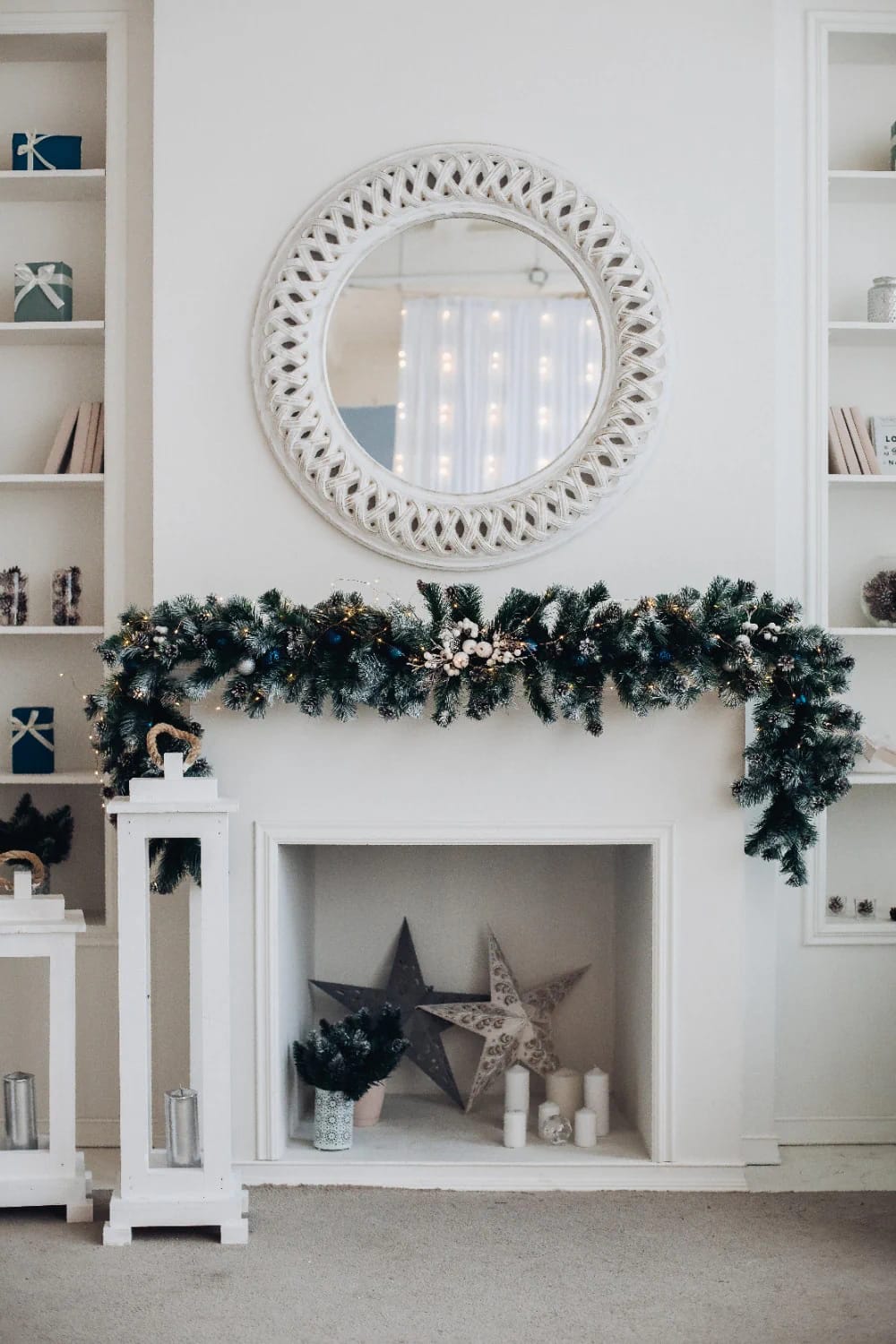
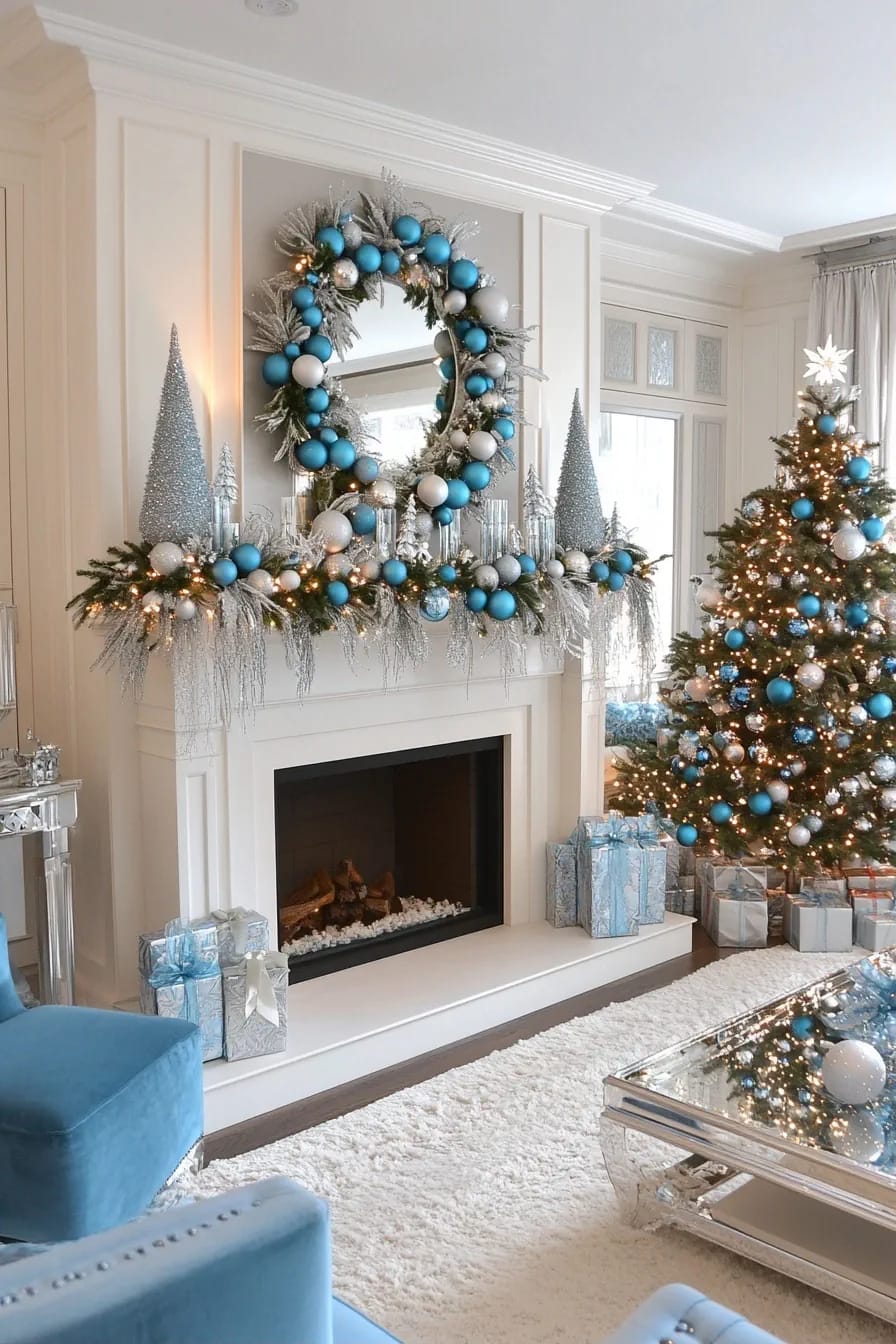
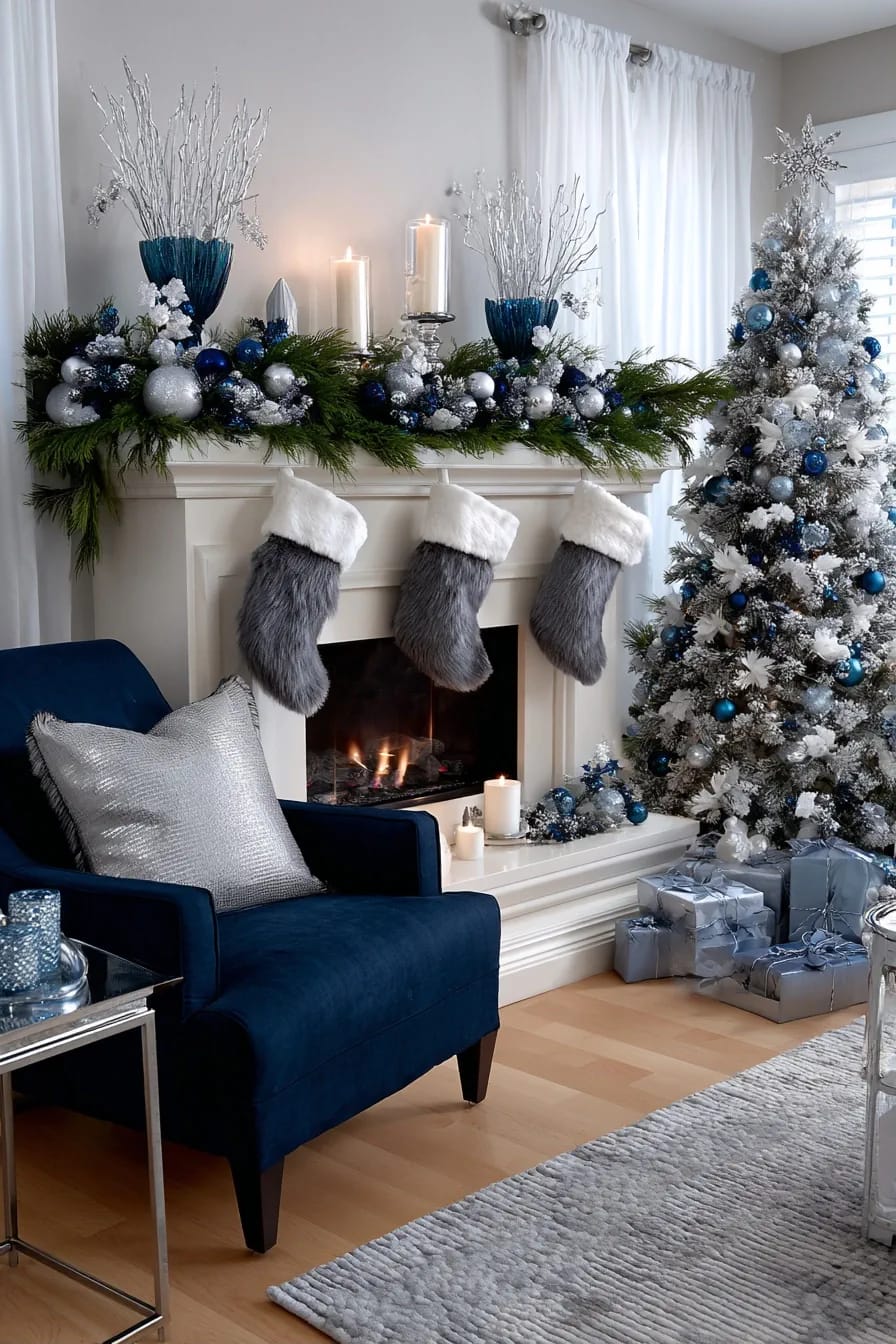
Hang the greenery first and treat the stockings as the last thing you add, not the first. A mantel that starts with four stockings nailed in a row has already committed to symmetry, and symmetry is what makes this palette look like a shop window.
Weight the garland to one side instead. Wire it to the mantel with green florist wire at three points, let the long tail fall to about a third of the way down the fireplace surround, and keep the short side tight to the corner. Then work in this order:
- Silver picks and frosted stems pushed deep into the greenery so the wire stems disappear, never laid on top.
- Navy baubles in clusters of three and five, varied in diameter (a 3-inch next to a 2-inch reads as depth; two 3-inches read as a pair of eyes).
- Two candlesticks, both silver, at different heights.
- Stockings last, and only if you have somewhere honest to hang them. Two is fine. Two looks better than four crammed in.
If there is a mirror above the mantel, everything you place gets doubled, so cut the quantity by about a third before you decide it looks sparse.
 Christmas Mantel Decor Ideas With Garland That Look Designer, Not Draped-On Seven ways to drape, layer, and edit a garland so it stops looking like a rope laid on a shelf.
Swap a third of the silver baubles for steel-blue dried stems
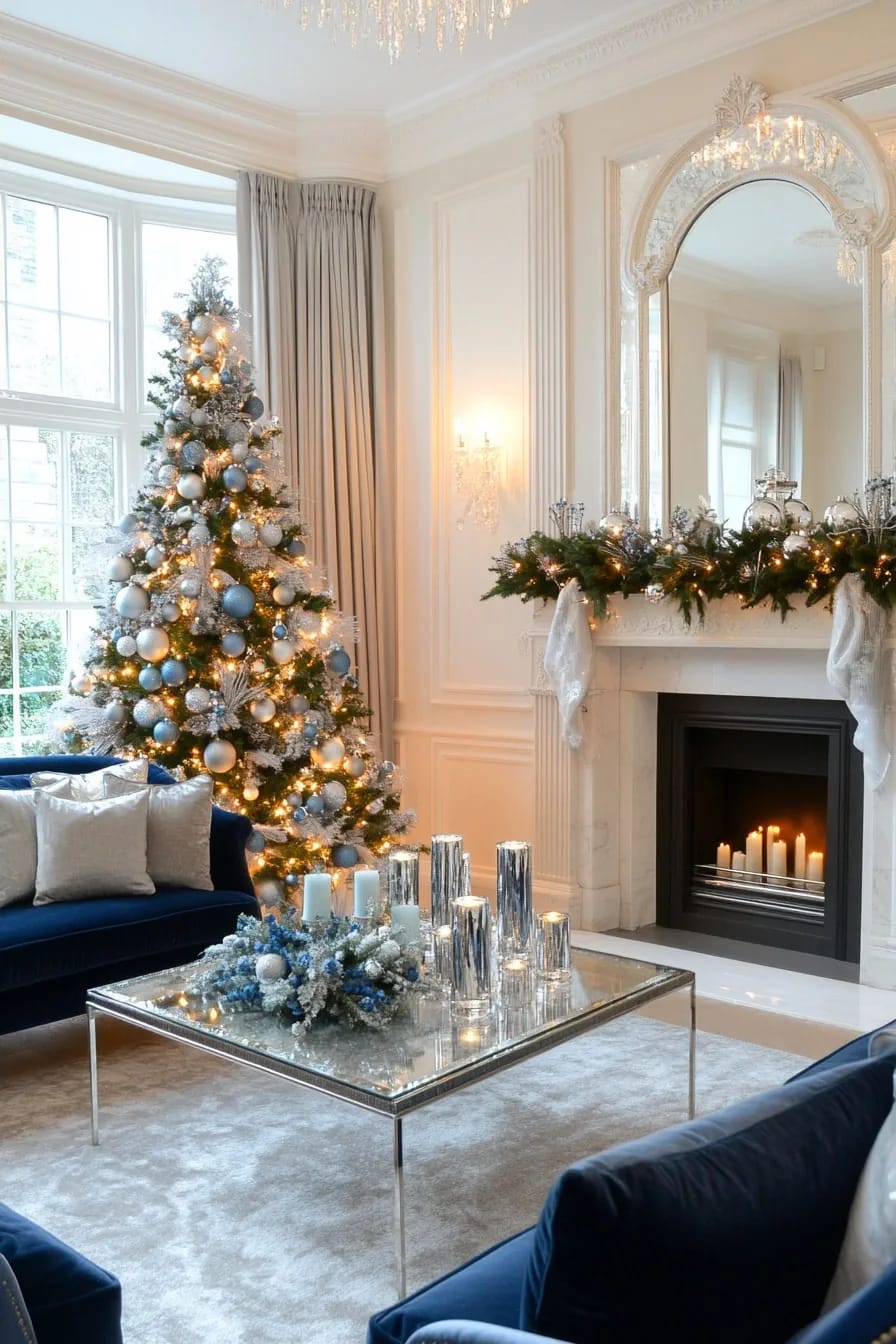
Replace roughly a third of the shiny objects with dried botanicals and the whole scheme stops looking bought. Globe thistle (Echinops) dries to a spiky steel-blue sphere, sea holly (Eryngium) holds a silvery blue in its bracts, and silver dollar eucalyptus dries to a grey-green with a chalky bloom you can see from across the room. These are the only genuinely blue-and-silver things in the scheme that are not made of plastic or coated glass, which is why they carry so much weight for so little money.
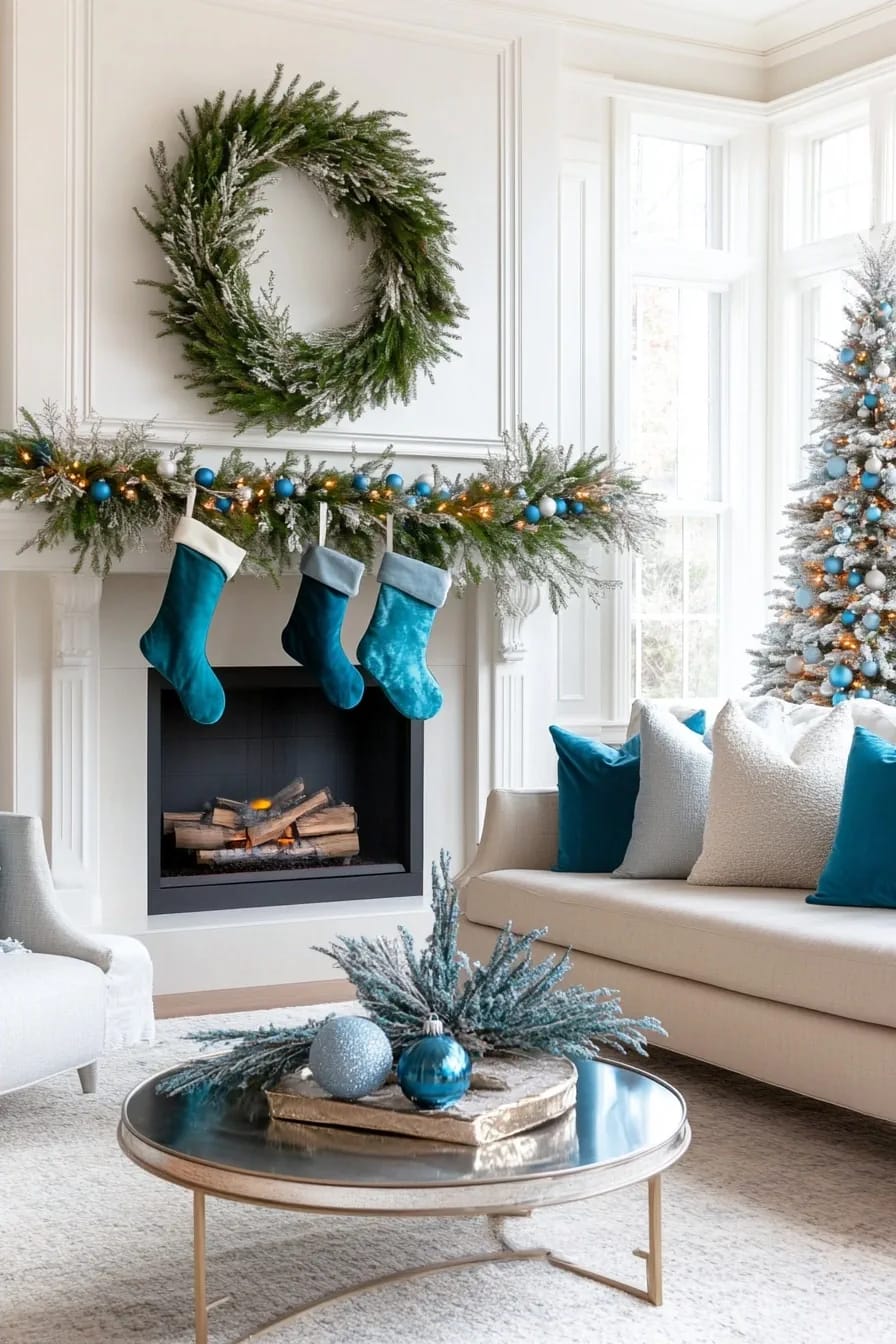
A single bunch is enough to run through a garland, a vase, and a gift tag or two, and it stores flat for next year.

Use them the way a florist would: in odd numbers, at three different heights, with the stems visible. Bunching them into a tight dome kills the texture that made you buy them.
Hang the snowflakes in the window instead of on the tree
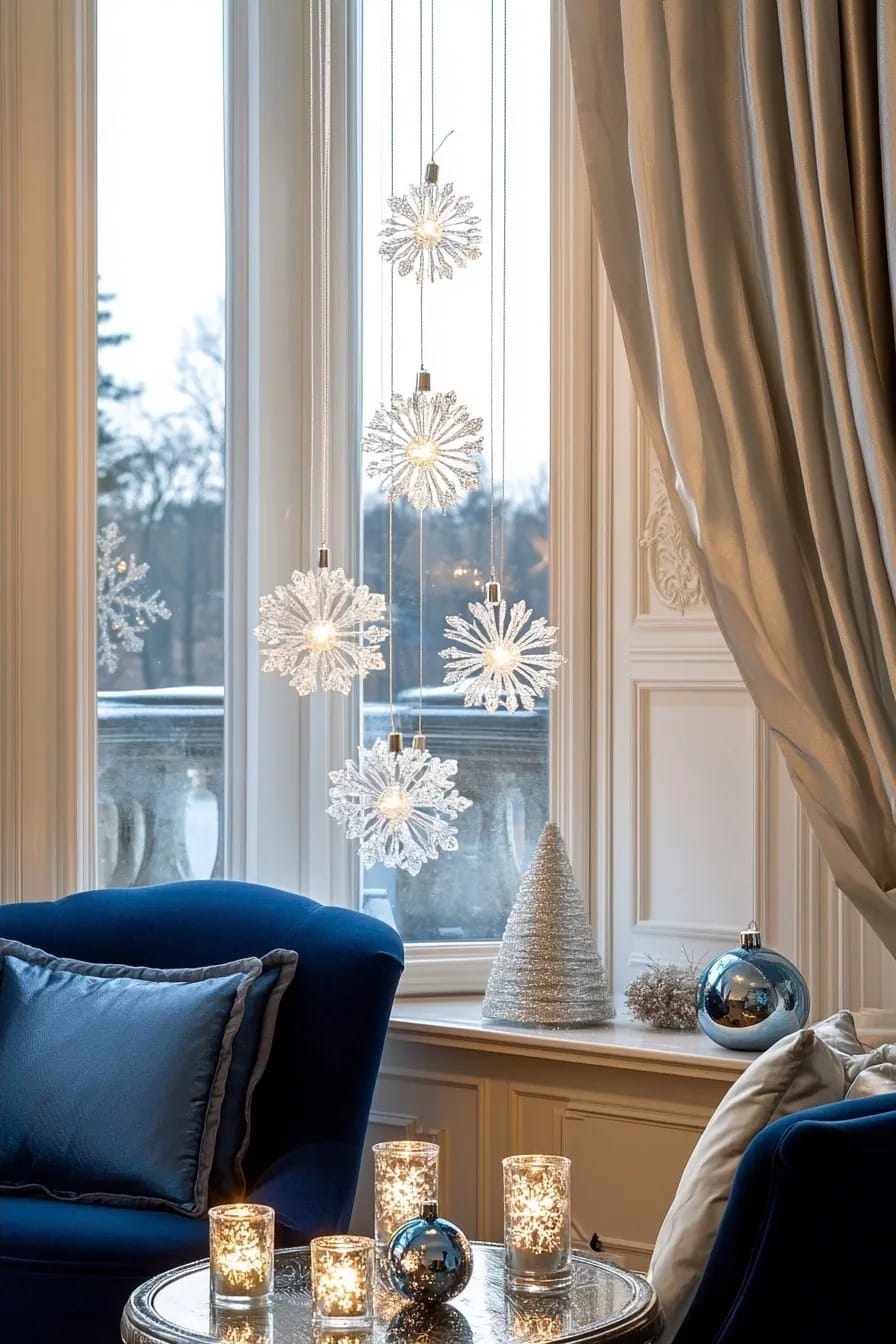
Crystal snowflakes disappear on a tree. Hang one against a branch and it is competing with a hundred other reflective objects at the same depth, which is why the ornament that looked so sharp in the pack ends up reading as a smudge of light. Put the same snowflake on fishing line in front of dark glass and it has the whole night behind it.
Five to seven per window, staggered in height and size, hung from a tension rod or small adhesive hooks along the top of the frame. At night the glass doubles them, so a modest handful looks like twice as many, and that reflection is the single most effective trick in a window worth decorating at all.
Give the coffee table one tray and nothing else

Contain the whole centerpiece on one tray and leave the rest of the table bare. A coffee table is a working surface for mugs and remote controls, and the arrangement that survives December is the one you can lift off with two hands.
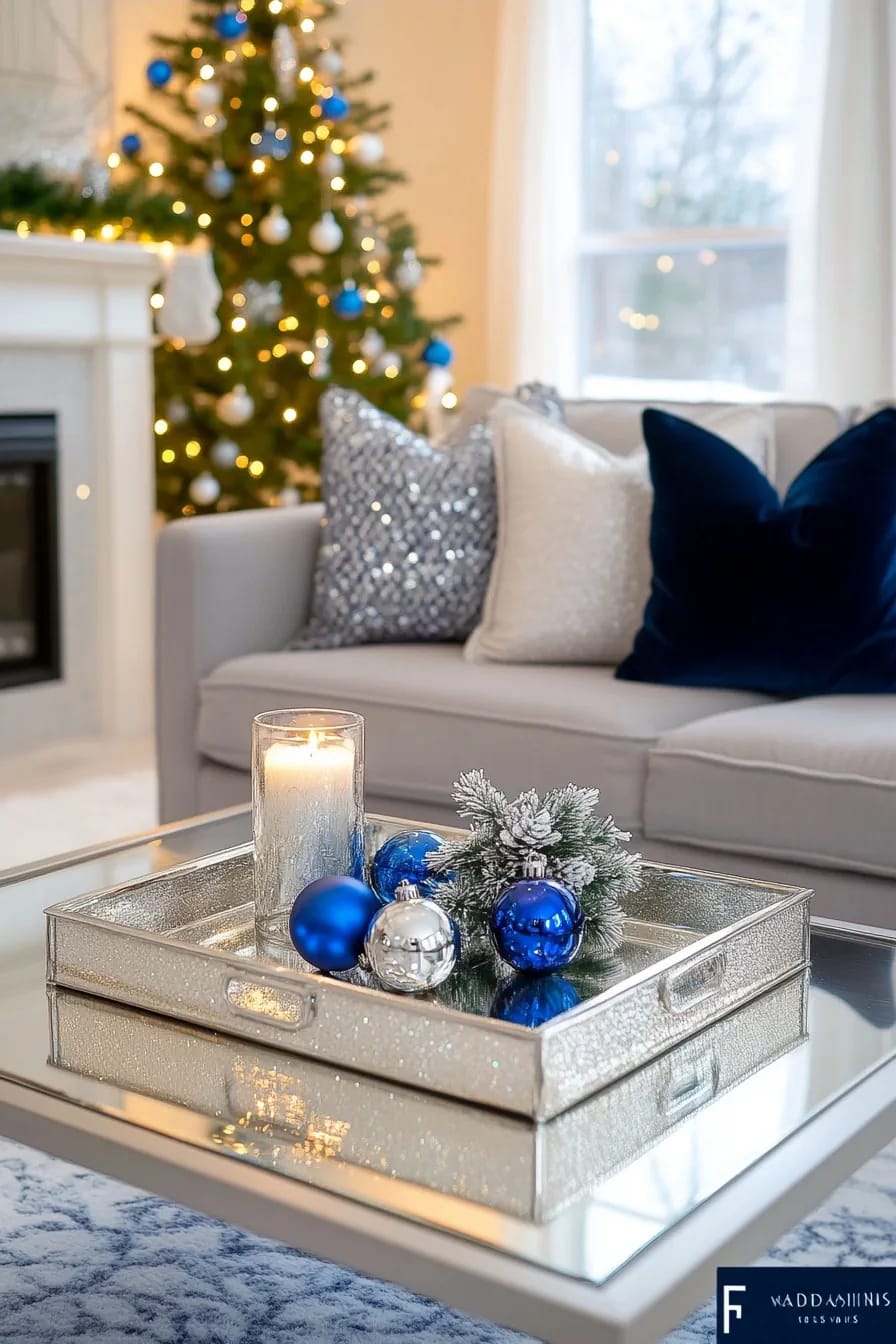
Three heights inside the tray, and no more: a cluster of mercury glass votives at the low end, a small footed bowl of navy baubles in the middle, and one taller element (a candlestick, or three stems of eucalyptus in a squat vase) breaking the horizontal. The speckled silvering on mercury glass is what makes candlelight read as blue-tinged silver instead of yellow, so this is where those votives earn their place rather than on a shelf where nobody sees the glow.
A dozen at roughly two inches across is the right scale for a tray; buyers do report the silvering flaking on the very cheapest sets, so check the wall thickness when they arrive.

Dried thistle, eucalyptus, and preserved greenery are dry by definition, and they will take a flame faster than fresh pine. NFPA data on home decoration fires puts nearly half of them down to a decoration sitting too close to a heat source, and candles are the leading culprit in December. Keep a hand’s width of clear air between any open flame and the greenery, or use LED tealights inside the votives, which most manufacturers now recommend anyway.
Put one wreath above the sofa, and skip the deco mesh
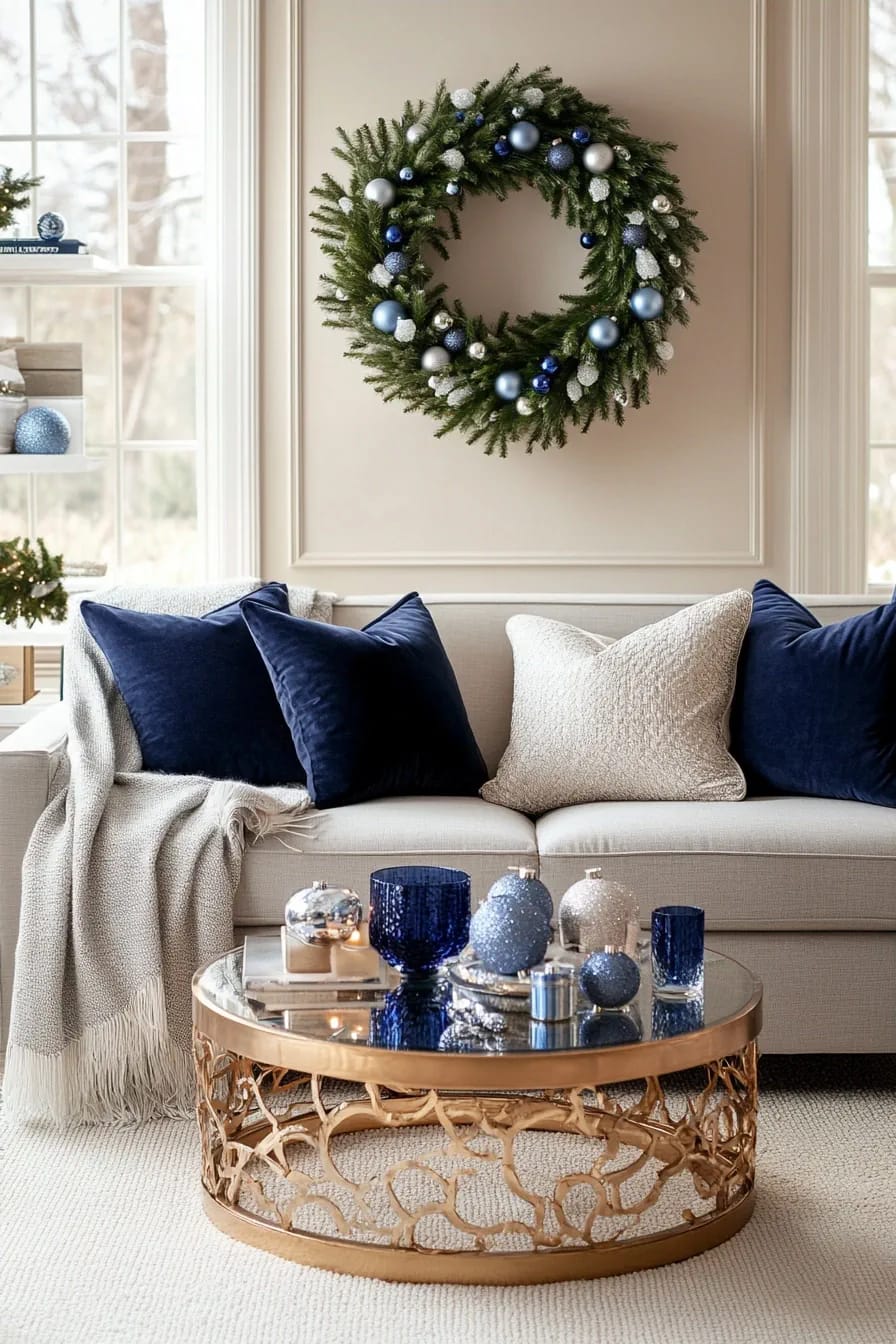
One wreath, hung centred above the sofa, and make it a flocked evergreen rather than a blue and silver deco mesh construction. I know deco mesh photographs well in a craft-store display. In a living room it reads as a parade float, it sheds glitter into the sofa cushions until March, and the poly mesh catches the light with a plasticky sheen that fights every other surface in the scheme.
Scale is where this goes wrong more often than color. A 24-inch wreath over an 84-inch sofa hangs there like a floating doughnut, so go 30 to 36 inches for a standard three-seater, and hang it so the bottom edge sits roughly eight to ten inches above the sofa back. If a front door version is also on the list, the entryway has its own scale problem and it is not the same one.
Add white, or the blue and silver will start to look like a screen
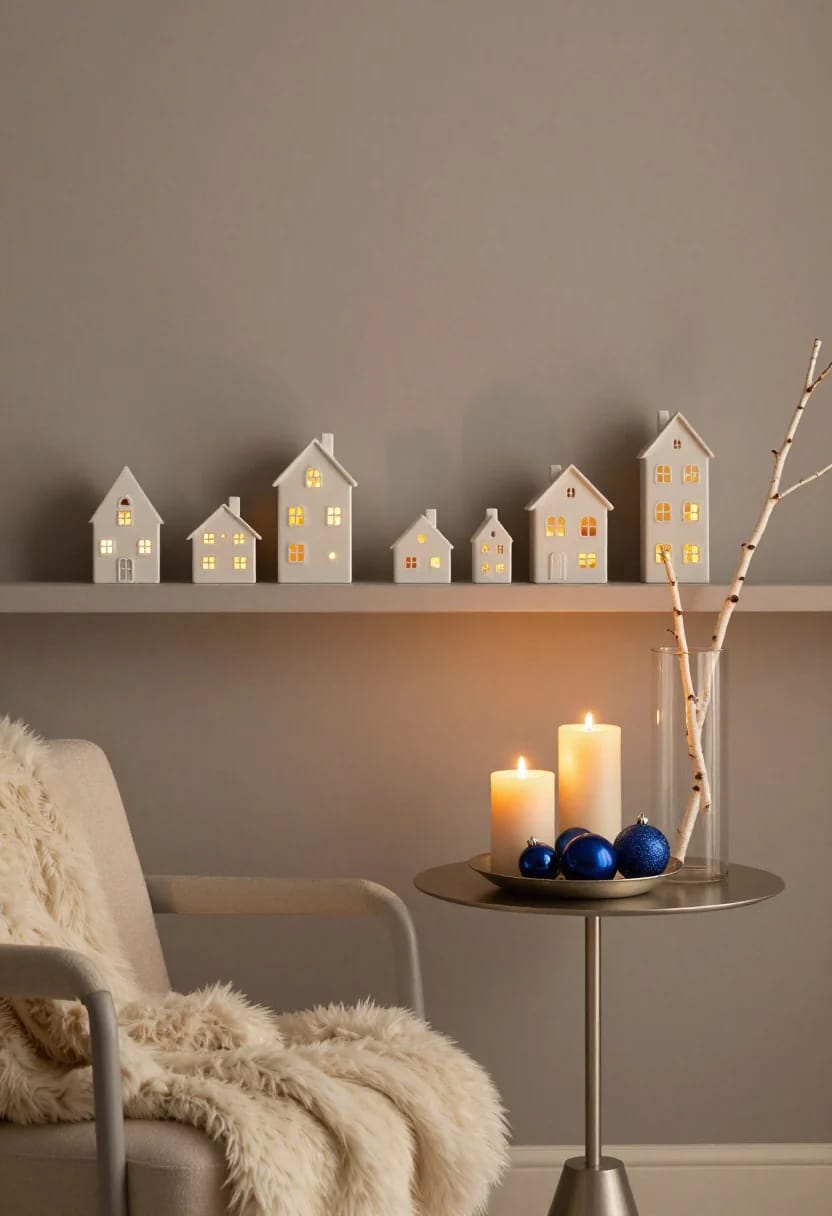
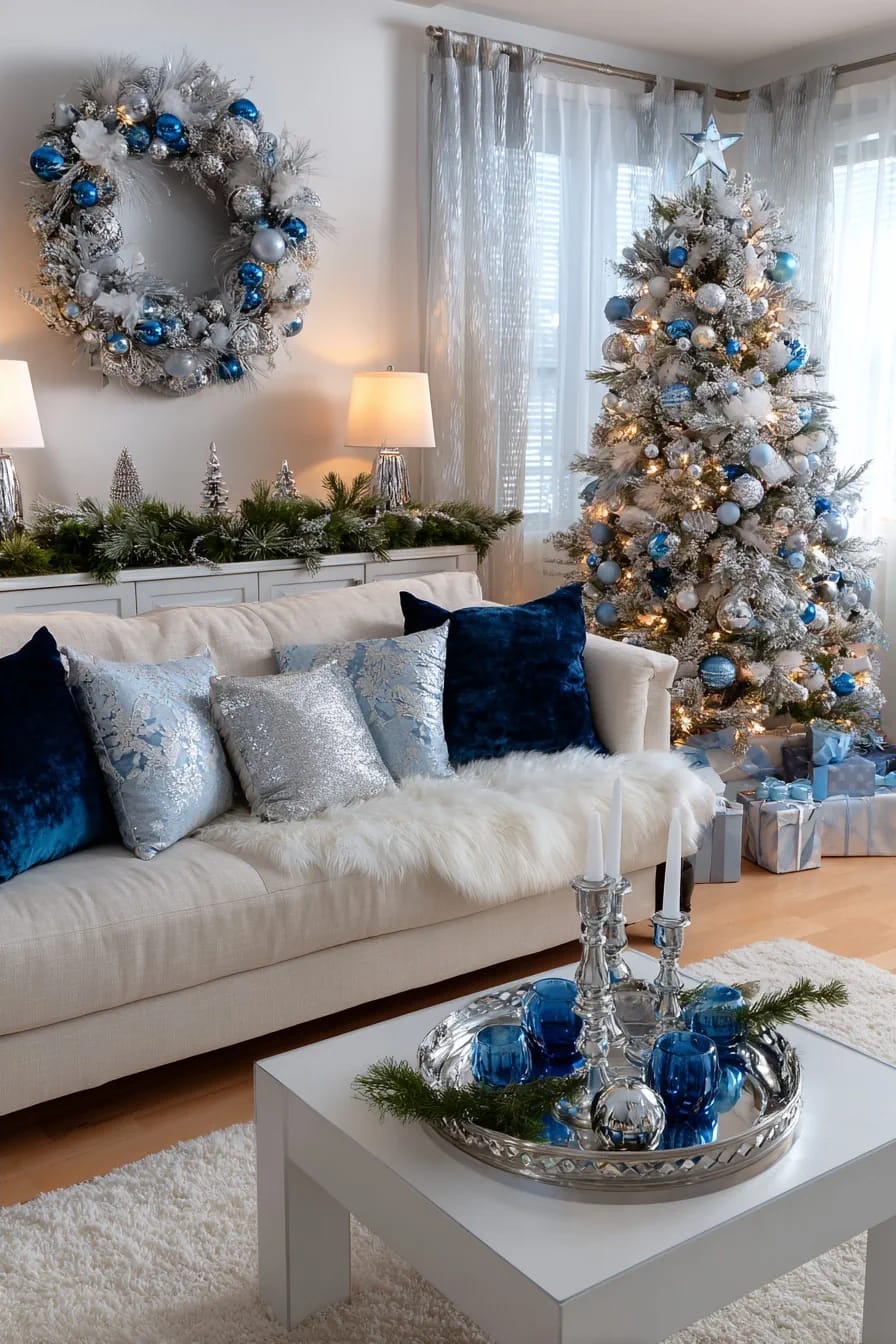
Bring in a third color and make it cream, not optic white. Blue and silver are both cool, and a room built from only those two gives the eye nowhere warm to land, which is the real reason so many of these schemes photograph as a lit phone screen rather than a room people sit in.
The pieces that do it: matte white ceramic houses on a shelf with warm lights inside, ivory pillar candles at mixed heights, a bare birch branch in a tall vase, a faux fur in cream over one arm of the sofa. Cream and ivory carry a trace of yellow, which is what softens the whole palette. Bright optic white does the opposite and pushes the room further toward surgical, so if you have a choice between two throws in the shop, take the one that looks slightly dirty next to the other. That instinct also explains why an all-white Christmas scheme leans so hard on texture: without warmth, the only thing left to hold the eye is surface.
Related Posts
- 11 Cozy Neutral Christmas Living Room Decor Ideas That Stay Warm Without the Red and Green
- Cozy Christmas Living Room Ideas for You
- Cozy Christmas Living Room Decor on a Budget That Doesn’t Look Cheap
- Cozy Christmas Living Room Ideas for Small Spaces, Without the Clutter
- 15 Unique Christmas Decor Ideas for Your Living Room
- 7 Cozy Modern Christmas Living Room Ideas That Don’t Bury the Architecture