
Small living rooms don't fail at Christmas because they lack decorations. They fail because every decoration fights for the same few square feet, and by the second week of December the tree, the throw pile, and the box of ornaments have quietly annexed the only walkway. The nine ideas below keep the holiday and give you the floor back, and they're grouped so you can work through them in roughly the order that matters: tree first, light second, everything else last.
A note on who this is for. These assume a room you can't rebuild: no built-in mantel, storage measured in one closet shelf, a television that isn't going anywhere. If you have a fireplace and a spare room to stash bins in, you can skip most of the workarounds and just decorate.

Solve the tree before anything else
The tree is the single largest object you'll bring into the room, so its footprint decides how much of the holiday the rest of the space can hold. Settle this question first and the other eight ideas get easier.
A flat, wall-mounted tree gives you the silhouette without the footprint
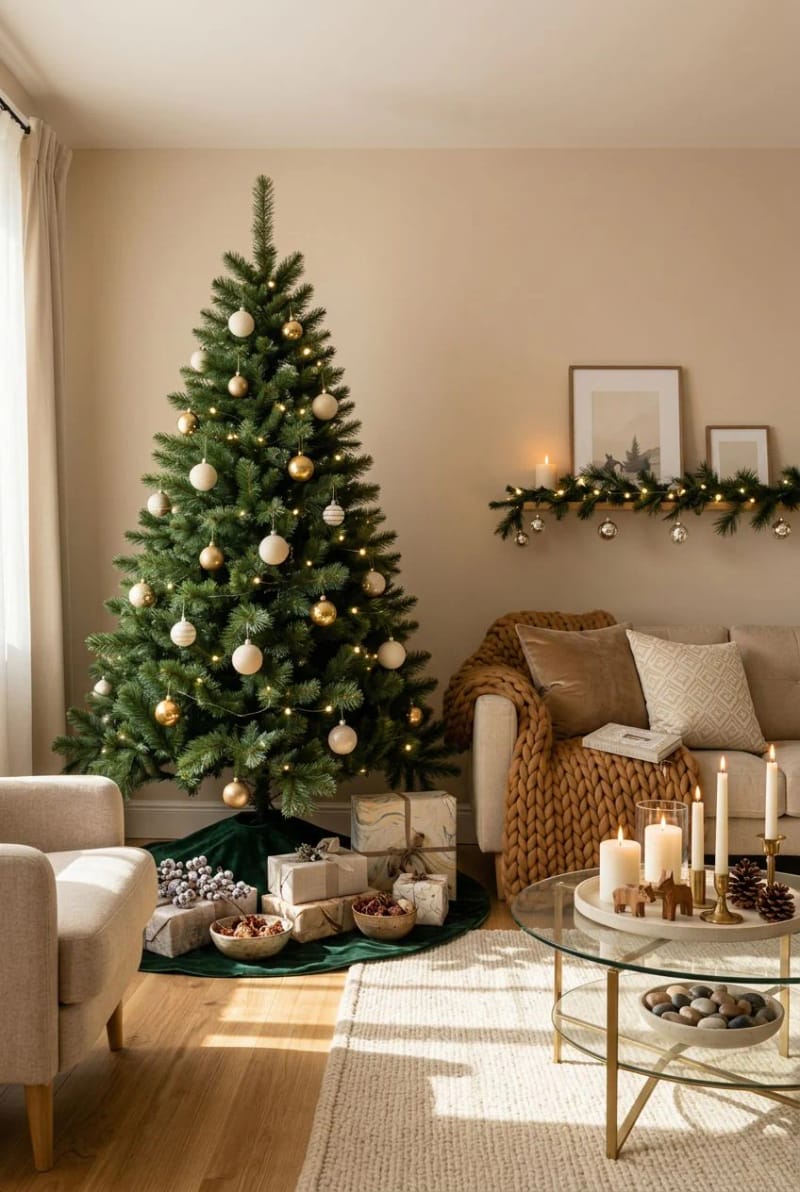
The biggest space win is refusing a tree that stands fully in the floor. A flat-backed half tree sits against the wall and takes a fraction of the depth while reading, from any seated angle, as a whole tree. Granted, the cheap "branches pinned in a triangle" version that floats around Pinterest every year tends to look like a craft-fair afterthought up close, so if you go the DIY route, use a real wall-hung wooden batten or a slim brass dowel ladder and let the greenery hang from it rather than taping sprigs to drywall. Renters: this is what flush-mount Command hooks were built for, and a half tree weighs almost nothing.
A potted living tree on a surface you already own
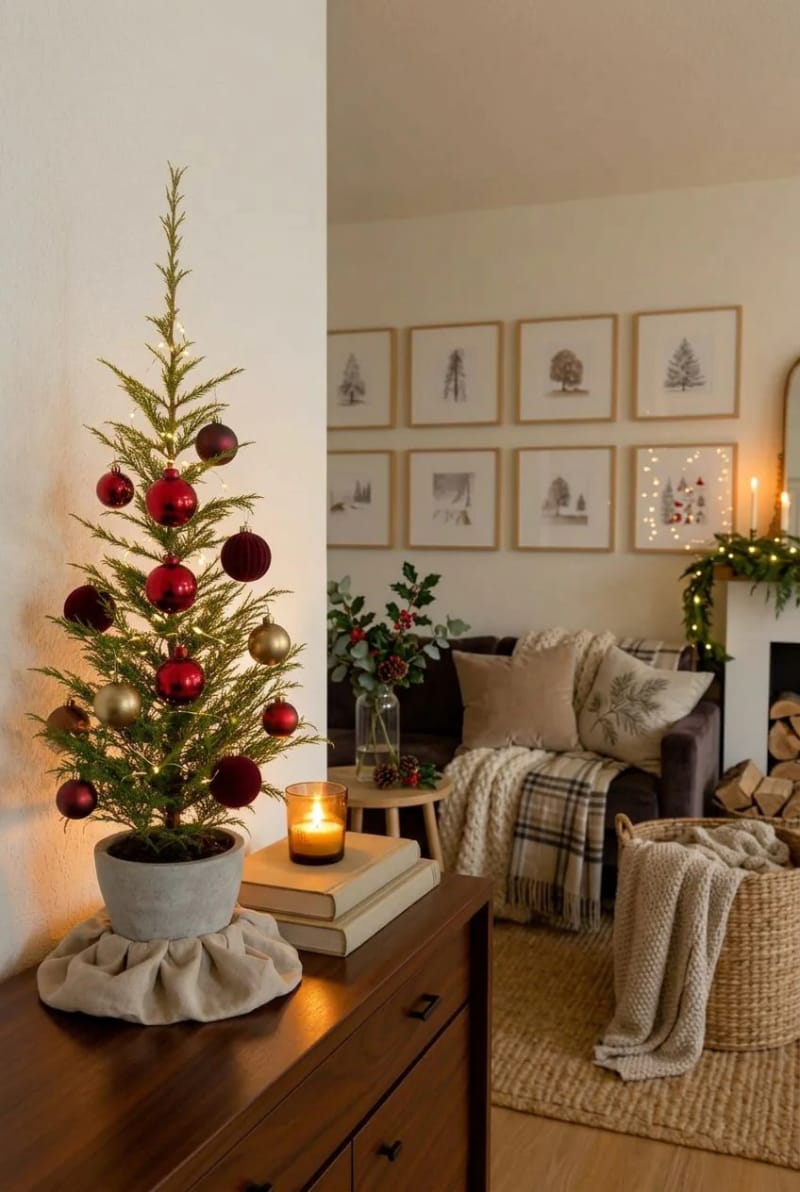
A small potted Norfolk Island pine or a rosemary topiary on a console or side table buys you a real, living tree at tabletop scale, with zero new floor space committed. I used to push the grocery-store rosemary topiaries every December because they're a few dollars and the room smells like a roast dinner; then I watched three of them brown out by New Year's in a dry heated apartment. The Norfolk pine is the better long game. It keeps its soft, layered needles indoors for years and reads unmistakably as a tree.
A skinny corner tree with a narrow base hugs the wall
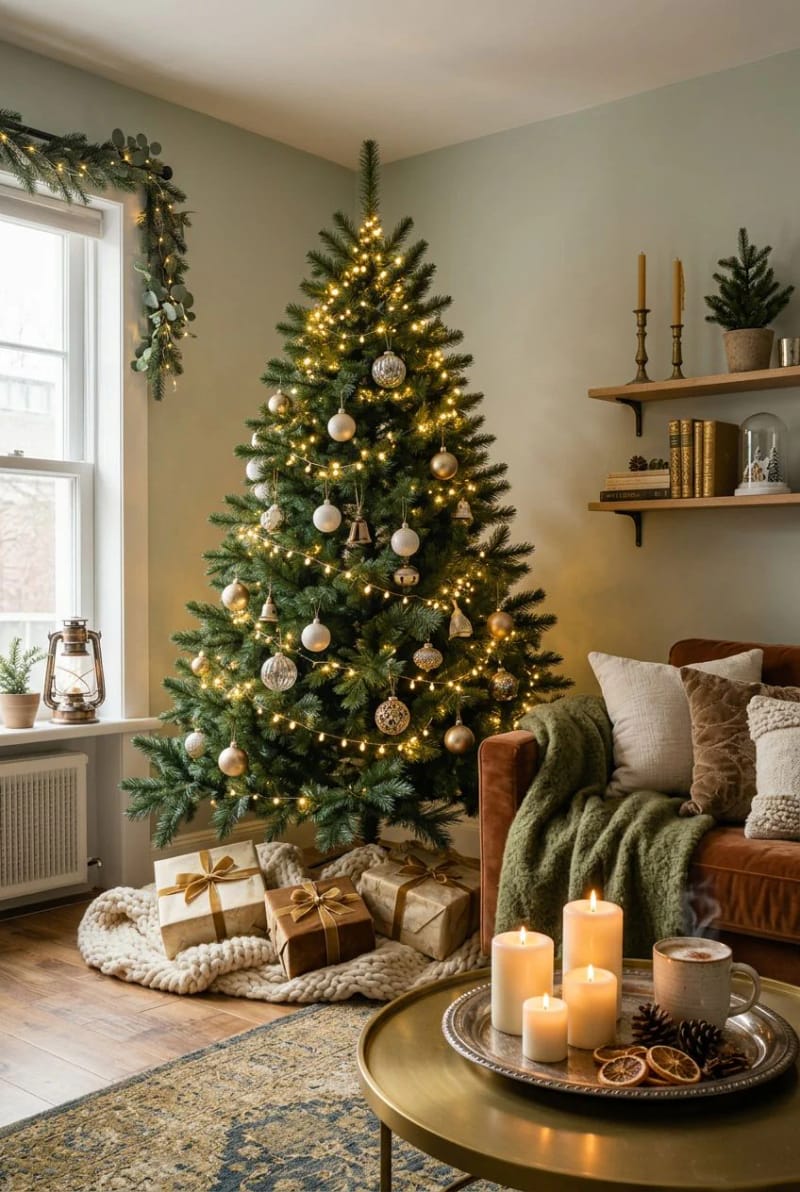
If you want a standing tree, buy for footprint, not height. A pencil or slim-profile tree gives you full vertical drama on a base that disappears into a corner, where two walls do the work of containing it and no traffic path gets pinched. Slim pre-lit versions in the six-foot range usually run well under what a full tree costs, and the corner placement means you only have to decorate the front two-thirds, which is fewer ornaments to buy, store, and dust.
| Tree approach | Floor footprint | Rough cost | Stores in | Best for |
|---|---|---|---|---|
| Flat wall tree | None (against wall) | ~$15 to $40 DIY | Flat behind a door | Tiny studios, renters |
| Potted tabletop tree | Surface you already use | ~$15 to $30 | Lives year-round | Real-tree feel, no storage |
| Slim corner tree | ~18 in corner | ~$60 to $150 pre-lit | One slim box | Full height in a corner |
The mistake that swallows a small room is decorating it at department-store scale: a full nine-foot tree, fist-sized ornaments, garland thick as a fire hose. Drop ornament diameter down a size from whatever feels normal, and treat empty branch space as part of the look rather than a gap to fill. A few well-spaced baubles on a slim tree read calmer and, oddly, more expensive than a tree buried under everything you own.
Let warm light do the heavy lifting
Light is where a small room earns its cozy reputation, and it costs almost nothing to get right. The whole strategy is to stop relying on the one fixture in the ceiling.
Layer light at three heights and switch off the ceiling fixture
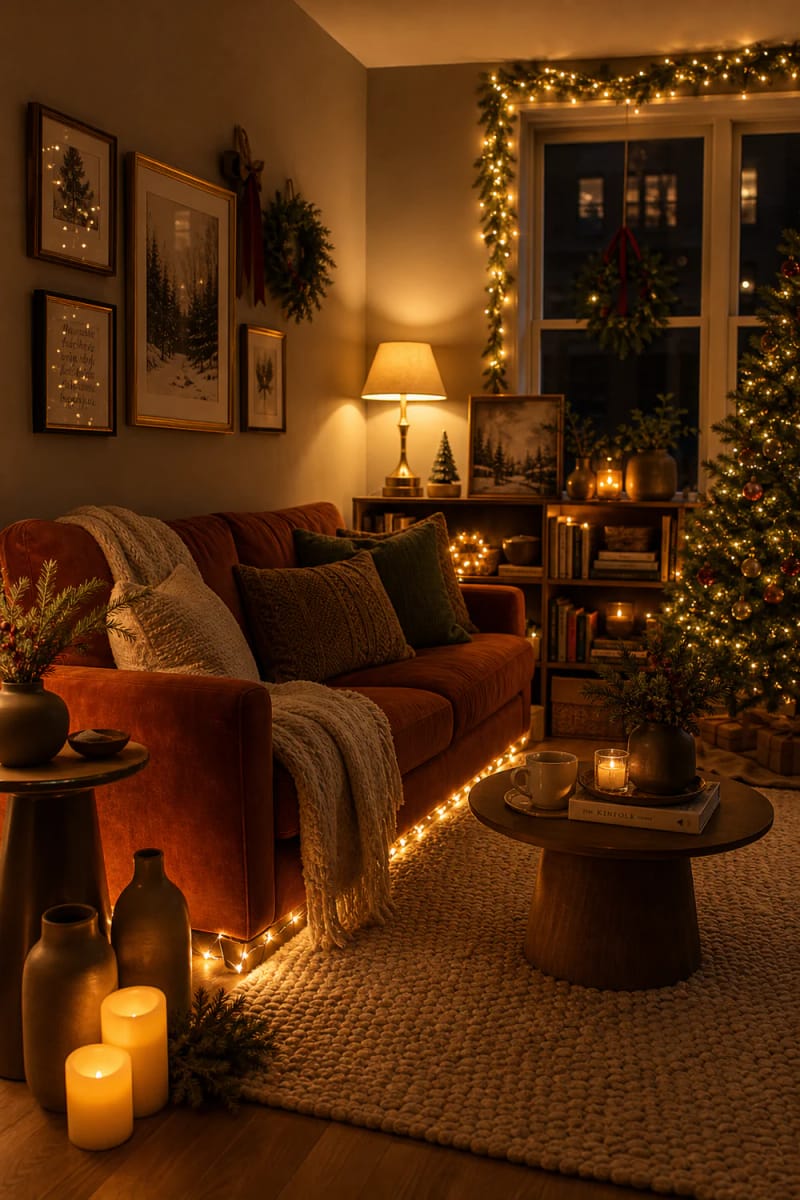
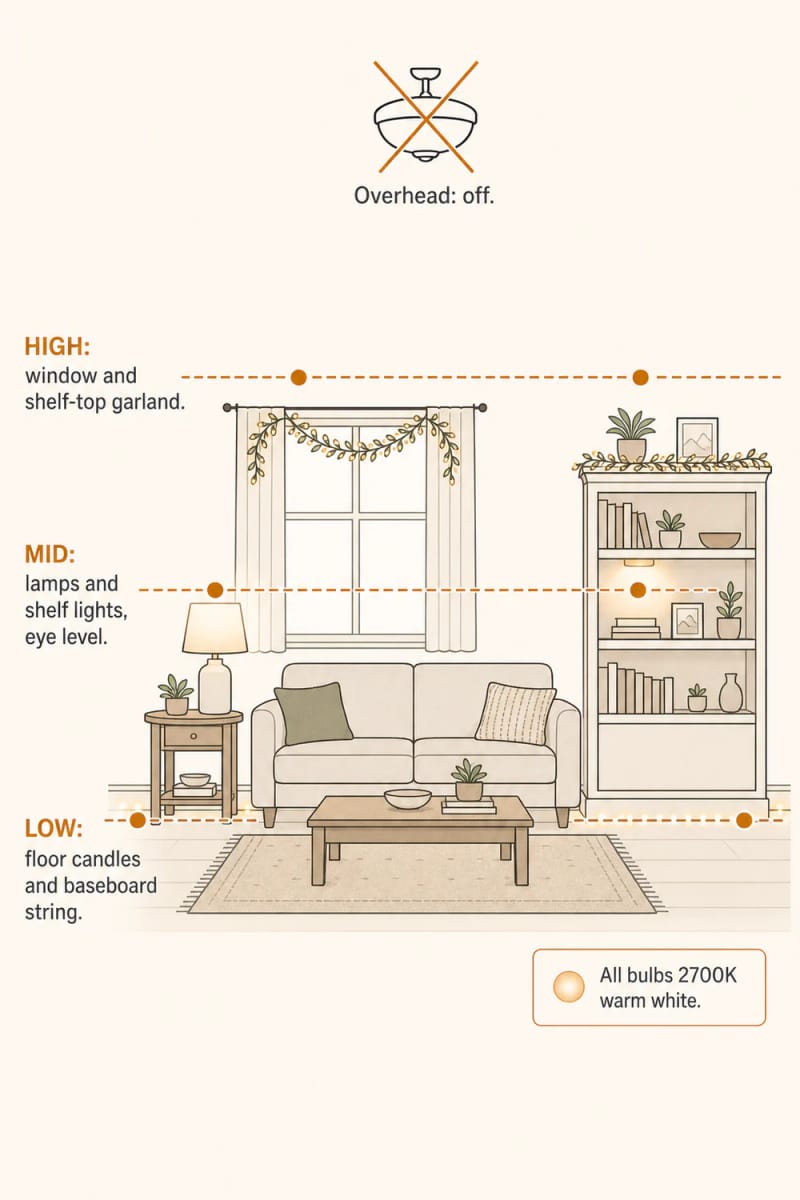
The fastest way to make a small living room feel like a waiting room is to light it from a single overhead source, so turn that off for the season and replace it with warm light at three levels. Low: battery candles or a floor-level string along the baseboard. Mid: lamps and shelf lights around seated eye height. High: a garland of pin lights over the window or along the top of the bookcase. Keep every bulb in the warm range, around 2700K; the cool blue-white "daylight" bulbs that come in most rental fixtures kill the effect instantly. The point isn't more light, it's light coming from several soft sources instead of one hard one.
Outline the window, not the whole room
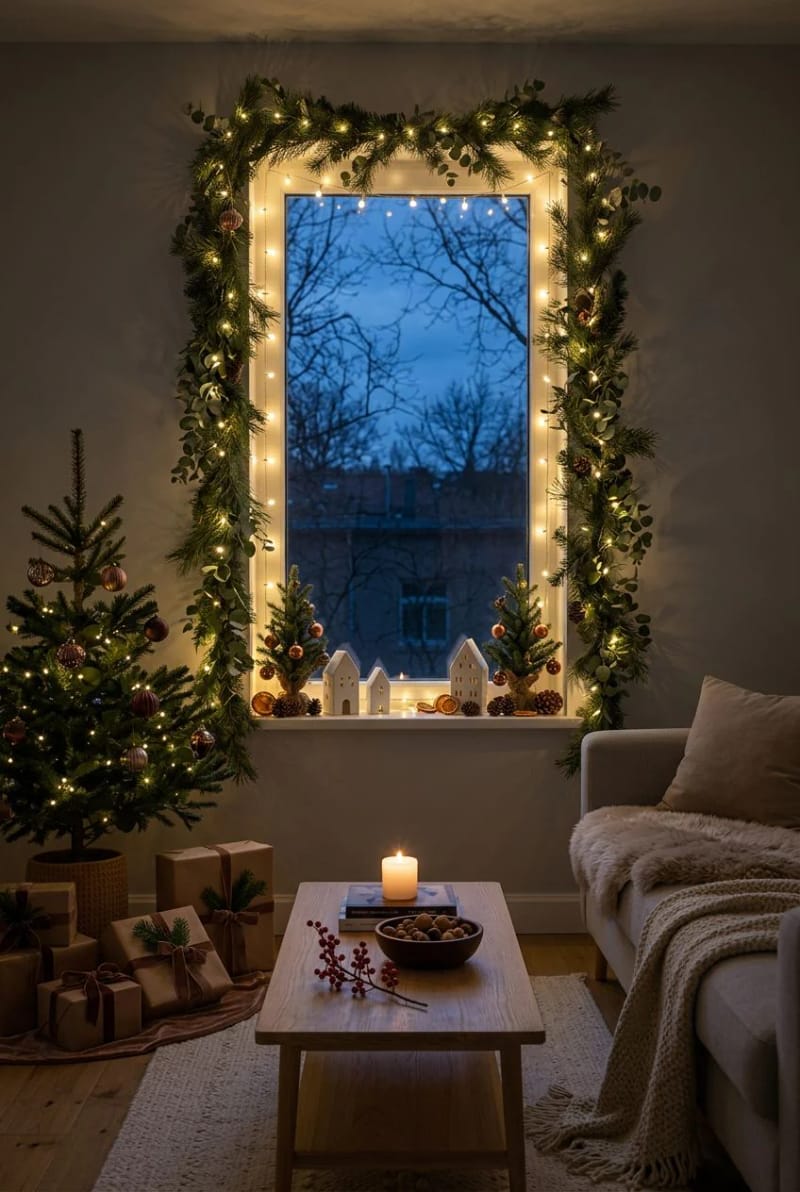
Frame a single window with warm string lights and stop there. At night the dark glass mirrors the lights back, so one strand reads as two, and the window becomes the room's focal point without you having to drape every surface. This is the move I'd reach for in a studio where the window and the seating share one wall; it pulls the eye to the prettiest architectural feature you've got and leaves the rest of the room quiet.
Do this
- Use warm bulbs around 2700K everywhere, including the tree lights.
- Put battery candles and string lights on cheap plug-in timers so the room is already glowing when you walk in.
- Pick one feature to light well: the window, the tree, or the shelf.
Avoid
- Cool blue-white “daylight” bulbs.
- Blinking or multicolor strands in a room you’re calling cozy.
- Lighting every surface at once. It flattens the depth that low warm pools create.
Decorate the verticals and the surfaces you already have
With no mantel and no spare tabletops, the trick is to stop adding objects and start dressing the surfaces and walls already in the room.
Garland the TV and the shelves when there's no mantel
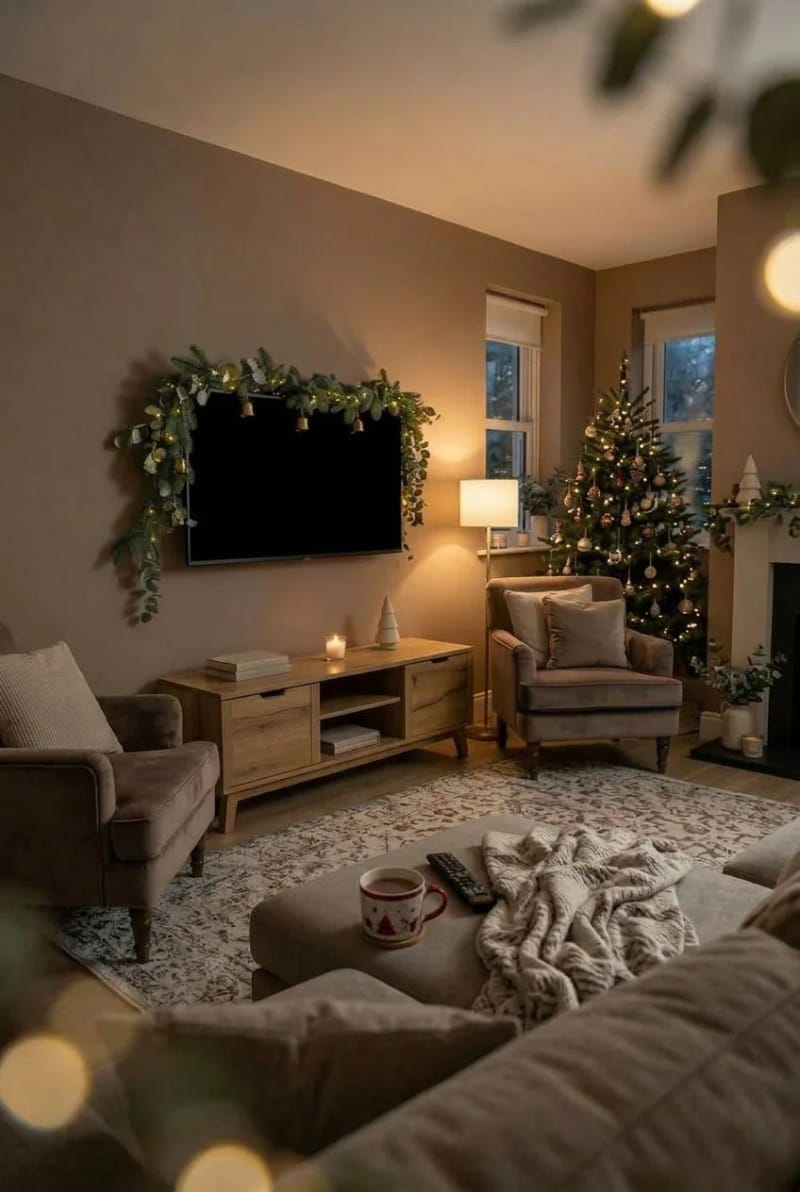
In a small living room the television is the de facto mantel, so treat it like one. A loose run of garland along the top edge of the TV, or framing it down both sides, gives you the focal greenery that a fireplace would have carried, and it's the single most-pinned small-space move for a reason. Keep it asymmetric. A garland that drapes a little longer on one side looks gathered by hand; a perfectly centered swag looks like a showroom.

Swap your textiles seasonally instead of stacking new decor
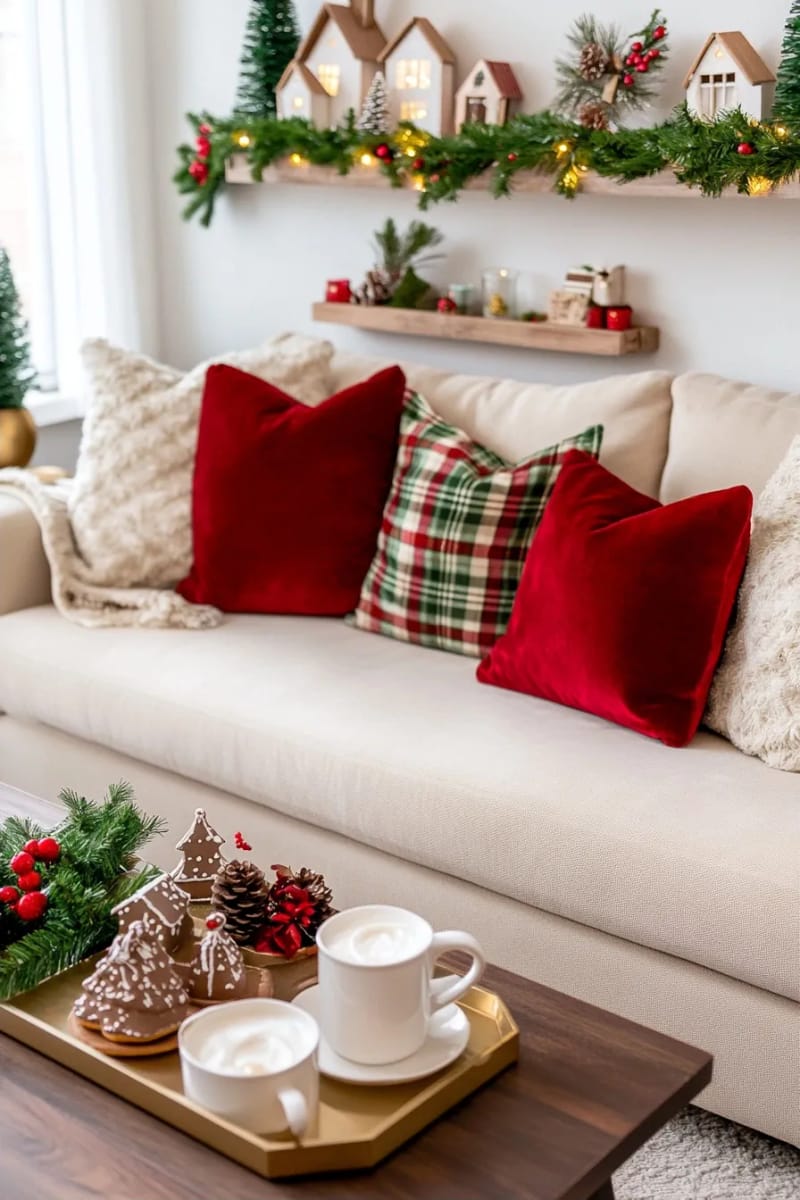
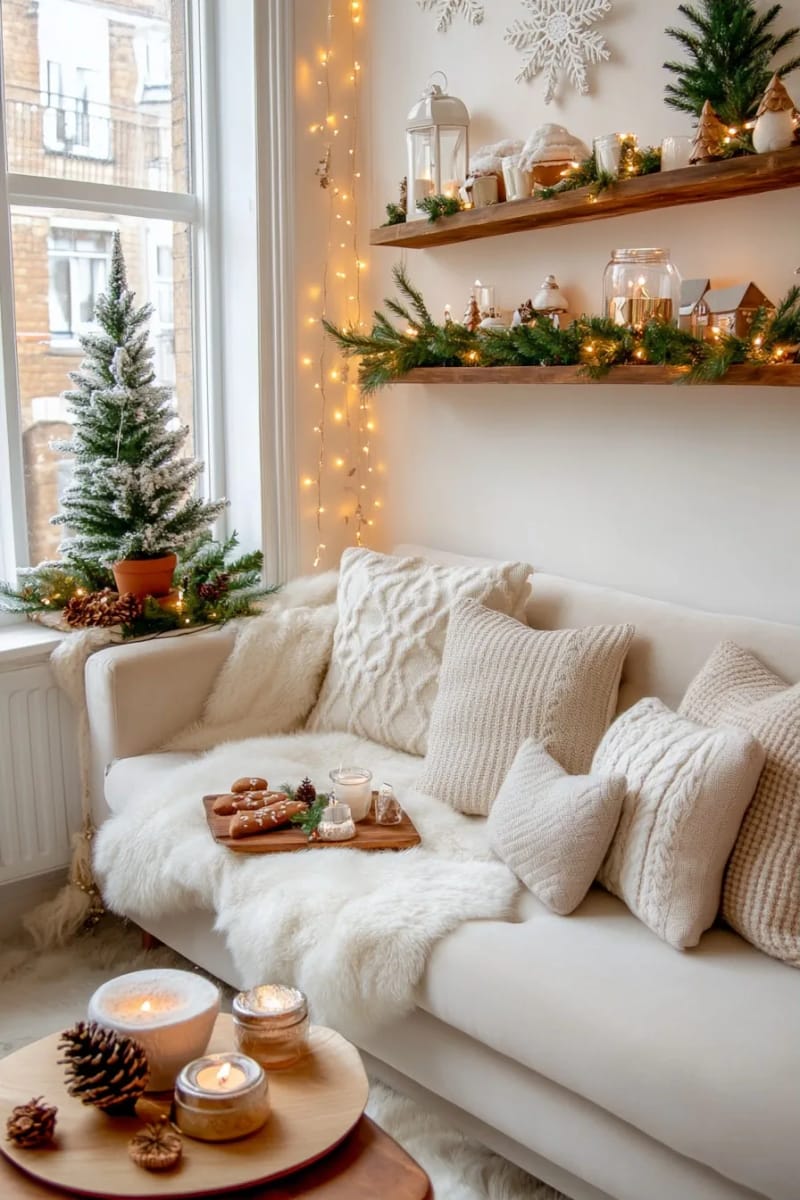
Don't add holiday objects; change the soft things already in the room. Slip winter-weight covers over the pillows you own, trade the summer throw for a chunky cream knit or a wool plaid, and layer a smaller sheepskin or a low-pile runner over the existing rug. This is the renter's and the budget decorator's whole holiday in one move: pillow covers store flat in a single envelope, there's nothing new to find shelf space for in January, and the change in weave and weight does more for warmth than any amount of tinsel. The texture is the point here, matte wool against a flat-woven rug, not the color.
Commit to a palette and one anchor moment
Pick a three-color palette and hold the line
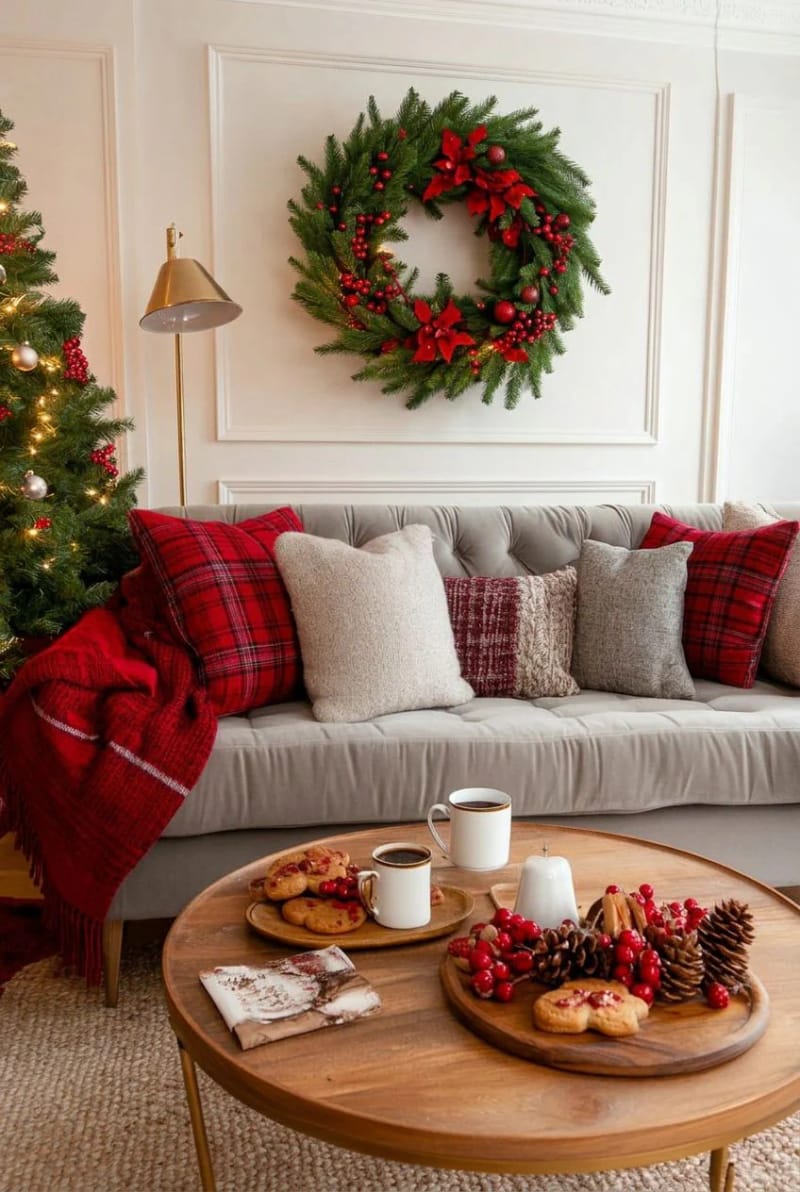
A small room physically cannot carry red and green and gold and silver and plaid at once, so choose three colors and refuse the rest. Two textiles, the tree, and the lights all pulling from the same short palette is what makes a compact space read as styled rather than as a clearance bin. People email me insisting their childhood Christmas had every color and felt cozy; sure, in a big farmhouse with twelve feet of mantel. Forty square feet of living room is a different math problem.
Choose one warm neutral (cream, oatmeal, putty), one deep grounding tone (forest, rust, charcoal), and one metal or accent (brass, or a single muted red). Every textile, ornament, and ribbon comes from those three. When you’re tempted to add a fourth, swap it in for one of the three instead of adding to them.
Build one styled coffee-table tray as the room's center of gravity
Instead of scattering small holiday objects across every surface, gather them onto a single tray on the coffee table and leave the rest of the room clean. A tray contains the clutter, defines a center of gravity, and is the one spot you can restyle in thirty seconds when it starts looking tired. Keep it to a handful of things at varying heights: a short candle, a small bundle of greenery, one textural object, a folded napkin or a stack of two books underneath for lift. Admittedly this only works if you're disciplined about the boundary, because the moment a second tray appears the trick is gone.


Conclusion
Work it in the order the sections run. Decide the tree first, because its footprint sets the budget for everything else, then fix the lighting, because warm light at three heights changes the room more than any object you can buy. Save the palette and the tray for last, once you can see what space is actually left.
The one thing I'd skip entirely is the oversized floor-standing decor that catalogs push at small rooms every year: the four-foot nutcracker, the light-up gift-box stacks. They eat the floor you just fought to protect, which is the whole reason the wall tree and the corner tree exist.
And if you only do two of the nine, make them the warm bulbs and the single styled tray. Those two cost the least, take an afternoon, and carry a surprising amount of the holiday on their own.