
I spent one December trying to make a client's concrete-and-walnut living room feel like Christmas without smothering the lines that made the room worth photographing, and the first attempt looked like a furniture showroom someone had sneezed tinsel on. The fix wasn't more restraint or more cheer. It was deciding, idea by idea, where warmth was allowed to win and where the clean lines had to. That's the whole game with a cozy modern Christmas living room: you are borrowing the layered, candle-lit warmth of a traditional holiday and spending it carefully inside a space that was designed to be spare.
So the ideas below are calls, not a mood board. They're roughly ordered by how much they change the room, and a couple of them argue against decorating advice you've probably absorbed without noticing (the all-neutral Christmas, the icy white fairy lights, the instinct to hide the television). If your living room leans contemporary and you want it cozy for the season without it reading like a Hallmark set, start at the top.

1. Pick three colors for the season and make one of them deep
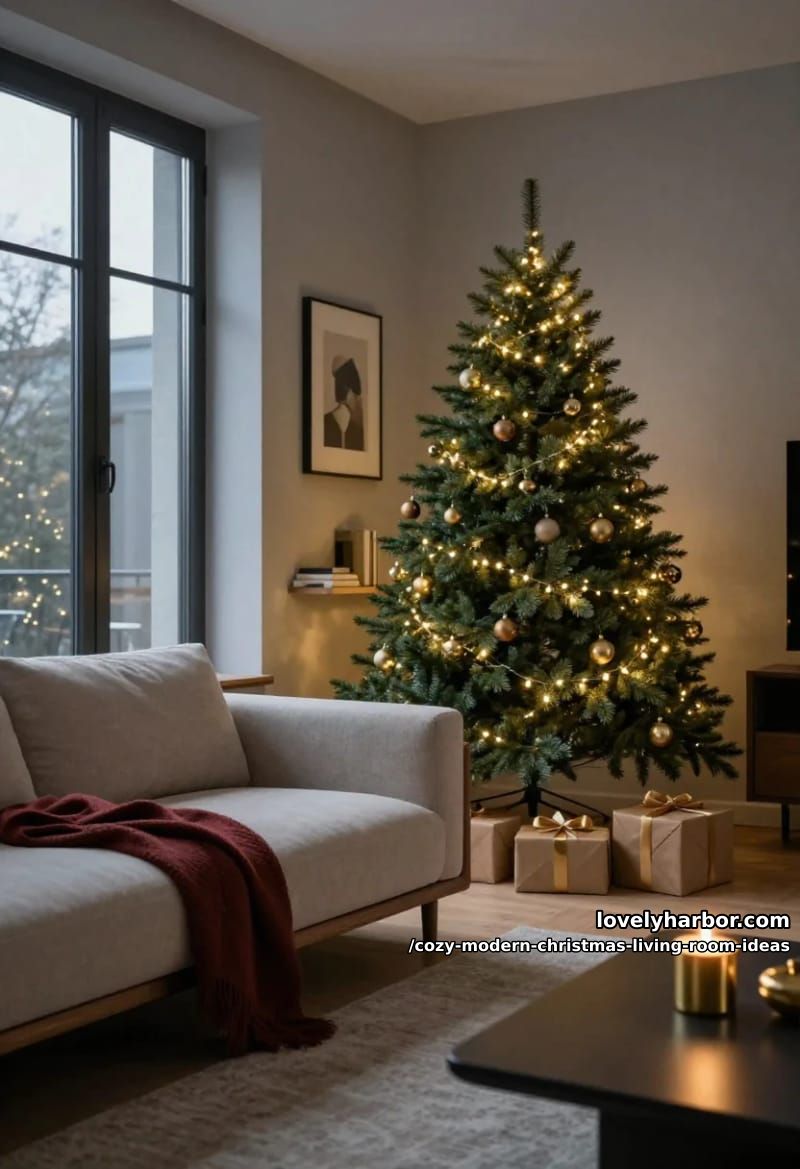
Lock the room to three colors before you buy anything, and let one of them be a deep, grounding tone instead of a third neutral. A modern room can carry holiday color, but only a little of it, and the trick that keeps it from looking decorated-by-committee is the same one designers use year round: a dominant, a supporting tone, and one accent, repeated. Christmas just lets the accent get richer.
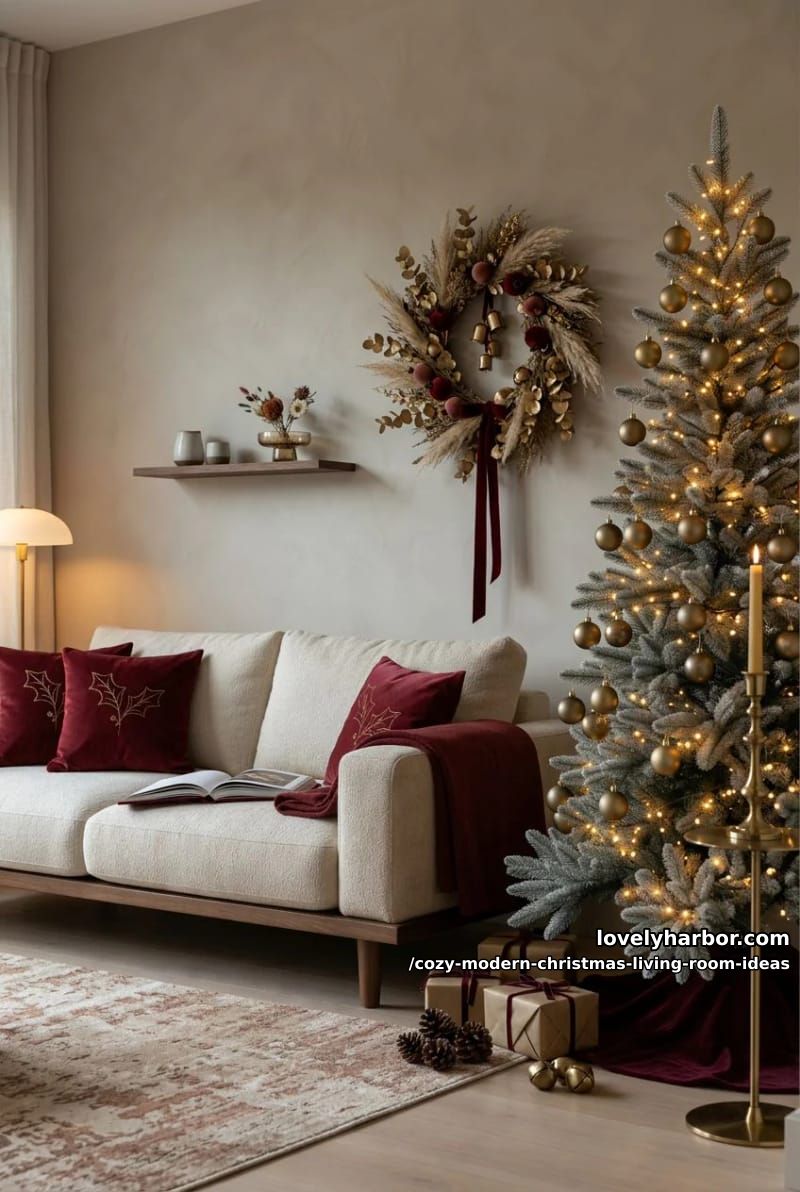
Start from the sofa you already own
Pull your two base values straight out of the furniture and walls that are staying put, then choose the anchor to flatter them. Camel leather and oak want cognac or chocolate; a cool greige room can take Behr’s 2026 Color of the Year, a smoky jade called Hidden Gem, as a deep blue-green that reads current without going full jewel-box. Sherwin-Williams went the opposite direction for 2026 with Universal Khaki, a soft mushroom neutral, and honestly that split is the whole decision in miniature: anchor with a moody color, or stay quiet and let texture do the work (idea five).
The all-cream Christmas photographs cold
For years I talked people into all-white, all-cream holiday schemes because they're hard to mess up, and then I lived with one and watched it photograph like a dental waiting room in February. Pure neutral has no temperature; it needs either warm lighting (idea three) or a deep anchor to feel like a retreat rather than a showroom. That said, the anchor should appear in three places minimum, not one lonely throw pillow, or it reads as a mistake instead of a choice.
| Deep anchor | Soft base | Metal accent | Reads as |
|---|---|---|---|
| Oxblood / cognac | Warm cream, oatmeal | Aged brass | Library, a touch masculine |
| Smoky jade | Greige, bone | Brushed bronze | Quiet, garden-adjacent, of-the-moment |
| Espresso brown | Camel, putty | Matte black | Warm minimalist |
| Forest / olive | Flax, ivory | Antique gold | Transitional, evergreen-led |
2. Decorate around the television instead of pretending it's invisible
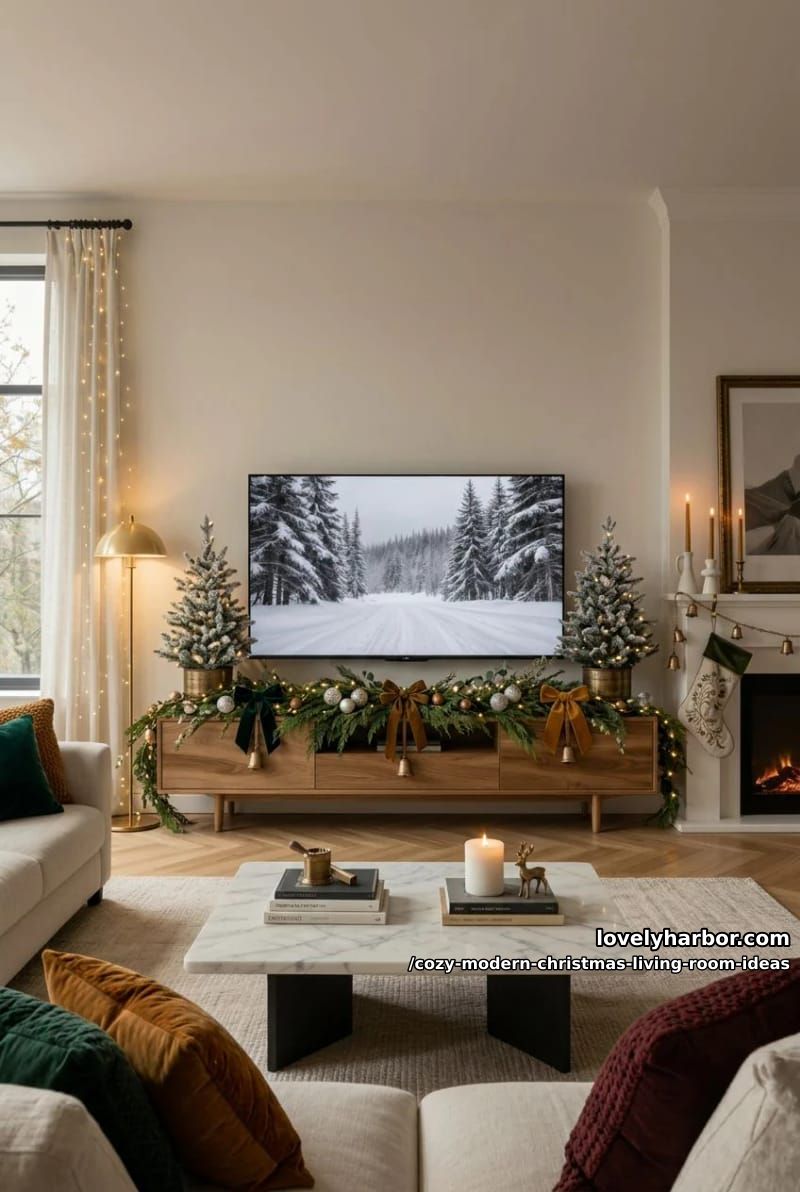
Style the wall the television lives on as a composition that includes the screen, rather than trying to disguise a 65-inch black rectangle with garland (you cannot, and the attempt always looks like you tried). In most contemporary living rooms the TV is the largest object in the room and frequently the focal point, so decorating as though it isn't there is what makes holiday styling look bolted-on.
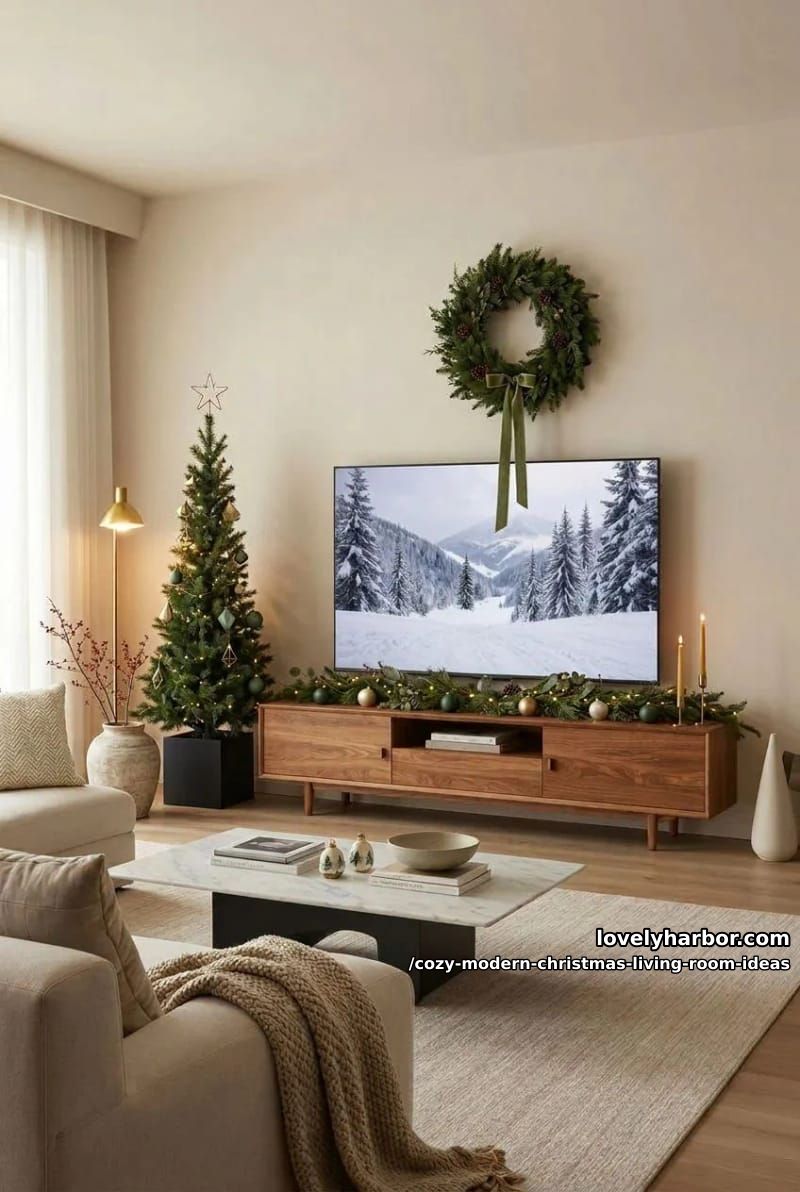
When it hangs over the fireplace
Resist draping the mantel below it with a tall, busy display that competes with the screen for the same vertical space; the eye can't settle and the room reads cluttered the moment the TV is off. Keep the mantel low and horizontal under a wall-mounted screen, and let idea six's asymmetry do the visual interest instead of height.
Art mode earns its keep
If you own a Frame-style art-mode television, this is the one week of the year it pays for itself: load a muted winter landscape or a vintage snow scene and the black rectangle becomes a framed picture that belongs with the room. No art mode? A looping fireplace or falling-snow video at low brightness does most of the same work for free.
3. Run the whole room at 2700K and turn the big light off
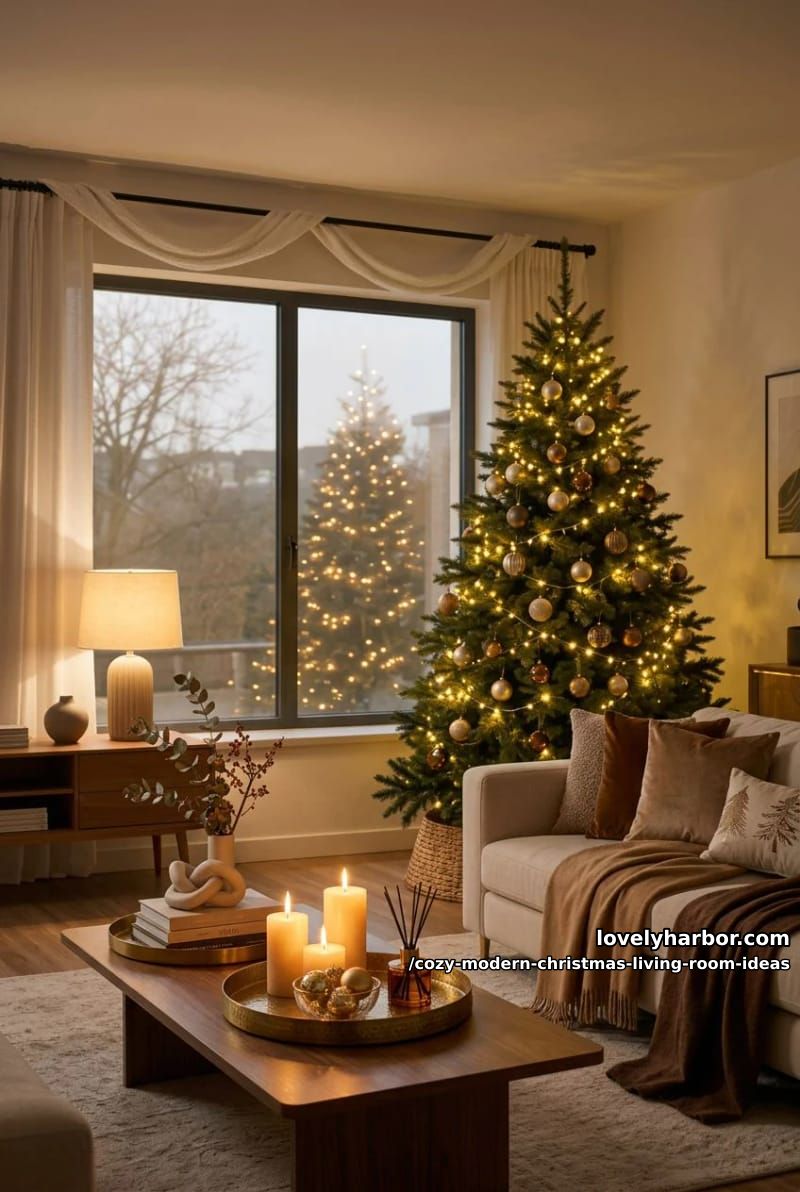
Warm white is the single biggest lever for cozy, and most people sabotage it with one cool strand they never notice. Color temperature is measured in Kelvin: 2700K is the amber, candle-like glow of an old incandescent bulb, and 3000K is a slightly cleaner warm white. Anything from 4000K up slides toward the blue-white of an office, which is the temperature of most cheap "bright white" Christmas lights and the reason a tree can somehow feel chilly.
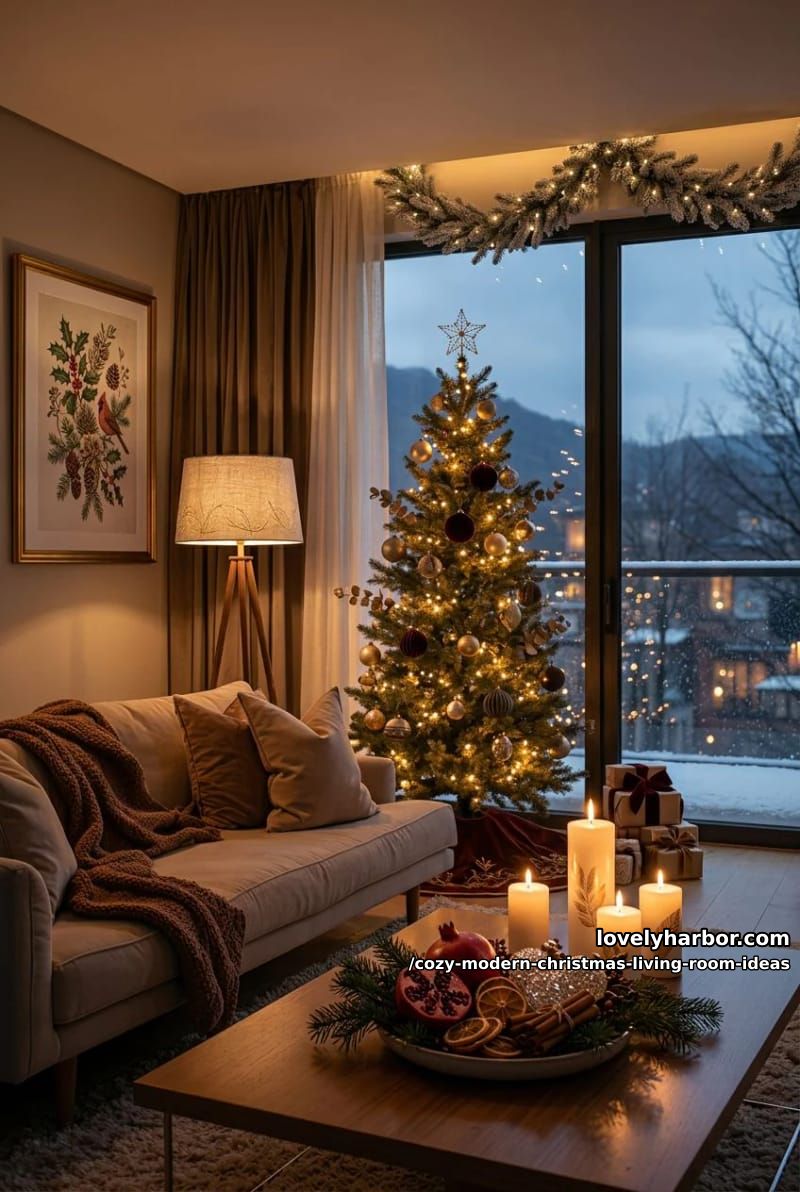
Warm white, not the blue-white stuff
Buy your string lights in warm white and check the box for the Kelvin number rather than trusting the word on the front, because "warm white" and "white" sit a thousand Kelvin apart in practice and look it on the tree. Lighting pros put living rooms at 2700K to 3000K for exactly the cozy, flattering glow you want in December; the cool-white tree everyone defaults to is the look of a parking lot, and I will not be talked out of this.
Three sources, no ceiling fixture
Kill the overhead light entirely for the season and replace it with at least three low, warm sources, because flat ceiling light erases the depth that makes a room feel layered. A table lamp does the heavy lifting, a couple of real candles or LED pillars add flicker, and the tree supplies the third. Granted, this only works if all three read warm; one blue-white nightlight in the sightline and the spell breaks.
Do this
- Match every bulb and strand to roughly 2700K to 3000K so the whole room reads one temperature.
- Put the brightest source low (a table lamp), not on the ceiling.
- Add real flame or LED pillar candles for movement.
- Dim the tree by running fewer, warmer strands rather than maxing them out.
Avoid
- Cool-white or “bright white” lights at 4000K and up.
- Leaving the ceiling can-lights on.
- Mixing warm and cool whites in one sightline.
- That one blue strand from a different set you forgot about.
4. Light the tree from the inside out and stop at two finishes
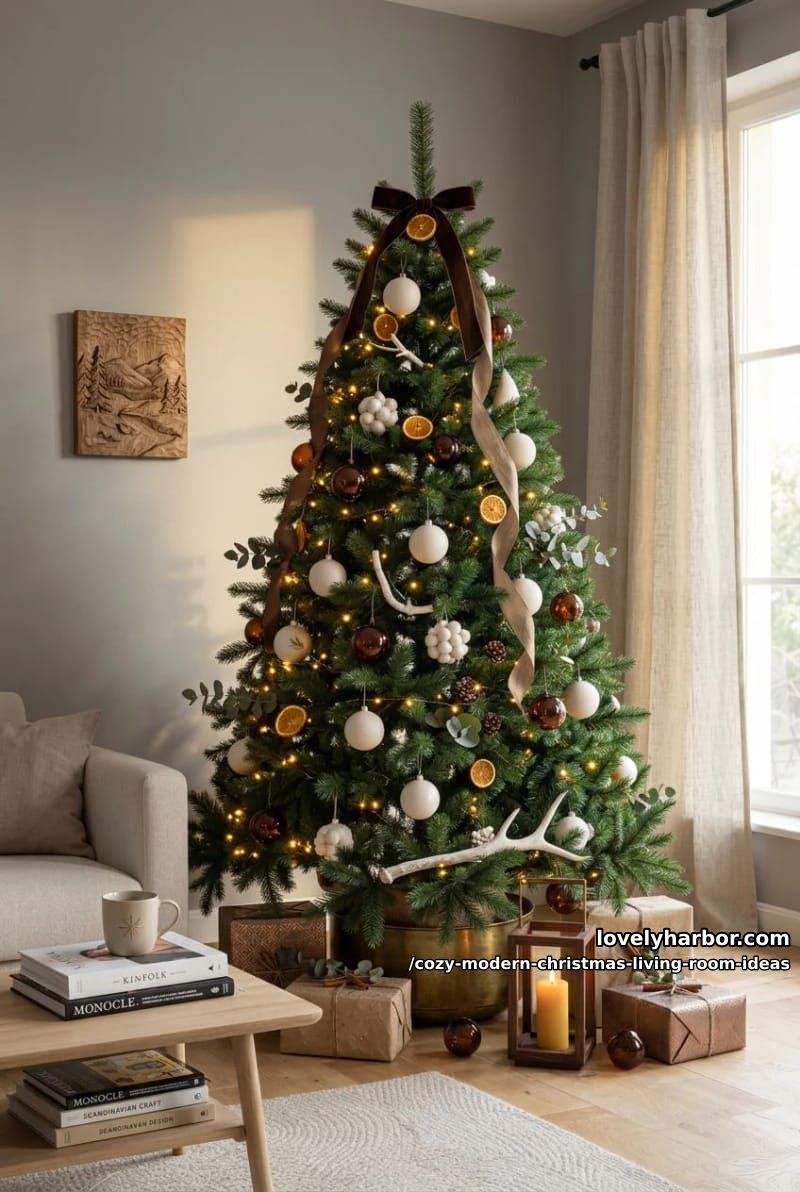
Light the tree trunk-outward and keep the whole thing to two ornament finishes, and it will look considered even if it's a $120 artificial tree from a big-box store. Restraint is what separates a modern tree from a maximalist one; you're not adding less stuff so much as repeating fewer kinds of stuff.
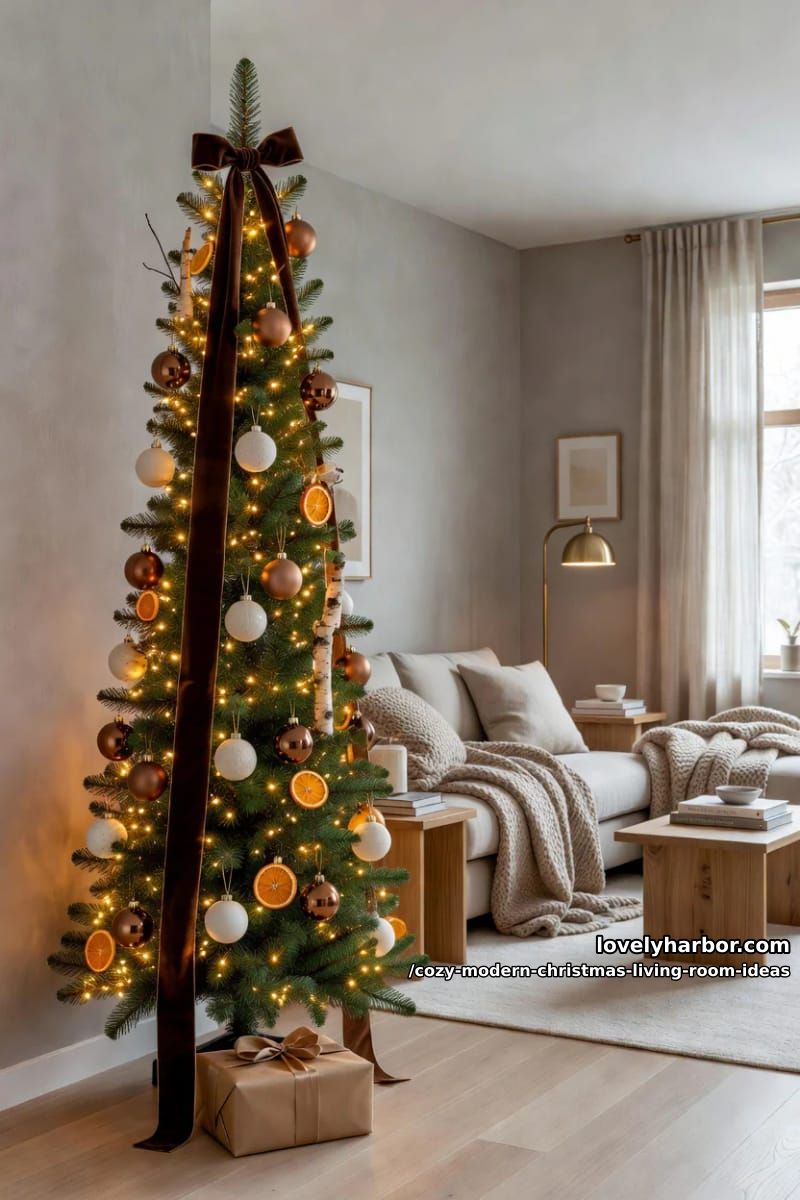
Lights first, trunk to tip
String the lights before anything else, starting at the trunk and weaving out to the tips so some bulbs sit deep in the branches. That buried glow is what gives a tree dimension instead of a flat outline of dots, and it's the step almost everyone skips because it takes twice as long.
Two finishes and one ribbon
Choose two ornament finishes that play off each other (matte ceramic against glossy glass, say) in your three-color palette, and one ribbon. For the ribbon, the move people miss is tucking wide ribbon vertically in folds from the top down rather than spiraling it, a technique that reads as soft cascading panels and makes the tree look taller.
Lights: trunk to tips, warm white only; bury several larger bulbs deep for glow-from-within.
Ribbon: wide (4 to 6 inches), tucked vertically in folds from the top down, never spiraled around the outside.
Ornaments: largest first, set deep near the trunk; mid-size on the middle branches; smallest at the tips.
Picks and dried botanicals last, to cover gaps and break the cone silhouette.
About that tree skirt
Skip the skirt and use a woven basket or a simple fabric collar instead; ruffled skirts are the one element that drags an otherwise restrained tree back toward the country-store look. A flat-weave basket reads modern and hides the stand better anyway.
Spiraling a single ribbon around the outside like a candy cane, then spacing every ornament evenly across the surface so it reads as a polka-dot cone. Cluster ornaments in odd-numbered groups, vary their depth from buried to surface, and the same ornaments suddenly look styled rather than hung.
5. Let texture carry the cozy, not more color
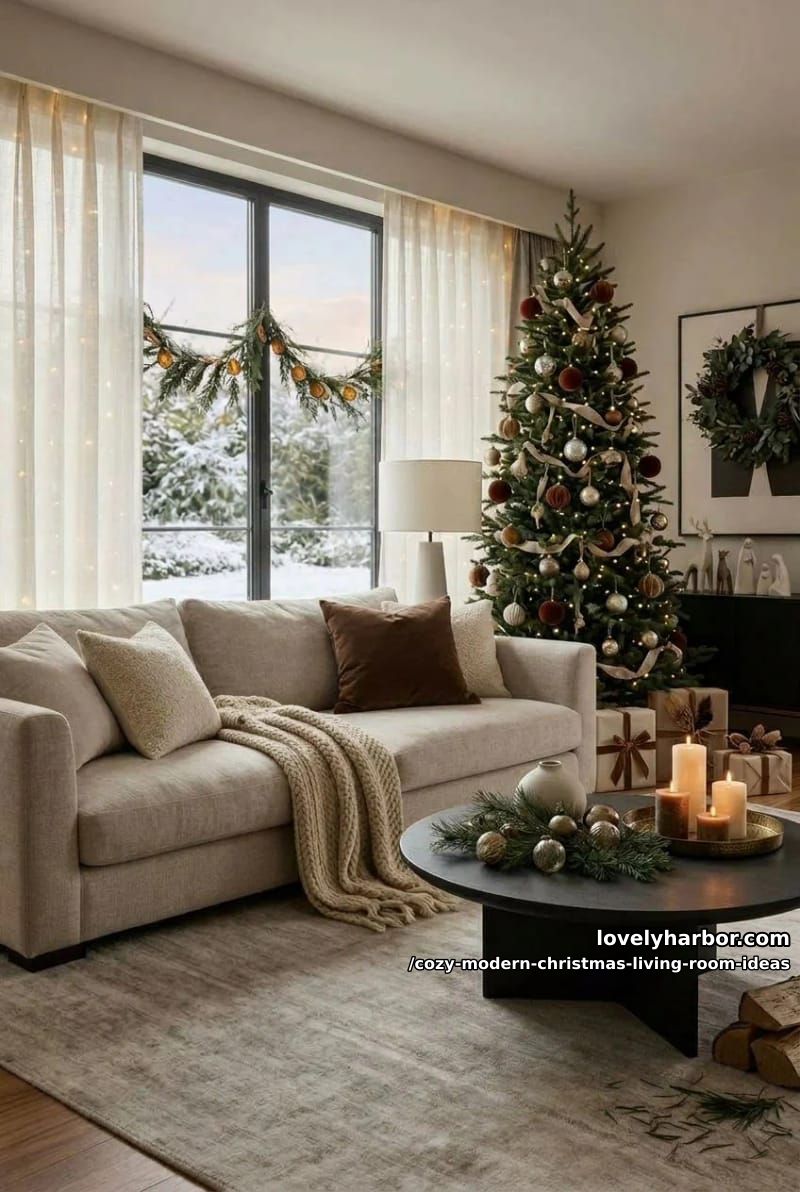
In a modern room, texture is what does the job that color does in a maximalist one. Where a traditional Christmas piles on red and gold and plaid, a contemporary space gets its warmth from how many different surfaces you can layer in nearly the same color. Three textures on the sofa, all tonal, beats five colors every time: boucle against velvet against a chunky knit, with a faux-fur or sheepskin underneath. Keep the holiday-specific stuff (the one velvet bow, the knit stocking) inside that same neutral range so it layers in rather than shouting.
6. Style the mantel off-balance with one real-touch garland
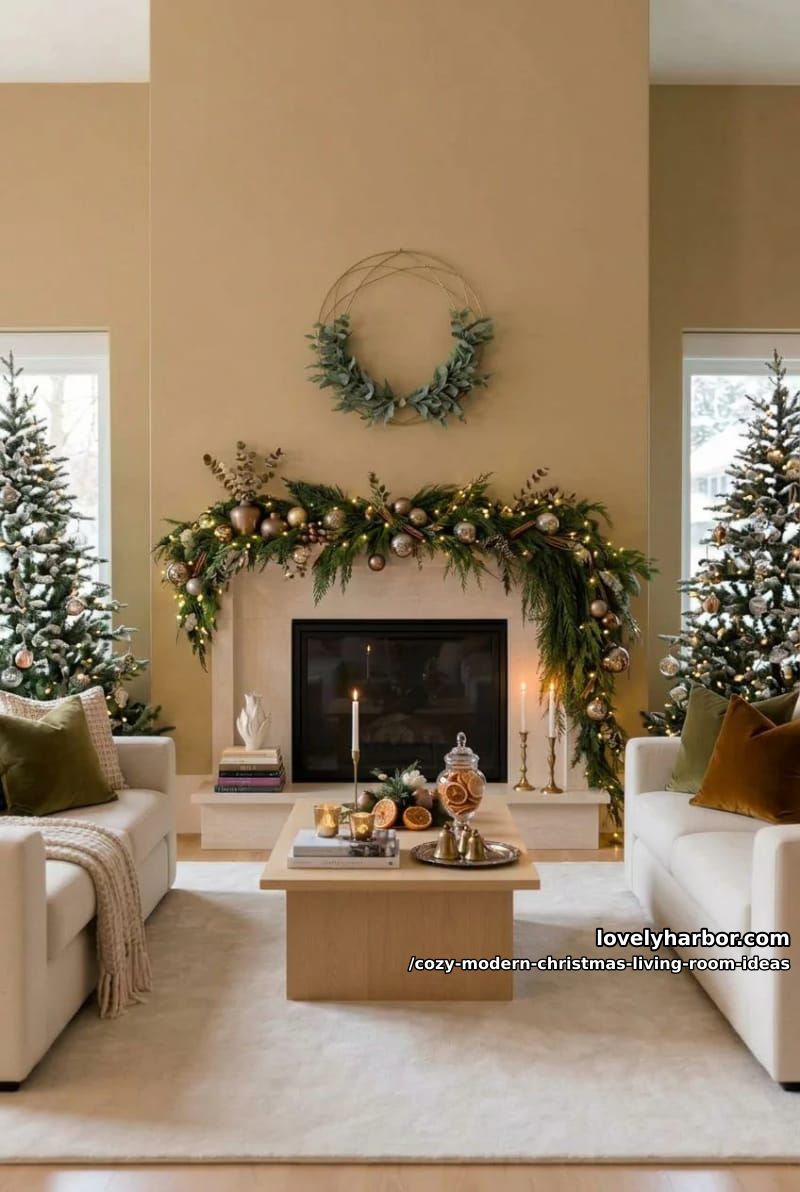
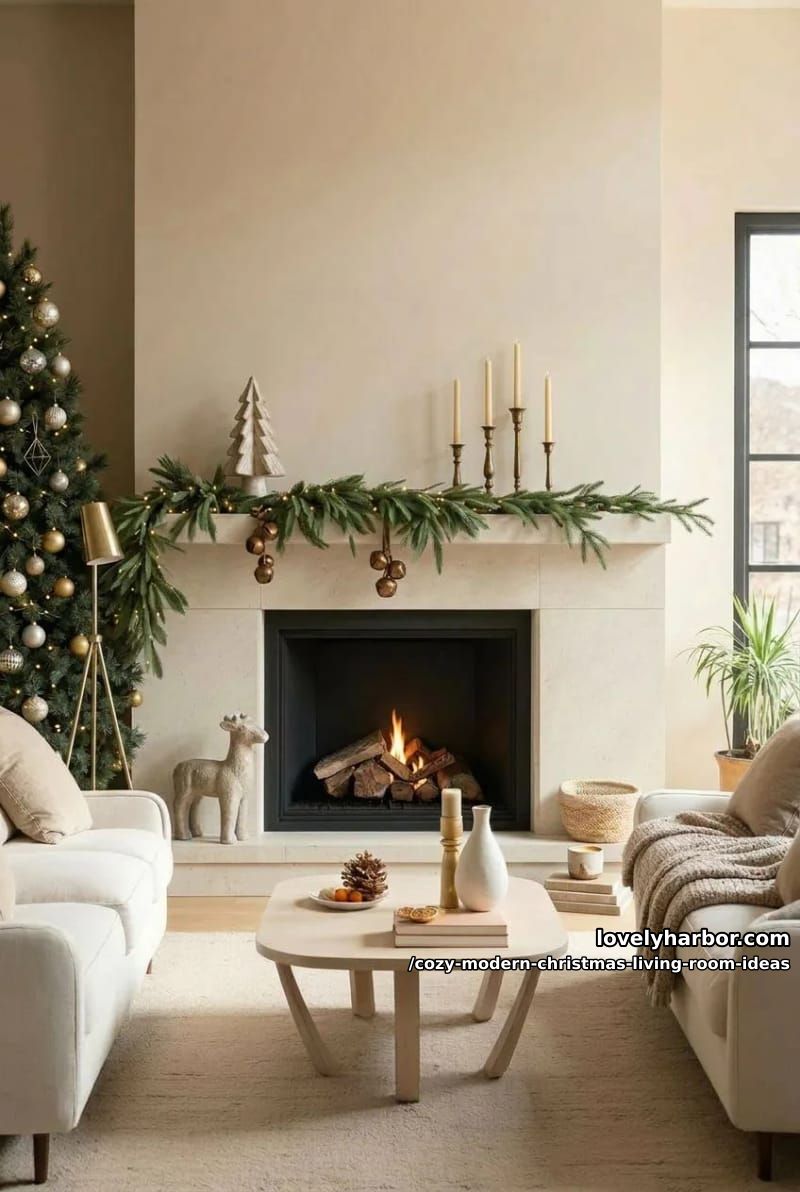
Drape the mantel asymmetrically, with the weight pulled to one side, because a perfectly symmetrical garland with matching everything at both ends is the single most dated holiday-styling move there is. Let one real-touch faux garland run long and heavy on one side and trail off on the other, then balance it with a low stack of books or a single object at the opposite end. Spend on the greenery and skip almost everything else; a convincing real-touch cedar or Norfolk pine garland is the one faux element guests notice, so it's worth more than another bin of ornaments. Under a wall-mounted TV (idea two), keep all of this low and horizontal.
7. In a small modern room, decorate three zones and quit
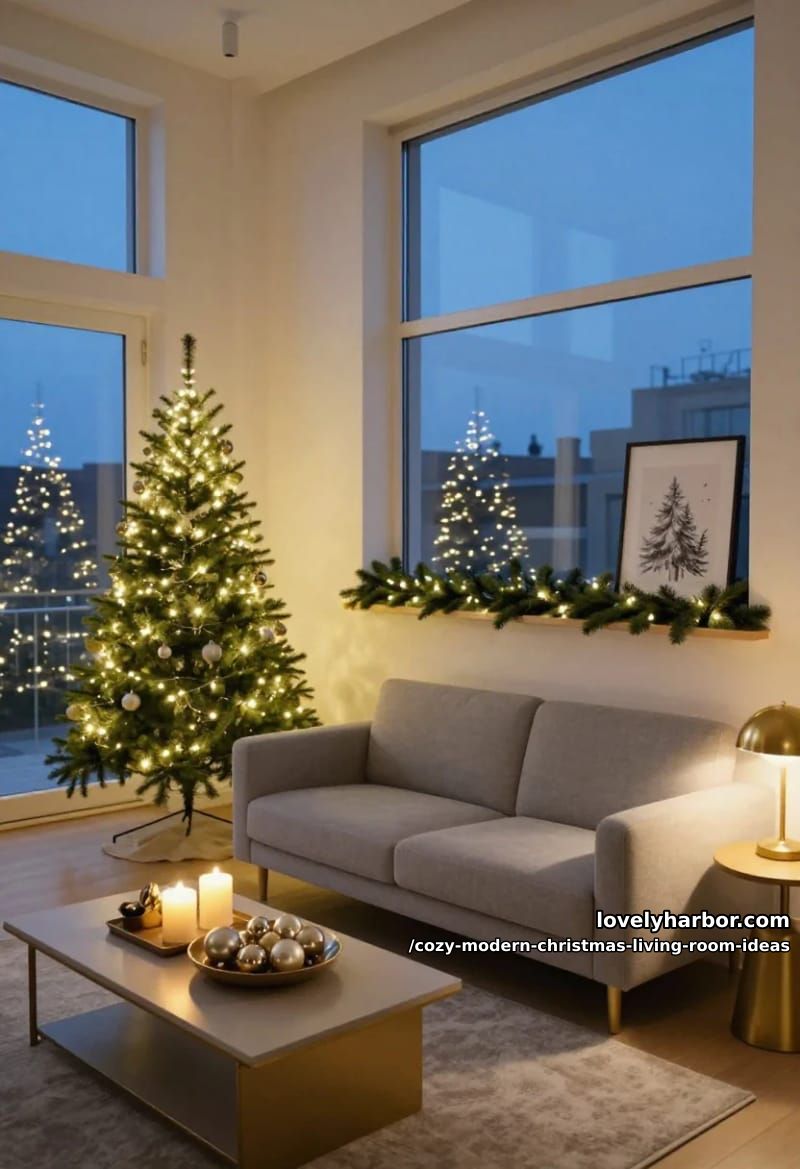
Decorate exactly three zones and leave the rest of a small room alone, because in tight square footage, restraint is what reads expensive and clutter is what reads cheap. Pick a corner for a slim pencil tree, the coffee table for a small tray, and one shelf or ledge, then stop. The instinct in a small space is to compensate with more, scattering a little Christmas onto every surface, and it backfires: the room reads busy and somehow smaller. A 5-foot pencil tree, one warm lamp, and a single styled tray will do more for a studio than three bins of decorations crammed into the same footprint, and your walkways stay clear.
Conclusion
If you do these in order, settle the three colors and fix the lighting before you buy a single ornament, because those two decide whether everything else reads warm or cold, and the tree (the part everyone starts with) is genuinely the last thing that matters. The hardest call in the whole list is the one about the television: most people will keep trying to hide it, and most people will keep ending up with a mantel that looks frantic the moment the screen goes dark. I'd rather you under-decorate and add than walk into a room that's working too hard. A cozy modern living room at Christmas is mostly a room that knew when to stop.