
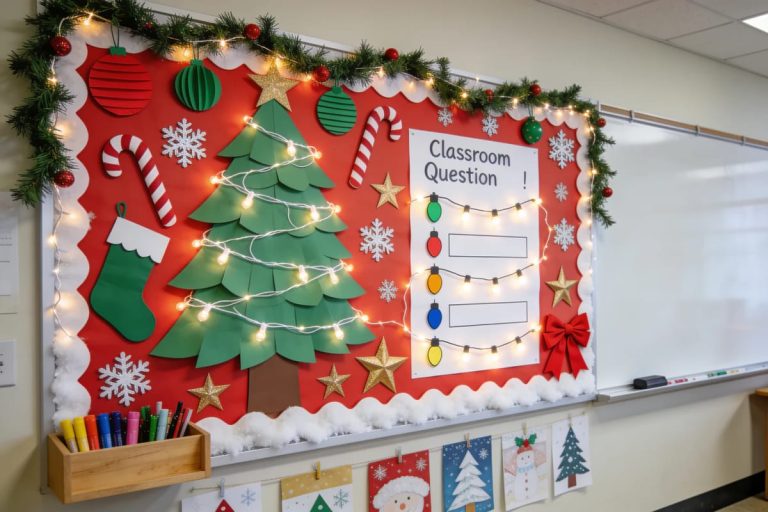
Bulletin board paper comes on a 48-inch roll because that is the height most classroom boards are built to, which makes a Christmas board a four-by-six-foot problem you solve in about forty minutes after dismissal with whatever is left in the supply closet. Everything below is built for that: near-zero budget, twenty-some pairs of hands that want a job, and a fire marshal with opinions about paper. Several of them also survive into January, which is the part most Christmas bulletin board roundups quietly skip.
A paper chain Christmas tree the class builds one link at a time
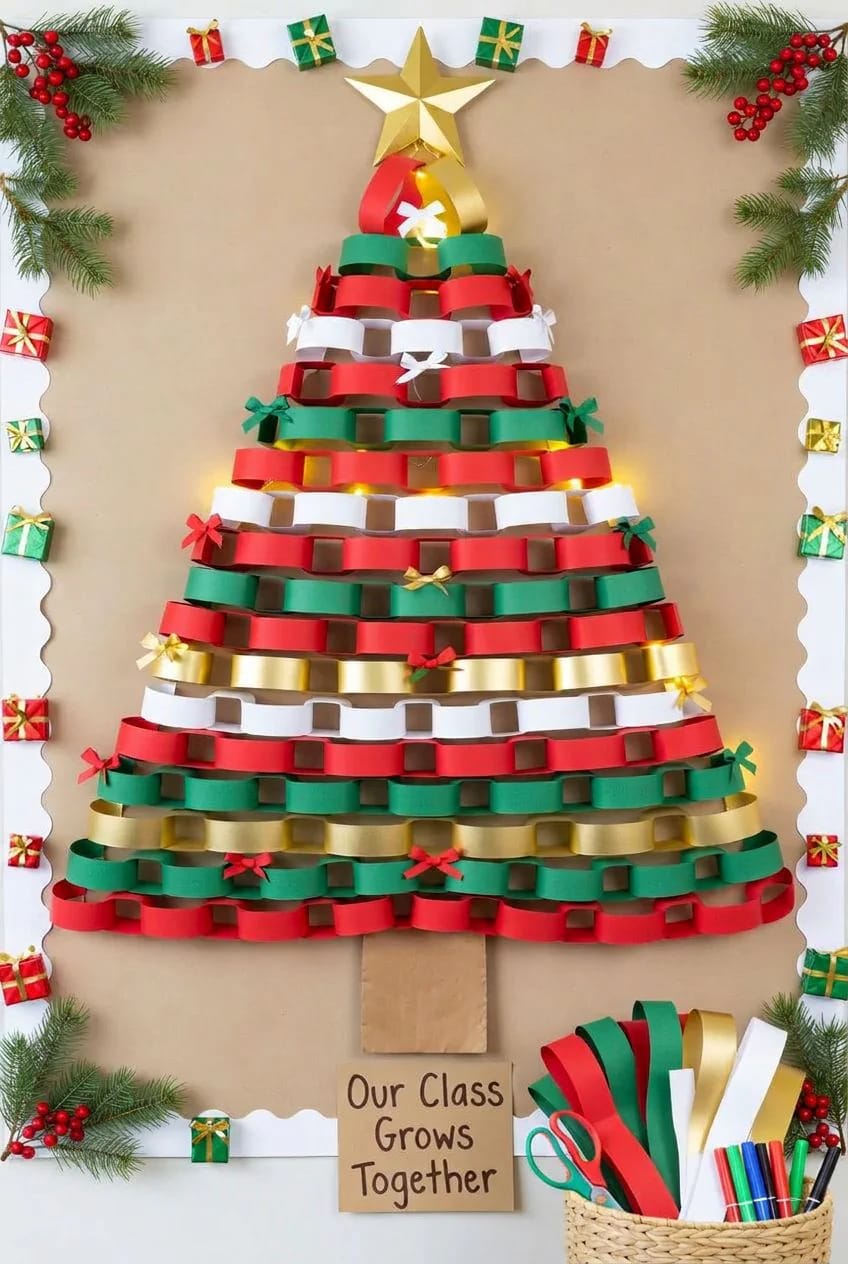
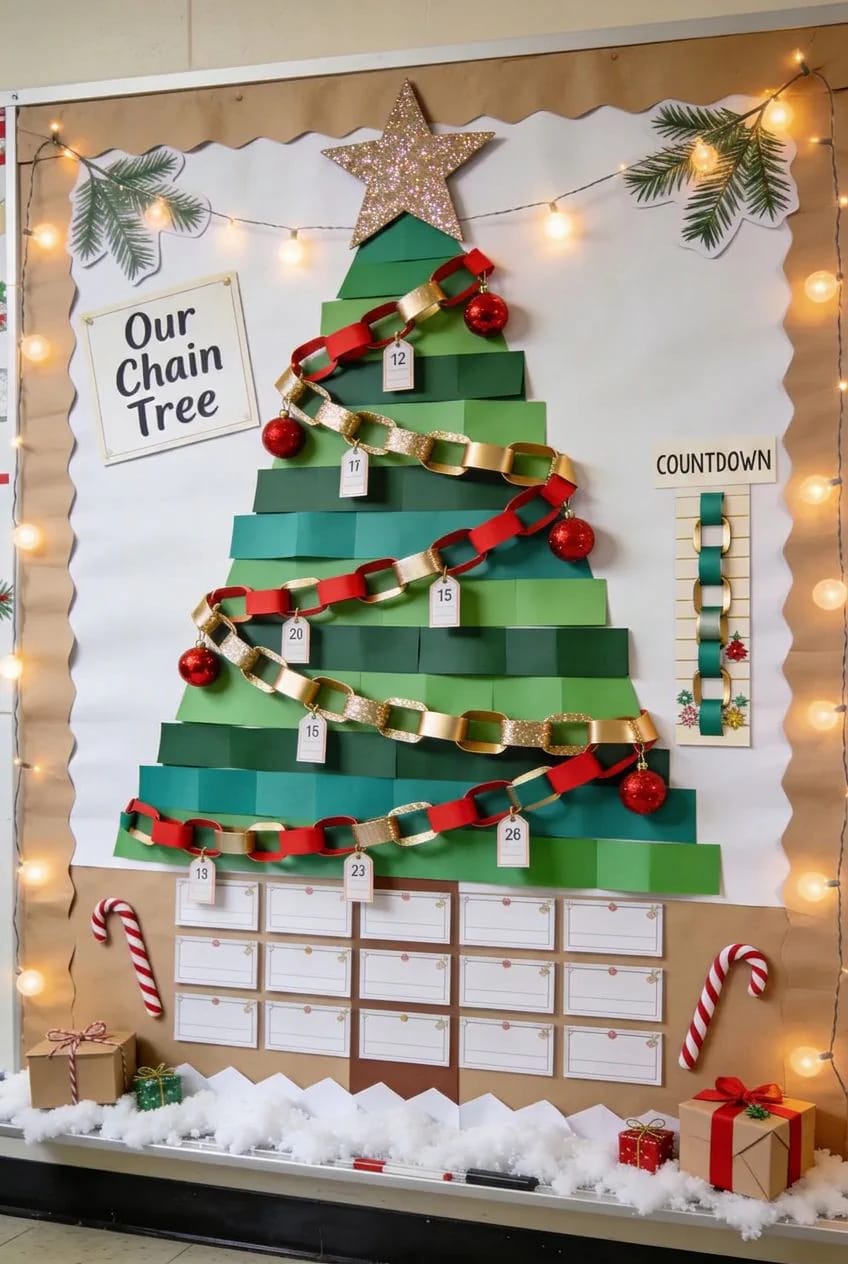
This is the one idea on the list that gets every student's hands on the board in a single class period, which is why it beats anything you cut out yourself the night before. Twenty-four kids making eight links each is 192 links, and 192 links is a tree that fills a standard board. The build is trivial: strips, a loop, a staple, thread the next strip through, repeat. The design decisions are where it goes wrong.
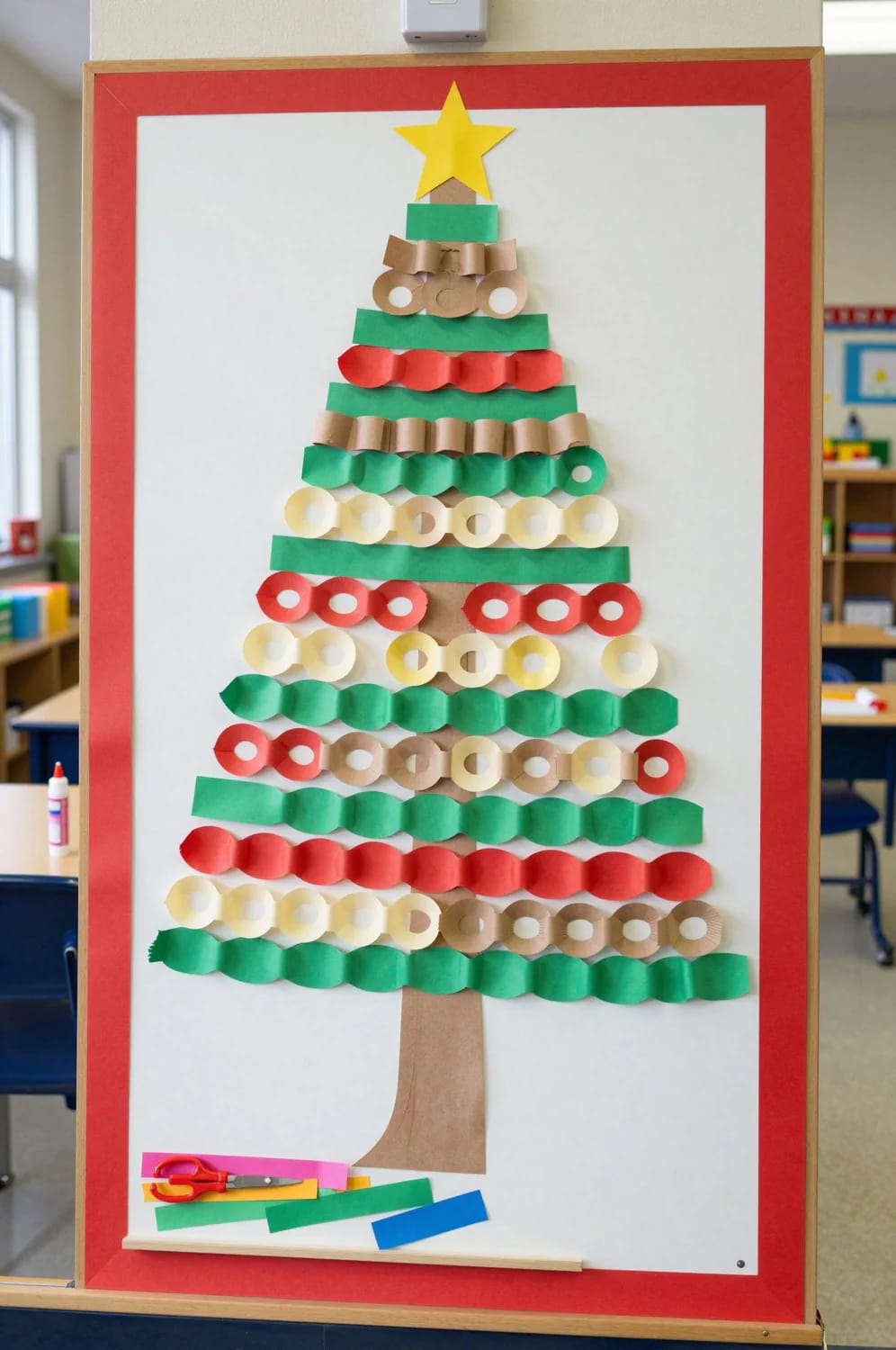
Cutting strips so the tree reads as a triangle from the doorway
Cut the strips at roughly 1.5 by 8 inches and staple the finished chains in horizontal rows rather than looping one continuous chain into a spiral. Rows give you a clean silhouette you can control; a spiral gives you a green blob that only reads as a tree if you already know it is one. Make the bottom row your widest, then take two links off each row going up. Six to eight rows is the sweet spot for a 4×6 board.
Weight matters more than it should. Standard construction paper goes limp within a week under classroom humidity and the rows start to sag into each other, so use a heavier stock if you have it. A 65 lb cover weight holds a fold and holds a staple, and one 250-sheet pack of Astrobrights 65 lb colored cardstock in the primary assortment cuts into more strips than a class of thirty will get through. If your budget is genuinely zero, the recycling bin of colored copy paper works; just expect to restaple in week two. There is a wider set of paper decorations built on the same cut-and-fold logic if you want to carry the material through the rest of the room.
The countdown variation, and why it is the weaker one
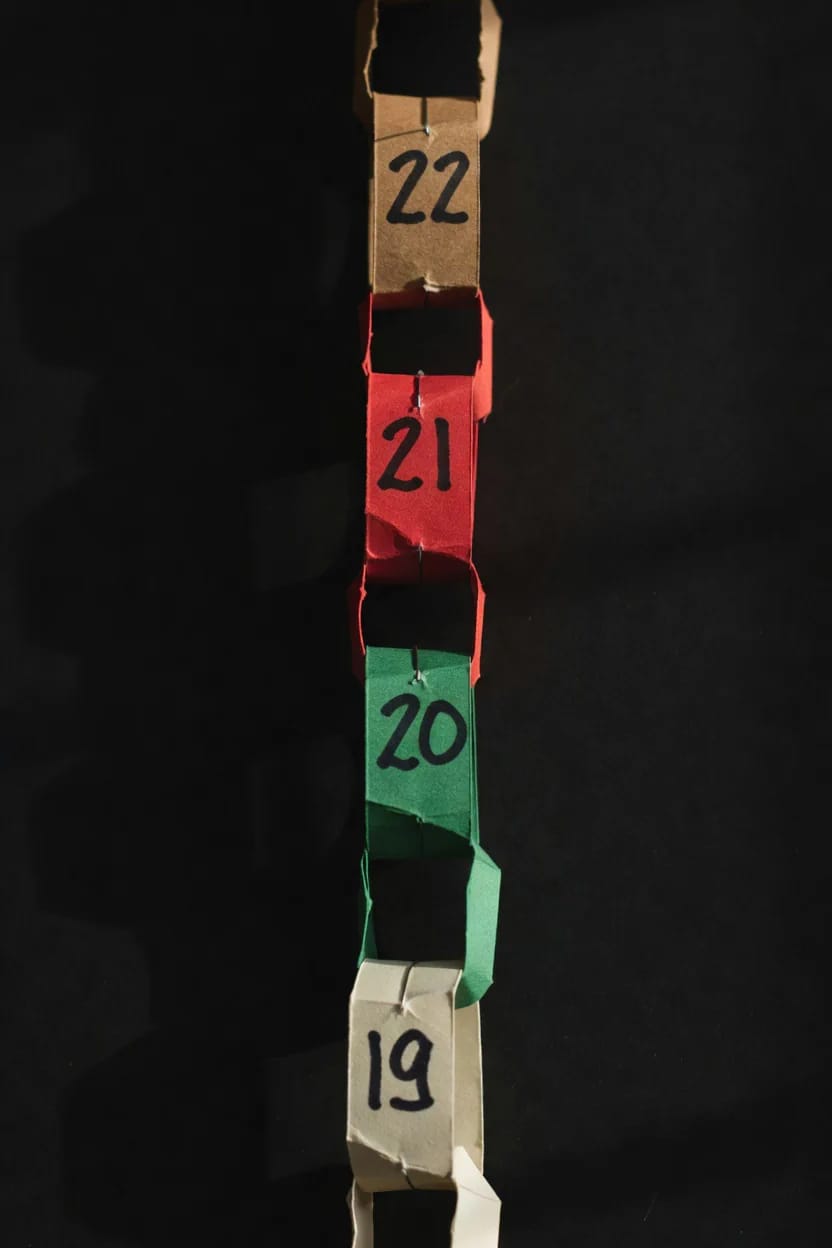
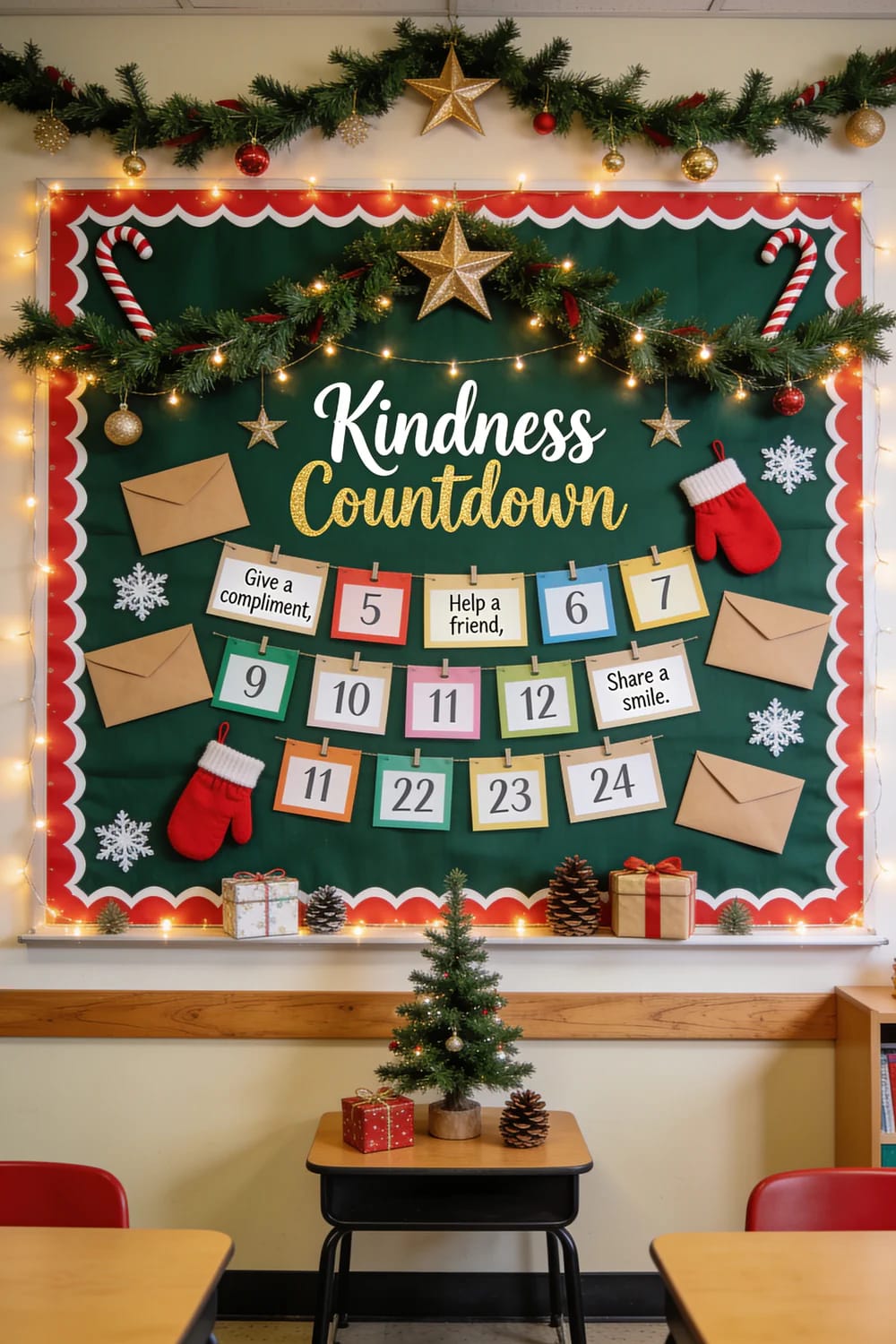
Number the links backward from the last school day and tear one off each morning. Kids love it, it takes ninety seconds of the morning meeting, and it is a legitimate counting exercise for K through 2. My hesitation is what it teaches: a countdown board says the point of December is the day December ends, and by the eighteenth you are looking at a stub. The version below fills up instead of emptying out, and it holds attention longer.
Trade the Christmas countdown board for a kindness board
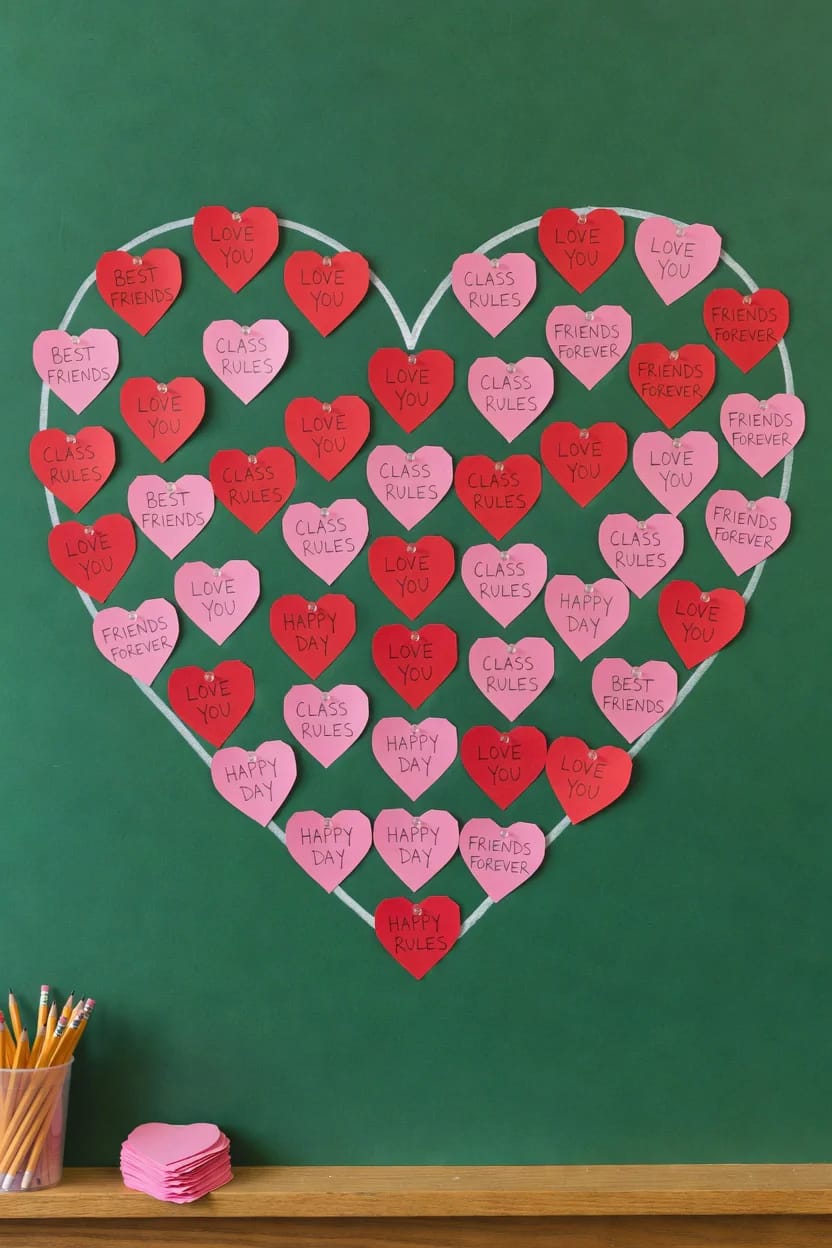
A kindness board earns its wall space for the whole month because it changes every day without you touching it. The mechanic is simple: a paper heart goes up whenever a student catches a classmate doing something decent, with two or three words on it and no name of the giver. Draw a large heart outline on the backing in white chalk marker and let the small hearts fill it in. By the last week the outline has disappeared under them, which is the entire visual payoff.
The Grinch framing is the obvious skin for this, and it is obvious for a reason: the heart that grows three sizes is already the mechanic. Just do not buy the licensed cutouts. A green board, red hearts, and hand-cut letters get you there for the cost of paper, and the bought version looks like every other bought version in the hallway. If you want the palette to actually work, it is worth seeing what a Whoville scheme looks like when it goes past green and red, because candy brights and curved shapes are doing more of the work than the character is.
Back the Christmas board in black, not red and green
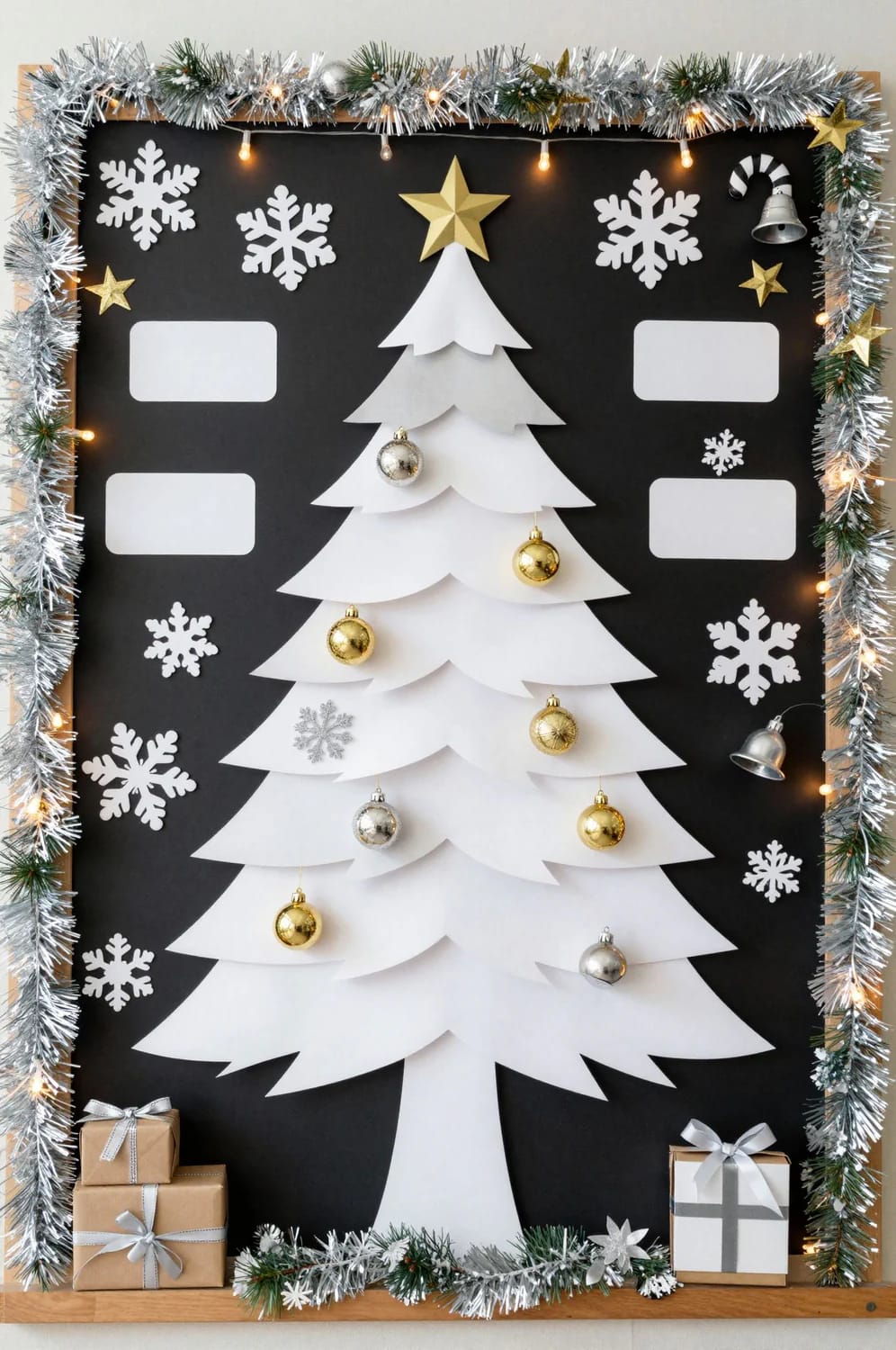
Back the board in black. This is the single decision that separates a Christmas bulletin board that photographs well from one that reads as noise from the hallway, and it costs the same as any other color.
What black does to red-and-green student work
Everything the students make in December is red and green. If the backing is also red or green, the work sits on top of its own color and the board flattens into one field. Black pushes every piece of paper forward, cream and white letters snap out, and the fluorescent overheads stop washing the whole thing gray. A 48-inch by 50-foot roll of Fadeless black bulletin board paper will do that board and the next four, and the fade resistance is the actual reason to buy the branded roll rather than butcher paper, which goes brown along the top edge by February.
A wrapping-paper border instead of the catalog scallop
Skip the scalloped border trim. (The die-cut holly scallop from the teacher-supply catalog is the Comic Sans of classroom decor, and it is currently on roughly every board in America.) Cut a 2-inch strip of wrapping paper and run it around the edge instead. Matte kraft with a small printed motif, not foil: foil throws a hard specular glare under ceiling fluorescents and every photo of the board comes back with a white stripe across it. One roll of dollar-store wrap borders three boards and costs less than the trim pack.
String lights on a classroom Christmas board are a code question first
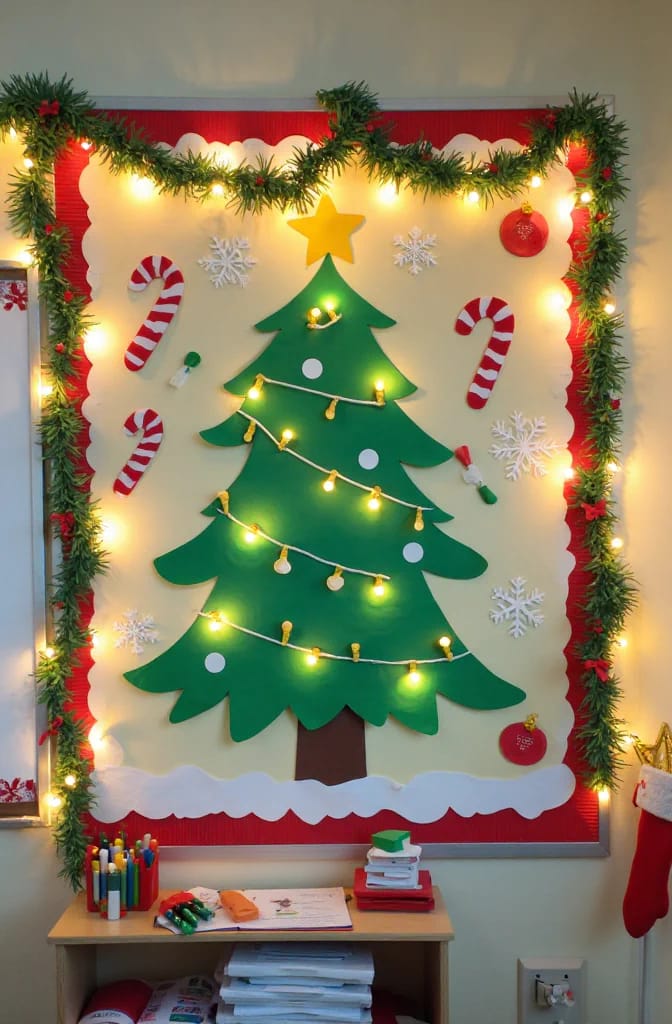
Lights are the fastest upgrade a Christmas board gets, and they are also the thing most likely to get a note from the building inspector. Worth knowing the actual rules before you string anything, because the rules are less restrictive than staff-room rumor and more restrictive than Pinterest.
The 20 percent rule and where a bulletin board sits inside it
Under NFPA 101, artwork and teaching materials attached directly to the walls of an educational occupancy are capped at 20 percent of the wall area in a building with no sprinkler system, and 50 percent in a sprinklered one. The distinction that matters for you: a designated bulletin board is a display surface, and the trouble usually starts when the display creeps off the board and onto the painted wall around it. Fire marshals also commonly ask that nothing hang from sprinkler heads, that materials stay clear of the ceiling by a foot and a half to two feet, and that nothing combustible sits within five feet of an exit door. The Columbia Fire Department’s classroom guidance lays those out in plain language if you want something to forward to a colleague. I could not find a district that publishes its own square-footage math for the calculation, so treat 20 percent as the shape of the rule and your building’s fire marshal as the number.
Battery, timer, and nothing touching the sprinkler head
Battery-operated copper-wire strings solve most of it at once: no extension cord across a walkway, no plug load, nothing to trip a breaker, and a built-in timer means the lights are off overnight without you remembering. Look for a 33-foot run with 100 LEDs and a 6-hours-on timer; a multipack like these 33 ft battery-operated fairy lights with a timer and remote covers a board, a window, and the reading corner. Run the wire under the border strip rather than across the face of the display so the copper disappears and the light reads as a glow along the edge. Warm white only. Multicolor on top of red-and-green student work turns the board into a slot machine.
Let the students be the ornaments on the Christmas bulletin board
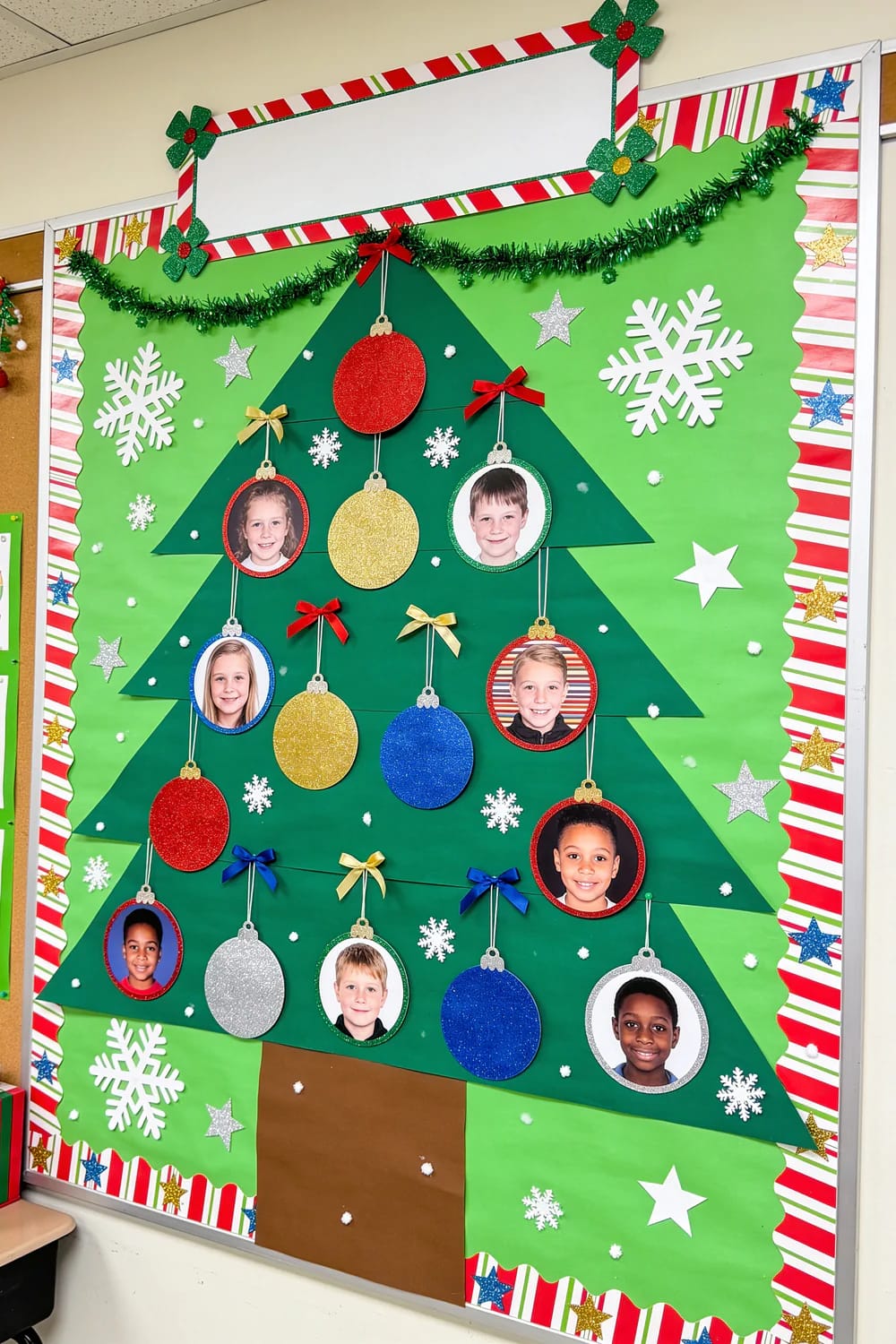
Every kid on the board means every family stops at the board on conference night. That is the whole argument, and it is a strong one. The execution risk is that twenty-four ornaments made by twenty-four different skill levels turn into a jumble, and the fix is uniformity in the mounting rather than in the making: cut every backing to the same 4-inch circle in the same cardstock, and let whatever happens inside that circle happen.
The photo version beats the handprint version after about age seven
Pre-K and kindergarten: handprints, every time. A green handprint with the fingers spread makes a passable wreath or tree, the families keep them, and the developmental point of the exercise is the making. By second or third grade the handprint reads as babyish to the kids themselves, and a 3-inch photo head mounted on a paper bauble does the job better. Print in grayscale if your color budget is what most color budgets are; grayscale photos on colored cardstock actually hold together as a design better than washed-out color prints. Which pieces survive being handled by thirty people is its own question, and there is a rundown of which kid-made decorations hold up and which fall apart that is worth a look before you commit a class period to one.
 21 Festive Classroom Christmas Decor Ideas for a Joyful Season Twenty-one ideas for the walls, windows and shelves once the board is done.
A Christmas writing board adults actually stop and read
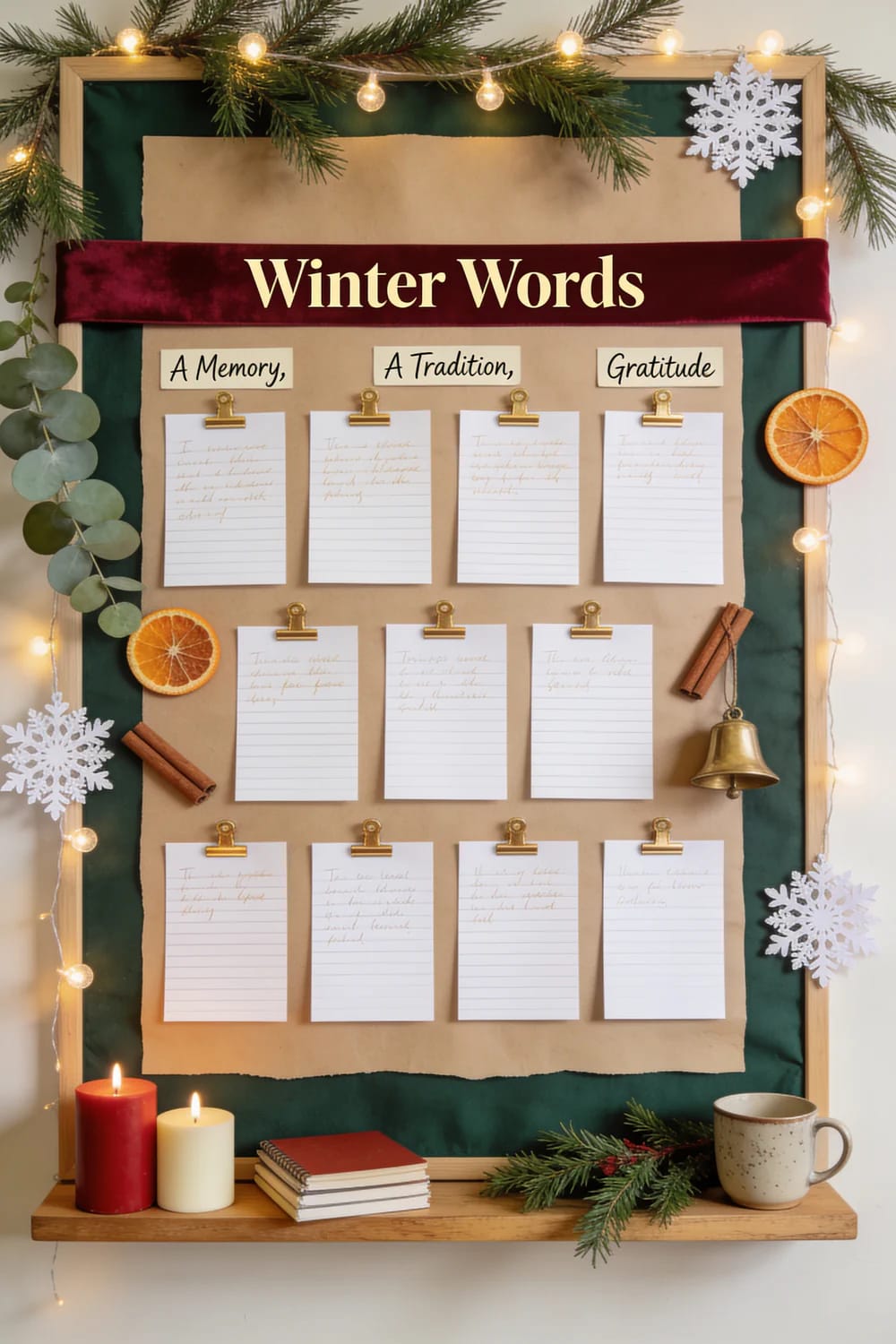
Get the prompt right and the display takes care of itself. "Dear Santa" works to about age eight and then dies; past that, ask for a thank-you note owed to someone in the building, or a persuasive paragraph arguing for one change to the December schedule. Both produce writing that adults stop and read, which is the actual metric for a hallway-facing board.
Two mechanical rules. Uniform card size, because a wall of mixed full-page essays gets read by nobody. And excerpt rather than display: pin the strongest three sentences on a card and keep the full draft in the folder. Twine and clothespins beat staples here, since you can swap a card without rebuilding the board.
Build the Christmas board so it becomes a winter board on January 3
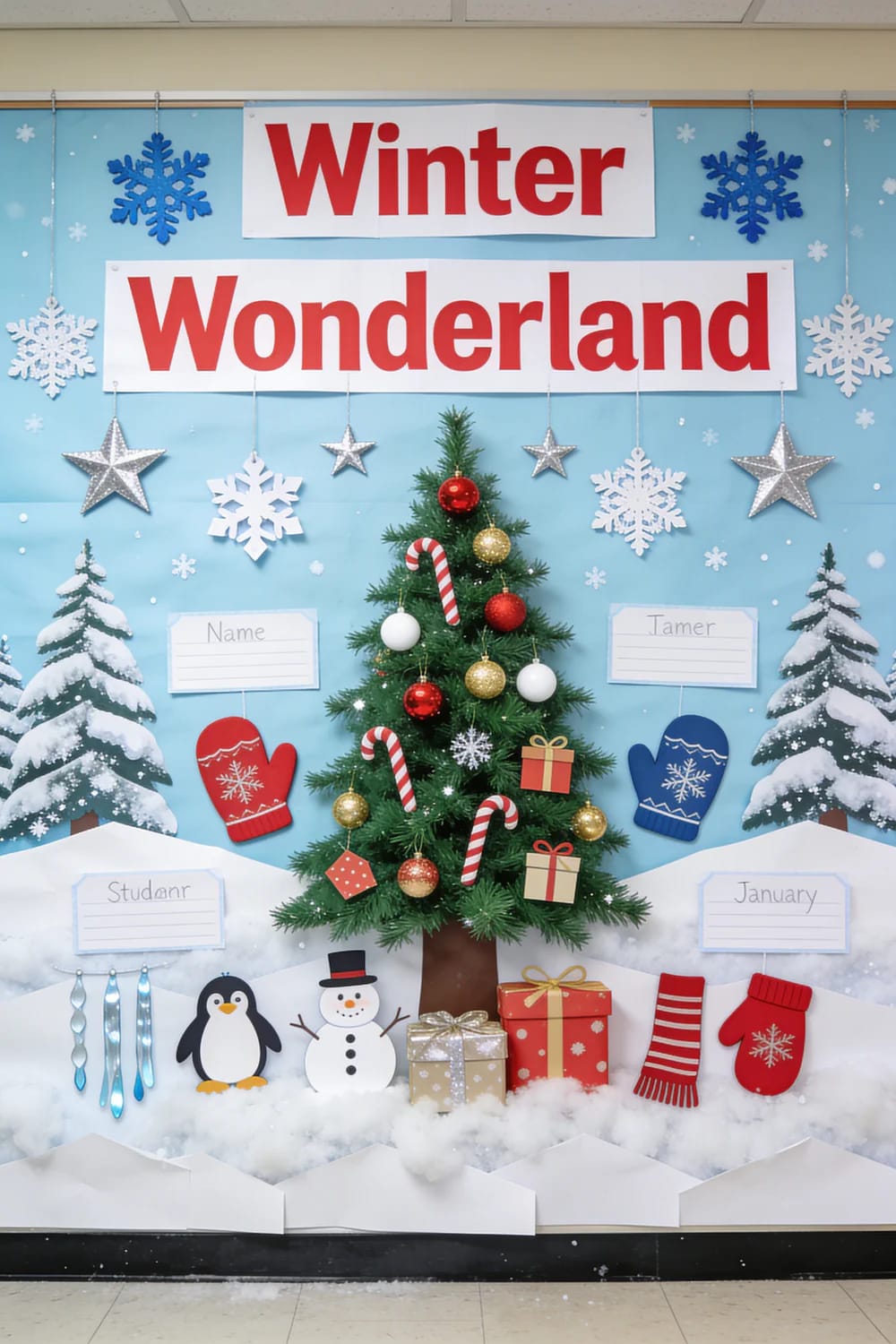
Design the board in two layers from the start and you buy yourself January and most of February for free. The permanent layer is the backing, the border, the letters, and a horizon: a low white snow line across the bottom third, a row of bare cut-paper trees, a scatter of snowflakes in the upper corners. The temporary layer is everything that reads specifically as Christmas, and it goes on with push pins, never staples or glue.
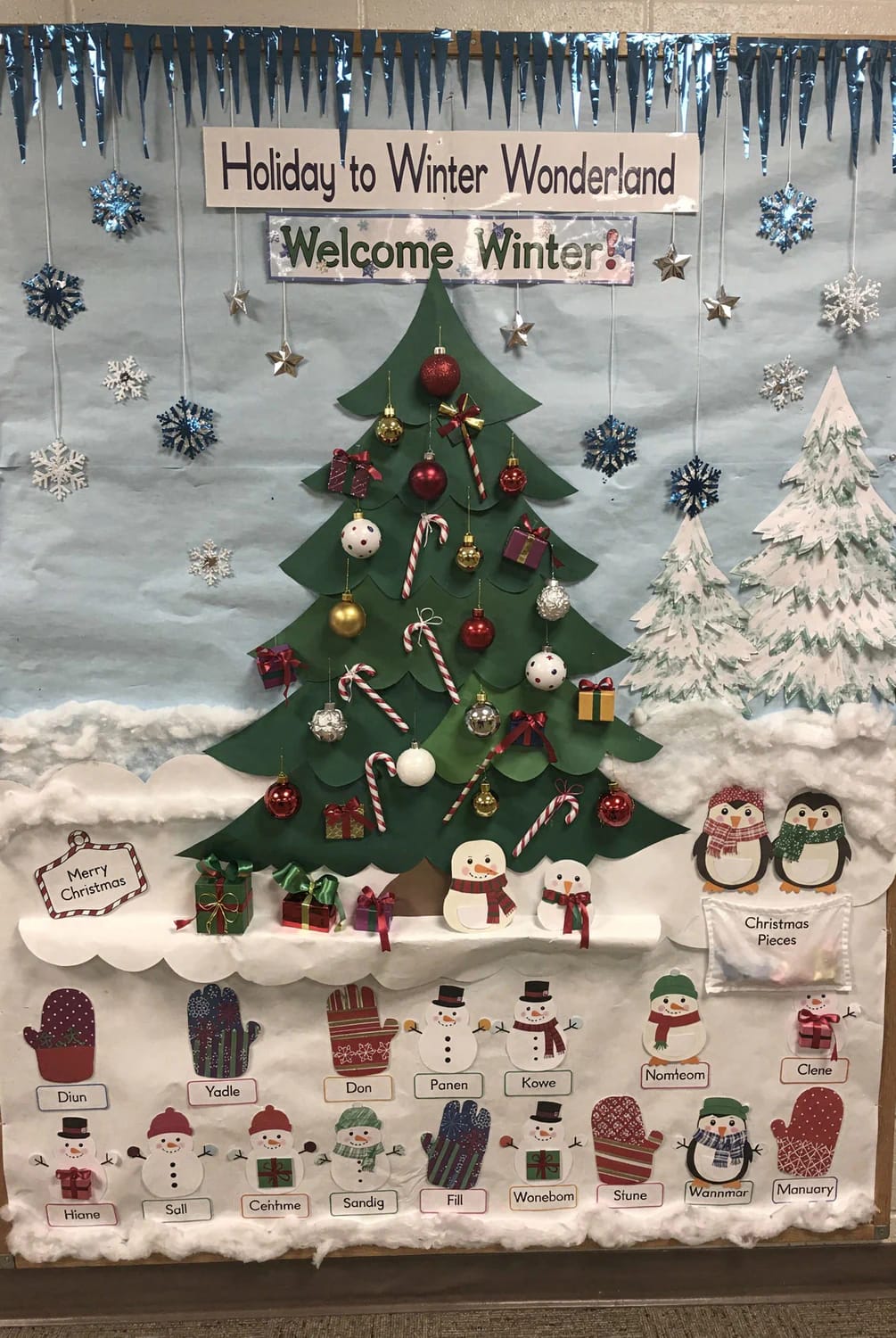
What stays up and what comes down
- Stays: black or deep blue backing, the snow line, the tree line, the cut letters if you word the heading neutrally, any student writing about winter.
- Comes down on the first work day of January: baubles, the paper chain tree, anything red-and-green, the star.
- Goes up in its place: paper snowflakes, which the class can cut in fifteen minutes, plus a January goals or new-year writing swap onto the same twine lines.
- Word the heading so it works in both months. “Warm Wishes” survives January; “Merry Christmas” does not.
Ten minutes of teardown instead of a full rebuild during the week everyone comes back exhausted. That is the entire return on doing it this way, and it is enough. If you want the January half to stand on its own rather than look like a Christmas board with the ornaments picked off, there is more on winter decorating that is not tied to December 25.
The other reason to build it this way
A layered board also handles the room where not every family celebrates Christmas. The permanent layer is snow and cold and turning the year over, which is true for everyone in the building; the Christmas layer sits on top of it and comes off. This is a quieter fix than a full winter-holidays board and, in most classrooms, a more honest one, because it does not pretend the tree was never there.
Whatever combination you land on, do the backing first. Every other decision on this list, the black, the border, the light run, the pins over staples, depends on the paper going up flat and square before a single student ornament exists.
And leave the letters until last. Cut heading letters are the one element you will want to reposition twice, and they are also the one element that gets stapled down permanently by someone who is out of time on a Thursday afternoon.
Related Posts
- 21 Festive Classroom Christmas Decor Ideas for a Joyful Season
- 9 Classroom Christmas Door Decorating Ideas for Teachers (Built for Paper, a Glue Stick, and a Room Full of Kids)
- Christmas Mantel Decorating Ideas That Actually Hold Up All Season
- 31 Festive Christmas Decorating Ideas to Inspire Your Holiday Season
- 15 Modern Christmas Decor Ideas for 2024
- 25 Stunning Classic Christmas Decorations: Ideas To Copy In 2025