
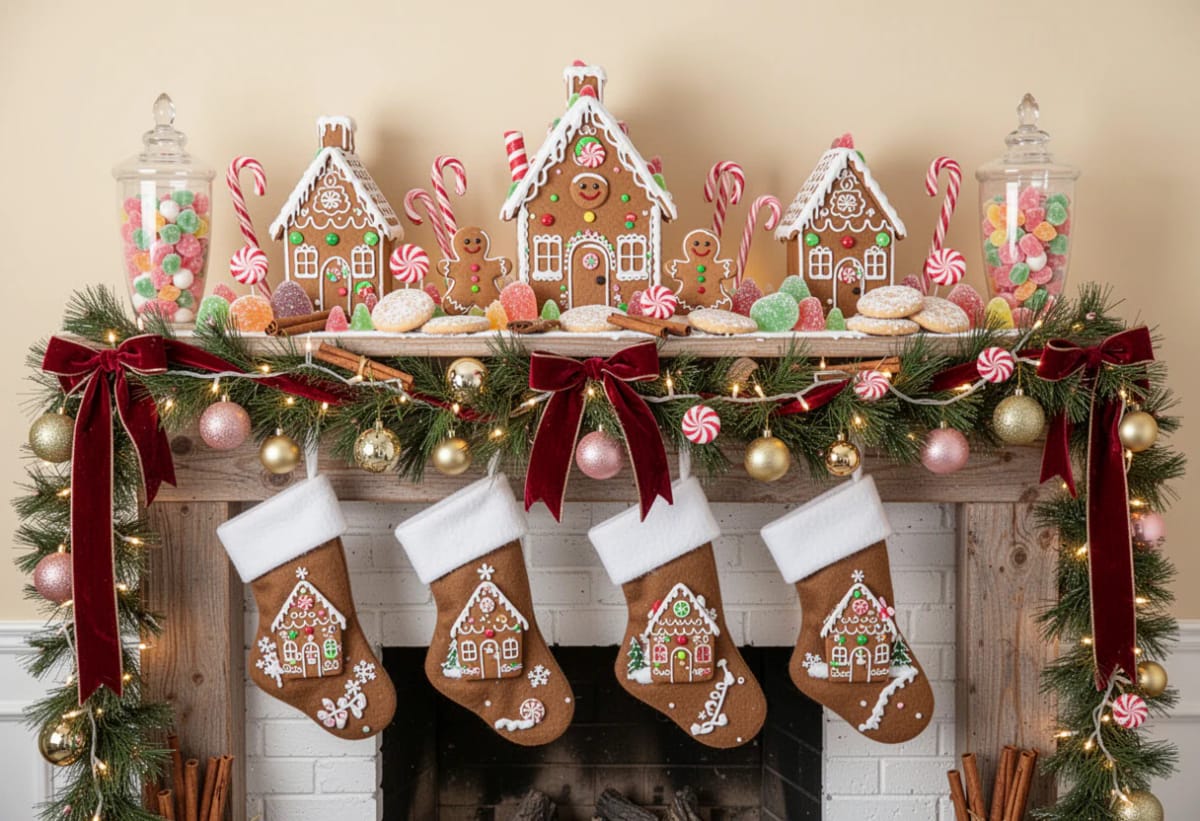
Most mantels are about five feet of shelf and seven inches deep, and almost every gingerbread and candy piece sold for one is deeper than that: cottages with porches, apothecary jars of ribbon candy, lollipop stakes in a crock. That mismatch is why so many sweet-themed mantels end up as one flat row of objects shoved against the wall with a plastic garland sagging underneath. The thirteen ideas below are organized around solving it, starting with what goes down before anything sweet does and ending with the last pass most people overshoot.

Palette and base layer, before anything sweet goes up
1. Build the gingerbread palette on molasses, icing white, and one pink
Pick three colors and refuse the fourth. Molasses brown carries the cookie bodies and the houses; icing white carries the piping, the trim, and later the faux snow; one candy accent carries everything else. The moment red and green both turn up, the mantel stops reading as a bakery and starts reading as generic Christmas with cookies on it.
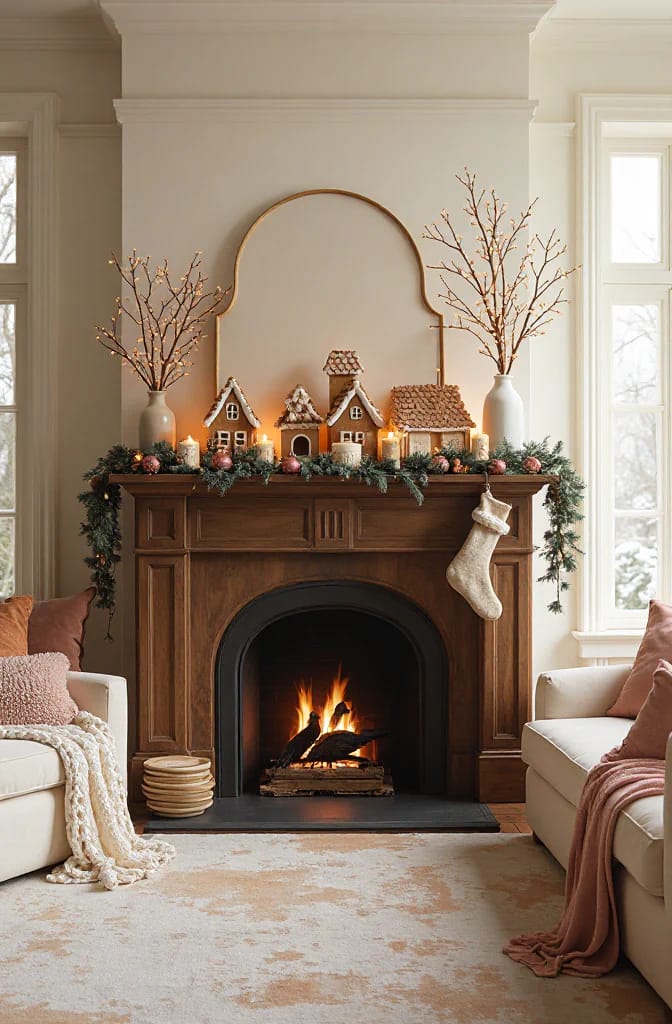
Pink is the accent currently doing the most work, and it is no longer a novelty finish: manufacturers now sell the same lit cottage in blush that they sell in brown, which is a decent proxy for how far the pastel version has traveled. Granted, it only works in some rooms. Against orange-red brick a blush accent goes muddy and you want a deep cherry instead, and against a white painted surround the pink is the only thing keeping the whole arrangement from disappearing.
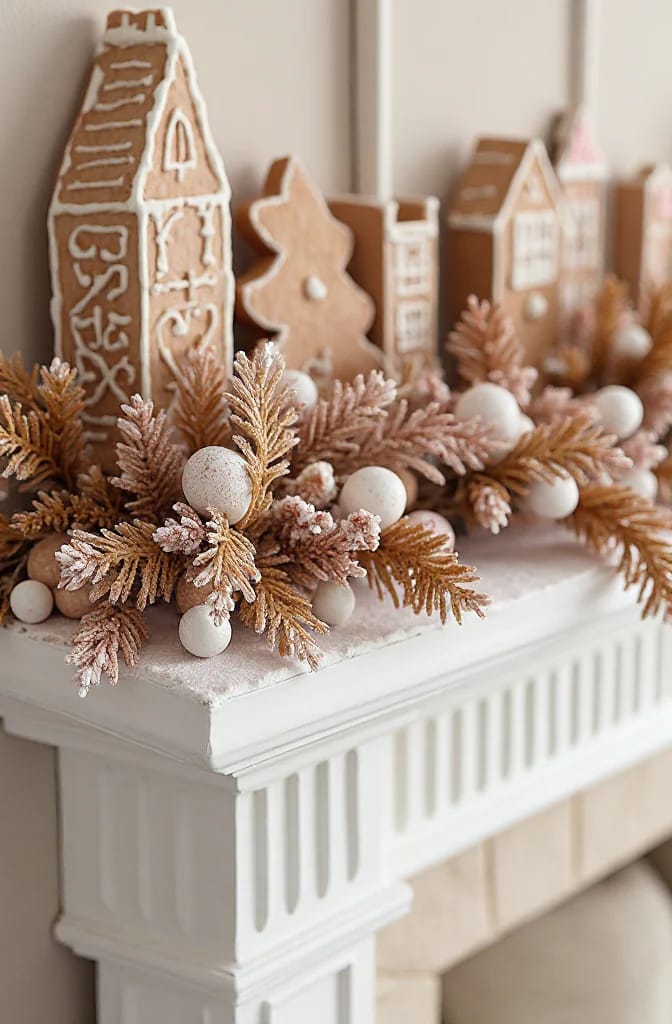
A small lit house is the cheapest way to test whether the pink accent works in your room before you commit a whole shelf to it.
LIBOOI 6.3 inch lighted pink gingerbread candy house, battery poweredThe same three-color discipline is what separates a gingerbread kitchen that still looks like a kitchen from one that reads as a themed merchandise display, and it matters more on a mantel, where there is no counter run to absorb the clutter and every object is at eye level.
2. Put a felt runner under the mantel display so brown does not vanish into brown

Lay a strip of cream or gingham felt down the shelf before a single cookie goes up. A wooden mantel is already brown, gingerbread is brown, and stained oak plus molasses-brown resin reads as one indistinct smudge from across the room; the felt is what gives every piece an edge. Cream wool felt at around a fifth of an inch thick sits flat without curling at the ends, which cheap craft felt will not do by week two.
Gingham in a small check is the other option and it behaves differently. It brings a second pattern in, so use it only if the stockings are plain, and cut it about two inches wider than the shelf on each side so a little drapes over the front lip. Most of the fixes for a mantel that sags or slides by mid-December are questions of quantity and physics rather than taste, and the base layer is the first of them.
3. Decorate the mantel face, not just the shelf
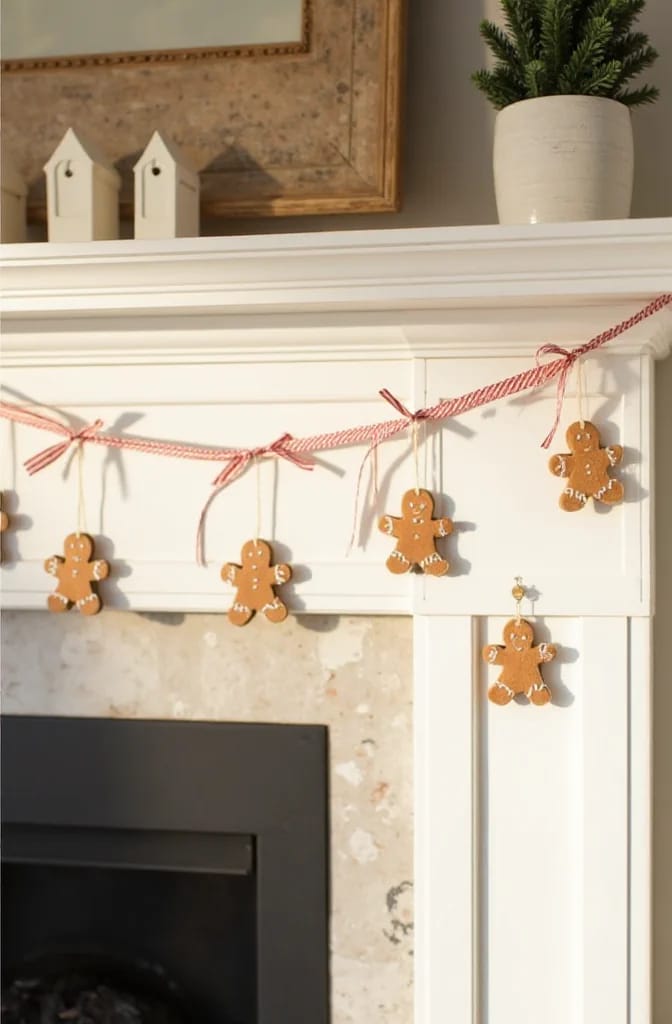
The vertical face under the shelf is the most underused surface in the room and it solves the depth problem outright. A candy-stripe grosgrain ribbon run horizontally across the face, tacked at both ends, with small gingerbread ornaments hung off it at uneven intervals, gives the mantel a second register of decoration that takes up zero shelf depth. This is the single move that pulls a gingerbread mantel out of the flat-row problem.
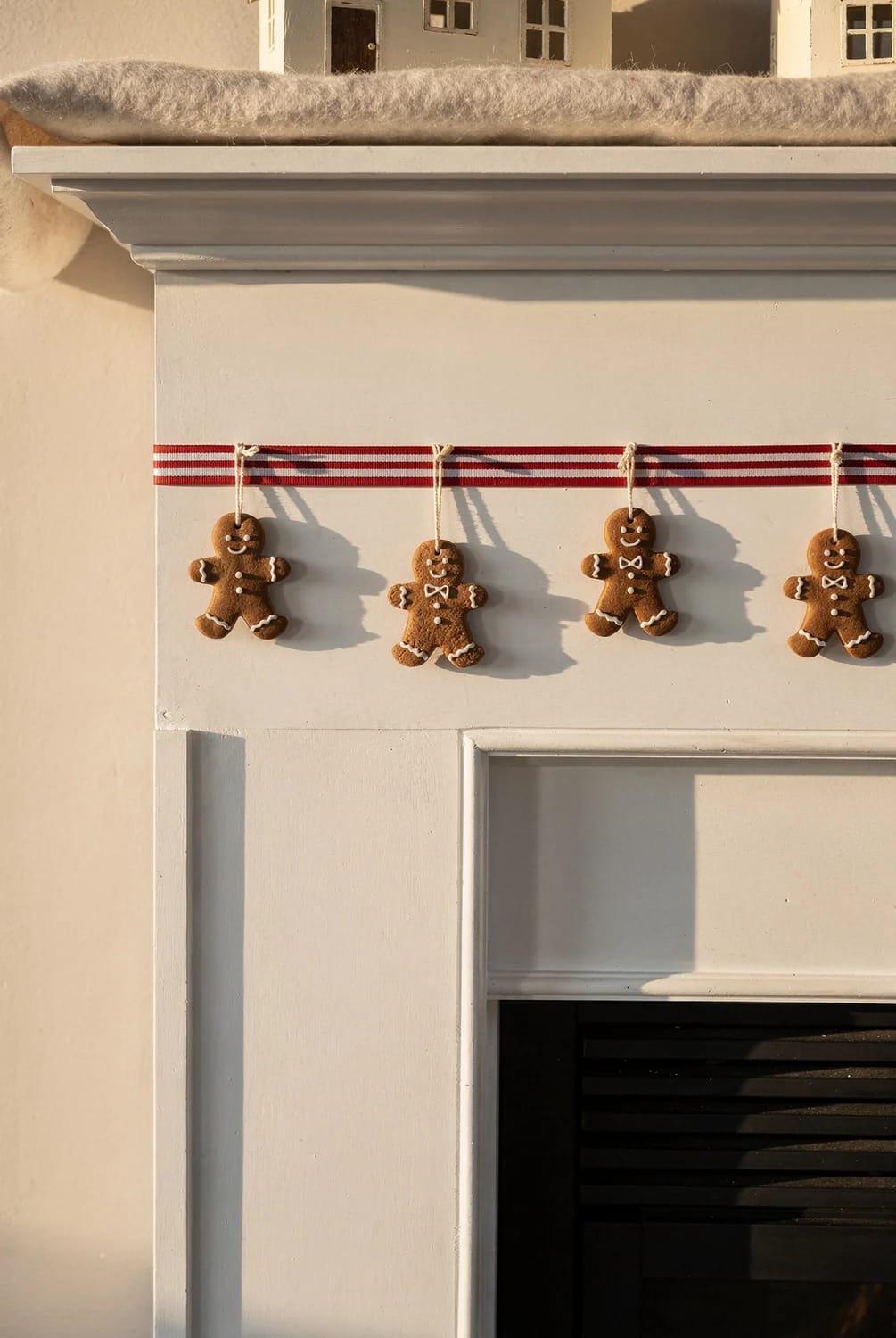
Do this
- Use removable adhesive hooks rated well above the weight you are hanging, then hide them under the ribbon ends.
- Hang in odd numbers at uneven heights. Seven ornaments at seven different drops beats eight in a tidy line.
- Let the ribbon sag a little between fixings; a taut horizontal line looks like signage.
Avoid
- Glue or nails on a painted face you will want intact in January.
- Anything heavy enough to swing. Resin figures over about four inches start knocking the face on every door slam.
 Christmas Mantel Decor Ideas With Garland That Look Designer, Not Draped-On What to layer underneath, how to drape it, and what to leave off entirely.
Gingerbread architecture on a seven-inch shelf
4. One lit gingerbread cottage, off-center, taller than everything else
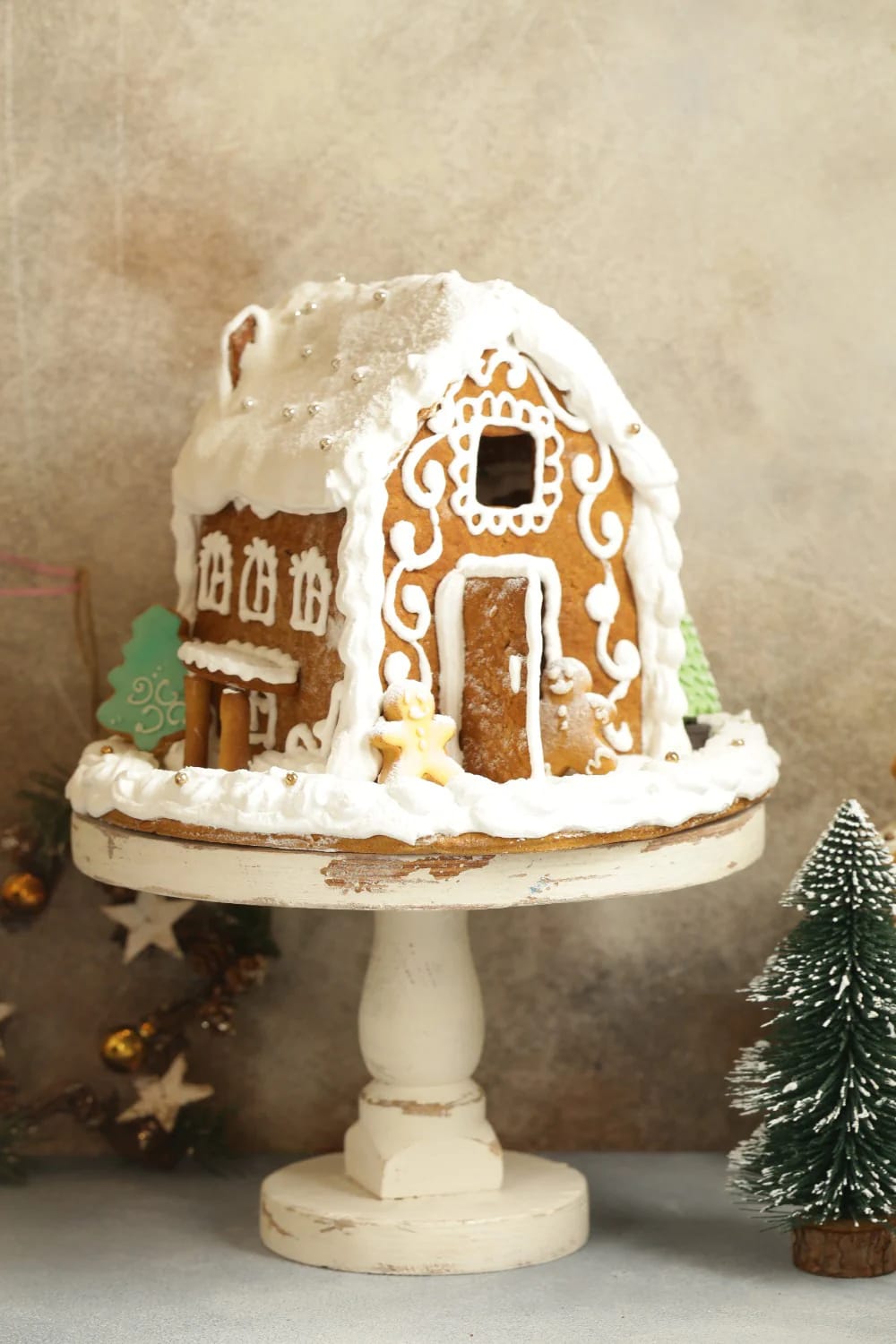
Put the tallest house at roughly sixty percent of the way along the shelf, not the middle. Centered symmetry on a mantel is what makes it look like a mantelpiece display rather than a room someone lives in, and the off-center anchor gives the garland and the smaller pieces somewhere to run toward. Eight to nine inches tall is the sweet spot for a standard five-foot shelf; below six and it disappears behind the garland, above twelve and it starts competing with whatever hangs on the wall.
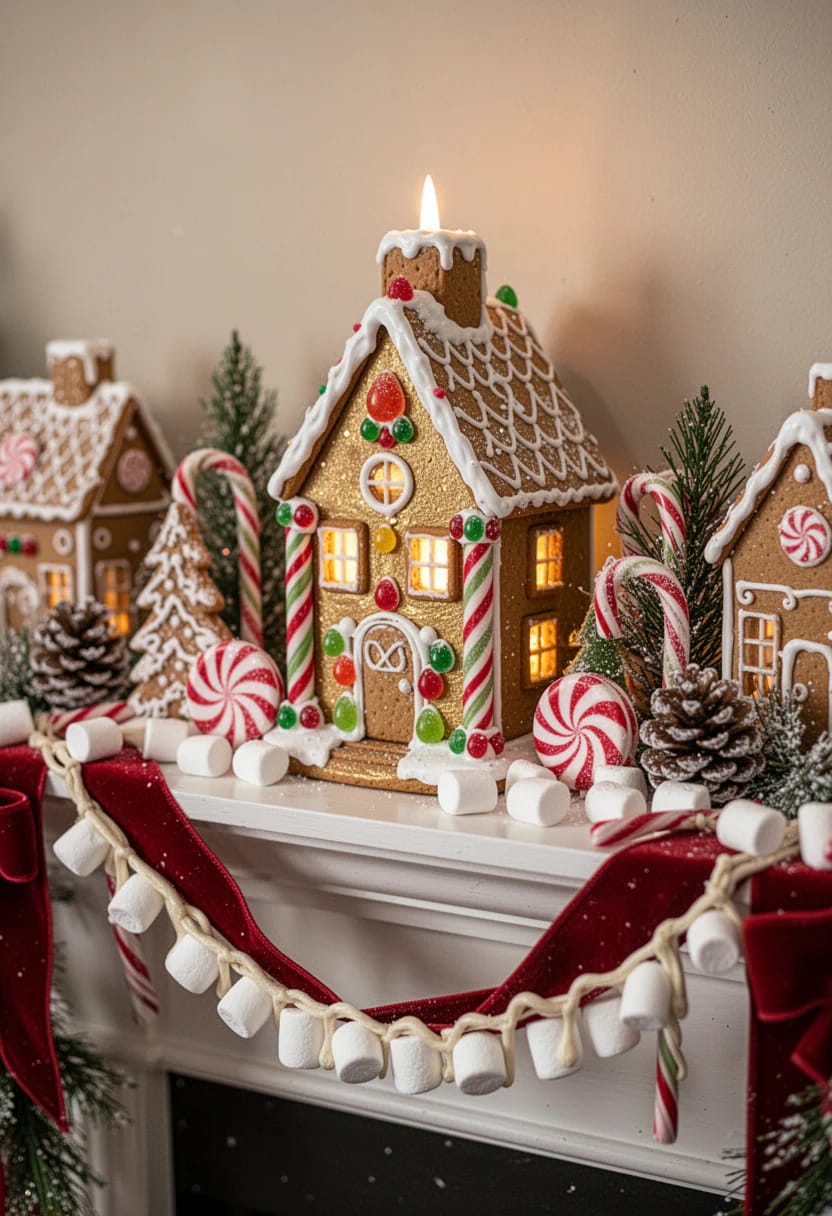
Buy for the finish, not the size. Resin and claydough houses hold hand-painted icing detail that survives close inspection, and both take an internal LED without the plastic glow-through you get from thin PVC. The cheap PVC ones look convincing in the listing photograph and like a lampshade in the room.
Resin holds the piped-icing texture that reads as real from three feet away, and at 8.25 inches it clears a garland without towering.
Braxio 8.25 inch resin gingerbread house with LED light5. Stagger a three-house gingerbread village on hidden risers
Three houses in a flat row is the failure state; three houses at three heights is a village. Stack hardback books or cut lengths of two-by-four under the back two, an inch and a half of lift for the middle and three for the back, then push them tight so the footprints overlap in silhouette from the front. Seven inches of shelf depth cannot give you a real second row, but overlapping silhouettes at different heights read as depth from any angle in the room.
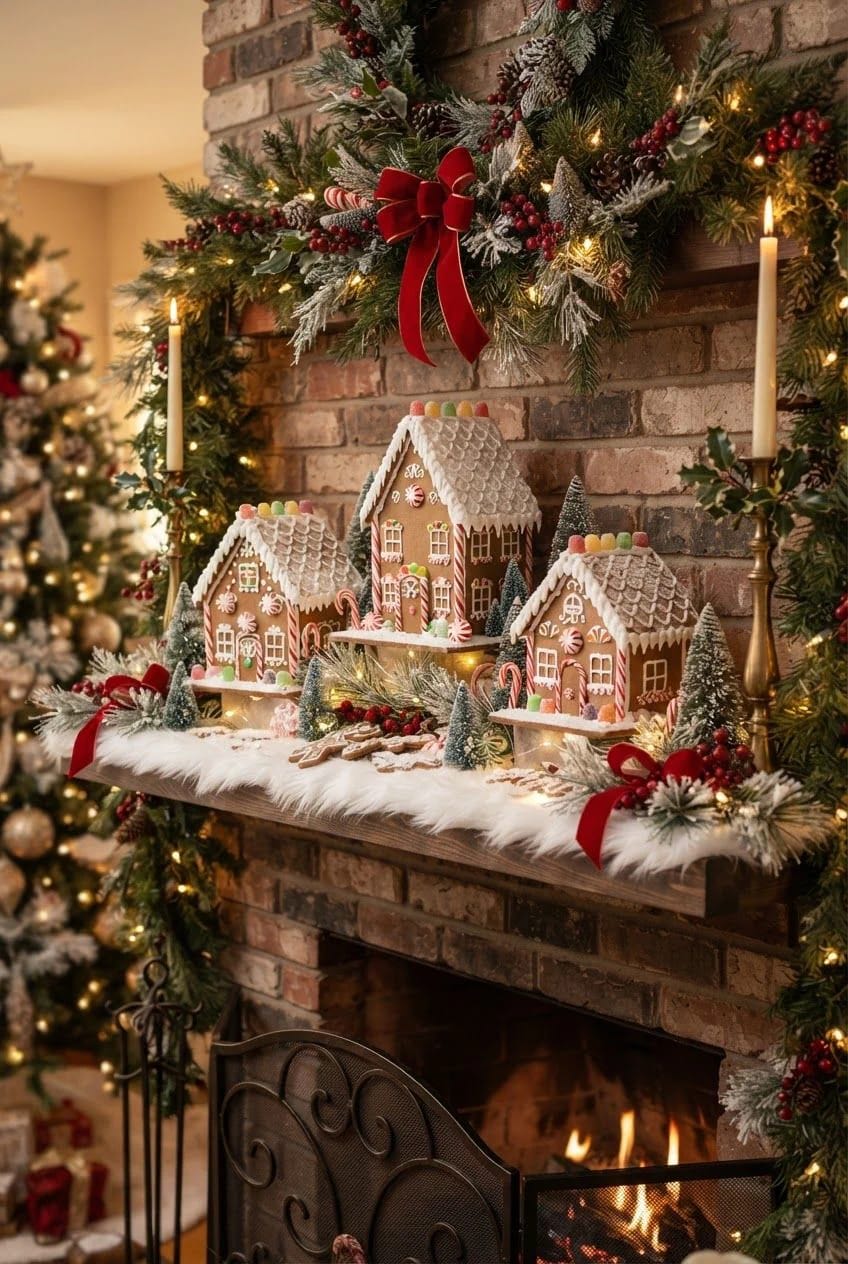
Match the material across all three, even if the shapes differ. A resin cottage next to a ceramic light-up next to a real baked house gives you three different surface finishes catching light three different ways, and the eye reads it as a collection of unrelated objects.
| House material | How it reads up close | Realistic lifespan | Rough cost each |
|---|---|---|---|
| Baked gingerbread | The real texture, but icing crazes and the walls darken | 2 to 4 weeks in a heated room | Cost of ingredients |
| Claydough | Matte and slightly grainy; closest to real at arm’s length | Years, if stored dry | $15 to $40 |
| Resin | Glossier, holds fine piped detail and an internal LED | Years | $20 to $50 |
| Ceramic light-up | High-gloss glaze, unmistakably ceramic, heavy | Decades | $25 to $60 new, far less secondhand |
| Paper or cardboard | Flat printed detail, but glows well with a light behind | One or two seasons | Under $20 for a set |
6. Lay a batting snow field under the village instead of dusting the shelf
Cotton batting laid as a continuous field does two jobs: it hides the risers and it visually joins three separate objects into one scene. Buy quilt batting by the yard rather than the bagged snow blanket, tear rather than cut the edges so they feather, and mound it slightly at the back so the field looks like ground rather than a tablecloth.
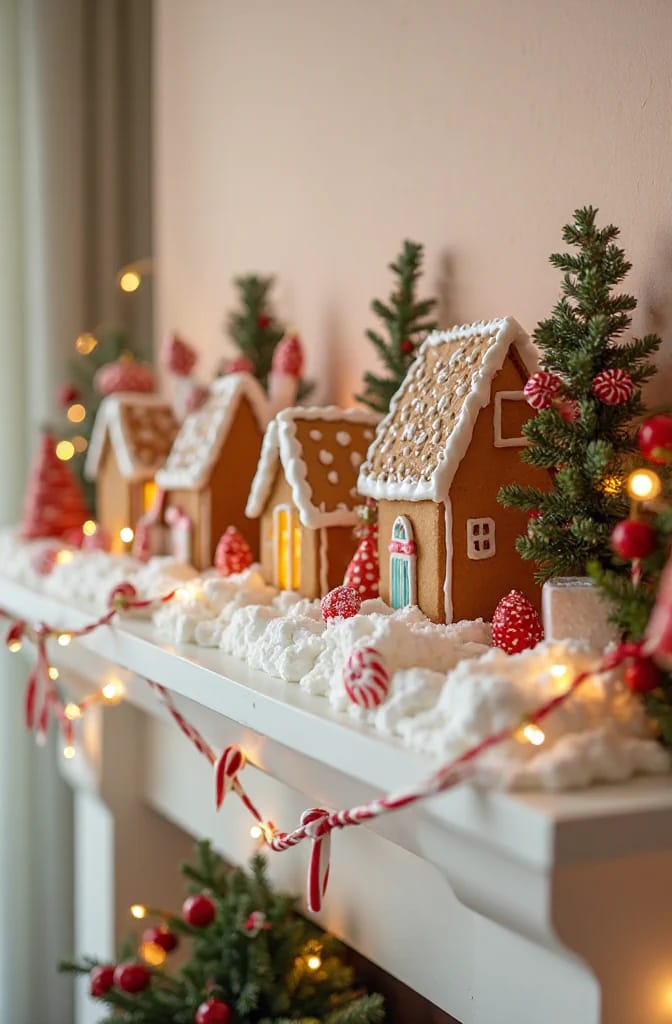
The dusting-only version, where people shake glitter snow directly onto a wooden shelf, is the one I would skip. It never distributes evenly, it migrates into the room for eleven months, and it does nothing for the riser problem you actually have.
7. Run a gingerbread cookie garland along the front lip
A strand of small gingerbread figures pinned along the front edge of the shelf gives the mantel a lower border, which is what stops the whole arrangement from floating. Sixteen two-inch claydough figures across five feet is about right; fewer than a dozen and the spacing looks accidental. Pin it at the lip rather than draping it from the underside, so the figures sit face-out toward the room instead of spinning.
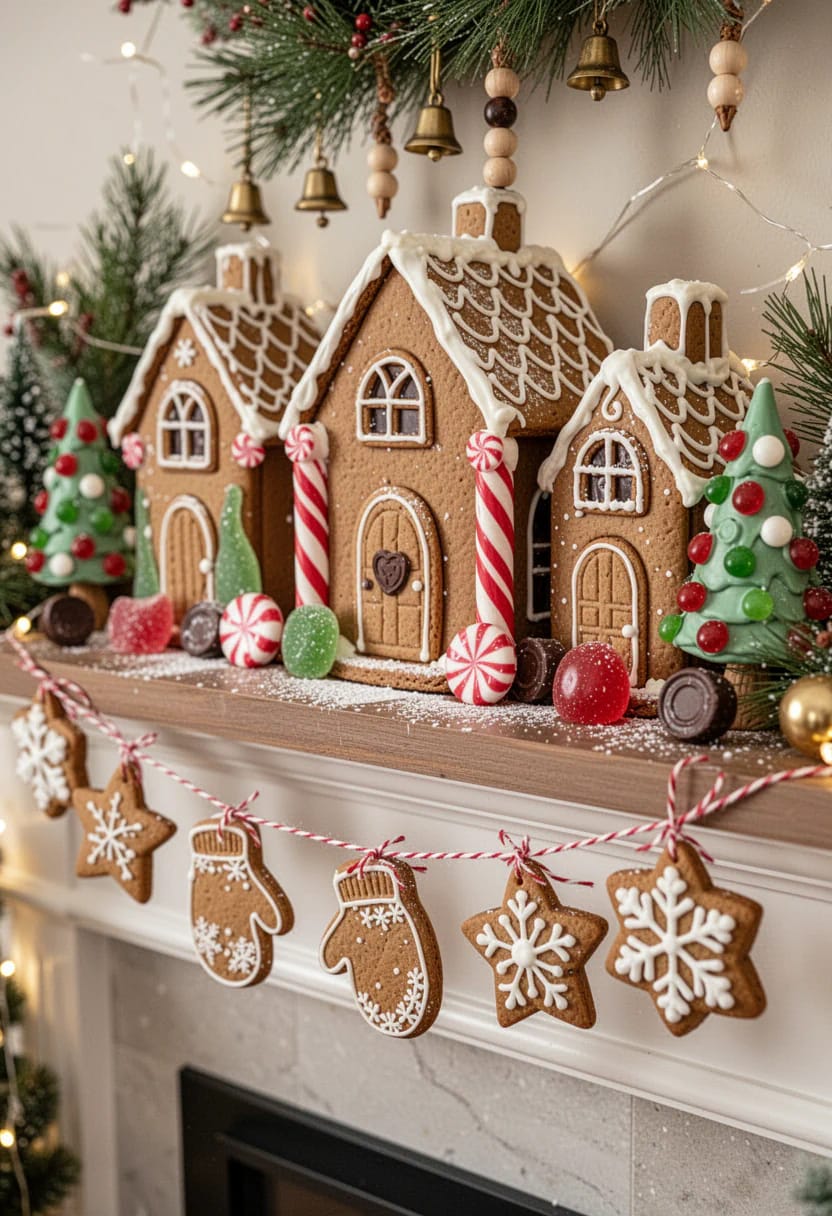
Nine feet of two-inch claydough figures covers a five-foot shelf with enough tail left to run down one side.
NorthPoleXpress 9 ft mini claydough gingerbread man garland, 16 figuresThe version that costs almost nothing is cinnamon and applesauce dough: ground cinnamon worked with enough smooth applesauce to make a firm rollable dough, cut with a small gingerbread cutter, holes punched with a straw before drying. Air-dry them for several days or hold them in a very low oven; they shrink noticeably as they dry, so cut them larger than you want them, and they perfume the room for weeks in a way no resin garland does.
The candy work, and where it goes wrong
8. Keep real candy under glass, not loose on the mantel
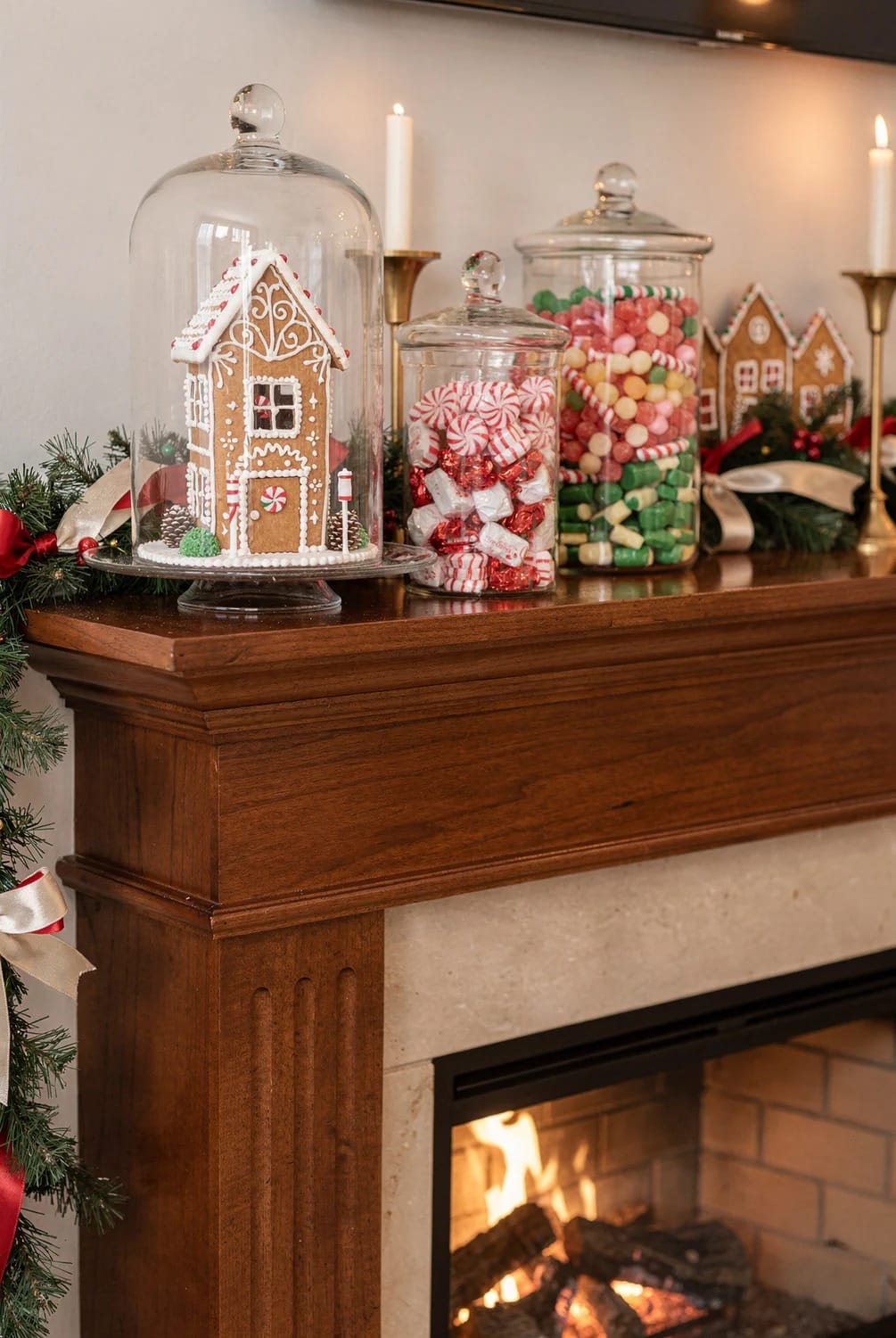
Real candy belongs on a mantel only inside something. A glass cloche over a low cake stand of ribbon candy, or a lidded apothecary jar of striped humbugs, keeps the color and the gloss while solving every practical problem the loose version creates. Ribbon candy in particular is worth the trouble: the folded ribbons throw light through themselves in a way no plastic reproduction manages, and a single eight-inch cloche of it holds its own against a lit cottage twice the size.
Loose candy is a different story. Hard candy is hygroscopic and goes tacky in a heated room, unwrapped canes yellow at the white stripes within a fortnight, and anything with chocolate in it softens well below the temperature a mantel above a working firebox reaches. Whimsy on this scale works, but it has to survive December to be worth doing, which is roughly the argument for letting the rest of the room go maximalist while the mantel stays edited.
The IRC treats a mantel as combustible trim and bars combustible material within 6 inches of the fireplace opening, with anything in the 6 to 12 inch band limited in how far it may project. Decor is not framing, but the reasoning holds: a garland tail, a ribbon end, or a strand of cookie figures that hangs down toward a working firebox is sitting in the hottest part of the room. Keep every hanging element clear of the opening, and if you actually burn wood, treat the shelf as a display surface only and put the candy somewhere else.
9. Stake oversized lollipops in a weighted crock for the height gingerbread never gives you
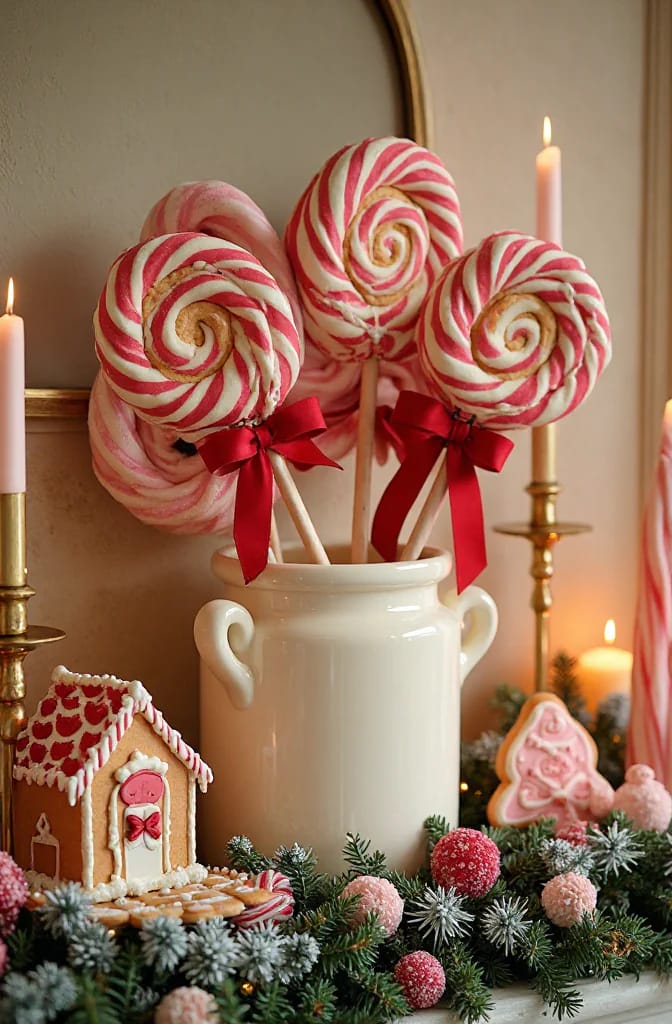
Gingerbread pieces are wide and low; lollipop stakes are the only candy element that goes genuinely vertical without hanging from the wall. Three stakes at eighteen to twenty-four inches, in an eight-inch stoneware crock filled with sand or gravel, gives you a second height point at the opposite end of the shelf from the lit cottage. Odd numbers and unequal heights, always, and let the discs face slightly different directions.

10. Stripe the stocking hangers, not the stockings
Plain stockings with striped hangers beats striped stockings every time. Stockings are the largest textile on the mantel and putting candy-cane stripes on that much surface area is what pushes the whole thing into party-supply territory; move the stripe up to the hanger ribbon, at two or three inches wide, and you get the same read at a tenth of the visual weight. Tie a small brown gingerbread figure onto each hanger knot and the two themes finally connect instead of sitting side by side.
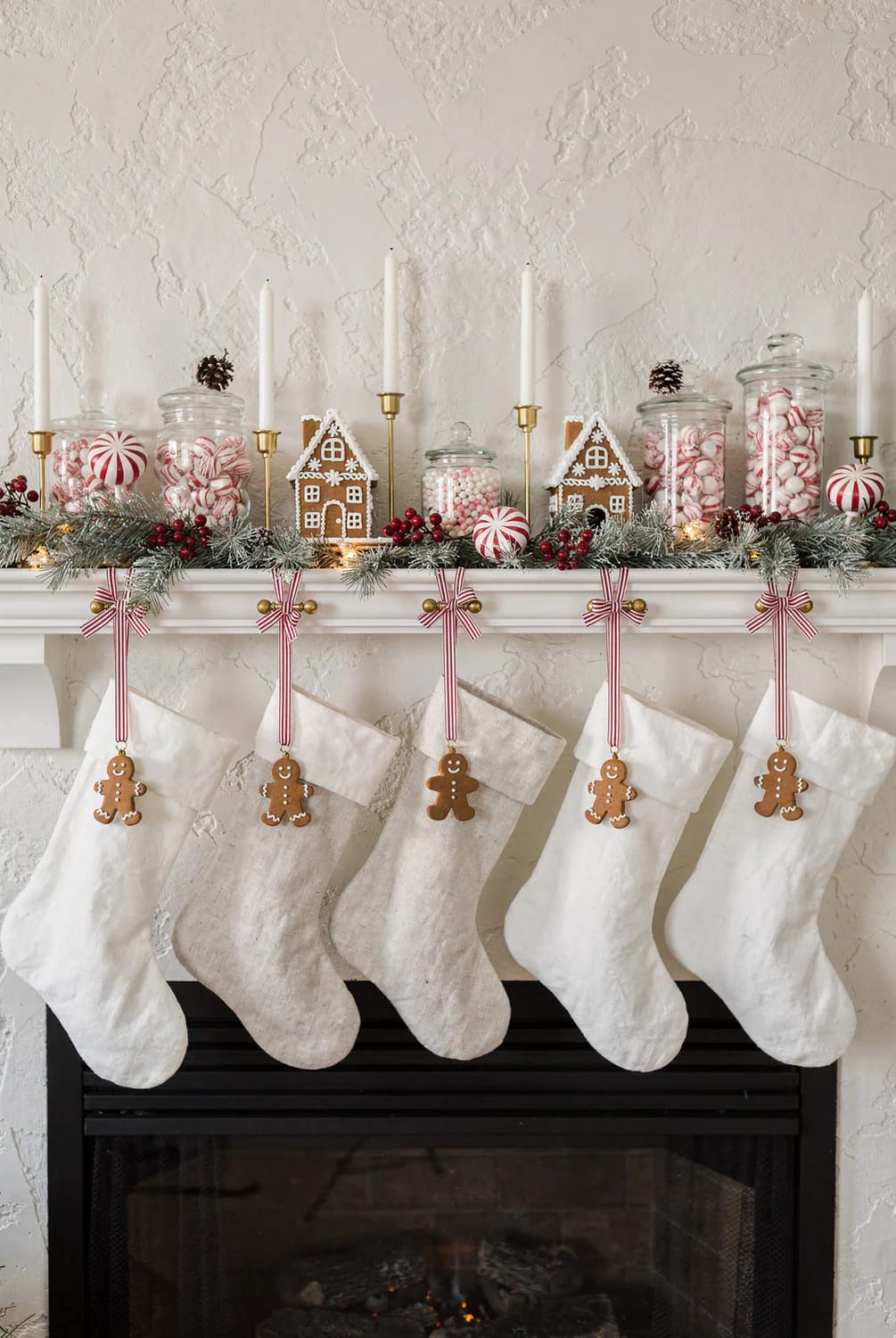
For that job you want figures around three inches, heavy enough to hang straight and light enough not to drag the ribbon out of shape. A set of 3 inch soft-rubber gingerbread man ornaments with hanging strings covers four stockings and leaves enough over for the ribbon on the mantel face.
11. Hang a peppermint wreath as the vertical anchor above the mantel
Everything so far lives within seven inches of shelf. The wreath is what gives the arrangement height and stops the mantel from reading as a horizontal band stranded on a wall. A twenty to twenty-four inch wreath worked in white and one red, with peppermint discs wired in tight clusters rather than glued on individually, hung so its bottom edge clears the tallest house by three or four inches.
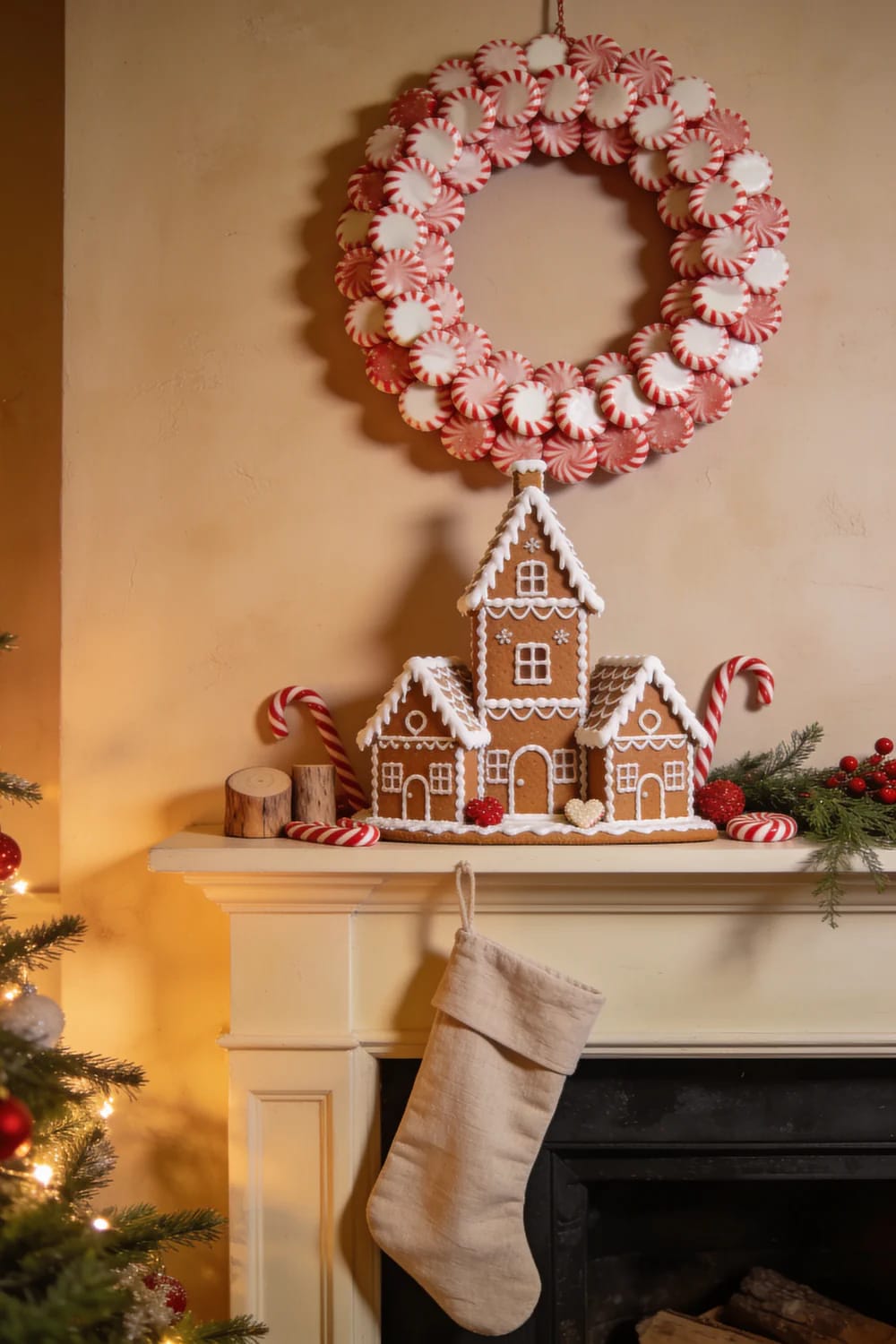
Skip it if a mirror or a television is already sitting there. A wreath hung over a mounted screen is one of the few decorating moves that looks worse than the bare screen did, and the honest answer in that room is to concentrate everything on the shelf and lean a small framed piece against the wall instead.
 11 Whimsical Candy Cane Christmas Decorations Worth Doing Well The two-color rule, and why real peppermint is usually the thing ruining the look.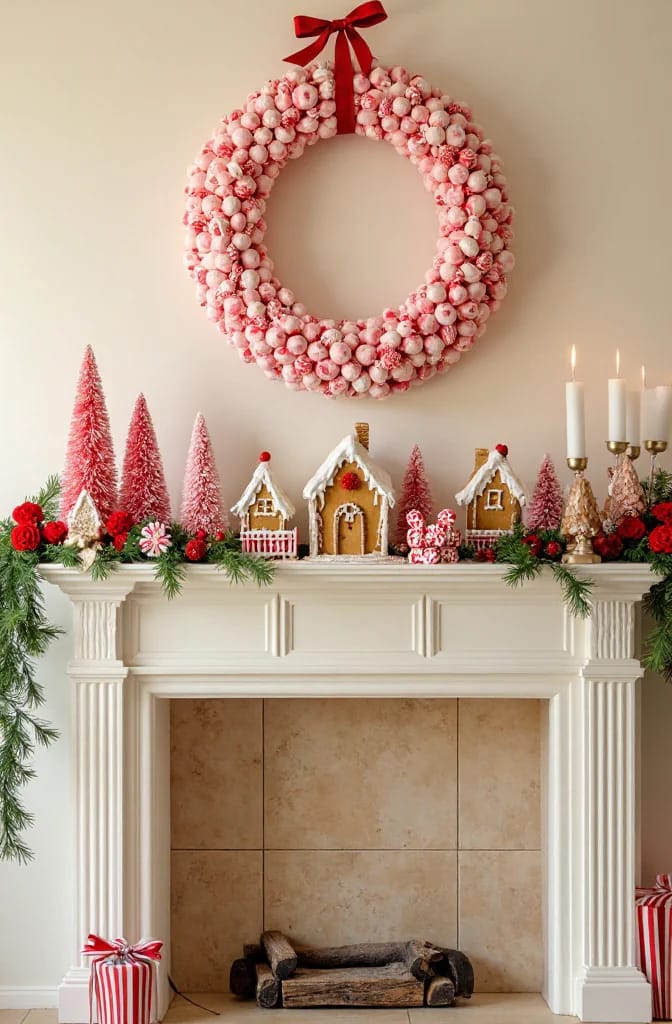
Light, snow, and the last pass
12. Warm-white bulbs, low and behind the gingerbread houses
Light the mantel from behind and below, never from the front. A short strand of warm-white bulbs tucked at the back of the shelf, hidden in the batting, throws light up through the icing detail and out through the cottage windows; a cool-white strand draped across the front does the opposite, flattening every piece and turning molasses brown a dull grey. Anything at 2700K or warmer keeps the brown reading as gingerbread rather than cardboard.
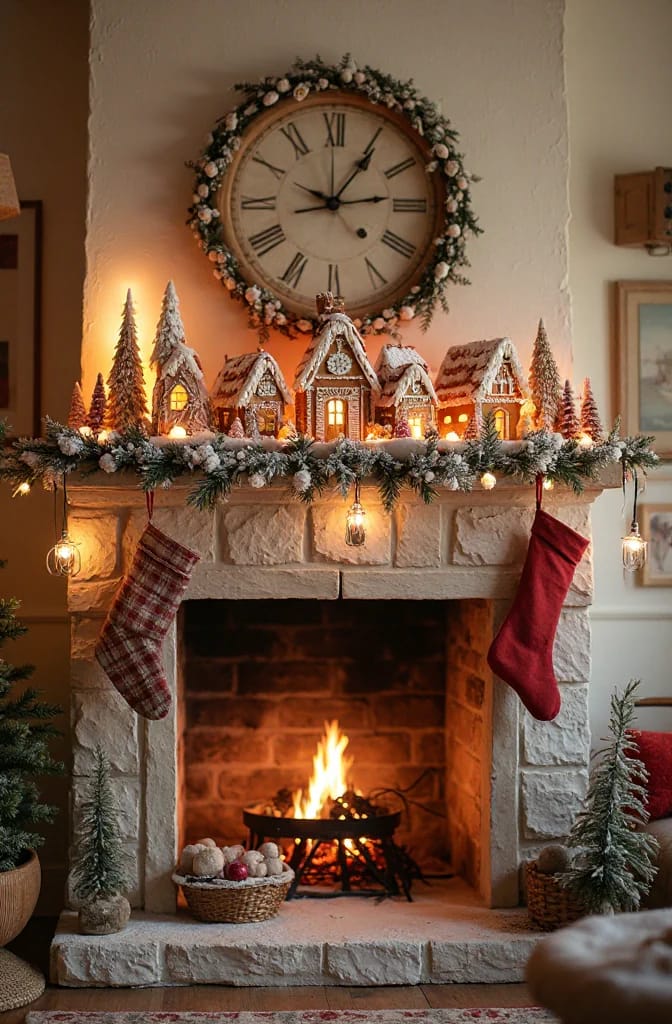
Bulb size matters more than strand length. The small round C6 and G12 shapes throw a defined point of light that reflects off glossy resin and candy the way the old incandescent bulbs did for mercury glass, where the flat modern rice-light strand just produces an even wash.
13. Finish with faux snow on three surfaces and stop
Three surfaces, then put the bag away. Rooflines, the batting field, and the top curve of the wreath, and that is the whole snow budget. The instinct is to keep going until everything is dusted, at which point the brown and white contrast that made the arrangement work in the first place has been sanded flat and every object looks like it has the same finish.
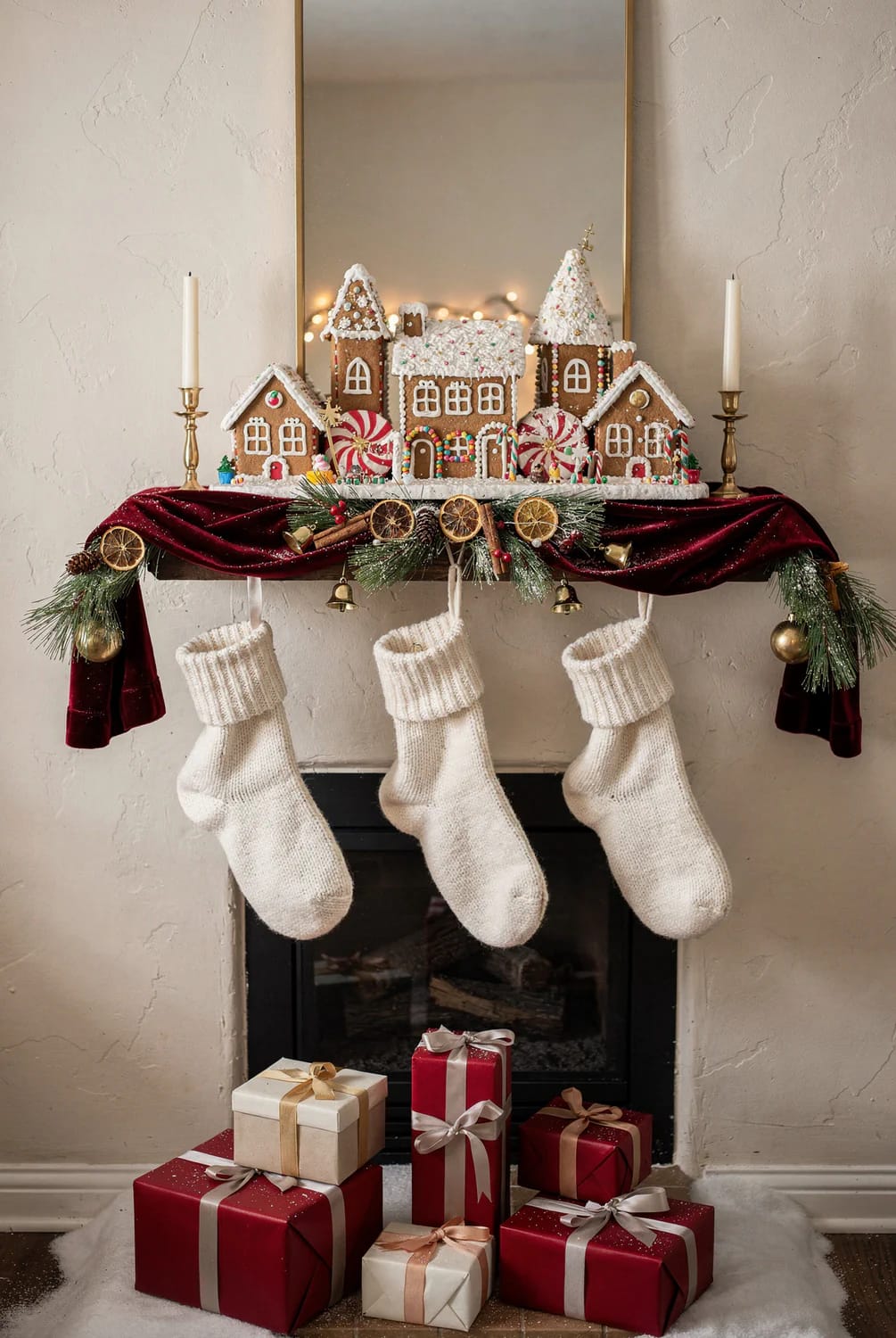
A 5 ft by 7 in mantel, everything on this list, what actually fits
60 inches of shelf, 7 inches deep, painted brick surround, working firebox
Cream felt runner the full 60 inches, cut 64 so it laps the ends. One 8.25 inch lit resin cottage at the 36 inch mark. Two smaller houses left of it on a 1.5 inch riser, batting mounded to hide both. One 8 inch cloche of ribbon candy at the 12 inch mark. A stoneware crock of three lollipop stakes at 54. Cookie garland pinned along the front lip, striped ribbon and hanging figures on the face below, 22 inch wreath centered above. What does not fit: a second cloche, a candy dish, bottle-brush trees taller than four inches, and any stocking hung where its toe swings within 6 inches of the firebox opening. The shelf holds five objects and a border, not nine.
Build it in that order and each pass covers the seams left by the last one: felt first, houses and risers second, candy and stockings third, light and snow last, because snow scattered before the lights go in ends up on the strand instead of the roof. The batting is the item people skip and the one that does the most, since it is the only thing standing between a staggered village and three objects on books.
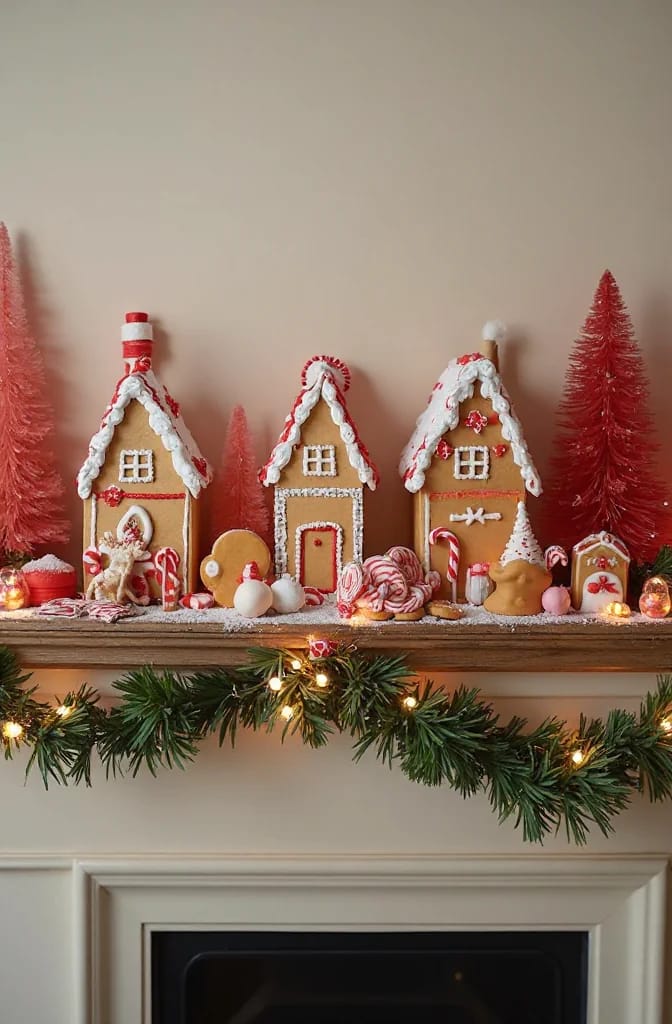
Where I would still hesitate is the pink. It photographs beautifully and it is genuinely everywhere in the product catalogs right now, which is exactly the reason to be careful: an accent color that arrived this fast can date the whole arrangement in two seasons, and you will be looking at it every December. If you want the safe version, keep the accent cherry red and put the pink in the ribbon on the mantel face, where swapping it costs you four feet of grosgrain rather than the cottage.
Related Posts
- 7 Modern Christmas Mantel Decor Ideas That Don’t Look Like a Craft Store
- Farmhouse Christmas Mantel Decorating Ideas That Skip the Store-Bought Look
- 21 Creative Halloween Mantle Decor Ideas To Copy
- 11 Whimsical Candy Cane Christmas Decorations Worth Doing Well
- 29 Stylish Christmas Mantle Decor Ideas to Inspire Your Home
- 16 Moody Christmas Decor Ideas for a Super Cozy Holiday