
The usual advice for a modern Christmas mantel is to take things away: white candles, a thin eucalyptus swag, one brass bead garland, done. That isn't modern, it's just underdressed, and it photographs better than it lives with you for six weeks. Modern means edited and deliberate, not empty. The seven ideas below deal with weight, color discipline and light, including where the garland actually belongs (not the middle) and what color temperature to buy (lower than you think).

1. Choose one color family for the whole mantel, then vary the texture
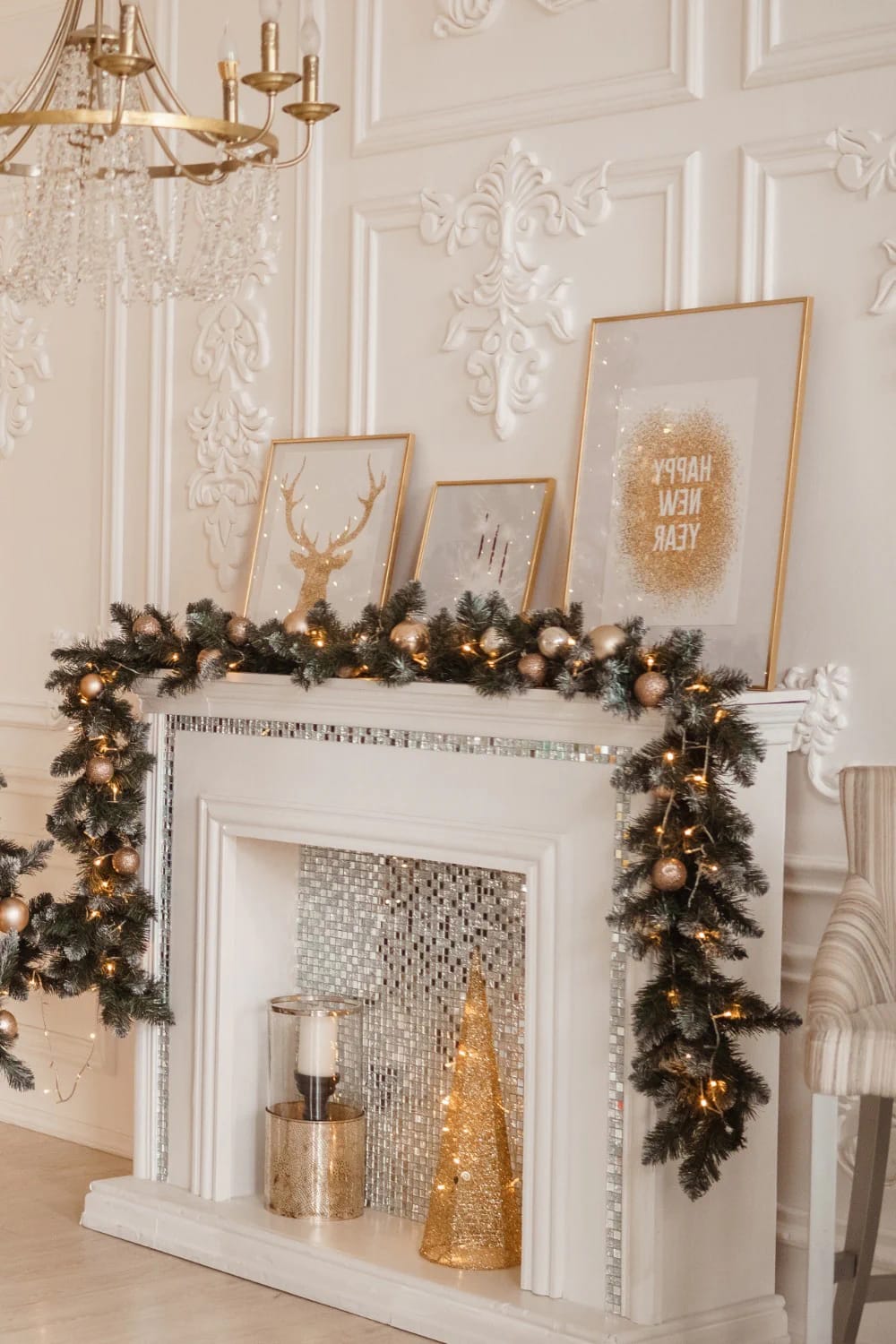
Hold one hue across every object on the shelf and let the variation come from finish instead. A mantel that runs bone, oat, putty and greige in matte ceramic, raw linen, unlacquered brass and dried grass reads as designed; the same shelf in red, green, gold and silver reads as inventory. This is the single change that separates a modern Christmas mantel from a decorated one, and it costs nothing to apply because it is mostly a decision about what to leave in the box.
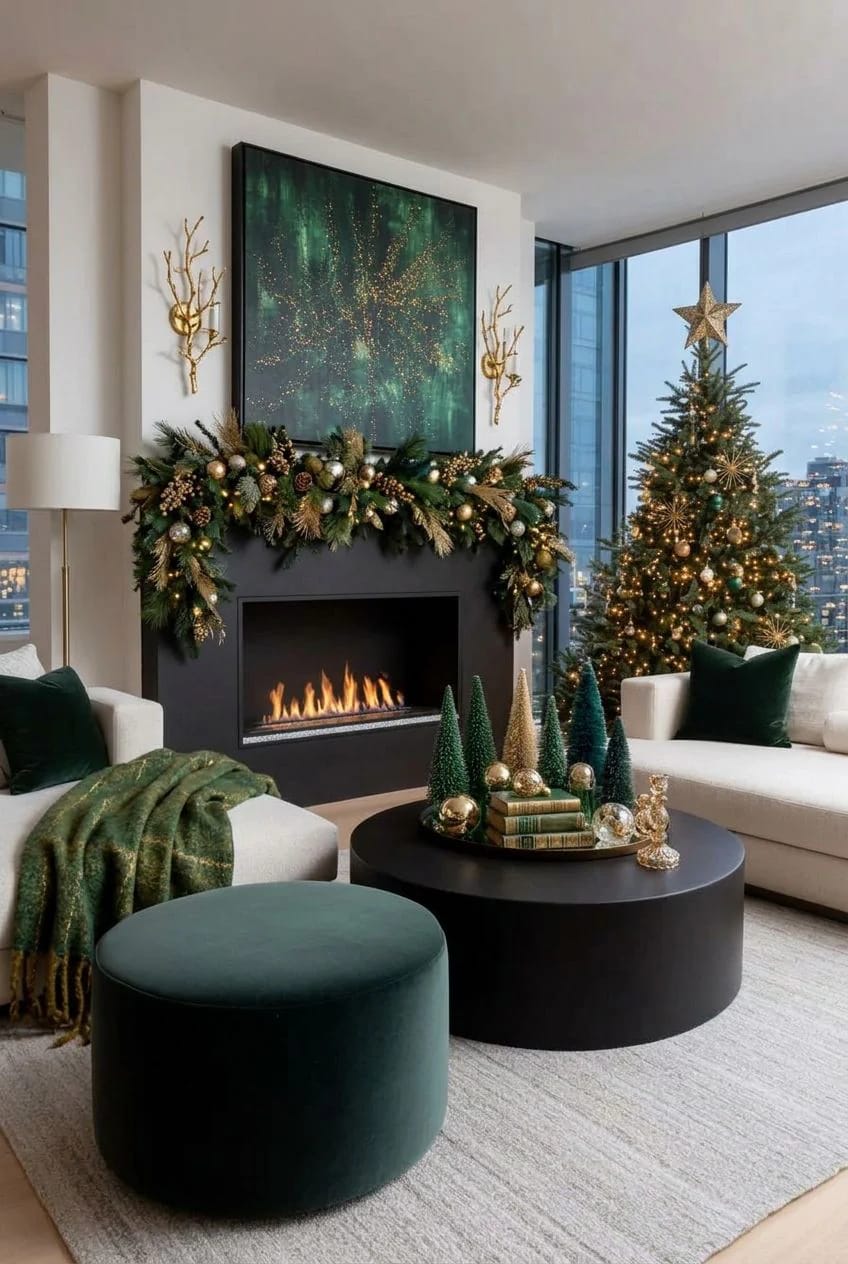
Start from the wall, not from the ornament bin
Whatever is behind the mantel is already the dominant color in the composition, so pick the family from that. Against warm white plaster, cream and pale wood objects nearly vanish and you need one deeper value (a charcoal candlestick, a black-stained bowl) to give the eye an anchor. Against a green or clay-colored wall, the anchor is already there, and the mantel objects should sit a shade or two lighter than the paint rather than matching it.
Metal counts as a color, so count it
Two metals maximum, and they should not be the same temperature. Brass with black iron works; brass with chrome and silver ornaments and a nickel picture light is four warm-cool arguments happening on one shelf. Granted, this only matters if the metal is actually visible from the sofa, which rules out the tiny gold detail on an ornament nobody sees.
2. Weight the garland to one end of the mantel, not the middle

Gather the mass of the greenery over one third of the shelf, let it spill down the side, and leave the rest close to bare. The symmetrical swag with matching tails is the most recognizable move in holiday decorating and it flattens everything under it, because a centered pile plus centered candles plus a centered wreath gives the eye one target and nothing to travel toward. An off-center pile does the opposite: the weight sits at one end, the single tall object sits at the other, and the empty stretch between them is what makes it look considered.
How much garland you actually need
Professional installers work from a simple ratio: multiply the mantel width by roughly 1.5 for a tailored drape and closer to 2 if you want a deep swag and long tails, which for most mantels lands somewhere between six and ten feet. Add another foot or two if the greenery is going to fall over the corners. Since garland ships in fixed lengths (six and nine feet are the common ones), the useful question is how many strands to put in the cart, not how many feet you theoretically need.
Mantel garland sizer
Estimate only. Unlit artificial garland runs about $15 a strand at the low end, pre-lit closer to $45. Buy one spare if your mantel is deeper than 8 inches.
The empty stretch is not a problem to solve. Put one thing in it, at most: a leaning frame, a single tall candlestick, a bowl. Anything more and you have rebuilt the symmetrical mantel with extra steps.
3. Dried citrus still works on a modern mantel, just not strung on twine

Dry the citrus, then treat the slices as objects rather than beads. Threaded on jute and hung in a swag, they read as a farmhouse craft project from 2016; laid flat on the shelf in a loose scatter, or standing in a brass bowl, or clipped to a single copper wire, the same slices read as a material. It is the twine that dates them, not the fruit.
The drying method is not complicated and every source that has actually done it lands in the same place: slice about an eighth of an inch thick with a serrated knife or a mandoline, blot the slices dry between towels, then bake at 200°F for three to four hours, flipping every half hour and pulling the thin ones early as they finish. Higher than about 225°F and they brown before the moisture leaves. Four navel oranges cost a few dollars and give you more slices than a mantel can hold, and if you store them flat in an airtight box they will come back out next year, a little darker. This is the cheapest idea on the list by a wide margin.
4. If your fireplace is dark, decorate into it instead of fighting it
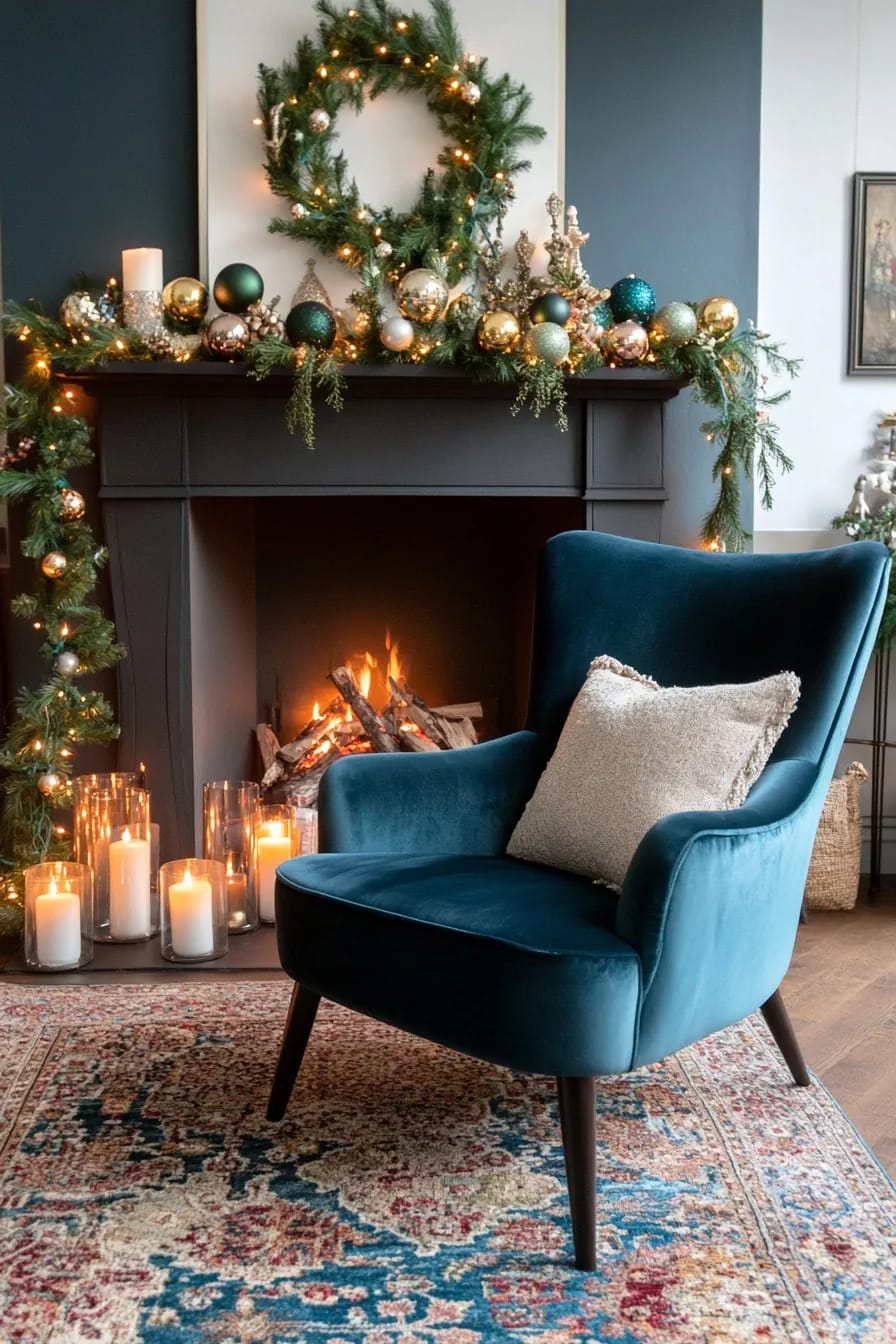
A black or slate surround is the best thing that can happen to a Christmas mantel, and most people spend December trying to cancel it out with white ceramic and pale linen. Push the other way. Deep green greenery, a black cast-iron candlestick, a bronze bowl and one wide brass tray against a dark surround gives you contrast where you want it (the light) and none where you don't (the objects), which is exactly the composition the eye reads as expensive.
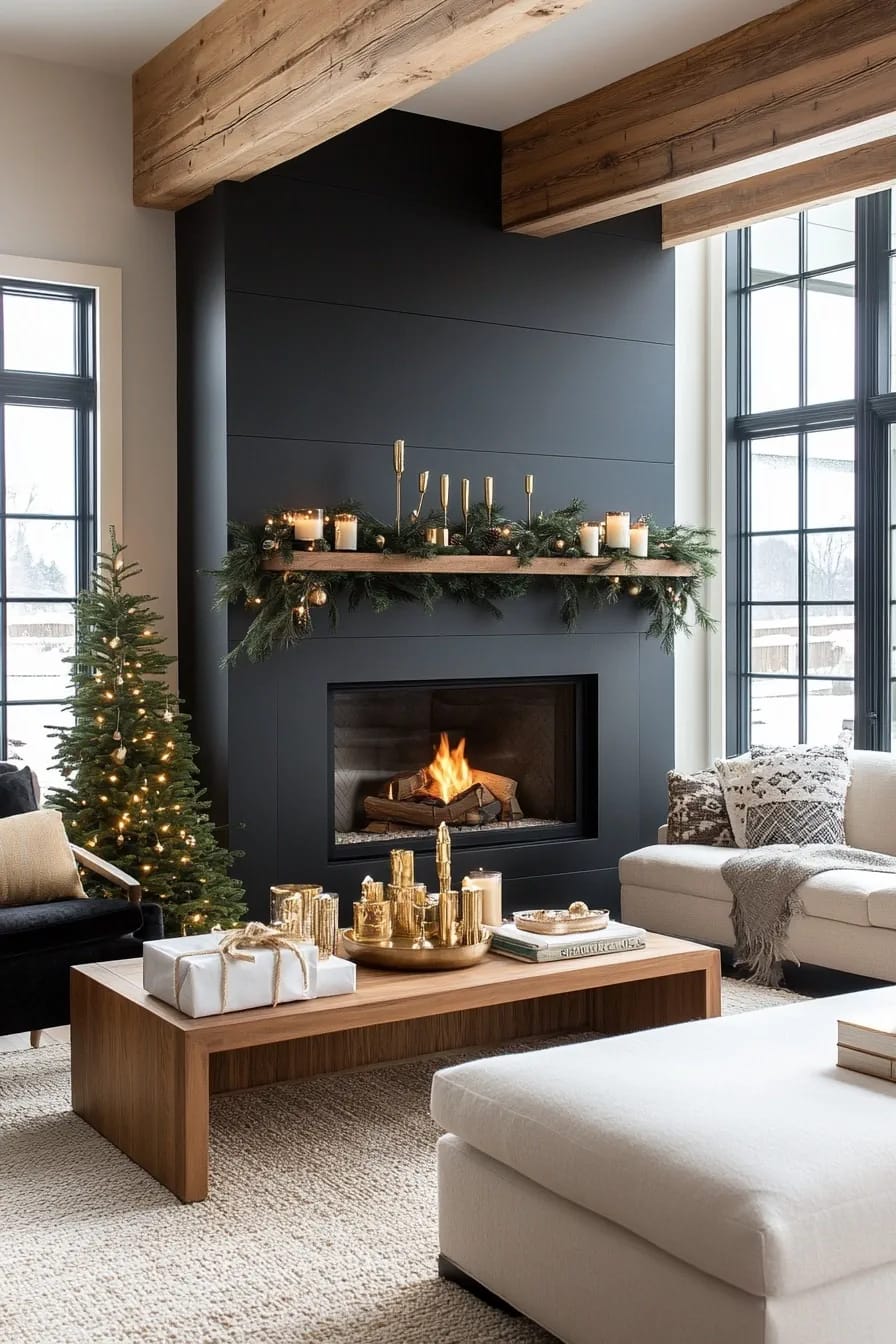
Brass reads, chrome disappears
Against black, a warm metal holds its edge because it reflects candlelight back as gold; chrome and polished nickel bounce the room's cool light and go flat and gray from four feet away. Unlacquered brass is the safest buy here and it will keep darkening in a way that suits the surround.
The thing that fails against a dark surround
White ceramic. It looks chalky and cheap against black, especially the matte white houses and trees that turn up in every seasonal aisle. If you want a light value in the composition, get it from a pale unbleached linen or an off-white candle, both of which have some warmth in them, and keep it to one object.
5. Hang fewer stockings, off-center, on weighted bases

Three stockings clustered at one end of the mantel look intentional; five spaced evenly across it look like a shelf of laundry. Choose the fabrics the way you would choose upholstery, in the mantel's color family and in varied weaves (a boucle next to a flat wool next to a slubby linen), and skip the embroidered names entirely, which are the single fastest way to turn a considered mantel into a family notice board. If the stockings are actually for children who care about names, tie a small brass tag to the hanging loop instead and remove it after Christmas morning.
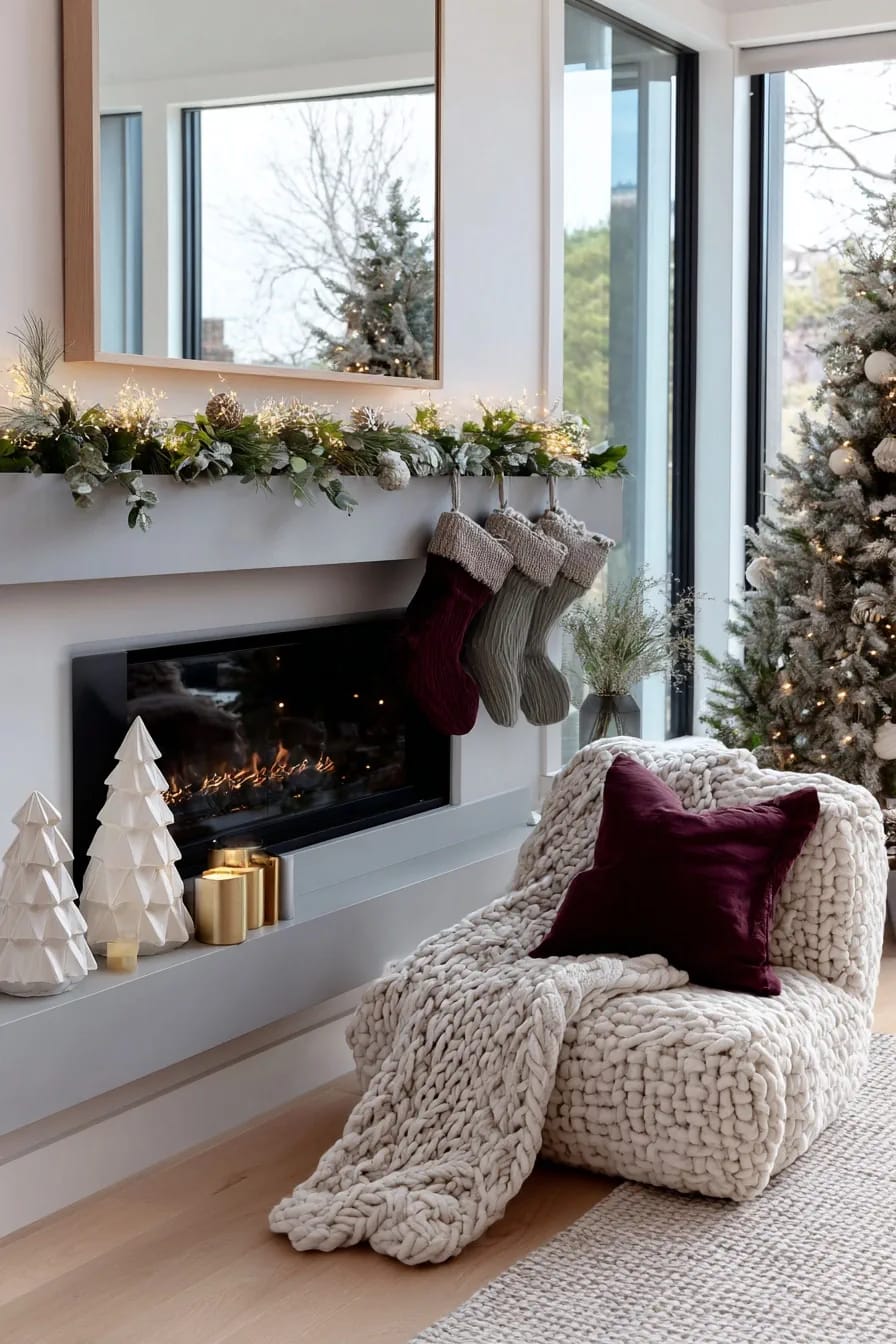
The hardware matters more than the stocking. Weighted low-profile bases sit on the shelf and hold a loaded stocking without a nail, a screw or a hole, which makes them the renter's answer as well as the modern one; look for at least 12 to 16 ounces per holder, because the lightweight ones tip forward the moment anything heavier than an orange goes in. A matte black set like these HMASYO low-profile weighted iron stocking holders runs about $20 to $30 for four and disappears against a dark shelf, which is the point.
Take the stockings and the garland down. The National Fire Protection Association's guidance is a three-foot clear zone around a working fireplace for anything combustible, and building codes keep flammable material at least six inches back from the firebox opening for a reason: dried evergreen and knit wool ignite from radiant heat alone, without a spark reaching them. Artificial garland labeled flame-retardant PVC (Balsam Hill and the other big artificial-tree brands sell it) lowers the risk but does not remove it. If you burn fires most nights, style the mantel to look right empty and treat the greenery as something you hang for the party.
6. Trade the string lights for candlelight around 1800K

Candlelight sits at roughly 1800K, standard warm-white bulbs at 2700K, and the mini string lights most people drape on a mantel are frequently cooler than either, which is why a mantel that looked warm in the store photo looks blue and clinical in your living room at six o'clock. Almost nobody prints the Kelvin figure on a box of mini lights, so you end up judging from a product photograph, which is a poor way to buy light. Buy for the number when you can find it, and when you can't, buy a candle.

| Light source | Color temp | What it does on a mantel | The catch |
|---|---|---|---|
| Wax taper | ~1800K | Amber pool, real falloff, moving light | Cannot be left with greenery or unattended |
| Flameless taper, dimmable | ~2200K amber | Close enough at four feet, safe under garland | Reads as plastic up close, so keep it back from the edge |
| Warm white mini lights | 2700K | Even sparkle through greenery | Flattens the composition; visible wire |
| Cool white mini lights | 3000K and up | Reads blue against warm materials | Avoid entirely on a mantel |
| Picture light above | 2700K | Lights the art, leaves the shelf in shadow | Needs something worth lighting |
What to buy if the greenery is staying on the shelf
Then the answer is a flameless taper with a real dimmer, positioned back from the front edge so nobody inspects it, and turned down. Full brightness is what gives these away; at about half output the flicker stops looking like a strobe and starts looking like a room with a candle in it. I will not pretend the plastic ones look like wax from two feet, because they don't.
The dimmer is the feature worth paying for here, since brightness (not flicker) is what makes flameless candles look fake. This set also runs on a timer, which matters when the mantel is six feet up.

7. One oversized object beats a styled cluster on a Christmas mantel

The most modern move available on a mantel is to put one large thing on it and stop. A thirty-inch paper star leaned against the wall, a plaster arch, an oversized brass ring, a wide charcoal canvas turned away from being a picture: any of these does more work than nine small objects arranged in a gradient, and it survives the entire season without needing to be tidied. Scale is what carries it. A twelve-inch star on a five-foot mantel is a knick-knack; the same object at thirty inches is architecture.
Do this
- Lean the object against the wall instead of hanging it. Nothing to patch in January.
- Let it break the plane of the mantel, overlapping the mirror or the art behind.
- Keep the shelf around it genuinely empty. Two small objects maximum, both at the far end.
Avoid
- Centering it.
- Pairing it with a second large object. That is a set, and sets go symmetrical fast.
- Buying the version with glitter on it, which is most versions.
Order matters more than you would think when you actually go to do this. Settle the light first, because the color temperature of whatever is glowing on that shelf decides how every material above it reads, and there is no point choosing between oat and bone linen under a 3000K string of lights. Then hang the garland weighted to one end, then put the one large object at the other. The stockings go up last, and if the fire is lit, they come down again.