
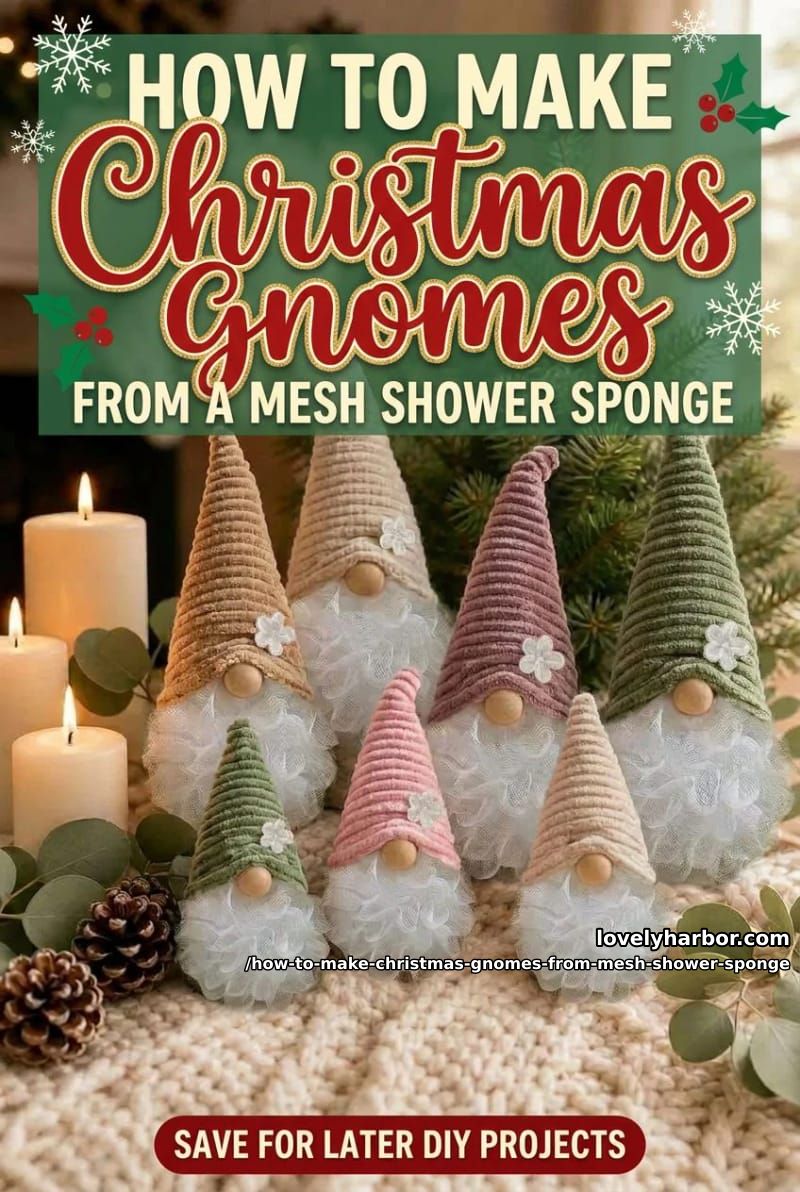
A $2 mesh shower pouf solves the worst part of making a Scandi gnome ornament: the beard. No more wrapping chunky yarn around a pom-pom maker and trimming it for forty minutes. The pouf gives you the same fluffy white silhouette, and its built-in cotton cord becomes the hanger for free. Full build below, with the proportions that keep these from looking like craft-store rejects.
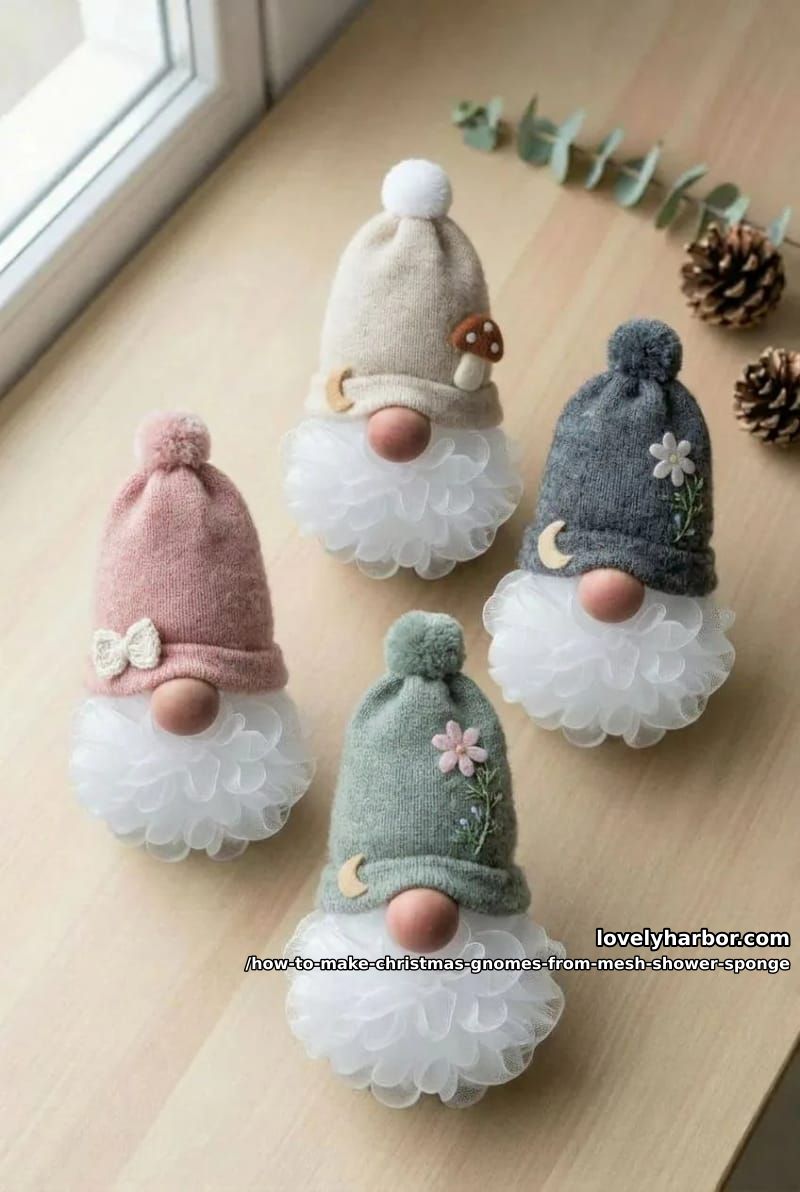
The hat can also be a rolled chunky yarn cone like this:
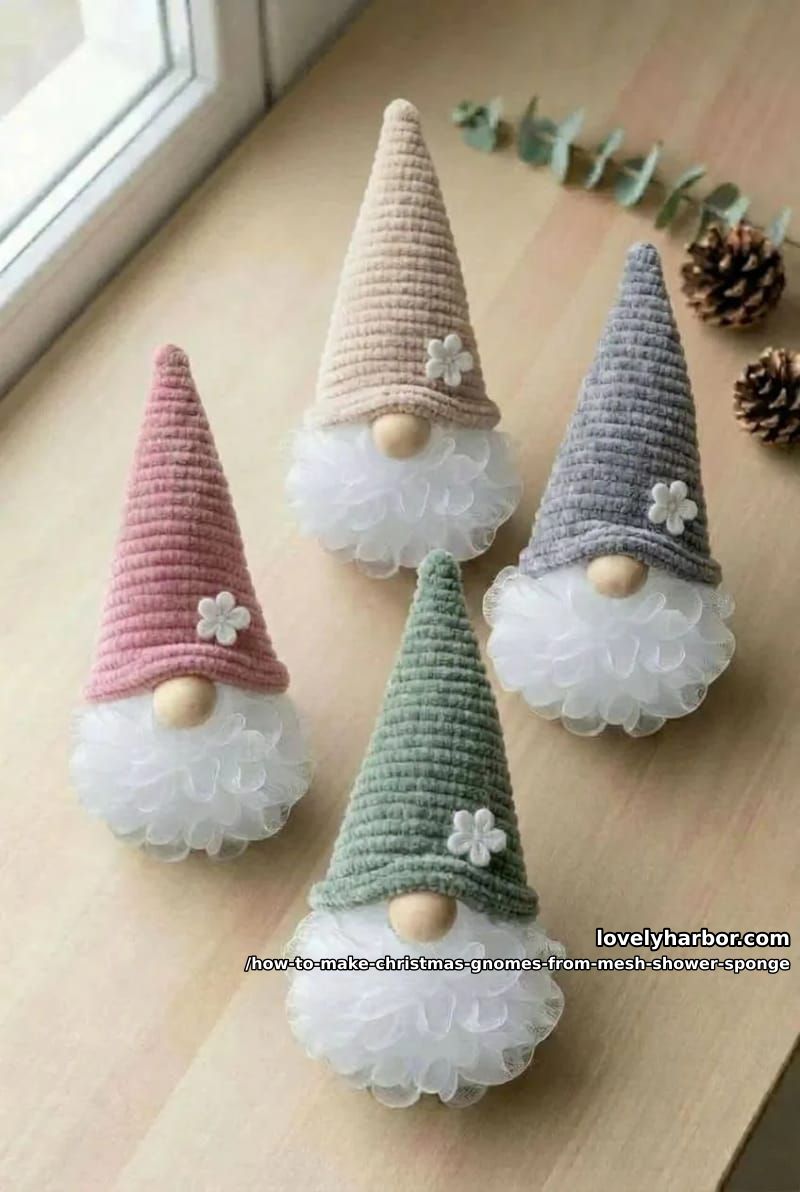
Or they can be knitted if you prefer, like the ones below:
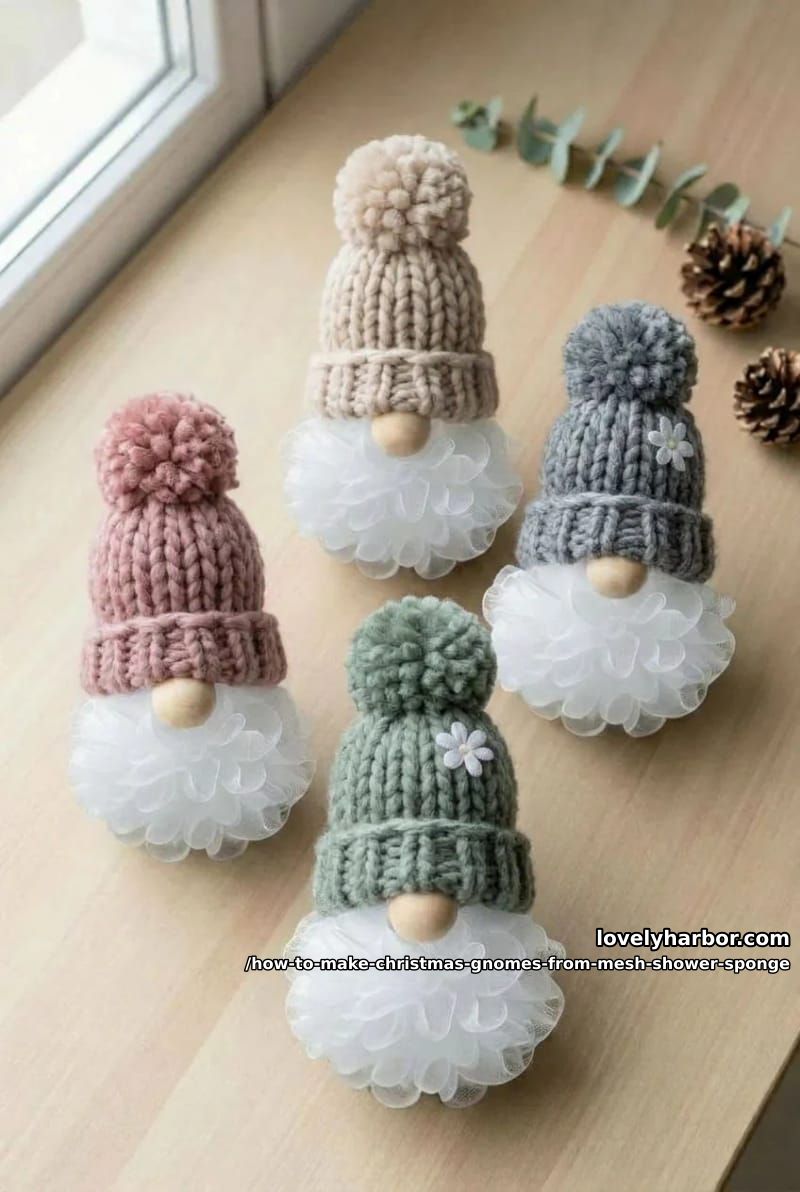
What you'll need
This assumes nothing in your craft drawer. Already own a glue gun and scissors? Skip to the materials block , your real cost is closer to $25 for a batch of six.
Materials (per batch of 4 to 6 gnomes)
| Qty | Item | Spec | Price |
|---|---|---|---|
| 4-6 | iboodi white mesh shower poufs, 6-pack 60g | Expands to ~5 in diameter, white only | $10 to $13 |
| 1 | HOMBYS #6 super bulky chenille yarn, cream white 12-pack | True #6 super bulky (about 5mm strand), not the 3/4 inch jumbo; for other colors pick an equivalent #6 | $28 to $40 |
| 1 pack | Bright Creations foam cones, 16 pack assorted 2.2 to 6 in | Use the 2.2 to 3.5 in sizes; trim taller ones | $15 to $22 |
| 1 pack | BigOtters natural unfinished 25mm wooden beads, 65 pack | 1 inch diameter, undyed birch | $9 to $13 |
| 1 bag | Glue sticks for mini glue gun | 7mm diameter, mini size | $5 to $8 |
| opt. | Mini white fabric flowers or tiny bells | 10 to 15mm appliques | $4 to $7 |
| Materials subtotal | $71 to $103 | ||
Tools (one-time, reusable)
| Qty | Item | Spec | Price |
|---|---|---|---|
| 1 | FEITA cordless mini hot glue gun, USB rechargeable | Mini size, 7mm sticks, low temp safer for foam | $18 to $26 |
| 1 | Sharp fabric scissors | For trimming yarn and foam | $8 to $15 |
| 1 | Serrated knife or bread knife | For shortening foam cones, kitchen drawer | Free |
| Tools subtotal | $26 to $41 | ||
Prices verified as approximate ranges as of late 2025; check the listing before purchase. All-in from scratch: $97 to $144 for six gnomes.
Step 1: Pick and prep the shower sponge
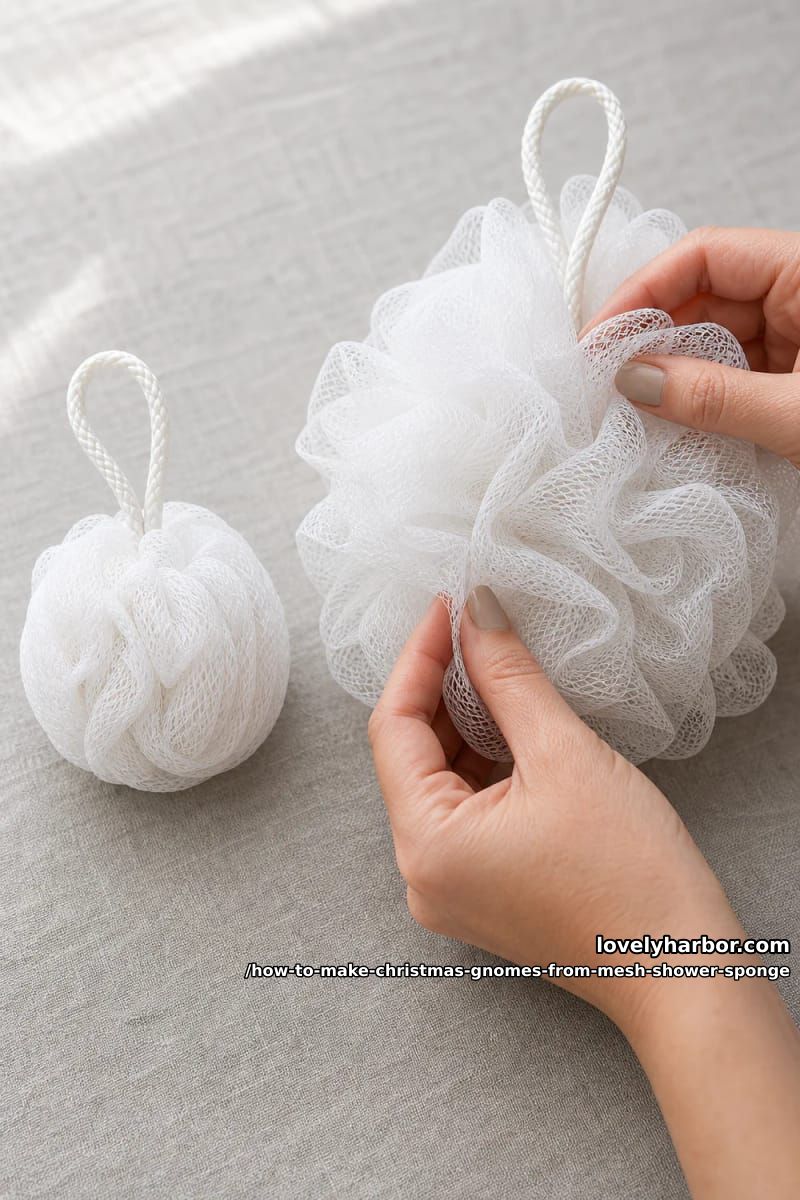
The pouf arrives vacuum-compressed, looking like a tight little doughnut. Spend thirty seconds pulling the mesh apart from the center outward and it blooms into the cloud you actually want. A 60g pouf expands to about 5 inches across, which is the sweet spot. The 35g travel-size ones look stingy and can't carry a hat.
- Inflate the layers. Hold the pouf by its cotton cord loop and gently pull the mesh ruffles outward in every direction until it’s roughly spherical and at least 4.5 inches across.
- Locate the cord loop. The braided cotton string at the top is your ready-made hanger. Do not cut it. You’ll hide its base under the hat and leave a 2 inch tail exposed.
- Decide on a “front.” One side of the pouf is always denser than the other. That’s the front , the bead goes there so the beard reads thick around it.
Do this
- 60 to 75g white poufs, with the cord loop visible and intact.
- The softest mesh you can find. Exfoliating ones are too stiff for this.
- Fluff with your fingers. Shaking tangles the loop.
Avoid
- Charcoal or color-flecked poufs , they read as dirty rather than snowy.
- The 35g travel size. Too small; the hat eats them.
- Net laundry bags. Tulle pom alternatives. None of them have the depth.
Step 2: Build the hat
The hat is the whole personality of the gnome, so it is worth getting right. Whichever route you take, aim for a hat that is roughly 60–70% of your fluffed pouf's diameter, for a 5 inch pouf that is about a 3 to 3.5 inch hat. Go much taller and your gnome stops looking cozy and starts looking like a witch.
There are three builds here, and the right one depends on what's already in your craft drawer and how much fuss you want. Pick a lane and skip to it.
The felt cone
A flat wedge of wool felt rolled into a cone, seamed at the back, with a folded-up brim and a blunted tip. No needles, no knitting, just cutting, rolling and a little glue or stitching.
Best for: fast results, crisp clean lines, and anyone who can’t knit.
The knitted cap
A tiny stocking cap with a chunky ribbed cuff, knitted as a small tube, decreased closed at the top, and topped with a pom pom. The soft, squishy look in the photos comes from bulky yarn.
Best for: that hand-knit texture and the thick turned-up brim.
The wrapped cone
A foam cone wrapped in a tight spiral of chunky chenille, glued as you coil, until the foam vanishes under a fuzzy ribbed shell. No pattern to cut, no needles. The thick yarn does all the texture work for you.
Best for: using the cone and yarn already in your cart, and the squishiest finish of the three.
Step 2A: The felt cone hat
It’s a wedge with a curved bottom, not a triangle
The flat piece is a wide “pizza slice”: a point at the top and a curved bottom edge. The curve is what lets the base close into a neat circle that sits flat on the pouf. The two straight sides come together to form the seam up the back; the curved edge becomes the bottom rim of the hat.
Sizing it for a 5 inch pouf: make the curved bottom edge about 10 inches long (that wraps to roughly a 3 inch base with a little overlap) and the height from point to curve about 5 inches. That leaves room for the body of the hat plus the fold-up brim. Trace it once onto card, and you have a reusable template for the whole batch.
- Cut the felt. Use the wedge template above. Wool or wool-blend felt holds the cone shape far better than thin craft felt.
- Roll it into a cone. Bring the two straight edges together with about a half-inch overlap until the bottom forms a clean circle that matches the top of your pouf.
- Close the seam. Two ways, both fine:
- Sewn (hidden seam): turn the cone inside out, whip-stitch the straight edges together, then turn it right-side-out so the seam sits inside, this is the cleanest finish.
- Glued (faster): run a thin line of hot glue down the overlap and hold until set, then rotate the seam to the back of the gnome so it’s out of sight.
- Blunt the tip. A sharp point reads as “witch,” not “gnome.” Fold the very point down about a half-inch toward the inside and tack it with a stitch or a dot of glue to get the soft rounded nub you see in the photos. (You can instead snip a few millimetres off the tip and stitch the opening closed, but folding is tidier and leaves no hole.)
- Fold up the brim. Turn the curved bottom edge up about a half to three-quarters of an inch to make the rolled rim. A few hidden glue dots keep it in place.
- Add the pom pom. Glue a pom pom centred on the folded tip.
- Decorate (optional). A tiny felt mushroom or flower, a little wooden moon or star bead, a small bow, or a line of simple embroidery on the front, all the touches in the example photos, go on now.
A gaping or puckered back seam, and a base that won’t sit flat. Both come from cutting a flat-bottomed triangle instead of a wedge with a curved bottom. A straight bottom edge fights the cone and leaves a gap. If the base still won’t close neatly, your curve isn’t deep enough; round it more. And resist making the hat tall: anything over about 70% of the pouf diameter tips straight into witch territory.
Step 2B: The knitted cap
This is a miniature stocking hat, made exactly like a full-size beanie, just at a smaller scale. Gauge doesn't matter here because nobody's head goes in it; you simply size it against your pouf as you go. You can work it in the round on double-pointed needles, or knit it flat and seam up the back, whichever you find easier at this size.
No needles? Fake the knit hat.
Cut the ribbed cuff off an old wool sock, or a 2–3 inch tube from a chunky sweater sleeve. Slip it over the pouf with the ribbing as the brim, gather and tie the top tightly with a strand of yarn, trim it, and glue on a pom pom. From the front it’s indistinguishable from a hand-knit cap.
- Pick chunky yarn. A bulky or super-bulky (#5–#6) yarn gives the plump, cozy look in the photos and knits up in minutes. Use needles a touch smaller than the yarn’s recommendation so the fabric is dense and doesn’t gap. A pom pom maker is handy but not essential.
- Cast on for the base. Cast on enough stitches to wrap around the top of your pouf. Don’t chase a number from a pattern. Cast on, join (or lay flat), and check it against the pouf, adjusting by a few stitches if needed.
- Work the brim. Knit a ribbed cuff (k1, p1 or k2, p2) for about an inch, this is the part you’ll fold up into the thick turned-up brim. A few rounds of plain stockinette will instead give you a softer self-rolling edge if you prefer that.
- Knit the body. Switch to stockinette (knit every round in the round, or knit one row / purl one row flat) and work straight until the hat is tall enough to clear the pouf, usually only an inch or two.
- Decrease to close the top. Knit two together at regular intervals every other round, repeating until roughly 6–10 stitches remain. This pulls the top into a neat dome.
- Cinch it shut. Cut the yarn leaving a long tail, thread it through the remaining stitches with a tapestry needle, pull tight to close the top, and weave the end in.
- Seam the back (flat-knit only). If you knitted flat, use the cast-on tail to sew the back seam closed, then weave in.
- Finish. Fold the ribbed cuff up into the brim, sew or glue a pom pom to the top, and add any small accent, a tiny stitched daisy or a little flower button like the ones in the photos.
This section assumes that you know how to knit, if not, you can check this guide for beginners.
Step 2C: The wrapped chenille cone
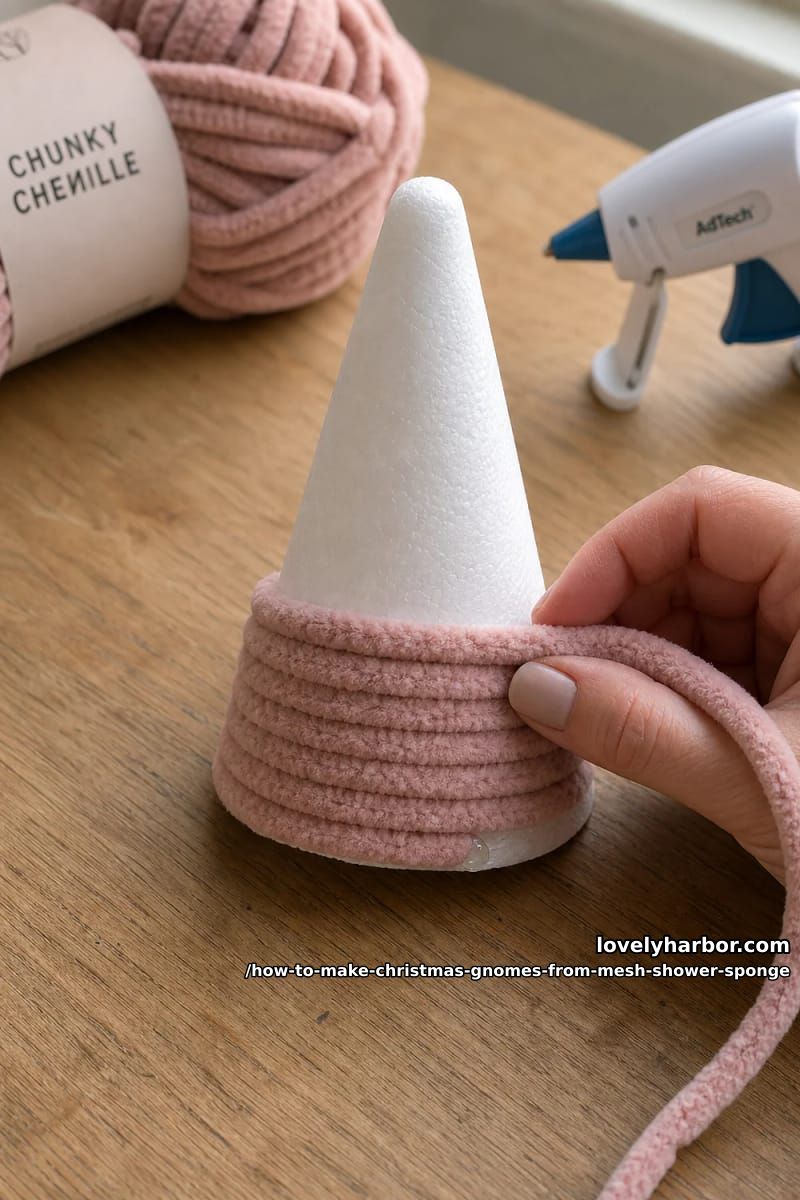
This is the method nobody photographs from the back, because the back is where the glue blobs hide. It uses the foam cones and chenille already in your cart, and once you find the rhythm it takes about five minutes per hat. The coiled yarn fakes a ribbed knit without a single stitch, which is why I reach for it when I've lost patience cutting felt seams.
- Match the cone to the pouf. Use a foam cone about 2.2 to 3 inches at the base for a 5 inch pouf, and saw the tip off taller ones with the bread knife so the finished hat lands near 3 inches. A cone wider than the pouf will crowd out the bead later.
- Anchor the first wrap. Dot hot glue at the cone tip, press the loose end of the chenille into it, and hold a few seconds until it grabs before you start coiling.
- Coil downward, gluing as you go. Wind the yarn around the cone in a tight spiral toward the base, each pass sitting snug against the one above it so no foam shows between coils. One dot of glue per full turn is plenty. Keep light tension. Pull hard and the foam dents under the coils.
- Build the brim. At the base, double back and lay two or three extra coils over the bottom inch, then nudge them up into a soft rolled lip. That rolled lip is the turned-up brim, and it also hides the join where the hat later meets the pouf.
- Close the tail. Cut the yarn, tuck the end under the last coil with a dab of glue, and turn that spot to the back of the gnome.
- Top it. Glue a pom pom to the tip, or leave it off and let the spiral close to its own point. The bare point reads more Nordic; the pom pom reads more playful.
For a pink batch, reach for a true #6 velvet, not the jumbo blanket yarn. Fine enough to coil a 3 inch cone in a dozen neat passes, and soft enough to forgive a shaky hand.

Foam glowing through the coils. It happens when the yarn is too thin for the cone or the spiral leaves gaps, and a white cone showing through cream chenille reads as a mistake from across the room. Stay with a #6 chenille, keep every coil touching its neighbor, and if a sliver still peeks out, slide a short offcut of yarn under the gap and glue it flat. Worsted weight will never cover a cone this size, so don’t try to stretch it.
Step 3: Glue or stitch the nose
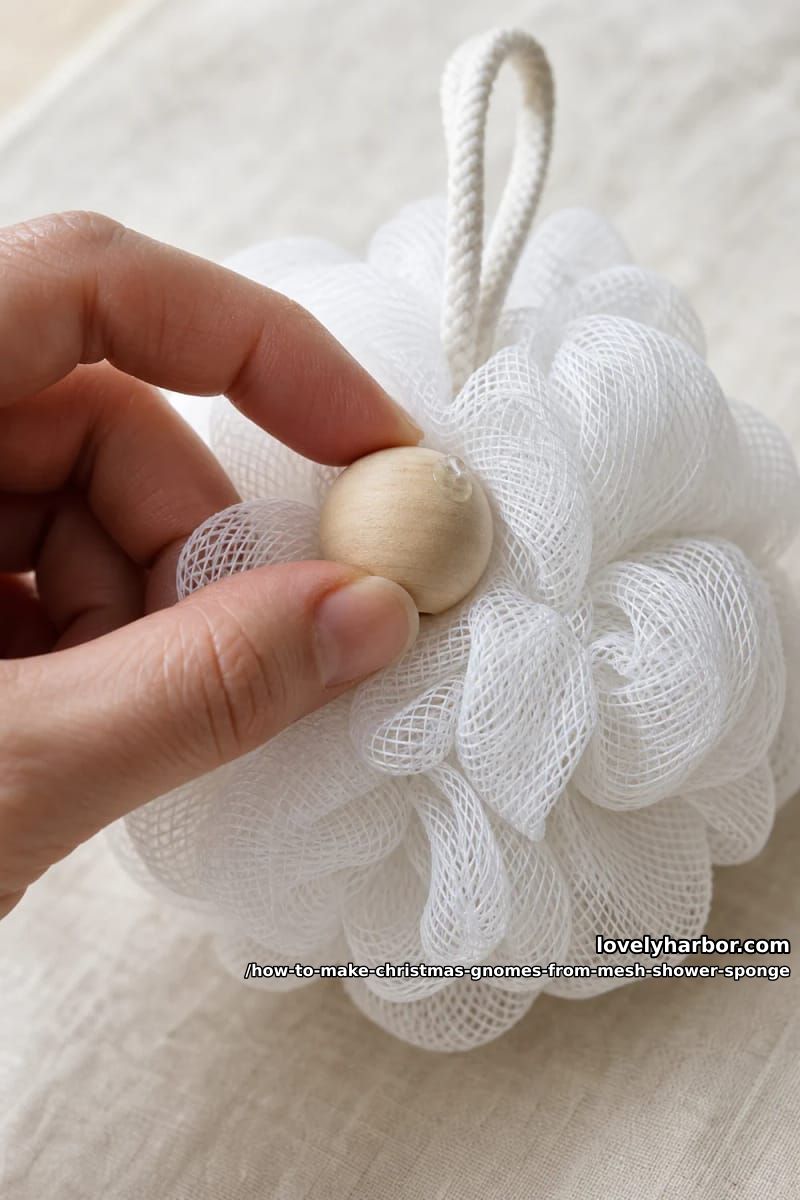
A 25mm unfinished wooden bead, glued or stitched to the front. Too high and the gnome looks startled. Too low and the beard swallows it.
- Find the placement line. About a third of the way down from the top of the fluffed pouf, centered on the front.
- Hide the hole. Generous dot of glue on the back of the bead, with the drilled hole rotated sideways or down so it doesn’t show.
- Press and hold for 15 seconds. Push it into the mesh, not just against it , the ruffles should puff out around the bead. That’s what frames it as a face.
Step 4: Crown the gnome
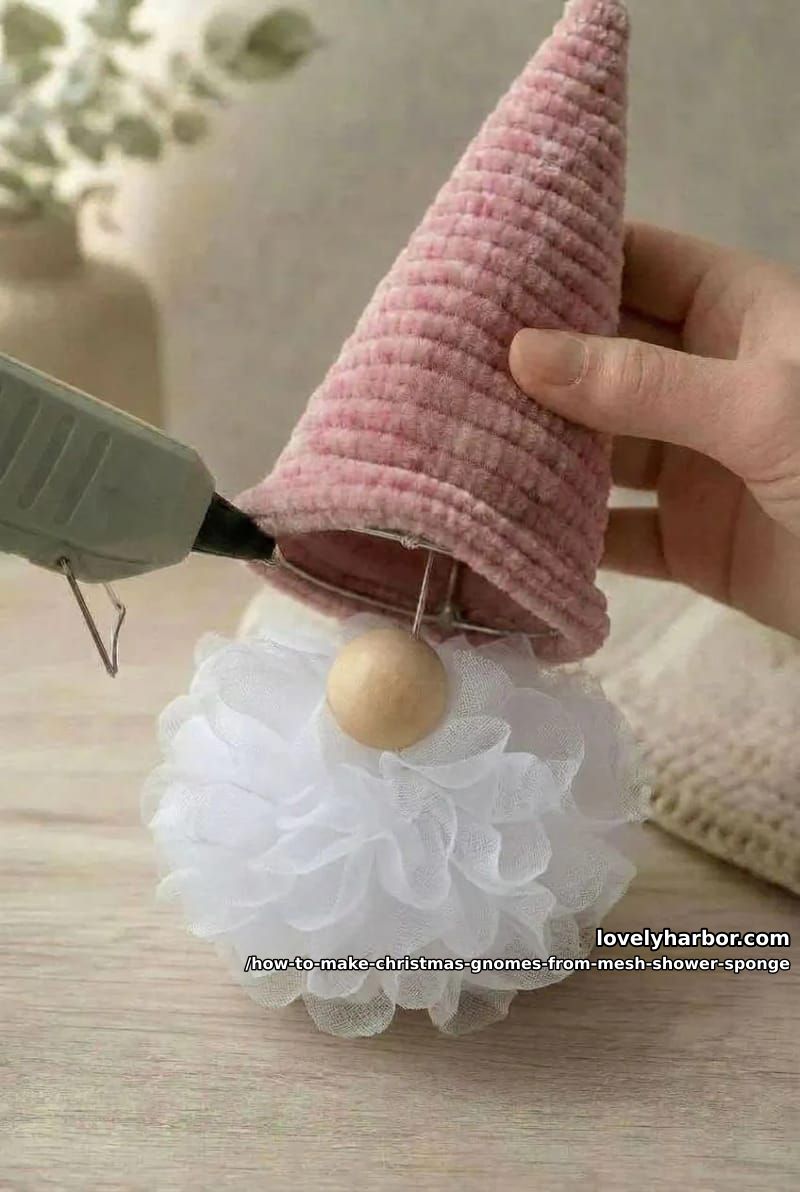
This is the step that decides whether your gnome has personality or sits on the mantel looking like a traffic cone someone glued to a snowball. The tilt is everything. A perfectly upright hat reads as inanimate. A hat angled 10 or 15 degrees forward suddenly has a posture , there's a head under there, leaning in slightly, considering something. I have made the upright version. It is not the same gnome.
The cord routing matters almost as much. The cotton loop wants to come out the back of the hat, not the side and not the front, because that's what makes the ornament hang straight on a branch. If you glue it in pointing forward, the gnome will spin face-down every time you breathe on the tree.
- Trial fit first. No glue. Position the hat so its front rim sits just above the wooden bead, covering the top half of the pouf. The brim should kiss the top of the nose.
- Route the cord. Pull the cotton loop up between the hat and the pouf so it emerges at the back of the hat. Invisible from the front, fully functional as a hanger.
- Glue the rim. Thick ring of hot glue around the bottom edge of the foam cone, then press it firmly onto the pouf. Hold for 20 to 30 seconds. (For the felt cone or knitted cap, run the glue around the inside of the brim instead.)
- Adjust the tilt. Tip the hat 10 to 15 degrees forward so the front rim almost touches the bead. You have about 30 seconds before the glue locks.
Step 5: Add finishing details
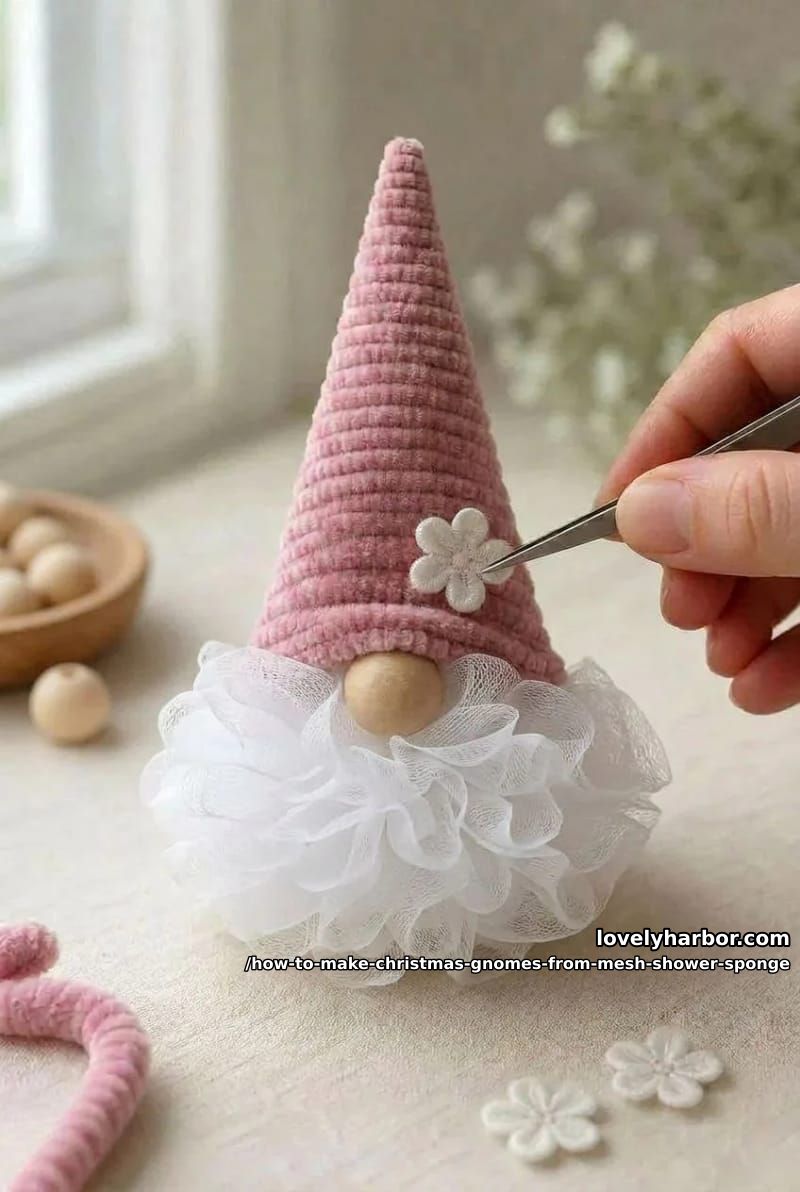
One micro-embellishment per gnome. Maybe two. The contrast between chunky hat and soft beard is doing the work , anything you pile on top fights that.
Step 5.1: Optional pom-pom topper
Wrap cream yarn around two fingers 30 times, slide off, tie tightly in the middle, cut the loops, fluff and trim to about 1 inch across. Glue to the tip. On the oatmeal-and-cream gnomes this is the one detail that pushes them from "DIY" to "looks bought."
Step 5.2: One accent, not three
- Mini white flower applique glued to the side of the hat near the brim. Works for pink and pastel hats.
- Tiny brass bell (8 to 10mm) on a short cord, dangling from the tip. More Nordic than cute.
- Dried baby’s breath. Tuck a sprig into the coiled yarn. Free if you’ve got a leftover bouquet.
Sizing and proportions that actually work
Beard (pouf) width: ~5 inches. The widest part of the silhouette, sets the scale for everything else.
Hat height: ~3 inches (60% of beard width). Taller starts to read wizard. Anything under half the beard width and the hat looks like a flopped pile.
Nose diameter: ~1 inch (25mm wooden bead). The visual anchor. Go smaller (16 or 18mm) and the beard swallows it; go bigger (30mm+) and you have a clown.
Hat-to-pouf overlap: about 40% of the pouf height. The front rim of the hat should sit just above the bead, hiding the upper 40% of the beard. This is what makes the bead read as a nose under a deep hat, not a button stuck on a snowball.
Mistakes that ruin the gnome
Six builds in, here are the failure modes I keep seeing in other people's photos.
- Colored or printed poufs. The green-and-pink swirl from the dollar store reads as bath product, not snow. Plain white only.
- Cutting off the cord loop. Once it’s gone you’ll be hot-gluing wire or fishing line through the back to make a hanger, and it never sits straight. The loop is already there. Use it.
- Thin yarn. Worsted weight against a foam cone is a losing battle , you’ll see white through every coil. Double the strand, triple it, or commit to a #6 chenille and move on.
- A perfectly level hat. Tilt it. Don’t think about it, don’t measure it, just nudge it forward before the glue sets.
- Painting or staining the bead. The raw birch against white mesh is the entire Scandi palette. Paint it skin-tone or red and you’ve made something else.
- Over-embellishing. Bells, holly, glitter, scarves, little wire glasses , every one of these makes the gnome worse. The negative space is the design.
Display ideas beyond the tree
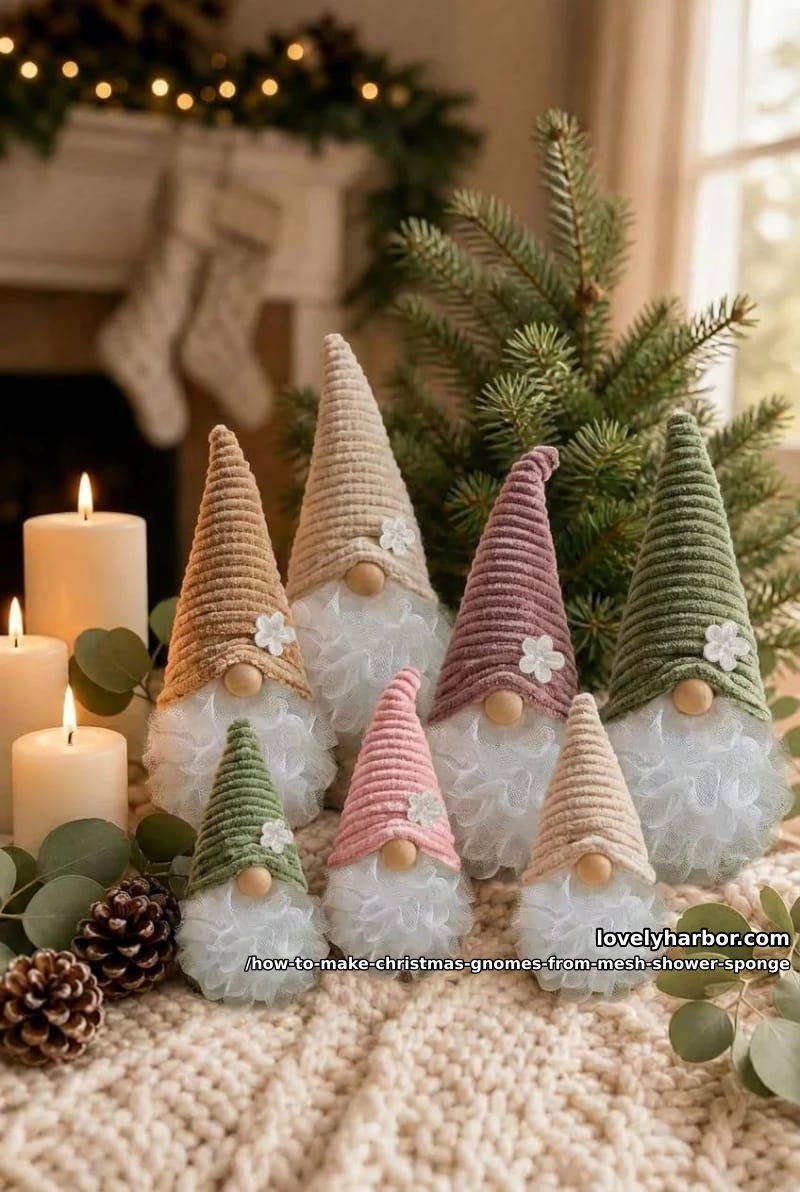
They hang from a tree like any ornament, but at 5 to 6 inches tall they actually look better in clusters on a mantel or shelf than buried in branches. Five or seven of them in varied hat colors looks intentional; scattered singles look forgotten. They also make decent place card holders for Christmas dinner , tuck a folded card under the cord loop , and respectable gift toppers if you trim the loop and tie the gnome directly to the ribbon.
People email me asking whether these survive being boxed up for next year. They do. The mesh fluffs back as long as you don't crush the bead off the front. Shallow box, hat up, tissue between layers. The hot glue lasts.
Conclusion
Cream-on-white, wooden bead, no embellishment. That's the one to make first , it photographs cleanest and it's the version people ask about. Pink and sage and patterned can wait for batches three and four, once the hat tilt is muscle memory.
If you're deciding between the three hats: the wrapped cone is the one to start on, since it forgives a wobbly hand and uses what's already in the box. Save the felt seam and the knitting for when you care how the back looks.
One thing I'd add that I didn't earlier: buy the 16-pack of cones and the 6-pack of poufs in the same order. You will not stop at one.