
Modern coastal does not mean rope mirrors and a bowl of starfish on the coffee table. The version worth living in sits closer to a quiet Cape house in February than a souvenir shop: pale walls, washable fabric, one or two blues, and enough texture that the room does not read like a furniture showroom. Below are nineteen rooms that get there, with honest notes on what holds up and what you will regret by August.

1. Airy coastal living room with L-shaped sectional and woven accents.
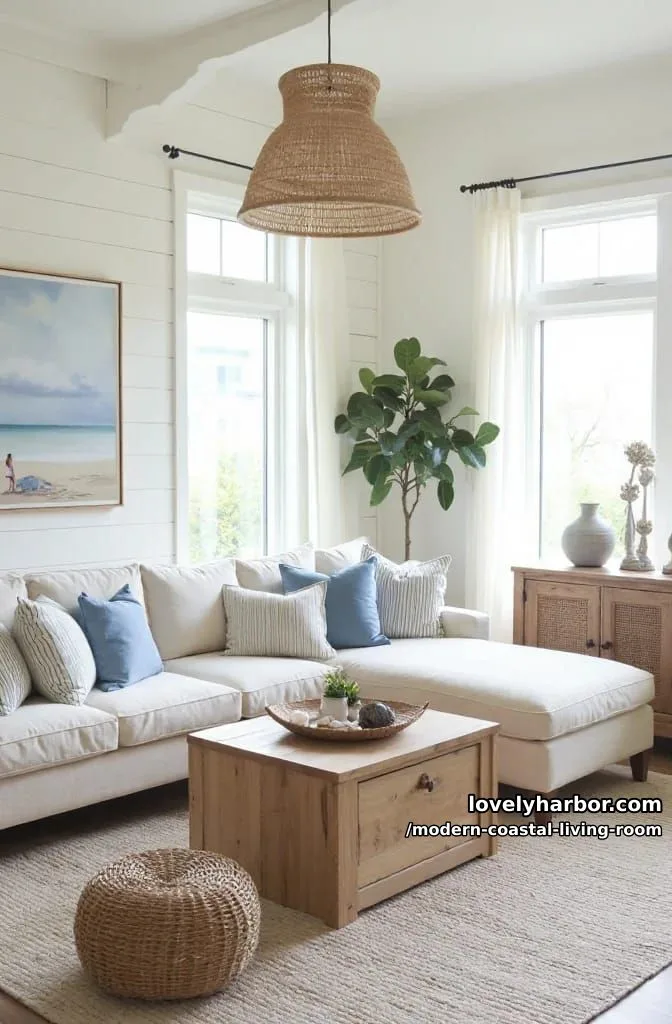
An L-shaped sectional does the one thing an open-plan coastal room needs most: it draws an edge around the seating area when there are no walls to do it. Push the long run toward the window so the room reads as one calm zone instead of a sofa marooned in the middle of the floor.
The woven part is where these rooms go wrong. A seagrass rug, a rattan chair, a wicker basket, and a jute pouf in the same eight feet stops looking coastal and starts looking like a garden center. Pick one or two textures and let the rest stay smooth. To make the baskets read intentional, vary the weave scale: a tight, fine seagrass against a loose open rattan reads richer than four pieces of the same basket weave.
2. Bright beach-inspired living room with woven textures and natural materials.
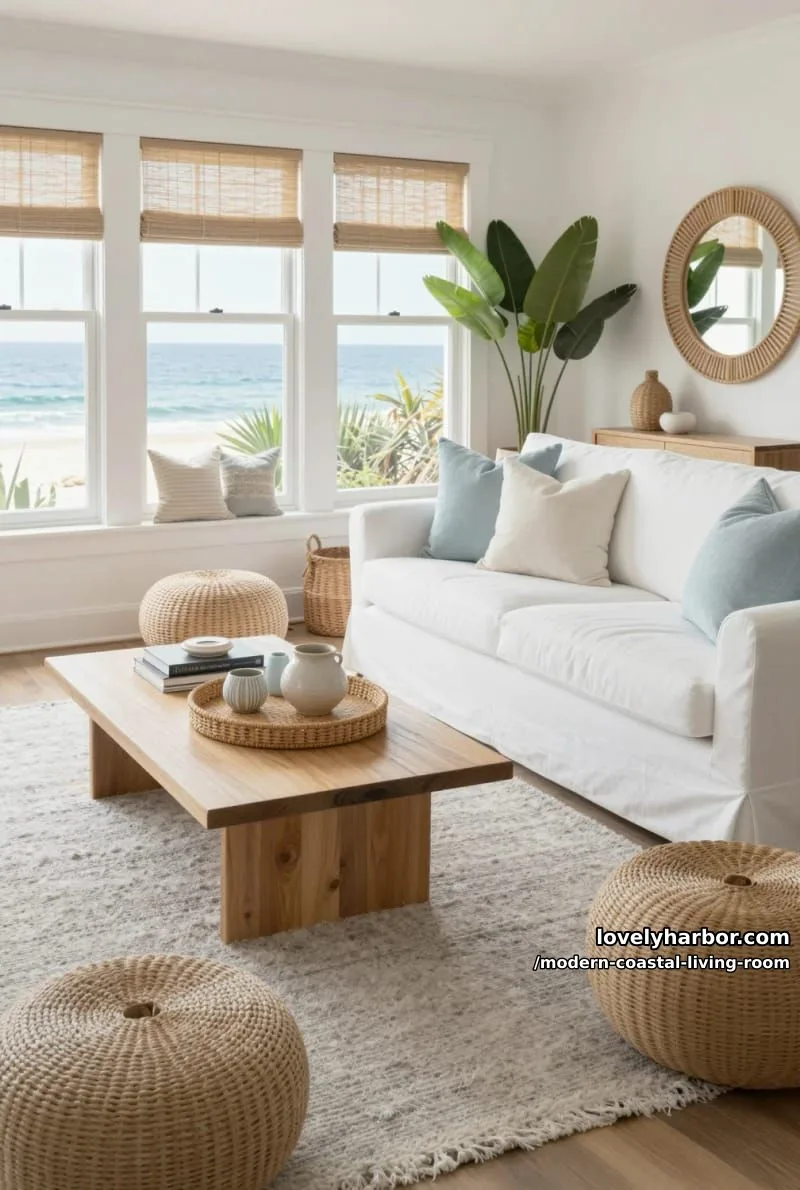
All-natural palettes die from sameness, not from a lack of stuff. Rattan, jute, oak, and linen are all warm mid-tones, so a room built only from them turns into a wall of beige with no focal point. The fix is one cool element doing the contrast work: a navy stripe, a piece of sea glass, a charcoal lamp base.
Texture has to vary too, or the warmth flattens out in photos. Set something coarse (a jute rug, a chunky knit) against something smooth (linen, a lacquered tray) so light has different surfaces to catch. One honest warning about jute: it sheds for the first month and hates moisture, which makes it the wrong rug for a room that opens onto a pool deck. Sisal or an indoor-outdoor polypropylene weave survives wet feet better.
3. Spacious open-plan coastal living room with light wood and soft neutrals.
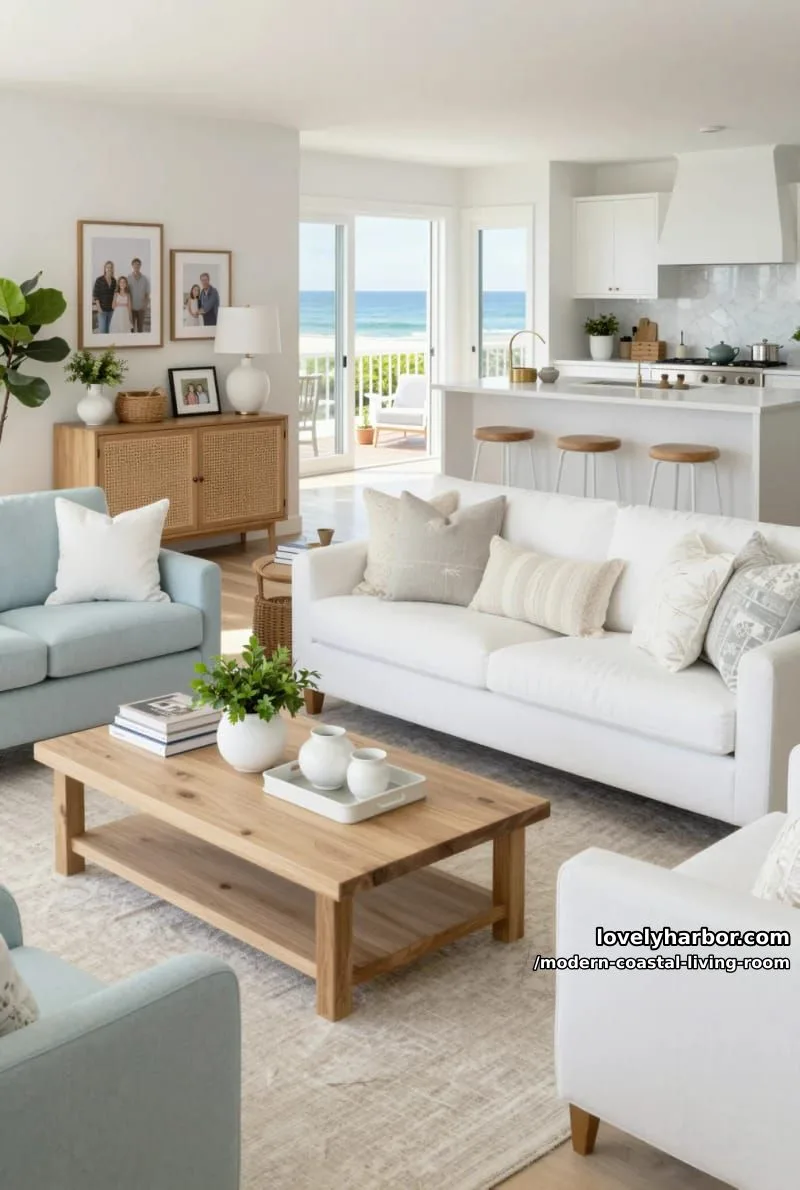
The undertone of the wood decides whether this room reads coastal or reads dentist's office. Pale oak and white oak carry a soft yellow warmth that flatters linen and cream. Grey-washed and ashy "driftwood" floors, which every flip house installed between roughly 2015 and 2020, already look dated, and they make neutrals go cold rather than calm.
Granted, you cannot rip up flooring for a refresh. If you are stuck with grey-washed wood, warm it back from the top: a jute or wool rug in oatmeal, leggy furniture in a warmer tone, table lamps with linen shades instead of overheads. The room needs warm light at eye level to counter a cool floor.
4. Serene coastal living room with cream ottoman and natural light.
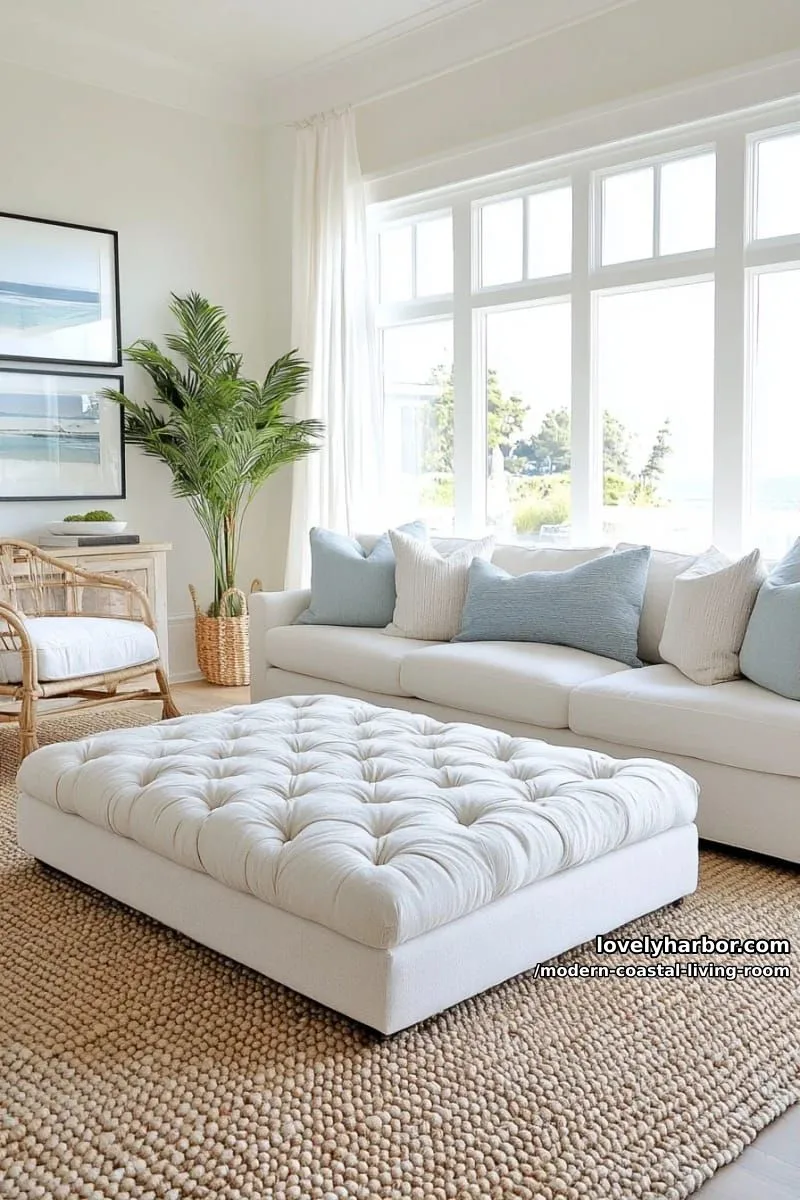
A cream upholstered ottoman pulls double duty as a footrest and a tray surface, which is why it beats a hard coffee table in a room you actually flop in. The catch is obvious to anyone who has owned one: the flat top is a magnet, and cream shows everything.
Buy it with a removable, washable cover or a performance fabric (Crypton and solution-dyed acrylic both clean up with soap and water), and keep a real tray on top so cups never touch the fabric. I bought a dry-clean-only linen ottoman once. It looked right for about four months. Skip it.
5. Relaxed coastal living room with white sectional and soft neutral tones.
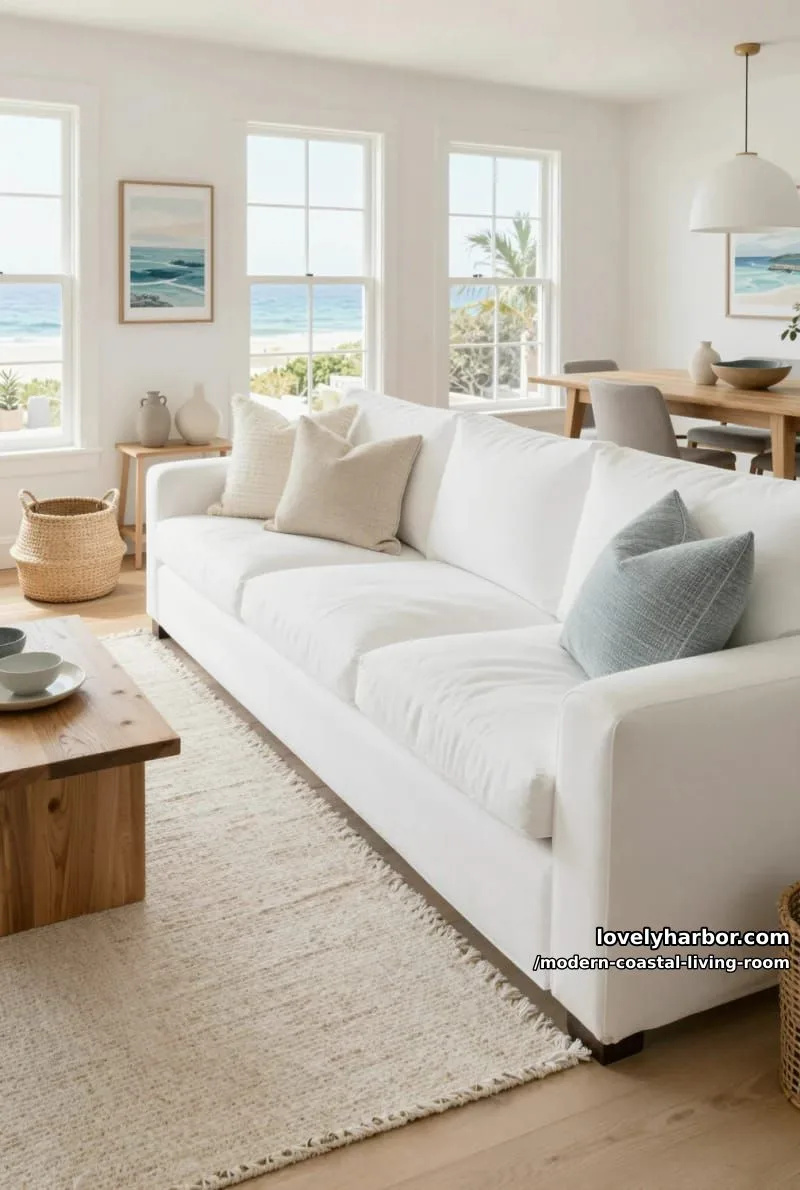
A white sectional only works long-term if you are honest about your household before you buy. In a kids-and-dogs house, a dry-clean-only white sectional is not furniture, it is anxiety with cushions. The look is achievable; the fabric spec is the whole game.
Keep the neutrals from going cold by layering tones instead of matching them. Sand, oatmeal, and a greyish pebble read richer than three pieces in the identical white.
Do this
- Choose performance fabric or removable, machine-washable slipcovers.
- Look for solution-dyed acrylic or Crypton, which recover from spills with a damp cloth.
- Pick a soft, warm white over an optic bright white next to wood tones.
Avoid
- Dry-clean-only linen or velvet on a daily-use sectional (you will baby it or stain it).
- Optic bright white beside warm wood, which reads clinical, not calm.
- Feather-only cushions with no foam core, which go flat and look slept-on by month three.
6. Airy living room with cream sectional, navy accents, and rattan coffee table.
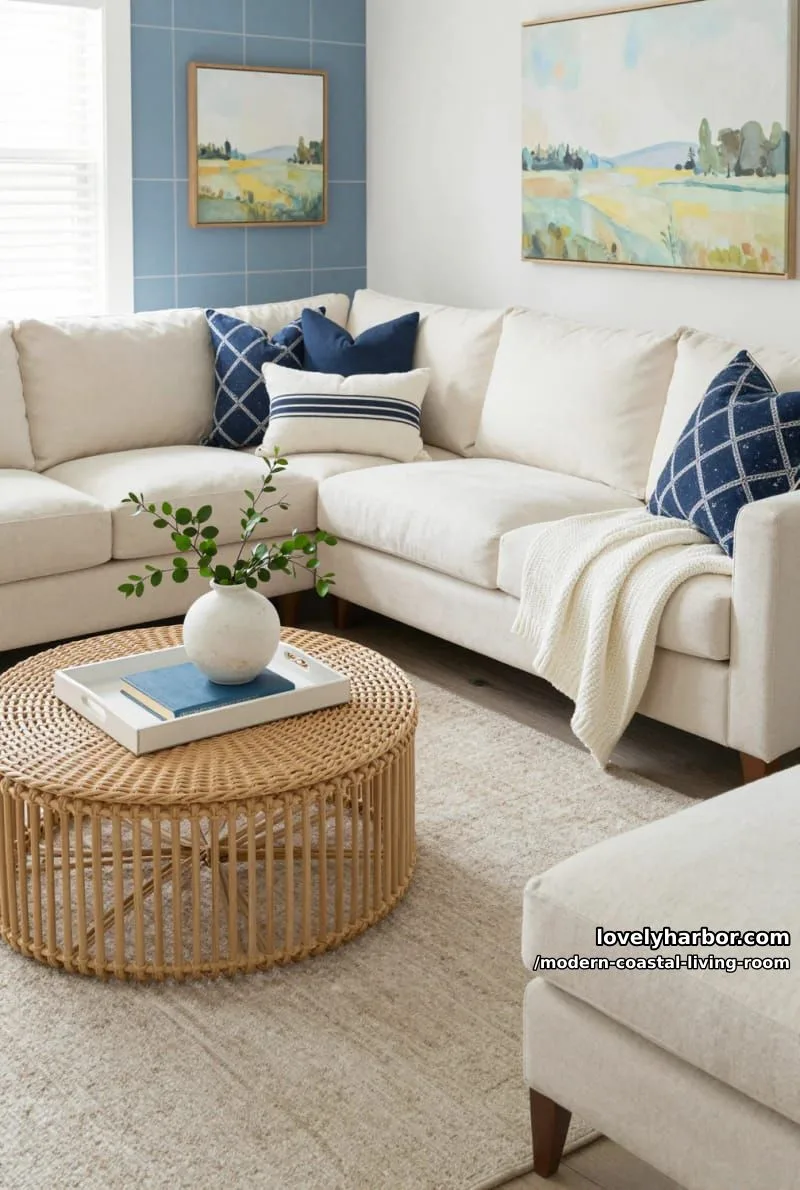
Navy is the accent to reach for here because it is the cheapest one to change your mind about. Pillows, a throw, one piece of art: roughly ten percent of the room, swapped in an afternoon when you tire of it. Going further (navy sofa, navy rug, navy walls) commits you to a scheme that is hard to walk back.
Rattan coffee tables hold up better than people expect, but the woven shelf underneath collects dust and grit, and you cannot wipe it like a glass top. If you own a vacuum with a brush head, fine. If you do not, a flat-topped table on a rattan base gives you the texture without the cleaning.
7. Open-concept living room and kitchen with white sectional and greenery.
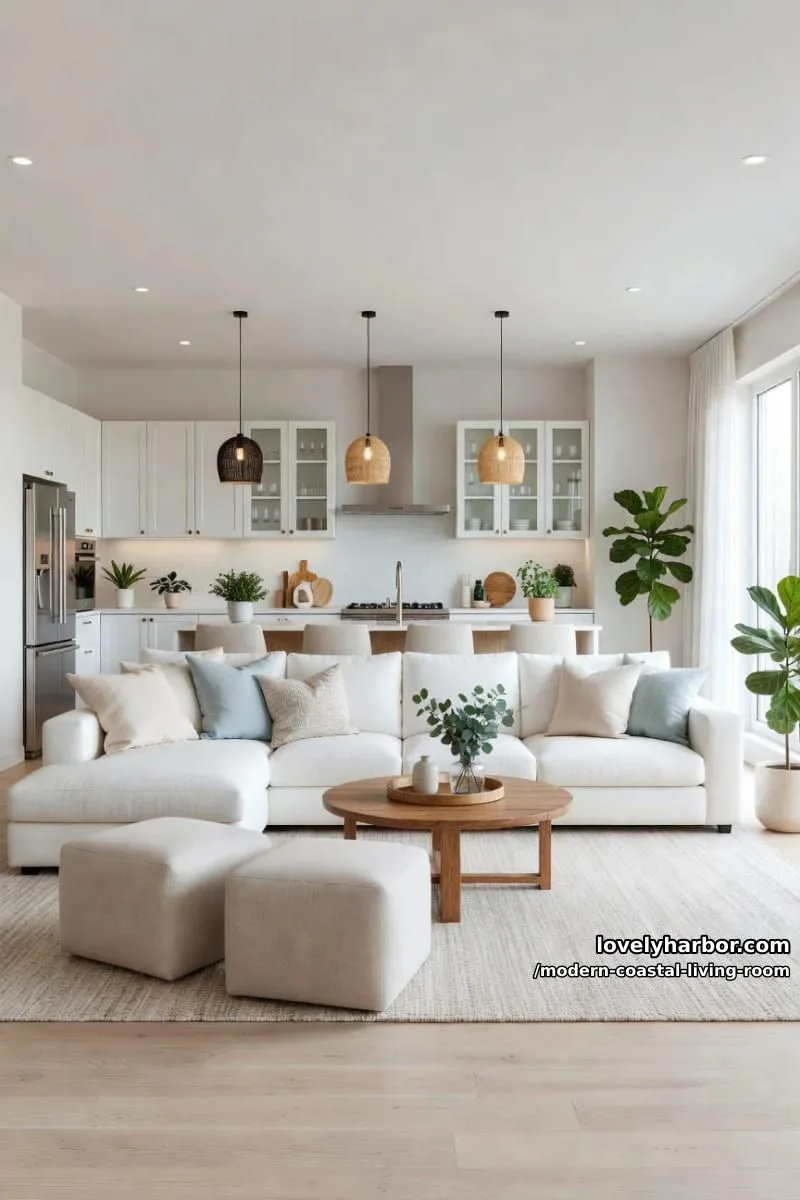
In an open-concept living-kitchen, the real design problem is the sightline from the sofa to the sink, not the sofa. Whatever sits on the counter is now living-room decor, so the room lives or dies on whether you can keep one surface clear. A trailing pothos on a floating shelf does soften the hard cabinet lines, and it is one of the few plants that survives the low, indirect light most of these layouts actually get.
Skip the fiddle-leaf fig that every catalog stages for this shot. It wants bright light and a stable spot, and it drops leaves the moment a draft hits it, which it will in a room with a kitchen door. A snake plant or a ZZ plant gives you the same vertical green and forgives neglect.
8. Modern coastal living room with beige sofa and wicker accents.
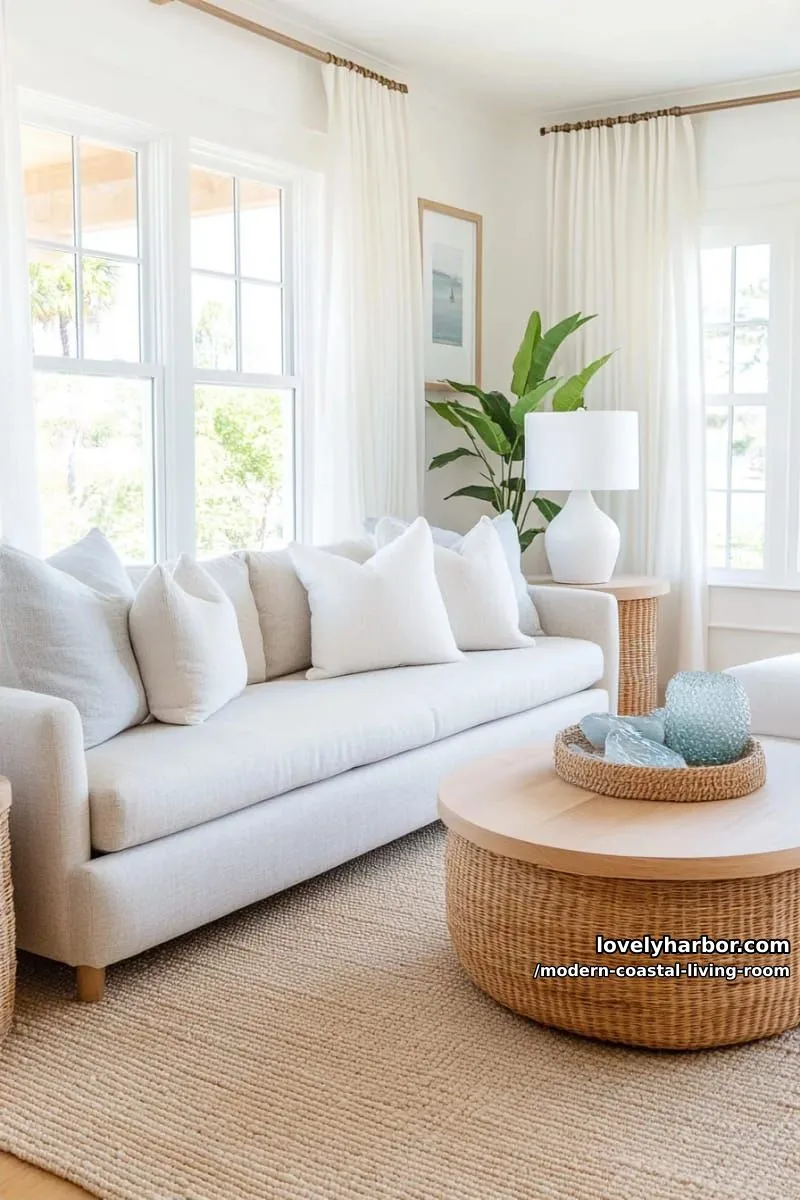
A beige sofa is the most forgiving anchor in this whole roundup: it hides everything, takes any accent color, and never looks of-its-moment the way a bouclé blob or a 1970s-revival sofa does. Add one real wicker piece and you have the look without trying.
Buy the wicker secondhand. The "coastal" wicker that big-box stores sell new is often thin, glued, and finished in a too-orange stain that screams reproduction; a genuine 1960s wicker chair from a local estate sale costs less and already has the patina the new stuff is faking.
One anchor, one thing from the sea, and stop. The moment you add shells, a ship’s wheel, rope trim, a “Beach This Way” sign, and a jar of sand to the same room, the style flips from calm to gift shop. If a piece would look at home in an airport souvenir store, it does not go in the room.
9. Coastal living room with white sectional and blue, beige accents.
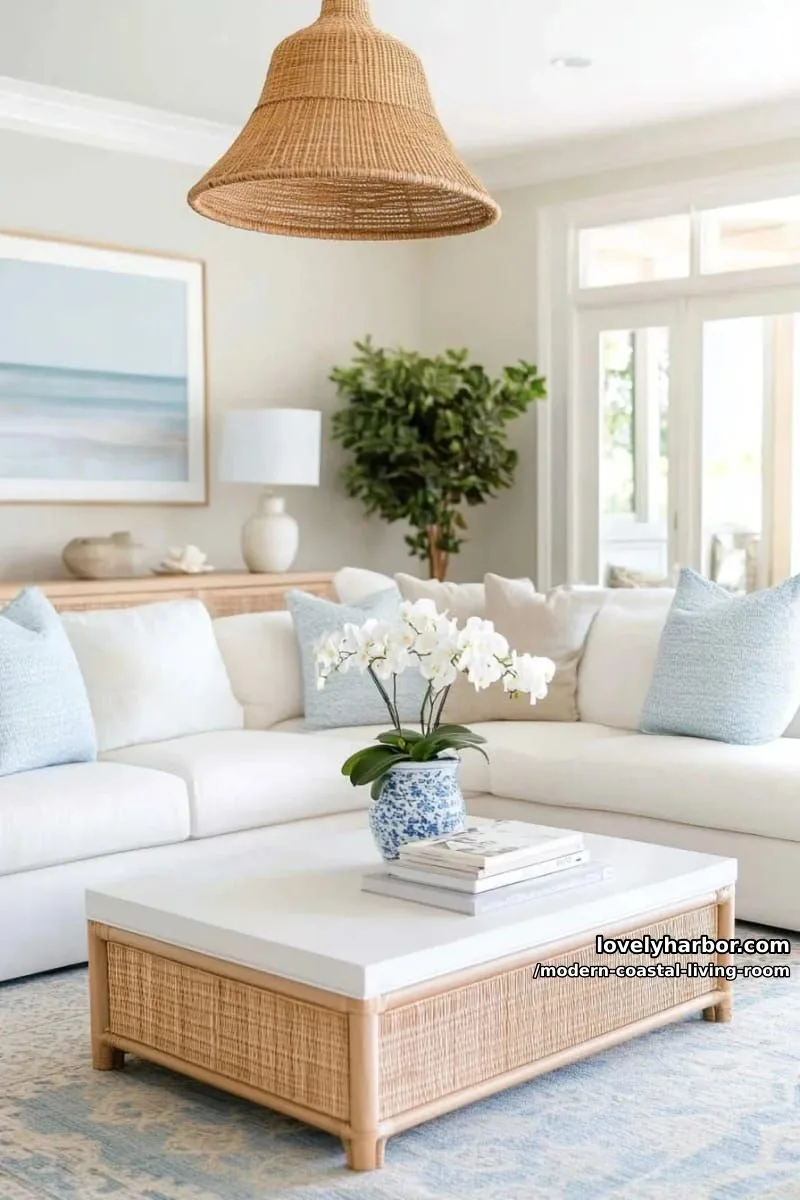
Three colors need a ratio or the room looks like a swatch board: white as the field, beige as the secondary, blue as the accent, roughly sixty-thirty-ten. Spread the blue across at least two spots (a pillow and a piece of art, say) so it reads as a deliberate thread, not one stranded throw pillow.
The shade of blue matters more than the amount. Powder and "baby" blue tip the room toward a nursery and date quickly. A greyed slate, a deep indigo, or a soft French blue carries the same coastal signal and lasts. Natural texture under it all, a jute rug or a driftwood tray, keeps the white from going clinical.
10. Neutral living room with round mirror, wood console, and soft textures.
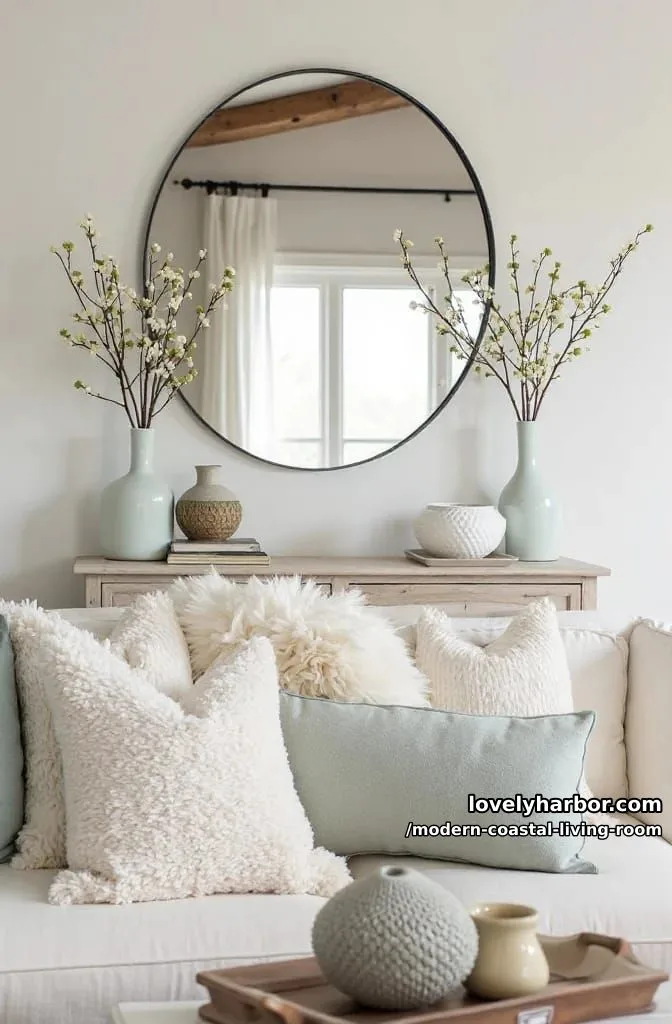
Hang the round mirror so it reflects a window or a lamp, not the blank wall across from it. A mirror's only real job in a neutral room is to throw light around, and a mirror pointed at nothing is just a circle. Put it on the wall the daylight hits and the whole corner brightens for free.
Size it to the console, not the wall: a mirror about two-thirds the width of the console looks anchored, while a small one floating over a long console looks like an afterthought. Yes, the big round mirror over a wood console is everywhere right now. It is everywhere because it works; get the proportion right and stop worrying that it is common.
11. Modern coastal living room with beige sectional and blue accents.
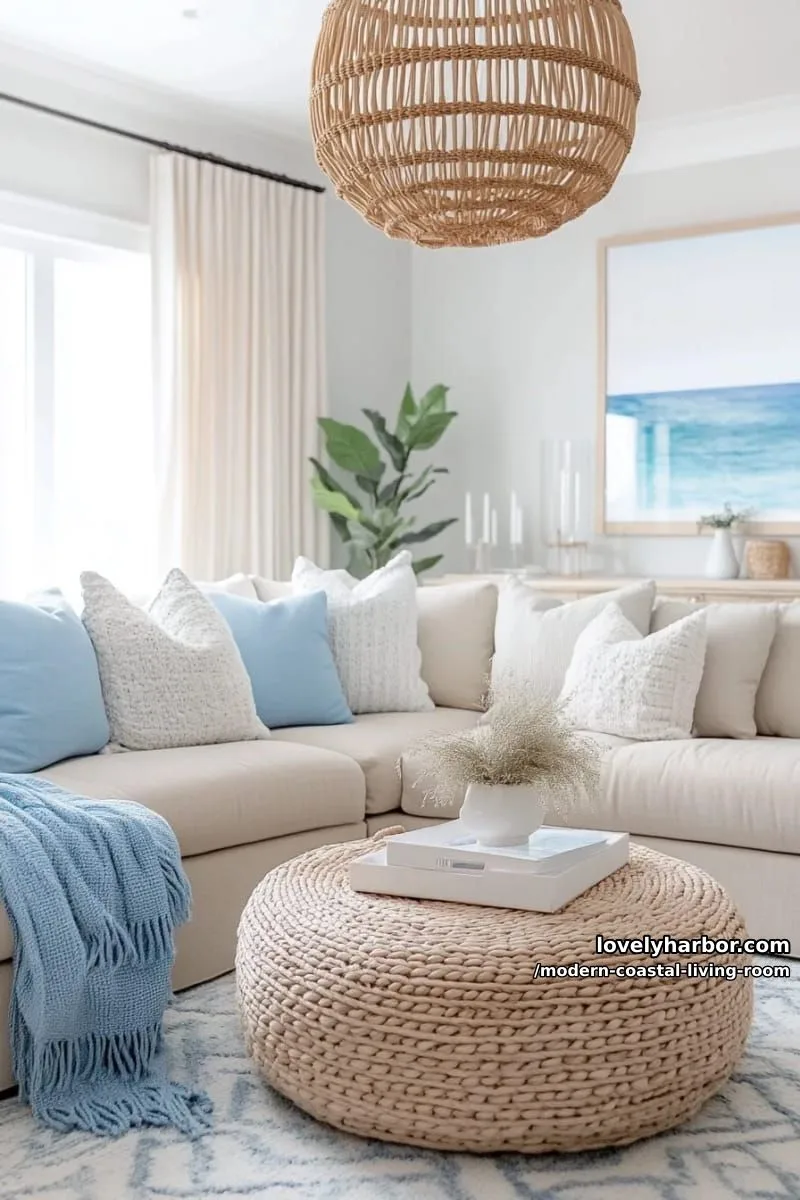
A beige sectional needs an undertone decision or it lands on builder-grade nothing. Beige with a pink or yellow base wants warm accents and brass; greige (the grey-based version) wants cooler blues and matte black. Mixing the two undertones is what makes a room feel slightly off without anyone being able to name why.
Blue accents read coastal here, and the swap-ability is the practical win: change the throws from indigo to rust in October and the same sectional reads autumn instead of beach. Resist the urge to "add a shell" to prove the room is coastal. The palette already says coastal; the literal objects just clutter it.
12. Ocean-view living room with white sofas, rustic coffee table, and plants.
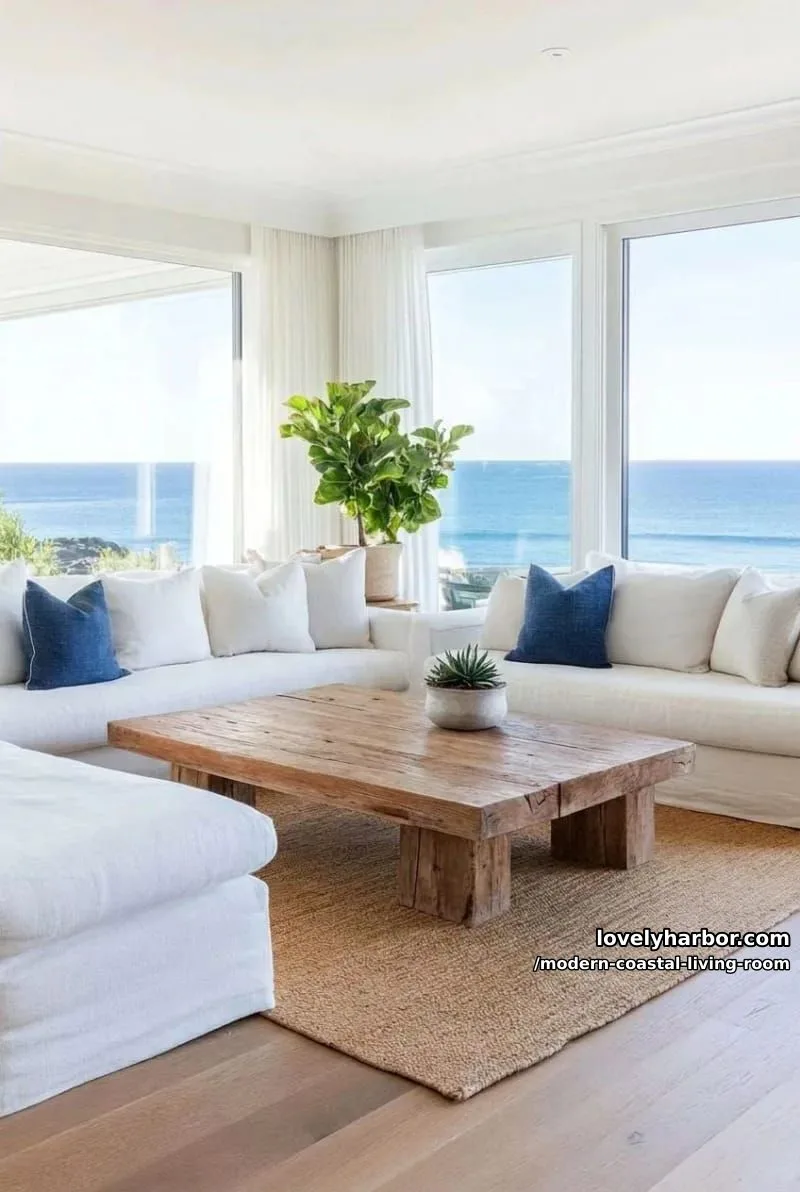
With a real ocean view, the design job is restraint: the window is the most interesting thing in the room, and your job is to not compete with it. Keep the sofas low-backed and pale so nothing blocks the sightline, and let the changing water supply the color the room would otherwise want from accents.
A rustic or reclaimed-wood coffee table earns its spot precisely because it does not need babying. Water rings, sand, salt air: reclaimed oak or teak shrugs all of it off, where a high-gloss lacquer table near the coast would show every mark. For plants, anything that handles salt and bright light, snake plant or a sansevieria, beats a fussy fern by a south-facing window.
13. Modern coastal throw pillows in blue, beige, and white tones.
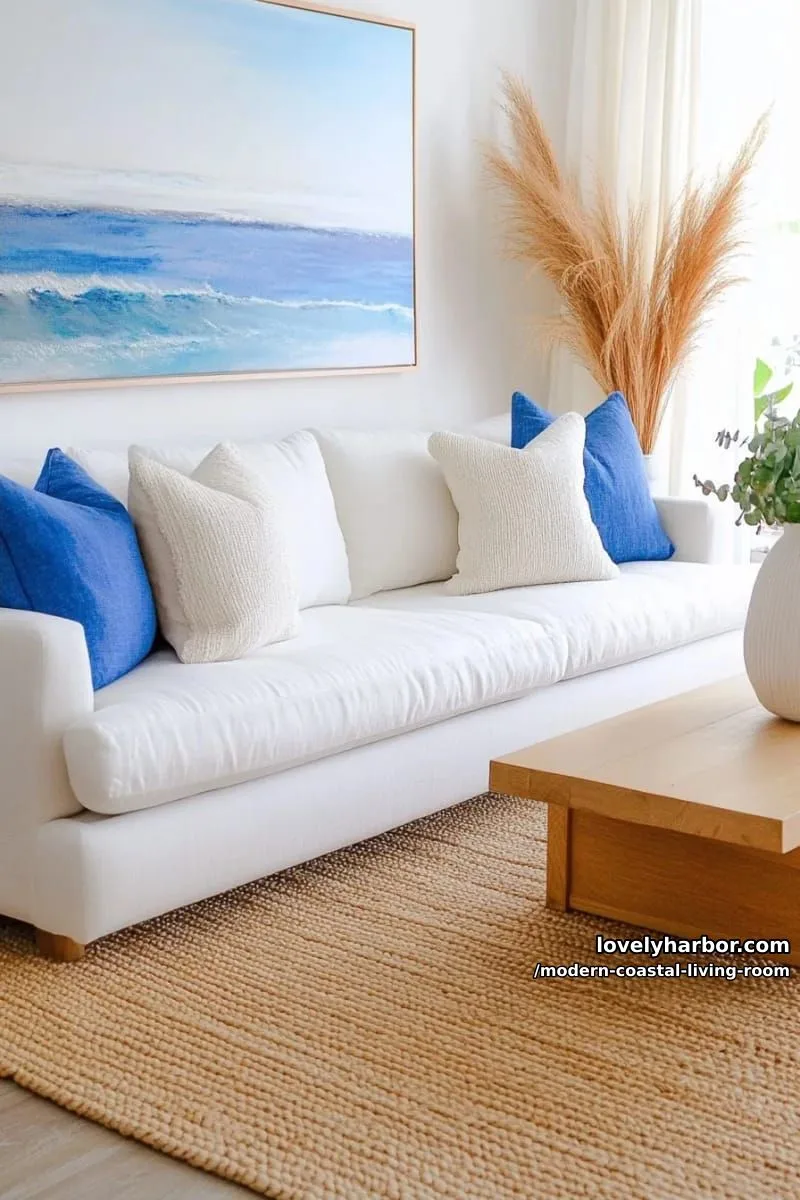
Pillows are the cheapest way to move a room, which is exactly why most people do them badly. The single biggest upgrade is the insert, not the cover: buy a feather-down or down-alternative insert two inches larger than the cover (a 22-inch insert in a 20-inch cover) so the pillow looks full instead of like a deflated envelope. The flat polyester slabs that ship bundled with cheap covers are the giveaway.
For the mix, vary scale and texture more than color: one large linen solid, a smaller woven stripe, maybe one knotted lumbar. Forget the "odd numbers only" rule people repeat; an even pair on a symmetrical sofa looks fine. Rotate covers by season and store the off-season set flat, not crammed in a bin, so they are not creased when you swap back.
14. Open-plan living room and kitchen with jute rug and rustic table.
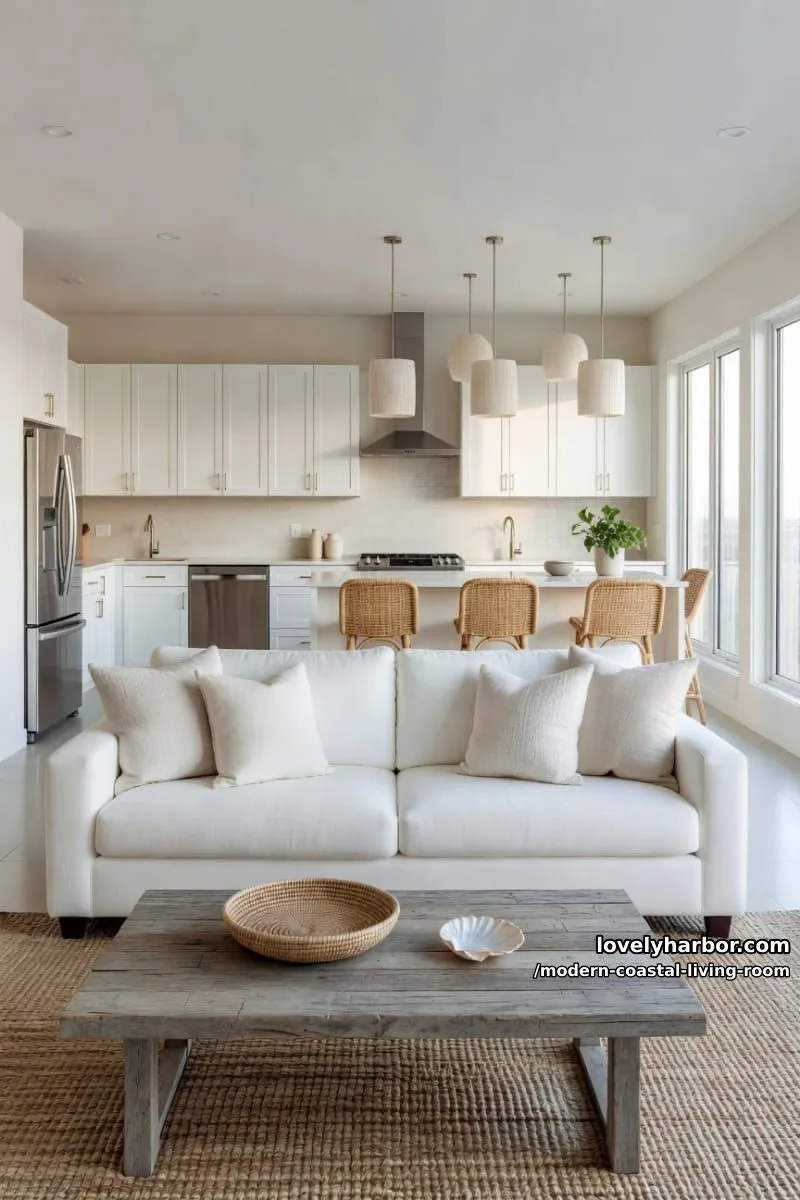
Jute is the wrong rug directly under a dining or eating zone, even though every open-plan shot puts it there. It cannot be wet-cleaned, it stains permanently from anything acidic (wine, tomato, citrus), and it traps crumbs deep in the weave. It looks right and behaves badly in the exact spot people spill most.
If you want the jute look where food happens, layer a flatweave cotton or a washable rug on top of a jute base so the texture shows at the edges while the washable layer takes the hits. The rustic table is the easy part: a slightly distressed wood top hides the dents and rings that a glossy surface would broadcast, which is what makes it survive a room that doubles as a homework desk and a snack station.
15. Neutral living room with cream sofa, arched credenza, and botanical prints.
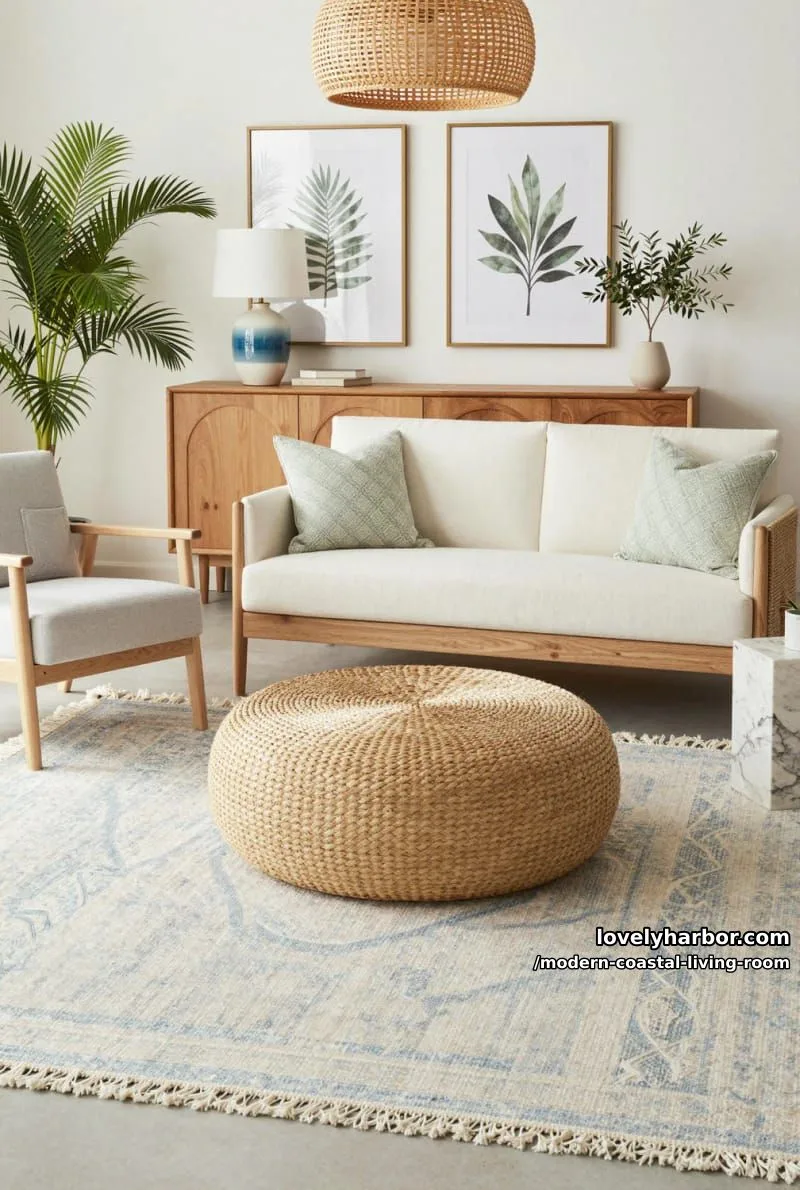
The arched credenza is having a moment, so buy it in solid wood or a quality veneer, not the curved MDF versions that chip at the edges within a year and cannot be repaired. A well-made arch-front piece outlives the trend and reads as a real furniture choice; the cheap ones announce the year you bought them.
Botanical prints soften the neutrals, but mass-market "palm leaf" art reads thin. Real pressed botanicals or vintage botanical plates, matted with generous white space and hung in a tight grid, look collected rather than ordered from the same site as everyone else's. A bold throw or a swapped print refreshes the corner when the cream starts to feel quiet.
16. Modern living room with ocean view, blue accents, and gold coffee tables.
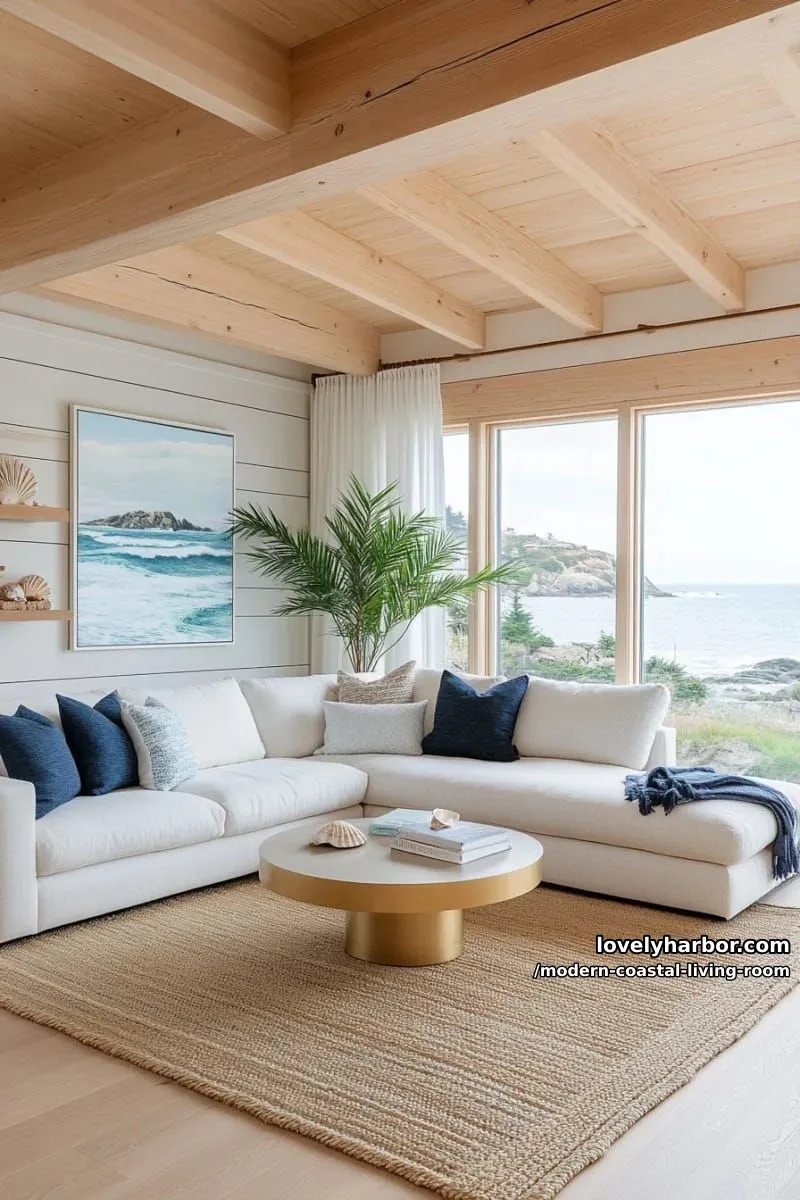
Gold and brass near the coast is a maintenance question before it is a style one. Raw, unlacquered brass tarnishes fast in salt air and needs polishing; a lacquered or PVD-finished brass holds its color and wipes clean. If the table is the showy gold piece, make it the only strong metal in the room so it reads as a deliberate accent.
A glass-topped gold table photographs well and shows every fingerprint and water spot, which is real work in a sunny room where the light rakes across it all afternoon. A solid metal or stone top is the lower-maintenance call if you would rather not wipe it daily. Keep at least one blue accent genuinely cool, slate or indigo, to offset the metal; lean all-warm and the gold-plus-beige combination starts to read hotel lobby.
17. Sunlit living room with blue sectional, leather ottoman, and botanical wallpaper.
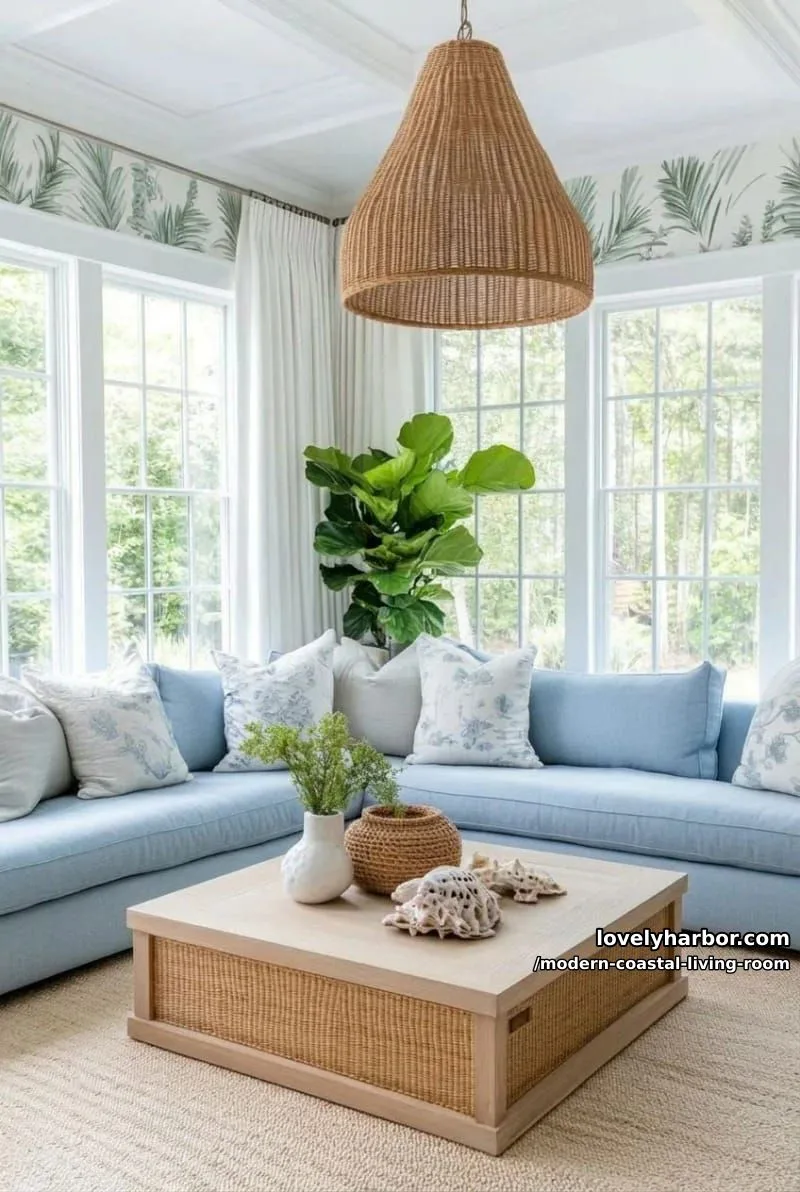
A blue sectional and botanical wallpaper are two loud elements, and two is the limit before the room turns into a contest. Once you commit to both, everything else has to go quiet: pale walls on the other three sides, a neutral rug, a leather ottoman that grounds the color instead of adding more.
Leather earns its place here as the calm, wipeable counterweight to all that pattern, and it takes spills better than any fabric on this list, which is why it suits a house with a dog. One restraint worth keeping: put the botanical paper on a single feature wall, not all four. Wrapping the whole room in leaves turns a sunlit space into a visually humid one, and there is no neutral left to rest your eye on.
18. Spacious coastal living room with slipcovered sofas and woven baskets.
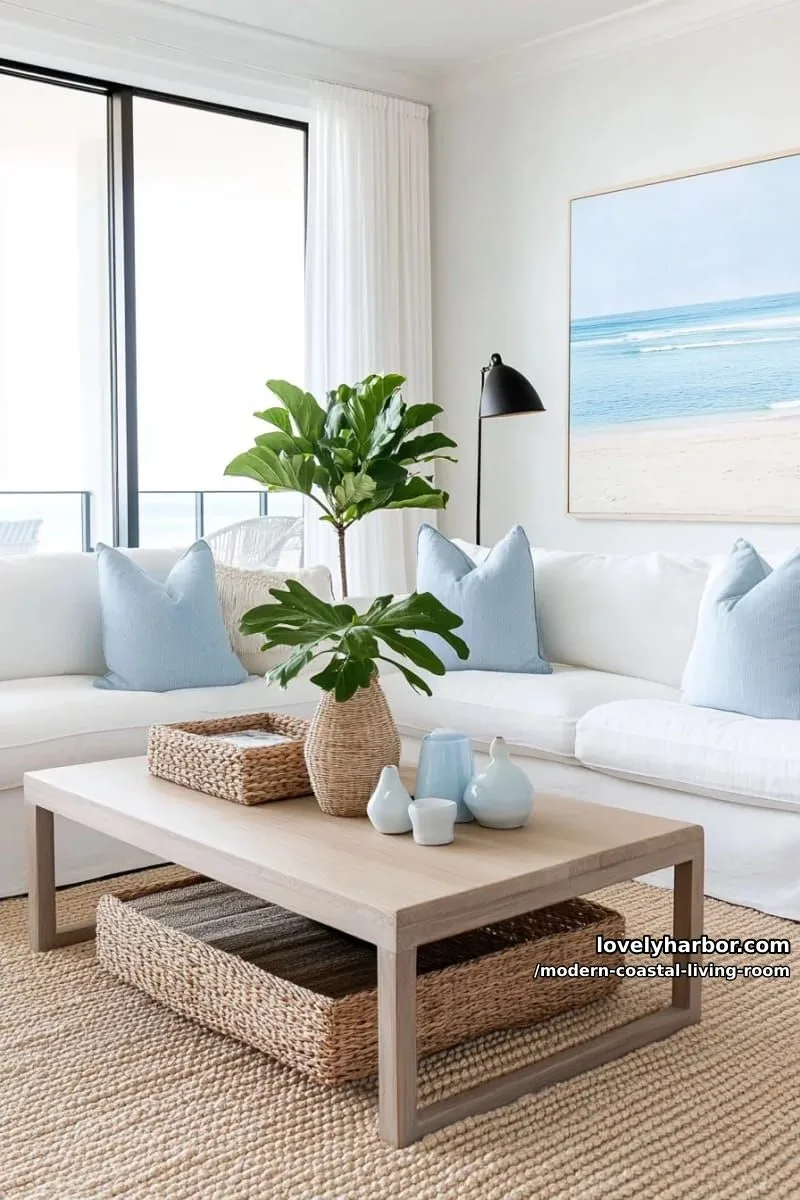
Slipcovers are the most practical thing in any coastal room, but only when the cover is actually machine-washable. A lot of "slipcovered" sofas sold as coastal are dry-clean-only, which defeats the entire point: the reason to own one is to throw the cover in the wash after a sandy summer, not to haul it to a cleaner twice a year. Confirm "machine washable" in the specs before you buy, because "removable cover" alone means nothing.
Baskets work as storage, but set a number and hold to it. Three baskets in a room is texture; seven is a basement waiting to happen. Use the closed ones for what you want hidden (remotes, throws, the kids' beach junk) and leave the open weave for things that look fine on display.
19. Modern cream sectional living room with wood beams and plants.
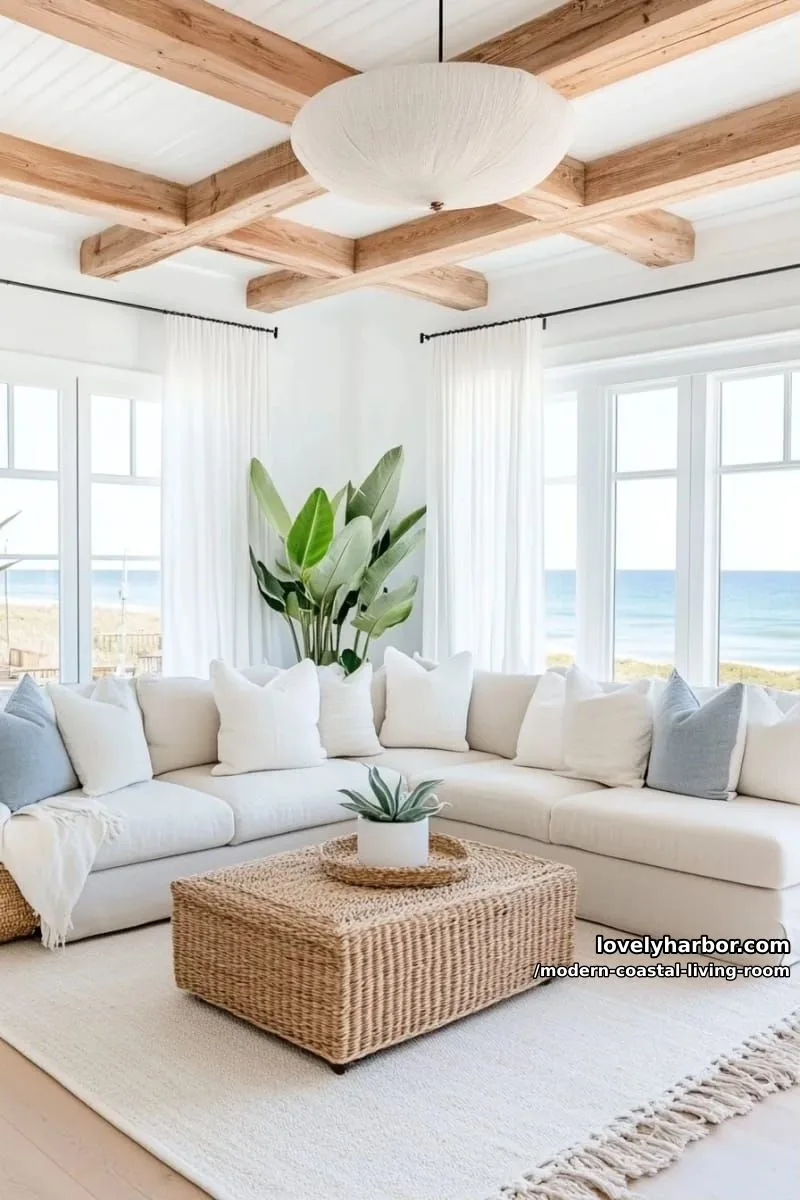
Exposed wood beams draw the eye up and make a ceiling feel taller, but they only read calm when their wood tone agrees with the floor and the other wood in the room. A warm honey beam over a cool grey floor looks like two houses arguing. Match the undertones, or paint the beams out in the wall color when matching is not an option, which keeps the architecture without the clash.
For greenery, one large plant beats five small ones. A tall olive tree or a rubber plant in a textured pot anchors a corner and looks intentional, where a scatter of tiny succulents on every shelf looks like a garden-center clearance table. Cream stays cream only with washable covers or a performance weave; on a daily sofa, anything dry-clean-only is a slow regret.
Conclusion
If you are starting from a normal room and not a blank beach house, do it in this order. Fix the fabric first, a washable slipcover or a performance-weave sofa, because that one decision is what lets everything else stay pale without becoming precious. Then sort the wood undertones so the floor, beams, and furniture are not fighting. Color and accents (the navy, the one blue, the basket or two) come last and cost the least, which is the part everyone wants to start with and the part that matters least when the first two are wrong. And resist the shells. One object from the actual sea is plenty; the rest of the coast can stay outside.