
Most small coastal kitchens fail the same way. They try to signal the beach with too many objects and end up reading like a gift shop instead of a room. The ones worth copying do less: a tight palette, one or two honest materials, and a single window left to set the tone. What follows are twenty small kitchens, some predictable and some not, with notes on what holds up once you actually cook in them and what you will be wiping down twice a day.
1. Bright coastal kitchen with white and blue cabinets, gold hardware, and open shelves
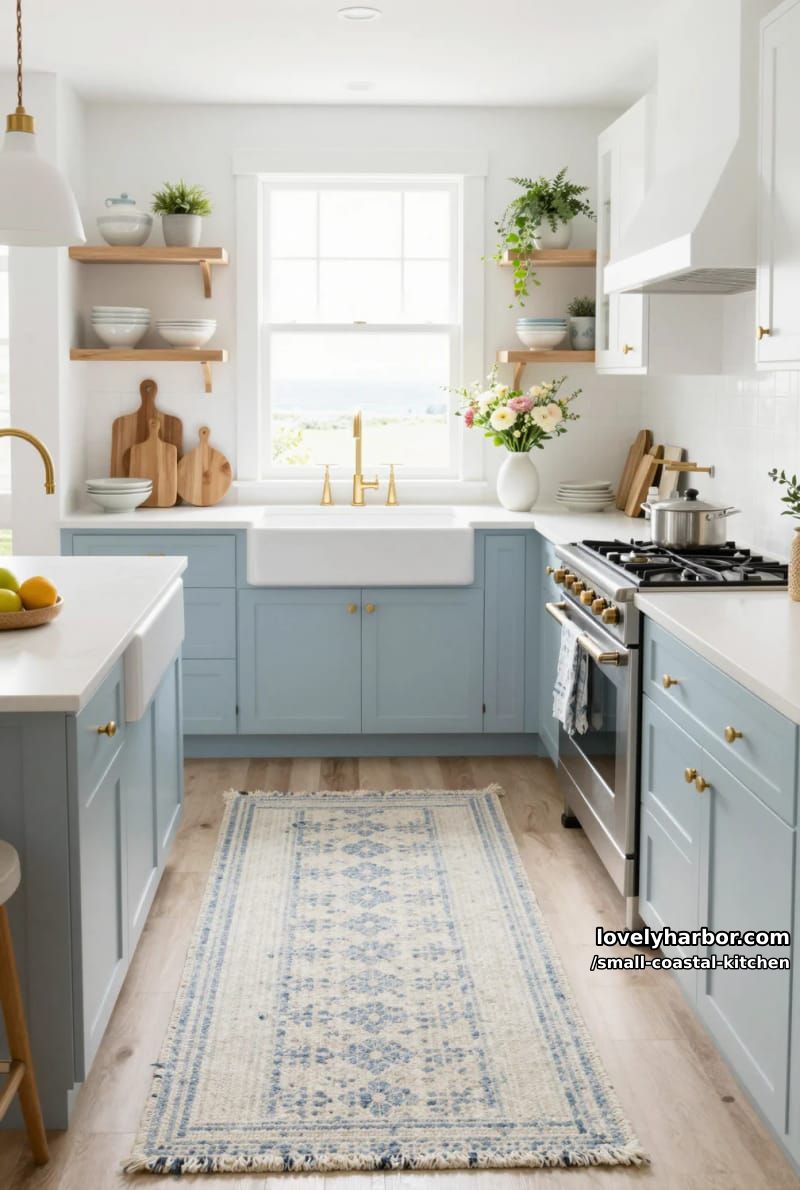
White-and-blue is the default coastal move, and it works. The hardware is where people overthink it or underspend. Shiny lacquered brass from a big-box bin tends toward an orange cast and looks tired inside a year; unlacquered brass from someone like Rejuvenation or CB2 runs roughly $12 to $25 a pull and dulls into a softer tone instead. Set cabinets in a soft white (Benjamin Moore White Dove is the reliable one) against a grayed blue rather than a primary one, which can tip the whole room toward nautical costume.
I lived with open shelving in a galley kitchen for two years, then took half of it down. Catalog photos show six matched bowls; real life shows a cereal box and a mug you meant to put away. Keep one short run at eye level for the things you reach for daily and put the rest behind doors.
Do this
- Keep open shelving at eye level, where you actually grab daily dishes.
- Group items by color or material so a busy shelf still reads calm.
- Back the shelf wall with the same blue or a tile, so gaps look intentional.
Avoid
- Open shelves directly above the cooktop; they collect a grease film fast.
- Displaying anything you use once a year. It just gathers dust.
- More than two plate styles per shelf. Past that it reads cluttered, not curated.
2. Wide plank wood floor, marble island, seafoam backsplash, glass cabinets, turquoise accents
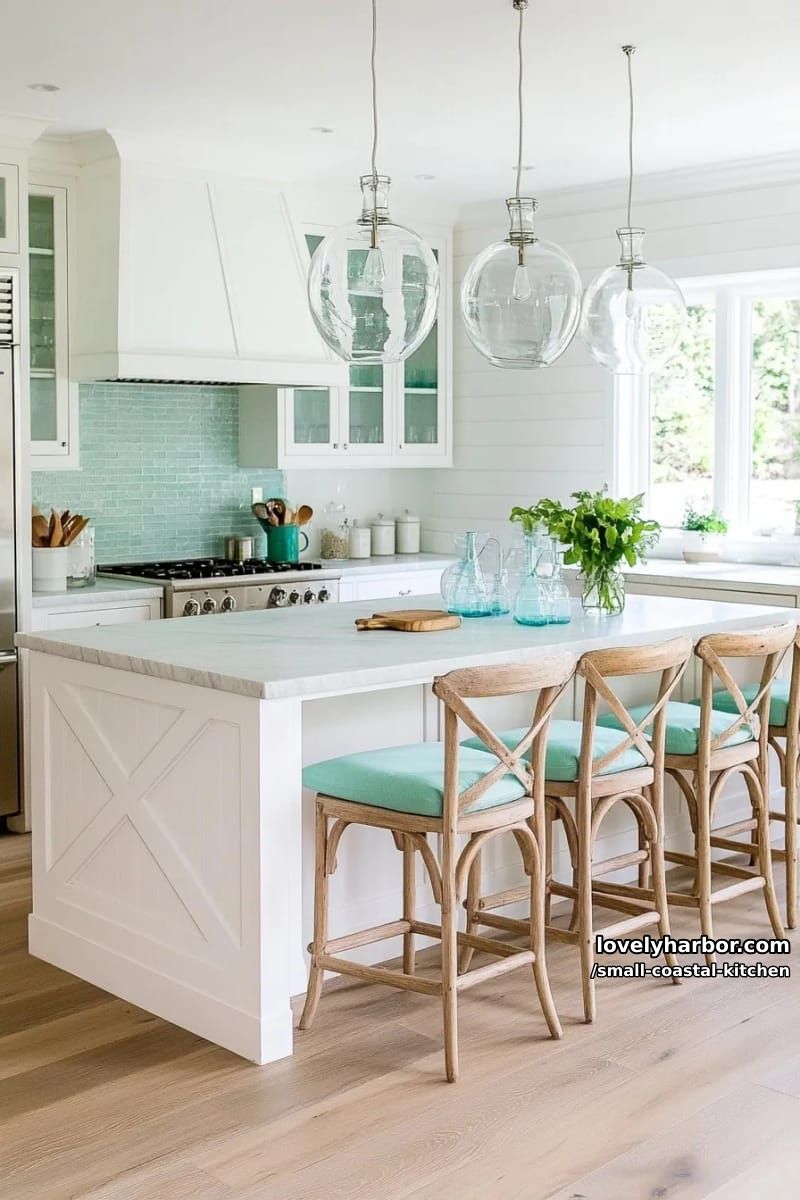
Wide plank flooring is the single best way to warm up a cool palette of marble and seafoam. In a kitchen, go engineered oak over solid: the plywood core handles the humidity swings near a sink and dishwasher far better, and a 7-inch or wider plank makes a small floor read as one calm plane instead of a grid of strips.
Seafoam is a specific color, not a mood, and that is where it goes wrong. Too saturated and it turns minty and juvenile. Aim for a grayed-down version (something near Benjamin Moore Palladian Blue) so it stays adjacent to the marble rather than competing with it. Glass cabinets only earn their place if what is behind them is worth seeing, so reserve them for one upper run and use solid doors everywhere else.
Hold the turquoise to one or two objects. A pair of stools or a bowl of lemons is plenty; a turquoise everything starts to look like a themed restaurant.
3. L-shaped coastal kitchen, white cabinets, mint backsplash, brass hardware, ocean views
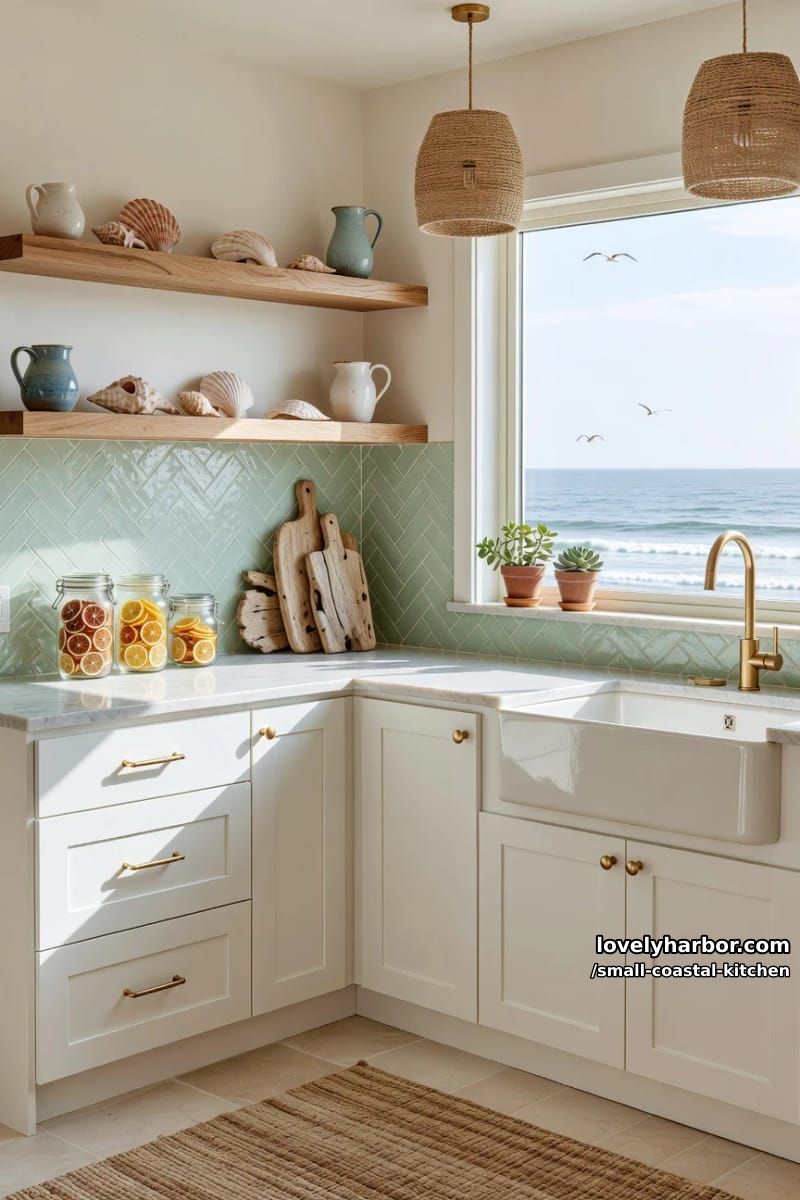
The L-shape is the workhorse of small kitchens for a reason. It puts sink, stove, and fridge on two adjacent runs so your steps form a short triangle, and it leaves the third and fourth walls free for a window or a slim table. If you have the view, this is the layout that lets you keep it: nothing tall blocks the glass.
Mint is risky. Pushed bright, it reads 1950s diner before it reads coast. A grayed sage-mint behind white cabinets stays in the right register, and brass pulls give it just enough warmth to keep the whole corner from going cold. Granted, white uppers and a pale backsplash will show every splash, so this is a kitchen for people who don't mind a daily wipe, not one for people who pretend they will.
4. Airy kitchen, light blue cabinets, floating wood shelves, woven pendants, Scandinavian touch
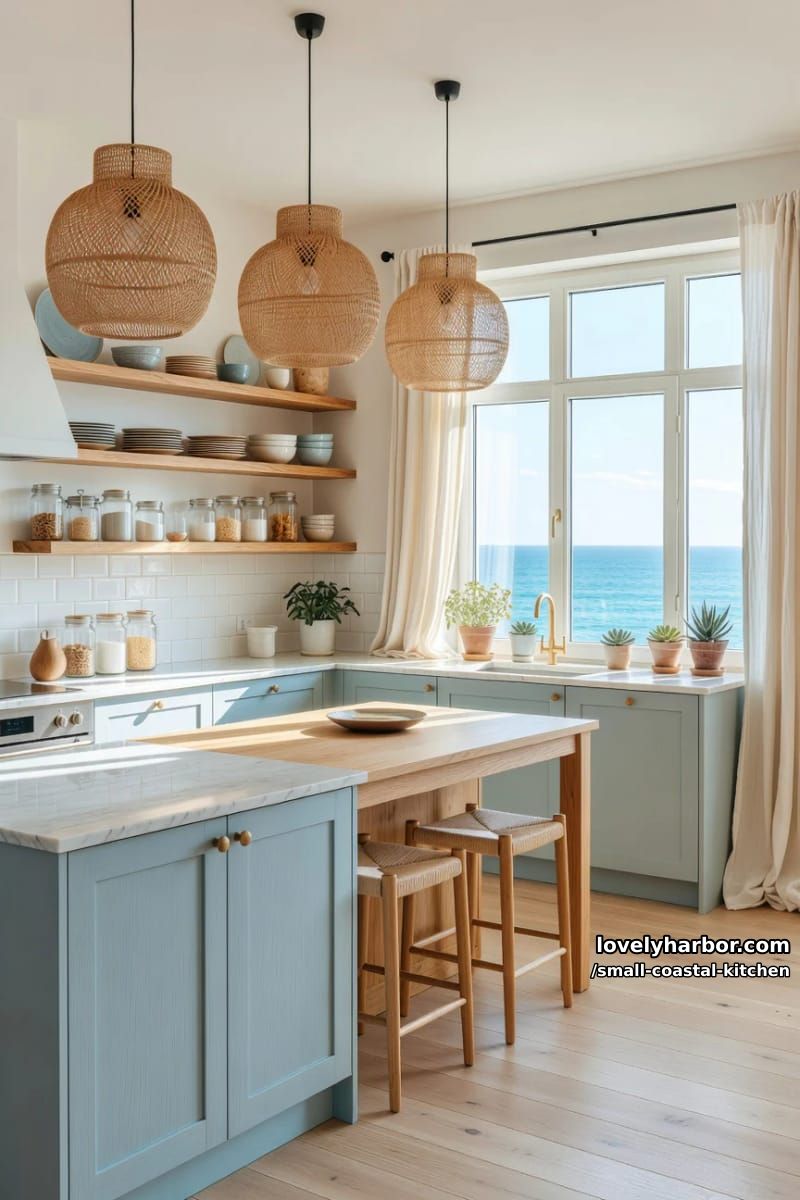
"Scandinavian" gets thrown at any room with pale wood and no clutter, but the part actually worth borrowing is the restraint: few materials, almost no visible hardware, nothing decorative that isn't also useful. Light blue cabinets with no pulls (push-to-open or a routed finger groove) read cleaner than the same cabinets covered in knobs.
Floating wood shelves only look weightless if the bracket is hidden, which means a steel rod sunk into the studs, not an L-bracket screwed to the surface. Buy the heavier-duty floating hardware and check it lands on framing; a 24-inch oak shelf full of plates is heavier than it looks. Skip the matchy set of three identical shelves. Two at slightly different lengths feels less like a showroom.
5. Modern beach kitchen, light stone island, seashell decor, beige shaker cabinets, glass pendants
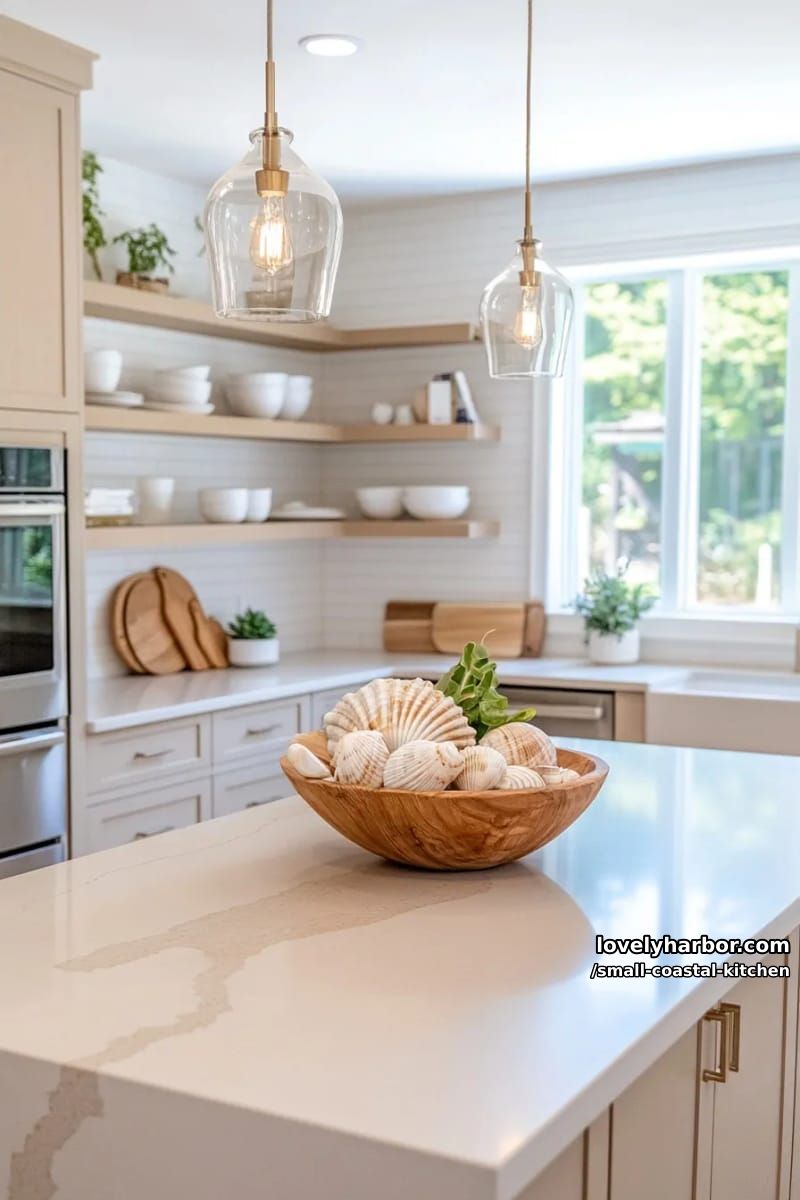
Beige is the most failure-prone color in this whole list because of undertone. A beige with a pink base goes salmon under warm bulbs; a beige with a green base goes olive in daylight. Bring home a large sample and look at it morning and night before you commit, because shaker fronts have a lot of surface and the wrong undertone reads off across the whole room.
Seashell decor is where coastal kitchens most often turn into souvenirs. The fix is editing: one large piece (a single bleached fan coral on the wall, a bowl of three sand dollars) reads collected, while a scatter of small shells reads beach-rental. If you have kids who hunt for shells, give them one shallow tray on the windowsill and let everything else live elsewhere.
6. Spacious kitchen, vaulted ceiling, marble island, brass fixtures, arched glass door
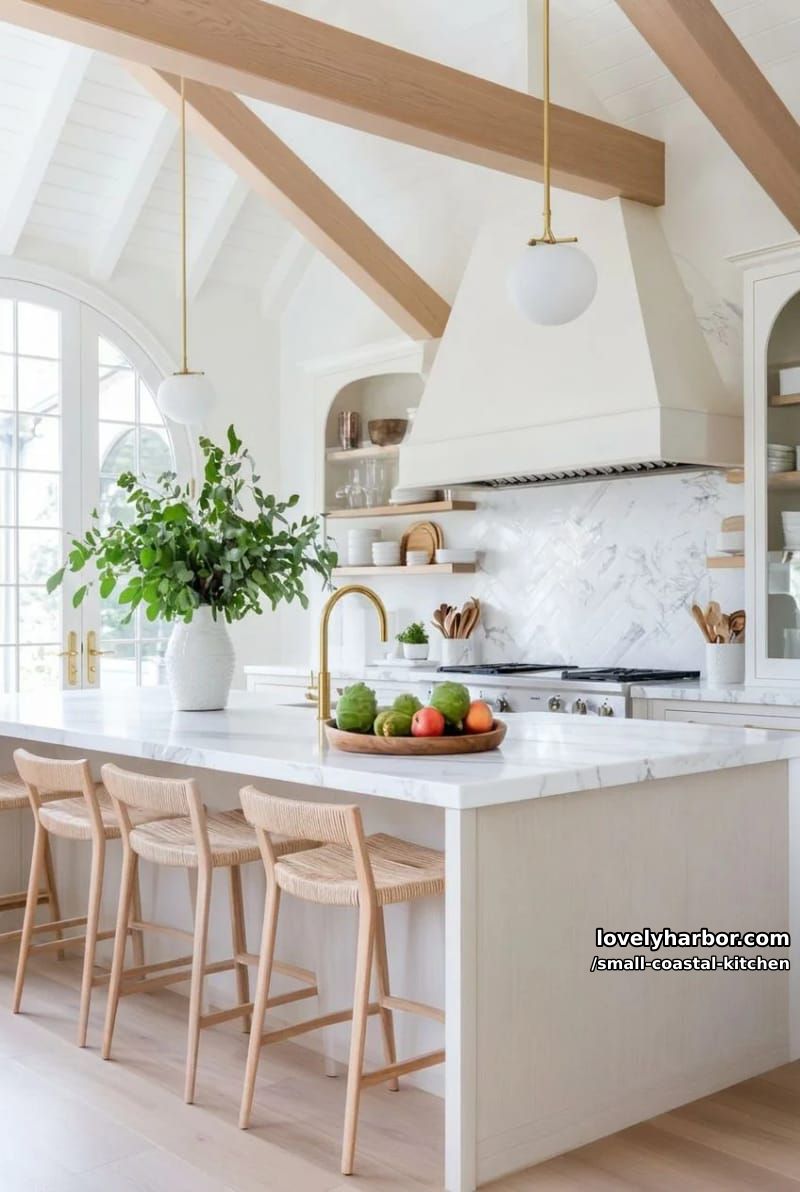
A vault is the rare structural change that pays back in a small kitchen. Stealing the attic space above and running the ceiling up to the rafters makes the room feel larger without adding a square foot of floor, and a single high window or an arched glass door at the end pulls light deep into the space. It is not cheap (you are into framing, drywall, and often a structural review), so it belongs in a real renovation, not a refresh.
The marble island is the part readers ask about most, usually after the fact.
Sealing marble stops stains, not etching. A lemon wedge, a splash of wine, or a tomato left on polished Carrara leaves a dull matte ring that no sealer prevents, because the acid reacts with the calcium in the stone. If you cook with citrus and tomatoes daily, choose honed marble (the etch barely shows on an already-matte surface) or skip to quartzite, which is a different, harder stone that does not react the same way.
7. White kitchen, gold hardware, marble island, glass pendants, elegant coastal design
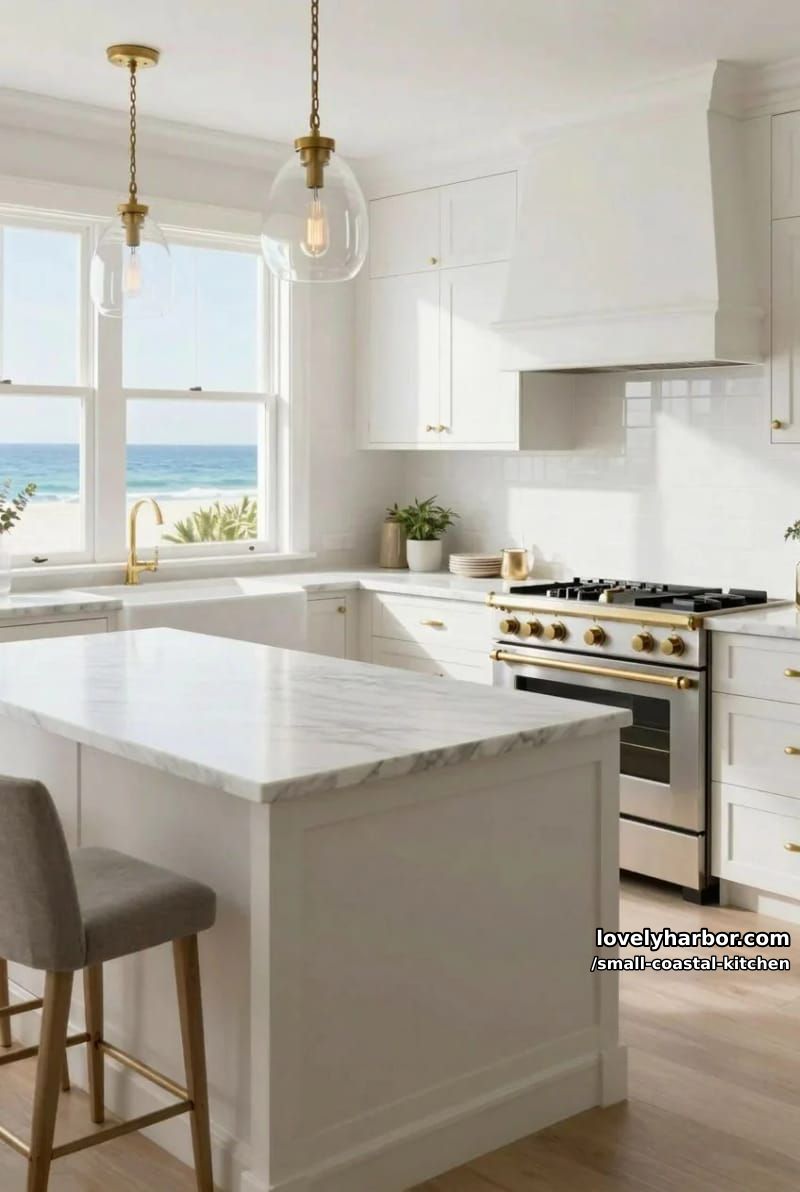
The all-white kitchen with gold hardware photographs better than it lives. I'll say it plainly: it is a look engineered for a listing photo, and it asks a lot of you afterward. Clear glass pendants over an island catch every fingerprint and every speck of cooking grease, and at the height they hang, you will be reaching up to wipe them more than you expect.
If you want the airy, light-bouncing effect without the maintenance tax, swap clear glass for a frosted or fluted shade, which hides smudges and still glows. Keep the white warm rather than stark (a creamy white reads coastal; a blue-white reads operating room) and let the brass be the only metal in the room so it actually registers as a choice.
8. Modern kitchen, blue tile backsplash, glass-front cabinets, blue island, gold accents
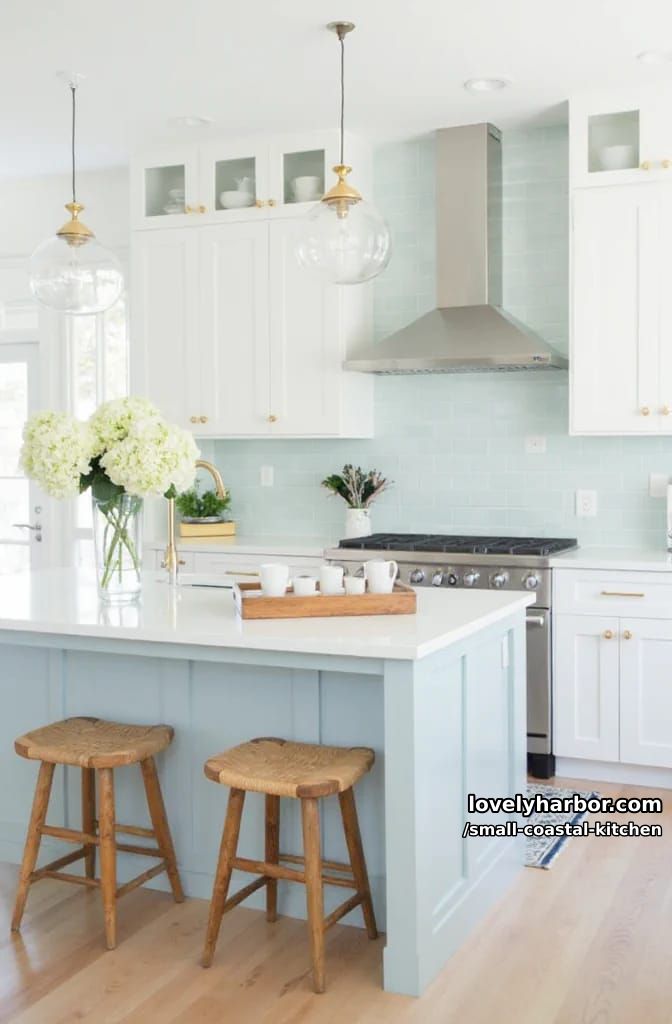
A blue tile backsplash plus a blue island is a lot of blue, and the thing that keeps it from feeling like a single block of color is grout. Use a soft gray grout, not white. White grout against blue tile reads as a grid of lines you will scrub forever, and gray hides the inevitable splatter while letting the tile shapes stay legible.
Glass-front cabinets are a commitment to keeping the inside tidy, full stop. Put your everyday glasses and the one set of nice plates behind glass and route everything chaotic (mismatched storage containers, the blender, the box of tea bags) into solid cabinets nearby. Gold accents work best here in small doses, on the faucet and the pulls, so they feel like punctuation rather than a third loud color fighting the two blues.
9. Airy kitchen, cream cabinets, pale blue island, rattan stools, fresh flowers
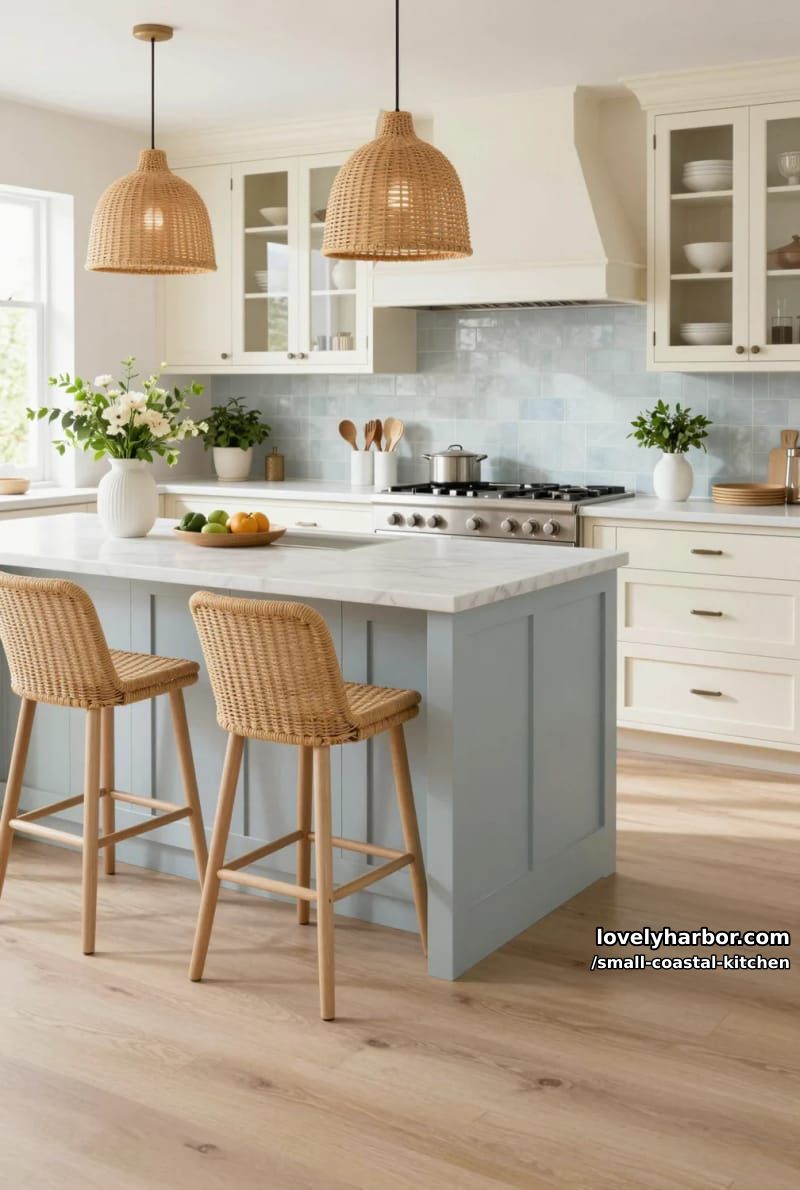
Cream cabinets with a pale blue island is the gentlest version of coastal, and the rattan stools are doing more than decoration here: natural fiber breaks up two flat painted surfaces and keeps the room from feeling like a paint chip. The magazine staple is the Serena & Lily Balboa stool, which is lovely and runs north of $400 each; if you need three of them, World Market and Article both sell woven counter stools in the $120 to $200 range that hold up to kitchen use just as well.
One honest caveat about rattan near a kitchen: real rattan dries out and cracks if it sits under a sunny window or takes constant splashes. If your stools live within range of the sink, a synthetic resin weave looks nearly identical and wipes clean. Fresh flowers do real work on a counter, but a single stem in a bud vase reads more considered than a supermarket bouquet crammed into a mason jar.
10. Coastal kitchen, white quartz island, seashell decor, light beige cabinetry, glass pendants
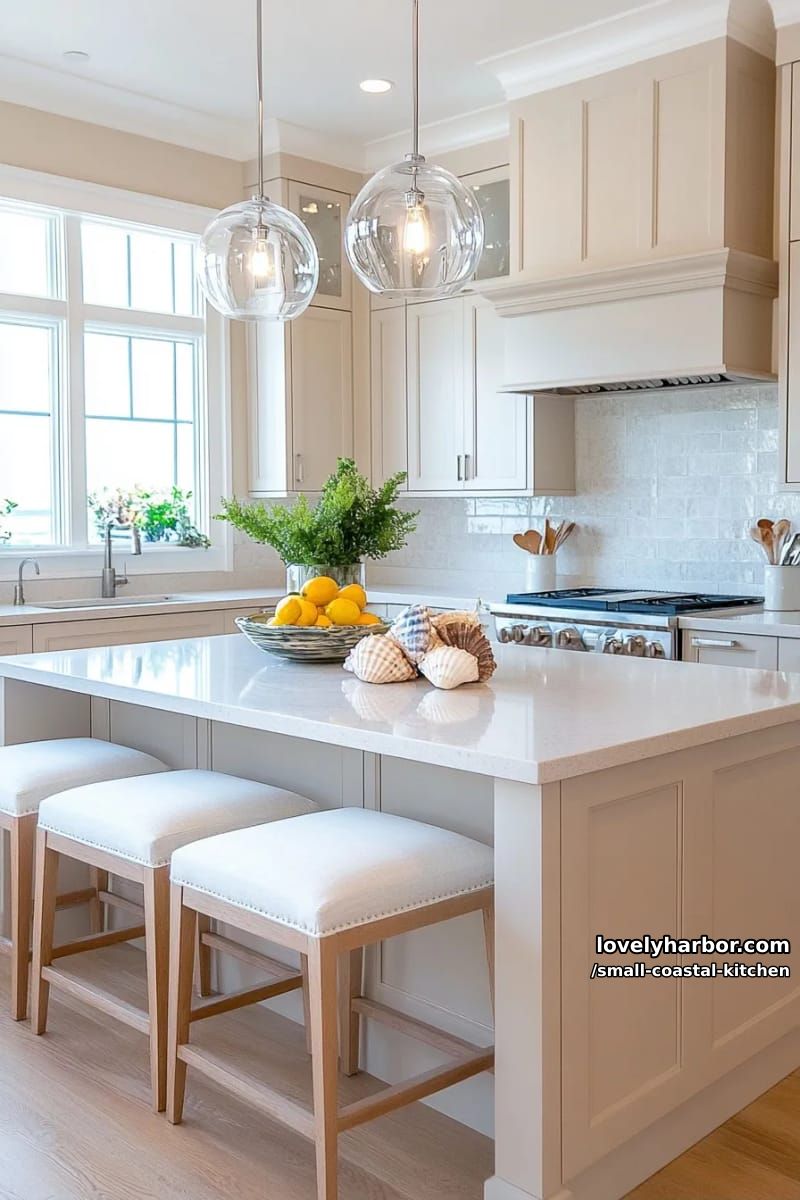
If the marble warnings above scared you off, this is your section. Engineered quartz (Caesarstone, Silestone, Cambria) gives you the same bright white surface with none of the etching anxiety, since it is a nonporous resin-and-stone composite that shrugs off lemon juice and wine. It has exactly one weakness worth knowing: it cannot take a hot pan straight off the burner, because the resin scorches and yellows. Keep a trivet within reach and it will outlast the rest of the kitchen.
The seashell rule from section 5 applies double on a quartz island, because the surface is so clean that clutter shows immediately. Pick one sculptural object and stop. A framed botanical-style print of a single shell often reads better than the actual shell, and it does not need dusting.
11. An beach cottage open kitchen with wicker bar stools, white walls, and blue accents
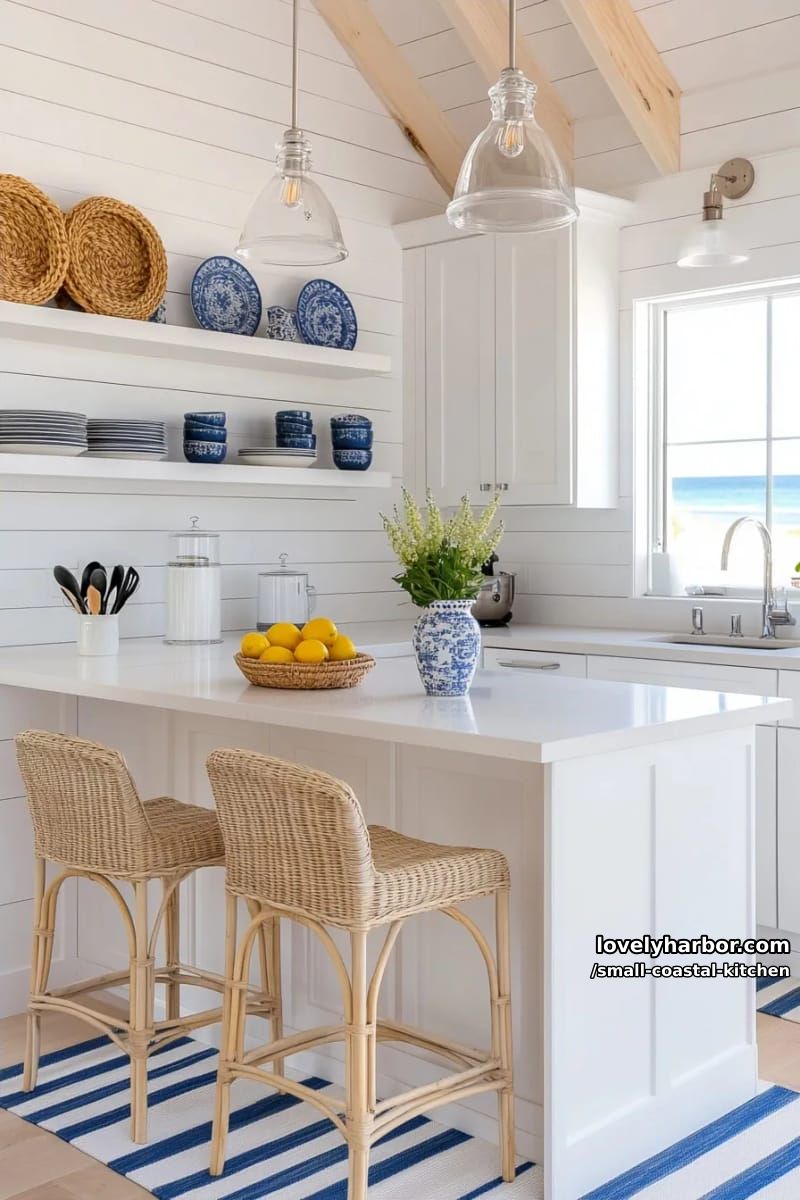
White walls in a real cottage kitchen need the right sheen, and most people default to flat, which marks the second a hand touches it near the stove. Eggshell or satin on kitchen walls wipes clean and still reads soft; save flat for the dining side of an open room where nobody is flicking oil. The blue accents work best as the changeable layer: bottles, a runner, a stack of bowls, the things you can swap when you get bored.
Never specify a flat or matte finish for walls inside a tight kitchen splash zone. Eggshell or satin on kitchen walls wipes clean of cooking oil and still reads soft; save flat paint entirely for the dining side of an open room where nobody is flicking grease.
Wicker stools and an open layout invite mess to migrate onto the counter, since there are no upper cabinets to swallow the overflow. Decide where the clutter goes before you fall in love with the look. A single deep drawer or a covered basket on a lower shelf is the difference between breezy and chaotic.
12. Small coastal kitchen, cream cabinets, pastel blue sink, beadboard, vintage accents
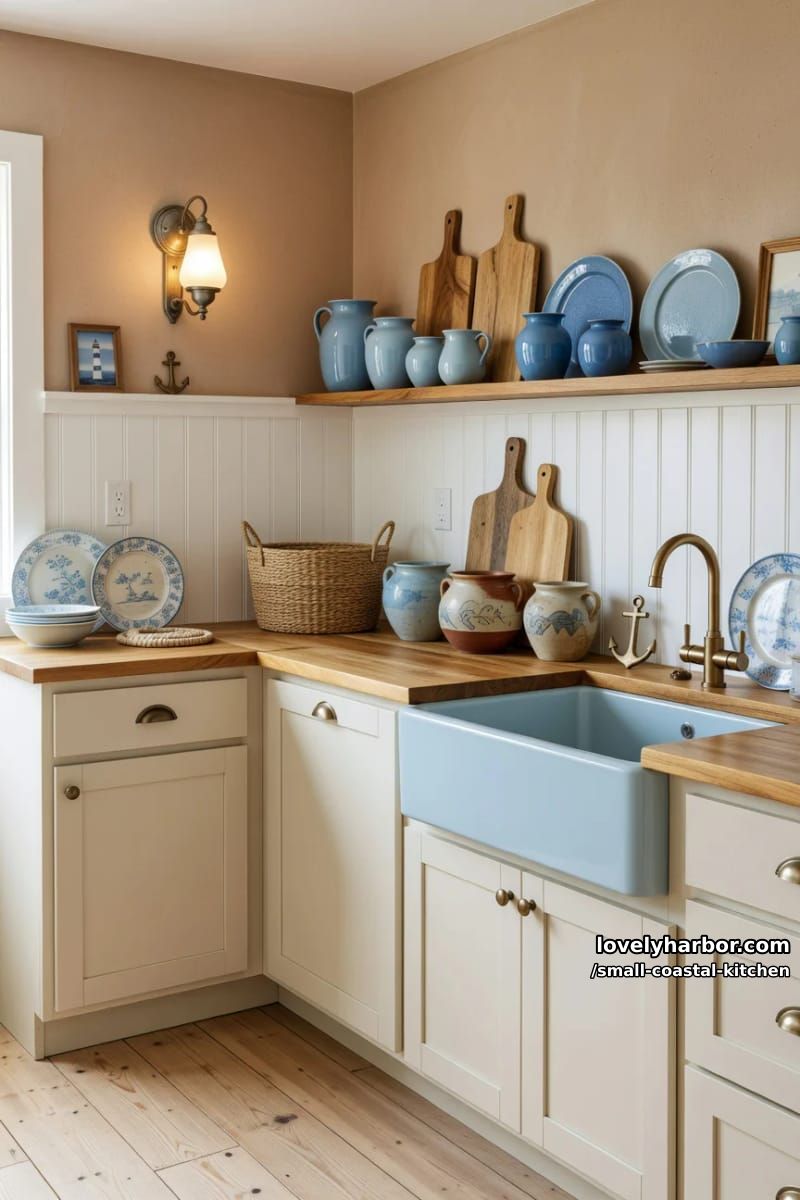
A colored sink is the charming detail that is hardest to undo, so go in with eyes open. A pastel blue fireclay or enameled cast-iron sink is a near-permanent decision: it costs more than a standard stainless basin, the color options narrow fast, and if you tire of it you are looking at a counter cut, not a quick swap. If you love it, commit; if you only half-love it, get the color from a faucet or a runner instead.
Beadboard backs up the cottage feel cheaply, but material matters in a splash zone. MDF beadboard swells if water gets behind it, so behind a sink or counter use PVC or a moisture-rated panel and prime the cut edges. Vintage accents (a chippy enamel jug, old glass canisters) keep a small kitchen from feeling builder-grade. One or two real pieces beat a shelf of reproductions.
13. Mint green island, open shelving, white marble, rattan stools, glass pendants
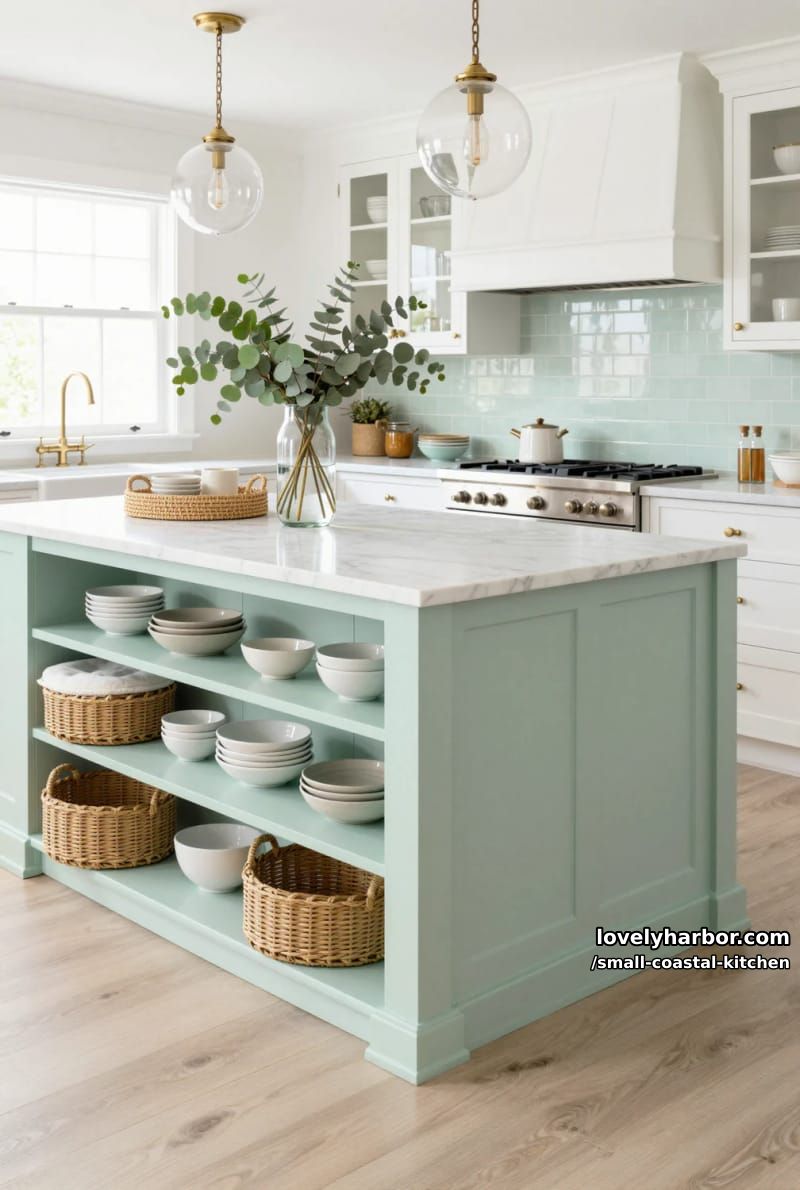
A mint island is a confident choice, and it earns the marble on top by keeping the rest of the room quiet. The hard decision in any kitchen built around a white stone surface is which white stone, because they behave nothing alike in a working kitchen.
| Surface | Etches from acid? | Heat tolerance | The trade you are making |
|---|---|---|---|
| Carrara / Calacatta marble | Yes, even when sealed | Takes a hot pan fine | The most beautiful veining, the most fragile surface |
| Engineered quartz | No | Scorches; needs a trivet | Bulletproof for spills, but the pattern can read printed up close |
| Quartzite (natural) | Mostly no; harder than marble | Takes heat well | Marble-ish look with stone durability, at a higher price |
14. Farmhouse sink, blue subway tile, open wood shelves, woven accents, organized look
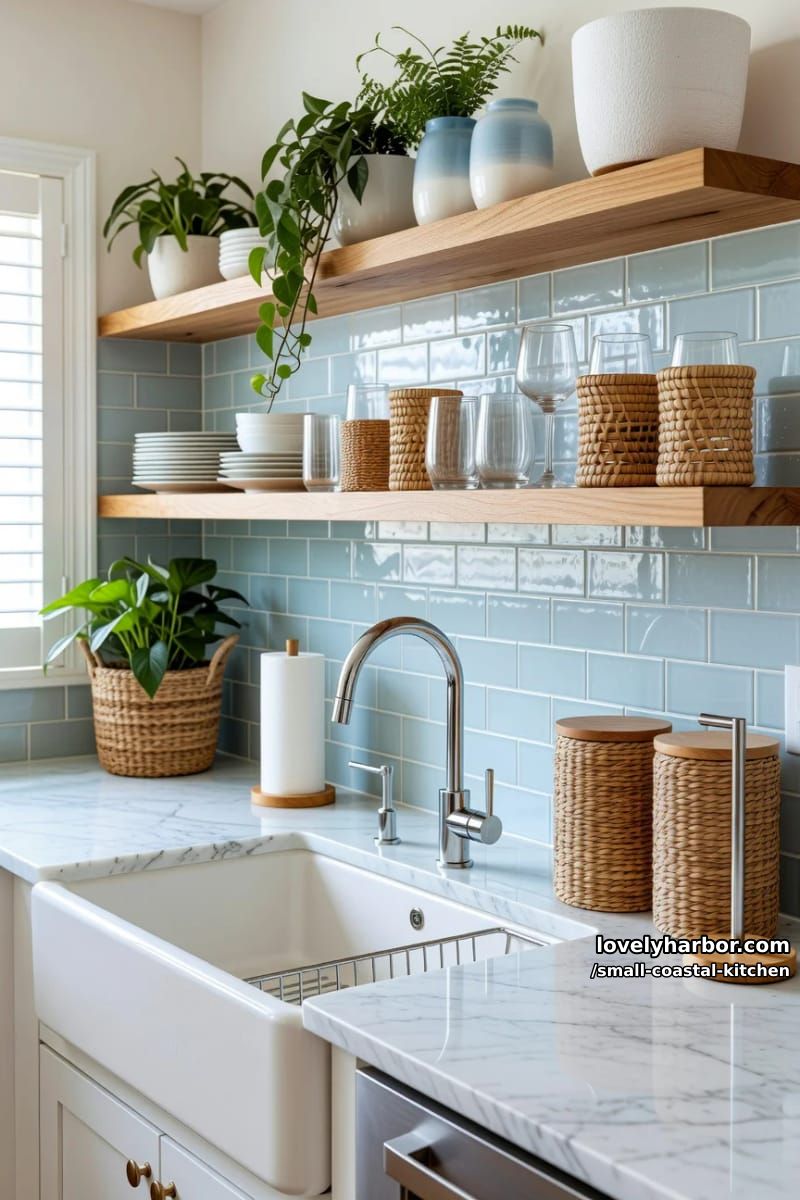
An apron-front sink is not a drop-in swap, and people learn this at the worst moment. The exposed front means you need a special sink base cabinet sized for it, so retrofitting one into existing cabinetry usually means modifying or replacing the base below. Fireclay looks the part and resists scratches but is heavy and can chip a dropped glass; cast iron with enamel is just as heavy and the enamel can scratch. Decide before you fall for the look, not after the plumber arrives.
Blue subway tile is the safe, durable backsplash, and the only real decision is grout color, same as section 8: a soft gray reads cleaner over time than bright white. Open wood shelves keep daily dishes in reach, and woven baskets earn their spot by corralling the produce and dish towels that otherwise sprawl across a small counter.
15. Coastal kitchen corner, blue shaker cabinets, glass jars, textured backsplash, shiplap walls
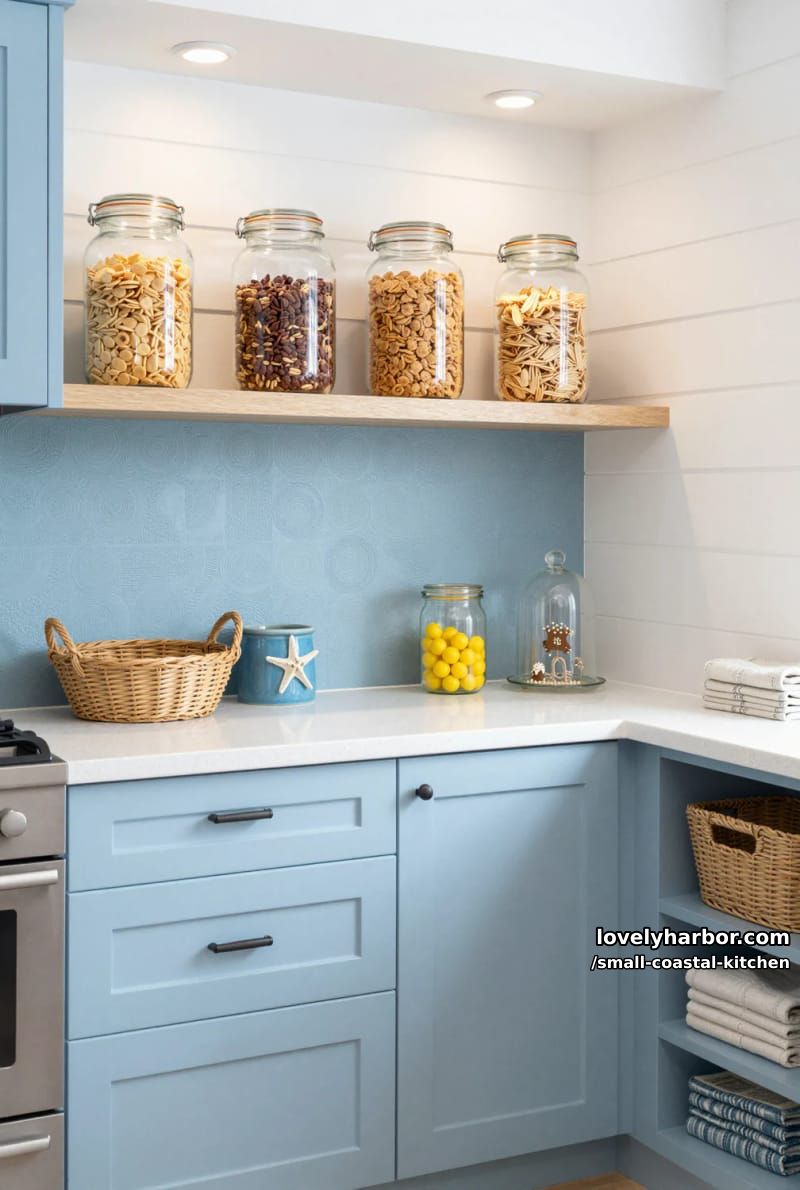
Here is where I'll be unpopular: horizontal shiplap is past its peak. After a decade of every renovation show installing it, it now dates a room to roughly 2016 the way sponge-painting dates one to 1998. If you want wall texture, vertical shiplap or a tongue-and-groove beadboard reads quieter and less of-a-moment, and it stretches a low corner upward besides.
The bigger trap in this section is stacking textures. Blue shaker fronts, a textured backsplash, glass jars, and a plank wall together is three competing surfaces past the point a small corner can carry. Pick the texture that does the most (the backsplash, usually) and let the walls go smooth. The glass jars are charming when they hold things you genuinely use; a row of jars filled with decorative pasta you will never cook is just dust collectors with a view.
16. Modern kitchen, marble countertops, blue subway tile, open shelves, teal pendant lamp
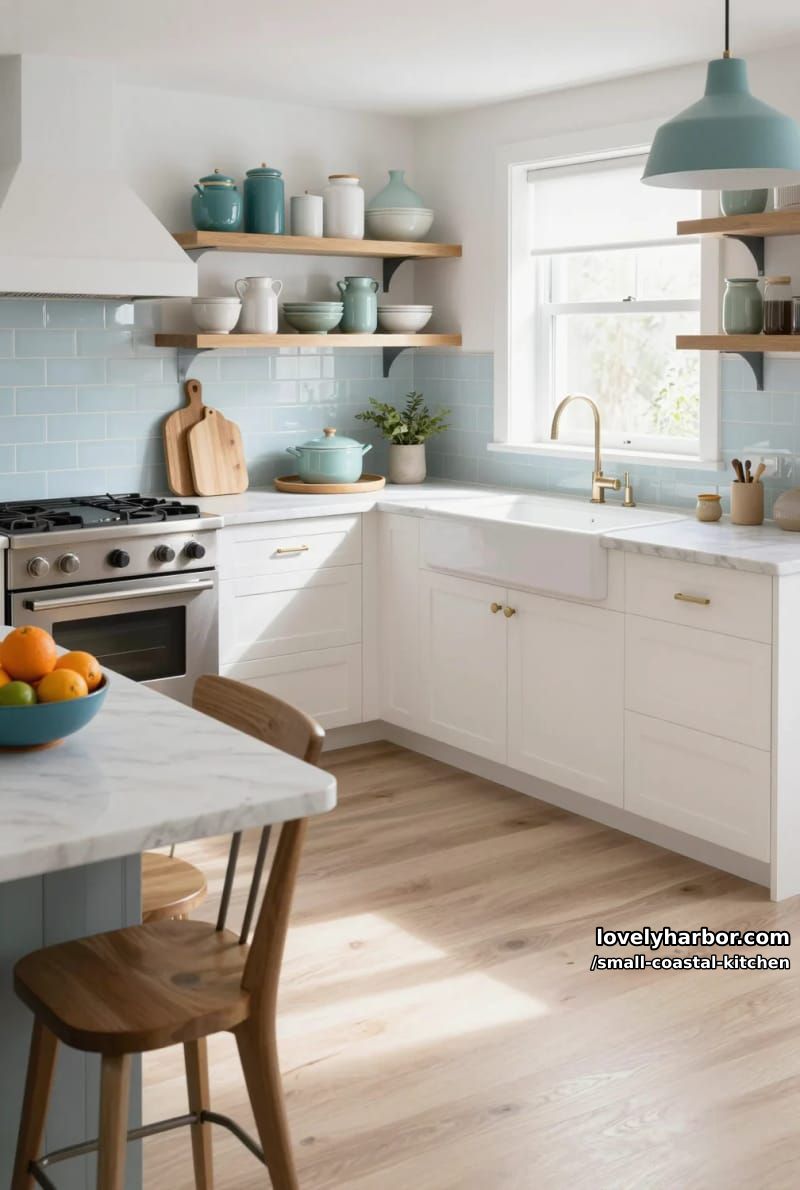
This is the cleanest formula in the list: neutral marble, blue tile, and a single teal pendant carrying all the color punch. The discipline is in keeping the teal as the only saturated note. One bold fixture in an otherwise quiet room reads as a decision; three bold things read as indecision.
Subway tile layout is a free way to make a modern kitchen feel less generic. The standard running-bond offset is fine and invisible; a vertical stack-bond or a herringbone in the same blue tile costs nothing extra in materials and instantly looks more considered. Open shelves here should hold the everyday glasses you reach for hourly, not a styled display, because in a working modern kitchen the honest version is the better-looking one.
17. Central island, light blue cabinetry, woven bar stools, blue pendants, wood shelving
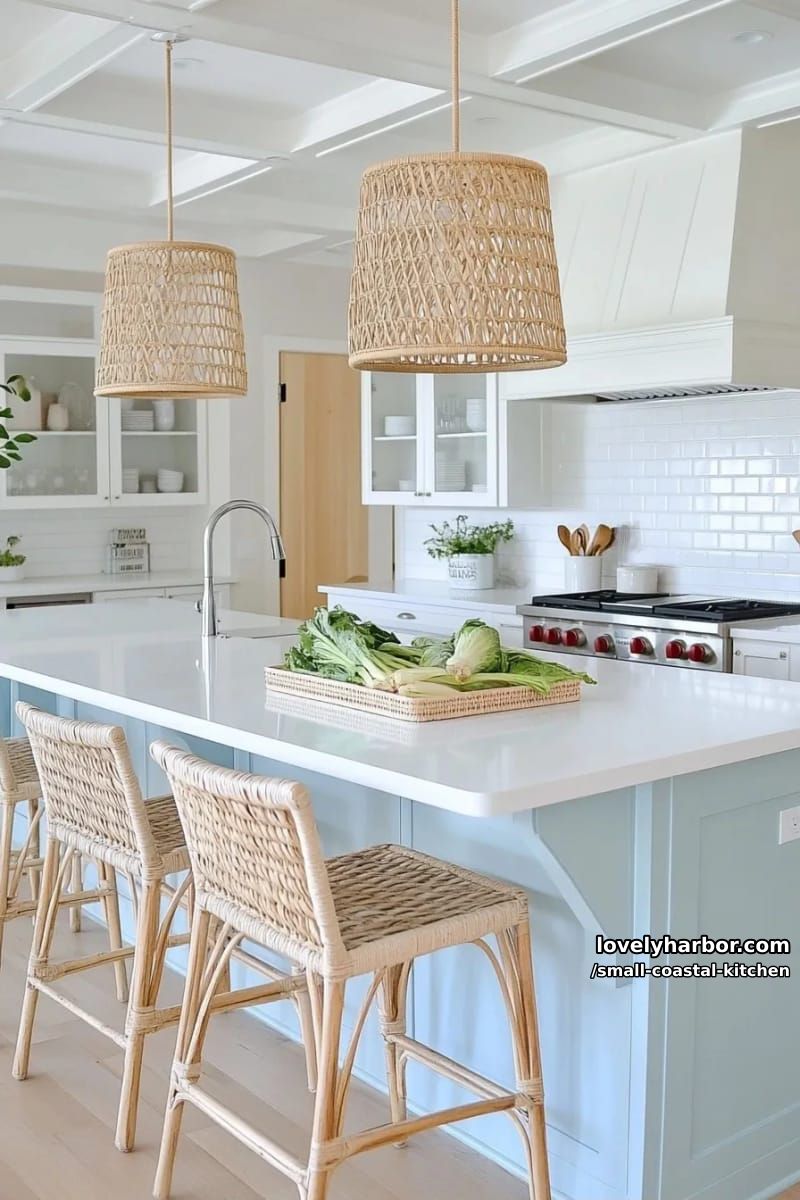
Before you fall for an island, measure your clearances, because a too-tight island makes a small kitchen worse, not better. You want at least 36 inches of walking space around it, and 42 to 48 inches on the working side where you open the dishwasher and oven doors. As a rough rule, a kitchen under about 10 by 10 feet usually can't take a built-in island without choking traffic.
If the room fails that math, a rolling cart or a butcher-block table on casters gives you the same prep surface and pendant moment, and you can shove it against a wall when you need the floor. Light blue cabinetry and woven stools do the coastal work; the wood shelving keeps the palette from going chilly. Watch the pendant height: hung too low over an island, two pendants block sightlines and bonk tall guests.
18. White paneled cabinets, green backsplash, natural light, sea-inspired decor, wooden flooring
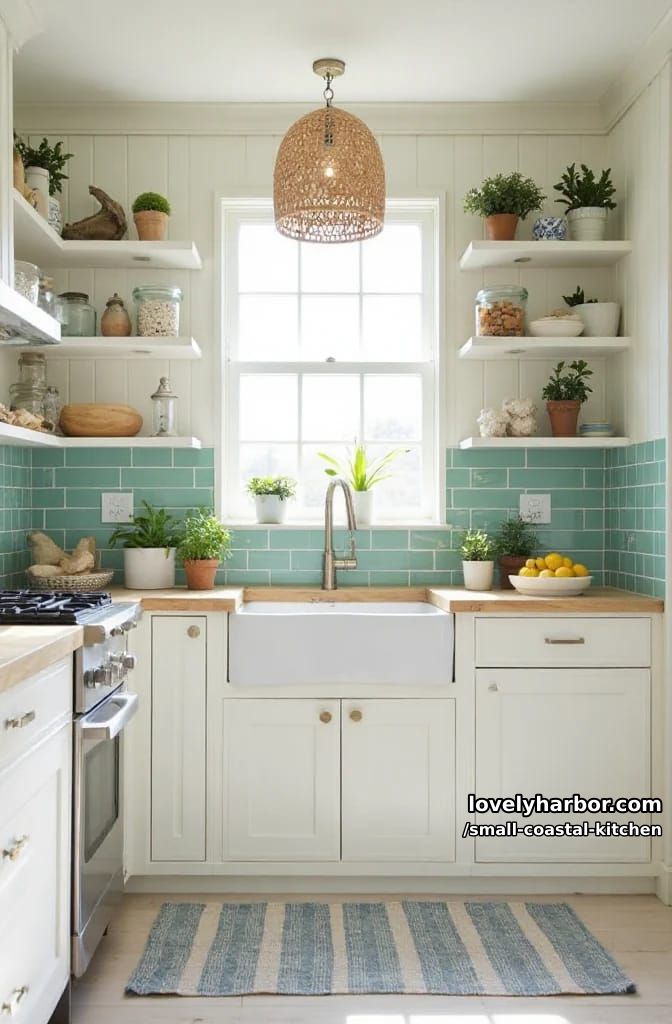
Green is having a moment in kitchens, and the coastal version lives in a narrow band. A green with a blue base reads sea glass and works; a green with a yellow base slides into avocado and reads 1974. Test the tile or paint against your white cabinets in real daylight, since green shifts hard under different light and the wrong one fights the wood floor instead of warming next to it.
Sea-inspired decor here means restraint again: a few pieces of blue studio pottery and shells the family actually found beat a shelf of store-bought "coastal" tchotchkes. Wood flooring grounds the cool green-and-white scheme; a mid-tone oak keeps it from feeling either too rustic or too cold. Let the window be the main event and resist filling the sill.
19. Blue cabinetry, marble countertops, rattan stools, woven pendants, natural textures
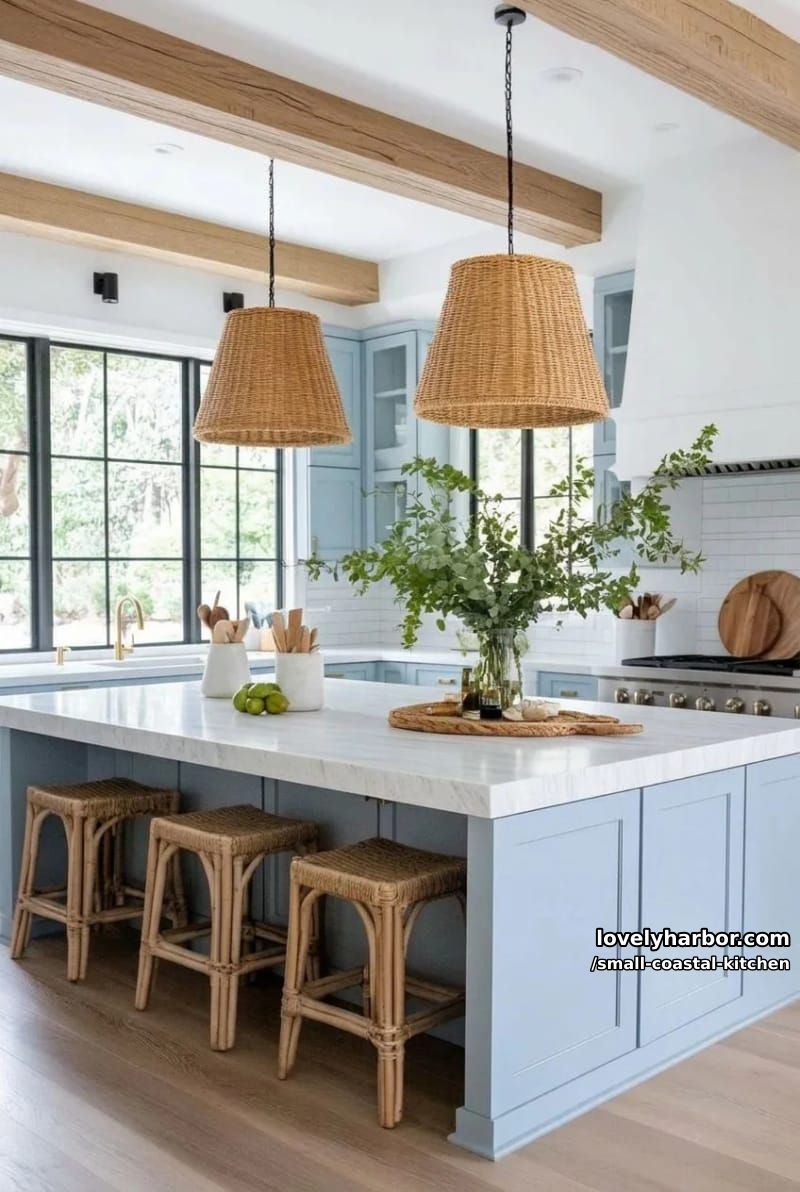
The depth of blue should track the size of the room, and small kitchens reward going lighter. A pale, grayed blue on the cabinets bounces light and keeps a tight space open; a deep navy looks rich in photos but eats light and can press a small room inward. If you want navy in a small kitchen, put it only on the island or the lower cabinets and keep the uppers pale, so the dark anchors the floor instead of closing in the ceiling.
Mixing rattan and woven shades against marble and painted wood is the move that keeps the room from reading cold, and it is the rare place where not matching is the goal. A rattan stool, a seagrass pendant, and a linen runner can be three different fibers and three different tones; the slight mismatch is what makes it look gathered over time rather than ordered in one click.
20. Light blue cabinets, marble countertop, open shelves, coral decor, gold hardware
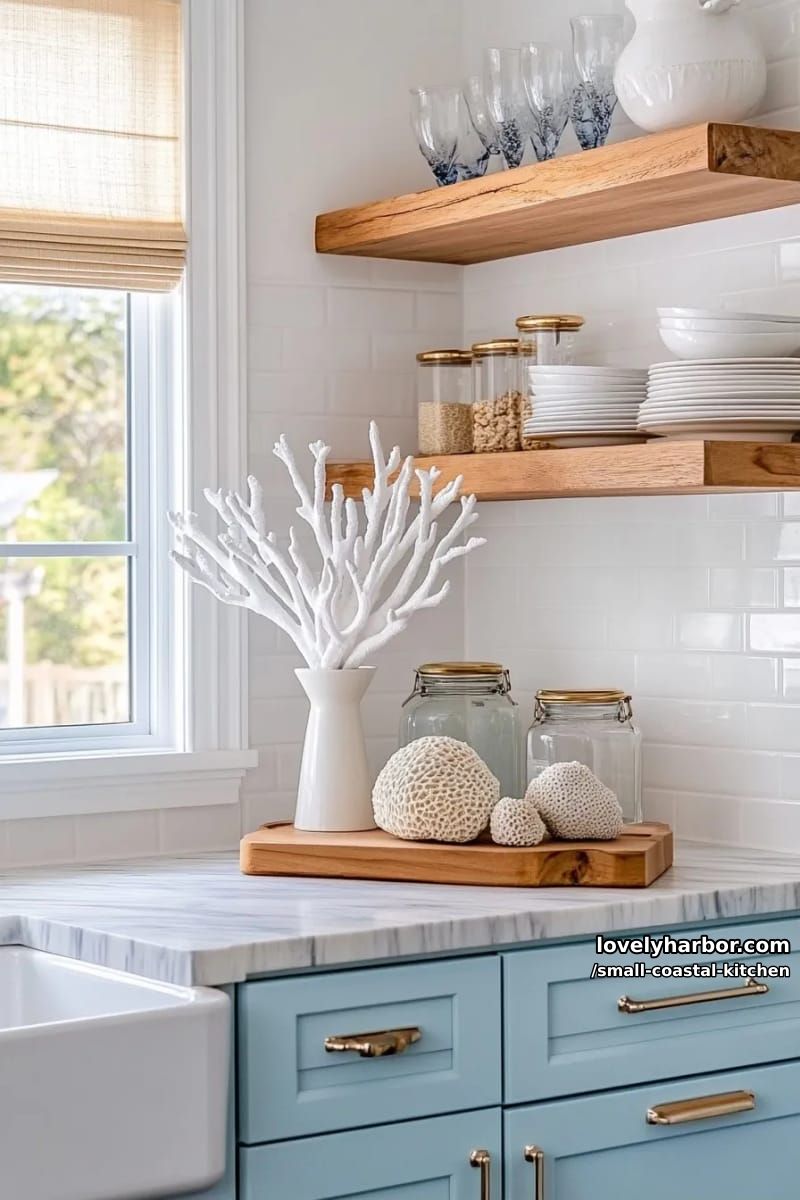
Light blue cabinets and a marble counter is the most forgiving combination in this list, which leaves the coral as the section's real talking point. A quick plea: don't buy real harvested coral. Most of it is taken from reefs that are already in trouble, and several species are protected, so a genuine coral specimen on your shelf is a worse look than it seems. Ceramic coral, a botanical print, or a piece of bleached driftwood gives you the same sculptural shape with none of the baggage.
Gold hardware against pale blue wants a light hand. A few warm pulls and a brass faucet read as a deliberate accent; gold on every door, plus gold pendants, plus a gold faucet starts to look like a jewelry counter. Pick one or two places for the metal to land and let the blue and white carry the rest.
Conclusion
If you take one thing from twenty kitchens, take this: the cheap changes are the ones that move the needle most, so do them first. New hardware in unlacquered brass and a recolored island or backsplash will shift the whole feel of a small kitchen for a few hundred dollars, and you can live with the result before committing to anything structural.
Save the expensive, hard-to-reverse decisions (a colored sink, a marble counter, a vaulted ceiling) for last, after you have seen how the room actually behaves with the light it gets. And edit harder than feels natural on the coastal decor. Nearly every kitchen here would look better with a third of the shells removed, including, if I'm honest, a few I have styled myself.