
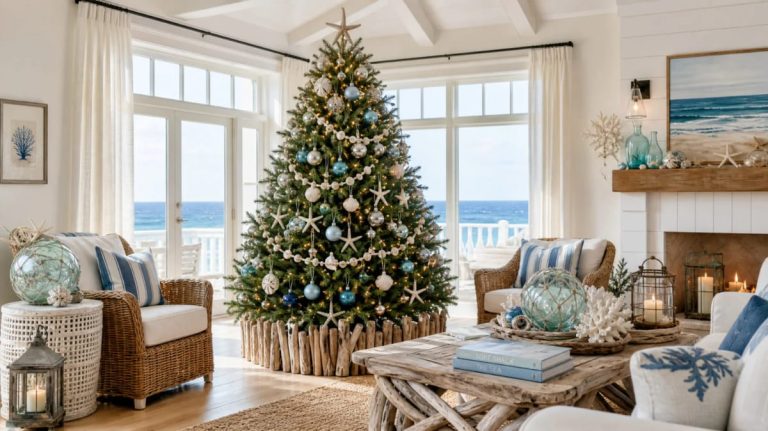
Sea glass is not manufactured. It is broken bottle, lost or dumped, then tumbled in surf for twenty or thirty years until the edges round off and the surface frosts over into something closer to a stone than a shard. Cobalt is the rarest color because almost nobody bottles in cobalt anymore. That single object explains what coastal blue Christmas decorations are actually after: blue that looks worn into the material rather than sprayed onto it, which is a different thing entirely from blue ornaments in a beach-themed box.
None of what follows involves a rope-lettered sign. Coastal blue at Christmas fails in two specific ways, either sliding into nautical-restaurant territory or going so cold the room reads like a waiting area in February, and the second failure is almost always a lighting problem rather than a color problem. The palette, tree, mantel, and porch sections below run in the order you would actually work through the house.
Set the palette before you buy a single ornament
1. Pick one blue and let three whites carry the range
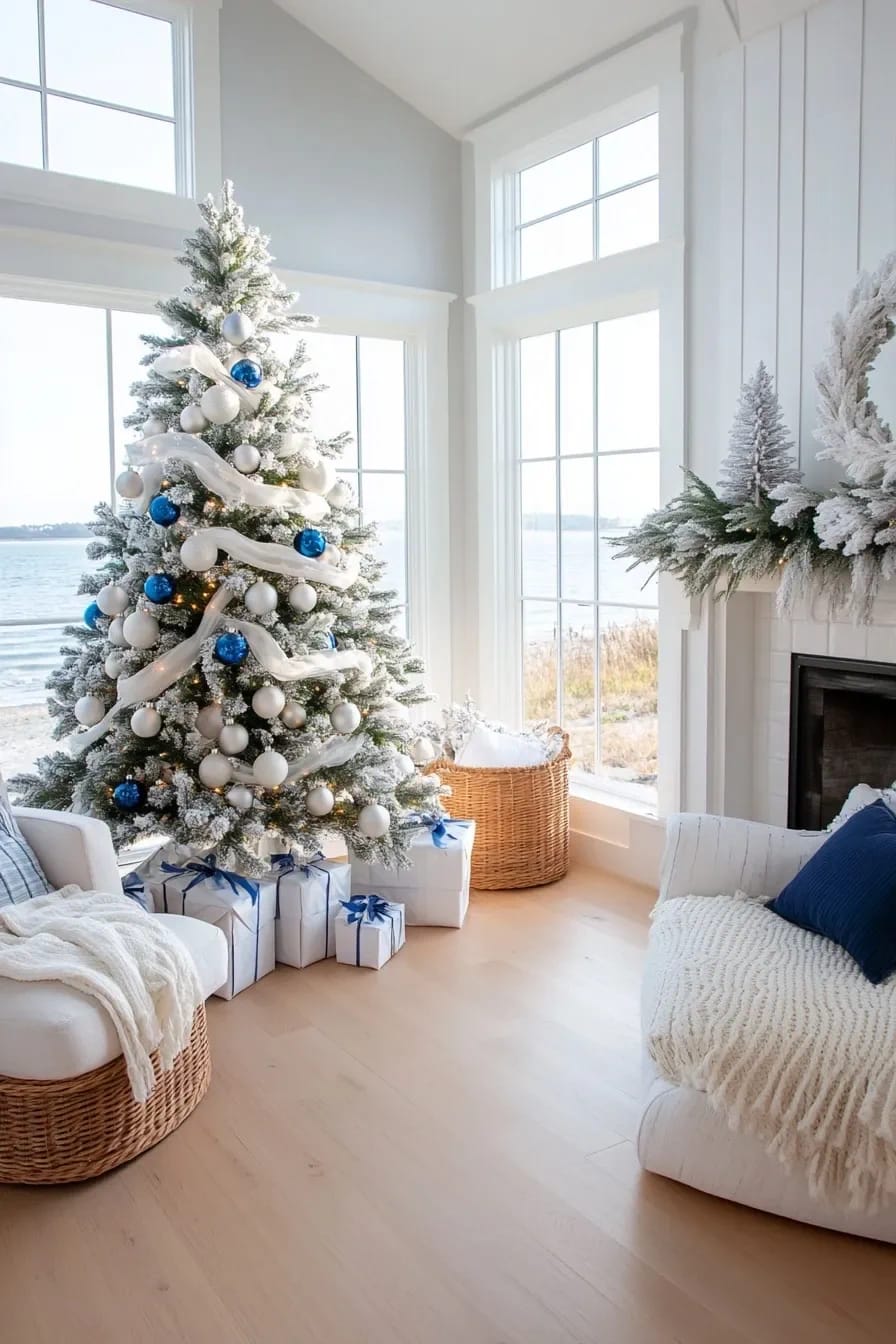
Commit to one blue and repeat it everywhere; the variety comes from the neutrals, not from stacking navy against powder against teal. Rooms that go wrong here usually contain four or five blues that were each fine on their own, and the eye reads the collision as noise rather than as a scheme. Pick your blue off something you already own, a bowl or a painting or the front door, and match ornaments to it rather than to a mood board.
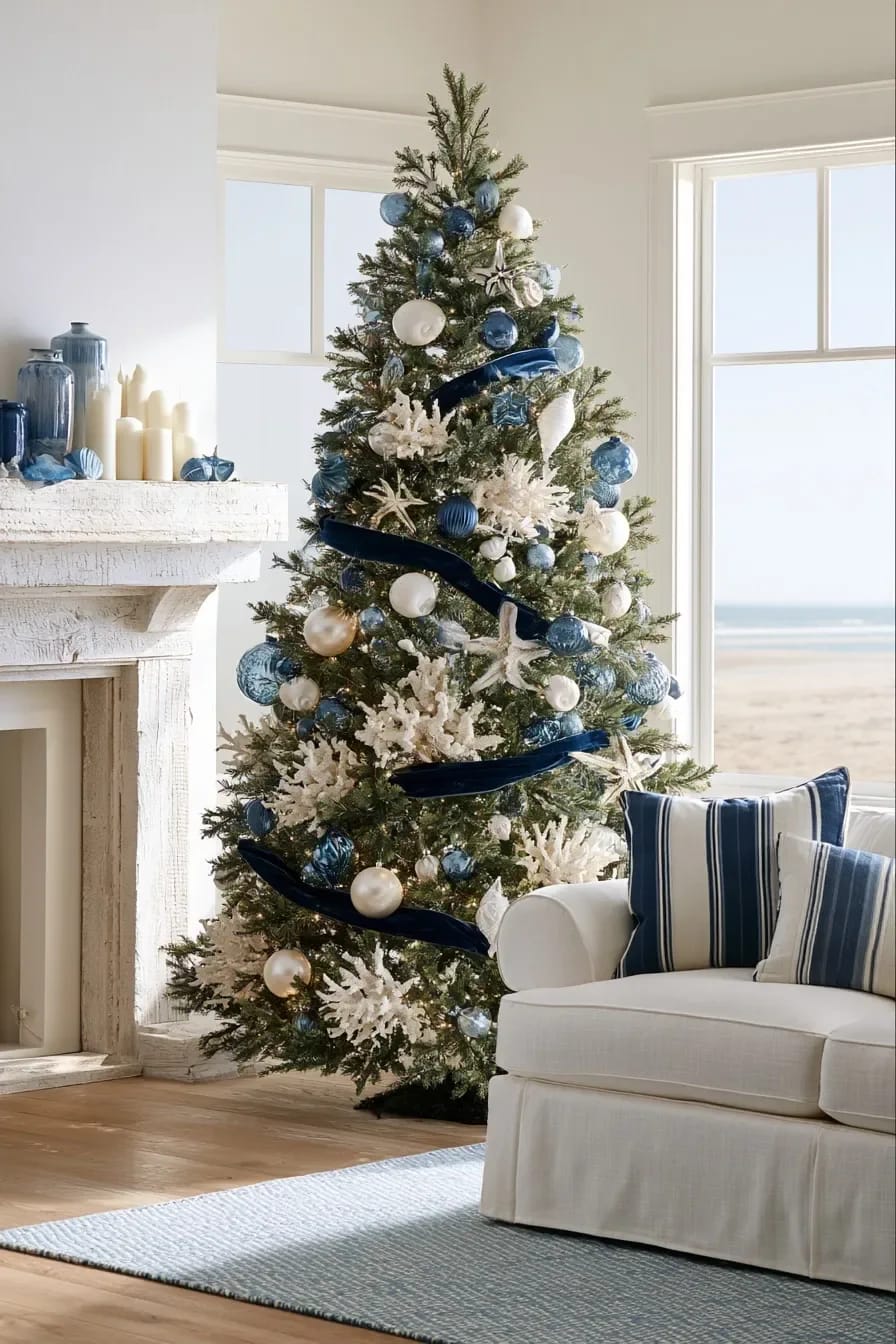
The neutrals do more work than most people expect. A useful set:
- Chalky flat white for the largest surfaces, not a bright optical white
- Oyster or greige for anything soft, so the whites do not all match exactly
- Sand, meaning jute, seagrass, raw linen
- Clear and frosted glass. This is the one that does the heavy lifting, because it carries light without adding a color
Silver has a place, gold mostly does not. If you want the wider survey of blue schemes that are not specifically coastal, the site’s round-up of blue Christmas decor across the whole house covers the navy and jewel-tone versions this article deliberately leaves alone.
2. Buy 2700K bulbs, even though the blue looks better under cool white
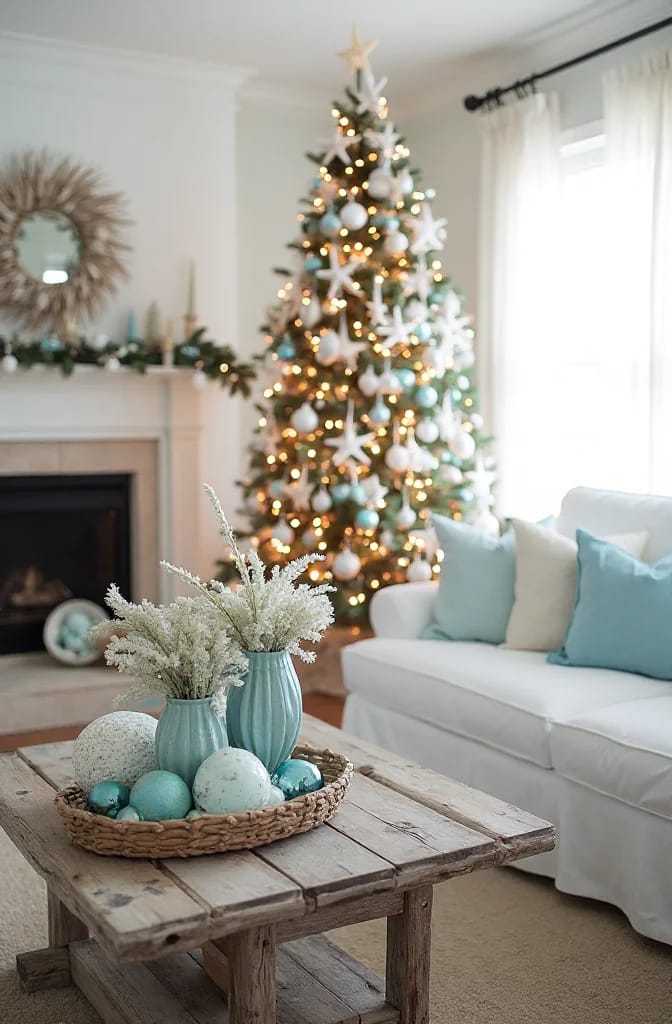
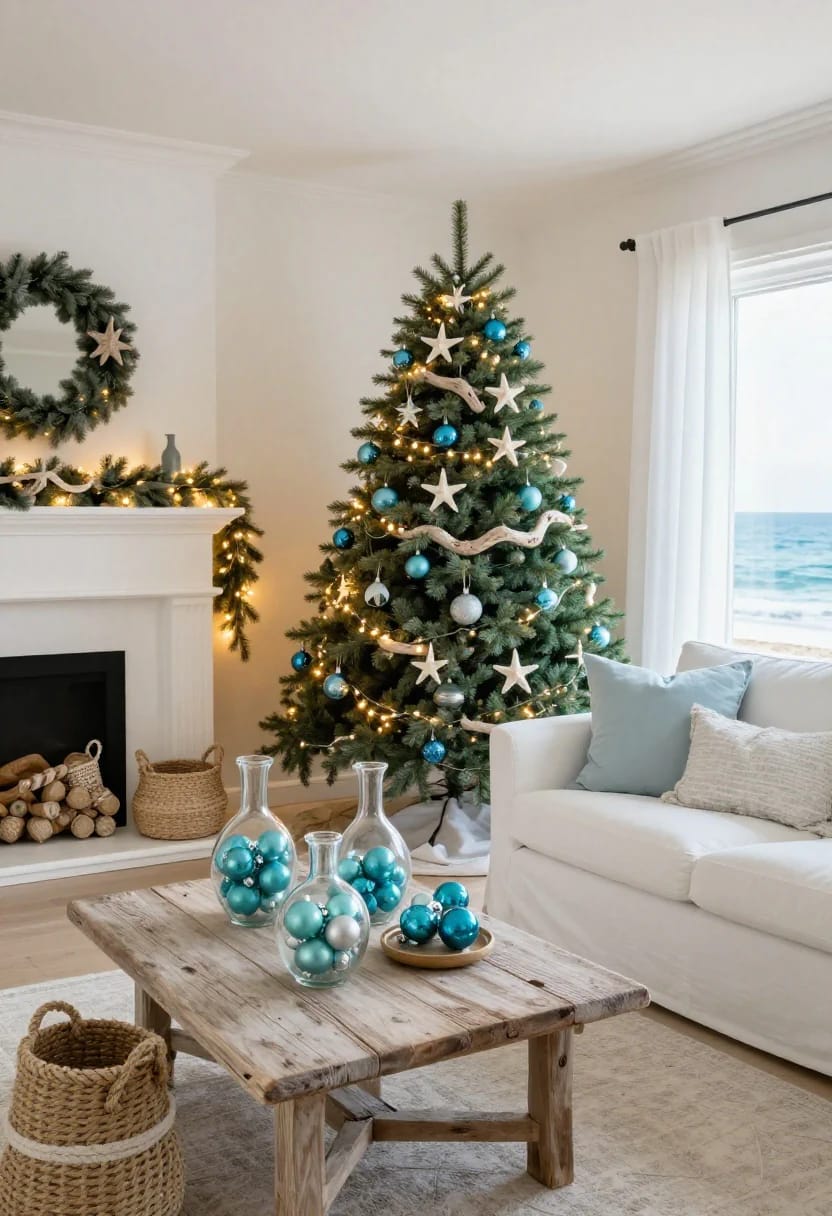
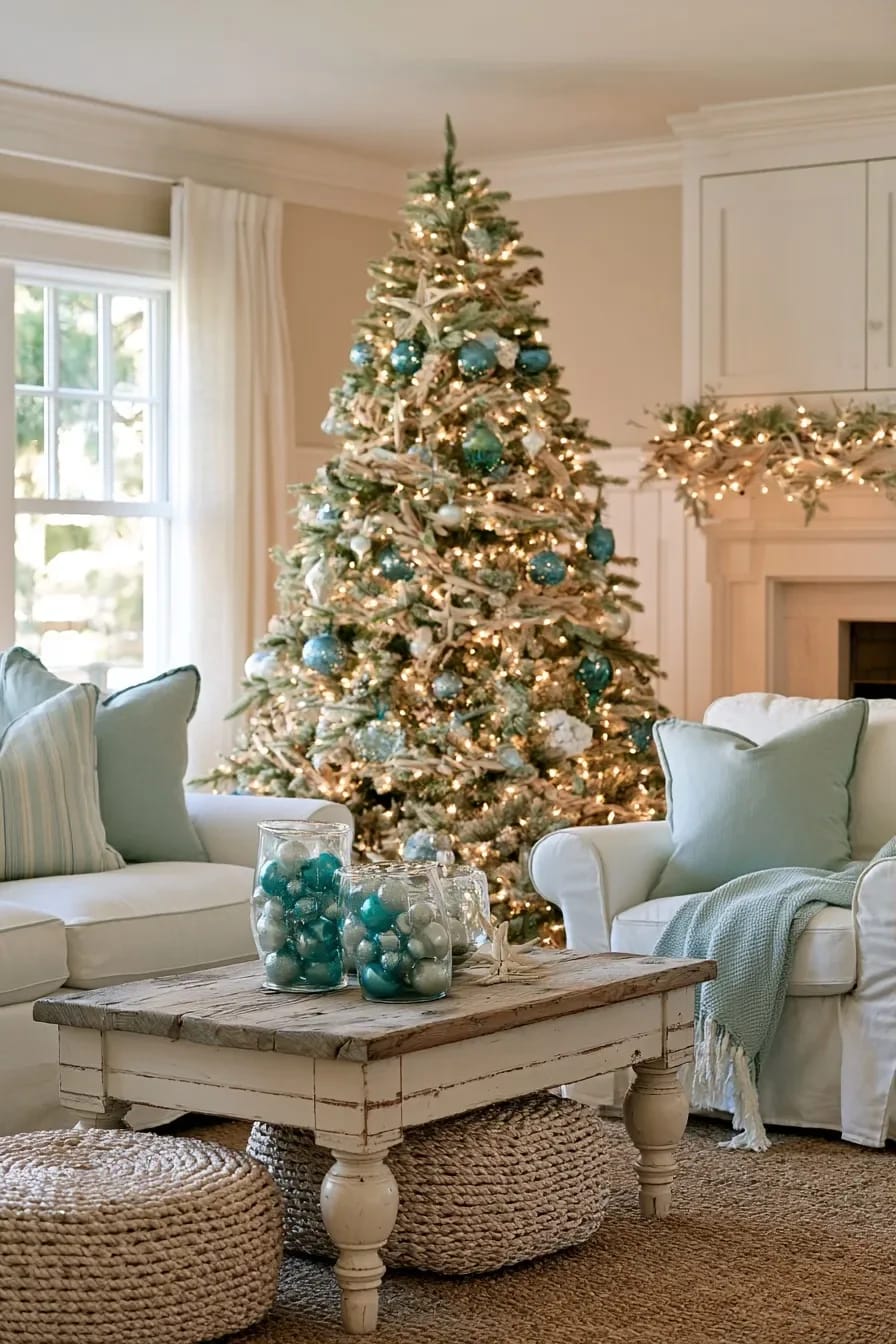
Warm white string lights, 2700K, and accept that they mute the blue a little. Cool white at 5000K makes cobalt and sea glass pop hard under the fluorescents of a store aisle, which is exactly why people buy it, and then the room at nine at night looks like a walk-in refrigerator with a tree in it. Warm light is also what makes the whites read as oyster and sand instead of as paper.
Check the Kelvin figure printed on the box rather than the marketing word. “Pure white,” “crystal white,” and “cool white” are all sold at 4000K and above, and the difference between two strings labeled white can be enormous once they are on the same tree. If you already own cold strings and cannot face replacing them, bury them deep and run a warm set on the outer branches. The blue and silver living room piece works through the same color-temperature problem in more detail, since silver punishes cold light even harder than blue does.
3. Swap every red ribbon for jute, raffia, or unbleached cotton tape
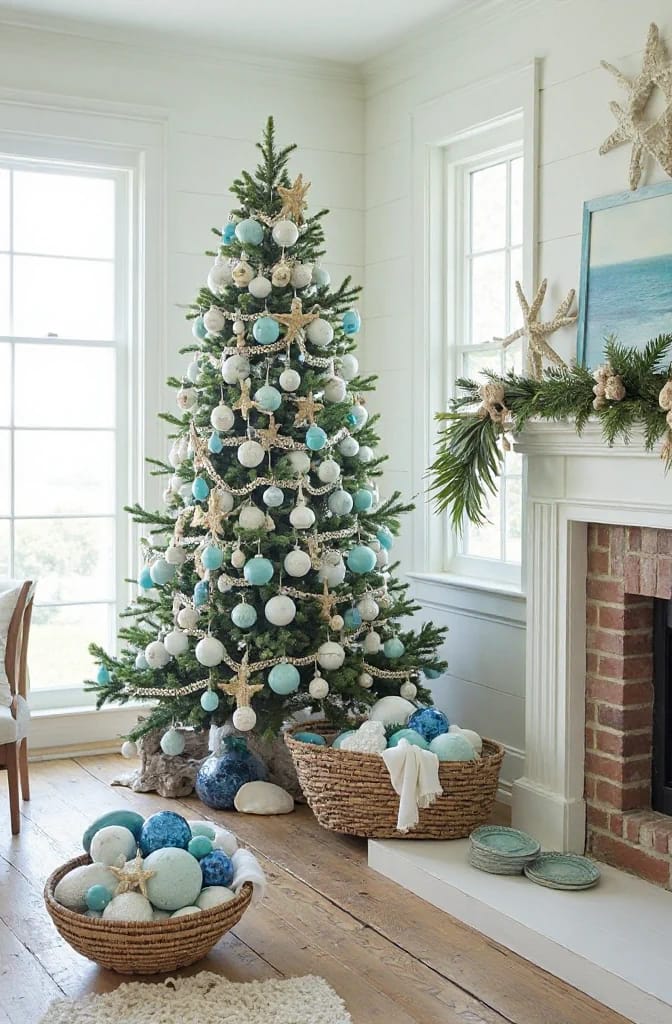
Ribbon is where most coastal blue schemes quietly collapse. A red velvet bow on an otherwise disciplined blue and white tree drags the whole thing back to conventional Christmas in one move, and wired glitter ribbon from the seasonal aisle does something worse, adding a plastic sheen that no amount of good ornaments recovers from. Natural fiber instead: jute webbing at 1.5 inches for garland ties, cotton twill tape for gift wrapping, and pale grosgrain when you want something finished rather than raw.
Granted, jute frays, and it frays faster on a tree that gets brushed past twenty times a day. Cut the ends at a sharp angle and hit them with a lighter for half a second, or use the twill tape in high-traffic spots and save the jute for the mantel. This same instinct, choosing texture over color, is what drives the shift documented in the organic-warmth coastal trends replacing blue-and-white beach house decorating, and it is worth reading if you are wondering whether blue-and-white is dated. It is not, but the reasoning there will change how you weight the neutrals.
 Guide to Coastal Home Decor (2026 Edition) The year-round palette and material rules these Christmas decorations are sitting on top of.
The coastal blue Christmas tree
4. A flocked or white tree holds coastal blue better than a green fir
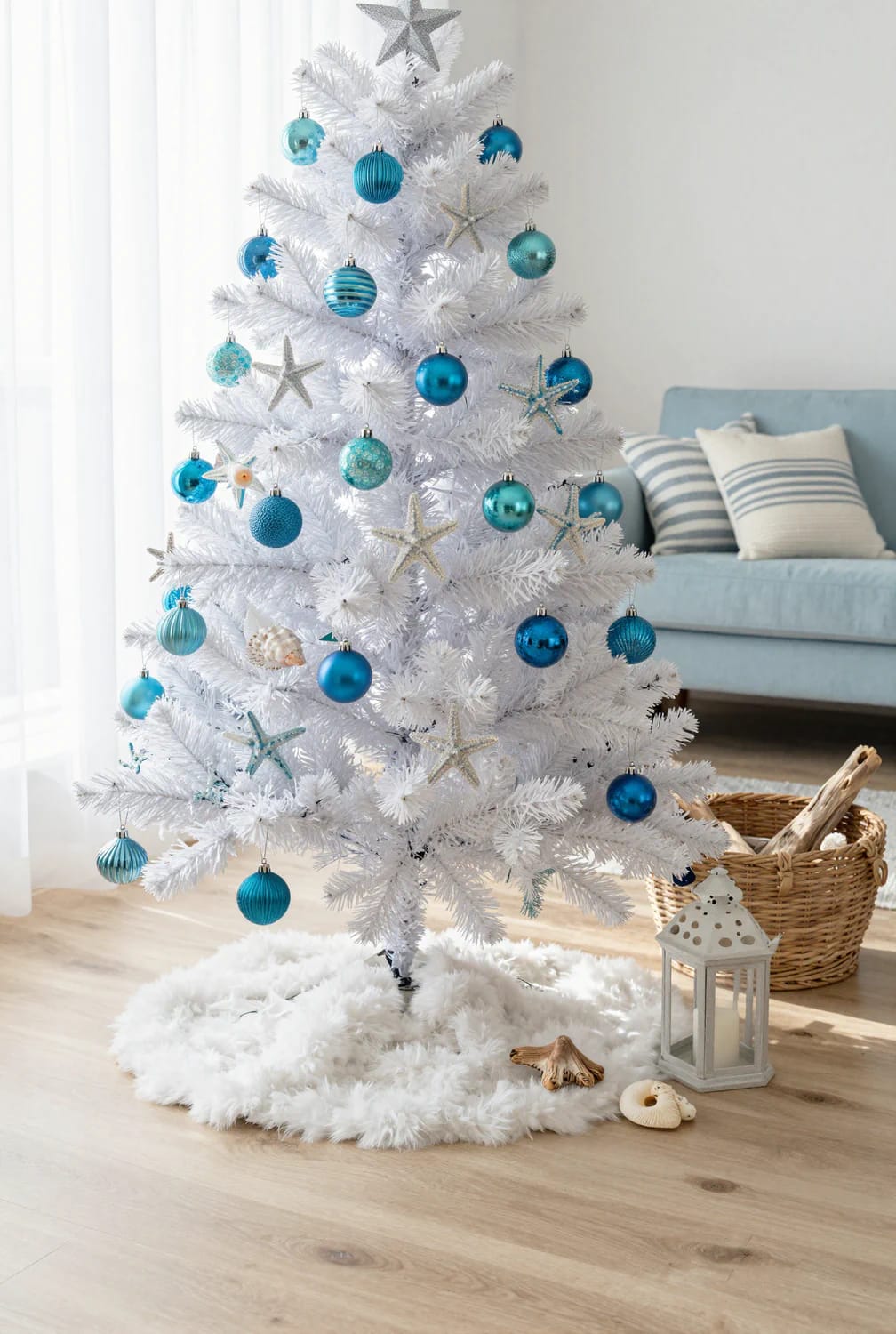
If you are buying an artificial tree specifically for a coastal blue Christmas, buy white or heavily flocked. Blue sitting against dark green goes slightly muddy and slightly purple, which is why so many blue trees photograph better than they look in person. Against white, the same ornament reads as the color you actually bought.
That said, nobody should throw out a working green tree over this. The fix on a green fir is to load the top two-thirds with white, silver, and clear glass and confine blue to translucent pieces that catch the bulbs, so the blue arrives as light rather than as a painted surface. Frosted and matte finishes also survive the green background better than gloss does, because gloss picks up the green as a reflection.
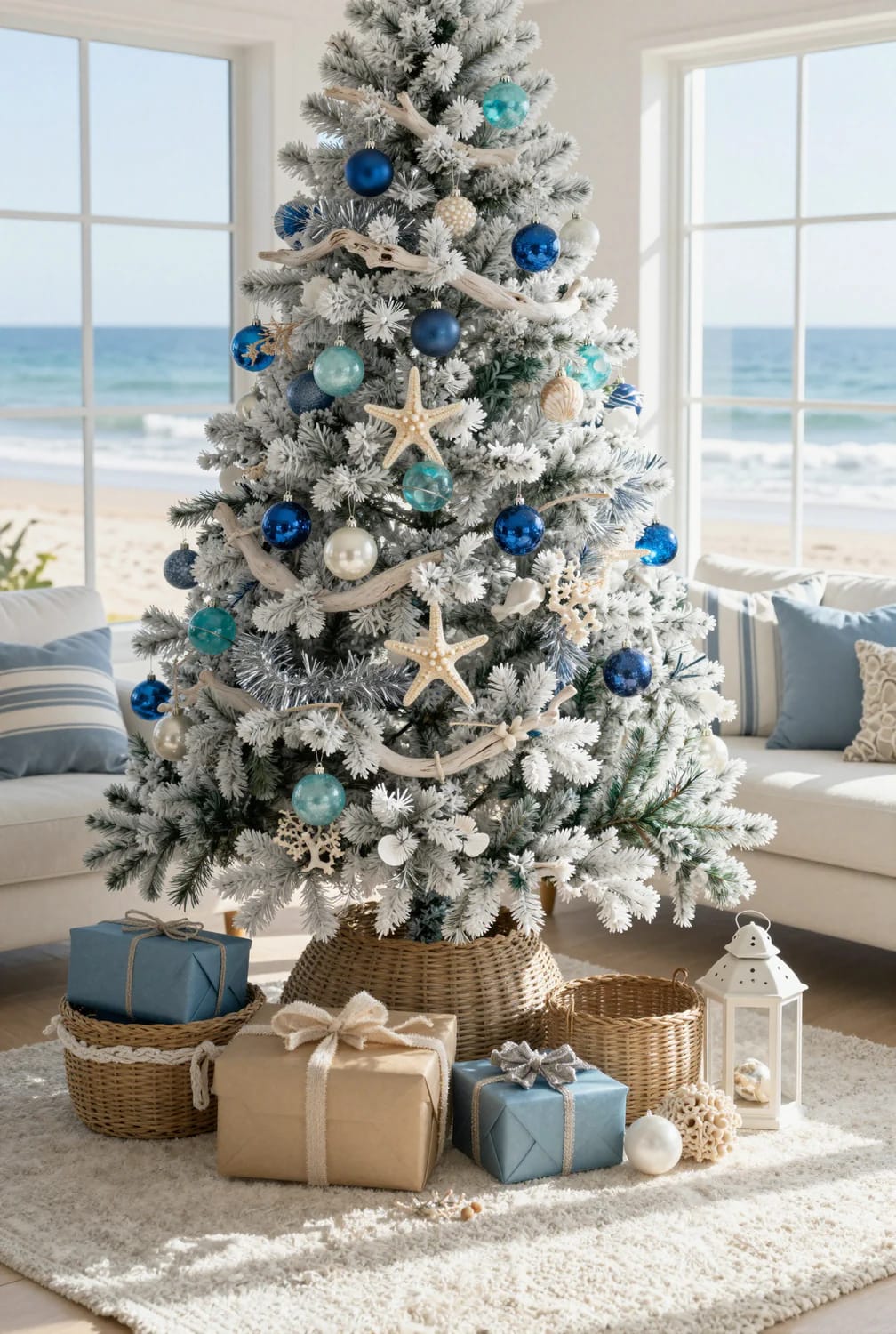
A flocked tree has one real cost worth knowing about before you commit: it sheds. Cheap flocking comes off on hands, on the floor, and on anything you brush past it with, and the shedding gets worse every year the tree goes back in the box. Look at the branch tips in the store and rub one. If white powder transfers, expect to vacuum around it all December.
5. Hang sea glass ornaments deep in the branches, not on the tips
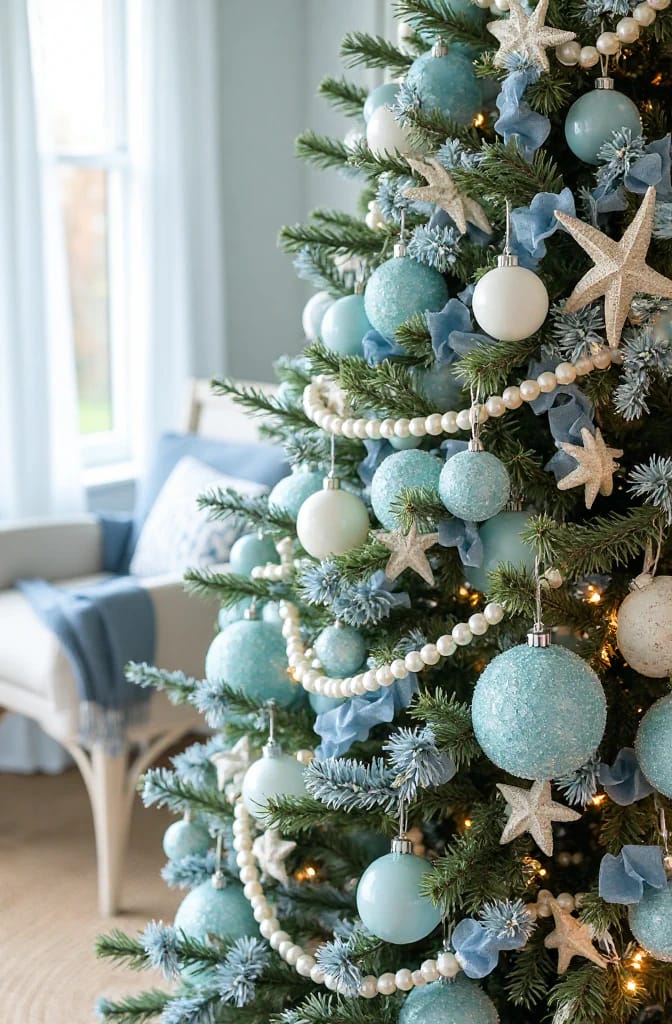
Sea glass and frosted glass ornaments belong four to six inches inside the branch line, not dangling off the tips where everyone instinctively puts them. The material is translucent, so it only does anything when there is a bulb behind it, and a piece hung at the outer edge has nothing behind it but the room. Push them in until they sit level with the second row of lights.
Scale matters more than quantity. Pieces around two to three inches across read from the far side of a room; anything under an inch disappears into the general glitter and might as well not be there. Cluster in threes at different depths rather than spacing evenly, which is also how the handmade sea glass trees sold on Etsy are assembled, with pieces stacked in graduated sizes so the light travels through several layers at once.
6. Real oyster shells and sand dollars, cleaned properly, beat the resin versions
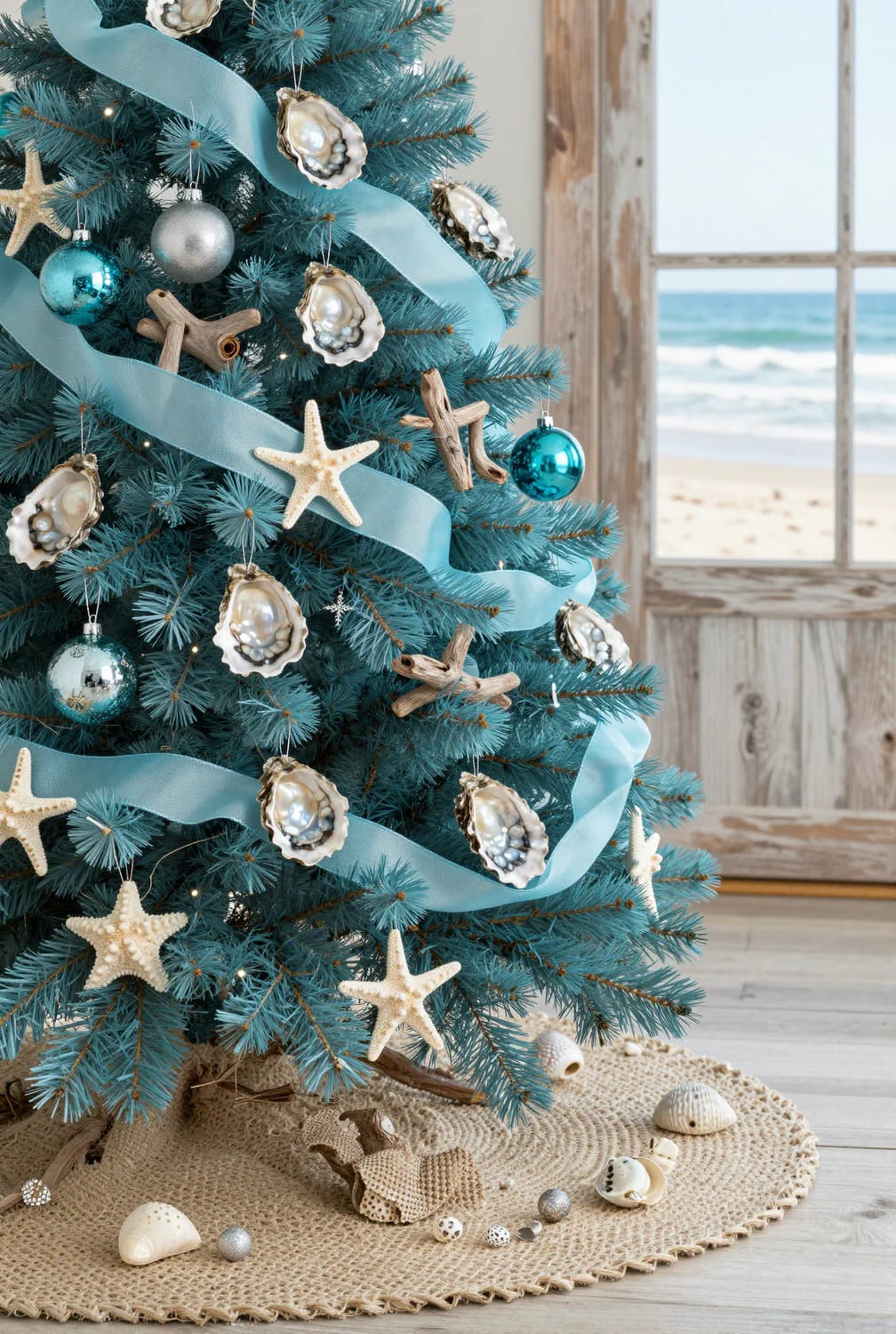
Use the real thing, because resin shells have a uniform surface and a slightly waxy sheen that gives them away from three feet. An oyster shell has an iridescent interior that shifts as you move past it and a chalky ridged exterior, and no molded copy reproduces both. Gold leaf on the rim of an oyster is the one embellishment that consistently works, partly because it echoes the natural pearl sheen already there.
Drill rather than glue where you can. A 1/16 inch bit in the thin edge of an oyster or scallop, run slowly with the shell supported on a scrap of wood, takes a jute loop and will still be attached in five years. Glued loops fail in storage.
Restaurant oyster shells and beach finds both carry organic residue that will smell within a week in a warm room. Simmer them for ten minutes, scrub, then soak briefly in roughly one part household bleach to ten parts water, rinse thoroughly, and dry for a full day before drilling. Sand dollars are skeletons, not shells, and they are brittle: never collect a living one (a live sand dollar is brown or purple and has moving spines), and handle bleached ones as though they were eggshell, because a drill will shatter them. Several US states and most beach parks restrict shell collecting, so check local rules before you fill a bucket.
7. A rope basket or driftwood collar instead of a tree skirt
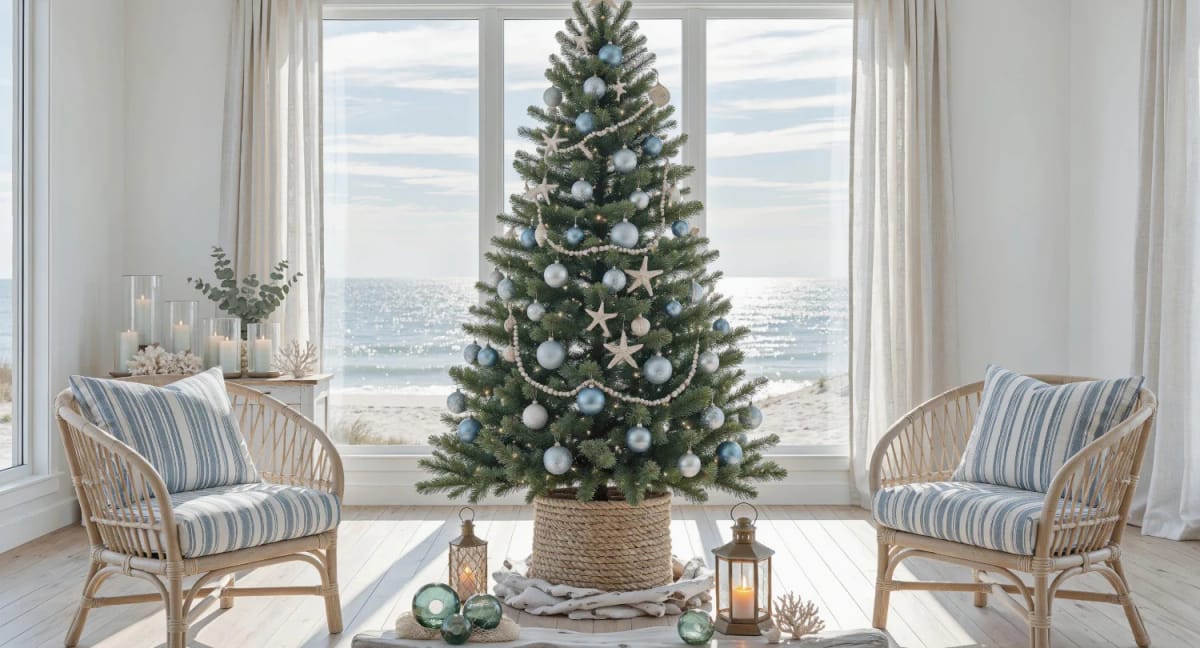
A pleated fabric skirt is the single most traditional object on the whole tree, and it undoes a lot of restraint above it. A woven seagrass or water hyacinth basket around 20 to 24 inches in diameter swallows a standard stand on a seven-foot tree and reads coastal without announcing itself.
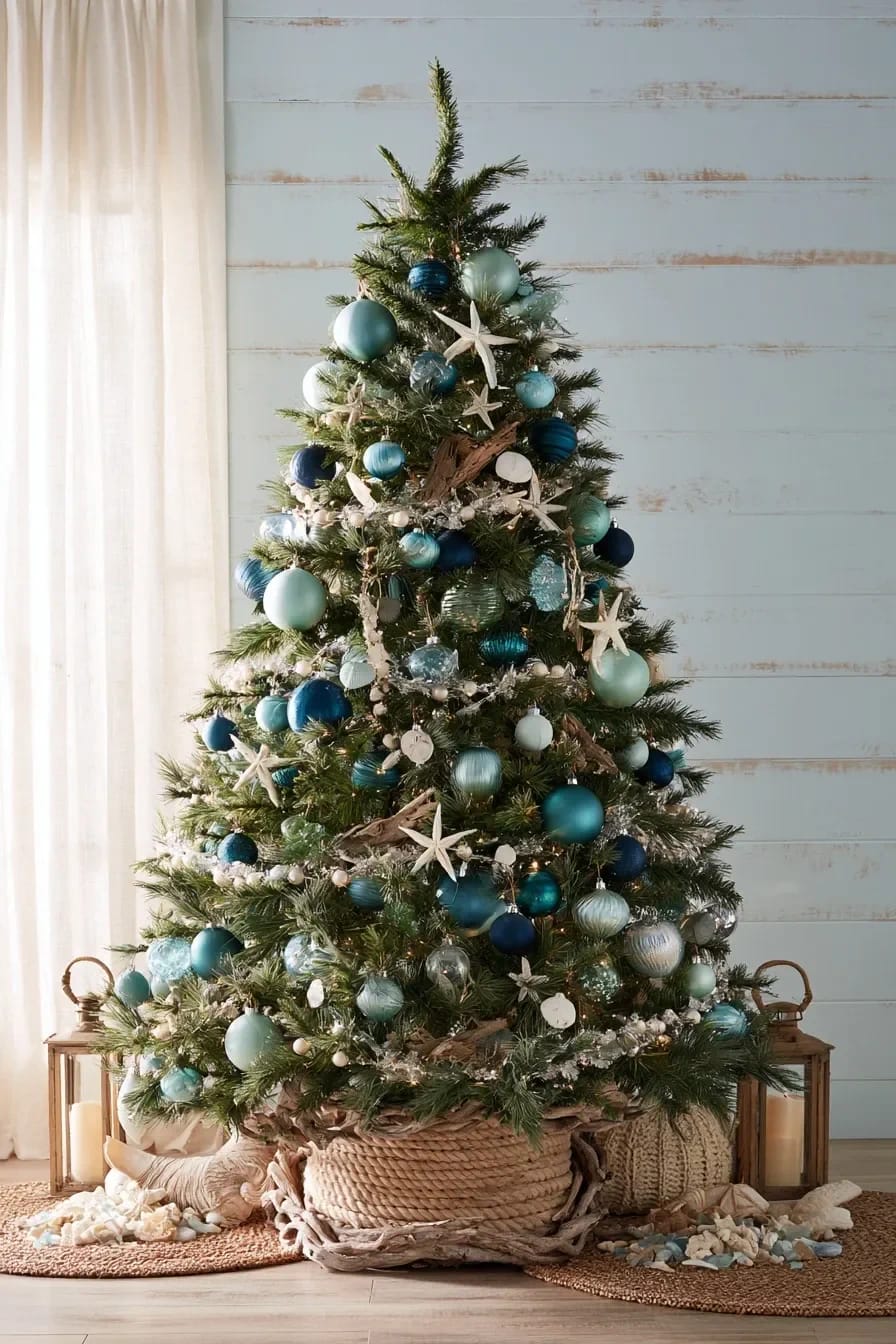
Measure the stand before you buy the basket, not after. Most quoted basket dimensions are the rim, and the base is often three or four inches narrower, which is exactly enough to leave you wedging the whole thing at an angle on Christmas Eve. Rolled towels inside fill the gap and stop the tree drifting.
Mantel, stairs, and the dining table
8. Build the mantel on driftwood and eucalyptus, then add exactly three blue glass floats
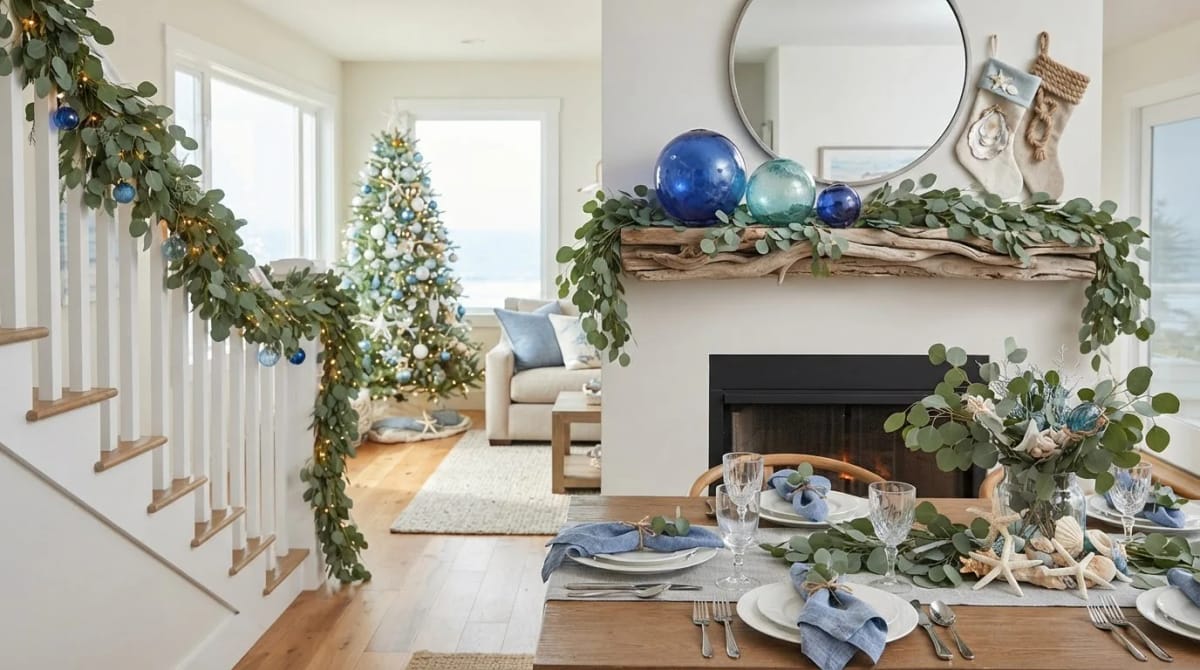
Silver dollar eucalyptus is the greenery to build on, because it dries to a grey-green that sits with driftwood instead of fighting it, where pine reads almost black against pale stone. Lay it long and let one tail fall toward the hearth rather than running it symmetrically shelf to shelf.
Glass floats are the coastal object with actual history behind them: hand-blown spheres used to hold fishing nets up, in Norway from the 1840s and later in enormous numbers off Japan, and they still wash up on Pacific beaches. Reproductions in rope netting cost a fraction of the genuine ones and look the part at a distance, though the moulded seam gives them away close up. Three, in three sizes, is the right number on a standard mantel; five starts to look like a display case. If you want the underlying construction rules for building density into a mantel, the garland-specific mantel piece gets into draping and layering properly.
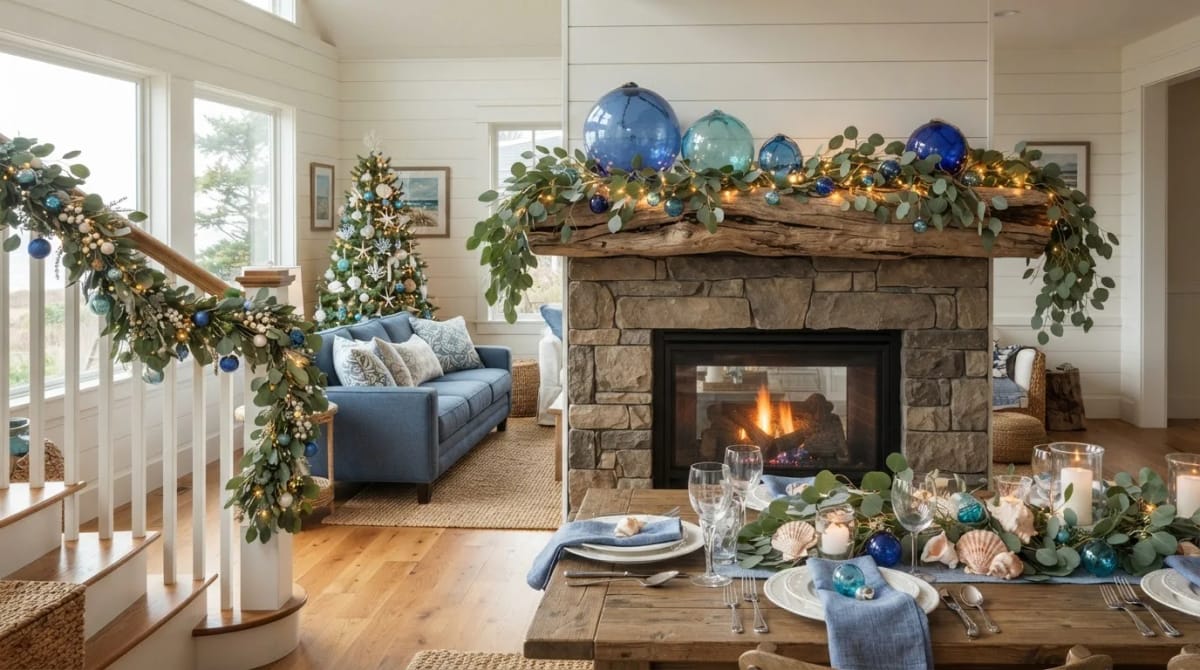
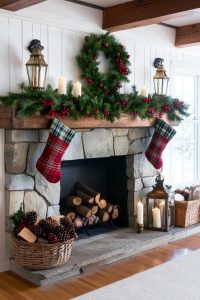 Rustic Christmas Mantel Garland Ideas That Look Collected, Not Bought How much greenery a mantel actually needs, and why most store-bought lengths look thin.
9. Line the stair treads with lanterns and keep flame off the banister
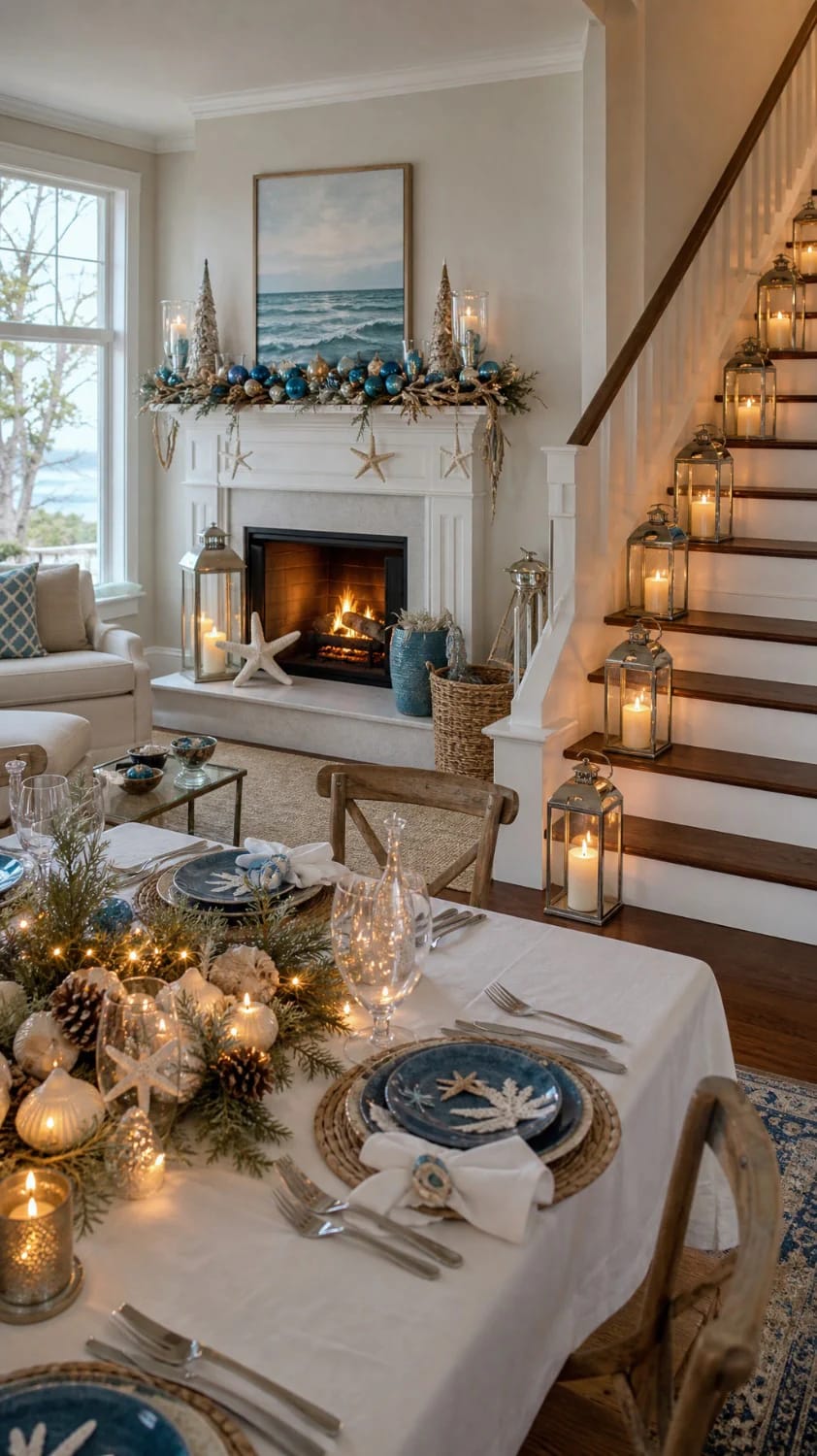
Put the light on the treads, not on the rail. Wrapping a banister in greenery and then setting candles along it is a genuinely bad idea, and dried eucalyptus is more flammable than fresh pine, not less. Glass lanterns with battery pillars sit on alternate treads against the wall side, where nobody's foot goes, and they throw exactly the low glow people are after in those staircase photos.
One wide pale blue grosgrain ribbon at the newel post, tails long and uneven, does more than bows tied at every spindle. The spindle-bow version takes an hour and reads as a wedding.
10. A dough bowl of sea glass, shells, and white tapers as the centerpiece
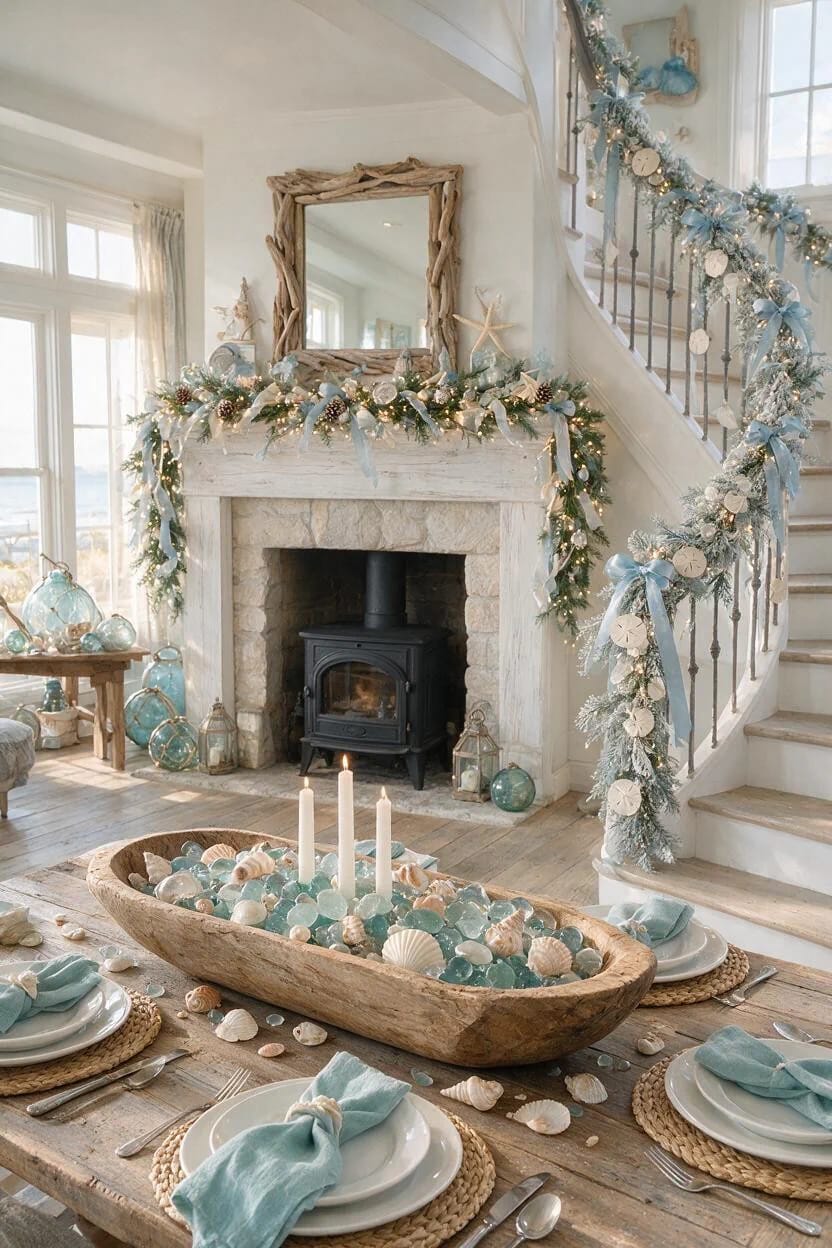
An 18 to 24 inch wooden dough bowl, filled with a base layer of sand or dry rice to seat three white tapers at staggered heights, then sea glass and small shells worked in around them. The sand does two jobs, holding the candles upright and hiding the mechanism.
Keep the whole thing under about twelve inches tall so people can see each other across it, and pull the shells back from the flames rather than nestling them at the base. Wax runs down into shells and never comes out.
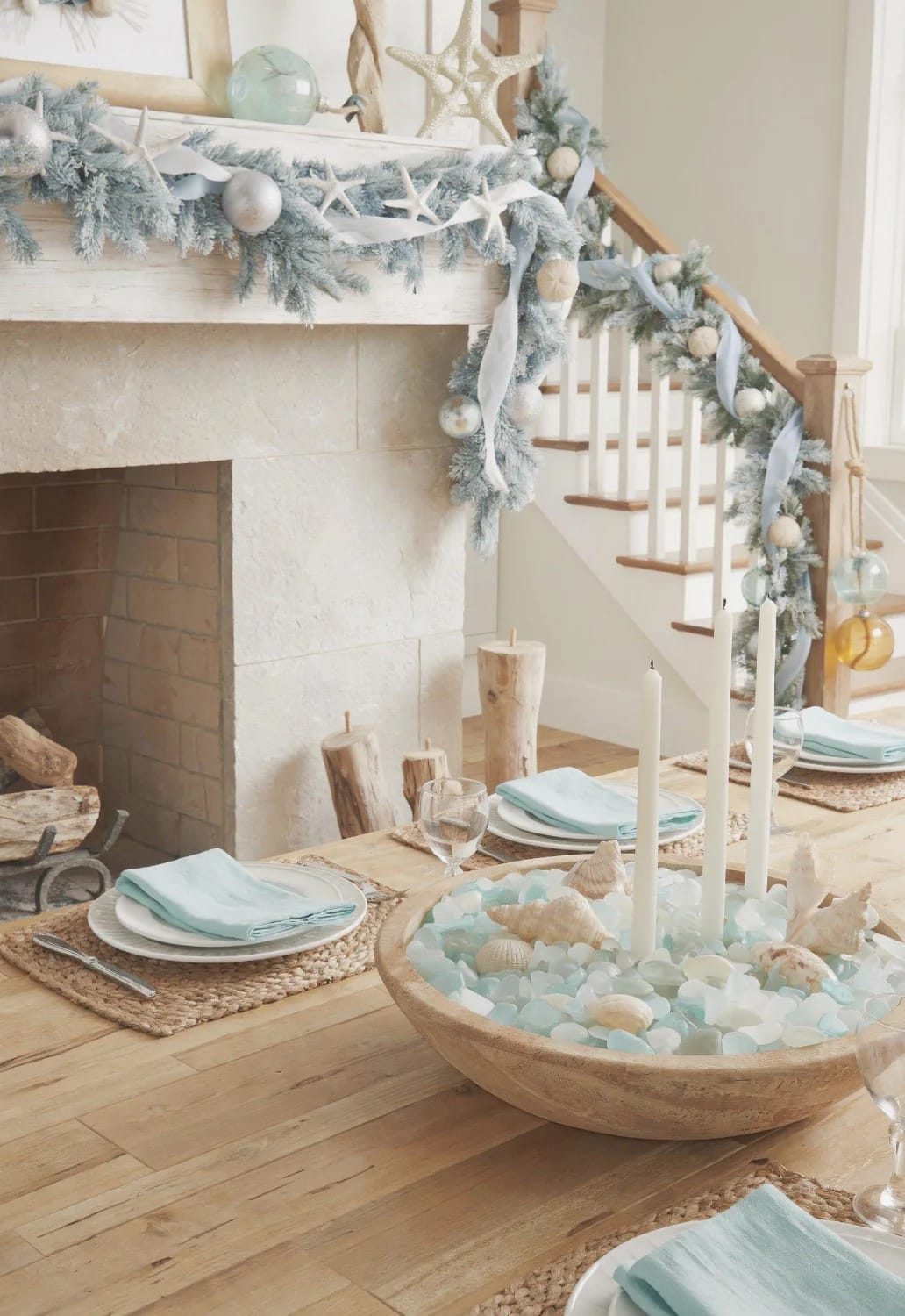
11. Run blue and white ginger jars down the table instead of a runner
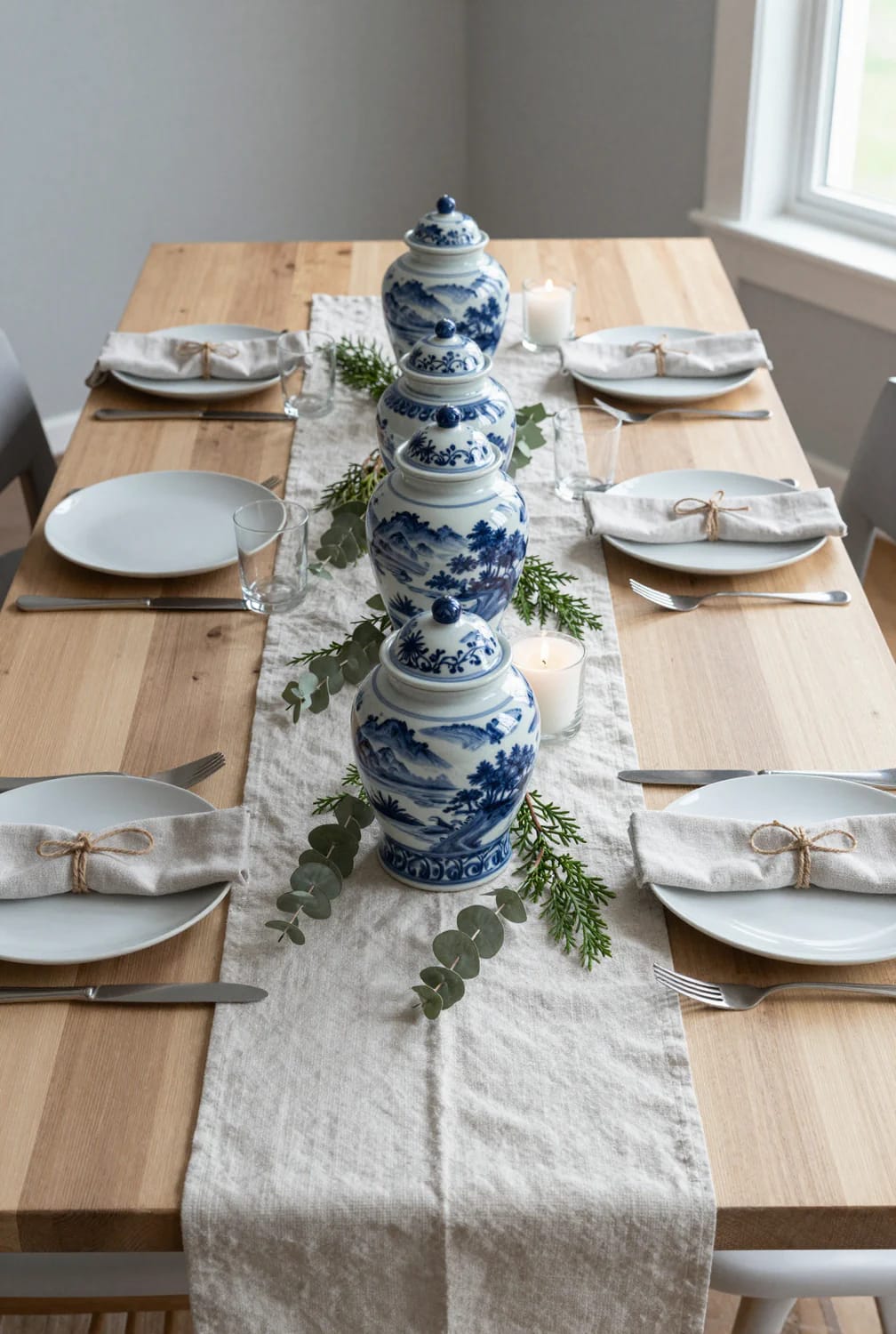
Ginger jars are the piece that connects coastal blue to the older blue-and-white china tradition, and three of them down a bare table do more than any runner. Cobalt on white porcelain is the same blue as sea glass at a different saturation, which is why the two sit together so easily.
Buy fewer and better. The cheap versions use a printed decal that sits flat on the glaze with no variation in the line weight, and once you have noticed it on one jar you cannot unsee it on any of them. Two good jars beat five decal ones, and vintage examples turn up steadily in estate sales for less than the reproductions cost new. The same blue-and-white logic runs through the year in coastal traditional living rooms, which is worth a look if you want the jars to still make sense in March.
Front door and porch
12. A shell wreath on a pale blue door, and no red berries near it
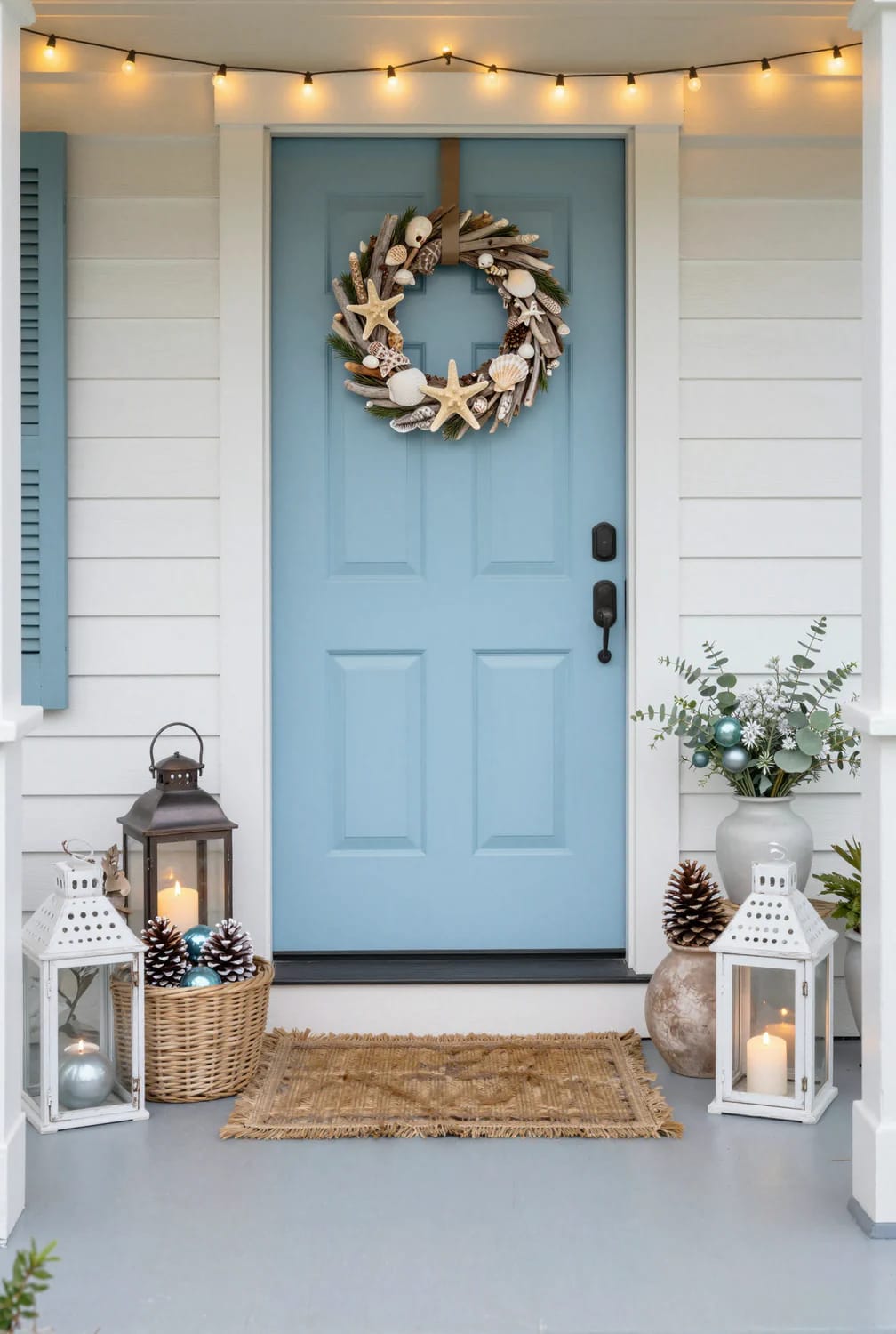
Back the wreath with magnolia leaves before any shells go on, because shells alone on a bare grapevine base look like a summer craft, and the dark glossy leaf reverse gives the pale shells something to sit against. Scallop and oyster work better than conch or anything spiraled, which throws shadows that read as clutter at a distance.
Wire the shells, or use E6000 rather than hot glue, if the door faces west or south. Hot glue softens in direct afternoon sun and the shells drop off the bottom of the wreath first, usually around the second week of December. A wreath on a shaded north door can be hot glued and will hold fine.
13. One lit tree in a rope-wrapped planter, and nothing else on the porch
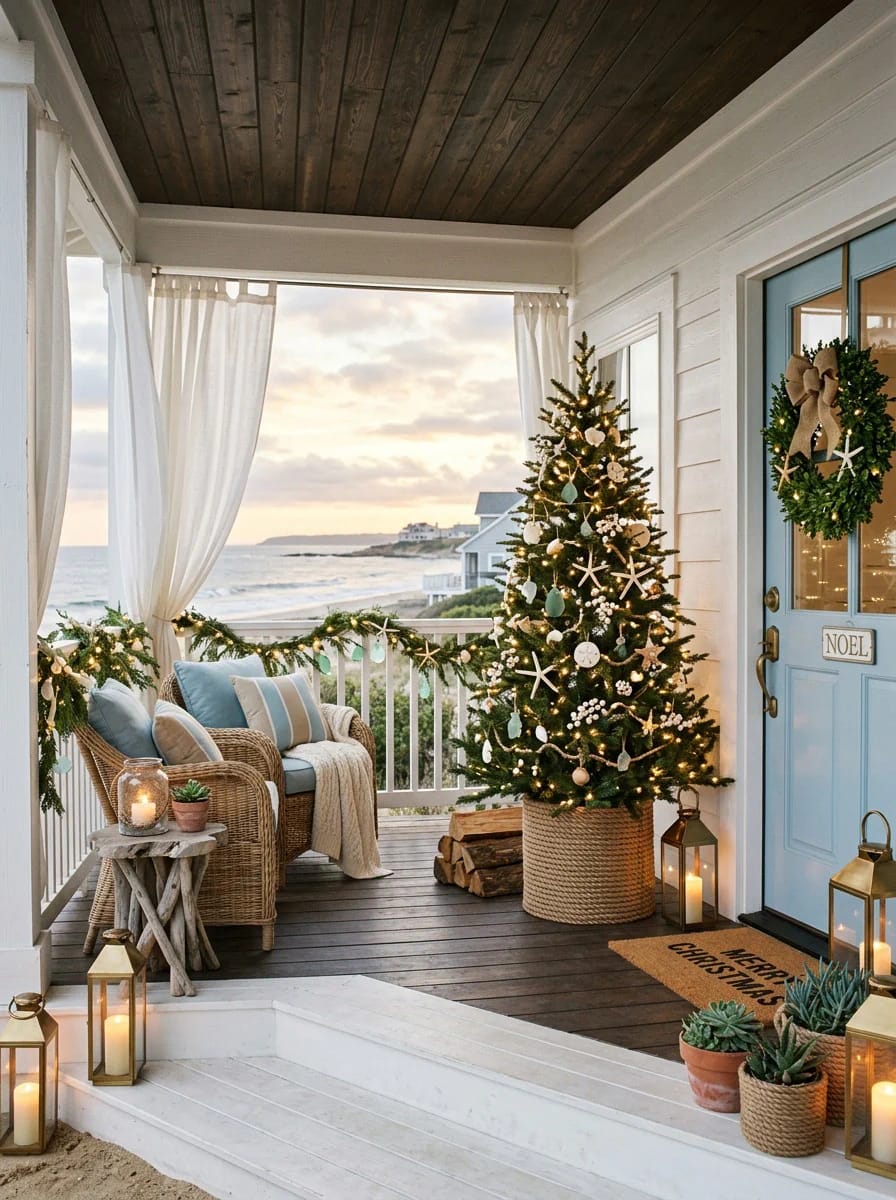
The porch is where restraint pays hardest, because a coastal house at night is mostly silhouette and one lit object is legible from the street where six are not. A four or five foot potted evergreen, warm white lights only, in a galvanized bucket wrapped in jute rope from rim to base. Two glass lanterns flanking the steps if you want more, and that is the whole scheme.
Blue exterior lights are the one place I would push back on the palette. They photograph well and read as cold blue haze in person, and against a white or grey-shingled house they turn the whole facade slightly lunar. Keep the blue indoors where the warm bulbs can balance it. The modern porch piece argues the same restraint case from a different starting point, with the specific counts and scale rules.
One thing worth admitting before you start ordering: real sea glass in any volume has become expensive, and the bagged "sea glass" sold cheaply by the pound is tumbled manufactured glass, uniform in thickness and slightly too even in color. It looks fine in a bowl and fine in a photograph, and up close it does not have the pitted surface that thirty years of surf produces. Buy it if you need volume for the dough bowl. Then put the three real pieces you found yourself at eye level on the tree, where somebody will pick one up.
Related Posts
- 21 Gorgeous Blue Christmas Decor Ideas You Must See
- 11 Whimsical Candy Cane Christmas Decorations Worth Doing Well
- 10 Organic Warmth Coastal Trends Replacing the Blue-and-White Beach House
- 25 Trendy Natural Christmas Decorations for 2025
- 11 Classy Outdoor Christmas Lights Ideas Without a Single Inflatable
- 20 Dreamy Blue Coastal Bedrooms for Effortless Relaxation