
The version of this lamp floating around makes it look like a furniture-store piece, but strip away the glow and it is four sticks, a square of plywood, a can of black paint, and a pile of fairy lights.
The part nobody mentions: a five-foot tower built from skinny dowels wobbles like a drunk giraffe, so the wood you pick matters more than the lights do. Below is the full cut list, the spray-don't-brush paint step, and how to drape the lights so they read as a glowing column instead of a sad little grid.
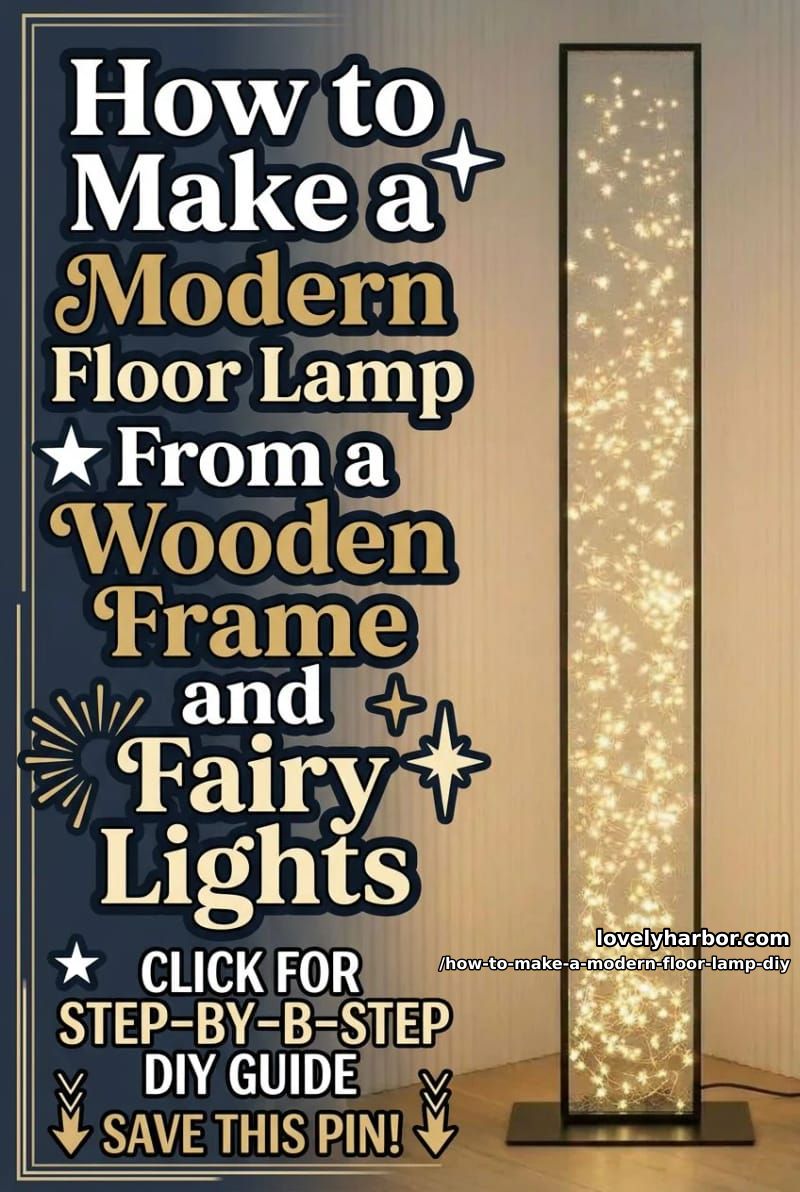
The whole thing is a glowing box
You are building an open rectangular tower, about five feet tall, painted black, packed with warm-white fairy lights so it reads as a vertical bar of light in a dim room. No diffuser, no shade, no wiring you have to splice. It is a weekend project, and if you already own a drill and something that cuts wood, the materials land somewhere around fifty to a hundred dollars.
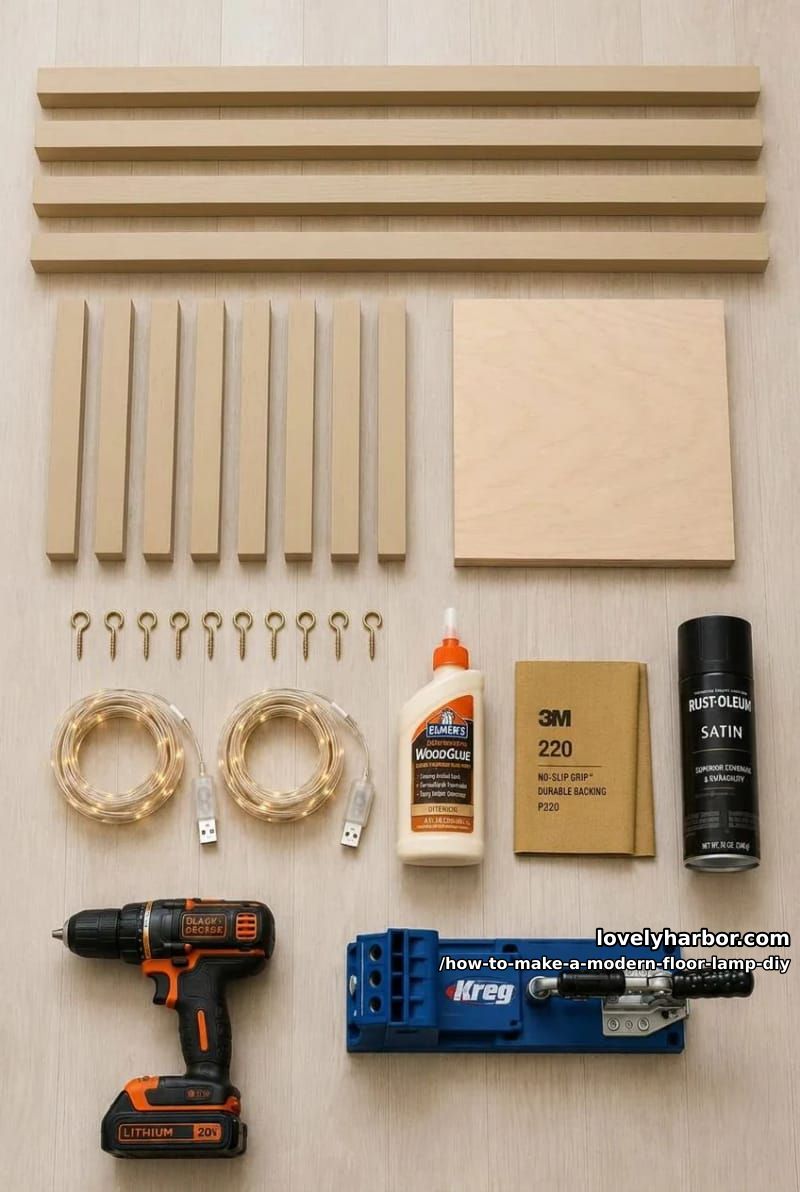
4 verticals: 1×2 stock, 60 in each.
8 rails (four at the top, four at the bottom): 1×2 stock, 9 in each, which gives you a footprint close to 11 in square.
1 base: ¾ in plywood, 12 x 12 in (slightly wider than the footprint so the tower doesn’t look like it’s standing on tiptoe).
Shopping list
Materials (the stuff that gets used up)
| Qty | Item | Spec | Price |
|---|---|---|---|
| 4 | Square-edge boards, poplar or pine | 1×2 in, 8 ft length | $5 to $10 each |
| 1 | Plywood or pine for the base | ¾ in, cut to ~12×12 in | $8 to $15 |
| 2 to 4 | Warm-white fairy light sets | thin-wire LED, 2700-3000K, plug-in or USB, ~100 LEDs each | $8 to $18 each |
| 1 | Wood glue | PVA, 8 oz | $4 to $8 |
| 1 | Black satin paint | spray (2-3 cans) or 1 qt enamel | $6 to $10 per can |
| 12 to 20 | Small cup hooks or screw eyes | ½ in, brass or black | $4 to $8 |
| 1 | Adhesive cable clips | for routing the cord down a back post | $4 to $7 |
| 1 | Sandpaper | 150 and 220 grit | $4 to $7 |
| Materials subtotal | $50 to $110 | ||
Tools (the stuff that stays in the drawer)
| Qty | Item | Spec | Price |
|---|---|---|---|
| 1 | Saw | miter saw, or hand saw and miter box, or the store cuts it for you | $0 to $120 |
| 1 | Drill / driver | cordless | $40 to $80 |
| 1 | Pocket-hole jig or corner brackets | Kreg-style jig, or 8 small L-brackets plus screws | $5 to $40 |
| 2 | Bar clamps | for holding the box square while glue sets | $15 to $30 |
| 1 | Measuring and marking | tape, pencil, speed square | $10 to $20 |
| 1 | Drop cloth and painter’s tape | for the paint step | $6 to $12 |
| Tools subtotal (most people already own the basics) | $0 to $300 | ||
| Combined total, buying everything from scratch | $90 to $260 |
Prices are approximate ranges as of June 2026; verify before purchase.
Picking wood and lights that don't look cheap
This is where the project is won or lost, so spend two minutes here before you spend money. The two decisions that show up later are the thickness of your posts and the color temperature of your lights, and getting either wrong is the difference between a lamp that looks bought and one that looks like a school project.
On wood: poplar takes black paint flatter than pine and won't telegraph its grain through a few coats, which is the look you want for a modern piece. People email me asking if they can use the cheap ¼-inch craft dowels from the hobby aisle. You can, and then you will spend the rest of the lamp's life nudging it back upright, because a five-foot post that thin flexes under its own light strings.
Do this
- 1×2 poplar (or pine) for the posts. Rigid enough that the box doesn’t sway.
- Warm white, 2700K to 3000K.
- Plug-in or USB sets, since this is something you’ll leave on all evening.
- Enough lights to actually fill the volume. Plan on 250 to 400 LEDs total for a tower this tall, which is usually two to four standard sets.
Avoid
- Thin square craft dowels for the verticals. They rack, and the whole box leans into a parallelogram.
- Cool white or “daylight” 6000K sets, which go blue and clinical the second they’re inside dark wood.
- Battery-only sets. You will be swapping AAs every few days and resenting it.
- One skimpy 50-LED string trying to do the whole job.
Step 1: Build the frame and base
Cut everything first, dry-fit it standing up, and only reach for glue once the box stands square on its own. If your saw work isn't trustworthy, most home centers will cut the boards to your list for free or close to it, which removes the single biggest source of a crooked tower.
- Cut the pieces: four posts at 60 in, eight rails at 9 in, and the base at 12 x 12 in. Sand the cut ends smooth with 150 grit so the joints sit tight.
- Build the top and bottom squares: join four rails into a square, then a second square, using pocket screws or glue plus a small L-bracket in each inside corner. Check each square with your speed square before the glue grabs.
- Stand up the four posts: connect the two squares with the verticals at each corner. Clamp the assembly and confirm it is square in both directions, because a box that’s a few degrees off at the base is wildly off at five feet up.
- Drill a cord notch: before you attach the base, mark and drill a ½-in hole near one back corner of the base (or notch the edge) for the light cord to exit. Easy to forget, miserable to add later.
- Attach the base: center the frame on the plywood square and drive two screws up through the base into each bottom rail. Let the glue cure overnight before you move it around.
Step 2: Prime and paint (and why you should spray, not brush)
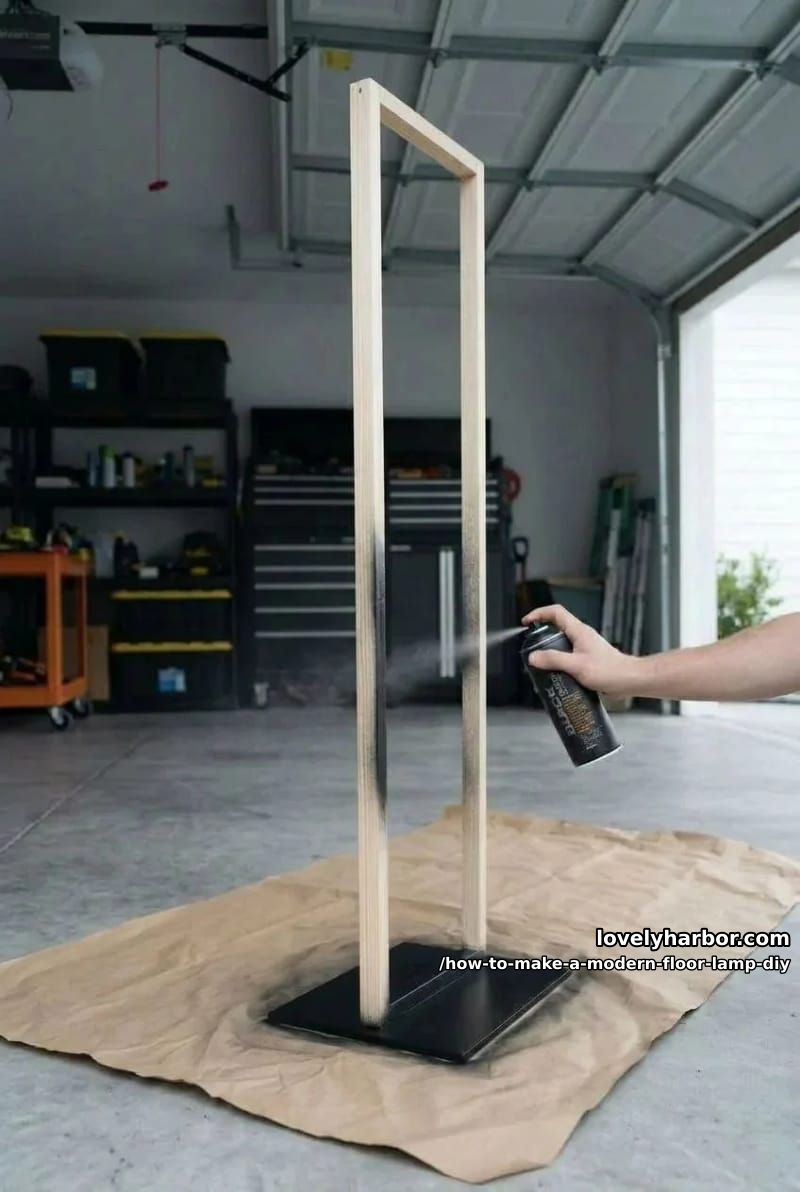
Spray it. A brush leaves tracks on stock this narrow, and on a skeletal frame with this many edges you'll be chasing drips into corners for an hour. A couple cans of black satin spray, held about ten inches off the wood, build up clean in two or three thin coats. Satin over gloss, unless you want every fingerprint to show.
Wipe the frame down, hit any raised grain with 220 grit, and prime first if you used pine (it drinks paint unevenly otherwise). Then thin coats, 30 to 60 minutes apart, turning the frame between passes so you reach the inside faces of the posts where the hooks will go.
One heavy coat to “save time” gives you runs and a tacky finish that stays soft for days. Three light coats actually dries faster and looks like furniture. Let the final coat cure a full 24 hours before you handle it, or your hooks will lift the paint when you screw them in.
Step 3: Add hooks and string the lights
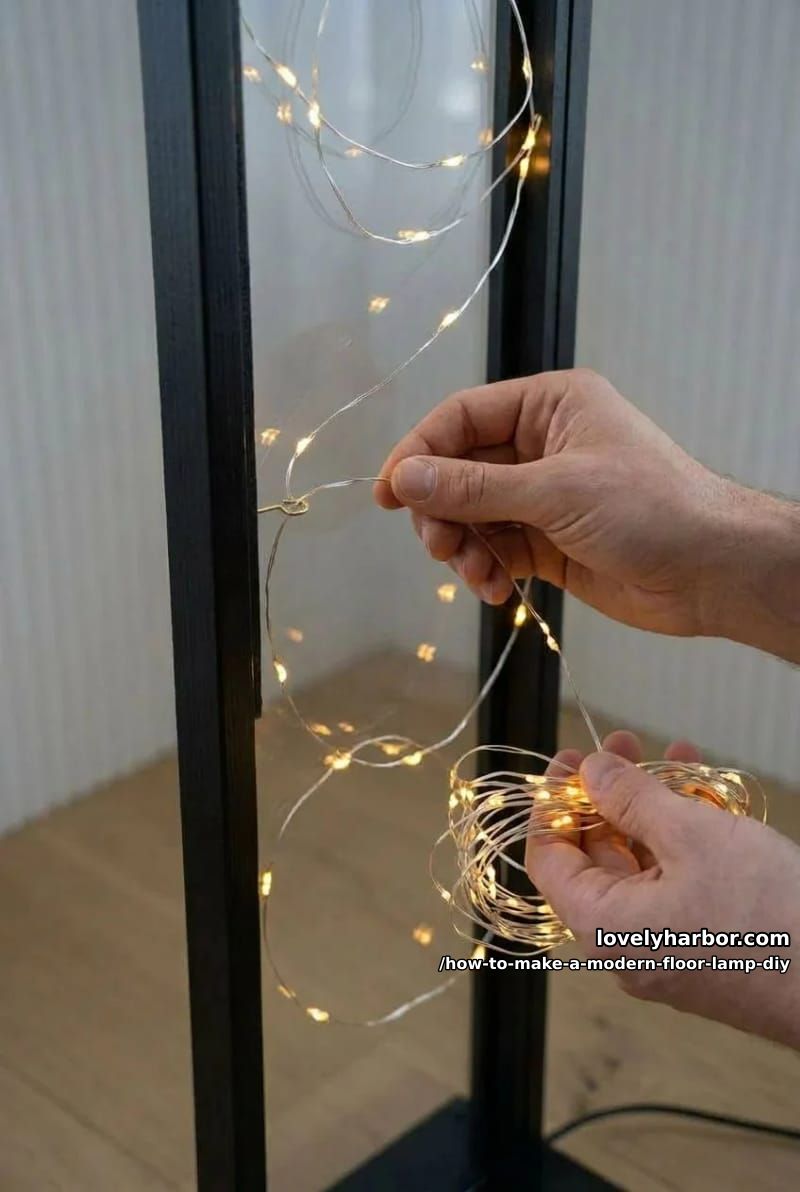
Once the paint is fully cured, screw your small cup hooks into the inside faces of the posts, spaced unevenly up the height, maybe four or five per post. They don't need to be neat. Their only job is to give the light wire something to catch on so it stays draped instead of pooling at the bottom.
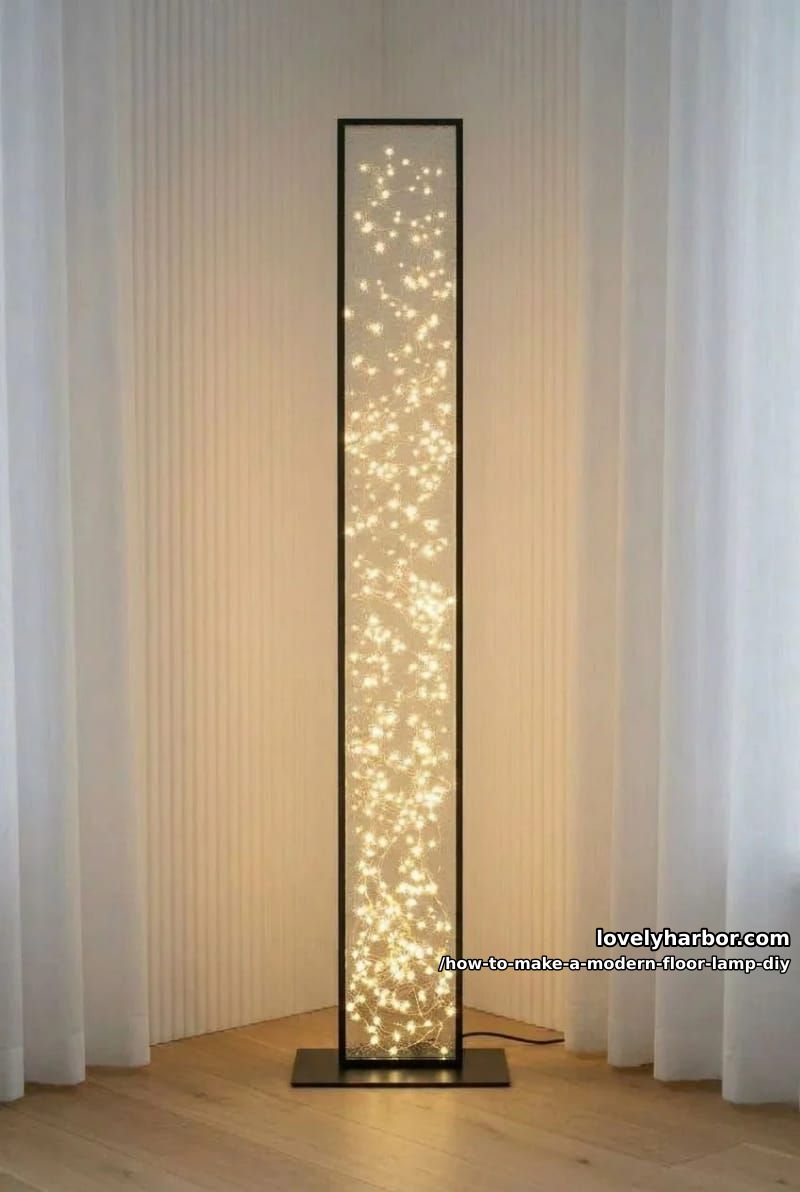
Now the part that actually decides whether this looks expensive: drape, don't wrap. Run the cord down a back post and out your cord notch, then loop the lights loosely from hook to hook, crossing the interior at different heights, letting some strands sag and some run nearly straight. A tight, even spiral reads as a craft kit. A loose tangle reads as the photo that made you want to build this. Plug it in partway through and keep adjusting until the column looks full top to bottom with no dark gaps.
Mistakes that ruin this lamp
- Skipping the dry-fit. Glue first, measure later, and you discover the lean only once it’s permanent.
- Not clamping square. Gravity pulls a tall glued box into a parallelogram while it cures. Clamp it and check both diagonals.
- Brushing the black. Brush marks on ¾-inch stock are unforgiving. Covered above, but it’s the error people make most.
- Mounting hooks on soft paint. Screw a hook into a finish that hasn’t cured and you’ll peel a ring of paint and gum the threads.
- Stringing the lights tight and even. A uniform wrap kills the effect. Loop loosely and let it look a little chaotic.
- No cord exit. Forget the notch and you’re either drilling around live lights or running the cord over the base where everyone sees it.
Conclusion
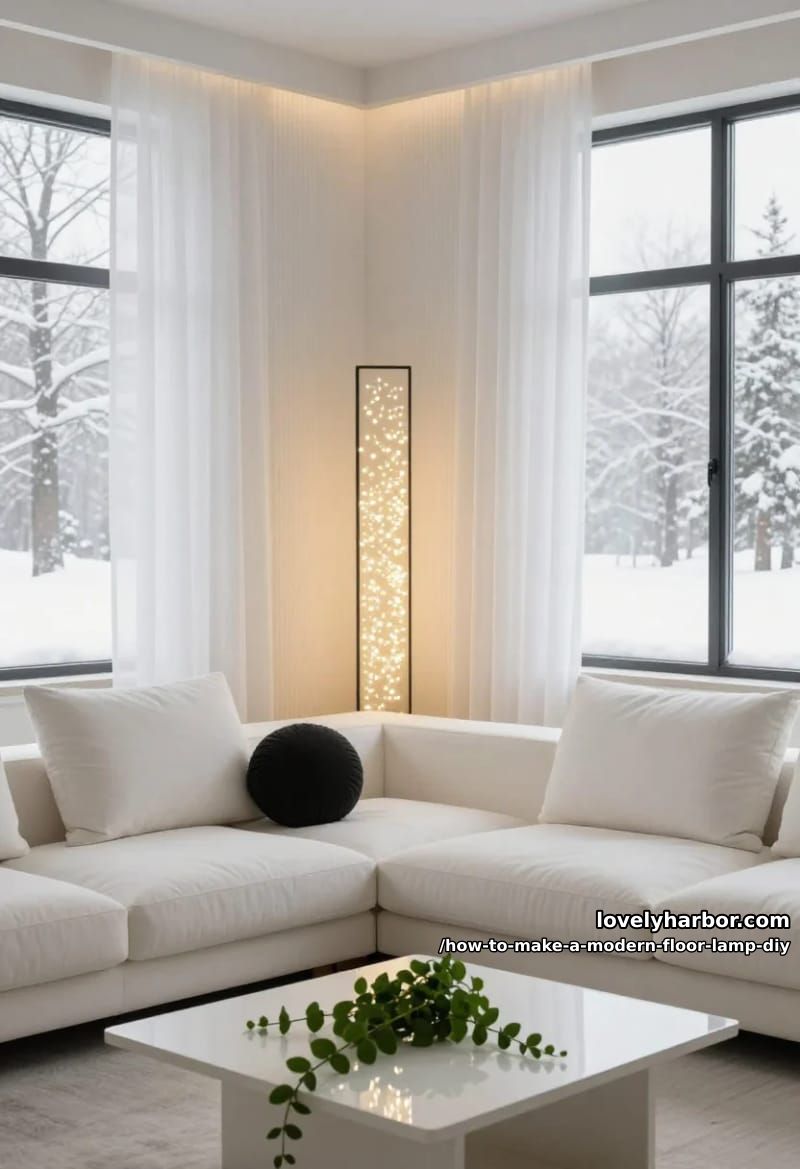
The one variation worth stealing is the base. In the photo that started this trend the base is left a warm metallic finish against the black frame, a small two-tone move that costs nothing and reads more deliberate than an all-black build.
If you want to try it, mask the base before you spray and either leave the plywood raw with a clear coat or hit it with a brass or gold paint. Everything else holds: rigid 1×2 posts so it doesn't sway, warm white around 2700K, and a loose drape rather than a tidy wrap.
Build the box on Saturday, paint it the same day, and you can have it glowing in the corner by Sunday night.