
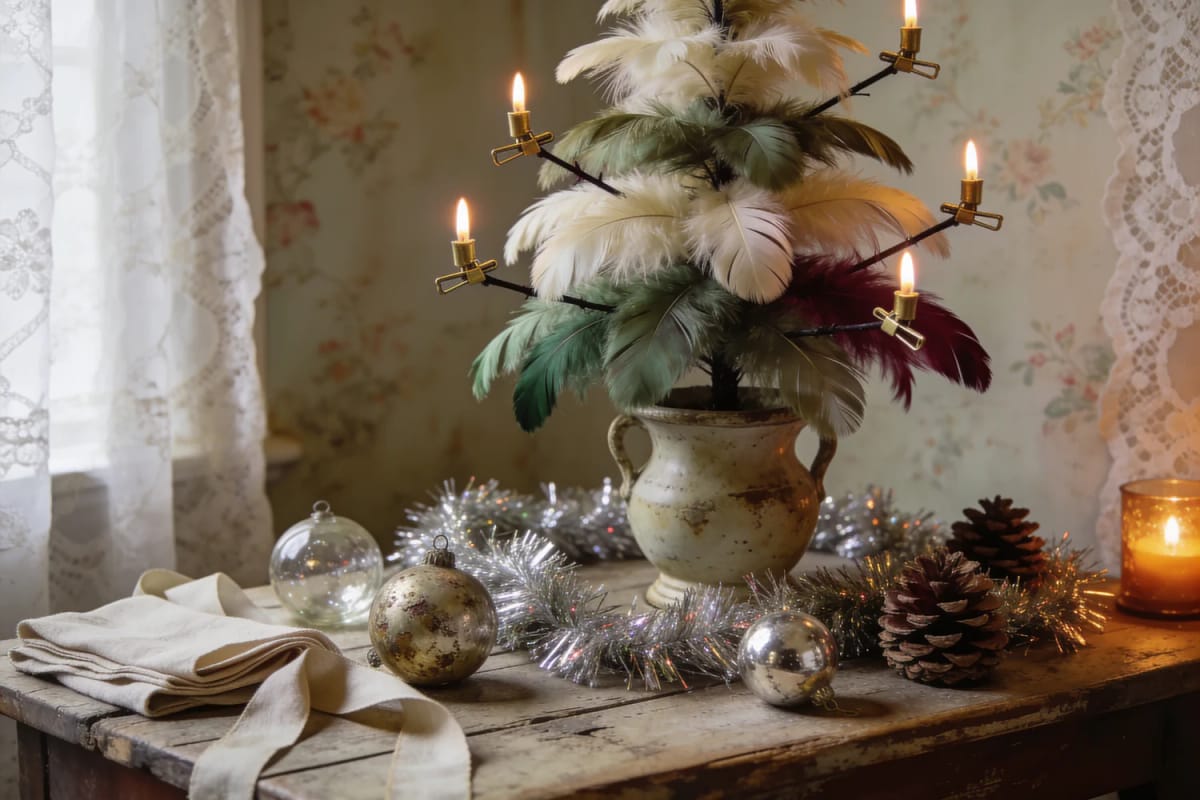
In 1879 a New York inventor named Frederick Arzt introduced a spring clip for holding a candle on a Christmas tree branch, and the thing it replaced was worse: a clay ball on a wire, slung over the bough as a counterweight, heavy enough to bend the branch and tip a burning taper into the tree. Both kinds still turn up clamped to antique feather trees at estate sales. Neither one should be holding fire in 2026, and everything below assumes you agree.
The tree itself is the reason. A German feather tree is dyed goose feather wound onto wire, drilled into a wooden dowel, usually finished with composition berries at the tips and set in a turned or square wooden base. The branches sit far apart because that is how the German makers imitated the region's white pines, and because the gaps left room for candles. That spacing was the period's fire precaution. It was not a solution.
Nine ideas follow, arranged the way you would actually buy: the tree first, then the hardware, then everything that hangs on it. The candle rule is item five, and it is the only one I would call non-negotiable.
Start with the tree, not the trimmings
1. Buy the tree by its branch spacing, not its height
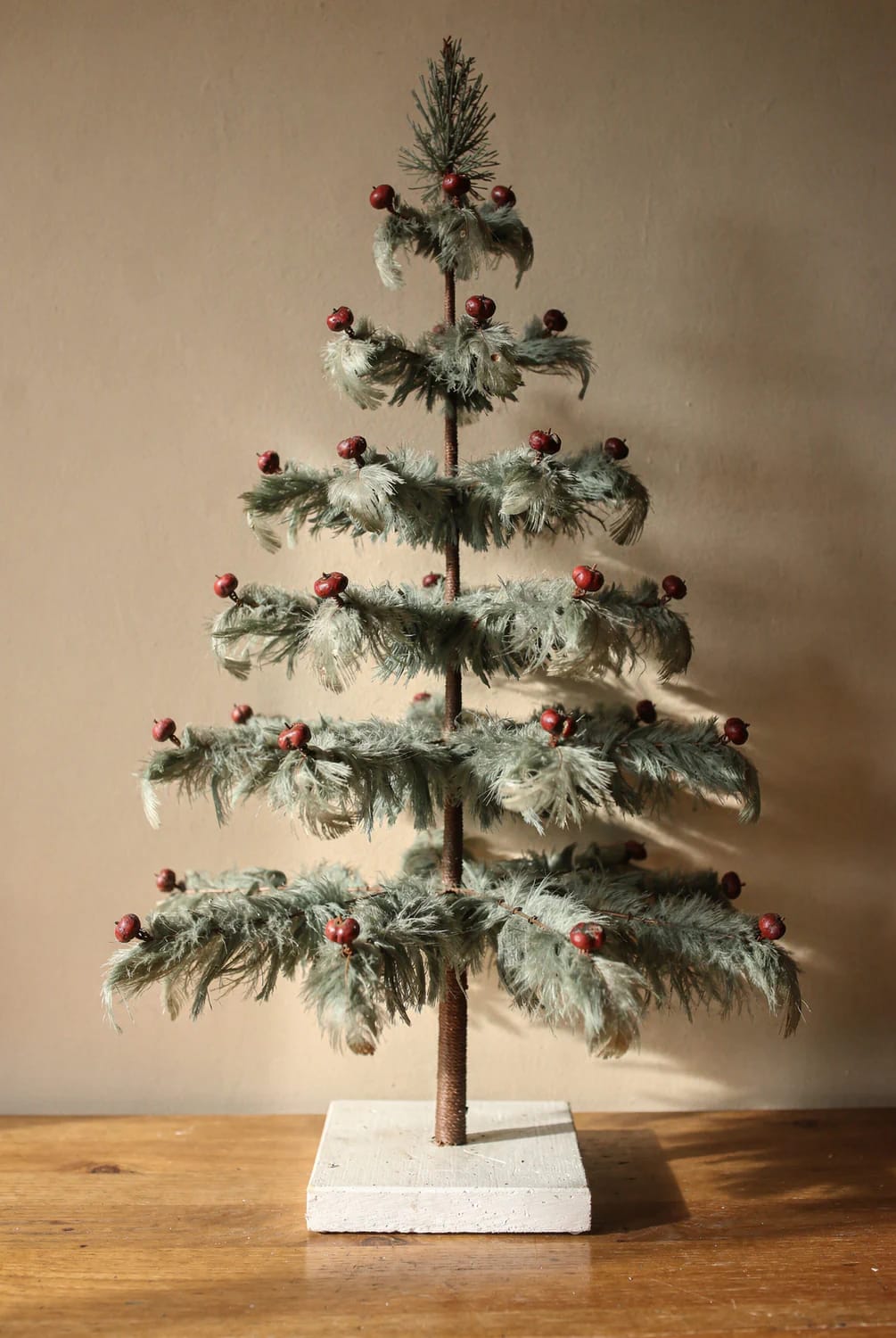
Height is the first number every seller quotes and the least useful one. What determines whether a feather tree looks like an antique or like a craft-store cone is the ratio of empty air to feather: original German trees run roughly five branches to a tier with several inches of bare dowel between tiers, and the whole point of that geometry is that you can see through the tree. Modern reproductions crowd the tiers to look fuller, which reads as a bottle brush from six feet away.
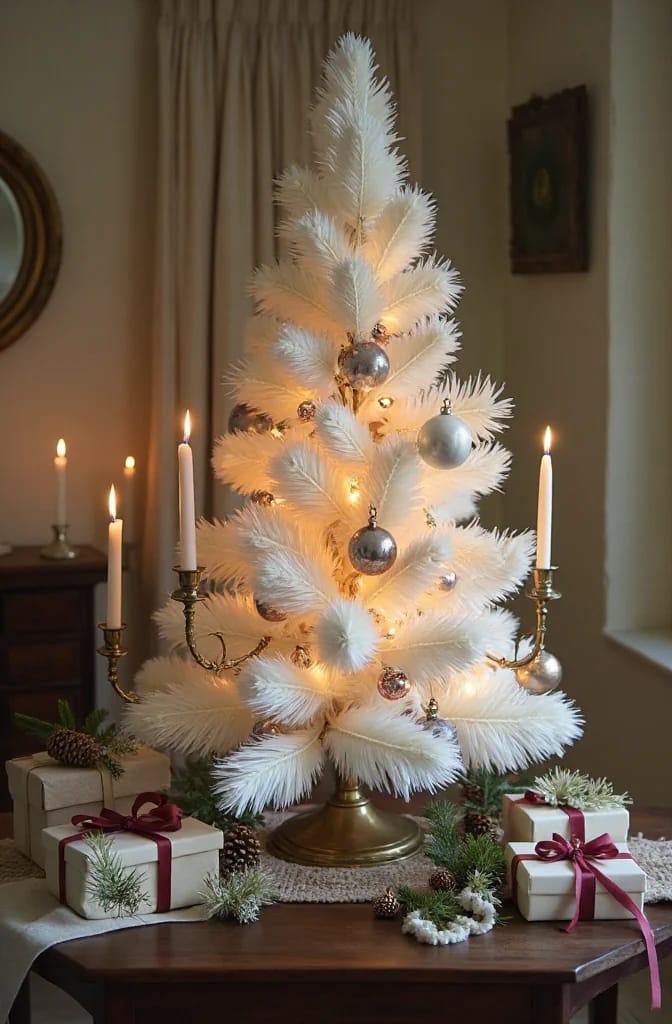
Count tiers and branches in the listing photos before you look at anything else. A documented example sold by Bargain John's Antiques runs 42 inches with eight tiers, five branches on seven of them and three on the top tier, on a square white base with painted garland on each side. That is the proportion to memorize. Then check the dowel for a stamp on the underside of the base, check whether the berries are original composition or later plastic replacements, and assume any tree described only as "vintage feather" with no country of origin is a 1980s revival piece.
Real goose feather rather than tinsel or PVC, 23 branches at 25 inches, with the open tiered spacing that makes the antiques read the way they do. A sensible stand-in while you wait for the right original to surface.
25-inch goose feather Christmas tree, vintage-style white, wooden base2. A 25-inch feather tree outperforms a four-foot one in most rooms
Everyone wants the big one. The big ones (four and five feet, the kind that show up on eBay described as "RARE 4.5 FOOT") are harder to place, more expensive by a wide margin, and much more fragile, because every extra tier is more leverage on the same thin wire. A 20 to 25 inch tree on a table at chest height puts the branch tips at eye level, which is where the ornaments and the clips actually get seen.
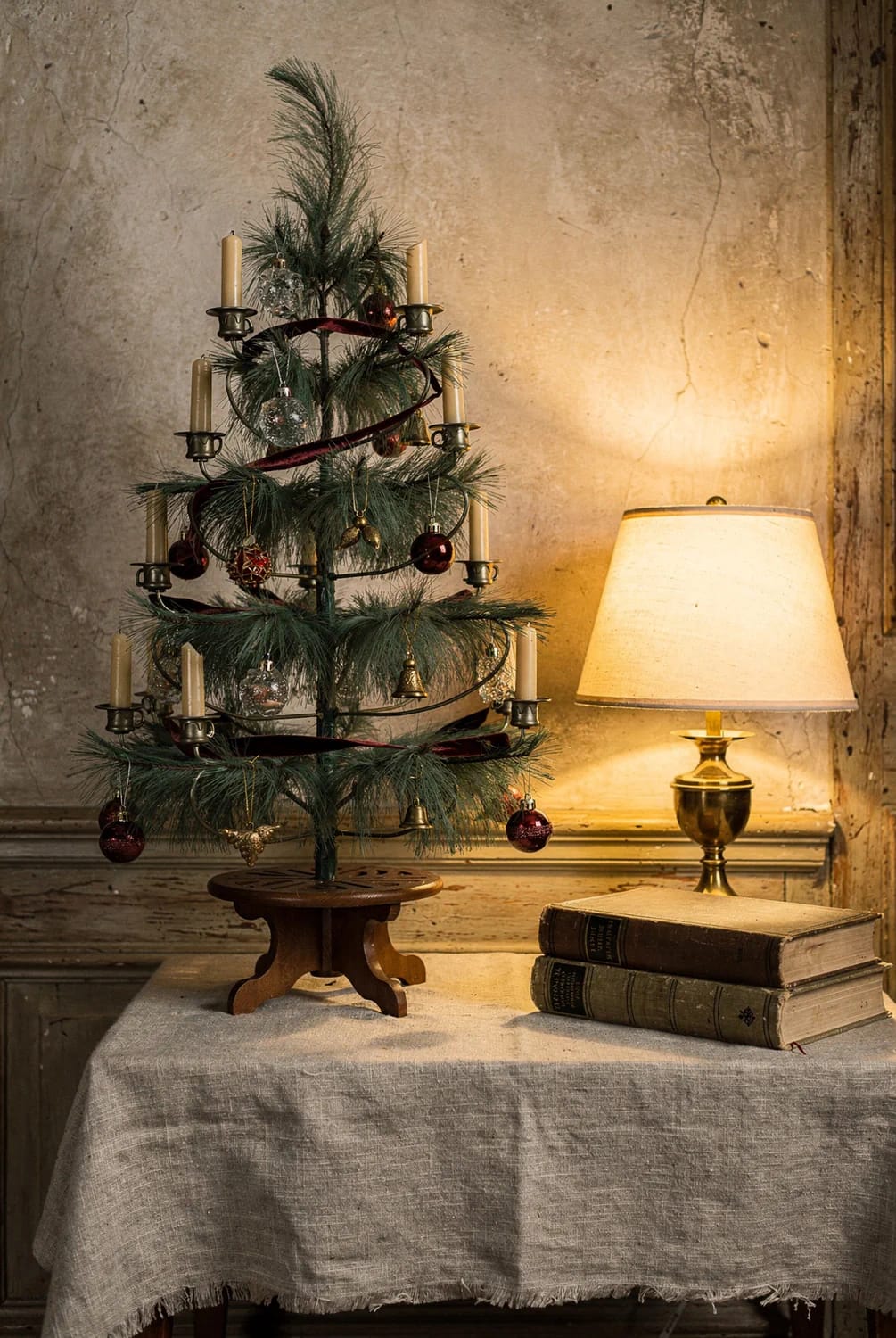
It also solves the problem small rooms have in December, which is that the tree annexes the walkway by the second week. A feather tree gives you the silhouette without the footprint, and it works in the same rotation as the other Christmas ideas that keep a small living room from filling up with decorations.
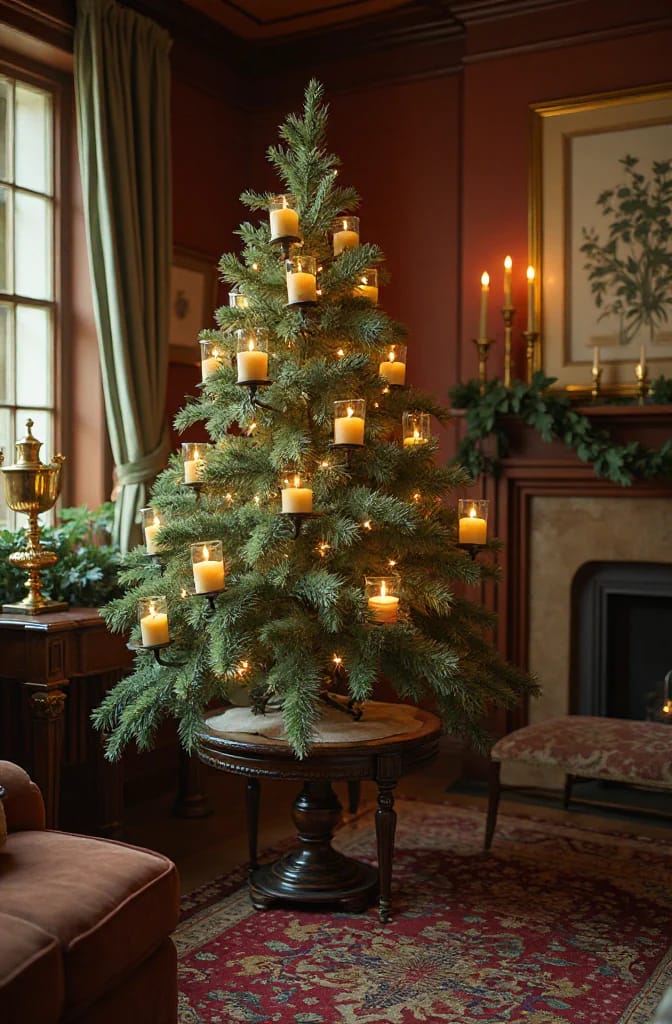
3. Leave the fade alone, and pay real attention if it is white, blue or pink

Green was the standard because green imitated pine, so a green tree that has faded to sage is simply a green tree doing what a hundred-year-old dye does. Restoring it, dyeing it, or worse, hot-gluing replacement feathers in, destroys the only thing separating it from a reproduction. According to the Golden Glow of Christmas Past, feather trees were also produced in white, blue, light green and gold, and those are the ones worth stopping for; the non-green colors are meaningfully scarcer and get priced accordingly when a collector recognizes what is on the table and you do not.
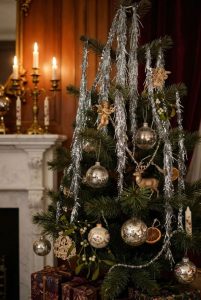 Vintage and Victorian Christmas Decorating: 11 Ideas for a Faded, Heirloom Holiday How much patina to leave alone, and why saturated color is what breaks the illusion.
The clips, the candles, and the rule about lighting them
4. Antique tin clip-on candle holders are the correct hardware, and they date the tree
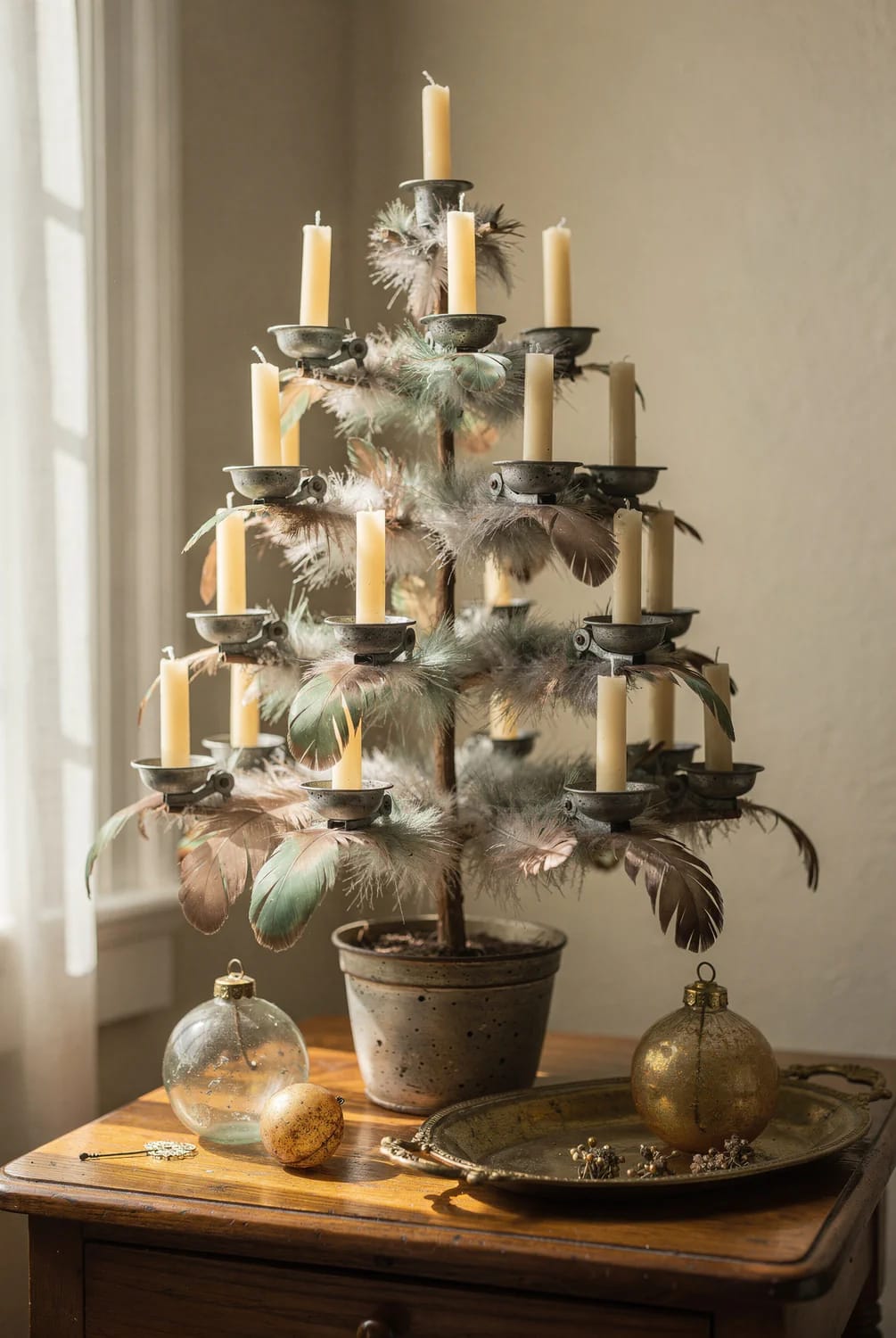
Clips are the hardware most people get wrong, because reproduction tin clips are everywhere and they photograph almost identically to originals. The tell is the finish. Period clips were decorated two ways: embossed and then painted with colored lacquer (a process called japanning), or lithographed with a printed image on flat tin. Golden Glow notes that japanning almost always wears or flakes off with age, so a genuinely old embossed clip usually shows relief with no color left in it at all. A bright, evenly colored embossed clip is nearly always new.
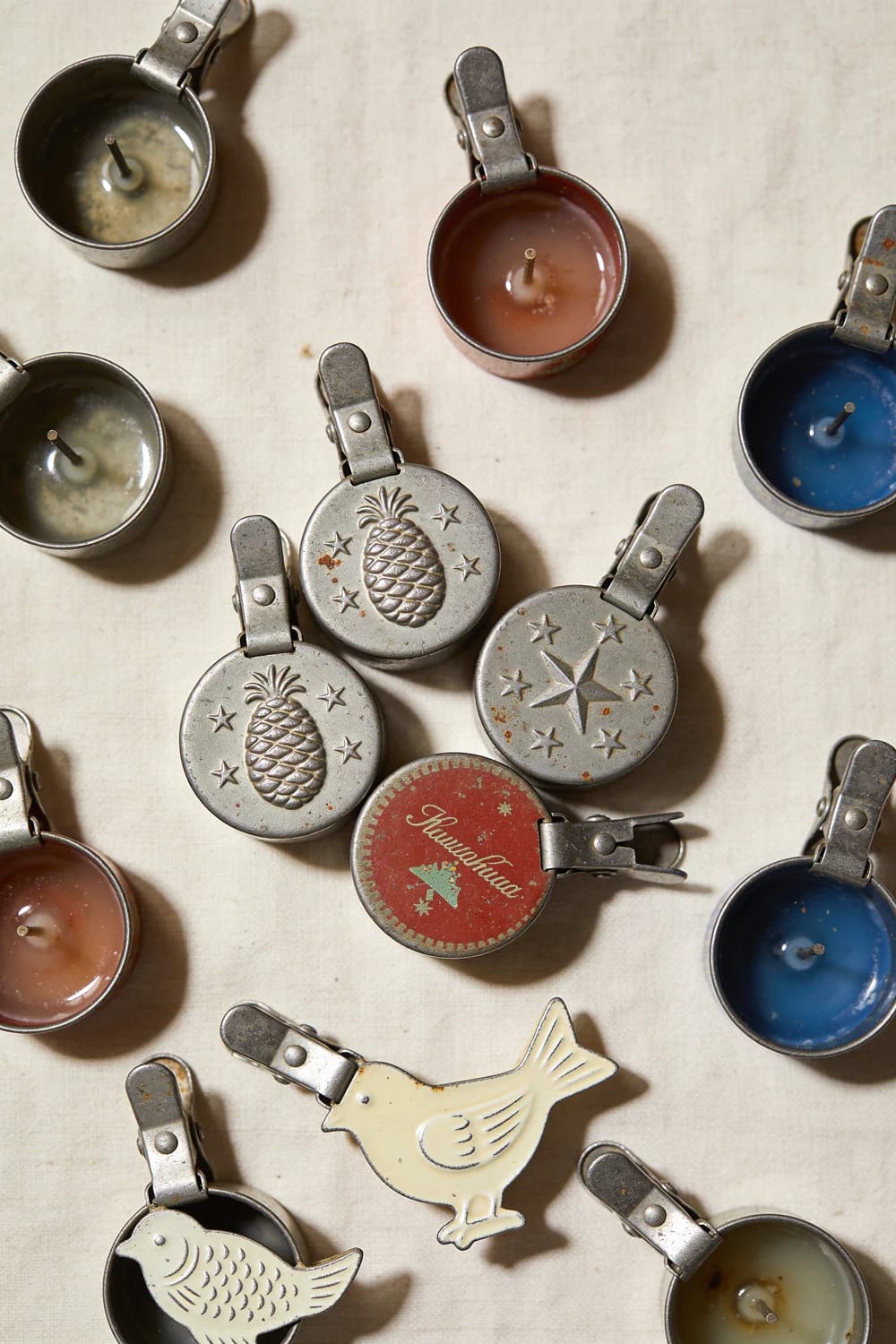
The anatomy is worth knowing before you buy a lot of forty at auction: a spring-loaded clamp for the branch, a pin or clasp to hold the candle upright, and a drip cup to catch wax. Test the spring on every one you can reach, because a clip that has lost tension is decorative only. Dating is messier than the collector sites imply, incidentally. The Henry Ford and the Kansas Historical Society both put Arzt’s spring clip at 1879, while Golden Glow dates the first lightweight clip patent to 1882. I have not found anything that reconciles the two, so treat “around 1880” as the honest answer.
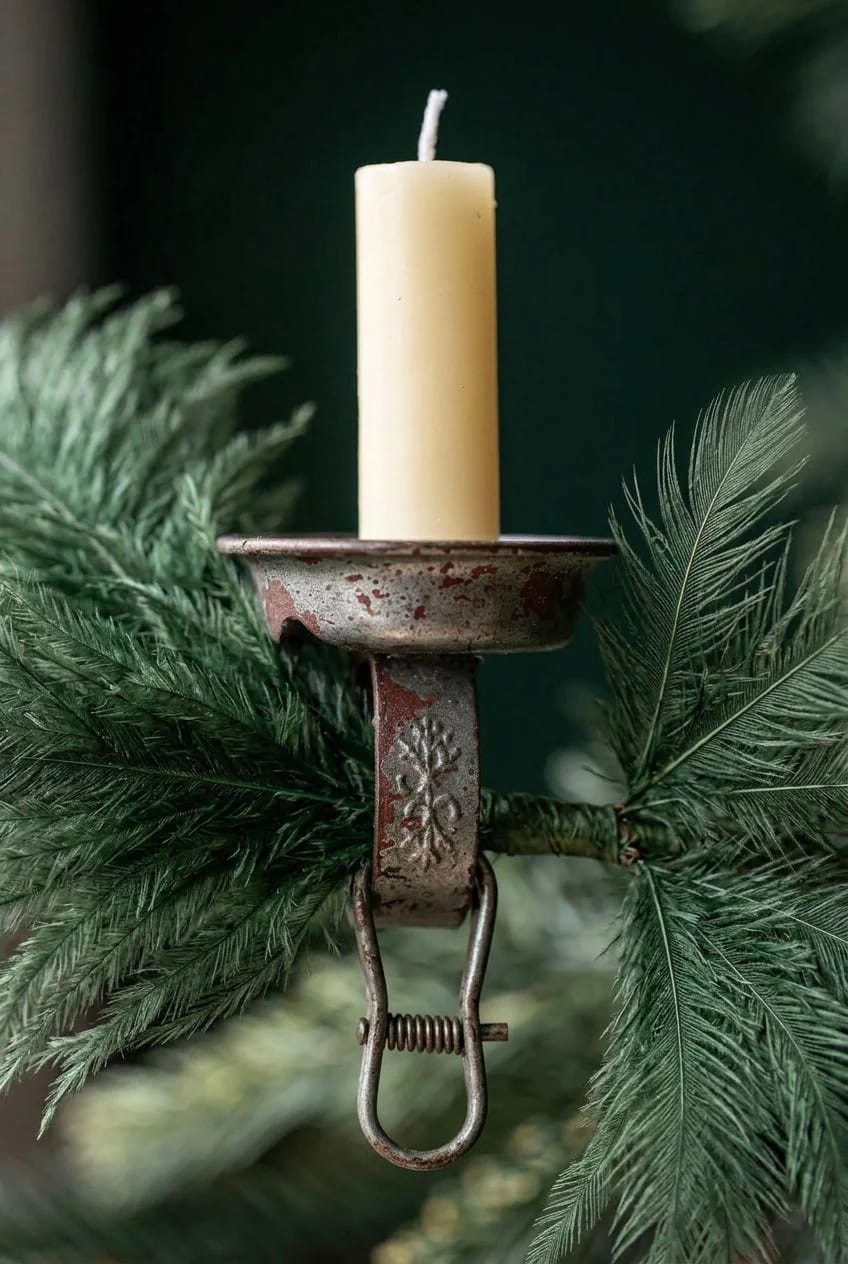
5. Put LED tapers in the antique clips and keep the wax in a drawer
This is the contrarian part and I am not going to soften it. A feather tree is dyed keratin wrapped on wire, frequently sealed with shellac, hung with composition and sometimes celluloid berries, mounted on a wooden dowel. It is a purpose-built ignition source with a base. The wide branch spacing was the German makers' precaution and it was a real one, but the historical record it produced was still a century of house fires, which is precisely why every museum that owns a feather tree displays it unlit.
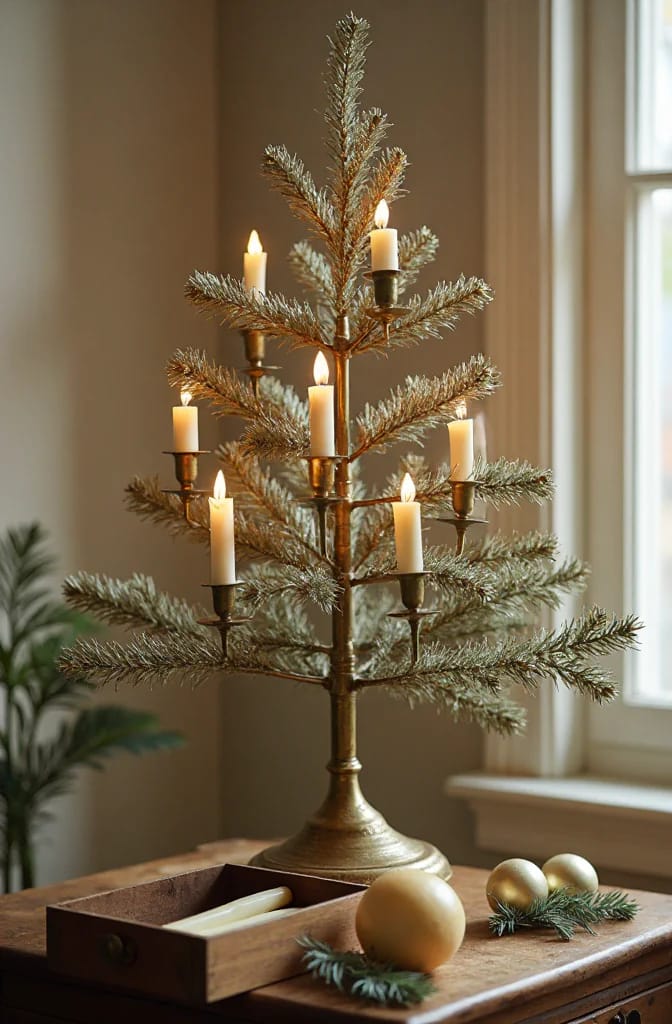
Real tapers on real feather trees remain a genuine fire risk, and an antique tree adds three aggravating factors a modern fir does not have: aged shellac, celluloid or composition berries at the branch tips (celluloid is famously flammable), and dry brittle feather barbs that catch and travel. There is no safe interval, no supervised exception, and no bucket of water that makes this a reasonable idea. If you want flame in the room, put it in a glass hurricane on the table, well away from the tree.
Scale is the thing here: at 3.5 inches these sit in an antique drip cup at roughly the proportion a period taper did. The same maker’s 5.5-inch version looks like a fence post on a small tree, so size down.
Wintergreen Lighting 3.5-inch clip-on flameless LED tree candles, set of 10 with remote6. Counterweight pendulum holders, but only on the lowest three branches
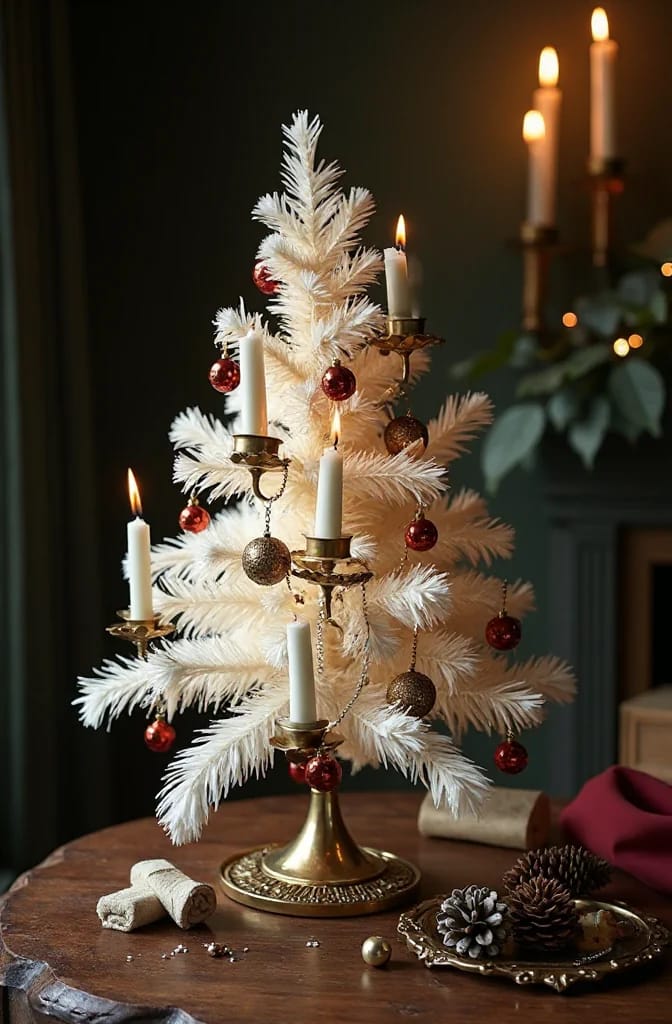
Counterweight holders are older than clips and, on the right tree, better: a hook over the bough with a weighted pendulum below it keeps the candle vertical even when the branch bends. On a feather tree they mostly do not work. The weights were molded clay or lead, and they were already too heavy for small boughs on a real fir, which is exactly the complaint the Kansas Historical Society records about them slipping off and increasing fire risk. A feather branch is thinner than anything they were designed for.
Use them anyway, on the three lowest tiers only, where the wire is thickest and a slight dip actually reads as period-correct droop. Hang the rest along the base or on a nearby shelf as objects, which is what they are now. If you want the whole look without the physics problem, the mid-century revivals solved it by getting rid of the branch load altogether, a lineage that runs straight through the aluminum and visca trees that replaced feather trees in American living rooms.
| Holder | How it attaches | On a feather branch | What belongs in it |
|---|---|---|---|
| Spring clip, c. 1880 | Sprung tin jaws pinch the branch | Works on any tier; the correct default | 3 to 3.5 inch LED taper |
| Counterweight pendulum, patented 1867 | Wire hook over the bough, clay or lead weight below | Lowest three tiers only; slips and droops above that | LED taper, or nothing at all |
| Modern LED clip | Plastic or metal clip, often with a suction cup alternative | Works, but reads new unless hidden under the feathers | Its own integrated candle |
Dressing it, and where it stands
7. Small kugels and thin-wall glass, sized to the branch
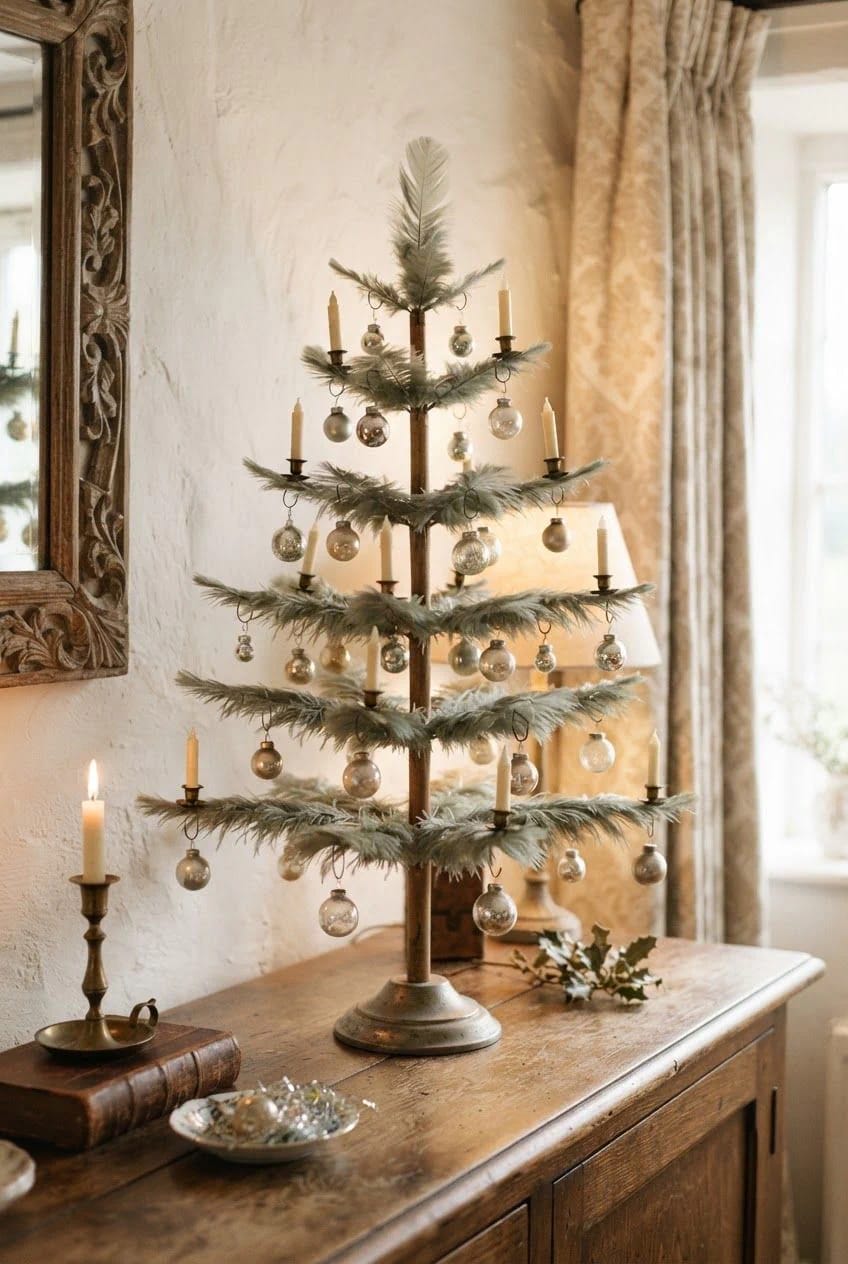
The ornament rule on a feather tree is weight, not style. A wire branch wrapped in feather will bend under a modern 3-inch ball and stay bent, so the working ceiling is roughly an inch and a half, which happens to be the size antique German glass was blown in anyway. Mixed finishes are fine and historically accurate; matched sets are the thing that makes a feather tree look staged.
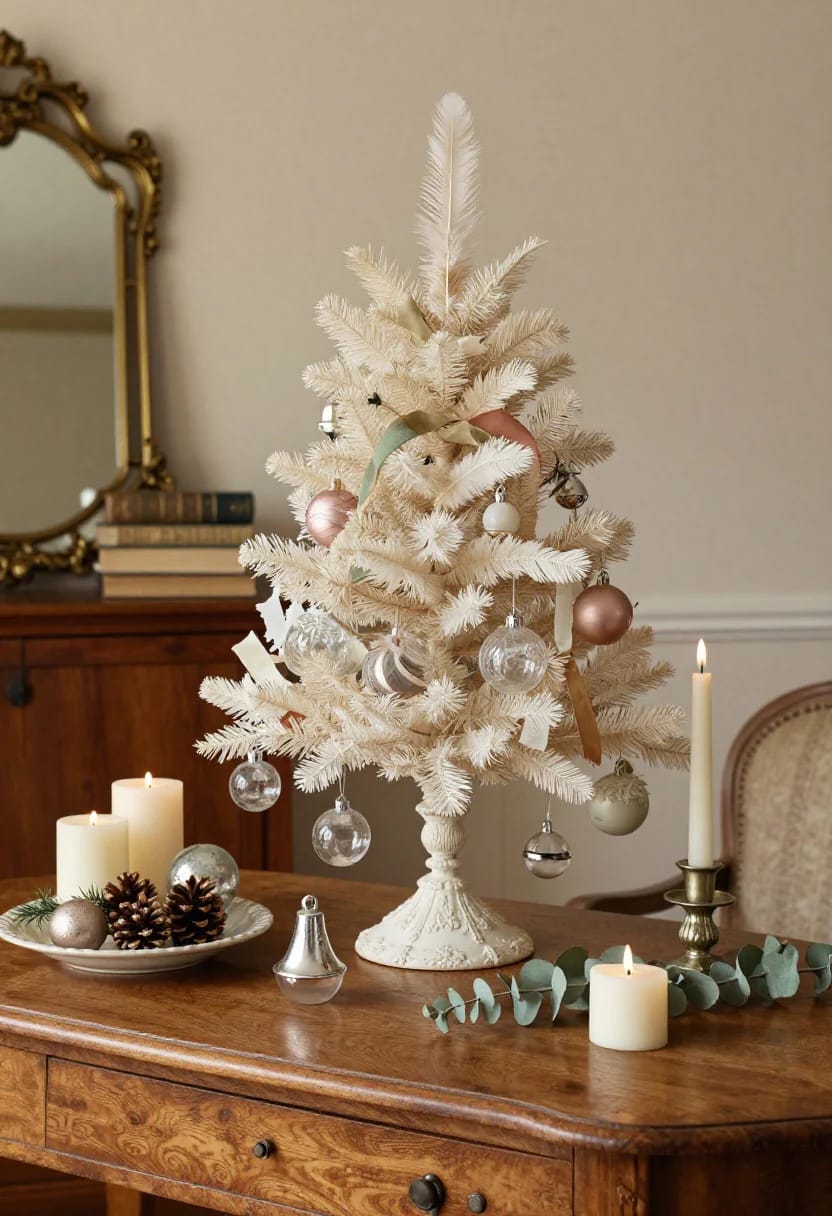
Hang glass on the tiers the clips are not using, alternating rather than stacking, so no branch carries a candle and a ball at once. Then top it with a wire tinsel star rather than an angel, because the star is flat and light and does not fight the silhouette. If you are buying new stock to fill gaps, mini kugel-style mercury glass ornaments at roughly two inches sit at about the right weight, and the general logic of not letting your metallics fight each other applies here more than on a full fir, because there is so much less tree to absorb the mismatch.
 Vintage Christmas Decorations with Mercury Glass and Shiny Brite Ornaments: 7 Ways to Display a Real Collection Why old indented glass falls flat under modern lighting, and what to do about it.
8. A picket fence and a crowd of candy containers at the base
The base is the half of a feather tree display that almost everyone skips, and period displays never did. The convention is a low German Putz fence encircling the wooden base, with papier-mâché candy containers standing inside it: snowmen, Belsnickel figures, small animals, the occasional Erzgebirge turned-wood figure. It fills the awkward gap between a 25-inch tree and the surface it sits on, and it gives the whole arrangement a floor.
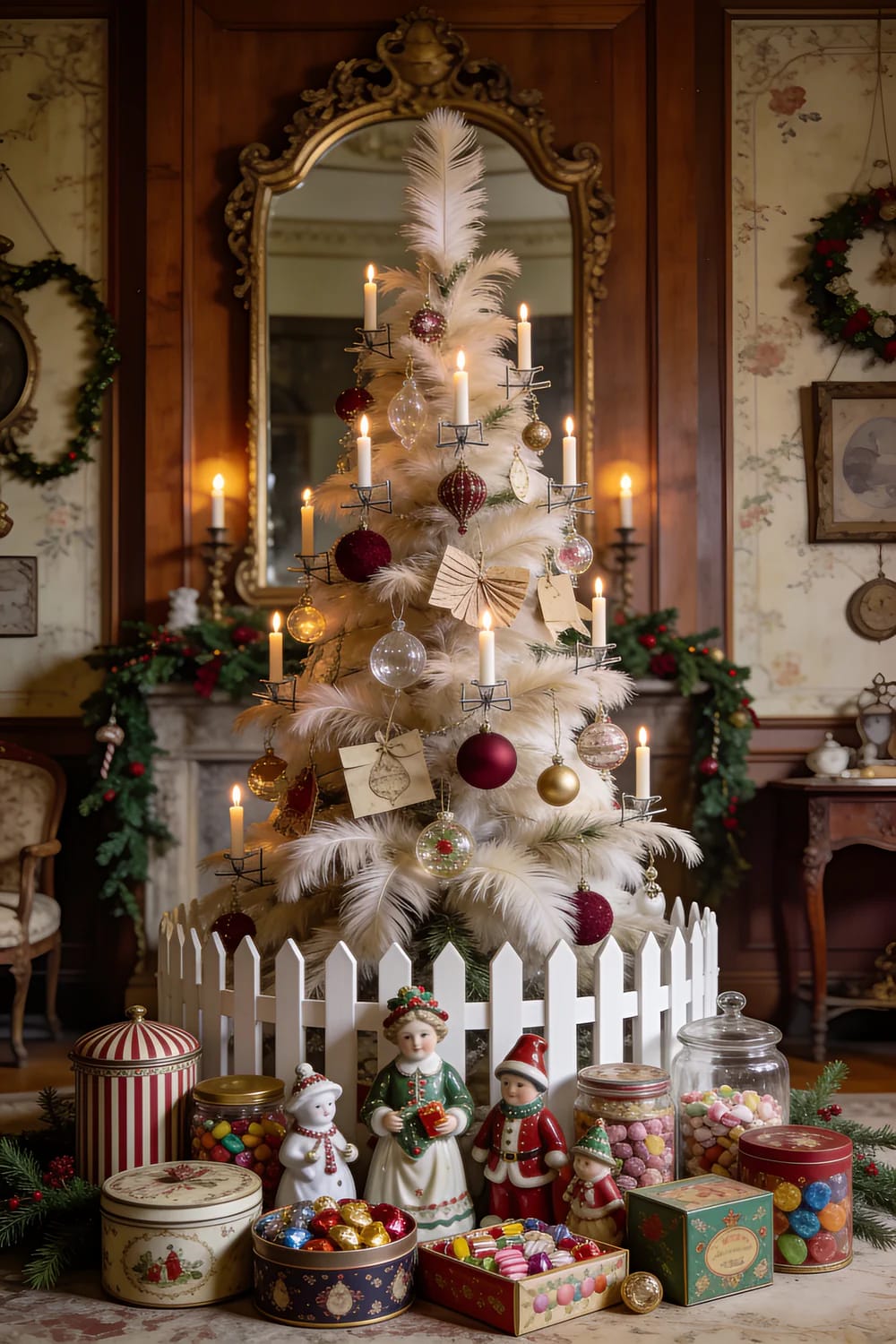
Buy the figures singly rather than as a lot. Sellers who bundle candy containers usually do it because half are reproductions, and the tell is the seam and the weight; the originals are lighter than they look and open somewhere. That whole staged-base approach carries over to the rest of the house if you are already leaning traditional with a nostalgic vintage edge.
9. Give it a pedestal table in a dark corner, not the mantel
The mantel is the obvious spot and the wrong one. A feather tree is a silhouette object: its whole appeal is the negative space between tiers, and negative space needs something dark behind it and light coming from the side. On a mantel you get the reverse, a bright wall behind and a firebox glowing underneath, which flattens the tree into a green smudge. There is also the heat, which is not doing aged shellac and hundred-year-old feather any favors over six weeks.
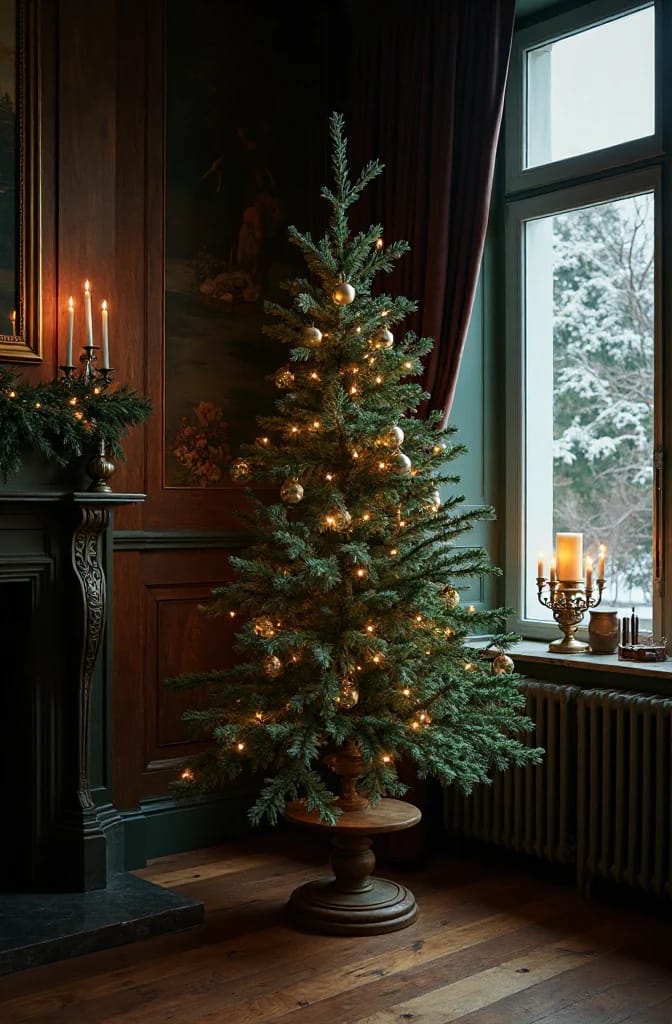
A pedestal table in a corner solves it in one move: dark planes on two sides, a lamp raking across from the third. If you want the tree near the fireplace anyway, put it on a side table two or three feet off to one side rather than up on the shelf, and let the mantel carry garland and stockings the way it is actually built to. The general case for giving one object a clear plane and letting it be the only thing in view is made better in the minimalist argument for one clear object per surface than I can make it here.
Do this
- Dark wall behind, light source to the side, at least two feet of clear air around the silhouette.
- Set it at chest height so the branch tips land at eye level.
- Rotate the tree so the fullest tiers face into the room and the thin side goes to the corner. Every antique feather tree has a thin side.
- Store it upright in the off season, never boxed flat under anything.
Avoid
- Mantels, radiator shelves, sunny windowsills. Heat and UV are what finish off aged feather.
- Backlighting it with a string of fairy lights behind, which erases the gaps.
- Anything heavier than about an inch and a half on the outer tips.
Buy in that order and you will not waste money: tree first, clips second, glass last. It matters because the clips dictate everything downstream. Once you know how many working clips you have and which tiers can take a counterweight, the ornament count is decided for you, and buying forty kugels before you have counted your candle positions is how people end up with a tree carrying twice what its wire can hold.
One honest gap: I could not find reliable current pricing on original German feather trees, and I would distrust anyone who quotes you a firm range. The market is auction-driven, thin, and swings hard on condition and color, so a 25-inch green tree with intact berries and no snapped tiers might sell twice at wildly different numbers in the same season. Watch completed listings for a few weeks before you bid on anything, and pay more attention to whether the tiers are original than to whatever the seller thinks the year is.
Related Posts
- Vintage Christmas Decorations with Mercury Glass and Shiny Brite Ornaments: 7 Ways to Display a Real Collection
- 10 Whimsical Christmas Tree Decorating Ideas That Actually Read as Playful, Not Cluttered
- 25 Traditional Christmas Decor Ideas with a Nostalgic Vintage Touch
- Christmas Tree With Red Velvet Ribbon and Bows: 12 Ways to Style It Without Looking Overdone
- Vintage and Victorian Christmas Decorating: 11 Ideas for a Faded, Heirloom Holiday
- 7 Modern Christmas Mantel Decor Ideas That Don’t Look Like a Craft Store